4 PICS 1 WORD
A D
D U L T H O O
G R O W T H
C O G N I T I O N
E M O T I O N
A N G E
C H
Learning Objectives:
1. Define Developmental task
2. Describe challenges and different
developmental tasks in Early, Middle,
and Late Adulthood
3. Identify common health concerns of
Adulthood
After the completion of this topic, students should
be able to:
I know I am
really an adult
when…
The Growth and
Developmental Tasks in
Early Adulthood, Middle
Adulthood, and Late
Adulthood
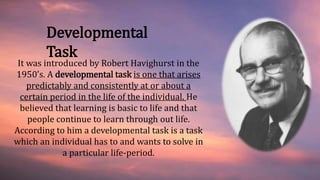
It was introduced by Robert Havighurst in the
1950’s. A developmental task is one that arises
predictably and consistently at or about a
certain period in the life of the individual. He
believed that learning is basic to life and that
people continue to learn through out life.
According to him a developmental task is a task
which an individual has to and wants to solve in
a particular life-period.
Developmental
Task
Early
Adulthood
Begins in late teens / early
20s and lasts through the
40s.
1. Selecting a mate
Until it is accomplished, the task of finding a
marriage partner is at once the most interesting
the most disturbing of the tasks of early adulthood.
2. Learning to live with a marriage partner
After the wedding there comes a period of learning
how to fit two lives together. In the main, this
consists of learning to express and control one’s
feelings that is anger, joy, and disgust so that one
live intimately and happily with one’s spouse.
Developmental Tasks in Early
Adulthood by Havighurst
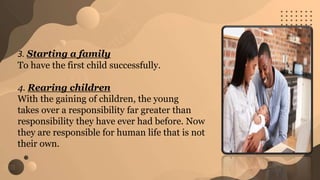
3. Starting a family
To have the first child successfully.
4. Rearing children
With the gaining of children, the young
takes over a responsibility far greater than
responsibility they have ever had before. Now
they are responsible for human life that is not
their own.
5. Managing a home
Family life is built around a physical center, the home,
and depends for its success greatly upon how well-
managed this home is.
6. Getting started in an occupation
This task takes an enormous amount of the
young person’s time and energy during young
adulthood.
8. Finding a congenial social group
Marriage often involves the breaking of social
ties for one or both young people, and the
forming of new friendships. Either the man or
the woman is apt to move away from former
friends.
7. Taking on civic responsibility
To assume responsibility for the welfare of a
group outside of the family such as a
neighborhood or community group or church or
a political organization.
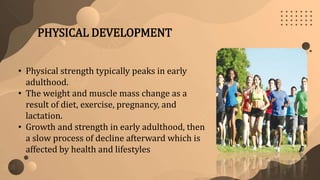
PHYSICAL DEVELOPMENT
• Physical strength typically peaks in early
adulthood.
• The weight and muscle mass change as a
result of diet, exercise, pregnancy, and
lactation.
• Growth and strength in early adulthood, then
a slow process of decline afterward which is
affected by health and lifestyles
COGNITIVE
DEVELOPMENT IN
EARLY ADULTHOOD
Piaget believed that the formal operational stage (ages
11 to 15) is the highest stage of thinking
Some researchers disagree with Piaget and believe that
thinking in early adulthood becomes more realistic and
pragmatic
Post-formal thought - thought that is:
• Reflective and relativistic
• Realistic, their idealism decreases
• Emotion & subjective factors can influence thinking
• Late adolescence to early adulthood is the main age
window for wisdom (expert knowledge about the
practical aspects of life that permits excellent
judgment about important matters).
Middle
Adulthoo
d
From the developmental perspective, middle
adulthood (or midlife) refers to the period of the
lifespan between young adulthood and old age
(40-60 years old).
Developmental Tasks of Middle
Adulthood
1. Tasks relating to physical changes
These include the acceptance of, and adjustment to
physical changes that normally occur during
middle age.
2. Tasks relating to changed interests
The middle-aged person often assumes civic and
social responsibilities and develops an interest in
adult-oriented leisure time activities that were not
taken care of during early adulthood.
3. Tasks relating to vocational
adjustments These tasks revolve around
around establishing and maintaining a
relatively stable standard of living
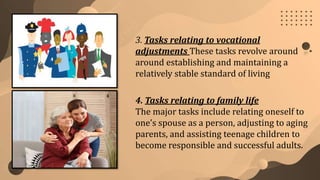
4. Tasks relating to family life
The major tasks include relating oneself to
one’s spouse as a person, adjusting to aging
parents, and assisting teenage children to
become responsible and successful adults.
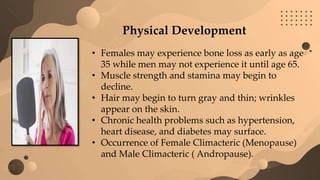
Physical Development
• Females may experience bone loss as early as age
35 while men may not experience it until age 65.
• Muscle strength and stamina may begin to
decline.
• Hair may begin to turn gray and thin; wrinkles
appear on the skin.
• Chronic health problems such as hypertension,
heart disease, and diabetes may surface.
• Occurrence of Female Climacteric (Menopause)
and Male Climacteric ( Andropause).
SENSORY EFFECTS OF AGING
• The decline in vision becomes more pronounced –
Adaptation to dark and driving at night becomes
especially difficult
• Hearing undergoes a gradual decline beginning in
middle adulthood
• Taste buds regenerate at a slower rate in middle-aged
adulthood. Additionally, smell receptors begin to
deteriorate, which can then lead to changes in both your
sense of taste and smell.
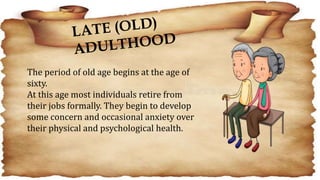
The period of old age begins at the age of
sixty.
At this age most individuals retire from
their jobs formally. They begin to develop
some concern and occasional anxiety over
their physical and psychological health.
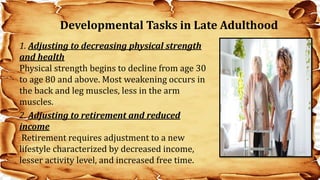
1. Adjusting to decreasing physical strength
and health
Physical strength begins to decline from age 30
to age 80 and above. Most weakening occurs in
the back and leg muscles, less in the arm
muscles.
2. Adjusting to retirement and reduced
income
Retirement requires adjustment to a new
lifestyle characterized by decreased income,
lesser activity level, and increased free time.
Developmental Tasks in Late Adulthood
4. Establishing an explicit affiliation with
one’s age group
Social convoy is a cluster of family members
and friends who provide safety and support.
Elders do try to maintain social networks of
family and friends to preserve security and
life continuity
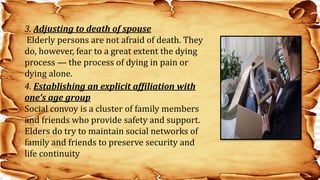
3. Adjusting to death of spouse
Elderly persons are not afraid of death. They
do, however, fear to a great extent the dying
process — the process of dying in pain or
dying alone.
5. Meeting social and civic obligations
Other potential gains in old age relate to the task
of meeting social and civic obligations that may
contribute to the development of younger
people and the society.
6. Establishing satisfactory physical living
arrangements
The principal values that older people look for in
housing are quiet, privacy, independence of action,
nearness to relatives and friends, residence among
own cultural group, cheapness, closeness to
transportation lines and communal institutions.
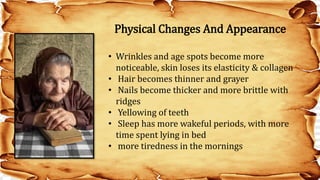
• Wrinkles and age spots become more
noticeable, skin loses its elasticity & collagen
• Hair becomes thinner and grayer
• Nails become thicker and more brittle with
ridges
• Yellowing of teeth
• Sleep has more wakeful periods, with more
time spent lying in bed
• more tiredness in the mornings
Physical Changes And Appearance
Sensory Development
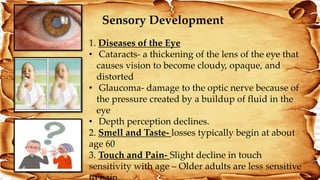
1. Diseases of the Eye
• Cataracts- a thickening of the lens of the eye that
causes vision to become cloudy, opaque, and
distorted
• Glaucoma- damage to the optic nerve because of
the pressure created by a buildup of fluid in the
eye
• Depth perception declines.
2. Smell and Taste- losses typically begin at about
age 60
3. Touch and Pain- Slight decline in touch
sensitivity with age – Older adults are less sensitive
COGNITIVE DEVELOPMENT
IN LATE ADULTHOOD
1. Speed of Processing- The speed of processing
information declines in late adulthood often due
to a decline in brain and Central Nervous System
functioning
2. Attention
• Selective attention -reduce performance in areas in
which they are not competent
• Divided attention- the more difficult the tasks, the
less effectively older adults divide attention and
perform in areas in which they can still function
effectively.
Theories Of Successful
Aging
1. Disengagement theory- states that as
people age, their withdrawal from society
is normal and desirable as it relieves them
of responsibilities and roles that have
become difficult. This process also opens
up opportunities for younger people;
society benefits as more‐energetic young
people fill the vacated positions.
2. Activity theory- contends that activity
is necessary to maintain a “life of quality,”
that is, that one must “use it or lose it” no
matter what one's age and that people
remain active in all respects—physically,
mentally, and socially—adjust better to the
aging process. Proponents of this theory
believe that activities of earlier years
be maintained as long as possible.
The Empty Nest
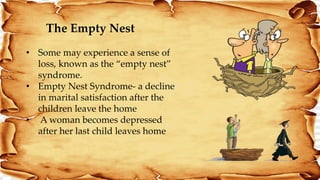
• Some may experience a sense of
loss, known as the “empty nest”
syndrome.
• Empty Nest Syndrome- a decline
in marital satisfaction after the
children leave the home
• A woman becomes depressed
after her last child leaves home
Death and Dying
Death is “the final stage of
growth”
Death and Dying Stages of Grief
1. Denial: The patient unconsciously can not accept the
diagnosis and refuses to believe he/she is dying.
2. Anger: This stage is often directed at the physician or staff
when no longer able to deny
4. Bargaining: The patient frequently tries to strike a
bargain with God or a higher being (accepts death,
wants more time)
5. Depression: The patient feels distant from others
and seems sad and hopeless.
6. Acceptance: The patient deals calmly with his/her
fate and is able to use/enjoy the remaining time with
family and friends.
Learning Objectives:
1. Define Developmental task
2. Describe challenges and different
developmental tasks in Early, Middle,
and Late Adulthood
3. Identify common health concerns of
Adulthood
By now, you should be able to:
• Kenny C. Sacueza
• Lauro Cornejo
• Jeric Rea
• Merwin Tarala
• Mariza Brosula
• Roanne Rodriguez
Group 3
Reporters
Websites and References:
https://www.cliffsnotes.com/study-
guides/psychology/psychology/developmental-psychology-age-
13-to-65/development-in-early--middle-adulthood
https://courses.lumenlearning.com/wm-
lifespandevelopment/chapter/lesson-8-introduction-to-early-
adulthood/
https://egyankosh.ac.in/bitstream/123456789/23374/1/Unit-
2.pdf

Adulthood-Autosaved.pptx

  • 1.
  • 2.
    A D D UL T H O O
  • 3.
    G R OW T H
  • 4.
    C O GN I T I O N
  • 5.
    E M OT I O N
  • 6.
    A N GE C H
  • 7.
    Learning Objectives: 1. DefineDevelopmental task 2. Describe challenges and different developmental tasks in Early, Middle, and Late Adulthood 3. Identify common health concerns of Adulthood After the completion of this topic, students should be able to:
  • 8.
    I know Iam really an adult when…
  • 9.
    The Growth and DevelopmentalTasks in Early Adulthood, Middle Adulthood, and Late Adulthood
  • 10.
    It was introducedby Robert Havighurst in the 1950’s. A developmental task is one that arises predictably and consistently at or about a certain period in the life of the individual. He believed that learning is basic to life and that people continue to learn through out life. According to him a developmental task is a task which an individual has to and wants to solve in a particular life-period. Developmental Task
  • 11.
    Early Adulthood Begins in lateteens / early 20s and lasts through the 40s.
  • 12.
    1. Selecting amate Until it is accomplished, the task of finding a marriage partner is at once the most interesting the most disturbing of the tasks of early adulthood. 2. Learning to live with a marriage partner After the wedding there comes a period of learning how to fit two lives together. In the main, this consists of learning to express and control one’s feelings that is anger, joy, and disgust so that one live intimately and happily with one’s spouse. Developmental Tasks in Early Adulthood by Havighurst
  • 13.
    3. Starting afamily To have the first child successfully. 4. Rearing children With the gaining of children, the young takes over a responsibility far greater than responsibility they have ever had before. Now they are responsible for human life that is not their own.
  • 14.
    5. Managing ahome Family life is built around a physical center, the home, and depends for its success greatly upon how well- managed this home is. 6. Getting started in an occupation This task takes an enormous amount of the young person’s time and energy during young adulthood.
  • 15.
    8. Finding acongenial social group Marriage often involves the breaking of social ties for one or both young people, and the forming of new friendships. Either the man or the woman is apt to move away from former friends. 7. Taking on civic responsibility To assume responsibility for the welfare of a group outside of the family such as a neighborhood or community group or church or a political organization.
  • 16.
    PHYSICAL DEVELOPMENT • Physicalstrength typically peaks in early adulthood. • The weight and muscle mass change as a result of diet, exercise, pregnancy, and lactation. • Growth and strength in early adulthood, then a slow process of decline afterward which is affected by health and lifestyles
  • 17.
    COGNITIVE DEVELOPMENT IN EARLY ADULTHOOD Piagetbelieved that the formal operational stage (ages 11 to 15) is the highest stage of thinking Some researchers disagree with Piaget and believe that thinking in early adulthood becomes more realistic and pragmatic Post-formal thought - thought that is: • Reflective and relativistic • Realistic, their idealism decreases • Emotion & subjective factors can influence thinking • Late adolescence to early adulthood is the main age window for wisdom (expert knowledge about the practical aspects of life that permits excellent judgment about important matters).
  • 18.
    Middle Adulthoo d From the developmentalperspective, middle adulthood (or midlife) refers to the period of the lifespan between young adulthood and old age (40-60 years old).
  • 19.
    Developmental Tasks ofMiddle Adulthood 1. Tasks relating to physical changes These include the acceptance of, and adjustment to physical changes that normally occur during middle age. 2. Tasks relating to changed interests The middle-aged person often assumes civic and social responsibilities and develops an interest in adult-oriented leisure time activities that were not taken care of during early adulthood.
  • 20.
    3. Tasks relatingto vocational adjustments These tasks revolve around around establishing and maintaining a relatively stable standard of living 4. Tasks relating to family life The major tasks include relating oneself to one’s spouse as a person, adjusting to aging parents, and assisting teenage children to become responsible and successful adults.
  • 21.
    Physical Development • Femalesmay experience bone loss as early as age 35 while men may not experience it until age 65. • Muscle strength and stamina may begin to decline. • Hair may begin to turn gray and thin; wrinkles appear on the skin. • Chronic health problems such as hypertension, heart disease, and diabetes may surface. • Occurrence of Female Climacteric (Menopause) and Male Climacteric ( Andropause).
  • 22.
    SENSORY EFFECTS OFAGING • The decline in vision becomes more pronounced – Adaptation to dark and driving at night becomes especially difficult • Hearing undergoes a gradual decline beginning in middle adulthood • Taste buds regenerate at a slower rate in middle-aged adulthood. Additionally, smell receptors begin to deteriorate, which can then lead to changes in both your sense of taste and smell.
  • 23.
    The period ofold age begins at the age of sixty. At this age most individuals retire from their jobs formally. They begin to develop some concern and occasional anxiety over their physical and psychological health.
  • 24.
    1. Adjusting todecreasing physical strength and health Physical strength begins to decline from age 30 to age 80 and above. Most weakening occurs in the back and leg muscles, less in the arm muscles. 2. Adjusting to retirement and reduced income Retirement requires adjustment to a new lifestyle characterized by decreased income, lesser activity level, and increased free time. Developmental Tasks in Late Adulthood
  • 25.
    4. Establishing anexplicit affiliation with one’s age group Social convoy is a cluster of family members and friends who provide safety and support. Elders do try to maintain social networks of family and friends to preserve security and life continuity 3. Adjusting to death of spouse Elderly persons are not afraid of death. They do, however, fear to a great extent the dying process — the process of dying in pain or dying alone.
  • 26.
    5. Meeting socialand civic obligations Other potential gains in old age relate to the task of meeting social and civic obligations that may contribute to the development of younger people and the society. 6. Establishing satisfactory physical living arrangements The principal values that older people look for in housing are quiet, privacy, independence of action, nearness to relatives and friends, residence among own cultural group, cheapness, closeness to transportation lines and communal institutions.
  • 27.
    • Wrinkles andage spots become more noticeable, skin loses its elasticity & collagen • Hair becomes thinner and grayer • Nails become thicker and more brittle with ridges • Yellowing of teeth • Sleep has more wakeful periods, with more time spent lying in bed • more tiredness in the mornings Physical Changes And Appearance
  • 28.
    Sensory Development 1. Diseasesof the Eye • Cataracts- a thickening of the lens of the eye that causes vision to become cloudy, opaque, and distorted • Glaucoma- damage to the optic nerve because of the pressure created by a buildup of fluid in the eye • Depth perception declines. 2. Smell and Taste- losses typically begin at about age 60 3. Touch and Pain- Slight decline in touch sensitivity with age – Older adults are less sensitive
  • 29.
    COGNITIVE DEVELOPMENT IN LATEADULTHOOD 1. Speed of Processing- The speed of processing information declines in late adulthood often due to a decline in brain and Central Nervous System functioning
  • 30.
    2. Attention • Selectiveattention -reduce performance in areas in which they are not competent • Divided attention- the more difficult the tasks, the less effectively older adults divide attention and perform in areas in which they can still function effectively.
  • 31.
    Theories Of Successful Aging 1.Disengagement theory- states that as people age, their withdrawal from society is normal and desirable as it relieves them of responsibilities and roles that have become difficult. This process also opens up opportunities for younger people; society benefits as more‐energetic young people fill the vacated positions.
  • 32.
    2. Activity theory-contends that activity is necessary to maintain a “life of quality,” that is, that one must “use it or lose it” no matter what one's age and that people remain active in all respects—physically, mentally, and socially—adjust better to the aging process. Proponents of this theory believe that activities of earlier years be maintained as long as possible.
  • 33.
    The Empty Nest •Some may experience a sense of loss, known as the “empty nest” syndrome. • Empty Nest Syndrome- a decline in marital satisfaction after the children leave the home • A woman becomes depressed after her last child leaves home
  • 34.

    Death and Dying Deathis “the final stage of growth” Death and Dying Stages of Grief 1. Denial: The patient unconsciously can not accept the diagnosis and refuses to believe he/she is dying. 2. Anger: This stage is often directed at the physician or staff when no longer able to deny
  • 35.
    4. Bargaining: Thepatient frequently tries to strike a bargain with God or a higher being (accepts death, wants more time) 5. Depression: The patient feels distant from others and seems sad and hopeless. 6. Acceptance: The patient deals calmly with his/her fate and is able to use/enjoy the remaining time with family and friends.
  • 36.
    Learning Objectives: 1. DefineDevelopmental task 2. Describe challenges and different developmental tasks in Early, Middle, and Late Adulthood 3. Identify common health concerns of Adulthood By now, you should be able to:
  • 37.
    • Kenny C.Sacueza • Lauro Cornejo • Jeric Rea • Merwin Tarala • Mariza Brosula • Roanne Rodriguez Group 3 Reporters
  • 38.