Download to read offline

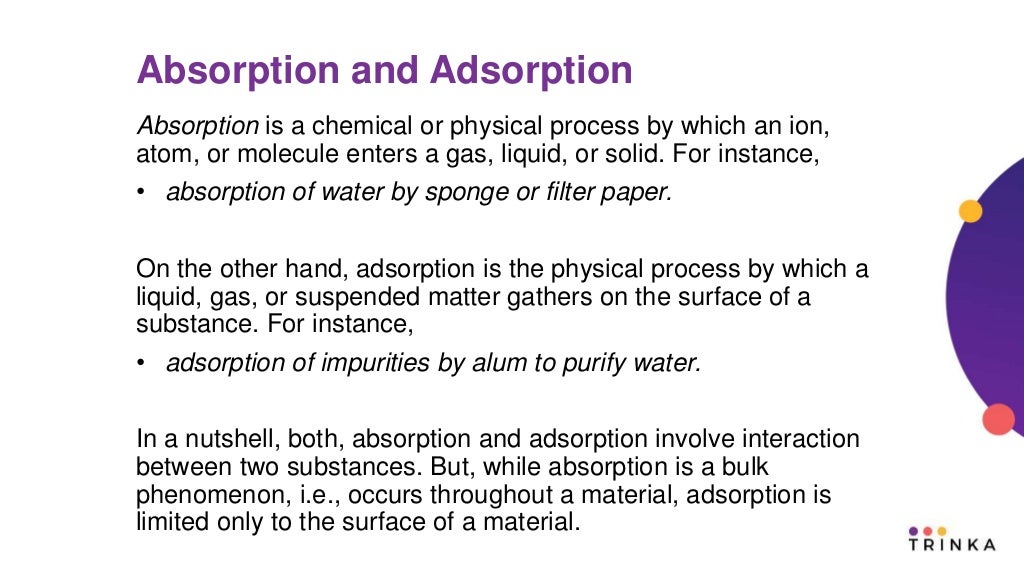
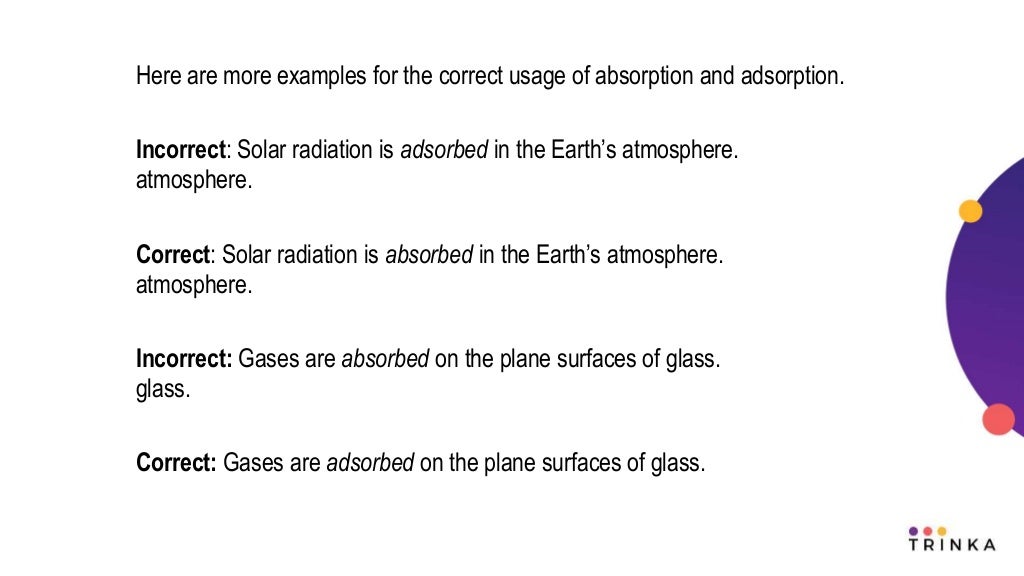


Absorption is a chemical or physical process by which an ion, atom, or molecule enters a gas, liquid, or solid. Adsorption is the physical process by which a liquid, gas, or suspended matter gathers on the surface of a substance. A teacher, while grading essays of her students, comes across a strange sentence, ‘To become the Major of the town, I must have a Mayor in political science’ She immediately identifies the error. Her student has clearly not proofread his essay. Thanks to the context set by the rest of the sentence, the teacher understands the intended meaning, and ignores the silliness of her student. If you think all misspellings are this harmless, or always end with only a disappointed sigh, you better have a close look on another such pair that is a popular error in academic writing! Absorption and Adsorption Absorption is a chemical or physical process by which an ion, atom, or molecule enters a gas, liquid, or solid. For instance, absorption of water by sponge or filter paper. On the other hand, adsorption is the physical process by which a liquid, gas, or suspended matter gathers on the surface of a substance. For instance, adsorption of impurities by alum to purify water. In a nutshell, both, absorption and adsorption involve interaction between two substances. But, while absorption is a bulk phenomenon, i.e., occurs throughout a material, adsorption is limited only to the surface of a material. We use the word ‘absorption’ quite often in general communication, but ‘adsorption’, being a scientific term, is hardly used outside the academic setting. These two words are near homophones, but not interchangeable. The distinction between absorption and adsorption might appear like a single-letter trifle but it holds great significance in academic writing.


