ADJECTIVE OR ADVERB
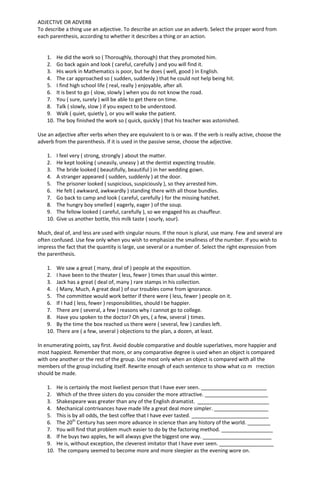
To describe a thing use an adjective. To describe an action use an adverb. Select the proper word from
each parenthesis, according to whether it describes a thing or an action.


    1.    He did the work so ( Thoroughly, thorough) that they promoted him.
    2.    Go back again and look ( careful, carefully ) and you will find it.
    3.    His work in Mathematics is poor, but he does ( well, good ) in English.
    4.    The car approached so ( sudden, suddenly ) that he could not help being hit.
    5.    I find high school life ( real, really ) enjoyable, after all.
    6.    It is best to go ( slow, slowly ) when you do not know the road.
    7.    You ( sure, surely ) will be able to get there on time.
    8.    Talk ( slowly, slow ) if you expect to be understood.
    9.    Walk ( quiet, quietly ), or you will wake the patient.
    10.   The boy finished the work so ( quick, quickly ) that his teacher was astonished.

Use an adjective after verbs when they are equivalent to is or was. If the verb is really active, choose the
adverb from the parenthesis. If it is used in the passive sense, choose the adjective.

    1.    I feel very ( strong, strongly ) about the matter.
    2.    He kept looking ( uneasily, uneasy ) at the dentist expecting trouble.
    3.    The bride looked ( beautifully, beautiful ) in her wedding gown.
    4.    A stranger appeared ( sudden, suddenly ) at the door.
    5.    The prisoner looked ( suspicious, suspiciously ), so they arrested him.
    6.    He felt ( awkward, awkwardly ) standing there with all those bundles.
    7.    Go back to camp and look ( careful, carefully ) for the missing hatchet.
    8.    The hungry boy smelled ( eagerly, eager ) of the soup.
    9.    The fellow looked ( careful, carefully ), so we engaged his as chauffeur.
    10.   Give us another bottle, this milk taste ( sourly, sour).

Much, deal of, and less are used with singular nouns. If the noun is plural, use many. Few and several are
often confused. Use few only when you wish to emphasize the smallness of the number. If you wish to
impress the fact that the quantity is large, use several or a number of. Select the right expression from
the parenthesis.

    1.    We saw a great ( many, deal of ) people at the exposition.
    2.    I have been to the theater ( less, fewer ) times than usual this winter.
    3.    Jack has a great ( deal of, many ) rare stamps in his collection.
    4.    ( Many, Much, A great deal ) of our troubles come from ignorance.
    5.    The committee would work better if there were ( less, fewer ) people on it.
    6.    If I had ( less, fewer ) responsibilities, should I be happier.
    7.    There are ( several, a few ) reasons why I cannot go to college.
    8.    Have you spoken to the doctor? Oh yes, ( a few, several ) times.
    9.    By the time the box reached us there were ( several, few ) candies left.
    10.   There are ( a few, several ) objections to the plan, a dozen, at least.

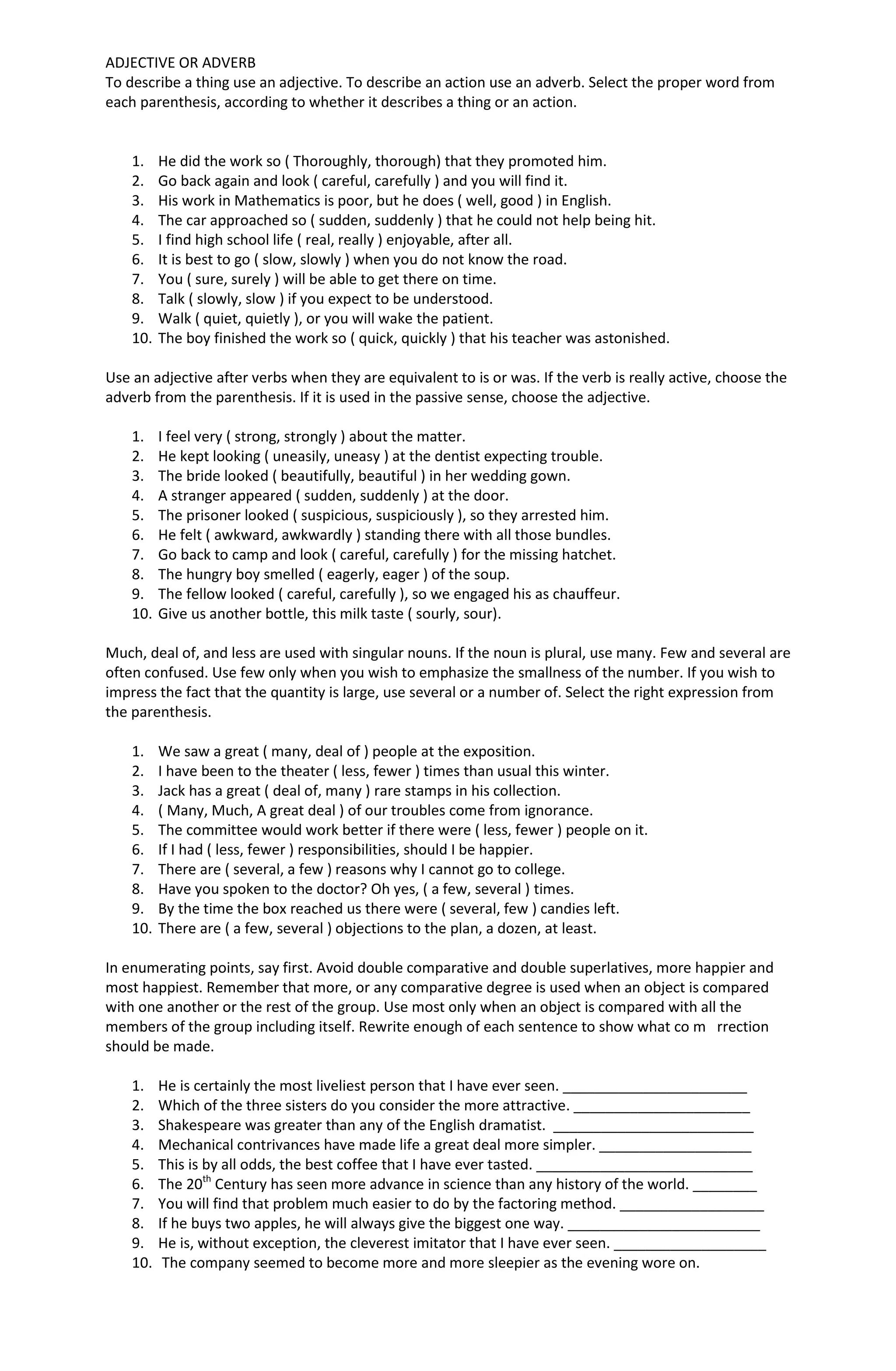
In enumerating points, say first. Avoid double comparative and double superlatives, more happier and
most happiest. Remember that more, or any comparative degree is used when an object is compared
with one another or the rest of the group. Use most only when an object is compared with all the
members of the group including itself. Rewrite enough of each sentence to show what co m rrection
should be made.

    1.    He is certainly the most liveliest person that I have ever seen. _______________________
    2.    Which of the three sisters do you consider the more attractive. ______________________
    3.    Shakespeare was greater than any of the English dramatist. _________________________
    4.    Mechanical contrivances have made life a great deal more simpler. ___________________
    5.    This is by all odds, the best coffee that I have ever tasted. ___________________________
    6.    The 20th Century has seen more advance in science than any history of the world. ________
    7.    You will find that problem much easier to do by the factoring method. __________________
    8.    If he buys two apples, he will always give the biggest one way. ________________________
    9.    He is, without exception, the cleverest imitator that I have ever seen. ___________________
    10.    The company seemed to become more and more sleepier as the evening wore on.
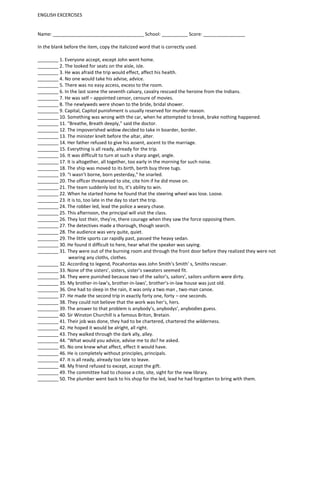
ENGLISH EXCERCISES


Name: ___________________________________ School: __________ Score: ________________

In the blank before the item, copy the italicized word that is correctly used.

________ 1. Everyone accept, except John went home.
________ 2. The looked for seats on the aisle, isle.
________ 3. He was afraid the trip would effect, affect his health.
________ 4. No one would take his advise, advice.
________ 5. There was no easy access, excess to the room.
________ 6. In the last scene the seventh calvary, cavalry rescued the heroine from the Indians.
________ 7. He was self – appointed censor, censure of movies.
________ 8. The newlyweds were shown to the bride, bridal shower.
________ 9. Capital, Capitol punishment is usually reserved for murder reason.
________ 10. Something was wrong with the car, when he attempted to break, brake nothing happened.
________ 11. “Breathe, Breath deeply,” said the doctor.
________ 12. The impoverished widow decided to take in boarder, border.
________ 13. The minister knelt before the altar, alter.
________ 14. Her father refused to give his assent, ascent to the marriage.
________ 15. Everything is all ready, already for the trip.
________ 16. It was difficult to turn at such a sharp angel, angle.
________ 17. It is altogether, all together, too early in the morning for such noise.
________ 18. The ship was moved to its birth, berth buy three tugs.
________ 19. “I wasn’t borne, born yesterday,” he snarled.
________ 20. The officer threatened to site, cite him if he did move on.
________ 21. The team suddenly lost its, it’s ability to win.
________ 22. When he started home he found that the steering wheel was lose. Loose.
________ 23. It is to, too late in the day to start the trip.
________ 24. The robber led, lead the police a weary chase.
________ 25. This afternoon, the principal will visit the class.
________ 26. They lost their, they’re, there courage when they saw the force opposing them.
________ 27. The detectives made a thorough, though search.
________ 28. The audience was very quite, quiet.
________ 29. The little sports car rapidly past, passed the heavy sedan.
________ 30. He found it difficult to here, hear what the speaker was saying.
________ 31. They were out of the burning room and through the front door before they realized they were not
              wearing any cloths, clothes.
________ 32. According to legend, Pocahontas was John Smith’s Smith’ s, Smiths rescuer.
________ 33. None of the sisters’, sisters, sister’s sweaters seemed fit.
________ 34. They were punished because two of the sailor’s, sailors’, sailors uniform were dirty.
________ 35. My brother-in-law’s, brother-in-laws’, brother’s-in-law house was just old.
________ 36. One had to sleep in the rain, it was only a two man , two-man canoe.
________ 37. He made the second trip in exactly forty one, forty – one seconds.
________ 38. They could not believe that the work was her’s, hers.
________ 39. The answer to that problem is anybody’s, anybodys’, anybodies guess.
________ 40. Sir Winston Churchill is a famous Briton, Bretain.
________ 41. Their job was done, they had to be chartered, chartered the wilderness.
________ 42. He hoped it would be alright, all right.
________ 43. They walked through the dark ally, alley.
________ 44. “What would you advice, advise me to do? he asked.
________ 45. No one knew what affect, effect it would have.
________ 46. He is completely without principles, principals.
________ 47. It is all ready, already too late to leave.
________ 48. My friend refused to except, accept the gift.
________ 49. The committee had to choose a cite, site, sight for the new library.
________ 50. The plumber went back to his shop for the led, lead he had forgotten to bring with them.

Adjective or adverb

  • 1.
    ADJECTIVE OR ADVERB Todescribe a thing use an adjective. To describe an action use an adverb. Select the proper word from each parenthesis, according to whether it describes a thing or an action. 1. He did the work so ( Thoroughly, thorough) that they promoted him. 2. Go back again and look ( careful, carefully ) and you will find it. 3. His work in Mathematics is poor, but he does ( well, good ) in English. 4. The car approached so ( sudden, suddenly ) that he could not help being hit. 5. I find high school life ( real, really ) enjoyable, after all. 6. It is best to go ( slow, slowly ) when you do not know the road. 7. You ( sure, surely ) will be able to get there on time. 8. Talk ( slowly, slow ) if you expect to be understood. 9. Walk ( quiet, quietly ), or you will wake the patient. 10. The boy finished the work so ( quick, quickly ) that his teacher was astonished. Use an adjective after verbs when they are equivalent to is or was. If the verb is really active, choose the adverb from the parenthesis. If it is used in the passive sense, choose the adjective. 1. I feel very ( strong, strongly ) about the matter. 2. He kept looking ( uneasily, uneasy ) at the dentist expecting trouble. 3. The bride looked ( beautifully, beautiful ) in her wedding gown. 4. A stranger appeared ( sudden, suddenly ) at the door. 5. The prisoner looked ( suspicious, suspiciously ), so they arrested him. 6. He felt ( awkward, awkwardly ) standing there with all those bundles. 7. Go back to camp and look ( careful, carefully ) for the missing hatchet. 8. The hungry boy smelled ( eagerly, eager ) of the soup. 9. The fellow looked ( careful, carefully ), so we engaged his as chauffeur. 10. Give us another bottle, this milk taste ( sourly, sour). Much, deal of, and less are used with singular nouns. If the noun is plural, use many. Few and several are often confused. Use few only when you wish to emphasize the smallness of the number. If you wish to impress the fact that the quantity is large, use several or a number of. Select the right expression from the parenthesis. 1. We saw a great ( many, deal of ) people at the exposition. 2. I have been to the theater ( less, fewer ) times than usual this winter. 3. Jack has a great ( deal of, many ) rare stamps in his collection. 4. ( Many, Much, A great deal ) of our troubles come from ignorance. 5. The committee would work better if there were ( less, fewer ) people on it. 6. If I had ( less, fewer ) responsibilities, should I be happier. 7. There are ( several, a few ) reasons why I cannot go to college. 8. Have you spoken to the doctor? Oh yes, ( a few, several ) times. 9. By the time the box reached us there were ( several, few ) candies left. 10. There are ( a few, several ) objections to the plan, a dozen, at least. In enumerating points, say first. Avoid double comparative and double superlatives, more happier and most happiest. Remember that more, or any comparative degree is used when an object is compared with one another or the rest of the group. Use most only when an object is compared with all the members of the group including itself. Rewrite enough of each sentence to show what co m rrection should be made. 1. He is certainly the most liveliest person that I have ever seen. _______________________ 2. Which of the three sisters do you consider the more attractive. ______________________ 3. Shakespeare was greater than any of the English dramatist. _________________________ 4. Mechanical contrivances have made life a great deal more simpler. ___________________ 5. This is by all odds, the best coffee that I have ever tasted. ___________________________ 6. The 20th Century has seen more advance in science than any history of the world. ________ 7. You will find that problem much easier to do by the factoring method. __________________ 8. If he buys two apples, he will always give the biggest one way. ________________________ 9. He is, without exception, the cleverest imitator that I have ever seen. ___________________ 10. The company seemed to become more and more sleepier as the evening wore on.
  • 2.
    ENGLISH EXCERCISES Name: ___________________________________School: __________ Score: ________________ In the blank before the item, copy the italicized word that is correctly used. ________ 1. Everyone accept, except John went home. ________ 2. The looked for seats on the aisle, isle. ________ 3. He was afraid the trip would effect, affect his health. ________ 4. No one would take his advise, advice. ________ 5. There was no easy access, excess to the room. ________ 6. In the last scene the seventh calvary, cavalry rescued the heroine from the Indians. ________ 7. He was self – appointed censor, censure of movies. ________ 8. The newlyweds were shown to the bride, bridal shower. ________ 9. Capital, Capitol punishment is usually reserved for murder reason. ________ 10. Something was wrong with the car, when he attempted to break, brake nothing happened. ________ 11. “Breathe, Breath deeply,” said the doctor. ________ 12. The impoverished widow decided to take in boarder, border. ________ 13. The minister knelt before the altar, alter. ________ 14. Her father refused to give his assent, ascent to the marriage. ________ 15. Everything is all ready, already for the trip. ________ 16. It was difficult to turn at such a sharp angel, angle. ________ 17. It is altogether, all together, too early in the morning for such noise. ________ 18. The ship was moved to its birth, berth buy three tugs. ________ 19. “I wasn’t borne, born yesterday,” he snarled. ________ 20. The officer threatened to site, cite him if he did move on. ________ 21. The team suddenly lost its, it’s ability to win. ________ 22. When he started home he found that the steering wheel was lose. Loose. ________ 23. It is to, too late in the day to start the trip. ________ 24. The robber led, lead the police a weary chase. ________ 25. This afternoon, the principal will visit the class. ________ 26. They lost their, they’re, there courage when they saw the force opposing them. ________ 27. The detectives made a thorough, though search. ________ 28. The audience was very quite, quiet. ________ 29. The little sports car rapidly past, passed the heavy sedan. ________ 30. He found it difficult to here, hear what the speaker was saying. ________ 31. They were out of the burning room and through the front door before they realized they were not wearing any cloths, clothes. ________ 32. According to legend, Pocahontas was John Smith’s Smith’ s, Smiths rescuer. ________ 33. None of the sisters’, sisters, sister’s sweaters seemed fit. ________ 34. They were punished because two of the sailor’s, sailors’, sailors uniform were dirty. ________ 35. My brother-in-law’s, brother-in-laws’, brother’s-in-law house was just old. ________ 36. One had to sleep in the rain, it was only a two man , two-man canoe. ________ 37. He made the second trip in exactly forty one, forty – one seconds. ________ 38. They could not believe that the work was her’s, hers. ________ 39. The answer to that problem is anybody’s, anybodys’, anybodies guess. ________ 40. Sir Winston Churchill is a famous Briton, Bretain. ________ 41. Their job was done, they had to be chartered, chartered the wilderness. ________ 42. He hoped it would be alright, all right. ________ 43. They walked through the dark ally, alley. ________ 44. “What would you advice, advise me to do? he asked. ________ 45. No one knew what affect, effect it would have. ________ 46. He is completely without principles, principals. ________ 47. It is all ready, already too late to leave. ________ 48. My friend refused to except, accept the gift. ________ 49. The committee had to choose a cite, site, sight for the new library. ________ 50. The plumber went back to his shop for the led, lead he had forgotten to bring with them.