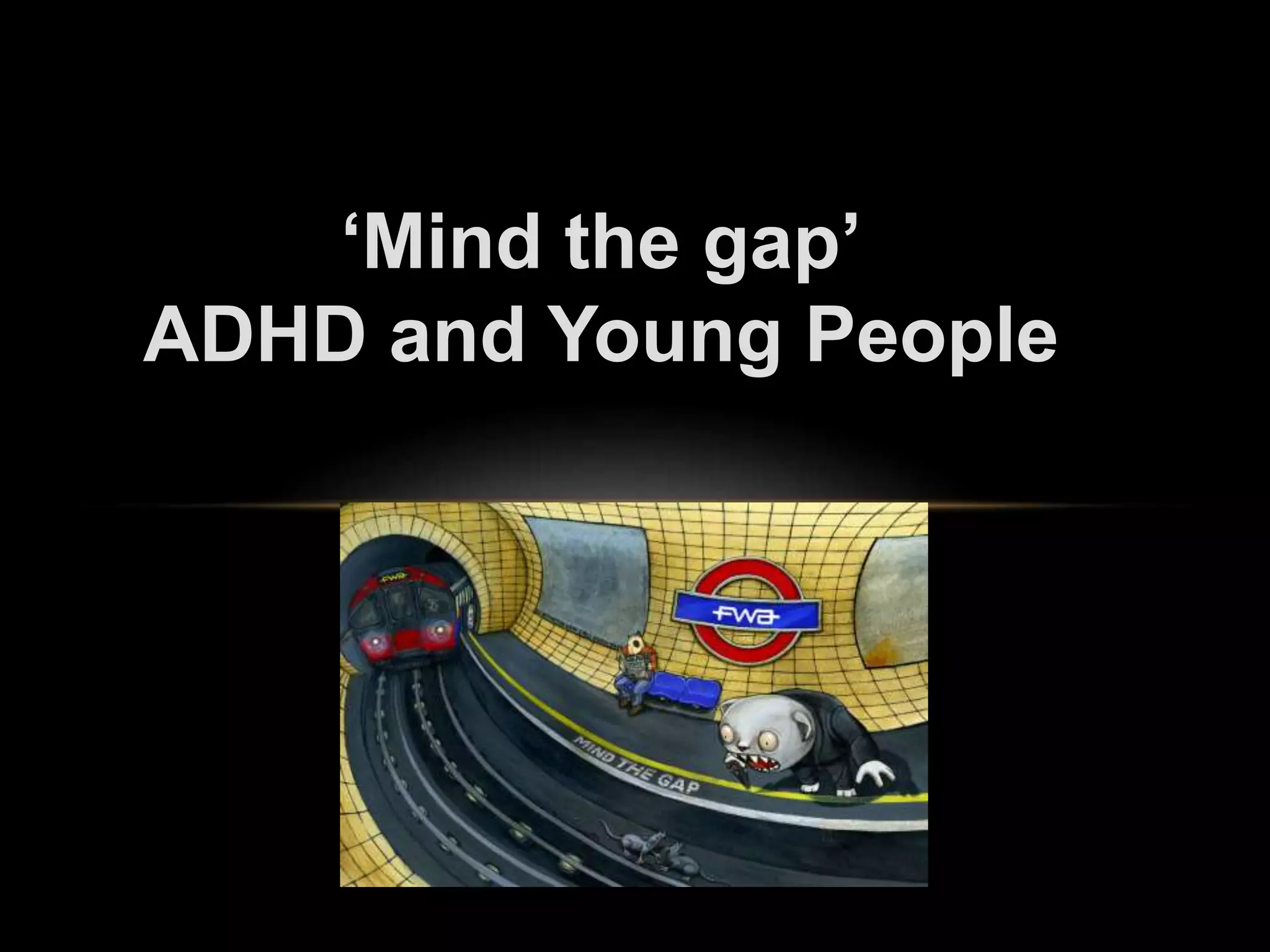
‘Mind the gap’
ADHD and Young People
ADHD AND ADOLESCENCE
• The disorder in adolescence
• Exploring consequences
• Defining needs
• Transition?
• Conclusions
PREVALENCE RATES OF ADHD
• Worldwide-pooled prevalence rate of 5.29% amongst children +
adolescents with ADHD1
• Symptom persistence into adolescence in as many as 85% of
patients2
• 5:1 ratio of males to females having the full syndrome in
adolescence3
• 15-65% symptomatic into adulthood4
• Male: Female in Adults ratio 1:15
1. Polanczyk G et al. 2007 Am J Psych; 164: 942–948
2. Biederman J et al, 1996 Arch Gen Psychiatry ;53: 437–46
3. Cuffe SP et al. 2001 J Am Acad Child Adolesc Psych; 40: 1037-44
4. Faraone S et al., 2006 Psych Med; 36: 159-65.
5 Levy, F. et al. Gender differences in ADHD subtype comorbidity. J Am Acad of Child and Adolesc Psych. 44, April 2005
SYMPTOMS INTO ADULTHOOD
DSM-V1
• Difficulty sustaining
attention in activity listen
• Can't organize
• Easily distractible
• Careless mistakes
• No follow-through
• Avoids/dislikes tasks
requiring sustained mental
effort
• Loses important items
• Forgetful in daily activities
• Does not listen
Common Adult Symptoms2
• Difficulty sustaining
attention
• Easily distracted
• Forgetful
• Poor concentration
• Poor time management
• Difficulty finishing tasks
• Loses/misplaces things
1. Adapted from DSM-V. APA 2014,
2. Weiss M et al. ADHD in Adulthood: a guide to current theory, diagnosis and treatment. 2001: 15-16
A
D
O
L
E
S
C
E
N
C
E
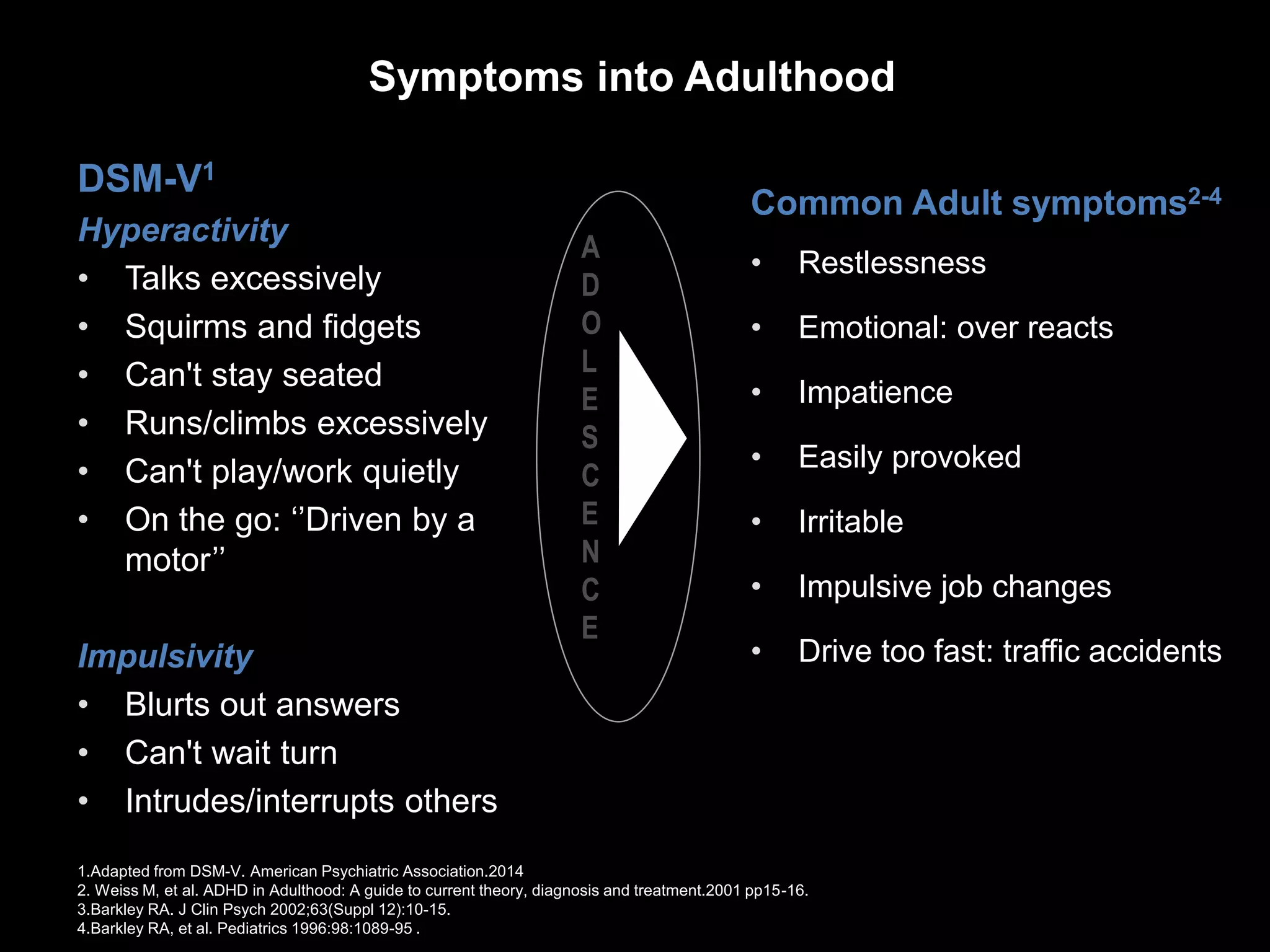
Symptoms into Adulthood
DSM-V1
Hyperactivity
• Talks excessively
• Squirms and fidgets
• Can't stay seated
• Runs/climbs excessively
• Can't play/work quietly
• On the go: ‘’Driven by a
motor’’
Impulsivity
• Blurts out answers
• Can't wait turn
• Intrudes/interrupts others
Common Adult symptoms2-4
• Restlessness
• Emotional: over reacts
• Impatience
• Easily provoked
• Irritable
• Impulsive job changes
• Drive too fast: traffic accidents
1.Adapted from DSM-V. American Psychiatric Association.2014
2. Weiss M, et al. ADHD in Adulthood: A guide to current theory, diagnosis and treatment.2001 pp15-16.
3.Barkley RA. J Clin Psych 2002;63(Suppl 12):10-15.
4.Barkley RA, et al. Pediatrics 1996:98:1089-95 .
A
D
O
L
E
S
C
E
N
C
E
PRESENTATION OF ADOLESCENTS WITH
ADHD
ADHD Clinical presentation: Adolescence (13-18 years)
May have a sense of inner restlessness(rather than hyperactivity)
Schoolwork disorganised and shows poor follow through; fails to
work independently
Poor peer relationships
Difficulty with authority figures
Engages in ‘risky’ behaviours (speeding and driving mishaps)
Poor self-esteem
1.Adapted from Wilens T 2004 J Clin Psych; 65/10: 1303-13
ADHD IN ADOLESCENCE- REALITY?
• Vulnerable age: Long term risks associated
with persisting ADHD 1
• Organised evidence based treatment protocols
-> improves outcomes 2
• Complete disengagement from services by
age 21 3
• Many remain untreated- as Adult ADHD is an
unrecognised entity & limited services 1
1.Wong et al Health technology assessment 2009, 13(50): 1-120
2. Swanson et al (MTA part II) 2008, J Atten Dis, 12: 15-43
3. McCarthy et al, 2009, B J Psych, 194: 273-77
WHAT ARE THE POSSIBLE
CONSEQUENCES?
CONSEQUENCES
• Social Difficulties
• Emotional difficulties
• Academic problems
• Antisocial behaviour
• Substance abuse
• Sexual behaviour: STIs & teenage pregnancy
• Reduced Compliance Harpin 2005 Arch Dis Child, 90, supppl 1)
Langley et al 2010 BJPsych, 196:235-40
Wong et al Health technology assessment 2009, 13(50): 1-120
SOCIAL DIFFICULTIES IN
ADOLESCENCE
• Impaired relationships 1
• Severe lack of friendship 1
• Less sharing, co-operation, turn-taking 2
• Reduced empathy and guilt 2
• In the presence of ODD/CD co-morbidity,
more bullying/being bullied 2
1. The mental health of children and adolescents in Great Britain. 2000 Office for National Statistics, London:
2. Wehmeier P et al 2010. J Adolesc Health; 46/3: 209-17
EMOTIONAL DIFFICULTIES
• Reduced self-esteem compared to control
adolescents 1
• Poor self-regulation of emotion 2
• Increased anger and aggression 2
• Anxiety/mood disorders may increase in
adolescence 3
1. Slomkowski C et al. 1995J Abnorm Clin Psychol; 23/3: 303-314
2. Barkley RA..2006 ADHD: A Handbook for diagnosis and Treatment. 3rd ed New York.
3. Biederman J et al. 1996 Arch Gen Psychiatry; 53:4 37–46
EDUCATIONAL IMPAIRMENT IN ADHD
• Lower grades in final year of schooling
• Ranked lower in the class
• Fewer graduate high school (68% vs 100%)
• Higher grade retention (42% vs 13%)
• Higher suspension or expulsion (73% vs 23%)
Barkley RA. 2006J Am Acad Child Adolesc Psych; 45/2: 192-202
ANTI-SOCIAL BEHAVIOUR
• Increased antisocial acts compared to control teenagers 1
• Theft
• Possession/Use of a weapon
• Vandalism
• Assault
• Young drivers with ADHD are 2,3
• Significantly more
• Driving Offences2
• Car crashes2
• More bodily injuries
• At fault more often for such accidents3
1.Barkley R et al. 1991 J Am acad Child Adolesc Psych; 30/5: 752-761
2.Nada-Raja S et al. 1997 J Am Acad Child Adolesc Psych; 36: 515–522
3. Barkley RA et al. 2003 Pediatrics; 92: 212-218
ANTI-SOCIAL BEHAVIOUR IN ADHD ADOLESCENTS
0
10
20
30
40
50
60
*
Subjects%
*P= 0.01
*
*
*
*
**
Adapted from Barkley R et al.1990 J Am Acad Child Adolesc Psych; 29/4: 546-557
Hyperactives (n=123)
Normal (n=66)
ADHD AND SUBSTANCE ABUSE
• Addicted to cigarette smoking twice the
rate of non-ADHD individuals 2
• Cigarette/marijuana use 2-5 times
higher with both ADHD and CD 1
• Increased risk of cigarette smoking and
substance abuse in adolescence 2
• Independent of co-morbidity, individuals
with ADHD maintain addictions longer 2
1.Barkley R et al. 1990 J Am Acad Child Adolesc Psych; 29/4: 546-556
2.Wilens T et al. 2002 Ann Review Med; 53:1 13-31
SEXUAL BEHAVIOUR OF ADOLESCENTS WITH ADHD
• Adolescents with ADHD :
• Earlier sexual activity
• More casual sex outside a relationship
• Less likely to use contraception
• There is an increased number of:
• Sexual partners
• Sexually transmitted diseases (4:1)
• Teenage pregnancies
• Births before the age of 20
Barkley RA. 2006 Attention-Deficit/Hyperactivity Disorder: A Handbook for Diagnosis and Treatment. 3rd edition. New York, NY: Guilford Press
COMPLIANCE
• Adolescents are more likely to stop taking their medication:
• Exert more control on their life
• Try time off medication
• Want to know who they really are
• Don’t want to be different
• In 3-year, longitudinal study, 48% of children between 9 - 15 yrs
discontinued their medication1
1.Thiruchelvam D et al. 2001 J Am Acad Child Adolesc Psych; 40: 922–928,
TREATMENT DISCONTINUATION
McCarthy S et al. 2009 British J Psych; 194: 273–277
• Swedish study: 2006-09
• 25,656 ADHD young people
• Criminality rates on meds & off meds
• When on meds
• Reduction by 30% in males & 41 % in females
Lichenstein et al 2012, NEJMed, 367: 2006-14
MEDICATIONS FOR ADHD & CRIMINALITY
• Swedish study: 2006-09
• 17, 408 ADHD young people
• Road Traffic Accident rates on meds & off meds
• Increased risk of RTA (Hazard ratio: 1.45- 1.47)
• When on meds
• Reduction by 58% in males
• No reduction in females!
Chang et al JAMA Psychiatry, 2014; 71(3):
MEDICATIONS - ADHD & RTA
• Danish study: 2006-09
• 1.52 million population studied: 32,061 with ADHD
• Mortality rate (per 10,000 person years) was 5.85 in ADHD vs 2.21 in those without
• People diagnosed with ADHD in adulthood had a higher rate
• Higher in women with ADHD than men with ADHD
• Mainly due to unnatural deaths!
• Dalsgaard et al The Lancet Feb 2015
ADHD & MORTALITY
BURDEN ON SOCIETY
• Anti-social behaviour support
• Educational support
• Substance abuse related issues
• Pregnancy related issues
• STI related issues
• Involvement of multiple agencies
• Health
• Education
• Criminal Justice
• Social services
• Voluntary agencies
Birnbaun et al, 2000, Cur Med Res Opin, 21: 195-206
Leibson et al, 2003, Pharmaco-economics, 21: 1239-62
What is the current
reality?
WHAT IS THE CURRENT SCENARIO?
• Cost of ADHD tremendous- for the patient and society
• Children’s services stretched
• Adult services yet to awaken!
• No transition service set pathway
• No clear pathways in YP or adults
• Self referral - Via GP surgery
• No supportive adult services: post-diagnosis
• More self support groups than help from CCGs
What do you think
is lacking?
DIFFICULTIES WITH SERVICES
• Complexity of service structures
• Arbitrary service boundaries
• Variations in protocol & policy practice gap
• Lay & professional misunderstanding
Singh et al -TRACK survey / 2009 Cur Opin Psych 22: 386-90
• Adult services are ill prepared
• Lack of structured guidelines on transitioning (‘Mind the gap- Hall et al)
• Little published evidence of transition: No transition policies within most trusts
• Different commissioning arrangements
• Who pays to bridge this gap?
DIFFICULTIES RELATED TO THE PATIENT
• Moving homes, going to university
• Considered adults, less parental control
• Poor parental/ patient organizational skills
• Lost to follow up…….
• Offenders/ emerging personality disorders/ substance misuse/ Comorbid
mental disorder
• Present when faced with crisis: relationship breakdown/ occupational problems
Young et al 2011, BMC Psychiatry 11:174
What
do
patients/families
want?
WHAT DO PATIENTS/FAMILIES WANT- SERVICES?
• Full reassessment: Current ADHD severity & co-morbidity, ASD, Dyslexia, Dyspraxia
• Easy access to ADHD services via GPs
• Information pack (‘Colourful and attractive’)
• Other services
• Welfare rights, benefits, job interview training, careers advice
• Support groups & ADHD coaching
• Strategies for living,
• Business development support
• University grants
• Money management courses
WHAT DO PATIENTS/FAMILIES WANT- PATIENTS?
• Mentor & Life coach: To speak to when struggling
• Technology for contact - texts, email!
• Apps
• E-Forums
• Drop in sessions/ support sessions
• Anger management, time management
• Parents to take a lead with the consent of young person
• incapable/disinterested/unmotivated to come to appointments
• Book appointments & discuss medications etc
What should it look like?
A GOOD TRANSITION SERVICE
• Focus on CAMHS/Paediatric services
• Clear transition policy & pathway
• Planned in advance
• Before age 18
• Agreed between child & adult ADHD services
• Person-centered
• Reassessed: co-morbidities
• Participation of young person and families
• Ensuring consistency in service- Seamless transition
• Joint working/ multi agency involvement
• Information sharing between services
Young et al 2011, BMC Psychiatry 11:174
NICE Guidelines Clinical guideline 72, 2008
What are we doing locally?
• CAMHS- Agreed transition pathway to Adult ADHD services
• Pilot project
• North west surrey- Transition Paediatric ADHD clinics- 4/ year
• Attended by staff from Adult ADHD services.
• Agreed transition plan/documentation
• GP- Education: Manage simple ADHD
• Adult ADHD services: Manage complex ADHD
• Supporting UNIQUE
CONCLUSIONS
• ADHD impairments persist into adolescence AND adulthood
• Problems are multi-faceted; issues and impairments specific to adolescents
• Huge implications to person and society
• Many problems preventable by smooth transition
• Medication as effective in adolescence & adulthood as in childhood
• Very little supportive services to Young people/ young adults
• Transition services imperative to prevent societal burden
Acknowledgement: Dr Bhathika Pereira, AMHS, Epsom

ADHD AND TRANSITION

  • 1.
    ‘Mind the gap’ ADHDand Young People
  • 2.
    ADHD AND ADOLESCENCE •The disorder in adolescence • Exploring consequences • Defining needs • Transition? • Conclusions
  • 3.
    PREVALENCE RATES OFADHD • Worldwide-pooled prevalence rate of 5.29% amongst children + adolescents with ADHD1 • Symptom persistence into adolescence in as many as 85% of patients2 • 5:1 ratio of males to females having the full syndrome in adolescence3 • 15-65% symptomatic into adulthood4 • Male: Female in Adults ratio 1:15 1. Polanczyk G et al. 2007 Am J Psych; 164: 942–948 2. Biederman J et al, 1996 Arch Gen Psychiatry ;53: 437–46 3. Cuffe SP et al. 2001 J Am Acad Child Adolesc Psych; 40: 1037-44 4. Faraone S et al., 2006 Psych Med; 36: 159-65. 5 Levy, F. et al. Gender differences in ADHD subtype comorbidity. J Am Acad of Child and Adolesc Psych. 44, April 2005
  • 4.
    SYMPTOMS INTO ADULTHOOD DSM-V1 •Difficulty sustaining attention in activity listen • Can't organize • Easily distractible • Careless mistakes • No follow-through • Avoids/dislikes tasks requiring sustained mental effort • Loses important items • Forgetful in daily activities • Does not listen Common Adult Symptoms2 • Difficulty sustaining attention • Easily distracted • Forgetful • Poor concentration • Poor time management • Difficulty finishing tasks • Loses/misplaces things 1. Adapted from DSM-V. APA 2014, 2. Weiss M et al. ADHD in Adulthood: a guide to current theory, diagnosis and treatment. 2001: 15-16 A D O L E S C E N C E
  • 5.
    Symptoms into Adulthood DSM-V1 Hyperactivity •Talks excessively • Squirms and fidgets • Can't stay seated • Runs/climbs excessively • Can't play/work quietly • On the go: ‘’Driven by a motor’’ Impulsivity • Blurts out answers • Can't wait turn • Intrudes/interrupts others Common Adult symptoms2-4 • Restlessness • Emotional: over reacts • Impatience • Easily provoked • Irritable • Impulsive job changes • Drive too fast: traffic accidents 1.Adapted from DSM-V. American Psychiatric Association.2014 2. Weiss M, et al. ADHD in Adulthood: A guide to current theory, diagnosis and treatment.2001 pp15-16. 3.Barkley RA. J Clin Psych 2002;63(Suppl 12):10-15. 4.Barkley RA, et al. Pediatrics 1996:98:1089-95 . A D O L E S C E N C E
  • 6.
    PRESENTATION OF ADOLESCENTSWITH ADHD ADHD Clinical presentation: Adolescence (13-18 years) May have a sense of inner restlessness(rather than hyperactivity) Schoolwork disorganised and shows poor follow through; fails to work independently Poor peer relationships Difficulty with authority figures Engages in ‘risky’ behaviours (speeding and driving mishaps) Poor self-esteem 1.Adapted from Wilens T 2004 J Clin Psych; 65/10: 1303-13
  • 7.
    ADHD IN ADOLESCENCE-REALITY? • Vulnerable age: Long term risks associated with persisting ADHD 1 • Organised evidence based treatment protocols -> improves outcomes 2 • Complete disengagement from services by age 21 3 • Many remain untreated- as Adult ADHD is an unrecognised entity & limited services 1 1.Wong et al Health technology assessment 2009, 13(50): 1-120 2. Swanson et al (MTA part II) 2008, J Atten Dis, 12: 15-43 3. McCarthy et al, 2009, B J Psych, 194: 273-77
  • 8.
    WHAT ARE THEPOSSIBLE CONSEQUENCES?
  • 9.
    CONSEQUENCES • Social Difficulties •Emotional difficulties • Academic problems • Antisocial behaviour • Substance abuse • Sexual behaviour: STIs & teenage pregnancy • Reduced Compliance Harpin 2005 Arch Dis Child, 90, supppl 1) Langley et al 2010 BJPsych, 196:235-40 Wong et al Health technology assessment 2009, 13(50): 1-120
  • 10.
    SOCIAL DIFFICULTIES IN ADOLESCENCE •Impaired relationships 1 • Severe lack of friendship 1 • Less sharing, co-operation, turn-taking 2 • Reduced empathy and guilt 2 • In the presence of ODD/CD co-morbidity, more bullying/being bullied 2 1. The mental health of children and adolescents in Great Britain. 2000 Office for National Statistics, London: 2. Wehmeier P et al 2010. J Adolesc Health; 46/3: 209-17
  • 11.
    EMOTIONAL DIFFICULTIES • Reducedself-esteem compared to control adolescents 1 • Poor self-regulation of emotion 2 • Increased anger and aggression 2 • Anxiety/mood disorders may increase in adolescence 3 1. Slomkowski C et al. 1995J Abnorm Clin Psychol; 23/3: 303-314 2. Barkley RA..2006 ADHD: A Handbook for diagnosis and Treatment. 3rd ed New York. 3. Biederman J et al. 1996 Arch Gen Psychiatry; 53:4 37–46
  • 12.
    EDUCATIONAL IMPAIRMENT INADHD • Lower grades in final year of schooling • Ranked lower in the class • Fewer graduate high school (68% vs 100%) • Higher grade retention (42% vs 13%) • Higher suspension or expulsion (73% vs 23%) Barkley RA. 2006J Am Acad Child Adolesc Psych; 45/2: 192-202
  • 13.
    ANTI-SOCIAL BEHAVIOUR • Increasedantisocial acts compared to control teenagers 1 • Theft • Possession/Use of a weapon • Vandalism • Assault • Young drivers with ADHD are 2,3 • Significantly more • Driving Offences2 • Car crashes2 • More bodily injuries • At fault more often for such accidents3 1.Barkley R et al. 1991 J Am acad Child Adolesc Psych; 30/5: 752-761 2.Nada-Raja S et al. 1997 J Am Acad Child Adolesc Psych; 36: 515–522 3. Barkley RA et al. 2003 Pediatrics; 92: 212-218
  • 14.
    ANTI-SOCIAL BEHAVIOUR INADHD ADOLESCENTS 0 10 20 30 40 50 60 * Subjects% *P= 0.01 * * * * ** Adapted from Barkley R et al.1990 J Am Acad Child Adolesc Psych; 29/4: 546-557 Hyperactives (n=123) Normal (n=66)
  • 15.
    ADHD AND SUBSTANCEABUSE • Addicted to cigarette smoking twice the rate of non-ADHD individuals 2 • Cigarette/marijuana use 2-5 times higher with both ADHD and CD 1 • Increased risk of cigarette smoking and substance abuse in adolescence 2 • Independent of co-morbidity, individuals with ADHD maintain addictions longer 2 1.Barkley R et al. 1990 J Am Acad Child Adolesc Psych; 29/4: 546-556 2.Wilens T et al. 2002 Ann Review Med; 53:1 13-31
  • 16.
    SEXUAL BEHAVIOUR OFADOLESCENTS WITH ADHD • Adolescents with ADHD : • Earlier sexual activity • More casual sex outside a relationship • Less likely to use contraception • There is an increased number of: • Sexual partners • Sexually transmitted diseases (4:1) • Teenage pregnancies • Births before the age of 20 Barkley RA. 2006 Attention-Deficit/Hyperactivity Disorder: A Handbook for Diagnosis and Treatment. 3rd edition. New York, NY: Guilford Press
  • 17.
    COMPLIANCE • Adolescents aremore likely to stop taking their medication: • Exert more control on their life • Try time off medication • Want to know who they really are • Don’t want to be different • In 3-year, longitudinal study, 48% of children between 9 - 15 yrs discontinued their medication1 1.Thiruchelvam D et al. 2001 J Am Acad Child Adolesc Psych; 40: 922–928,
  • 18.
    TREATMENT DISCONTINUATION McCarthy Set al. 2009 British J Psych; 194: 273–277
  • 19.
    • Swedish study:2006-09 • 25,656 ADHD young people • Criminality rates on meds & off meds • When on meds • Reduction by 30% in males & 41 % in females Lichenstein et al 2012, NEJMed, 367: 2006-14 MEDICATIONS FOR ADHD & CRIMINALITY
  • 20.
    • Swedish study:2006-09 • 17, 408 ADHD young people • Road Traffic Accident rates on meds & off meds • Increased risk of RTA (Hazard ratio: 1.45- 1.47) • When on meds • Reduction by 58% in males • No reduction in females! Chang et al JAMA Psychiatry, 2014; 71(3): MEDICATIONS - ADHD & RTA
  • 21.
    • Danish study:2006-09 • 1.52 million population studied: 32,061 with ADHD • Mortality rate (per 10,000 person years) was 5.85 in ADHD vs 2.21 in those without • People diagnosed with ADHD in adulthood had a higher rate • Higher in women with ADHD than men with ADHD • Mainly due to unnatural deaths! • Dalsgaard et al The Lancet Feb 2015 ADHD & MORTALITY
  • 22.
    BURDEN ON SOCIETY •Anti-social behaviour support • Educational support • Substance abuse related issues • Pregnancy related issues • STI related issues • Involvement of multiple agencies • Health • Education • Criminal Justice • Social services • Voluntary agencies Birnbaun et al, 2000, Cur Med Res Opin, 21: 195-206 Leibson et al, 2003, Pharmaco-economics, 21: 1239-62
  • 23.
    What is thecurrent reality?
  • 24.
    WHAT IS THECURRENT SCENARIO? • Cost of ADHD tremendous- for the patient and society • Children’s services stretched • Adult services yet to awaken! • No transition service set pathway • No clear pathways in YP or adults • Self referral - Via GP surgery • No supportive adult services: post-diagnosis • More self support groups than help from CCGs
  • 25.
    What do youthink is lacking?
  • 26.
    DIFFICULTIES WITH SERVICES •Complexity of service structures • Arbitrary service boundaries • Variations in protocol & policy practice gap • Lay & professional misunderstanding Singh et al -TRACK survey / 2009 Cur Opin Psych 22: 386-90 • Adult services are ill prepared • Lack of structured guidelines on transitioning (‘Mind the gap- Hall et al) • Little published evidence of transition: No transition policies within most trusts • Different commissioning arrangements • Who pays to bridge this gap?
  • 27.
    DIFFICULTIES RELATED TOTHE PATIENT • Moving homes, going to university • Considered adults, less parental control • Poor parental/ patient organizational skills • Lost to follow up……. • Offenders/ emerging personality disorders/ substance misuse/ Comorbid mental disorder • Present when faced with crisis: relationship breakdown/ occupational problems Young et al 2011, BMC Psychiatry 11:174
  • 28.
  • 29.
    WHAT DO PATIENTS/FAMILIESWANT- SERVICES? • Full reassessment: Current ADHD severity & co-morbidity, ASD, Dyslexia, Dyspraxia • Easy access to ADHD services via GPs • Information pack (‘Colourful and attractive’) • Other services • Welfare rights, benefits, job interview training, careers advice • Support groups & ADHD coaching • Strategies for living, • Business development support • University grants • Money management courses
  • 30.
    WHAT DO PATIENTS/FAMILIESWANT- PATIENTS? • Mentor & Life coach: To speak to when struggling • Technology for contact - texts, email! • Apps • E-Forums • Drop in sessions/ support sessions • Anger management, time management • Parents to take a lead with the consent of young person • incapable/disinterested/unmotivated to come to appointments • Book appointments & discuss medications etc
  • 31.
    What should itlook like?
  • 32.
    A GOOD TRANSITIONSERVICE • Focus on CAMHS/Paediatric services • Clear transition policy & pathway • Planned in advance • Before age 18 • Agreed between child & adult ADHD services • Person-centered • Reassessed: co-morbidities • Participation of young person and families • Ensuring consistency in service- Seamless transition • Joint working/ multi agency involvement • Information sharing between services Young et al 2011, BMC Psychiatry 11:174 NICE Guidelines Clinical guideline 72, 2008
  • 33.
    What are wedoing locally? • CAMHS- Agreed transition pathway to Adult ADHD services • Pilot project • North west surrey- Transition Paediatric ADHD clinics- 4/ year • Attended by staff from Adult ADHD services. • Agreed transition plan/documentation • GP- Education: Manage simple ADHD • Adult ADHD services: Manage complex ADHD • Supporting UNIQUE
  • 34.
    CONCLUSIONS • ADHD impairmentspersist into adolescence AND adulthood • Problems are multi-faceted; issues and impairments specific to adolescents • Huge implications to person and society • Many problems preventable by smooth transition • Medication as effective in adolescence & adulthood as in childhood • Very little supportive services to Young people/ young adults • Transition services imperative to prevent societal burden
  • 35.
    Acknowledgement: Dr BhathikaPereira, AMHS, Epsom