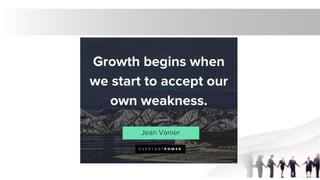
Addressing our Personal
Weaknesses
Presented by: Stephanie G. Olino, Rpm
Lunch & Learn #04
Objective
• Define Personal Weaknesses
• How to Identify our Personal Weakness
• How to Address our Weaknesses
• Importance of Addressing our Weaknesses
• Best Practices when Addressing our Weaknesses
WHAT IS PERSONAL
WEAKNESS?
Personal Weakness
• Personal weakness is a behavioral weakness that makes
it more difficult for you to fulfill your potential. These
weaknesses can be both mental, physical, and emotional.
Personal Weakness
• Personal weakness is a behavioral weakness that makes
it more difficult for you to fulfill your potential. These
weaknesses can be both mental, physical, and emotional.
• Your unique challenges or the things you know you
struggle with
HOW TO IDENTIFY OUR
PERSONAL WEAKNESSES?
#1. Take time for self-reflection
• Self-reflection involves setting aside time to analyse your
thoughts, actions and behaviors. Think about situations where you
feel less confident or encounter challenges. Are there any
patterns or recurring themes? For example, did you communicate
a feeling or idea as well as you could have done? Were you using
plain language, or might things you’ve said be open to
interpretation?
• By honestly assessing your strengths and weaknesses, you can
gain valuable insights into areas that require improvement.
#2. Seek feedback from others
• Receiving feedback from trusted colleagues, friends or family
members can provide an external perspective on your
weaknesses. You might even consider taking on a mentor.
#2. Seek feedback from others
• Receiving feedback from trusted colleagues, friends or family
members can provide an external perspective on your
weaknesses. You might even consider taking on a mentor.
• When you ask for constructive criticism, be open to observations,
and try not to take things too personally. Feedback is an
opportunity for growth, and listening to different viewpoints can
help you gain a clearer understanding of where you may be falling
short.
#3. Review Performance Metrics
• Review performance metrics: If you work in a field where you
have access to metrics regarding your performance, you can
review this qualitative data to gain a better understanding of any
weaknesses you have. Metrics can also offer additional context to
your self-evaluation or any feedback you receive.
HOW TO ADDRESS YOUR
PERSONAL WEAKNESSES?
#1. Work on self-improvement
• Once you’ve identified your weaknesses, prioritise them based on
their impact and significance. Start by addressing those that have
the greatest influence on your personal or professional life. By
focusing on one weakness at a time, you can allocate your time
effectively, while avoiding becoming overwhelmed.
#2. Set SMART goals
• Next, establish SMART goals to address your weaknesses.
These are objectives which are specific, measurable, achievable,
relevant and timebound.
#2. Set SMART goals
• Next, establish SMART goals to address your weaknesses.
These are objectives which are specific, measurable, achievable,
relevant and timebound.
• Clearly define what you want to achieve, then outline the steps
required to get there. By breaking your goals into smaller,
manageable tasks, you make it easier to track your progress and
stay focused. This also stops you from becoming overloaded with
seemingly unwieldy tasks.
#3. Seek knowledge and acquire new skills
• One of the best ways to go about tackling specific weaknesses is
through gaining knowledge and relevant skills. Consider taking
courses, attending workshops or engaging in learning platforms
online. You might even go old-school and hit the books!
#3. Seek knowledge and acquire new skills
• One of the best ways to go about tackling specific weaknesses is
through gaining knowledge and relevant skills. Consider taking
courses, attending workshops or engaging in learning platforms
online. You might even go old-school and hit the books!
• And, as mentioned above, it’s a good idea to seek out a mentor.
This will help you acquire skills and knowledge from someone
who’s gone the distance in your chosen field.
#4. Take risks!
• Real growth often occurs outside of one’s comfort zone. As such,
you should be willing to take risks and embrace discomfort.
#4. Take risks!
• Real growth often occurs outside of one’s comfort zone. As such,
you should be willing to take risks and embrace discomfort.
• Challenge yourself by engaging in activities that directly confront
your weaknesses. This could involve public speaking, taking on
new responsibilities at work, or facing situations that make you
uncomfortable. You’re unlikely to expand your capabilities and
build resilience if you never step outside your comfort bubble.
#5. Celebrate progress. And be kind to yourself!
• When you make progress in addressing your weaknesses, be
sure to give yourself the recognition you deserve. Whether it’s a
small step or a milestone, celebrating your progress reinforces
positive behaviour and motivates you to keep going.
#5. Celebrate progress. And be kind to yourself!
• When you make progress in addressing your weaknesses, be
sure to give yourself the recognition you deserve. Whether it’s a
small step or a milestone, celebrating your progress reinforces
positive behaviour and motivates you to keep going.
• And being kind to yourself is also key to the process of tackling
weaknesses. It’s good to understand that everyone has room for
improvement, and it’s a natural part of personal growth. Treat
yourself with kindness and understanding, especially when facing
setbacks or encountering challenges. Always bear in mind that the
path to self-improvement is ongoing, and setbacks are
opportunities to learn.
Importance of Addressing
your Personal Weaknesses
Professional development
• Improving your skills is an important aspect of professional
development. As you grow in your role, it's important to evaluate
your skills regularly. Doing so can show managers and future
employers your commitment to developing your skills and
improving your value as a professional. These are admirable
qualities because they communicate the care you have for your
job and your performance.
Job satisfaction
• Another benefit to improving your skills is increasing the personal
satisfaction you feel at work. Growing your confidence in your
abilities can make it more rewarding to perform your job tasks. By
improving your skills, you're more likely to receive positive
attention from supervisors and coworkers, which can boost your
mood, improve the satisfaction you receive from completing a task
successfully and provide intrinsic motivation to continue
performing well.
Personal development
• Beyond professional development, improving weaknesses can be
good for your personal development too. With the possible
exception of certain technical skills, many job skills can translate
into your personal life. For example, improving your
communication skills can have profound effects on your personal
relationships. By focusing on development, you can improve
yourself as an individual, not just as an employee.
Career growth
• Developing certain skills can qualify you for new opportunities and
allow you to advance in your career. Consider asking your
employer what you can improve to be considered for a promotion
or advancement opportunity. They might have valuable feedback
for you and appreciate your dedication to adding value to the
team. Learning new technical skills can also boost your resume
and make you a more desirable candidate for future positions.
Team support
• By building your strengths, you can become a better resource for
your team. Having strengths in specific areas may make others
more likely to seek your advice on certain projects or tasks.
Developing a sense of community and feeling like an integral part
of your team can make work more fulfilling and satisfactory.
Best Practices when
addressing Weaknesses
Consistency
• Overcoming weaknesses requires consistent effort. Set a routine
and stick to it, whether it's daily practice, weekly check-ins, or
monthly assessments.
Patience
• Improvement takes time. Be patient with yourself as you work on
your weaknesses. Celebrate small victories along the way to
maintain motivation.
Visualization
• Visualize your success in addressing your weaknesses. Creating
a mental image of your progress can help motivate and guide
your efforts.
Positive Mindset
• Maintain a positive attitude towards your weaknesses. Instead of
viewing them as obstacles, see them as opportunities for growth
and development.
• Remember that overcoming weaknesses is a gradual process. It's
okay to face setbacks, but the key is to persevere and keep
working towards improvement. By combining these strategies and
tailoring them to your unique circumstances, you can make
significant progress in both your personal and professional life.
In a Nutshell....
• Recognizing weaknesses is not a sign of inadequacy. Rather, it
demonstrates a willingness to grow and improve. It helps to
embrace the process as an opportunity to expand your skills and
overcome obstacles, ultimately reaching your full potential.
In a Nutshell....
• Recognizing weaknesses is not a sign of inadequacy. Rather, it
demonstrates a willingness to grow and improve. It helps to
embrace the process as an opportunity to expand your skills and
overcome obstacles, ultimately reaching your full potential.
• The path to tackling weaknesses, like so many things, is a journey
– not a quick fix. But by approaching it positively, with dedication
and self-reflection, you can tackle your weaknesses… Hopefully
starting you on a transformative journey of personal development.
WHAT QUESTIONS DO YOU
HAVE?

Addressing your Personal Weaknesses presmat

  • 1.
    Addressing our Personal Weaknesses Presentedby: Stephanie G. Olino, Rpm Lunch & Learn #04
  • 2.
    Objective • Define PersonalWeaknesses • How to Identify our Personal Weakness • How to Address our Weaknesses • Importance of Addressing our Weaknesses • Best Practices when Addressing our Weaknesses
  • 3.
  • 4.
    Personal Weakness • Personalweakness is a behavioral weakness that makes it more difficult for you to fulfill your potential. These weaknesses can be both mental, physical, and emotional.
  • 5.
    Personal Weakness • Personalweakness is a behavioral weakness that makes it more difficult for you to fulfill your potential. These weaknesses can be both mental, physical, and emotional. • Your unique challenges or the things you know you struggle with
  • 6.
    HOW TO IDENTIFYOUR PERSONAL WEAKNESSES?
  • 7.
    #1. Take timefor self-reflection • Self-reflection involves setting aside time to analyse your thoughts, actions and behaviors. Think about situations where you feel less confident or encounter challenges. Are there any patterns or recurring themes? For example, did you communicate a feeling or idea as well as you could have done? Were you using plain language, or might things you’ve said be open to interpretation? • By honestly assessing your strengths and weaknesses, you can gain valuable insights into areas that require improvement.
  • 8.
    #2. Seek feedbackfrom others • Receiving feedback from trusted colleagues, friends or family members can provide an external perspective on your weaknesses. You might even consider taking on a mentor.
  • 9.
    #2. Seek feedbackfrom others • Receiving feedback from trusted colleagues, friends or family members can provide an external perspective on your weaknesses. You might even consider taking on a mentor. • When you ask for constructive criticism, be open to observations, and try not to take things too personally. Feedback is an opportunity for growth, and listening to different viewpoints can help you gain a clearer understanding of where you may be falling short.
  • 10.
    #3. Review PerformanceMetrics • Review performance metrics: If you work in a field where you have access to metrics regarding your performance, you can review this qualitative data to gain a better understanding of any weaknesses you have. Metrics can also offer additional context to your self-evaluation or any feedback you receive.
  • 11.
    HOW TO ADDRESSYOUR PERSONAL WEAKNESSES?
  • 12.
    #1. Work onself-improvement • Once you’ve identified your weaknesses, prioritise them based on their impact and significance. Start by addressing those that have the greatest influence on your personal or professional life. By focusing on one weakness at a time, you can allocate your time effectively, while avoiding becoming overwhelmed.
  • 13.
    #2. Set SMARTgoals • Next, establish SMART goals to address your weaknesses. These are objectives which are specific, measurable, achievable, relevant and timebound.
  • 14.
    #2. Set SMARTgoals • Next, establish SMART goals to address your weaknesses. These are objectives which are specific, measurable, achievable, relevant and timebound. • Clearly define what you want to achieve, then outline the steps required to get there. By breaking your goals into smaller, manageable tasks, you make it easier to track your progress and stay focused. This also stops you from becoming overloaded with seemingly unwieldy tasks.
  • 15.
    #3. Seek knowledgeand acquire new skills • One of the best ways to go about tackling specific weaknesses is through gaining knowledge and relevant skills. Consider taking courses, attending workshops or engaging in learning platforms online. You might even go old-school and hit the books!
  • 16.
    #3. Seek knowledgeand acquire new skills • One of the best ways to go about tackling specific weaknesses is through gaining knowledge and relevant skills. Consider taking courses, attending workshops or engaging in learning platforms online. You might even go old-school and hit the books! • And, as mentioned above, it’s a good idea to seek out a mentor. This will help you acquire skills and knowledge from someone who’s gone the distance in your chosen field.
  • 17.
    #4. Take risks! •Real growth often occurs outside of one’s comfort zone. As such, you should be willing to take risks and embrace discomfort.
  • 18.
    #4. Take risks! •Real growth often occurs outside of one’s comfort zone. As such, you should be willing to take risks and embrace discomfort. • Challenge yourself by engaging in activities that directly confront your weaknesses. This could involve public speaking, taking on new responsibilities at work, or facing situations that make you uncomfortable. You’re unlikely to expand your capabilities and build resilience if you never step outside your comfort bubble.
  • 19.
    #5. Celebrate progress.And be kind to yourself! • When you make progress in addressing your weaknesses, be sure to give yourself the recognition you deserve. Whether it’s a small step or a milestone, celebrating your progress reinforces positive behaviour and motivates you to keep going.
  • 20.
    #5. Celebrate progress.And be kind to yourself! • When you make progress in addressing your weaknesses, be sure to give yourself the recognition you deserve. Whether it’s a small step or a milestone, celebrating your progress reinforces positive behaviour and motivates you to keep going. • And being kind to yourself is also key to the process of tackling weaknesses. It’s good to understand that everyone has room for improvement, and it’s a natural part of personal growth. Treat yourself with kindness and understanding, especially when facing setbacks or encountering challenges. Always bear in mind that the path to self-improvement is ongoing, and setbacks are opportunities to learn.
  • 21.
    Importance of Addressing yourPersonal Weaknesses
  • 22.
    Professional development • Improvingyour skills is an important aspect of professional development. As you grow in your role, it's important to evaluate your skills regularly. Doing so can show managers and future employers your commitment to developing your skills and improving your value as a professional. These are admirable qualities because they communicate the care you have for your job and your performance.
  • 23.
    Job satisfaction • Anotherbenefit to improving your skills is increasing the personal satisfaction you feel at work. Growing your confidence in your abilities can make it more rewarding to perform your job tasks. By improving your skills, you're more likely to receive positive attention from supervisors and coworkers, which can boost your mood, improve the satisfaction you receive from completing a task successfully and provide intrinsic motivation to continue performing well.
  • 24.
    Personal development • Beyondprofessional development, improving weaknesses can be good for your personal development too. With the possible exception of certain technical skills, many job skills can translate into your personal life. For example, improving your communication skills can have profound effects on your personal relationships. By focusing on development, you can improve yourself as an individual, not just as an employee.
  • 25.
    Career growth • Developingcertain skills can qualify you for new opportunities and allow you to advance in your career. Consider asking your employer what you can improve to be considered for a promotion or advancement opportunity. They might have valuable feedback for you and appreciate your dedication to adding value to the team. Learning new technical skills can also boost your resume and make you a more desirable candidate for future positions.
  • 26.
    Team support • Bybuilding your strengths, you can become a better resource for your team. Having strengths in specific areas may make others more likely to seek your advice on certain projects or tasks. Developing a sense of community and feeling like an integral part of your team can make work more fulfilling and satisfactory.
  • 27.
  • 28.
    Consistency • Overcoming weaknessesrequires consistent effort. Set a routine and stick to it, whether it's daily practice, weekly check-ins, or monthly assessments.
  • 29.
    Patience • Improvement takestime. Be patient with yourself as you work on your weaknesses. Celebrate small victories along the way to maintain motivation.
  • 30.
    Visualization • Visualize yoursuccess in addressing your weaknesses. Creating a mental image of your progress can help motivate and guide your efforts.
  • 31.
    Positive Mindset • Maintaina positive attitude towards your weaknesses. Instead of viewing them as obstacles, see them as opportunities for growth and development. • Remember that overcoming weaknesses is a gradual process. It's okay to face setbacks, but the key is to persevere and keep working towards improvement. By combining these strategies and tailoring them to your unique circumstances, you can make significant progress in both your personal and professional life.
  • 38.
    In a Nutshell.... •Recognizing weaknesses is not a sign of inadequacy. Rather, it demonstrates a willingness to grow and improve. It helps to embrace the process as an opportunity to expand your skills and overcome obstacles, ultimately reaching your full potential.
  • 39.
    In a Nutshell.... •Recognizing weaknesses is not a sign of inadequacy. Rather, it demonstrates a willingness to grow and improve. It helps to embrace the process as an opportunity to expand your skills and overcome obstacles, ultimately reaching your full potential. • The path to tackling weaknesses, like so many things, is a journey – not a quick fix. But by approaching it positively, with dedication and self-reflection, you can tackle your weaknesses… Hopefully starting you on a transformative journey of personal development.
  • 40.

Editor's Notes

  • #3 In your own opinion, what is personal weakness?