AD/DA Conversion Techniques
-
An Overview
J. G. Pett
 Introductory tutorial lecture for :-
‘Analogue and digital techniques in
closed-loop regulation applications’
17/09/2002
 for terminology see Analog Devices Inc.
AD/DA
 Introduction to the subject
 Understanding conversion methods
 Methods
 Parameters
 The past, the present and the future
Introduction
 What are AD/DA Converters
 What are they used for
 Why do you need to know how they work
 Digital coding methods
 Waveform digitising
 CERN examples
What are AD/DA
Converters (1)
 An Analog to Digital converter [AD or ADC]
is an electronic circuit which accepts an
analog input signal (usually a voltage) and
produces a corresponding digital number at
the output
 An Digital to Analog converter [DA or DAC]
is an electronic circuit which accepts a
digital number at its input and produces a
corresponding analog signal (usually a
voltage) at the output
 They exist as modules, ICs, or fully
integrated inside other parts, e.g. µCs
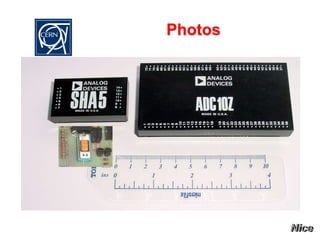
Photos
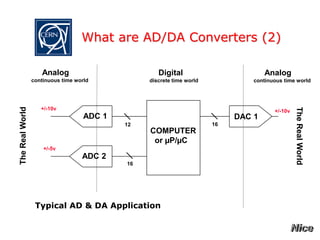
What are AD/DA Converters (2)
ADC 1 DAC 1
ADC 2
COMPUTER
or µP/µC
12
16
16
Digital
discrete time world
Analog
continuous time world
Analog
continuous time world
The
Real
World
The
Real
World
Typical AD & DA Application
+/-10v
+/-5v
+/-10v
What are they used for
 Any time a real world analog signal is
connected to a digital system
 CD players, GSMs, DVMs, Digital Camcorders
etc, etc
 CERN control systems & instruments
 HOWEVER, each application has particular
needs
 Resolution - number of bits
 Speed and Accuracy
 Level of input/output waveforms
 Cost etc
Why do you need to know
how they work
 Because the theoretical course you will
shortly undertake assumes perfect
converter products - BUT
 Practical converters have :
 Many conversion methods - why
 Trade-offs between resolution and speeds +
delays
 Different methods of “sampling” the
waveforms
 A large number of basic and method-dependent
error sources
 Manufacturers specifications which ‘differ’ -
AND
 Almost all converters need some analog ‘signal
conditioning’ which is application dependent
Digital coding methods (1)
 8,10,12,14,16,18, 20-24bits?
 Most/Least significant bit
MSB/LSB
 Uni-polar, bipolar, straight
binary, 2’s complement -
invert MSB
 Parallel I/O or serial [delay]
 Bytes or words
 Double buffering
 Digital ‘breakthrough’
 Digital correction methods
 Time skewing & jitter
0v
+10v
-10v
0000 FFFF
8000
AD/DA Transfer Characteristic
0000 7FFF
FFFF
8000
Digital coding methods (2)
 Resolution = 2n-1 [n = number of bits]
n 2n 1bit ppm [1x10⁻⁶]
 8bits 256 3906
 10bits 1024 976
 12bits 4096 244
 14bits 16384 61
 16bits 65536 15
 18bits 262144 3.8
 20bits 1,048576 0.95
 22bits 4,194304 0.24
 24bits 16,777216 0.06
Waveform digitising (1)
 A waveform is ‘digitised’ (sampled) at a constant
rate D t
 Each such sample represents the instantaneous
amplitude at the instant of sampling
 Between samples the value remains constant [zero
order hold]
 What errors can occur in this process ?
time
Digital
value
Waveform digitising (2)
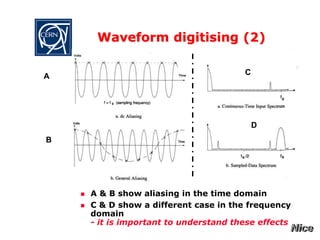
 A & B show aliasing in the time domain
 C & D show a different case in the frequency
domain
- it is important to understand these effects
A
B
C
D
Waveform digitising errors
 For a DAC
 output waveform is a ‘distorted’ version of original
 higher frequencies not reproduced - aliasing ?
 ‘average shape’ displaced in time
 ‘sharp’ edges need filtering
 For an ADC
 converter sampling errors
 with a ‘sample & hold’ circuit ahead of the converter?
 integrating action during part, or all of the sample-time
?
 conversion time
 data ‘available’ delay
 aliasing - [ is multiplication of input spectrum and
fs]
…[must ‘remove’ all spectrum > fs/2 before
sampling]
Sampling rate
 Nyquist rate = 2x highest frequency of
interest
 Practically, - always sample at least 5x, or
higher
 Ensure ADCs have input filtering [anti-alias]
where necessary [large hf signals]
 Filter DAC outputs to remove higher
frequencies and switching ‘glitches’
 ‘Over-sampling’ converters sample x4 to
x500 - this may reduce above problems
and/or extend resolution
CERN examples
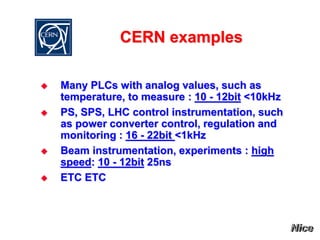
 Many PLCs with analog values, such as
temperature, to measure : 10 - 12bit <10kHz
 PS, SPS, LHC control instrumentation, such
as power converter control, regulation and
monitoring : 16 - 22bit <1kHz
 Beam instrumentation, experiments : high
speed: 10 - 12bit 25ns
 ETC ETC
Photos
1969
ISR Beam-Transfer DAC
[5 decimal decades]
Relay switching
Kelvin-Varley divider
1973
ISR Main Bends DAC
[16bit binary
All electronic switching
Photos
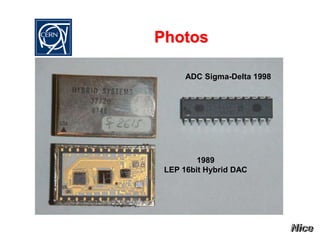
ADC Sigma-Delta 1998
1989
LEP 16bit Hybrid DAC
Understanding Conversion
Methods
AD/DA Methods
 Some very simple ideas
 DAC circuits
 Basic ADC circuits
 Successive approximation, flash - S&H
 Integrating - single/dual/multi slope
 Charge balance, D
Some very simple ideas
 ADC =
 precise reference voltage
 comparison of divider value with unknown [analog input]
 “digitally adjustable” divider or potentiometer [output
value]
 DAC =
 precise reference voltage ……. {multiplying dac}
 “digitally adjustable” divider or potentiometer [input
value]
 optional output amplifier of pot. value [analog output]
=
‘Digitally set’
potentiometer
dial
Comparator
equal
Vref
Unknown
voltage
DAC ADC
Vdac
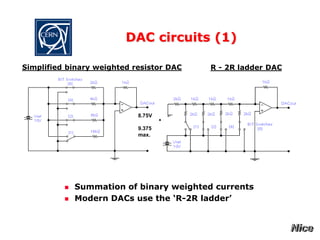
DAC circuits (1)
 Summation of binary weighted currents
 Modern DACs use the ‘R-2R ladder’
Simplified binary weighted resistor DAC
8.75V
9.375
max.
R - 2R ladder DAC
DAC circuits (2)
 Important circuit concepts
 Resistor tracking - temp. & time > ratios
 Switch is part of R [on & off resistance]
 Limits for tracking and adjustment
 Switch transition times - glitches
 Switched current sources are faster
 Other DAC methods
 DC performance not needed for all uses
 Different ladders, Caps. as well as Resistors
 PWM, F>V
 Sigma-Delta
 Performance cannot be better than the Reference
- {multiplying DAC concept}
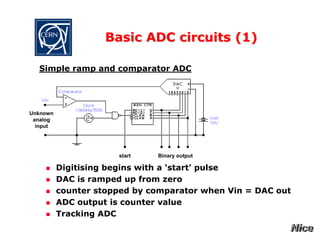
Basic ADC circuits (1)
 Digitising begins with a ‘start’ pulse
 DAC is ramped up from zero
 counter stopped by comparator when Vin = DAC out
 ADC output is counter value
 Tracking ADC
Simple ramp and comparator ADC
start Binary output
Unknown
analog
input
Basic ADC circuits (2)
 This ADC circuit is limited and rarely used
WHY -
 slow
 variable time to give result
 input signal can vary during digitising
 Successive Approximation ADC solves these
problems - using
 complex logic to test and retain each DAC bit
 a sample and hold circuit ahead of the
comparator
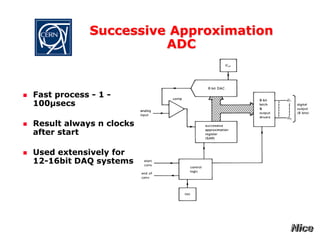
Successive Approximation
ADC
 Fast process - 1 -
100µsecs
 Result always n clocks
after start
 Used extensively for
12-16bit DAQ systems
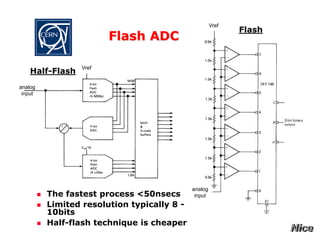
Flash ADC
 The fastest process <50nsecs
 Limited resolution typically 8 -
10bits
 Half-flash technique is cheaper
Flash
Half-Flash
analog
input
analog
input
Vref
Vref
Sample & Hold Circuit (1)
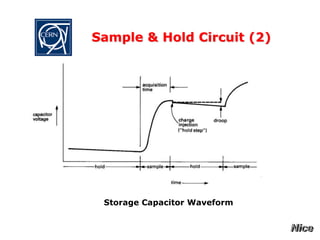
 Essential for defining the ‘exact’ moment of
sampling
 Circuit introduces other error sources [ see (2) ]
LF398
Sample & Hold Circuit (2)
Storage Capacitor Waveform

ADDA_Lecture_P1.ppt

  • 1.
    AD/DA Conversion Techniques - AnOverview J. G. Pett  Introductory tutorial lecture for :- ‘Analogue and digital techniques in closed-loop regulation applications’ 17/09/2002  for terminology see Analog Devices Inc.
  • 2.
    AD/DA  Introduction tothe subject  Understanding conversion methods  Methods  Parameters  The past, the present and the future
  • 3.
    Introduction  What areAD/DA Converters  What are they used for  Why do you need to know how they work  Digital coding methods  Waveform digitising  CERN examples
  • 4.
    What are AD/DA Converters(1)  An Analog to Digital converter [AD or ADC] is an electronic circuit which accepts an analog input signal (usually a voltage) and produces a corresponding digital number at the output  An Digital to Analog converter [DA or DAC] is an electronic circuit which accepts a digital number at its input and produces a corresponding analog signal (usually a voltage) at the output  They exist as modules, ICs, or fully integrated inside other parts, e.g. µCs
  • 5.
  • 6.
    What are AD/DAConverters (2) ADC 1 DAC 1 ADC 2 COMPUTER or µP/µC 12 16 16 Digital discrete time world Analog continuous time world Analog continuous time world The Real World The Real World Typical AD & DA Application +/-10v +/-5v +/-10v
  • 7.
    What are theyused for  Any time a real world analog signal is connected to a digital system  CD players, GSMs, DVMs, Digital Camcorders etc, etc  CERN control systems & instruments  HOWEVER, each application has particular needs  Resolution - number of bits  Speed and Accuracy  Level of input/output waveforms  Cost etc
  • 8.
    Why do youneed to know how they work  Because the theoretical course you will shortly undertake assumes perfect converter products - BUT  Practical converters have :  Many conversion methods - why  Trade-offs between resolution and speeds + delays  Different methods of “sampling” the waveforms  A large number of basic and method-dependent error sources  Manufacturers specifications which ‘differ’ - AND  Almost all converters need some analog ‘signal conditioning’ which is application dependent
  • 9.
    Digital coding methods(1)  8,10,12,14,16,18, 20-24bits?  Most/Least significant bit MSB/LSB  Uni-polar, bipolar, straight binary, 2’s complement - invert MSB  Parallel I/O or serial [delay]  Bytes or words  Double buffering  Digital ‘breakthrough’  Digital correction methods  Time skewing & jitter 0v +10v -10v 0000 FFFF 8000 AD/DA Transfer Characteristic 0000 7FFF FFFF 8000
  • 10.
    Digital coding methods(2)  Resolution = 2n-1 [n = number of bits] n 2n 1bit ppm [1x10⁻⁶]  8bits 256 3906  10bits 1024 976  12bits 4096 244  14bits 16384 61  16bits 65536 15  18bits 262144 3.8  20bits 1,048576 0.95  22bits 4,194304 0.24  24bits 16,777216 0.06
  • 11.
    Waveform digitising (1) A waveform is ‘digitised’ (sampled) at a constant rate D t  Each such sample represents the instantaneous amplitude at the instant of sampling  Between samples the value remains constant [zero order hold]  What errors can occur in this process ? time Digital value
  • 12.
    Waveform digitising (2) A & B show aliasing in the time domain  C & D show a different case in the frequency domain - it is important to understand these effects A B C D
  • 13.
    Waveform digitising errors For a DAC  output waveform is a ‘distorted’ version of original  higher frequencies not reproduced - aliasing ?  ‘average shape’ displaced in time  ‘sharp’ edges need filtering  For an ADC  converter sampling errors  with a ‘sample & hold’ circuit ahead of the converter?  integrating action during part, or all of the sample-time ?  conversion time  data ‘available’ delay  aliasing - [ is multiplication of input spectrum and fs] …[must ‘remove’ all spectrum > fs/2 before sampling]
  • 14.
    Sampling rate  Nyquistrate = 2x highest frequency of interest  Practically, - always sample at least 5x, or higher  Ensure ADCs have input filtering [anti-alias] where necessary [large hf signals]  Filter DAC outputs to remove higher frequencies and switching ‘glitches’  ‘Over-sampling’ converters sample x4 to x500 - this may reduce above problems and/or extend resolution
  • 15.
    CERN examples  ManyPLCs with analog values, such as temperature, to measure : 10 - 12bit <10kHz  PS, SPS, LHC control instrumentation, such as power converter control, regulation and monitoring : 16 - 22bit <1kHz  Beam instrumentation, experiments : high speed: 10 - 12bit 25ns  ETC ETC
  • 16.
    Photos 1969 ISR Beam-Transfer DAC [5decimal decades] Relay switching Kelvin-Varley divider 1973 ISR Main Bends DAC [16bit binary All electronic switching
  • 17.
  • 18.
  • 19.
    AD/DA Methods  Somevery simple ideas  DAC circuits  Basic ADC circuits  Successive approximation, flash - S&H  Integrating - single/dual/multi slope  Charge balance, D
  • 20.
    Some very simpleideas  ADC =  precise reference voltage  comparison of divider value with unknown [analog input]  “digitally adjustable” divider or potentiometer [output value]  DAC =  precise reference voltage ……. {multiplying dac}  “digitally adjustable” divider or potentiometer [input value]  optional output amplifier of pot. value [analog output] = ‘Digitally set’ potentiometer dial Comparator equal Vref Unknown voltage DAC ADC Vdac
  • 21.
    DAC circuits (1) Summation of binary weighted currents  Modern DACs use the ‘R-2R ladder’ Simplified binary weighted resistor DAC 8.75V 9.375 max. R - 2R ladder DAC
  • 22.
    DAC circuits (2) Important circuit concepts  Resistor tracking - temp. & time > ratios  Switch is part of R [on & off resistance]  Limits for tracking and adjustment  Switch transition times - glitches  Switched current sources are faster  Other DAC methods  DC performance not needed for all uses  Different ladders, Caps. as well as Resistors  PWM, F>V  Sigma-Delta  Performance cannot be better than the Reference - {multiplying DAC concept}
  • 23.
    Basic ADC circuits(1)  Digitising begins with a ‘start’ pulse  DAC is ramped up from zero  counter stopped by comparator when Vin = DAC out  ADC output is counter value  Tracking ADC Simple ramp and comparator ADC start Binary output Unknown analog input
  • 24.
    Basic ADC circuits(2)  This ADC circuit is limited and rarely used WHY -  slow  variable time to give result  input signal can vary during digitising  Successive Approximation ADC solves these problems - using  complex logic to test and retain each DAC bit  a sample and hold circuit ahead of the comparator
  • 25.
    Successive Approximation ADC  Fastprocess - 1 - 100µsecs  Result always n clocks after start  Used extensively for 12-16bit DAQ systems
  • 26.
    Flash ADC  Thefastest process <50nsecs  Limited resolution typically 8 - 10bits  Half-flash technique is cheaper Flash Half-Flash analog input analog input Vref Vref
  • 27.
    Sample & HoldCircuit (1)  Essential for defining the ‘exact’ moment of sampling  Circuit introduces other error sources [ see (2) ] LF398
  • 28.
    Sample & HoldCircuit (2) Storage Capacitor Waveform

Editor's Notes

  • #2 Good Afternoon Everyone My name is John Pett SL/PO group and I have been working with AD/DA conversion for all of my career at Cern some 36 years Now today we have an important introduction to this subject and since I have some 50 odd slides it would be good to know my audience a little. Would all of you who have NO knowledge about the subject please raise their hands Fine, now all of you who have actually bought an ADC or a DAC and made it work please raise their hands. THANKS Now as this is going to be a long tutorial and you may well forget any questions, I would propose that at the end of each slide please raise any immediate questions. Either I will note them on the blackboard or answer them immediately. Equally, at the end of each major section I will answer any general questions. Now the aim is to give you all a feel about the subject and some fairly basic information to take to the other courses. This is not a design course so many of my diagrams are simple but remember that the circuit design detail is what is so important to success. SO LETS GET GOING