International Medical Faculty
NAME :- MOHIT RULANIYA
TOPIC :- ACUTE PYELONEPHRITIS
Acute pyelonephritis:-
• It is a sudden and severe kidney
infection. It causes the kidneys to swell
and may permanently damage them.
• Acute pyelonephritis is a bacterial
infection of the renal pelvis and
parenchyma most commonly seen in
young women.
• It remains common and continues to
have significant morbidity in certain
groups of patients.
Epidemiology:-
• The incidence of acute pyelonephritis
parallels that of lower urinary tract
infections:-
• approximately five times more common
in females with a sharp increase
following puberty.
• Epidemiologic data on
the incidence of pyelonephritis are
limited. A population-based study
of acute pyelonephritis in the United
States found overall annual rates of 15-17
cases per 10,000 females and 3-4 cases
per 10,000 males. At least 250,000 cases
of pyelonephritis are diagnosed annually
in the United States.
Etiology:-
ETIOLOGY:-
• From there, the bacteria travel through the
ureters to the kidneys.
• Bacteria such as E. coli often cause the
infection.
• However, any serious infection in the
bloodstream can also spread to the kidneys
and cause acute pyelonephritis.
Symptoms:-
• Symptoms usually appear within two days
of infection. Common symptoms include:
• a fever greater than 102°F (38.9°C)
• pain in the abdomen, back, side, or groin
• painful or burning urination
• cloudy urine
• pus or blood in the urine
• urgent or frequent urination
• fishy-smelling urine
Other symptoms can include:
• shaking or chills
• nausea
• vomiting
• general aching or ill feeling,Fatigue,moist
skin,mental confusion
Clinical presentation:-
•Clinical presentation is fairly specific
and classical in most cases, consisting
of a rapid onset of high fever and flank
pain and tenderness.
• In many instances, less specific or non-
urinary symptoms and signs may also
be present, which may lead to clinical
confusion 1.
•White cells and bacteria are usually
present in the urine, and blood tests
reveal the expected changes:
leukocytosis (WBC) and increased C-
reactive protein (CRP) and/or
erythrocyte sedimentation rate (ESR).
In severe cases, sepsis may be present.
•Anorexia
•Dysuria
•Hematuria
•Foul smelling in urine
•Low back pain
Risk factors of Acute pyelonephritis:-
Any problem that interrupts the normal flow of
urine causes a greater risk of acute pyelonephritis.
For example, a urinary tract that is an unusual size
or shape is more likely to lead to acute
pyelonephritis. Also, women’s urethras are much
shorter than men’s, so it’s easier for bacteria to
enter their bodies. That makes women more prone
to kidney infections and puts them at a higher risk
of acute pyelonephritis.
• Other people who are at increased risk include:
• anyone with chronic kidney stones or other kidney
or bladder conditions
• older adults
• people with suppressed immune systems, such as
people with diabetes, AIDS, or cancer
• people with vesicoureteral reflux (a condition
where small amounts of urine back up from the
bladder into the ureters and kidneys)
• people with enlarged prostate
• Other factors that can make you vulnerable to
infection include:
• catheter use
• cystoscopic examination
• urinary tract surgery
• certain medications
• nerve or spinal cord damage
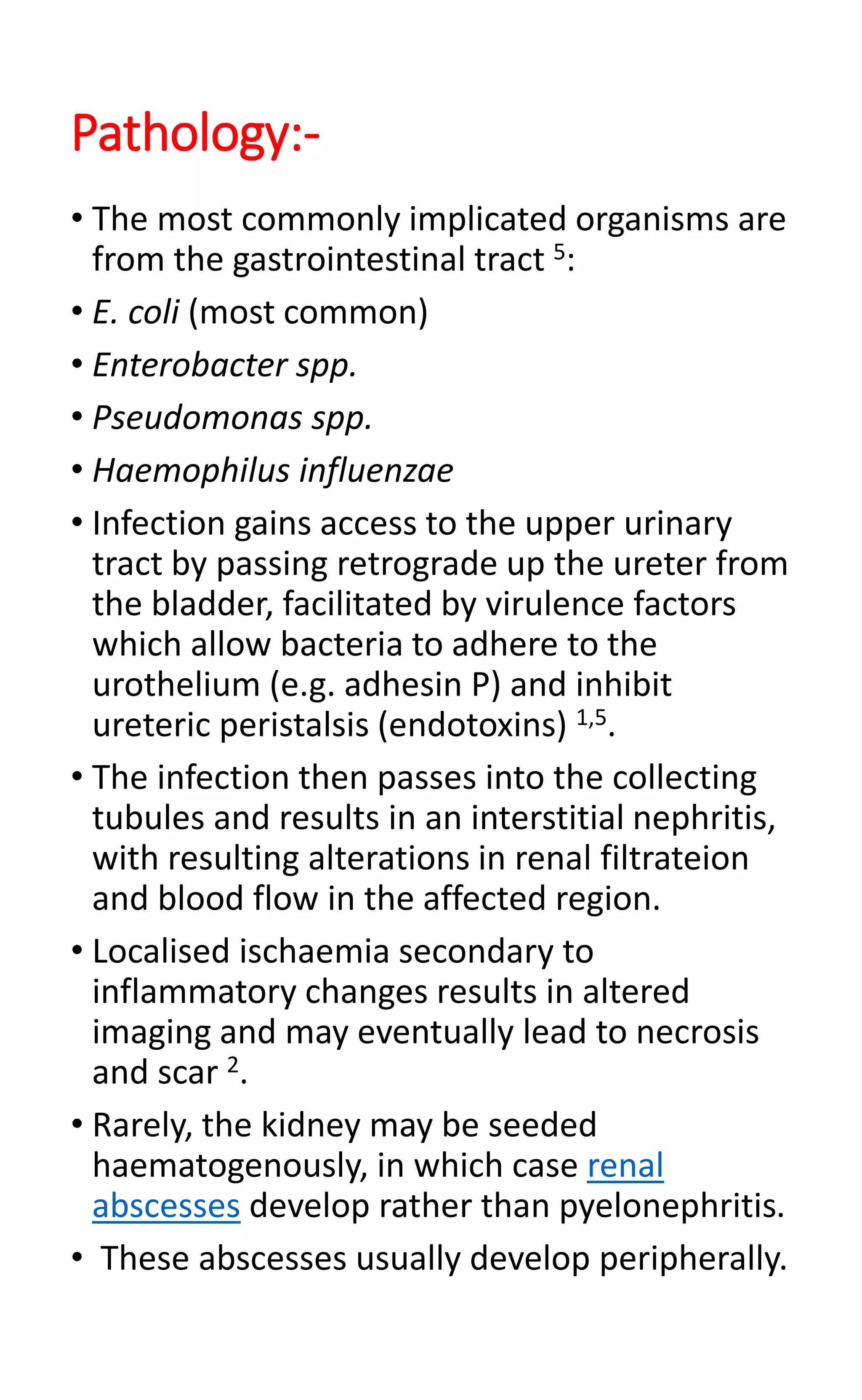
Pathology:-
• The most commonly implicated organisms are
from the gastrointestinal tract 5:
• E. coli (most common)
• Enterobacter spp.
• Pseudomonas spp.
• Haemophilus influenzae
• Infection gains access to the upper urinary
tract by passing retrograde up the ureter from
the bladder, facilitated by virulence factors
which allow bacteria to adhere to the
urothelium (e.g. adhesin P) and inhibit
ureteric peristalsis (endotoxins) 1,5.
• The infection then passes into the collecting
tubules and results in an interstitial nephritis,
with resulting alterations in renal filtrateion
and blood flow in the affected region.
• Localised ischaemia secondary to
inflammatory changes results in altered
imaging and may eventually lead to necrosis
and scar 2.
• Rarely, the kidney may be seeded
haematogenously, in which case renal
abscesses develop rather than pyelonephritis.
• These abscesses usually develop peripherally.
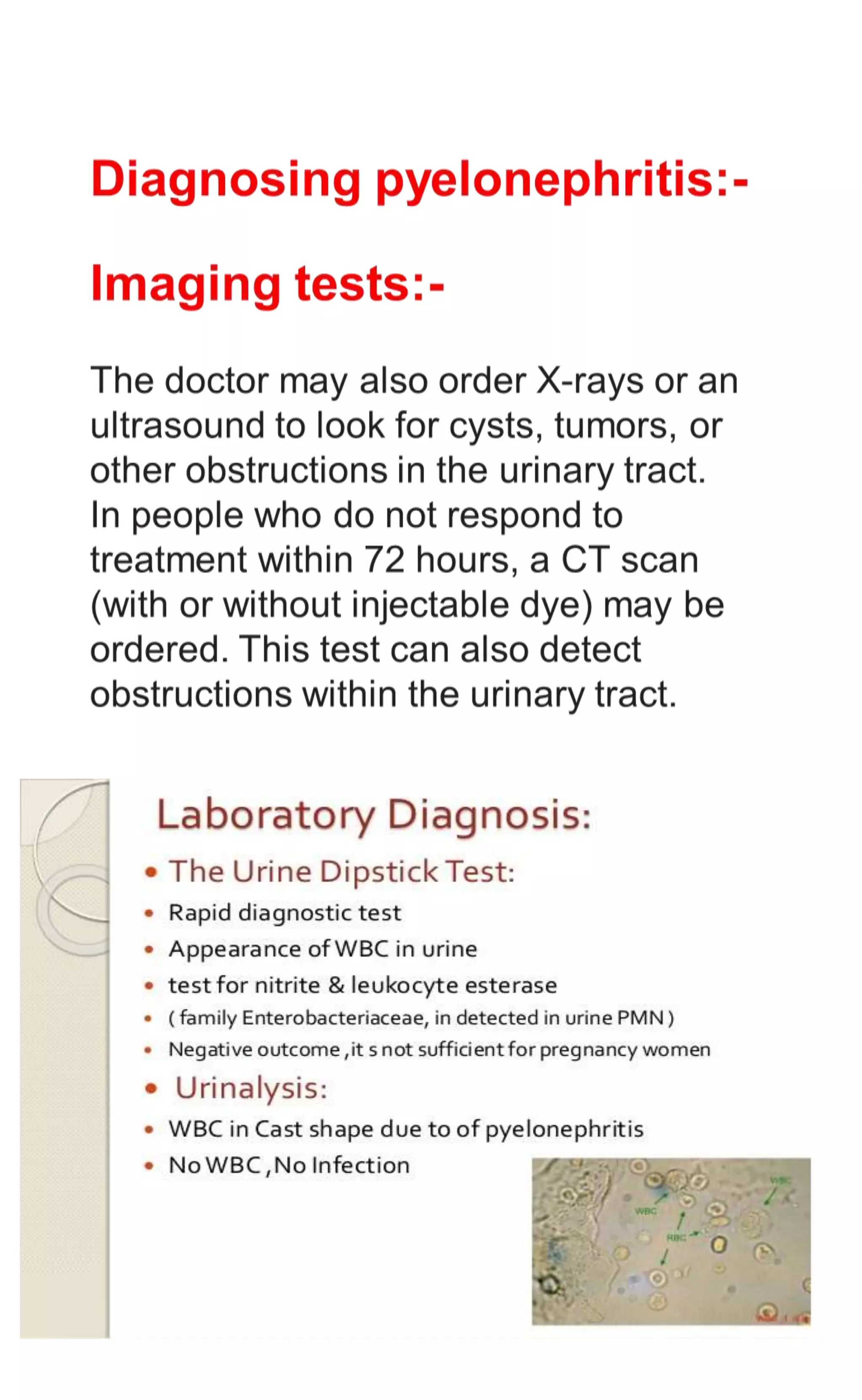
DIAGNOSIS:-
•CBC test
•Urine test
•Blood test
•Ultra sound
•CT scan
•MRI:-
•MRI is usually reserved for patients who
are pregnant, and findings mirror those
seen on CT. The kidney demonstrates
wedge shaped regions of altered signal:-
•T1: affected region(s) appear hypointense
compared to normal kidney parenchyma
•T2: hyperintense compared to normal
kidney parenchyma
T1 C+: reduced enhancement
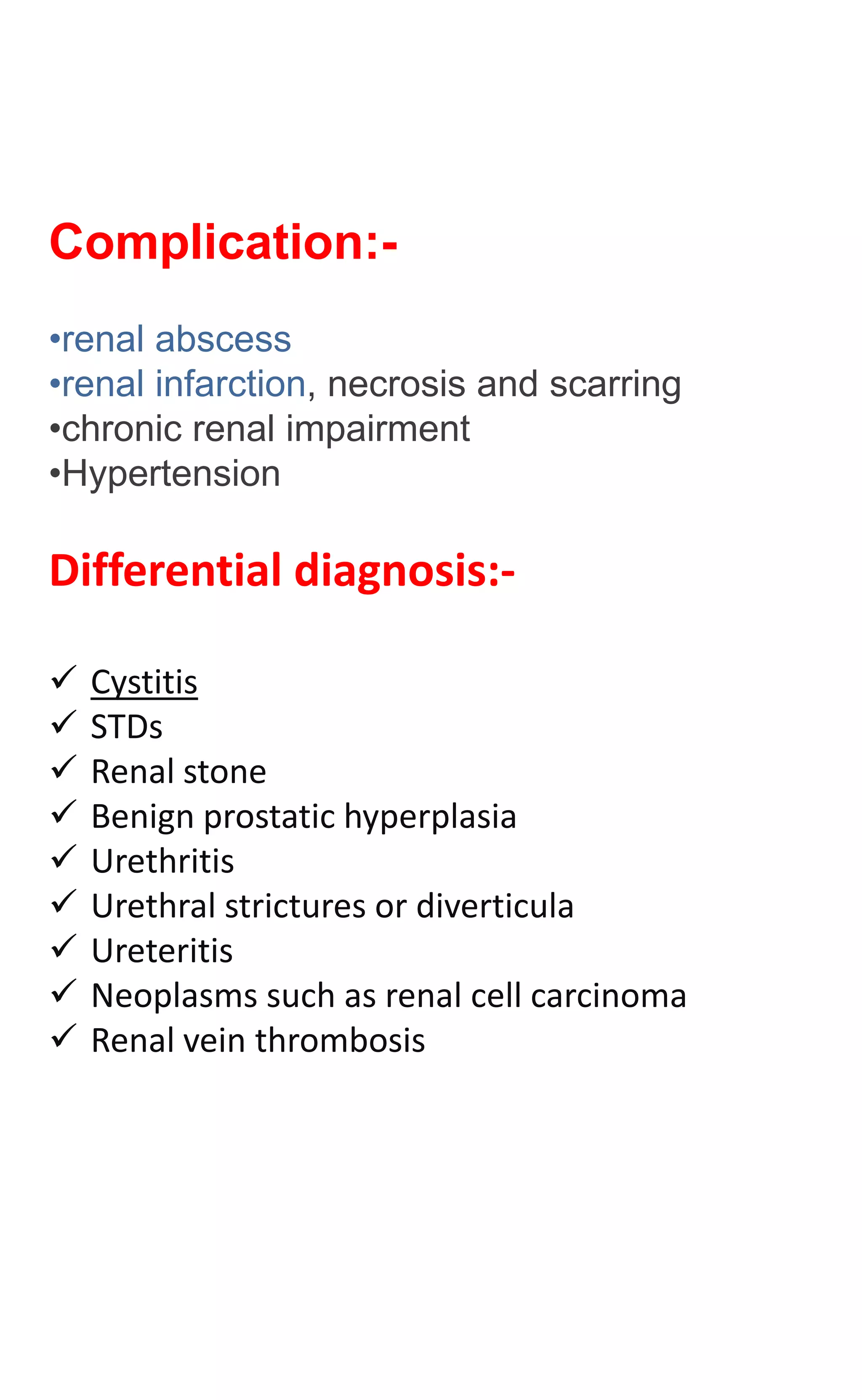
Complication:-
•renal abscess
•renal infarction, necrosis and scarring
•chronic renal impairment
•Hypertension
Differential diagnosis:-
 Cystitis
 STDs
 Renal stone
 Benign prostatic hyperplasia
 Urethritis
 Urethral strictures or diverticula
 Ureteritis
 Neoplasms such as renal cell carcinoma
 Renal vein thrombosis
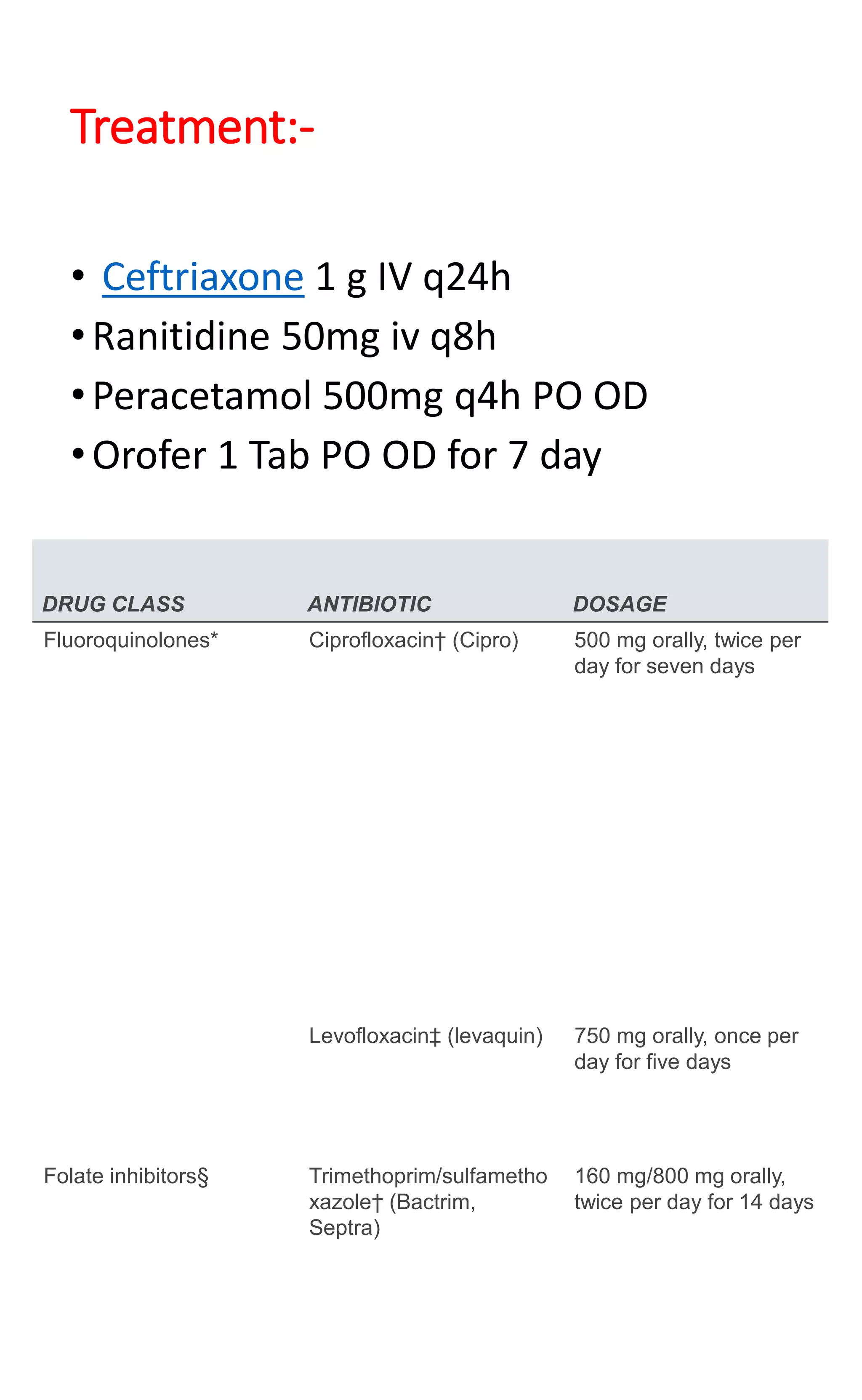
Treatment:-
• Ceftriaxone 1 g IV q24h
•Ranitidine 50mg iv q8h
•Peracetamol 500mg q4h PO OD
•Orofer 1 Tab PO OD for 7 day
DRUG CLASS ANTIBIOTIC DOSAGE
Fluoroquinolones* Ciprofloxacin† (Cipro) 500 mg orally, twice per
day for seven days
Levofloxacin‡ (levaquin) 750 mg orally, once per
day for five days
Folate inhibitors§ Trimethoprim/sulfametho
xazole† (Bactrim,
Septra)
160 mg/800 mg orally,
twice per day for 14 days

Acute pyelonephritis

  • 1.
    International Medical Faculty NAME:- MOHIT RULANIYA TOPIC :- ACUTE PYELONEPHRITIS
  • 2.
    Acute pyelonephritis:- Acute pyelonephritis:- •It is a sudden and severe kidney infection. It causes the kidneys to swell and may permanently damage them. • Acute pyelonephritis is a bacterial infection of the renal pelvis and parenchyma most commonly seen in young women. • It remains common and continues to have significant morbidity in certain groups of patients. Epidemiology:- • The incidence of acute pyelonephritis parallels that of lower urinary tract infections:- • approximately five times more common in females with a sharp increase following puberty. • Epidemiologic data on the incidence of pyelonephritis are limited. A population-based study of acute pyelonephritis in the United States found overall annual rates of 15-17 cases per 10,000 females and 3-4 cases per 10,000 males. At least 250,000 cases of pyelonephritis are diagnosed annually in the United States.
  • 3.
    Etiology:- ETIOLOGY:- • From there,the bacteria travel through the ureters to the kidneys. • Bacteria such as E. coli often cause the infection. • However, any serious infection in the bloodstream can also spread to the kidneys and cause acute pyelonephritis. Symptoms:- • Symptoms usually appear within two days of infection. Common symptoms include: • a fever greater than 102°F (38.9°C) • pain in the abdomen, back, side, or groin • painful or burning urination • cloudy urine • pus or blood in the urine • urgent or frequent urination • fishy-smelling urine Other symptoms can include: • shaking or chills • nausea • vomiting • general aching or ill feeling,Fatigue,moist skin,mental confusion
  • 4.
    Clinical presentation:- •Clinical presentationis fairly specific and classical in most cases, consisting of a rapid onset of high fever and flank pain and tenderness. • In many instances, less specific or non- urinary symptoms and signs may also be present, which may lead to clinical confusion 1. •White cells and bacteria are usually present in the urine, and blood tests reveal the expected changes: leukocytosis (WBC) and increased C- reactive protein (CRP) and/or erythrocyte sedimentation rate (ESR). In severe cases, sepsis may be present. •Anorexia •Dysuria •Hematuria •Foul smelling in urine •Low back pain
  • 5.
    Risk factors ofAcute pyelonephritis:- Any problem that interrupts the normal flow of urine causes a greater risk of acute pyelonephritis. For example, a urinary tract that is an unusual size or shape is more likely to lead to acute pyelonephritis. Also, women’s urethras are much shorter than men’s, so it’s easier for bacteria to enter their bodies. That makes women more prone to kidney infections and puts them at a higher risk of acute pyelonephritis. • Other people who are at increased risk include: • anyone with chronic kidney stones or other kidney or bladder conditions • older adults • people with suppressed immune systems, such as people with diabetes, AIDS, or cancer • people with vesicoureteral reflux (a condition where small amounts of urine back up from the bladder into the ureters and kidneys) • people with enlarged prostate • Other factors that can make you vulnerable to infection include: • catheter use • cystoscopic examination • urinary tract surgery • certain medications • nerve or spinal cord damage
  • 6.
    Pathology:- • The mostcommonly implicated organisms are from the gastrointestinal tract 5: • E. coli (most common) • Enterobacter spp. • Pseudomonas spp. • Haemophilus influenzae • Infection gains access to the upper urinary tract by passing retrograde up the ureter from the bladder, facilitated by virulence factors which allow bacteria to adhere to the urothelium (e.g. adhesin P) and inhibit ureteric peristalsis (endotoxins) 1,5. • The infection then passes into the collecting tubules and results in an interstitial nephritis, with resulting alterations in renal filtrateion and blood flow in the affected region. • Localised ischaemia secondary to inflammatory changes results in altered imaging and may eventually lead to necrosis and scar 2. • Rarely, the kidney may be seeded haematogenously, in which case renal abscesses develop rather than pyelonephritis. • These abscesses usually develop peripherally.
  • 8.
    DIAGNOSIS:- •CBC test •Urine test •Bloodtest •Ultra sound •CT scan •MRI:- •MRI is usually reserved for patients who are pregnant, and findings mirror those seen on CT. The kidney demonstrates wedge shaped regions of altered signal:- •T1: affected region(s) appear hypointense compared to normal kidney parenchyma •T2: hyperintense compared to normal kidney parenchyma T1 C+: reduced enhancement
  • 9.
    Complication:- •renal abscess •renal infarction,necrosis and scarring •chronic renal impairment •Hypertension Differential diagnosis:-  Cystitis  STDs  Renal stone  Benign prostatic hyperplasia  Urethritis  Urethral strictures or diverticula  Ureteritis  Neoplasms such as renal cell carcinoma  Renal vein thrombosis
  • 10.
    Treatment:- • Ceftriaxone 1g IV q24h •Ranitidine 50mg iv q8h •Peracetamol 500mg q4h PO OD •Orofer 1 Tab PO OD for 7 day DRUG CLASS ANTIBIOTIC DOSAGE Fluoroquinolones* Ciprofloxacin† (Cipro) 500 mg orally, twice per day for seven days Levofloxacin‡ (levaquin) 750 mg orally, once per day for five days Folate inhibitors§ Trimethoprim/sulfametho xazole† (Bactrim, Septra) 160 mg/800 mg orally, twice per day for 14 days