ACTIVE MOVEMENT –
ASSISTED EXERCISE
Prof. Dr. M. Rajesh, PT, M.P.T(cardio), B.C.R.C
TRINITY MISSION AND MEDICAL FOUNDATION
MADURAI
INTRODUCTION
 Active exercise or active movement is a term commonly used by
physical therapy, rehabilitation and fitness centres. ‘Active
movement’ is that which an individual does voluntary
movement, one’s own strength or energy. Active exercise help
keep joints flexible, maintain good blood flow to the exercised
joints and may help prevent blood clots. A health care
practitioner may assign active exercises after an injury or in
connection with medications and other therapies to help
manage chronic pain.
VOLUNTARY MOVEMENT
Definition
 Movement performed or controlled by the voluntary action of
muscles, working in opposition to and external force.
CLASSIFICATION
 Free exercise – the working muscles are subject only to the
forces of gravity acting upon the part moved or stabilized.
 Assister exercise – when muscle strength or co-ordination is
inadequate to perform a movement an external force is applied
to compensate for the deficiency.
 Assisted-resisted exercise – muscles may be strong enough to
work against resistance in part of the range and not in others.
This type of exercise ensures that the external forces applied
are adapted in every part of the range to the abilities of the
muscles.
 Resisted exercise – the forces of resistance offered to the action
of the working muscles are artificially and systematically
increased to develop the power endurance of the muscles.
ASSISTED EXERCISE
PRINCIPLES OF ASSISTED
EXERCISE
 When the force exerted on one of the body levers by muscular
action is sufficient for the production or control of movement,
an external force may be added to augment it. This external
force must be applied in the direction of the muscle action but
not necessarily aat the same point, as a mechanical advantage
can be gained by increasing the leverage. The magnitude of this
assisting force must be sufficient only to augment the muscular
action and must not be allowed to act as a substitiue for it, for if
it does a passive movement results. As the power of the muscle
increases, the assistance given must decrease proportionally.
TECHNIQUE
 The general plan is to ensure that the inefficient muscles exert
their maximum effort to produce movement under conditions
designed to facilitate their action. The assisting force is applied
only to augment this maximum effort and not to act as a
substitute for it
START POSITION
 Stability for the body as a whole ensures that the patient’s
whole attention is concentrated on the pattern of movement
and the effort required to perform it
PATTERN OF MOVMENT
 This must be well known and understood by the patient. It can
be taught by passive movement or in the case of limb
movements by active movement of the contralateral limb.
FIXATION
 Adequate fixation of the bone of origin of the prime movers
improves their efficiency. Whenever possible this fixation should
be achieved by active means in order that the weak muscles
may receive reinforcement from of those muscles with which
they normally associate for the production of voluntary
movement. When there is a tendency for movement to be
transferred to neighbouring joints to compensate for the
inefficiency of the weak muscles, movement in these joint must
be controlled or ‘held back’ by manual pressure or other means
of fixation, so that the movement is provided at the required
joint.
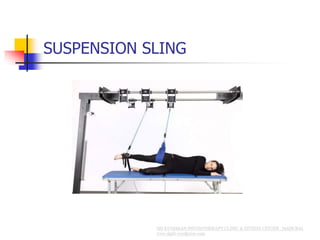
SUPPORT
 The part of the body moved is supported throughout to reduce
the load on the weakened muscles by counterbalancing the
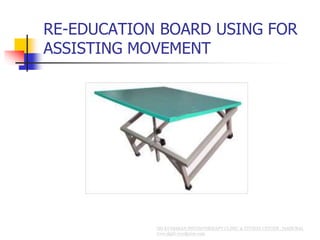
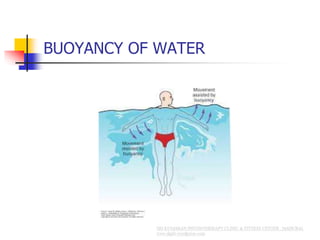
effects of the force of gravity. This support may be provided by
the physiotherapist’s hands, suspension slings, polished
horizontal surface such as re-education board, the buoyancy of
water or ball-bearing skates. Advantage of manual support is
that it can be effective in whichever plane is most suitable for
the movement and the assistance adjusted to what is required
in each successive part of the range.
SUSPENSION SLING
RE-EDUCATION BOARD USING FOR
ASSISTING MOVEMENT
BUOYANCY OF WATER
ANTAGONISTIC MUSCLES
 Every effort must be made to reduce tension in the muscles
which are antagonistic to the movement. The starting position
for the movement should be chosen to ensure that tension in
these muscles is minimal, e.g. a position in which the knee is
flexed is suitable for assisted dorsiflexion of the foot.
TRACTION
 Preliminaty stretching of the weak muscles to elicit the myotatic
(stretch) reflex provides a powerful stimulus to contraction.
Other means of facilitating the activity of the muscles may also
be used.
THE ASSISTING FORCE
 The force used to augment the action of the muscles is applied
in the direction of the movement, preferably by means of the
physiotherapist’s hands, which should be placed in such in way
that they rest on the surface of the patient’ skin which is in the
direction of the movement. In some cases the patient’s own
hands may be substituted for those of the physiotherapist,
provided the thoroughly understands the procedure.
 The range of movement is as full as possible, but as the power
of muscles varies in different parts of their range more
assistance will be necessary in some parts than in others. In
general, most assistance is required to overcome the initial
inertia at the beginning of movement and at the end to
complete the range. The assistance provided by mechanical
means varies in different parts of the range according to
definite physical laws and therefore it cannot be adjusted to
meet the precise requirements of the muscles, with the result
that their maximum effort is rarely elicited and all too frequently
the movement becomes passive in character.
THE CHARACTER OF THE
MOVEMENT
 The character of the movement - the movement is essentially
smooth as this is characteristic of efficient voluntary movement
and it is performed in response to a forceful command which
demands the patient’s full attention. The speed of movement
depends on the muscles involved as each has its own optimum
rate of contraction which varies according to its structure and
the load. Generally speaking fusiform muscles contract rapidly
and multipennate ones take longer. Very weak muscles cannot
be expected to produced a sustained contraction and therefore
assistance is giver ‘in step’ with the contraction which may only
be evident as a flicker in the early stages but as power
increases the speed of the movement can be decreased.
REPETITION
 The number of times the movement is repeated depends on
whether it is considered advisable or injurious to fatigue the
muscles in question; therefore the condition which has caused
the weakness must be known and understood.
CO-OPERATION OF THE
PATIENT
 The co-operation of the patient is essential during this type of
exercise, the aim being for him to achieve controlled active
movement without assistance. Concentrated effort is needed to
encourage the muscles to do all they can to help the movement,
so praise, well earned, should not be stinted. The ability to see
results and to feel what is happening is a great help to the
patient so he can be encouraged to palpate his muscles as they
contract.
EFFECTS AND USED OF
ASSISTED EXERCISE
(A)
 The working muscles co-operate in the production of movement
which they are incapable of achieving unaided. Provided the
maximum effort of which they are capable is demanded from
the weak muscles and the assisting force utilised is only
complementary, these muscles will gain in strength and
hypertrophy.
 The type of exercise may be used in the early stages of
neuromuscular re-education.
(B)
 The memory of the pattern of co-ordinated movement is
stimulated by the correct performance of a movement which the
patient is unable to achieve without assistance. By frequent
repetition of the correct pattern with decreasing assistance, the
patient may re-learn to control the movement himself as the
conduction of impulses is facilitated in the neuromuscular
pathways.
 Assisted exercise may therefore be helpful in training co-
ordination.
(C)
 Confidence in the ability to move is established when the
Patient observes the movement and the fact that his muscles
co-operate in producing it. The knowledge that the limb is
supported throughout and that the movement attempted will be
achieved encourages the patient to make a maximum efforts.
 When movement must be maintained in spite of pain in joints
these exercises are very useful, e.g. in Rheumatoid arthritis.
(D)
 The rang of effective joint movement may be increased by
assisted exercise; however, as both range and control are often
dependent on the efficiency of the muscles working over that
joint, a technique which utilize resisted exercise for these
muscles for these muscles is usually preferable.
THANK YOU
Prof. Dr. M. RAJESH, PT,M.P.T(cardio),B.C.R.C
TRINITY MISSIOIN AND MEDICAL FOUNDATION
MADURAI.
Visit:
www.skpfc.wordpress.com

Active movement - Assisted exercises

  • 1.
    ACTIVE MOVEMENT – ASSISTEDEXERCISE Prof. Dr. M. Rajesh, PT, M.P.T(cardio), B.C.R.C TRINITY MISSION AND MEDICAL FOUNDATION MADURAI
  • 2.
    INTRODUCTION  Active exerciseor active movement is a term commonly used by physical therapy, rehabilitation and fitness centres. ‘Active movement’ is that which an individual does voluntary movement, one’s own strength or energy. Active exercise help keep joints flexible, maintain good blood flow to the exercised joints and may help prevent blood clots. A health care practitioner may assign active exercises after an injury or in connection with medications and other therapies to help manage chronic pain.
  • 3.
    VOLUNTARY MOVEMENT Definition  Movementperformed or controlled by the voluntary action of muscles, working in opposition to and external force.
  • 4.
    CLASSIFICATION  Free exercise– the working muscles are subject only to the forces of gravity acting upon the part moved or stabilized.  Assister exercise – when muscle strength or co-ordination is inadequate to perform a movement an external force is applied to compensate for the deficiency.  Assisted-resisted exercise – muscles may be strong enough to work against resistance in part of the range and not in others. This type of exercise ensures that the external forces applied are adapted in every part of the range to the abilities of the muscles.  Resisted exercise – the forces of resistance offered to the action of the working muscles are artificially and systematically increased to develop the power endurance of the muscles.
  • 5.
  • 6.
    PRINCIPLES OF ASSISTED EXERCISE When the force exerted on one of the body levers by muscular action is sufficient for the production or control of movement, an external force may be added to augment it. This external force must be applied in the direction of the muscle action but not necessarily aat the same point, as a mechanical advantage can be gained by increasing the leverage. The magnitude of this assisting force must be sufficient only to augment the muscular action and must not be allowed to act as a substitiue for it, for if it does a passive movement results. As the power of the muscle increases, the assistance given must decrease proportionally.
  • 7.
    TECHNIQUE  The generalplan is to ensure that the inefficient muscles exert their maximum effort to produce movement under conditions designed to facilitate their action. The assisting force is applied only to augment this maximum effort and not to act as a substitute for it
  • 8.
    START POSITION  Stabilityfor the body as a whole ensures that the patient’s whole attention is concentrated on the pattern of movement and the effort required to perform it
  • 9.
    PATTERN OF MOVMENT This must be well known and understood by the patient. It can be taught by passive movement or in the case of limb movements by active movement of the contralateral limb.
  • 10.
    FIXATION  Adequate fixationof the bone of origin of the prime movers improves their efficiency. Whenever possible this fixation should be achieved by active means in order that the weak muscles may receive reinforcement from of those muscles with which they normally associate for the production of voluntary movement. When there is a tendency for movement to be transferred to neighbouring joints to compensate for the inefficiency of the weak muscles, movement in these joint must be controlled or ‘held back’ by manual pressure or other means of fixation, so that the movement is provided at the required joint.
  • 11.
    SUPPORT  The partof the body moved is supported throughout to reduce the load on the weakened muscles by counterbalancing the effects of the force of gravity. This support may be provided by the physiotherapist’s hands, suspension slings, polished horizontal surface such as re-education board, the buoyancy of water or ball-bearing skates. Advantage of manual support is that it can be effective in whichever plane is most suitable for the movement and the assistance adjusted to what is required in each successive part of the range.
  • 12.
  • 13.
    RE-EDUCATION BOARD USINGFOR ASSISTING MOVEMENT
  • 14.
  • 15.
    ANTAGONISTIC MUSCLES  Everyeffort must be made to reduce tension in the muscles which are antagonistic to the movement. The starting position for the movement should be chosen to ensure that tension in these muscles is minimal, e.g. a position in which the knee is flexed is suitable for assisted dorsiflexion of the foot.
  • 16.
    TRACTION  Preliminaty stretchingof the weak muscles to elicit the myotatic (stretch) reflex provides a powerful stimulus to contraction. Other means of facilitating the activity of the muscles may also be used.
  • 17.
    THE ASSISTING FORCE The force used to augment the action of the muscles is applied in the direction of the movement, preferably by means of the physiotherapist’s hands, which should be placed in such in way that they rest on the surface of the patient’ skin which is in the direction of the movement. In some cases the patient’s own hands may be substituted for those of the physiotherapist, provided the thoroughly understands the procedure.
  • 18.
     The rangeof movement is as full as possible, but as the power of muscles varies in different parts of their range more assistance will be necessary in some parts than in others. In general, most assistance is required to overcome the initial inertia at the beginning of movement and at the end to complete the range. The assistance provided by mechanical means varies in different parts of the range according to definite physical laws and therefore it cannot be adjusted to meet the precise requirements of the muscles, with the result that their maximum effort is rarely elicited and all too frequently the movement becomes passive in character.
  • 19.
    THE CHARACTER OFTHE MOVEMENT  The character of the movement - the movement is essentially smooth as this is characteristic of efficient voluntary movement and it is performed in response to a forceful command which demands the patient’s full attention. The speed of movement depends on the muscles involved as each has its own optimum rate of contraction which varies according to its structure and the load. Generally speaking fusiform muscles contract rapidly and multipennate ones take longer. Very weak muscles cannot be expected to produced a sustained contraction and therefore assistance is giver ‘in step’ with the contraction which may only be evident as a flicker in the early stages but as power increases the speed of the movement can be decreased.
  • 20.
    REPETITION  The numberof times the movement is repeated depends on whether it is considered advisable or injurious to fatigue the muscles in question; therefore the condition which has caused the weakness must be known and understood.
  • 21.
    CO-OPERATION OF THE PATIENT The co-operation of the patient is essential during this type of exercise, the aim being for him to achieve controlled active movement without assistance. Concentrated effort is needed to encourage the muscles to do all they can to help the movement, so praise, well earned, should not be stinted. The ability to see results and to feel what is happening is a great help to the patient so he can be encouraged to palpate his muscles as they contract.
  • 22.
    EFFECTS AND USEDOF ASSISTED EXERCISE (A)  The working muscles co-operate in the production of movement which they are incapable of achieving unaided. Provided the maximum effort of which they are capable is demanded from the weak muscles and the assisting force utilised is only complementary, these muscles will gain in strength and hypertrophy.  The type of exercise may be used in the early stages of neuromuscular re-education.
  • 23.
    (B)  The memoryof the pattern of co-ordinated movement is stimulated by the correct performance of a movement which the patient is unable to achieve without assistance. By frequent repetition of the correct pattern with decreasing assistance, the patient may re-learn to control the movement himself as the conduction of impulses is facilitated in the neuromuscular pathways.  Assisted exercise may therefore be helpful in training co- ordination.
  • 24.
    (C)  Confidence inthe ability to move is established when the Patient observes the movement and the fact that his muscles co-operate in producing it. The knowledge that the limb is supported throughout and that the movement attempted will be achieved encourages the patient to make a maximum efforts.  When movement must be maintained in spite of pain in joints these exercises are very useful, e.g. in Rheumatoid arthritis.
  • 25.
    (D)  The rangof effective joint movement may be increased by assisted exercise; however, as both range and control are often dependent on the efficiency of the muscles working over that joint, a technique which utilize resisted exercise for these muscles for these muscles is usually preferable.
  • 26.
    THANK YOU Prof. Dr.M. RAJESH, PT,M.P.T(cardio),B.C.R.C TRINITY MISSIOIN AND MEDICAL FOUNDATION MADURAI. Visit: www.skpfc.wordpress.com