NOVEMBER, 2016
OUTLINE
 INTRODUCTION
 HISTORICAL BACKGROUND
 ARCHITECTURE OF AD DS
 PROTOCOL
 AUTHENTICATION
 AUTHORIZATION
 COMPONENTS OVERVIEW
 TRUSTS
 BENEFITS OF AD DS
 LIMITATIONS OF AD DS
 CONCLUSION
INTRODUCTION
Active Directory Domain Service (AD DS) is a server role in
Window Server Operating System that allows administrators to
centrally manage and store information about resources of a
network, as well as application data in a distributed database.
It is an outstanding versatile and secured technology for most
modern networking client-server environment
HISTORICAL BACKGROUND
 Mid 1990s, Active Directory was introduced by Microsoft
 Active Directory replaced Windows NT-style user
authentication
 Active Directory did not become a part of Windows
Operating System until the release of Windows 2000 in
2000
 Active Directory improved as Windows Server 2003 and
Windows Server 2008 was released
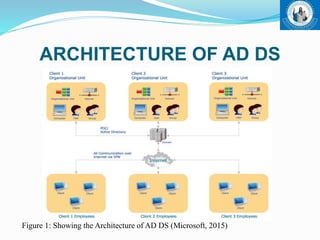
ARCHITECTURE OF AD DS
Figure 1: Showing the Architecture of AD DS (Microsoft, 2015)
PROTOCOL
 Lightweight Directory Access Protocol (LDAP)
 X.500 Standard
 Based on TCP/IP
 A method for accessing, searching, and modifying a
directory Service
 A client-server model
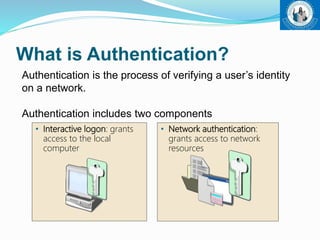
What is Authentication?
• Network authentication:
grants access to network
resources
• Interactive logon: grants
access to the local
computer
Authentication is the process of verifying a user’s identity
on a network.
Authentication includes two components
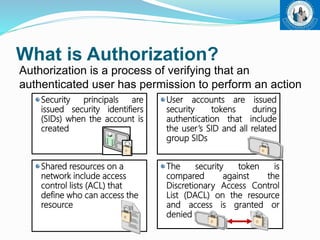
What is Authorization?
Security principals are
issued security identifiers
(SIDs) when the account is
created
User accounts are issued
security tokens during
authentication that include
the user’s SID and all related
group SIDs
Shared resources on a
network include access
control lists (ACL) that
define who can access the
resource
The security token is
compared against the
Discretionary Access Control
List (DACL) on the resource
and access is granted or
denied
Authorization is a process of verifying that an
authenticated user has permission to perform an action
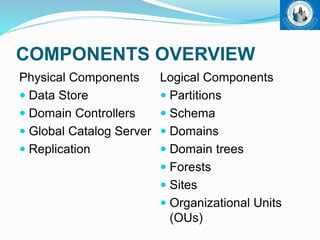
COMPONENTS OVERVIEW
Physical Components
 Data Store
 Domain Controllers
 Global Catalog Server
 Replication
Logical Components
 Partitions
 Schema
 Domains
 Domain trees
 Forests
 Sites
 Organizational Units
(OUs)
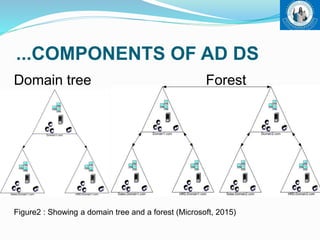
...COMPONENTS OF AD DS
Domain tree Forest
Figure2 : Showing a domain tree and a forest (Microsoft, 2015)
TRUSTS
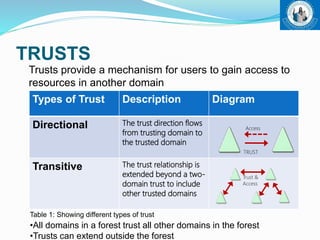
Trusts provide a mechanism for users to gain access to
resources in another domain
Types of Trust Description Diagram
Directional The trust direction flows
from trusting domain to
the trusted domain
Transitive The trust relationship is
extended beyond a two-
domain trust to include
other trusted domains
Access
TRUST
Trust &
Access
•All domains in a forest trust all other domains in the forest
•Trusts can extend outside the forest
Table 1: Showing different types of trust
BENEFITS OF AD DS
 Centralized Directory
 Single Sign on Access
 Scalability
 Common Management Interface
 Centralized Network Management
LIMITATIONS OF AD DS
 High maintenance costs
 Active Directory is OS dependent
 Cost of the infrastructure can be high
 It is prone to being hacked
CONCLUSION
Some firms today use workgroup network which
makes it difficult to centralize network
management. As a result of this, Active Directory
Domain Service comes handy which includes
storage of directory data and management of
communication between users and domains,
including user authentication and directory
searches.
THANKS
FOR
LISTENING

Active directory domain service

  • 1.
  • 2.
    OUTLINE  INTRODUCTION  HISTORICALBACKGROUND  ARCHITECTURE OF AD DS  PROTOCOL  AUTHENTICATION  AUTHORIZATION  COMPONENTS OVERVIEW  TRUSTS  BENEFITS OF AD DS  LIMITATIONS OF AD DS  CONCLUSION
  • 3.
    INTRODUCTION Active Directory DomainService (AD DS) is a server role in Window Server Operating System that allows administrators to centrally manage and store information about resources of a network, as well as application data in a distributed database. It is an outstanding versatile and secured technology for most modern networking client-server environment
  • 4.
    HISTORICAL BACKGROUND  Mid1990s, Active Directory was introduced by Microsoft  Active Directory replaced Windows NT-style user authentication  Active Directory did not become a part of Windows Operating System until the release of Windows 2000 in 2000  Active Directory improved as Windows Server 2003 and Windows Server 2008 was released
  • 5.
    ARCHITECTURE OF ADDS Figure 1: Showing the Architecture of AD DS (Microsoft, 2015)
  • 6.
    PROTOCOL  Lightweight DirectoryAccess Protocol (LDAP)  X.500 Standard  Based on TCP/IP  A method for accessing, searching, and modifying a directory Service  A client-server model
  • 7.
    What is Authentication? •Network authentication: grants access to network resources • Interactive logon: grants access to the local computer Authentication is the process of verifying a user’s identity on a network. Authentication includes two components
  • 8.
    What is Authorization? Securityprincipals are issued security identifiers (SIDs) when the account is created User accounts are issued security tokens during authentication that include the user’s SID and all related group SIDs Shared resources on a network include access control lists (ACL) that define who can access the resource The security token is compared against the Discretionary Access Control List (DACL) on the resource and access is granted or denied Authorization is a process of verifying that an authenticated user has permission to perform an action
  • 9.
    COMPONENTS OVERVIEW Physical Components Data Store  Domain Controllers  Global Catalog Server  Replication Logical Components  Partitions  Schema  Domains  Domain trees  Forests  Sites  Organizational Units (OUs)
  • 10.
    ...COMPONENTS OF ADDS Domain tree Forest Figure2 : Showing a domain tree and a forest (Microsoft, 2015)
  • 11.
    TRUSTS Trusts provide amechanism for users to gain access to resources in another domain Types of Trust Description Diagram Directional The trust direction flows from trusting domain to the trusted domain Transitive The trust relationship is extended beyond a two- domain trust to include other trusted domains Access TRUST Trust & Access •All domains in a forest trust all other domains in the forest •Trusts can extend outside the forest Table 1: Showing different types of trust
  • 12.
    BENEFITS OF ADDS  Centralized Directory  Single Sign on Access  Scalability  Common Management Interface  Centralized Network Management
  • 13.
    LIMITATIONS OF ADDS  High maintenance costs  Active Directory is OS dependent  Cost of the infrastructure can be high  It is prone to being hacked
  • 14.
    CONCLUSION Some firms todayuse workgroup network which makes it difficult to centralize network management. As a result of this, Active Directory Domain Service comes handy which includes storage of directory data and management of communication between users and domains, including user authentication and directory searches.
  • 15.

Editor's Notes