Accounting
Information
Systems
Chapter
6
HORNGREN ♦ HARRISON ♦ BAMBER ♦ BEST ♦ FRASER ♦
Objectives
6 - 2
Horngren ♦ Harrison ♦ Bamber ♦ Best ♦ Fraser ♦ Willett, Accounting 4e Copyright © 2004 Pearson Education Australia
1. Describe the features of an effective accounting
information system.
2. Understand how computerised and manual
accounting systems work.
3. Understand how spreadsheets are used in
accounting
4. Use the sales journal, the cash receipts journal
and the accounts receivable subsidiary ledger
5. Use the purchases journal, the cash payments
journal and the accounts payable subsidiary
ledger
Describe the
features of
an effective
accounting
information
system.
6 - 3
Horngren ♦ Harrison ♦ Bamber ♦ Best ♦ Fraser ♦ Willett, Accounting 4e Copyright © 2004 Pearson Education Australia
Objective 1
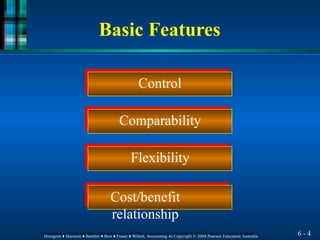
Control
Comparability
Flexibility
Cost/benefit
relationship
6 - 4
Horngren ♦ Harrison ♦ Bamber ♦ Best ♦ Fraser ♦ Willett, Accounting 4e Copyright © 2004 Pearson Education Australia
Basic Features
Basic Features
6 - 5
Horngren ♦ Harrison ♦ Bamber ♦ Best ♦ Fraser ♦ Willett, Accounting 4e Copyright © 2004 Pearson Education Australia
● Internal controls are the methods and
procedures used to authorise
transactions and safeguard assets.
● Comparability means that the system
works smoothly with operations,
personnel, and the organisational
structure.
Basic Features
6 - 6
Horngren ♦ Harrison ♦ Bamber ♦ Best ♦ Fraser ♦ Willett, Accounting 4e Copyright © 2004 Pearson Education Australia
● Flexibility relates to the system’s ability
to accommodate changes in the
organisation.
● A cost/benefit relationship indicates that
the cost of controls do not exceed
their value to the organisation.
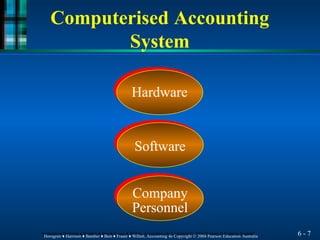
Hardware
Software
Company
Personnel
6 - 7
Horngren ♦ Harrison ♦ Bamber ♦ Best ♦ Fraser ♦ Willett, Accounting 4e Copyright © 2004 Pearson Education Australia
Computerised Accounting
System
Computerised Accounting
System
6 - 8
Horngren ♦ Harrison ♦ Bamber ♦ Best ♦ Fraser ♦ Willett, Accounting 4e Copyright © 2004 Pearson Education Australia
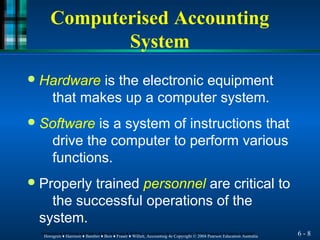
● Hardware is the electronic equipment
that makes up a computer system.
● Software is a system of instructions that
drive the computer to perform various
functions.
● Properly trained personnel are critical to
the successful operations of the
system.
Objective 2
6 - 9
Horngren ♦ Harrison ♦ Bamber ♦ Best ♦ Fraser ♦ Willett, Accounting 4e Copyright © 2004 Pearson Education Australia
Understand how both
computerised and manual
accounting systems work.
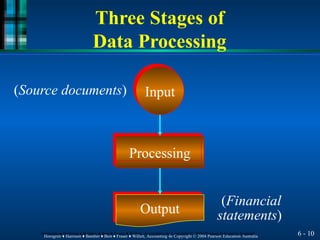
Processing
Input
(Source documents)
(Financial
statements)
Output
Three Stages of
Data Processing
6 - 10
Horngren ♦ Harrison ♦ Bamber ♦ Best ♦ Fraser ♦ Willett, Accounting 4e Copyright © 2004 Pearson Education Australia
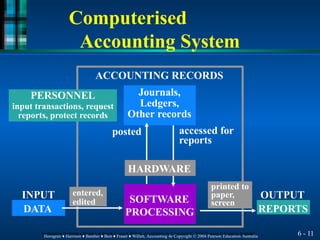
Computerised
Accounting System
entered,
edited
printed to
paper,
screen
ACCOUNTING RECORDS
Journals,
Ledgers,
Other records
SOFTWARE
PROCESSING
PERSONNEL
input transactions, request
reports, protect records
REPORTS
DATA
INPUT OUTPUT
posted accessed for
reports
HARDWARE
6 - 11
Horngren ♦ Harrison ♦ Bamber ♦ Best ♦ Fraser ♦ Willett, Accounting 4e Copyright © 2004 Pearson Education Australia
Designing an Accounting
System
● Design of the accounting system begins
with the chart of accounts.
● The chart of accounts lists all accounts
and their account number in the
ledger.
6 - 12
Horngren ♦ Harrison ♦ Bamber ♦ Best ♦ Fraser ♦ Willett, Accounting 4e Copyright © 2004 Pearson Education Australia
Menu-Driven Accounting
System
6 - 13
Horngren ♦ Harrison ♦ Bamber ♦ Best ♦ Fraser ♦ Willett, Accounting 4e Copyright © 2004 Pearson Education Australia
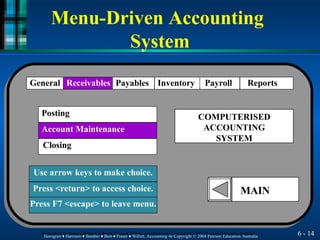
● Computer systems are organised by
function or task.
● Computer systems usually have a
choice of processing options on
a “menu.”
Menu-Driven Accounting
System
COMPUTERISED
ACCOUNTING
SYSTEM
Use arrow keys to make choice.
Press <return> to access choice.
Press F7 <escape> to leave menu.
MAIN
General Receivables Payables Inventory Payroll Reports
Posting
Account Maintenance
Closing
6 - 14
Horngren ♦ Harrison ♦ Bamber ♦ Best ♦ Fraser ♦ Willett, Accounting 4e Copyright © 2004 Pearson Education Australia
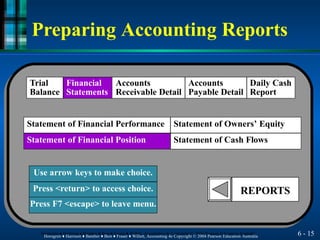
Preparing Accounting Reports
Trial
Balance
Financial
Statements
Accounts
Receivable Detail
Accounts
Payable Detail
Daily Cash
Report
Statement of Financial Performance Statement of Owners’ Equity
Statement of Financial Position Statement of Cash Flows
Use arrow keys to make choice.
Press <return> to access choice.
Press F7 <escape> to leave menu.
REPORTS
6 - 15
Horngren ♦ Harrison ♦ Bamber ♦ Best ♦ Fraser ♦ Willett, Accounting 4e Copyright © 2004 Pearson Education Australia
Objective 3
6 - 16
Horngren ♦ Harrison ♦ Bamber ♦ Best ♦ Fraser ♦ Willett, Accounting 4e Copyright © 2004 Pearson Education Australia
Understand how
spreadsheets
are used in accounting.
Integrated Accounting Systems
6 - 17
Horngren ♦ Harrison ♦ Bamber ♦ Best ♦ Fraser ♦ Willett, Accounting 4e Copyright © 2004 Pearson Education Australia
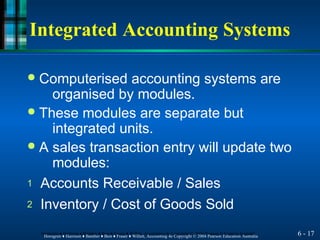
● Computerised accounting systems are
organised by modules.
● These modules are separate but
integrated units.
● A sales transaction entry will update two
modules:
1 Accounts Receivable / Sales
2 Inventory / Cost of Goods Sold
Ana’s Boutique Example
6 - 18
Horngren ♦ Harrison ♦ Bamber ♦ Best ♦ Fraser ♦ Willett, Accounting 4e Copyright © 2004 Pearson Education Australia
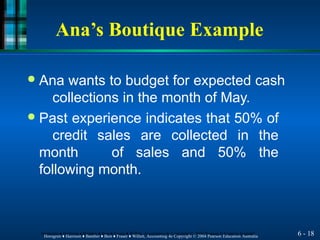
● Ana wants to budget for expected cash
collections in the month of May.
● Past experience indicates that 50% of
credit sales are collected in the
month of sales and 50% the
following month.
Ana’s Boutique Example
6 - 19
Horngren ♦ Harrison ♦ Bamber ♦ Best ♦ Fraser ♦ Willett, Accounting 4e Copyright © 2004 Pearson Education Australia
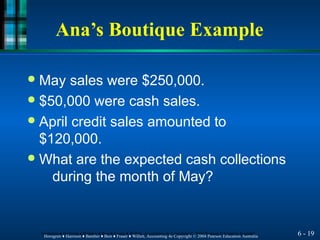
● May sales were $250,000.
● $50,000 were cash sales.
● April credit sales amounted to
$120,000.
● What are the expected cash collections
during the month of May?
Ana’s Boutique Example
6 - 20
Horngren ♦ Harrison ♦ Bamber ♦ Best ♦ Fraser ♦ Willett, Accounting 4e Copyright © 2004 Pearson Education Australia
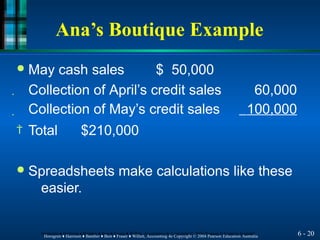
Collection of April’s credit sales 60,000
Collection of May’s credit sales 100,000
Total $210,000
● May cash sales $ 50,000



● Spreadsheets make calculations like these
easier.
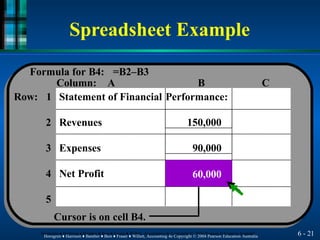
Spreadsheet Example
Statement of Financial Performance:
Revenues 150,000
Expenses 90,000
Net Profit
Row: 1
2
3
4
Column: B C
Formula for B4: =B2–B3
A
5
Cursor is on cell B4.
60,000
6 - 21
Horngren ♦ Harrison ♦ Bamber ♦ Best ♦ Fraser ♦ Willett, Accounting 4e Copyright © 2004 Pearson Education Australia
Objective 4
6 - 22
Horngren ♦ Harrison ♦ Bamber ♦ Best ♦ Fraser ♦ Willett, Accounting 4e Copyright © 2004 Pearson Education Australia
Use the sales journal,
the cash receipts
journal,
and the accounts
receivable
subsidiary ledger.
Special Journals
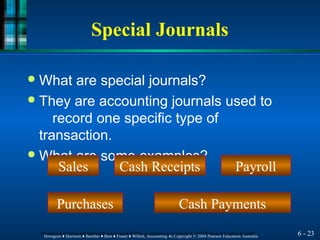
● What are special journals?
● They are accounting journals used to
record one specific type of
transaction.
● What are some examples?
Sales Cash Receipts Payroll
Cash Payments
Purchases
6 - 23
Horngren ♦ Harrison ♦ Bamber ♦ Best ♦ Fraser ♦ Willett, Accounting 4e Copyright © 2004 Pearson Education Australia
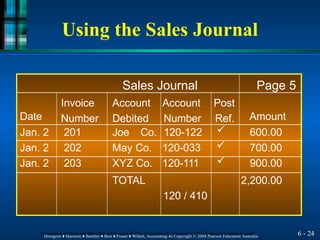
Sales Journal Page 5
Date
Invoice
Number
Account
Debited
Account
Number
Post
Ref. Amount
Jan. 2 201 Joe Co. 120-122 ✓ 600.00
Jan. 2 202 May Co. 120-033 ✓ 700.00
Jan. 2 203 XYZ Co. 120-111 ✓ 900.00
TOTAL
120 / 410
2,200.00
6 - 24
Horngren ♦ Harrison ♦ Bamber ♦ Best ♦ Fraser ♦ Willett, Accounting 4e Copyright © 2004 Pearson Education Australia
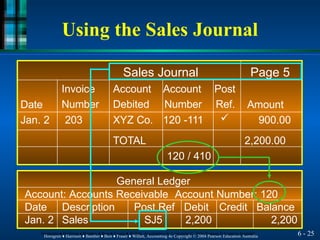
Using the Sales Journal
Sales Journal Page 5
Date
Invoice
Number
Account
Debited
Account
Number
Post
Ref. Amount
Jan. 2 203 XYZ Co. 120 -111 ✓ 900.00
TOTAL 2,200.00
120 / 410
General Ledger
Account: Accounts Receivable Account Number: 120
Date Description Post Ref Debit Credit Balance
Jan. 2 Sales SJ5 2,200 2,200
Using the Sales Journal
6 - 25
Horngren ♦ Harrison ♦ Bamber ♦ Best ♦ Fraser ♦ Willett, Accounting 4e Copyright © 2004 Pearson Education Australia
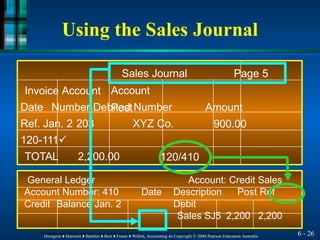
Using the Sales Journal
Page 5
Invoice Account
Sales Journal
Account
Post Amount
900.00
Date Number Debited Number
Ref. Jan. 2 203 XYZ Co.
120-111✓
TOTAL 2,200.00 120/410
General Ledger
Account Number: 410
Credit Balance Jan. 2
Account: Credit Sales
Date Description Post Ref
Debit
Sales SJ5 2,200 2,200
6 - 26
Horngren ♦ Harrison ♦ Bamber ♦ Best ♦ Fraser ♦ Willett, Accounting 4e Copyright © 2004 Pearson Education Australia
Subsidiary Ledger
6 - 27
Horngren ♦ Harrison ♦ Bamber ♦ Best ♦ Fraser ♦ Willett, Accounting 4e Copyright © 2004 Pearson Education Australia
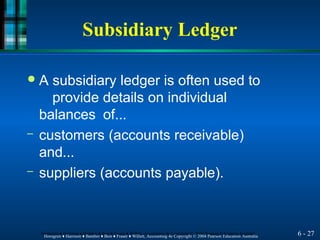
● A subsidiary ledger is often used to
provide details on individual
balances of...
– customers (accounts receivable)
and...
– suppliers (accounts payable).
A Control Account
6 - 28
Horngren ♦ Harrison ♦ Bamber ♦ Best ♦ Fraser ♦ Willett, Accounting 4e Copyright © 2004 Pearson Education Australia
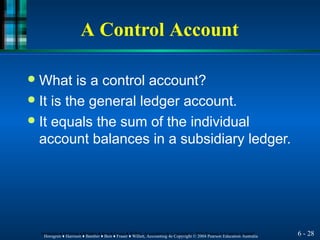
● What is a control account?
● It is the general ledger account.
● It equals the sum of the individual
account balances in a subsidiary ledger.
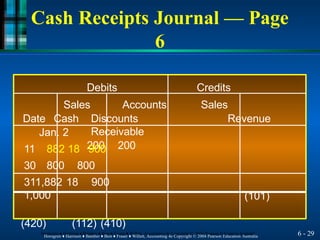
Debits Credits
Sales Accounts Sales
Date Cash Revenue
Discounts
Receivable
200 200
Jan. 2
11 882 18 900
30 800 800
(101)
311,882 18 900
1,000
(420) (112) (410)
Cash Receipts Journal — Page
6
6 - 29
Horngren ♦ Harrison ♦ Bamber ♦ Best ♦ Fraser ♦ Willett, Accounting 4e Copyright © 2004 Pearson Education Australia
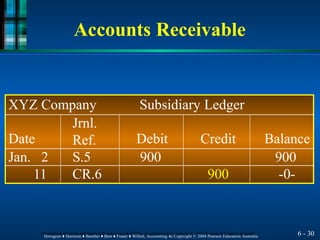
Accounts Receivable
XYZ Company Subsidiary Ledger
Date
Jrnl.
Ref. Debit Credit Balance
Jan. 2 S.5 900 900
11 CR.6 900 -0-
6 - 30
Horngren ♦ Harrison ♦ Bamber ♦ Best ♦ Fraser ♦ Willett, Accounting 4e Copyright © 2004 Pearson Education Australia
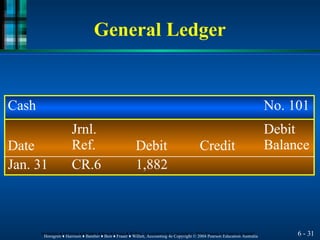
General Ledger
Cash No. 101
Date
Jrnl.
Ref. Debit Credit
Debit
Balance
Jan. 31 CR.6 1,882
6 - 31
Horngren ♦ Harrison ♦ Bamber ♦ Best ♦ Fraser ♦ Willett, Accounting 4e Copyright © 2004 Pearson Education Australia
Cash Receipts Journal
6 - 32
Horngren ♦ Harrison ♦ Bamber ♦ Best ♦ Fraser ♦ Willett, Accounting 4e Copyright © 2004 Pearson Education Australia
● Additional columns are provided to enter
other account descriptions and
amounts.
● Cash receipts amounts affecting subsidiary
ledger accounts are posted daily to keep
customer balances up to date.
● At month end, foot and crossfoot the journal
and post to the general ledger.
Objective 5
6 - 33
Horngren ♦ Harrison ♦ Bamber ♦ Best ♦ Fraser ♦ Willett, Accounting 4e Copyright © 2004 Pearson Education Australia
Use the purchase journal, the
cash payments journal,
and the accounts payable
subsidiary ledger.
Purchases Journal
6 - 34
Horngren ♦ Harrison ♦ Bamber ♦ Best ♦ Fraser ♦ Willett, Accounting 4e Copyright © 2004 Pearson Education Australia
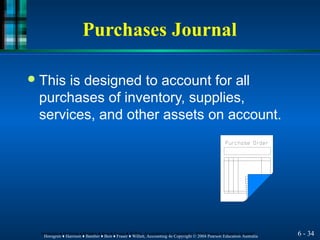
● This is designed to account for all
purchases of inventory, supplies,
services, and other assets on account.
Purchases Journal
6 - 35
Horngren ♦ Harrison ♦ Bamber ♦ Best ♦ Fraser ♦ Willett, Accounting 4e Copyright © 2004 Pearson Education Australia
● Cash purchases are recorded in the
cash payments journal.
● At month end the journal is footed
(totaled) and crossfooted.
● Posting to the general ledger is similar
to posting from sales and cash
receipts journals.
Cash Payments Journal
6 - 36
Horngren ♦ Harrison ♦ Bamber ♦ Best ♦ Fraser ♦ Willett, Accounting 4e Copyright © 2004 Pearson Education Australia
● Most payments are by check and are
recorded in the cash payments
journal.
● The cash payments journal is also
called:
– cheque register
– cash disbursements journal
Cash Payments Journal
6 - 37
Horngren ♦ Harrison ♦ Bamber ♦ Best ♦ Fraser ♦ Willett, Accounting 4e Copyright © 2004 Pearson Education Australia
● This has columns for:
– Date
– Cheque number (or transfer number)
– Account Debited
– Debits;
– Other Accounts, Accounts payable
– Credits
– Discounts Received, Cash at Bank
General Journal
6 - 38
Horngren ♦ Harrison ♦ Bamber ♦ Best ♦ Fraser ♦ Willett, Accounting 4e Copyright © 2004 Pearson Education Australia
● Special journals save much time in
recording repetitive transactions and
posting to the ledger.
● However, some transactions do not fit
into any of the special journals.
General Journal
6 - 39
Horngren ♦ Harrison ♦ Bamber ♦ Best ♦ Fraser ♦ Willett, Accounting 4e Copyright © 2004 Pearson Education Australia
● Every accounting system needs a
general journal.
● What entries are recorded in the
general journal?
– depreciation
– expiration of prepaid insurance
– accrual of salaries payable
– adjusting and closing entries
General Journal
6 - 40
Horngren ♦ Harrison ♦ Bamber ♦ Best ♦ Fraser ♦ Willett, Accounting 4e Copyright © 2004 Pearson Education Australia
● Many companies record sales returns
and allowances and purchase returns
in the general journal.
● A credit note (or credit memo) is the
document issued by the seller for
a credit to a customer’s Accounts
Receivable.
Purchase Returns and
Allowances
6 - 41
Horngren ♦ Harrison ♦ Bamber ♦ Best ♦ Fraser ♦ Willett, Accounting 4e Copyright © 2004 Pearson Education Australia
● A debit note or debit memorandum is
the business document that states
that the buyer no longer
owes the seller for the amount of the
returned purchases.
● The buyer debits the Accounts Payable
to the seller and credits Inventory.
Balancing the Ledgers
6 - 42
Horngren ♦ Harrison ♦ Bamber ♦ Best ♦ Fraser ♦ Willett, Accounting 4e Copyright © 2004 Pearson Education Australia
● At the end of the accounting period:
● Total debits and credits of account
balances in the general ledger
are equal.
● Control account balances are equal to
the sum of the appropriate
subsidiary ledger accounts.
End of Chapter 6
6 - 43
Horngren ♦ Harrison ♦ Bamber ♦ Best ♦ Fraser ♦ Willett, Accounting 4e Copyright © 2004 Pearson Education Australia

Accounting information systems CAPITULO 6.pptx

  • 1.
  • 2.
    Objectives 6 - 2 Horngren♦ Harrison ♦ Bamber ♦ Best ♦ Fraser ♦ Willett, Accounting 4e Copyright © 2004 Pearson Education Australia Horngren ♦ Harrison ♦ Bamber ♦ Best ♦ Fraser ♦ Willett, Accounting 4e Copyright © 2004 Pearson Education Australia 1. Describe the features of an effective accounting information system. 2. Understand how computerised and manual accounting systems work. 3. Understand how spreadsheets are used in accounting 4. Use the sales journal, the cash receipts journal and the accounts receivable subsidiary ledger 5. Use the purchases journal, the cash payments journal and the accounts payable subsidiary ledger
  • 3.
    Describe the features of aneffective accounting information system. 6 - 3 Horngren ♦ Harrison ♦ Bamber ♦ Best ♦ Fraser ♦ Willett, Accounting 4e Copyright © 2004 Pearson Education Australia Horngren ♦ Harrison ♦ Bamber ♦ Best ♦ Fraser ♦ Willett, Accounting 4e Copyright © 2004 Pearson Education Australia Objective 1
  • 4.
    Control Comparability Flexibility Cost/benefit relationship 6 - 4 Horngren♦ Harrison ♦ Bamber ♦ Best ♦ Fraser ♦ Willett, Accounting 4e Copyright © 2004 Pearson Education Australia Horngren ♦ Harrison ♦ Bamber ♦ Best ♦ Fraser ♦ Willett, Accounting 4e Copyright © 2004 Pearson Education Australia Basic Features
  • 5.
    Basic Features 6 -5 Horngren ♦ Harrison ♦ Bamber ♦ Best ♦ Fraser ♦ Willett, Accounting 4e Copyright © 2004 Pearson Education Australia Horngren ♦ Harrison ♦ Bamber ♦ Best ♦ Fraser ♦ Willett, Accounting 4e Copyright © 2004 Pearson Education Australia ● Internal controls are the methods and procedures used to authorise transactions and safeguard assets. ● Comparability means that the system works smoothly with operations, personnel, and the organisational structure.
  • 6.
    Basic Features 6 -6 Horngren ♦ Harrison ♦ Bamber ♦ Best ♦ Fraser ♦ Willett, Accounting 4e Copyright © 2004 Pearson Education Australia Horngren ♦ Harrison ♦ Bamber ♦ Best ♦ Fraser ♦ Willett, Accounting 4e Copyright © 2004 Pearson Education Australia ● Flexibility relates to the system’s ability to accommodate changes in the organisation. ● A cost/benefit relationship indicates that the cost of controls do not exceed their value to the organisation.
  • 7.
    Hardware Software Company Personnel 6 - 7 Horngren♦ Harrison ♦ Bamber ♦ Best ♦ Fraser ♦ Willett, Accounting 4e Copyright © 2004 Pearson Education Australia Horngren ♦ Harrison ♦ Bamber ♦ Best ♦ Fraser ♦ Willett, Accounting 4e Copyright © 2004 Pearson Education Australia Computerised Accounting System
  • 8.
    Computerised Accounting System 6 -8 Horngren ♦ Harrison ♦ Bamber ♦ Best ♦ Fraser ♦ Willett, Accounting 4e Copyright © 2004 Pearson Education Australia Horngren ♦ Harrison ♦ Bamber ♦ Best ♦ Fraser ♦ Willett, Accounting 4e Copyright © 2004 Pearson Education Australia ● Hardware is the electronic equipment that makes up a computer system. ● Software is a system of instructions that drive the computer to perform various functions. ● Properly trained personnel are critical to the successful operations of the system.
  • 9.
    Objective 2 6 -9 Horngren ♦ Harrison ♦ Bamber ♦ Best ♦ Fraser ♦ Willett, Accounting 4e Copyright © 2004 Pearson Education Australia Horngren ♦ Harrison ♦ Bamber ♦ Best ♦ Fraser ♦ Willett, Accounting 4e Copyright © 2004 Pearson Education Australia Understand how both computerised and manual accounting systems work.
  • 10.
    Processing Input (Source documents) (Financial statements) Output Three Stagesof Data Processing 6 - 10 Horngren ♦ Harrison ♦ Bamber ♦ Best ♦ Fraser ♦ Willett, Accounting 4e Copyright © 2004 Pearson Education Australia Horngren ♦ Harrison ♦ Bamber ♦ Best ♦ Fraser ♦ Willett, Accounting 4e Copyright © 2004 Pearson Education Australia
  • 11.
    Computerised Accounting System entered, edited printed to paper, screen ACCOUNTINGRECORDS Journals, Ledgers, Other records SOFTWARE PROCESSING PERSONNEL input transactions, request reports, protect records REPORTS DATA INPUT OUTPUT posted accessed for reports HARDWARE 6 - 11 Horngren ♦ Harrison ♦ Bamber ♦ Best ♦ Fraser ♦ Willett, Accounting 4e Copyright © 2004 Pearson Education Australia Horngren ♦ Harrison ♦ Bamber ♦ Best ♦ Fraser ♦ Willett, Accounting 4e Copyright © 2004 Pearson Education Australia
  • 12.
    Designing an Accounting System ●Design of the accounting system begins with the chart of accounts. ● The chart of accounts lists all accounts and their account number in the ledger. 6 - 12 Horngren ♦ Harrison ♦ Bamber ♦ Best ♦ Fraser ♦ Willett, Accounting 4e Copyright © 2004 Pearson Education Australia Horngren ♦ Harrison ♦ Bamber ♦ Best ♦ Fraser ♦ Willett, Accounting 4e Copyright © 2004 Pearson Education Australia
  • 13.
    Menu-Driven Accounting System 6 -13 Horngren ♦ Harrison ♦ Bamber ♦ Best ♦ Fraser ♦ Willett, Accounting 4e Copyright © 2004 Pearson Education Australia Horngren ♦ Harrison ♦ Bamber ♦ Best ♦ Fraser ♦ Willett, Accounting 4e Copyright © 2004 Pearson Education Australia ● Computer systems are organised by function or task. ● Computer systems usually have a choice of processing options on a “menu.”
  • 14.
    Menu-Driven Accounting System COMPUTERISED ACCOUNTING SYSTEM Use arrowkeys to make choice. Press <return> to access choice. Press F7 <escape> to leave menu. MAIN General Receivables Payables Inventory Payroll Reports Posting Account Maintenance Closing 6 - 14 Horngren ♦ Harrison ♦ Bamber ♦ Best ♦ Fraser ♦ Willett, Accounting 4e Copyright © 2004 Pearson Education Australia Horngren ♦ Harrison ♦ Bamber ♦ Best ♦ Fraser ♦ Willett, Accounting 4e Copyright © 2004 Pearson Education Australia
  • 15.
    Preparing Accounting Reports Trial Balance Financial Statements Accounts ReceivableDetail Accounts Payable Detail Daily Cash Report Statement of Financial Performance Statement of Owners’ Equity Statement of Financial Position Statement of Cash Flows Use arrow keys to make choice. Press <return> to access choice. Press F7 <escape> to leave menu. REPORTS 6 - 15 Horngren ♦ Harrison ♦ Bamber ♦ Best ♦ Fraser ♦ Willett, Accounting 4e Copyright © 2004 Pearson Education Australia Horngren ♦ Harrison ♦ Bamber ♦ Best ♦ Fraser ♦ Willett, Accounting 4e Copyright © 2004 Pearson Education Australia
  • 16.
    Objective 3 6 -16 Horngren ♦ Harrison ♦ Bamber ♦ Best ♦ Fraser ♦ Willett, Accounting 4e Copyright © 2004 Pearson Education Australia Horngren ♦ Harrison ♦ Bamber ♦ Best ♦ Fraser ♦ Willett, Accounting 4e Copyright © 2004 Pearson Education Australia Understand how spreadsheets are used in accounting.
  • 17.
    Integrated Accounting Systems 6- 17 Horngren ♦ Harrison ♦ Bamber ♦ Best ♦ Fraser ♦ Willett, Accounting 4e Copyright © 2004 Pearson Education Australia Horngren ♦ Harrison ♦ Bamber ♦ Best ♦ Fraser ♦ Willett, Accounting 4e Copyright © 2004 Pearson Education Australia ● Computerised accounting systems are organised by modules. ● These modules are separate but integrated units. ● A sales transaction entry will update two modules: 1 Accounts Receivable / Sales 2 Inventory / Cost of Goods Sold
  • 18.
    Ana’s Boutique Example 6- 18 Horngren ♦ Harrison ♦ Bamber ♦ Best ♦ Fraser ♦ Willett, Accounting 4e Copyright © 2004 Pearson Education Australia Horngren ♦ Harrison ♦ Bamber ♦ Best ♦ Fraser ♦ Willett, Accounting 4e Copyright © 2004 Pearson Education Australia ● Ana wants to budget for expected cash collections in the month of May. ● Past experience indicates that 50% of credit sales are collected in the month of sales and 50% the following month.
  • 19.
    Ana’s Boutique Example 6- 19 Horngren ♦ Harrison ♦ Bamber ♦ Best ♦ Fraser ♦ Willett, Accounting 4e Copyright © 2004 Pearson Education Australia Horngren ♦ Harrison ♦ Bamber ♦ Best ♦ Fraser ♦ Willett, Accounting 4e Copyright © 2004 Pearson Education Australia ● May sales were $250,000. ● $50,000 were cash sales. ● April credit sales amounted to $120,000. ● What are the expected cash collections during the month of May?
  • 20.
    Ana’s Boutique Example 6- 20 Horngren ♦ Harrison ♦ Bamber ♦ Best ♦ Fraser ♦ Willett, Accounting 4e Copyright © 2004 Pearson Education Australia Horngren ♦ Harrison ♦ Bamber ♦ Best ♦ Fraser ♦ Willett, Accounting 4e Copyright © 2004 Pearson Education Australia Collection of April’s credit sales 60,000 Collection of May’s credit sales 100,000 Total $210,000 ● May cash sales $ 50,000    ● Spreadsheets make calculations like these easier.
  • 21.
    Spreadsheet Example Statement ofFinancial Performance: Revenues 150,000 Expenses 90,000 Net Profit Row: 1 2 3 4 Column: B C Formula for B4: =B2–B3 A 5 Cursor is on cell B4. 60,000 6 - 21 Horngren ♦ Harrison ♦ Bamber ♦ Best ♦ Fraser ♦ Willett, Accounting 4e Copyright © 2004 Pearson Education Australia Horngren ♦ Harrison ♦ Bamber ♦ Best ♦ Fraser ♦ Willett, Accounting 4e Copyright © 2004 Pearson Education Australia
  • 22.
    Objective 4 6 -22 Horngren ♦ Harrison ♦ Bamber ♦ Best ♦ Fraser ♦ Willett, Accounting 4e Copyright © 2004 Pearson Education Australia Horngren ♦ Harrison ♦ Bamber ♦ Best ♦ Fraser ♦ Willett, Accounting 4e Copyright © 2004 Pearson Education Australia Use the sales journal, the cash receipts journal, and the accounts receivable subsidiary ledger.
  • 23.
    Special Journals ● Whatare special journals? ● They are accounting journals used to record one specific type of transaction. ● What are some examples? Sales Cash Receipts Payroll Cash Payments Purchases 6 - 23 Horngren ♦ Harrison ♦ Bamber ♦ Best ♦ Fraser ♦ Willett, Accounting 4e Copyright © 2004 Pearson Education Australia Horngren ♦ Harrison ♦ Bamber ♦ Best ♦ Fraser ♦ Willett, Accounting 4e Copyright © 2004 Pearson Education Australia
  • 24.
    Sales Journal Page5 Date Invoice Number Account Debited Account Number Post Ref. Amount Jan. 2 201 Joe Co. 120-122 ✓ 600.00 Jan. 2 202 May Co. 120-033 ✓ 700.00 Jan. 2 203 XYZ Co. 120-111 ✓ 900.00 TOTAL 120 / 410 2,200.00 6 - 24 Horngren ♦ Harrison ♦ Bamber ♦ Best ♦ Fraser ♦ Willett, Accounting 4e Copyright © 2004 Pearson Education Australia Horngren ♦ Harrison ♦ Bamber ♦ Best ♦ Fraser ♦ Willett, Accounting 4e Copyright © 2004 Pearson Education Australia Using the Sales Journal
  • 25.
    Sales Journal Page5 Date Invoice Number Account Debited Account Number Post Ref. Amount Jan. 2 203 XYZ Co. 120 -111 ✓ 900.00 TOTAL 2,200.00 120 / 410 General Ledger Account: Accounts Receivable Account Number: 120 Date Description Post Ref Debit Credit Balance Jan. 2 Sales SJ5 2,200 2,200 Using the Sales Journal 6 - 25 Horngren ♦ Harrison ♦ Bamber ♦ Best ♦ Fraser ♦ Willett, Accounting 4e Copyright © 2004 Pearson Education Australia Horngren ♦ Harrison ♦ Bamber ♦ Best ♦ Fraser ♦ Willett, Accounting 4e Copyright © 2004 Pearson Education Australia
  • 26.
    Using the SalesJournal Page 5 Invoice Account Sales Journal Account Post Amount 900.00 Date Number Debited Number Ref. Jan. 2 203 XYZ Co. 120-111✓ TOTAL 2,200.00 120/410 General Ledger Account Number: 410 Credit Balance Jan. 2 Account: Credit Sales Date Description Post Ref Debit Sales SJ5 2,200 2,200 6 - 26 Horngren ♦ Harrison ♦ Bamber ♦ Best ♦ Fraser ♦ Willett, Accounting 4e Copyright © 2004 Pearson Education Australia Horngren ♦ Harrison ♦ Bamber ♦ Best ♦ Fraser ♦ Willett, Accounting 4e Copyright © 2004 Pearson Education Australia
  • 27.
    Subsidiary Ledger 6 -27 Horngren ♦ Harrison ♦ Bamber ♦ Best ♦ Fraser ♦ Willett, Accounting 4e Copyright © 2004 Pearson Education Australia Horngren ♦ Harrison ♦ Bamber ♦ Best ♦ Fraser ♦ Willett, Accounting 4e Copyright © 2004 Pearson Education Australia ● A subsidiary ledger is often used to provide details on individual balances of... – customers (accounts receivable) and... – suppliers (accounts payable).
  • 28.
    A Control Account 6- 28 Horngren ♦ Harrison ♦ Bamber ♦ Best ♦ Fraser ♦ Willett, Accounting 4e Copyright © 2004 Pearson Education Australia Horngren ♦ Harrison ♦ Bamber ♦ Best ♦ Fraser ♦ Willett, Accounting 4e Copyright © 2004 Pearson Education Australia ● What is a control account? ● It is the general ledger account. ● It equals the sum of the individual account balances in a subsidiary ledger.
  • 29.
    Debits Credits Sales AccountsSales Date Cash Revenue Discounts Receivable 200 200 Jan. 2 11 882 18 900 30 800 800 (101) 311,882 18 900 1,000 (420) (112) (410) Cash Receipts Journal — Page 6 6 - 29 Horngren ♦ Harrison ♦ Bamber ♦ Best ♦ Fraser ♦ Willett, Accounting 4e Copyright © 2004 Pearson Education Australia Horngren ♦ Harrison ♦ Bamber ♦ Best ♦ Fraser ♦ Willett, Accounting 4e Copyright © 2004 Pearson Education Australia
  • 30.
    Accounts Receivable XYZ CompanySubsidiary Ledger Date Jrnl. Ref. Debit Credit Balance Jan. 2 S.5 900 900 11 CR.6 900 -0- 6 - 30 Horngren ♦ Harrison ♦ Bamber ♦ Best ♦ Fraser ♦ Willett, Accounting 4e Copyright © 2004 Pearson Education Australia Horngren ♦ Harrison ♦ Bamber ♦ Best ♦ Fraser ♦ Willett, Accounting 4e Copyright © 2004 Pearson Education Australia
  • 31.
    General Ledger Cash No.101 Date Jrnl. Ref. Debit Credit Debit Balance Jan. 31 CR.6 1,882 6 - 31 Horngren ♦ Harrison ♦ Bamber ♦ Best ♦ Fraser ♦ Willett, Accounting 4e Copyright © 2004 Pearson Education Australia Horngren ♦ Harrison ♦ Bamber ♦ Best ♦ Fraser ♦ Willett, Accounting 4e Copyright © 2004 Pearson Education Australia
  • 32.
    Cash Receipts Journal 6- 32 Horngren ♦ Harrison ♦ Bamber ♦ Best ♦ Fraser ♦ Willett, Accounting 4e Copyright © 2004 Pearson Education Australia Horngren ♦ Harrison ♦ Bamber ♦ Best ♦ Fraser ♦ Willett, Accounting 4e Copyright © 2004 Pearson Education Australia ● Additional columns are provided to enter other account descriptions and amounts. ● Cash receipts amounts affecting subsidiary ledger accounts are posted daily to keep customer balances up to date. ● At month end, foot and crossfoot the journal and post to the general ledger.
  • 33.
    Objective 5 6 -33 Horngren ♦ Harrison ♦ Bamber ♦ Best ♦ Fraser ♦ Willett, Accounting 4e Copyright © 2004 Pearson Education Australia Horngren ♦ Harrison ♦ Bamber ♦ Best ♦ Fraser ♦ Willett, Accounting 4e Copyright © 2004 Pearson Education Australia Use the purchase journal, the cash payments journal, and the accounts payable subsidiary ledger.
  • 34.
    Purchases Journal 6 -34 Horngren ♦ Harrison ♦ Bamber ♦ Best ♦ Fraser ♦ Willett, Accounting 4e Copyright © 2004 Pearson Education Australia Horngren ♦ Harrison ♦ Bamber ♦ Best ♦ Fraser ♦ Willett, Accounting 4e Copyright © 2004 Pearson Education Australia ● This is designed to account for all purchases of inventory, supplies, services, and other assets on account.
  • 35.
    Purchases Journal 6 -35 Horngren ♦ Harrison ♦ Bamber ♦ Best ♦ Fraser ♦ Willett, Accounting 4e Copyright © 2004 Pearson Education Australia Horngren ♦ Harrison ♦ Bamber ♦ Best ♦ Fraser ♦ Willett, Accounting 4e Copyright © 2004 Pearson Education Australia ● Cash purchases are recorded in the cash payments journal. ● At month end the journal is footed (totaled) and crossfooted. ● Posting to the general ledger is similar to posting from sales and cash receipts journals.
  • 36.
    Cash Payments Journal 6- 36 Horngren ♦ Harrison ♦ Bamber ♦ Best ♦ Fraser ♦ Willett, Accounting 4e Copyright © 2004 Pearson Education Australia Horngren ♦ Harrison ♦ Bamber ♦ Best ♦ Fraser ♦ Willett, Accounting 4e Copyright © 2004 Pearson Education Australia ● Most payments are by check and are recorded in the cash payments journal. ● The cash payments journal is also called: – cheque register – cash disbursements journal
  • 37.
    Cash Payments Journal 6- 37 Horngren ♦ Harrison ♦ Bamber ♦ Best ♦ Fraser ♦ Willett, Accounting 4e Copyright © 2004 Pearson Education Australia Horngren ♦ Harrison ♦ Bamber ♦ Best ♦ Fraser ♦ Willett, Accounting 4e Copyright © 2004 Pearson Education Australia ● This has columns for: – Date – Cheque number (or transfer number) – Account Debited – Debits; – Other Accounts, Accounts payable – Credits – Discounts Received, Cash at Bank
  • 38.
    General Journal 6 -38 Horngren ♦ Harrison ♦ Bamber ♦ Best ♦ Fraser ♦ Willett, Accounting 4e Copyright © 2004 Pearson Education Australia Horngren ♦ Harrison ♦ Bamber ♦ Best ♦ Fraser ♦ Willett, Accounting 4e Copyright © 2004 Pearson Education Australia ● Special journals save much time in recording repetitive transactions and posting to the ledger. ● However, some transactions do not fit into any of the special journals.
  • 39.
    General Journal 6 -39 Horngren ♦ Harrison ♦ Bamber ♦ Best ♦ Fraser ♦ Willett, Accounting 4e Copyright © 2004 Pearson Education Australia Horngren ♦ Harrison ♦ Bamber ♦ Best ♦ Fraser ♦ Willett, Accounting 4e Copyright © 2004 Pearson Education Australia ● Every accounting system needs a general journal. ● What entries are recorded in the general journal? – depreciation – expiration of prepaid insurance – accrual of salaries payable – adjusting and closing entries
  • 40.
    General Journal 6 -40 Horngren ♦ Harrison ♦ Bamber ♦ Best ♦ Fraser ♦ Willett, Accounting 4e Copyright © 2004 Pearson Education Australia Horngren ♦ Harrison ♦ Bamber ♦ Best ♦ Fraser ♦ Willett, Accounting 4e Copyright © 2004 Pearson Education Australia ● Many companies record sales returns and allowances and purchase returns in the general journal. ● A credit note (or credit memo) is the document issued by the seller for a credit to a customer’s Accounts Receivable.
  • 41.
    Purchase Returns and Allowances 6- 41 Horngren ♦ Harrison ♦ Bamber ♦ Best ♦ Fraser ♦ Willett, Accounting 4e Copyright © 2004 Pearson Education Australia Horngren ♦ Harrison ♦ Bamber ♦ Best ♦ Fraser ♦ Willett, Accounting 4e Copyright © 2004 Pearson Education Australia ● A debit note or debit memorandum is the business document that states that the buyer no longer owes the seller for the amount of the returned purchases. ● The buyer debits the Accounts Payable to the seller and credits Inventory.
  • 42.
    Balancing the Ledgers 6- 42 Horngren ♦ Harrison ♦ Bamber ♦ Best ♦ Fraser ♦ Willett, Accounting 4e Copyright © 2004 Pearson Education Australia Horngren ♦ Harrison ♦ Bamber ♦ Best ♦ Fraser ♦ Willett, Accounting 4e Copyright © 2004 Pearson Education Australia ● At the end of the accounting period: ● Total debits and credits of account balances in the general ledger are equal. ● Control account balances are equal to the sum of the appropriate subsidiary ledger accounts.
  • 43.
    End of Chapter6 6 - 43 Horngren ♦ Harrison ♦ Bamber ♦ Best ♦ Fraser ♦ Willett, Accounting 4e Copyright © 2004 Pearson Education Australia Horngren ♦ Harrison ♦ Bamber ♦ Best ♦ Fraser ♦ Willett, Accounting 4e Copyright © 2004 Pearson Education Australia