
The business of doing the
        business
    Devised by C Morris - www.evolve.ie


                          - April 2011
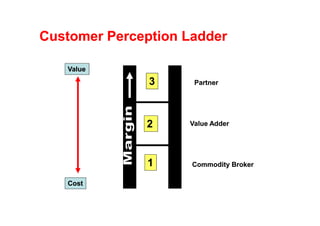
Customer Perception Ladder

   Value
               3     Partner


              2     Value Adder


              1      Commodity Broker

   Cost
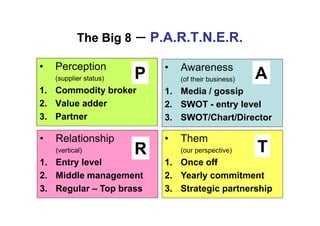
The Big 8   – P.A.R.T.N.E.R.
•   Perception              •   Awareness
    (supplier status)   P       (of their business)   A
1. Commodity broker         1. Media / gossip
2. Value adder              2. SWOT - entry level
3. Partner                  3. SWOT/Chart/Director

•   Relationship            •   Them
    (vertical)          R       (our perspective)     T
1. Entry level              1. Once off
2. Middle management        2. Yearly commitment
3. Regular – Top brass      3. Strategic partnership
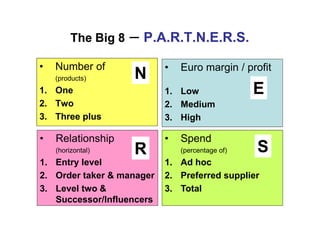
The Big 8   – P.A.R.T.N.E.R.S.
•   Number of              •   Euro margin / profit
    (products)       N         (of their business)
1. One                     1. Low                    E
2. Two                     2. Medium
3. Three plus              3. High

•   Relationship           •   Spend
    (horizontal)     R         (percentage of)       S
1. Entry level             1. Ad hoc
2. Order taker & manager   2. Preferred supplier
3. Level two &             3. Total
   Successor/Influencers
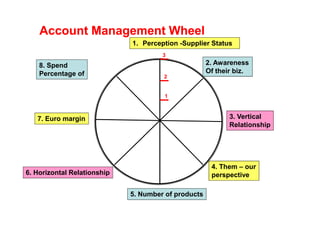
Account Management Wheel
                             1. Perception -Supplier Status
                                      3

    8. Spend                                         2. Awareness
    Percentage of                                    Of their biz.
                                      2


                                      1


   7. Euro margin                                           3. Vertical
                                                            Relationship


                                                      4. Them – our
6. Horizontal Relationship                            perspective

                             5. Number of products
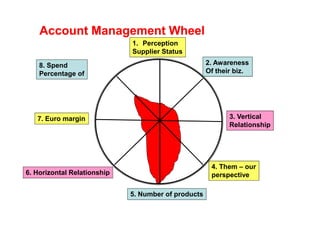
Account Management Wheel
                             1. Perception
                             Supplier Status

    8. Spend                                         2. Awareness
    Percentage of                                    Of their biz.


   7. Euro margin                                           3. Vertical
                                                            Relationship


                                                      4. Them – our
6. Horizontal Relationship                            perspective

                             5. Number of products
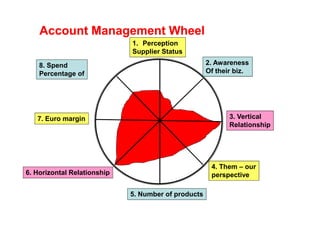
Account Management Wheel
                             1. Perception
                             Supplier Status

    8. Spend                                         2. Awareness
    Percentage of                                    Of their biz.


   7. Euro margin                                           3. Vertical
                                                            Relationship


                                                      4. Them – our
6. Horizontal Relationship                            perspective

                             5. Number of products
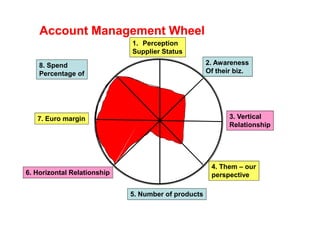
Account Management Wheel
                             1. Perception
                             Supplier Status

    8. Spend                                         2. Awareness
    Percentage of                                    Of their biz.


   7. Euro margin                                           3. Vertical
                                                            Relationship


                                                      4. Them – our
6. Horizontal Relationship                            perspective

                             5. Number of products
NEGOTIATION

Concede in areas of lesser importance to
 gain in areas of greater importance
GREAT NEGOTIATORS
      KNOW TWO THINGS

(1)THE VALUE OF THEIR PROPOSITION
  Belief in their product or service
  Ability to Communicate that Belief
  Competitor Knowledge
  Industry Knowledge
  The benefit to the purchaser
(2)
6 Principles Of Negotiation
Distinguish the issue from the personality
of the negotiator
Agree Objective Criteria
Innovative Option Creation
Be Specific
Interests versus Positions
Zonal Negotiation
Preparation for Negotiation
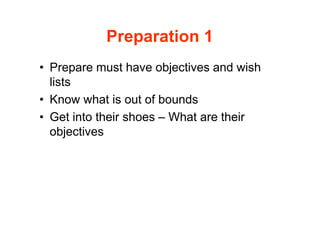
Preparation 1
• Prepare must have objectives and wish
  lists
• Know what is out of bounds
• Get into their shoes – What are their
  objectives
Preparation 2
• Decide Fallback Position (theirs and yours)
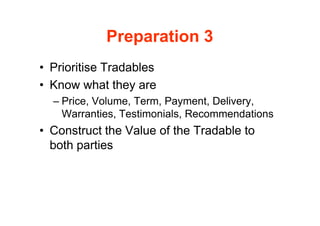
Preparation 3
• Prioritise Tradables
• Know what they are
  – Price, Volume, Term, Payment, Delivery,
    Warranties, Testimonials, Recommendations
• Construct the Value of the Tradable to
  both parties
Preparation 4
• Construct best and worst trading limits
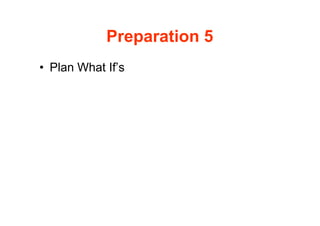
Preparation 5
• Plan What If’s
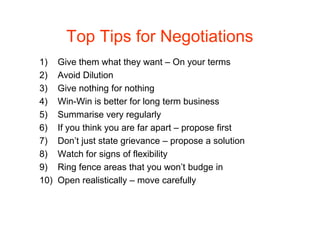
Top Tips for Negotiations
1)    Give them what they want – On your terms
2)    Avoid Dilution
3)    Give nothing for nothing
4)    Win-Win is better for long term business
5)    Summarise very regularly
6)    If you think you are far apart – propose first
7)    Don’t just state grievance – propose a solution
8)    Watch for signs of flexibility
9)    Ring fence areas that you won’t budge in
10)   Open realistically – move carefully
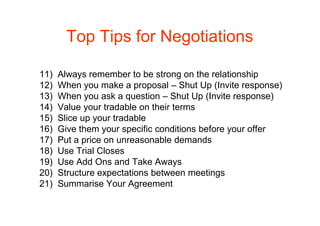
Top Tips for Negotiations

11)   Always remember to be strong on the relationship
12)   When you make a proposal – Shut Up (Invite response)
13)   When you ask a question – Shut Up (Invite response)
14)   Value your tradable on their terms
15)   Slice up your tradable
16)   Give them your specific conditions before your offer
17)   Put a price on unreasonable demands
18)   Use Trial Closes
19)   Use Add Ons and Take Aways
20)   Structure expectations between meetings
21)   Summarise Your Agreement
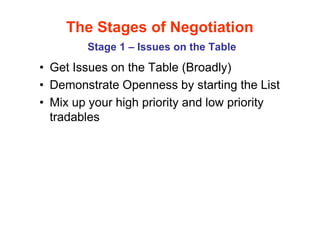
The Stages of Negotiation
        Stage 1 – Issues on the Table
• Get Issues on the Table (Broadly)
• Demonstrate Openness by starting the List
• Mix up your high priority and low priority
  tradables
The Stages of Negotiation
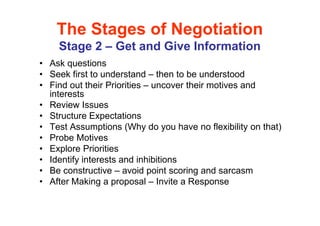
    Stage 2 – Get and Give Information
• Ask questions
• Seek first to understand – then to be understood
• Find out their Priorities – uncover their motives and
  interests
• Review Issues
• Structure Expectations
• Test Assumptions (Why do you have no flexibility on that)
• Probe Motives
• Explore Priorities
• Identify interests and inhibitions
• Be constructive – avoid point scoring and sarcasm
• After Making a proposal – Invite a Response
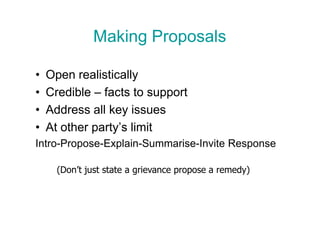
Making Proposals

•   Open realistically
•   Credible – facts to support
•   Address all key issues
•   At other party’s limit
Intro-Propose-Explain-Summarise-Invite Response

      (Don’t just state a grievance propose a remedy)
The Stages of Negotiation
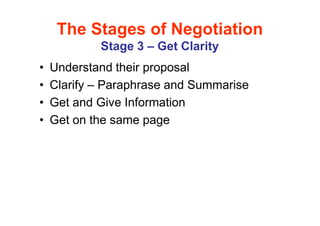
            Stage 3 – Get Clarity
•   Understand their proposal
•   Clarify – Paraphrase and Summarise
•   Get and Give Information
•   Get on the same page
The Stages of Negotiation
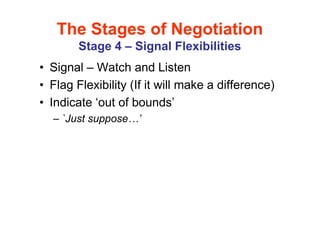
        Stage 4 – Signal Flexibilities
• Signal – Watch and Listen
• Flag Flexibility (If it will make a difference)
• Indicate ‘out of bounds’
  – `Just suppose   ’
The Stages of Negotiation
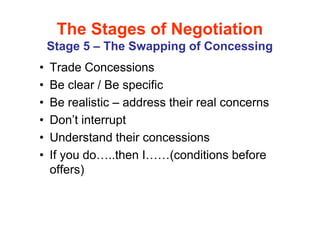
    Stage 5 – The Swapping of Concessing
•   Trade Concessions
•   Be clear / Be specific
•   Be realistic – address their real concerns
•   Don’t interrupt
•   Understand their concessions
•   If you do ..then I     (conditions before
    offers)
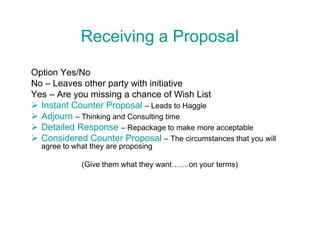
Receiving a Proposal

Option Yes/No
No – Leaves other party with initiative
Yes – Are you missing a chance of Wish List
  Instant Counter Proposal – Leads to Haggle
  Adjourn – Thinking and Consulting time
  Detailed Response – Repackage to make more acceptable
  Considered Counter Proposal – The circumstances that you will
  agree to what they are proposing

             (Give them what they want   .on your terms)
The Stages of Negotiation
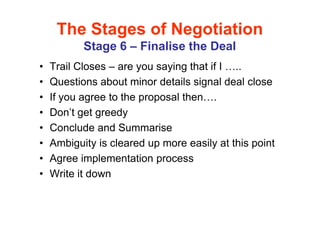
           Stage 6 – Finalise the Deal
•   Trail Closes – are you saying that if I ..
•   Questions about minor details signal deal close
•   If you agree to the proposal then .
•   Don’t get greedy
•   Conclude and Summarise
•   Ambiguity is cleared up more easily at this point
•   Agree implementation process
•   Write it down
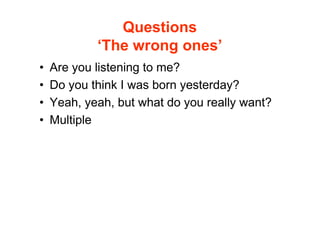
Questions
            ‘The wrong ones’
•   Are you listening to me?
•   Do you think I was born yesterday?
•   Yeah, yeah, but what do you really want?
•   Multiple
Questions
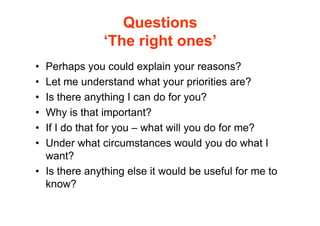
              ‘The right ones’
• Perhaps you could explain your reasons?
• Let me understand what your priorities are?
• Is there anything I can do for you?
• Why is that important?
• If I do that for you – what will you do for me?
• Under what circumstances would you do what I
  want?
• Is there anything else it would be useful for me to
  know?
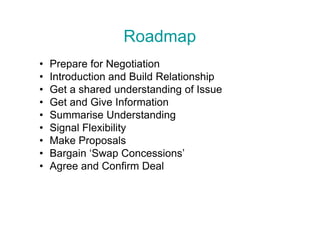
Roadmap
•   Prepare for Negotiation
•   Introduction and Build Relationship
•   Get a shared understanding of Issue
•   Get and Give Information
•   Summarise Understanding
•   Signal Flexibility
•   Make Proposals
•   Bargain ‘Swap Concessions’
•   Agree and Confirm Deal
NEVER
• SAY ‘IS THAT YOUR FINAL OFFER?’
QUESTIONS
THANKS
 Conor Morris
 www.evolve.ie

Account management profiling tool

  • 1.
    The business ofdoing the business Devised by C Morris - www.evolve.ie - April 2011
  • 2.
    Customer Perception Ladder Value 3 Partner 2 Value Adder 1 Commodity Broker Cost
  • 3.
    The Big 8 – P.A.R.T.N.E.R. • Perception • Awareness (supplier status) P (of their business) A 1. Commodity broker 1. Media / gossip 2. Value adder 2. SWOT - entry level 3. Partner 3. SWOT/Chart/Director • Relationship • Them (vertical) R (our perspective) T 1. Entry level 1. Once off 2. Middle management 2. Yearly commitment 3. Regular – Top brass 3. Strategic partnership
  • 4.
    The Big 8 – P.A.R.T.N.E.R.S. • Number of • Euro margin / profit (products) N (of their business) 1. One 1. Low E 2. Two 2. Medium 3. Three plus 3. High • Relationship • Spend (horizontal) R (percentage of) S 1. Entry level 1. Ad hoc 2. Order taker & manager 2. Preferred supplier 3. Level two & 3. Total Successor/Influencers
  • 5.
    Account Management Wheel 1. Perception -Supplier Status 3 8. Spend 2. Awareness Percentage of Of their biz. 2 1 7. Euro margin 3. Vertical Relationship 4. Them – our 6. Horizontal Relationship perspective 5. Number of products
  • 6.
    Account Management Wheel 1. Perception Supplier Status 8. Spend 2. Awareness Percentage of Of their biz. 7. Euro margin 3. Vertical Relationship 4. Them – our 6. Horizontal Relationship perspective 5. Number of products
  • 7.
    Account Management Wheel 1. Perception Supplier Status 8. Spend 2. Awareness Percentage of Of their biz. 7. Euro margin 3. Vertical Relationship 4. Them – our 6. Horizontal Relationship perspective 5. Number of products
  • 8.
    Account Management Wheel 1. Perception Supplier Status 8. Spend 2. Awareness Percentage of Of their biz. 7. Euro margin 3. Vertical Relationship 4. Them – our 6. Horizontal Relationship perspective 5. Number of products
  • 9.
    NEGOTIATION Concede in areasof lesser importance to gain in areas of greater importance
  • 10.
    GREAT NEGOTIATORS KNOW TWO THINGS (1)THE VALUE OF THEIR PROPOSITION Belief in their product or service Ability to Communicate that Belief Competitor Knowledge Industry Knowledge The benefit to the purchaser
  • 11.
  • 12.
    6 Principles OfNegotiation Distinguish the issue from the personality of the negotiator Agree Objective Criteria Innovative Option Creation Be Specific Interests versus Positions Zonal Negotiation
  • 13.
  • 14.
    Preparation 1 • Preparemust have objectives and wish lists • Know what is out of bounds • Get into their shoes – What are their objectives
  • 15.
    Preparation 2 • DecideFallback Position (theirs and yours)
  • 16.
    Preparation 3 • PrioritiseTradables • Know what they are – Price, Volume, Term, Payment, Delivery, Warranties, Testimonials, Recommendations • Construct the Value of the Tradable to both parties
  • 17.
    Preparation 4 • Constructbest and worst trading limits
  • 18.
  • 19.
    Top Tips forNegotiations 1) Give them what they want – On your terms 2) Avoid Dilution 3) Give nothing for nothing 4) Win-Win is better for long term business 5) Summarise very regularly 6) If you think you are far apart – propose first 7) Don’t just state grievance – propose a solution 8) Watch for signs of flexibility 9) Ring fence areas that you won’t budge in 10) Open realistically – move carefully
  • 20.
    Top Tips forNegotiations 11) Always remember to be strong on the relationship 12) When you make a proposal – Shut Up (Invite response) 13) When you ask a question – Shut Up (Invite response) 14) Value your tradable on their terms 15) Slice up your tradable 16) Give them your specific conditions before your offer 17) Put a price on unreasonable demands 18) Use Trial Closes 19) Use Add Ons and Take Aways 20) Structure expectations between meetings 21) Summarise Your Agreement
  • 21.
    The Stages ofNegotiation Stage 1 – Issues on the Table • Get Issues on the Table (Broadly) • Demonstrate Openness by starting the List • Mix up your high priority and low priority tradables
  • 22.
    The Stages ofNegotiation Stage 2 – Get and Give Information • Ask questions • Seek first to understand – then to be understood • Find out their Priorities – uncover their motives and interests • Review Issues • Structure Expectations • Test Assumptions (Why do you have no flexibility on that) • Probe Motives • Explore Priorities • Identify interests and inhibitions • Be constructive – avoid point scoring and sarcasm • After Making a proposal – Invite a Response
  • 23.
    Making Proposals • Open realistically • Credible – facts to support • Address all key issues • At other party’s limit Intro-Propose-Explain-Summarise-Invite Response (Don’t just state a grievance propose a remedy)
  • 24.
    The Stages ofNegotiation Stage 3 – Get Clarity • Understand their proposal • Clarify – Paraphrase and Summarise • Get and Give Information • Get on the same page
  • 25.
    The Stages ofNegotiation Stage 4 – Signal Flexibilities • Signal – Watch and Listen • Flag Flexibility (If it will make a difference) • Indicate ‘out of bounds’ – `Just suppose ’
  • 26.
    The Stages ofNegotiation Stage 5 – The Swapping of Concessing • Trade Concessions • Be clear / Be specific • Be realistic – address their real concerns • Don’t interrupt • Understand their concessions • If you do ..then I (conditions before offers)
  • 27.
    Receiving a Proposal OptionYes/No No – Leaves other party with initiative Yes – Are you missing a chance of Wish List Instant Counter Proposal – Leads to Haggle Adjourn – Thinking and Consulting time Detailed Response – Repackage to make more acceptable Considered Counter Proposal – The circumstances that you will agree to what they are proposing (Give them what they want .on your terms)
  • 28.
    The Stages ofNegotiation Stage 6 – Finalise the Deal • Trail Closes – are you saying that if I .. • Questions about minor details signal deal close • If you agree to the proposal then . • Don’t get greedy • Conclude and Summarise • Ambiguity is cleared up more easily at this point • Agree implementation process • Write it down
  • 29.
    Questions ‘The wrong ones’ • Are you listening to me? • Do you think I was born yesterday? • Yeah, yeah, but what do you really want? • Multiple
  • 30.
    Questions ‘The right ones’ • Perhaps you could explain your reasons? • Let me understand what your priorities are? • Is there anything I can do for you? • Why is that important? • If I do that for you – what will you do for me? • Under what circumstances would you do what I want? • Is there anything else it would be useful for me to know?
  • 31.
    Roadmap • Prepare for Negotiation • Introduction and Build Relationship • Get a shared understanding of Issue • Get and Give Information • Summarise Understanding • Signal Flexibility • Make Proposals • Bargain ‘Swap Concessions’ • Agree and Confirm Deal
  • 32.
    NEVER • SAY ‘ISTHAT YOUR FINAL OFFER?’
  • 33.
  • 34.
    THANKS Conor Morris www.evolve.ie