Accessibility in GenAI Education Apps
solulab.com/accessibility-in-genai-education-apps
The global gen AI in education market is expected to grow to $30 billion by 2032, but many
apps still fail the learners they aim to serve. Most GenAI solutions are built for an “average”
user, leaving students with disabilities, neurodiverse learners, language barriers, or access
limitations behind.
Learner engagement drops, outcomes suffer, and institutions face ethical, legal, and
reputational risks. Even the most advanced Generative AI education platforms fail when
students cannot fully access or benefit from them. Accessibility is not a feature upgrade—it
directly affects adoption, trust, and long-term success.
The solution is strategic, not optional. When accessibility is embedded from day one, GenAI
education apps can deliver personalized, fair, and scalable learning experiences—while
growing responsibly alongside the product.
In this blog, we’ll walk you through the role of GenAI development in education apps, its
reasons, and more. Let’s get started!
Key Takeaways
The problem: Over 1.3 billion learners globally face accessibility barriers, yet most
GenAI education apps still prioritize features over inclusion.
The solution: Accessibility-first GenAI education platforms improve learning outcomes by
30–40% and expand market penetration across diverse user groups.
How SoluLab helps: SoluLab designs GenAI-powered education apps with built-in
accessibility– AI tutors, speech-to-text, and multilingual learning.
1/7
Role of Gen AI Development Services in Building Inclusive Education
Apps
Gen AI integration services assist education platforms in creating inclusive, accessible, and
scalable learning applications by directly embodying the principles of accessibility,
personalization, and ethical AI into the product structure.
Personal GenAI Model Development: GenAI developers train models to accommodate
a wide range of learning requirements, such as learning disabilities, attention deficit
hyperactivity disorders, visual impairment, and language barriers, so that AI must adjust
to the students, and not vice versa.
Combining NLP, Speech, and Adaptive Learning Engines: GenAI services combine
NLP, speech-to-text, text-to-speech, and adaptive learning engines to customize content
delivery, enhance understanding, and facilitate the multiple learning styles successfully.
Ethical and Compliant AI Systems: Education apps become securely scaled to legal
data privacy regulations, ethical AI principles, and accessibility, gaining the trust of users,
institutions, and regulators, through the work of expert GenAI teams.
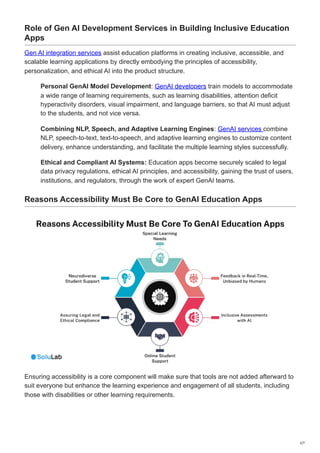
Reasons Accessibility Must Be Core to GenAI Education Apps
Ensuring accessibility is a core component will make sure that tools are not added afterward to
suit everyone but enhance the learning experience and engagement of all students, including
those with disabilities or other learning requirements.
2/7
Special learning Needs: 73% of students with disabilities find GenAI applications useful
for a unique lesson plan based on their pace and style of learning, enabling learners with
unique abilities to engage with educational content in the way that best suits them and
bridge learning gaps.
Feedback in Real-Time, Unbiased by Humans: AI is able to provide instant feedback,
which is not biased and changes based on the progress of the individual learner. This
minimizes judgmental differences and promotes proper performance feedback to the
students who might not perform well in conventional evaluations.
Inclusive Assessments with AI: Generative AI has the potential to create adaptive
assessments that adapt to what a student answers, thus making tests more equitable and
more accessible, and representing the actual understanding of the material instead of the
fixed standard format.
Online Student Support: Neurodiverse students can use accessible tools based on
GenAI, such as adaptive content and customizing the UI, to focus, have motivation, and
benefit from navigation based on their learning preferences.
Assuring Legal and Ethical Compliance: Generally, accessibility can be integrated
early to allow apps to meet the expectations set by the global standards and ethical
principles; this will prevent exclusion and reduce risks of litigation as an integrated
approach to inclusive values.
3/7
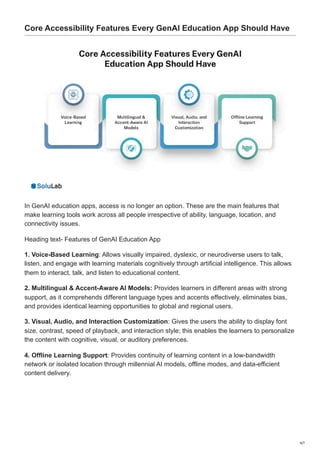
Core Accessibility Features Every GenAI Education App Should Have
In GenAI education apps, access is no longer an option. These are the main features that
make learning tools work across all people irrespective of ability, language, location, and
connectivity issues.
Heading text- Features of GenAI Education App
1. Voice-Based Learning: Allows visually impaired, dyslexic, or neurodiverse users to talk,
listen, and engage with learning materials cognitively through artificial intelligence. This allows
them to interact, talk, and listen to educational content.
2. Multilingual & Accent-Aware AI Models: Provides learners in different areas with strong
support, as it comprehends different language types and accents effectively, eliminates bias,
and provides identical learning opportunities to global and regional users.
3. Visual, Audio, and Interaction Customization: Gives the users the ability to display font
size, contrast, speed of playback, and interaction style; this enables the learners to personalize
the content with cognitive, visual, or auditory preferences.
4. Offline Learning Support: Provides continuity of learning content in a low-bandwidth
network or isolated location through millennial AI models, offline modes, and data-efficient
content delivery.
4/7
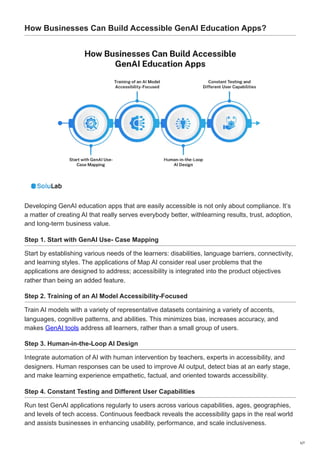
How Businesses Can Build Accessible GenAI Education Apps?
Developing GenAI education apps that are easily accessible is not only about compliance. It’s
a matter of creating AI that really serves everybody better, withlearning results, trust, adoption,
and long-term business value.
Step 1. Start with GenAI Use- Case Mapping
Start by establishing various needs of the learners: disabilities, language barriers, connectivity,
and learning styles. The applications of Map AI consider real user problems that the
applications are designed to address; accessibility is integrated into the product objectives
rather than being an added feature.
Step 2. Training of an AI Model Accessibility-Focused
Train AI models with a variety of representative datasets containing a variety of accents,
languages, cognitive patterns, and abilities. This minimizes bias, increases accuracy, and
makes GenAI tools address all learners, rather than a small group of users.
Step 3. Human-in-the-Loop AI Design
Integrate automation of AI with human intervention by teachers, experts in accessibility, and
designers. Human responses can be used to improve AI output, detect bias at an early stage,
and make learning experience empathetic, factual, and oriented towards accessibility.
Step 4. Constant Testing and Different User Capabilities
Run test GenAI applications regularly to users across various capabilities, ages, geographies,
and levels of tech access. Continuous feedback reveals the accessibility gaps in the real world
and assists businesses in enhancing usability, performance, and scale inclusiveness.
5/7
Common Mistakes Businesses Make When Building GenAI Education
Apps
The majority of companies are in a hurry to create GenAI education applications without
considering the significant basics. These pitfalls become weaker in impact, uptake, and
decrease ROI over time. Here are the pitfalls and how they can be corrected.
1. Addressing accessibility as a check box: Most teams are adding accessibility as a last-
minute add to achieve compliance. This causes ineffective learning.
Solution: implement accessibility during design – design inclusive UX and adaptive learning
and multimodal AI capabilities into the system.
2. Using generic AI models: Commonly, off-the-shelf AI models do not learn the context,
accents, or cognitive differences.
Solution: personalize GenAI models with education-specific data and a variety of learner
profiles to provide personalized, correct, and inclusive learning.
3. Ignorance of the actual user feedback: Developing in isolation causes features not really
needed by the learners to be included.
Solution: early engagement of educators, students, and accessibility users. Feedback on
learning processes and results is continuously gathered,d and human-in-the-loop AI systems
are used to optimize the learning processes and results.
4. Failing to test at scale: Applications that perform on a demo can fail with real users.
Solution: test GenAI systems on different devices, languages, bandwidth settings, and types
of learners. Massive testing guarantees consistency, equity, and uniformity in learning in actual
circumstances.
Conclusion
Accessibility cannot be an extra feature of GenAI education apps, but it has to be included.
When AI systems are created with a variety of learning requirements at their core, they produce
more equal, active, and engaging learning models.
6/7
Accessible GenAI not only accommodates students with disabilities or neurodiverse learners
but also enhances usability among all people. In the case of businesses, this translates to
increased adoption, increased levels of trust, and a lasting effect.
Companies that are focused on accessibility today will be future innovators, responsible, and
attainable, with sustainable growth, and they will provide experiences in learning that actually
work.
SoluLab, a generative AI development company, helps you design, develop, and scale
accessible generative AI solutions. Book a free discovery call today!
FAQs
1. What does accessibility mean in GenAI education apps?
Accessibility means designing AI-powered learning tools that everyone can use, including
people with disabilities, neurodiverse learners, and users with language or connectivity
limitations.
2. How does accessibility impact business growth?
Available GenAI applications can reach more people, retain more, and churn less, plus create
new markets in regulated and government sectors.
3. Does accessibility affect AI ethics?
Yes. Inclusive AI design ensures fairness, transparency, and responsible technology use,
reducing harm and building trust with users.
4. Which industries use accessible GenAI education apps?
GenAI is used in EdTech, corporate learning, government-learning, healthcare learning, and
skill development platforms to scale training for various learners.
5. How does AI reduce bias in learning assessments?
Instead of relying on human judgment, AI-based assessment is based on patterns of
performance, and thus it provides more fair evaluation with the inclusion of inclusive data and
testing.
7/7

Accessibility in GenAI Education Apps.pdf

  • 1.
    Accessibility in GenAIEducation Apps solulab.com/accessibility-in-genai-education-apps The global gen AI in education market is expected to grow to $30 billion by 2032, but many apps still fail the learners they aim to serve. Most GenAI solutions are built for an “average” user, leaving students with disabilities, neurodiverse learners, language barriers, or access limitations behind. Learner engagement drops, outcomes suffer, and institutions face ethical, legal, and reputational risks. Even the most advanced Generative AI education platforms fail when students cannot fully access or benefit from them. Accessibility is not a feature upgrade—it directly affects adoption, trust, and long-term success. The solution is strategic, not optional. When accessibility is embedded from day one, GenAI education apps can deliver personalized, fair, and scalable learning experiences—while growing responsibly alongside the product. In this blog, we’ll walk you through the role of GenAI development in education apps, its reasons, and more. Let’s get started! Key Takeaways The problem: Over 1.3 billion learners globally face accessibility barriers, yet most GenAI education apps still prioritize features over inclusion. The solution: Accessibility-first GenAI education platforms improve learning outcomes by 30–40% and expand market penetration across diverse user groups. How SoluLab helps: SoluLab designs GenAI-powered education apps with built-in accessibility– AI tutors, speech-to-text, and multilingual learning. 1/7
  • 2.
    Role of GenAI Development Services in Building Inclusive Education Apps Gen AI integration services assist education platforms in creating inclusive, accessible, and scalable learning applications by directly embodying the principles of accessibility, personalization, and ethical AI into the product structure. Personal GenAI Model Development: GenAI developers train models to accommodate a wide range of learning requirements, such as learning disabilities, attention deficit hyperactivity disorders, visual impairment, and language barriers, so that AI must adjust to the students, and not vice versa. Combining NLP, Speech, and Adaptive Learning Engines: GenAI services combine NLP, speech-to-text, text-to-speech, and adaptive learning engines to customize content delivery, enhance understanding, and facilitate the multiple learning styles successfully. Ethical and Compliant AI Systems: Education apps become securely scaled to legal data privacy regulations, ethical AI principles, and accessibility, gaining the trust of users, institutions, and regulators, through the work of expert GenAI teams. Reasons Accessibility Must Be Core to GenAI Education Apps Ensuring accessibility is a core component will make sure that tools are not added afterward to suit everyone but enhance the learning experience and engagement of all students, including those with disabilities or other learning requirements. 2/7
  • 3.
    Special learning Needs:73% of students with disabilities find GenAI applications useful for a unique lesson plan based on their pace and style of learning, enabling learners with unique abilities to engage with educational content in the way that best suits them and bridge learning gaps. Feedback in Real-Time, Unbiased by Humans: AI is able to provide instant feedback, which is not biased and changes based on the progress of the individual learner. This minimizes judgmental differences and promotes proper performance feedback to the students who might not perform well in conventional evaluations. Inclusive Assessments with AI: Generative AI has the potential to create adaptive assessments that adapt to what a student answers, thus making tests more equitable and more accessible, and representing the actual understanding of the material instead of the fixed standard format. Online Student Support: Neurodiverse students can use accessible tools based on GenAI, such as adaptive content and customizing the UI, to focus, have motivation, and benefit from navigation based on their learning preferences. Assuring Legal and Ethical Compliance: Generally, accessibility can be integrated early to allow apps to meet the expectations set by the global standards and ethical principles; this will prevent exclusion and reduce risks of litigation as an integrated approach to inclusive values. 3/7
  • 4.
    Core Accessibility FeaturesEvery GenAI Education App Should Have In GenAI education apps, access is no longer an option. These are the main features that make learning tools work across all people irrespective of ability, language, location, and connectivity issues. Heading text- Features of GenAI Education App 1. Voice-Based Learning: Allows visually impaired, dyslexic, or neurodiverse users to talk, listen, and engage with learning materials cognitively through artificial intelligence. This allows them to interact, talk, and listen to educational content. 2. Multilingual & Accent-Aware AI Models: Provides learners in different areas with strong support, as it comprehends different language types and accents effectively, eliminates bias, and provides identical learning opportunities to global and regional users. 3. Visual, Audio, and Interaction Customization: Gives the users the ability to display font size, contrast, speed of playback, and interaction style; this enables the learners to personalize the content with cognitive, visual, or auditory preferences. 4. Offline Learning Support: Provides continuity of learning content in a low-bandwidth network or isolated location through millennial AI models, offline modes, and data-efficient content delivery. 4/7
  • 5.
    How Businesses CanBuild Accessible GenAI Education Apps? Developing GenAI education apps that are easily accessible is not only about compliance. It’s a matter of creating AI that really serves everybody better, withlearning results, trust, adoption, and long-term business value. Step 1. Start with GenAI Use- Case Mapping Start by establishing various needs of the learners: disabilities, language barriers, connectivity, and learning styles. The applications of Map AI consider real user problems that the applications are designed to address; accessibility is integrated into the product objectives rather than being an added feature. Step 2. Training of an AI Model Accessibility-Focused Train AI models with a variety of representative datasets containing a variety of accents, languages, cognitive patterns, and abilities. This minimizes bias, increases accuracy, and makes GenAI tools address all learners, rather than a small group of users. Step 3. Human-in-the-Loop AI Design Integrate automation of AI with human intervention by teachers, experts in accessibility, and designers. Human responses can be used to improve AI output, detect bias at an early stage, and make learning experience empathetic, factual, and oriented towards accessibility. Step 4. Constant Testing and Different User Capabilities Run test GenAI applications regularly to users across various capabilities, ages, geographies, and levels of tech access. Continuous feedback reveals the accessibility gaps in the real world and assists businesses in enhancing usability, performance, and scale inclusiveness. 5/7
  • 6.
    Common Mistakes BusinessesMake When Building GenAI Education Apps The majority of companies are in a hurry to create GenAI education applications without considering the significant basics. These pitfalls become weaker in impact, uptake, and decrease ROI over time. Here are the pitfalls and how they can be corrected. 1. Addressing accessibility as a check box: Most teams are adding accessibility as a last- minute add to achieve compliance. This causes ineffective learning. Solution: implement accessibility during design – design inclusive UX and adaptive learning and multimodal AI capabilities into the system. 2. Using generic AI models: Commonly, off-the-shelf AI models do not learn the context, accents, or cognitive differences. Solution: personalize GenAI models with education-specific data and a variety of learner profiles to provide personalized, correct, and inclusive learning. 3. Ignorance of the actual user feedback: Developing in isolation causes features not really needed by the learners to be included. Solution: early engagement of educators, students, and accessibility users. Feedback on learning processes and results is continuously gathered,d and human-in-the-loop AI systems are used to optimize the learning processes and results. 4. Failing to test at scale: Applications that perform on a demo can fail with real users. Solution: test GenAI systems on different devices, languages, bandwidth settings, and types of learners. Massive testing guarantees consistency, equity, and uniformity in learning in actual circumstances. Conclusion Accessibility cannot be an extra feature of GenAI education apps, but it has to be included. When AI systems are created with a variety of learning requirements at their core, they produce more equal, active, and engaging learning models. 6/7
  • 7.
    Accessible GenAI notonly accommodates students with disabilities or neurodiverse learners but also enhances usability among all people. In the case of businesses, this translates to increased adoption, increased levels of trust, and a lasting effect. Companies that are focused on accessibility today will be future innovators, responsible, and attainable, with sustainable growth, and they will provide experiences in learning that actually work. SoluLab, a generative AI development company, helps you design, develop, and scale accessible generative AI solutions. Book a free discovery call today! FAQs 1. What does accessibility mean in GenAI education apps? Accessibility means designing AI-powered learning tools that everyone can use, including people with disabilities, neurodiverse learners, and users with language or connectivity limitations. 2. How does accessibility impact business growth? Available GenAI applications can reach more people, retain more, and churn less, plus create new markets in regulated and government sectors. 3. Does accessibility affect AI ethics? Yes. Inclusive AI design ensures fairness, transparency, and responsible technology use, reducing harm and building trust with users. 4. Which industries use accessible GenAI education apps? GenAI is used in EdTech, corporate learning, government-learning, healthcare learning, and skill development platforms to scale training for various learners. 5. How does AI reduce bias in learning assessments? Instead of relying on human judgment, AI-based assessment is based on patterns of performance, and thus it provides more fair evaluation with the inclusion of inclusive data and testing. 7/7