A REPORT ON ORGANIZATION STUDY AT
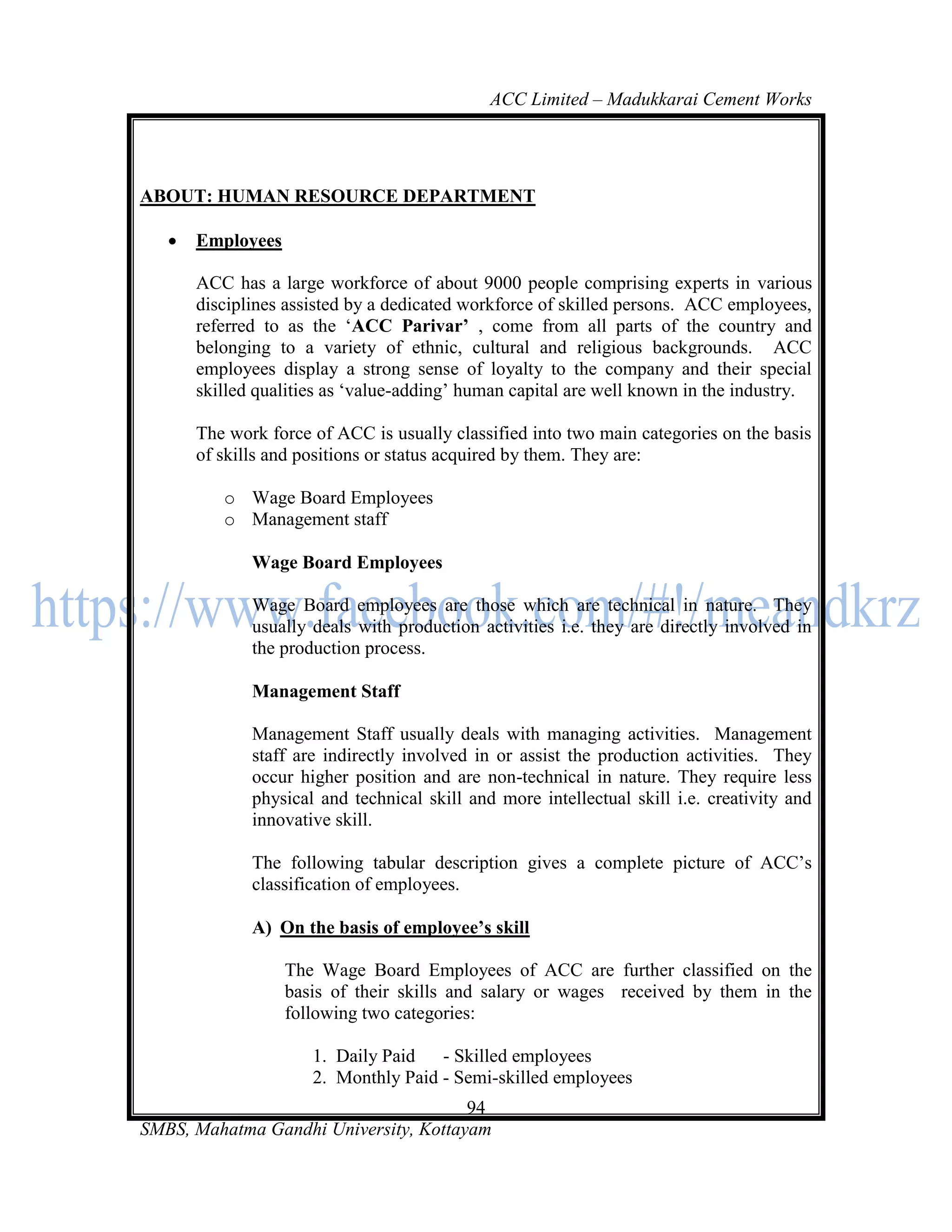
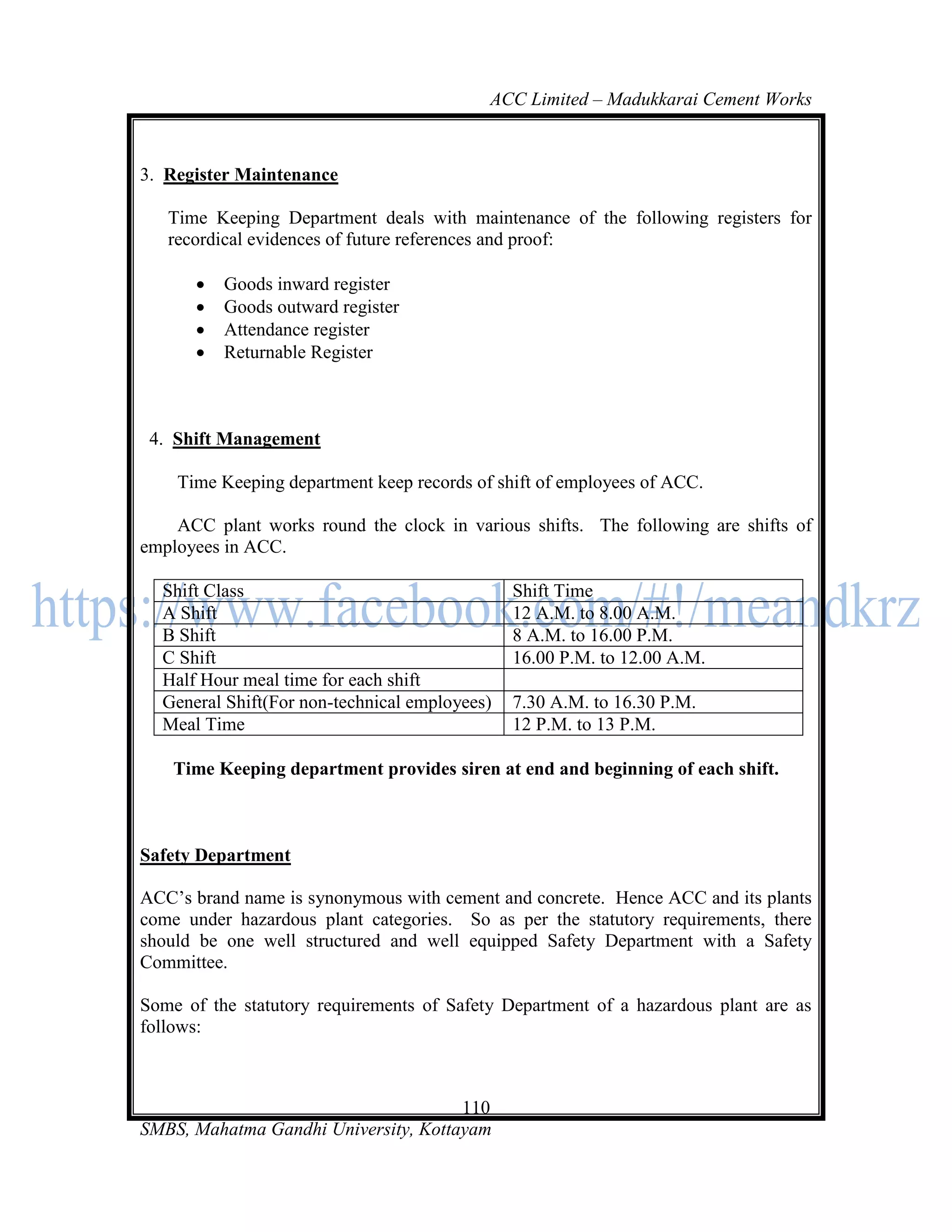
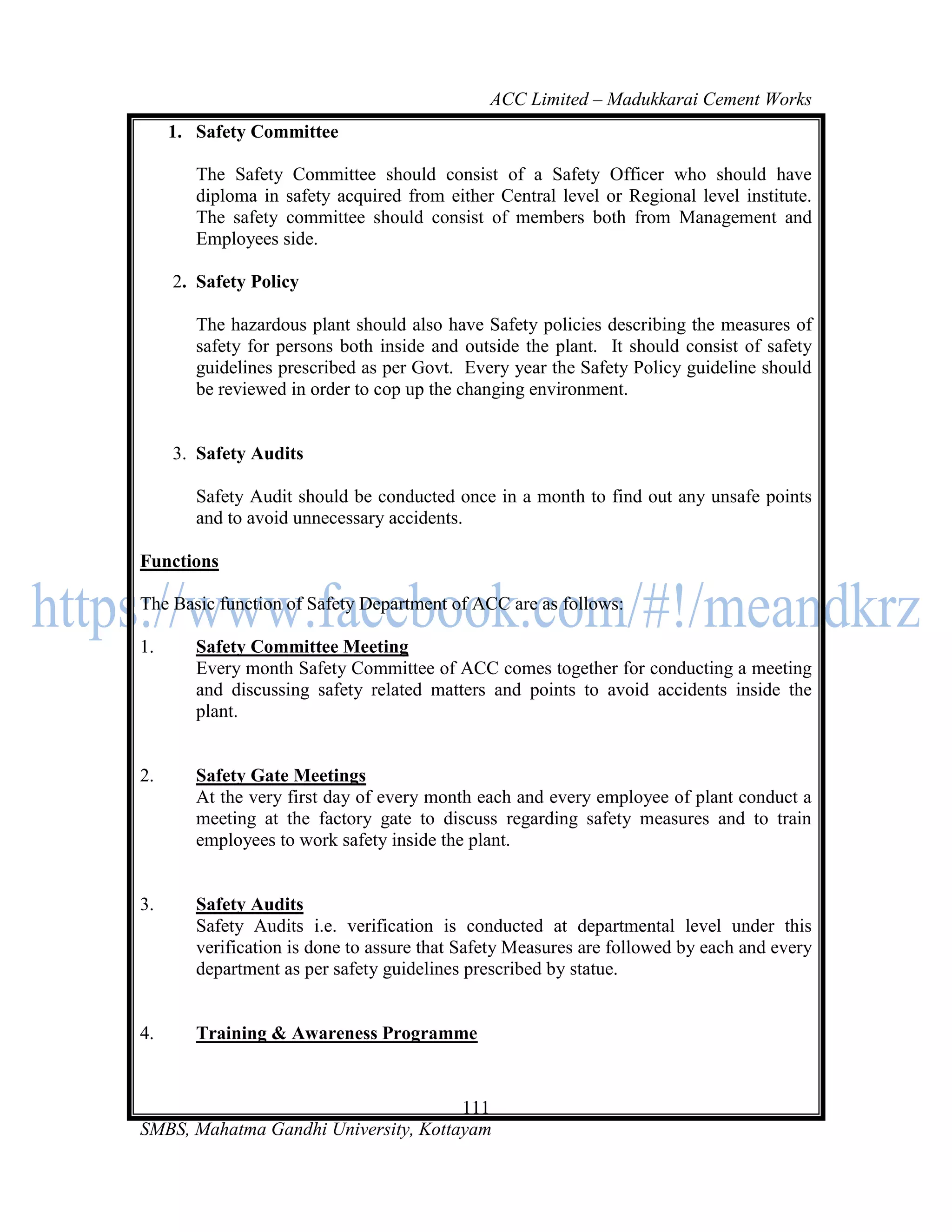
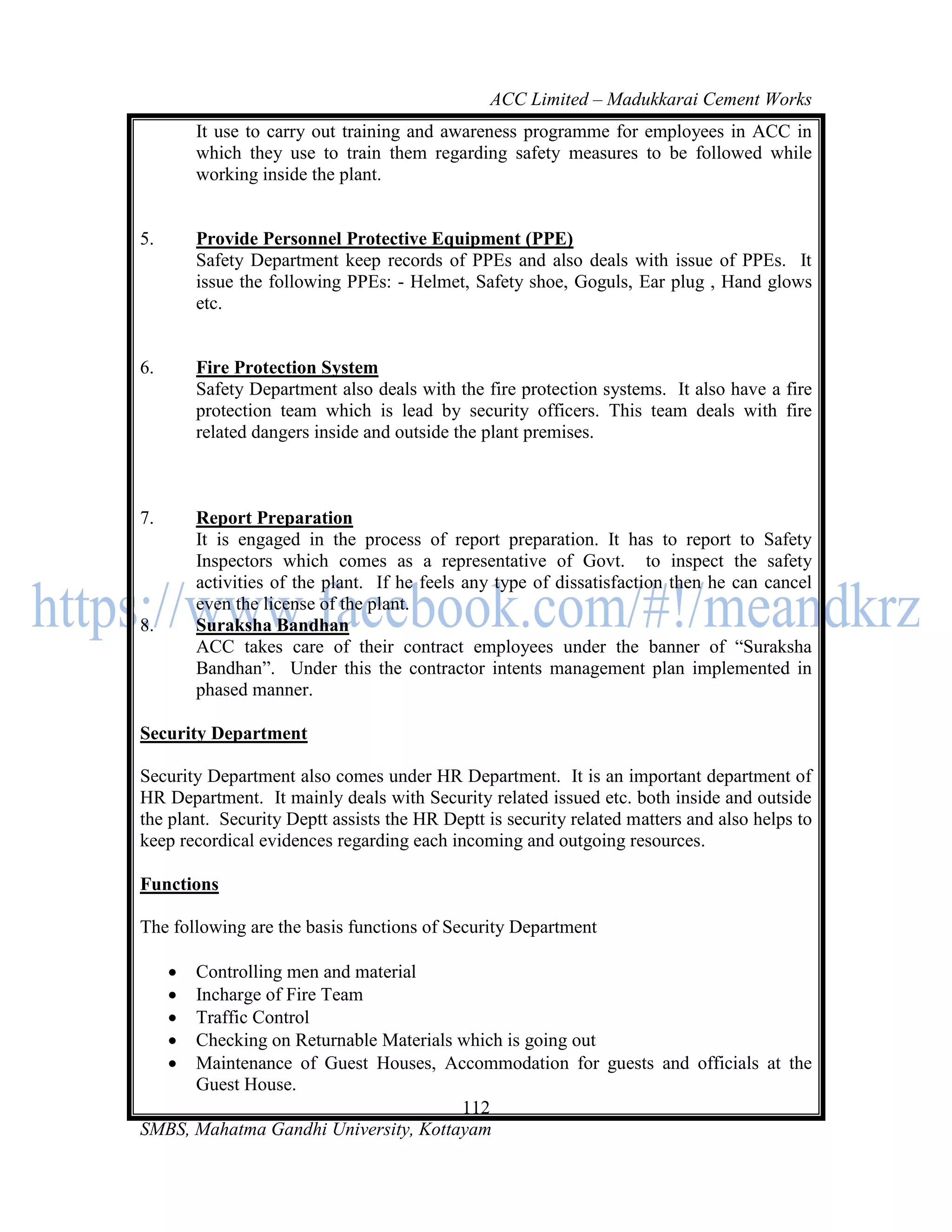
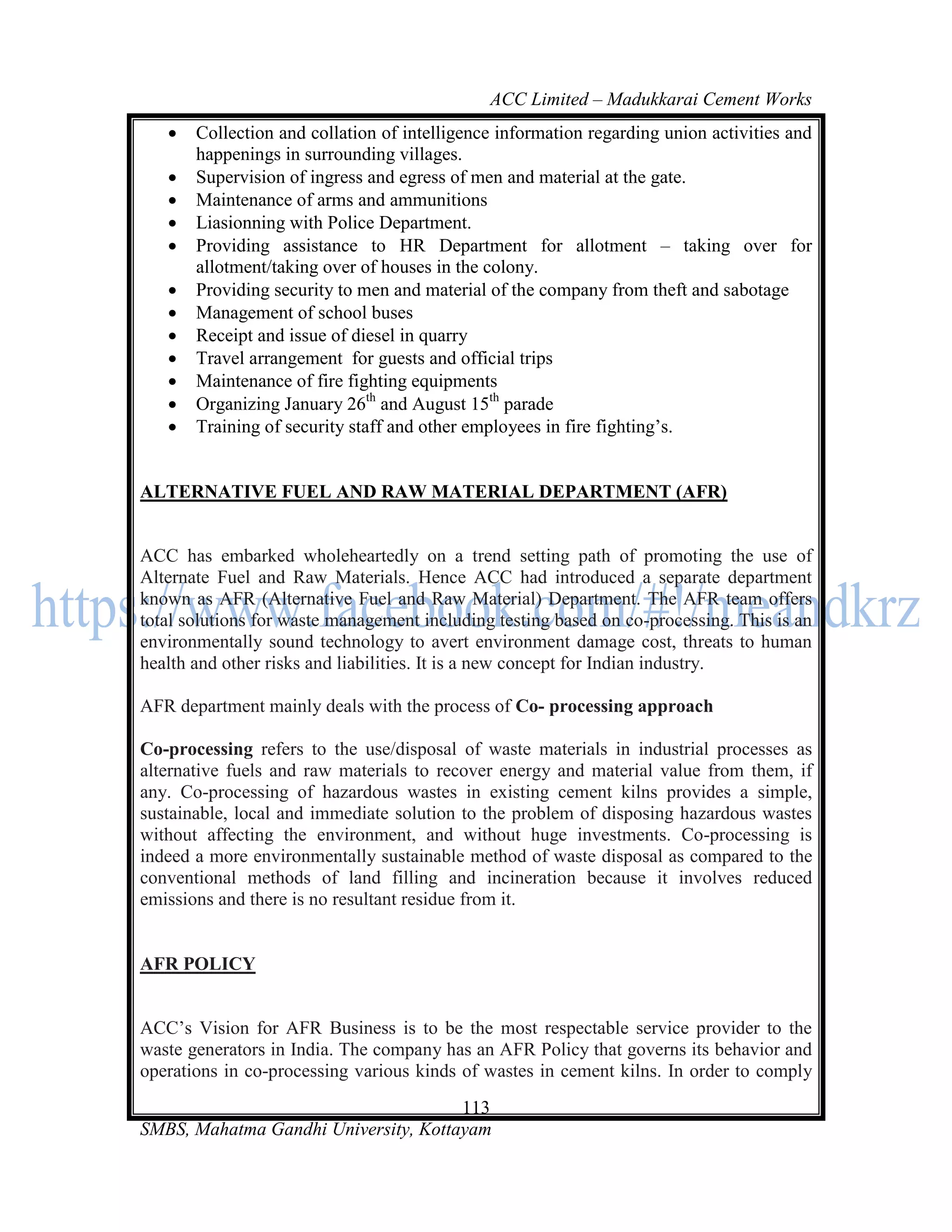
   ACC LIMITED, MADUKKARAI CEMENT WORKS,
                         COIMBATORE


An Organization study Report submitted to Mahatma Gandhi University
     for the partial fulfillment of the Award of Master of Business
                        Administration 2011-2013


                           Submitted By
                          CHRIS JOSE
                         (Reg No. 121115)


                      Under the Supervision of
                       Dr. Saji M Abraham


    SCHOOL OF MANAGEMENT AND BUSINESS STUDIES
           MAHATMA GANDHI UNIVERSITY
                    PRIYADARSHINI HILLS P.O
                       KOTTAYAM – 686 560
                           KERALA
ACC Limited – Madukkarai Cement Works


         SCHOOL OF MANAGEMENT & BUSINESS STUDIES
               MAHATMA GANDHI UNIVERSITY
                             PRIYADARSHINI HILLS P.O
                                KOTTAYAM – 686 560
                                    KERALA


                                  CERTIFICATE

               This is to certify that the report on ―ORGANIZATION STUDY AT
ACC LIMITED-MADUKKARAI CEMENT WORKS, COIMBATORE‖, submitted
to Mahatma Gandhi University in partial fulfillment of the requirements for the award of
the degree of Master of Business Administration is a record of the original work done by
Mr. Chris Jose (Reg No: 121115) during the period of his study in the School of
Management and Business Studies, Priyadarshini Hills, Kottayam under my supervision
and guidance and the report or any part thereof has not been submitted elsewhere for any
other degree, diploma or other similar title of any other University.


Place:                                                       Dr. K. Sreeranganadhan
Date:                                                              DIRECTOR


                                       2
SMBS, Mahatma Gandhi University, Kottayam
ACC Limited – Madukkarai Cement Works


                                   DECLARATION


                      I,   Chris    Jose,   hereby    declare   that   this     Report   on

―ORGANIZATION STUDY AT ACC LIMITED – MADUKKARAI CEMENT

WORKS, COIMBATORE‖ is my original work and that it has not previously formed

the basis for the award of any Degree, Diploma or other similar title of any University or

Institution.


                                                                              - Chris Jose
Place:
Date:
                                                     Email: meandkrz@yahoo.co.in
                                                           Mob: 9496333809


                                       3
SMBS, Mahatma Gandhi University, Kottayam
ACC Limited – Madukkarai Cement Works


                           ACKNOWLEDGEMENT
              The success that has been accomplished in my project would not have
been possible without the timely help and guidance rendered to me by many people. This
study became possible through the wholehearted co-operation of many persons and well
wishers.

I am grateful to Dr. K. Sreeranganathan, Director, School Of Management and Business
Studies, Kottayam for permitting me to take up this report work on Organization Study.

I am grateful to Dr. Saji M Abraham, Faculty co-ordinator, School Of Management and
Business Studies, Kottayam for all the provision made available to me.

I express my deep sense of gratitude to Shri R. Rajendrakumar sir (Manager HR), Mrs.
Padma (Manager HR), Shri Maheshkumar Sir, (Assistant Manager HR) Ms. Neha Guptha
(Quality control department), Ms. Nithra Yogi (AFR laboratory), Mr. Husain (Deputy
Manager –Procurement department) of M/s ACC Limited-Madukkarai Cement Works,
Coimbatore and Shri Ninan Thayi sir (Manager –Logistics), Mr. S.N. Vijayakumaran
Nair (Sales Head), Mr. Prasad Parsewar (Dy. Manager – Marketing) Mr. Jaxen K.J
(Manager – special projects) of M/s ACC Limited – Sales unit, Edappally, Cochin for
kind co-operation and assistance extended during my report work on Organization Study.

I extend my sincere thanks to the Officials of the College Office and Library for
providing the necessary facilities for completing this work.

I am also thankful to my family and friends who supported me throughout the project
work. I will be failing in my duty if I do not acknowledge the deep debt of gratitude I
owe to the authors whose writings have provided an insight to the intricacies of the
subject.


                                                                   - Chris Jose


                                       4
SMBS, Mahatma Gandhi University, Kottayam
ACC Limited – Madukkarai Cement Works


                                    ABSTRACT

                Organization study is usually conducted in a well structured and reputed
organization.    The basic objective of conducting organization study is simply to
understand and learn the actual structure and working of each and every department of an
organization. The main purpose of the study is to observe, analyze and interpret ate the
functions and procedures of each and every department of the selected organization.


From the study conducted in ACC Limited, Madukkarai Cement Works a basic idea of
functioning of various departments of the company has got. Hence the organization
study conducted in ACC Limited, helped to a large extent to experience the real work life
situation in an organization. Cement is a binder, a substance which sets and hardens
independently, and can bind other material together. The working of the cement plant has
been studied in depth with the history of the plant, sources of raw materials, production
of cement, functioning of various departments adopted.


                                       5
SMBS, Mahatma Gandhi University, Kottayam
ACC Limited – Madukkarai Cement Works


                                CONTENTS

    SL No.          CHAPTER                       TITLE                PAGE
                                                                        No.

       1            CHAPTER--I               INTRODUCTION               7


       2            CHAPTER--II         AN OUTLOOK OF--TYPE             10
                                            OF INDUSTRY


       3            CHAPTER--III        COMPANY-- PROFILE               22


                                        DEPARTMENTAL                    45
                                        ANALYSIS-
                                        * Production department         48
       4            CHAPTER--IV         * Quality control department    62
                                        * Finance department            78
                                        * HRM department                91
                                        * ARF department               112
                                        * Procurement department       119
                                        * General stores department    122
                                        * Environment department       129
                                        * CSR department               136
                                        * Maintenance department       140
                                        * System department            147
                                        * Marketing department         152
                                        * Internal audit section       166


       5            CHAPTER--V              SWOT--ANALYSIS             168


       6            CHAPTER--VI             EVALUATION AND             174
                                              SUGGESTIONS

       7           CHAPTER--VII         LEARNING EXPERIENCE            177


                                       6
SMBS, Mahatma Gandhi University, Kottayam
ACC Limited – Madukkarai Cement Works
       8           CHAPTER--VIII            CONCLUSION &             179
                                            BIBLIOGRAPHY


                        CHAPTER                   I

                     INTRODUCTION


                                       7
SMBS, Mahatma Gandhi University, Kottayam
ACC Limited – Madukkarai Cement Works


               ORGANIZATION STUDY AT
       ACC LIMITED, MADUKKARAI CEMENT WORKS

INTRODUCTION
               Organization Study helps to convert the theoretical knowledge and
practical knowledge into experienced one. An organization is a social unit of people,
systematically structured and managed to meet a need or to pursue collective goals on a
continuing basis. Organizational study conducted by the School of Management and
Business Studies is a training program that helps management students gain knowledge
and practical working conditions of an organization. The purpose of training program is
to have an exposure to the real life situations relevant to business areas and strengthen the
conceptual knowledge gained from the industry.


Organization study is usually conducted in a well structured and reputed organization.
The basic objective of conducting organization study is simply to understand and learn
the actual structure and working of each and every department of an organization. The
main purpose of the study is to observe, analyze and interpret ate the functions and
procedures of each and every department of the selected organization.


From the study conducted in ACC Limited, Madukkarai Cement Works a basic idea of
functioning of various departments of the company has got. Hence the organization
study conducted in ACC Limited, helped to a large extent to experience the real work life
situation in an organization.


OBJECTIVES OF THE STUDY
     Understand the structure of the organization
                                           8
SMBS, Mahatma Gandhi University, Kottayam
ACC Limited – Madukkarai Cement Works
      To understand the Functional Departments of the organization
      To know the plans, policies, and procedures of the organization
      To fulfill the requirements of the curriculum
      To familiar with the day to day activities of the organization
      To know how the functions of the various Departments co-ordinate
      To know how the Qualities maintained
      To know how HR is managed effectively
      To understand how the firm faces tight competitions
      To know the social responsibility of the organization


SCOPE OF THE STUDY
The organization study conducted in ACC Limited, Madukkarai Cement Works gave a
basic idea of functioning of various departments of the company. It helped to understand
the constraints and problems involved in carrying out a business successfully. The study
gave the experience of working in an organization and also helped to understand the
environment of the organization.


It helped to view and analyze the functioning of various departments and also helped to
view the decision making and implementation strategies in an organization.


SOURCES OF INFORMATION
Primary data were collected through the personal visits and interview with the staff and
executives of various departments of ACC Limited, Madukkarai Cement Works.


Secondary data were received from the Annual Report and Magazines of the company
and from the website of the company.


LIMITATION OF THE STUDY


                                       9
SMBS, Mahatma Gandhi University, Kottayam
ACC Limited – Madukkarai Cement Works
A detailed study was not possible because of the time constrains. However, efforts have
been made to incorporate all aspects related to ―Organization Study‖ in ACC Limited,
Madukarai Cement Works. The study is based on the information supplied and inference
that is made from the statement of experts. The techniques used for the analysis has its
own limitations and these limitations have its own effect on the report also.


                             CHAPTER II
                      AN OUTLOOK OF
                     TYPE OF INDUSTRY


                                       10
SMBS, Mahatma Gandhi University, Kottayam
ACC Limited – Madukkarai Cement Works


            An Outlook of              Indian Cement Industry

                            Cement is one of the core industries which plays a vital role in
the growth and expansion of a nation. The demand for cement depends primarily on the
pace of activities in the business, financial, real estate and infrastructure sectors of the
economy. Cement is considered preferred building material and is used worldwide for all
construction works such as housing and industrial construction as well as creation of
infrastructures like ports, roads, power pants, etc. Indian cement industry is globally
competitive because the industry has witnessed healthy trends such as cost control and
continuous technology up-gradation.
The Indian cement industry is extremely energy intensive and is the third largest user of
coal in the country. It is modern and uses latest technology, which is among the best in
the world. Also, the industry has tremendous potential for development as limestone of
excellent quality is found almost throughout the country.


INVENTION OF CEMENT

Ever since civilizations first started to build, the world has sought a man made bonding
material that would bind stones into a solid, formed mass. During the Paleolithic Age,
men used to enjoy adequate shelter provided by nature. The Bronze Age witnessed the
use of building materials from a clay based mixture and air hardening lime. The
Egyptians advanced to the discovery of lime and gypsum mortar as a binding agent for
building such structures as the Pyramids. The Greeks made further improvements and
finally the Romans developed cement that produced structures of remarkable durability
(Cement Association of Canada 2006). The secret of Roman success in making cement
was traced to the mixing of slaked lime with Pozzolana, a volcanic ash from Mount
Vesuvius. This process produced cement capable of hardening under water. During the
Middle Ages this art was somehow lost. In the 18th century, big efforts started in Europe
to understand why some limes have hydraulic properties (Cimenterie Nationale 2007).
John Smeaton often referred to as ‗father of civil engineering‘ in England concentrated
his work in this field and made the first modern concrete by adding pebbles as a coarse
aggregate and mixing powered brick into the cement in 1759. A number of discoveries
followed. It was in 1817 that Louis Vicat conducted work on the hydraulic nature of the
lime-volcanic ash mixture. He was the first person to accurately determine the
                                              11
SMBS, Mahatma Gandhi University, Kottayam
ACC Limited – Madukkarai Cement Works
proportions of limestone and silica required to make the mixture of cement. He published
the results of his research, but did not apply for a patent. Finally, in 1824 Joseph Aspdin
patented the basic process of slower-setting cement. He addressed this as ‗Portland
cement‘ due to the fact that in appearance and hardness, it resembled the upper Jurassic
rock found in the region of Portland, in southern England (Lafarge 2004).


CEMENT INDUSTRY IN INDIA

The Indian cement industry is the second largest cement producer just behind China , but
ahead of the United States and Japan. The government of India giving boost to various
infrastructure projects housing facilities and road networks as a result of which the
cement industry in India is currently growing at an enviable pace. It is also predicted that
the cement production in India would rise to 262.61 MT.

The Indian cement industry comprises of 140 large and, more than 365 mini cement
plants , where majority of the production of cement (94%) in the country is by large
plants.

The industry‘s capacity at the beginning of the year 2009-10 was 217.80 million tones.
During the period of April—Sept 2009, the Indian cement companies have produced 11
MT cement. The Indian cement industry has witnessed a phenomenal capacity addition
to the tune of about 52 MT tones in the last two financial years which accounted for
about 24% of the industry‘s capacity of 218 mn tones at the end of FY09. In the last two
financial years, the cement industry has registered a double-digit growth in capacity
addition compared to moderate growth of 3-7% registered during period FY 03-07. As a
result, industry‘s capacity utilization rate which showed a rising trend up to FY07 has
dropped to a level of 83% in FY09.
In FY09, the GDP growth slowed down to 6.7% compared to the 9% growth reported in
FY08.

There is only one Central Public Sector Undertaking in the cement sector, i.e. Cement
Corporation of India, which has 10 units. There are 10 large cement plants owned by
various State Governments.


BEGINING OF INDIAN CEMENT INDUSTRY

The attempt to produce cement in India dates back to 1889 when a Calcutta firm
attempted to produce cement from Argillaceous (kankar). But the first organized effort on
mass scale to manufacture Portland cement commenced in Madras (Washermanpet), in
1904, by South India Industries Limited (Cement Manufacturers Association 1964;
Gadhok 2000). The factory could not succeed hence it failed. However, it was in 1914
that the first commissioned cement-manufacturing unit in India was set up by India
                                       12
SMBS, Mahatma Gandhi University, Kottayam
ACC Limited – Madukkarai Cement Works
Cement Company Limited at Porbandar, Gujarat, with an installed capacity of 10,000
tonnes and production of 1000 tonnes. Subsequently two plants; one at Katni (M.P.) and
another at Lakheri (Rajasthan) were set up. The First World War gave positive stimulus
to the infant industry. The following decades saw increase in number of plants, installed
capacity and production. This period can thus be called the Nascent Stage of Indian
cement industry.


The problem of supply outstripping demand was significant in early period of the
industry. Problem of disposal of cement was aggravated by the prejudice with which
indigenous cement was regarded. This was followed by a price war between the
producers where they resorted to cutting down of prices and selling at below production
cost. This situation forced many companies into liquidation.

 It was then when the government of India intervened into the market and referred the
cement industry to the Tariff Board. The board recommended protection by government
and cooperation among existing cement units. All these events resulted in formation of
Indian Cement Manufacturers‘ Association in 1925 whose main function was to regulate
prices in the industry. In 1927, Concrete Association of India was formed whose two
main objectives were to educate public about the use of cement and to play an active role
in popularizing Indian cement. The next step in the direction of rescuing cement industry
was the formation of Cement Marketing Company of India Limited in 1930 to promote
and control the sale and distribution of cement at regulated prices.

After all these initiatives, the sales increased along with more plants. In 1936, eleven
companies, except Sone Valley Portland Cement Company Limited, merged to form
Associated Cement Company Limited (ACC). In 1937, Dalmiya Jain Group set up five
factories with installed capacity of 575000 tonnes and ACC added four more plants. With
all these expansions, price war again started off which resulted into a significant decrease
in prices. But in the post world war period, setting up of Department of Planning and
independence of the country provided fresh impetus to the industry.

The price and distribution control system on cement, implemented in 1956, aimed at
ensuring fair prices to producers and consumers all over the country, thus reducing
regional imbalances, and at reaching self-sufficiency within a short time period. Although
due to slow growth in capacity expansion and rising cost in the industry, the government
had to increase the fixed price several times. However, these price increases as well as
financial incentives to enhance investment, showed little effect on the industry. In spite of
the fact that government exercised no control over the Indian cement industry all through
the Third Five Year Plan (1961-1967), growth was low due to inadequate retention price
and lack of adequate financial resources to the existing companies.


CEMENT BUSINES----PERFORMANCE AT A GLANCE

                                       13
SMBS, Mahatma Gandhi University, Kottayam
ACC Limited – Madukkarai Cement Works
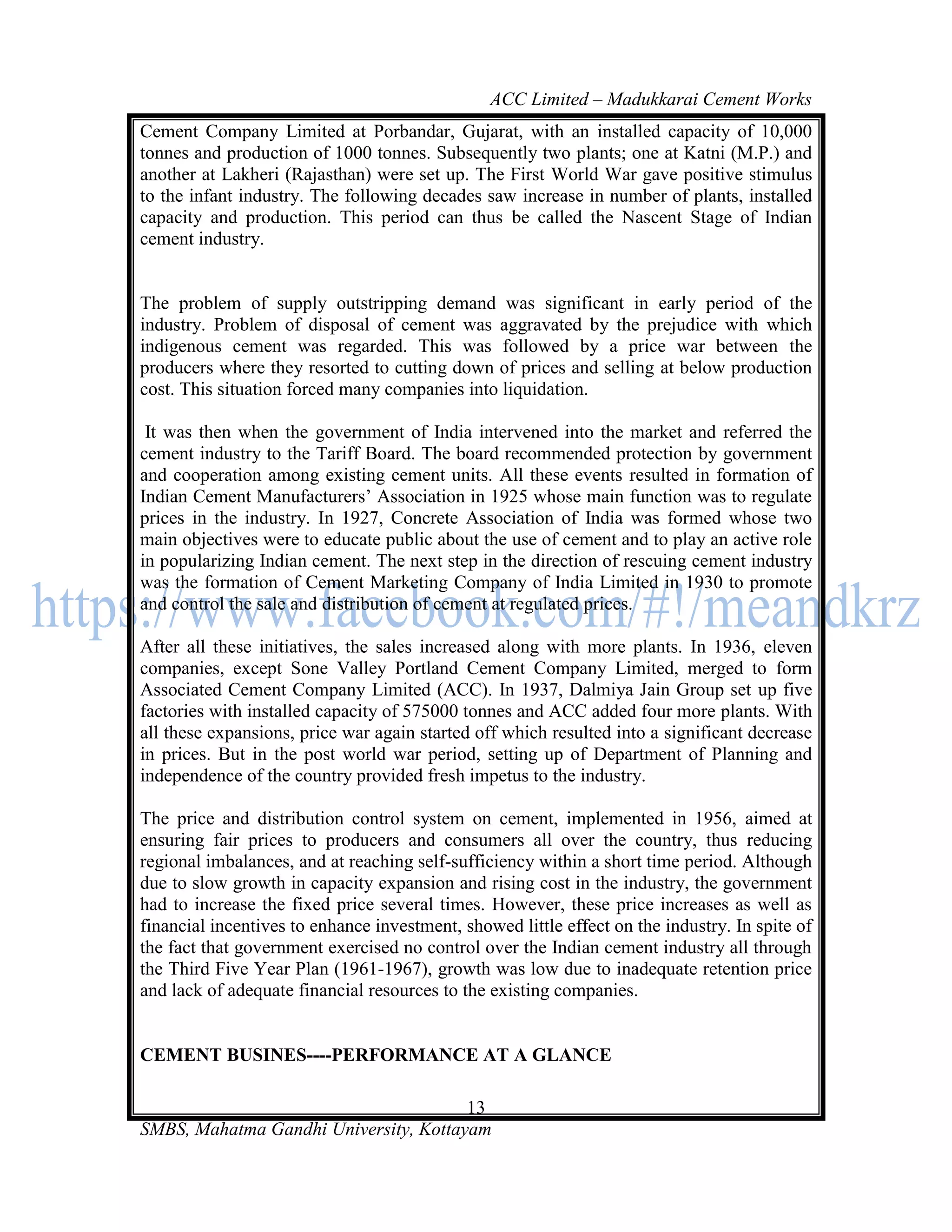
                         2011                  2010                   Change %
  Production- million    21.37                 20.83                  2.6
  tones
  Sales       volume-    21.52                 21.01                  2.4
  million tones
  Sales value-Rs.crore   8027.19               7282.87                10.2
  EBITDA %               32.3%                 25.5%

CEMENT PRODUCTION AND GROWTH

Domestic demand plays a major role in the fast growth of cement industry in India. In
fact the domestic demand of cement has surpassed the economic growth rate of India.
During 2008—2009 total cement consumption in India stood at 178 million tones while
exports of cement and clinker amounted to around 3 million tones. However, cement
consumption growth in FY09 at 8.4% has been able to maintain its multiplier factor with
GDP growth at 1.25 times.


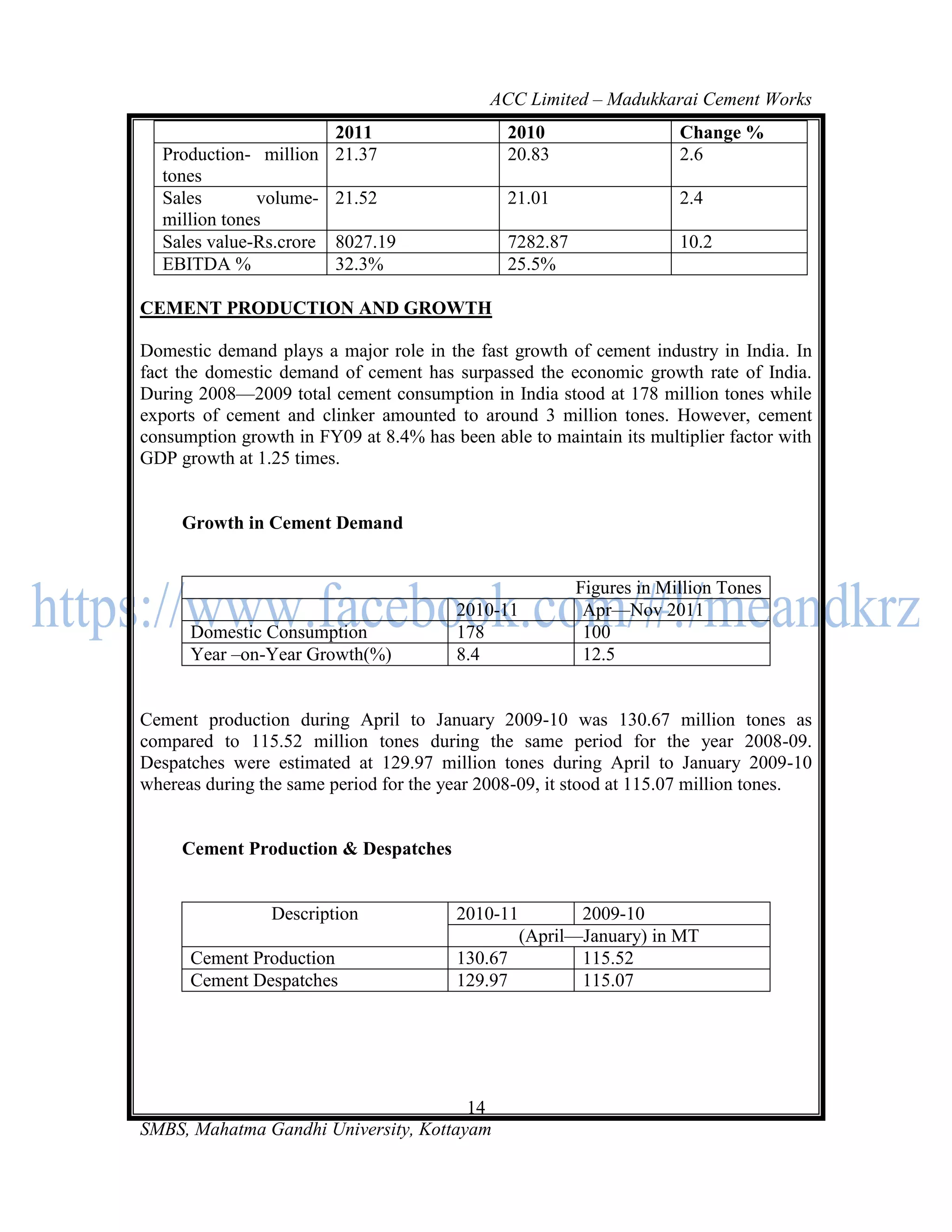
     Growth in Cement Demand


                                                         Figures in Million Tones
                                        2010-11           Apr—Nov 2011
      Domestic Consumption              178               100
      Year –on-Year Growth(%)           8.4               12.5


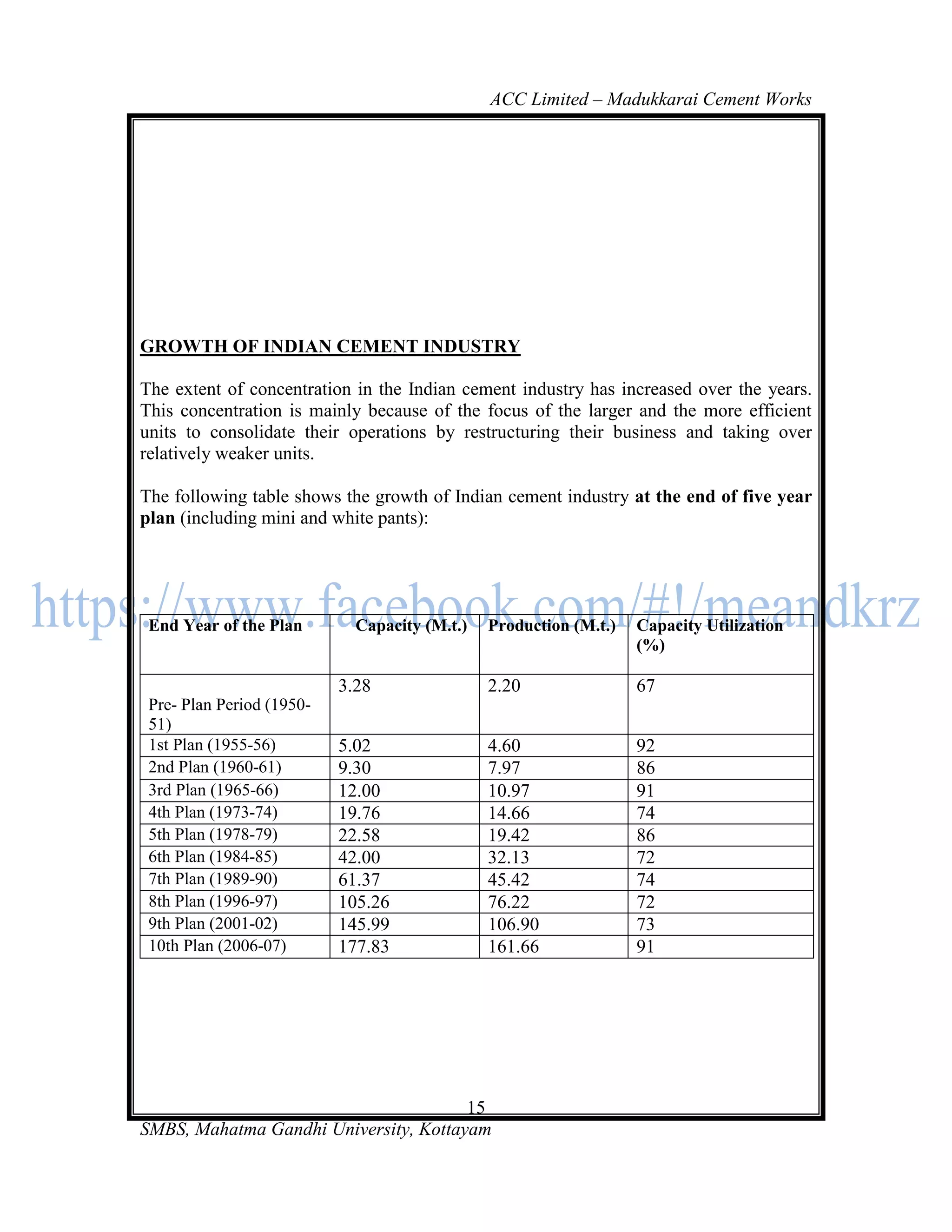
Cement production during April to January 2009-10 was 130.67 million tones as
compared to 115.52 million tones during the same period for the year 2008-09.
Despatches were estimated at 129.97 million tones during April to January 2009-10
whereas during the same period for the year 2008-09, it stood at 115.07 million tones.


     Cement Production & Despatches


                 Description            2010-11       2009-10
                                               (April—January) in MT
      Cement Production                 130.67        115.52
      Cement Despatches                 129.97        115.07


                                       14
SMBS, Mahatma Gandhi University, Kottayam
ACC Limited – Madukkarai Cement Works


GROWTH OF INDIAN CEMENT INDUSTRY

The extent of concentration in the Indian cement industry has increased over the years.
This concentration is mainly because of the focus of the larger and the more efficient
units to consolidate their operations by restructuring their business and taking over
relatively weaker units.

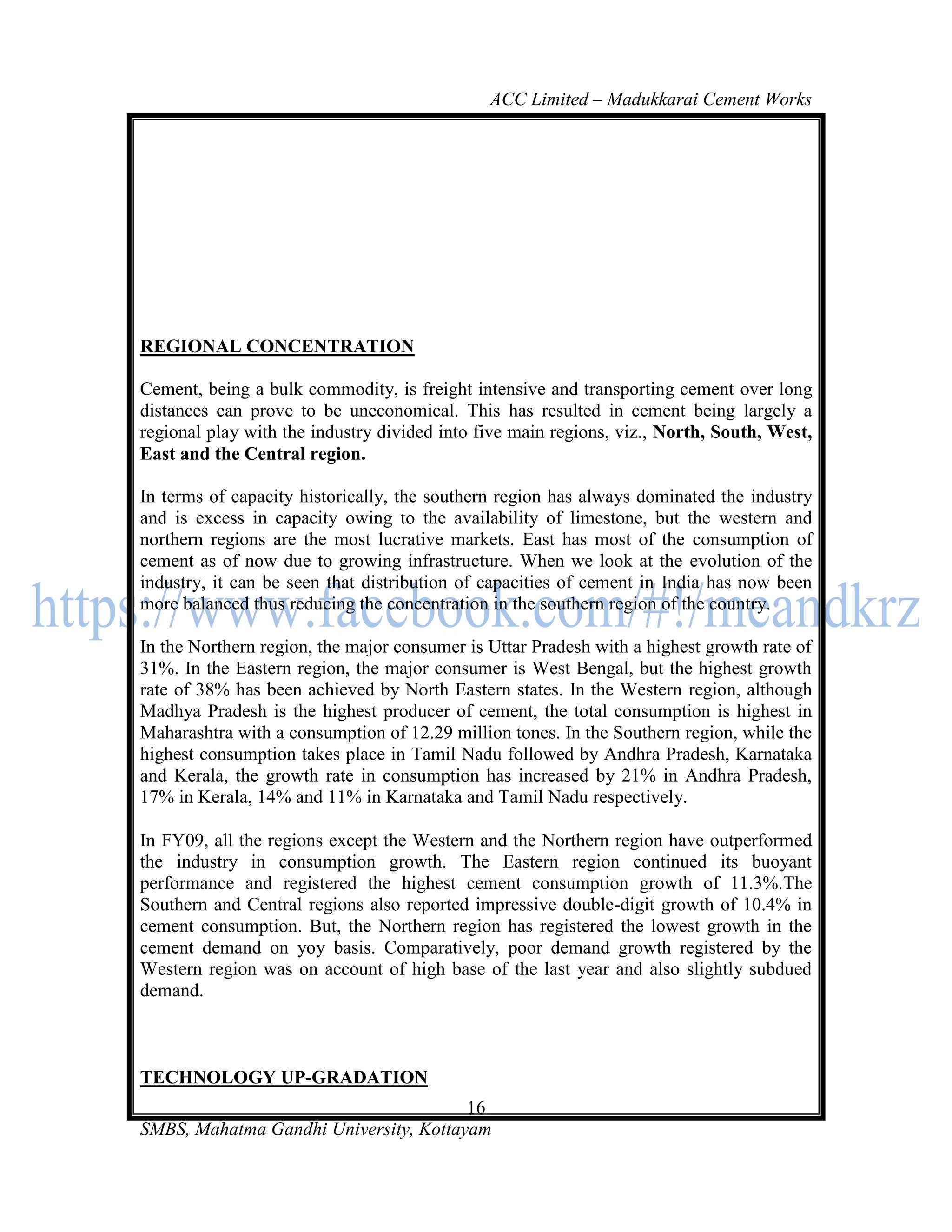
The following table shows the growth of Indian cement industry at the end of five year
plan (including mini and white pants):


 End Year of the Plan        Capacity (M.t.)   Production (M.t.)   Capacity Utilization
                                                                   (%)

                           3.28                2.20                67
 Pre- Plan Period (1950-
 51)
 1st Plan (1955-56)        5.02                4.60                92
 2nd Plan (1960-61)        9.30                7.97                86
 3rd Plan (1965-66)        12.00               10.97               91
 4th Plan (1973-74)        19.76               14.66               74
 5th Plan (1978-79)        22.58               19.42               86
 6th Plan (1984-85)        42.00               32.13               72
 7th Plan (1989-90)        61.37               45.42               74
 8th Plan (1996-97)        105.26              76.22               72
 9th Plan (2001-02)        145.99              106.90              73
 10th Plan (2006-07)       177.83              161.66              91


                                       15
SMBS, Mahatma Gandhi University, Kottayam
ACC Limited – Madukkarai Cement Works


REGIONAL CONCENTRATION

Cement, being a bulk commodity, is freight intensive and transporting cement over long
distances can prove to be uneconomical. This has resulted in cement being largely a
regional play with the industry divided into five main regions, viz., North, South, West,
East and the Central region.

In terms of capacity historically, the southern region has always dominated the industry
and is excess in capacity owing to the availability of limestone, but the western and
northern regions are the most lucrative markets. East has most of the consumption of
cement as of now due to growing infrastructure. When we look at the evolution of the
industry, it can be seen that distribution of capacities of cement in India has now been
more balanced thus reducing the concentration in the southern region of the country.

In the Northern region, the major consumer is Uttar Pradesh with a highest growth rate of
31%. In the Eastern region, the major consumer is West Bengal, but the highest growth
rate of 38% has been achieved by North Eastern states. In the Western region, although
Madhya Pradesh is the highest producer of cement, the total consumption is highest in
Maharashtra with a consumption of 12.29 million tones. In the Southern region, while the
highest consumption takes place in Tamil Nadu followed by Andhra Pradesh, Karnataka
and Kerala, the growth rate in consumption has increased by 21% in Andhra Pradesh,
17% in Kerala, 14% and 11% in Karnataka and Tamil Nadu respectively.

In FY09, all the regions except the Western and the Northern region have outperformed
the industry in consumption growth. The Eastern region continued its buoyant
performance and registered the highest cement consumption growth of 11.3%.The
Southern and Central regions also reported impressive double-digit growth of 10.4% in
cement consumption. But, the Northern region has registered the lowest growth in the
cement demand on yoy basis. Comparatively, poor demand growth registered by the
Western region was on account of high base of the last year and also slightly subdued
demand.


TECHNOLOGY UP-GRADATION
                                       16
SMBS, Mahatma Gandhi University, Kottayam
ACC Limited – Madukkarai Cement Works
Cement industry in India is currently going through a technological change as a lot of up
gradation and assimilation is taking place currently, almost 93% of total capacity is based
entirely on the modern dry process, which is considered as more environment –friendly.
Only the rest 7% uses old wet and semi dry process technology. There is also a huge
scope of waste heat recovery in cement plants, when lead to reduction is the emissions
level and hence improves the environment.


COMPONENTS FOR MANUFACTURING THE CEMENT

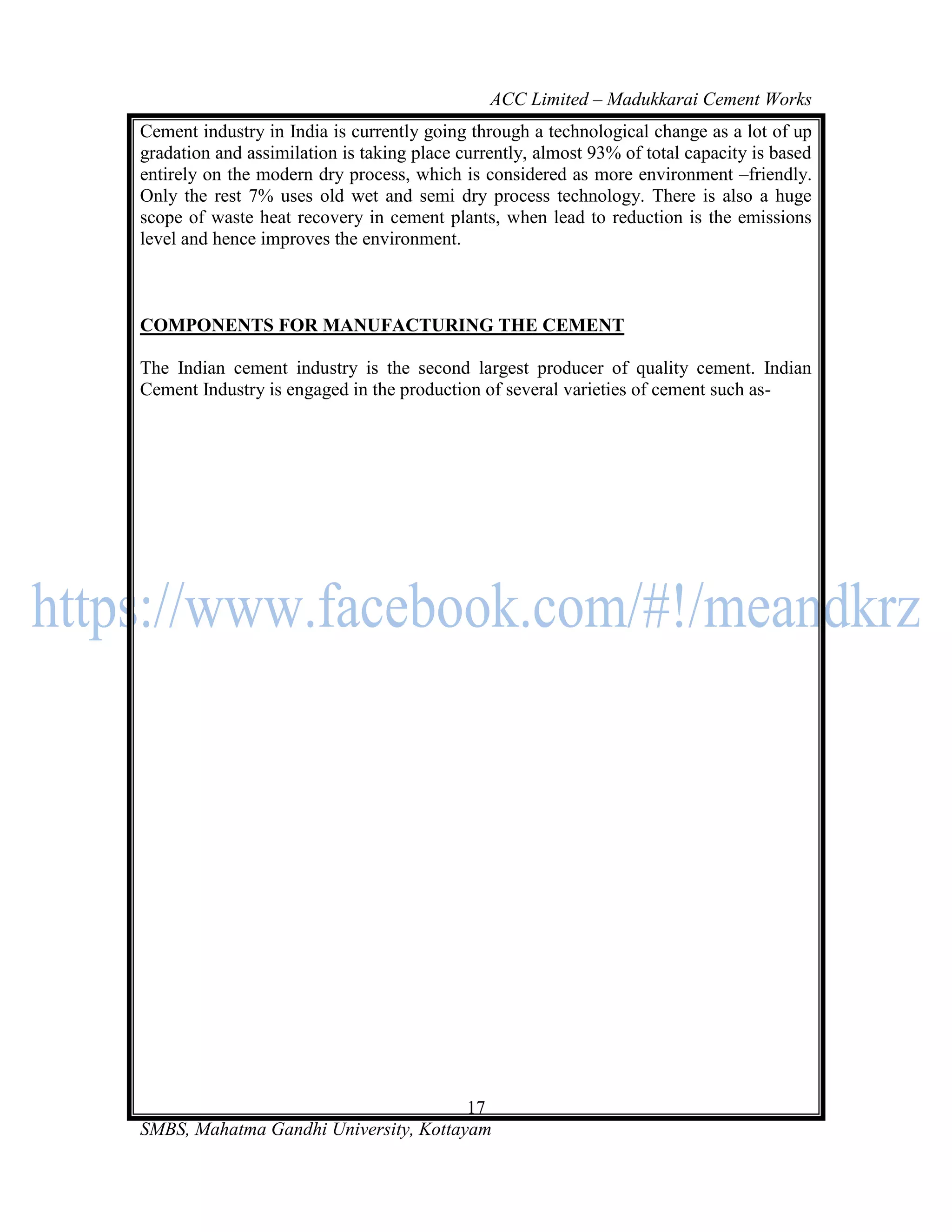
The Indian cement industry is the second largest producer of quality cement. Indian
Cement Industry is engaged in the production of several varieties of cement such as-


                                       17
SMBS, Mahatma Gandhi University, Kottayam
ACC Limited – Madukkarai Cement Works


                             Portland Blast
                             Furnace Slag
                             Cement (PBFS)


   Ordinary                                                Portland
   Portland                                                Pozzolana
   Cement (OPC)                                            Cement (PPC)


                          Sulphate Resisting Portland
                                   Cement


     White Cement                                          Rapid Hardening
                                                           Portland Cement


                              Oil Well Cement


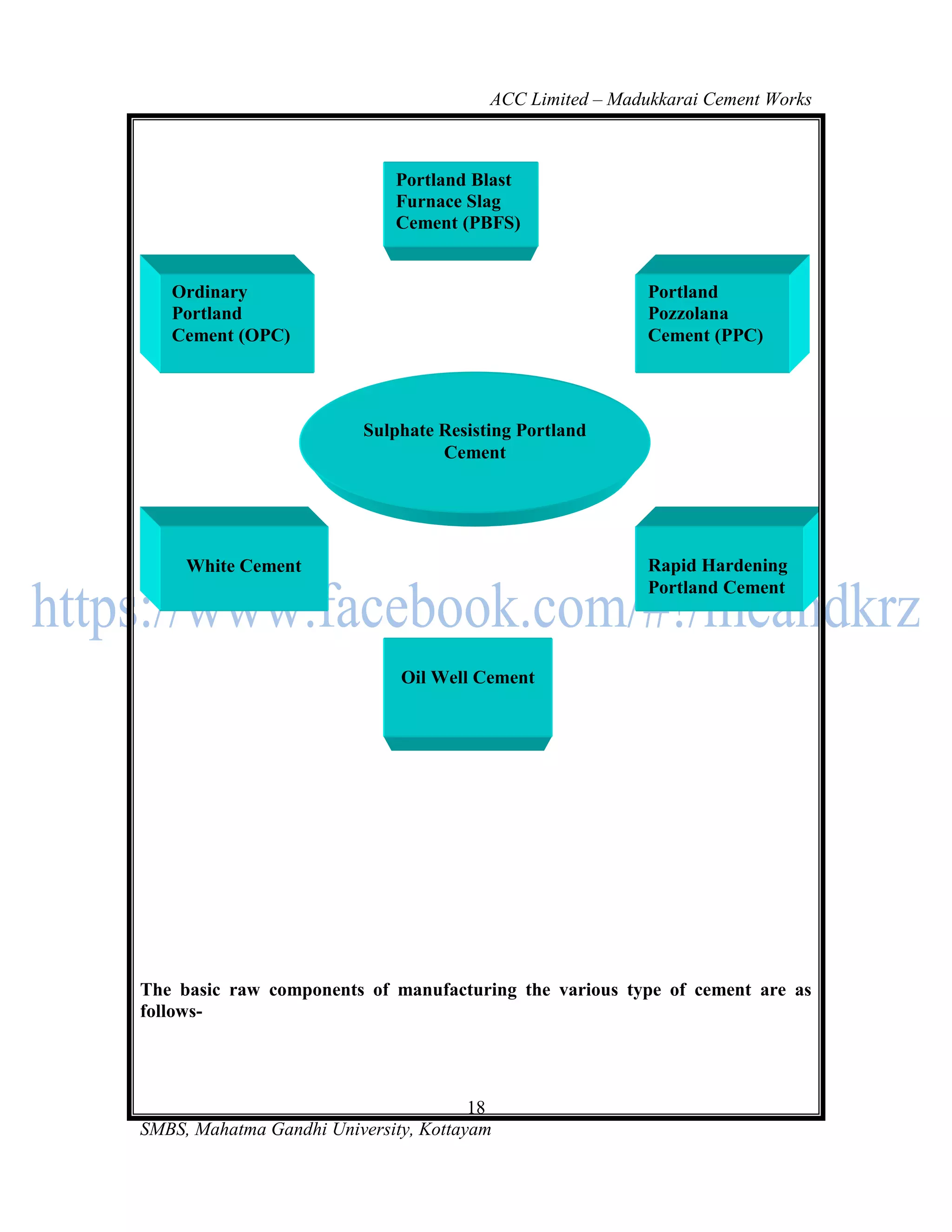
The basic raw components of manufacturing the various type of cement are as
follows-


                                       18
SMBS, Mahatma Gandhi University, Kottayam
ACC Limited – Madukkarai Cement Works


                                      Limestone


                                       Raw
         Silica                     Components                        Iron Oxide


                                      Aluminum
                                         Oxide


              MAJOR PLAYERS IN INDIAN CEMENT INDUSTRY

There are a number of players prevailing in cement industry in India. However , there are
around 17 big names that account for more than 70% of total cement production in India.
                                           19
SMBS, Mahatma Gandhi University, Kottayam
ACC Limited – Madukkarai Cement Works
The total installed capacity is distributed over around 129 plants, owned by 54 major
companies across the nation.

List of Cement Companies in India.

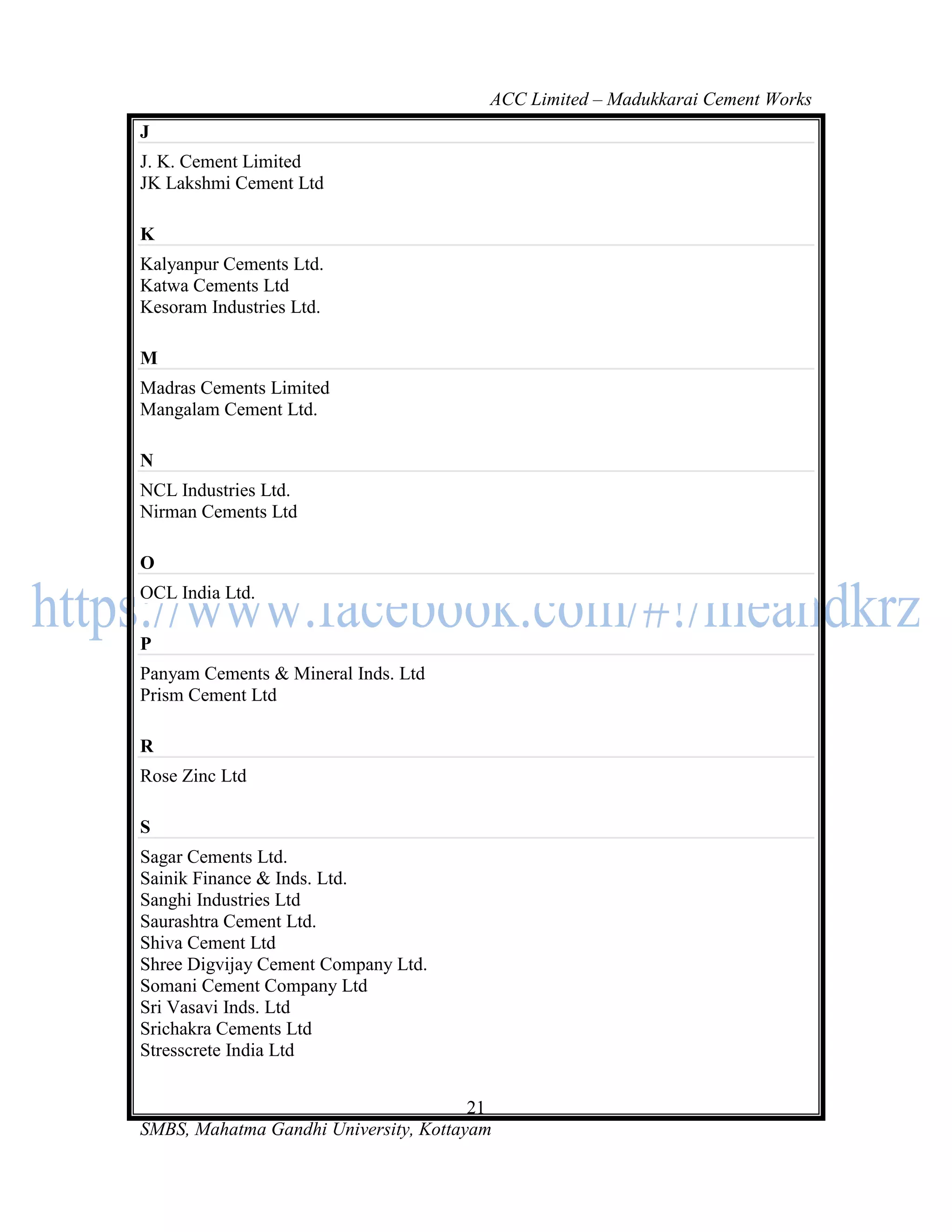
A
ACC Limited
Ambuja Cements Limited
Andhra Cements Ltd

B
Barak Valley Cements Ltd
Bheema Cements Ltd
Binani Cement Ltd
Birla Corporation Limited
Burnpur Cement Ltd

C
Chettinad Cement Corporation Limited

D
Dalmia Cement (Bharat) Limited
Deccan Cements Ltd.

E
Everest Industries Ltd

G
Grasim Industries Limited
Gujarat Sidhee Cement Ltd

H
Heidelberg Cement India Ltd
Hyderabad Industries Ltd

I
Indian Hume Pipe Company Ltd


                                       20
SMBS, Mahatma Gandhi University, Kottayam
ACC Limited – Madukkarai Cement Works
J
J. K. Cement Limited
JK Lakshmi Cement Ltd

K
Kalyanpur Cements Ltd.
Katwa Cements Ltd
Kesoram Industries Ltd.

M
Madras Cements Limited
Mangalam Cement Ltd.

N
NCL Industries Ltd.
Nirman Cements Ltd

O
OCL India Ltd.

P
Panyam Cements & Mineral Inds. Ltd
Prism Cement Ltd

R
Rose Zinc Ltd

S
Sagar Cements Ltd.
Sainik Finance & Inds. Ltd.
Sanghi Industries Ltd
Saurashtra Cement Ltd.
Shiva Cement Ltd
Shree Digvijay Cement Company Ltd.
Somani Cement Company Ltd
Sri Vasavi Inds. Ltd
Srichakra Cements Ltd
Stresscrete India Ltd


                                       21
SMBS, Mahatma Gandhi University, Kottayam
ACC Limited – Madukkarai Cement Works
T
The India Cements Limited

U
Udaipur Cement Works Ltd
UltraTech Cement Limited

V
Vinay Cements Ltd
Visaka Industries Ltd


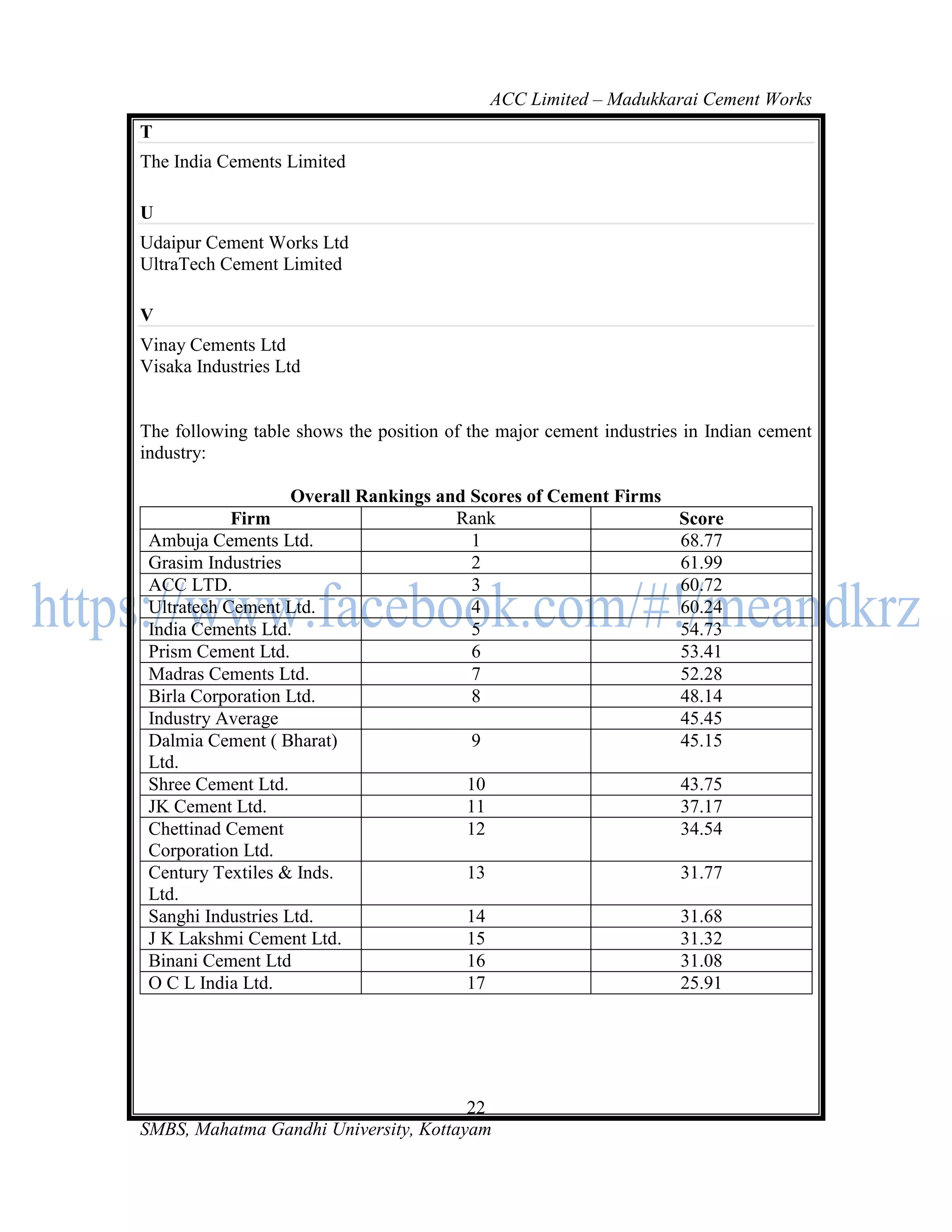
The following table shows the position of the major cement industries in Indian cement
industry:

                    Overall Rankings and Scores of Cement Firms
            Firm                       Rank                     Score
 Ambuja Cements Ltd.                     1                      68.77
 Grasim Industries                       2                      61.99
 ACC LTD.                                3                      60.72
 Ultratech Cement Ltd.                   4                      60.24
 India Cements Ltd.                      5                      54.73
 Prism Cement Ltd.                       6                      53.41
 Madras Cements Ltd.                     7                      52.28
 Birla Corporation Ltd.                  8                      48.14
 Industry Average                                               45.45
 Dalmia Cement ( Bharat)                 9                      45.15
 Ltd.
 Shree Cement Ltd.                      10                      43.75
 JK Cement Ltd.                         11                      37.17
 Chettinad Cement                       12                      34.54
 Corporation Ltd.
 Century Textiles & Inds.               13                      31.77
 Ltd.
 Sanghi Industries Ltd.                 14                      31.68
 J K Lakshmi Cement Ltd.                15                      31.32
 Binani Cement Ltd                      16                      31.08
 O C L India Ltd.                       17                      25.91


                                       22
SMBS, Mahatma Gandhi University, Kottayam
ACC Limited – Madukkarai Cement Works


                       CHAPTER                  III

               COMPANY                      PROFILE


                                       23
SMBS, Mahatma Gandhi University, Kottayam
ACC Limited – Madukkarai Cement Works


                      MADUKKARAI CEMENT WORKS
                            COMPANY PROFILE

               ACC (ACC Limited) is India's foremost manufacturer of cement and
concrete. ACC's operations are spread throughout the country with 16 modern cement
factories, more than 40 Ready mix concrete plants, 20 sales offices, and several zonal
offices. It has a workforce of about 10,000 persons and a countrywide distribution
network of over 9,000 dealers.

Since inception in 1936, the company has been a trendsetter and important benchmark for
the cement industry in many areas of cement and concrete technology. ACC has a unique
track record of innovative research, product development and specialized consultancy
services. The company's various manufacturing units are backed by a central technology
support services centre - the only one of its kind in the Indian cement industry.

ACC has rich experience in mining, being the largest user of limestone. As the largest
cement producer in India, it is one of the biggest customers of the domestic coal industry,
of Indian Railways, and a considerable user of the country‘s road transport network
services for inward and outward movement of materials and products.

Among the first companies in India to include commitment to environmental protection
as one of its corporate objectives, the company installed sophisticated pollution control
equipment as far back as 1966, long before pollution control laws came into existence.
Today each of its cement plants has state-of-the art pollution control equipment and
devices.

ACC plants, mines and townships visibly demonstrate successful endeavors in quarry
rehabilitation, water management techniques and ‗greening‘ activities. The company
actively promotes the use of alternative fuels and raw materials and offers total solutions
for waste management including testing, suggestions for reuse, recycling and co-
processing.


                                       24
SMBS, Mahatma Gandhi University, Kottayam
ACC Limited – Madukkarai Cement Works
ACC has taken purposeful steps in knowledge building. We run two institutes that offer
professional technical courses for engineering graduates and diploma holders which are
relevant to manufacturing sectors such as cement. The main beneficiaries are youth from
remote and backward areas of the country.

ACC has made significant contributions to the nation building process by way of quality
products, services and sharing expertise. Its commitment to sustainable development, its
high ethical standards in business dealings and its on-going efforts in community welfare
programmes have won it acclaim as a responsible corporate citizen. ACC‘s brand name is
synonymous with cement and enjoys a high level of equity in the Indian market. It is the
only cement company that figures in the list of Consumer Super Brands of India.


                                     HISTORY
                       ACC CEMENT has an interesting story - one that inspired a book.
ACC was formed in 1936 when ten existing cement companies came together under one
umbrella in a historic merger - the country's first notable merger at a time when the term
mergers and acquisitions was not even coined. The history of ACC spans a wide canvas
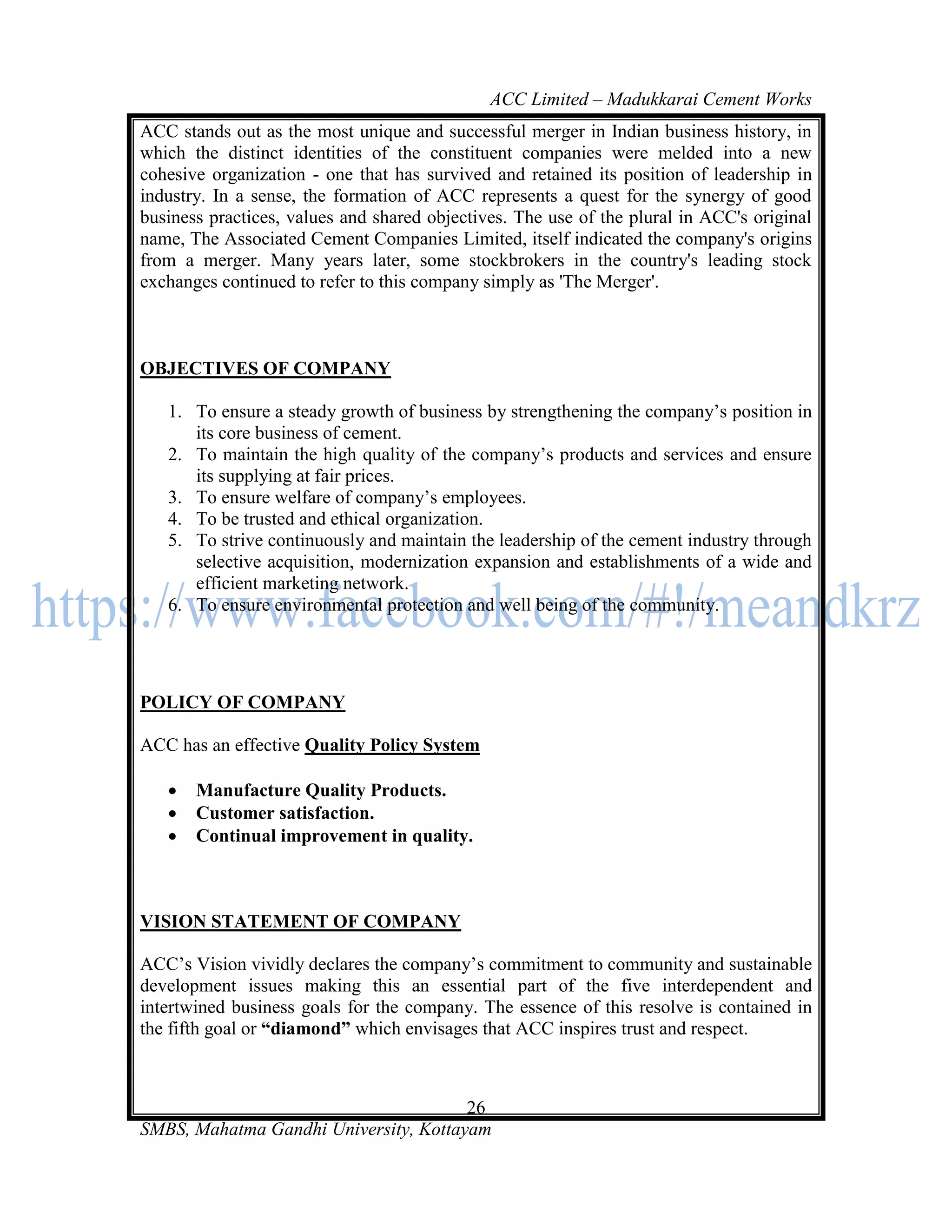
beginning with the lonely struggle of its pioneer F E Dinshaw and other Indian
entrepreneurs like him who founded the Indian cement industry. Their efforts to face
competition for survival in a small but aggressive market mingled with the stirring of a
country's nationalist pride that touched all walks of life - including trade, commerce and
business.

The first success came in a move towards cooperation in the country's young cement
industry and culminated in the historic merger of ten companies to form a cement giant.
These companies belonged to four prominent business groups - Tatas, Khataus, Killick
Nixon and F E Dinshaw groups. ACC was formally established on August 1, 1936.
Sadly, F E Dinshaw, the man recognized as the founder of ACC, died in January 1936;
just months before his dream could be realized.


                        F. E. Dinshaw – the founder of ACC

                                       25
SMBS, Mahatma Gandhi University, Kottayam
ACC Limited – Madukkarai Cement Works
ACC stands out as the most unique and successful merger in Indian business history, in
which the distinct identities of the constituent companies were melded into a new
cohesive organization - one that has survived and retained its position of leadership in
industry. In a sense, the formation of ACC represents a quest for the synergy of good
business practices, values and shared objectives. The use of the plural in ACC's original
name, The Associated Cement Companies Limited, itself indicated the company's origins
from a merger. Many years later, some stockbrokers in the country's leading stock
exchanges continued to refer to this company simply as 'The Merger'.


OBJECTIVES OF COMPANY

   1. To ensure a steady growth of business by strengthening the company‘s position in
      its core business of cement.
   2. To maintain the high quality of the company‘s products and services and ensure
      its supplying at fair prices.
   3. To ensure welfare of company‘s employees.
   4. To be trusted and ethical organization.
   5. To strive continuously and maintain the leadership of the cement industry through
      selective acquisition, modernization expansion and establishments of a wide and
      efficient marketing network.
   6. To ensure environmental protection and well being of the community.


POLICY OF COMPANY

ACC has an effective Quality Policy System

      Manufacture Quality Products.
      Customer satisfaction.
      Continual improvement in quality.


VISION STATEMENT OF COMPANY

ACC‘s Vision vividly declares the company‘s commitment to community and sustainable
development issues making this an essential part of the five interdependent and
intertwined business goals for the company. The essence of this resolve is contained in
the fifth goal or ―diamond‖ which envisages that ACC inspires trust and respect.


                                       26
SMBS, Mahatma Gandhi University, Kottayam
ACC Limited – Madukkarai Cement Works

The ―5 diamonds‖ of ACC‘s Vision Statement is as follows-


           ACC is a leading organization.

           ACC is a customer driven organization.

           ACC is a great place to work.

           ACC is the most efficient cement producer

           ACC inspires trust and respect


This statement is synonymous with balancing the Triple Bottom Line – defined as the
achievement of three interdependent and mutually reinforcing goals of-

           Environmental protection

           Economic development

           Social development


                      VISION STATEMENT OF ACC LTD.


         ―To be one of the most respected companies in India; recognized for
              challenging conventions and delivering on our promises.‖


                                       27
SMBS, Mahatma Gandhi University, Kottayam
ACC Limited – Madukkarai Cement Works


   VALUES OF ACC LTD.

               STRENTH

                  Building strong and lasting relationships. Conducting everyday
                  operations internally in true team spirit. Acting responsibly with
                  integrity and demonstrating strength of character.

               PERFORMANCE

                  Delivering on our promises to each other and to our stakeholders.
                  Always ensuring excellence. Working together and striving to delight
                  customers with best solutions.

               PASSION

                  Caring, being dedicated, committed and passionate about everything
                  we do.


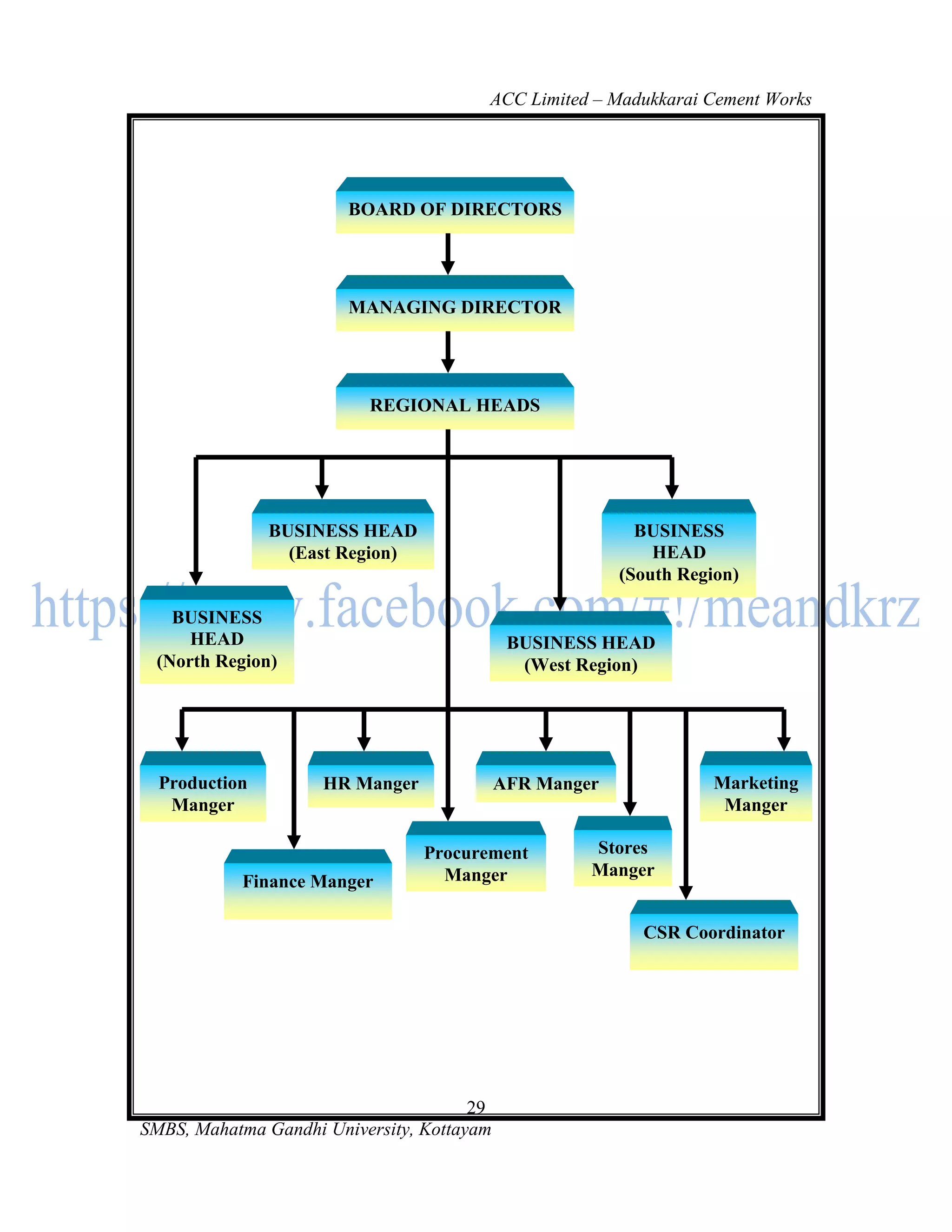
ORGANIZATION STRUCTURE

ACC‘s organization structure was revised in 2006. Added thrust was given to sustainable
development with the creation of separate cells at the corporate office and plants to
coordinate activities relating to waste management, alternate fuels and raw materials,
corporate social responsibility and occupational health and safety. All these were placed
under the supervision of the Managing Director.


                                       28
SMBS, Mahatma Gandhi University, Kottayam
ACC Limited – Madukkarai Cement Works


                        BOARD OF DIRECTORS


                        MANAGING DIRECTOR


                          REGIONAL HEADS


               BUSINESS HEAD                               BUSINESS
                 (East Region)                               HEAD
                                                         (South Region)

   BUSINESS
     HEAD                                    BUSINESS HEAD
 (North Region)                               (West Region)


  Production         HR Manger              AFR Manger              Marketing
   Manger                                                            Manger

                                 Procurement         Stores
                                   Manger            Manger
           Finance Manger

                                                           CSR Coordinator


                                       29
SMBS, Mahatma Gandhi University, Kottayam
ACC Limited – Madukkarai Cement Works

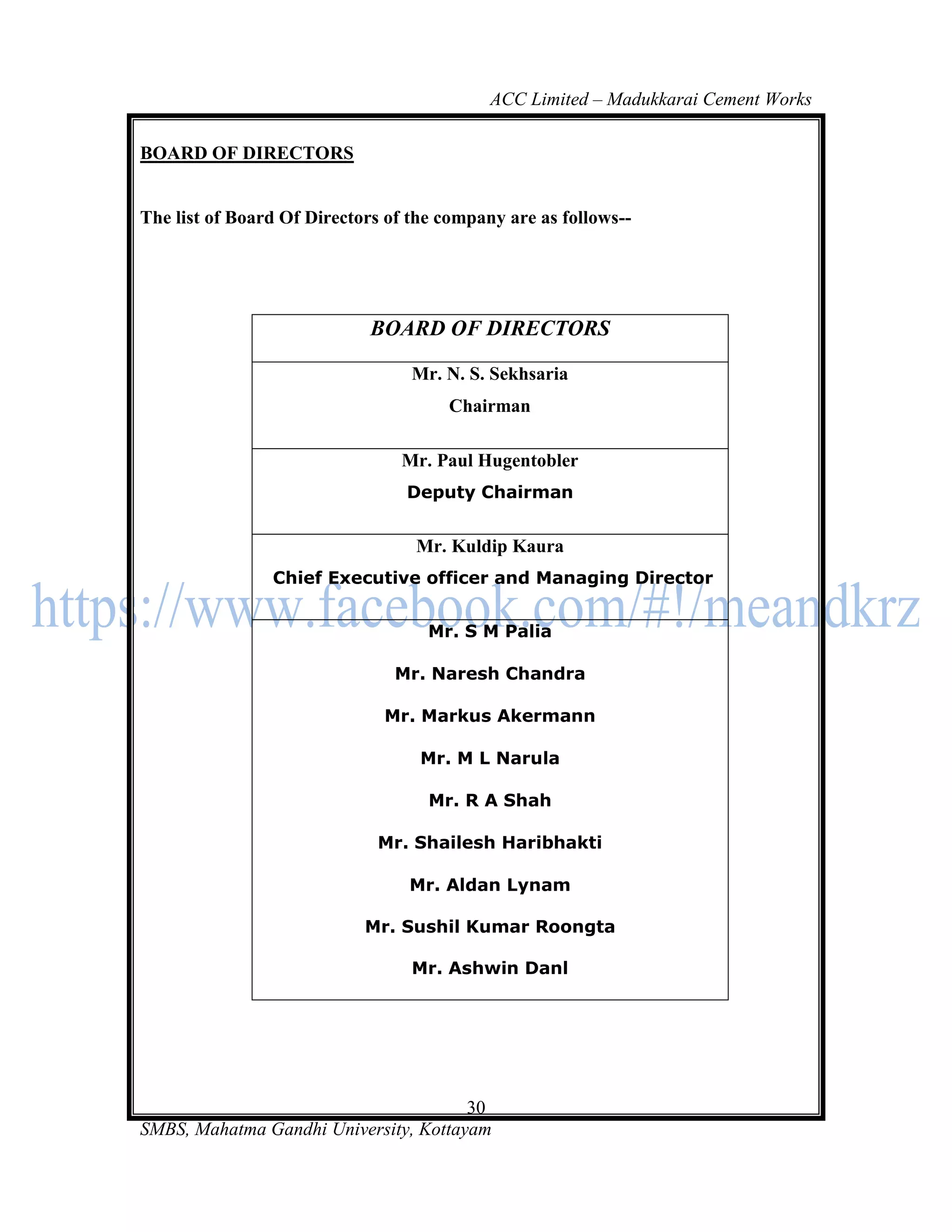
BOARD OF DIRECTORS


The list of Board Of Directors of the company are as follows--


                             BOARD OF DIRECTORS

                                  Mr. N. S. Sekhsaria
                                      Chairman

                                 Mr. Paul Hugentobler
                                 Deputy Chairman


                                  Mr. Kuldip Kaura
                Chief Executive officer and Managing Director


                                    Mr. S M Palia

                                Mr. Naresh Chandra

                              Mr. Markus Akermann

                                   Mr. M L Narula

                                    Mr. R A Shah

                             Mr. Shailesh Haribhakti

                                  Mr. Aldan Lynam

                            Mr. Sushil Kumar Roongta

                                  Mr. Ashwin Danl


                                       30
SMBS, Mahatma Gandhi University, Kottayam
ACC Limited – Madukkarai Cement Works
PRODUCTS PROFILE

                The company manufactures Portland cement for general construction
while its blended products, acknowledged for outstanding durability, include fly ash and
slag-based cements. Both these varieties of cement offer high quality and special
properties that defy the harshest environments. In addition to conserving valuable mineral
resources and reducing waste, these blended cements also help cut down the emission of
carbon dioxide and assist in checking global warming. ACC is sensitive to consumer
needs. When the company realized that large construction activities would require large
amounts of cement it set up the country‘s first facility for distribution of cement in bulk,
as far back as 1956. To meet the needs of other consumers it introduced cement in small
25 kilogram bags as also jumbo bags of 1MT.

Today, of course, mechanized mega construction projects receive cement from ACC
delivered in bulk tankers – a welcome change from the conventional cement bag. ACC
was also the first company in India to introduce Ready Mix Concrete on a commercial
basis. A transit concrete mixer is now a familiar sight in India‘s major cities. Ready Mix
Concrete and Bulk Cement have enabled the construction industry to introduce
sophisticated practices for the speedy completion of large infrastructure projects.


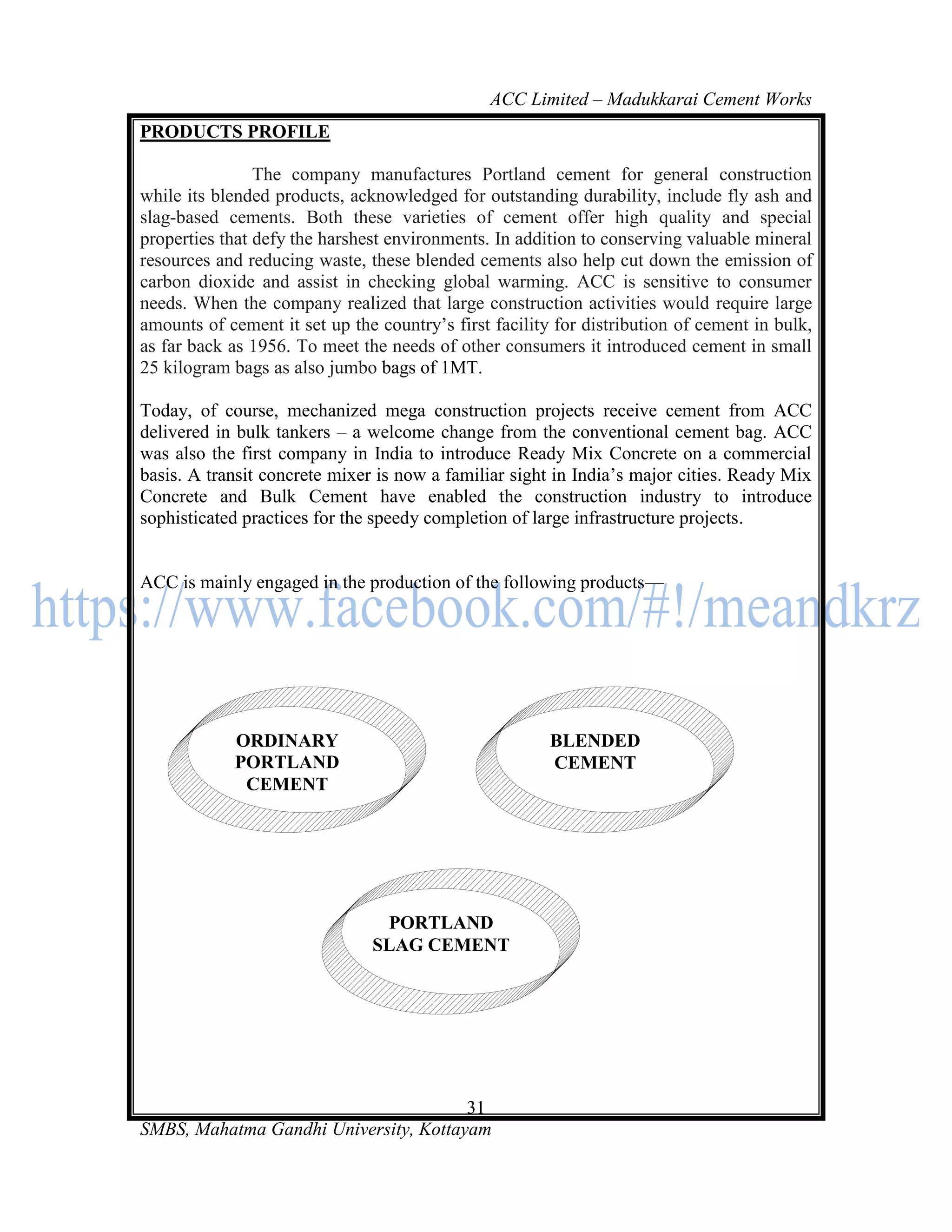
ACC is mainly engaged in the production of the following products—


            ORDINARY                                    BLENDED
            PORTLAND                                    CEMENT
             CEMENT


                                PORTLAND
                               SLAG CEMENT


                                       31
SMBS, Mahatma Gandhi University, Kottayam
ACC Limited – Madukkarai Cement Works

ORDINARY PORTLAND CEMENT

   1. 43 Grade Cement (OPC 43 Grade)
      ACC cement is the most commonly used cement in all constructions including
      plain and reinforced cement concrete brick and stone Masonry, floors and
      plastering. It is also used in the finishing of all types of buildings, bridges,
      culverts, roads, water retaining structures etc.

   2. 53 Grade Cement
      This is an Ordinary Portland cement which surpasses the requirement of
      IS:12269-53 Grade. It is produced from high quality clinker ground with high
      purity gypsum.
      It‘s 53 Grade OPC provides high strength and durability to structure and balanced
      phase composition.
      It is available in specially designed 50 kg bags. It surpasses BIS specifications (IS
      8112—1989 for 43 Grade OPC) on compressive strength levels.


BLENDED CEMENT

   1. Fly-ash based Portland Pozzolana Cement
      This is special blended cement, produced by inter-grinding higher strength
      ordinary Portland cement clinker with high quality processed fly-ash based on
      norms set by the company‘s R&D division. This unique, value-added product has
      hydraulic binding properties not found in ordinary cements. It is available in
      specially designed 50-kg bags.

      ACC Fly-ash based PPC is made by intergrading high strength clinker with
      specially processed fly ash. This imparts a greater degree of fineness to ACC Fly-
      ash based PPC Cement, improved workability properties while mixing, and makes
      concrete more corrosion resistant and impermeable. All of this makes for better
      long-term strength and improved corrosion resistance and therefore, greater life
      for your constructions. ACC Fly-ash based PPC is an eco-friendly cement.

      In concrete made from ordinary cements, moisture reacts with calcium
      bicarbonate, which leaches out of the concrete, leaving pores that reduce its
      strength. ACC Fly-ash based PPC has ingredients which react with calcium
      hydroxide to form CSH get, to provide additional strength, which actually makes
      the concrete grow in strength over the years. It also produces less heat of
      hydration and offers greater resistance to the attack of aggressive water than
      normal Portland cement.

      ACC Fly-ash based PPC easily replaced OPC and provides additional advantages
      for practically all types of construction application-commercial, residential,
                                       32
SMBS, Mahatma Gandhi University, Kottayam
ACC Limited – Madukkarai Cement Works
       bungalows, complexes, foundation, columns, beams, slabs and RCC jobs. It is
       especially recommended for mass concreting work, and where soil conditions and
       the prevailing environment take heavy toll of constructions made with ordinary
       cements.

       Due to its inherent characteristics, ACC Fly-ash based PPC makes very corrosion
       resistant concrete that is superior to concrete made with OPC. It is more
       impermeable to Oxygen, CO2, chlorides etc. Leaching of alkalis is reduced and
       the alkaline environment around steel is maintained.
       ACC Cement is marketed in specially designed 50 kg. bags.

PORTLAND SLAG CEMENT

This is slag-based blended cement that imparts strength and durability to all structures. It
is manufactured by blending and inter-grinding OPC clinker and granulated slag in
suitable proportions as per our norms of consistent quality. PSC has many superior
performance characteristics which give it certain extra advantages when compared to
ordinary Portland cement. It is available in specially designed 50-kg bags.


ACC'S ECO-FRIENDLY CEMENT IN ONE YEAR

Cement major ACC is likely to launch in the next one year environment-friendly cement
that will emit less carbon dioxide (CO2) while being produced.

The new environment-friendly cement will emit 400-450 kg of CO2 per tonne at the time
of burning limestone during its production, while the same is about 900 kg in the case of
conventional cement.

According to sources in the know of the development, ACC‘s R&D division at Thane has
been working on this for the last one year and is now carrying out pilot production.

―The development is almost complete and ACC is now doing the pilot testing. It will take
about another one year to commercially launch the product as pricing, branding and some
other issues have not been decided yet,‖ a source said.

The new product will cost more than the ordinary cement, sources said.

The company is yet to decide whether the final product will be marketed by the group
firm or Ambuja Cement which shares the R&D centre at Thane.

As per the plan, the company will introduce the product in a few areas initially. Later, it
will expand distribution of the new cement across India based on customer feedback.

When contated, a company spokesperson declined to comment on the development.
                                       33
SMBS, Mahatma Gandhi University, Kottayam
ACC Limited – Madukkarai Cement Works
―The new product is being developed by using lesser limestone. The quality remains
same as some additives are used during the production process, besides improvement in
grinding techniques,‖ another source said.

Cement production has always remained a concern for global warming due to the high
energy requirements and the release of significant amounts of CO2.

Besides, ACC has embarked upon an ambitious project for substituting five per cent of its
annual coal requirement of about five million tonnes over the next three years with waste
generated by cities and industries. It has already replaced two per cent of its coal
requirement with all types of wastes.

The company, which saved Rs 47 crore last year on fossil fuels, aims to save Rs 60 crore
in 2011 by burning waste, primarily plastics, at its plants.

Global cement major Holcim-controlled ACC has an installed production capacity of 30
million tonnes per annum in India.

Apart from waste management, the company has also undertaken a drive to plant jatropha
and castor trees in and around its mines, plants, townships and waste land. As of 2010, it
had planted two million saplings out of its target of five million trees.

ACC: VOLUME, VALUATION BOOST

VOLUME BOOST

                ACC has marked excellent 14 per cent growth in volumes to 17.76 million
tonnes (mt) during January-September 2011 — translating into an annualised capacity
utilisation of 77 per cent. On a comparable basis, during April-September 2011, ACC
volumes at 11.56 mt have marked 15.1 per cent growth annually, compared to 0.2 per
cent by Ultratech and one per cent by Ambuja Cement, a group firm, partly aided by a
low base.

ACC, facing capacity constraints during last year, had been a laggard in terms of volume
growth. It had posted negative growth for first three quarters of 2010, as its brownfield
expansions in Orissa (1.2 mt) and Karnataka (3 mt) got delayed and took time to stabilise.
Further, post completion of the 3-mt-per-annum clinkering plant in Chanda
(Maharashtra), along with the 25-Mw captive power capacity starting contributions, the
cement capacity increased to 30.6 mt per annum by the end of 2010. Its captive power
capacity increased to 346 Mw. These have led to the growth in volumes seen so far
during 2011, and given the availability capacity volumes should continue to rise at a
healthy pace.


                                       34
SMBS, Mahatma Gandhi University, Kottayam
ACC Limited – Madukkarai Cement Works
BETTER REALISATIONS

Along with volumes boost, realisations have also improved. The increase in cement price
(ranging from Rs 25-50 for each 50-kg bag) undertaken by players in southern states
since September 2010 have sustained. Prior to September 2010, the prices in the southern
states had been much below the national average of around Rs 225 a bag (of 50 kg).
These have helped ACC post better realisation looking at its good presence in south.

Though overall cement capacity additions in the country have outpaced the demand, by
maintaining production discipline cement players have been able to sustain higher prices
in rest of India too. ACC saw realisations of Rs 4,052 a tonne (Rs 202.60 per bag) during
the April-June quarter, 5.7 per cent higher over the same period last year. Further, during
the sluggish September quarter which was marred by monsoon, realisations should come
at Rs 3,772 a tonne or Rs 188.60 per bag (up 11.3 per cent year on year), according to
Motilal Oswal Research estimates.

Notably, as the monsoon season ended, the last 15-20 days have also seen cement prices
going up by Rs 50 per bag in northern states, to an extent due to an increase in costs.
Analysts feel while demand in October may take a slump due to the festive season, the
coming months should see better demand. They feel though a major boost to demand will
only come after large infrastructure projects take off, cement players should be able to
keep prices at reasonable levels by maintaining volume discipline.

COAL RISK

Coking coal remains the basic raw material for cement production. While cement
manufacturers had been dealing with firm coal prices, a new problem has cropped up for
them. ACC procures about 20 per cent of its requirements from e-auctions from Coal
India. However, for October 2011, Coal India has decided to offer e-auction quota to
power companies facing acute shortage of coal. While cement majors generally keep 30-
40 days of coal inventory and for now Coal India has decided for diverting supplies
during October only, if the problem persist cement producers will have to shift to high-
cost imported coal. According to Emkay Global estimates, if the problem persists for the
October-December period, CY2011 EPS of ACC can be negatively impacted by 1.2 per
cent. Also, there is likelihood of Coal India going for price hikes considering the wage
revisions at the company, which could further impact ACC‘s margins.

Secretarial & Share departments receive ISO 9001 – 2008 Certification
The Secretarial Compliance division & Share Department have received ISO 9001 –
2008 Certification from Det Norske Veritas (DNV) A S Certification Services.
The ISO 9001 -2008 Certificate certifies the robustness of quality management processes.
ACC is one of the very few organizations whose Secretarial Compliance and Share
Department processes have received ISO certification.


                                       35
SMBS, Mahatma Gandhi University, Kottayam
ACC Limited – Madukkarai Cement Works


SUBSIDIARIES AND ASSOCIATES


   1. ACC Concrete Limited

      ACC set up India's first commercial Ready Mix Concrete (RMX) plant in
      Mumbai in 1994 which together with the promotion of bulk cement has played a
      key role in redefining the pace and quality of construction activity in our large
      cities and mega infrastructure projects.
      The Ready Mix Concrete business of ACC was reorganized as a separate wholly
      owned subsidiary which was incorporated as ACC Concrete Limited with
      headquarters in Mumbai. Today this company is one of the largest manufacturers
      of Ready Mix Concrete in India with a countrywide network of over 30 plants,
      with modern equipment and a large fleet of transit mixers.

   2. ACC Mineral Resources Limited

      ACC's wholly owned subsidiary, The Cement Marketing Company of India
      Limited, was renamed as ACC Mineral Resources Limited (AMRL) in May 2009
      with an objective of securing valuable mineral resources, such as coal for captive
      use. ACC Mineral Resources Limited has already entered into Joint Venture
      arrangements for prospecting, exploration and mining coal from the coal blocks in
      Madhya Pradesh and West Bengal. The company is also exploring other
      opportunities for securing additional coal and gypsum resources in India and
      abroad

   3. Bulk Cement Corporation (India) Limited

      Situated at Kalamboli, in Navi Mumbai (formerly New Bombay), this company
      caters to bulk cement requirements of the city of Mumbai and its environs. It has
      two cement storage silos with a capacity of 5,000 tons each. The plant receives
      cement in bulk from ACC plants at Wadi. The plant has its own special purpose
      railway wagons and rakes and its own railway siding. The first of its kind in India,
      BCCI is equipped with all the facilities required by increasingly sophisticated
      construction sites in a bustling metropolis, including a laboratory, a fleet of
      specialized trucks and site silos for the convenience of customers and is capable
      of offering loose cement in bulk-tanker vehicles as well as packed cement in bags
      of varying sizes from 1 tone down to 25 kg bags. BCCI is situated strategically on
      the outskirts of Mumbai, just off the new Mumbai-Pune Expressway. It is a
      landmark structure spread over 30 acres of land.


                                       36
SMBS, Mahatma Gandhi University, Kottayam
ACC Limited – Madukkarai Cement Works

   4. Lucky Minmat

      ACC acquired 100 per cent of the equity of Lucky Minmat Private Limited. This
      company holds limestone mines in the Sikar district of Rajasthan, and helps
      supplement limestone supply to the Lakheri Plant.

   5. National Limestone Company Private Limited

      National Limestone Company Private Limited is a wholly owned subsidiary. The
      company is engaged in the business of mining and sale of limestone. It holds
      mining leases for limestone in the state of Rajasthan.

   6. Encore Cements & Additives Private Limited

      ACC acquired 100 percent of the financial equity of this company which is a slag
      grinding plant in Vishakhapatnam in coastal Andhra Pradesh. This company
      became a wholly-owned subsidiary of ACC in January 2010.


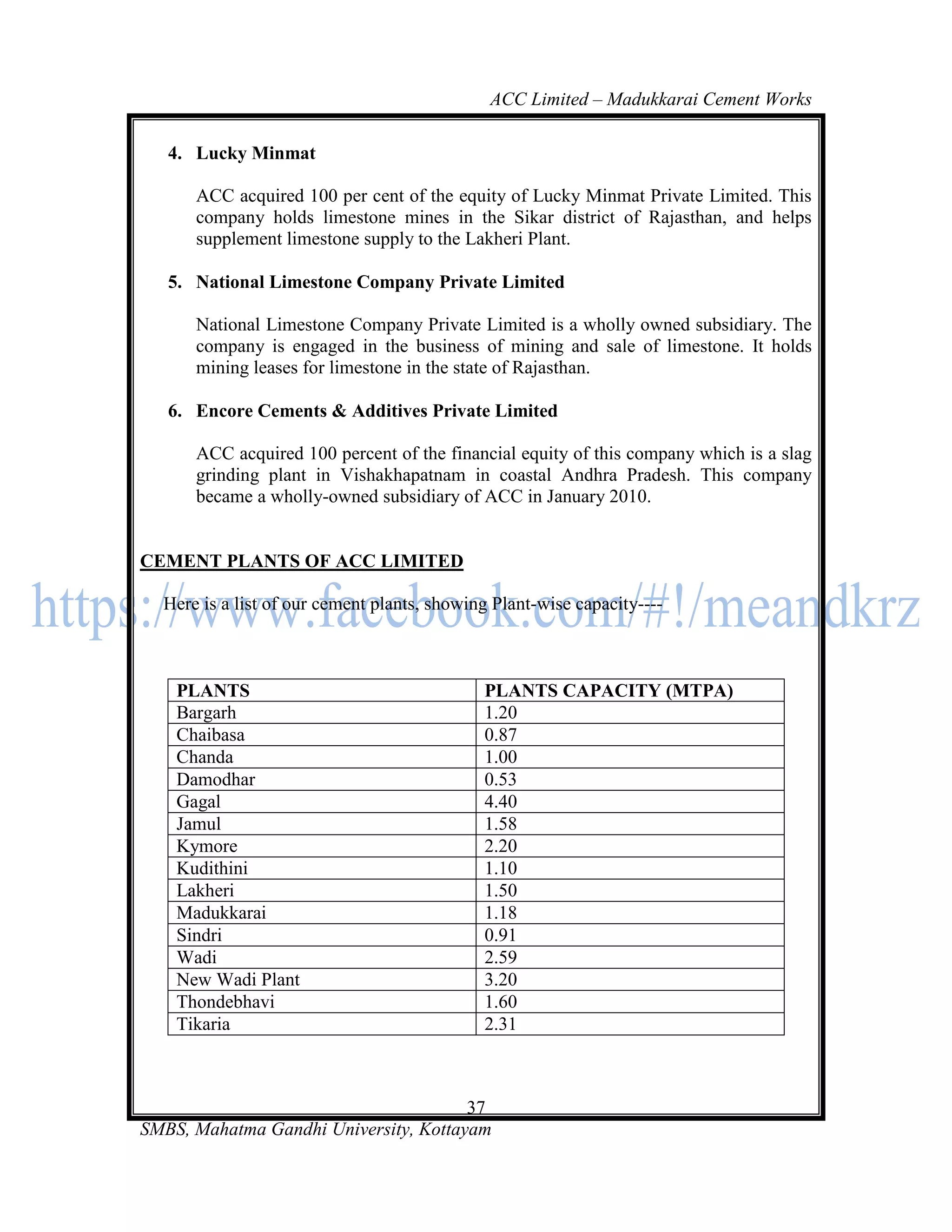
CEMENT PLANTS OF ACC LIMITED

  Here is a list of our cement plants, showing Plant-wise capacity----


    PLANTS                                   PLANTS CAPACITY (MTPA)
    Bargarh                                  1.20
    Chaibasa                                 0.87
    Chanda                                   1.00
    Damodhar                                 0.53
    Gagal                                    4.40
    Jamul                                    1.58
    Kymore                                   2.20
    Kudithini                                1.10
    Lakheri                                  1.50
    Madukkarai                               1.18
    Sindri                                   0.91
    Wadi                                     2.59
    New Wadi Plant                           3.20
    Thondebhavi                              1.60
    Tikaria                                  2.31


                                       37
SMBS, Mahatma Gandhi University, Kottayam
ACC Limited – Madukkarai Cement Works


BUSINESS STRATERGY OF ACC


    2009           2010          2011           2012           2013


       Market Share                Maintain Leadership Position in Industry


      Competitiveness              Leadership in Quality, Services and Cost
                                   Efficiency


       Organization                Accountable, Responsive and Motivated


                              Create Safe Place to Work
                              Become employer of choice
        Corporate
                              Reputed Corporate entity
        Citizenship
                              Leadership in sustainable development
                              Enhance community living standards
                              Continual improvement in environment
                              performance


        Bottom Line           Achieve Internal target for growth in EBITDA
                              over2007


                                       38
SMBS, Mahatma Gandhi University, Kottayam
ACC Limited – Madukkarai Cement Works
                               ACC - MILESTONES
1936      Incorporation of The Associated Cement Companies Limited on August 1,
          1936.
1936      First Board Meeting of The Associated Cement Companies Limited held at
          Esplanade House, Mumbai on November 10, 1936.
1937      With the transfer of the 10th company to ACC, viz. Dewarkhand Cement
          Company, the formation of ACC is complete on October 23, 1937.
1944      ACC‘s first community development venture near Bombay
1947      India‘s first entirely indigenous cement plant established at Chaibasa in
          Bihar
1952      Village Welfare Scheme launched
1955      Sindri cement works used the waste product calcium carbonate sludge from
          fertilizer factory at Sindri.
1956      Bulk Cement Depot established at Okhla, Delhi
1957      Technical training institute established at Kymore, Madhya Pradesh.
1957      Katni Refractories
1961      Blast furnace slag from TISCO used at the Chaibasa Unit to manufacture
          Portland Slag Cement for the first time in India.
1961      Manufacture of Accocid Cement, which resists the corrosive action of acids
          and chemicals.
1961      Oilwell Cement manufactured at ACC Shahabad Cement Works in
          Karnataka for cementation of oilwells upto a depth of 6,000 feet.
1961      Manufacture of Hydrophobic (waterproof) cement at ACC Khalari Cement
          Works in Bihar.
1962      Manufacture of Accoproof, a waterproofing additive.
1965      ACC‘s Central Research Station (CRS) established at Thane
1965      Manufacture of Portland Pozzolana Cement.
1965      Manufacture of Calundum, a High Alumina Binder; Firecrete, Low Density
          Alumina Castables and High Alumina Refractory Cement.
1968      Advent of computers in ACC for data processing and designing
          management information and control systems.


                                       39
SMBS, Mahatma Gandhi University, Kottayam
ACC Limited – Madukkarai Cement Works

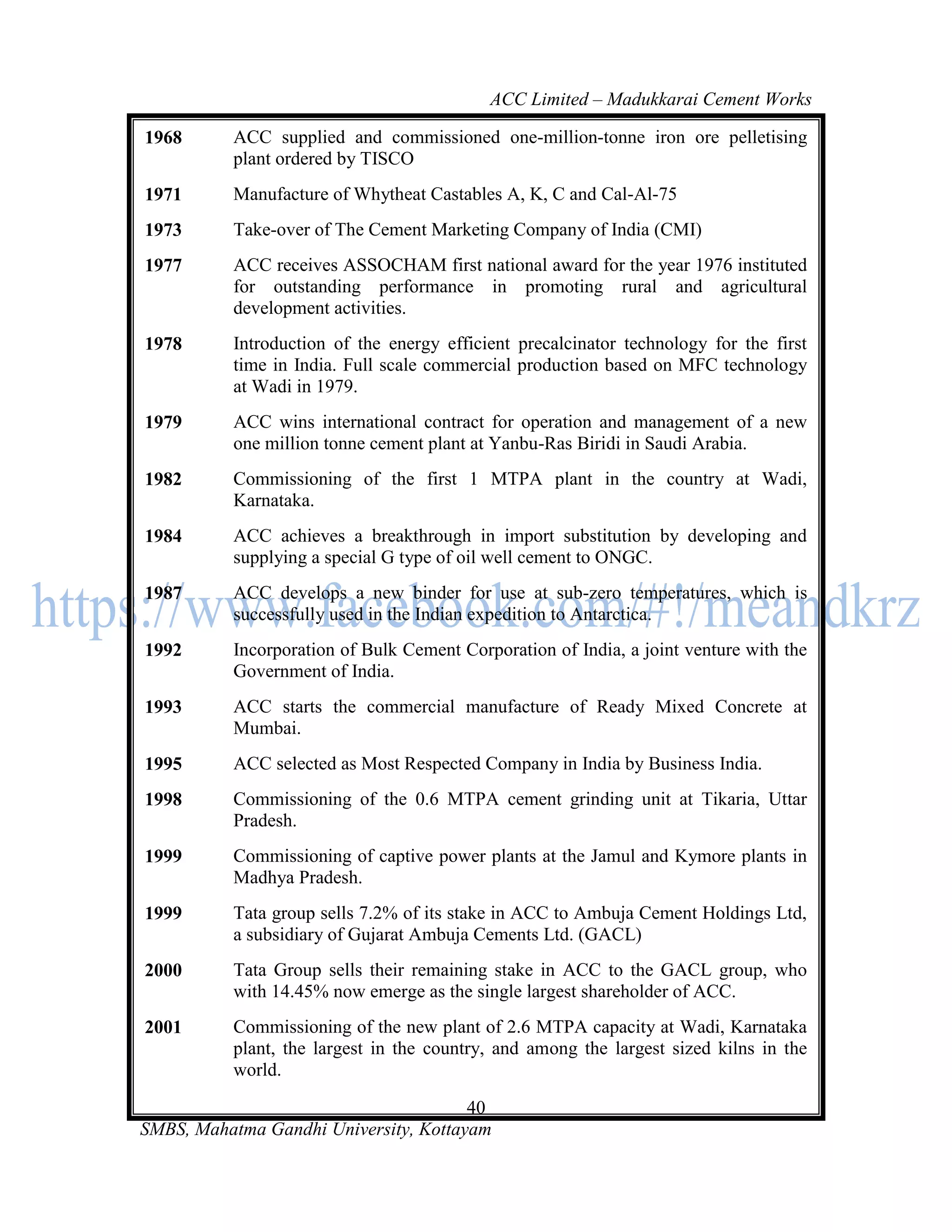
1968      ACC supplied and commissioned one-million-tonne iron ore pelletising
          plant ordered by TISCO
1971      Manufacture of Whytheat Castables A, K, C and Cal-Al-75
1973      Take-over of The Cement Marketing Company of India (CMI)
1977      ACC receives ASSOCHAM first national award for the year 1976 instituted
          for outstanding performance in promoting rural and agricultural
          development activities.
1978      Introduction of the energy efficient precalcinator technology for the first
          time in India. Full scale commercial production based on MFC technology
          at Wadi in 1979.
1979      ACC wins international contract for operation and management of a new
          one million tonne cement plant at Yanbu-Ras Biridi in Saudi Arabia.
1982      Commissioning of the first 1 MTPA plant in the country at Wadi,
          Karnataka.
1984      ACC achieves a breakthrough in import substitution by developing and
          supplying a special G type of oil well cement to ONGC.
1987      ACC develops a new binder for use at sub-zero temperatures, which is
          successfully used in the Indian expedition to Antarctica.
1992      Incorporation of Bulk Cement Corporation of India, a joint venture with the
          Government of India.
1993      ACC starts the commercial manufacture of Ready Mixed Concrete at
          Mumbai.
1995      ACC selected as Most Respected Company in India by Business India.
1998      Commissioning of the 0.6 MTPA cement grinding unit at Tikaria, Uttar
          Pradesh.
1999      Commissioning of captive power plants at the Jamul and Kymore plants in
          Madhya Pradesh.
1999      Tata group sells 7.2% of its stake in ACC to Ambuja Cement Holdings Ltd,
          a subsidiary of Gujarat Ambuja Cements Ltd. (GACL)
2000      Tata Group sells their remaining stake in ACC to the GACL group, who
          with 14.45% now emerge as the single largest shareholder of ACC.
2001      Commissioning of the new plant of 2.6 MTPA capacity at Wadi, Karnataka
          plant, the largest in the country, and among the largest sized kilns in the
          world.

                                       40
SMBS, Mahatma Gandhi University, Kottayam
ACC Limited – Madukkarai Cement Works

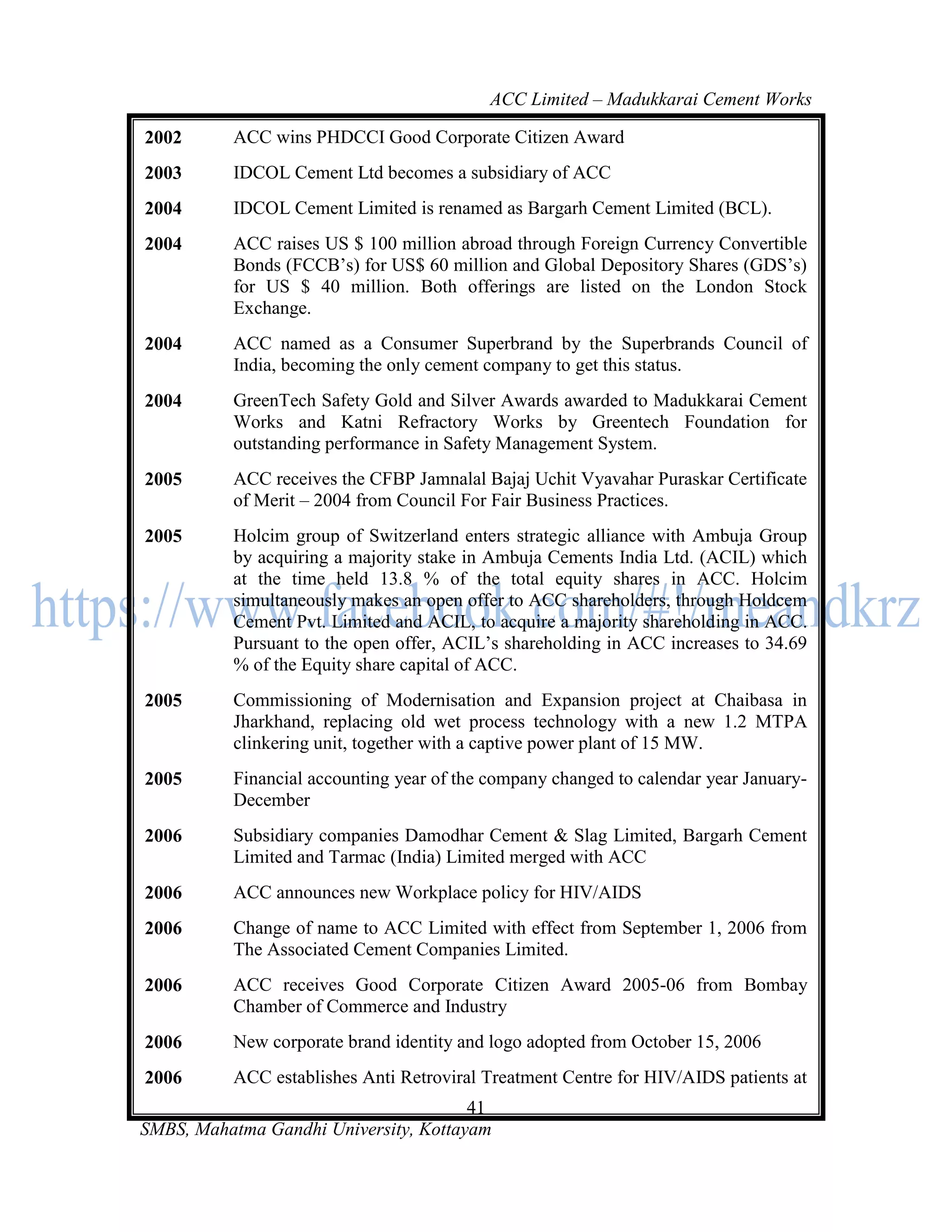
2002      ACC wins PHDCCI Good Corporate Citizen Award
2003      IDCOL Cement Ltd becomes a subsidiary of ACC
2004      IDCOL Cement Limited is renamed as Bargarh Cement Limited (BCL).
2004      ACC raises US $ 100 million abroad through Foreign Currency Convertible
          Bonds (FCCB‘s) for US$ 60 million and Global Depository Shares (GDS‘s)
          for US $ 40 million. Both offerings are listed on the London Stock
          Exchange.
2004      ACC named as a Consumer Superbrand by the Superbrands Council of
          India, becoming the only cement company to get this status.
2004      GreenTech Safety Gold and Silver Awards awarded to Madukkarai Cement
          Works and Katni Refractory Works by Greentech Foundation for
          outstanding performance in Safety Management System.
2005      ACC receives the CFBP Jamnalal Bajaj Uchit Vyavahar Puraskar Certificate
          of Merit – 2004 from Council For Fair Business Practices.
2005      Holcim group of Switzerland enters strategic alliance with Ambuja Group
          by acquiring a majority stake in Ambuja Cements India Ltd. (ACIL) which
          at the time held 13.8 % of the total equity shares in ACC. Holcim
          simultaneously makes an open offer to ACC shareholders, through Holdcem
          Cement Pvt. Limited and ACIL, to acquire a majority shareholding in ACC.
          Pursuant to the open offer, ACIL‘s shareholding in ACC increases to 34.69
          % of the Equity share capital of ACC.
2005      Commissioning of Modernisation and Expansion project at Chaibasa in
          Jharkhand, replacing old wet process technology with a new 1.2 MTPA
          clinkering unit, together with a captive power plant of 15 MW.
2005      Financial accounting year of the company changed to calendar year January-
          December
2006      Subsidiary companies Damodhar Cement & Slag Limited, Bargarh Cement
          Limited and Tarmac (India) Limited merged with ACC
2006      ACC announces new Workplace policy for HIV/AIDS
2006      Change of name to ACC Limited with effect from September 1, 2006 from
          The Associated Cement Companies Limited.
2006      ACC receives Good Corporate Citizen Award 2005-06 from Bombay
          Chamber of Commerce and Industry
2006      New corporate brand identity and logo adopted from October 15, 2006
2006      ACC establishes Anti Retroviral Treatment Centre for HIV/AIDS patients at
                                       41
SMBS, Mahatma Gandhi University, Kottayam
ACC Limited – Madukkarai Cement Works

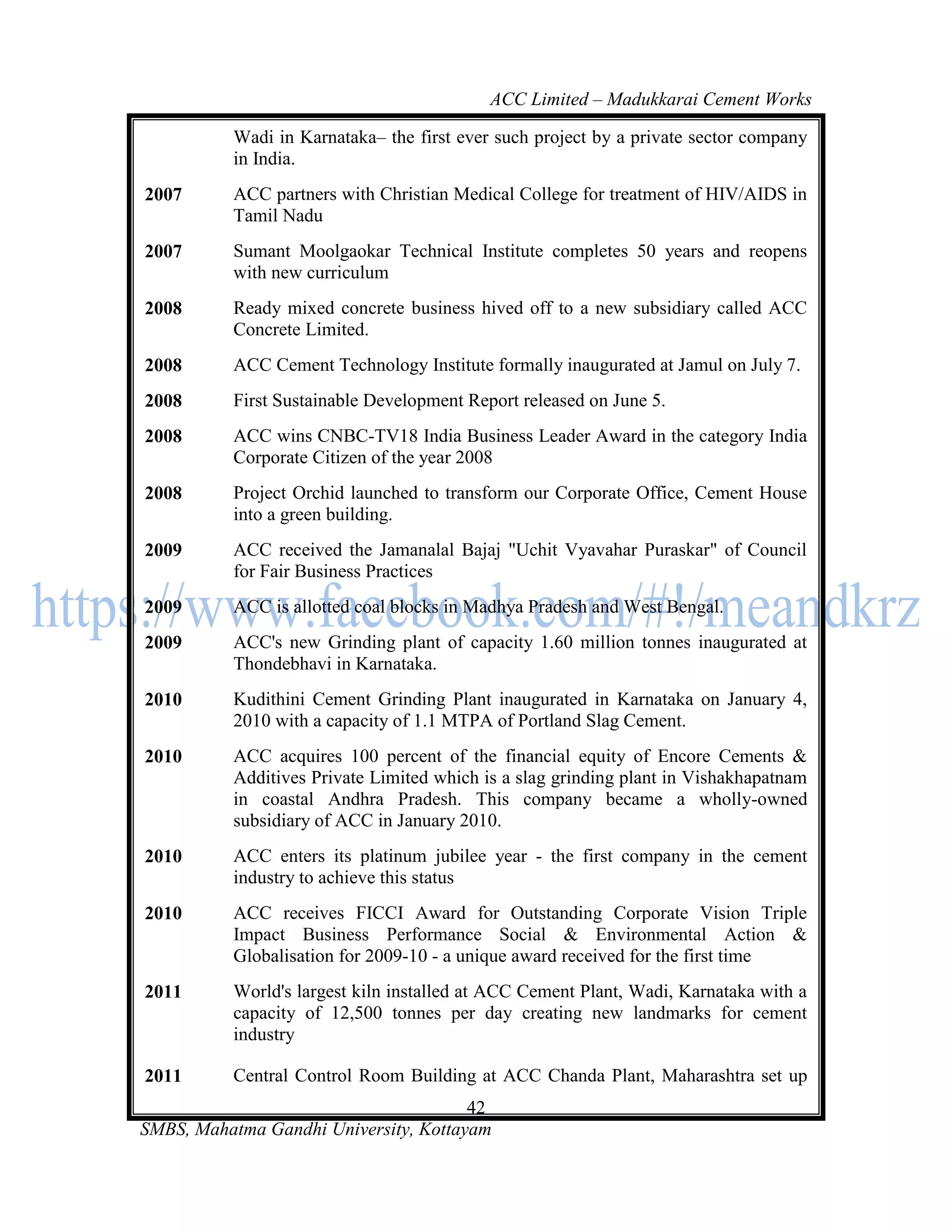
          Wadi in Karnataka– the first ever such project by a private sector company
          in India.
2007      ACC partners with Christian Medical College for treatment of HIV/AIDS in
          Tamil Nadu
2007      Sumant Moolgaokar Technical Institute completes 50 years and reopens
          with new curriculum
2008      Ready mixed concrete business hived off to a new subsidiary called ACC
          Concrete Limited.
2008      ACC Cement Technology Institute formally inaugurated at Jamul on July 7.
2008      First Sustainable Development Report released on June 5.
2008      ACC wins CNBC-TV18 India Business Leader Award in the category India
          Corporate Citizen of the year 2008
2008      Project Orchid launched to transform our Corporate Office, Cement House
          into a green building.
2009      ACC received the Jamanalal Bajaj "Uchit Vyavahar Puraskar" of Council
          for Fair Business Practices
2009      ACC is allotted coal blocks in Madhya Pradesh and West Bengal.
2009      ACC's new Grinding plant of capacity 1.60 million tonnes inaugurated at
          Thondebhavi in Karnataka.
2010      Kudithini Cement Grinding Plant inaugurated in Karnataka on January 4,
          2010 with a capacity of 1.1 MTPA of Portland Slag Cement.
2010      ACC acquires 100 percent of the financial equity of Encore Cements &
          Additives Private Limited which is a slag grinding plant in Vishakhapatnam
          in coastal Andhra Pradesh. This company became a wholly-owned
          subsidiary of ACC in January 2010.
2010      ACC enters its platinum jubilee year - the first company in the cement
          industry to achieve this status
2010      ACC receives FICCI Award for Outstanding Corporate Vision Triple
          Impact Business Performance Social & Environmental Action &
          Globalisation for 2009-10 - a unique award received for the first time
2011      World's largest kiln installed at ACC Cement Plant, Wadi, Karnataka with a
          capacity of 12,500 tonnes per day creating new landmarks for cement
          industry

2011      Central Control Room Building at ACC Chanda Plant, Maharashtra set up
                                       42
SMBS, Mahatma Gandhi University, Kottayam
ACC Limited – Madukkarai Cement Works

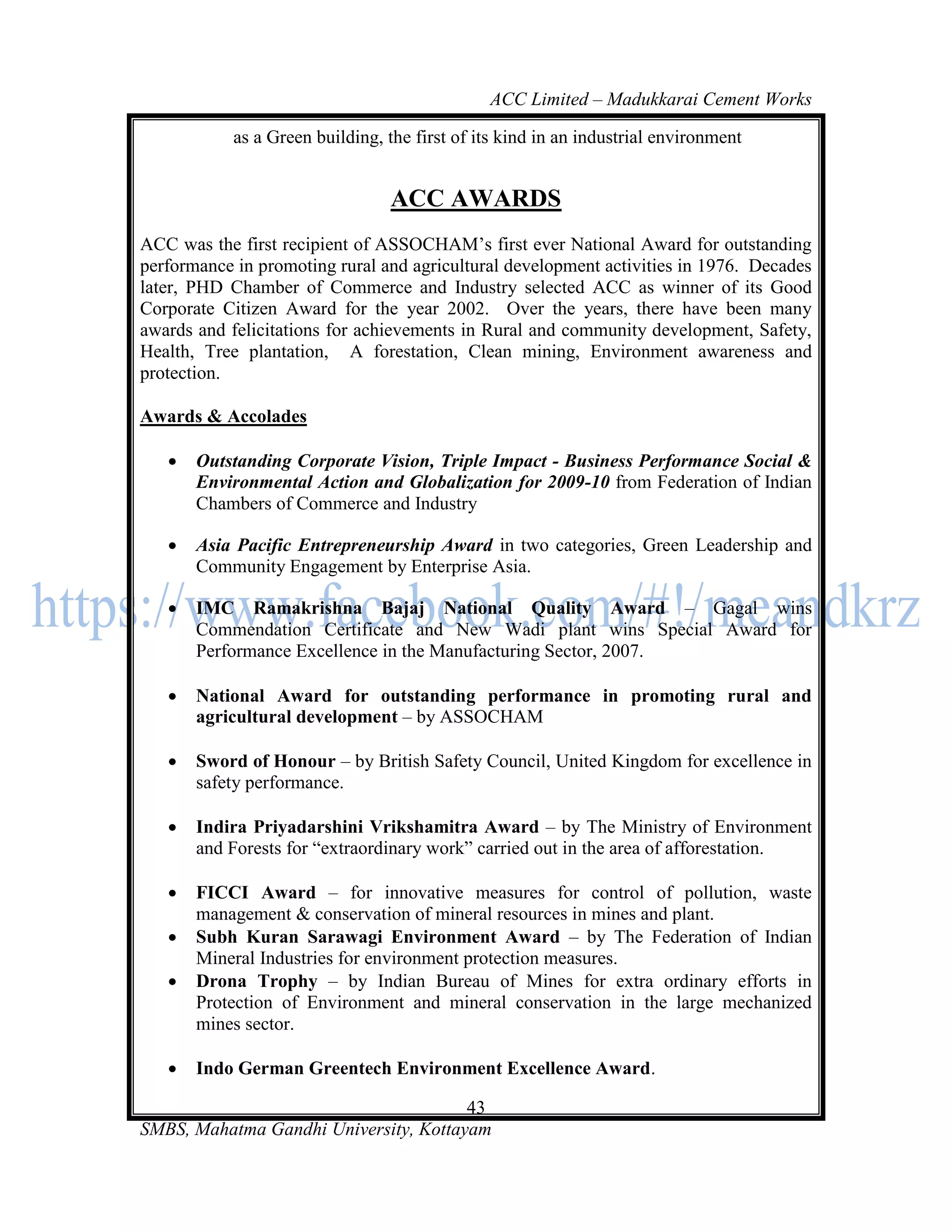
            as a Green building, the first of its kind in an industrial environment


                                 ACC AWARDS
ACC was the first recipient of ASSOCHAM‘s first ever National Award for outstanding
performance in promoting rural and agricultural development activities in 1976. Decades
later, PHD Chamber of Commerce and Industry selected ACC as winner of its Good
Corporate Citizen Award for the year 2002. Over the years, there have been many
awards and felicitations for achievements in Rural and community development, Safety,
Health, Tree plantation, A forestation, Clean mining, Environment awareness and
protection.

Awards & Accolades

      Outstanding Corporate Vision, Triple Impact - Business Performance Social &
       Environmental Action and Globalization for 2009-10 from Federation of Indian
       Chambers of Commerce and Industry

      Asia Pacific Entrepreneurship Award in two categories, Green Leadership and
       Community Engagement by Enterprise Asia.

      IMC Ramakrishna Bajaj National Quality Award – Gagal wins
       Commendation Certificate and New Wadi plant wins Special Award for
       Performance Excellence in the Manufacturing Sector, 2007.

      National Award for outstanding performance in promoting rural and
       agricultural development – by ASSOCHAM

      Sword of Honour – by British Safety Council, United Kingdom for excellence in
       safety performance.

      Indira Priyadarshini Vrikshamitra Award – by The Ministry of Environment
       and Forests for ―extraordinary work‖ carried out in the area of afforestation.

      FICCI Award – for innovative measures for control of pollution, waste
       management & conservation of mineral resources in mines and plant.
      Subh Kuran Sarawagi Environment Award – by The Federation of Indian
       Mineral Industries for environment protection measures.
      Drona Trophy – by Indian Bureau of Mines for extra ordinary efforts in
       Protection of Environment and mineral conservation in the large mechanized
       mines sector.

      Indo German Greentech Environment Excellence Award.

                                       43
SMBS, Mahatma Gandhi University, Kottayam
ACC Limited – Madukkarai Cement Works

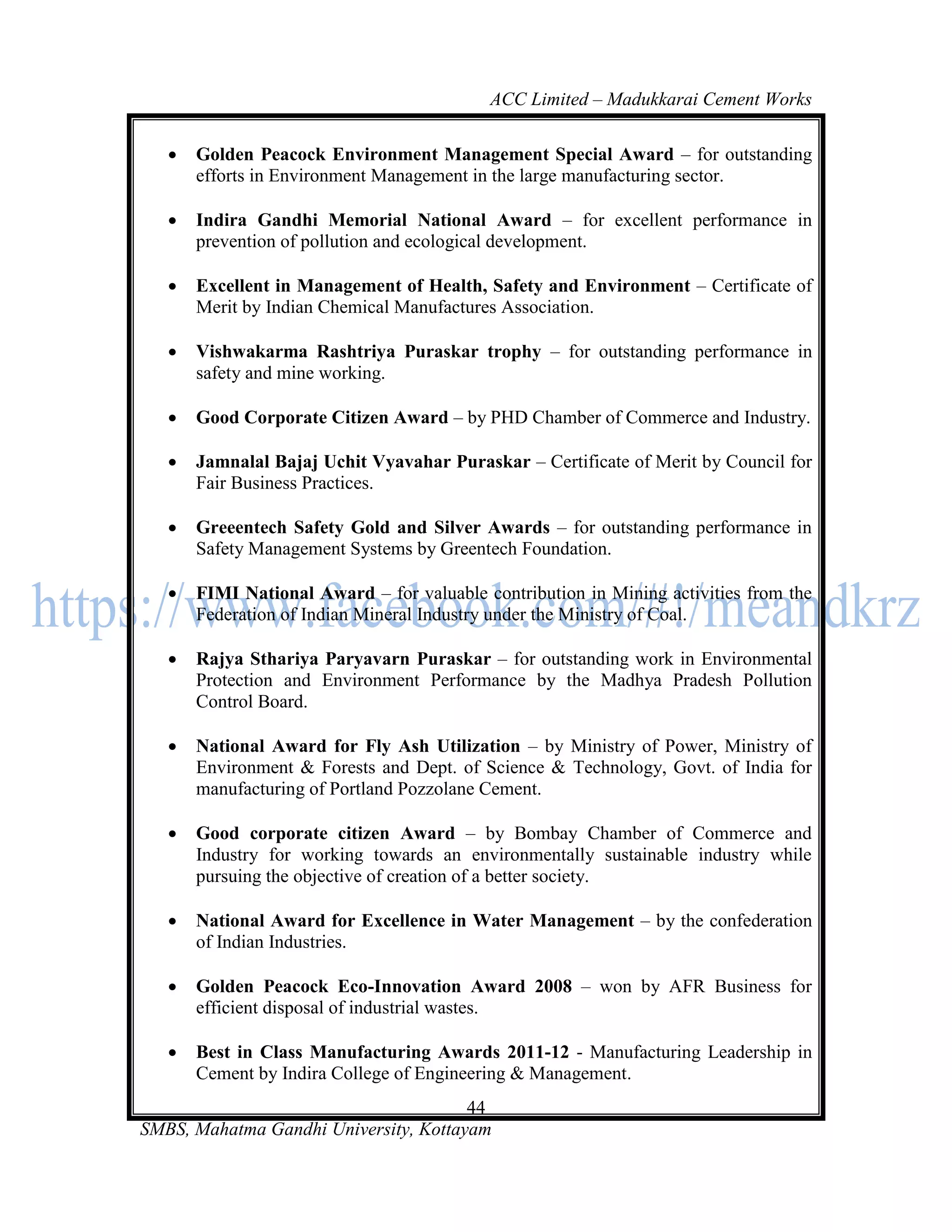
      Golden Peacock Environment Management Special Award – for outstanding
       efforts in Environment Management in the large manufacturing sector.

      Indira Gandhi Memorial National Award – for excellent performance in
       prevention of pollution and ecological development.

      Excellent in Management of Health, Safety and Environment – Certificate of
       Merit by Indian Chemical Manufactures Association.

      Vishwakarma Rashtriya Puraskar trophy – for outstanding performance in
       safety and mine working.

      Good Corporate Citizen Award – by PHD Chamber of Commerce and Industry.

      Jamnalal Bajaj Uchit Vyavahar Puraskar – Certificate of Merit by Council for
       Fair Business Practices.

      Greeentech Safety Gold and Silver Awards – for outstanding performance in
       Safety Management Systems by Greentech Foundation.

      FIMI National Award – for valuable contribution in Mining activities from the
       Federation of Indian Mineral Industry under the Ministry of Coal.

      Rajya Sthariya Paryavarn Puraskar – for outstanding work in Environmental
       Protection and Environment Performance by the Madhya Pradesh Pollution
       Control Board.

      National Award for Fly Ash Utilization – by Ministry of Power, Ministry of
       Environment & Forests and Dept. of Science & Technology, Govt. of India for
       manufacturing of Portland Pozzolane Cement.

      Good corporate citizen Award – by Bombay Chamber of Commerce and
       Industry for working towards an environmentally sustainable industry while
       pursuing the objective of creation of a better society.

      National Award for Excellence in Water Management – by the confederation
       of Indian Industries.

      Golden Peacock Eco-Innovation Award 2008 – won by AFR Business for
       efficient disposal of industrial wastes.

      Best in Class Manufacturing Awards 2011-12 - Manufacturing Leadership in
       Cement by Indira College of Engineering & Management.
                                       44
SMBS, Mahatma Gandhi University, Kottayam
ACC Limited – Madukkarai Cement Works
      IMC Ramkrishna Bajaj National Quality (RBNQ) Awards - Certificate of
       Merit and Performance Excellence Trophy to ACC Gagal and Gagal DAV Sr
       Sec.Public School.

      Confederation of Indian Industry (CII) Best Environmental Practices award
       to ACC Damodhar.

      Confederation of Indian Industry (CII) Energy award to ACC Wadi.

      Safety Innovation Award 2011 from The Institution of Engineers' (India) to
       ACC Kymore and Tikaria.

      India Manufacturing Excellence Awards 2011 - Gold Certificates of Merit to
       ACC Lakheri, Gagal, Wadi and Silver to Jamul by The Economic Times and
       Frost & Sullivan.

      Association of Business Communicators of India (ABCI) awards for
       Accelerate (ACC intranet portal), Annual Report, Parivar and Screensavers.

      Secretarial & Share processes receive ISO 9001 – 2008 Certification

      ACC wins 4th Global Initiative for Restructuring Environment &
       Management (GIREM) Award for Company of the Year 2011

      Greentech CSR Platinum award 2011 in cement sector by Greentech
       Foundation to ACC Damodhar

      Greentech Environment Award 2011 by Greentech Foundation to Alternative
       Fuels & Raw Materials; Gold Category in cement sector to ACC Lakheri

      Golden Peacock Award for Eco-Innovation by World Environment Foundation

      ACC wins Dun & Bradstreet Rolta Corporate Award 2010 - leader in Cement
       category.

      10th Annual Greentech Safety Award 2010 by Greentech Foundation to ACC
       Chaibasa, Chanda, Gagal, Lakheri, Madukkarai and Tikaria. Tikaria won the
       award in platinum category while Lakheri bagged Gold and Chaibasa,
       Madukkarai, Jamul, Sindri and Wadi won in Silver category.


                                       45
SMBS, Mahatma Gandhi University, Kottayam
ACC Limited – Madukkarai Cement Works


                       CHAPTER                  IV

         DEPARTMENTAL ANALYSIS


                                       46
SMBS, Mahatma Gandhi University, Kottayam
ACC Limited – Madukkarai Cement Works


                        DEPARTMENTAL ANALYSIS

The brand ACC enjoys a high level of equity in the Indian market. ACC‘s brand equity
was found to be the strongest among its key competitors. ACC is a brand with meaning
not just to customers but to other stakeholders such as shareholders, employees and
vendors.


The true index of ACC‘s greatness is not only its turnover, not only its quantum of profits
but its well defined Organization Structure- backed by a systematic and well organized
departments.


ACC consists of a set of various departments backed by a loyal and dedicated workforce
and other resources which lays down the foundation of building a strong, passionate and
confident organization i.e. ACC.


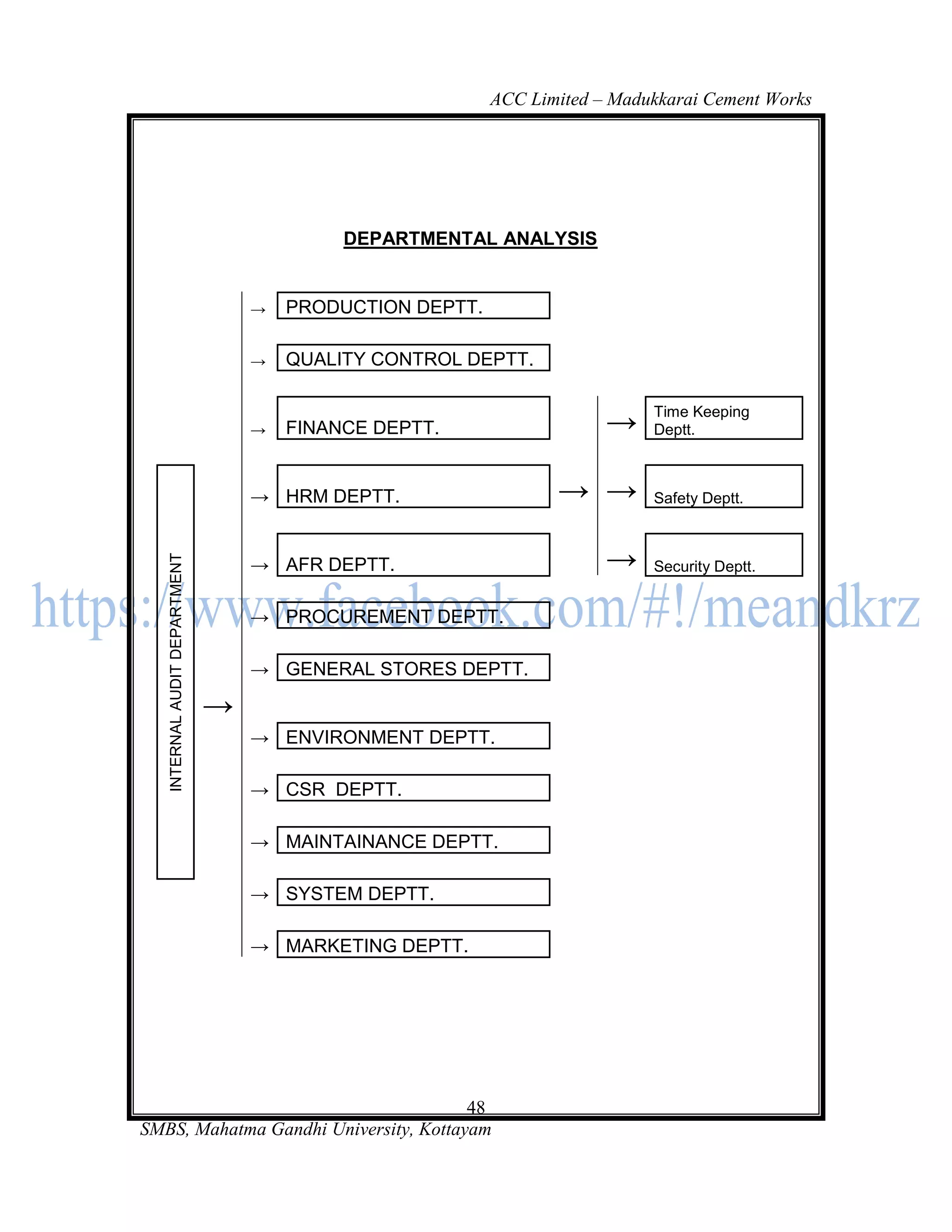
ACC consists of a number of departments. From the study conducted in ACC
Madukkarai Cement Works we can broadly classify the departmental structure of ACC
into the following --


                                       47
SMBS, Mahatma Gandhi University, Kottayam
ACC Limited – Madukkarai Cement Works


                                            DEPARTMENTAL ANALYSIS


                                   →   PRODUCTION DEPTT.

                                   →   QUALITY CONTROL DEPTT.


                                   →   FINANCE DEPTT.                   →    Time Keeping
                                                                             Deptt.


                                   → HRM DEPTT.                   → →        Safety Deptt.


                                                                        →
   INTERNAL AUDIT DEPARTMENT


                                   → AFR DEPTT.                              Security Deptt.


                                   → PROCUREMENT DEPTT.

                                   → GENERAL STORES DEPTT.

                               →
                                   → ENVIRONMENT DEPTT.

                                   → CSR DEPTT.

                                   → MAINTAINANCE DEPTT.

                                   → SYSTEM DEPTT.

                                   → MARKETING DEPTT.


                                       48
SMBS, Mahatma Gandhi University, Kottayam
ACC Limited – Madukkarai Cement Works


PRODUCTION DEPARTMENT

Production Department is considered as the heart of an organization. It is an area of work
where the core products of an organization take its physical form.

ACC have a well structured as systematic Production Department which is engaged in the
process of cement and concrete production.

The Production Department of ACC concentrate on ‗4S‘ system of management, they are
as follows:

              Seiri – Separate the necessary from unnecessary item


              Seiton – Arrange orderly and label


              Seiso – Clean the work place and keep clean


              Seiketsu – Constant practice of Seiri, Seiton & Seiso


OBJECTIVE OF PRODUCTION DEPARTMENT

The main objective of Production Department is – ―To produce a quality oriented
cement and concrete through a well structured production procedure‖.


                                       49
SMBS, Mahatma Gandhi University, Kottayam
ACC Limited – Madukkarai Cement Works


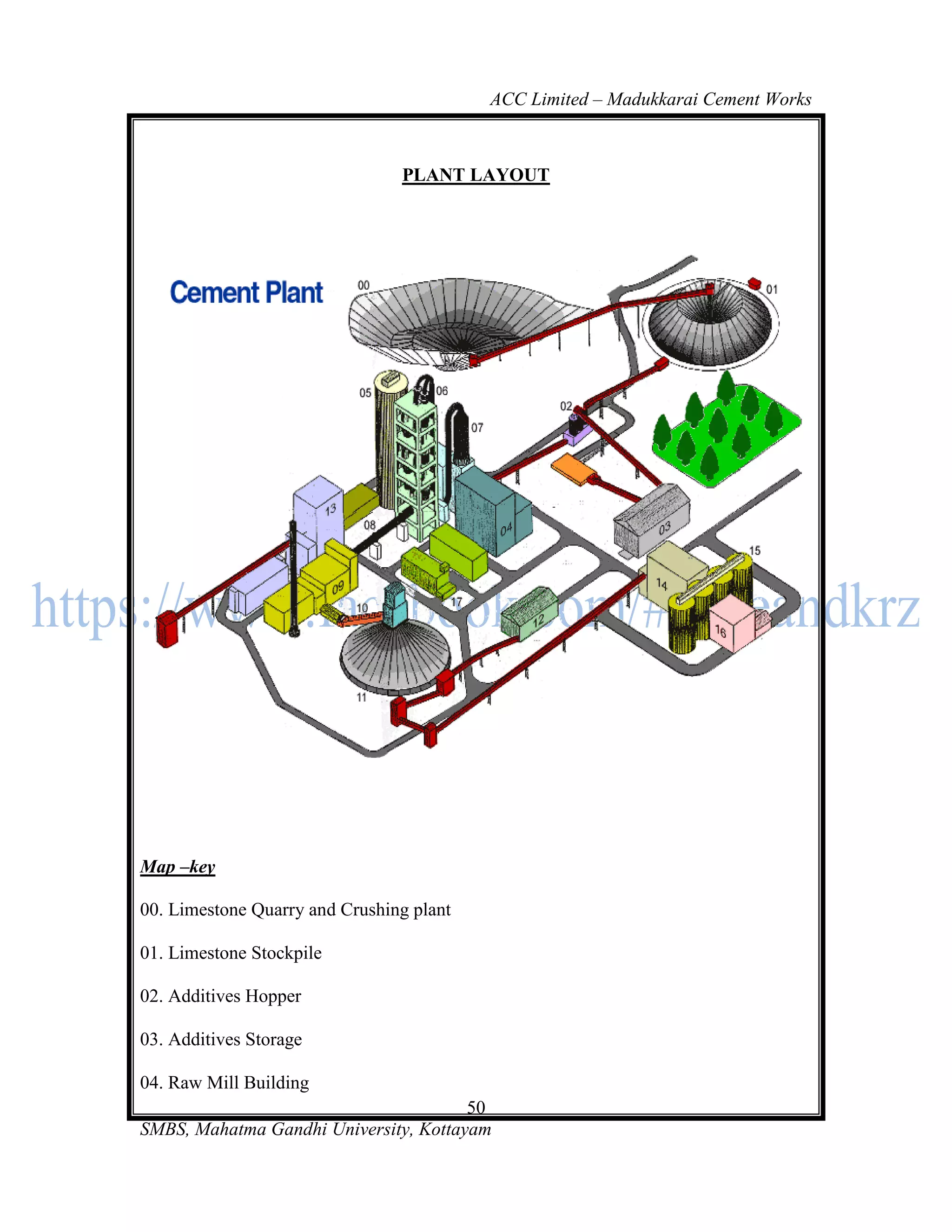
                                PLANT LAYOUT


Map –key

00. Limestone Quarry and Crushing plant

01. Limestone Stockpile

02. Additives Hopper

03. Additives Storage

04. Raw Mill Building
                                       50
SMBS, Mahatma Gandhi University, Kottayam
ACC Limited – Madukkarai Cement Works
05. Blending and Storage Silo

06. Pre Heater

07. Gas Conditioning Tower and ESP

08. Kiln

09. Cooler

10. Deep Bucket Conveyor

11. - 12. Clinker/Gypsum storage

13. Coal Mill Building

14. Cement Mill and Bag House

15. Cement Storage Silo

16. Packing and Dispatch

17. Central Control Room


Plant lay out simply refers to the arrangements of the machines, equipments and other
physical facilities within the factory premises. ACC Plants usually follow ―Process
Layout‖ i.e. similar machines are placed in one place (work area) according to the
operation or functions they perform.


                                       51
SMBS, Mahatma Gandhi University, Kottayam
ACC Limited – Madukkarai Cement Works


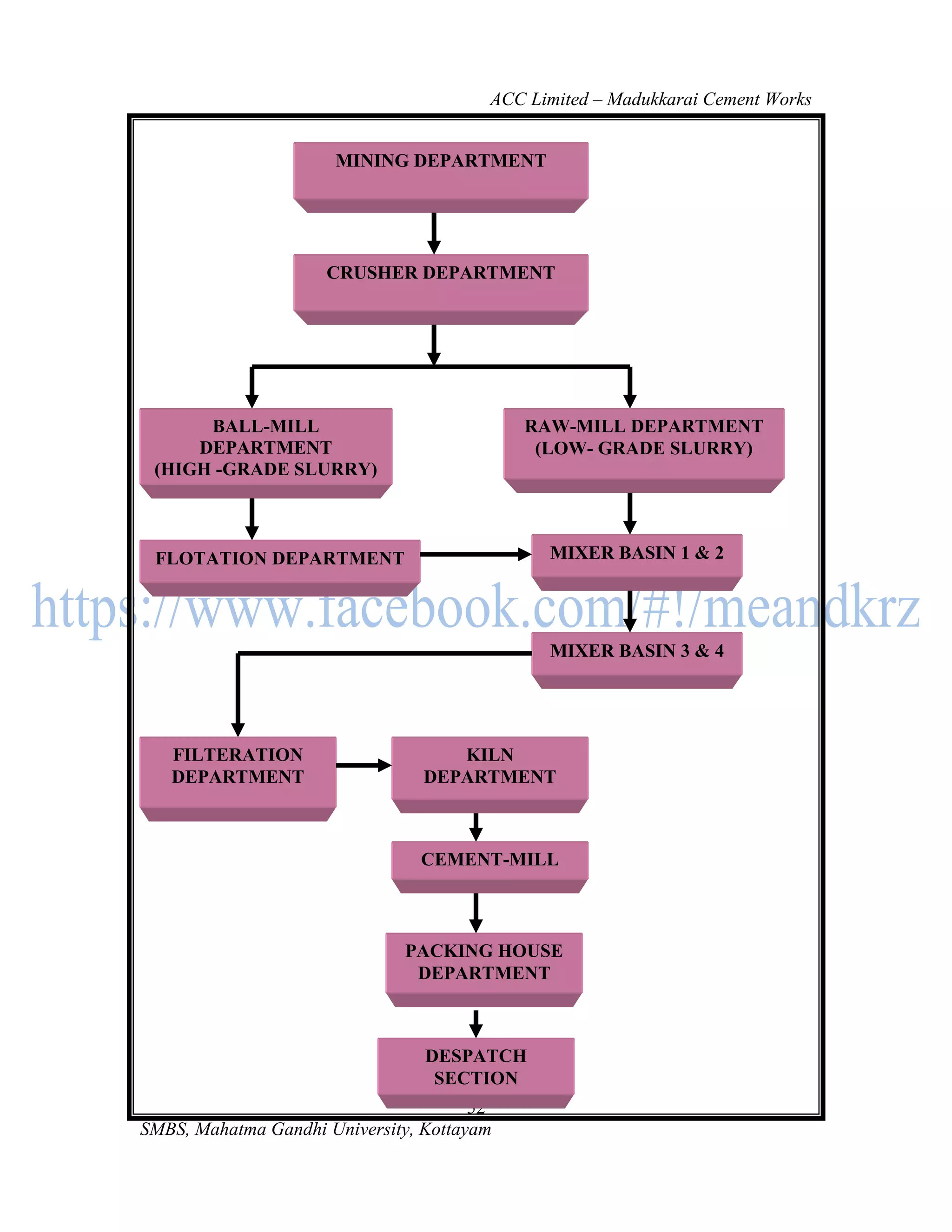
                      MINING DEPARTMENT


                     CRUSHER DEPARTMENT


      BALL-MILL                             RAW-MILL DEPARTMENT
     DEPARTMENT                              (LOW- GRADE SLURRY)
 (HIGH -GRADE SLURRY)


 FLOTATION DEPARTMENT                         MIXER BASIN 1 & 2


                                              MIXER BASIN 3 & 4


   FILTERATION                      KILN
   DEPARTMENT                    DEPARTMENT


                                CEMENT-MILL
                                DEPARTMENT


                              PACKING HOUSE
                               DEPARTMENT


                                 DESPATCH
                                  SECTION
                                       52
SMBS, Mahatma Gandhi University, Kottayam
ACC Limited – Madukkarai Cement Works


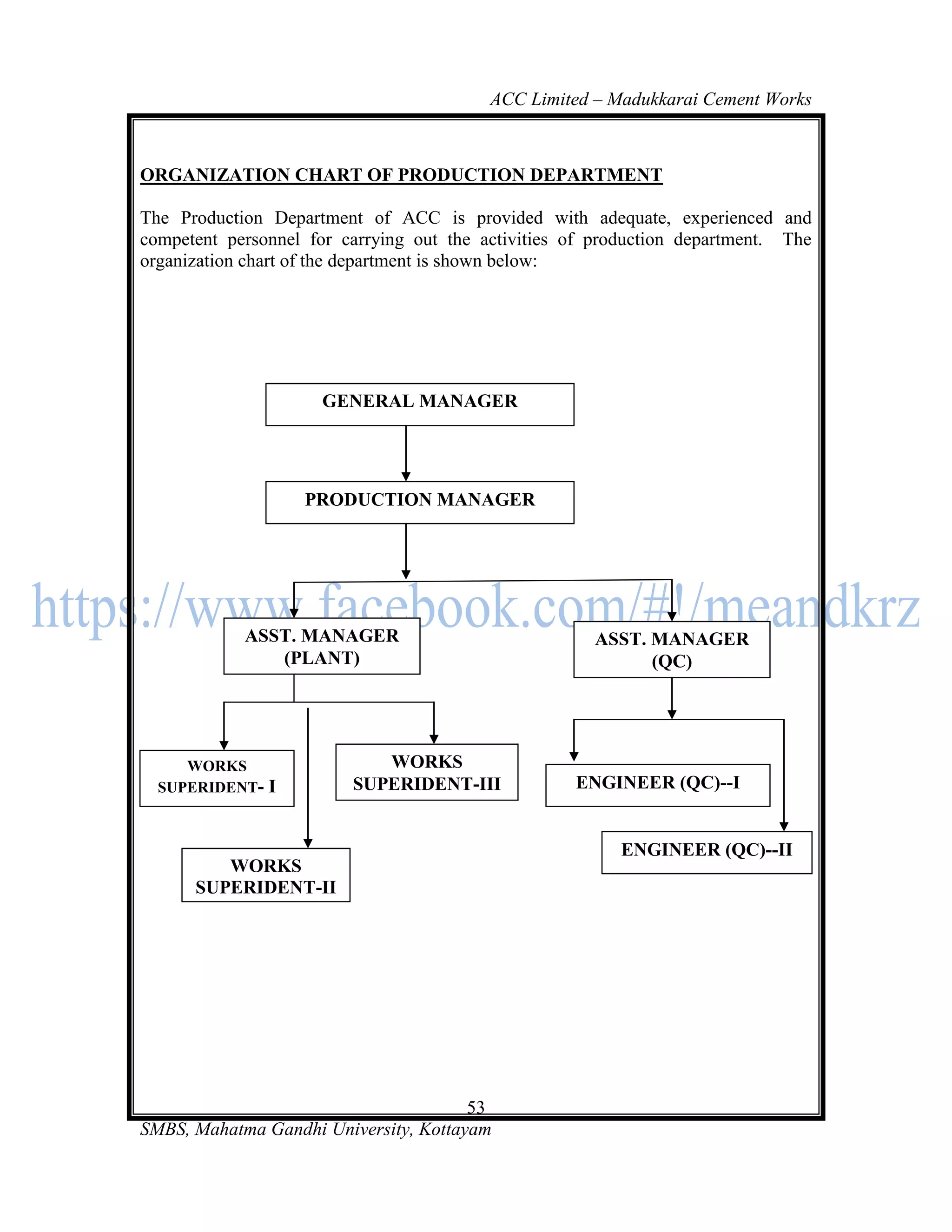
ORGANIZATION CHART OF PRODUCTION DEPARTMENT

The Production Department of ACC is provided with adequate, experienced and
competent personnel for carrying out the activities of production department. The
organization chart of the department is shown below:


                     GENERAL MANAGER


                   PRODUCTION MANAGER


            ASST. MANAGER                             ASST. MANAGER
               (PLANT)                                      (QC)


     WORKS                  WORKS
  SUPERIDENT- I          SUPERIDENT-III             ENGINEER (QC)--I


                                                          ENGINEER (QC)--II
         WORKS
      SUPERIDENT-II


                                       53
SMBS, Mahatma Gandhi University, Kottayam
ACC Limited – Madukkarai Cement Works


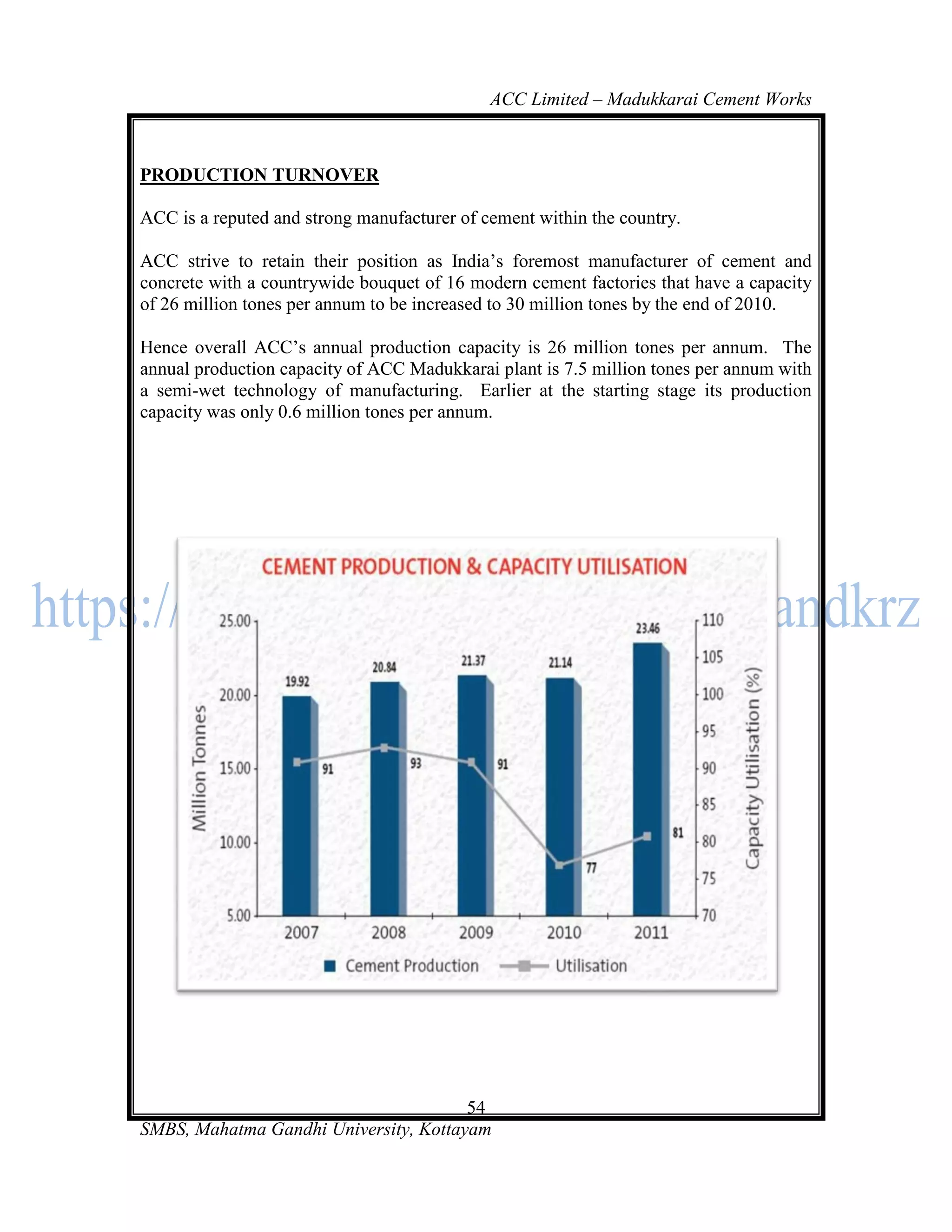
PRODUCTION TURNOVER

ACC is a reputed and strong manufacturer of cement within the country.

ACC strive to retain their position as India‘s foremost manufacturer of cement and
concrete with a countrywide bouquet of 16 modern cement factories that have a capacity
of 26 million tones per annum to be increased to 30 million tones by the end of 2010.

Hence overall ACC‘s annual production capacity is 26 million tones per annum. The
annual production capacity of ACC Madukkarai plant is 7.5 million tones per annum with
a semi-wet technology of manufacturing. Earlier at the starting stage its production
capacity was only 0.6 million tones per annum.


                                       54
SMBS, Mahatma Gandhi University, Kottayam
ACC Limited – Madukkarai Cement Works


DEPARTMENTAL FUNCTION

The functioning of Production Department of Madukkari Plant of ACC is somewhat
different from other plants of ACC. This is basically because the basic raw material
obtained from the mines of Madukkari plant is of low quality. Hence in order to increase
its quality up to the mark, Madukkarai plant practices the semi wet process along with
wet and dry process.

In other plants of ACC they use to follow wet process and dry process only but in
Madukkarai plant of ACC they undergo through wet process – semi wet process – dry
process.

The production department of Madukkarai plant is basically divided into various sub-
departments. These sub-departments are known as Zones. Each zone of production
department have a zone name, owner (head of the sub-department). The following are
the various zones of production department----


                              ZONAL -- STRUCURE
               ZONE                                AREA
          ZONE—PEARL                   MINING DEPARTMENT
          ZONE—RUBY                    CRUSHER DEPARTMENT
                                       ADDITIVE STORAGE HOPPER
          ZONE—SAPPHIRE                BALL-MILL DEPARTMENT
                                       FLOTATION DEPARTMENT
                                       RAW-MILL DEPARTMENT
          ZONE—DIAMOND                 MIXER-BASIN NO. 1 & 2
                                       MIXER BASIN NO. 3 & 4
                                       CENTRAL CONTROL ROOM
                                       FILTERATION DEPARTMENT
          ZONE—EMERALD                 KILN DEPARTMENT
                                       CLINKER/GYPSUM STORAGE
                                       COAL MILL BUILDING
          ZONE—CORAL                   CEMENT- MILL DEPARTMENT
                                       CEMENT STORAGE SILO
          ZONE—GARNET                  PACKING HOUSE DEPARTMENT
                                       DESPATCH SECTION


                                       55
SMBS, Mahatma Gandhi University, Kottayam
ACC Limited – Madukkarai Cement Works
The following are the main functions of each zone of production department:

       Zone-Pearl

       1. Mining Department

           The major raw-material for cement production is limestone. The limestone
           most suitable for cement production must have some ingredients in specified
           quantities i.e. calcium carbonate, silica, alumina, iron etc.

           Typically, cement plants locations are based upon the availability of good
           quality limestone in the vicinity. But in case of Madukkarai plant, the
           limestone available in mines are not upto mark. ACC Madukkarai plant
           basically has two mines from where lime stones are obtained i.e. Madukkarai
           quarry which is located at a distance of 4 kms. and at Walayar quarry located
           at a distance of 22 kms from the plant. The limestones obtained from these
           mines are usually in the form huge rocks. Hence, it undergo quarrying
           process. The quarrying operations are done by the cement producer using
           the open cast mining process. Quarrying is done through drilling and
           subsequently, using heavy earthmoving equipment such as bulldozers, pay
           loaders and dumpers.

           The quarried raw material is then transported to the cement plant by vehicles
           like wagons and trucks.

           The limestone (CaO) obtained from these quarries are usually of 74-75%
           quality but actual required quality is around 83-95%.

       Zone - Ruby

       2. Crusher Department

           Limestone from mines is brought to the crusher department. The quarried
           limestone is normally in the form of big boulders, ranging from a few inches
           to meters in size. These varying sizes of limestone need to be crushed to a
           size of about 6 to 8 inches in order to be prepared for finish grinding.

           Crusher Department usually have two sections – Primary Crusher(300 tons
           per hour) and Secondary Crusher(400 tons per hour).

           Primary crusher

         The limestone from mines is brought to the plant site by trippers (20 tons
         capacity) and halpack (40 tons per halpack) and then it is dumped into
         dumpers. Then through laminated conveyers it is sent to primary crusher.
                                       56
SMBS, Mahatma Gandhi University, Kottayam
ACC Limited – Madukkarai Cement Works
          The lime stones are crushed to the size of 6-10 inches in ‗Jaw Type‘ primary
          crusher then through belt conveyers it is transported to the secondary crusher.

          Secondary Crusher

          In secondary crusher the primary crushed limestone further reduced to the
          size of less than 1 inch. Then the secondary crushed limestone is passed to
          vibrating screen which helps to separate fine material with that of course
          material.

          Then the fine material is forwarded to other department for further process
          and course material is transferred again to secondary crusher for reprocessing.

       3. Additive Storage Hooper

          In order to required composition of raw material, certain additive such as iron
          ore, bauxite, laterite and fluorspar are added in required quantities. These
          additives are stored at the plant in separate hopper and are extracted using
          belt conveyers in conjunction with belt weighing equipment. This ensures
          that only the required quantities are extracted and are added to the raw
          material.

      Zone – Sapphire

       4. Ball Mill Department

          Crushed limestone from secondary crusher is fed to Ball Mill. As we know
          that the quality composition of lime stone required is different from that of
          actual received composition. So in order to make this limestone fit for
          production of final product the corrective material i.e. iron ore (Fe2 O3),
          Alumina (Al2 O3 ), Silica (SiO2 ) is added with limestone and then grounded
          with water to make ‗high grade slurry‘.

          Ball Mill usually has two parts – Ball Mill 1 (57 ton per hour) and Ball Mill
          2(25 ton per hour).

          Ball Mill 1

          The crushed limestone from secondary crusher is fed to Ball Mill 1 through
          conveyers. In this mill the limestone is added up with corrective material and
          they are grounded together with the help of grinding media.

          Ball Mill 2


                                       57
SMBS, Mahatma Gandhi University, Kottayam
ACC Limited – Madukkarai Cement Works
          Then the above mixture is transferred to Ball Mill 2 where it is grounded with
          water to form high grade slurry. Then this slurry is pumped to hydrocyclon
          having 380 ton capacity which is placed at the top of the Ball Mill. Here the
          high grade slurry get separated into fine slurry and course slurry.

          Then the fine slurry is pumped to floatation department and course slurry will
          again settled down to the Ball Mill 1 for reprocessing.

       5. Floatation Department(Cell House)

          Floatation Department deals with semi wet processing in order to make
          quality oriented materials. In this department the fine slurry from Ball Mill
          hydrocyclon is pumped to turbo mixer basin. Here the slurry undergoes
          blending process in order to homogenize these different material efficiently to
          counter act flectuations in the chemical compositions of the high grade slurry.
          Then it is transferred to Hydrocyclon (350 ton, 250 tons) situated at the top of
          the Floatation Department. Here again the slurry undergoes separation
          process then the fine slurry will be transferred to thickener and course will be
          transferred to cells. In cells the course slurry will be added up with the
          reagents (caustic soda, soap stock and rosin) then as a result of processing in
          cells, the fines are separated from course and then that will be transferred to
          thickener and the course will be rejected.

          Heavy course particles mainly silica is removed as rejects. From the
          Floatation Tank is being used by the other industries and remaining used for
          reclamation of worked out quarries.

          The high grade fine slurry after removal of rejects is transported to the
          thickener from where carbonate rich high grade slurry is removed and then
          stored in floatation silos.

      Zone - Diamond

       6. Raw Mill Department

          Crushed limestone from secondary crusher is fed to raw mills through
          hoppers alongwith required quantity of bauxite, laterite and iron ore and
          ground with water to make the ‗low grade slurry‘. Low grade slurry is basic
          used to provide strength in the final product. This slurry prepared in raw mill
          is then sent to hydrocyclon (350 tons) situated at top of raw mill, here the
          fines are separated from course materials. Then the fine low grade slurry is
          stored in raw mill silos.

       7. Mixer Basin

                                       58
SMBS, Mahatma Gandhi University, Kottayam
ACC Limited – Madukkarai Cement Works
          There are usually 4 Mixer Basins. Required quantity of high grade slurry and
          low grade slurry is mixed in Mixer Basin No. 1 and 2 where thorough mixing
          is carried out. The slurry of required composition is then pumped to Mixer
          Basin No. 3 and 4 from where it is pumped to Rotary Drum Filters.

      Zone – Emerald

       8. Filtration Department

          The corrective slurry in Mixer Basin 3&4 is now quality wise reached but it
          contains 34% moisture content in it. Filtration Department and Kiln
          Department carries out the drying process.

          The corrective slurry is pumped into the slurry header tank in Filtration Deptt
          and then from there through pumps it is transferred into the Filter Drums (7).
          These Filter Drums consists of Filter Blocks made up of cloths and these
          Filter Blocks sucks up 20% of moisture contents from the corrective slurry.
          After undergoing this filtration process the corrective slurry become kiln feed
          or raw meal. So output of Filtration Deptt is Raw meal or Kiln feed. Then
          the raw meal having 13-14% moisture content is fed into the Kiln Deptt from
          the Filtration Department through a common belt conveyer.

       9. Kiln Department

          A kiln is the heart of any cement plant. It is basically a long cylindrical
          shaped pipe, and rotate in horizontal position. Its internal surface is lined by
          re factory bricks. Limestone and addictives are calcined in this. The output
          of the kiln is called clinker.

          This department mainly helps to suck up the remaining percentage of
          moisture content from Kiln feed and also make it in powdered form by
          supplying heat in excess amount.

          The main fuel used in Kiln Deptt is coal (alongwith alternative fuel). The
          raw meal is transferred from Filtration Deptt to the Crusher Dryer. Here a
          heat up to 1800C to 200oC is transferred by exhaust fan to make Kiln feed
          into powder form having moisture content in it.

          Pre-calcination

          Kiln Feed is fed to the two stream top cyclone from crusher dryer through
          impact weigh feeder, which partly enters into straight line calciner (SLC).
          Hot air is supplied to SLC from grate Cooler. In SLC, Kiln feed undergoes
          calcinations and later fed to bottom cyclone and then to rotary kiln.

                                       59
SMBS, Mahatma Gandhi University, Kottayam
ACC Limited – Madukkarai Cement Works
           Pre-processing in Rotary Kiln

           When Kiln feed is transferred to Rotary Kiln, then it has a temperature of
           900oC already (thus it helps to save coal usage). In Rotary kiln at 1400 oC,
           Calcium carbonate in presence of fluxes undergoes sintering and clinker is
           formed. Clinker is discharged to grate cooler for cooling. Hot air from
           cooler is used as secondary air to kiln, tertiary air to SLC and Coal Mill for
           drying. Then the clinker formed is stored in clinker silos.

           Central Control Room

           It is the nerve centre of the cement plant since all equipments of filtration,
           kiln section is controlled from this place. It is the place from where all the
           process parameters are controlled.

       10. Clinker/Gypsum Storage

           The output of the kiln is stored before it is fed to the cement mill for
           conversion to cement. This storage is called clinker storage, if it is used for
           clinker storage purpose. If the storage space is used for Gypsum storage, it is
           called gypsum storage.

           The storage may be of silo type or covered stacker reclaimer type or simply a
           gantry type. Silo type clinker storage has been advantage that there is no dust
           pollution and spillage of clinker. Same advantage can be achieved through
           stacker reclaimer type as well. However, there is a little bit of dust generated.
           Gantry type is not used in modern cement plants because of its environmental
           unfriendly nature.

       11. Coal Mill Building

           The Coal Mill Building houses the mill for grinding lumpy coals. This fine
           ground coal is used for burning in the kiln. The mills used for call grinding
           and drying are either trumbling or roller mills.

       Zone - Coral

       12. Cement Mill

           The basic raw material of a cement factory is clinker which is manufactured
           in plant of ACC in the above steps.

         Cement Mill is that part of plant which carries out the main function of a
         cement factory i.e. production of final product cement and concrete. The
         clinker produced in kiln is stored in clinker silos. Then through crane yard
                                         60
SMBS, Mahatma Gandhi University, Kottayam
ACC Limited – Madukkarai Cement Works
          the clinker is transported and dropped into hopper of cement mill and gypsum
          is also added in it in appropriate quantity.

          Cement Mill has two sections i.e. Cement Mill 1 and Cement Mill 2.

          The clinker and gypsum comes in Mill 1 from hopper then in order to mix it
          properly it is crushed in Mill 1 using grinding media (magnized steel ball
          material). Then it comes in Mill 2 where fine crushing is done i.e. finished
          grinding process.

          Then after this final product is formed by adding appropriate composition of
          each material (composition changes on basis of product type). The following
          are the products types and their composition of ACC‘s Madukkarai plant:

                Clinker + Gypsum + Slag = Portland Slag Cement (PSC)
                Clinker + Gypsum = Ordinary Portland Cement (OPC)
                Clinker + Gypsum + Fly Ash = Portland Poslana Cement
                Clinker + Gypsum + Flotation Reject = Masanaory Cement(New
                 product)


       13. Cement Storage Silo

          This cement storage silo is used for storing the finished products – Cement

   Zone – Garnet

       14. Packaging House

          The cement prepared in cement mill is send to cement silos. There are usually
          5 cement silos situated in Packaging House. Among these 5 cement silos, the
          silo 1 is for storing PSC cements and Silo 2 for OPC, Silo 3 for PPC and
          Silo 4 for Masanaory cement.

          Then using bucket elevator cement is put into static/rotary packers 1 & 2
          from silos then it is loaded to trucks and thus transports to dispatch
          department.

       15. Central Despatch Section (CDS)

          The cement bags loaded from packing houses in trucks and wagons will come
          in CDS for carrying out dispatch procedure.


                                       61
SMBS, Mahatma Gandhi University, Kottayam
ACC Limited – Madukkarai Cement Works
            The truck drivers present the printed gate-pass slip in dispatch section issued
            from Time Keeping Deptt. The officer is dispatch section then issue Delivery
            Notes i.e. JJ Forms to truck drivers usually they issue 4 JJ Forms i.e. 1 for
            company records, 1 for the receiving party and two for presenting in check
            post (Chawadi Check Post and Walayar Check Post).

            Usually from Madukarai plant the final product is transported mainly to
            warehouses situated in Kerala (Palakkad, Trichur, Aluva & Kozhikode) and
            to industries and other customers in Tamil Nadu itself.

            Hence from dispatch section the goods are finally dispatched to the Market
            from Production Department.


CEMENT PRODUCTION AND DESPATCHES IN APRIL 2012
Month

April -2012
Cement Production 2.17 million tonnes

Cement Despatches 2.07 million tonnes

April-2011
Cement Production 2.06 million tonnes

Cement Despatches 2.05 million tonnes

Cumulative

January-April 2012
Cement Production 8.87 million tonnes

Cement Despatches 8.79 million tonnes

January-April 2011
Cement Production 8.28 million tonnes

Cement Despatches 8.27 million tonnes


                                       62
SMBS, Mahatma Gandhi University, Kottayam
ACC Limited – Madukkarai Cement Works


QUALITY CONTROL DEPARTMENT(QCD)
Quality Control Department mainly deals with the process of quality control and
assurance. ACC is highly concerned about the quality aspects of its products. They are
very conscious about there quality and services. Hence, each plant of ACC has there own
separate well structured and equipped Quality Control Department.

From the study conducted in ACC Madukkarai Cement Works plant, it become very
much clear that they focus on continuous improvement strategy i.e. Kaizen approach.

The quality department of ACC basically deals with and focus on the quality assurance
and control phenomena on a regular or continuous basis.

In ACC, the manufacturing process of Ordinary Portland cement and Portland poyyolana
cement is a continuous process and thus the quality and process control activities are
carried out at all stages of manufacturing process with the objective to achieve zero
defect and to ensure that the quality of cement produced surpasses the relevant IS
specification requirements with liberal margin and to satisfy the customer fully and
continuously.


QUALITY POLICY

      Manufacture Quality Products

      Customer satisfaction

      Continual improvement in quality.


ORGANIZATION CHART

The Quality Control Department of ACC is provided with adequate experienced and
competent personnel for carrying out the activities of department. The organizational
chart of the department is shown below:


                                       63
SMBS, Mahatma Gandhi University, Kottayam
ACC Limited – Madukkarai Cement Works


                         MANAGER PRODUCTION
                                        ↓
                         DY. / JT. MANAGER(QC)
                                        ↓
                          ASST. MANAGER (QC)
                                        ↓
                                                  ↓
              JR.ASST.ANALYST            MATERIAL                  W/BRIDGE
           ↓               ↓             HANDLING                TALLY CHECKER
       GAUGERS        TESTERS            SUPERVISOR
           ↓                 ↓                     ↓
       TESTING        TESTING            YARD
       SAMPLE         SAMPLE             SUPERVISOR
       BOYS           BOYS                         ↓
                                         HEOS


Quality Cells/Sections

Quality Control Department has four sections/cells. They are:

       Chemical & Instrumental Analysis Laboratory (Main Lab)
       Physical Testing Laboratory
       Site Laboratory and
       Flotation Laboratory
       Microscopy
       AFR
       PSD


                                       64
SMBS, Mahatma Gandhi University, Kottayam
ACC Limited – Madukkarai Cement Works

   Chemical & Instrumental Analysis Laboratory

   Chemical Analysis of raw materials, intermediate products and final products are
   carried out in this laboratory. The main function of this laboratory is to test and
   assure the chemical composition of raw material and intermediate products and final
   products. It basically deals with the process of quality assurance regarding
   composition of chemicals like limestone etc. at various stages of production.

   Physical Testing Laboratory

   Physical testing of raw materials, intermediate products and final products are carried
   out in this laboratory. It basically deals with the process of assuring the strength and
   quality grade of the cement cakes. It provide assurance regarding the durability of
   product and also grade analysis of cement cake is performed in this laboratory.

   Site Laboratory

   This laboratory functions in all the three shifts. Round the clock quality control and
   monitoring activities pertaining to flolakeon process are carried out in this laboratory.
   It mainly deals with the process of monitoring and assuring the quality of kiln fud,
   clinker cement. It deals with assurance of quality of output of each department in
   order to judge its composition, strength ad durability etc.

   Flotation Laboratory

   Flotation Laboratory also functions in all the three shifts round the clock quality
   control and monitoring activities pertaining to flotation process. This laboratory
   mainly deals with the process of monitoring and controlling of quality at the flotation
   stage. It is the most crucial stage in production in ACC plants because in this stage
   the low quality raw material is converted into quality oriented raw material (clinker).
   This laboratory mainly focuses on high grade quality of flotation stage and in this
   laboratory residence analysis is performed.

Quality Control Functions

ACC has effectively pledged its reputation as the market leader in the quality of cement
by effective quality control functions of quality zone of ACC.

The Quality Control functions cover all the processes effecting the product quality. The
quality control functions include – inspection, sampling and testing of all the incoming
raw materials, in process materials and the finished products.


                                       65
SMBS, Mahatma Gandhi University, Kottayam
ACC Limited – Madukkarai Cement Works
The test results so obtained from these tests are also known as parameters. Hence the test
parameters obtained are used for control of quality of incoming raw materials/in-process
materials and also for control of processes.

The desirable quality parameters and the minimum acceptance criteria with respect to in-
coming raw-materials in process materials and finished products are given under:

Acceptance criteria/Control of Important parameters at various stages of cement
manufacturing process:


                                      Table (a)
                               Incoming Raw-Materials

 Material                  Parameter                             Range
                                                    Desired        Acceptable
 Limestone, Walayar    Total Carbonate               72 – 76 %     68% minimum
 Limestone, Madukkarai Total Carbonate               74 – 80 %     72% minimum
 Bauxite               A12 03                        35 – 45 %     30% minimum
                       Si 02                         10 – 15 %     18% maximum
 Iron Ore              Fe2 03                        60 – 95%      60% minimum
 Laterite              A12 03                        30 – 45 %     25% minimum
                       Si 02                         10 – 15 %     18% maximum
 Fly Ash               Combustibles                   2–7%         12% maximum
                       Specific
                       surface(M2/kg.)              350 – 400       320 minimum
 Gypsum                Purity as Ca SO4 ,            75 – 95 %      65% minimum
                       2H2O
                       Chloride content              0.3 – 0.8      1% maximum
 Coal (imported)       Ash content                    10 – 15%      20% maximum

       In-coming Raw-materials

       The raw-materials used in manufacturing of cement at Madukkarai Cement
       Works are limestone, Bauxite/Laterite, (i.e. aluminia as silica ) , Iron ore, fly ash
       and gypsum, coal/lignite is used as a fuel in pyroprocessing.

             Limestone

            Received from company own two captive mines through, Walayar Mines
            & Madukkarai mines. ACC to mine programme, drilling is carried out on
            deposit as the drill cutting samples are analyzed by Quality Control
            Department for total carbonate content which gives an advance
            information to the mines department on quality of limestone before it is
            blasted.
                                        66
SMBS, Mahatma Gandhi University, Kottayam
ACC Limited – Madukkarai Cement Works

             Quality of limestone is also monitored by analyzing quality of crushed
             lime sample collected from crusher department.


          Bauxite/Laterite/Fluoro sludge (Alumina as Silica)

             It is used in raw mill as a corrective material for required alumina content.

             Source wise daily average samples are analyzed for acceptability.


          Iron Ore(Fez03)

             Mill scale /Iron ore is used in Raw Mill as corrective material for required
             iron content.

             Quality Control Department analyze the source wise daily average
             samples for acceptability.


          Gypsum

             It is used in required proportion in cement mills. Quality Control
             Department analyze the source wise daily average samples of Gypsum for
             acceptability or Quality assurance.


          Fly ash

             Fly ash is used as a pozzolanic material in manufacture of Portland
             pozzolana cement in cement mills procured from established sources.

             Weekly average composite samples are tested for assessing to conformity
             to IS:3812.


          Coal/Lignite/Alterative Fuel

             Presently imported coal from China is being used as a fuel for the
             pyroproceesing stage. Material Management Division of Corporate Office
             organizes procurement of imported coal. Coal received by rail or road and
             the quality is monitored.

                                       67
SMBS, Mahatma Gandhi University, Kottayam
ACC Limited – Madukkarai Cement Works
               Lignite and alternative fuel may also be carried out in accordance to work
               instruction Nos. and standard test procedures.

               The quality control department verifies the quality of incoming raw-
               material against the purchase order specifications for deciding its
               acceptability/rejection. If the material is meeting the requirement, it is
               allowed to store at the designated places. In case of non-conformance, the
               material is rejected and stored separately. However, if the non-
               conformance is found to be marginal and satisfying the min acceptance
               values as given in about table which will ensure no adverse effect on
               product quality shall be accepted by imposing suitable penalty clause.
               Manager Production is final authority for acceptance/rejection of these
               materials. His decision is final as in no case shall be overridden by
               anyone.


Sampling & Testing Plan for in-coming Raw-materials.

 Details of Sample    Parameters       Frequence of     Frequence of     Purpose of
                                       Sampling         testing          testing
 Lime stone           TC               As and when      As and when      To access
 Drill cut                             received from    received from    quality of
                                       mines            mines            limestone
                                                                         before blast
 Bauxite / Laterite   Moisture         Daily receipts   Daily receipts   To access
                      A12 03           source wise                       quality and
                      S1 02                                              acceptance
                      Size
                      Full Chemical    Daily receipts   Fortnightly      Quality
                      Analysis         source wise      composite        Assurance
                                                        sample
 Iron Ore             Moisture         Daily receipts   Daily receipts   To access
                      Fez 03           source wise                       quality and
                                                                         acceptance
                      Full chemical    Daily receipts   Fortnightly      Quality
                      analysis         Source wise      composite        Assurance
                                                        sample
 Gypsum               Moisture         Daily receipts   Daily receipts   To access
                      Purity           source wise                       quality and
                      Chloride                                           acceptance
                      Full chemical    Daily receipts   Fortnightly      Quality
                      analysis         Source wise      composite        Assurance
                                                        sample
                                       68
SMBS, Mahatma Gandhi University, Kottayam
ACC Limited – Madukkarai Cement Works
Fly ash             Specific          Daily receipts     Weekly           Suitability for
                    surface, LR,      Source wise        composite        cement
                    CR, drying                           sample           quality
                    shrinkage &
                    full chemical
                    analysis
Coal                Moisture,         Daily receipts     Ratewise         To access
                    proximate                            sample           quality
                    analysis
                    including CV
Lignite/alternative Moisture ash      Daily receipts     Dailywise        To access
fuel                                                                      quality.

      Packing Cement Bags

      Cement is packed in HDPE (High Density Polyethyline) / PP (Poly propylene)
      woven sacks and in paper bags conforming to companies specification formulated
      by Material Management Division (MMD) of corporate office.

      For each supply of bags the supplier is submitting the test reports, which
      preserved by packing house department.

      Lot of bag – sampled for quality check by quality control personnel.

      Bags are checked for following parameters

         Length and width of bag
         Length of valve
         Weight of bag
         No. of stitches /decimeter
         Tensile strength for length, width, top seam and bottom seam.
         Taper test for branding

      In case of paper bags following checks are made:

         Length and width of bag
         Length and width of valve
         Weight of bag

      The Quality Control Department forward test report for each lot of cement bags
      received to Manager Commercial and to Packing House. Manager Commercial
      decides the acceptance/rejection of lot and communicates to packing house
      accordingly. Packing house ensures use of bags only from accepted lot.


                                       69
SMBS, Mahatma Gandhi University, Kottayam
ACC Limited – Madukkarai Cement Works

      Acceptance criteria / control of important parameters at various stages of cement
      manufacturing process:


                                      Table (b)

                                In-process Materials

  Material               Parameter                              Range
                                                   Desired       Acceptable
  Flotation Mill fuels   Residence on
                         72 Mesh                    4.5 – 6%     6.5% maximum
                         170 Mesh                  25 – 30%      35% maximum
  Flotation Rejects      Total Carbonate           20 – 30%      35% maximum
  High Grade Slurry      Residence on 72 Mesh      1.5 – 3.0%    4.0% maximum
                         Residence on 170Mesh      15 – 22%      25% maximum
                         Moisture content          32 – 34%      35% maximum
                         Total carbonate content   80 – 85%      78% minimum
  Low Grade Slurry       Residence on 72 Mesh      2.5 – 4.5%    5.0% maximum
                         Residence on 170Mesh      20 – 28%      30% maximum
                         Moisture content          30 – 38%      40% maximum
                         Total carbonate content   35 – 75%      40% minimum
  Kiln Feed Slurry       Residence on 72 Mesh      2.8 – 3.2%    3.5% maximum
                         Residence on 170Mesh      20 – 27%      32% maximum
                         Moisture content          32 – 35%      36% maximum
                         Ca O                      43 – 45%      43.5% min.
                         Fez 03                    2.5 – 3.2%      2% minimum
                         A12 03                    2.7 – 3.5%    2.5% minimum
  Filter cake            Moisture content          13 – 17%      18% maximum
  Fine coal kiln         Moisture content          3 – 6%          8% maximum
                         Residence on 72 mesh      0.5 - 5.5%    5.5% maximum
                                      170 mesh     5 – 26%       26% maximum
  Clinker                Litre weight              108-1180      1000 Min.
                         Gram/ltr.
                         Free Ca O                 1.5 – 2.5% 3.5% Max.
                         A12 03                    5.0 – 6.0% 4.5% Min.
                         Fez 03                    3.7 - 4.3%   3% Min.
                         CaO                       64.0-65.0 63.0%Min.


                                       70
SMBS, Mahatma Gandhi University, Kottayam
ACC Limited – Madukkarai Cement Works


      In process materials

          Crusher Department

             The output of crusher department is limestone. The quality check is
             carried out by samples collected from product belt conveyor.


          Raw Mill Department

             The input of Raw Mill department is crushed limestone, ground in raw
             mills along with required quantity of corrective materials and water for
             producing low grade slurry.

             Quality Control function involved here – check quality of low grade
             slurry, its fineness and moisture content on the samples collected from
             mill discharge as well as from low grade slurry silos.

             The corrected slurry preparation takes place in mixer basins No. 1 & 2 by
             releasing high grade and low grade slurry from silos in required
             proportions. The corrected slurry is sampled from mixer basins and
             checked for its quality, fineness and moisture content.

             If parameters are found beyond set norms further correction is applied
             which is followed by x-sampling and testing. On clearance from QC
             Department the Raw Mill Dept. pump out the corrected slurry to mixer
             basins 3 & 4 for feeding to the kiln.

          Ball Mill and Flotation Department

             The input of Ball Mill Dept. is crushed limestone which is grounded in
             closed circuit ball mills. The quality control function involved in this
             process is to check the quality and fineness of slurry which is the final
             output from the ball mill and also the quality of enriched slurry which is
             fed to thickener as quality of reject generated from the flotation process.

             For purpose of quality control about 1 – 1 ½ litre of slurry samples are
             collected from following points:

                Ball Mill 350 mm Hydrocyclone fines for control of mill output
                 quality for each mill separately.
                Thickener feed sample for ascertaining the level of enrichment for
                 each thickener separately.
                                       71
SMBS, Mahatma Gandhi University, Kottayam
ACC Limited – Madukkarai Cement Works

                Thickener under/low sample for ascertaining the quality of high grade
                 slurry from each thickener separately.

                Reject sample for evaluation of material recovery from each raw
                 separately.

          Kiln Department

             The corrected slurry in Mixer Basin 1 & 2 of raw mill department is
             pumped to mixer basin no. 3&4 of Kiln Dept. where from it is fed to the
             slurry filters. The quality control functions involved in this process are
             given below:

          Kiln feed

             Corrected slurry available in mixer basin 3&4 which is ready for feeding
             to the slurry filters is called kiln feed. It is sampled from point of
             overflow from constant head tank located at the top of slurry filtration
             plant. About 1 – 1 ½ ltr. of sample is collected twice a shift and checked
             for quality, moisture and fitness.

          Filter cake

             The slurry filter drums filter out the water from kiln feed and cake
             produced is dislodged over the belt conveyors for feeding to the kiln
             system. About ½ kg. sample of cake is collected from common belt
             conveyor once in a shift and tested for moisture content.

          Fine Coal

             Coal which is used as a fuel is finally ground in a mill for firing to the kiln
             system. About ½ kg. of fine coal sample is collected from discharge point
             of screw conveyors for kiln once in a shift and tested for moisture, ash and
             fineness.

          Clinker

             The output from Kiln system is clinker, which come out from cooler
             discharge point. About 5 kg. sample is drawn every hour and part of
             sample is sieved for litre weight determination and another part is kept
             separately for preparation of daily average composite samples. The spot
             clinker samples are also analyzed once in a shift for quality.


                                       72
SMBS, Mahatma Gandhi University, Kottayam
ACC Limited – Madukkarai Cement Works


          Cement Grinding

             The clinker so produced is ground along with gypsum or gypsum and fly
             ash for manufacture of OPC or PPC, as the case may be, in cement mills.
             The QC function involves in this process are to check the fineness, setting
             time and specific chemical parameters on periodic samples collected from
             each mill separately. About 1 kg. sample is collected mill-wise hourly and
             checked.

          Grade Analysis

             In this stage only grade test is also conducted the final product i.e. cement
             undergoes physical test as per which a specific grade is fixed for each type
             of cement. This grade act as a representative symbol of quality and
             strength of final product in front of customer. Under this quality grade is
             fixed by undergoing queering process.

             Queering process is a process of keeping cement cake/concrete produced
             in mold with water and sand in it in a certain pre-fixed proportion for a
             period of 24 hours.

             After period of 24 hours the quality control department will apply certain
             level of pressure to the molded cement cake if it withstand pressure up to
             stage of 16 mega Pascal then concrete is good otherwise bad in quality.


             This is a case of fixing grade at base of one day test. There are other
             criteria also:

             1 day          16 mega Pascal                 33 grade (now removed)
             3 days         22 mega Pascal                 43 grade
             7 days         30 mega Pascal                 43 grade
             28 days        53 mega Pascal                 53 grade

             Hence this test conform the quality and strength of final product in a
             visible form to the ordinary consumers also.


                                       73
SMBS, Mahatma Gandhi University, Kottayam
ACC Limited – Madukkarai Cement Works
      Acceptance criteria/control of important parameters of various stages of cement
      manufacturing process.
                                      Table (c)

                                 Finished Products

  Material   Parameter                                   Range
                                         Desired             Acceptable
  Cement     Specific surface(m2/kg)
             33 Grade OPC                290 I 30             225 Min.
             43 Grade OPC                310 I 30             225 Min.
             PPC                         340 I 30             300 Min.

             Residence on 45 Mesh
             33 Grade OPC                18 – 28%             30% Max.
             43 Grade OPC                18 – 28%             30% Max.
             PPC                         15 – 20%             25% Max.

             SO3 Content for
             OPC                         1.7 – 2.7%           3.0% Max.
             PPC                         1.5 – 2.5%           3.0% Max.

             Setting Times
             OPC (33 & 43)                                    30 Min.

             Initial                     80 – 140             30 Min.
             Final                       130 – 220            600 Max.

             Setting Time-PPC

             Initial                     90 – 160             30 Min.
             Final                       150 – 240            600 Max.

             Composite strength-3 days

             OPC 33                      23-28 Mega Pascal    16 M.Pa. Min.
             OPC 43                      27-32 Mega Pascal    23 M.Pa. Min.
             PPC                         25-30 Mega Pascal    16 M.Pa. Min.

             Composite strength-28 day

             OPC 33 grade                43-48 Mega Pascal    33 M.Pa Min.
             OPC 43 grade                48-53 M. Pascal      43 M.Pa Min.
             PPC                         45-50 M. Pascal      33 M.Pa Min.

                                       74
SMBS, Mahatma Gandhi University, Kottayam
ACC Limited – Madukkarai Cement Works

      Finished Products

      The finished products of ACC are OPC 33 & 43 Grade and PPC (53 Grades).
      Samples collected hourly from spout of packer machines in packing house
      department for each type of cement separately.

      Spot sample analyzed – check fineness and specific chemical parameters twice in
      a shift.
      Daily and weekly composite samples are prepared from hourly samples which
      analysis for –full chemical and physical tests as specified under scheme of Testing
      & Inspection (S TI) of BIS relevant for each type of cement.

      Sampling/Testing Plan for finished products.

Manufacturing     Details of       Parameters to    Frequency of        Frequency of
stage             sample           be tested        sampling            Test
Packing House     Cement for       Specific surface Hourly              Twice in a
Dept.             each type        Co O & SO3                           shift
                  separately
                                   Complete           Daily/Weekly      Daily/Weekly.
                                   chemical &         composite
                                   Physical Tests     sampling
                                   as per BIS‘s ST

      Chemical analysis of clinker and cement is carried out in accordance to procedure
      defined in IS:4032 and physical test on laboratory bass mill ground cement and
      cement samples for grinding and packing stages are tested as per IS:4031. Fly ash
      used for PPC manufacturing is also tested as per IS:1727.

   Measurement Analysis & Improvement

   a) Monitoring and Measurement of Quality

      It is carried out at each stage of manufacturing process. When the above
      mentioned quality parameters are out of required norms –corrective/preventive
      actions are taken in process to bring it back so that in process materials at each
      processing stage is meeting required quality norms so as to ensure that the quality
      of final product.

      However, if any –
      Non conformance is observed then it means that required set of clinker quality is
      not present. Hence segregate this from the process and store it separately with
      proper identification.

                                       75
SMBS, Mahatma Gandhi University, Kottayam
ACC Limited – Madukkarai Cement Works


      Quality of this clinker will be separately evaluated and accordingly actions will be
      taken for its usage for next process.

      Necessary corrective/preventive actions shall be initiated to eliminate recurrence
      of such instances.

   b) Control of Non conforming product
      The products which also not conform to specified requirement is identified and
      controlled to prevent its unintended use on delivery.

      The process of cement manufacture is not a batch process but continuous process
      where control and corrective/preventive actions are taken continuously at each
      unit operation stage and the monitoring of presence and quality parameters are
      also continuously undertaken.

      Where nonconformance is observed at any stage of manufacturing process then it
      is communicated to concerned personnel for taking corrective/preventive actions
      and rechecking is done for conformance.

      If nonconformance is noticed for any parameter after the cement is ground and
      stand in silos, the silo will be declared non-conforming by Manager Production
      and the silo will be sealed.

      Sr. Vice-President (CCO) inform, Manager Production responsible for identifying
      the reason of non-conformance and notify concerned departments and decide
      regarding re-categorize the material if conforming to their grades of cement or
      decide reprocessing or disposal and recommend to Sr. Vice-President for final
      decision on above.

      Cement shall be re inspected as per quality requirements before allowed for
      dispatch – in case of reprocessing.


   c) Continual Improvement
      Continually improve the efficiency of quality management system pertains to
      working of QC Department, it has framed a department objective, target and
      action plan to achieve the said objectives and targets and the same are given
      below:

      Objectives

         To monitor and control quality of incoming raw material, in process monitor
          finished products.
                                       76
SMBS, Mahatma Gandhi University, Kottayam
ACC Limited – Madukkarai Cement Works
         To manufacture quality products all …
         Continual improvement in quality of products.


      Action Plans

         Testing the lime in clinker
         Trial with use of minerals


      Statistical Quality Control

      The purpose of control chart is to obtain a state of statistical control by locating
      and eliminating the assignable causes and then to maintain the production in this
      state so as to ensure the manufacture of uniform product of acceptable quality. As
      long as plotted point are within the control limits the process is left alone.
      However, if point follows either below the lower control limit (LCL) or above the
      upper control unit (UCL) there is a possibility of existence of some assignable
      oases as an investigation is made and action taken for elimination of sure cases.

      Quality Control Department prepares the process control chart for

      Production                    Parameter                      Frequency

      OPC-43 Grinding               Specific Surface               Daily Average
      PPC – Grinding                Specific Surface               Daily Average
      OPC 43 Loading                3 days compressive strength    Daily Average
      PPC Loading                   3 days compressive strength    Daily Average


   d) Corrective and Preventive Actions

      These actions are integral part of Quality and Process control during cement
      manufacture. Quality norms and acceptance criteria have been fixed for raw-
      materials, in process control and final products. These actions are taken whenever
      there is a deviation from fixed parameters. These actions are taken by quality
      control department directly or through the concerned process department are
      given.


                                       77
SMBS, Mahatma Gandhi University, Kottayam
ACC Limited – Madukkarai Cement Works


                                    Table (d)

                          Corrective/Preventive Action

Parameter               Corrective action                 Preventive action
Limestone TC low from Quality feedback given to           Taken by concerned Mine
Walayar/Madukkarai      mines department shifting         Deptt.
                        of limestone available in
                        stock
Raw-materials (Bauxite, Acceptance/rejection as per       Supplier‘s potential is
Loterite, Iron ore)     contractual terms. Supplier       established by issuing trial
                        is suitably advised to            order in beginning and
                        improve the quality.              testing    samples     from
                                                          source of supply also.
Lower JC of High grade Adjustment     in  magnet          Charges      in     magnet
slurry                 dosage,    improvement in          proportion.      Preventive
                       limestone quality.                 action by mine dept. to
                                                          improve quality.
Deviation of chemical Block the low grade slurry          Make suitable changes in
composition of loco grade silo and release only in        the corrective materials
slurry from set norms.     small quantity to the mixer    add them to raw-mills.
                           basin 1&2.
Kiln feed slurry(mixer Required quantity of high          Ensuring required quantity
basin 1&2) Deviation of grade or low grade slurry is      of low grade & high grade
chemical       composition released to mixer basin 1 or   slurry is released to mixer
from set norms.            2 to get the desired Kiln      basin 1&2.
                           feed composition.
Fine coal variation in ash Make suitable correction in
                                                     Checking of coal quality at
content                    kiln feed quality.        discharge point.
Clinker-Ltr weight on Taken by Kiln dept.            Adjustment in chemical
lower side                                           composition of Kiln feed
                                                     slurry.
Clinker -Deviation of Make suitable correction in Maintaining         adequate
chemical      composition kiln feed quality.         stock of slurry.
from set norms.
Cement-Deviate         in Adjust the feed setting of Control over moisture in
CoO&SO3 values from the clinkers & gypsum            supply of gypsum.
set norms.
Cement-Deviation       in Adjust the feed setting of Control over moisture in
setting time from the set gypsum                     supply of gypsum .
norms


                                       78
SMBS, Mahatma Gandhi University, Kottayam
ACC Limited – Madukkarai Cement Works


                         FINANCE DEPARTMENT
               The brand ACC enjoys a high level of equity in the Indian market. ACC‘s
brand equity was found to be the strongest among its key competitors. This brand enjoys
among the highest level of equity in the global cement market.
ACC is a brand with meaning not just to customers but to other stakeholders such as
shareholders, employees and vendors. The name invokes an assurance of quality and
trust.

ACC has registered consistent improvement in its financial and overall economic
performance. The company‘s operations are aligned to maximize shareholders value.
Profitability has increased appreciably in the last five years. Organic growth is preferred
as it is faster and enables overall economies of scale.
ACC is currently implementing expansion projects that will raise to cement capacity from
22.40 million tones in December 2007 to 30.40 million tones by the close of 2010.
Thus this shows that ACC has well designed Finance Department which deals with
economic and income and expenditure related activities of the company.

ORGANIZATION STRUCTURE

ACC has a well structured Finance Department consisting of competent and experienced
personnel resources. The following chart provides an idea of structure of Finance
Department—


                          FINANACE MANAGER


                             ASST. FINANACE
                               MANAGER


      Sr. Accounts               Accounts Officer            Accounts Officer
         Officer                 (Sales Accounts)             (Cash Section)
    ( Books-Section)

                    Accounts Officer
                    (Establishment)                          Supdt. Accounts
                                                               Office Asst.
                                       79
SMBS, Mahatma Gandhi University, Kottayam
ACC Limited – Madukkarai Cement Works


HIGHLIGHTS OF PERFORMANCE/EVENTS

                               Cement despatches were 23.68 million tonnes
during the year as compared to 21.17 million tonnes during 2010;
                               Consolidated income for the year under review was
Rs.10428 crore, an increase of 21% as compared to Rs.8619 crore in 2010;
                               Consolidated profit before tax increased in 2011 to
Rs.1505 crore against Rs.1415 crore in 2010;
                               Consolidated profit after tax was higher in 2011 at
Rs.1301 crore against Rs.1078 crore in 2010.

FINANCIAL PERFORMANCE OF ACC LTD

According to unaudited results of quarter 3, ACC Ltd has registered a net profit of
Rs.1675.766 million for the quarter ended September 30, 2011. This is substantially
higher than that of the same quarter last year when the company made a net profit of
Rs.1000.446 million. Total income of the firm has gone up to Rs. 23060.26 million for
the quarter ended September        30, 2011 and has shown a significant rise from
RS.17180.862 million which was posted during the same quarter one year back.


                                       80
SMBS, Mahatma Gandhi University, Kottayam
ACC Limited – Madukkarai Cement Works


FINANCIAL PERFORMANCE

ACC has a well structured Finance Department. It basically deals with the process of
managing the financial structure and dealings of the company. It helps to build a strong
financial back ground and foundation for the growth of ACC and its subsidiaries.

The income statement and position statement helps to obtain an idea about the financial
performance of ACC. The following Tables briefly describe the financial performance of
ACC---


                                       81
SMBS, Mahatma Gandhi University, Kottayam
ACC Limited – Madukkarai Cement Works


                                       82
SMBS, Mahatma Gandhi University, Kottayam
ACC Limited – Madukkarai Cement Works


                                       83
SMBS, Mahatma Gandhi University, Kottayam
ACC Limited – Madukkarai Cement Works


FINANCIAL STRUCTURE


The above table gives an idea of the financial position and profit making capacity of the
company. Thus, from that a detailed study on financial structure of the company can be
conducted in the following manner.

   a) Capital Structure

       ACC has basically raised its capital by issue of capital shares to various sections
       at a face value of Rs. 10 per share. Hence the following shows the capital
       structure of ACC.


                             CAPITAL STRUCTURE OF ACC


                                                                   2010      2009
                                                        Rs.       Rs.       Rs.
                                                        Crore     Crore     Crores
AUTHORISED
22,50,00,000 Equity shares of Rs. 10 each                225.00               225.00
10,00,00,000 Preference share of Rs. 10
each                                                     100.00               100.00
                                                                   325.00     325.00
ISSUED
18,87,88,179(Prev.year-18,87,29,706)                               188.78     188.72
            Equity share of Rs. 10 each

SUBSCRIBED
18,77,40,292(Prev.year-18,76,81,819)                     187.74               187.68
             Equity Share of Rs. 10 each fully paid)
Add: 3,84,060(Prev.Year 3,84,060)
              Equity share of Rs. 10 each
Forfeited : Amount paid                                    0.20                 0.20
                                                                   187.94     187.88
                                                TOTAL              187.94     187.88


                                       84
SMBS, Mahatma Gandhi University, Kottayam
ACC Limited – Madukkarai Cement Works
   b) Working Capital Structure

      ACC‘s working capital requirement is mainly meet out through two sources.

          i)      Long Term non-convertible debenture
          ii)     Bank Loan

      In 2009, the company borrowed Rs. 300 crores through non-convertible
      debentures having a five year maturity at an all inclusive cost of 8.45% per
      annum.

      As on 31st December, 2009, the company‘s debt equity ratio stood at a
      comfortable level of 0.09:1.

   c) Fixed Deposits

      The company had discontinued its fixed deposit schemes in the financial year
      2001-2002, and as on December 31, 2011 the total amount of fixed deposits
      matured and remaining unclaimed was Rs. 17.53 lakhs.

      The following table gives the idea of total Fixed Assets of the company.
                               FIXED ASSETS OF ACC

  FIXED ASSETS                                        As at          As at
                                                      31.12.2011     31.12.2010
  Tangible Assets
  1. Freehold Land                                        148.72         100.54
  2. Leasehold Land                                        31.04          29.04
  3. Building                                             576.82         431.54
  4. Machinery, Plant and Kilns                          2539.98        2179.37
  5. Road , Bridges and Fence                              87.23          78.62
  6. Water Works                                            6.74           6.08
  7. Railway Sidings                                       39.04          29.67
  8. Rolling Stock                                         43.75          19.65
  9. Furniture, Fixtures and Equipment                     77.38          69.21
  10. Motor car, trucks, etc.                              10.52          10.72
  11. Electrical Installations                            567.88         491.72
  Sub Total                                               4129.1        3446.16
  Intangible Assets
  12. Computer Software                                    10.17           23.54
  Mining Rights                                            19.02          -
  Sub Total                                                29.19           23.54
  TOTAL                                                  4158.29        3469.70
  Previous Year                                          3469.70
  14. Capital Work-in-Progress                           2156.21        1602.86
      (including Capital advance Rs. 201.74 Crore)
      Previous Year - Rs. 356.33 Crore)
                                       85
SMBS, Mahatma Gandhi University, Kottayam
ACC Limited – Madukkarai Cement Works

   d) Sources of Funds

      Sources of Funds simply show the various sources or medium through which the
      company can raise funds for the working of the company. The following table
      shows the various sources of funds of the company.

                                  SOURCES OF FUNDS

                                                                  2011         2010
                                             Sch.   Rs. Crore   Rs. Crore    Rs. Crores
SOURCES OF FUNDS:
Shareholders Funds:
Share Capital                                  1       187.94                    187.88
Share Application Money, pending allotment               0.08                     -
Reserve and Surplus                            2     5,828.20                  4,739.85
                                                                6,016.22       4;927.73
Loan Funds
Secured Loans                                  3       550.00                   450.00
Unsecured Loans                                4        16.92                    32.03
                                                                  566.92        482.03

Deferred Tax Liabilities(Net)                                     349.25        335.79
(Refer Note-14(b)

TOTAL FUNDS                                                     6,932.39       5,745.55


   e) Dividend Paid

      ACC use to pay adequate amount as dividend to its shareholders. In August 2009,
      the company had paid an interim dividend of Rs. 10 per equity share, involving an
      outgo (including the dividend distribution tax) of Rs. 219.60 crores. The
      Directors of the company have decided to recommend a final dividend of Rs. 13
      per equity share of Rs. 10 each. The total dividend for the year 2009 would
      accordingly be Rs. 23 per equity share as against Rs. 20 per equity share for the
      year ended December 31, 2008.

      The total dividend outgo for the current fiscal would amount to Rs. 505.14 crores,
      including dividend distribution tax of Rs. 73.38 crores, as against Rs. 439.12
      crores, including dividend distribution tax of Rs. 63.79 crores in the previous
      year.


                                       86
SMBS, Mahatma Gandhi University, Kottayam
ACC Limited – Madukkarai Cement Works


      The following Table provides a complete structure of dividend paid by ACC.


                               DIVIIDEND ISSUED

                                                             2011        2010
                                                  Rs.       Rs.         Rs.
                                        Sch.      Crore     Crore       Crores
  Interim Dividend                                 187.80                187.65
  Proposed Dividend                                244.06                187.68
  Dividend Distribution Tax                         73.38                  63.79
  Previous year dividend                                                    0.02


   f) Share Holders List

      ACC has a well structured share capital fund. During the year, the company
      allotted 58,473 equity shares of the face value of Rs. 10 each. The following
      Table gives a complete list of the shares holders of the company.


                                       87
SMBS, Mahatma Gandhi University, Kottayam
ACC Limited – Madukkarai Cement Works
               SHAREHOLDING PATTERN AS ON MARCH 31, 2012

          Category of Shareholder                  No. of    Total        Percentage
                                                   Share-    No.of        of Share
                                                   holders   Shares       Capital
   (A)    Shareholding of Promoter and
          Promoter Group
    1     Indian
   (a)    Individual/Hindu Undivided Family             0           0              0
   (b)    Central Government / State Govt.(s)           0           0              0
   (c )   Bodies Corporate                              1    93888120          50.01
   (d)    Financial Institutions/Banks                  0           0              0
   (e)    Any other (specify)                           0           0              0
          Sub-Total(A)(1)                               1    93888120          50.01

    2     Foreign
   (a)    Individuals(Non-Resident Individuals/         0             0           0
          Foreign individuals)
   (b)    Bodies Corporate                              1      541000           0.29
   (c )   Institutions                                  0           0              0
   (d)    Any Other(Specify)                            0           0              0
          Sub Total(A) (2)                              1      541000           0.29
          Total Shareholding of Promoter and
          Promoter Group(A)=(A)(1)+(A)(2)               2    94429120          50.30

   (B)    Public Shareholding
    1     Institutions
   (a)    Mutual Funds/UTI                            132     4236414           2.26
   (b)    Financial Institutions/Banks                123    17856708           9.51
   (c )   Central Govt./State Govt.(s)                  4      287815           0.25
   (d)    Venture Capital Funds                         0           0              0
   (e)    Insurance Companies                           0           0              0
                                                                    3
   (f)    Foreign Institutional Investors             385    34269005          18.25
   (g)    Foreign Ventures Capital Investors            0           0              0
   (h)    Any other (specify)                           0           0              0
          Sub Total(B)(1)                             644    56649942          30.17
    2     Non-Institutions
   (a)    Bodies Corporate                           1329     9730215           5.18
   (b)    Individuals
          i. Individual shareholders holding
          nominal share capital upto Rs. 1 lakh     98615    21962894          11.70
          ii. Individual shareholders holding
          nominal share capital in excess             126     3315233           1.77
          of Rs. 1 lakh.


                                       88
SMBS, Mahatma Gandhi University, Kottayam
ACC Limited – Madukkarai Cement Works


         Category of Shareholder                 No. of        Total          Percentage
                                                 Share-        No.of          of Share
                                                 holders       Shares         Capital

  (c )   Any Other (specify)
         i. Limited Liability partnership                  2            565         0.00


         ii. Shares held by Pakistani Citizens
              vested with the Custodian of
              Enemy property                           172        385965            0.21
         iii. Other Foreign Nationals                    4          1130            0.00
         iv. Foreign Bodies                              0             0               0
         v. NRI/OCBs                                  1976        743368            0.40
         vi. Clearing Members/Clearing
         House                                         130        407797            0.22
         vii. Trusts                                    36        664785            0.22
         Sub-Total (B)(2)                           102390      36666294           19.53
         Total Public
         Shareholding(B)(1)+(B)(2)                  103034      93316236           49.70
         TOTAL(A)+(B)                               103036     187745356          100.00
         Shares held by Custodians and
  C)     against
         which Depository Receipts have
         been
         issued.                                         0             0               0
         GRAND TOTAL(A)+(B)+(C )                    103036     187745356          100.00


                                       89
SMBS, Mahatma Gandhi University, Kottayam
ACC Limited – Madukkarai Cement Works
Foreign Promoters Group Disclosure

Foreign Promoters shareholding in the Company is held by Holderind Investments Ltd.
Maruitius and indirectly through its Indian subsidiary Ambuja Cements India Pvt. Ltd.

Holderind Investments Ltd., Mauritius (Holcim Mauritius) has informed the Company
that, Holcim Limited, Holderfin B.V., Holcim(India) Private Ltd. And Ambuja Cements
India Pvt. Ltd. Are companies belonging to the same group (hereinafter referred as
―Holcim Group‖) as defined under the Monopolies and Restrictive Trade Practices Act,
1969.


       Statement showing Shareholding or more than 1% of the Capital as on 31.12.2009

       Category of Shareholder                      No. of       Total       Percentage
                                                    Share-       No.of       of Share
                                                    holders      Shares      Capital
   1   Ambuja Cement India Pvt.Ltd.(Promoter)        86191067     86732067         46.20
       Holderind Investments Ltd.(Promoter)             541000
   2   Life Insurance Corporation of India                        31681260         16.88
   3   ICICI(Prudential Life Insu.Co.Ltd.)                         4984776          2.66
   4   J.P.Morgan Asset Management(Europe)
       S.A.R.L A/c JP Morgan Funds Emerging
       Market Equity Fund                                          3067219          1.63
       TOTAL                                                     126465322         67.36


       SOURCES OF FINANCE

                                    Financial Policy
                                    Capital structure
                                    Ratio analysis
                                    Leverages
                                    Depreciation policy]
                                    Dividend Policy
                                    Tax Payments
                                    Budgets
                                    Income statement


                                       90
SMBS, Mahatma Gandhi University, Kottayam
ACC Limited – Madukkarai Cement Works

   FINANCIAL HIGHLIGHTS


                                                         Rs.
                                                       Crore
                                    2011       2010     2009    2008
    INCOME STATEMENT
    Net Sales                       9,341     7,717     8,027   7,283
    Operating EBIDTA                1,921    1,1812     2,643   1,899
    Profit Before Tax               1,540     1,461     2,294   1,737
    Profit After Tax                1,325     1,120     1,607   1,213

    BALANCE SHEET
    Net worth                       7,192     6,469     6,016   4,928
    Borrowings                        511       254       567     482
    Net Fixed Assets                6,643     6,645     6,315   5,073
    Current Assets                  3,618     2,753     2,294   2,760
    Current Liabilities             3,664     3,746     3,152   2,766
    Capital Employed                8,221     7,355     6,932   5,746

    SIGNIFICANT RATIOS
    Operating EBIDTA/ Net Sales      20%       23%       33%     26%
    Return on Capital Employed       19%       25%       49%     40%
    Return on Net Worth              18%       17%       27%     25%
    Current Ratio                    0.99      0.73         1        1
    Debts Equity Ratio               0.07      0.08         0      0.1
    Price Earning Ratio             16.29     18.04        10    7.39
    Dividend Yield Ratio              2%        3%        3%      4%
    Net Worth per Share(Rs.)          385       345       320     263
    Net Sales per Share(Rs.)        28.00     30.50       428     388
    Basic Earnings per Share(Rs.)   70.59     59.66      85.6   64.63


                                       91
SMBS, Mahatma Gandhi University, Kottayam
ACC Limited – Madukkarai Cement Works


                HUMAN RESOURCE DEPARTMENT
                The true index to a ACC‘s greatness is not only its turnover, not only its
quantum of profits, but its human resource. The ultimate resource - backed by a loyal
and dedicated workforce- helped ACC to prove itself as an expert in the management of
change. Its success will be judged not merely by the market value of its shares but by the
pride of place the company occupies in the hearts and minds o the people (both internal
and external) it seeks to serve.

The company recognized that a motivated, responsive and accountable human resource
team is critical in enabling it to fulfill its long term agenda for growth and
competitiveness. A clearly defined HR strategy endeavors to ensure that the right people
are in the right place doing the right jobs in the right way-through a well devised
performance management system, through carefully planned training and career
development programmes and through need – based recruitment. An important
ingredient of the plan is to motivate employees by improving the quality of life,
addressing compensation issues, providing regular feedback and open international
communication such as through the newly re-launched intranet ‗portal accelerate.‘


HUMAN RESOURCE DEPARTMENT OBJECTIVE


The basic objective of Human Resource Department are as follows:

      To attract, retain and develop efficient and effective manpower.

      To empower employees for organizational effectiveness

      To identify training and development

      To evolve and implement pragmatic employees relation policy.


                                       92
SMBS, Mahatma Gandhi University, Kottayam
ACC Limited – Madukkarai Cement Works


ORGANIZATION CHART

The Human Resource Department is provided with adequate experienced and competent
personnel for carrying out the activities of department. The organization chart of
department is shown below:


                           HR MANAGER


                        ASST. HR MANAGER


              SENIOR HR                                        SENIOR HR
               OFFICER                                          OFFICER


                                                                  Sr. Superident
                Junior Officer         Junior Officer                  Civil
                  Security                Safety                   Department

   Junior Officer             Junior Officer            Sr. Superident
   Recruitment &              Establishment             Time-Keeping
     Training                    Section                 Department


                                       93
SMBS, Mahatma Gandhi University, Kottayam
ACC Limited – Madukkarai Cement Works


ABOUT: HUMAN RESOURCE DEPARTMENT

      Employees

       ACC has a large workforce of about 9000 people comprising experts in various
       disciplines assisted by a dedicated workforce of skilled persons. ACC employees,
       referred to as the ‗ACC Parivar’ , come from all parts of the country and
       belonging to a variety of ethnic, cultural and religious backgrounds. ACC
       employees display a strong sense of loyalty to the company and their special
       skilled qualities as ‗value-adding‘ human capital are well known in the industry.

       The work force of ACC is usually classified into two main categories on the basis
       of skills and positions or status acquired by them. They are:

          o Wage Board Employees
          o Management staff

              Wage Board Employees

              Wage Board employees are those which are technical in nature. They
              usually deals with production activities i.e. they are directly involved in
              the production process.

              Management Staff

              Management Staff usually deals with managing activities. Management
              staff are indirectly involved in or assist the production activities. They
              occur higher position and are non-technical in nature. They require less
              physical and technical skill and more intellectual skill i.e. creativity and
              innovative skill.

              The following tabular description gives a complete picture of ACC‘s
              classification of employees.

              A) On the basis of employee’s skill

                   The Wage Board Employees of ACC are further classified on the
                   basis of their skills and salary or wages received by them in the
                   following two categories:

                      1. Daily Paid   - Skilled employees
                      2. Monthly Paid - Semi-skilled employees
                                       94
SMBS, Mahatma Gandhi University, Kottayam
ACC Limited – Madukkarai Cement Works


                               Employees Classification

                             Daily paid – Skill employees

                        Category            Skill Level
                           A                Skilled higher
                           B                Skilled upper
                           C                Skilled lower
                           D                Semi-skilled
                           E                Unskilled

                        Monthly paid Semi-skilled Employees

               Category                     Semi-skilled Grade
               Asst. General Manager        Wage Board Gr. VII
               Staff Officer                Wage Board Gr. VI
               Junior Staff Officer         Wage Board Gr. V
               Supervisor                   Wage Board Gr. IV
               Clerk I                      Wage Board Gr. III
               Clark II                     Wage Board Gr. II
               Tally checker                Wage Board Gr. I


      Recruitment & Selection

       ACC has clearly stated guidelines concerning recruitment, termination, career
       advancement, performance appraisal, professional and employee ethics and code
       of conduct. The Company‘s personnel policies and processes enshrine equal
       opportunities to all and non-discrimination with regard to gender, caste, creed,
       ideology or other opinion, whether social, political or religious. Also ensured is a
       due process for employee consultation and participation in organizational
       development and policy formulation.

       i) Recruitment

       Recruitment in ACC is a very fair and transparent process with adequate
       opportunities to look for suitable candidates internally as well as from outside.
       Applicants are generally invited on the basis of specific advertisements in
       newspapers and websites. A Committee of officers called the Central Recruitment
       Committee handles the entire recruitment process comprising screening of
       applications, preliminary short-listing, interviews and final selection. Every


                                       95
SMBS, Mahatma Gandhi University, Kottayam
ACC Limited – Madukkarai Cement Works
      attempt is made to make the selection process as objective as possible by
      incorporating tests of competence. In some cases, outside consultants are retained.


      All decisions of the recruitment committee are recorded in respect of each
      candidate. Candidates are informed of their short-listing and selection
      immediately after the interview or at the earliest thereafter.

      ii) Selection

      The entire selection process is carried out by the Central Recruitment Committee.
      The process includes:-


      Screening of applications → Preliminary short-listing → Tests →
      Interviews →Medical Examination → Final Selection → Placement
      & induction.


                             RECRUITMENT


                                     ↓
                      CENTRAL RECRUITMENT
                        COMMITTEE (CRC)


                                     ↓
                        SELECTION PROCESS


                                       96
SMBS, Mahatma Gandhi University, Kottayam
ACC Limited – Madukkarai Cement Works


      Performance Appraisal

       The Company‘s performance management system is in itself a benchmark that
       provides ample opportunities and motivational incentives to employees so as to
       reward and retain good talent within the Company. These incentives include:

       a) Performance Linked Incentives

          As per this an additional incentives in monetary or in fringe benefit form will
          be provided to those employees who perform in an outstanding manner.

       b) Good Work Awards

          Awards were given to employees as a lot of appreciation for their innovative
          and creative ideas etc.

       c) Special Increments

          Besides regular pay and other incentives certain other increments or additional
          amount were given by the company to employees for accomplishment of
          special task and also for motivating them.

       d) Promotion & Transfer

          After every three years the employee‘s seniority list is prepared and a
          committee is constituted to review the performance of the employees and
          according to the performance, qualification and experience the employee is
          promoted to the next cadre. After the promotion some employees are
          transferred to another department to place them suitably according to their
          promoted post and performance.

       e) Best House-Keeping Works

          As per this programme of Corporate Office of ACC, each plant of ACC will
          be rewarded with points ranging from 1 to 5 (maximum point). Under this,
          points are awarded on the basis of the cleanness and eco-friendliness of each
          plant. The plant which is most clean that will be rewarded with 5 points or on
          the basis of cleanness any point between 1 to 5. For each point each worker
          of the plant will be awarded with Rs. 90 per point.


                                       97
SMBS, Mahatma Gandhi University, Kottayam
ACC Limited – Madukkarai Cement Works


          Other Performance Appraisal Methods are:

          o   Letter of Appreciation
          o   Nomination to external training programmes in India and Abroad.
          o   Public felicitation and appreciation.
          o   Best employee/employees of the month awards
          o   Training the trainer facilitation.


      Welfare facilities

       Employees welfare receives prime attention at ACC. They have several schemes
       for general welfare of the employees and their families. These cover:-

       Housing facilities.

       At ACC‘s cement plants and factories, employees are provided furnished and
       unfurnished accommodation based on their entitlements. At many locations, the
       employees are given free electricity, free water supply and free bus facility for
       nearby places and schools. These houses are well-maintained and periodically
       upgraded.

       Hospital facilities.

       Liberal medical benefits are made available to employees and their family
       members by way of reimbursements towards normal medical treatment,
       domiciliary treatments and special sanctions for serious illness. Each of ACC‘s
       townships has well-equipped health care centres with qualified medical staff and
       facilities, ambulance, referrals and tie-ups with reputed hospitals for specialised
       treatment. In addition, there are regular health checkups, camps and programmes.

       School facilities:

       ACC townships have excellent schools that are often the best in the district.
       Education at these schools is subsidized for employees‘ wards. ACC offer
       attractive scholarship allowances for children studying at places away from their
       parents, merit scholarships for outstanding children and financial assistance for
       employees‘ children to pursue higher professional education.


                                       98
SMBS, Mahatma Gandhi University, Kottayam
ACC Limited – Madukkarai Cement Works


       Loan & Financial assistance:

       Employees are eligible to apply for loans and financial assistance for various
       purposes such as purchase of assets, residential premises as well as a scheme that
       provides for supply of cement at subsidized rates to those building their own
       houses.

       Other facilities:

       The following are some other facilities provided by ACC to their employees:

          o   Uniform and footwear facilities
          o   Canteen facility
          o   School bus facility
          o   Rest Hall and shelter facility
          o   Swimming pool facility
          o   Co-operative society
          o   Sports club


      Training & Development

       ACC‘s new Performance Management System incorporates a process called
       Competency Assessment and Training and Developmental Needs wherein
       appraisers are specifically called upon to identify and assess training needs of
       employees at specific intervals that do not coincide with Performance Appraisals.
       This is so that training needs can be assessed objectively.

       ACC consists of a vast cell of Training and Development. It is controlled by
       Human Resource department of each respective plant. It is basically divided into
       two cells:

       a) Training Cell                                    (b) Development Cell

       Training Cell:

      Training is imparted to take care of an individual‘s career development as well as
      functional and skill enhancement. Competency and Development training inputs
      include Skill and general performance enhancement, communication skills and
      Career development. Functional training needs are identified and conducted by
      functional departments while Corporate HR organizes competency and
      developmental inputs.
                                           99
SMBS, Mahatma Gandhi University, Kottayam
ACC Limited – Madukkarai Cement Works


      The Sumant Moolgaokar Institute (SMEI) is an eloquent testimony to the ACC
      commitments to training. It provides exhaustive training in various trades like
      Electrician, Instrument Mechanics and Foreman etc. in various discipline.

      A third training institute The Technical & Training (TMT) Division located at
      RCD-conducts training programmes/workshops, seminars for Officers/Managers
      of the cement and other industries at its training centre in Thane.

      Besides this as part of employee development programme, many training
      programmes are arranged by the Training Department. Some of them are :

         o Executive Development Programme is done for the Management level
           employees wherein Management effectiveness, quality improvement, time
           management etc. are educated.
         o Supervisory Development Programmes are arranged for the supervisory
           level of employees wherein Role & Function of a Supervisor, Discipline,
           Interpersonal skill, Work planning etc. are educated.
         o Workers Development Programme is arranged for the benefit of workers
           wherein work and work culture, discipline at work, self awareness,
           attitudinal change etc. are educated.
         o The Analytical Skill Development Programme help to improve process
           and analytical ability in order to uncover and examine problems more
           effecatively.
         o The fresh ITI/Diploma holders and Engineering Graduates are also given
           training in their field of work and Apprenticeship Training.

      After the Training training reports are collected from each individual and the
      same is studied and necessary improvement in the training programme is done
      from time to time.

      Development Cell:

      ACC basically believes in sustainable development strategy. Its policy is to
      ‗measure the actual performance‘.

      As per this sustainable development programme ACC believe in Top Bottom Line
      Approach. In this they measure their success on the basis of three approaches:

         o Economic Prosperity
         o Contribution to the wellbeing and preservation of the plant and its
           people.
         o Social & Local wellbeing

                                      100
SMBS, Mahatma Gandhi University, Kottayam
ACC Limited – Madukkarai Cement Works


      ACC longed several new programmes in order to strengthen its existing Human
      Resources. Under this the following programmes has been introduced:

         o Strategic Talent Management

             A transparent and efficient system for managing talent has been
             conceptualized and is under implementation. This new Strategic Talent
             Management programme (STM) help to create a blueprint for
             development of talent in the organization by introducing effective
             measures to identify companywide talent, build adequate strength for
             future needs through succession planning for critical positions while
             creating a healthy balance between internal and external talent in the
             organization.

         o Special change Management initiatives for shop floor associates

             ACC used to annually launch a number of transformation initiatives that
             involve shop floor associates and was directed at developing greater team
             working skills amongst them and overall manufacturing excellence.

         o Innovate to Excel

             This is a special flat form to encourage change and innovation at the work
             place. Cross functional teams across various plans, sales units and
             functional department are encouraged to work on an innovative
             idea/project. The teams then compete at unit and regional levels and
             finally the winning teams participate in a competitive presentation of their
             project at the corporate level.

         o Linguistic Development Programme

             Under this programme each and every employee of ACC undergoes
             training and development programme in various languages specially in
             Hindi and English. Since ACC has a big pool of national and international
             markets so in order to maintain and provide best services to customers
             effective communication skill is necessary for each and every employee
             of ACC.

         o System Knowledge

             ACC also provide basic and high level knowledge in computers in various
             training centers of ACC basically to make its employees competent
             enough in the technical world.
                                      101
SMBS, Mahatma Gandhi University, Kottayam
ACC Limited – Madukkarai Cement Works
          o Workshop

              The plants of ACC has a workshop inside the plant where each and every
              employee of plant is provided with various development programmes
              periodically and on a regular basis. Training is provided in safety related
              matters, production techniques, new technologies and also provided with
              programme covering refreshing activities to keep employees fresh and
              health.

          o Quality Circles

              The employees of ACC plant formulate small committees i.e. Quality
              Circles in order to improve quality of their work life. It consists of 10
              members from each and every department of plant. This committee is
              named as ‗Parivarthan’. Their mantra is – ‗Change to Excel’.

      Grievances Handling Techniques

       Grievance Cell is functioning under the Department of HRD wherein the
       grievances of the employees are heard and solutions are found. A Grievance
       Committee is formed wherein members from both the Management and Trade
       Unions are selected in ratio of 50:50. Timely meetings are held by this committee
       to discuss various matters relating to the grievances of the employees. The
       solutions are recommended by this committee and the same is implemented with
       the approval of the Management.

       In order to handle and reduce grievances level, the Grievance Cell under HR
       Department of ACC has introduced various methods. Some of them are:

          o Enabling employee communication

              The ‗Accelerate portal‘ was introduced in 2008 in order to encourage and
              facilitate the communication among employees and employers and among
              employees themselves. This facilitated employees to communicate across
              level and locations on vide variety of issue related to work life and
              personal life and this helps the management to found solution to such
              issues.

          o Complaint Box

              Complaint Box facilities are provided within the factory premises for
              internal customers of ACC. Under this employees can put their complaints
              and problems even without mentioning their names. The incharge of this
              complain box will be the Grievances Handing Committee.

                                      102
SMBS, Mahatma Gandhi University, Kottayam
ACC Limited – Madukkarai Cement Works


         o Employees Satisfaction Surveys

             In addition to periodic internal Employee Satisfaction Surveys, ACC
             participate in Employee Satisfaction and Work Places Surveys conducted
             by reputed external agencies and organizations like Hewitt Associates
             Grow Talent. And from time to time, ACC has also retained reputed firms
             like Mercer and Boston Consulting Group to study our internal work
             environment and employee policies and suggest areas of improvement.
             ACC share below salient points of the latest survey of employees:

                   People are treated fairly regardless of religion and gender
                   ACC is a safe place to work
                   Management is competent in running business
                   Employees feel good about what we do for society
                   Proud to tell others I work here
                   Management thinks positively

             The overall findings show significant job satisfaction at all levels as also
             deep respect for the company, its performance management system and its
             overall business performance.


                                      103
SMBS, Mahatma Gandhi University, Kottayam
ACC Limited – Madukkarai Cement Works
      Trade Union

       ACC has a strong and well designed trade union which always act in the interest
       of employees and also employers. ACC Madukkarai plant also has a well
       structured trade union and union office within the factory premises.

       The trade union functioning in ACC Madukkarai Cement works is All India Trade
       Union Congress (AITUC) which is functioning under the banner of Indian
       National Trade Union Congress (INTUC).

       The Secretary of Trade Union of Madukkarai plant is Shri N. Nanjappan. Trade
       under his leadership is functioning in a efficient and effective manner. The main
       focus area of Trade Union is :

       a) Safeguarding interest / benefits of employees

       b) Co-operating and Co-coordinating the Management for smooth functioning.


       Achievements of Trade Union

          1. Common uniforms

              Earlier Wage Board employees have blue uniform and Management Staff
              has creamish color uniform. But as per actions of Trade Union from this
              year onwards a common uniform (creamish one) came into existence to
              avoid any type of discrimination.

          2. Participative management

          Trade Union always focus on Participative Management mode i.e. all
          development and decision making committees should have 50:50 ratio of
          members .It means 50 members of management staff and 50 from employees
          side

          3. Compensation committee

          This committee was formulated by Trade Union in order to provide
          appropriate and adequate compensation to those employees who has lost their
          life or met with physical incapability while working in the factory premises or
          outside also. In this committee both employer and employees make
          contributions. Then the fund of this committee is used for making livelihood
          or for compensating the aggrieved party or their family members.

                                      104
SMBS, Mahatma Gandhi University, Kottayam
ACC Limited – Madukkarai Cement Works
             4. Learning gallery

             It is a small gallery maintained by trade union. It consists of old records and
             references related to production and employees. Only staff of ACC has access
             to this gallery.

       Employers’ Association

       There is an employer‘s association also to safe guard the interest of employers. It
       includes ---

              Supervisors Association

                This association of supervisors is engaged in protecting the interest of
                Supervisory Staff.

              Officers Association

                Officers association is working in parallel of supervisors association for
                the benefits of officers.

Time Keeping Department

Time Keeping Department comes under HR Department. It is a section of HR Deptt. It
mainly deals with Time Keeping process and remuneration calculation of etc. of
employees.

Objectives

The main objectives of Time Keeping Deptt. is as follows:

      To facilitate preparation of pay roll if wages are paid on time basis.
      To maintain discipline in attendance
      To calculate overtime
      To control labour cost.
      To introduce incentive plans


Functions

The basic functions of Time Keeping Deptt. are as follows:


                                      105
SMBS, Mahatma Gandhi University, Kottayam
ACC Limited – Madukkarai Cement Works


1. Attendance keeping

  Time Keeping deptt. mainly deals with the process of maintaining the attendance of
  each and every employees of ACC.

  In order to maintain the attendance of the employees of ACC, the following methods
  are adopted:

a) Time card system

   Time Keeping Deptt. has a separate rack having various bins. Each bin consist of a
   time card in the name of each employee of an organization. The employees going out
   and coming in the factory premises should make entry in it. Usually time card system
   is for wage board employees.

b) Identity Card Recorder System (ICR)

   Time Keeping Department has 4 ICR systems inside the plant premises at the
   entrance and 2 outside the plant i.e. in General Office. Under this ICR machine has 2
   sections in and out. Each employee should show his identity card containing his
   name and employee code no. in the ICR machine whenever he comes or goes outside
   the company premises of the organization. Usually ICR Time Keeping system is for
   Management Staff.

c) Register Maintenance

   This system is usually for contract labour. Under this whenever each contract
   employee goes outside or comes inside the plant they must make entry in contract
   labour attendance register and should obtain a gate-pass from time office department.

   Hence with the support of such system a proper and systematic attendance taking
   system is maintained within the ACC.

2. Remuneration Policy and Calculation

   Time keeping deptt. deals with formulation of remuneration policies and calculation
   of remuneration of each and every employee of ACC and submit the report to HR
   deptt. and from there distribution of remuneration takes place.

   a) Remuneration Policy


                                      106
SMBS, Mahatma Gandhi University, Kottayam
ACC Limited – Madukkarai Cement Works
      The remuneration structure for the Managing Director and other employees
      consist of salary, performance incentives, perquisites and allowances, contribution
      to provident fund, superannuation fund and gratuity.

      The non-executive Directors are paid sitting fees for each meeting of the
      Board/Committee of the board attended by them (approx. Rs. 20,000/- per
      meeting). In addition to the sitting fees, the non-executive Directors are entitled
      to received commission not exceeding 1% of the net profit of the company as
      computed in the manner provided by section 198 (1) of the Company‘s Act 1956.

   b) Remuneration calculation

      Time Keeping Deptt. usually deals with calculation of remunerations paid to
      employees of ACC. As per this employees are paid with – basic pay, D.A., HRA,
      Conveyance Allowances, Total productive maintenance allowances, night shift
      allowance, washing allowance, periodical allowance, educational allowance etc.
      as per the services rendered by them.


            Basic Pay

             The following is the list of basic pay of wage board employees:

    Class of workers                Rate of wages              Annual
                                                               increment
                          Maximum           Minimum
  A Grade                 4040              2220               91
  B Grade                 3580              2180               70
  C Grade                 3199              2149               52.50
  D Grade                 2893              2123               38.50
  E Grade                 2670              2110               28
  Grade VII               5090              2290               140
  Grade VI                4785              2265               126
  Grade V                 4480              2240               112
  Grade IV                4175              2215               98
  Grade III               3870              2190               84
  Grade II                3570              2170               70
  Grade I                 3270              2150               56
  Tally Checker           3045              2135               45.50


                                      107
SMBS, Mahatma Gandhi University, Kottayam
ACC Limited – Madukkarai Cement Works


            Other pays

             The following is the list of other pays besides basic pay of employees (it is
             common to all):

       Other pays                      Monthly Pay
       D.A.                            7259.60
       Bonus                           20% (Basic pay + DA)
       HRA                             125 (C-D-E), 135 (A-B)
       CA                              950
       TPM                             151
       Night Shift Allowance           12.5% (Basic Pay x No.of nights)
       Washing Allowance               20
       Periodical allowances           185
       Educational allowance           500
       Quarter Rent                    60


            Other Monitory facilities

             The other monitory facilities besides the above pays are as follows:

             a) Provident Fund

                 PF is usually 12% of the basic pay and DA. Employer‘s contribution
                 to PF of employees is 3.67% and 8.33% goes to employee family
                 pension scheme under PF.

             b) Employees State Insurance (ESI)

                The employee having salary or basic pay between Rs. 1000 to 15000
                will enjoy ESI benefit. ESI card provides the card holder and other
                persons dependent on him i.e. father, mother, wife, children (upto 18
                years age), facility to get treatment under ESI hospitals at free of cost
                or in private hospitals at expenses of ESI.

                Employee contribute 1.75% of salary in ESI fund and employer
                contribute 4.75%. This ESI remittance amount is paid to ESI local
                office Manager at a half yearly period i.e. at every six months period
                (1st April – 30th Sept. and 1st Oct. – 31st March) .


                                      108
SMBS, Mahatma Gandhi University, Kottayam
ACC Limited – Madukkarai Cement Works
                  The ESI cheque should be remitted in local office within a period of 21
                  days from due date.

              c) Insurance Coverage

                  The employees of ACC are covered under the following Insurance
                  Policies:

                  Employee Deposit Link Insurance(EDLI)

                  EDLI comes under the banner of LIC. The employer bear this EDLI
                  amount for employee (contribution is 0.005%) . In case of death of
                  employee before retirement, the eligible amount given to his nominee
                  by LIC is Rs. 62,000/-

                  General Insurance

                  The employees of ACC are covered by Janatha Accident Policy also.

             Fringe benefits

              The non-monetary benefits enjoyed by employees of ACC are as follows:

                  Medical benefits
                  LTC Allowances
                  Canteen Facility (Tea at 35 paisa, food at Rs. 1 )


   c) Mode of Payment

   The employees of ACC are paid in the following ways:

         Monthly paid employees – 1 day before the last day of every month
         Daily paid people – on 6th day of every week
         Contract labours – paid per day (Rs. 160 per day to male & Rs. 164 per day to
          female)

   The salary of employees are paid to them through bank. ACC has account in two
   banks i.e. Canara Bank, Madukkarai & State Bank of India, Kunaimuthu.

  It depends on employees choice that in which bank out of this two their individual
  account should be opened.


                                      109
SMBS, Mahatma Gandhi University, Kottayam
ACC Limited – Madukkarai Cement Works


3. Register Maintenance

   Time Keeping Department deals with maintenance of the following registers for
   recordical evidences of future references and proof:

         Goods inward register
         Goods outward register
         Attendance register
         Returnable Register


 4. Shift Management

    Time Keeping department keep records of shift of employees of ACC.

    ACC plant works round the clock in various shifts. The following are shifts of
employees in ACC.

  Shift Class                                  Shift Time
  A Shift                                      12 A.M. to 8.00 A.M.
  B Shift                                      8 A.M. to 16.00 P.M.
  C Shift                                      16.00 P.M. to 12.00 A.M.
  Half Hour meal time for each shift
  General Shift(For non-technical employees)   7.30 A.M. to 16.30 P.M.
  Meal Time                                    12 P.M. to 13 P.M.

    Time Keeping department provides siren at end and beginning of each shift.


Safety Department

ACC‘s brand name is synonymous with cement and concrete. Hence ACC and its plants
come under hazardous plant categories. So as per the statutory requirements, there
should be one well structured and well equipped Safety Department with a Safety
Committee.

Some of the statutory requirements of Safety Department of a hazardous plant are as
follows:


                                      110
SMBS, Mahatma Gandhi University, Kottayam
ACC Limited – Madukkarai Cement Works
     1. Safety Committee

        The Safety Committee should consist of a Safety Officer who should have
        diploma in safety acquired from either Central level or Regional level institute.
        The safety committee should consist of members both from Management and
        Employees side.

     2. Safety Policy

        The hazardous plant should also have Safety policies describing the measures of
        safety for persons both inside and outside the plant. It should consist of safety
        guidelines prescribed as per Govt. Every year the Safety Policy guideline should
        be reviewed in order to cop up the changing environment.


     3. Safety Audits

        Safety Audit should be conducted once in a month to find out any unsafe points
        and to avoid unnecessary accidents.

Functions

The Basic function of Safety Department of ACC are as follows:

1.      Safety Committee Meeting
        Every month Safety Committee of ACC comes together for conducting a meeting
        and discussing safety related matters and points to avoid accidents inside the
        plant.


2.      Safety Gate Meetings
        At the very first day of every month each and every employee of plant conduct a
        meeting at the factory gate to discuss regarding safety measures and to train
        employees to work safety inside the plant.


3.      Safety Audits
        Safety Audits i.e. verification is conducted at departmental level under this
        verification is done to assure that Safety Measures are followed by each and every
        department as per safety guidelines prescribed by statue.


4.      Training & Awareness Programme


                                      111
SMBS, Mahatma Gandhi University, Kottayam
ACC Limited – Madukkarai Cement Works
         It use to carry out training and awareness programme for employees in ACC in
         which they use to train them regarding safety measures to be followed while
         working inside the plant.


5.       Provide Personnel Protective Equipment (PPE)
         Safety Department keep records of PPEs and also deals with issue of PPEs. It
         issue the following PPEs: - Helmet, Safety shoe, Goguls, Ear plug , Hand glows
         etc.


6.       Fire Protection System
         Safety Department also deals with the fire protection systems. It also have a fire
         protection team which is lead by security officers. This team deals with fire
         related dangers inside and outside the plant premises.


7.       Report Preparation
         It is engaged in the process of report preparation. It has to report to Safety
         Inspectors which comes as a representative of Govt. to inspect the safety
         activities of the plant. If he feels any type of dissatisfaction then he can cancel
         even the license of the plant.
8.       Suraksha Bandhan
         ACC takes care of their contract employees under the banner of ―Suraksha
         Bandhan‖. Under this the contractor intents management plan implemented in
         phased manner.

Security Department

Security Department also comes under HR Department. It is an important department of
HR Department. It mainly deals with Security related issued etc. both inside and outside
the plant. Security Deptt assists the HR Deptt is security related matters and also helps to
keep recordical evidences regarding each incoming and outgoing resources.

Functions

The following are the basis functions of Security Department

     Controlling men and material
     Incharge of Fire Team
     Traffic Control
     Checking on Returnable Materials which is going out
     Maintenance of Guest Houses, Accommodation for guests and officials at the
      Guest House.
                                       112
SMBS, Mahatma Gandhi University, Kottayam
ACC Limited – Madukkarai Cement Works
      Collection and collation of intelligence information regarding union activities and
       happenings in surrounding villages.
      Supervision of ingress and egress of men and material at the gate.
      Maintenance of arms and ammunitions
      Liasionning with Police Department.
      Providing assistance to HR Department for allotment – taking over for
       allotment/taking over of houses in the colony.
      Providing security to men and material of the company from theft and sabotage
      Management of school buses
      Receipt and issue of diesel in quarry
      Travel arrangement for guests and official trips
      Maintenance of fire fighting equipments
      Organizing January 26th and August 15th parade
      Training of security staff and other employees in fire fighting‘s.


ALTERNATIVE FUEL AND RAW MATERIAL DEPARTMENT (AFR)


ACC has embarked wholeheartedly on a trend setting path of promoting the use of
Alternate Fuel and Raw Materials. Hence ACC had introduced a separate department
known as AFR (Alternative Fuel and Raw Material) Department. The AFR team offers
total solutions for waste management including testing based on co-processing. This is an
environmentally sound technology to avert environment damage cost, threats to human
health and other risks and liabilities. It is a new concept for Indian industry.

AFR department mainly deals with the process of Co- processing approach

Co-processing refers to the use/disposal of waste materials in industrial processes as
alternative fuels and raw materials to recover energy and material value from them, if
any. Co-processing of hazardous wastes in existing cement kilns provides a simple,
sustainable, local and immediate solution to the problem of disposing hazardous wastes
without affecting the environment, and without huge investments. Co-processing is
indeed a more environmentally sustainable method of waste disposal as compared to the
conventional methods of land filling and incineration because it involves reduced
emissions and there is no resultant residue from it.


AFR POLICY


ACC‘s Vision for AFR Business is to be the most respectable service provider to the
waste generators in India. The company has an AFR Policy that governs its behavior and
operations in co-processing various kinds of wastes in cement kilns. In order to comply
                                      113
SMBS, Mahatma Gandhi University, Kottayam
ACC Limited – Madukkarai Cement Works
with the principles listed in the policy as also to provide better services to our customers,
ACC is setting up essential infrastructure and facilities including ISO 17025 certified
AFR testing laboratories for speedy and accurate evaluation of wastes, continuous
emission monitoring systems on kiln stacks, waste specific feeding arrangements and pre-
processing platforms at different locations.


ORGANIZATION CHART

The AFR Department consists of efficient and highly skilled personnel‘s enjoying
suitable and competent positions. The following is the organization chart of AFR
department of ACC Ltd.


                                    AFR DIRECTOR


                                                                       SUPPORT
          REGIONAL                                                    FUNCTION
          BUSINESS
           HEADS


         REGIONAL
         COODINATORS
                                            SUPPLY
                                            CHAIN
         REGIONAL                           MANGER- I
         PLANT                                                               PLANT CO-
         COODINATORS                                                         ORDINATOR

                                            SUPPLY
                                            CHAIN
                                            MANAGER --II


                                      114
SMBS, Mahatma Gandhi University, Kottayam
ACC Limited – Madukkarai Cement Works


ADVANTAGES OF AFR DEPARTMENT

The following are some of the advantages provided by the AFR department:
           Reduce the coal consumption
           Reduce the cost up gradation
           Increase the brand image of the company
           Help in waste disposal process
           Act for social well being.


DEPARTMENTAL FUNCTION

AFR department usually deals with –

      Replacement of fuel (coal)
      Replacement of raw material


   a) Replacement of fuel

   ACC has successfully demonstrated re-channeling the use of industrial wastes as fuel
   in existing cement kilns. So ACC now extends co-processing services in the country
   as a safe and environment friendly method for management of wastes to industry and
   society. We are capable of accepting not only those wastes which have some raw
   material or fuel value, but also other wastes which are difficult to handle and dispose.
   All types of wastes can be effectively disposed off in this way without any harmful
   emissions, due to the high temperature and long residence time of the material in
   cement kilns. An efficient cement kiln can thus provide an environmentally sound
   and cost-effective recovery or disposal option for most wastes including hazardous
   and non-hazardous ones but excluding banned wastes. These banned wastes comprise
   anatomical hospital wastes, asbestos containing wastes, bio-hazardous wastes,
   electronic scrap, entire batteries, explosives, high concentration cyanide waste,
   mineral acids, radioactive wastes and unsorted municipal garbage.
   It also deals with—

   Reduction of Green House Gases (GHG) emissions
   The usage of AFR in cement process does not lead to any additional emissions. This
   fact is reinforced through the trial runs that have been conducted by third party
   monitoring agency which demonstrates that all emissions in the kiln stacks including
   the heavy metals, POPs, PCDDs and PCDFs are well within the norms prescribed by
   CPCB for the incinerators. In fact, some of the emissions (such as NOx) were
   reduced by disposing/using the wastes in the cement process. The overall CO2
   emission also decreases. Thus, ACC is going a long way in promoting co-processing
                                      115
SMBS, Mahatma Gandhi University, Kottayam
ACC Limited – Madukkarai Cement Works
   as an environmentally sustainable solution for the management of hazardous and non
   hazardous wastes from the industries. Further, the cement plants already exist, so
   there is no need to invest in infrastructure development for waste disposal, and this
   reduces the usage of public funds. Considering the cost towards environmental
   remediation and the expenses related to health and well being of the society, co-
   processing offers the most economical solution for the management of wastes.


   Procedure for acquisitions of waste materials

   The waste materials are usually acquired from respective customers by creating
   contract with them with the help of procurement department. The following is the
   graphical representation of acquisitions of waste materials—


 Identify the
 Customer                                                                  Initiate
                                                                           Regular
                                                                            Usage
 Customer
 Interaction
                             Suggest
                             alternative
 Sample                      solution
 Evaluation                                          Submit to
                                                     Authorities


                                                   Undertake Trial
                                                   Burn
 Finalize usage
 plan


                                                   Co-processing
 Clearance from                                    agreement with
 authorities by AFR                                customer
 India & customer
                                      116
SMBS, Mahatma Gandhi University, Kottayam
ACC Limited – Madukkarai Cement Works

   b) Replacement of Raw Material

   ACC has successfully demonstrated rechanneling the use of industrial wastes such as
   fly ash and slag to make premium quality blended cements. Today it is the largest
   producer of blended cements in the country, offering two varieties of blended
   cements namely; Fly-ash based Portland Pozzolana Cement and Portland Slag
   Cement. Fly Ash is generated as a waste by Thermal Power Plants, while Slag is a
   waste by-product from steel plants.


          Fly-ash based Portland Pozzolana Cement (PPC)

           It is made by intergrinding high strength clinker with processed fly ash. This
           imparts a greater degree of fineness to the cement and improved workability
           properties while mixing. Concrete made of this cement is more corrosion
           resistant and impermeable which together provide better long term strength
           and durability of structures.

          Portland Slag Cement (PSC)

           It is manufactured by blending and intergrinding OPC clinker and granulated
           slag in suitable proportions as per approved norms of consistent quality.
           Portland Slag cement imparts strength and durability to all structures. PSC
           has many superior performance characteristics which give it certain extra
           advantages when compared to Ordinary Portland Cement The manufacture of
           blended cements using pollutant industrial wastes is among the most publicly
           recognized eco-friendly practices demonstrated by the cement industry. ACC
           has been a trend-setter in the industry in this respect with as much as 85 % of
           its total production comprising these environment friendly ‗green‘ cements.
           Following our lead, the share of blended cements in total production has been
           growing steadily in the last few years. Blended cements involve less
           combustion and hence less emissions. The use of these materials to make
           value added cements is acknowledged as serving many benefits conservation
           of limestone (a precious mineral), energy conservation, recycling of pollutant
           industrial wastes and reduction of greenhouse gases.

          Clinker Factor

           ACC has been able to reduce the clinker factor to 67.58% by utilizing other
           compatible industrial wastes like blast furnace slag and fly ash.


                                      117
SMBS, Mahatma Gandhi University, Kottayam
ACC Limited – Madukkarai Cement Works
                       Mineral Component and Clinker Factor


                                        2011                          2010
  Clinker factor %                      67.58                         69.43
  Blast Furnace Slag                     1.86                          1.75
  Consumption(Million
  tones/annum)
  Coal Fly Ash                           3.54                         2.99
  Consumption(Million
  tones/annum)

      In 2006, the company was felicitated by three ministries of the Government
      of India (Power, Environment & Forests and Science & Technology) for
      registering the country’s highest utilization of fly-ash.


   c) Testing facilities


   ACC has ISO 17025 certified AFR testing laboratories at its Wadi, Madukkarai and
   Kymore plants and at the Technical Support Services in Thane- near Mumbai, for
   prompt and accurate determination of waste characteristics. They will be manned by
   trained chemists. Over 600 samples from different industries have been tested so far.


                           AFR LABORATORY OF ACC
                             MADUKKARAI PLANT

                                      118
SMBS, Mahatma Gandhi University, Kottayam
ACC Limited – Madukkarai Cement Works

   AFR Laboratory of Madukkarai plant has been inaugurated on 17th March 2008.AFR
   Laboratory mainly deals with the ―Finger Print Analysis‖ process.
   AFR Laboratory of Madukkarai plant consists of 16 ultra technological equipments.
   They are as follows:

              Karlfischer
              Ion specific electrode
              Supra pure water analyser
              Flesh point analyzer
              Flame photometer analyzer
              Microwave digesting
              Gas chromatography (GC)
              Bomb calorimeter
              Proximate analyzer
              Ultimate analyzer
              Autolitrator
              Moisture balance
              Radioactive Dozimeter
              Muflfurnace
              Hot air oven
              Inductive coupled plasma spectro-photometer(ICP)


AFR DEPARTMENT OF MADUKKARAI PLANT

AFR department came into existence in Madukkarai plant in 2005 only. At present it
has 10-15 waste streams. it plays a vital role in Madukkarai plant because at present this
plant of ACC is facing a major problem of Clinker cost up gradation due to fuel (coal)
usage. Hence in order to reduce the cost up gradation the ,management has decided to
make Madukkarai plant a grinding plant instead of integrated plant but Trade Union
rejected this idea as many peephole will become unemployed as a result of this decision.
So in order to make a last attempt to save clinker production sector in Madukkarai plant
AFR Department came into existence.


Thus, ACC (with coordination of its AFR department) is going a long way in
promoting co-processing as an environmentally sustainable solution for the management
of hazardous and non hazardous wastes from the industries.


                                      119
SMBS, Mahatma Gandhi University, Kottayam
ACC Limited – Madukkarai Cement Works


                   PROCUREMENT DEPARTMENT
        ACC‘s countrywide spread of cement plants consumes a wide spectrum of inputs
– about 130,000 different items ranging from coal, gypsum, slag, packaging bags,
refractory products, steel, grinding media, lubricants, electrodes, cables, bearings, and
conveyor belts, spares of various mechanical, electrical and mining equipment, and
explosives and instrumentation.
Thus a team of professionals at Corporate, Region and Plant Level manages the
procurement function. The function is organized so as to derive maximum value for the
company through economies of scale from central pooling and procurement of some
inputs at the corporate level while meeting individual operational requirements at plant
level.


PROCUREMENT ORGANIZATION

        The materials management and purchase processes were reorganized in 2006 as
the company‘s new Procurement function. The function underwent further change after
implementation of an SAP based Enterprise Resource Planning (ERP) system.
The procurement section of ACC comprises of a Central Procurement Team at the plant
level. It simply means that each plant of ACC has a separate centralized procurement
department which is linked to a Central Procurement team at the corporate office.


ORGANIZATION STRUCTURE

The structure of procurement department of ACC is as follows:


                       PURCHASE MANAGER


                  ASST. PURCHASE MANAGER


        CLERK – I            CLERK – II          CLERK – III
         Receiving            Enquiry &          Order Processing
        Requisitions          Quotations         & Delivery made

                                      120
SMBS, Mahatma Gandhi University, Kottayam
ACC Limited – Madukkarai Cement Works


POLICY OF PROCUREMENT DEPARTMENT

―To integrate the requirements of all department of the organization in order to take the
advantages of economy of scale wherever possible and to also avoid duplications of
purchase resulting in wastes and obsolescence.‖

DEPARTMENTAL FUNCTIONS

Central Procurement team of ACC mainly deals with procurement of major inputs for the
operation of cement plants.

The basic functions of procurement department are as follows:

Receiving purchase requisition


        Inviting quotations and tender


              Selecting the supplier


                      Placing the purchase order


                             Receiving of materials


                                     Inspection of materials


                                         Checking the invoice and making payment


All these functions are carried out by dividing the Central Procurement Department into
the following sub-sections:

    Raw materials—
     This section mainly deals with procurement of raw materials as per requisition of
     each section of production department.


                                      121
SMBS, Mahatma Gandhi University, Kottayam
ACC Limited – Madukkarai Cement Works
    Energy, Fuels and Gases—
     This section deals with procurement of diesel, oil ,gases etc. required for smooth
     functioning of machinery and other mechanical section of the company.

    Maintenance spares—
     This section deals with procurement of spare parts etc. required by maintenance
     section for repairing purposes.

    Wearing parts, Consumable materials—
     This section deals with procurement of consumable materials etc.

    Administrative & office supplies—
     This section deals with supplies of stationary items etc. for administrative and
     official purposes.

    Services—
     This section mainly deals with providing services and assistance in functioning of
     other sections of the organization.

    Packing—
     This section deals with the functioning of meeting the requisition of procurement
     department.


VENDOR MANAGEMENT

The vendor base is more than 19000 suppliers across the country, comprising reputed
manufacturers, usually the leading names of their particular industry segment who are
technically and financially sound and have the intrinsic capacity to supply material of
desired quality on time. Preference is given to applicants with ISO (Quality &
Environmental) certification. About half of the registered vendors who represent about 10
per cent of total purchase volume have been individually assessed based on quality
standards.

The new vendor registration system incorporates details of environment performance,
social responsibility initiatives and employment practices implemented by the vendor
applicants, but these parameters have not been formally inducted for evaluation and
selection. There are plans to widen the scope of the vendor registration and evaluation
system to incorporate specific prequalification criteria relating to environment
performance.

Care is taken to ascertain that vendors and contractors, who operate within the company‘s
premises, observe and conform to fair labour practices. The engagement of children and
adolescent labour is not permitted.

                                      122
SMBS, Mahatma Gandhi University, Kottayam
ACC Limited – Madukkarai Cement Works
ACC have detailed guidelines for vendor appraisal, registration, approval, rating and de-
listing. Periodical evaluation and assessment is recommended on a random basis.
                 GENERAL STORES DEPARTMENT
ACC has a well structured and effective stores department. The stores department in
ACC is termed as General Stores that means in ACC a technique of ‗Centralized Storage‘
is practiced.

In all plants of ACC centralized stores are there and this is basically because all of its
plants are constructed in such a manner that all production takes place at one
place/location only, including integrated plants also.

The basic objective of ‗General Stores Department‘ is to receive the materials and storing
the same in proper condition and issue of materials to the users.

The operation and maintenance activities of the department are carried out by trained
personnel who are competent enough to carry out these activities.


QUALITY POLICY OF GENERAL STORES DEPARTMENT

The Quality Policy of General Stores Department is stated below:

       ―To receive and store materials under conditions such that no damage
       or loss takes place during storage‖


ORGANIZATION CHART OF STORES DEPARTMENT

The General Stores Department is provided with adequate experienced and competent
personnel for carrying out the activities of department. The Organization Chart of
Department is shown below:


                   HEAD OF THE DEPARTMENT


                        ASST. STORE KEEPER


   CLERK              Sr.CLERK/CLERK                              TALLY
 INDENTING                RECEIPTS    123                     CHEKER/CLERK--
SMBS, Mahatma Gandhi University, Kottayam                          WISE
ACC Limited – Madukkarai Cement Works


DEPARTMENTAL FUNCTIONS

The main function of General Stores Department is to receive stores and spare items,
verification and storage of the same under conditions such that no damage or low takes
place.

The functions of Stores Department is as follows—


                                INSPECTION


                            INSURANCE-- CLAIM


                                  STORAGE


                                    ISSUE


                            RECORD--KEEPING


                                  CONTROL


                               VERIFICATION


                          CO-ORDINATION
                                      124
SMBS, Mahatma Gandhi University, Kottayam
ACC Limited – Madukkarai Cement Works

   a) Receipt of Materials

      All the items coming inside the factory are entered at the main gate by the
      security department and also in the inward register of time office. Both the
      sections put their seal on the delivery document as a conformance of entry of
      material in their record. The receipt clerk verifies the delivery documents against
      entries at the main gate and Time Office and also the order copy against which the
      material is received. He checks the outward condition of the packages and their
      quantity/weight and put suitable remarks on the delivery document, while
      acknowledging the receipt (GAR) is prepared in SAP system for every receipt and
      kept the same in the pigeon-hole for inspection by the indenter.

   b) Inspection

      The material received is inspected by the indenting department against the
      purchase order specification i.e. the inspection details include
      acceptance/rejection and reason for rejection which are incorporated in the GAR
      by the inspecting authority. In case of acceptance the tags are provided to the
      materials and then they are placed at the designated areas and the GAR is
      forwarded to Accounts Department for payment clearance.

      In case of rejection the material is shifted to a separately marked area called
      ‗Rejected Cell‘. The copy of GAR of rejected material is forwarded to Purchase
      Deptt. for necessary action. Stores Deptt. initiate actions with the supplier for
      replacement/rework keeper.

   c) Insurance Claim / MODVAT

      Necessary insurance claim is made with transporter/insurance company towards
      the shortages/damages/loss of material received against the delivery documents.

      The items which attract excise duty, the central excise document received along
      with the delivery document, are forwarded to the Accounts Department to avail
      Modvat credit benefit.

   d) Storage

      General Stores Department provided with adequate facilities for proper and safe
      storing of items. The storage facilities include:

             Separate rooms/almirahs/bins for storing diff. types of items.

             Separate oil godown for storing oils.

                                      125
SMBS, Mahatma Gandhi University, Kottayam
ACC Limited – Madukkarai Cement Works


             Separate place for storing electric motor and panels.

             Open Yard for storing heavy casting and steel materials.


      The bins are provided with identification nos. to facilitate easy retrieval of
      materials.

      For protection of materials in stores following safety measures are taken.

             Smoking is prohibited in the stores premises.

             Naked light fittings are prohibited inside the oil godown.

             Acetylene gas cylinders are always kept in upright position.

             Adequate fire extinguishers are provided inside the stores premises.

             Acetylene gas, oil drums, rubber items are kept a distant places from each
              other.

             General stores personnel are also given training on first aid and fire
              fighting.


   e) Issue

      All the materials received, stocked and issued by stores deptt. with correct
      material specification and correct quantity in terms of no. and weight against
      proper requisition. All critical items are marked only for specific equipment and
      issues of these items are done only for specific equipment.

   f) Record Keeping

      Stores department also deals with the process of generating and maintaining
      records for proper maintenance and control over inventory and for the purpose of
      future verification.

      General stores department of ACC and its plants use to maintain records of
      inventory in a systematic and planned manner with the help of SAP system.


                                      126
SMBS, Mahatma Gandhi University, Kottayam
ACC Limited – Madukkarai Cement Works


      Following records are maintained by stores department.

       Sl. Description of record            Identification No.   Minimum
       No.                                                       preservation
                                                                 period
       1.    Record for stock of HSD oil    MKCW/GS/QR/01        1 year
       2.    Record for retail issue of     MKCW/GS/QR/02        1 year
             HSD oil
       3.    For Gas cylinder               MKCW/GS/QR/03        1 year
       4.    Record for item kept under     MKCW/GS/QR/04        1 year
             safe custody
       5.    Item sent for repairs,         MKCW/GS/QR/05        1 year
             reconditioning etc.
       6.    Record for outgoing item       MKCW/GS/QR/06        1 year
       7.    Record         for     items   MKCW/GS/QR/07        1 year
             rejected/excess       supply
             returned to supplier
       8.    Record for Modvat on           MKCW/GS/QR/08        1 year
             receipt items.
       9.    Record for scrap sale          MKCW/GS/QR/09        1 year
       10.   Record of training/Internal    MKCW/GS/QR/10        1 year
             Audit Reports


   g) Control

      Stores Department is mainly engaged in receiving and issuing process. The other
      function of stores department is controlling of inventory. Controlling means
      keeping a vigil on the discrepancies, abnormal consumptions, accumulation of
      stocks, etc. and enforcing control measures. It mainly deals with inventory
      control or inventory management. The following are some of the techniques used
      by General Stores department for inventory control.


             Perpetual Inventory System

             Perpetual inventory system is the continuous physical stock taking of the
             stores items in order to ensure the accuracy of book stock in comparison
             with physical stock.

                                      127
SMBS, Mahatma Gandhi University, Kottayam
ACC Limited – Madukkarai Cement Works


             Perpetual Inventory (PI) is carried out by Perpetual Inventory clerk as per
             the guidance given by Internal control system (ICS).

             Perpetual duty is carried out by PI Clerk as per the programme covering
             A,B,C class items by the clerk working under Manager Finance. Perpetual
             Inventory checking showing the variations observed during PI checking
             shall be recorded and actions will be initiated for correcting the same.

             Visual Display Board System

             General Stores have a ‗Visual Display Board‘ which displays all sorts of
             details regarding inventory managed there. It provides a visual display of
             the details of the inventory stored in the stores, issued and received etc. It
             provide a tabular list and graphical view of materials, lubricants etc. stored
             there.

             A B C analysis

             It is one of the best and popular techniques of inventory control. Under
             ABC analysis all materials except raw-materials and finished goods) are
             classified into three categories – A, B and C according to value.


             Category-A includes high value materials (costlier materials)

             Category-B includes medium or moderate value of materials
                        (less costly materials)
             Category-C includes lower value materials (least costly materials)

             According to this techniques a greater or strict control is exercised over
             category A materials, a moderate control is exercised over category B
             materials and relatively lesser degree of control over category C materials.

             X Y Z analysis system

             Under this technique raw materials and finished goods are classified into
             three categories – X,Y and Z on the basis of rate of consumption of raw
             materials and finished goods. Stores department carry out this analysis
             with the help and under supervision of maintenance department(Civil
             Cell) and Quality control department.
                                      128
SMBS, Mahatma Gandhi University, Kottayam
ACC Limited – Madukkarai Cement Works

             Category X includes highly consumable materials. Hence these materials
             should be always in stock.


             Category Y includes moderately consumable materials. Hence moderate
             level of control is required.

             Category Z includes less consumable materials. Hence less investment is
             required for this. It should be in stock as per requirement only.

             Double Bin System

             Stores department also have a double bin system for adequate inventory
             management. Hence it helps to control inventory adequately and to avoid
             overstocking and under locking situation.


   h) Verification

      Stores department also deals with verification process. Under this the in charge of
      stores department along with storekeeper conducts physical verification of
      inventories in stores. It focuses on verification of bin card balances with physical
      quantities in bin. This help to deduct the shortages and also help to analyze the
      variation in physical stock and recorded stock.

      Stores department hence use to carry out Perpetual Inventory System which helps
      to conduct continuous verification of inventories in stores. Also stores
      department undergoes a detailed verification process on a monthly basis.


   i) Co-ordination and co-operation

      Stores department functions in co-operation and co-ordination with procurement
      department, Quality Control Department and Civil Cell of Maintenance
      Department.

      Quality control department and Maintenance Department helps to carry out store
      keeping of raw materials and finished goods to stores department. Hence with
      the co-ordination and help of these departments, General stores of ACC functions
      in an efficient and effective manner.


                                      129
SMBS, Mahatma Gandhi University, Kottayam
ACC Limited – Madukkarai Cement Works


                    ENVIRONMENT DEPARTMENT
        ACC has been a trendsetter in the industry in respect of its environment protection
practices. There is evidence to show that quarry rehabilitation, tree plantation,
afforestation, water management, pollution control and utilization of wastes were
practiced many decades ago.

The company installed pollution control equipment in its cement plants more than forty
years ago. Today each of ACC plants has state-of-the art pollution control systems
designed by the in-house pollution control equipment design team. These systems are
capable of keeping emissions well below the statutory levels. All plants of ACC conform
to ISO 14001 certification.

The Environment and Energy Conservation Cell was formed in September 2007, in all
plants of ACC including Madukkarai plant, with a clear road map to pursue emission and
energy reduction. Earlier these functions were organized differently. A large group of 70
environment engineers (including 11 environment engineers of Madukkarai plant) are
deployed across the company with separate teams for environment related R&D, design
and installation of equipment at the central level and separate engineers overseeing
maintenance and operation at each plant.

ORGANIZATION CHART OF ENVIRONMENT DEPARTMENT

The organization chart of environment department are as follows--


                       DIRECTOR PLANT (HEAD)


                       HEAD PLANT OPERATION


                       MANAGER ENVIRONMENT


             SENIOR                           JUNIOR
         EXECUTIVE (E& I)                   EXECUTIVE
                                      130 (MECHANICAL)
SMBS, Mahatma Gandhi University, Kottayam
ACC Limited – Madukkarai Cement Works


ENVIRONMENT POLICY

   1. Prevent pollution and minimize fugitive emission from all activities of
      Madukkarai Cement Works.
   2. Comply with all relevant legal and regulatory requirements.
   3. Conserve key resources such as water and energy.
   4. Minimize generation of solid waste and take appropriate action for reuse.
   5. Continual improvement in Environmental Performance at Madukkarai Cement
      Works.

DEPARTMENTAL FUNCTIONS

The main function or basic objectives of Environment Department are:

      Conservation of mineral and energy resources
      Stricter environment management and promoting greener technologies
      Upgrading pollution control technologies
      Usage of alternative fuels and raw-materials
      Water Management

These are some of major functions of Environment Department of ACC cements. They
are discussed in details as follows:

       Energy Resources

       With rampant energy shortage in India, ACC is engaged in making regular
       modifications in process and technology to adapt to best practices in energy
       savings on the usage of conventional energy and fuel sources. This is mainly
       because, cement manufacture is an energy intensive process consuming both
       electrical and thermal energies.

       The company introduced Captive Power Plants and Wind Power Plants
       programme, basically to generate energy from natural sources i.e. wind etc. This
       effort of ACC helped it economically and also helped the society to seek energy
       from viable renewable and non-fossil fuel sources.

       The company has 225 MW of Captive Power Generating capacity of which 184
       MW is thermal while the remaining is mainly liquid fuel based.

       ACC has constituted a renewable energy division within its Power Management
       Group. The first major initiative was to establish a state of the art wind power
       plant/project in Udayathur in Tirunelveli Dist., Tamil Nadu.

                                      131
SMBS, Mahatma Gandhi University, Kottayam
ACC Limited – Madukkarai Cement Works
      At present ACC have two main wind farms in Tamil Nadu and Rajasthan. The
      wind power project in Tamil Nadu provide an environmentally sustainable energy
      input to ACC‘s Madukkarai plant.

      The company is planning to set up a wind farm in Maharashtra by the end of this
      year.

      Clean Development Mechanism

      The company mainly aims at Clean Development Mechanism. As per this
      mechanism the company aims to pursue other sources of non-conventional green
      energy such as wind power, waste heat recovery, solar PV energy, solar thermal
      energy and mini hydrel power etc.

      Waste Heat Recovery

      In dry process cement plants nearly 40 percent of total heat input is rejected as
      waste heat from exit gases of pre-heaters and grate coolers. In most plants the
      waste heat is utilized for drying raw material or pre-heating air required for coal
      combustion. But even after covering these applications, there is still some heat
      available which can be utilized for electrical power generation. Tapping this
      energy offers much potential. Waste Heat Recovery Systems are known to be
      working successfully in cement plants in some countries. The power generated in
      this way can be enough to operate the kiln section on a sustained basis. ACC is
      exploring power generation based on waste heat recovery from cement kiln and
      cooler gases.


      Atmospheric Emissions Control

      Sophisticated pollution control equipment and devices and a well equipped
      environmental laboratory provided at each plant of ACC help in the monitoring
      and measurement of environmental parameters. All plants of ACC are certified
      with EMS (Environmental Management Systems) – ISO 14001:2004.
      International audits, surveillance audits and reviews are carried out regularly.

             a) Baseline Monitoring

                 ACC is making substantial investments to monitor and measure the
                 environmental performance of its plants in terms of emissions termed
                 as Baseline Monitoring.     The result of this monitoring provides
                 emission values using conventional fuel and act as reference for
                 evaluating the incremental change in emission from the usage of
                 alternative fuels.

                                      132
SMBS, Mahatma Gandhi University, Kottayam
ACC Limited – Madukkarai Cement Works


                Emission parameters that were measured in this exercise are – dust,
                SO2, Hel, NH3, H2O, CO, O2, Benzene, Mercury, Heavy Metals(Sb,As
                etc.) Dioxins / Furans (PCDD/PCDF) and total organic compounds.

             b) Continuous Emission Monitoring Systems

                Continuous Emission Monitoring Systems (CEMS) are being installed
                at all our plants in a phased manner to facilitate continuous monitoring
                of emissions and ensure environment compliance within the standards.
                These systems would also allow online monitoring of the associated
                emissions from co-processing wastes and indicate whether each type
                of industrial waste used is viable and environment friendly material.


             c) Monthly CO2 Reporting

                Cement industry is among the major emitters of greenhouse gases.
                Thus, ACC has started reporting the CO2 emissions from clinker and
                cement production activities. Gross CO2 emissions and Net CO2
                emissions is calculated for the company as a whole using data
                provided by each individual cement plant. The calculation principles
                and guidelines are based on the cement CO2 protocol developed by the
                cement sustainability initiatives (CSI) of the World Business Council
                for sustainable Development (WBCSD).             Absolute Gross CO2
                emissions are also calculated for the entire company.

                                       Atmospheric Emissions

                Average specific concentration (g/tonne of cementations material)

                        PARAMETER                                    2011
                 NOx                                   929.51
                 SO2                                   105.06
                 NH3                                   1.50
                 DUST                                  95.12
                 ORGANICS                              6.53
                 MERCURY                               0.02
                 CHROMIUM                              0.02
                 DIOXINS/FURANS                        0.003-0.015


                                      133
SMBS, Mahatma Gandhi University, Kottayam
ACC Limited – Madukkarai Cement Works


      Dust Control

      ACC has installed dust emission control equipments. The company introduced its
      own facility for retrofitting and upgradation of dust emission control equipments
      in 1993 at its Thane complex in collaboration with Hamon Research Cottrell,
      USA. This included a full fledged fluid dynamics laboratory, the first in the
      Indian cement industry, for carrying out physical gas flow model studies for
      different equipment. Over the years, most of the equipment were continuously
      upgraded to meet local statutory emission norms. Apart from upgrading and
      installing pollution control equipment for ACC, the division also took up
      consultancy, supply and erection jobs for clients from various industries in India
      and overseas. In fact ACC gained significant recognition for excellent services
      rendered.


      The following are some of the dust control equipments:

            Gas conditioning tower and ESP
             The conditioning tower is used to reduce the temperature and to increase
             the moisture level of the dusty exhaust fas from the kil, before it is passed
             through th bag house and ESPs. It is called a conditioning tower because it
             conditions the hot gas, thus making it more suitable for the ESP and bag
             house dust from it. The Electrostatic Precipitators are used in cement
             plants particularly for removal of dust from the exit gases of cement kilns
             and from the exhaust air discharged by dryers, combined grinding and
             drying plants, finishing mills and raw mills through water injection.

             Through ESPs, the dust-laden gas is made to flow through a chamber
             usually horizontally, during which it passes through one or more high
             voltage electric fields formed by alternate discharge electrodes and palate
             type collecting electrodes.

             By the action of electric field, the dust particles, which have become
             electrically charged by negative gas ions which are formed at the
             discharge electrodes and attach themselves to the particles, fly to the
             collecting electrodes and are deposited there. The dust is dislodged from
             these electrodes by rapping and thus falls into the receiving hopper at the
             base of the precipitator casing.

            Road sweeper cum industrial vaccum cleaner
             ACC was the first to introduce this road sweeper equipment .This
             equipment helps to accumulate or suck up the dust of the cement plants of
             ACC.
                                      134
SMBS, Mahatma Gandhi University, Kottayam
ACC Limited – Madukkarai Cement Works

            Bag House
             The term Bag House is applied to large filters containing a number of
             tubular bags mounted in a usually rectangular casing. The dust laden air is
             drawn through them by suction.
             The Bag House is used to remove dusty particles from discharge of
             different equipment such as cement mill, coal mill and kiln. In a Bag
             House system discharge gas containing dusty particles is passed through a
             series of bags made of strong fabrics

      Greening

      ACC has won several prizes and certificates of merit for its programmes
      involving ‗greening‘ , afforestation, reclamation and rehabilitation, top soil
      management, noise abatement and other visible measures such as tree plantation
      and water management. ACC has proudly showcased its success with
      reclamation of lands abandoned as mines and quarries. Some of these desolate
      tracts have been transformed into green parks, orchards, forests and even a bird
      sanctuary with a picturesque lake.

      Some of plant of ACC have developed as much as 40% area for green belts as
      compared to the statutory requirement of 30 per cent. Each cement plant has its
      own success story of tree plantation etc.

          Kymore has undertaken greening of the desolate Kaimur Hills-an
           ambitious project where 1,50,000 trees are already planted with a survival
           rate of more than 95 per cent. Elsewhere volunteers at Kymore have
           planted a record 1,00,000 saplings in a single day.
          At Gaggle in Himachal Pradesh, 1.1 million plants and saplings were
           planted in waste lands.

          Chaibasa distributes saplings to local people free of cost on Independence
           Day. 1,50,000 trees have been planted over an area of 24.9 hectares.


          In Chanda around 5000 trees are planted every year.

          Fruit orchards and plantations flourish in Jamul, Katni and Gagal.

      The total plantation undertaken across ACC is more than 3.3 million nos. of trees,
      with an average survival rate of 85% and spread over an area of 10,000 acres in
      mines, factories and residential townships.


                                      135
SMBS, Mahatma Gandhi University, Kottayam
ACC Limited – Madukkarai Cement Works
      Biodiversity

      Among the most satisfying results of the company‘s horticulture, rehabilitation,
      greening and afforestation activities is the opportunity it provides to enable
      natural life to flourish. This is most evident in the many water bodies created in
      abandoned mines or the dense forests and orchards grown on arid and barren
      lands where migratory birds, insects and plants thrive.

      Wild life conservation plans have been made and submitted for two of ACC‘s
      locations in the states of Jharkhand and Orissa. These include suggestions in
      respect of the protection of flora and fauna along with the creation of some basic
      infrastructure for water-harvesting, support for anti-poaching measures and
      livelihood generation assistance for tribals in forest areas.

      Water Management

      ACC‘s water conservation efforts have been noteworthy, with important
      contributions from nearly all our plants. The company maintains a norm of Zero
      Water Discharge at all cement units. Water is used in the plants as industrial
      cooling and the entire water is recycled through cooling towers, water ponds and
      tanks.

      Ground water encountered during mining operations at our mines together with
      any other rain or surface water, is pumped out of the mines to keep it dry for
      operation. ACC cement plants have converted old abandoned mines into huge
      reservoirs by collecting rain water from different catchments around mines. The
      collected water is then channelled into the abandoned mines forming water
      storage areas. The capacity of each such reservoir is approximately 6 to 10 lakh
      cubic metres. The reservoir water is further treated in the plant and colony before
      it is used. Old worked out mines have thus been converted into water reservoirs at
      Kymore, Jamul, Chaibasa and Wadi plants. These reservoirs meet the water
      requirement of our plants and help improve ground water tables in surrounding
      areas. Rain water harvested at Lakheri mine is utilized for irrigation of
      surrounding areas.

      As a result of these initiatives, we now have several examples of outstanding
      achievements in water harvesting and in the creation of reservoirs in abandoned
      mines and quarries. Some of our plants have become self-reliant with respect to
      their water requirements for use in the plant, mines and colony.

So these are the structure and main functions of Environment Development of ACC and
ACC Madukkarai Plant.


                                      136
SMBS, Mahatma Gandhi University, Kottayam
ACC Limited – Madukkarai Cement Works
CORPORATE SOCIAL RESPONSIBILITY DEPARTMENT (CSR)

              Today ACC define Corporate Social Responsibility as the way a
company balances it‘s economic, social and environmental objectives while addressing
stakeholder expectations and enhancing shareholder value.

ACC has undertaken social volunteering practices almost from its inception, – long
before the term corporate social responsibility was coined. The company‘s earliest
initiatives in community development date back to the 1940's in a village on the outskirts
of Mumbai while the first formal Village Welfare Scheme was launched in 1952. The
community living around many of our factories comprises the weakest sections of rural
and tribal India with no access to basic amenities.

ACC demonstrates the practices of being a good corporate citizen and has a clearly stated
policy in respect of its corporate social responsibility ACC was amongst the earliest
companies in the country to have an independent department dedicated to rural
development and village welfare activities, as part of the company‘s village welfare
scheme launched in 1952. The Rural Development Department had a team of
professionals comprising social scientists, agriculturists, civil engineers, horticulturists,
medical officers and social workers. The Company was forced to disband this team two
decades ago on account of acute financial stringency. However the spirit of community
development was kept alive and the company conducted its CSR agenda with the
function entrusted as an additional responsibility to Plant Heads and other executives.
The system worked satisfactorily as it helped integrate community development closely
with the Company‘s main business.

A new CSR Department was introduced in ACC in 2006. The Company‘s Corporate
Communications Department has been expanded to include Corporate Social
Responsibility as an independent function. We have put in place a new organizational
structure for CSR and inducted experience and trained professionals to coordinate this
work at regional and plant levels while retaining the spirit of volunteering and
participation from employees of mainstream functions.


                                      137
SMBS, Mahatma Gandhi University, Kottayam
ACC Limited – Madukkarai Cement Works
ORGANIZATION CHART

The CSR department consist of well skilled and competent members enjoying adequate
rights and power. The following is the structure of CSR department—

                          CSR--COMMITTE


                     CSR—HEAD CORPORATE
                            CELL


                           DEPUTY HEAD


     PLANT HEADS                                           REGIONAL
                                                            HEADS


     PLANT CSR                                         REGIONAL CSR
    COORDINATOR                                        COORDINATOR


DEPARTMENTAL FUNCTION

CSR department performs a number of functions for the development of society and its
members. The main focus area of CSR department is under mentioned—

              Community Development
              Ladies Club in ACC
              Health Care Facility
              Awareness Programmes

COMMUNITY DEVELOPMENT PROGRAMME

The rural community around many of ACC plants comprises the weakest sections of rural
India with no access to basic amenities. Tribal people also form part of the neighborhood.
ACC have a long history of undertaking a range of activities meant to raise the quality of
life and living conditions of the under-privileged and backward classes in the vicinity of

                                      138
SMBS, Mahatma Gandhi University, Kottayam
ACC Limited – Madukkarai Cement Works
their plants and mines. At most of ACC‘s plants they extend educational and medical
facilities for the local populace.
With a new team of dedicated CSR coordinators being posted at all their major plants,
they are strengthening and streamlining their agenda for community development and
engagement at each of their locations. The company‘s new approach is more holistic and
comprises the following typical steps:

       A. Rapid Assessment including stakeholder analysis

       B. Needs Assessment - study and report

       C. Identifying local partners & NGO’s for engagement

       D. Training and coaching in different areas

              i. Self-development
              ii. Quality of living - hygiene
              iii. Health
              iv. Capacity building - participation in village institutions, livelihood
                   generation, enhancing trade skills

       E. Linkages – identifying and formalizing backward and forward linkages in
          production, employment, fund mobilization and marketing.

       F. Making an Action Plan for target communities

       G. Implementation of Action Plan.

       H. Monitoring and evaluation


The new approach brings a sharp focus on capacity building and livelihood generation,
particularly for the youth and women. The main objective of this programme is to make
the community self-reliant.

LADIES CLUB

Every plant in ACC has traditionally had an informal association of ladies predominantly
for their social and recreational activities. These Clubs have been contributing by way of
organized voluntary work in the areas of school activities, literacy drives, health camps,
blood donation drives, donations, relief measures as well as empowerment programmes
for women. The Ladies Clubs participate in tree plantation campaigns and promote
cultural activities.
The programmes supported by these Ladies Club focus on hygiene, women‘s
empowerment through capacity building and livelihood generation, education and
                                      139
SMBS, Mahatma Gandhi University, Kottayam
ACC Limited – Madukkarai Cement Works
training through a Learn & Earn model. Ladies Club members display a strong propensity
for volunteerism in these specific areas and also demonstrate commitment and
competence.
At Jamul, the Jamul Ladies Club has successfully organized women of the Kherda village
to make gloves needed by workers in the packing section of ACC‘s plant. Cloth and
thread is supplied free of charge to each woman and the gloves are purchased from them
at an agreed rate. Each woman is able to make an average of about 10 pairs of gloves a
day. The goal for the Jamul Ladies Club is how to make this a self-financing enterprise.

At Chaibasa, the Ladies Club is operating a Tailoring school for local women since 1992.
The school conducts courses in tailoring, cutting and embroidery of six month duration.

HEALTH CARE FACILLITY

Each of ACC‘s townships has well-equipped health care centres that have mini-hospitals
with qualified medical staff, the latest in basic diagnostic equipment and facilities
including ambulance and referrals with reputed hospitals for specialized treatment.

 In several locations, ACC share these facilities with members of the local community. At
other places, the company provides mobile health services to adjoining villages and
conducts regular diagnostic health camps focused on general medicine as well as special
ailments and diseases such as Mother child health care, Cancer detection, Hepatitis,
Tuberculosis, Eye check-up, and Diabetes.


AWARENESS PROGRAMMES (ON HIV/AIDS)

ACC volunteered to lend a hand in the national effort to combat the HIV/AIDS which is
recognized as being one of the country‘s major public health issues.

The company first announced a Workplace policy for HIV/AIDS that guarantees the
fundamental human rights of employees affected by this virus, while enunciating concern
for their treatment. The policy includes awareness programmes for employees, their
families and the community around ACC plants – especially the high-risk groups among
them.

The Company has set up an Anti Retroviral Treatment (ART) Centre for HIV/AIDS
treatment in Wadi in Karnataka, a State where the virus is highly prevalent. The Wadi
ART Centre opened in March 2007. It is equipped with all basic physical infrastructure,
medical equipment, laboratory facilities and trained personnel. It has a complement of
trained medical and Para-medical staff. The centre provides voluntary counseling and
testing services and caters to the general public living in Wadi and surrounding districts.
It conforms to the guidelines stipulated by the National AIDS Control Organization
(NACO) of Government of India. Supply of vital antiretroviral drugs is arranged free of

                                      140
SMBS, Mahatma Gandhi University, Kottayam
ACC Limited – Madukkarai Cement Works
cost by NACO. The Centre is the first outside the Government sector to be included in
the list of NACO‘s approved ART Centres in the country.

An independent Trust called ACC Ayushmaan Trust has been created to enable the Wadi
ART center to function effectively. The Trustees include senior executives of the
company and an experienced medical person from the local district.

Awareness Education --―Prevention is better than cure.‖

Accordingly ACC conducted general Health camps and awareness programmes targeted
at high-risk groups in the community as well as their employees, their families and
adolescent children. Condom vending facilities have been installed at the Wadi ART
centre and other places.

ACC is the first company in the private sector to set up such treatment centers and among
only a handful of companies in India to have a formal workplace policy for HIV/AIDS.

So these are some of the functions of CSR department of ACC.


                   MAINTAINENCE DEPARTMENT
                  ACC has a strong and well structured maintenance team. All plants of
ACC have a separate maintenance department which provides all types of maintenance
services i.e. it act as a service department for the production department.

From the study conducted in Madukkarai plant of ACC the structure and functioning of
maintenance department became clear to some extent. The maintenance department in
Madukkarai plant mainly deals with preventive and corrective form of maintenance on a
regular basis. It also deals either predictive form of maintenance under certain
circumstances.


ORGANIZATION CHART

The maintenance department is provided with adequate experienced and competent
personnel for carrying out the activities of department. The organization chart of
maintenance department is shown below:


                                      141
SMBS, Mahatma Gandhi University, Kottayam
ACC Limited – Madukkarai Cement Works


                                    CHIEF MANAGER
                                    MECHANNICAL


                                    HEAD PLANNER


   CIVIL PLANNER              MECHANICAL                     E&I PLANNER
                              PLANNER


                                                                    PLANT
                                                                    MAINTENANCE
                                                                    EXECUTION


From the above structure of maintenance department it became clear that along with
Plant Execution cell it has the following cells (section) also:

      Civil cell
      Mechanical cell
      Electrical and instrumental cell

It can be studied one by one in the following manner--

CIVIL CELL

This section of maintenance department mainly deals with the repair and renovation
activities both inside and outside plant.
It mainly deals with the activities of construction, masonry etc, of plant and outside plant
(i.e. in General office and Quarters).


                                      142
SMBS, Mahatma Gandhi University, Kottayam
ACC Limited – Madukkarai Cement Works


DEPARTMENTAL FUNCTION

Civil section of maintenance department is engaged in the following functions or
activities:

      It performs the repair and renovation activities both inside and outside the plant
       i.e. in quarters also.
      It provides maintenance services in the plant like preventing or correcting the
       leakage problems, water proofing etc.
      It carries out the construction and masonry activities both inside and outside the
       plant.
      It carries out the general cleaning activities inside and outside the plant.
      It helps the quality control department in stock taking of raw materials and
       finished products.
      It carries out a preventive activity of annual shut down along with coordination of
       other sections of maintenance department and also other departments.


MECHANICAL CELL

This section of maintenance department mainly deals with the process of preventive and
corrective maintenance of mechanical section of the plant .The periodic and regular
maintenance procedure of machines and equipments both inside and outside plant is dealt
by this section of maintenance department.


FUNCTION

   1. MECHANICAL PLANNER:

              Planning for major shut down 9kiln department)
              Planning for scheduled replacement (any department)
              Spares planning
              Critical spares planning
              Monthly scheduled planning—mills/crusher/cell rows/filtration
              SAP –plant maintenance order
                    i. Bill of material preparation
                   ii. Material creation/ codification
              Report preparation


                                      143
SMBS, Mahatma Gandhi University, Kottayam
ACC Limited – Madukkarai Cement Works
   2. CONDITION BASED MONITOR:

              Deals with predictive measures like- vibration anticipation etc.
              Regular maintenance of kiln department (in a period of 6 months) and
               other areas also.
              Mill inspection ( internal)
              Gear box inspection
              Any thicknesses measurement
              Report preparation

   3. TOTAL LUBRICANT MANAGER

              Take care of no stoppage based on lubrication.
              Oil/grease supply to concerned departments.
              Oil consumption monitoring
              Oil/lubricant analysis
              Any leakages to be arrested.
              Lubricant condition report
              Report preparation


ELECTRICAL & INSTRUMENTAL CELL

This section of maintenance department mainly deals with preventive and corrective
maintenance program along with predictive maintenance programme of electrical and
instrumental structure both inside and outside the plant.


DEPARTMENTAL FUNCTION

The following are the main functions of Electrical & Instrumentation section of
maintenance department:

       Formulation of planning related to electrical and instrumentation issues.
       Planning for replacement of electrical arrangements both inside and outside the
        plant
       Deals with the maintenance of instruments utilized in the process of
        manufacturing
       Planning of preventive measures to avoid sudden breakdowns etc. in production
        process due to electrical or instrumental faults.
       Inspection of electrical and instrumental arrangements of the organization.
       Report preparation.

                                      144
SMBS, Mahatma Gandhi University, Kottayam
ACC Limited – Madukkarai Cement Works


PLANT MAINTENANCE EXECUTION CELL

This section of maintenance department mainly deals with the maintenance activities of
plant i.e. inside the plant. It is engaged in the process of maintenance of plant on a regular
basis. The other sections of maintenance department like civil etc. mainly deal with the
maintenance of certain specific areas both inside and outside the plant. But this section
deals with overall maintenance of plan i.e. preventive and corrective measures required
for smooth functioning of plant only.


DEPARTMENTAL FUNCTION

Plant maintenance execution section of maintenance department mainly deals with the
following functions:
     Reduction in Mean Time to Repair (MTTR).
           o Ensuring the availability of spares
           o Ensuring the availability of manpower required
           o Ensuring the availability of skill level required.

      Achieving Net Availability Index percentage (NAI %).
      Deals with the process of local modification.
          o Deals with power modification i.e. power reduction etc. as per
              requirements.
          o Cost reduction.
          o Ensuring Reliability and adequacy of all sources required for smooth
              production process.
      Assembling the spare parts required.
      Preventive and corrective jobs to be carried out.


PM Execution cell is mainly divided into the following sub groups—

   1. Preventive PM Execution cell
   2. Corrective PM Execution cell


PREVENTIVE CELL

This cell mainly deals with the process of providing maintenance in advance i.e. before
occurring actual break down of machinery or instruments etc.

                                      145
SMBS, Mahatma Gandhi University, Kottayam
ACC Limited – Madukkarai Cement Works


It follows the following procedure—

                                          Task list


                                            Plan


                                           Orders


                                         Reporting

Task list

It is a list of task which is to be performed in advance. It is usually prepared on the basis
of ratio of Preventive Maintenance Routine % to Plant Attainment % (PMR%/PA%).

Planning

Planning is a process of determination of future course of action. In this stage the way in
which the preventive task to be performed is prepared.

Orders

In this stage the orders of maintenance were received by various sections of maintenance
team and they have to execute those orders as per the task list and plan.

Reporting

It is the final stage in this each member should prepare a report showing the list of task
performed by each member of each maintenance section. It help to compare the task
actual performed and task planned.


CORRECTIVE CELL

It is a process of providing maintenance services after the actual breakdown or block
occurs.
It follows the following procedures:

                                      146
SMBS, Mahatma Gandhi University, Kottayam
ACC Limited – Madukkarai Cement Works
Notification      Orders Received       Corrective Job     Reporting


Notification

Under this stage when the breakdown occurs or when it is predictive then a notification is
issued by the concerned department facing the problem informing the maintenance
department.

Orders received

Under this the concerned section of maintenance cell gets orders mentioning the task to
be performed immediately.

Corrective job

Under this the section receiving the order start the execution of corrective steps required
to solve the problem.

Reporting

Under this final stage the task performed by the concerned section is reported in order to
compare the actual task to be performed the actual task completed.


Hence these are the structural form and mode of functioning of Maintenance department
of ACC and its plants.


                                      147
SMBS, Mahatma Gandhi University, Kottayam
ACC Limited – Madukkarai Cement Works


                         SYSTEM DEPARTMENT

                ACC was among the first Indian companies to adopt automation of
information technology. They started computerizing their systems as early as 1968 - a
commitment to progress through the harnessing of relevant available technologies, a
practice that continues even today.

They have traveled a long way from their early days when they were using simple
keypunching machines. Significant improvements have been made in application systems
and infrastructure since then - from Batch processing to on-line systems, from IBM 1401
and Data General system to the latest Linux/UNIX and Windows 2003 based machines.
They have made timely transitions determined by available technologies and business
requirements.

ORGANIZTION CHART

The following chart represents the structure of system department of ACC---


                        SYSTEM MANAGER


                          ASST. MANAGER


                       SYSTEM PALNNER


       SUB—                 SUB—PLANNER                  SUB—PLANNER
     PLANNER                    MM                            PP
       FICO

                 SUB—PLANNER                  SUB—PLANNER                SUB—
                      SD                          PM                   PLANNER
                                                                          HR
                                      148
SMBS, Mahatma Gandhi University, Kottayam
ACC Limited – Madukkarai Cement Works


IT INFRASTRUCTURE

IT in ACC is well placed to master future expansions of their core business. IT
Infrastructure of ACC is well designed with adequate automation systems.

IT infrastructure of ACC includes the following—

              ERP based solutions
              Intranet Portal System
              Networking System
              Security System


ERP based solutions

In February 2007 the company made a quantum jump from in-house developed systems
using Oracle 9i and Developer 6i to an ERP (SAP) based solution. This decision was
based solely on their strategic objectives and the business benefits that they expect to
derive from implementing such a solution. With this move they also aligned people,
business processes and technologies across the country.

Hence at present the system department of ACC and its plant is using ERP based
packages.

Enterprise Resource Planning (ERP) is an integrated computer based system used to
manage internal and external resources including tangible assets, financial resources,
materials and human resources.

SAP-ERP package is used in ACC. The SAP ERP application is an integrated enterprise
resource planning (ERP) software manufactured by SAP AG that targets business
software requirements of midsize and large organizations in all industries and sectors. It
allows for open communication within and between all company functions.


                                      149
SMBS, Mahatma Gandhi University, Kottayam
ACC Limited – Madukkarai Cement Works


      Functional areas of SAP ERP


                                     FUNCTIONAL AREAS


       SAP FICO (Finance & Cost Controlling)


                 SAP SD (Sales & Distribution)


                      SAP HR (Human Resource)


                         SAP PP (Production Planning)


                             SAP MM (Material Management)


                                    SAP PM (Plant Maintenance)


                                      150
SMBS, Mahatma Gandhi University, Kottayam
ACC Limited – Madukkarai Cement Works
Intranet Portal System

The Company has an Intranet Portal called ‗Accelerate‘ which is dedicated to employees.
The portal‘s content is based on Personal information relating to Human Resource
matters, Performance Management, as well as other information of use to employees such
as the latest news on company affairs, developments on sustainable development, house
magazines and newsletters.

Thus the mantra of system department for this Portal is---

                                 ―Know Your College‖

This Intranet Portal basically helps the employees to communicate with their employer
as well as with their colleges. It helps the employees to build up a strong communication
between themselves and also helps to know about the company and its policies. It
provides a platform to the employees were they can interact with each other and also can
update their knowledge and can solve their queries related to company and its policies.


Networking System

Being a large organization with a countrywide network of manufacturing, marketing and
R&D centers, ACC have invested in the creation of a comprehensive infrastructure that
allows free flow of information across the organization. This enables almost instant
communication between all levels in the organization. A hybrid WAN network connects
each of their 275 plants locations. A judicious mix of VSAT and VPN links ensure
adequate connectivity between these locations. Each manufacturing location has a well
designed LAN to meet its needs.


Security System

All departments of ACC has their own separate SAP ERP solution. A department can
access only its SAP package system i.e. it can‘t access the SAP system of any other
department for e.g.- HR department can not access the Finance departments SAP package
and vice versa. Each departments SAP system has been designed in such a way that no
other department of the organization can have an access on it.

Only the Production Planning section and the Plant Maintenance section can have a
access on the Material Managements SAP ERP system .


                                      151
SMBS, Mahatma Gandhi University, Kottayam
ACC Limited – Madukkarai Cement Works


The following problems have been noted after studying the Systems and IT department.


      Still lack of system integration after a level. Though inventory management
       module is integrated well with all the other modules like financial system, thus
       reducing the redundancy. But still there is need of paper work and manual
       intervention when reordering is required. System cannot be configured to reorder
       automatically, even for the fast moving raw material.
      Legacy Network Support. Backbone network used by ACC is still the same,
       which they used in 1993. They haven‘t upgraded the network support from then,
       which has started creating problems for them already. As MIS of the company is
       improving day-by-day including more and more functionalities, the network has
       already become very slow.
      Lack of training to managers to effectively use the decision support
       functionalities of system. This is another problem that we felt at the company. IT
       department is basically making the improvements in the system continuously with
       new added functionalities, but there is lack of training to managers to effectively
       use these functions in way that can support them to make better decisions. For
       example, on an average, a manager uses only 10-15 types of reports out of more
       than 200 types of reports available.


                                      152
SMBS, Mahatma Gandhi University, Kottayam
ACC Limited – Madukkarai Cement Works


                     MARKETING DEPARTMENT
                ACC‘s brand name is synonymous with cement and enjoys a high level of
equity in the Indian market. ACC‘s brand name is maintained and developed by a well
designed marketing team. A range of ACC‘s cement s and blended cements is marketed
through a network of 19 Sales Units, 54 Area Offices, and 194 warehouses. This is
backed by a countrywide network of over 9000 dealer who, in turn, are assisted by their
sub-dealers.

ACC‘s marketing; sales and distribution processes are industry standards. Although we
take immense pride in having supplied some of India‘s most admired projects, ACC id
essentially a people‘s brand of cement with more than 80 per cent of sales, made
thorough an extensive dealer network that covers every state in India. Its customer base
represents the masses of India- individual homebuilders in small towns, rural and semi-
urban India. ACC cement enjoys an image of assuring consistency and of high quality
backed by in- house research and expertise.

ACC manufactures the various kinds of Portland Cement for general construction and
special applications. In addition to this , ACC offers two value added products namely,
Bulk Cement and Ready Mix Concrete.


POLICY


The following is the policy of marketing department of ACC on the basis of which they
carry out their functions—


                      ―Brand Building through Services‖


                                      153
SMBS, Mahatma Gandhi University, Kottayam
ACC Limited – Madukkarai Cement Works
ORGANIZATION CHART

Marketing department of ACC has a reserve of adequate and skilled sales person who
helps to boost out the sales and demand of ACC‘s products.
The following is the organization chart of marketing department of ACC showing the
structure of its sales force-


                         VICE PRESIDENT
                         (BUSINESS HEAD)


  REGIONAL MANAGER                  REGIONAL MANAGER
     (Eastern Region)                 (Northern Region)

                                                              REGIONAL
                    REGIONAL MANAGER                          MANAGER
                      (Southern Region)                     (Western Region)


      BRANCH            BRANCH                   BRANCH             BRANCH
     MANAGER            MANAGER                 MANAGER            MANAGER


      SALES                SALES                 SALES              SALES
     MANAGER              MANAGER               MANAGER            MANAGER


        SALES             SALES                   SALES              SALES
       OFFICES           OFFICES                 OFFICES            OFFICES


    Kolkata            Bangalore               New Delhi        Bhopal
    Asansol            Cochin                  Chandigarh       Hubli
    Dehradun                                   Lucknow          Mumbai
    Patna                                      Kanpur           Pune
    Bhunaeshwar                                                 Sekendrabad
    Ranchi                                                      Nagpur
    Raipur

                                      154
SMBS, Mahatma Gandhi University, Kottayam
ACC Limited – Madukkarai Cement Works

MAJOR MARKETS

The marketing team of ACC mainly concentrates on region wise marketing strategy.
Under this the whole market of the company has been divided into five major regions---
North, South, West, East and Central regions.

The following table shows the major markets of ACC in each region along with the
market share enjoyed in these regions—

     MARKETS OF ACC

      REGIONS                 MAJOR MARKETS                 MAKET SHARE (%)
      Western region          Maharashtra                   16.3
      Northern region         Punjab                        31.4
      Central region          Uttar Pradesh                 32.3
      Southern region         Karnataka                     22.9
      Eastern region          West Bengal                   17.9


From the above table the major markets of ACC in different regions have become clear
and also it become clear that central region (UP) is the strongest market of ACC enjoying
highest share of market in this region compared to other regions.


                                      155
SMBS, Mahatma Gandhi University, Kottayam
ACC Limited – Madukkarai Cement Works
MARKET SHARES

Cement industries consists of a number of players. ACC is just one among those players.
These players of cement industry differentiate from each other in different manners and
hence they enjoy different level of status in market.
The following table shows the market share enjoyed by different players in cement
industry—

                  Cement Companies                Market Share (%)
                  Grasim Industries Ltd.          18.38
                  Ambuja Cements Ltd.             16.34
                  ACC Ltd.                        14.21
                  Ultratech Cement Ltd.           12.13
                  Century textiles& Industries    7.89
                  India Cements Ltd.              6.23
                  Birla Corporation Ltd.          5.04
                  Madras Cements Ltd.             3.34
                  Shree Cement Ltd.               3.10
                  Dalmia Cement Ltd.              2.64
                  Prism Cement Ltd.               2.29

Thus from the above table it become clear that Grasim group enjoys the maximum
number of shares in the market. Hence in terms of sales and marketing strategies Grasim
industries is the leader( top in the market) but when the overall performances in cement
industries is considered then Ambuja group is the market leader of cement industry.


SUPPLY CHAIN MANAGEMENT

                 ACC is proud of its large supply chain management by an energetic sales
force from an extensive spread of sales offices spanning India, a country- wide network
of highly motivated channel partners comprising more than 9000 dedicated dealers
complemented by a chain of retailers. They supply ACC cements by rail and road from
ACC‘s cement plants supported by efficient authorized road transport contractors who
assure express delivery. Warehouses in intermediary location ensure uninterrupted supply
to remotely located customers.
ACC Concrete has more than 40 Ready Mixed Concrete plants in the major cities of
India which supply fresh concrete to their customers‘ doorsteps through their own fleet of
transit mixers. ACC‘s Bulk Cement terminal at Kalamboli, near Mumbai caters to the
requirements of Mumbai and its environs, through its own dedicated fleet of bulkers and
site storage facilities.
The challenge before the company‘s supply chain is to ensure uninterrupted supply of
high quality cement and concrete backed by efficient logistics and transportation.

                                      156
SMBS, Mahatma Gandhi University, Kottayam
ACC Limited – Madukkarai Cement Works
The sales office at Cochin handles the logistics and transportation from Tamil Nadu and
Karnataka. In Kerala ACC has 25 warehouses and 30 sub go downs.

LOGISTICS

ACC have strong and well build logistic team. All the transportation related matters are
handled by this team. The freight charges are paid by the company itself to the dealers.
The logistic department also manages the go down and stores. The main function of the
logistics department is to reduce the logistic cost. The minimum quantity of per order is
1500KT (100 Packets/Nos.) There are two types of freight:

      Primary freight – From plant to ware house
      Secondary freight – From ware house to dealer

The ware house and transportation is managed by Carrying and Forwarding agents
(CAF). In order to find the least cost in freight charges a software called ―OPTIMISER‖
is used in the logistics department. An optimized list of freight charges to various ware
houses in Kerala is listed in the table.


                                      157
SMBS, Mahatma Gandhi University, Kottayam
ACC Limited – Madukkarai Cement Works

ADVERTISEMENT ACTIVITIES


ACC has two levels of advertisement team to manage and perform the advertisement
activities.

-National team
-State level sales unit team
The national team in cooperate office - Mumbai looks over the large scale advertisement
activities, all India level. i.e., in television, radio, news paper and other mass media. The
sales unit in states looks over the advertisement activities such as local outdoor
advertisement, building bus shelters, wall printing, and local television channels and
radio.


PAYMENT AND COLLECTION METHODS

ACC adopts 100% e-payment methods in paying and receiving money in its business
activities. RTG and Fund transfer are the two main methods adopted for financial
transactions. ACC does not use demand draft or cheque for financial transactions. ACC
has direct contact in financial transaction only with its Premium dealers and Authorized
dealers.


MARKETING INTELLIGENCE

ACC uses Retail Marketing Information System (RIMS) for its marketing activities.
There is one marketing intelligence officer for every district to prepare and analyze the
daily sales report.ACC is costly cement. Its well marketed because of its customer quality
and brand image.


SALES PROMOTION

ACC has adopted several sales promotion programs for its dealers. ―ACC Lakshya‖ is
one among them. It‘s a loyalty program for the premium dealers and authorized dealers.
The dealers get points into their accounts as they purchase cement from ACC Limited. At
the end the dealers can redeem points for bikes, laptops, handy cams etc. After a fixed
period of time every dealer obtains some belts and thus they can add more points to their
account.
ACC is also providing several incentive schemes for dealers as they perform financial
transactions towards ACC at the earliest.
                                      158
SMBS, Mahatma Gandhi University, Kottayam
ACC Limited – Madukkarai Cement Works
SALES UNIT HIERARCHY

The hierarchy of sales unit is illustrated below:


                                     SALES HEAD


                   ACVERTISEMENT                                          ADMIN
     CSS           AND BRANDING
                                        FINANCE          LOGISTICS
  INCHARGE           INCHARGE          INCHARGE          INCHARGE       INCHAREGE


Thus as shown in the figure every sales unit has a sales head and all the sales/marketing
activities are performed under the sales head.


MARKETING MODEL

ACC sells the cement in the dealership mode and rarely in consignment mode. ACC
never sells products to the end user (Laye Buyer).
The marketing model is illustrated below:


                                   ACC LIMITED


                  WHOLESAL E DEALER                 RETAIL DEALER


                        (SUB                         END CUSTOMER
                      DEALER)*

                         END CUSTOMER


* Three sub dealers [authorized dealers] – Premium Dealer
                                      159
SMBS, Mahatma Gandhi University, Kottayam
ACC Limited – Madukkarai Cement Works
From the figure the marketing model of AC limited is clear. To market the product ACC
has a concept known as Authorized retailer ship concept. Under this concept ACC
collects small deposit from various retailers and gave a membership in the ACC club. A
retailer who is a member of the ACC club gets attached to a wholesaler. In this concept
the retailer can buy ACC cement only from that wholesaler and the wholesaler will be
connected to three authorized retailers only. The wholesaler will be known as premium
dealer. The dealers who don‘t have any retailer under them and those have direct contact
with ACC and have a membership in ACC club is known as Authorized dealers.

SALES FORCE STRUCTURE

                In ACC every district will have one district officer (No. may depends
upon the district), one customer service officer and a team of sales force known as PDF
(Premium dealer sales force). The structure of ACC sales force is as shown below:


                                 MANAGEING DIRETOR


                                    DIRECTOR SALES


                                 REGIONAL SALES HEAD


                                      SALES HEAD
                                      (SALES UNIT)


                                 AREA INCHARGE - SALES


                                    DISTRICT OFFICER


                                      PDF (CONTRACT
                                        WORKERS)


                                      160
SMBS, Mahatma Gandhi University, Kottayam
ACC Limited – Madukkarai Cement Works

CUSTOMERS

ACC is essentially a people‘s brand of cement and its customer base represent the masses
of India- individual homebuilders in small towns, rural and semi-urban India.
The customers of ACC can be broadly classified into the following sectors—

   1. Government sector

   2. Industrial sector

   3. Infrastructures sector

   4. Engineers and other related professionalists

   5. Individual home builders


CUSTOMER’S RELATIONS

ACC is India‘s largest manufacturer of cement. ACC Cement has an image of being
dependable, consistent and of high quality backed by in-house research and expertise.

The company is known to promote ethical and fair practices in its supply chain. The
company‘s commercial terms, procedures are professional and transparent. ACC is
popular with its customers and suppliers. Their marketing and sales practices envisage
the promotion and encouragement of all dealers including small traders and retailers,
particularly those in interior places. In addition, the company fosters a tremendous sense
of belonging not only among employees, but also among its customers, dealers and
associates.

The important differentiator which helps ACC to compete and win over other brands is
the phenomena of –customer service.
The level of customer services has been appreciably increased through the expansion of
their sales network and sales force.
The Regional Offices of ACC have Customer Services Cells manned by qualified Civil
Engineers who interact either customers to assess their needs and problems, offer advice
before and after sales including educating users and customers on correct usage of
cement and concrete and good construction practices.

ACC reaches out to its customers, home builders and engineers in the following ways—


                                      161
SMBS, Mahatma Gandhi University, Kottayam
ACC Limited – Madukkarai Cement Works
    1. Regular Interactions

        The company has a regular practice of interacting with customers and end-users
        as well as members of their distribution channels such as dealers, sub-dealers
        and retailers. Through these interactions they use to build relationships and seek
        to educate customers about cement, common complaints and pit-falls in usage
        and other aspects of construction.

    2. Surveys

        Market surveys are organized at regular intervals to ascertain perceptions about
        ACC‘s brand image, marketing and distribution procedures, thier sales force,
        channel management and relationships with customers, dealers and influencers.
        A brand equity study carried out by a well-known market research firm of
        global repute indicated that ACC is the most preferred and recommended brand
        of cement in India. The brand stood way ahead of all other competitors in this
        comparative analysis.

    3. Interactive Websites (www.acchelp.in)

        In the last few years, a host of new customer services were introduced to assist
        customers in selected cities and towns. These include an interactive website for
        solving out all construction related quarries of customers. Most were devised for
        individual home builders who constitute a large group of our end-users.
        An interactive website was launched primarily for the benefit of small retail
        consumers and home builders. The site provides online inputs on a host of
        useful topics related to home building and is proving to be quite popular. The
        website- www.askacc.com is visited by about 10,000 persons from different
        parts of the country.

    4. ACC Help Centers

        A unique new service was the establishment of ACC Help Centres in several
        cities to provide basic information and guidance to customers on various home
        building-related procedures such as pr-construction worries on stamp duty,
        selection of architects and appropriate service providers, estimating budgers.
        Issues from purchasing land, budgeting to choice of material and planning of the
        construction process are elaborated, step-by-step. Tutorials, conveniently
        scheduled in the evenings, guide the customer, through the relevant stages of
        house stage of building one‘s ―Dream House‖. These publication are available
        in english, hindi and major regional languages. To look for an ACC Help Centre
        in nearest to you visit www.com.acchelp.in or write to--
        acchelp@acclimited.com.


                                      162
SMBS, Mahatma Gandhi University, Kottayam
ACC Limited – Madukkarai Cement Works

    5. ACC Help Literature

        The ACC Help Centre distributes specially design booklets on each stage of
        building one‘s ― Dream House‖ . These publication are available in english,
        hindi and major regional languages. To look for an ACC Help Centre in nearest
        to you visit www.com.acchelp.in or write to-- acchelp@acclimited.com.


    6. ACC Help Vans

        Mobile touring vans to visit construction sites to educate users and masons at
        site and provide certain specialized services like supervision during slab casting
        on demand.


    7. Indian Concrete Journal

        The ― Indian Concrete Journal‖, the country‘s oldest civil engineering journal,
        continuous to be published by ACC. It reaches out to practicing and consulting
        engineers, architectures, builders, contractors and government departments. It
        aims to be disseminate the latest information and technological progress in civil
        and structural engineering, cement and concrete technologies, construction
        methods and practice.

    8. Suggestion Boxes

        Each regional sales office of ACC use to maintain a suggestion box in which
        the customers and suppliers of ACC can put their suggestions to improve the
        service of the company. The marketing team use to accept the reasonable and
        possible suggestion to improve their services.


    9. Complaint Handling

        Customer service personnel are responsible to attend to customer complaints.
        There is a formal system in place for handling customer complaints at all sales
        offices. These systems and documentation are regularly inspected by
        representatives of the Bureau of Indian Standards. The regional head is
        personally responsible to resolve individual complaints to their just and logical
        end. Commercial complaints are resolved at the local level while complaints
        related to application failures and quality are promptly referred to the head and
        quality in charge at the supplying cement plant as well as to the quality
        department at the corporate office. On receipt of a complaint, our
                                      163
SMBS, Mahatma Gandhi University, Kottayam
ACC Limited – Madukkarai Cement Works
        representatives visit the complainant‘s site at the earliest and, if found
        necessary, samples are drawn for testing at the company‘s own laboratory.

     10. Consumer Communication

        ACC have established and maintains effective communication with customers
        in relation to-

             Product information
             Enquires, contractors or order handling, including amendments and
             Customers feedback, including customers complaints

        Usually Marketing Department in coordination with Quality Control
        Department provides a high quality services to their customers.
        The weekly test certificate indicating characteristics and quality of cement
        dispatches is sent to Regional Marketing Office (RMO) and these test


        certificates are issued to the needy customers by marketing office (ACC also
        issue directly to customers on specified request).
        Marketing offices keeps regular touch with customers directly or through
        appointed dealers and get feedback from customers and any complaints/ queries
        is attended and resolved. Quality control personnel go to the site for assisting
        the marketing personnel in investigation.
        They collect sample if available and prepare a report and submit to RMO and
        Production Manger. These samples are tested at laboratory to evaluate any non-
        conformance of product and the genuinty of complaints.
        Customer is compensated or material is replaced if test prove any non-
        conformance and then non-conformance is recorded for further references and
        corrective/preventive actions to avoid reoccurrences of same.


COMPETITORS

ACC‘s brand equity was found to be one of the strongest brands in cement industry. ACC
has a number of competitors in the cement industry. The major competitors of ACC are
as follows—

       Domestic competitors
            Major competitors--
                 o Ambuja Cements Ltd.
                 o Ultratech Cements Ltd.
                 o Grasim Cements Ltd.

              Other competitors—
                                      164
SMBS, Mahatma Gandhi University, Kottayam
ACC Limited – Madukkarai Cement Works
                  o   JK Group
                  o   Shree Cements Ltd.
                  o   India Cements Ltd.
                  o   Jaypee Group
                  o   Madras Cemets Ltd.
                  o   Birla Corporation
                  o   Century cements Ltd.
                  o   Binani cements Ltd.
                  o   Dalmia cements Ltd.
                  o   Prism cements Ltd.

              International competitors—
                  o Holcim Group (Switzerland)
                  o Italcementi Group ( Italy)
                  o Heidelberg Cements (Germany)
                  o Lafarge India Pvt. Ltd. (France)

So these are some of the competitors of ACC.


ACC usually beliefs on a fair competition and hence it has formulated ―ten golden rules‖
of competence to make its sales force well equipped. It is as follows—

     1. Apply due diligence
     2. Seek assistance
     3. Report to our legal department
     4. Maintain a firm standard towards our competition
     5. Draft with care
     6. Avoid business contacts with our competitor
     7. Do not unduly restrict our dealer
     8. Do not force our dealers into dealings
     9. Do not unduly obstruct our competitors
     10. Don not exploit a dominant position


NEW PRODUCT DEVELOPMENT

Product development has always being an important activity at ACC arising out of a
focus on quality and process improvement. It has been a constant partner, driving
research, innovation and evaluation. In 1964, a centralized research complex now
renamed as ACC Thane Complex, spread over an area of 8000 sq m has modern labs
with the latest equipment and manned by highly qualified scientists and technologists
who carry out product development work in cement and allied fields.


                                      165
SMBS, Mahatma Gandhi University, Kottayam
ACC Limited – Madukkarai Cement Works
ACC has introduced a new product in the market known as Masonary Cement. The
composition of Masonary Cement is as follows—Clinker + Low Gypsum + Flotation
Rejects.
They are used for plastering purposes only. It provides shine and finishing. It have a low
strength hence it can‘t be used for building any type of structures. Hence the marketing
team of ACC is presently engaged in introducing Masonary Cements in the market. They
are mainly engaged in the educating process of customers about the usage of low cost
Masonary Cement and its quality.


TECHNOLOGY ABSORBTION


The marketing department of ACC has a well structured Research and Development
(R&D) section. The marketing team of ACC always concentrate on adopting technical
advancements and developing quality oriented and technically upgraded products. This
R&D section of marketing team always helps in developing new technologically
advanced products the main functions of R&D Department is as follows—


    1. Specific areas in which R&D is carried out by the company

            Improving quality of blended cement through innovative process utilizing
             industrial by-products
            Conservation of resources through use of low grade limestone for cement
             manufacture.
            Development of application of blending materials
            Process/product design improvements
            Development of new product or discovering new methods of analysis

    2. Benefits derived as result of above R&D

            Effective use of marginal quality raw materials and fuels with improved
             clinker quality
            Increased absorption of blending materials in blended cements
            Effective replacement of the costlier natural Gypsum by cheaper Phospho
             gypsum without affecting the quality of cement.
            Maintain a lead position in all the market clusters of the country.

    3. Future plan of action

            Exploratory research work on the above specific areas
            Focus on development of products aimed at enhancing use of cement in
             various applications
                                      166
SMBS, Mahatma Gandhi University, Kottayam
ACC Limited – Madukkarai Cement Works
            Use of waste/ by-products in cement manufacture as alternative material
            Improve product quality particularly with respect to long term durability
             and reduction in its cost of manufacture.

    4. Expenditure on R&D
                                                                            Rs. Lakhs
              Capital                                                         37
              Recurring (Gross)                                               325
              Total                                                           362
              Total R&D expenditure                                           0.05%

    5. Foreign Exchange earnings and outgo
                                                                            Rs. Lakhs
            Foreign exchange earned                                           5561
            Foreign exchange used                                             4217


Thus the effective sales force of ACC helps to enhance the equity and strengthen its
marketing potentials through these initiatives.


                   INTERNAL AUDIT DEPARTMENT
The Internal Audit Department functions independently, monitors and evaluates the
efficacy and adequacy of internal control systems in the Company, and their compliance
with operating systems, accounting procedures and policies at all the Company‘s
locations, including its subsidiaries. Every quarter, the Audit Committee of the Board is
presented with the audit findings and connected issues, if any, together with an
implementation tracker which highlights management action taken on past audit issues.

ACC has also implemented a well structured Internal Control System(ICS) and the
internal and external audit periodically tests all the defined controls to ensure full
compliance.


BUSINESS RISK MANAGEMENT (BRM)

The Company has implemented a Business Risk Management process under this internal
control systems that systematically identifies risks and opportunities. The BRM process
supports the Managing Committee in strategic decision making. The process is robust
and is a rolling exercise with a consistence annual review at the Regional level and the
Corporate level, to examine and evaluate risks and opportunities. A detailed mind
mapping of the risks is carried out, so as to identify the root cause of the particular risk, to
enable the management to take effective steps to address/mitigate such risks. The risks
                                             167
SMBS, Mahatma Gandhi University, Kottayam
ACC Limited – Madukkarai Cement Works
are plotted on a likelihood matrix and then integrated into the annual business plans as
well as the audit plan of the company as relevant.

The following is an analysis of the company‘s key business risks and mitigation plans:

Fuels Risks

ACC is a major consumer of coal for producing cement at various locations. The release
of coal and allocation of quantities of coal, are entirely dependent upon the demand from
all sectors and is in control of the Government of India. To ensure the timely availability
of coal, ACC has taken steps to acquire coal blocks, to enter into medium term firm
contracts and also to the possibility of using alternate fuels in place of coal.


Projects Risks

ACC is executing large CAPEX projects to set up new cement manufacturing facilities,
where the company is exposed to risks of timely completion and cost competitiveness.
ACC has initiated semi-turnkey projects approach to reduce the time and costs for
completion of large projects and has also restructured the project organization.


Compliance Risks

ACC is exposed to significant risks due to non-compliance with various statutes and
regulations including Competition Act. The company is mitigating these risks through
regular reviews of legal compliance, through internal as well as external compliance
audits and training to relevant employees. The company has set up the process to
mitigate the environmental compliance risks such as investments in pollution abatement
equipment, monitoring of ambient air quality, and construction of environmental labs.

People risks

Retaining the existing talent pool and attracting new manpower are major risks in this
respect. The company has initiated various measures such as rollout of strategic talent
management system and integration of learning activities in order to retain talent.

The above key risks, along with all other risks and their mitigation plans as well as
opportunities assessed by the Management, are built into the rolling business plans of the
company.


                                      168
SMBS, Mahatma Gandhi University, Kottayam
ACC Limited – Madukkarai Cement Works


                          CHAPTER V
                    SWOT-ANALYSIS


                                      169
SMBS, Mahatma Gandhi University, Kottayam
ACC Limited – Madukkarai Cement Works

                             SWOT-ANALYSIS


SWOT ANALYSIS OF ACC LIMITED

SWOT Analysis is under taken to understand the firm‘s external and internal
environments. Hence SWOT Analysis helps to identify the internal strengths and
weakness of ACC and also the external opportunities and threats for ACC.
The following are the details of SWOT Analysis conducted in the context of ACC
Limited –

Strength

ACC‘s brand name is synonymous with cement and concrete. The trademark ACC on 50
kilogram bags of Ordinary Portland Cements (45 and 53 grad), Blended cements (Fly ash
and slag based) and some special purpose cements offers customers an assurance of
dependable and consistent quality.

The following are the strengths of ACC Limited:

            People’s Brand

              The brand ACC enjoys a high level of equity in the Indian market. ACC
              is a brand with meaning not just to customers but to other stake holders
              such as share holders, employees and vendors. The name invokes an
              assurance of quality and trust.

            Product Assuring Quality and Trust

                                      170
SMBS, Mahatma Gandhi University, Kottayam
ACC Limited – Madukkarai Cement Works
              ACC promotes the use of blended cements which are environment friendly
              and acknowledged for their superior and unmatched durability as
              compared to ordinary cements.

            Ultimate Resources

              The Ultimate Resource – backed by a loyal and dedicated workforce
              helped ACC to prove itself as an expert in the management of change.

            Manufacturing Excellence

              ACC strive to retain their position as India‘s foremost manufacturer of
              cement and concretes with a countrywide bouquet of 60 modern cement
              factories.

            Uninterrupted Supply Chain

              ACC has a large supply chain managed by an energetic sales force from
              an extensive spread of sales offices spanning India, Countrywide network
              of highly channel partners comprising more than 9000 dedicated dealers
              complimented by a chain of retailers.

            Sustainable Development

              ACC believe in the triple bottom line approach. Measuring their progress
              against this framework means balancing the pursuit of their economic
              prosperity together with maximizing their contribution to the wellbeing
              and preservation of the planet and its people.

            ACC Help – to build with confidence

              ACC is essentially a people‘s brand of cement and its customer base
              represents the masses of India – individual home builders in small towns,
              rural and semi urban area. ACC Help Services cater to the retail buyer
              offering not merely guidance about the correct application of cement but
              also knowledge about the entire process of home building.

Hence these are some of the strengths of ACC which helps to bring out the ACC as one
of the best brands in cement industries.

Weakness

ACC is a brand which enjoys a high level equity in the Indian market. Despite being the
largest cement producer in the country, ACC possesses certain weakness. They are as
follows-
                                      171
SMBS, Mahatma Gandhi University, Kottayam
ACC Limited – Madukkarai Cement Works

           Cost Structure

              The performance of ACC is more sensitive to price than volumes because
              of its cost structure. The cost structure of ACC is showing an increasing
              trend which results in the high cost of production.

           Price Sensitivity

              ACC has the highest sensitivity to cement prices and its fragmented
              capacity results in not being able to influence the price in any significant
              manner. Even in Karnataka, despite having the highest market share ACC
              cement is priced lower than ultra tech cement.

           Capacity Addition Hurts

              A nation wide presence has resulted in ACC being one of the worst
              effected due to commissioning of new capacities in any region – South,
              East & West. Capacity addition invariably results in market share
              adjustments and thereby price war.

           Lower Cost – the impact is not visible

              The decrease in the cost of production does not show much impact in
              ACC‘s cost structure. This is basically due to the high power and fuel
              cost. The fuel use in ACC plants is basically coal and hence the cost
              spend on power and fuel is inevitable. As a result of high cost of power
              and fuel, the decease in cost from any source is not visible in the cost
              structure.

           Price Follower

              ACC is a price follower despite being the largest cement manufacturer in
              the country. It‘s sensitivity to prices ensures that it can never lower prices
              to gain market share without hurting itself more than the competitors.

These are some of the weakness of ACC Limited. The company is highly conscious
while dealing with these weaknesses. The main area of focus of the company is to
convert these weakness into the strength of the company.

Opportunities

ACC is one of the important brands of Indian cement industry. The changes in Indian
cement industry will effect directly or indirectly ACC Limited. The positive changes in

                                      172
SMBS, Mahatma Gandhi University, Kottayam
ACC Limited – Madukkarai Cement Works
Indian cement industry act as a opportunity for brands like ACC.          Some of such
opportunities are as follows-

          Infrastructure Development

             The Finance Minister Pranab Mukherjee in his Union Budget 2010 speech
             gave due importance to the expansion of excellent quality of physical
             infrastructure in the form of roads, airports, ports and railways to maintain
             economic development. He proposed few initiatives which are estimated
             to have a considerable impact on Infrastructure Sector in FY 2010-11.

          Housing Sector Boom

             Over the next five years, the numbers of households are expected to
             increase at a CAGR of 2.3 per cent, against a population growth rate of
             over 1.7 per cent. The growth in urban households will be higher than
             rural households, shifting the rural-urban household ratio from 70:30 to
             67:33. As the growth in households is higher than the population growth,
             it will accelerate the demand for new houses.

             Higher demand and greater affordability due to lower interest rates and tax
             breaks is expected to trigger an unprecedented housing boom. The housing
             finance industry has estimated a latent demand of 33 million houses and
             forecasts a growth of 50 per cent per annum till 2010. With the housing
             sector accounting for 50 per cent of the current cement demand, this boom
             is expected to propel even higher cement demand.

          Road Construction will boost demand

             The Government has set the target of constructing 20 km. of national
             highways on daily basis and to trigger these changes projects have been
             undertaken via public private partnerships (PPPs). The Finance Ministry
             increases the allotment of road transport to Rs. 19,894 crore against the
             previous Rs. 17,520 crore for 2010-11. In an attempt to revise and enlarge
             the railway network, the ministry has also allocated Rs. 16,752 crore while
             presenting the union budget.

          Commercial Structure and Corporate Projects

             With most industries like textiles, chemicals and plastics, ferrous and non-
             ferrous metals and non-metallic and mineral products operating at close to
             full capacity, large investment in capacity expansions across sectors is
             likely to boost cement demand. Strong off take is also expected from
             select segments such as commercial complexes and multiplexes in
             important centres such as Bangalore, Hyderabad and Ahmedabad.
                                      173
SMBS, Mahatma Gandhi University, Kottayam
ACC Limited – Madukkarai Cement Works
These are some of the opportunities for Indian cement industries which helps brand like
ACC to invade new areas of development.

Threats

ACC being part of domestic cement industry has to face the threats associated with
Indian cement industries. The following are some of the threats of Indian cement
industries-

            Coal Cess

              The introduction of cess on coal in the recent budget is proving to be
              having a multiplier effect across board in terms of cost rise. Cement
              companies claims that production cost will have to rise because of this.

            Excise Roll over

              The Excise roll over of about 2% in the recent budget will surely increase
              price of cement per bag. The excise roll over of about 2% will definitely
              hit cement companies as it will increase the cost of production as well as
              cost of cement per bag.

            Increase in Competition

              The international players in cement industries are entering in the domestic
              cement market of the country, as a result of which the domestic players
              like ACC etc. are facing tough competition and price war situation.

            Infrastructure Development

              Budgetary allocation for infrastructure has increased but in actual there is
              no big picture emerging for the much needed infrastructure development.
              Hence it will act as a negative point for the cement industry and its
              growth.

Hence these are some of the internal strengths and weaknesses and external opportunities
and threats of ACC Limited.


                                      174
SMBS, Mahatma Gandhi University, Kottayam
ACC Limited – Madukkarai Cement Works


                        CHAPTER VI
    EVALUTION AND SUGGESTIONS


                                      175
SMBS, Mahatma Gandhi University, Kottayam
ACC Limited – Madukkarai Cement Works


FINDINGS

      The first factor to be considered is there is a lot of procedures involved in the
       entire process of cement packing and loading
      The second one is that the vehicle traffic at the parking lot increases gradually
       based on the demand of cement
      On the average every vehicle spends nearly 13 hours to complete their process
       (from the parking lot to gate out)
      The average time spent in parking lot is 63%, loading is 15%, and placing time is
       32% y every truck. Out of 182 truck (15 days) waiting time of 65 trucks fall under
       5 to 10 hours. 42 trucks fall under 0 to 5 hours 10 trucks fall under 15 to 20 hours.
       Permitting the truck in between to fulfill the local needs is the major reason for
       the problem
      The consumption of ACC ltd in the year 2014-15 will increase to 26404 tones


SUGGESTIONS

    The time wastage of trucks can be eliminated by computerizing the token issue
       counter at the parking lot.
    Arrives for loading rarely, except that times the parking house remaining idle.
       That could be used for loading the truck so that the next truck can be called in
       earlier. In order to implement this man power must be increased.
    To avoid trucks waiting in the parking lot, time and date for the dispatch for the
       orders placed can be informed prior to the dealers so that they can send their
       trucks at the time. The truck which has its dispatch on that day arrives and waits
       in the parking lot. This reduce crowd in the parking lot.
    There is a need in improving the maintenance system exiting in the company.
                                      176
SMBS, Mahatma Gandhi University, Kottayam
ACC Limited – Madukkarai Cement Works
    The delay in the checking process can be minimized by automating the system.
    Improvement or changes could be bought in the work atmosphere so that it may
      increase productivity results
    Company should give satisfied salary to their employees
    Cleanliness, sanitation facilities should be improved
    Company should bring changes and improvement in drinking water facilities
    Rest room and canteen facilities should be provided to the workers in hygienic
      manner
    Remuneration policy will helps to improvement in productivity
    The company may try to make free time of the employees more pleasant and
      joyful by providing better recreation facilities. Games, cultural programs, sports,
      competitions etc, are the measures suggested.
    Motivation and industrial training facilities should be provided to worker in a
      convenient manner.
    The company has to concentrate at the net profit
    The liquidity ratio is in good position and thus, the company should maintain this
      in future as well
    Due to large and expanded operations, the company should always keep a check
      in its working capital. so that day to day production can continue without any
      hindrance and financial obstacles
    The management of inventory should ensure that no inventories are lying in stock
      for log time.


                                      177
SMBS, Mahatma Gandhi University, Kottayam
ACC Limited – Madukkarai Cement Works


                       CHAPTER VII
          LEARNING EXPERIENCE


                                      178
SMBS, Mahatma Gandhi University, Kottayam
ACC Limited – Madukkarai Cement Works


                         LEARNING EXPERIENCE
The training period in ACC Limited was immensely beneficial as I learnt practically all
that I had been studying theoretically. It also enabled me to understand the
implementation of various methods, policies, accounting procedures and other aspects in
the organization.
The organization study at ACC Limited, Madukkarai Cement works, to acquaint myself
with the business environment for a period of one month from May 2nd 2012 to June 4th
2012 as a part of the MBA curriculum at the School of Management and Business
Studies, Mahatma Gandhi University, Kottayam.
The study was conducted to understand the structure, function and process of various
departments and their interdependent. During the course of study I was able to
successfully interact with the employees of the organization. They were happy to give me
all possible information. They also took me to the plants and work sites were I got the
first hand information about the organizational process and function.
The methodology consists of data collection through interview, observation and literature
review. The data collection from different sources are classified and analyzed and
interpreted based on different which an organizational structure, its function various
departments are identified. The various departmental functions are clearly identified and
their process and activities carried are recorded and the department analysis made me to
understand the departmental process based on which a process chart is prepared. The
analysis further formed the basis for identifying the departmental interdependency. The
study further relives some of the challenges faced by the department. The study helps us
to obtain an exact picture of ACC Limited based on which, a SWOT analysis is done.
Finally with the help of latest statistics available for the organization, the present trend
and current scenario of ACC Limited is clearly revealed.


                                      179
SMBS, Mahatma Gandhi University, Kottayam
ACC Limited – Madukkarai Cement Works


                      CHAPTER VIII
                        CONCLUSION
                                     &
                     BIBLIOGRAPHY


                                      180
SMBS, Mahatma Gandhi University, Kottayam
ACC Limited – Madukkarai Cement Works


                                 CONCLUSION
               From the above study conducted in ACC Madukkarai Cement Works, the
departmental structure and functioning of ACC Limited and its other plants become clear
to a large extend. The factors related to the functioning of each department and of the
organization as a whole become clear from the study conducted in ACC Limited.


From the above study the theoretical knowledge has become the experienced one. It
helped to understand and learn the actual structure and working of each and every
department of an organization. It also helped to observe and analyze closely the function
and procedure of each and every department of the organization.


The study also revealed the facts related to the changing environment of the cement
industry and its impact on the brands like ACC. It also revealed the facts related to the
opportunities and threats of cement industry of the country. It also represented the
sustainable development in the Indian cement industry and the impact of growth of
Indian cement industry on the economic growth of the country.


Thus from the above study the gap between the theoretical study and practical study has
been filled up. It provided an essence of experience in the pool of theoretical knowledge.


                                                                   Chris Jose.

                                             Email: meandkrz@yahoo.co.in
                                                        Mob: 9496333809


                                      181
SMBS, Mahatma Gandhi University, Kottayam
ACC Limited – Madukkarai Cement Works


                           BIBLIOGRAPHY


WEBSITES:


   1. ACC LIMITED , http://www.acclimited.com


   2. ACC HELP CENTRE , http://www.acchelp.com


   3. GOOGLE SEARCH , http://www.google.com


   4. CEMENTERIE NATIONALE , http://www.cimnat.com.ib/history.asp


   5. ASIAN DEVELOPMENT BANK , http://www.adb.org


   6. CEMENT MANUFACTURERS ASSOCIATION SITES


   7. ANNUAL REPORTS OF ACC LIMITED.


                                      182
SMBS, Mahatma Gandhi University, Kottayam
ACC Limited – Madukkarai Cement Works


                                      183
SMBS, Mahatma Gandhi University, Kottayam

Acc limitedbychris jose

  • 1.
    A REPORT ONORGANIZATION STUDY AT ACC LIMITED, MADUKKARAI CEMENT WORKS, COIMBATORE An Organization study Report submitted to Mahatma Gandhi University for the partial fulfillment of the Award of Master of Business Administration 2011-2013 Submitted By CHRIS JOSE (Reg No. 121115) Under the Supervision of Dr. Saji M Abraham SCHOOL OF MANAGEMENT AND BUSINESS STUDIES MAHATMA GANDHI UNIVERSITY PRIYADARSHINI HILLS P.O KOTTAYAM – 686 560 KERALA
  • 2.
    ACC Limited –Madukkarai Cement Works SCHOOL OF MANAGEMENT & BUSINESS STUDIES MAHATMA GANDHI UNIVERSITY PRIYADARSHINI HILLS P.O KOTTAYAM – 686 560 KERALA CERTIFICATE This is to certify that the report on ―ORGANIZATION STUDY AT ACC LIMITED-MADUKKARAI CEMENT WORKS, COIMBATORE‖, submitted to Mahatma Gandhi University in partial fulfillment of the requirements for the award of the degree of Master of Business Administration is a record of the original work done by Mr. Chris Jose (Reg No: 121115) during the period of his study in the School of Management and Business Studies, Priyadarshini Hills, Kottayam under my supervision and guidance and the report or any part thereof has not been submitted elsewhere for any other degree, diploma or other similar title of any other University. Place: Dr. K. Sreeranganadhan Date: DIRECTOR 2 SMBS, Mahatma Gandhi University, Kottayam
  • 3.
    ACC Limited –Madukkarai Cement Works DECLARATION I, Chris Jose, hereby declare that this Report on ―ORGANIZATION STUDY AT ACC LIMITED – MADUKKARAI CEMENT WORKS, COIMBATORE‖ is my original work and that it has not previously formed the basis for the award of any Degree, Diploma or other similar title of any University or Institution. - Chris Jose Place: Date: Email: meandkrz@yahoo.co.in Mob: 9496333809 3 SMBS, Mahatma Gandhi University, Kottayam
  • 4.
    ACC Limited –Madukkarai Cement Works ACKNOWLEDGEMENT The success that has been accomplished in my project would not have been possible without the timely help and guidance rendered to me by many people. This study became possible through the wholehearted co-operation of many persons and well wishers. I am grateful to Dr. K. Sreeranganathan, Director, School Of Management and Business Studies, Kottayam for permitting me to take up this report work on Organization Study. I am grateful to Dr. Saji M Abraham, Faculty co-ordinator, School Of Management and Business Studies, Kottayam for all the provision made available to me. I express my deep sense of gratitude to Shri R. Rajendrakumar sir (Manager HR), Mrs. Padma (Manager HR), Shri Maheshkumar Sir, (Assistant Manager HR) Ms. Neha Guptha (Quality control department), Ms. Nithra Yogi (AFR laboratory), Mr. Husain (Deputy Manager –Procurement department) of M/s ACC Limited-Madukkarai Cement Works, Coimbatore and Shri Ninan Thayi sir (Manager –Logistics), Mr. S.N. Vijayakumaran Nair (Sales Head), Mr. Prasad Parsewar (Dy. Manager – Marketing) Mr. Jaxen K.J (Manager – special projects) of M/s ACC Limited – Sales unit, Edappally, Cochin for kind co-operation and assistance extended during my report work on Organization Study. I extend my sincere thanks to the Officials of the College Office and Library for providing the necessary facilities for completing this work. I am also thankful to my family and friends who supported me throughout the project work. I will be failing in my duty if I do not acknowledge the deep debt of gratitude I owe to the authors whose writings have provided an insight to the intricacies of the subject. - Chris Jose 4 SMBS, Mahatma Gandhi University, Kottayam
  • 5.
    ACC Limited –Madukkarai Cement Works ABSTRACT Organization study is usually conducted in a well structured and reputed organization. The basic objective of conducting organization study is simply to understand and learn the actual structure and working of each and every department of an organization. The main purpose of the study is to observe, analyze and interpret ate the functions and procedures of each and every department of the selected organization. From the study conducted in ACC Limited, Madukkarai Cement Works a basic idea of functioning of various departments of the company has got. Hence the organization study conducted in ACC Limited, helped to a large extent to experience the real work life situation in an organization. Cement is a binder, a substance which sets and hardens independently, and can bind other material together. The working of the cement plant has been studied in depth with the history of the plant, sources of raw materials, production of cement, functioning of various departments adopted. 5 SMBS, Mahatma Gandhi University, Kottayam
  • 6.
    ACC Limited –Madukkarai Cement Works CONTENTS SL No. CHAPTER TITLE PAGE No. 1 CHAPTER--I INTRODUCTION 7 2 CHAPTER--II AN OUTLOOK OF--TYPE 10 OF INDUSTRY 3 CHAPTER--III COMPANY-- PROFILE 22 DEPARTMENTAL 45 ANALYSIS- * Production department 48 4 CHAPTER--IV * Quality control department 62 * Finance department 78 * HRM department 91 * ARF department 112 * Procurement department 119 * General stores department 122 * Environment department 129 * CSR department 136 * Maintenance department 140 * System department 147 * Marketing department 152 * Internal audit section 166 5 CHAPTER--V SWOT--ANALYSIS 168 6 CHAPTER--VI EVALUATION AND 174 SUGGESTIONS 7 CHAPTER--VII LEARNING EXPERIENCE 177 6 SMBS, Mahatma Gandhi University, Kottayam
  • 7.
    ACC Limited –Madukkarai Cement Works 8 CHAPTER--VIII CONCLUSION & 179 BIBLIOGRAPHY CHAPTER I INTRODUCTION 7 SMBS, Mahatma Gandhi University, Kottayam
  • 8.
    ACC Limited –Madukkarai Cement Works ORGANIZATION STUDY AT ACC LIMITED, MADUKKARAI CEMENT WORKS INTRODUCTION Organization Study helps to convert the theoretical knowledge and practical knowledge into experienced one. An organization is a social unit of people, systematically structured and managed to meet a need or to pursue collective goals on a continuing basis. Organizational study conducted by the School of Management and Business Studies is a training program that helps management students gain knowledge and practical working conditions of an organization. The purpose of training program is to have an exposure to the real life situations relevant to business areas and strengthen the conceptual knowledge gained from the industry. Organization study is usually conducted in a well structured and reputed organization. The basic objective of conducting organization study is simply to understand and learn the actual structure and working of each and every department of an organization. The main purpose of the study is to observe, analyze and interpret ate the functions and procedures of each and every department of the selected organization. From the study conducted in ACC Limited, Madukkarai Cement Works a basic idea of functioning of various departments of the company has got. Hence the organization study conducted in ACC Limited, helped to a large extent to experience the real work life situation in an organization. OBJECTIVES OF THE STUDY  Understand the structure of the organization 8 SMBS, Mahatma Gandhi University, Kottayam
  • 9.
    ACC Limited –Madukkarai Cement Works  To understand the Functional Departments of the organization  To know the plans, policies, and procedures of the organization  To fulfill the requirements of the curriculum  To familiar with the day to day activities of the organization  To know how the functions of the various Departments co-ordinate  To know how the Qualities maintained  To know how HR is managed effectively  To understand how the firm faces tight competitions  To know the social responsibility of the organization SCOPE OF THE STUDY The organization study conducted in ACC Limited, Madukkarai Cement Works gave a basic idea of functioning of various departments of the company. It helped to understand the constraints and problems involved in carrying out a business successfully. The study gave the experience of working in an organization and also helped to understand the environment of the organization. It helped to view and analyze the functioning of various departments and also helped to view the decision making and implementation strategies in an organization. SOURCES OF INFORMATION Primary data were collected through the personal visits and interview with the staff and executives of various departments of ACC Limited, Madukkarai Cement Works. Secondary data were received from the Annual Report and Magazines of the company and from the website of the company. LIMITATION OF THE STUDY 9 SMBS, Mahatma Gandhi University, Kottayam
  • 10.
    ACC Limited –Madukkarai Cement Works A detailed study was not possible because of the time constrains. However, efforts have been made to incorporate all aspects related to ―Organization Study‖ in ACC Limited, Madukarai Cement Works. The study is based on the information supplied and inference that is made from the statement of experts. The techniques used for the analysis has its own limitations and these limitations have its own effect on the report also. CHAPTER II AN OUTLOOK OF TYPE OF INDUSTRY 10 SMBS, Mahatma Gandhi University, Kottayam
  • 11.
    ACC Limited –Madukkarai Cement Works An Outlook of Indian Cement Industry Cement is one of the core industries which plays a vital role in the growth and expansion of a nation. The demand for cement depends primarily on the pace of activities in the business, financial, real estate and infrastructure sectors of the economy. Cement is considered preferred building material and is used worldwide for all construction works such as housing and industrial construction as well as creation of infrastructures like ports, roads, power pants, etc. Indian cement industry is globally competitive because the industry has witnessed healthy trends such as cost control and continuous technology up-gradation. The Indian cement industry is extremely energy intensive and is the third largest user of coal in the country. It is modern and uses latest technology, which is among the best in the world. Also, the industry has tremendous potential for development as limestone of excellent quality is found almost throughout the country. INVENTION OF CEMENT Ever since civilizations first started to build, the world has sought a man made bonding material that would bind stones into a solid, formed mass. During the Paleolithic Age, men used to enjoy adequate shelter provided by nature. The Bronze Age witnessed the use of building materials from a clay based mixture and air hardening lime. The Egyptians advanced to the discovery of lime and gypsum mortar as a binding agent for building such structures as the Pyramids. The Greeks made further improvements and finally the Romans developed cement that produced structures of remarkable durability (Cement Association of Canada 2006). The secret of Roman success in making cement was traced to the mixing of slaked lime with Pozzolana, a volcanic ash from Mount Vesuvius. This process produced cement capable of hardening under water. During the Middle Ages this art was somehow lost. In the 18th century, big efforts started in Europe to understand why some limes have hydraulic properties (Cimenterie Nationale 2007). John Smeaton often referred to as ‗father of civil engineering‘ in England concentrated his work in this field and made the first modern concrete by adding pebbles as a coarse aggregate and mixing powered brick into the cement in 1759. A number of discoveries followed. It was in 1817 that Louis Vicat conducted work on the hydraulic nature of the lime-volcanic ash mixture. He was the first person to accurately determine the 11 SMBS, Mahatma Gandhi University, Kottayam
  • 12.
    ACC Limited –Madukkarai Cement Works proportions of limestone and silica required to make the mixture of cement. He published the results of his research, but did not apply for a patent. Finally, in 1824 Joseph Aspdin patented the basic process of slower-setting cement. He addressed this as ‗Portland cement‘ due to the fact that in appearance and hardness, it resembled the upper Jurassic rock found in the region of Portland, in southern England (Lafarge 2004). CEMENT INDUSTRY IN INDIA The Indian cement industry is the second largest cement producer just behind China , but ahead of the United States and Japan. The government of India giving boost to various infrastructure projects housing facilities and road networks as a result of which the cement industry in India is currently growing at an enviable pace. It is also predicted that the cement production in India would rise to 262.61 MT. The Indian cement industry comprises of 140 large and, more than 365 mini cement plants , where majority of the production of cement (94%) in the country is by large plants. The industry‘s capacity at the beginning of the year 2009-10 was 217.80 million tones. During the period of April—Sept 2009, the Indian cement companies have produced 11 MT cement. The Indian cement industry has witnessed a phenomenal capacity addition to the tune of about 52 MT tones in the last two financial years which accounted for about 24% of the industry‘s capacity of 218 mn tones at the end of FY09. In the last two financial years, the cement industry has registered a double-digit growth in capacity addition compared to moderate growth of 3-7% registered during period FY 03-07. As a result, industry‘s capacity utilization rate which showed a rising trend up to FY07 has dropped to a level of 83% in FY09. In FY09, the GDP growth slowed down to 6.7% compared to the 9% growth reported in FY08. There is only one Central Public Sector Undertaking in the cement sector, i.e. Cement Corporation of India, which has 10 units. There are 10 large cement plants owned by various State Governments. BEGINING OF INDIAN CEMENT INDUSTRY The attempt to produce cement in India dates back to 1889 when a Calcutta firm attempted to produce cement from Argillaceous (kankar). But the first organized effort on mass scale to manufacture Portland cement commenced in Madras (Washermanpet), in 1904, by South India Industries Limited (Cement Manufacturers Association 1964; Gadhok 2000). The factory could not succeed hence it failed. However, it was in 1914 that the first commissioned cement-manufacturing unit in India was set up by India 12 SMBS, Mahatma Gandhi University, Kottayam
  • 13.
    ACC Limited –Madukkarai Cement Works Cement Company Limited at Porbandar, Gujarat, with an installed capacity of 10,000 tonnes and production of 1000 tonnes. Subsequently two plants; one at Katni (M.P.) and another at Lakheri (Rajasthan) were set up. The First World War gave positive stimulus to the infant industry. The following decades saw increase in number of plants, installed capacity and production. This period can thus be called the Nascent Stage of Indian cement industry. The problem of supply outstripping demand was significant in early period of the industry. Problem of disposal of cement was aggravated by the prejudice with which indigenous cement was regarded. This was followed by a price war between the producers where they resorted to cutting down of prices and selling at below production cost. This situation forced many companies into liquidation. It was then when the government of India intervened into the market and referred the cement industry to the Tariff Board. The board recommended protection by government and cooperation among existing cement units. All these events resulted in formation of Indian Cement Manufacturers‘ Association in 1925 whose main function was to regulate prices in the industry. In 1927, Concrete Association of India was formed whose two main objectives were to educate public about the use of cement and to play an active role in popularizing Indian cement. The next step in the direction of rescuing cement industry was the formation of Cement Marketing Company of India Limited in 1930 to promote and control the sale and distribution of cement at regulated prices. After all these initiatives, the sales increased along with more plants. In 1936, eleven companies, except Sone Valley Portland Cement Company Limited, merged to form Associated Cement Company Limited (ACC). In 1937, Dalmiya Jain Group set up five factories with installed capacity of 575000 tonnes and ACC added four more plants. With all these expansions, price war again started off which resulted into a significant decrease in prices. But in the post world war period, setting up of Department of Planning and independence of the country provided fresh impetus to the industry. The price and distribution control system on cement, implemented in 1956, aimed at ensuring fair prices to producers and consumers all over the country, thus reducing regional imbalances, and at reaching self-sufficiency within a short time period. Although due to slow growth in capacity expansion and rising cost in the industry, the government had to increase the fixed price several times. However, these price increases as well as financial incentives to enhance investment, showed little effect on the industry. In spite of the fact that government exercised no control over the Indian cement industry all through the Third Five Year Plan (1961-1967), growth was low due to inadequate retention price and lack of adequate financial resources to the existing companies. CEMENT BUSINES----PERFORMANCE AT A GLANCE 13 SMBS, Mahatma Gandhi University, Kottayam
  • 14.
    ACC Limited –Madukkarai Cement Works 2011 2010 Change % Production- million 21.37 20.83 2.6 tones Sales volume- 21.52 21.01 2.4 million tones Sales value-Rs.crore 8027.19 7282.87 10.2 EBITDA % 32.3% 25.5% CEMENT PRODUCTION AND GROWTH Domestic demand plays a major role in the fast growth of cement industry in India. In fact the domestic demand of cement has surpassed the economic growth rate of India. During 2008—2009 total cement consumption in India stood at 178 million tones while exports of cement and clinker amounted to around 3 million tones. However, cement consumption growth in FY09 at 8.4% has been able to maintain its multiplier factor with GDP growth at 1.25 times. Growth in Cement Demand Figures in Million Tones 2010-11 Apr—Nov 2011 Domestic Consumption 178 100 Year –on-Year Growth(%) 8.4 12.5 Cement production during April to January 2009-10 was 130.67 million tones as compared to 115.52 million tones during the same period for the year 2008-09. Despatches were estimated at 129.97 million tones during April to January 2009-10 whereas during the same period for the year 2008-09, it stood at 115.07 million tones. Cement Production & Despatches Description 2010-11 2009-10 (April—January) in MT Cement Production 130.67 115.52 Cement Despatches 129.97 115.07 14 SMBS, Mahatma Gandhi University, Kottayam
  • 15.
    ACC Limited –Madukkarai Cement Works GROWTH OF INDIAN CEMENT INDUSTRY The extent of concentration in the Indian cement industry has increased over the years. This concentration is mainly because of the focus of the larger and the more efficient units to consolidate their operations by restructuring their business and taking over relatively weaker units. The following table shows the growth of Indian cement industry at the end of five year plan (including mini and white pants): End Year of the Plan Capacity (M.t.) Production (M.t.) Capacity Utilization (%) 3.28 2.20 67 Pre- Plan Period (1950- 51) 1st Plan (1955-56) 5.02 4.60 92 2nd Plan (1960-61) 9.30 7.97 86 3rd Plan (1965-66) 12.00 10.97 91 4th Plan (1973-74) 19.76 14.66 74 5th Plan (1978-79) 22.58 19.42 86 6th Plan (1984-85) 42.00 32.13 72 7th Plan (1989-90) 61.37 45.42 74 8th Plan (1996-97) 105.26 76.22 72 9th Plan (2001-02) 145.99 106.90 73 10th Plan (2006-07) 177.83 161.66 91 15 SMBS, Mahatma Gandhi University, Kottayam
  • 16.
    ACC Limited –Madukkarai Cement Works REGIONAL CONCENTRATION Cement, being a bulk commodity, is freight intensive and transporting cement over long distances can prove to be uneconomical. This has resulted in cement being largely a regional play with the industry divided into five main regions, viz., North, South, West, East and the Central region. In terms of capacity historically, the southern region has always dominated the industry and is excess in capacity owing to the availability of limestone, but the western and northern regions are the most lucrative markets. East has most of the consumption of cement as of now due to growing infrastructure. When we look at the evolution of the industry, it can be seen that distribution of capacities of cement in India has now been more balanced thus reducing the concentration in the southern region of the country. In the Northern region, the major consumer is Uttar Pradesh with a highest growth rate of 31%. In the Eastern region, the major consumer is West Bengal, but the highest growth rate of 38% has been achieved by North Eastern states. In the Western region, although Madhya Pradesh is the highest producer of cement, the total consumption is highest in Maharashtra with a consumption of 12.29 million tones. In the Southern region, while the highest consumption takes place in Tamil Nadu followed by Andhra Pradesh, Karnataka and Kerala, the growth rate in consumption has increased by 21% in Andhra Pradesh, 17% in Kerala, 14% and 11% in Karnataka and Tamil Nadu respectively. In FY09, all the regions except the Western and the Northern region have outperformed the industry in consumption growth. The Eastern region continued its buoyant performance and registered the highest cement consumption growth of 11.3%.The Southern and Central regions also reported impressive double-digit growth of 10.4% in cement consumption. But, the Northern region has registered the lowest growth in the cement demand on yoy basis. Comparatively, poor demand growth registered by the Western region was on account of high base of the last year and also slightly subdued demand. TECHNOLOGY UP-GRADATION 16 SMBS, Mahatma Gandhi University, Kottayam
  • 17.
    ACC Limited –Madukkarai Cement Works Cement industry in India is currently going through a technological change as a lot of up gradation and assimilation is taking place currently, almost 93% of total capacity is based entirely on the modern dry process, which is considered as more environment –friendly. Only the rest 7% uses old wet and semi dry process technology. There is also a huge scope of waste heat recovery in cement plants, when lead to reduction is the emissions level and hence improves the environment. COMPONENTS FOR MANUFACTURING THE CEMENT The Indian cement industry is the second largest producer of quality cement. Indian Cement Industry is engaged in the production of several varieties of cement such as- 17 SMBS, Mahatma Gandhi University, Kottayam
  • 18.
    ACC Limited –Madukkarai Cement Works Portland Blast Furnace Slag Cement (PBFS) Ordinary Portland Portland Pozzolana Cement (OPC) Cement (PPC) Sulphate Resisting Portland Cement White Cement Rapid Hardening Portland Cement Oil Well Cement The basic raw components of manufacturing the various type of cement are as follows- 18 SMBS, Mahatma Gandhi University, Kottayam
  • 19.
    ACC Limited –Madukkarai Cement Works Limestone Raw Silica Components Iron Oxide Aluminum Oxide MAJOR PLAYERS IN INDIAN CEMENT INDUSTRY There are a number of players prevailing in cement industry in India. However , there are around 17 big names that account for more than 70% of total cement production in India. 19 SMBS, Mahatma Gandhi University, Kottayam
  • 20.
    ACC Limited –Madukkarai Cement Works The total installed capacity is distributed over around 129 plants, owned by 54 major companies across the nation. List of Cement Companies in India. A ACC Limited Ambuja Cements Limited Andhra Cements Ltd B Barak Valley Cements Ltd Bheema Cements Ltd Binani Cement Ltd Birla Corporation Limited Burnpur Cement Ltd C Chettinad Cement Corporation Limited D Dalmia Cement (Bharat) Limited Deccan Cements Ltd. E Everest Industries Ltd G Grasim Industries Limited Gujarat Sidhee Cement Ltd H Heidelberg Cement India Ltd Hyderabad Industries Ltd I Indian Hume Pipe Company Ltd 20 SMBS, Mahatma Gandhi University, Kottayam
  • 21.
    ACC Limited –Madukkarai Cement Works J J. K. Cement Limited JK Lakshmi Cement Ltd K Kalyanpur Cements Ltd. Katwa Cements Ltd Kesoram Industries Ltd. M Madras Cements Limited Mangalam Cement Ltd. N NCL Industries Ltd. Nirman Cements Ltd O OCL India Ltd. P Panyam Cements & Mineral Inds. Ltd Prism Cement Ltd R Rose Zinc Ltd S Sagar Cements Ltd. Sainik Finance & Inds. Ltd. Sanghi Industries Ltd Saurashtra Cement Ltd. Shiva Cement Ltd Shree Digvijay Cement Company Ltd. Somani Cement Company Ltd Sri Vasavi Inds. Ltd Srichakra Cements Ltd Stresscrete India Ltd 21 SMBS, Mahatma Gandhi University, Kottayam
  • 22.
    ACC Limited –Madukkarai Cement Works T The India Cements Limited U Udaipur Cement Works Ltd UltraTech Cement Limited V Vinay Cements Ltd Visaka Industries Ltd The following table shows the position of the major cement industries in Indian cement industry: Overall Rankings and Scores of Cement Firms Firm Rank Score Ambuja Cements Ltd. 1 68.77 Grasim Industries 2 61.99 ACC LTD. 3 60.72 Ultratech Cement Ltd. 4 60.24 India Cements Ltd. 5 54.73 Prism Cement Ltd. 6 53.41 Madras Cements Ltd. 7 52.28 Birla Corporation Ltd. 8 48.14 Industry Average 45.45 Dalmia Cement ( Bharat) 9 45.15 Ltd. Shree Cement Ltd. 10 43.75 JK Cement Ltd. 11 37.17 Chettinad Cement 12 34.54 Corporation Ltd. Century Textiles & Inds. 13 31.77 Ltd. Sanghi Industries Ltd. 14 31.68 J K Lakshmi Cement Ltd. 15 31.32 Binani Cement Ltd 16 31.08 O C L India Ltd. 17 25.91 22 SMBS, Mahatma Gandhi University, Kottayam
  • 23.
    ACC Limited –Madukkarai Cement Works CHAPTER III COMPANY PROFILE 23 SMBS, Mahatma Gandhi University, Kottayam
  • 24.
    ACC Limited –Madukkarai Cement Works MADUKKARAI CEMENT WORKS COMPANY PROFILE ACC (ACC Limited) is India's foremost manufacturer of cement and concrete. ACC's operations are spread throughout the country with 16 modern cement factories, more than 40 Ready mix concrete plants, 20 sales offices, and several zonal offices. It has a workforce of about 10,000 persons and a countrywide distribution network of over 9,000 dealers. Since inception in 1936, the company has been a trendsetter and important benchmark for the cement industry in many areas of cement and concrete technology. ACC has a unique track record of innovative research, product development and specialized consultancy services. The company's various manufacturing units are backed by a central technology support services centre - the only one of its kind in the Indian cement industry. ACC has rich experience in mining, being the largest user of limestone. As the largest cement producer in India, it is one of the biggest customers of the domestic coal industry, of Indian Railways, and a considerable user of the country‘s road transport network services for inward and outward movement of materials and products. Among the first companies in India to include commitment to environmental protection as one of its corporate objectives, the company installed sophisticated pollution control equipment as far back as 1966, long before pollution control laws came into existence. Today each of its cement plants has state-of-the art pollution control equipment and devices. ACC plants, mines and townships visibly demonstrate successful endeavors in quarry rehabilitation, water management techniques and ‗greening‘ activities. The company actively promotes the use of alternative fuels and raw materials and offers total solutions for waste management including testing, suggestions for reuse, recycling and co- processing. 24 SMBS, Mahatma Gandhi University, Kottayam
  • 25.
    ACC Limited –Madukkarai Cement Works ACC has taken purposeful steps in knowledge building. We run two institutes that offer professional technical courses for engineering graduates and diploma holders which are relevant to manufacturing sectors such as cement. The main beneficiaries are youth from remote and backward areas of the country. ACC has made significant contributions to the nation building process by way of quality products, services and sharing expertise. Its commitment to sustainable development, its high ethical standards in business dealings and its on-going efforts in community welfare programmes have won it acclaim as a responsible corporate citizen. ACC‘s brand name is synonymous with cement and enjoys a high level of equity in the Indian market. It is the only cement company that figures in the list of Consumer Super Brands of India. HISTORY ACC CEMENT has an interesting story - one that inspired a book. ACC was formed in 1936 when ten existing cement companies came together under one umbrella in a historic merger - the country's first notable merger at a time when the term mergers and acquisitions was not even coined. The history of ACC spans a wide canvas beginning with the lonely struggle of its pioneer F E Dinshaw and other Indian entrepreneurs like him who founded the Indian cement industry. Their efforts to face competition for survival in a small but aggressive market mingled with the stirring of a country's nationalist pride that touched all walks of life - including trade, commerce and business. The first success came in a move towards cooperation in the country's young cement industry and culminated in the historic merger of ten companies to form a cement giant. These companies belonged to four prominent business groups - Tatas, Khataus, Killick Nixon and F E Dinshaw groups. ACC was formally established on August 1, 1936. Sadly, F E Dinshaw, the man recognized as the founder of ACC, died in January 1936; just months before his dream could be realized. F. E. Dinshaw – the founder of ACC 25 SMBS, Mahatma Gandhi University, Kottayam
  • 26.
    ACC Limited –Madukkarai Cement Works ACC stands out as the most unique and successful merger in Indian business history, in which the distinct identities of the constituent companies were melded into a new cohesive organization - one that has survived and retained its position of leadership in industry. In a sense, the formation of ACC represents a quest for the synergy of good business practices, values and shared objectives. The use of the plural in ACC's original name, The Associated Cement Companies Limited, itself indicated the company's origins from a merger. Many years later, some stockbrokers in the country's leading stock exchanges continued to refer to this company simply as 'The Merger'. OBJECTIVES OF COMPANY 1. To ensure a steady growth of business by strengthening the company‘s position in its core business of cement. 2. To maintain the high quality of the company‘s products and services and ensure its supplying at fair prices. 3. To ensure welfare of company‘s employees. 4. To be trusted and ethical organization. 5. To strive continuously and maintain the leadership of the cement industry through selective acquisition, modernization expansion and establishments of a wide and efficient marketing network. 6. To ensure environmental protection and well being of the community. POLICY OF COMPANY ACC has an effective Quality Policy System  Manufacture Quality Products.  Customer satisfaction.  Continual improvement in quality. VISION STATEMENT OF COMPANY ACC‘s Vision vividly declares the company‘s commitment to community and sustainable development issues making this an essential part of the five interdependent and intertwined business goals for the company. The essence of this resolve is contained in the fifth goal or ―diamond‖ which envisages that ACC inspires trust and respect. 26 SMBS, Mahatma Gandhi University, Kottayam
  • 27.
    ACC Limited –Madukkarai Cement Works The ―5 diamonds‖ of ACC‘s Vision Statement is as follows-  ACC is a leading organization.  ACC is a customer driven organization.  ACC is a great place to work.  ACC is the most efficient cement producer  ACC inspires trust and respect This statement is synonymous with balancing the Triple Bottom Line – defined as the achievement of three interdependent and mutually reinforcing goals of-  Environmental protection  Economic development  Social development VISION STATEMENT OF ACC LTD. ―To be one of the most respected companies in India; recognized for challenging conventions and delivering on our promises.‖ 27 SMBS, Mahatma Gandhi University, Kottayam
  • 28.
    ACC Limited –Madukkarai Cement Works VALUES OF ACC LTD.  STRENTH Building strong and lasting relationships. Conducting everyday operations internally in true team spirit. Acting responsibly with integrity and demonstrating strength of character.  PERFORMANCE Delivering on our promises to each other and to our stakeholders. Always ensuring excellence. Working together and striving to delight customers with best solutions.  PASSION Caring, being dedicated, committed and passionate about everything we do. ORGANIZATION STRUCTURE ACC‘s organization structure was revised in 2006. Added thrust was given to sustainable development with the creation of separate cells at the corporate office and plants to coordinate activities relating to waste management, alternate fuels and raw materials, corporate social responsibility and occupational health and safety. All these were placed under the supervision of the Managing Director. 28 SMBS, Mahatma Gandhi University, Kottayam
  • 29.
    ACC Limited –Madukkarai Cement Works BOARD OF DIRECTORS MANAGING DIRECTOR REGIONAL HEADS BUSINESS HEAD BUSINESS (East Region) HEAD (South Region) BUSINESS HEAD BUSINESS HEAD (North Region) (West Region) Production HR Manger AFR Manger Marketing Manger Manger Procurement Stores Manger Manger Finance Manger CSR Coordinator 29 SMBS, Mahatma Gandhi University, Kottayam
  • 30.
    ACC Limited –Madukkarai Cement Works BOARD OF DIRECTORS The list of Board Of Directors of the company are as follows-- BOARD OF DIRECTORS Mr. N. S. Sekhsaria Chairman Mr. Paul Hugentobler Deputy Chairman Mr. Kuldip Kaura Chief Executive officer and Managing Director Mr. S M Palia Mr. Naresh Chandra Mr. Markus Akermann Mr. M L Narula Mr. R A Shah Mr. Shailesh Haribhakti Mr. Aldan Lynam Mr. Sushil Kumar Roongta Mr. Ashwin Danl 30 SMBS, Mahatma Gandhi University, Kottayam
  • 31.
    ACC Limited –Madukkarai Cement Works PRODUCTS PROFILE The company manufactures Portland cement for general construction while its blended products, acknowledged for outstanding durability, include fly ash and slag-based cements. Both these varieties of cement offer high quality and special properties that defy the harshest environments. In addition to conserving valuable mineral resources and reducing waste, these blended cements also help cut down the emission of carbon dioxide and assist in checking global warming. ACC is sensitive to consumer needs. When the company realized that large construction activities would require large amounts of cement it set up the country‘s first facility for distribution of cement in bulk, as far back as 1956. To meet the needs of other consumers it introduced cement in small 25 kilogram bags as also jumbo bags of 1MT. Today, of course, mechanized mega construction projects receive cement from ACC delivered in bulk tankers – a welcome change from the conventional cement bag. ACC was also the first company in India to introduce Ready Mix Concrete on a commercial basis. A transit concrete mixer is now a familiar sight in India‘s major cities. Ready Mix Concrete and Bulk Cement have enabled the construction industry to introduce sophisticated practices for the speedy completion of large infrastructure projects. ACC is mainly engaged in the production of the following products— ORDINARY BLENDED PORTLAND CEMENT CEMENT PORTLAND SLAG CEMENT 31 SMBS, Mahatma Gandhi University, Kottayam
  • 32.
    ACC Limited –Madukkarai Cement Works ORDINARY PORTLAND CEMENT 1. 43 Grade Cement (OPC 43 Grade) ACC cement is the most commonly used cement in all constructions including plain and reinforced cement concrete brick and stone Masonry, floors and plastering. It is also used in the finishing of all types of buildings, bridges, culverts, roads, water retaining structures etc. 2. 53 Grade Cement This is an Ordinary Portland cement which surpasses the requirement of IS:12269-53 Grade. It is produced from high quality clinker ground with high purity gypsum. It‘s 53 Grade OPC provides high strength and durability to structure and balanced phase composition. It is available in specially designed 50 kg bags. It surpasses BIS specifications (IS 8112—1989 for 43 Grade OPC) on compressive strength levels. BLENDED CEMENT 1. Fly-ash based Portland Pozzolana Cement This is special blended cement, produced by inter-grinding higher strength ordinary Portland cement clinker with high quality processed fly-ash based on norms set by the company‘s R&D division. This unique, value-added product has hydraulic binding properties not found in ordinary cements. It is available in specially designed 50-kg bags. ACC Fly-ash based PPC is made by intergrading high strength clinker with specially processed fly ash. This imparts a greater degree of fineness to ACC Fly- ash based PPC Cement, improved workability properties while mixing, and makes concrete more corrosion resistant and impermeable. All of this makes for better long-term strength and improved corrosion resistance and therefore, greater life for your constructions. ACC Fly-ash based PPC is an eco-friendly cement. In concrete made from ordinary cements, moisture reacts with calcium bicarbonate, which leaches out of the concrete, leaving pores that reduce its strength. ACC Fly-ash based PPC has ingredients which react with calcium hydroxide to form CSH get, to provide additional strength, which actually makes the concrete grow in strength over the years. It also produces less heat of hydration and offers greater resistance to the attack of aggressive water than normal Portland cement. ACC Fly-ash based PPC easily replaced OPC and provides additional advantages for practically all types of construction application-commercial, residential, 32 SMBS, Mahatma Gandhi University, Kottayam
  • 33.
    ACC Limited –Madukkarai Cement Works bungalows, complexes, foundation, columns, beams, slabs and RCC jobs. It is especially recommended for mass concreting work, and where soil conditions and the prevailing environment take heavy toll of constructions made with ordinary cements. Due to its inherent characteristics, ACC Fly-ash based PPC makes very corrosion resistant concrete that is superior to concrete made with OPC. It is more impermeable to Oxygen, CO2, chlorides etc. Leaching of alkalis is reduced and the alkaline environment around steel is maintained. ACC Cement is marketed in specially designed 50 kg. bags. PORTLAND SLAG CEMENT This is slag-based blended cement that imparts strength and durability to all structures. It is manufactured by blending and inter-grinding OPC clinker and granulated slag in suitable proportions as per our norms of consistent quality. PSC has many superior performance characteristics which give it certain extra advantages when compared to ordinary Portland cement. It is available in specially designed 50-kg bags. ACC'S ECO-FRIENDLY CEMENT IN ONE YEAR Cement major ACC is likely to launch in the next one year environment-friendly cement that will emit less carbon dioxide (CO2) while being produced. The new environment-friendly cement will emit 400-450 kg of CO2 per tonne at the time of burning limestone during its production, while the same is about 900 kg in the case of conventional cement. According to sources in the know of the development, ACC‘s R&D division at Thane has been working on this for the last one year and is now carrying out pilot production. ―The development is almost complete and ACC is now doing the pilot testing. It will take about another one year to commercially launch the product as pricing, branding and some other issues have not been decided yet,‖ a source said. The new product will cost more than the ordinary cement, sources said. The company is yet to decide whether the final product will be marketed by the group firm or Ambuja Cement which shares the R&D centre at Thane. As per the plan, the company will introduce the product in a few areas initially. Later, it will expand distribution of the new cement across India based on customer feedback. When contated, a company spokesperson declined to comment on the development. 33 SMBS, Mahatma Gandhi University, Kottayam
  • 34.
    ACC Limited –Madukkarai Cement Works ―The new product is being developed by using lesser limestone. The quality remains same as some additives are used during the production process, besides improvement in grinding techniques,‖ another source said. Cement production has always remained a concern for global warming due to the high energy requirements and the release of significant amounts of CO2. Besides, ACC has embarked upon an ambitious project for substituting five per cent of its annual coal requirement of about five million tonnes over the next three years with waste generated by cities and industries. It has already replaced two per cent of its coal requirement with all types of wastes. The company, which saved Rs 47 crore last year on fossil fuels, aims to save Rs 60 crore in 2011 by burning waste, primarily plastics, at its plants. Global cement major Holcim-controlled ACC has an installed production capacity of 30 million tonnes per annum in India. Apart from waste management, the company has also undertaken a drive to plant jatropha and castor trees in and around its mines, plants, townships and waste land. As of 2010, it had planted two million saplings out of its target of five million trees. ACC: VOLUME, VALUATION BOOST VOLUME BOOST ACC has marked excellent 14 per cent growth in volumes to 17.76 million tonnes (mt) during January-September 2011 — translating into an annualised capacity utilisation of 77 per cent. On a comparable basis, during April-September 2011, ACC volumes at 11.56 mt have marked 15.1 per cent growth annually, compared to 0.2 per cent by Ultratech and one per cent by Ambuja Cement, a group firm, partly aided by a low base. ACC, facing capacity constraints during last year, had been a laggard in terms of volume growth. It had posted negative growth for first three quarters of 2010, as its brownfield expansions in Orissa (1.2 mt) and Karnataka (3 mt) got delayed and took time to stabilise. Further, post completion of the 3-mt-per-annum clinkering plant in Chanda (Maharashtra), along with the 25-Mw captive power capacity starting contributions, the cement capacity increased to 30.6 mt per annum by the end of 2010. Its captive power capacity increased to 346 Mw. These have led to the growth in volumes seen so far during 2011, and given the availability capacity volumes should continue to rise at a healthy pace. 34 SMBS, Mahatma Gandhi University, Kottayam
  • 35.
    ACC Limited –Madukkarai Cement Works BETTER REALISATIONS Along with volumes boost, realisations have also improved. The increase in cement price (ranging from Rs 25-50 for each 50-kg bag) undertaken by players in southern states since September 2010 have sustained. Prior to September 2010, the prices in the southern states had been much below the national average of around Rs 225 a bag (of 50 kg). These have helped ACC post better realisation looking at its good presence in south. Though overall cement capacity additions in the country have outpaced the demand, by maintaining production discipline cement players have been able to sustain higher prices in rest of India too. ACC saw realisations of Rs 4,052 a tonne (Rs 202.60 per bag) during the April-June quarter, 5.7 per cent higher over the same period last year. Further, during the sluggish September quarter which was marred by monsoon, realisations should come at Rs 3,772 a tonne or Rs 188.60 per bag (up 11.3 per cent year on year), according to Motilal Oswal Research estimates. Notably, as the monsoon season ended, the last 15-20 days have also seen cement prices going up by Rs 50 per bag in northern states, to an extent due to an increase in costs. Analysts feel while demand in October may take a slump due to the festive season, the coming months should see better demand. They feel though a major boost to demand will only come after large infrastructure projects take off, cement players should be able to keep prices at reasonable levels by maintaining volume discipline. COAL RISK Coking coal remains the basic raw material for cement production. While cement manufacturers had been dealing with firm coal prices, a new problem has cropped up for them. ACC procures about 20 per cent of its requirements from e-auctions from Coal India. However, for October 2011, Coal India has decided to offer e-auction quota to power companies facing acute shortage of coal. While cement majors generally keep 30- 40 days of coal inventory and for now Coal India has decided for diverting supplies during October only, if the problem persist cement producers will have to shift to high- cost imported coal. According to Emkay Global estimates, if the problem persists for the October-December period, CY2011 EPS of ACC can be negatively impacted by 1.2 per cent. Also, there is likelihood of Coal India going for price hikes considering the wage revisions at the company, which could further impact ACC‘s margins. Secretarial & Share departments receive ISO 9001 – 2008 Certification The Secretarial Compliance division & Share Department have received ISO 9001 – 2008 Certification from Det Norske Veritas (DNV) A S Certification Services. The ISO 9001 -2008 Certificate certifies the robustness of quality management processes. ACC is one of the very few organizations whose Secretarial Compliance and Share Department processes have received ISO certification. 35 SMBS, Mahatma Gandhi University, Kottayam
  • 36.
    ACC Limited –Madukkarai Cement Works SUBSIDIARIES AND ASSOCIATES 1. ACC Concrete Limited ACC set up India's first commercial Ready Mix Concrete (RMX) plant in Mumbai in 1994 which together with the promotion of bulk cement has played a key role in redefining the pace and quality of construction activity in our large cities and mega infrastructure projects. The Ready Mix Concrete business of ACC was reorganized as a separate wholly owned subsidiary which was incorporated as ACC Concrete Limited with headquarters in Mumbai. Today this company is one of the largest manufacturers of Ready Mix Concrete in India with a countrywide network of over 30 plants, with modern equipment and a large fleet of transit mixers. 2. ACC Mineral Resources Limited ACC's wholly owned subsidiary, The Cement Marketing Company of India Limited, was renamed as ACC Mineral Resources Limited (AMRL) in May 2009 with an objective of securing valuable mineral resources, such as coal for captive use. ACC Mineral Resources Limited has already entered into Joint Venture arrangements for prospecting, exploration and mining coal from the coal blocks in Madhya Pradesh and West Bengal. The company is also exploring other opportunities for securing additional coal and gypsum resources in India and abroad 3. Bulk Cement Corporation (India) Limited Situated at Kalamboli, in Navi Mumbai (formerly New Bombay), this company caters to bulk cement requirements of the city of Mumbai and its environs. It has two cement storage silos with a capacity of 5,000 tons each. The plant receives cement in bulk from ACC plants at Wadi. The plant has its own special purpose railway wagons and rakes and its own railway siding. The first of its kind in India, BCCI is equipped with all the facilities required by increasingly sophisticated construction sites in a bustling metropolis, including a laboratory, a fleet of specialized trucks and site silos for the convenience of customers and is capable of offering loose cement in bulk-tanker vehicles as well as packed cement in bags of varying sizes from 1 tone down to 25 kg bags. BCCI is situated strategically on the outskirts of Mumbai, just off the new Mumbai-Pune Expressway. It is a landmark structure spread over 30 acres of land. 36 SMBS, Mahatma Gandhi University, Kottayam
  • 37.
    ACC Limited –Madukkarai Cement Works 4. Lucky Minmat ACC acquired 100 per cent of the equity of Lucky Minmat Private Limited. This company holds limestone mines in the Sikar district of Rajasthan, and helps supplement limestone supply to the Lakheri Plant. 5. National Limestone Company Private Limited National Limestone Company Private Limited is a wholly owned subsidiary. The company is engaged in the business of mining and sale of limestone. It holds mining leases for limestone in the state of Rajasthan. 6. Encore Cements & Additives Private Limited ACC acquired 100 percent of the financial equity of this company which is a slag grinding plant in Vishakhapatnam in coastal Andhra Pradesh. This company became a wholly-owned subsidiary of ACC in January 2010. CEMENT PLANTS OF ACC LIMITED Here is a list of our cement plants, showing Plant-wise capacity---- PLANTS PLANTS CAPACITY (MTPA) Bargarh 1.20 Chaibasa 0.87 Chanda 1.00 Damodhar 0.53 Gagal 4.40 Jamul 1.58 Kymore 2.20 Kudithini 1.10 Lakheri 1.50 Madukkarai 1.18 Sindri 0.91 Wadi 2.59 New Wadi Plant 3.20 Thondebhavi 1.60 Tikaria 2.31 37 SMBS, Mahatma Gandhi University, Kottayam
  • 38.
    ACC Limited –Madukkarai Cement Works BUSINESS STRATERGY OF ACC 2009 2010 2011 2012 2013 Market Share Maintain Leadership Position in Industry Competitiveness Leadership in Quality, Services and Cost Efficiency Organization Accountable, Responsive and Motivated Create Safe Place to Work Become employer of choice Corporate Reputed Corporate entity Citizenship Leadership in sustainable development Enhance community living standards Continual improvement in environment performance Bottom Line Achieve Internal target for growth in EBITDA over2007 38 SMBS, Mahatma Gandhi University, Kottayam
  • 39.
    ACC Limited –Madukkarai Cement Works ACC - MILESTONES 1936 Incorporation of The Associated Cement Companies Limited on August 1, 1936. 1936 First Board Meeting of The Associated Cement Companies Limited held at Esplanade House, Mumbai on November 10, 1936. 1937 With the transfer of the 10th company to ACC, viz. Dewarkhand Cement Company, the formation of ACC is complete on October 23, 1937. 1944 ACC‘s first community development venture near Bombay 1947 India‘s first entirely indigenous cement plant established at Chaibasa in Bihar 1952 Village Welfare Scheme launched 1955 Sindri cement works used the waste product calcium carbonate sludge from fertilizer factory at Sindri. 1956 Bulk Cement Depot established at Okhla, Delhi 1957 Technical training institute established at Kymore, Madhya Pradesh. 1957 Katni Refractories 1961 Blast furnace slag from TISCO used at the Chaibasa Unit to manufacture Portland Slag Cement for the first time in India. 1961 Manufacture of Accocid Cement, which resists the corrosive action of acids and chemicals. 1961 Oilwell Cement manufactured at ACC Shahabad Cement Works in Karnataka for cementation of oilwells upto a depth of 6,000 feet. 1961 Manufacture of Hydrophobic (waterproof) cement at ACC Khalari Cement Works in Bihar. 1962 Manufacture of Accoproof, a waterproofing additive. 1965 ACC‘s Central Research Station (CRS) established at Thane 1965 Manufacture of Portland Pozzolana Cement. 1965 Manufacture of Calundum, a High Alumina Binder; Firecrete, Low Density Alumina Castables and High Alumina Refractory Cement. 1968 Advent of computers in ACC for data processing and designing management information and control systems. 39 SMBS, Mahatma Gandhi University, Kottayam
  • 40.
    ACC Limited –Madukkarai Cement Works 1968 ACC supplied and commissioned one-million-tonne iron ore pelletising plant ordered by TISCO 1971 Manufacture of Whytheat Castables A, K, C and Cal-Al-75 1973 Take-over of The Cement Marketing Company of India (CMI) 1977 ACC receives ASSOCHAM first national award for the year 1976 instituted for outstanding performance in promoting rural and agricultural development activities. 1978 Introduction of the energy efficient precalcinator technology for the first time in India. Full scale commercial production based on MFC technology at Wadi in 1979. 1979 ACC wins international contract for operation and management of a new one million tonne cement plant at Yanbu-Ras Biridi in Saudi Arabia. 1982 Commissioning of the first 1 MTPA plant in the country at Wadi, Karnataka. 1984 ACC achieves a breakthrough in import substitution by developing and supplying a special G type of oil well cement to ONGC. 1987 ACC develops a new binder for use at sub-zero temperatures, which is successfully used in the Indian expedition to Antarctica. 1992 Incorporation of Bulk Cement Corporation of India, a joint venture with the Government of India. 1993 ACC starts the commercial manufacture of Ready Mixed Concrete at Mumbai. 1995 ACC selected as Most Respected Company in India by Business India. 1998 Commissioning of the 0.6 MTPA cement grinding unit at Tikaria, Uttar Pradesh. 1999 Commissioning of captive power plants at the Jamul and Kymore plants in Madhya Pradesh. 1999 Tata group sells 7.2% of its stake in ACC to Ambuja Cement Holdings Ltd, a subsidiary of Gujarat Ambuja Cements Ltd. (GACL) 2000 Tata Group sells their remaining stake in ACC to the GACL group, who with 14.45% now emerge as the single largest shareholder of ACC. 2001 Commissioning of the new plant of 2.6 MTPA capacity at Wadi, Karnataka plant, the largest in the country, and among the largest sized kilns in the world. 40 SMBS, Mahatma Gandhi University, Kottayam
  • 41.
    ACC Limited –Madukkarai Cement Works 2002 ACC wins PHDCCI Good Corporate Citizen Award 2003 IDCOL Cement Ltd becomes a subsidiary of ACC 2004 IDCOL Cement Limited is renamed as Bargarh Cement Limited (BCL). 2004 ACC raises US $ 100 million abroad through Foreign Currency Convertible Bonds (FCCB‘s) for US$ 60 million and Global Depository Shares (GDS‘s) for US $ 40 million. Both offerings are listed on the London Stock Exchange. 2004 ACC named as a Consumer Superbrand by the Superbrands Council of India, becoming the only cement company to get this status. 2004 GreenTech Safety Gold and Silver Awards awarded to Madukkarai Cement Works and Katni Refractory Works by Greentech Foundation for outstanding performance in Safety Management System. 2005 ACC receives the CFBP Jamnalal Bajaj Uchit Vyavahar Puraskar Certificate of Merit – 2004 from Council For Fair Business Practices. 2005 Holcim group of Switzerland enters strategic alliance with Ambuja Group by acquiring a majority stake in Ambuja Cements India Ltd. (ACIL) which at the time held 13.8 % of the total equity shares in ACC. Holcim simultaneously makes an open offer to ACC shareholders, through Holdcem Cement Pvt. Limited and ACIL, to acquire a majority shareholding in ACC. Pursuant to the open offer, ACIL‘s shareholding in ACC increases to 34.69 % of the Equity share capital of ACC. 2005 Commissioning of Modernisation and Expansion project at Chaibasa in Jharkhand, replacing old wet process technology with a new 1.2 MTPA clinkering unit, together with a captive power plant of 15 MW. 2005 Financial accounting year of the company changed to calendar year January- December 2006 Subsidiary companies Damodhar Cement & Slag Limited, Bargarh Cement Limited and Tarmac (India) Limited merged with ACC 2006 ACC announces new Workplace policy for HIV/AIDS 2006 Change of name to ACC Limited with effect from September 1, 2006 from The Associated Cement Companies Limited. 2006 ACC receives Good Corporate Citizen Award 2005-06 from Bombay Chamber of Commerce and Industry 2006 New corporate brand identity and logo adopted from October 15, 2006 2006 ACC establishes Anti Retroviral Treatment Centre for HIV/AIDS patients at 41 SMBS, Mahatma Gandhi University, Kottayam
  • 42.
    ACC Limited –Madukkarai Cement Works Wadi in Karnataka– the first ever such project by a private sector company in India. 2007 ACC partners with Christian Medical College for treatment of HIV/AIDS in Tamil Nadu 2007 Sumant Moolgaokar Technical Institute completes 50 years and reopens with new curriculum 2008 Ready mixed concrete business hived off to a new subsidiary called ACC Concrete Limited. 2008 ACC Cement Technology Institute formally inaugurated at Jamul on July 7. 2008 First Sustainable Development Report released on June 5. 2008 ACC wins CNBC-TV18 India Business Leader Award in the category India Corporate Citizen of the year 2008 2008 Project Orchid launched to transform our Corporate Office, Cement House into a green building. 2009 ACC received the Jamanalal Bajaj "Uchit Vyavahar Puraskar" of Council for Fair Business Practices 2009 ACC is allotted coal blocks in Madhya Pradesh and West Bengal. 2009 ACC's new Grinding plant of capacity 1.60 million tonnes inaugurated at Thondebhavi in Karnataka. 2010 Kudithini Cement Grinding Plant inaugurated in Karnataka on January 4, 2010 with a capacity of 1.1 MTPA of Portland Slag Cement. 2010 ACC acquires 100 percent of the financial equity of Encore Cements & Additives Private Limited which is a slag grinding plant in Vishakhapatnam in coastal Andhra Pradesh. This company became a wholly-owned subsidiary of ACC in January 2010. 2010 ACC enters its platinum jubilee year - the first company in the cement industry to achieve this status 2010 ACC receives FICCI Award for Outstanding Corporate Vision Triple Impact Business Performance Social & Environmental Action & Globalisation for 2009-10 - a unique award received for the first time 2011 World's largest kiln installed at ACC Cement Plant, Wadi, Karnataka with a capacity of 12,500 tonnes per day creating new landmarks for cement industry 2011 Central Control Room Building at ACC Chanda Plant, Maharashtra set up 42 SMBS, Mahatma Gandhi University, Kottayam
  • 43.
    ACC Limited –Madukkarai Cement Works as a Green building, the first of its kind in an industrial environment ACC AWARDS ACC was the first recipient of ASSOCHAM‘s first ever National Award for outstanding performance in promoting rural and agricultural development activities in 1976. Decades later, PHD Chamber of Commerce and Industry selected ACC as winner of its Good Corporate Citizen Award for the year 2002. Over the years, there have been many awards and felicitations for achievements in Rural and community development, Safety, Health, Tree plantation, A forestation, Clean mining, Environment awareness and protection. Awards & Accolades  Outstanding Corporate Vision, Triple Impact - Business Performance Social & Environmental Action and Globalization for 2009-10 from Federation of Indian Chambers of Commerce and Industry  Asia Pacific Entrepreneurship Award in two categories, Green Leadership and Community Engagement by Enterprise Asia.  IMC Ramakrishna Bajaj National Quality Award – Gagal wins Commendation Certificate and New Wadi plant wins Special Award for Performance Excellence in the Manufacturing Sector, 2007.  National Award for outstanding performance in promoting rural and agricultural development – by ASSOCHAM  Sword of Honour – by British Safety Council, United Kingdom for excellence in safety performance.  Indira Priyadarshini Vrikshamitra Award – by The Ministry of Environment and Forests for ―extraordinary work‖ carried out in the area of afforestation.  FICCI Award – for innovative measures for control of pollution, waste management & conservation of mineral resources in mines and plant.  Subh Kuran Sarawagi Environment Award – by The Federation of Indian Mineral Industries for environment protection measures.  Drona Trophy – by Indian Bureau of Mines for extra ordinary efforts in Protection of Environment and mineral conservation in the large mechanized mines sector.  Indo German Greentech Environment Excellence Award. 43 SMBS, Mahatma Gandhi University, Kottayam
  • 44.
    ACC Limited –Madukkarai Cement Works  Golden Peacock Environment Management Special Award – for outstanding efforts in Environment Management in the large manufacturing sector.  Indira Gandhi Memorial National Award – for excellent performance in prevention of pollution and ecological development.  Excellent in Management of Health, Safety and Environment – Certificate of Merit by Indian Chemical Manufactures Association.  Vishwakarma Rashtriya Puraskar trophy – for outstanding performance in safety and mine working.  Good Corporate Citizen Award – by PHD Chamber of Commerce and Industry.  Jamnalal Bajaj Uchit Vyavahar Puraskar – Certificate of Merit by Council for Fair Business Practices.  Greeentech Safety Gold and Silver Awards – for outstanding performance in Safety Management Systems by Greentech Foundation.  FIMI National Award – for valuable contribution in Mining activities from the Federation of Indian Mineral Industry under the Ministry of Coal.  Rajya Sthariya Paryavarn Puraskar – for outstanding work in Environmental Protection and Environment Performance by the Madhya Pradesh Pollution Control Board.  National Award for Fly Ash Utilization – by Ministry of Power, Ministry of Environment & Forests and Dept. of Science & Technology, Govt. of India for manufacturing of Portland Pozzolane Cement.  Good corporate citizen Award – by Bombay Chamber of Commerce and Industry for working towards an environmentally sustainable industry while pursuing the objective of creation of a better society.  National Award for Excellence in Water Management – by the confederation of Indian Industries.  Golden Peacock Eco-Innovation Award 2008 – won by AFR Business for efficient disposal of industrial wastes.  Best in Class Manufacturing Awards 2011-12 - Manufacturing Leadership in Cement by Indira College of Engineering & Management. 44 SMBS, Mahatma Gandhi University, Kottayam
  • 45.
    ACC Limited –Madukkarai Cement Works  IMC Ramkrishna Bajaj National Quality (RBNQ) Awards - Certificate of Merit and Performance Excellence Trophy to ACC Gagal and Gagal DAV Sr Sec.Public School.  Confederation of Indian Industry (CII) Best Environmental Practices award to ACC Damodhar.  Confederation of Indian Industry (CII) Energy award to ACC Wadi.  Safety Innovation Award 2011 from The Institution of Engineers' (India) to ACC Kymore and Tikaria.  India Manufacturing Excellence Awards 2011 - Gold Certificates of Merit to ACC Lakheri, Gagal, Wadi and Silver to Jamul by The Economic Times and Frost & Sullivan.  Association of Business Communicators of India (ABCI) awards for Accelerate (ACC intranet portal), Annual Report, Parivar and Screensavers.  Secretarial & Share processes receive ISO 9001 – 2008 Certification  ACC wins 4th Global Initiative for Restructuring Environment & Management (GIREM) Award for Company of the Year 2011  Greentech CSR Platinum award 2011 in cement sector by Greentech Foundation to ACC Damodhar  Greentech Environment Award 2011 by Greentech Foundation to Alternative Fuels & Raw Materials; Gold Category in cement sector to ACC Lakheri  Golden Peacock Award for Eco-Innovation by World Environment Foundation  ACC wins Dun & Bradstreet Rolta Corporate Award 2010 - leader in Cement category.  10th Annual Greentech Safety Award 2010 by Greentech Foundation to ACC Chaibasa, Chanda, Gagal, Lakheri, Madukkarai and Tikaria. Tikaria won the award in platinum category while Lakheri bagged Gold and Chaibasa, Madukkarai, Jamul, Sindri and Wadi won in Silver category. 45 SMBS, Mahatma Gandhi University, Kottayam
  • 46.
    ACC Limited –Madukkarai Cement Works CHAPTER IV DEPARTMENTAL ANALYSIS 46 SMBS, Mahatma Gandhi University, Kottayam
  • 47.
    ACC Limited –Madukkarai Cement Works DEPARTMENTAL ANALYSIS The brand ACC enjoys a high level of equity in the Indian market. ACC‘s brand equity was found to be the strongest among its key competitors. ACC is a brand with meaning not just to customers but to other stakeholders such as shareholders, employees and vendors. The true index of ACC‘s greatness is not only its turnover, not only its quantum of profits but its well defined Organization Structure- backed by a systematic and well organized departments. ACC consists of a set of various departments backed by a loyal and dedicated workforce and other resources which lays down the foundation of building a strong, passionate and confident organization i.e. ACC. ACC consists of a number of departments. From the study conducted in ACC Madukkarai Cement Works we can broadly classify the departmental structure of ACC into the following -- 47 SMBS, Mahatma Gandhi University, Kottayam
  • 48.
    ACC Limited –Madukkarai Cement Works DEPARTMENTAL ANALYSIS → PRODUCTION DEPTT. → QUALITY CONTROL DEPTT. → FINANCE DEPTT. → Time Keeping Deptt. → HRM DEPTT. → → Safety Deptt. → INTERNAL AUDIT DEPARTMENT → AFR DEPTT. Security Deptt. → PROCUREMENT DEPTT. → GENERAL STORES DEPTT. → → ENVIRONMENT DEPTT. → CSR DEPTT. → MAINTAINANCE DEPTT. → SYSTEM DEPTT. → MARKETING DEPTT. 48 SMBS, Mahatma Gandhi University, Kottayam
  • 49.
    ACC Limited –Madukkarai Cement Works PRODUCTION DEPARTMENT Production Department is considered as the heart of an organization. It is an area of work where the core products of an organization take its physical form. ACC have a well structured as systematic Production Department which is engaged in the process of cement and concrete production. The Production Department of ACC concentrate on ‗4S‘ system of management, they are as follows:  Seiri – Separate the necessary from unnecessary item  Seiton – Arrange orderly and label  Seiso – Clean the work place and keep clean  Seiketsu – Constant practice of Seiri, Seiton & Seiso OBJECTIVE OF PRODUCTION DEPARTMENT The main objective of Production Department is – ―To produce a quality oriented cement and concrete through a well structured production procedure‖. 49 SMBS, Mahatma Gandhi University, Kottayam
  • 50.
    ACC Limited –Madukkarai Cement Works PLANT LAYOUT Map –key 00. Limestone Quarry and Crushing plant 01. Limestone Stockpile 02. Additives Hopper 03. Additives Storage 04. Raw Mill Building 50 SMBS, Mahatma Gandhi University, Kottayam
  • 51.
    ACC Limited –Madukkarai Cement Works 05. Blending and Storage Silo 06. Pre Heater 07. Gas Conditioning Tower and ESP 08. Kiln 09. Cooler 10. Deep Bucket Conveyor 11. - 12. Clinker/Gypsum storage 13. Coal Mill Building 14. Cement Mill and Bag House 15. Cement Storage Silo 16. Packing and Dispatch 17. Central Control Room Plant lay out simply refers to the arrangements of the machines, equipments and other physical facilities within the factory premises. ACC Plants usually follow ―Process Layout‖ i.e. similar machines are placed in one place (work area) according to the operation or functions they perform. 51 SMBS, Mahatma Gandhi University, Kottayam
  • 52.
    ACC Limited –Madukkarai Cement Works MINING DEPARTMENT CRUSHER DEPARTMENT BALL-MILL RAW-MILL DEPARTMENT DEPARTMENT (LOW- GRADE SLURRY) (HIGH -GRADE SLURRY) FLOTATION DEPARTMENT MIXER BASIN 1 & 2 MIXER BASIN 3 & 4 FILTERATION KILN DEPARTMENT DEPARTMENT CEMENT-MILL DEPARTMENT PACKING HOUSE DEPARTMENT DESPATCH SECTION 52 SMBS, Mahatma Gandhi University, Kottayam
  • 53.
    ACC Limited –Madukkarai Cement Works ORGANIZATION CHART OF PRODUCTION DEPARTMENT The Production Department of ACC is provided with adequate, experienced and competent personnel for carrying out the activities of production department. The organization chart of the department is shown below: GENERAL MANAGER PRODUCTION MANAGER ASST. MANAGER ASST. MANAGER (PLANT) (QC) WORKS WORKS SUPERIDENT- I SUPERIDENT-III ENGINEER (QC)--I ENGINEER (QC)--II WORKS SUPERIDENT-II 53 SMBS, Mahatma Gandhi University, Kottayam
  • 54.
    ACC Limited –Madukkarai Cement Works PRODUCTION TURNOVER ACC is a reputed and strong manufacturer of cement within the country. ACC strive to retain their position as India‘s foremost manufacturer of cement and concrete with a countrywide bouquet of 16 modern cement factories that have a capacity of 26 million tones per annum to be increased to 30 million tones by the end of 2010. Hence overall ACC‘s annual production capacity is 26 million tones per annum. The annual production capacity of ACC Madukkarai plant is 7.5 million tones per annum with a semi-wet technology of manufacturing. Earlier at the starting stage its production capacity was only 0.6 million tones per annum. 54 SMBS, Mahatma Gandhi University, Kottayam
  • 55.
    ACC Limited –Madukkarai Cement Works DEPARTMENTAL FUNCTION The functioning of Production Department of Madukkari Plant of ACC is somewhat different from other plants of ACC. This is basically because the basic raw material obtained from the mines of Madukkari plant is of low quality. Hence in order to increase its quality up to the mark, Madukkarai plant practices the semi wet process along with wet and dry process. In other plants of ACC they use to follow wet process and dry process only but in Madukkarai plant of ACC they undergo through wet process – semi wet process – dry process. The production department of Madukkarai plant is basically divided into various sub- departments. These sub-departments are known as Zones. Each zone of production department have a zone name, owner (head of the sub-department). The following are the various zones of production department---- ZONAL -- STRUCURE ZONE AREA ZONE—PEARL MINING DEPARTMENT ZONE—RUBY CRUSHER DEPARTMENT ADDITIVE STORAGE HOPPER ZONE—SAPPHIRE BALL-MILL DEPARTMENT FLOTATION DEPARTMENT RAW-MILL DEPARTMENT ZONE—DIAMOND MIXER-BASIN NO. 1 & 2 MIXER BASIN NO. 3 & 4 CENTRAL CONTROL ROOM FILTERATION DEPARTMENT ZONE—EMERALD KILN DEPARTMENT CLINKER/GYPSUM STORAGE COAL MILL BUILDING ZONE—CORAL CEMENT- MILL DEPARTMENT CEMENT STORAGE SILO ZONE—GARNET PACKING HOUSE DEPARTMENT DESPATCH SECTION 55 SMBS, Mahatma Gandhi University, Kottayam
  • 56.
    ACC Limited –Madukkarai Cement Works The following are the main functions of each zone of production department: Zone-Pearl 1. Mining Department The major raw-material for cement production is limestone. The limestone most suitable for cement production must have some ingredients in specified quantities i.e. calcium carbonate, silica, alumina, iron etc. Typically, cement plants locations are based upon the availability of good quality limestone in the vicinity. But in case of Madukkarai plant, the limestone available in mines are not upto mark. ACC Madukkarai plant basically has two mines from where lime stones are obtained i.e. Madukkarai quarry which is located at a distance of 4 kms. and at Walayar quarry located at a distance of 22 kms from the plant. The limestones obtained from these mines are usually in the form huge rocks. Hence, it undergo quarrying process. The quarrying operations are done by the cement producer using the open cast mining process. Quarrying is done through drilling and subsequently, using heavy earthmoving equipment such as bulldozers, pay loaders and dumpers. The quarried raw material is then transported to the cement plant by vehicles like wagons and trucks. The limestone (CaO) obtained from these quarries are usually of 74-75% quality but actual required quality is around 83-95%. Zone - Ruby 2. Crusher Department Limestone from mines is brought to the crusher department. The quarried limestone is normally in the form of big boulders, ranging from a few inches to meters in size. These varying sizes of limestone need to be crushed to a size of about 6 to 8 inches in order to be prepared for finish grinding. Crusher Department usually have two sections – Primary Crusher(300 tons per hour) and Secondary Crusher(400 tons per hour). Primary crusher The limestone from mines is brought to the plant site by trippers (20 tons capacity) and halpack (40 tons per halpack) and then it is dumped into dumpers. Then through laminated conveyers it is sent to primary crusher. 56 SMBS, Mahatma Gandhi University, Kottayam
  • 57.
    ACC Limited –Madukkarai Cement Works The lime stones are crushed to the size of 6-10 inches in ‗Jaw Type‘ primary crusher then through belt conveyers it is transported to the secondary crusher. Secondary Crusher In secondary crusher the primary crushed limestone further reduced to the size of less than 1 inch. Then the secondary crushed limestone is passed to vibrating screen which helps to separate fine material with that of course material. Then the fine material is forwarded to other department for further process and course material is transferred again to secondary crusher for reprocessing. 3. Additive Storage Hooper In order to required composition of raw material, certain additive such as iron ore, bauxite, laterite and fluorspar are added in required quantities. These additives are stored at the plant in separate hopper and are extracted using belt conveyers in conjunction with belt weighing equipment. This ensures that only the required quantities are extracted and are added to the raw material. Zone – Sapphire 4. Ball Mill Department Crushed limestone from secondary crusher is fed to Ball Mill. As we know that the quality composition of lime stone required is different from that of actual received composition. So in order to make this limestone fit for production of final product the corrective material i.e. iron ore (Fe2 O3), Alumina (Al2 O3 ), Silica (SiO2 ) is added with limestone and then grounded with water to make ‗high grade slurry‘. Ball Mill usually has two parts – Ball Mill 1 (57 ton per hour) and Ball Mill 2(25 ton per hour). Ball Mill 1 The crushed limestone from secondary crusher is fed to Ball Mill 1 through conveyers. In this mill the limestone is added up with corrective material and they are grounded together with the help of grinding media. Ball Mill 2 57 SMBS, Mahatma Gandhi University, Kottayam
  • 58.
    ACC Limited –Madukkarai Cement Works Then the above mixture is transferred to Ball Mill 2 where it is grounded with water to form high grade slurry. Then this slurry is pumped to hydrocyclon having 380 ton capacity which is placed at the top of the Ball Mill. Here the high grade slurry get separated into fine slurry and course slurry. Then the fine slurry is pumped to floatation department and course slurry will again settled down to the Ball Mill 1 for reprocessing. 5. Floatation Department(Cell House) Floatation Department deals with semi wet processing in order to make quality oriented materials. In this department the fine slurry from Ball Mill hydrocyclon is pumped to turbo mixer basin. Here the slurry undergoes blending process in order to homogenize these different material efficiently to counter act flectuations in the chemical compositions of the high grade slurry. Then it is transferred to Hydrocyclon (350 ton, 250 tons) situated at the top of the Floatation Department. Here again the slurry undergoes separation process then the fine slurry will be transferred to thickener and course will be transferred to cells. In cells the course slurry will be added up with the reagents (caustic soda, soap stock and rosin) then as a result of processing in cells, the fines are separated from course and then that will be transferred to thickener and the course will be rejected. Heavy course particles mainly silica is removed as rejects. From the Floatation Tank is being used by the other industries and remaining used for reclamation of worked out quarries. The high grade fine slurry after removal of rejects is transported to the thickener from where carbonate rich high grade slurry is removed and then stored in floatation silos. Zone - Diamond 6. Raw Mill Department Crushed limestone from secondary crusher is fed to raw mills through hoppers alongwith required quantity of bauxite, laterite and iron ore and ground with water to make the ‗low grade slurry‘. Low grade slurry is basic used to provide strength in the final product. This slurry prepared in raw mill is then sent to hydrocyclon (350 tons) situated at top of raw mill, here the fines are separated from course materials. Then the fine low grade slurry is stored in raw mill silos. 7. Mixer Basin 58 SMBS, Mahatma Gandhi University, Kottayam
  • 59.
    ACC Limited –Madukkarai Cement Works There are usually 4 Mixer Basins. Required quantity of high grade slurry and low grade slurry is mixed in Mixer Basin No. 1 and 2 where thorough mixing is carried out. The slurry of required composition is then pumped to Mixer Basin No. 3 and 4 from where it is pumped to Rotary Drum Filters. Zone – Emerald 8. Filtration Department The corrective slurry in Mixer Basin 3&4 is now quality wise reached but it contains 34% moisture content in it. Filtration Department and Kiln Department carries out the drying process. The corrective slurry is pumped into the slurry header tank in Filtration Deptt and then from there through pumps it is transferred into the Filter Drums (7). These Filter Drums consists of Filter Blocks made up of cloths and these Filter Blocks sucks up 20% of moisture contents from the corrective slurry. After undergoing this filtration process the corrective slurry become kiln feed or raw meal. So output of Filtration Deptt is Raw meal or Kiln feed. Then the raw meal having 13-14% moisture content is fed into the Kiln Deptt from the Filtration Department through a common belt conveyer. 9. Kiln Department A kiln is the heart of any cement plant. It is basically a long cylindrical shaped pipe, and rotate in horizontal position. Its internal surface is lined by re factory bricks. Limestone and addictives are calcined in this. The output of the kiln is called clinker. This department mainly helps to suck up the remaining percentage of moisture content from Kiln feed and also make it in powdered form by supplying heat in excess amount. The main fuel used in Kiln Deptt is coal (alongwith alternative fuel). The raw meal is transferred from Filtration Deptt to the Crusher Dryer. Here a heat up to 1800C to 200oC is transferred by exhaust fan to make Kiln feed into powder form having moisture content in it. Pre-calcination Kiln Feed is fed to the two stream top cyclone from crusher dryer through impact weigh feeder, which partly enters into straight line calciner (SLC). Hot air is supplied to SLC from grate Cooler. In SLC, Kiln feed undergoes calcinations and later fed to bottom cyclone and then to rotary kiln. 59 SMBS, Mahatma Gandhi University, Kottayam
  • 60.
    ACC Limited –Madukkarai Cement Works Pre-processing in Rotary Kiln When Kiln feed is transferred to Rotary Kiln, then it has a temperature of 900oC already (thus it helps to save coal usage). In Rotary kiln at 1400 oC, Calcium carbonate in presence of fluxes undergoes sintering and clinker is formed. Clinker is discharged to grate cooler for cooling. Hot air from cooler is used as secondary air to kiln, tertiary air to SLC and Coal Mill for drying. Then the clinker formed is stored in clinker silos. Central Control Room It is the nerve centre of the cement plant since all equipments of filtration, kiln section is controlled from this place. It is the place from where all the process parameters are controlled. 10. Clinker/Gypsum Storage The output of the kiln is stored before it is fed to the cement mill for conversion to cement. This storage is called clinker storage, if it is used for clinker storage purpose. If the storage space is used for Gypsum storage, it is called gypsum storage. The storage may be of silo type or covered stacker reclaimer type or simply a gantry type. Silo type clinker storage has been advantage that there is no dust pollution and spillage of clinker. Same advantage can be achieved through stacker reclaimer type as well. However, there is a little bit of dust generated. Gantry type is not used in modern cement plants because of its environmental unfriendly nature. 11. Coal Mill Building The Coal Mill Building houses the mill for grinding lumpy coals. This fine ground coal is used for burning in the kiln. The mills used for call grinding and drying are either trumbling or roller mills. Zone - Coral 12. Cement Mill The basic raw material of a cement factory is clinker which is manufactured in plant of ACC in the above steps. Cement Mill is that part of plant which carries out the main function of a cement factory i.e. production of final product cement and concrete. The clinker produced in kiln is stored in clinker silos. Then through crane yard 60 SMBS, Mahatma Gandhi University, Kottayam
  • 61.
    ACC Limited –Madukkarai Cement Works the clinker is transported and dropped into hopper of cement mill and gypsum is also added in it in appropriate quantity. Cement Mill has two sections i.e. Cement Mill 1 and Cement Mill 2. The clinker and gypsum comes in Mill 1 from hopper then in order to mix it properly it is crushed in Mill 1 using grinding media (magnized steel ball material). Then it comes in Mill 2 where fine crushing is done i.e. finished grinding process. Then after this final product is formed by adding appropriate composition of each material (composition changes on basis of product type). The following are the products types and their composition of ACC‘s Madukkarai plant:  Clinker + Gypsum + Slag = Portland Slag Cement (PSC)  Clinker + Gypsum = Ordinary Portland Cement (OPC)  Clinker + Gypsum + Fly Ash = Portland Poslana Cement  Clinker + Gypsum + Flotation Reject = Masanaory Cement(New product) 13. Cement Storage Silo This cement storage silo is used for storing the finished products – Cement Zone – Garnet 14. Packaging House The cement prepared in cement mill is send to cement silos. There are usually 5 cement silos situated in Packaging House. Among these 5 cement silos, the silo 1 is for storing PSC cements and Silo 2 for OPC, Silo 3 for PPC and Silo 4 for Masanaory cement. Then using bucket elevator cement is put into static/rotary packers 1 & 2 from silos then it is loaded to trucks and thus transports to dispatch department. 15. Central Despatch Section (CDS) The cement bags loaded from packing houses in trucks and wagons will come in CDS for carrying out dispatch procedure. 61 SMBS, Mahatma Gandhi University, Kottayam
  • 62.
    ACC Limited –Madukkarai Cement Works The truck drivers present the printed gate-pass slip in dispatch section issued from Time Keeping Deptt. The officer is dispatch section then issue Delivery Notes i.e. JJ Forms to truck drivers usually they issue 4 JJ Forms i.e. 1 for company records, 1 for the receiving party and two for presenting in check post (Chawadi Check Post and Walayar Check Post). Usually from Madukarai plant the final product is transported mainly to warehouses situated in Kerala (Palakkad, Trichur, Aluva & Kozhikode) and to industries and other customers in Tamil Nadu itself. Hence from dispatch section the goods are finally dispatched to the Market from Production Department. CEMENT PRODUCTION AND DESPATCHES IN APRIL 2012 Month April -2012 Cement Production 2.17 million tonnes Cement Despatches 2.07 million tonnes April-2011 Cement Production 2.06 million tonnes Cement Despatches 2.05 million tonnes Cumulative January-April 2012 Cement Production 8.87 million tonnes Cement Despatches 8.79 million tonnes January-April 2011 Cement Production 8.28 million tonnes Cement Despatches 8.27 million tonnes 62 SMBS, Mahatma Gandhi University, Kottayam
  • 63.
    ACC Limited –Madukkarai Cement Works QUALITY CONTROL DEPARTMENT(QCD) Quality Control Department mainly deals with the process of quality control and assurance. ACC is highly concerned about the quality aspects of its products. They are very conscious about there quality and services. Hence, each plant of ACC has there own separate well structured and equipped Quality Control Department. From the study conducted in ACC Madukkarai Cement Works plant, it become very much clear that they focus on continuous improvement strategy i.e. Kaizen approach. The quality department of ACC basically deals with and focus on the quality assurance and control phenomena on a regular or continuous basis. In ACC, the manufacturing process of Ordinary Portland cement and Portland poyyolana cement is a continuous process and thus the quality and process control activities are carried out at all stages of manufacturing process with the objective to achieve zero defect and to ensure that the quality of cement produced surpasses the relevant IS specification requirements with liberal margin and to satisfy the customer fully and continuously. QUALITY POLICY  Manufacture Quality Products  Customer satisfaction  Continual improvement in quality. ORGANIZATION CHART The Quality Control Department of ACC is provided with adequate experienced and competent personnel for carrying out the activities of department. The organizational chart of the department is shown below: 63 SMBS, Mahatma Gandhi University, Kottayam
  • 64.
    ACC Limited –Madukkarai Cement Works MANAGER PRODUCTION ↓ DY. / JT. MANAGER(QC) ↓ ASST. MANAGER (QC) ↓ ↓ JR.ASST.ANALYST MATERIAL W/BRIDGE ↓ ↓ HANDLING TALLY CHECKER GAUGERS TESTERS SUPERVISOR ↓ ↓ ↓ TESTING TESTING YARD SAMPLE SAMPLE SUPERVISOR BOYS BOYS ↓ HEOS Quality Cells/Sections Quality Control Department has four sections/cells. They are:  Chemical & Instrumental Analysis Laboratory (Main Lab)  Physical Testing Laboratory  Site Laboratory and  Flotation Laboratory  Microscopy  AFR  PSD 64 SMBS, Mahatma Gandhi University, Kottayam
  • 65.
    ACC Limited –Madukkarai Cement Works Chemical & Instrumental Analysis Laboratory Chemical Analysis of raw materials, intermediate products and final products are carried out in this laboratory. The main function of this laboratory is to test and assure the chemical composition of raw material and intermediate products and final products. It basically deals with the process of quality assurance regarding composition of chemicals like limestone etc. at various stages of production. Physical Testing Laboratory Physical testing of raw materials, intermediate products and final products are carried out in this laboratory. It basically deals with the process of assuring the strength and quality grade of the cement cakes. It provide assurance regarding the durability of product and also grade analysis of cement cake is performed in this laboratory. Site Laboratory This laboratory functions in all the three shifts. Round the clock quality control and monitoring activities pertaining to flolakeon process are carried out in this laboratory. It mainly deals with the process of monitoring and assuring the quality of kiln fud, clinker cement. It deals with assurance of quality of output of each department in order to judge its composition, strength ad durability etc. Flotation Laboratory Flotation Laboratory also functions in all the three shifts round the clock quality control and monitoring activities pertaining to flotation process. This laboratory mainly deals with the process of monitoring and controlling of quality at the flotation stage. It is the most crucial stage in production in ACC plants because in this stage the low quality raw material is converted into quality oriented raw material (clinker). This laboratory mainly focuses on high grade quality of flotation stage and in this laboratory residence analysis is performed. Quality Control Functions ACC has effectively pledged its reputation as the market leader in the quality of cement by effective quality control functions of quality zone of ACC. The Quality Control functions cover all the processes effecting the product quality. The quality control functions include – inspection, sampling and testing of all the incoming raw materials, in process materials and the finished products. 65 SMBS, Mahatma Gandhi University, Kottayam
  • 66.
    ACC Limited –Madukkarai Cement Works The test results so obtained from these tests are also known as parameters. Hence the test parameters obtained are used for control of quality of incoming raw materials/in-process materials and also for control of processes. The desirable quality parameters and the minimum acceptance criteria with respect to in- coming raw-materials in process materials and finished products are given under: Acceptance criteria/Control of Important parameters at various stages of cement manufacturing process: Table (a) Incoming Raw-Materials Material Parameter Range Desired Acceptable Limestone, Walayar Total Carbonate 72 – 76 % 68% minimum Limestone, Madukkarai Total Carbonate 74 – 80 % 72% minimum Bauxite A12 03 35 – 45 % 30% minimum Si 02 10 – 15 % 18% maximum Iron Ore Fe2 03 60 – 95% 60% minimum Laterite A12 03 30 – 45 % 25% minimum Si 02 10 – 15 % 18% maximum Fly Ash Combustibles 2–7% 12% maximum Specific surface(M2/kg.) 350 – 400 320 minimum Gypsum Purity as Ca SO4 , 75 – 95 % 65% minimum 2H2O Chloride content 0.3 – 0.8 1% maximum Coal (imported) Ash content 10 – 15% 20% maximum In-coming Raw-materials The raw-materials used in manufacturing of cement at Madukkarai Cement Works are limestone, Bauxite/Laterite, (i.e. aluminia as silica ) , Iron ore, fly ash and gypsum, coal/lignite is used as a fuel in pyroprocessing.  Limestone Received from company own two captive mines through, Walayar Mines & Madukkarai mines. ACC to mine programme, drilling is carried out on deposit as the drill cutting samples are analyzed by Quality Control Department for total carbonate content which gives an advance information to the mines department on quality of limestone before it is blasted. 66 SMBS, Mahatma Gandhi University, Kottayam
  • 67.
    ACC Limited –Madukkarai Cement Works Quality of limestone is also monitored by analyzing quality of crushed lime sample collected from crusher department.  Bauxite/Laterite/Fluoro sludge (Alumina as Silica) It is used in raw mill as a corrective material for required alumina content. Source wise daily average samples are analyzed for acceptability.  Iron Ore(Fez03) Mill scale /Iron ore is used in Raw Mill as corrective material for required iron content. Quality Control Department analyze the source wise daily average samples for acceptability.  Gypsum It is used in required proportion in cement mills. Quality Control Department analyze the source wise daily average samples of Gypsum for acceptability or Quality assurance.  Fly ash Fly ash is used as a pozzolanic material in manufacture of Portland pozzolana cement in cement mills procured from established sources. Weekly average composite samples are tested for assessing to conformity to IS:3812.  Coal/Lignite/Alterative Fuel Presently imported coal from China is being used as a fuel for the pyroproceesing stage. Material Management Division of Corporate Office organizes procurement of imported coal. Coal received by rail or road and the quality is monitored. 67 SMBS, Mahatma Gandhi University, Kottayam
  • 68.
    ACC Limited –Madukkarai Cement Works Lignite and alternative fuel may also be carried out in accordance to work instruction Nos. and standard test procedures. The quality control department verifies the quality of incoming raw- material against the purchase order specifications for deciding its acceptability/rejection. If the material is meeting the requirement, it is allowed to store at the designated places. In case of non-conformance, the material is rejected and stored separately. However, if the non- conformance is found to be marginal and satisfying the min acceptance values as given in about table which will ensure no adverse effect on product quality shall be accepted by imposing suitable penalty clause. Manager Production is final authority for acceptance/rejection of these materials. His decision is final as in no case shall be overridden by anyone. Sampling & Testing Plan for in-coming Raw-materials. Details of Sample Parameters Frequence of Frequence of Purpose of Sampling testing testing Lime stone TC As and when As and when To access Drill cut received from received from quality of mines mines limestone before blast Bauxite / Laterite Moisture Daily receipts Daily receipts To access A12 03 source wise quality and S1 02 acceptance Size Full Chemical Daily receipts Fortnightly Quality Analysis source wise composite Assurance sample Iron Ore Moisture Daily receipts Daily receipts To access Fez 03 source wise quality and acceptance Full chemical Daily receipts Fortnightly Quality analysis Source wise composite Assurance sample Gypsum Moisture Daily receipts Daily receipts To access Purity source wise quality and Chloride acceptance Full chemical Daily receipts Fortnightly Quality analysis Source wise composite Assurance sample 68 SMBS, Mahatma Gandhi University, Kottayam
  • 69.
    ACC Limited –Madukkarai Cement Works Fly ash Specific Daily receipts Weekly Suitability for surface, LR, Source wise composite cement CR, drying sample quality shrinkage & full chemical analysis Coal Moisture, Daily receipts Ratewise To access proximate sample quality analysis including CV Lignite/alternative Moisture ash Daily receipts Dailywise To access fuel quality. Packing Cement Bags Cement is packed in HDPE (High Density Polyethyline) / PP (Poly propylene) woven sacks and in paper bags conforming to companies specification formulated by Material Management Division (MMD) of corporate office. For each supply of bags the supplier is submitting the test reports, which preserved by packing house department. Lot of bag – sampled for quality check by quality control personnel. Bags are checked for following parameters  Length and width of bag  Length of valve  Weight of bag  No. of stitches /decimeter  Tensile strength for length, width, top seam and bottom seam.  Taper test for branding In case of paper bags following checks are made:  Length and width of bag  Length and width of valve  Weight of bag The Quality Control Department forward test report for each lot of cement bags received to Manager Commercial and to Packing House. Manager Commercial decides the acceptance/rejection of lot and communicates to packing house accordingly. Packing house ensures use of bags only from accepted lot. 69 SMBS, Mahatma Gandhi University, Kottayam
  • 70.
    ACC Limited –Madukkarai Cement Works Acceptance criteria / control of important parameters at various stages of cement manufacturing process: Table (b) In-process Materials Material Parameter Range Desired Acceptable Flotation Mill fuels Residence on 72 Mesh 4.5 – 6% 6.5% maximum 170 Mesh 25 – 30% 35% maximum Flotation Rejects Total Carbonate 20 – 30% 35% maximum High Grade Slurry Residence on 72 Mesh 1.5 – 3.0% 4.0% maximum Residence on 170Mesh 15 – 22% 25% maximum Moisture content 32 – 34% 35% maximum Total carbonate content 80 – 85% 78% minimum Low Grade Slurry Residence on 72 Mesh 2.5 – 4.5% 5.0% maximum Residence on 170Mesh 20 – 28% 30% maximum Moisture content 30 – 38% 40% maximum Total carbonate content 35 – 75% 40% minimum Kiln Feed Slurry Residence on 72 Mesh 2.8 – 3.2% 3.5% maximum Residence on 170Mesh 20 – 27% 32% maximum Moisture content 32 – 35% 36% maximum Ca O 43 – 45% 43.5% min. Fez 03 2.5 – 3.2% 2% minimum A12 03 2.7 – 3.5% 2.5% minimum Filter cake Moisture content 13 – 17% 18% maximum Fine coal kiln Moisture content 3 – 6% 8% maximum Residence on 72 mesh 0.5 - 5.5% 5.5% maximum 170 mesh 5 – 26% 26% maximum Clinker Litre weight 108-1180 1000 Min. Gram/ltr. Free Ca O 1.5 – 2.5% 3.5% Max. A12 03 5.0 – 6.0% 4.5% Min. Fez 03 3.7 - 4.3% 3% Min. CaO 64.0-65.0 63.0%Min. 70 SMBS, Mahatma Gandhi University, Kottayam
  • 71.
    ACC Limited –Madukkarai Cement Works In process materials  Crusher Department The output of crusher department is limestone. The quality check is carried out by samples collected from product belt conveyor.  Raw Mill Department The input of Raw Mill department is crushed limestone, ground in raw mills along with required quantity of corrective materials and water for producing low grade slurry. Quality Control function involved here – check quality of low grade slurry, its fineness and moisture content on the samples collected from mill discharge as well as from low grade slurry silos. The corrected slurry preparation takes place in mixer basins No. 1 & 2 by releasing high grade and low grade slurry from silos in required proportions. The corrected slurry is sampled from mixer basins and checked for its quality, fineness and moisture content. If parameters are found beyond set norms further correction is applied which is followed by x-sampling and testing. On clearance from QC Department the Raw Mill Dept. pump out the corrected slurry to mixer basins 3 & 4 for feeding to the kiln.  Ball Mill and Flotation Department The input of Ball Mill Dept. is crushed limestone which is grounded in closed circuit ball mills. The quality control function involved in this process is to check the quality and fineness of slurry which is the final output from the ball mill and also the quality of enriched slurry which is fed to thickener as quality of reject generated from the flotation process. For purpose of quality control about 1 – 1 ½ litre of slurry samples are collected from following points:  Ball Mill 350 mm Hydrocyclone fines for control of mill output quality for each mill separately.  Thickener feed sample for ascertaining the level of enrichment for each thickener separately. 71 SMBS, Mahatma Gandhi University, Kottayam
  • 72.
    ACC Limited –Madukkarai Cement Works  Thickener under/low sample for ascertaining the quality of high grade slurry from each thickener separately.  Reject sample for evaluation of material recovery from each raw separately.  Kiln Department The corrected slurry in Mixer Basin 1 & 2 of raw mill department is pumped to mixer basin no. 3&4 of Kiln Dept. where from it is fed to the slurry filters. The quality control functions involved in this process are given below:  Kiln feed Corrected slurry available in mixer basin 3&4 which is ready for feeding to the slurry filters is called kiln feed. It is sampled from point of overflow from constant head tank located at the top of slurry filtration plant. About 1 – 1 ½ ltr. of sample is collected twice a shift and checked for quality, moisture and fitness.  Filter cake The slurry filter drums filter out the water from kiln feed and cake produced is dislodged over the belt conveyors for feeding to the kiln system. About ½ kg. sample of cake is collected from common belt conveyor once in a shift and tested for moisture content.  Fine Coal Coal which is used as a fuel is finally ground in a mill for firing to the kiln system. About ½ kg. of fine coal sample is collected from discharge point of screw conveyors for kiln once in a shift and tested for moisture, ash and fineness.  Clinker The output from Kiln system is clinker, which come out from cooler discharge point. About 5 kg. sample is drawn every hour and part of sample is sieved for litre weight determination and another part is kept separately for preparation of daily average composite samples. The spot clinker samples are also analyzed once in a shift for quality. 72 SMBS, Mahatma Gandhi University, Kottayam
  • 73.
    ACC Limited –Madukkarai Cement Works  Cement Grinding The clinker so produced is ground along with gypsum or gypsum and fly ash for manufacture of OPC or PPC, as the case may be, in cement mills. The QC function involves in this process are to check the fineness, setting time and specific chemical parameters on periodic samples collected from each mill separately. About 1 kg. sample is collected mill-wise hourly and checked.  Grade Analysis In this stage only grade test is also conducted the final product i.e. cement undergoes physical test as per which a specific grade is fixed for each type of cement. This grade act as a representative symbol of quality and strength of final product in front of customer. Under this quality grade is fixed by undergoing queering process. Queering process is a process of keeping cement cake/concrete produced in mold with water and sand in it in a certain pre-fixed proportion for a period of 24 hours. After period of 24 hours the quality control department will apply certain level of pressure to the molded cement cake if it withstand pressure up to stage of 16 mega Pascal then concrete is good otherwise bad in quality. This is a case of fixing grade at base of one day test. There are other criteria also: 1 day 16 mega Pascal 33 grade (now removed) 3 days 22 mega Pascal 43 grade 7 days 30 mega Pascal 43 grade 28 days 53 mega Pascal 53 grade Hence this test conform the quality and strength of final product in a visible form to the ordinary consumers also. 73 SMBS, Mahatma Gandhi University, Kottayam
  • 74.
    ACC Limited –Madukkarai Cement Works Acceptance criteria/control of important parameters of various stages of cement manufacturing process. Table (c) Finished Products Material Parameter Range Desired Acceptable Cement Specific surface(m2/kg) 33 Grade OPC 290 I 30 225 Min. 43 Grade OPC 310 I 30 225 Min. PPC 340 I 30 300 Min. Residence on 45 Mesh 33 Grade OPC 18 – 28% 30% Max. 43 Grade OPC 18 – 28% 30% Max. PPC 15 – 20% 25% Max. SO3 Content for OPC 1.7 – 2.7% 3.0% Max. PPC 1.5 – 2.5% 3.0% Max. Setting Times OPC (33 & 43) 30 Min. Initial 80 – 140 30 Min. Final 130 – 220 600 Max. Setting Time-PPC Initial 90 – 160 30 Min. Final 150 – 240 600 Max. Composite strength-3 days OPC 33 23-28 Mega Pascal 16 M.Pa. Min. OPC 43 27-32 Mega Pascal 23 M.Pa. Min. PPC 25-30 Mega Pascal 16 M.Pa. Min. Composite strength-28 day OPC 33 grade 43-48 Mega Pascal 33 M.Pa Min. OPC 43 grade 48-53 M. Pascal 43 M.Pa Min. PPC 45-50 M. Pascal 33 M.Pa Min. 74 SMBS, Mahatma Gandhi University, Kottayam
  • 75.
    ACC Limited –Madukkarai Cement Works Finished Products The finished products of ACC are OPC 33 & 43 Grade and PPC (53 Grades). Samples collected hourly from spout of packer machines in packing house department for each type of cement separately. Spot sample analyzed – check fineness and specific chemical parameters twice in a shift. Daily and weekly composite samples are prepared from hourly samples which analysis for –full chemical and physical tests as specified under scheme of Testing & Inspection (S TI) of BIS relevant for each type of cement. Sampling/Testing Plan for finished products. Manufacturing Details of Parameters to Frequency of Frequency of stage sample be tested sampling Test Packing House Cement for Specific surface Hourly Twice in a Dept. each type Co O & SO3 shift separately Complete Daily/Weekly Daily/Weekly. chemical & composite Physical Tests sampling as per BIS‘s ST Chemical analysis of clinker and cement is carried out in accordance to procedure defined in IS:4032 and physical test on laboratory bass mill ground cement and cement samples for grinding and packing stages are tested as per IS:4031. Fly ash used for PPC manufacturing is also tested as per IS:1727. Measurement Analysis & Improvement a) Monitoring and Measurement of Quality It is carried out at each stage of manufacturing process. When the above mentioned quality parameters are out of required norms –corrective/preventive actions are taken in process to bring it back so that in process materials at each processing stage is meeting required quality norms so as to ensure that the quality of final product. However, if any – Non conformance is observed then it means that required set of clinker quality is not present. Hence segregate this from the process and store it separately with proper identification. 75 SMBS, Mahatma Gandhi University, Kottayam
  • 76.
    ACC Limited –Madukkarai Cement Works Quality of this clinker will be separately evaluated and accordingly actions will be taken for its usage for next process. Necessary corrective/preventive actions shall be initiated to eliminate recurrence of such instances. b) Control of Non conforming product The products which also not conform to specified requirement is identified and controlled to prevent its unintended use on delivery. The process of cement manufacture is not a batch process but continuous process where control and corrective/preventive actions are taken continuously at each unit operation stage and the monitoring of presence and quality parameters are also continuously undertaken. Where nonconformance is observed at any stage of manufacturing process then it is communicated to concerned personnel for taking corrective/preventive actions and rechecking is done for conformance. If nonconformance is noticed for any parameter after the cement is ground and stand in silos, the silo will be declared non-conforming by Manager Production and the silo will be sealed. Sr. Vice-President (CCO) inform, Manager Production responsible for identifying the reason of non-conformance and notify concerned departments and decide regarding re-categorize the material if conforming to their grades of cement or decide reprocessing or disposal and recommend to Sr. Vice-President for final decision on above. Cement shall be re inspected as per quality requirements before allowed for dispatch – in case of reprocessing. c) Continual Improvement Continually improve the efficiency of quality management system pertains to working of QC Department, it has framed a department objective, target and action plan to achieve the said objectives and targets and the same are given below: Objectives  To monitor and control quality of incoming raw material, in process monitor finished products. 76 SMBS, Mahatma Gandhi University, Kottayam
  • 77.
    ACC Limited –Madukkarai Cement Works  To manufacture quality products all …  Continual improvement in quality of products. Action Plans  Testing the lime in clinker  Trial with use of minerals Statistical Quality Control The purpose of control chart is to obtain a state of statistical control by locating and eliminating the assignable causes and then to maintain the production in this state so as to ensure the manufacture of uniform product of acceptable quality. As long as plotted point are within the control limits the process is left alone. However, if point follows either below the lower control limit (LCL) or above the upper control unit (UCL) there is a possibility of existence of some assignable oases as an investigation is made and action taken for elimination of sure cases. Quality Control Department prepares the process control chart for Production Parameter Frequency OPC-43 Grinding Specific Surface Daily Average PPC – Grinding Specific Surface Daily Average OPC 43 Loading 3 days compressive strength Daily Average PPC Loading 3 days compressive strength Daily Average d) Corrective and Preventive Actions These actions are integral part of Quality and Process control during cement manufacture. Quality norms and acceptance criteria have been fixed for raw- materials, in process control and final products. These actions are taken whenever there is a deviation from fixed parameters. These actions are taken by quality control department directly or through the concerned process department are given. 77 SMBS, Mahatma Gandhi University, Kottayam
  • 78.
    ACC Limited –Madukkarai Cement Works Table (d) Corrective/Preventive Action Parameter Corrective action Preventive action Limestone TC low from Quality feedback given to Taken by concerned Mine Walayar/Madukkarai mines department shifting Deptt. of limestone available in stock Raw-materials (Bauxite, Acceptance/rejection as per Supplier‘s potential is Loterite, Iron ore) contractual terms. Supplier established by issuing trial is suitably advised to order in beginning and improve the quality. testing samples from source of supply also. Lower JC of High grade Adjustment in magnet Charges in magnet slurry dosage, improvement in proportion. Preventive limestone quality. action by mine dept. to improve quality. Deviation of chemical Block the low grade slurry Make suitable changes in composition of loco grade silo and release only in the corrective materials slurry from set norms. small quantity to the mixer add them to raw-mills. basin 1&2. Kiln feed slurry(mixer Required quantity of high Ensuring required quantity basin 1&2) Deviation of grade or low grade slurry is of low grade & high grade chemical composition released to mixer basin 1 or slurry is released to mixer from set norms. 2 to get the desired Kiln basin 1&2. feed composition. Fine coal variation in ash Make suitable correction in Checking of coal quality at content kiln feed quality. discharge point. Clinker-Ltr weight on Taken by Kiln dept. Adjustment in chemical lower side composition of Kiln feed slurry. Clinker -Deviation of Make suitable correction in Maintaining adequate chemical composition kiln feed quality. stock of slurry. from set norms. Cement-Deviate in Adjust the feed setting of Control over moisture in CoO&SO3 values from the clinkers & gypsum supply of gypsum. set norms. Cement-Deviation in Adjust the feed setting of Control over moisture in setting time from the set gypsum supply of gypsum . norms 78 SMBS, Mahatma Gandhi University, Kottayam
  • 79.
    ACC Limited –Madukkarai Cement Works FINANCE DEPARTMENT The brand ACC enjoys a high level of equity in the Indian market. ACC‘s brand equity was found to be the strongest among its key competitors. This brand enjoys among the highest level of equity in the global cement market. ACC is a brand with meaning not just to customers but to other stakeholders such as shareholders, employees and vendors. The name invokes an assurance of quality and trust. ACC has registered consistent improvement in its financial and overall economic performance. The company‘s operations are aligned to maximize shareholders value. Profitability has increased appreciably in the last five years. Organic growth is preferred as it is faster and enables overall economies of scale. ACC is currently implementing expansion projects that will raise to cement capacity from 22.40 million tones in December 2007 to 30.40 million tones by the close of 2010. Thus this shows that ACC has well designed Finance Department which deals with economic and income and expenditure related activities of the company. ORGANIZATION STRUCTURE ACC has a well structured Finance Department consisting of competent and experienced personnel resources. The following chart provides an idea of structure of Finance Department— FINANACE MANAGER ASST. FINANACE MANAGER Sr. Accounts Accounts Officer Accounts Officer Officer (Sales Accounts) (Cash Section) ( Books-Section) Accounts Officer (Establishment) Supdt. Accounts Office Asst. 79 SMBS, Mahatma Gandhi University, Kottayam
  • 80.
    ACC Limited –Madukkarai Cement Works HIGHLIGHTS OF PERFORMANCE/EVENTS  Cement despatches were 23.68 million tonnes during the year as compared to 21.17 million tonnes during 2010;  Consolidated income for the year under review was Rs.10428 crore, an increase of 21% as compared to Rs.8619 crore in 2010;  Consolidated profit before tax increased in 2011 to Rs.1505 crore against Rs.1415 crore in 2010;  Consolidated profit after tax was higher in 2011 at Rs.1301 crore against Rs.1078 crore in 2010. FINANCIAL PERFORMANCE OF ACC LTD According to unaudited results of quarter 3, ACC Ltd has registered a net profit of Rs.1675.766 million for the quarter ended September 30, 2011. This is substantially higher than that of the same quarter last year when the company made a net profit of Rs.1000.446 million. Total income of the firm has gone up to Rs. 23060.26 million for the quarter ended September 30, 2011 and has shown a significant rise from RS.17180.862 million which was posted during the same quarter one year back. 80 SMBS, Mahatma Gandhi University, Kottayam
  • 81.
    ACC Limited –Madukkarai Cement Works FINANCIAL PERFORMANCE ACC has a well structured Finance Department. It basically deals with the process of managing the financial structure and dealings of the company. It helps to build a strong financial back ground and foundation for the growth of ACC and its subsidiaries. The income statement and position statement helps to obtain an idea about the financial performance of ACC. The following Tables briefly describe the financial performance of ACC--- 81 SMBS, Mahatma Gandhi University, Kottayam
  • 82.
    ACC Limited –Madukkarai Cement Works 82 SMBS, Mahatma Gandhi University, Kottayam
  • 83.
    ACC Limited –Madukkarai Cement Works 83 SMBS, Mahatma Gandhi University, Kottayam
  • 84.
    ACC Limited –Madukkarai Cement Works FINANCIAL STRUCTURE The above table gives an idea of the financial position and profit making capacity of the company. Thus, from that a detailed study on financial structure of the company can be conducted in the following manner. a) Capital Structure ACC has basically raised its capital by issue of capital shares to various sections at a face value of Rs. 10 per share. Hence the following shows the capital structure of ACC. CAPITAL STRUCTURE OF ACC 2010 2009 Rs. Rs. Rs. Crore Crore Crores AUTHORISED 22,50,00,000 Equity shares of Rs. 10 each 225.00 225.00 10,00,00,000 Preference share of Rs. 10 each 100.00 100.00 325.00 325.00 ISSUED 18,87,88,179(Prev.year-18,87,29,706) 188.78 188.72 Equity share of Rs. 10 each SUBSCRIBED 18,77,40,292(Prev.year-18,76,81,819) 187.74 187.68 Equity Share of Rs. 10 each fully paid) Add: 3,84,060(Prev.Year 3,84,060) Equity share of Rs. 10 each Forfeited : Amount paid 0.20 0.20 187.94 187.88 TOTAL 187.94 187.88 84 SMBS, Mahatma Gandhi University, Kottayam
  • 85.
    ACC Limited –Madukkarai Cement Works b) Working Capital Structure ACC‘s working capital requirement is mainly meet out through two sources. i) Long Term non-convertible debenture ii) Bank Loan In 2009, the company borrowed Rs. 300 crores through non-convertible debentures having a five year maturity at an all inclusive cost of 8.45% per annum. As on 31st December, 2009, the company‘s debt equity ratio stood at a comfortable level of 0.09:1. c) Fixed Deposits The company had discontinued its fixed deposit schemes in the financial year 2001-2002, and as on December 31, 2011 the total amount of fixed deposits matured and remaining unclaimed was Rs. 17.53 lakhs. The following table gives the idea of total Fixed Assets of the company. FIXED ASSETS OF ACC FIXED ASSETS As at As at 31.12.2011 31.12.2010 Tangible Assets 1. Freehold Land 148.72 100.54 2. Leasehold Land 31.04 29.04 3. Building 576.82 431.54 4. Machinery, Plant and Kilns 2539.98 2179.37 5. Road , Bridges and Fence 87.23 78.62 6. Water Works 6.74 6.08 7. Railway Sidings 39.04 29.67 8. Rolling Stock 43.75 19.65 9. Furniture, Fixtures and Equipment 77.38 69.21 10. Motor car, trucks, etc. 10.52 10.72 11. Electrical Installations 567.88 491.72 Sub Total 4129.1 3446.16 Intangible Assets 12. Computer Software 10.17 23.54 Mining Rights 19.02 - Sub Total 29.19 23.54 TOTAL 4158.29 3469.70 Previous Year 3469.70 14. Capital Work-in-Progress 2156.21 1602.86 (including Capital advance Rs. 201.74 Crore) Previous Year - Rs. 356.33 Crore) 85 SMBS, Mahatma Gandhi University, Kottayam
  • 86.
    ACC Limited –Madukkarai Cement Works d) Sources of Funds Sources of Funds simply show the various sources or medium through which the company can raise funds for the working of the company. The following table shows the various sources of funds of the company. SOURCES OF FUNDS 2011 2010 Sch. Rs. Crore Rs. Crore Rs. Crores SOURCES OF FUNDS: Shareholders Funds: Share Capital 1 187.94 187.88 Share Application Money, pending allotment 0.08 - Reserve and Surplus 2 5,828.20 4,739.85 6,016.22 4;927.73 Loan Funds Secured Loans 3 550.00 450.00 Unsecured Loans 4 16.92 32.03 566.92 482.03 Deferred Tax Liabilities(Net) 349.25 335.79 (Refer Note-14(b) TOTAL FUNDS 6,932.39 5,745.55 e) Dividend Paid ACC use to pay adequate amount as dividend to its shareholders. In August 2009, the company had paid an interim dividend of Rs. 10 per equity share, involving an outgo (including the dividend distribution tax) of Rs. 219.60 crores. The Directors of the company have decided to recommend a final dividend of Rs. 13 per equity share of Rs. 10 each. The total dividend for the year 2009 would accordingly be Rs. 23 per equity share as against Rs. 20 per equity share for the year ended December 31, 2008. The total dividend outgo for the current fiscal would amount to Rs. 505.14 crores, including dividend distribution tax of Rs. 73.38 crores, as against Rs. 439.12 crores, including dividend distribution tax of Rs. 63.79 crores in the previous year. 86 SMBS, Mahatma Gandhi University, Kottayam
  • 87.
    ACC Limited –Madukkarai Cement Works The following Table provides a complete structure of dividend paid by ACC. DIVIIDEND ISSUED 2011 2010 Rs. Rs. Rs. Sch. Crore Crore Crores Interim Dividend 187.80 187.65 Proposed Dividend 244.06 187.68 Dividend Distribution Tax 73.38 63.79 Previous year dividend 0.02 f) Share Holders List ACC has a well structured share capital fund. During the year, the company allotted 58,473 equity shares of the face value of Rs. 10 each. The following Table gives a complete list of the shares holders of the company. 87 SMBS, Mahatma Gandhi University, Kottayam
  • 88.
    ACC Limited –Madukkarai Cement Works SHAREHOLDING PATTERN AS ON MARCH 31, 2012 Category of Shareholder No. of Total Percentage Share- No.of of Share holders Shares Capital (A) Shareholding of Promoter and Promoter Group 1 Indian (a) Individual/Hindu Undivided Family 0 0 0 (b) Central Government / State Govt.(s) 0 0 0 (c ) Bodies Corporate 1 93888120 50.01 (d) Financial Institutions/Banks 0 0 0 (e) Any other (specify) 0 0 0 Sub-Total(A)(1) 1 93888120 50.01 2 Foreign (a) Individuals(Non-Resident Individuals/ 0 0 0 Foreign individuals) (b) Bodies Corporate 1 541000 0.29 (c ) Institutions 0 0 0 (d) Any Other(Specify) 0 0 0 Sub Total(A) (2) 1 541000 0.29 Total Shareholding of Promoter and Promoter Group(A)=(A)(1)+(A)(2) 2 94429120 50.30 (B) Public Shareholding 1 Institutions (a) Mutual Funds/UTI 132 4236414 2.26 (b) Financial Institutions/Banks 123 17856708 9.51 (c ) Central Govt./State Govt.(s) 4 287815 0.25 (d) Venture Capital Funds 0 0 0 (e) Insurance Companies 0 0 0 3 (f) Foreign Institutional Investors 385 34269005 18.25 (g) Foreign Ventures Capital Investors 0 0 0 (h) Any other (specify) 0 0 0 Sub Total(B)(1) 644 56649942 30.17 2 Non-Institutions (a) Bodies Corporate 1329 9730215 5.18 (b) Individuals i. Individual shareholders holding nominal share capital upto Rs. 1 lakh 98615 21962894 11.70 ii. Individual shareholders holding nominal share capital in excess 126 3315233 1.77 of Rs. 1 lakh. 88 SMBS, Mahatma Gandhi University, Kottayam
  • 89.
    ACC Limited –Madukkarai Cement Works Category of Shareholder No. of Total Percentage Share- No.of of Share holders Shares Capital (c ) Any Other (specify) i. Limited Liability partnership 2 565 0.00 ii. Shares held by Pakistani Citizens vested with the Custodian of Enemy property 172 385965 0.21 iii. Other Foreign Nationals 4 1130 0.00 iv. Foreign Bodies 0 0 0 v. NRI/OCBs 1976 743368 0.40 vi. Clearing Members/Clearing House 130 407797 0.22 vii. Trusts 36 664785 0.22 Sub-Total (B)(2) 102390 36666294 19.53 Total Public Shareholding(B)(1)+(B)(2) 103034 93316236 49.70 TOTAL(A)+(B) 103036 187745356 100.00 Shares held by Custodians and C) against which Depository Receipts have been issued. 0 0 0 GRAND TOTAL(A)+(B)+(C ) 103036 187745356 100.00 89 SMBS, Mahatma Gandhi University, Kottayam
  • 90.
    ACC Limited –Madukkarai Cement Works Foreign Promoters Group Disclosure Foreign Promoters shareholding in the Company is held by Holderind Investments Ltd. Maruitius and indirectly through its Indian subsidiary Ambuja Cements India Pvt. Ltd. Holderind Investments Ltd., Mauritius (Holcim Mauritius) has informed the Company that, Holcim Limited, Holderfin B.V., Holcim(India) Private Ltd. And Ambuja Cements India Pvt. Ltd. Are companies belonging to the same group (hereinafter referred as ―Holcim Group‖) as defined under the Monopolies and Restrictive Trade Practices Act, 1969. Statement showing Shareholding or more than 1% of the Capital as on 31.12.2009 Category of Shareholder No. of Total Percentage Share- No.of of Share holders Shares Capital 1 Ambuja Cement India Pvt.Ltd.(Promoter) 86191067 86732067 46.20 Holderind Investments Ltd.(Promoter) 541000 2 Life Insurance Corporation of India 31681260 16.88 3 ICICI(Prudential Life Insu.Co.Ltd.) 4984776 2.66 4 J.P.Morgan Asset Management(Europe) S.A.R.L A/c JP Morgan Funds Emerging Market Equity Fund 3067219 1.63 TOTAL 126465322 67.36 SOURCES OF FINANCE  Financial Policy  Capital structure  Ratio analysis  Leverages  Depreciation policy]  Dividend Policy  Tax Payments  Budgets  Income statement 90 SMBS, Mahatma Gandhi University, Kottayam
  • 91.
    ACC Limited –Madukkarai Cement Works FINANCIAL HIGHLIGHTS Rs. Crore 2011 2010 2009 2008 INCOME STATEMENT Net Sales 9,341 7,717 8,027 7,283 Operating EBIDTA 1,921 1,1812 2,643 1,899 Profit Before Tax 1,540 1,461 2,294 1,737 Profit After Tax 1,325 1,120 1,607 1,213 BALANCE SHEET Net worth 7,192 6,469 6,016 4,928 Borrowings 511 254 567 482 Net Fixed Assets 6,643 6,645 6,315 5,073 Current Assets 3,618 2,753 2,294 2,760 Current Liabilities 3,664 3,746 3,152 2,766 Capital Employed 8,221 7,355 6,932 5,746 SIGNIFICANT RATIOS Operating EBIDTA/ Net Sales 20% 23% 33% 26% Return on Capital Employed 19% 25% 49% 40% Return on Net Worth 18% 17% 27% 25% Current Ratio 0.99 0.73 1 1 Debts Equity Ratio 0.07 0.08 0 0.1 Price Earning Ratio 16.29 18.04 10 7.39 Dividend Yield Ratio 2% 3% 3% 4% Net Worth per Share(Rs.) 385 345 320 263 Net Sales per Share(Rs.) 28.00 30.50 428 388 Basic Earnings per Share(Rs.) 70.59 59.66 85.6 64.63 91 SMBS, Mahatma Gandhi University, Kottayam
  • 92.
    ACC Limited –Madukkarai Cement Works HUMAN RESOURCE DEPARTMENT The true index to a ACC‘s greatness is not only its turnover, not only its quantum of profits, but its human resource. The ultimate resource - backed by a loyal and dedicated workforce- helped ACC to prove itself as an expert in the management of change. Its success will be judged not merely by the market value of its shares but by the pride of place the company occupies in the hearts and minds o the people (both internal and external) it seeks to serve. The company recognized that a motivated, responsive and accountable human resource team is critical in enabling it to fulfill its long term agenda for growth and competitiveness. A clearly defined HR strategy endeavors to ensure that the right people are in the right place doing the right jobs in the right way-through a well devised performance management system, through carefully planned training and career development programmes and through need – based recruitment. An important ingredient of the plan is to motivate employees by improving the quality of life, addressing compensation issues, providing regular feedback and open international communication such as through the newly re-launched intranet ‗portal accelerate.‘ HUMAN RESOURCE DEPARTMENT OBJECTIVE The basic objective of Human Resource Department are as follows:  To attract, retain and develop efficient and effective manpower.  To empower employees for organizational effectiveness  To identify training and development  To evolve and implement pragmatic employees relation policy. 92 SMBS, Mahatma Gandhi University, Kottayam
  • 93.
    ACC Limited –Madukkarai Cement Works ORGANIZATION CHART The Human Resource Department is provided with adequate experienced and competent personnel for carrying out the activities of department. The organization chart of department is shown below: HR MANAGER ASST. HR MANAGER SENIOR HR SENIOR HR OFFICER OFFICER Sr. Superident Junior Officer Junior Officer Civil Security Safety Department Junior Officer Junior Officer Sr. Superident Recruitment & Establishment Time-Keeping Training Section Department 93 SMBS, Mahatma Gandhi University, Kottayam
  • 94.
    ACC Limited –Madukkarai Cement Works ABOUT: HUMAN RESOURCE DEPARTMENT  Employees ACC has a large workforce of about 9000 people comprising experts in various disciplines assisted by a dedicated workforce of skilled persons. ACC employees, referred to as the ‗ACC Parivar’ , come from all parts of the country and belonging to a variety of ethnic, cultural and religious backgrounds. ACC employees display a strong sense of loyalty to the company and their special skilled qualities as ‗value-adding‘ human capital are well known in the industry. The work force of ACC is usually classified into two main categories on the basis of skills and positions or status acquired by them. They are: o Wage Board Employees o Management staff Wage Board Employees Wage Board employees are those which are technical in nature. They usually deals with production activities i.e. they are directly involved in the production process. Management Staff Management Staff usually deals with managing activities. Management staff are indirectly involved in or assist the production activities. They occur higher position and are non-technical in nature. They require less physical and technical skill and more intellectual skill i.e. creativity and innovative skill. The following tabular description gives a complete picture of ACC‘s classification of employees. A) On the basis of employee’s skill The Wage Board Employees of ACC are further classified on the basis of their skills and salary or wages received by them in the following two categories: 1. Daily Paid - Skilled employees 2. Monthly Paid - Semi-skilled employees 94 SMBS, Mahatma Gandhi University, Kottayam
  • 95.
    ACC Limited –Madukkarai Cement Works Employees Classification Daily paid – Skill employees Category Skill Level A Skilled higher B Skilled upper C Skilled lower D Semi-skilled E Unskilled Monthly paid Semi-skilled Employees Category Semi-skilled Grade Asst. General Manager Wage Board Gr. VII Staff Officer Wage Board Gr. VI Junior Staff Officer Wage Board Gr. V Supervisor Wage Board Gr. IV Clerk I Wage Board Gr. III Clark II Wage Board Gr. II Tally checker Wage Board Gr. I  Recruitment & Selection ACC has clearly stated guidelines concerning recruitment, termination, career advancement, performance appraisal, professional and employee ethics and code of conduct. The Company‘s personnel policies and processes enshrine equal opportunities to all and non-discrimination with regard to gender, caste, creed, ideology or other opinion, whether social, political or religious. Also ensured is a due process for employee consultation and participation in organizational development and policy formulation. i) Recruitment Recruitment in ACC is a very fair and transparent process with adequate opportunities to look for suitable candidates internally as well as from outside. Applicants are generally invited on the basis of specific advertisements in newspapers and websites. A Committee of officers called the Central Recruitment Committee handles the entire recruitment process comprising screening of applications, preliminary short-listing, interviews and final selection. Every 95 SMBS, Mahatma Gandhi University, Kottayam
  • 96.
    ACC Limited –Madukkarai Cement Works attempt is made to make the selection process as objective as possible by incorporating tests of competence. In some cases, outside consultants are retained. All decisions of the recruitment committee are recorded in respect of each candidate. Candidates are informed of their short-listing and selection immediately after the interview or at the earliest thereafter. ii) Selection The entire selection process is carried out by the Central Recruitment Committee. The process includes:- Screening of applications → Preliminary short-listing → Tests → Interviews →Medical Examination → Final Selection → Placement & induction. RECRUITMENT ↓ CENTRAL RECRUITMENT COMMITTEE (CRC) ↓ SELECTION PROCESS 96 SMBS, Mahatma Gandhi University, Kottayam
  • 97.
    ACC Limited –Madukkarai Cement Works  Performance Appraisal The Company‘s performance management system is in itself a benchmark that provides ample opportunities and motivational incentives to employees so as to reward and retain good talent within the Company. These incentives include: a) Performance Linked Incentives As per this an additional incentives in monetary or in fringe benefit form will be provided to those employees who perform in an outstanding manner. b) Good Work Awards Awards were given to employees as a lot of appreciation for their innovative and creative ideas etc. c) Special Increments Besides regular pay and other incentives certain other increments or additional amount were given by the company to employees for accomplishment of special task and also for motivating them. d) Promotion & Transfer After every three years the employee‘s seniority list is prepared and a committee is constituted to review the performance of the employees and according to the performance, qualification and experience the employee is promoted to the next cadre. After the promotion some employees are transferred to another department to place them suitably according to their promoted post and performance. e) Best House-Keeping Works As per this programme of Corporate Office of ACC, each plant of ACC will be rewarded with points ranging from 1 to 5 (maximum point). Under this, points are awarded on the basis of the cleanness and eco-friendliness of each plant. The plant which is most clean that will be rewarded with 5 points or on the basis of cleanness any point between 1 to 5. For each point each worker of the plant will be awarded with Rs. 90 per point. 97 SMBS, Mahatma Gandhi University, Kottayam
  • 98.
    ACC Limited –Madukkarai Cement Works Other Performance Appraisal Methods are: o Letter of Appreciation o Nomination to external training programmes in India and Abroad. o Public felicitation and appreciation. o Best employee/employees of the month awards o Training the trainer facilitation.  Welfare facilities Employees welfare receives prime attention at ACC. They have several schemes for general welfare of the employees and their families. These cover:- Housing facilities. At ACC‘s cement plants and factories, employees are provided furnished and unfurnished accommodation based on their entitlements. At many locations, the employees are given free electricity, free water supply and free bus facility for nearby places and schools. These houses are well-maintained and periodically upgraded. Hospital facilities. Liberal medical benefits are made available to employees and their family members by way of reimbursements towards normal medical treatment, domiciliary treatments and special sanctions for serious illness. Each of ACC‘s townships has well-equipped health care centres with qualified medical staff and facilities, ambulance, referrals and tie-ups with reputed hospitals for specialised treatment. In addition, there are regular health checkups, camps and programmes. School facilities: ACC townships have excellent schools that are often the best in the district. Education at these schools is subsidized for employees‘ wards. ACC offer attractive scholarship allowances for children studying at places away from their parents, merit scholarships for outstanding children and financial assistance for employees‘ children to pursue higher professional education. 98 SMBS, Mahatma Gandhi University, Kottayam
  • 99.
    ACC Limited –Madukkarai Cement Works Loan & Financial assistance: Employees are eligible to apply for loans and financial assistance for various purposes such as purchase of assets, residential premises as well as a scheme that provides for supply of cement at subsidized rates to those building their own houses. Other facilities: The following are some other facilities provided by ACC to their employees: o Uniform and footwear facilities o Canteen facility o School bus facility o Rest Hall and shelter facility o Swimming pool facility o Co-operative society o Sports club  Training & Development ACC‘s new Performance Management System incorporates a process called Competency Assessment and Training and Developmental Needs wherein appraisers are specifically called upon to identify and assess training needs of employees at specific intervals that do not coincide with Performance Appraisals. This is so that training needs can be assessed objectively. ACC consists of a vast cell of Training and Development. It is controlled by Human Resource department of each respective plant. It is basically divided into two cells: a) Training Cell (b) Development Cell Training Cell: Training is imparted to take care of an individual‘s career development as well as functional and skill enhancement. Competency and Development training inputs include Skill and general performance enhancement, communication skills and Career development. Functional training needs are identified and conducted by functional departments while Corporate HR organizes competency and developmental inputs. 99 SMBS, Mahatma Gandhi University, Kottayam
  • 100.
    ACC Limited –Madukkarai Cement Works The Sumant Moolgaokar Institute (SMEI) is an eloquent testimony to the ACC commitments to training. It provides exhaustive training in various trades like Electrician, Instrument Mechanics and Foreman etc. in various discipline. A third training institute The Technical & Training (TMT) Division located at RCD-conducts training programmes/workshops, seminars for Officers/Managers of the cement and other industries at its training centre in Thane. Besides this as part of employee development programme, many training programmes are arranged by the Training Department. Some of them are : o Executive Development Programme is done for the Management level employees wherein Management effectiveness, quality improvement, time management etc. are educated. o Supervisory Development Programmes are arranged for the supervisory level of employees wherein Role & Function of a Supervisor, Discipline, Interpersonal skill, Work planning etc. are educated. o Workers Development Programme is arranged for the benefit of workers wherein work and work culture, discipline at work, self awareness, attitudinal change etc. are educated. o The Analytical Skill Development Programme help to improve process and analytical ability in order to uncover and examine problems more effecatively. o The fresh ITI/Diploma holders and Engineering Graduates are also given training in their field of work and Apprenticeship Training. After the Training training reports are collected from each individual and the same is studied and necessary improvement in the training programme is done from time to time. Development Cell: ACC basically believes in sustainable development strategy. Its policy is to ‗measure the actual performance‘. As per this sustainable development programme ACC believe in Top Bottom Line Approach. In this they measure their success on the basis of three approaches: o Economic Prosperity o Contribution to the wellbeing and preservation of the plant and its people. o Social & Local wellbeing 100 SMBS, Mahatma Gandhi University, Kottayam
  • 101.
    ACC Limited –Madukkarai Cement Works ACC longed several new programmes in order to strengthen its existing Human Resources. Under this the following programmes has been introduced: o Strategic Talent Management A transparent and efficient system for managing talent has been conceptualized and is under implementation. This new Strategic Talent Management programme (STM) help to create a blueprint for development of talent in the organization by introducing effective measures to identify companywide talent, build adequate strength for future needs through succession planning for critical positions while creating a healthy balance between internal and external talent in the organization. o Special change Management initiatives for shop floor associates ACC used to annually launch a number of transformation initiatives that involve shop floor associates and was directed at developing greater team working skills amongst them and overall manufacturing excellence. o Innovate to Excel This is a special flat form to encourage change and innovation at the work place. Cross functional teams across various plans, sales units and functional department are encouraged to work on an innovative idea/project. The teams then compete at unit and regional levels and finally the winning teams participate in a competitive presentation of their project at the corporate level. o Linguistic Development Programme Under this programme each and every employee of ACC undergoes training and development programme in various languages specially in Hindi and English. Since ACC has a big pool of national and international markets so in order to maintain and provide best services to customers effective communication skill is necessary for each and every employee of ACC. o System Knowledge ACC also provide basic and high level knowledge in computers in various training centers of ACC basically to make its employees competent enough in the technical world. 101 SMBS, Mahatma Gandhi University, Kottayam
  • 102.
    ACC Limited –Madukkarai Cement Works o Workshop The plants of ACC has a workshop inside the plant where each and every employee of plant is provided with various development programmes periodically and on a regular basis. Training is provided in safety related matters, production techniques, new technologies and also provided with programme covering refreshing activities to keep employees fresh and health. o Quality Circles The employees of ACC plant formulate small committees i.e. Quality Circles in order to improve quality of their work life. It consists of 10 members from each and every department of plant. This committee is named as ‗Parivarthan’. Their mantra is – ‗Change to Excel’.  Grievances Handling Techniques Grievance Cell is functioning under the Department of HRD wherein the grievances of the employees are heard and solutions are found. A Grievance Committee is formed wherein members from both the Management and Trade Unions are selected in ratio of 50:50. Timely meetings are held by this committee to discuss various matters relating to the grievances of the employees. The solutions are recommended by this committee and the same is implemented with the approval of the Management. In order to handle and reduce grievances level, the Grievance Cell under HR Department of ACC has introduced various methods. Some of them are: o Enabling employee communication The ‗Accelerate portal‘ was introduced in 2008 in order to encourage and facilitate the communication among employees and employers and among employees themselves. This facilitated employees to communicate across level and locations on vide variety of issue related to work life and personal life and this helps the management to found solution to such issues. o Complaint Box Complaint Box facilities are provided within the factory premises for internal customers of ACC. Under this employees can put their complaints and problems even without mentioning their names. The incharge of this complain box will be the Grievances Handing Committee. 102 SMBS, Mahatma Gandhi University, Kottayam
  • 103.
    ACC Limited –Madukkarai Cement Works o Employees Satisfaction Surveys In addition to periodic internal Employee Satisfaction Surveys, ACC participate in Employee Satisfaction and Work Places Surveys conducted by reputed external agencies and organizations like Hewitt Associates Grow Talent. And from time to time, ACC has also retained reputed firms like Mercer and Boston Consulting Group to study our internal work environment and employee policies and suggest areas of improvement. ACC share below salient points of the latest survey of employees:  People are treated fairly regardless of religion and gender  ACC is a safe place to work  Management is competent in running business  Employees feel good about what we do for society  Proud to tell others I work here  Management thinks positively The overall findings show significant job satisfaction at all levels as also deep respect for the company, its performance management system and its overall business performance. 103 SMBS, Mahatma Gandhi University, Kottayam
  • 104.
    ACC Limited –Madukkarai Cement Works  Trade Union ACC has a strong and well designed trade union which always act in the interest of employees and also employers. ACC Madukkarai plant also has a well structured trade union and union office within the factory premises. The trade union functioning in ACC Madukkarai Cement works is All India Trade Union Congress (AITUC) which is functioning under the banner of Indian National Trade Union Congress (INTUC). The Secretary of Trade Union of Madukkarai plant is Shri N. Nanjappan. Trade under his leadership is functioning in a efficient and effective manner. The main focus area of Trade Union is : a) Safeguarding interest / benefits of employees b) Co-operating and Co-coordinating the Management for smooth functioning. Achievements of Trade Union 1. Common uniforms Earlier Wage Board employees have blue uniform and Management Staff has creamish color uniform. But as per actions of Trade Union from this year onwards a common uniform (creamish one) came into existence to avoid any type of discrimination. 2. Participative management Trade Union always focus on Participative Management mode i.e. all development and decision making committees should have 50:50 ratio of members .It means 50 members of management staff and 50 from employees side 3. Compensation committee This committee was formulated by Trade Union in order to provide appropriate and adequate compensation to those employees who has lost their life or met with physical incapability while working in the factory premises or outside also. In this committee both employer and employees make contributions. Then the fund of this committee is used for making livelihood or for compensating the aggrieved party or their family members. 104 SMBS, Mahatma Gandhi University, Kottayam
  • 105.
    ACC Limited –Madukkarai Cement Works 4. Learning gallery It is a small gallery maintained by trade union. It consists of old records and references related to production and employees. Only staff of ACC has access to this gallery. Employers’ Association There is an employer‘s association also to safe guard the interest of employers. It includes ---  Supervisors Association This association of supervisors is engaged in protecting the interest of Supervisory Staff.  Officers Association Officers association is working in parallel of supervisors association for the benefits of officers. Time Keeping Department Time Keeping Department comes under HR Department. It is a section of HR Deptt. It mainly deals with Time Keeping process and remuneration calculation of etc. of employees. Objectives The main objectives of Time Keeping Deptt. is as follows:  To facilitate preparation of pay roll if wages are paid on time basis.  To maintain discipline in attendance  To calculate overtime  To control labour cost.  To introduce incentive plans Functions The basic functions of Time Keeping Deptt. are as follows: 105 SMBS, Mahatma Gandhi University, Kottayam
  • 106.
    ACC Limited –Madukkarai Cement Works 1. Attendance keeping Time Keeping deptt. mainly deals with the process of maintaining the attendance of each and every employees of ACC. In order to maintain the attendance of the employees of ACC, the following methods are adopted: a) Time card system Time Keeping Deptt. has a separate rack having various bins. Each bin consist of a time card in the name of each employee of an organization. The employees going out and coming in the factory premises should make entry in it. Usually time card system is for wage board employees. b) Identity Card Recorder System (ICR) Time Keeping Department has 4 ICR systems inside the plant premises at the entrance and 2 outside the plant i.e. in General Office. Under this ICR machine has 2 sections in and out. Each employee should show his identity card containing his name and employee code no. in the ICR machine whenever he comes or goes outside the company premises of the organization. Usually ICR Time Keeping system is for Management Staff. c) Register Maintenance This system is usually for contract labour. Under this whenever each contract employee goes outside or comes inside the plant they must make entry in contract labour attendance register and should obtain a gate-pass from time office department. Hence with the support of such system a proper and systematic attendance taking system is maintained within the ACC. 2. Remuneration Policy and Calculation Time keeping deptt. deals with formulation of remuneration policies and calculation of remuneration of each and every employee of ACC and submit the report to HR deptt. and from there distribution of remuneration takes place. a) Remuneration Policy 106 SMBS, Mahatma Gandhi University, Kottayam
  • 107.
    ACC Limited –Madukkarai Cement Works The remuneration structure for the Managing Director and other employees consist of salary, performance incentives, perquisites and allowances, contribution to provident fund, superannuation fund and gratuity. The non-executive Directors are paid sitting fees for each meeting of the Board/Committee of the board attended by them (approx. Rs. 20,000/- per meeting). In addition to the sitting fees, the non-executive Directors are entitled to received commission not exceeding 1% of the net profit of the company as computed in the manner provided by section 198 (1) of the Company‘s Act 1956. b) Remuneration calculation Time Keeping Deptt. usually deals with calculation of remunerations paid to employees of ACC. As per this employees are paid with – basic pay, D.A., HRA, Conveyance Allowances, Total productive maintenance allowances, night shift allowance, washing allowance, periodical allowance, educational allowance etc. as per the services rendered by them.  Basic Pay The following is the list of basic pay of wage board employees: Class of workers Rate of wages Annual increment Maximum Minimum A Grade 4040 2220 91 B Grade 3580 2180 70 C Grade 3199 2149 52.50 D Grade 2893 2123 38.50 E Grade 2670 2110 28 Grade VII 5090 2290 140 Grade VI 4785 2265 126 Grade V 4480 2240 112 Grade IV 4175 2215 98 Grade III 3870 2190 84 Grade II 3570 2170 70 Grade I 3270 2150 56 Tally Checker 3045 2135 45.50 107 SMBS, Mahatma Gandhi University, Kottayam
  • 108.
    ACC Limited –Madukkarai Cement Works  Other pays The following is the list of other pays besides basic pay of employees (it is common to all): Other pays Monthly Pay D.A. 7259.60 Bonus 20% (Basic pay + DA) HRA 125 (C-D-E), 135 (A-B) CA 950 TPM 151 Night Shift Allowance 12.5% (Basic Pay x No.of nights) Washing Allowance 20 Periodical allowances 185 Educational allowance 500 Quarter Rent 60  Other Monitory facilities The other monitory facilities besides the above pays are as follows: a) Provident Fund PF is usually 12% of the basic pay and DA. Employer‘s contribution to PF of employees is 3.67% and 8.33% goes to employee family pension scheme under PF. b) Employees State Insurance (ESI) The employee having salary or basic pay between Rs. 1000 to 15000 will enjoy ESI benefit. ESI card provides the card holder and other persons dependent on him i.e. father, mother, wife, children (upto 18 years age), facility to get treatment under ESI hospitals at free of cost or in private hospitals at expenses of ESI. Employee contribute 1.75% of salary in ESI fund and employer contribute 4.75%. This ESI remittance amount is paid to ESI local office Manager at a half yearly period i.e. at every six months period (1st April – 30th Sept. and 1st Oct. – 31st March) . 108 SMBS, Mahatma Gandhi University, Kottayam
  • 109.
    ACC Limited –Madukkarai Cement Works The ESI cheque should be remitted in local office within a period of 21 days from due date. c) Insurance Coverage The employees of ACC are covered under the following Insurance Policies: Employee Deposit Link Insurance(EDLI) EDLI comes under the banner of LIC. The employer bear this EDLI amount for employee (contribution is 0.005%) . In case of death of employee before retirement, the eligible amount given to his nominee by LIC is Rs. 62,000/- General Insurance The employees of ACC are covered by Janatha Accident Policy also.  Fringe benefits The non-monetary benefits enjoyed by employees of ACC are as follows:  Medical benefits  LTC Allowances  Canteen Facility (Tea at 35 paisa, food at Rs. 1 ) c) Mode of Payment The employees of ACC are paid in the following ways:  Monthly paid employees – 1 day before the last day of every month  Daily paid people – on 6th day of every week  Contract labours – paid per day (Rs. 160 per day to male & Rs. 164 per day to female) The salary of employees are paid to them through bank. ACC has account in two banks i.e. Canara Bank, Madukkarai & State Bank of India, Kunaimuthu. It depends on employees choice that in which bank out of this two their individual account should be opened. 109 SMBS, Mahatma Gandhi University, Kottayam
  • 110.
    ACC Limited –Madukkarai Cement Works 3. Register Maintenance Time Keeping Department deals with maintenance of the following registers for recordical evidences of future references and proof:  Goods inward register  Goods outward register  Attendance register  Returnable Register 4. Shift Management Time Keeping department keep records of shift of employees of ACC. ACC plant works round the clock in various shifts. The following are shifts of employees in ACC. Shift Class Shift Time A Shift 12 A.M. to 8.00 A.M. B Shift 8 A.M. to 16.00 P.M. C Shift 16.00 P.M. to 12.00 A.M. Half Hour meal time for each shift General Shift(For non-technical employees) 7.30 A.M. to 16.30 P.M. Meal Time 12 P.M. to 13 P.M. Time Keeping department provides siren at end and beginning of each shift. Safety Department ACC‘s brand name is synonymous with cement and concrete. Hence ACC and its plants come under hazardous plant categories. So as per the statutory requirements, there should be one well structured and well equipped Safety Department with a Safety Committee. Some of the statutory requirements of Safety Department of a hazardous plant are as follows: 110 SMBS, Mahatma Gandhi University, Kottayam
  • 111.
    ACC Limited –Madukkarai Cement Works 1. Safety Committee The Safety Committee should consist of a Safety Officer who should have diploma in safety acquired from either Central level or Regional level institute. The safety committee should consist of members both from Management and Employees side. 2. Safety Policy The hazardous plant should also have Safety policies describing the measures of safety for persons both inside and outside the plant. It should consist of safety guidelines prescribed as per Govt. Every year the Safety Policy guideline should be reviewed in order to cop up the changing environment. 3. Safety Audits Safety Audit should be conducted once in a month to find out any unsafe points and to avoid unnecessary accidents. Functions The Basic function of Safety Department of ACC are as follows: 1. Safety Committee Meeting Every month Safety Committee of ACC comes together for conducting a meeting and discussing safety related matters and points to avoid accidents inside the plant. 2. Safety Gate Meetings At the very first day of every month each and every employee of plant conduct a meeting at the factory gate to discuss regarding safety measures and to train employees to work safety inside the plant. 3. Safety Audits Safety Audits i.e. verification is conducted at departmental level under this verification is done to assure that Safety Measures are followed by each and every department as per safety guidelines prescribed by statue. 4. Training & Awareness Programme 111 SMBS, Mahatma Gandhi University, Kottayam
  • 112.
    ACC Limited –Madukkarai Cement Works It use to carry out training and awareness programme for employees in ACC in which they use to train them regarding safety measures to be followed while working inside the plant. 5. Provide Personnel Protective Equipment (PPE) Safety Department keep records of PPEs and also deals with issue of PPEs. It issue the following PPEs: - Helmet, Safety shoe, Goguls, Ear plug , Hand glows etc. 6. Fire Protection System Safety Department also deals with the fire protection systems. It also have a fire protection team which is lead by security officers. This team deals with fire related dangers inside and outside the plant premises. 7. Report Preparation It is engaged in the process of report preparation. It has to report to Safety Inspectors which comes as a representative of Govt. to inspect the safety activities of the plant. If he feels any type of dissatisfaction then he can cancel even the license of the plant. 8. Suraksha Bandhan ACC takes care of their contract employees under the banner of ―Suraksha Bandhan‖. Under this the contractor intents management plan implemented in phased manner. Security Department Security Department also comes under HR Department. It is an important department of HR Department. It mainly deals with Security related issued etc. both inside and outside the plant. Security Deptt assists the HR Deptt is security related matters and also helps to keep recordical evidences regarding each incoming and outgoing resources. Functions The following are the basis functions of Security Department Controlling men and material Incharge of Fire Team Traffic Control Checking on Returnable Materials which is going out Maintenance of Guest Houses, Accommodation for guests and officials at the Guest House. 112 SMBS, Mahatma Gandhi University, Kottayam
  • 113.
    ACC Limited –Madukkarai Cement Works  Collection and collation of intelligence information regarding union activities and happenings in surrounding villages.  Supervision of ingress and egress of men and material at the gate.  Maintenance of arms and ammunitions  Liasionning with Police Department.  Providing assistance to HR Department for allotment – taking over for allotment/taking over of houses in the colony.  Providing security to men and material of the company from theft and sabotage  Management of school buses  Receipt and issue of diesel in quarry  Travel arrangement for guests and official trips  Maintenance of fire fighting equipments  Organizing January 26th and August 15th parade  Training of security staff and other employees in fire fighting‘s. ALTERNATIVE FUEL AND RAW MATERIAL DEPARTMENT (AFR) ACC has embarked wholeheartedly on a trend setting path of promoting the use of Alternate Fuel and Raw Materials. Hence ACC had introduced a separate department known as AFR (Alternative Fuel and Raw Material) Department. The AFR team offers total solutions for waste management including testing based on co-processing. This is an environmentally sound technology to avert environment damage cost, threats to human health and other risks and liabilities. It is a new concept for Indian industry. AFR department mainly deals with the process of Co- processing approach Co-processing refers to the use/disposal of waste materials in industrial processes as alternative fuels and raw materials to recover energy and material value from them, if any. Co-processing of hazardous wastes in existing cement kilns provides a simple, sustainable, local and immediate solution to the problem of disposing hazardous wastes without affecting the environment, and without huge investments. Co-processing is indeed a more environmentally sustainable method of waste disposal as compared to the conventional methods of land filling and incineration because it involves reduced emissions and there is no resultant residue from it. AFR POLICY ACC‘s Vision for AFR Business is to be the most respectable service provider to the waste generators in India. The company has an AFR Policy that governs its behavior and operations in co-processing various kinds of wastes in cement kilns. In order to comply 113 SMBS, Mahatma Gandhi University, Kottayam
  • 114.
    ACC Limited –Madukkarai Cement Works with the principles listed in the policy as also to provide better services to our customers, ACC is setting up essential infrastructure and facilities including ISO 17025 certified AFR testing laboratories for speedy and accurate evaluation of wastes, continuous emission monitoring systems on kiln stacks, waste specific feeding arrangements and pre- processing platforms at different locations. ORGANIZATION CHART The AFR Department consists of efficient and highly skilled personnel‘s enjoying suitable and competent positions. The following is the organization chart of AFR department of ACC Ltd. AFR DIRECTOR SUPPORT REGIONAL FUNCTION BUSINESS HEADS REGIONAL COODINATORS SUPPLY CHAIN REGIONAL MANGER- I PLANT PLANT CO- COODINATORS ORDINATOR SUPPLY CHAIN MANAGER --II 114 SMBS, Mahatma Gandhi University, Kottayam
  • 115.
    ACC Limited –Madukkarai Cement Works ADVANTAGES OF AFR DEPARTMENT The following are some of the advantages provided by the AFR department:  Reduce the coal consumption  Reduce the cost up gradation  Increase the brand image of the company  Help in waste disposal process  Act for social well being. DEPARTMENTAL FUNCTION AFR department usually deals with –  Replacement of fuel (coal)  Replacement of raw material a) Replacement of fuel ACC has successfully demonstrated re-channeling the use of industrial wastes as fuel in existing cement kilns. So ACC now extends co-processing services in the country as a safe and environment friendly method for management of wastes to industry and society. We are capable of accepting not only those wastes which have some raw material or fuel value, but also other wastes which are difficult to handle and dispose. All types of wastes can be effectively disposed off in this way without any harmful emissions, due to the high temperature and long residence time of the material in cement kilns. An efficient cement kiln can thus provide an environmentally sound and cost-effective recovery or disposal option for most wastes including hazardous and non-hazardous ones but excluding banned wastes. These banned wastes comprise anatomical hospital wastes, asbestos containing wastes, bio-hazardous wastes, electronic scrap, entire batteries, explosives, high concentration cyanide waste, mineral acids, radioactive wastes and unsorted municipal garbage. It also deals with— Reduction of Green House Gases (GHG) emissions The usage of AFR in cement process does not lead to any additional emissions. This fact is reinforced through the trial runs that have been conducted by third party monitoring agency which demonstrates that all emissions in the kiln stacks including the heavy metals, POPs, PCDDs and PCDFs are well within the norms prescribed by CPCB for the incinerators. In fact, some of the emissions (such as NOx) were reduced by disposing/using the wastes in the cement process. The overall CO2 emission also decreases. Thus, ACC is going a long way in promoting co-processing 115 SMBS, Mahatma Gandhi University, Kottayam
  • 116.
    ACC Limited –Madukkarai Cement Works as an environmentally sustainable solution for the management of hazardous and non hazardous wastes from the industries. Further, the cement plants already exist, so there is no need to invest in infrastructure development for waste disposal, and this reduces the usage of public funds. Considering the cost towards environmental remediation and the expenses related to health and well being of the society, co- processing offers the most economical solution for the management of wastes. Procedure for acquisitions of waste materials The waste materials are usually acquired from respective customers by creating contract with them with the help of procurement department. The following is the graphical representation of acquisitions of waste materials— Identify the Customer Initiate Regular Usage Customer Interaction Suggest alternative Sample solution Evaluation Submit to Authorities Undertake Trial Burn Finalize usage plan Co-processing Clearance from agreement with authorities by AFR customer India & customer 116 SMBS, Mahatma Gandhi University, Kottayam
  • 117.
    ACC Limited –Madukkarai Cement Works b) Replacement of Raw Material ACC has successfully demonstrated rechanneling the use of industrial wastes such as fly ash and slag to make premium quality blended cements. Today it is the largest producer of blended cements in the country, offering two varieties of blended cements namely; Fly-ash based Portland Pozzolana Cement and Portland Slag Cement. Fly Ash is generated as a waste by Thermal Power Plants, while Slag is a waste by-product from steel plants.  Fly-ash based Portland Pozzolana Cement (PPC) It is made by intergrinding high strength clinker with processed fly ash. This imparts a greater degree of fineness to the cement and improved workability properties while mixing. Concrete made of this cement is more corrosion resistant and impermeable which together provide better long term strength and durability of structures.  Portland Slag Cement (PSC) It is manufactured by blending and intergrinding OPC clinker and granulated slag in suitable proportions as per approved norms of consistent quality. Portland Slag cement imparts strength and durability to all structures. PSC has many superior performance characteristics which give it certain extra advantages when compared to Ordinary Portland Cement The manufacture of blended cements using pollutant industrial wastes is among the most publicly recognized eco-friendly practices demonstrated by the cement industry. ACC has been a trend-setter in the industry in this respect with as much as 85 % of its total production comprising these environment friendly ‗green‘ cements. Following our lead, the share of blended cements in total production has been growing steadily in the last few years. Blended cements involve less combustion and hence less emissions. The use of these materials to make value added cements is acknowledged as serving many benefits conservation of limestone (a precious mineral), energy conservation, recycling of pollutant industrial wastes and reduction of greenhouse gases.  Clinker Factor ACC has been able to reduce the clinker factor to 67.58% by utilizing other compatible industrial wastes like blast furnace slag and fly ash. 117 SMBS, Mahatma Gandhi University, Kottayam
  • 118.
    ACC Limited –Madukkarai Cement Works Mineral Component and Clinker Factor 2011 2010 Clinker factor % 67.58 69.43 Blast Furnace Slag 1.86 1.75 Consumption(Million tones/annum) Coal Fly Ash 3.54 2.99 Consumption(Million tones/annum) In 2006, the company was felicitated by three ministries of the Government of India (Power, Environment & Forests and Science & Technology) for registering the country’s highest utilization of fly-ash. c) Testing facilities ACC has ISO 17025 certified AFR testing laboratories at its Wadi, Madukkarai and Kymore plants and at the Technical Support Services in Thane- near Mumbai, for prompt and accurate determination of waste characteristics. They will be manned by trained chemists. Over 600 samples from different industries have been tested so far. AFR LABORATORY OF ACC MADUKKARAI PLANT 118 SMBS, Mahatma Gandhi University, Kottayam
  • 119.
    ACC Limited –Madukkarai Cement Works AFR Laboratory of Madukkarai plant has been inaugurated on 17th March 2008.AFR Laboratory mainly deals with the ―Finger Print Analysis‖ process. AFR Laboratory of Madukkarai plant consists of 16 ultra technological equipments. They are as follows:  Karlfischer  Ion specific electrode  Supra pure water analyser  Flesh point analyzer  Flame photometer analyzer  Microwave digesting  Gas chromatography (GC)  Bomb calorimeter  Proximate analyzer  Ultimate analyzer  Autolitrator  Moisture balance  Radioactive Dozimeter  Muflfurnace  Hot air oven  Inductive coupled plasma spectro-photometer(ICP) AFR DEPARTMENT OF MADUKKARAI PLANT AFR department came into existence in Madukkarai plant in 2005 only. At present it has 10-15 waste streams. it plays a vital role in Madukkarai plant because at present this plant of ACC is facing a major problem of Clinker cost up gradation due to fuel (coal) usage. Hence in order to reduce the cost up gradation the ,management has decided to make Madukkarai plant a grinding plant instead of integrated plant but Trade Union rejected this idea as many peephole will become unemployed as a result of this decision. So in order to make a last attempt to save clinker production sector in Madukkarai plant AFR Department came into existence. Thus, ACC (with coordination of its AFR department) is going a long way in promoting co-processing as an environmentally sustainable solution for the management of hazardous and non hazardous wastes from the industries. 119 SMBS, Mahatma Gandhi University, Kottayam
  • 120.
    ACC Limited –Madukkarai Cement Works PROCUREMENT DEPARTMENT ACC‘s countrywide spread of cement plants consumes a wide spectrum of inputs – about 130,000 different items ranging from coal, gypsum, slag, packaging bags, refractory products, steel, grinding media, lubricants, electrodes, cables, bearings, and conveyor belts, spares of various mechanical, electrical and mining equipment, and explosives and instrumentation. Thus a team of professionals at Corporate, Region and Plant Level manages the procurement function. The function is organized so as to derive maximum value for the company through economies of scale from central pooling and procurement of some inputs at the corporate level while meeting individual operational requirements at plant level. PROCUREMENT ORGANIZATION The materials management and purchase processes were reorganized in 2006 as the company‘s new Procurement function. The function underwent further change after implementation of an SAP based Enterprise Resource Planning (ERP) system. The procurement section of ACC comprises of a Central Procurement Team at the plant level. It simply means that each plant of ACC has a separate centralized procurement department which is linked to a Central Procurement team at the corporate office. ORGANIZATION STRUCTURE The structure of procurement department of ACC is as follows: PURCHASE MANAGER ASST. PURCHASE MANAGER CLERK – I CLERK – II CLERK – III Receiving Enquiry & Order Processing Requisitions Quotations & Delivery made 120 SMBS, Mahatma Gandhi University, Kottayam
  • 121.
    ACC Limited –Madukkarai Cement Works POLICY OF PROCUREMENT DEPARTMENT ―To integrate the requirements of all department of the organization in order to take the advantages of economy of scale wherever possible and to also avoid duplications of purchase resulting in wastes and obsolescence.‖ DEPARTMENTAL FUNCTIONS Central Procurement team of ACC mainly deals with procurement of major inputs for the operation of cement plants. The basic functions of procurement department are as follows: Receiving purchase requisition Inviting quotations and tender Selecting the supplier Placing the purchase order Receiving of materials Inspection of materials Checking the invoice and making payment All these functions are carried out by dividing the Central Procurement Department into the following sub-sections:  Raw materials— This section mainly deals with procurement of raw materials as per requisition of each section of production department. 121 SMBS, Mahatma Gandhi University, Kottayam
  • 122.
    ACC Limited –Madukkarai Cement Works  Energy, Fuels and Gases— This section deals with procurement of diesel, oil ,gases etc. required for smooth functioning of machinery and other mechanical section of the company.  Maintenance spares— This section deals with procurement of spare parts etc. required by maintenance section for repairing purposes.  Wearing parts, Consumable materials— This section deals with procurement of consumable materials etc.  Administrative & office supplies— This section deals with supplies of stationary items etc. for administrative and official purposes.  Services— This section mainly deals with providing services and assistance in functioning of other sections of the organization.  Packing— This section deals with the functioning of meeting the requisition of procurement department. VENDOR MANAGEMENT The vendor base is more than 19000 suppliers across the country, comprising reputed manufacturers, usually the leading names of their particular industry segment who are technically and financially sound and have the intrinsic capacity to supply material of desired quality on time. Preference is given to applicants with ISO (Quality & Environmental) certification. About half of the registered vendors who represent about 10 per cent of total purchase volume have been individually assessed based on quality standards. The new vendor registration system incorporates details of environment performance, social responsibility initiatives and employment practices implemented by the vendor applicants, but these parameters have not been formally inducted for evaluation and selection. There are plans to widen the scope of the vendor registration and evaluation system to incorporate specific prequalification criteria relating to environment performance. Care is taken to ascertain that vendors and contractors, who operate within the company‘s premises, observe and conform to fair labour practices. The engagement of children and adolescent labour is not permitted. 122 SMBS, Mahatma Gandhi University, Kottayam
  • 123.
    ACC Limited –Madukkarai Cement Works ACC have detailed guidelines for vendor appraisal, registration, approval, rating and de- listing. Periodical evaluation and assessment is recommended on a random basis. GENERAL STORES DEPARTMENT ACC has a well structured and effective stores department. The stores department in ACC is termed as General Stores that means in ACC a technique of ‗Centralized Storage‘ is practiced. In all plants of ACC centralized stores are there and this is basically because all of its plants are constructed in such a manner that all production takes place at one place/location only, including integrated plants also. The basic objective of ‗General Stores Department‘ is to receive the materials and storing the same in proper condition and issue of materials to the users. The operation and maintenance activities of the department are carried out by trained personnel who are competent enough to carry out these activities. QUALITY POLICY OF GENERAL STORES DEPARTMENT The Quality Policy of General Stores Department is stated below: ―To receive and store materials under conditions such that no damage or loss takes place during storage‖ ORGANIZATION CHART OF STORES DEPARTMENT The General Stores Department is provided with adequate experienced and competent personnel for carrying out the activities of department. The Organization Chart of Department is shown below: HEAD OF THE DEPARTMENT ASST. STORE KEEPER CLERK Sr.CLERK/CLERK TALLY INDENTING RECEIPTS 123 CHEKER/CLERK-- SMBS, Mahatma Gandhi University, Kottayam WISE
  • 124.
    ACC Limited –Madukkarai Cement Works DEPARTMENTAL FUNCTIONS The main function of General Stores Department is to receive stores and spare items, verification and storage of the same under conditions such that no damage or low takes place. The functions of Stores Department is as follows— INSPECTION INSURANCE-- CLAIM STORAGE ISSUE RECORD--KEEPING CONTROL VERIFICATION CO-ORDINATION 124 SMBS, Mahatma Gandhi University, Kottayam
  • 125.
    ACC Limited –Madukkarai Cement Works a) Receipt of Materials All the items coming inside the factory are entered at the main gate by the security department and also in the inward register of time office. Both the sections put their seal on the delivery document as a conformance of entry of material in their record. The receipt clerk verifies the delivery documents against entries at the main gate and Time Office and also the order copy against which the material is received. He checks the outward condition of the packages and their quantity/weight and put suitable remarks on the delivery document, while acknowledging the receipt (GAR) is prepared in SAP system for every receipt and kept the same in the pigeon-hole for inspection by the indenter. b) Inspection The material received is inspected by the indenting department against the purchase order specification i.e. the inspection details include acceptance/rejection and reason for rejection which are incorporated in the GAR by the inspecting authority. In case of acceptance the tags are provided to the materials and then they are placed at the designated areas and the GAR is forwarded to Accounts Department for payment clearance. In case of rejection the material is shifted to a separately marked area called ‗Rejected Cell‘. The copy of GAR of rejected material is forwarded to Purchase Deptt. for necessary action. Stores Deptt. initiate actions with the supplier for replacement/rework keeper. c) Insurance Claim / MODVAT Necessary insurance claim is made with transporter/insurance company towards the shortages/damages/loss of material received against the delivery documents. The items which attract excise duty, the central excise document received along with the delivery document, are forwarded to the Accounts Department to avail Modvat credit benefit. d) Storage General Stores Department provided with adequate facilities for proper and safe storing of items. The storage facilities include:  Separate rooms/almirahs/bins for storing diff. types of items.  Separate oil godown for storing oils. 125 SMBS, Mahatma Gandhi University, Kottayam
  • 126.
    ACC Limited –Madukkarai Cement Works  Separate place for storing electric motor and panels.  Open Yard for storing heavy casting and steel materials. The bins are provided with identification nos. to facilitate easy retrieval of materials. For protection of materials in stores following safety measures are taken.  Smoking is prohibited in the stores premises.  Naked light fittings are prohibited inside the oil godown.  Acetylene gas cylinders are always kept in upright position.  Adequate fire extinguishers are provided inside the stores premises.  Acetylene gas, oil drums, rubber items are kept a distant places from each other.  General stores personnel are also given training on first aid and fire fighting. e) Issue All the materials received, stocked and issued by stores deptt. with correct material specification and correct quantity in terms of no. and weight against proper requisition. All critical items are marked only for specific equipment and issues of these items are done only for specific equipment. f) Record Keeping Stores department also deals with the process of generating and maintaining records for proper maintenance and control over inventory and for the purpose of future verification. General stores department of ACC and its plants use to maintain records of inventory in a systematic and planned manner with the help of SAP system. 126 SMBS, Mahatma Gandhi University, Kottayam
  • 127.
    ACC Limited –Madukkarai Cement Works Following records are maintained by stores department. Sl. Description of record Identification No. Minimum No. preservation period 1. Record for stock of HSD oil MKCW/GS/QR/01 1 year 2. Record for retail issue of MKCW/GS/QR/02 1 year HSD oil 3. For Gas cylinder MKCW/GS/QR/03 1 year 4. Record for item kept under MKCW/GS/QR/04 1 year safe custody 5. Item sent for repairs, MKCW/GS/QR/05 1 year reconditioning etc. 6. Record for outgoing item MKCW/GS/QR/06 1 year 7. Record for items MKCW/GS/QR/07 1 year rejected/excess supply returned to supplier 8. Record for Modvat on MKCW/GS/QR/08 1 year receipt items. 9. Record for scrap sale MKCW/GS/QR/09 1 year 10. Record of training/Internal MKCW/GS/QR/10 1 year Audit Reports g) Control Stores Department is mainly engaged in receiving and issuing process. The other function of stores department is controlling of inventory. Controlling means keeping a vigil on the discrepancies, abnormal consumptions, accumulation of stocks, etc. and enforcing control measures. It mainly deals with inventory control or inventory management. The following are some of the techniques used by General Stores department for inventory control. Perpetual Inventory System Perpetual inventory system is the continuous physical stock taking of the stores items in order to ensure the accuracy of book stock in comparison with physical stock. 127 SMBS, Mahatma Gandhi University, Kottayam
  • 128.
    ACC Limited –Madukkarai Cement Works Perpetual Inventory (PI) is carried out by Perpetual Inventory clerk as per the guidance given by Internal control system (ICS). Perpetual duty is carried out by PI Clerk as per the programme covering A,B,C class items by the clerk working under Manager Finance. Perpetual Inventory checking showing the variations observed during PI checking shall be recorded and actions will be initiated for correcting the same. Visual Display Board System General Stores have a ‗Visual Display Board‘ which displays all sorts of details regarding inventory managed there. It provides a visual display of the details of the inventory stored in the stores, issued and received etc. It provide a tabular list and graphical view of materials, lubricants etc. stored there. A B C analysis It is one of the best and popular techniques of inventory control. Under ABC analysis all materials except raw-materials and finished goods) are classified into three categories – A, B and C according to value. Category-A includes high value materials (costlier materials) Category-B includes medium or moderate value of materials (less costly materials) Category-C includes lower value materials (least costly materials) According to this techniques a greater or strict control is exercised over category A materials, a moderate control is exercised over category B materials and relatively lesser degree of control over category C materials. X Y Z analysis system Under this technique raw materials and finished goods are classified into three categories – X,Y and Z on the basis of rate of consumption of raw materials and finished goods. Stores department carry out this analysis with the help and under supervision of maintenance department(Civil Cell) and Quality control department. 128 SMBS, Mahatma Gandhi University, Kottayam
  • 129.
    ACC Limited –Madukkarai Cement Works Category X includes highly consumable materials. Hence these materials should be always in stock. Category Y includes moderately consumable materials. Hence moderate level of control is required. Category Z includes less consumable materials. Hence less investment is required for this. It should be in stock as per requirement only. Double Bin System Stores department also have a double bin system for adequate inventory management. Hence it helps to control inventory adequately and to avoid overstocking and under locking situation. h) Verification Stores department also deals with verification process. Under this the in charge of stores department along with storekeeper conducts physical verification of inventories in stores. It focuses on verification of bin card balances with physical quantities in bin. This help to deduct the shortages and also help to analyze the variation in physical stock and recorded stock. Stores department hence use to carry out Perpetual Inventory System which helps to conduct continuous verification of inventories in stores. Also stores department undergoes a detailed verification process on a monthly basis. i) Co-ordination and co-operation Stores department functions in co-operation and co-ordination with procurement department, Quality Control Department and Civil Cell of Maintenance Department. Quality control department and Maintenance Department helps to carry out store keeping of raw materials and finished goods to stores department. Hence with the co-ordination and help of these departments, General stores of ACC functions in an efficient and effective manner. 129 SMBS, Mahatma Gandhi University, Kottayam
  • 130.
    ACC Limited –Madukkarai Cement Works ENVIRONMENT DEPARTMENT ACC has been a trendsetter in the industry in respect of its environment protection practices. There is evidence to show that quarry rehabilitation, tree plantation, afforestation, water management, pollution control and utilization of wastes were practiced many decades ago. The company installed pollution control equipment in its cement plants more than forty years ago. Today each of ACC plants has state-of-the art pollution control systems designed by the in-house pollution control equipment design team. These systems are capable of keeping emissions well below the statutory levels. All plants of ACC conform to ISO 14001 certification. The Environment and Energy Conservation Cell was formed in September 2007, in all plants of ACC including Madukkarai plant, with a clear road map to pursue emission and energy reduction. Earlier these functions were organized differently. A large group of 70 environment engineers (including 11 environment engineers of Madukkarai plant) are deployed across the company with separate teams for environment related R&D, design and installation of equipment at the central level and separate engineers overseeing maintenance and operation at each plant. ORGANIZATION CHART OF ENVIRONMENT DEPARTMENT The organization chart of environment department are as follows-- DIRECTOR PLANT (HEAD) HEAD PLANT OPERATION MANAGER ENVIRONMENT SENIOR JUNIOR EXECUTIVE (E& I) EXECUTIVE 130 (MECHANICAL) SMBS, Mahatma Gandhi University, Kottayam
  • 131.
    ACC Limited –Madukkarai Cement Works ENVIRONMENT POLICY 1. Prevent pollution and minimize fugitive emission from all activities of Madukkarai Cement Works. 2. Comply with all relevant legal and regulatory requirements. 3. Conserve key resources such as water and energy. 4. Minimize generation of solid waste and take appropriate action for reuse. 5. Continual improvement in Environmental Performance at Madukkarai Cement Works. DEPARTMENTAL FUNCTIONS The main function or basic objectives of Environment Department are:  Conservation of mineral and energy resources  Stricter environment management and promoting greener technologies  Upgrading pollution control technologies  Usage of alternative fuels and raw-materials  Water Management These are some of major functions of Environment Department of ACC cements. They are discussed in details as follows: Energy Resources With rampant energy shortage in India, ACC is engaged in making regular modifications in process and technology to adapt to best practices in energy savings on the usage of conventional energy and fuel sources. This is mainly because, cement manufacture is an energy intensive process consuming both electrical and thermal energies. The company introduced Captive Power Plants and Wind Power Plants programme, basically to generate energy from natural sources i.e. wind etc. This effort of ACC helped it economically and also helped the society to seek energy from viable renewable and non-fossil fuel sources. The company has 225 MW of Captive Power Generating capacity of which 184 MW is thermal while the remaining is mainly liquid fuel based. ACC has constituted a renewable energy division within its Power Management Group. The first major initiative was to establish a state of the art wind power plant/project in Udayathur in Tirunelveli Dist., Tamil Nadu. 131 SMBS, Mahatma Gandhi University, Kottayam
  • 132.
    ACC Limited –Madukkarai Cement Works At present ACC have two main wind farms in Tamil Nadu and Rajasthan. The wind power project in Tamil Nadu provide an environmentally sustainable energy input to ACC‘s Madukkarai plant. The company is planning to set up a wind farm in Maharashtra by the end of this year. Clean Development Mechanism The company mainly aims at Clean Development Mechanism. As per this mechanism the company aims to pursue other sources of non-conventional green energy such as wind power, waste heat recovery, solar PV energy, solar thermal energy and mini hydrel power etc. Waste Heat Recovery In dry process cement plants nearly 40 percent of total heat input is rejected as waste heat from exit gases of pre-heaters and grate coolers. In most plants the waste heat is utilized for drying raw material or pre-heating air required for coal combustion. But even after covering these applications, there is still some heat available which can be utilized for electrical power generation. Tapping this energy offers much potential. Waste Heat Recovery Systems are known to be working successfully in cement plants in some countries. The power generated in this way can be enough to operate the kiln section on a sustained basis. ACC is exploring power generation based on waste heat recovery from cement kiln and cooler gases. Atmospheric Emissions Control Sophisticated pollution control equipment and devices and a well equipped environmental laboratory provided at each plant of ACC help in the monitoring and measurement of environmental parameters. All plants of ACC are certified with EMS (Environmental Management Systems) – ISO 14001:2004. International audits, surveillance audits and reviews are carried out regularly. a) Baseline Monitoring ACC is making substantial investments to monitor and measure the environmental performance of its plants in terms of emissions termed as Baseline Monitoring. The result of this monitoring provides emission values using conventional fuel and act as reference for evaluating the incremental change in emission from the usage of alternative fuels. 132 SMBS, Mahatma Gandhi University, Kottayam
  • 133.
    ACC Limited –Madukkarai Cement Works Emission parameters that were measured in this exercise are – dust, SO2, Hel, NH3, H2O, CO, O2, Benzene, Mercury, Heavy Metals(Sb,As etc.) Dioxins / Furans (PCDD/PCDF) and total organic compounds. b) Continuous Emission Monitoring Systems Continuous Emission Monitoring Systems (CEMS) are being installed at all our plants in a phased manner to facilitate continuous monitoring of emissions and ensure environment compliance within the standards. These systems would also allow online monitoring of the associated emissions from co-processing wastes and indicate whether each type of industrial waste used is viable and environment friendly material. c) Monthly CO2 Reporting Cement industry is among the major emitters of greenhouse gases. Thus, ACC has started reporting the CO2 emissions from clinker and cement production activities. Gross CO2 emissions and Net CO2 emissions is calculated for the company as a whole using data provided by each individual cement plant. The calculation principles and guidelines are based on the cement CO2 protocol developed by the cement sustainability initiatives (CSI) of the World Business Council for sustainable Development (WBCSD). Absolute Gross CO2 emissions are also calculated for the entire company. Atmospheric Emissions Average specific concentration (g/tonne of cementations material) PARAMETER 2011 NOx 929.51 SO2 105.06 NH3 1.50 DUST 95.12 ORGANICS 6.53 MERCURY 0.02 CHROMIUM 0.02 DIOXINS/FURANS 0.003-0.015 133 SMBS, Mahatma Gandhi University, Kottayam
  • 134.
    ACC Limited –Madukkarai Cement Works Dust Control ACC has installed dust emission control equipments. The company introduced its own facility for retrofitting and upgradation of dust emission control equipments in 1993 at its Thane complex in collaboration with Hamon Research Cottrell, USA. This included a full fledged fluid dynamics laboratory, the first in the Indian cement industry, for carrying out physical gas flow model studies for different equipment. Over the years, most of the equipment were continuously upgraded to meet local statutory emission norms. Apart from upgrading and installing pollution control equipment for ACC, the division also took up consultancy, supply and erection jobs for clients from various industries in India and overseas. In fact ACC gained significant recognition for excellent services rendered. The following are some of the dust control equipments:  Gas conditioning tower and ESP The conditioning tower is used to reduce the temperature and to increase the moisture level of the dusty exhaust fas from the kil, before it is passed through th bag house and ESPs. It is called a conditioning tower because it conditions the hot gas, thus making it more suitable for the ESP and bag house dust from it. The Electrostatic Precipitators are used in cement plants particularly for removal of dust from the exit gases of cement kilns and from the exhaust air discharged by dryers, combined grinding and drying plants, finishing mills and raw mills through water injection. Through ESPs, the dust-laden gas is made to flow through a chamber usually horizontally, during which it passes through one or more high voltage electric fields formed by alternate discharge electrodes and palate type collecting electrodes. By the action of electric field, the dust particles, which have become electrically charged by negative gas ions which are formed at the discharge electrodes and attach themselves to the particles, fly to the collecting electrodes and are deposited there. The dust is dislodged from these electrodes by rapping and thus falls into the receiving hopper at the base of the precipitator casing.  Road sweeper cum industrial vaccum cleaner ACC was the first to introduce this road sweeper equipment .This equipment helps to accumulate or suck up the dust of the cement plants of ACC. 134 SMBS, Mahatma Gandhi University, Kottayam
  • 135.
    ACC Limited –Madukkarai Cement Works  Bag House The term Bag House is applied to large filters containing a number of tubular bags mounted in a usually rectangular casing. The dust laden air is drawn through them by suction. The Bag House is used to remove dusty particles from discharge of different equipment such as cement mill, coal mill and kiln. In a Bag House system discharge gas containing dusty particles is passed through a series of bags made of strong fabrics Greening ACC has won several prizes and certificates of merit for its programmes involving ‗greening‘ , afforestation, reclamation and rehabilitation, top soil management, noise abatement and other visible measures such as tree plantation and water management. ACC has proudly showcased its success with reclamation of lands abandoned as mines and quarries. Some of these desolate tracts have been transformed into green parks, orchards, forests and even a bird sanctuary with a picturesque lake. Some of plant of ACC have developed as much as 40% area for green belts as compared to the statutory requirement of 30 per cent. Each cement plant has its own success story of tree plantation etc.  Kymore has undertaken greening of the desolate Kaimur Hills-an ambitious project where 1,50,000 trees are already planted with a survival rate of more than 95 per cent. Elsewhere volunteers at Kymore have planted a record 1,00,000 saplings in a single day.  At Gaggle in Himachal Pradesh, 1.1 million plants and saplings were planted in waste lands.  Chaibasa distributes saplings to local people free of cost on Independence Day. 1,50,000 trees have been planted over an area of 24.9 hectares.  In Chanda around 5000 trees are planted every year.  Fruit orchards and plantations flourish in Jamul, Katni and Gagal. The total plantation undertaken across ACC is more than 3.3 million nos. of trees, with an average survival rate of 85% and spread over an area of 10,000 acres in mines, factories and residential townships. 135 SMBS, Mahatma Gandhi University, Kottayam
  • 136.
    ACC Limited –Madukkarai Cement Works Biodiversity Among the most satisfying results of the company‘s horticulture, rehabilitation, greening and afforestation activities is the opportunity it provides to enable natural life to flourish. This is most evident in the many water bodies created in abandoned mines or the dense forests and orchards grown on arid and barren lands where migratory birds, insects and plants thrive. Wild life conservation plans have been made and submitted for two of ACC‘s locations in the states of Jharkhand and Orissa. These include suggestions in respect of the protection of flora and fauna along with the creation of some basic infrastructure for water-harvesting, support for anti-poaching measures and livelihood generation assistance for tribals in forest areas. Water Management ACC‘s water conservation efforts have been noteworthy, with important contributions from nearly all our plants. The company maintains a norm of Zero Water Discharge at all cement units. Water is used in the plants as industrial cooling and the entire water is recycled through cooling towers, water ponds and tanks. Ground water encountered during mining operations at our mines together with any other rain or surface water, is pumped out of the mines to keep it dry for operation. ACC cement plants have converted old abandoned mines into huge reservoirs by collecting rain water from different catchments around mines. The collected water is then channelled into the abandoned mines forming water storage areas. The capacity of each such reservoir is approximately 6 to 10 lakh cubic metres. The reservoir water is further treated in the plant and colony before it is used. Old worked out mines have thus been converted into water reservoirs at Kymore, Jamul, Chaibasa and Wadi plants. These reservoirs meet the water requirement of our plants and help improve ground water tables in surrounding areas. Rain water harvested at Lakheri mine is utilized for irrigation of surrounding areas. As a result of these initiatives, we now have several examples of outstanding achievements in water harvesting and in the creation of reservoirs in abandoned mines and quarries. Some of our plants have become self-reliant with respect to their water requirements for use in the plant, mines and colony. So these are the structure and main functions of Environment Development of ACC and ACC Madukkarai Plant. 136 SMBS, Mahatma Gandhi University, Kottayam
  • 137.
    ACC Limited –Madukkarai Cement Works CORPORATE SOCIAL RESPONSIBILITY DEPARTMENT (CSR) Today ACC define Corporate Social Responsibility as the way a company balances it‘s economic, social and environmental objectives while addressing stakeholder expectations and enhancing shareholder value. ACC has undertaken social volunteering practices almost from its inception, – long before the term corporate social responsibility was coined. The company‘s earliest initiatives in community development date back to the 1940's in a village on the outskirts of Mumbai while the first formal Village Welfare Scheme was launched in 1952. The community living around many of our factories comprises the weakest sections of rural and tribal India with no access to basic amenities. ACC demonstrates the practices of being a good corporate citizen and has a clearly stated policy in respect of its corporate social responsibility ACC was amongst the earliest companies in the country to have an independent department dedicated to rural development and village welfare activities, as part of the company‘s village welfare scheme launched in 1952. The Rural Development Department had a team of professionals comprising social scientists, agriculturists, civil engineers, horticulturists, medical officers and social workers. The Company was forced to disband this team two decades ago on account of acute financial stringency. However the spirit of community development was kept alive and the company conducted its CSR agenda with the function entrusted as an additional responsibility to Plant Heads and other executives. The system worked satisfactorily as it helped integrate community development closely with the Company‘s main business. A new CSR Department was introduced in ACC in 2006. The Company‘s Corporate Communications Department has been expanded to include Corporate Social Responsibility as an independent function. We have put in place a new organizational structure for CSR and inducted experience and trained professionals to coordinate this work at regional and plant levels while retaining the spirit of volunteering and participation from employees of mainstream functions. 137 SMBS, Mahatma Gandhi University, Kottayam
  • 138.
    ACC Limited –Madukkarai Cement Works ORGANIZATION CHART The CSR department consist of well skilled and competent members enjoying adequate rights and power. The following is the structure of CSR department— CSR--COMMITTE CSR—HEAD CORPORATE CELL DEPUTY HEAD PLANT HEADS REGIONAL HEADS PLANT CSR REGIONAL CSR COORDINATOR COORDINATOR DEPARTMENTAL FUNCTION CSR department performs a number of functions for the development of society and its members. The main focus area of CSR department is under mentioned—  Community Development  Ladies Club in ACC  Health Care Facility  Awareness Programmes COMMUNITY DEVELOPMENT PROGRAMME The rural community around many of ACC plants comprises the weakest sections of rural India with no access to basic amenities. Tribal people also form part of the neighborhood. ACC have a long history of undertaking a range of activities meant to raise the quality of life and living conditions of the under-privileged and backward classes in the vicinity of 138 SMBS, Mahatma Gandhi University, Kottayam
  • 139.
    ACC Limited –Madukkarai Cement Works their plants and mines. At most of ACC‘s plants they extend educational and medical facilities for the local populace. With a new team of dedicated CSR coordinators being posted at all their major plants, they are strengthening and streamlining their agenda for community development and engagement at each of their locations. The company‘s new approach is more holistic and comprises the following typical steps: A. Rapid Assessment including stakeholder analysis B. Needs Assessment - study and report C. Identifying local partners & NGO’s for engagement D. Training and coaching in different areas i. Self-development ii. Quality of living - hygiene iii. Health iv. Capacity building - participation in village institutions, livelihood generation, enhancing trade skills E. Linkages – identifying and formalizing backward and forward linkages in production, employment, fund mobilization and marketing. F. Making an Action Plan for target communities G. Implementation of Action Plan. H. Monitoring and evaluation The new approach brings a sharp focus on capacity building and livelihood generation, particularly for the youth and women. The main objective of this programme is to make the community self-reliant. LADIES CLUB Every plant in ACC has traditionally had an informal association of ladies predominantly for their social and recreational activities. These Clubs have been contributing by way of organized voluntary work in the areas of school activities, literacy drives, health camps, blood donation drives, donations, relief measures as well as empowerment programmes for women. The Ladies Clubs participate in tree plantation campaigns and promote cultural activities. The programmes supported by these Ladies Club focus on hygiene, women‘s empowerment through capacity building and livelihood generation, education and 139 SMBS, Mahatma Gandhi University, Kottayam
  • 140.
    ACC Limited –Madukkarai Cement Works training through a Learn & Earn model. Ladies Club members display a strong propensity for volunteerism in these specific areas and also demonstrate commitment and competence. At Jamul, the Jamul Ladies Club has successfully organized women of the Kherda village to make gloves needed by workers in the packing section of ACC‘s plant. Cloth and thread is supplied free of charge to each woman and the gloves are purchased from them at an agreed rate. Each woman is able to make an average of about 10 pairs of gloves a day. The goal for the Jamul Ladies Club is how to make this a self-financing enterprise. At Chaibasa, the Ladies Club is operating a Tailoring school for local women since 1992. The school conducts courses in tailoring, cutting and embroidery of six month duration. HEALTH CARE FACILLITY Each of ACC‘s townships has well-equipped health care centres that have mini-hospitals with qualified medical staff, the latest in basic diagnostic equipment and facilities including ambulance and referrals with reputed hospitals for specialized treatment. In several locations, ACC share these facilities with members of the local community. At other places, the company provides mobile health services to adjoining villages and conducts regular diagnostic health camps focused on general medicine as well as special ailments and diseases such as Mother child health care, Cancer detection, Hepatitis, Tuberculosis, Eye check-up, and Diabetes. AWARENESS PROGRAMMES (ON HIV/AIDS) ACC volunteered to lend a hand in the national effort to combat the HIV/AIDS which is recognized as being one of the country‘s major public health issues. The company first announced a Workplace policy for HIV/AIDS that guarantees the fundamental human rights of employees affected by this virus, while enunciating concern for their treatment. The policy includes awareness programmes for employees, their families and the community around ACC plants – especially the high-risk groups among them. The Company has set up an Anti Retroviral Treatment (ART) Centre for HIV/AIDS treatment in Wadi in Karnataka, a State where the virus is highly prevalent. The Wadi ART Centre opened in March 2007. It is equipped with all basic physical infrastructure, medical equipment, laboratory facilities and trained personnel. It has a complement of trained medical and Para-medical staff. The centre provides voluntary counseling and testing services and caters to the general public living in Wadi and surrounding districts. It conforms to the guidelines stipulated by the National AIDS Control Organization (NACO) of Government of India. Supply of vital antiretroviral drugs is arranged free of 140 SMBS, Mahatma Gandhi University, Kottayam
  • 141.
    ACC Limited –Madukkarai Cement Works cost by NACO. The Centre is the first outside the Government sector to be included in the list of NACO‘s approved ART Centres in the country. An independent Trust called ACC Ayushmaan Trust has been created to enable the Wadi ART center to function effectively. The Trustees include senior executives of the company and an experienced medical person from the local district. Awareness Education --―Prevention is better than cure.‖ Accordingly ACC conducted general Health camps and awareness programmes targeted at high-risk groups in the community as well as their employees, their families and adolescent children. Condom vending facilities have been installed at the Wadi ART centre and other places. ACC is the first company in the private sector to set up such treatment centers and among only a handful of companies in India to have a formal workplace policy for HIV/AIDS. So these are some of the functions of CSR department of ACC. MAINTAINENCE DEPARTMENT ACC has a strong and well structured maintenance team. All plants of ACC have a separate maintenance department which provides all types of maintenance services i.e. it act as a service department for the production department. From the study conducted in Madukkarai plant of ACC the structure and functioning of maintenance department became clear to some extent. The maintenance department in Madukkarai plant mainly deals with preventive and corrective form of maintenance on a regular basis. It also deals either predictive form of maintenance under certain circumstances. ORGANIZATION CHART The maintenance department is provided with adequate experienced and competent personnel for carrying out the activities of department. The organization chart of maintenance department is shown below: 141 SMBS, Mahatma Gandhi University, Kottayam
  • 142.
    ACC Limited –Madukkarai Cement Works CHIEF MANAGER MECHANNICAL HEAD PLANNER CIVIL PLANNER MECHANICAL E&I PLANNER PLANNER PLANT MAINTENANCE EXECUTION From the above structure of maintenance department it became clear that along with Plant Execution cell it has the following cells (section) also:  Civil cell  Mechanical cell  Electrical and instrumental cell It can be studied one by one in the following manner-- CIVIL CELL This section of maintenance department mainly deals with the repair and renovation activities both inside and outside plant. It mainly deals with the activities of construction, masonry etc, of plant and outside plant (i.e. in General office and Quarters). 142 SMBS, Mahatma Gandhi University, Kottayam
  • 143.
    ACC Limited –Madukkarai Cement Works DEPARTMENTAL FUNCTION Civil section of maintenance department is engaged in the following functions or activities:  It performs the repair and renovation activities both inside and outside the plant i.e. in quarters also.  It provides maintenance services in the plant like preventing or correcting the leakage problems, water proofing etc.  It carries out the construction and masonry activities both inside and outside the plant.  It carries out the general cleaning activities inside and outside the plant.  It helps the quality control department in stock taking of raw materials and finished products.  It carries out a preventive activity of annual shut down along with coordination of other sections of maintenance department and also other departments. MECHANICAL CELL This section of maintenance department mainly deals with the process of preventive and corrective maintenance of mechanical section of the plant .The periodic and regular maintenance procedure of machines and equipments both inside and outside plant is dealt by this section of maintenance department. FUNCTION 1. MECHANICAL PLANNER:  Planning for major shut down 9kiln department)  Planning for scheduled replacement (any department)  Spares planning  Critical spares planning  Monthly scheduled planning—mills/crusher/cell rows/filtration  SAP –plant maintenance order i. Bill of material preparation ii. Material creation/ codification  Report preparation 143 SMBS, Mahatma Gandhi University, Kottayam
  • 144.
    ACC Limited –Madukkarai Cement Works 2. CONDITION BASED MONITOR:  Deals with predictive measures like- vibration anticipation etc.  Regular maintenance of kiln department (in a period of 6 months) and other areas also.  Mill inspection ( internal)  Gear box inspection  Any thicknesses measurement  Report preparation 3. TOTAL LUBRICANT MANAGER  Take care of no stoppage based on lubrication.  Oil/grease supply to concerned departments.  Oil consumption monitoring  Oil/lubricant analysis  Any leakages to be arrested.  Lubricant condition report  Report preparation ELECTRICAL & INSTRUMENTAL CELL This section of maintenance department mainly deals with preventive and corrective maintenance program along with predictive maintenance programme of electrical and instrumental structure both inside and outside the plant. DEPARTMENTAL FUNCTION The following are the main functions of Electrical & Instrumentation section of maintenance department:  Formulation of planning related to electrical and instrumentation issues.  Planning for replacement of electrical arrangements both inside and outside the plant  Deals with the maintenance of instruments utilized in the process of manufacturing  Planning of preventive measures to avoid sudden breakdowns etc. in production process due to electrical or instrumental faults.  Inspection of electrical and instrumental arrangements of the organization.  Report preparation. 144 SMBS, Mahatma Gandhi University, Kottayam
  • 145.
    ACC Limited –Madukkarai Cement Works PLANT MAINTENANCE EXECUTION CELL This section of maintenance department mainly deals with the maintenance activities of plant i.e. inside the plant. It is engaged in the process of maintenance of plant on a regular basis. The other sections of maintenance department like civil etc. mainly deal with the maintenance of certain specific areas both inside and outside the plant. But this section deals with overall maintenance of plan i.e. preventive and corrective measures required for smooth functioning of plant only. DEPARTMENTAL FUNCTION Plant maintenance execution section of maintenance department mainly deals with the following functions:  Reduction in Mean Time to Repair (MTTR). o Ensuring the availability of spares o Ensuring the availability of manpower required o Ensuring the availability of skill level required.  Achieving Net Availability Index percentage (NAI %).  Deals with the process of local modification. o Deals with power modification i.e. power reduction etc. as per requirements. o Cost reduction. o Ensuring Reliability and adequacy of all sources required for smooth production process.  Assembling the spare parts required.  Preventive and corrective jobs to be carried out. PM Execution cell is mainly divided into the following sub groups— 1. Preventive PM Execution cell 2. Corrective PM Execution cell PREVENTIVE CELL This cell mainly deals with the process of providing maintenance in advance i.e. before occurring actual break down of machinery or instruments etc. 145 SMBS, Mahatma Gandhi University, Kottayam
  • 146.
    ACC Limited –Madukkarai Cement Works It follows the following procedure— Task list Plan Orders Reporting Task list It is a list of task which is to be performed in advance. It is usually prepared on the basis of ratio of Preventive Maintenance Routine % to Plant Attainment % (PMR%/PA%). Planning Planning is a process of determination of future course of action. In this stage the way in which the preventive task to be performed is prepared. Orders In this stage the orders of maintenance were received by various sections of maintenance team and they have to execute those orders as per the task list and plan. Reporting It is the final stage in this each member should prepare a report showing the list of task performed by each member of each maintenance section. It help to compare the task actual performed and task planned. CORRECTIVE CELL It is a process of providing maintenance services after the actual breakdown or block occurs. It follows the following procedures: 146 SMBS, Mahatma Gandhi University, Kottayam
  • 147.
    ACC Limited –Madukkarai Cement Works Notification Orders Received Corrective Job Reporting Notification Under this stage when the breakdown occurs or when it is predictive then a notification is issued by the concerned department facing the problem informing the maintenance department. Orders received Under this the concerned section of maintenance cell gets orders mentioning the task to be performed immediately. Corrective job Under this the section receiving the order start the execution of corrective steps required to solve the problem. Reporting Under this final stage the task performed by the concerned section is reported in order to compare the actual task to be performed the actual task completed. Hence these are the structural form and mode of functioning of Maintenance department of ACC and its plants. 147 SMBS, Mahatma Gandhi University, Kottayam
  • 148.
    ACC Limited –Madukkarai Cement Works SYSTEM DEPARTMENT ACC was among the first Indian companies to adopt automation of information technology. They started computerizing their systems as early as 1968 - a commitment to progress through the harnessing of relevant available technologies, a practice that continues even today. They have traveled a long way from their early days when they were using simple keypunching machines. Significant improvements have been made in application systems and infrastructure since then - from Batch processing to on-line systems, from IBM 1401 and Data General system to the latest Linux/UNIX and Windows 2003 based machines. They have made timely transitions determined by available technologies and business requirements. ORGANIZTION CHART The following chart represents the structure of system department of ACC--- SYSTEM MANAGER ASST. MANAGER SYSTEM PALNNER SUB— SUB—PLANNER SUB—PLANNER PLANNER MM PP FICO SUB—PLANNER SUB—PLANNER SUB— SD PM PLANNER HR 148 SMBS, Mahatma Gandhi University, Kottayam
  • 149.
    ACC Limited –Madukkarai Cement Works IT INFRASTRUCTURE IT in ACC is well placed to master future expansions of their core business. IT Infrastructure of ACC is well designed with adequate automation systems. IT infrastructure of ACC includes the following—  ERP based solutions  Intranet Portal System  Networking System  Security System ERP based solutions In February 2007 the company made a quantum jump from in-house developed systems using Oracle 9i and Developer 6i to an ERP (SAP) based solution. This decision was based solely on their strategic objectives and the business benefits that they expect to derive from implementing such a solution. With this move they also aligned people, business processes and technologies across the country. Hence at present the system department of ACC and its plant is using ERP based packages. Enterprise Resource Planning (ERP) is an integrated computer based system used to manage internal and external resources including tangible assets, financial resources, materials and human resources. SAP-ERP package is used in ACC. The SAP ERP application is an integrated enterprise resource planning (ERP) software manufactured by SAP AG that targets business software requirements of midsize and large organizations in all industries and sectors. It allows for open communication within and between all company functions. 149 SMBS, Mahatma Gandhi University, Kottayam
  • 150.
    ACC Limited –Madukkarai Cement Works Functional areas of SAP ERP FUNCTIONAL AREAS SAP FICO (Finance & Cost Controlling) SAP SD (Sales & Distribution) SAP HR (Human Resource) SAP PP (Production Planning) SAP MM (Material Management) SAP PM (Plant Maintenance) 150 SMBS, Mahatma Gandhi University, Kottayam
  • 151.
    ACC Limited –Madukkarai Cement Works Intranet Portal System The Company has an Intranet Portal called ‗Accelerate‘ which is dedicated to employees. The portal‘s content is based on Personal information relating to Human Resource matters, Performance Management, as well as other information of use to employees such as the latest news on company affairs, developments on sustainable development, house magazines and newsletters. Thus the mantra of system department for this Portal is--- ―Know Your College‖ This Intranet Portal basically helps the employees to communicate with their employer as well as with their colleges. It helps the employees to build up a strong communication between themselves and also helps to know about the company and its policies. It provides a platform to the employees were they can interact with each other and also can update their knowledge and can solve their queries related to company and its policies. Networking System Being a large organization with a countrywide network of manufacturing, marketing and R&D centers, ACC have invested in the creation of a comprehensive infrastructure that allows free flow of information across the organization. This enables almost instant communication between all levels in the organization. A hybrid WAN network connects each of their 275 plants locations. A judicious mix of VSAT and VPN links ensure adequate connectivity between these locations. Each manufacturing location has a well designed LAN to meet its needs. Security System All departments of ACC has their own separate SAP ERP solution. A department can access only its SAP package system i.e. it can‘t access the SAP system of any other department for e.g.- HR department can not access the Finance departments SAP package and vice versa. Each departments SAP system has been designed in such a way that no other department of the organization can have an access on it. Only the Production Planning section and the Plant Maintenance section can have a access on the Material Managements SAP ERP system . 151 SMBS, Mahatma Gandhi University, Kottayam
  • 152.
    ACC Limited –Madukkarai Cement Works The following problems have been noted after studying the Systems and IT department.  Still lack of system integration after a level. Though inventory management module is integrated well with all the other modules like financial system, thus reducing the redundancy. But still there is need of paper work and manual intervention when reordering is required. System cannot be configured to reorder automatically, even for the fast moving raw material.  Legacy Network Support. Backbone network used by ACC is still the same, which they used in 1993. They haven‘t upgraded the network support from then, which has started creating problems for them already. As MIS of the company is improving day-by-day including more and more functionalities, the network has already become very slow.  Lack of training to managers to effectively use the decision support functionalities of system. This is another problem that we felt at the company. IT department is basically making the improvements in the system continuously with new added functionalities, but there is lack of training to managers to effectively use these functions in way that can support them to make better decisions. For example, on an average, a manager uses only 10-15 types of reports out of more than 200 types of reports available. 152 SMBS, Mahatma Gandhi University, Kottayam
  • 153.
    ACC Limited –Madukkarai Cement Works MARKETING DEPARTMENT ACC‘s brand name is synonymous with cement and enjoys a high level of equity in the Indian market. ACC‘s brand name is maintained and developed by a well designed marketing team. A range of ACC‘s cement s and blended cements is marketed through a network of 19 Sales Units, 54 Area Offices, and 194 warehouses. This is backed by a countrywide network of over 9000 dealer who, in turn, are assisted by their sub-dealers. ACC‘s marketing; sales and distribution processes are industry standards. Although we take immense pride in having supplied some of India‘s most admired projects, ACC id essentially a people‘s brand of cement with more than 80 per cent of sales, made thorough an extensive dealer network that covers every state in India. Its customer base represents the masses of India- individual homebuilders in small towns, rural and semi- urban India. ACC cement enjoys an image of assuring consistency and of high quality backed by in- house research and expertise. ACC manufactures the various kinds of Portland Cement for general construction and special applications. In addition to this , ACC offers two value added products namely, Bulk Cement and Ready Mix Concrete. POLICY The following is the policy of marketing department of ACC on the basis of which they carry out their functions— ―Brand Building through Services‖ 153 SMBS, Mahatma Gandhi University, Kottayam
  • 154.
    ACC Limited –Madukkarai Cement Works ORGANIZATION CHART Marketing department of ACC has a reserve of adequate and skilled sales person who helps to boost out the sales and demand of ACC‘s products. The following is the organization chart of marketing department of ACC showing the structure of its sales force- VICE PRESIDENT (BUSINESS HEAD) REGIONAL MANAGER REGIONAL MANAGER (Eastern Region) (Northern Region) REGIONAL REGIONAL MANAGER MANAGER (Southern Region) (Western Region) BRANCH BRANCH BRANCH BRANCH MANAGER MANAGER MANAGER MANAGER SALES SALES SALES SALES MANAGER MANAGER MANAGER MANAGER SALES SALES SALES SALES OFFICES OFFICES OFFICES OFFICES Kolkata Bangalore New Delhi Bhopal Asansol Cochin Chandigarh Hubli Dehradun Lucknow Mumbai Patna Kanpur Pune Bhunaeshwar Sekendrabad Ranchi Nagpur Raipur 154 SMBS, Mahatma Gandhi University, Kottayam
  • 155.
    ACC Limited –Madukkarai Cement Works MAJOR MARKETS The marketing team of ACC mainly concentrates on region wise marketing strategy. Under this the whole market of the company has been divided into five major regions--- North, South, West, East and Central regions. The following table shows the major markets of ACC in each region along with the market share enjoyed in these regions— MARKETS OF ACC REGIONS MAJOR MARKETS MAKET SHARE (%) Western region Maharashtra 16.3 Northern region Punjab 31.4 Central region Uttar Pradesh 32.3 Southern region Karnataka 22.9 Eastern region West Bengal 17.9 From the above table the major markets of ACC in different regions have become clear and also it become clear that central region (UP) is the strongest market of ACC enjoying highest share of market in this region compared to other regions. 155 SMBS, Mahatma Gandhi University, Kottayam
  • 156.
    ACC Limited –Madukkarai Cement Works MARKET SHARES Cement industries consists of a number of players. ACC is just one among those players. These players of cement industry differentiate from each other in different manners and hence they enjoy different level of status in market. The following table shows the market share enjoyed by different players in cement industry— Cement Companies Market Share (%) Grasim Industries Ltd. 18.38 Ambuja Cements Ltd. 16.34 ACC Ltd. 14.21 Ultratech Cement Ltd. 12.13 Century textiles& Industries 7.89 India Cements Ltd. 6.23 Birla Corporation Ltd. 5.04 Madras Cements Ltd. 3.34 Shree Cement Ltd. 3.10 Dalmia Cement Ltd. 2.64 Prism Cement Ltd. 2.29 Thus from the above table it become clear that Grasim group enjoys the maximum number of shares in the market. Hence in terms of sales and marketing strategies Grasim industries is the leader( top in the market) but when the overall performances in cement industries is considered then Ambuja group is the market leader of cement industry. SUPPLY CHAIN MANAGEMENT ACC is proud of its large supply chain management by an energetic sales force from an extensive spread of sales offices spanning India, a country- wide network of highly motivated channel partners comprising more than 9000 dedicated dealers complemented by a chain of retailers. They supply ACC cements by rail and road from ACC‘s cement plants supported by efficient authorized road transport contractors who assure express delivery. Warehouses in intermediary location ensure uninterrupted supply to remotely located customers. ACC Concrete has more than 40 Ready Mixed Concrete plants in the major cities of India which supply fresh concrete to their customers‘ doorsteps through their own fleet of transit mixers. ACC‘s Bulk Cement terminal at Kalamboli, near Mumbai caters to the requirements of Mumbai and its environs, through its own dedicated fleet of bulkers and site storage facilities. The challenge before the company‘s supply chain is to ensure uninterrupted supply of high quality cement and concrete backed by efficient logistics and transportation. 156 SMBS, Mahatma Gandhi University, Kottayam
  • 157.
    ACC Limited –Madukkarai Cement Works The sales office at Cochin handles the logistics and transportation from Tamil Nadu and Karnataka. In Kerala ACC has 25 warehouses and 30 sub go downs. LOGISTICS ACC have strong and well build logistic team. All the transportation related matters are handled by this team. The freight charges are paid by the company itself to the dealers. The logistic department also manages the go down and stores. The main function of the logistics department is to reduce the logistic cost. The minimum quantity of per order is 1500KT (100 Packets/Nos.) There are two types of freight:  Primary freight – From plant to ware house  Secondary freight – From ware house to dealer The ware house and transportation is managed by Carrying and Forwarding agents (CAF). In order to find the least cost in freight charges a software called ―OPTIMISER‖ is used in the logistics department. An optimized list of freight charges to various ware houses in Kerala is listed in the table. 157 SMBS, Mahatma Gandhi University, Kottayam
  • 158.
    ACC Limited –Madukkarai Cement Works ADVERTISEMENT ACTIVITIES ACC has two levels of advertisement team to manage and perform the advertisement activities. -National team -State level sales unit team The national team in cooperate office - Mumbai looks over the large scale advertisement activities, all India level. i.e., in television, radio, news paper and other mass media. The sales unit in states looks over the advertisement activities such as local outdoor advertisement, building bus shelters, wall printing, and local television channels and radio. PAYMENT AND COLLECTION METHODS ACC adopts 100% e-payment methods in paying and receiving money in its business activities. RTG and Fund transfer are the two main methods adopted for financial transactions. ACC does not use demand draft or cheque for financial transactions. ACC has direct contact in financial transaction only with its Premium dealers and Authorized dealers. MARKETING INTELLIGENCE ACC uses Retail Marketing Information System (RIMS) for its marketing activities. There is one marketing intelligence officer for every district to prepare and analyze the daily sales report.ACC is costly cement. Its well marketed because of its customer quality and brand image. SALES PROMOTION ACC has adopted several sales promotion programs for its dealers. ―ACC Lakshya‖ is one among them. It‘s a loyalty program for the premium dealers and authorized dealers. The dealers get points into their accounts as they purchase cement from ACC Limited. At the end the dealers can redeem points for bikes, laptops, handy cams etc. After a fixed period of time every dealer obtains some belts and thus they can add more points to their account. ACC is also providing several incentive schemes for dealers as they perform financial transactions towards ACC at the earliest. 158 SMBS, Mahatma Gandhi University, Kottayam
  • 159.
    ACC Limited –Madukkarai Cement Works SALES UNIT HIERARCHY The hierarchy of sales unit is illustrated below: SALES HEAD ACVERTISEMENT ADMIN CSS AND BRANDING FINANCE LOGISTICS INCHARGE INCHARGE INCHARGE INCHARGE INCHAREGE Thus as shown in the figure every sales unit has a sales head and all the sales/marketing activities are performed under the sales head. MARKETING MODEL ACC sells the cement in the dealership mode and rarely in consignment mode. ACC never sells products to the end user (Laye Buyer). The marketing model is illustrated below: ACC LIMITED WHOLESAL E DEALER RETAIL DEALER (SUB END CUSTOMER DEALER)* END CUSTOMER * Three sub dealers [authorized dealers] – Premium Dealer 159 SMBS, Mahatma Gandhi University, Kottayam
  • 160.
    ACC Limited –Madukkarai Cement Works From the figure the marketing model of AC limited is clear. To market the product ACC has a concept known as Authorized retailer ship concept. Under this concept ACC collects small deposit from various retailers and gave a membership in the ACC club. A retailer who is a member of the ACC club gets attached to a wholesaler. In this concept the retailer can buy ACC cement only from that wholesaler and the wholesaler will be connected to three authorized retailers only. The wholesaler will be known as premium dealer. The dealers who don‘t have any retailer under them and those have direct contact with ACC and have a membership in ACC club is known as Authorized dealers. SALES FORCE STRUCTURE In ACC every district will have one district officer (No. may depends upon the district), one customer service officer and a team of sales force known as PDF (Premium dealer sales force). The structure of ACC sales force is as shown below: MANAGEING DIRETOR DIRECTOR SALES REGIONAL SALES HEAD SALES HEAD (SALES UNIT) AREA INCHARGE - SALES DISTRICT OFFICER PDF (CONTRACT WORKERS) 160 SMBS, Mahatma Gandhi University, Kottayam
  • 161.
    ACC Limited –Madukkarai Cement Works CUSTOMERS ACC is essentially a people‘s brand of cement and its customer base represent the masses of India- individual homebuilders in small towns, rural and semi-urban India. The customers of ACC can be broadly classified into the following sectors— 1. Government sector 2. Industrial sector 3. Infrastructures sector 4. Engineers and other related professionalists 5. Individual home builders CUSTOMER’S RELATIONS ACC is India‘s largest manufacturer of cement. ACC Cement has an image of being dependable, consistent and of high quality backed by in-house research and expertise. The company is known to promote ethical and fair practices in its supply chain. The company‘s commercial terms, procedures are professional and transparent. ACC is popular with its customers and suppliers. Their marketing and sales practices envisage the promotion and encouragement of all dealers including small traders and retailers, particularly those in interior places. In addition, the company fosters a tremendous sense of belonging not only among employees, but also among its customers, dealers and associates. The important differentiator which helps ACC to compete and win over other brands is the phenomena of –customer service. The level of customer services has been appreciably increased through the expansion of their sales network and sales force. The Regional Offices of ACC have Customer Services Cells manned by qualified Civil Engineers who interact either customers to assess their needs and problems, offer advice before and after sales including educating users and customers on correct usage of cement and concrete and good construction practices. ACC reaches out to its customers, home builders and engineers in the following ways— 161 SMBS, Mahatma Gandhi University, Kottayam
  • 162.
    ACC Limited –Madukkarai Cement Works 1. Regular Interactions The company has a regular practice of interacting with customers and end-users as well as members of their distribution channels such as dealers, sub-dealers and retailers. Through these interactions they use to build relationships and seek to educate customers about cement, common complaints and pit-falls in usage and other aspects of construction. 2. Surveys Market surveys are organized at regular intervals to ascertain perceptions about ACC‘s brand image, marketing and distribution procedures, thier sales force, channel management and relationships with customers, dealers and influencers. A brand equity study carried out by a well-known market research firm of global repute indicated that ACC is the most preferred and recommended brand of cement in India. The brand stood way ahead of all other competitors in this comparative analysis. 3. Interactive Websites (www.acchelp.in) In the last few years, a host of new customer services were introduced to assist customers in selected cities and towns. These include an interactive website for solving out all construction related quarries of customers. Most were devised for individual home builders who constitute a large group of our end-users. An interactive website was launched primarily for the benefit of small retail consumers and home builders. The site provides online inputs on a host of useful topics related to home building and is proving to be quite popular. The website- www.askacc.com is visited by about 10,000 persons from different parts of the country. 4. ACC Help Centers A unique new service was the establishment of ACC Help Centres in several cities to provide basic information and guidance to customers on various home building-related procedures such as pr-construction worries on stamp duty, selection of architects and appropriate service providers, estimating budgers. Issues from purchasing land, budgeting to choice of material and planning of the construction process are elaborated, step-by-step. Tutorials, conveniently scheduled in the evenings, guide the customer, through the relevant stages of house stage of building one‘s ―Dream House‖. These publication are available in english, hindi and major regional languages. To look for an ACC Help Centre in nearest to you visit www.com.acchelp.in or write to-- acchelp@acclimited.com. 162 SMBS, Mahatma Gandhi University, Kottayam
  • 163.
    ACC Limited –Madukkarai Cement Works 5. ACC Help Literature The ACC Help Centre distributes specially design booklets on each stage of building one‘s ― Dream House‖ . These publication are available in english, hindi and major regional languages. To look for an ACC Help Centre in nearest to you visit www.com.acchelp.in or write to-- acchelp@acclimited.com. 6. ACC Help Vans Mobile touring vans to visit construction sites to educate users and masons at site and provide certain specialized services like supervision during slab casting on demand. 7. Indian Concrete Journal The ― Indian Concrete Journal‖, the country‘s oldest civil engineering journal, continuous to be published by ACC. It reaches out to practicing and consulting engineers, architectures, builders, contractors and government departments. It aims to be disseminate the latest information and technological progress in civil and structural engineering, cement and concrete technologies, construction methods and practice. 8. Suggestion Boxes Each regional sales office of ACC use to maintain a suggestion box in which the customers and suppliers of ACC can put their suggestions to improve the service of the company. The marketing team use to accept the reasonable and possible suggestion to improve their services. 9. Complaint Handling Customer service personnel are responsible to attend to customer complaints. There is a formal system in place for handling customer complaints at all sales offices. These systems and documentation are regularly inspected by representatives of the Bureau of Indian Standards. The regional head is personally responsible to resolve individual complaints to their just and logical end. Commercial complaints are resolved at the local level while complaints related to application failures and quality are promptly referred to the head and quality in charge at the supplying cement plant as well as to the quality department at the corporate office. On receipt of a complaint, our 163 SMBS, Mahatma Gandhi University, Kottayam
  • 164.
    ACC Limited –Madukkarai Cement Works representatives visit the complainant‘s site at the earliest and, if found necessary, samples are drawn for testing at the company‘s own laboratory. 10. Consumer Communication ACC have established and maintains effective communication with customers in relation to-  Product information  Enquires, contractors or order handling, including amendments and  Customers feedback, including customers complaints Usually Marketing Department in coordination with Quality Control Department provides a high quality services to their customers. The weekly test certificate indicating characteristics and quality of cement dispatches is sent to Regional Marketing Office (RMO) and these test certificates are issued to the needy customers by marketing office (ACC also issue directly to customers on specified request). Marketing offices keeps regular touch with customers directly or through appointed dealers and get feedback from customers and any complaints/ queries is attended and resolved. Quality control personnel go to the site for assisting the marketing personnel in investigation. They collect sample if available and prepare a report and submit to RMO and Production Manger. These samples are tested at laboratory to evaluate any non- conformance of product and the genuinty of complaints. Customer is compensated or material is replaced if test prove any non- conformance and then non-conformance is recorded for further references and corrective/preventive actions to avoid reoccurrences of same. COMPETITORS ACC‘s brand equity was found to be one of the strongest brands in cement industry. ACC has a number of competitors in the cement industry. The major competitors of ACC are as follows— Domestic competitors Major competitors-- o Ambuja Cements Ltd. o Ultratech Cements Ltd. o Grasim Cements Ltd. Other competitors— 164 SMBS, Mahatma Gandhi University, Kottayam
  • 165.
    ACC Limited –Madukkarai Cement Works o JK Group o Shree Cements Ltd. o India Cements Ltd. o Jaypee Group o Madras Cemets Ltd. o Birla Corporation o Century cements Ltd. o Binani cements Ltd. o Dalmia cements Ltd. o Prism cements Ltd. International competitors— o Holcim Group (Switzerland) o Italcementi Group ( Italy) o Heidelberg Cements (Germany) o Lafarge India Pvt. Ltd. (France) So these are some of the competitors of ACC. ACC usually beliefs on a fair competition and hence it has formulated ―ten golden rules‖ of competence to make its sales force well equipped. It is as follows— 1. Apply due diligence 2. Seek assistance 3. Report to our legal department 4. Maintain a firm standard towards our competition 5. Draft with care 6. Avoid business contacts with our competitor 7. Do not unduly restrict our dealer 8. Do not force our dealers into dealings 9. Do not unduly obstruct our competitors 10. Don not exploit a dominant position NEW PRODUCT DEVELOPMENT Product development has always being an important activity at ACC arising out of a focus on quality and process improvement. It has been a constant partner, driving research, innovation and evaluation. In 1964, a centralized research complex now renamed as ACC Thane Complex, spread over an area of 8000 sq m has modern labs with the latest equipment and manned by highly qualified scientists and technologists who carry out product development work in cement and allied fields. 165 SMBS, Mahatma Gandhi University, Kottayam
  • 166.
    ACC Limited –Madukkarai Cement Works ACC has introduced a new product in the market known as Masonary Cement. The composition of Masonary Cement is as follows—Clinker + Low Gypsum + Flotation Rejects. They are used for plastering purposes only. It provides shine and finishing. It have a low strength hence it can‘t be used for building any type of structures. Hence the marketing team of ACC is presently engaged in introducing Masonary Cements in the market. They are mainly engaged in the educating process of customers about the usage of low cost Masonary Cement and its quality. TECHNOLOGY ABSORBTION The marketing department of ACC has a well structured Research and Development (R&D) section. The marketing team of ACC always concentrate on adopting technical advancements and developing quality oriented and technically upgraded products. This R&D section of marketing team always helps in developing new technologically advanced products the main functions of R&D Department is as follows— 1. Specific areas in which R&D is carried out by the company  Improving quality of blended cement through innovative process utilizing industrial by-products  Conservation of resources through use of low grade limestone for cement manufacture.  Development of application of blending materials  Process/product design improvements  Development of new product or discovering new methods of analysis 2. Benefits derived as result of above R&D  Effective use of marginal quality raw materials and fuels with improved clinker quality  Increased absorption of blending materials in blended cements  Effective replacement of the costlier natural Gypsum by cheaper Phospho gypsum without affecting the quality of cement.  Maintain a lead position in all the market clusters of the country. 3. Future plan of action  Exploratory research work on the above specific areas  Focus on development of products aimed at enhancing use of cement in various applications 166 SMBS, Mahatma Gandhi University, Kottayam
  • 167.
    ACC Limited –Madukkarai Cement Works  Use of waste/ by-products in cement manufacture as alternative material  Improve product quality particularly with respect to long term durability and reduction in its cost of manufacture. 4. Expenditure on R&D Rs. Lakhs  Capital 37  Recurring (Gross) 325  Total 362  Total R&D expenditure 0.05% 5. Foreign Exchange earnings and outgo Rs. Lakhs  Foreign exchange earned 5561  Foreign exchange used 4217 Thus the effective sales force of ACC helps to enhance the equity and strengthen its marketing potentials through these initiatives. INTERNAL AUDIT DEPARTMENT The Internal Audit Department functions independently, monitors and evaluates the efficacy and adequacy of internal control systems in the Company, and their compliance with operating systems, accounting procedures and policies at all the Company‘s locations, including its subsidiaries. Every quarter, the Audit Committee of the Board is presented with the audit findings and connected issues, if any, together with an implementation tracker which highlights management action taken on past audit issues. ACC has also implemented a well structured Internal Control System(ICS) and the internal and external audit periodically tests all the defined controls to ensure full compliance. BUSINESS RISK MANAGEMENT (BRM) The Company has implemented a Business Risk Management process under this internal control systems that systematically identifies risks and opportunities. The BRM process supports the Managing Committee in strategic decision making. The process is robust and is a rolling exercise with a consistence annual review at the Regional level and the Corporate level, to examine and evaluate risks and opportunities. A detailed mind mapping of the risks is carried out, so as to identify the root cause of the particular risk, to enable the management to take effective steps to address/mitigate such risks. The risks 167 SMBS, Mahatma Gandhi University, Kottayam
  • 168.
    ACC Limited –Madukkarai Cement Works are plotted on a likelihood matrix and then integrated into the annual business plans as well as the audit plan of the company as relevant. The following is an analysis of the company‘s key business risks and mitigation plans: Fuels Risks ACC is a major consumer of coal for producing cement at various locations. The release of coal and allocation of quantities of coal, are entirely dependent upon the demand from all sectors and is in control of the Government of India. To ensure the timely availability of coal, ACC has taken steps to acquire coal blocks, to enter into medium term firm contracts and also to the possibility of using alternate fuels in place of coal. Projects Risks ACC is executing large CAPEX projects to set up new cement manufacturing facilities, where the company is exposed to risks of timely completion and cost competitiveness. ACC has initiated semi-turnkey projects approach to reduce the time and costs for completion of large projects and has also restructured the project organization. Compliance Risks ACC is exposed to significant risks due to non-compliance with various statutes and regulations including Competition Act. The company is mitigating these risks through regular reviews of legal compliance, through internal as well as external compliance audits and training to relevant employees. The company has set up the process to mitigate the environmental compliance risks such as investments in pollution abatement equipment, monitoring of ambient air quality, and construction of environmental labs. People risks Retaining the existing talent pool and attracting new manpower are major risks in this respect. The company has initiated various measures such as rollout of strategic talent management system and integration of learning activities in order to retain talent. The above key risks, along with all other risks and their mitigation plans as well as opportunities assessed by the Management, are built into the rolling business plans of the company. 168 SMBS, Mahatma Gandhi University, Kottayam
  • 169.
    ACC Limited –Madukkarai Cement Works CHAPTER V SWOT-ANALYSIS 169 SMBS, Mahatma Gandhi University, Kottayam
  • 170.
    ACC Limited –Madukkarai Cement Works SWOT-ANALYSIS SWOT ANALYSIS OF ACC LIMITED SWOT Analysis is under taken to understand the firm‘s external and internal environments. Hence SWOT Analysis helps to identify the internal strengths and weakness of ACC and also the external opportunities and threats for ACC. The following are the details of SWOT Analysis conducted in the context of ACC Limited – Strength ACC‘s brand name is synonymous with cement and concrete. The trademark ACC on 50 kilogram bags of Ordinary Portland Cements (45 and 53 grad), Blended cements (Fly ash and slag based) and some special purpose cements offers customers an assurance of dependable and consistent quality. The following are the strengths of ACC Limited:  People’s Brand The brand ACC enjoys a high level of equity in the Indian market. ACC is a brand with meaning not just to customers but to other stake holders such as share holders, employees and vendors. The name invokes an assurance of quality and trust.  Product Assuring Quality and Trust 170 SMBS, Mahatma Gandhi University, Kottayam
  • 171.
    ACC Limited –Madukkarai Cement Works ACC promotes the use of blended cements which are environment friendly and acknowledged for their superior and unmatched durability as compared to ordinary cements.  Ultimate Resources The Ultimate Resource – backed by a loyal and dedicated workforce helped ACC to prove itself as an expert in the management of change.  Manufacturing Excellence ACC strive to retain their position as India‘s foremost manufacturer of cement and concretes with a countrywide bouquet of 60 modern cement factories.  Uninterrupted Supply Chain ACC has a large supply chain managed by an energetic sales force from an extensive spread of sales offices spanning India, Countrywide network of highly channel partners comprising more than 9000 dedicated dealers complimented by a chain of retailers.  Sustainable Development ACC believe in the triple bottom line approach. Measuring their progress against this framework means balancing the pursuit of their economic prosperity together with maximizing their contribution to the wellbeing and preservation of the planet and its people.  ACC Help – to build with confidence ACC is essentially a people‘s brand of cement and its customer base represents the masses of India – individual home builders in small towns, rural and semi urban area. ACC Help Services cater to the retail buyer offering not merely guidance about the correct application of cement but also knowledge about the entire process of home building. Hence these are some of the strengths of ACC which helps to bring out the ACC as one of the best brands in cement industries. Weakness ACC is a brand which enjoys a high level equity in the Indian market. Despite being the largest cement producer in the country, ACC possesses certain weakness. They are as follows- 171 SMBS, Mahatma Gandhi University, Kottayam
  • 172.
    ACC Limited –Madukkarai Cement Works  Cost Structure The performance of ACC is more sensitive to price than volumes because of its cost structure. The cost structure of ACC is showing an increasing trend which results in the high cost of production.  Price Sensitivity ACC has the highest sensitivity to cement prices and its fragmented capacity results in not being able to influence the price in any significant manner. Even in Karnataka, despite having the highest market share ACC cement is priced lower than ultra tech cement.  Capacity Addition Hurts A nation wide presence has resulted in ACC being one of the worst effected due to commissioning of new capacities in any region – South, East & West. Capacity addition invariably results in market share adjustments and thereby price war.  Lower Cost – the impact is not visible The decrease in the cost of production does not show much impact in ACC‘s cost structure. This is basically due to the high power and fuel cost. The fuel use in ACC plants is basically coal and hence the cost spend on power and fuel is inevitable. As a result of high cost of power and fuel, the decease in cost from any source is not visible in the cost structure.  Price Follower ACC is a price follower despite being the largest cement manufacturer in the country. It‘s sensitivity to prices ensures that it can never lower prices to gain market share without hurting itself more than the competitors. These are some of the weakness of ACC Limited. The company is highly conscious while dealing with these weaknesses. The main area of focus of the company is to convert these weakness into the strength of the company. Opportunities ACC is one of the important brands of Indian cement industry. The changes in Indian cement industry will effect directly or indirectly ACC Limited. The positive changes in 172 SMBS, Mahatma Gandhi University, Kottayam
  • 173.
    ACC Limited –Madukkarai Cement Works Indian cement industry act as a opportunity for brands like ACC. Some of such opportunities are as follows-  Infrastructure Development The Finance Minister Pranab Mukherjee in his Union Budget 2010 speech gave due importance to the expansion of excellent quality of physical infrastructure in the form of roads, airports, ports and railways to maintain economic development. He proposed few initiatives which are estimated to have a considerable impact on Infrastructure Sector in FY 2010-11.  Housing Sector Boom Over the next five years, the numbers of households are expected to increase at a CAGR of 2.3 per cent, against a population growth rate of over 1.7 per cent. The growth in urban households will be higher than rural households, shifting the rural-urban household ratio from 70:30 to 67:33. As the growth in households is higher than the population growth, it will accelerate the demand for new houses. Higher demand and greater affordability due to lower interest rates and tax breaks is expected to trigger an unprecedented housing boom. The housing finance industry has estimated a latent demand of 33 million houses and forecasts a growth of 50 per cent per annum till 2010. With the housing sector accounting for 50 per cent of the current cement demand, this boom is expected to propel even higher cement demand.  Road Construction will boost demand The Government has set the target of constructing 20 km. of national highways on daily basis and to trigger these changes projects have been undertaken via public private partnerships (PPPs). The Finance Ministry increases the allotment of road transport to Rs. 19,894 crore against the previous Rs. 17,520 crore for 2010-11. In an attempt to revise and enlarge the railway network, the ministry has also allocated Rs. 16,752 crore while presenting the union budget.  Commercial Structure and Corporate Projects With most industries like textiles, chemicals and plastics, ferrous and non- ferrous metals and non-metallic and mineral products operating at close to full capacity, large investment in capacity expansions across sectors is likely to boost cement demand. Strong off take is also expected from select segments such as commercial complexes and multiplexes in important centres such as Bangalore, Hyderabad and Ahmedabad. 173 SMBS, Mahatma Gandhi University, Kottayam
  • 174.
    ACC Limited –Madukkarai Cement Works These are some of the opportunities for Indian cement industries which helps brand like ACC to invade new areas of development. Threats ACC being part of domestic cement industry has to face the threats associated with Indian cement industries. The following are some of the threats of Indian cement industries-  Coal Cess The introduction of cess on coal in the recent budget is proving to be having a multiplier effect across board in terms of cost rise. Cement companies claims that production cost will have to rise because of this.  Excise Roll over The Excise roll over of about 2% in the recent budget will surely increase price of cement per bag. The excise roll over of about 2% will definitely hit cement companies as it will increase the cost of production as well as cost of cement per bag.  Increase in Competition The international players in cement industries are entering in the domestic cement market of the country, as a result of which the domestic players like ACC etc. are facing tough competition and price war situation.  Infrastructure Development Budgetary allocation for infrastructure has increased but in actual there is no big picture emerging for the much needed infrastructure development. Hence it will act as a negative point for the cement industry and its growth. Hence these are some of the internal strengths and weaknesses and external opportunities and threats of ACC Limited. 174 SMBS, Mahatma Gandhi University, Kottayam
  • 175.
    ACC Limited –Madukkarai Cement Works CHAPTER VI EVALUTION AND SUGGESTIONS 175 SMBS, Mahatma Gandhi University, Kottayam
  • 176.
    ACC Limited –Madukkarai Cement Works FINDINGS  The first factor to be considered is there is a lot of procedures involved in the entire process of cement packing and loading  The second one is that the vehicle traffic at the parking lot increases gradually based on the demand of cement  On the average every vehicle spends nearly 13 hours to complete their process (from the parking lot to gate out)  The average time spent in parking lot is 63%, loading is 15%, and placing time is 32% y every truck. Out of 182 truck (15 days) waiting time of 65 trucks fall under 5 to 10 hours. 42 trucks fall under 0 to 5 hours 10 trucks fall under 15 to 20 hours. Permitting the truck in between to fulfill the local needs is the major reason for the problem  The consumption of ACC ltd in the year 2014-15 will increase to 26404 tones SUGGESTIONS  The time wastage of trucks can be eliminated by computerizing the token issue counter at the parking lot.  Arrives for loading rarely, except that times the parking house remaining idle. That could be used for loading the truck so that the next truck can be called in earlier. In order to implement this man power must be increased.  To avoid trucks waiting in the parking lot, time and date for the dispatch for the orders placed can be informed prior to the dealers so that they can send their trucks at the time. The truck which has its dispatch on that day arrives and waits in the parking lot. This reduce crowd in the parking lot.  There is a need in improving the maintenance system exiting in the company. 176 SMBS, Mahatma Gandhi University, Kottayam
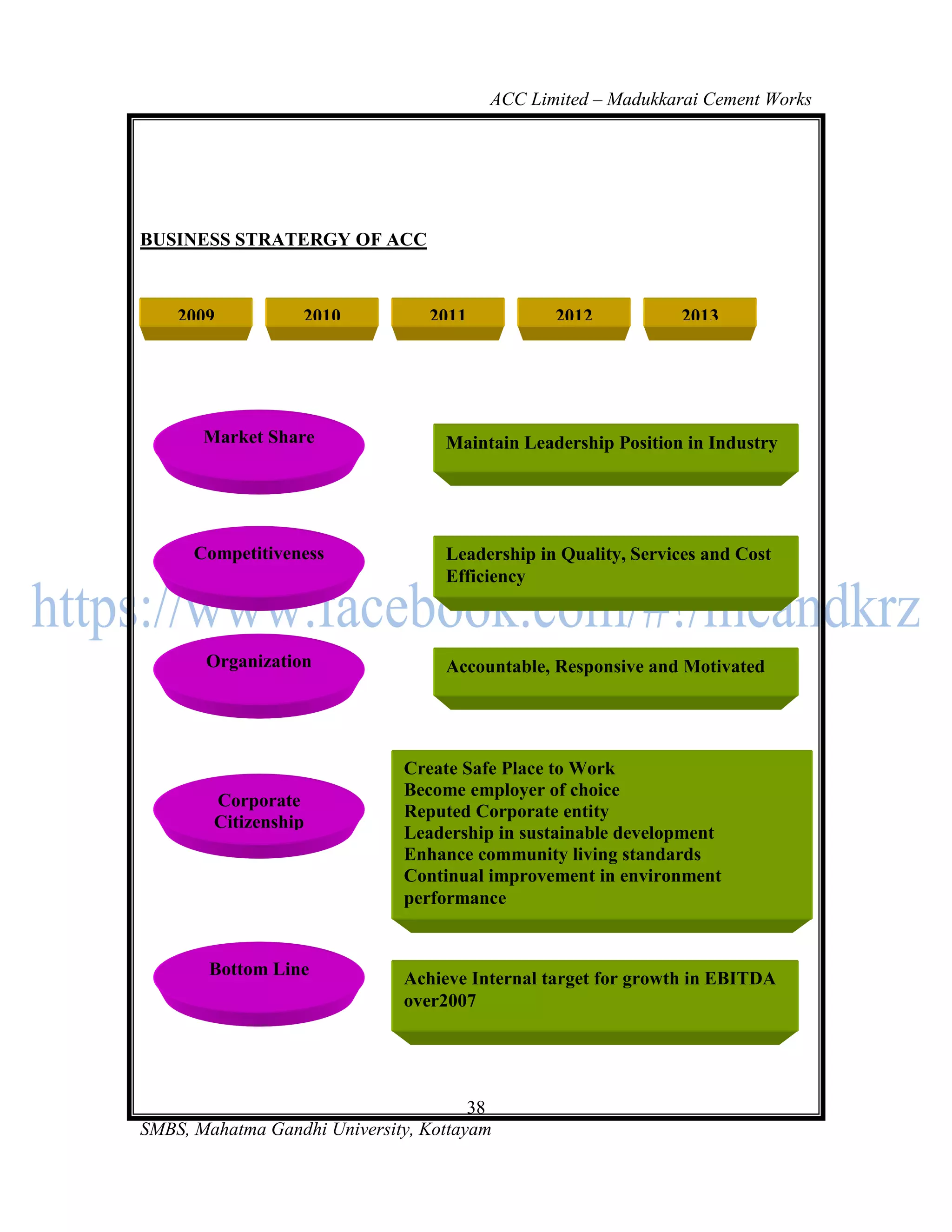
  • 177.
    ACC Limited –Madukkarai Cement Works  The delay in the checking process can be minimized by automating the system.  Improvement or changes could be bought in the work atmosphere so that it may increase productivity results  Company should give satisfied salary to their employees  Cleanliness, sanitation facilities should be improved  Company should bring changes and improvement in drinking water facilities  Rest room and canteen facilities should be provided to the workers in hygienic manner  Remuneration policy will helps to improvement in productivity  The company may try to make free time of the employees more pleasant and joyful by providing better recreation facilities. Games, cultural programs, sports, competitions etc, are the measures suggested.  Motivation and industrial training facilities should be provided to worker in a convenient manner.  The company has to concentrate at the net profit  The liquidity ratio is in good position and thus, the company should maintain this in future as well  Due to large and expanded operations, the company should always keep a check in its working capital. so that day to day production can continue without any hindrance and financial obstacles  The management of inventory should ensure that no inventories are lying in stock for log time. 177 SMBS, Mahatma Gandhi University, Kottayam
  • 178.
    ACC Limited –Madukkarai Cement Works CHAPTER VII LEARNING EXPERIENCE 178 SMBS, Mahatma Gandhi University, Kottayam
  • 179.
    ACC Limited –Madukkarai Cement Works LEARNING EXPERIENCE The training period in ACC Limited was immensely beneficial as I learnt practically all that I had been studying theoretically. It also enabled me to understand the implementation of various methods, policies, accounting procedures and other aspects in the organization. The organization study at ACC Limited, Madukkarai Cement works, to acquaint myself with the business environment for a period of one month from May 2nd 2012 to June 4th 2012 as a part of the MBA curriculum at the School of Management and Business Studies, Mahatma Gandhi University, Kottayam. The study was conducted to understand the structure, function and process of various departments and their interdependent. During the course of study I was able to successfully interact with the employees of the organization. They were happy to give me all possible information. They also took me to the plants and work sites were I got the first hand information about the organizational process and function. The methodology consists of data collection through interview, observation and literature review. The data collection from different sources are classified and analyzed and interpreted based on different which an organizational structure, its function various departments are identified. The various departmental functions are clearly identified and their process and activities carried are recorded and the department analysis made me to understand the departmental process based on which a process chart is prepared. The analysis further formed the basis for identifying the departmental interdependency. The study further relives some of the challenges faced by the department. The study helps us to obtain an exact picture of ACC Limited based on which, a SWOT analysis is done. Finally with the help of latest statistics available for the organization, the present trend and current scenario of ACC Limited is clearly revealed. 179 SMBS, Mahatma Gandhi University, Kottayam
  • 180.
    ACC Limited –Madukkarai Cement Works CHAPTER VIII CONCLUSION & BIBLIOGRAPHY 180 SMBS, Mahatma Gandhi University, Kottayam
  • 181.
    ACC Limited –Madukkarai Cement Works CONCLUSION From the above study conducted in ACC Madukkarai Cement Works, the departmental structure and functioning of ACC Limited and its other plants become clear to a large extend. The factors related to the functioning of each department and of the organization as a whole become clear from the study conducted in ACC Limited. From the above study the theoretical knowledge has become the experienced one. It helped to understand and learn the actual structure and working of each and every department of an organization. It also helped to observe and analyze closely the function and procedure of each and every department of the organization. The study also revealed the facts related to the changing environment of the cement industry and its impact on the brands like ACC. It also revealed the facts related to the opportunities and threats of cement industry of the country. It also represented the sustainable development in the Indian cement industry and the impact of growth of Indian cement industry on the economic growth of the country. Thus from the above study the gap between the theoretical study and practical study has been filled up. It provided an essence of experience in the pool of theoretical knowledge. Chris Jose. Email: meandkrz@yahoo.co.in Mob: 9496333809 181 SMBS, Mahatma Gandhi University, Kottayam
  • 182.
    ACC Limited –Madukkarai Cement Works BIBLIOGRAPHY WEBSITES: 1. ACC LIMITED , http://www.acclimited.com 2. ACC HELP CENTRE , http://www.acchelp.com 3. GOOGLE SEARCH , http://www.google.com 4. CEMENTERIE NATIONALE , http://www.cimnat.com.ib/history.asp 5. ASIAN DEVELOPMENT BANK , http://www.adb.org 6. CEMENT MANUFACTURERS ASSOCIATION SITES 7. ANNUAL REPORTS OF ACC LIMITED. 182 SMBS, Mahatma Gandhi University, Kottayam
  • 183.
    ACC Limited –Madukkarai Cement Works 183 SMBS, Mahatma Gandhi University, Kottayam