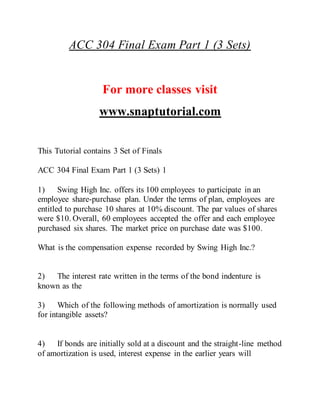
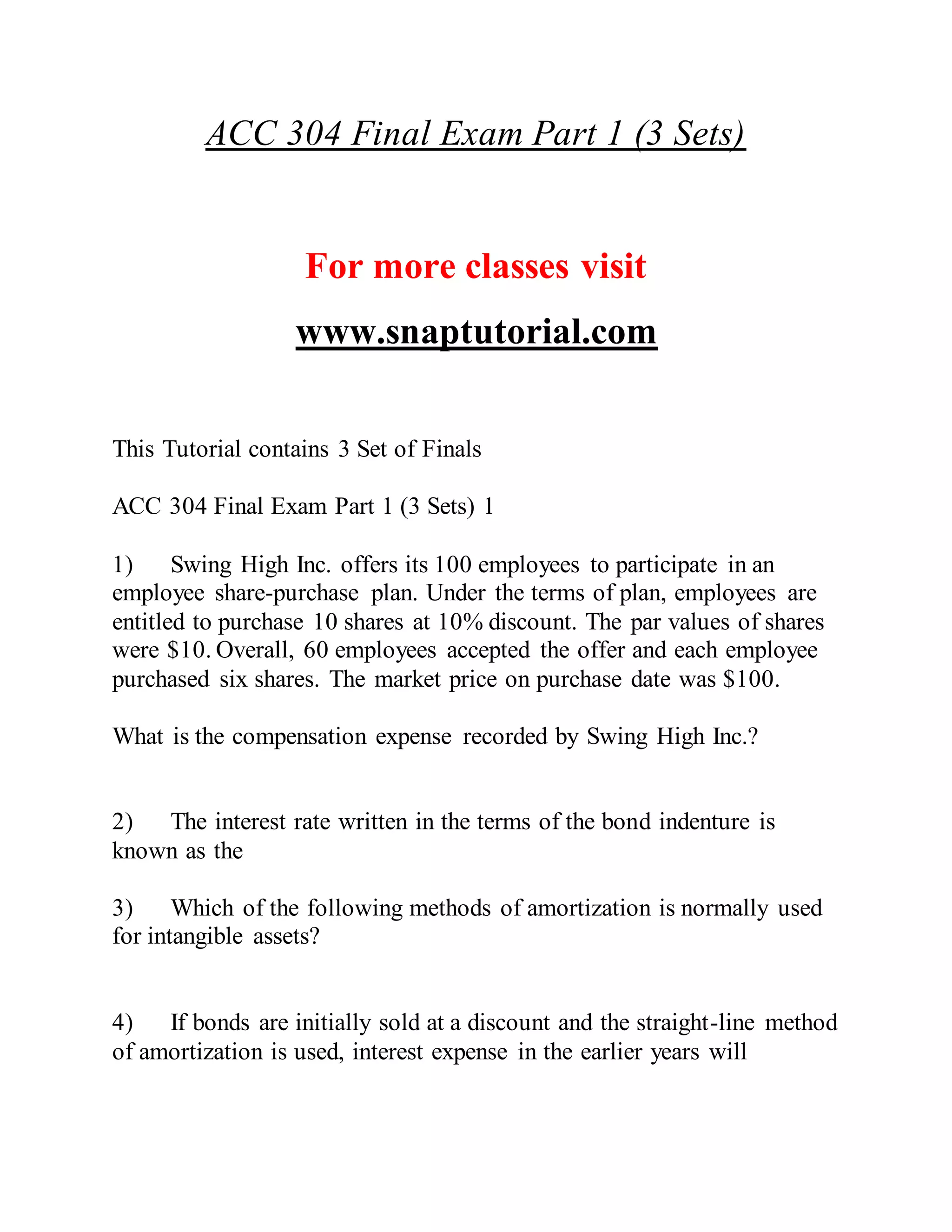
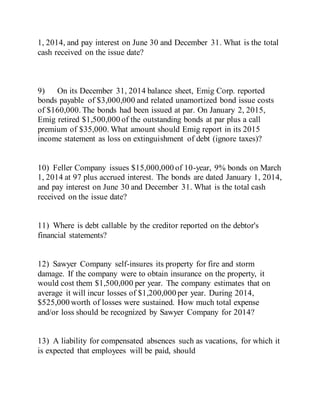
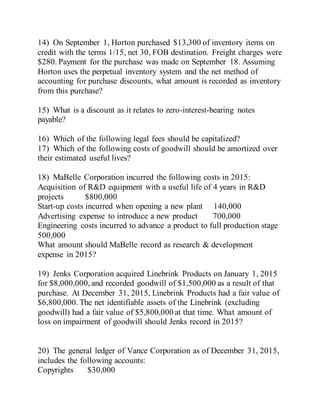
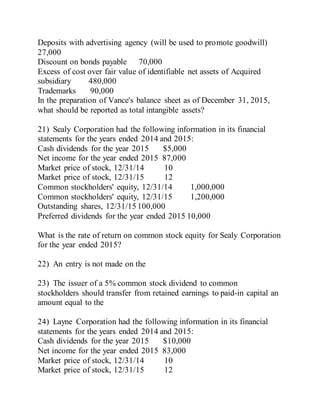
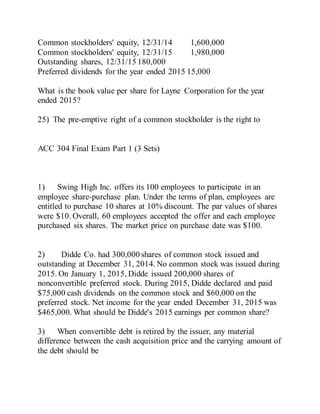
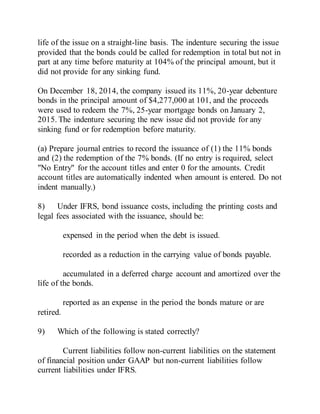
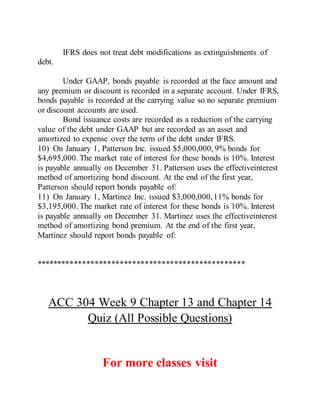
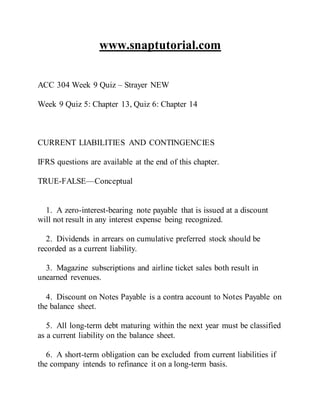
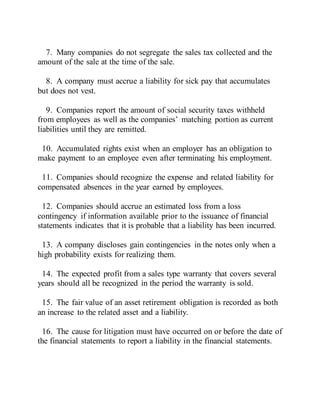
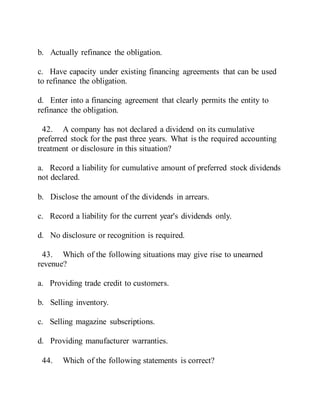
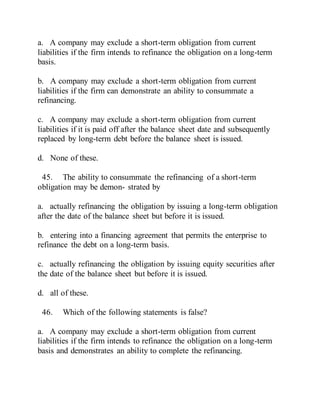
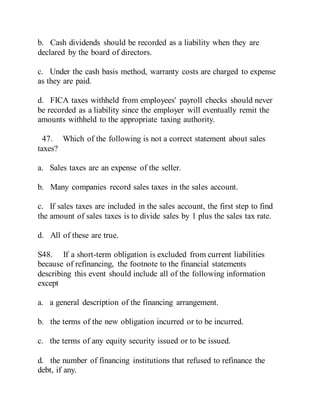
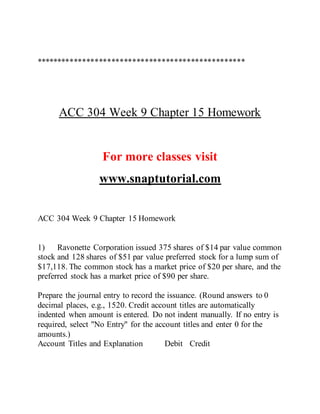
ACC 304 Final Exam Part 1 (3 Sets)
For more classes visit
www.snaptutorial.com
This Tutorial contains 3 Set of Finals
ACC 304 Final Exam Part 1 (3 Sets) 1
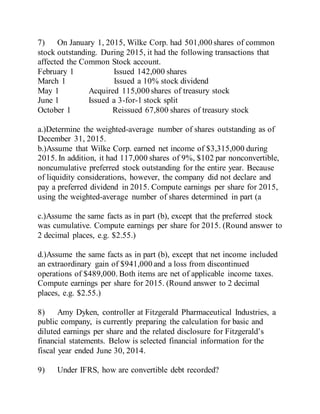
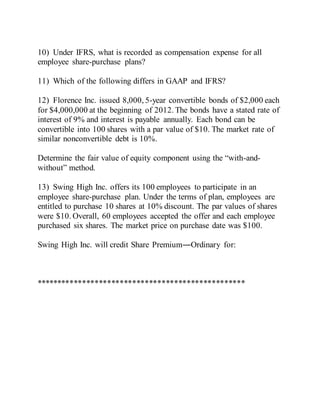
1) Swing High Inc. offers its 100 employees to participate in an
employee share-purchase plan. Under the terms of plan, employees are
entitled to purchase 10 shares at 10% discount. The par values of shares
were $10. Overall, 60 employees accepted the offer and each employee
purchased six shares. The market price on purchase date was $100.
What is the compensation expense recorded by Swing High Inc.?
2) The interest rate written in the terms of the bond indenture is
known as the
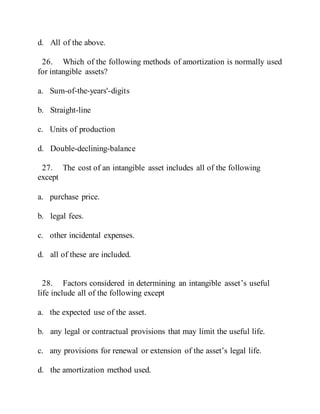
3) Which of the following methods of amortization is normally used
for intangible assets?
4) If bonds are initially sold at a discount and the straight-line method
of amortization is used, interest expense in the earlier years will
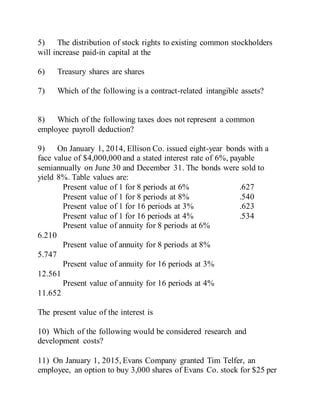
5) The distribution of stock rights to existing common stockholders
will increase paid-in capital at the
6) Treasury shares are shares
7) Which of the following is a contract-related intangible assets?
8) Which of the following taxes does not represent a common
employee payroll deduction?
9) On January 1, 2014, Ellison Co. issued eight-year bonds with a
face value of $4,000,000 and a stated interest rate of 6%, payable
semiannually on June 30 and December 31. The bonds were sold to
yield 8%. Table values are:
Present value of 1 for 8 periods at 6% .627
Present value of 1 for 8 periods at 8% .540
Present value of 1 for 16 periods at 3% .623
Present value of 1 for 16 periods at 4% .534
Present value of annuity for 8 periods at 6%
6.210
Present value of annuity for 8 periods at 8%
5.747
Present value of annuity for 16 periods at 3%
12.561
Present value of annuity for 16 periods at 4%
11.652
The present value of the interest is
10) Which of the following would be considered research and
development costs?
11) On January 1, 2015, Evans Company granted Tim Telfer, an
employee, an option to buy 3,000 shares of Evans Co. stock for $25 per
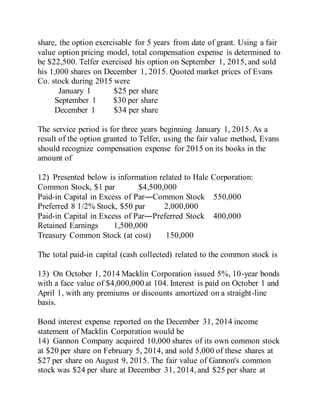
share, the option exercisable for 5 years from date of grant. Using a fair
value option pricing model, total compensation expense is determined to
be $22,500. Telfer exercised his option on September 1, 2015, and sold
his 1,000 shares on December 1, 2015. Quoted market prices of Evans
Co. stock during 2015 were
January 1 $25 per share
September 1 $30 per share
December 1 $34 per share
The service period is for three years beginning January 1, 2015. As a
result of the option granted to Telfer, using the fair value method, Evans
should recognize compensation expense for 2015 on its books in the
amount of
12) Presented below is information related to Hale Corporation:
Common Stock, $1 par $4,500,000
Paid-in Capital in Excess of Par―Common Stock 550,000
Preferred 8 1/2% Stock, $50 par 2,000,000
Paid-in Capital in Excess of Par―Preferred Stock 400,000
Retained Earnings 1,500,000
Treasury Common Stock (at cost) 150,000
The total paid-in capital (cash collected) related to the common stock is
13) On October 1, 2014 Macklin Corporation issued 5%, 10-year bonds
with a face value of $4,000,000 at 104. Interest is paid on October 1 and
April 1, with any premiums or discounts amortized on a straight-line
basis.
Bond interest expense reported on the December 31, 2014 income
statement of Macklin Corporation would be
14) Gannon Company acquired 10,000 shares of its own common stock
at $20 per share on February 5, 2014, and sold 5,000 of these shares at
$27 per share on August 9, 2015. The fair value of Gannon's common
stock was $24 per share at December 31, 2014, and $25 per share at
December 31, 2015. The cost method is used to record treasury stock
transactions. What account(s) should Gannon credit in 2015 to record
the sale of 5,000 shares?
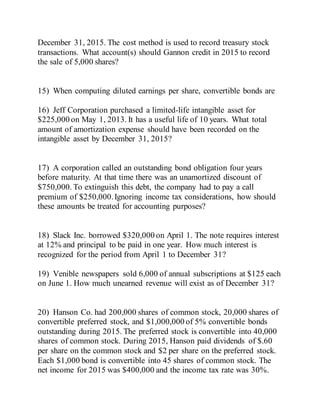
15) When computing diluted earnings per share, convertible bonds are
16) Jeff Corporation purchased a limited-life intangible asset for
$225,000 on May 1, 2013. It has a useful life of 10 years. What total
amount of amortization expense should have been recorded on the
intangible asset by December 31, 2015?
17) A corporation called an outstanding bond obligation four years
before maturity. At that time there was an unamortized discount of
$750,000. To extinguish this debt, the company had to pay a call
premium of $250,000.Ignoring income tax considerations, how should
these amounts be treated for accounting purposes?
18) Slack Inc. borrowed $320,000 on April 1. The note requires interest
at 12% and principal to be paid in one year. How much interest is
recognized for the period from April 1 to December 31?
19) Venible newspapers sold 6,000 of annual subscriptions at $125 each
on June 1. How much unearned revenue will exist as of December 31?
20) Hanson Co. had 200,000 shares of common stock, 20,000 shares of
convertible preferred stock, and $1,000,000 of 5% convertible bonds
outstanding during 2015. The preferred stock is convertible into 40,000
shares of common stock. During 2015, Hanson paid dividends of $.60
per share on the common stock and $2 per share on the preferred stock.
Each $1,000 bond is convertible into 45 shares of common stock. The
net income for 2015 was $400,000 and the income tax rate was 30%.
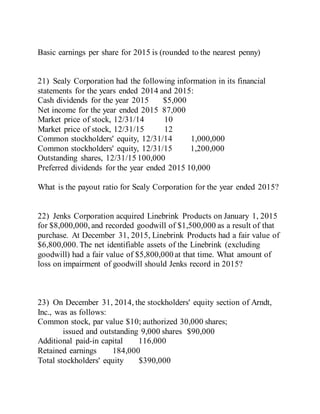
Basic earnings per share for 2015 is (rounded to the nearest penny)
21) Sealy Corporation had the following information in its financial
statements for the years ended 2014 and 2015:
Cash dividends for the year 2015 $5,000
Net income for the year ended 2015 87,000
Market price of stock, 12/31/14 10
Market price of stock, 12/31/15 12
Common stockholders' equity, 12/31/14 1,000,000
Common stockholders' equity, 12/31/15 1,200,000
Outstanding shares, 12/31/15 100,000
Preferred dividends for the year ended 2015 10,000
What is the payout ratio for Sealy Corporation for the year ended 2015?
22) Jenks Corporation acquired Linebrink Products on January 1, 2015
for $8,000,000, and recorded goodwill of $1,500,000 as a result of that
purchase. At December 31, 2015, Linebrink Products had a fair value of
$6,800,000. The net identifiable assets of the Linebrink (excluding
goodwill) had a fair value of $5,800,000 at that time. What amount of
loss on impairment of goodwill should Jenks record in 2015?
23) On December 31, 2014, the stockholders' equity section of Arndt,
Inc., was as follows:
Common stock, par value $10; authorized 30,000 shares;
issued and outstanding 9,000 shares $90,000
Additional paid-in capital 116,000
Retained earnings 184,000
Total stockholders' equity $390,000
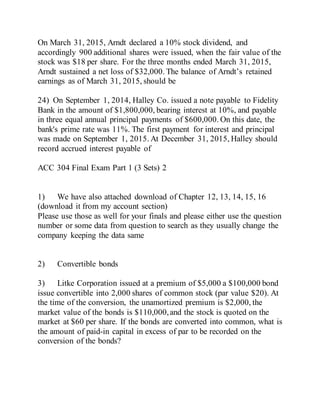
On March 31, 2015, Arndt declared a 10% stock dividend, and
accordingly 900 additional shares were issued, when the fair value of the
stock was $18 per share. For the three months ended March 31, 2015,
Arndt sustained a net loss of $32,000. The balance of Arndt’s retained
earnings as of March 31, 2015, should be
24) On September 1, 2014, Halley Co. issued a note payable to Fidelity
Bank in the amount of $1,800,000, bearing interest at 10%, and payable
in three equal annual principal payments of $600,000. On this date, the
bank's prime rate was 11%. The first payment for interest and principal
was made on September 1, 2015. At December 31, 2015, Halley should
record accrued interest payable of
ACC 304 Final Exam Part 1 (3 Sets) 2
1) We have also attached download of Chapter 12, 13, 14, 15, 16
(download it from my account section)
Please use those as well for your finals and please either use the question
number or some data from question to search as they usually change the
company keeping the data same
2) Convertible bonds
3) Litke Corporation issued at a premium of $5,000 a $100,000 bond
issue convertible into 2,000 shares of common stock (par value $20). At
the time of the conversion, the unamortized premium is $2,000, the
market value of the bonds is $110,000,and the stock is quoted on the
market at $60 per share. If the bonds are converted into common, what is
the amount of paid-in capital in excess of par to be recorded on the
conversion of the bonds?
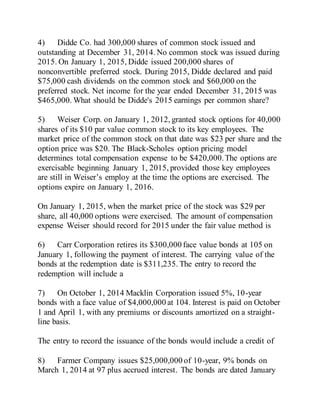
4) Didde Co. had 300,000 shares of common stock issued and
outstanding at December 31, 2014. No common stock was issued during
2015. On January 1, 2015, Didde issued 200,000 shares of
nonconvertible preferred stock. During 2015, Didde declared and paid
$75,000 cash dividends on the common stock and $60,000 on the
preferred stock. Net income for the year ended December 31, 2015 was
$465,000. What should be Didde's 2015 earnings per common share?
5) Weiser Corp. on January 1, 2012, granted stock options for 40,000
shares of its $10 par value common stock to its key employees. The
market price of the common stock on that date was $23 per share and the
option price was $20. The Black-Scholes option pricing model
determines total compensation expense to be $420,000.The options are
exercisable beginning January 1, 2015, provided those key employees
are still in Weiser’s employ at the time the options are exercised. The
options expire on January 1, 2016.
On January 1, 2015, when the market price of the stock was $29 per
share, all 40,000 options were exercised. The amount of compensation
expense Weiser should record for 2015 under the fair value method is
6) Carr Corporation retires its $300,000 face value bonds at 105 on
January 1, following the payment of interest. The carrying value of the
bonds at the redemption date is $311,235. The entry to record the
redemption will include a
7) On October 1, 2014 Macklin Corporation issued 5%, 10-year
bonds with a face value of $4,000,000 at 104. Interest is paid on October
1 and April 1, with any premiums or discounts amortized on a straight-
line basis.
The entry to record the issuance of the bonds would include a credit of
8) Farmer Company issues $25,000,000 of 10-year, 9% bonds on
March 1, 2014 at 97 plus accrued interest. The bonds are dated January
1, 2014, and pay interest on June 30 and December 31. What is the total
cash received on the issue date?
9) On its December 31, 2014 balance sheet, Emig Corp. reported
bonds payable of $3,000,000 and related unamortized bond issue costs
of $160,000. The bonds had been issued at par. On January 2, 2015,
Emig retired $1,500,000 of the outstanding bonds at par plus a call
premium of $35,000. What amount should Emig report in its 2015
income statement as loss on extinguishment of debt (ignore taxes)?
10) Feller Company issues $15,000,000 of 10-year, 9% bonds on March
1, 2014 at 97 plus accrued interest. The bonds are dated January 1, 2014,
and pay interest on June 30 and December 31. What is the total cash
received on the issue date?
11) Where is debt callable by the creditor reported on the debtor's
financial statements?
12) Sawyer Company self-insures its property for fire and storm
damage. If the company were to obtain insurance on the property, it
would cost them $1,500,000 per year. The company estimates that on
average it will incur losses of $1,200,000 per year. During 2014,
$525,000 worth of losses were sustained. How much total expense
and/or loss should be recognized by Sawyer Company for 2014?
13) A liability for compensated absences such as vacations, for which it
is expected that employees will be paid, should
14) On September 1, Horton purchased $13,300 of inventory items on
credit with the terms 1/15, net 30, FOB destination. Freight charges were
$280. Payment for the purchase was made on September 18. Assuming
Horton uses the perpetual inventory system and the net method of
accounting for purchase discounts, what amount is recorded as inventory
from this purchase?
15) What is a discount as it relates to zero-interest-bearing notes
payable?
16) Which of the following legal fees should be capitalized?
17) Which of the following costs of goodwill should be amortized over
their estimated useful lives?
18) MaBelle Corporation incurred the following costs in 2015:
Acquisition of R&D equipment with a useful life of 4 years in R&D
projects $800,000
Start-up costs incurred when opening a new plant 140,000
Advertising expense to introduce a new product 700,000
Engineering costs incurred to advance a product to full production stage
500,000
What amount should MaBelle record as research & development
expense in 2015?
19) Jenks Corporation acquired Linebrink Products on January 1, 2015
for $8,000,000, and recorded goodwill of $1,500,000 as a result of that
purchase. At December 31, 2015, Linebrink Products had a fair value of
$6,800,000. The net identifiable assets of the Linebrink (excluding
goodwill) had a fair value of $5,800,000 at that time. What amount of
loss on impairment of goodwill should Jenks record in 2015?
20) The general ledger of Vance Corporation as of December 31, 2015,
includes the following accounts:
Copyrights $30,000
Deposits with advertising agency (will be used to promote goodwill)
27,000
Discount on bonds payable 70,000
Excess of cost over fair value of identifiable net assets of Acquired
subsidiary 480,000
Trademarks 90,000
In the preparation of Vance's balance sheet as of December 31, 2015,
what should be reported as total intangible assets?
21) Sealy Corporation had the following information in its financial
statements for the years ended 2014 and 2015:
Cash dividends for the year 2015 $5,000
Net income for the year ended 2015 87,000
Market price of stock, 12/31/14 10
Market price of stock, 12/31/15 12
Common stockholders' equity, 12/31/14 1,000,000
Common stockholders' equity, 12/31/15 1,200,000
Outstanding shares, 12/31/15 100,000
Preferred dividends for the year ended 2015 10,000
What is the rate of return on common stock equity for Sealy Corporation
for the year ended 2015?
22) An entry is not made on the
23) The issuer of a 5% common stock dividend to common
stockholders should transfer from retained earnings to paid-in capital an
amount equal to the
24) Layne Corporation had the following information in its financial
statements for the years ended 2014 and 2015:
Cash dividends for the year 2015 $10,000
Net income for the year ended 2015 83,000
Market price of stock, 12/31/14 10
Market price of stock, 12/31/15 12
Common stockholders' equity, 12/31/14 1,600,000
Common stockholders' equity, 12/31/15 1,980,000
Outstanding shares, 12/31/15 180,000
Preferred dividends for the year ended 2015 15,000
What is the book value per share for Layne Corporation for the year
ended 2015?
25) The pre-emptive right of a common stockholder is the right to
ACC 304 Final Exam Part 1 (3 Sets)
1) Swing High Inc. offers its 100 employees to participate in an
employee share-purchase plan. Under the terms of plan, employees are
entitled to purchase 10 shares at 10% discount. The par values of shares
were $10. Overall, 60 employees accepted the offer and each employee
purchased six shares. The market price on purchase date was $100.
2) Didde Co. had 300,000 shares of common stock issued and
outstanding at December 31, 2014. No common stock was issued during
2015. On January 1, 2015, Didde issued 200,000 shares of
nonconvertible preferred stock. During 2015, Didde declared and paid
$75,000 cash dividends on the common stock and $60,000 on the
preferred stock. Net income for the year ended December 31, 2015 was
$465,000. What should be Didde's 2015 earnings per common share?
3) When convertible debt is retired by the issuer, any material
difference between the cash acquisition price and the carrying amount of
the debt should be
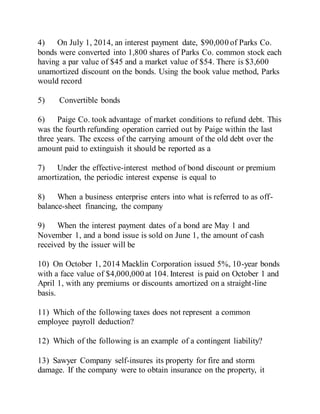
4) On July 1, 2014, an interest payment date, $90,000 of Parks Co.
bonds were converted into 1,800 shares of Parks Co. common stock each
having a par value of $45 and a market value of $54. There is $3,600
unamortized discount on the bonds. Using the book value method, Parks
would record
5) Convertible bonds
6) Paige Co. took advantage of market conditions to refund debt. This
was the fourth refunding operation carried out by Paige within the last
three years. The excess of the carrying amount of the old debt over the
amount paid to extinguish it should be reported as a
7) Under the effective-interest method of bond discount or premium
amortization, the periodic interest expense is equal to
8) When a business enterprise enters into what is referred to as off-
balance-sheet financing, the company
9) When the interest payment dates of a bond are May 1 and
November 1, and a bond issue is sold on June 1, the amount of cash
received by the issuer will be
10) On October 1, 2014 Macklin Corporation issued 5%, 10-year bonds
with a face value of $4,000,000 at 104. Interest is paid on October 1 and
April 1, with any premiums or discounts amortized on a straight-line
basis.
11) Which of the following taxes does not represent a common
employee payroll deduction?
12) Which of the following is an example of a contingent liability?
13) Sawyer Company self-insures its property for fire and storm
damage. If the company were to obtain insurance on the property, it
would cost them $1,500,000 per year. The company estimates that on
average it will incur losses of $1,200,000 per year. During 2014,
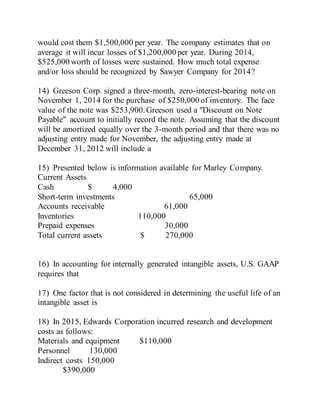
$525,000 worth of losses were sustained. How much total expense
and/or loss should be recognized by Sawyer Company for 2014?
14) Greeson Corp. signed a three-month, zero-interest-bearing note on
November 1, 2014 for the purchase of $250,000 of inventory. The face
value of the note was $253,900.Greeson used a "Discount on Note
Payable" account to initially record the note. Assuming that the discount
will be amortized equally over the 3-month period and that there was no
adjusting entry made for November, the adjusting entry made at
December 31, 2012 will include a
15) Presented below is information available for Marley Company.
Current Assets
Cash $ 4,000
Short-term investments 65,000
Accounts receivable 61,000
Inventories 110,000
Prepaid expenses 30,000
Total current assets $ 270,000
16) In accounting for internally generated intangible assets, U.S. GAAP
requires that
17) One factor that is not considered in determining the useful life of an
intangible asset is
18) In 2015, Edwards Corporation incurred research and development
costs as follows:
Materials and equipment $110,000
Personnel 130,000
Indirect costs 150,000
$390,000
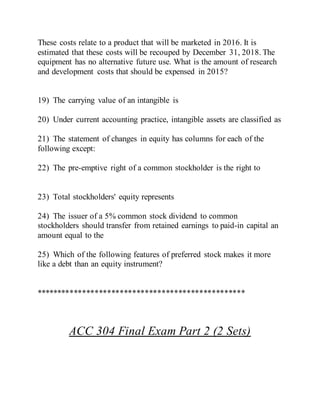
These costs relate to a product that will be marketed in 2016. It is
estimated that these costs will be recouped by December 31, 2018. The
equipment has no alternative future use. What is the amount of research
and development costs that should be expensed in 2015?
19) The carrying value of an intangible is
20) Under current accounting practice, intangible assets are classified as
21) The statement of changes in equity has columns for each of the
following except:
22) The pre-emptive right of a common stockholder is the right to
23) Total stockholders' equity represents
24) The issuer of a 5% common stock dividend to common
stockholders should transfer from retained earnings to paid-in capital an
amount equal to the
25) Which of the following features of preferred stock makes it more
like a debt than an equity instrument?
**************************************************
ACC 304 Final Exam Part 2 (2 Sets)
For more classes visit
www.snaptutorial.com
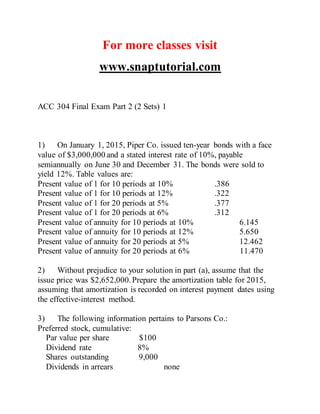
ACC 304 Final Exam Part 2 (2 Sets) 1
1) On January 1, 2015, Piper Co. issued ten-year bonds with a face
value of $3,000,000 and a stated interest rate of 10%, payable
semiannually on June 30 and December 31. The bonds were sold to
yield 12%. Table values are:
Present value of 1 for 10 periods at 10% .386
Present value of 1 for 10 periods at 12% .322
Present value of 1 for 20 periods at 5% .377
Present value of 1 for 20 periods at 6% .312
Present value of annuity for 10 periods at 10% 6.145
Present value of annuity for 10 periods at 12% 5.650
Present value of annuity for 20 periods at 5% 12.462
Present value of annuity for 20 periods at 6% 11.470
2) Without prejudice to your solution in part (a), assume that the
issue price was $2,652,000.Prepare the amortization table for 2015,
assuming that amortization is recorded on interest payment dates using
the effective-interest method.
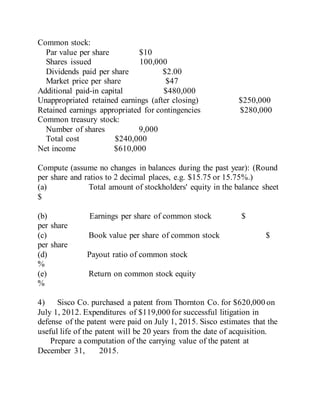
3) The following information pertains to Parsons Co.:
Preferred stock, cumulative:
Par value per share $100
Dividend rate 8%
Shares outstanding 9,000
Dividends in arrears none
Common stock:
Par value per share $10
Shares issued 100,000
Dividends paid per share $2.00
Market price per share $47
Additional paid-in capital $480,000
Unappropriated retained earnings (after closing) $250,000
Retained earnings appropriated for contingencies $280,000
Common treasury stock:
Number of shares 9,000
Total cost $240,000
Net income $610,000
Compute (assume no changes in balances during the past year): (Round
per share and ratios to 2 decimal places, e.g. $15.75 or 15.75%.)
(a) Total amount of stockholders' equity in the balance sheet
$
(b) Earnings per share of common stock $
per share
(c) Book value per share of common stock $
per share
(d) Payout ratio of common stock
%
(e) Return on common stock equity
%
4) Sisco Co. purchased a patent from Thornton Co. for $620,000 on
July 1, 2012. Expenditures of $119,000 for successful litigation in
defense of the patent were paid on July 1, 2015. Sisco estimates that the
useful life of the patent will be 20 years from the date of acquisition.
Prepare a computation of the carrying value of the patent at
December 31, 2015.
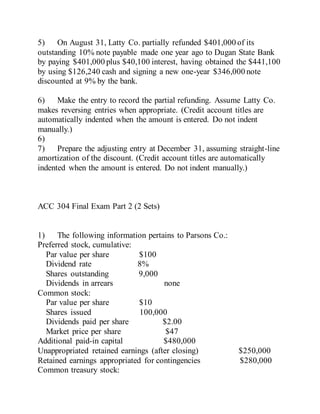
5) On August 31, Latty Co. partially refunded $401,000 of its
outstanding 10% note payable made one year ago to Dugan State Bank
by paying $401,000 plus $40,100 interest, having obtained the $441,100
by using $126,240 cash and signing a new one-year $346,000 note
discounted at 9% by the bank.
6) Make the entry to record the partial refunding. Assume Latty Co.
makes reversing entries when appropriate. (Credit account titles are
automatically indented when the amount is entered. Do not indent
manually.)
6)
7) Prepare the adjusting entry at December 31, assuming straight-line
amortization of the discount. (Credit account titles are automatically
indented when the amount is entered. Do not indent manually.)
ACC 304 Final Exam Part 2 (2 Sets)
1) The following information pertains to Parsons Co.:
Preferred stock, cumulative:
Par value per share $100
Dividend rate 8%
Shares outstanding 9,000
Dividends in arrears none
Common stock:
Par value per share $10
Shares issued 100,000
Dividends paid per share $2.00
Market price per share $47
Additional paid-in capital $480,000
Unappropriated retained earnings (after closing) $250,000
Retained earnings appropriated for contingencies $280,000
Common treasury stock:
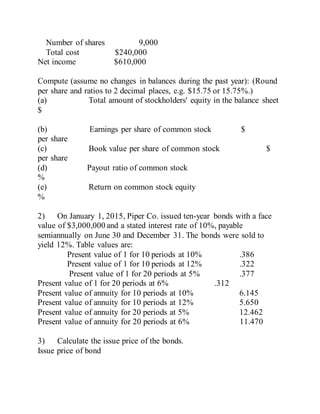
Number of shares 9,000
Total cost $240,000
Net income $610,000
Compute (assume no changes in balances during the past year): (Round
per share and ratios to 2 decimal places, e.g. $15.75 or 15.75%.)
(a) Total amount of stockholders' equity in the balance sheet
$
(b) Earnings per share of common stock $
per share
(c) Book value per share of common stock $
per share
(d) Payout ratio of common stock
%
(e) Return on common stock equity
%
2) On January 1, 2015, Piper Co. issued ten-year bonds with a face
value of $3,000,000 and a stated interest rate of 10%, payable
semiannually on June 30 and December 31. The bonds were sold to
yield 12%. Table values are:
Present value of 1 for 10 periods at 10% .386
Present value of 1 for 10 periods at 12% .322
Present value of 1 for 20 periods at 5% .377
Present value of 1 for 20 periods at 6% .312
Present value of annuity for 10 periods at 10% 6.145
Present value of annuity for 10 periods at 12% 5.650
Present value of annuity for 20 periods at 5% 12.462
Present value of annuity for 20 periods at 6% 11.470
3) Calculate the issue price of the bonds.
Issue price of bond
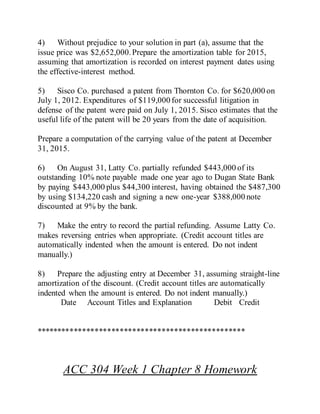
4) Without prejudice to your solution in part (a), assume that the
issue price was $2,652,000.Prepare the amortization table for 2015,
assuming that amortization is recorded on interest payment dates using
the effective-interest method.
5) Sisco Co. purchased a patent from Thornton Co. for $620,000 on
July 1, 2012. Expenditures of $119,000 for successful litigation in
defense of the patent were paid on July 1, 2015. Sisco estimates that the
useful life of the patent will be 20 years from the date of acquisition.
Prepare a computation of the carrying value of the patent at December
31, 2015.
6) On August 31, Latty Co. partially refunded $443,000 of its
outstanding 10% note payable made one year ago to Dugan State Bank
by paying $443,000 plus $44,300 interest, having obtained the $487,300
by using $134,220 cash and signing a new one-year $388,000 note
discounted at 9% by the bank.
7) Make the entry to record the partial refunding. Assume Latty Co.
makes reversing entries when appropriate. (Credit account titles are
automatically indented when the amount is entered. Do not indent
manually.)
8) Prepare the adjusting entry at December 31, assuming straight-line
amortization of the discount. (Credit account titles are automatically
indented when the amount is entered. Do not indent manually.)
Date Account Titles and Explanation Debit Credit
**************************************************
ACC 304 Week 1 Chapter 8 Homework
For more classes visit
www.snaptutorial.com
ACC 304 Week 1 Chapter 8 Homework
1) Matlock Company uses a perpetual inventory system. Its
beginning inventory consists 50 units that cost $34 each. During June ,
(1) the company purchased units at $34 each, (2) returned 6 units for
credit ,and (3) sold 125 unit at $50 each. Journalize the June
transactions.
2) Amsterdam Company uses a periodic inventory system. For April,
When the company sold 600 units, The following information is
available. calculate weighted average cost per unit.
3) Arna, Inc. uses the dollar value LIFO method of computing its
inventory. Data for the past 3 year follow. Compute the value of the
2014 and 2015 inventories using the dollar-value LIFE method.
4) Craig Company asks you to review its December 31, 2014,
inventory values and prepare the necessary adjustments to the book. The
following information is given to u. determine the proper inventory
balance for Craig Company at December 31, 2014.
5) Prepare any correcting entries to adjust inventory to its proper
amount at December 31, 2014. Assume the books have not been closed.
6) The net income per books of Linda Patrick Company was
determined without knowledge of the errors indicated below. Prepare
work sheet to show the adjusted net income figure for each of the 6
years after taking into account the inventory errors.
7) Presented below the information related to Dino Radja Company.
Compute the ending inventory for Dino Radja Company for 2011 throw
2016 using the Dollar value LIFO method.
8) Under IFRS, an entity should initially recognize inventory when
9) With respect to accounting of inventories, which of the following
is a difference that exists for IFRS, as opposed to U.S GAAP?
10) Some of the transactions of Torres Company during August are
listed below. Torres uses the periodic inventory method.
11) Assuming that purchases are recorded at gross amounts and that
discounts are to be recorded when taken: prepare general journal entries
to record the transactions
12) Assuming that purchases are recorded at net amounts and that
discounts lost are treated as financial expenses: prepare general journal
entries to record the transactions
13) Assuming that purchases are recorded at net amounts and that
discounts lost are treated as financial expenses: prepare the adjusting
entry necessary on August 31 if financial statements are to be prepared
at that time.
14) Under IFRS, which of the following would be included in the cost
of inventories?
15) Under IFRS, inventories are classified as
16) Which of the following best describes the IFRS requirement for
applying the same cost formula to all inventories?
**************************************************
ACC 304 Week 2 Chapter 8 Quiz (All Possible
Questions)
For more classes visit
www.snaptutorial.com
ACC 304 Week 2 Quiz – Strayer NEW
CHAPTER 8
VALUATION OF INVENTORIES:A COST-BASIS APPROACH
IFRS questions are available at the end of this chapter.
TRUE FALSE—Conceptual
1. A manufacturing concern would report the cost of units only
partially processed as inventory in the balance sheet.
2. Both merchandising and manufacturing companies normally
have multiple inventory accounts.
3. When using a perpetual inventory system, freight charges on
goods purchased are debited to Freight-In.
4. If a supplier ships goods f.o.b. destination, title passes to the
buyer when the supplier delivers the goods to the common carrier.
5. If ending inventory is understated, then net income is
understated.
6. If both purchases and ending inventory are overstated by the
same amount, net income is not affected.
7. Freight charges on goods purchased are considered a period cost
and therefore are not part of the cost of the inventory.
8. Purchase Discounts Lost is a financial expense and is reported in
the “other expenses and losses” section of the income statement.
9. The cost flow assumption adopted must be consistent with the
physical movement of the goods.
10. In all cases when FIFO is used, the cost of goods sold would be
the same whether a perpetual or periodic system is used.
11. The change in the LIFO Reserve from one period to the next is
recorded as an adjustment to Cost of Goods Sold.
12. Many companies use LIFO for both tax and internal reporting
purposes.
13. LIFO liquidation often distorts net income, but usually leads to
substantial tax savings.
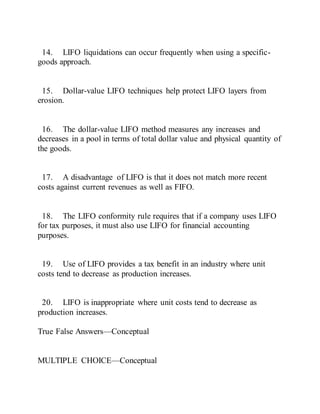
14. LIFO liquidations can occur frequently when using a specific-
goods approach.
15. Dollar-value LIFO techniques help protect LIFO layers from
erosion.
16. The dollar-value LIFO method measures any increases and
decreases in a pool in terms of total dollar value and physical quantity of
the goods.
17. A disadvantage of LIFO is that it does not match more recent
costs against current revenues as well as FIFO.
18. The LIFO conformity rule requires that if a company uses LIFO
for tax purposes, it must also use LIFO for financial accounting
purposes.
19. Use of LIFO provides a tax benefit in an industry where unit
costs tend to decrease as production increases.
20. LIFO is inappropriate where unit costs tend to decrease as
production increases.
True False Answers—Conceptual
MULTIPLE CHOICE—Conceptual
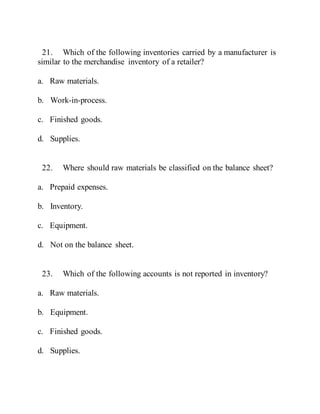
21. Which of the following inventories carried by a manufacturer is
similar to the merchandise inventory of a retailer?
a. Raw materials.
b. Work-in-process.
c. Finished goods.
d. Supplies.
22. Where should raw materials be classified on the balance sheet?
a. Prepaid expenses.
b. Inventory.
c. Equipment.
d. Not on the balance sheet.
23. Which of the following accounts is not reported in inventory?
a. Raw materials.
b. Equipment.
c. Finished goods.
d. Supplies.
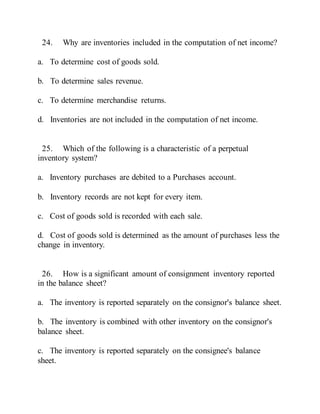
24. Why are inventories included in the computation of net income?
a. To determine cost of goods sold.
b. To determine sales revenue.
c. To determine merchandise returns.
d. Inventories are not included in the computation of net income.
25. Which of the following is a characteristic of a perpetual
inventory system?
a. Inventory purchases are debited to a Purchases account.
b. Inventory records are not kept for every item.
c. Cost of goods sold is recorded with each sale.
d. Cost of goods sold is determined as the amount of purchases less the
change in inventory.
26. How is a significant amount of consignment inventory reported
in the balance sheet?
a. The inventory is reported separately on the consignor's balance sheet.
b. The inventory is combined with other inventory on the consignor's
balance sheet.
c. The inventory is reported separately on the consignee's balance
sheet.
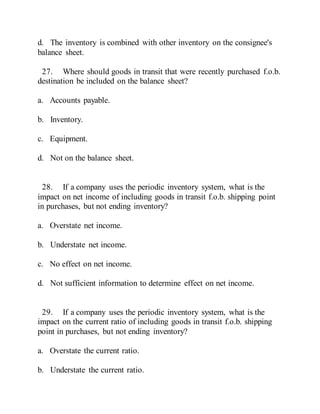
d. The inventory is combined with other inventory on the consignee's
balance sheet.
27. Where should goods in transit that were recently purchased f.o.b.
destination be included on the balance sheet?
a. Accounts payable.
b. Inventory.
c. Equipment.
d. Not on the balance sheet.
28. If a company uses the periodic inventory system, what is the
impact on net income of including goods in transit f.o.b. shipping point
in purchases, but not ending inventory?
a. Overstate net income.
b. Understate net income.
c. No effect on net income.
d. Not sufficient information to determine effect on net income.
29. If a company uses the periodic inventory system, what is the
impact on the current ratio of including goods in transit f.o.b. shipping
point in purchases, but not ending inventory?
a. Overstate the current ratio.
b. Understate the current ratio.
c. No effect on the current ratio.
d. Not sufficient information to determine effect on the current ratio.
30. What is consigned inventory?
a. Goods that are shipped, but title transfers to the receiver.
b. Goods that are sold, but payment is not required until the goods are
sold.
c. Goods that are shipped, but title remains with the shipper.
d. Goods that have been segregated for shipment to a customer.
31. When using a perpetual inventory system,
a. no Purchases account is used.
b. a Cost of Goods Sold account is used.
c. two entries are required to record a sale.
d. all of these.
32. Goods in transit which are shipped f.o.b. shipping point should
be
a. included in the inventory of the seller.
b. included in the inventory of the buyer.
c. included in the inventory of the shipping company.
d. none of these.
33. Goods in transit which are shipped f.o.b. destination should be
a. included in the inventory of the seller.
b. included in the inventory of the buyer.
c. included in the inventory of the shipping company.
d. none of these.
34. Which of the following items should be included in a company's
inventory at the balance sheet date?
a. Goods in transit which were purchased f.o.b. destination.
b. Goods received from another company for sale on consignment.
c. Goods sold to a customer which are being held for the customer to
call for at his or her convenience.
d. None of these.
Use the following information for questions 35 and 36.
During 2012 Carne Corporation transferred inventory to Nolan
Corporation and agreed to repurchase the merchandise early in 2013.
Nolan then used the inventory as collateral to borrow from Norwalk
Bank, remitting the proceeds to Carne. In 2013 when Carne repurchased
the inventory, Nolan used the proceeds to repay its bank loan.
35. This transaction is known as a(n)
a. consignment.
b. installment sale.
c. assignment for the benefit of creditors.
d. product financing arrangement.
36. On whose books should the cost of the inventory appear at the
December 31, 2012 balance sheet date?
a. Carne Corporation
b. Nolan Corporation
c. Norwalk Bank
d. Nolan Corporation, with Carne making appropriate note disclosure
of the transaction
37. Goods on consignment are
a. included in the consignee's inventory.
b. recorded in a Consignment Out account which is an inventory
account.
c. recorded in a Consignment In account which is an inventory account.
d. all of these
S38. Valuation of inventories requires the determination of all of the
following except
a. the costs to be included in inventory.
b. the physical goods to be included in inventory.
c. the cost of goods held on consign-ment from other companies.
d. the cost flow assumption to be adopted.
P39. The accountant for the Pryor Sales Company is preparing the
income statement for 2012 and the balance sheet at December 31, 2012.
Pryor uses the periodic inventory system. The January 1, 2012
merchandise inventory balance will appear
a. only as an asset on the balance sheet.
b. only in the cost of goods sold section of the income statement.
c. as a deduction in the cost of goods sold section of the income
statement and as a current asset on the balance sheet.
d. as an addition in the cost of goods sold section of the income
statement and as a current asset on the balance sheet.
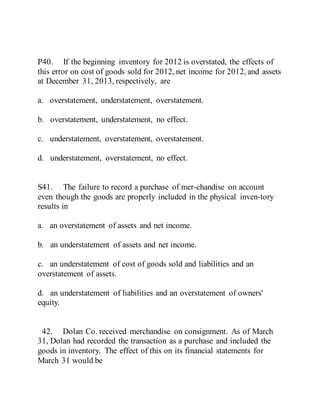
P40. If the beginning inventory for 2012 is overstated, the effects of
this error on cost of goods sold for 2012, net income for 2012, and assets
at December 31, 2013, respectively, are
a. overstatement, understatement, overstatement.
b. overstatement, understatement, no effect.
c. understatement, overstatement, overstatement.
d. understatement, overstatement, no effect.
S41. The failure to record a purchase of mer-chandise on account
even though the goods are properly included in the physical inven-tory
results in
a. an overstatement of assets and net income.
b. an understatement of assets and net income.
c. an understatement of cost of goods sold and liabilities and an
overstatement of assets.
d. an understatement of liabilities and an overstatement of owners'
equity.
42. Dolan Co. received merchandise on consignment. As of March
31, Dolan had recorded the transaction as a purchase and included the
goods in inventory. The effect of this on its financial statements for
March 31 would be
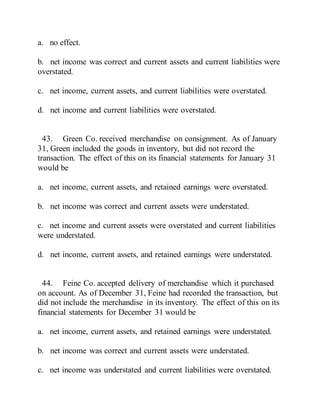
a. no effect.
b. net income was correct and current assets and current liabilities were
overstated.
c. net income, current assets, and current liabilities were overstated.
d. net income and current liabilities were overstated.
43. Green Co. received merchandise on consignment. As of January
31, Green included the goods in inventory, but did not record the
transaction. The effect of this on its financial statements for January 31
would be
a. net income, current assets, and retained earnings were overstated.
b. net income was correct and current assets were understated.
c. net income and current assets were overstated and current liabilities
were understated.
d. net income, current assets, and retained earnings were understated.
44. Feine Co. accepted delivery of merchandise which it purchased
on account. As of December 31, Feine had recorded the transaction, but
did not include the merchandise in its inventory. The effect of this on its
financial statements for December 31 would be
a. net income, current assets, and retained earnings were understated.
b. net income was correct and current assets were understated.
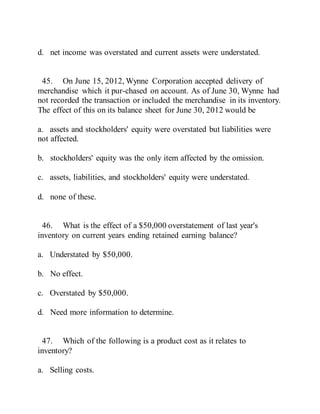
c. net income was understated and current liabilities were overstated.
d. net income was overstated and current assets were understated.
45. On June 15, 2012, Wynne Corporation accepted delivery of
merchandise which it pur-chased on account. As of June 30, Wynne had
not recorded the transaction or included the merchandise in its inventory.
The effect of this on its balance sheet for June 30, 2012 would be
a. assets and stockholders' equity were overstated but liabilities were
not affected.
b. stockholders' equity was the only item affected by the omission.
c. assets, liabilities, and stockholders' equity were understated.
d. none of these.
46. What is the effect of a $50,000 overstatement of last year's
inventory on current years ending retained earning balance?
a. Understated by $50,000.
b. No effect.
c. Overstated by $50,000.
d. Need more information to determine.
47. Which of the following is a product cost as it relates to
inventory?
a. Selling costs.
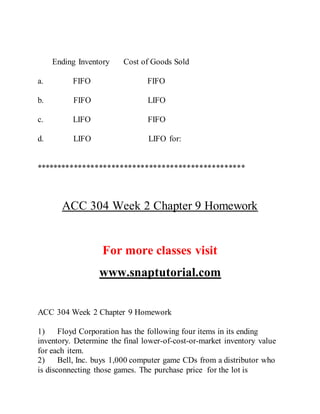
Ending Inventory Cost of Goods Sold
a. FIFO FIFO
b. FIFO LIFO
c. LIFO FIFO
d. LIFO LIFO for:
**************************************************
ACC 304 Week 2 Chapter 9 Homework
For more classes visit
www.snaptutorial.com
ACC 304 Week 2 Chapter 9 Homework
1) Floyd Corporation has the following four items in its ending
inventory. Determine the final lower-of-cost-or-market inventory value
for each item.
2) Bell, Inc. buys 1,000 computer game CDs from a distributor who
is disconnecting those games. The purchase price for the lot is
$8,000.Bell will group the CDs into three price categories for resale, as
indicated bellow. Determine the cost per CD for each group, using the
relative sales value method.
3) Boyne Inc. had beginning inventory of $12,000 at cost and
$20,000 t retail. Net purchase were $12,000 at cost and $17,000 at retail.
Net markups were $10,000;net markdowns were $7,000; and sales
revenue was $147,000.compute ending inventory at cost using the
conventional retail method.
4) Marvin Gaye Company has been having difficulty obtaining key
raw materials for its manufacturing process. The Company therefore
signed a long-term non cancelable purchase commitment with its largest
supplier of this raw material on November 30, 2014,at an agreed price of
$400,0000.At December 31, 2014, the raw material had declined in
price to $365,000. What entry would you make on December 31, 2014,
to recognize these facts?
5) Tim Legler requires an estimate of the cost of goods loat by fire on
March 9. Merchandise on hand on January 1 was $38,000. Purchases
since January 1 were $72,000; freight-in $3,400; purchases returns and
allowances, $2,400. Sales are made at 33 1/3% above cost and totaled
$100,000 to March 9. Goods coasting $10,900 were left undamaged by
the fire; remaining goods were destroyed. (a). compute the cost goods
destroyed. (b). compute the cost goods destroyed, assuming that the
gross profit 33 1/3% of sales.
6) Presented below is information related to Ricky Henderson
Company. Compute the inventory by the conventional retail inventory
method.
7) The inventory section of Maddox’s balance sheet as of November
30,2014, including required foot notes, is presented below are the
inventory section supporting calculations.
8) All of the following are key similarities between GAAP and IFRS
with respect to accounting for inventories except:
9) Starfish Company (a Company using Gap and LIFO inventory
method) is considering changing to IFRS and the FIFO inventory
method. How would a comparison of these methods affect Starfish’s
financials?
10) Assume that Darcy industry had the following inventory values.
1. Inventory cost (on December 31,2014)$1,500
2. Inventory sales value (on December 31,2014)$1,350
3. Inventory net realizable value (on December 31,2014)$1,320
Under IFRS, what is the inventory carrying value on December 31, 2014
?
11) Under IFRS, agricultural activity results in which of the following
types of assets?
1. Agricultural produce
2. Biological assets
**************************************************
ACC 304 Week 3 Chapter 9 Quiz (All Possible
Questions)
For more classes visit
www.snaptutorial.com
1. A company should abandon the historical cost principle when the
future utility of the inventory item falls below its original cost.
2. The lower-of-cost-or-market method is used for inventory
despite being less conservative than valuing inventory at market value.
3. The purpose of the “floor” in lower-of-cost-or-market
considerations is to avoid overstating inventory.
4. Application of the lower-of-cost-or-market rule results in
inconsistency because a company may value inventory at cost in one
year and at market in the next year.
5. GAAP requires reporting inventory at net realizable value, even
if above cost, whenever there is a controlled market with a quoted price
applicable to all quantities.
6. A reason for valuing inventory at net realizable value is that
sometimes it is too difficult to obtain the cost figures.
7. In a basket purchase, the cost of the individual assets acquired is
determined on the basis of their relative sales value.
8. A basket purchase occurs when a company agrees to buy
inventory weeks or months in advance.
9. Most purchase commitments must be recorded as a liability.
10. If the contract price on a noncancelable purchase commitment
exceeds the market price, the buyer should record any expected losses
on the commitment in the period in which the market decline takes
place.
11. When a buyer enters into a formal, noncancelable purchase
contract, an asset and a liability are recorded at the inception of the
contract.
12. The gross profit method can be used to approximate the dollar
amount of inventory on hand.
13. In most situations, the gross profit percentage is stated as a
percentage of cost.
14. A disadvantage of the gross profit method is that it uses past
percentages in determining the markup.
15. When the conventional retail method includes both net markups
and net markdowns in the cost-to-retail ratio, it approximates a lower-of-
cost-or-market valuation.
16. In the retail inventory method, the term markup means a markup
on the original cost of an inventory item.
17. In the retail inventory method, abnormal shortages are deducted
from both the cost and retail amounts and reported as a loss.
18. The inventory turnover ratio is computed by dividing the cost of
goods sold by the ending inventory on hand.
19. The average days to sell inventory represents the average number
of days’ sales for which a company has inventory on hand.
*20. The LIFO retail method assumes that markups and markdowns
apply only to the goods purchased during the period.
True False Answers—Conceptual
MULTIPLE CHOICE—Conceptual
21. Which of the following is true about lower-of-cost-or-market?
a. It is inconsistent because losses are recognized but not gains.
b. It usually understates assets.
c. It can increase future income.
d. All of these.
22. The primary basis of accounting for inventories is cost. A
departure from the cost basis of pricing the inventory is required where
there is evidence that when the goods are sold in the ordinary course of
business their
a. selling price will be less than their replacement cost.
b. replacement cost will be more than their net realizable value.
c. cost will be less than their replacement cost.
d. future utility will be less than their cost.
23. When valuing raw materials inventory at lower-of-cost-or-
market, what is the meaning of the term "market"?
a. Net realizable value
b. Net realizable value less a normal profit margin
c. Current replacement cost
d. Discounted present value
24. In no case can "market" in the lower-of-cost-or-market rule be
more than
a. estimated selling price in the ordinary course of business.
b. estimated selling price in the ordinary course of business less
reasonably predictable costs of completion and disposal.
c. estimated selling price in the ordinary course of business less
reasonably predictable costs of completion and disposal and an
allowance for an approximately normal profit margin.
d. estimated selling price in the ordinary course of business less
reasonably predictable costs of completion and disposal, an allowance
for an approximately normal profit margin, and an adequate reserve for
possible future losses.
25. Designated market value
a. is always the middle value of replacement cost, net realizable value,
and net realizable value less a normal profit margin.
b. should always be equal to net realizable value.
c. may sometimes exceed net realizable value.
d. should always be equal to net realizable value less a normal profit
margin.
26. Lower-of-cost-or-market
a. is most conservative if applied to the total inventory.
b. is most conservative if applied to major categories of inventory.
c. is most conservative if applied to individual items of inventory.
d. must be applied to major categories for taxes.
27. An item of inventory purchased this period for $15.00 has been
incorrectly written down to its current replacement cost of $10.00. It
sells during the following period for $30.00, its normal selling price,
with disposal costs of $3.00 and normal profit of $12.00. Which of the
following statements is not true?
a. The cost of sales of the following year will be understated.
b. The current year's income is understated.
c. The closing inventory of the current year is understated.
d. Income of the following year will be understated.
S28. When the cost-of-goods-sold method is used to record inventory
at market
a. there is a direct reduction in the selling price of the product that
results in a loss being recorded on the income statement prior to the sale.
b. a loss is recorded directly in the inventory account by crediting
inventory and debiting loss on inventory decline.
c. only the portion of the loss attributable to inventory sold during the
period is recorded in the financial statements.
d. the market value figure for ending inventory is substituted for cost
and the loss is buried in cost of goods sold.
29. Lower-of-cost-or-market as it applies to inventory is best
described as the
a. drop of future utility below its original cost.
b. method of determining cost of goods sold.
c. assumption to determine inventory flow.
d. change in inventory value to market value.
30. The floor to be used in applying the lower-of-cost-or-market
method to inventory is determined as the
a. net realizable value.
b. net realizable value less normal profit margin.
c. replacement cost.
d. selling price less costs of completion and disposal.
31. What is the rationale behind the ceiling when applying the lower-
of-cost-or-market method to inventory?
a. Prevents understatement of the inventory value.
b. Allows for a normal profit to be earned.
c. Allows for items to be valued at replacement cost.
d. Prevents overstatement of the value of obsolete or damaged
inventories.
32. Why are inventories stated at lower-of-cost-or-market?
a. To report a loss when there is a decrease in the future utility.
b. To be conservative.
c. To report a loss when there is a decrease in the future utility below
the original cost.
d. To permit future profits to be recognized.
33. Which of the following is not an acceptable approach in applying
the lower-of-cost-or-market method to inventory?
a. Inventory location.
b. Categories of inventory items.
c. Individual item.
d. Total of the inventory.
34. Which method(s) may be used to record a loss due to a price
decline in the value of inventory?
a. Cost-of-goods-sold.
b. Sales method.
c. Loss method
d. Both a and c.
35. Why might inventory be reported at sales prices (net realizable
value or market price) rather than cost?
a. When there is a controlled market with a quoted price applicable to
all quantities and when there are no significant costs of disposal.
b. When there are no significant costs of disposal.
c. When a non-cancellable contract exists to sell the inventory.
d. When there is a controlled market with a quoted price applicable to
all quantities.
S36. Recording inventory at net realizable value is permitted, even if
it is above cost, when there are no significant costs of disposal involved
and
a. the ending inventory is determined by a physical inventory count.
b. a normal profit is not anticipated.
c. there is a controlled market with a quoted price applicable to all
quantities.
d. the internal revenue service is assured that the practice is not used
only to distort reported net income.
37. When inventory declines in value below original (historical) cost,
and this decline is considered other than temporary, what is the
maximum amount that the inventory can be valued at?
a. Sales price
b. Net realizable value
c. Historical cost
d. Net realizable value reduced by a normal profit margin
38. Net realizable value is
a. acquisition cost plus costs to complete and sell.
b. selling price.
c. selling price plus costs to complete and sell.
d. selling price less costs to complete and sell.
39. If a unit of inventory has declined in value below original cost,
but the market value exceeds net realizable value, the amount to be used
for purposes of inventory valuation is
a. net realizable value.
b. original cost.
c. market value.
d. net realizable value less a normal profit margin.
40. Inventory may be recorded at net realizable value if
a. there is a controlled market with a quoted price.
b. there are no significant costs of disposal.
c. the inventory consists of precious metals or agricultural products.
d. all of these.
41. If a material amount of inventory has been ordered through a
formal purchase contract at the balance sheet date for future delivery at
firm prices,
a. this fact must be disclosed.
b. disclosure is required only if prices have declined since the date of
the order.
c. disclosure is required only if prices have since risen substantially.
d. an appropriation of retained earnings is necessary.
42. The credit balance that arises when a net loss on a purchase
commitment is recognized should be
a. presented as a current liability.
b. subtracted from ending inventory.
c. presented as an appropriation of retained earnings.
d. presented in the income statement.
P43. In 2012, Orear Manufacturing signed a contract with a supplier
to purchase raw materials in 2013 for $700,000. Before the December
31, 2012 balance sheet date, the market price for these materials dropped
to $510,000. The journal entry to record this situation at December 31,
2012 will result in a credit that should be reported
a. as a valuation account to Inventory on the balance sheet.
b. as a current liability.
c. as an appropriation of retained earnings.
d. on the income statement.
44. At the end of the fiscal year, Apha Airlines has an outstanding
non-cancellable purchase commitment for the purchase of 1 million
gallons of jet fuel at a price of $4.10 per gallon for delivery during the
coming summer. The company prices its inventory at the lower of cost
or market. If the market price for jet fuel at the end of the year is $4.50,
how would this situation be reflected in the annual financial statements?
a. Record unrealized gains of $400,000 and disclose the existence of
the purchase commitment.
b. No impact.
c. Record unrealized losses of $400,000 and disclose the existence of
the purchase commitment.
d. Disclose the existence of the purchase commitment.
45. At the end of the fiscal year, Apha Airlines has an outstanding
purchase commitment for the purchase of 1 million gallons of jet fuel at
a price of $4.60 per gallon for delivery during the coming summer. The
company prices its inventory at the lower of cost or market. If the
market price for jet fuel at the end of the year is $4.25, how would this
situation be reflected in the annual financial statements?
a. Record unrealized gains of $350,000 and disclose the existence of
the purchase commitment.
b. No impact.
c. Record unrealized losses of $350,000 and disclose the existence of
the purchase commitment.
d. Disclose the existence of the purchase commitment.
46. How is the gross profit method used as it relates to inventory
valuation?
a. Verify the accuracy of the perpetual inventory records.
b. Verity the accuracy of the physical inventory.
c. To estimate cost of goods sold.
d. To provide an inventory value of LIFO inventories.
S47. Which of the following is not a basic assumption of the gross
profit method?
a. The beginning inventory plus the purchases equal total goods to be
accounted for.
b. Goods not sold must be on hand.
c. If the sales, reduced to the cost basis, are deducted from the sum of
the opening inventory plus purchases, the result is the amount of
inventory on hand.
d. The total amount of purchases and the total amount of sales remain
relatively unchanged from the comparable previous period.
48. The gross profit method of inventory valuation is invalid when
a. a portion of the inventory is destroyed.
b. there is a substantial increase in inventory during the year.
c. there is no beginning inventory because it is the first year of
operation.
d. none of these.
49. Which statement is not true about the gross profit method of
inventory valuation?
a. It may be used to estimate inventories for interim statements.
b. It may be used to estimate inventories for annual statements.
c. It may be used by auditors.
d. None of these.
50. A major advantage of the retail inventory method is that it
a. provides reliable results in cases where the distribution of items in
the inventory is different from that of items sold during the period.
b. hides costs from competitors and customers.
**************************************************
ACC 304 Week 3 Chapter 10 Homework
For more classes visit
www.snaptutorial.com
ACC 304 Week 3 Homework (Chapter 10)
1) Hanson Company is constructing a building. Construction begins
on February 1 and was completed on December 31. Expenditure were
$1,800,000 on march 1, $1,200,000 on June 1, and $3,000,000 on
December 31. Compute Hanson’s weighted-average accumulated
expenditure for interest capitalization purposes.
2) Mehta Company traded a used welding machine (cost $9,000,
accumulated depreciation $3,000) for office equipment with an
estimated fair value of $5,000. Mehta also paid $3,000 cash in the
transaction. Prepare the journal entry to record the exchange.
3) Ottawa Corporation owns machinery that cost $20,000 when
purchased on July 1, 2011. Depreciation has been recorded at a rate of
$2,400 per year, resulting in a balance is accumulated depreciation of
$8,400 at December 31, 2014. The machinery is sold on September 1,
2015, for $10,500. Prepare journal entries to (a) update depreciation for
2015 and (b) record the sale.
4) Martin Buber co. purchased land as a factory site for $400,000.
The process of tearing down two old buildings on the site and
constructing the factory required 6 months. The company paid $42,000
to raze the old buildings and salvaged lumber and brick for $6,300.
Legal fees of $1,850 were paid for title investigation and drawing the
purchase contract. Martin Buber paid $2,200 to an engineering firm for a
land survey, and $68,000 for drawing the factory plans. The land survey
had to be made before definitive plans could be drawn. Title insurance
on the property cost $1,500, and a liability insurance premium paid
during construction was $900. The contractor’s charge for construction
was $2,740,000.The company paid the contractor in two
installments:$1,200,000 at the end of 3 months and $1,540,000 upon
completion. Interest costs of $170,000 were incurred to finance the
construction. Determine the cost of the land and the cost of the building
as they should be recorded on the books of Martin Buberk Co. assumes
that the land survey was for the building.
5) Ben Sisko Supply Company, a newly formed corporation, incurred
the following expenditure related to land, to Buildings, and to machinery
and equipment. Determine the amounts that should be debited to land, to
buildings, and to machinery and equipment. Assume the benefits of
capitalizing interest during construction exceed the cost of
implementation.
6) On December 31, 2013, Main Inc. borrowed $3,000,000 at 12%
payable annually to finance the construction of a new building. In 2014,
the company made the following expenditures related to this building:
March 1, $360,000; June 1, $600,000;$1,500,000; December 1,
$1,500,000. The building was completed in February 2015. Additional
information is provided as follows.
7) Determine the amount of interest to be capitalized in 2014 in
relation to the construction of the building.
8) Prepare the journal entry to record the capitalization of interest and
the recognition of interest expense, if any, at December 31, 2014.
9) Busytown Corporation, which manufactures shoes, hired a recent
college graduate to work in accounting department. On the first day of
work, the accountant was assigned to total a batch of invoices with the
use of an adding machine. Before long, the accountant, who had never
before seen such a machine, managed to break the machine. Busy town
Corporation gave the machine plus $340 to Disk Business machine
Company (dealer) in exchange for a new machine. Assume the
following information about the machines. For each company, prepare
the necessary journal entry to record the exchange.
10) Under IFRS, Sampson company, who has a non-current asset which
has been classified as held-for-sale, should
11) Miller Company, a company who uses IFRS reporting standards,
sells a non-current asset classified as held-for-sale. Which of the
following statements is true regarding the treatment of a gain on a
subsequent increase in the fair value less cost?
12) Damson Company, a company who uses IFRS reporting standards,
has a non-current asset that has been classified as held-for-sale. When
the asset no longer meets this definition, Danson should
13) Elton Industries, a company who uses IFRS reporting standards, has
asset and liabilities of a disposal group classified as held-for-sale shown
on its statement of financial position. Which of the following presents
the best treatment for these?
14) Woodson Company, a company who uses IFRS reporting standards,
has identified a group of plant assets for disposal. On January 1, 2014,
the carrying value of these assets was $14.5 million. The assets were
revalued to $13.5 million on January 5, 2014, when they were identified
as property for the disposal group. In addition, Woodson thinks that it
will cost $1.5 million to sell these assets. What carrying amount should
these assets reflect for year-end financial statements to be prepared on
January 10, 2014?
ACC 304 Week 4 Chapter 10 Quiz (All Possible
Questions)
For more classes visit
www.snaptutorial.com
ACC 304 Week 4 Quiz – Strayer NEW
Week 4 Quiz 3: Chapter 10
ACQUISITION AND DISPOSITION OF PROPERTY, PLANT, AND
EQUIPMENT
IFRS questions are available at the end of this chapter.
TRUE-FALSE—Conceptual
1. Assets classified as Property, Plant, and Equipment can be either
acquired for use in operations, or acquired for resale.
2. Assets classified as Property, Plant, and Equipment must be both
long-term in nature and possess physical substance.
3. When land with an old building is purchased as a future building
site, the cost of removing the old building is part of the cost of the new
building.
4. Insurance on equipment purchased, while the equipment is in
transit, is part of the cost of the equipment.
5. Special assessments for local improvements such as street lights
and sewers should be accounted for as land improvements.
6. Variable overhead costs incurred to self-construct an asset should
be included in the cost of the asset.
7. Companies should assign no portion of fixed overhead to self-
constructed assets.
8. When capitalizing interest during construction of an asset, an
imputed interest cost on stock financing must be included.
9. Assets under construction for a company’s own use do not
qualify for interest cost capitalization.
10. Avoidable interest is the amount of interest cost that a company
could theoretically avoid if it had not made expenditures for the asset.
11. When a company purchases land with the intention of developing
it for a particular use, interest costs associated with those expenditures
qualify for interest capitalization.
12. Assets purchased on long-term credit contracts should be
recorded at the present value of the consideration exchanged.
13. Companies account for the exchange of nonmonetary assets on
the basis of the fair value of the asset given up or the fair value of the
asset received.
14. If a nonmonetary exchange lacks commercial substance, and
cash is received, a partial gain or loss is recognized.
15. When a company exchanges nonmonetary assets and a loss
results, the company recognizes the loss only if the exchange has
commercial substance.
16. Costs incurred subsequent to the acquisition of an asset are
capitalized if they provide future benefits.
17. Improvements are often referred to as betterments and involve
the substitution of a better asset for the one currently used.
18. When an ordinary repair occurs, several periods will usually
benefit.
19. Companies always treat gains or losses from an involuntary
conversion as extraordinary items.
20. If a company scraps an asset without any cash recovery, it
recognizes a loss equal to the asset’s book value.
True False Answers—Conceptual
MULTIPLE CHOICE—Conceptual
21. Plant assets may properly include
a. deposits on machinery not yet received.
b. idle equipment awaiting sale.
c. land held for possible use as a future plant site.
d. none of these.
22. Which of the following is not a major characteristic of a plant
asset?
a. Possesses physical substance
b. Acquired for resale
c. Acquired for use
d. Yields services over a number of years
23. Which of these is not a major characteristic of a plant asset?
a. Possesses physical substance
b. Acquired for use in operations
c. Yields services over a number of years
d. All of these are major characteristics of a plant asset.
24. Cotton Hotel Corporation recently purchased Emporia Hotel and
the land on which it is located with the plan to tear down the Emporia
Hotel and build a new luxury hotel on the site. The cost of the Emporia
Hotel should be
a. depreciated over the period from acquisition to the date the hotel is
scheduled to be torn down.
b. written off as an extraordinary loss in the year the hotel is torn down.
c. capitalized as part of the cost of the land.
d. capitalized as part of the cost of the new hotel.
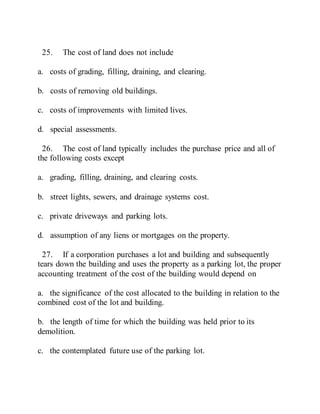
25. The cost of land does not include
a. costs of grading, filling, draining, and clearing.
b. costs of removing old buildings.
c. costs of improvements with limited lives.
d. special assessments.
26. The cost of land typically includes the purchase price and all of
the following costs except
a. grading, filling, draining, and clearing costs.
b. street lights, sewers, and drainage systems cost.
c. private driveways and parking lots.
d. assumption of any liens or mortgages on the property.
27. If a corporation purchases a lot and building and subsequently
tears down the building and uses the property as a parking lot, the proper
accounting treatment of the cost of the building would depend on
a. the significance of the cost allocated to the building in relation to the
combined cost of the lot and building.
b. the length of time for which the building was held prior to its
demolition.
c. the contemplated future use of the parking lot.
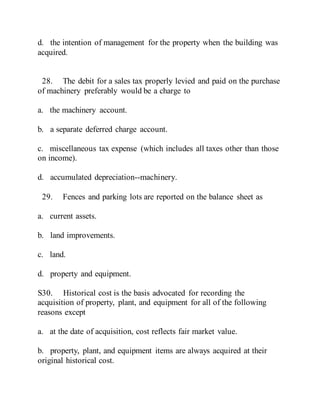
d. the intention of management for the property when the building was
acquired.
28. The debit for a sales tax properly levied and paid on the purchase
of machinery preferably would be a charge to
a. the machinery account.
b. a separate deferred charge account.
c. miscellaneous tax expense (which includes all taxes other than those
on income).
d. accumulated depreciation--machinery.
29. Fences and parking lots are reported on the balance sheet as
a. current assets.
b. land improvements.
c. land.
d. property and equipment.
S30. Historical cost is the basis advocated for recording the
acquisition of property, plant, and equipment for all of the following
reasons except
a. at the date of acquisition, cost reflects fair market value.
b. property, plant, and equipment items are always acquired at their
original historical cost.
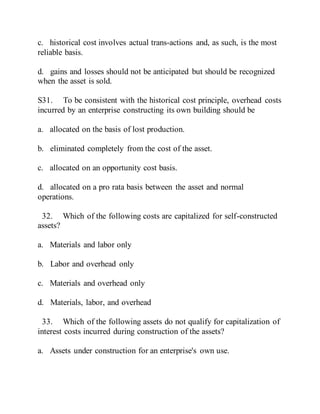
c. historical cost involves actual trans-actions and, as such, is the most
reliable basis.
d. gains and losses should not be anticipated but should be recognized
when the asset is sold.
S31. To be consistent with the historical cost principle, overhead costs
incurred by an enterprise constructing its own building should be
a. allocated on the basis of lost production.
b. eliminated completely from the cost of the asset.
c. allocated on an opportunity cost basis.
d. allocated on a pro rata basis between the asset and normal
operations.
32. Which of the following costs are capitalized for self-constructed
assets?
a. Materials and labor only
b. Labor and overhead only
c. Materials and overhead only
d. Materials, labor, and overhead
33. Which of the following assets do not qualify for capitalization of
interest costs incurred during construction of the assets?
a. Assets under construction for an enterprise's own use.
b. Assets intended for sale or lease that are produced as discrete
projects.
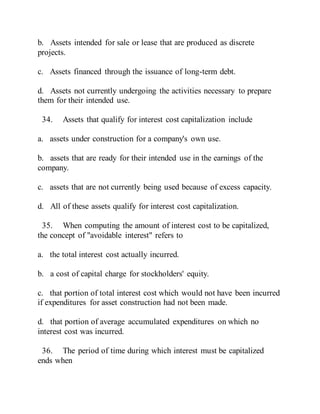
c. Assets financed through the issuance of long-term debt.
d. Assets not currently undergoing the activities necessary to prepare
them for their intended use.
34. Assets that qualify for interest cost capitalization include
a. assets under construction for a company's own use.
b. assets that are ready for their intended use in the earnings of the
company.
c. assets that are not currently being used because of excess capacity.
d. All of these assets qualify for interest cost capitalization.
35. When computing the amount of interest cost to be capitalized,
the concept of "avoidable interest" refers to
a. the total interest cost actually incurred.
b. a cost of capital charge for stockholders' equity.
c. that portion of total interest cost which would not have been incurred
if expenditures for asset construction had not been made.
d. that portion of average accumulated expenditures on which no
interest cost was incurred.
36. The period of time during which interest must be capitalized
ends when
a. the asset is substantially complete and ready for its intended use.
b. no further interest cost is being incurred.
c. the asset is abandoned, sold, or fully depreciated.
d. the activities that are necessary to get the asset ready for its intended
use have begun.
37. Which of the following statements is true regarding
capitalization of interest?
a. Interest cost capitalized in connection with the purchase of land to be
used as a building site should be debited to the land account and not to
the building account.
b. The amount of interest cost capitalized during the period should not
exceed the actual interest cost incurred.
c. When excess borrowed funds not immediately needed for
construction are temporarily invested, any interest earned should be
offset against interest cost incurred when determining the amount of
interest cost to be capitalized.
d. The minimum amount of interest to be capitalized is determined by
multiplying a weighted average interest rate by the amount of average
accumulated expenditures on qualifying assets during the period.
38. Construction of a qualifying asset is started on April 1 and
finished on December 1. The fraction used to multiply an expenditure
made on April 1 to find weighted-average accumulated expenditures is
a. 8/8.
b. 8/12.
d. an abandonment of the asset.
**************************************************
ACC 304 Week 4 Chapter 11 Homework
For more classes visit
www.snaptutorial.com
ACC 304 Week 4 Chapter 11 Homework
1) Lockard Company purchased machinery on January 1, 2014, for
$102,960. The machinery is estimated to have a salvage value of
$10,296 after a useful life of 8 years.
2) Compute 2014 depreciation expense using the double-declining-
balance method.
3) Compute 2014 depreciation expense using the double-declining-
balance method, assuming the machinery was purchased on October 1,
2014.
4) Everly Corporation acquires a coal mine at a cost of $452,000.
Intangible development costs total $113,000.After extraction has
occurred, Everly must restore the property (estimated fair value of the
obligation is $90,400), after which it can be sold for $180,800. Everly
estimates that 4,520 tons of coal can be extracted.
5) In its 2011 annual report, Campbell Soup Company reports
beginning-of-the-year total assets of $6,276 million, end-of-the-year
total assets of $6,862 million, total sales of $7,719 million, and net
income of $805 million.
6) Compute Campbell’s asset turnover ratio. (Round answer to 3
decimal places, e.g. 4.871.)
Asset turnover ratio
7) Compute Campbell’s profit margin on sales. (Round answer to 2
decimal places, e.g. 4.87 or 4.87%.)
8) Compute Campbell’s return on assets using (1) asset turnover and
profit margin and (2) net income. (Round answers to 2 decimal places,
e.g. 4.87 or 4.87%.)Return on assets
9) Rembrandt Company acquired a plant asset at the beginning of
Year 1. The asset has an estimated service life of 5 years. An employee
has prepared depreciation schedules for this asset using three different
methods to compare the results of using one method with the results of
using other methods. You are to assume that the following schedules
have been correctly prepared for this asset using (1) the straight-line
method, (2) the sum-of-the-years'-digits method, and (3) the double-
declining-balance method.
Year Straight-Line Sum-of-the-
Years'-Digits Double-Declining-
Balance
1 $11,970 $19,950
$26,600
2 11,970 15,960
15,960
3 11,970 11,970
9,576
4 11,970 7,980
5,746
5 11,970 3,990
1,968
Total $59,850
$59,850 $59,850
10) What is the cost of the asset being depreciated? (Round answer to 0
decimal places, e.g. 45,892.)
Cost of asset $
11) If there is any salvage value and the amount is unknown (as is the
case here), the cost would have to be determined by looking at the data
for the double-declining balance method.
12) What amount, if any, was used in the depreciation calculations for
the salvage value for this asset? (Round answer to 0 decimal places, e.g.
45,892.)
13) Which method will produce the highest charge to income in Year 1?
The method that produces the highest charge to income in Year 1 is
14) Which method will produce the highest charge to income in Year 4?
The method that produces the highest charge to income in Year 4 is
15) Which method will produce the highest book value for the asset at
the end of Year 3?
The method that produces the highest book value for the asset at the end
of Year 3 is
16) Prepare the journal entry (if any) to record the impairment of the
asset at December 31, 2014. (If no entry is required, select "No entry"
for the account titles and enter 0 for the amounts. Credit account titles
are automatically indented when amount is entered. Do not indent
manually.)
17) If the asset is sold at the end of Year 3, which method would yield
the highest gain (or lowest loss) on disposal of the asset?
The method that will yield the highest gain (or lowest loss) on disposal
of the asset if the asset is sold at the end of Year 3 is
18) Muggsy Bogues Company purchased equipment for $224,700 on
October 1, 2014. It is estimated that the equipment will have a useful life
of 8 years and a salvage value of $24,720. Estimated production is
39,600 units and estimated working hours are 20,200. During 2014,
Bogues uses the equipment for 590 hours and the equipment produces
1,100 units.
Compute depreciation expense under each of the following methods.
Bogues is on a calendar-year basis ending December 31.
19) Presented below is information related to equipment owned by
Suarez Company at December 31, 2014.
Cost $ 20,232,000
Accumulated depreciation to date 2,248,000
Expected future net cash flows 15,736,000
Fair value 10,790,400
Suarez intends to dispose of the equipment in the coming year. It is
expected that the cost of disposal will be $ 44,960 . As of December 31,
2014, the equipment has a remaining useful life of 4 years.
20) The following data relate to the Machinery account of Eshkol, Inc.
at December 31, 2014.
Machinery
A B C D
Original cost $108,560 $120,360
$188,800 $188,800
Year purchased 2009 2010 2011
2013
Useful life 10 years 15,000 hours 15
years 10 years
Salvage value $7,316 $7,080 $11,800
$11,800
Depreciation method Sum-of-the-years'-digits
Activity Straight-line Double-declining balance
Accum. depr through 2014* $73,632 $83,072
$35,400 $37,760
*In the year an asset is purchased, Eshkol, Inc. does not record any
depreciation expense on the asset.
In the year an asset is retired or traded in, Eshkol, Inc. takes a full year’s
depreciation on the asset.
21) Mandall Company constructed a warehouse for $280,000 on
January 2, 2014. Mandall estimates that the warehouse has a useful life
of 20 years and no residual value. Construction records indicate that
$40,000 of the cost of the warehouse relates to its heating, ventilation,
and air conditioning (HVAC) system, which has an estimated useful life
of only 10 years. What is the first year of depreciation expense using
straight-line component depreciation under IFRS?
22) Francisco Corporation is constructing a new building at a total
initial cost of $10,000,000.The building is expected to have a useful life
of 50 years with no residual value. The building’s finished surfaces (e.g.,
roof cover and floor cover) are 5% of this cost and have a useful life of
20 years. Building services systems (e.g., electric, heating, and
plumbing) are 20% of the cost and have a useful life of 25 years. The
depreciation in the first year using component depreciation, assuming
straight-line depreciation with no residual value, is:
23) Which of the following statements is correct?
Both IFRS and GAAP permit revaluation of property, plant, and
equipment.
IFRS permits revaluation of property, plant, and equipment but not
GAAP.
Both IFRS and GAAP do not permit revaluation of property, plant, and
equipment.
GAAP permits revaluation of property, plant, and equipment but not
IFRS.
24) Hilo Company has land that cost $350,000 but now has a fair value
of $500,000. Hilo Company decides to use the revaluation method
specified in IFRS to account for the land. Which of the following
statements is correct?
25) Under IFRS, value-in-use is defined as:
**************************************************
ACC 304 Week 5 Midterm Part 1 (Set 1)
For more classes visit
www.snaptutorial.com
The book value of a plant asset is
The asset turnover ratio is computed by dividing
On September 19, 2014, Markham Co. purchased machinery for
$285,000. Salvage value was estimated to be $15,000. The machinery
will be depreciated over eight years using the sum-of-the-years'-digits
method. If depreciation is computed on the basis of the nearest full
month, Markham should record depreciation expense for 2015 on this
machinery of
In 2014, Bargain shop reported net income of $5.7 billion, net sales of
$175 billion, and average total assets of $70 billion. What is Bargain
shop's asset turnover ratio?
In 2006, Jarrett Company purchased a tract of land as a possible future
plant site. In January, 2014, valuable sulphur deposits were discovered
on adjoining property and Jarrett Company immediately began
explorations on its property. In December, 2014, after incurring
$800,000 in exploration costs, which were accumulated in an expense
account, Jarrett discovered sulphur deposits appraised at $4,500,000
more than the value of the land. To record the discovery of the deposits,
Jarrett should
The primary IFRS related to property, plant and equipment is found in
Ryan Distribution Co. has determined its December 31, 2014 inventory
on a FIFO basis at $490,000. Information pertaining to that inventory
follows:
LF Corporation, a manufacturer of Mexican foods, contracted in 2014 to
purchase 1,500 pounds of a spice mixture at $5.00 per pound, delivery to
be made in spring of 2015. By 12/31/14, the price per pound of the spice
mixture had dropped to $4.70 per pound. In 2014, LF should recognize
Plank Co. uses the retail inventory method. The following information is
available for the current year.
Cost
Retail
Beginning inventory
$234,000
$366,000
Purchases
885,000
1,245,000
Freight-in
15,000
—
Employee discounts
—
6,000
Net markups
—
45,000
Net markdowns
—
60,000
Sales revenue
—
1,170,000
10.
Which of the following is true of normal shortages?
Under the lower-of-cost-or-market method, the replacement cost of an
inventory item would be used as the designated market value
Which of the following is not a common disclosure for inventories?
The use of a Purchase Discounts account implies that the recorded cost
of a purchased inventory item is its
Hay Company had January 1 inventory of $180,000 when it adopted
dollar-value LIFO. During the year, purchases were $1,080,000 and
sales were $1,800,000.December 31 inventory at year-end prices was
$227,700, and the price index was 110.
What is Hay Company’s gross profit
16. In the double-extension method, the value of the units in
inventory is extended at:
17. Web World began using dollar-value LIFO for costing its
inventory last year. The base year layer consists of $400,000. Assuming
the current inventory at end of year prices equals $552,000 and the index
for the current year is 1.10, what is the ending inventory using dollar-
value LIFO?
18.
RF Company had January 1 inventory of $200,000 when it adopted
dollar-value LIFO. During the year, purchases were $1,200,000 and
sales were $2,000,000.December 31 inventory at year-end prices was
$286,720, and the price index was 112.
What is RF Company’s gross profit?
19. Cotton Hotel Corporation recently purchased Emporia Hotel and the
land on which it is located with the plan to tear down the Emporia Hotel
and build a new luxury hotel on the site. The cost of the Emporia Hotel
should be
20. Ecker Company purchased a new machine on May 1, 2006 for
$352,000. At the time of acquisition, the machine was estimated to have
a useful life of ten years and an estimated salvage value of $16,000. The
company has recorded monthly depreciation using the straight-line
method. On March 1, 2015, the machine was sold for $48,000. What
should be the loss recognized from the sale of the machine?
21. Under IFRS, Sampson Company, who has a non-current asset which
has been classified as held-for-sale, should
22. The cost of land does not include
23. Which of the following is not a condition that must be satisfied
before interest capitalization can begin on a qualifying asset?
24. Which of the following is not a major characteristic of a plant asset?
25. Ringler Corporation exchanges one plant asset for a similar plant
asset and gives cash in the exchange. The exchange is not expected to
cause a material change in the future cash flows for either entity. If a
gain on the disposal of the old asset is indicated, the gain will
**************************************************
ACC 304 Week 5 Midterm Part 1 (Set 2)
For more classes visit
www.snaptutorial.com
Multiple Choice Question 90
If Labor, Inc. uses the composite method and its composite rate is 7.5%
per year, what entry should it make when plant assets that originally cost
$80,000 and have been used for 10 years are sold for $24,000?
Multiple Choice Question 102
Porter Resources Company acquired a tract of land containing an
extractable natural resource. Porter is required by its purchase contract to
restore the land to a condition suitable for recreational use after it has
extracted the natural resource. Geological surveys estimate that the
recoverable reserves will be 2,000,000 tons, and that the land will have a
value of $1,000,000 after restoration. Relevant cost information follows:
Multiple Choice Question 110
In 2014, shop reported net income of $5.7 billion, net sales of $175
billion, and average total assets of $70 billion. What is Bargain shop's
return on total assets?
Multiple Choice Question 106
In 2006, Jarrett Company purchased a tract of land as a possible future
plant site. In January, 2014, valuable sulphur deposits were discovered
on adjoining property and Jarrett Company immediately began
explorations on its property. In December, 2014, after incurring
$800,000 in exploration costs, which were accumulated in an expense
account, Jarrett discovered sulphur deposits appraised at $4,500,000
more than the value of the land. To record the discovery of the deposits,
Jarrett should
Multiple Choice Question 66
Grover Corporation purchased a truck at the beginning of 2014 for
$93,600. The truck is estimated to have a salvage value of $3,600 and a
useful life of 120,000 miles. It was driven 21,000 miles in 2014 and
29,000 miles in 2015. What is the depreciation expense for 2015?
Multiple Choice Question 70
Halltown Company purchased a depreciable asset for $450,000.The
estimated salvage value is $30,000, and the estimated useful life is 8
years. The double-declining balance method will be used for
depreciation. What is the depreciation expense for the second year on
this asset?
Multiple Choice Question 78
Robust Inc. has the following information related to an item in its ending
inventory. Product 66 has a cost of $812, a replacement cost of $775, a
net realizable value of $800, and a normal profit margin of $50. What is
the final lower-of-cost-or-market inventory value for product 66?
Multiple Choice Question 132
Ryan Distribution Co. has determined its December 31, 2014 inventory
on a FIFO basis at $490,000. Information pertaining to that inventory
follows:
Multiple Choice Question 50
A major advantage of the retail inventory method is that it
provides a method for inventory control and facilitates determination of
the periodic inventory for certain types of companies.
Multiple Choice Question 116
The following data concerning the retail inventory method are taken
from the financial records of
If the foregoing figures are verified and a count of the ending inventory
reveals that merchandise actually on hand amounts to $108,000 at retail,
the business has
Multiple Choice Question 76
Given the historical cost of product Dominoe is $22, the selling price of
product Dominoe is $30, costs to sell product Dominoe are $5, the
replacement cost for product Dominoe is $20, and the normal profit
margin is 20% of sales price, what is the cost amount that should be used
in the lower-of-cost-or-market comparison?
IFRS Multiple Choice Question 06
Which of the following statements is true regarding IFRS and
inventories?
With respect to inventories, IFRS defines market as net realizable value.
Multiple Choice Question 74
In a period of falling prices, which inventory method generally provides
the greatest amount of net income?
Multiple Choice Question 31
When using a perpetual inventory system,
all of these answer choices are correct.
Multiple Choice Question 100
Niles Co. has the following data related to an item of inventory:
Inventory, March 1 200 units @ $2.10
Purchase, March 7 700 units @ $2.20
Purchase, March 16 140 units @ $2.25
Inventory, March 31 260 units
The value assigned to ending inventory if Niles uses LIFO is
Multiple Choice Question 72
Which of the following is a reason why the specific identification
method may be considered ideal for assigning costs to inventory and
cost of goods sold?
The cost flow matches the physical flow.
Multiple Choice Question 27
Where should goods in transit that were recently purchased f.o.b.
destination be included on the balance sheet?
Not on the balance sheet
Multiple Choice Question 135
The following information applied to Howe, Inc. for 2014:
IFRS Multiple Choice Question 08
Tram Industries, a company who uses IFRS reporting standards, is
installing a new plant. The company has incurred the following costs
Multiple Choice Question 95
Glen Inc. and Armstrong Co. have an exchange with no commercial
substance. The asset given up by Glen Inc. has a book value of $36,000
and a fair value of $45,000. The asset given up by Armstrong Co. has a
book value of $60,000 and a fair value of $57,000. Boot of $12,000 is
received by Armstrong Co.
What amount should Armstrong Co. record for the asset received?
Multiple Choice Question 53
A plant site donated by a township to a manufacturer that plans to open a
new factory should be recorded on the manufacturer's books at
IFRS Multiple Choice Question 10
All of the following are true regarding the revaluation model allowed
under IFRS except
when an asset is revalued, any increase in carrying amount is reported as
miscellaneous revenue.
Multiple Choice Question 119
Peterson Company purchased machinery for $800,000 on January 1,
2011. Straight-line depreciation has been recorded based on a $50,000
salvage value and a 5-year useful life. The machinery was sold on May
1, 2015 at a gain of $15,000. How much cash did Peterson receive from
the sale of the machinery?
Multiple Choice Question 82
On January 2, 2014, Indian River Groves began construction of a new
citrus processing plant. The automated plant was finished and ready for
use on September 30, 2015. Expenditures for the
Indian River Groves borrowed $2,200,000 on a construction loan at 12%
interest on January 2, 2014. This loan was outstanding during the
construction period. The company also had $8,000,000 in 9% bonds
outstanding in 2014 and 2015.
What were the weighted-average accumulated expenditures for 2014?
$800,000
Multiple Choice Question 50
Accounting recognition should be given to some or all of the gain
realized on a nonmonetary exchange of plant assets except when the
exchange has
no commercial substance and additional cash is paid.
**************************************************
ACC 304 Week 5 Midterm Part 1 (Set 3)
For more classes visit
www.snaptutorial.com
ACC 304 Week 5 Midterm Part 1 (Set 3)
1) Tongas Company applies revaluation accounting to plant assets
with a carrying value of $1,600,000, a useful life of 4 years, and no
salvage value. Depreciation is calculated on the straight-line basis. At
the end of year 1, independent appraisers determine that the asset has a
fair value of $1,500,000.
The journal entry to adjust the plant assets to fair value and record
revaluation surplus in year one will include a
2) Tongas Company applies revaluation accounting to plant assets
with a carrying value of $1,600,000, a useful life of 4 years, and no
salvage value. Depreciation is calculated on the straight-line basis. At
the end of year 1, independent appraisers determine that the asset has a
fair value of $1,500,000.
The journal entry to adjust the plant assets to fair value and record
revaluation surplus in year one will include a
3) A major objective of MACRS for tax depreciation is to
4) Sifton Company reported the following data:
2014 2015
Sales $3,000,000 $3,900,000
Net Income 300,000 400,000
Assets at year end 1,800,000 2,500,000
Liabilities at year end 1,100,000 1,500,000
What is Sifton’s asset turnover for 2015?
5) Which of the following principles best describes the conceptual
rationale for the methods of matching depreciation expense with
revenues?
6) Slotkin Products purchased a machine for $39,000 on July 1, 2014.
The company intends to depreciate it over 8 years using the double-
declining balance method. Salvage value is $3,000. Depreciation for
2014 is
7) Tongas Company applies revaluation accounting to plant assets
with a carrying value of $1,600,000, a useful life of 4 years, and no
salvage value. Depreciation is calculated on the straight-line basis. At
the end of year 1, independent appraisers determine that the asset has a
fair value of $1,500,000.
The financial statements for year one will include the following
information
8) Tongas Company applies revaluation accounting to plant assets
with a carrying value of $1,600,000, a useful life of 4 years, and no
salvage value. Depreciation is calculated on the straight-line basis. At
the end of year 1, independent appraisers determine that the asset has a
fair value of $1,500,000.
9) Which of the following is not an acceptable approach in applying
the lower-of-cost-or-market method to inventory?
10) The following data concerning the retail inventory method are
taken from the financial records of Welch Company.
Cost Retail
Beginning inventory $ 147,000 $ 210,000
Purchases 672,000 960,000
Freight-in 18,000 —
Net markups — 60,000
Net markdowns — 42,000
Sales — 1,008,000
If the foregoing figures are verified and a count of the ending inventory
reveals that merchandise actually on hand amounts to $108,000 at retail,
the business has
11) Muckenthaler Company sells product 2005WSC for $40 per unit.
The cost of one unit of 2005WSC is $36, and the replacement cost is
$35. The estimated cost to dispose of a unit is $8, and the normal profit
is 40%. At what amount per unit should product 2005WSC be reported,
applying lower-of-cost-or-market?
12) Muckenthaler Company sells product 2005WSC for $40 per unit.
The cost of one unit of 2005WSC is $36, and the replacement cost is
$35. The estimated cost to dispose of a unit is $8, and the normal profit
is 40%. At what amount per unit should product 2005WSC be reported,
applying lower-of-cost-or-market?
13) Barker Pet supply uses the conventional retail method to determine
its ending inventory at cost. Assume the beginning inventory at cost
(retail) were $531,200 ($653,800), purchases during the current year at
cost (retail) were $2,137,200 ($2,772,200), freight-in on these purchases
totaled $127,800, sales during the current year totaled $2,704,000,and
net markups (markdowns) were $4,000 ($192,600). What is the ending
inventory value at cost?
14) Barker Pet supply uses the conventional retail method to determine
its ending inventory at cost. Assume the beginning inventory at cost
(retail) were $531,200 ($653,800), purchases during the current year at
cost (retail) were $2,137,200 ($2,772,200), freight-in on these purchases
totaled $127,800, sales during the current year totaled $2,704,000,and
net markups (markdowns) were $4,000 ($192,600). What is the ending
inventory value at cost?
15) Under the lower-of-cost-or-market method, the replacement cost of
an inventory item would be used as the designated market value
16) Under the lower-of-cost-or-market method, the replacement cost of
an inventory item would be used as the designated market value
17) During 2014, Larue Co., a manufacturer of chocolate candies,
contracted to purchase 200,000 pounds of cocoa beans at $4.00 per
pound, delivery to be made in the spring of 2015. Because a record
harvest is predicted for 2015, the price per pound for cocoa beans had
fallen to $3.30 by December 31, 2014.
Of the following journal entries, the one which would properly reflect in
2014 the effect of the commitment of Larue Co. to purchase the
200,000 pounds of cocoa is
18) During 2014, Larue Co., a manufacturer of chocolate candies,
contracted to purchase 200,000 pounds of cocoa beans at $4.00 per
pound, delivery to be made in the spring of 2015. Because a record
harvest is predicted for 2015, the price per pound for cocoa beans had
fallen to $3.30 by December 31, 2014.
19) Which method of inventory pricing best approximates specific
identification of the actual flow of costs and units in most manufacturing
situations?
20) Checkers uses the periodic inventory system. For the current
month, the beginning inventory consisted of 4,800 units that cost $12
each. During the month, the company made two purchases: 2,000 units
at $13 each and 8,000 units at $13.50 each. Checkers also sold 8,600
units during the month. Using the FIFO method, what is the ending
inventory?
21) Groh Co. recorded the following data pertaining to raw material X
during January 2014:
Units
Date Received Cost
Issued On Hand
1/1/14 Inventory $6.00
3,200
1/11/14 Issue
1,600 1,600
1/22/14 Purchase 4,000 $7.05
5,600
The moving-average unit cost of X inventory at January 31, 2014 is
22) Gross Corporation adopted the dollar-value LIFO method of
inventory valuation on December 31, 2013. Its inventory at that date was
$550,000 and the relevant price index was 100. Information regarding
inventory for subsequent years is as follows:
Date Inventory at
Current Prices Current
Price Index
December 31, 2014 $642,000
107
December 31, 2015 725,000 125
December 31, 2016 812,500 130
What is the cost of the ending inventory at December 31, 2014 under
dollar-value LIFO?
23) Gross Corporation adopted the dollar-value LIFO method of
inventory valuation on December 31, 2013. Its inventory at that date was
$550,000 and the relevant price index was 100. Information regarding
inventory for subsequent years is as follows:
Date Inventory at
Current Prices Current
Price Index
December 31, 2014 $642,000
107
December 31, 2015 725,000 125
December 31, 2016 812,500 130
What is the cost of the ending inventory at December 31, 2014 under
dollar-value LIFO?
24)Goods in transit which are shipped f.o.b. destination should be
24) Milford Company had 400 units of “Tank” in its inventory at a cost
of $6 each. It purchased 600 more units of “Tank” at a cost of $9 each.
Milford then sold 700 units at a selling price of $15 each. The LIFO
liquidation overstated normal gross profit by
26) Milford Company had 400 units of “Tank” in its inventory at a cost
of $6 each. It purchased 600 more units of “Tank” at a cost of $9 each.
Milford then sold 700 units at a selling price of $15 each. The LIFO
liquidation overstated normal gross profit by
27)Huff Co. exchanged nonmonetary assets with Sayler Co. No cash
was exchanged and the exchange had no commercial substance. The
carrying amount of the asset surrendered by Huff exceeded both the fair
value of the asset received and Sayler's carrying amount of that asset.
Huff should recognize the difference between the carrying amount of the
asset it surrendered and
28) A machine cost $600,000, has annual depreciation of $100,000,and
has accumulated depreciation of $450,000 on December 31, 2014. On
April 1, 2015, when the machine has a fair value of $137,500, it is
exchanged for a machine with a fair value of $675,000 and the proper
amount of cash is paid. The exchange had commercial substance.
The gain to be recorded on the exchange is
29) Glen Inc. and Armstrong Co. have an exchange with no commercial
substance. The asset given up by Glen Inc. has a book value of $36,000
and a fair value of $45,000. The asset given up by Armstrong Co. has a
book value of $60,000 and a fair value of $57,000. Boot of $12,000 is
received by Armstrong Co.
What amount should Glen Inc. record for the asset received?
30) Glen Inc. and Armstrong Co. have an exchange with no commercial
substance. The asset given up by Glen Inc. has a book value of $36,000
and a fair value of $45,000. The asset given up by Armstrong Co. has a
book value of $60,000 and a fair value of $57,000. Boot of $12,000 is
received by Armstrong Co.
What amount should Glen Inc. record for the asset received?
31) Arlington Company is constructing a building. Construction began
on January 1 and was completed on December 31. Expenditures were
$4,800,000 on March 1, $3,960,000 on June 1, and $6,000,000 on
December 31. Arlington Company borrowed $2,400,000 on January 1
on a 5-year, 12% note to help finance construction of the building. In
addition, the company had outstanding all year a 10%, 3-year,
$4,800,000 note payable and an 11%, 4-year, $9,000,000 note payable.
What is the weighted-average interest rate used for interest capitalization
purposes?
32) Arlington Company is constructing a building. Construction began
on January 1 and was completed on December 31. Expenditures were
$4,800,000 on March 1, $3,960,000 on June 1, and $6,000,000 on
December 31. Arlington Company borrowed $2,400,000 on January 1
on a 5-year, 12% note to help finance construction of the building. In
addition, the company had outstanding all year a 10%, 3-year,
$4,800,000 note payable and an 11%, 4-year, $9,000,000 note payable.
What is the weighted-average interest rate used for interest capitalization
purposes?
33) Assets that qualify for interest cost capitalization include
34) Arlington Company is constructing a building. Construction began
on January 1 and was completed on December 31. Expenditures were
$4,800,000 on March 1, $3,960,000 on June 1, and $6,000,000 on
December 31. Arlington Company borrowed $2,400,000 on January 1
on a 5-year, 12% note to help finance construction of the building. In
addition, the company had outstanding all year a 10%, 3-year,
$4,800,000 note payable and an 11%, 4-year, $9,000,000 note payable.
What are the weighted-average accumulated expenditures?
35) Which of the following is a capital expenditure?
**************************************************
ACC 304 Week 5 Midterm Part 2
For more classes visit
www.snaptutorial.com
ACC 304 Week 5 Midterm Part 2
1) 1) A machine which cost $300,000 is acquired on October1, 2014.
Its estimated salvage value is $30,000 and its expected life is eight years.
a) Calculate depreciation expense for 2014 and 2015 by double-
declining balance
b) Calculate depreciation expense for 2014 and 2015 by sum-of-the-
years-digits
c) At the end of 2015, which method results in the larger
accumulated depreciation amount?
2) Assume in each case that the selling expenses are $8 per unit and
that the normal profit is $5 per unit. Calculate the limits for each case.
Then enter the amount that should be used for lower of cost or market
3) Purchased merchandise costing $2,500 with terms 2/10, n/30.
a) Inventory = ???
b) Payment was made thirty days after the purchase
4) A machine cost $221,400, has annual depreciation expense of
$44,280, and has accumulated depreciation of $110,700 on December
31, 2014. On April 1, 2015, when the machine has a fair value of
$87,070, it is exchanged for a similar machine with a fair value of
$281,600 and the proper amount of cash is paid. The exchange lacked
commercial substance.
Prepare all entries that are necessary at April 1, 2015. (Credit account
titles are automatically indented when the amount is entered. Do not
indent manually.)
**************************************************
ACC 304 Week 6 Chapter 12 Homework
For more classes visit
www.snaptutorial.com
ACC 304 Week 6 Chapter 12 Homework
1) Waters Corporation purchased Johnson Company 3 years ago and
at that time recorded goodwill of $400,000.The Johnson Division’s net
assets, including the good well, have a carrying amount of $800,000.
The fair value of the division is estimated to be $1,000,000.prepare
Water’s journal entry to record impairment of the goodwill.
2) Treasure Land Corporation incurred the following costs in 2014.
Prepare the necessary 2014 journal entry or entries for Treasure Land.
3) Sinise Industries acquired two copyrights during 2014. One copy
right related to a text book that was developed internally at a cost of
$9,900. This textbook is estimated to have a useful life of 3 years from
September 1, 2014, the date it was published. The second copy right (a
history research textbook) was purchased from University press on
December 1, 2014, for $24,000. This textbook has an indefinite useful
life. How should these two copyrights be reported on Sinise’s balance
sheet as of December 31, 2014?
4) Alatorre purchased a patent from Vaina Co. for $1,000,000 on
January 1, 2012. The patent is being amortized over its remaining legal
life of 10 years, expiring on January 1, 2022. During 2014, alatorre
determined that the economic benefits of the patent would not last longer
than 6 years from the date of acquisition. What amount should be
reported in the balance sheet for the patent, net of accumulated
amortization, at December 31, 2014?
5) Alatorre bought a franchise from Alexandar Co. on January 1,
2013, for $400,000.The carrying amount of the franchise on
Alexandar’s books on January 1, 2013, was $500,000.The franchise
agreement had an estimated useful life of 30 years. Because Alatorre
must enter a competitive bidding at the end of 2015, it is unlikely that
franchise will be retained beyond 2022.what amount should be
amortized for the year ended December 31, 2014?
6) On January 1, 2014, alatorre incurred organization costs of
$275,000. What amount of organization expense should be reported in
2014?
7) Alatorre purchased the license for distribution of a popular
consumer product on January 1, 2014, for $150,000. It is expected that
this product will generate cash flows for an indefinite period of time.
The license has an initial term of 5 years but by paying a nominal fee,
alatorre can renew the license indefinitely for successive 5-year terms.
What amount should be amortized for the year ended December 31,
2014?
8) Tones Industries has the following patents on its December 31,
2013, balance sheet. The following events occurred during the year
ended December 31, 2014. The proper discount rate to be used for these
flow is 8%. ( assume that the cash flow occur at the end of the year.)
Compute the total carrying amount of tones’ patents on its December 31,
2013, balance sheet.
9) Compute the total carrying amount of tones’ patents on its
December 31, 2014, balance sheet.
10) Presented below is information related to copyrights owned by
Walter de la Mare Company at December 31, 2014. Assume that Walter
de la Mare Company will continue to use this copyright in the future. As
of December 31, 2014, the copyright is estimated to have a remaining
useul life of 10 years.
11) Prepare the journal entry ( if any ) to record the impairment of the
asset at December 31, 2014. The company does not use accumulated
amortization accounts.
12) Prepare the journal entry to record amortization expense for 2015
related to the copyrights.
13) The fair value of the copyright at December 31, 2015, is $3, 20,000.
Prepare journal entry ( if any) necessary to record the increase in fair
value.
14) During 2012, Robin Wright Tool Company purchased a building
site for its proposed research and development laboratory at a cost of
$60,000. Construction of the building was started in 2012. The building
was completed on December 31, 2013, at a cost of $320,000 and was
placed in service on January 2, 2014. The estimated useful life of the
building for depreciation purposes was 20 years. The straight-line
method of depreciation was to be employed, and there was no estimated
residual value. Management estimates that about 50% of the projects of
the research and development group will result in long-term benefits (
i.e., at least 10 years ) to the corporation. The remaining projects and the
direct costs incurred in conjunction with the research and development
activities for 2014 appears below. Upon recommendation of the research
and development group, Robin Wright Tool Company acquired a patent
for manufacturing rights at a cost of $88,000. The patent was acquired
on April 1, 2013, and has an economic life 10 years. If generally
accepted accounting principles were followed, how would the item
above relating to research and development activities be reported on the
following financial statements?
15) All of the following are key similarities between GAAP and IFRS
with respect to accounting for intangible assets except:
16) Research and development costs are:
17) Which of the following statements is correct?
18) A loss on impairment of an intangible asset under IFRS is the
asset’s?
19) Recovery of impairment is recognized for all the following except:
**************************************************
ACC 304 Week 7 Chapter 12 Quiz (All Possible
Questions)
For more classes visit
www.snaptutorial.com
ACC 304 Week 7 Quiz – Strayer NEW
Week 7 Quiz 4: Chapter 12
INTANGIBLE ASSETS
IFRS questions are available at the end of this chapter.
TRUE-FALSE—Conceptual
1. Intangible assets derive their value from the right (claim) to
receive cash in the future.
2. Internally created intangibles are recorded at cost.
3. Internally generated intangible assets are initially recorded at fair
value.
4. Amortization of limited-life intangible assets should not be
impacted by expected residual values.
5. Some intangible assets are not required to be amortized every
year.
6. Limited-life intangibles are amortized by systematic charges to
expense over their useful life.
7. The cost of acquiring a customer list from another company is
recorded as an intangible asset.
8. The cost of purchased patents should be amortized over the
remaining legal life of the patent.
9. If a new patent is acquired through modification of an existing
patent, the remaining book value of the original patent may be amortized
over the life of the new patent.
10. In a business combination, a company assigns the cost, where
possible, to the identifiable tangible and intangible assets, with the
remainder recorded as goodwill.
11. Internally generated goodwill should not be capitalized in the
accounts.
12. Internally generated goodwill associated with a business may be
recorded as an asset when a firm offer to purchase that business unit has
been received.
13. All intangibles are subject to periodic consideration of
impairment with corresponding potential write-downs.
14. If the fair value of an unlimited life intangible other than
goodwill is less than its book value, an impairment loss must be
recognized.
15. If market value of an impaired asset recovers after an impairment
has been recognized, the impairment may be reversed in a subsequent
period.
16. The same recoverability test that is used for impairments of
property, plant, and equipment is used for impairments of indefinite-life
intangibles.
17. Periodic alterations to existing products are an example of
research and development costs.
18. Research and development costs that result in patents may be
capitalized to the extent of the fair value of the patent.
19. Research and development costs are recorded as an intangible
asset if it is felt they will provide economic benefits in future years.
20. Contra accounts must be reported for intangible assets in a
manner similar to accumu-lated depreciation and property, plant, and
equipment.
True False Answers—Conceptual
MULTIPLE CHOICE—Conceptual
21. Which of the following does not describe intangible assets?
a. They lack physical existence.
b. They are financial instruments.
c. They provide long-term benefits.
d. They are classified as long-term assets.
22. Which of the following characteristics do intangible assets
possess?
a. Physical existence.
b. Claim to a specific amount of cash in the future.
c. Long-lived.
d. Held for resale.
23. Which characteristic is not possessed by intangible assets?
a. Physical existence.
b. Short-lived.
c. Result in future benefits.
d. Expensed over current and/or future years.
24. Costs incurred internally to create intangibles are
a. capitalized.
b. capitalized if they have an indefinite life.
c. expensed as incurred.
d. expensed only if they have a limited life.
25. Which of the following costs incurred internally to create an
intangible asset is generally expensed?
a. Research and development costs.
b. Filing costs.
c. Legal costs.
d. All of the above.
26. Which of the following methods of amortization is normally used
for intangible assets?
a. Sum-of-the-years'-digits
b. Straight-line
c. Units of production
d. Double-declining-balance
27. The cost of an intangible asset includes all of the following
except
a. purchase price.
b. legal fees.
c. other incidental expenses.
d. all of these are included.
28. Factors considered in determining an intangible asset’s useful
life include all of the following except
a. the expected use of the asset.
b. any legal or contractual provisions that may limit the useful life.
c. any provisions for renewal or extension of the asset’s legal life.
d. the amortization method used.
29. Under current accounting practice, intangible assets are classified
as
a. amortizable or unamortizable.
b. limited-life or indefinite-life.
c. specifically identifiable or goodwill-type.
d. legally restricted or goodwill-type.
30. Companies should test indefinite life intangible assets at least
annually for:
a. recoverability.
b. amortization.
c. impairment.
d. estimated useful life.
S31. One factor that is not considered in determining the useful life of
an intangible asset is
a. salvage value.
b. provisions for renewal or extension.
c. legal life.
d. expected actions of competitors.
32. Which intangible assets are amortized?
Limited-Life Indefinite-Life
a. Yes Yes
b. Yes No
c. No Yes
d. No No
33. The cost of purchasing patent rights for a product that might
otherwise have seriously competed with one of the purchaser's patented
products should be
a. charged off in the current period.
b. amortized over the legal life of the purchased patent.
c. added to factory overhead and allocated to production of the
purchaser's product.
d. amortized over the remaining estimated life of the original patent
covering the product whose market would have been impaired by
competition from the newly patented product.
34. Broadway Corporation was granted a patent on a product on
January 1, 2001. To protect its patent, the corporation purchased on
January 1, 2012 a patent on a competing product which was originally
issued on January 10, 2008. Because of its unique plant, Broadway
Corporation does not feel the competing patent can be used in producing
a product. The cost of the competing patent should be
a. amortized over a maximum period of 20 years.
b. amortized over a maximum period of 16 years.
c. amortized over a maximum period of 9 years.
d. expensed in 2012.
35. Wriglee, Inc. went to court this year and successfully defended
its patent from infringe-ment by a competitor. The cost of this defense
should be charged to
a. patents and amortized over the legal life of the patent.
b. legal fees and amortized over 5 years or less.
c. expenses of the period.
d. patents and amortized over the remaining useful life of the patent.
36. Which of the following is not an intangible asset?
a. Trade name
b. Research and development costs
c. Franchise
d. Copyrights
37. Which of the following intangible assets should not be
amortized?
a. Copyrights
b. Customer lists
c. Perpetual franchises
d. All of these intangible assets should be amortized.
38. When a patent is amortized, the credit is usually made to
a. the Patent account.
b. an Accumulated Amortization account.
c. a Deferred Credit account.
d. an expense account.
39. When a company develops a trademark the costs directly related
to securing it should generally be capitalized. Which of the following
costs associated with a trademark would not be allowed to be
capitalized?
a. Attorney fees.
b. Consulting fees.
c. Research and development fees.
d. Design costs.
**************************************************
ACC 304 Week 7 Chapter 13 Homework
For more classes visit
www.snaptutorial.com
ACC 304 Week 7 Chapter 13 Homework
1) Takemoto Corporation borrowed $64,850 on November 1, 2014,
by signing a $68,450, 3-month, zero-interest-bearing note. Prepare
Takemoto’s November 1, 2014, entry; the December 31, 2014, annual
adjusting entry; and the February 1, 2015, entry. (If no entry is required,
select "No Entry" for the account titles and enter 0 for the amounts.
Credit account titles are automatically indented when amount is entered.
Do not indent manually.)
2) Kasten Inc. provides paid vacations to its employees. At December
31, 2014, 36 employees have each earned 2 weeks of vacation time. The
employees’ average salary is $513 per week. Prepare Kasten’s
December 31, 2014, adjusting entry. (If no entry is required, select "No
Entry" for the account titles and enter 0 for the amounts. Credit account
titles are automatically indented when amount is entered. Do not indent
manually.)
3) Buchanan Company recently was sued by a competitor for patent
infringement. Attorneys have determined that it is probable that
Buchanan will lose the case and that a reasonable estimate of damages to
be paid by Buchanan is $317,310. In light of this case, Buchanan is
considering establishing a $115,690 self-insurance allowance.
4) Buchanan should record a litigation accrual on the patent case,
since the amount is both estimable and probable. This entry will reduce
income by $317,310 and Buchanan will report a litigation liability of
$317,310. The $115,690 self-insurance allowance has no impact on
income or liabilities.
5) Green Day Hardware Company’s payroll for November 2014 is
summarized below.
Amount Subject to Payroll Taxes
Unemployment Tax
Payroll Wages Due Federal
State
Factory $212,000 $43,000
$43,000
Sales 36,400 5,300 5,300
Administrative 41,200
Total $289,600 $48,300
$48,300
At this point in the year, some employees have already received wages
in excess of those to which payroll taxes apply. Assume that the state
unemployment tax is 2.5%. The FICA rate is 7.65% on an employee’s
wages to $114,600 and 1.45% in excess of $114,600.Of the $289,600
wages subject to FICA tax, $22,000 of the sales wages is in excess of
$114,600. Federal unemployment tax rate is 0.8% after credits. Income
tax withheld amounts to $16,570 for factory, $6,110 for sales, and
$5,010 for administrative.
6) No Doubt Company includes 1 coupon in each box of soap powder
that it packs, and 10 coupons are redeemable for a premium (a kitchen
utensil). In 2014, No Doubt Company purchased 8,840 premiums at 70
cents each and sold 122,500 boxes of soap powder at $3.40 per box;
50,000 coupons were presented for redemption in 2014. It is estimated
that 60% of the coupons will eventually be presented for redemption.
Prepare all the entries that would be made relative to sales of soap
powder and to the premium plan in 2014. (Round answers to 0 decimal
places, e.g. 5,275. If no entry is required, select "No Entry" for the
account titles and enter 0 for the amounts. Credit account titles are
automatically indented when amount is entered. Do not indent
manually.)
Account Titles and Explanation Debit Credit
Make all the journal entries necessary to record the transactions above
using appropriate dates. (If no entry is required, select "No Entry" for
the account titles and enter 0 for the amounts. Credit account titles are
automatically indented when amount is entered. Do not indent
manually.)
Date Account Titles and Explanation Debit Credit
7) Edwardson Corporation’s year-end is December 31. Assuming that
no adjusting entries relative to the transactions above have been
recorded, prepare any adjusting journal entries concerning interest that
are necessary to present fair financial statements at December 31.
Assume straight-line amortization of discounts. (If no entry is required,
select "No Entry" for the account titles and enter 0 for the amounts.
Credit account titles are automatically indented when amount is entered.
Do not indent manually. Record journal entries in the order presented in
the problem.)
8) The presentation of current and non-current liabilities in the
statement of financial position (balance sheet):
9) In accounting for short-term debt expected to be refinanced to
long-term debt:
10) Under IFRS, a provision is the same as:
11) A typical provision is:
12) In determining the amount of a provision, a company using IFRS
should generally measure:
**************************************************
ACC 304 Week 8 Assignment 1 Delta Airlines
Property, Plant, And Equipment
For more classes visit
www.snaptutorial.com
ACC 304 WEEK 8 ASSIGNMENT 1 DELTA AIRLINES PROPERTY,
PLANT, AND EQUIPMENT
Assignment 1: Delta Airlines Property, Plant, and Equipment
Due Week 8 and worth 200 points
According to the textbook, U.S. companies and foreign companies are
affected by deprecation rules. When companies write off the cost of
long-lived assets over a period of time, the term used is depreciation.
In order to complete this assignment, review Delta Airlines’ annual
reports for the years 2012 and 2013, located athttp://ir.delta.com/stock-
and-financial/sec-filings/.
Write a five to six (5-6) page paper in which you:
Briefly outline Delta Airlines company’s history, products, and services,
and identify the costs reported in the balance sheet for property, plant,
and equipment. Prepare a horizontal analysis of Delta’s property, plant,
and equipment for 2012 and 2013. Next, calculate the asset turnover
ratio, return on asset ratio, and the debt to total assets ratio. Based on
your calculations, indicate the conclusions that you can draw, based on
the changes in property, plant, and equipment.
Determine the method or methods of depreciation that Delta Airlines
uses to depreciate its property, plant, and equipment. Suggest three (3)
alternative methods that Delta Airlines could use in order to depreciate
assets. Based on your suggestions, propose the method that Delta
Airlines could use in order to improve the reporting of its property, plant
and equipment. Provide a rationale for your response.
Analyze the information disclosed in Delta Airlines’ notes to their
financial statements on property, plant, and equipment. Recommend
additional data that Delta Airlines could include that would be useful to
potential investors and creditors.
Use at least three (3) quality academic resources in this assignment.
Note: Wikipedia and other Websites do not qualify as academic
resources.
Your assignment must follow these formatting requirements:
Be typed, double spaced, using Times New Roman font (size 12), with
one-inch margins on all sides; citations and references must follow APA
or school-specific format. Check with your professor for any additional
instructions.
Include a cover page containing the title of the assignment, the student’s
name, the professor’s name, the course title, and the date. The cover
page and the reference page are not included in the required assignment
page length.
The specific course learning outcomes associated with this assignment
are:
Demonstrate, analyze, and explain the proper accounting for acquisition
and valuation of property, plant, and equipment; valuation; costs
subsequent to acquisition; and disposition of plant assets.
Demonstrate, analyze, and explain the proper accounting for
depreciation, impairments, and depletion.
Use technology and information resources to research issues in
intermediate accounting.
Write clearly and concisely about intermediate accounting using proper
writing mechanics.
**************************************************
ACC 304 Week 8 Chapter 14 Homework
For more classes visit
www.snaptutorial.com
ACC 304 Week 8 Chapter 14 Homework
1) Teton Corporation issued $704,000 of 9% bonds on November 1,
2014, for $745,018.The bonds were dated November 1, 2014, and
mature in 8 years, with interest payable each May 1 and November 1.
Teton uses the effective-interest method with an effective rate of 8%.
Prepare Teton’s December 31, 2014, adjusting entry. (Round answers to
0 decimal places, e.g. 38,548. If no entry is required, select "No Entry"
for the account titles and enter 0 for the amounts. Credit account titles
are automatically indented when amount is entered. Do not indent
manually.)
2) On January 1, 2014, Henderson Corporation redeemed $572,100
of bonds at 97. At the time of redemption, the unamortized premium was
$17,163 and unamortized bond issue costs were $5,721.
Prepare the corporation’s journal entry to record the reacquisition of the
bonds. (If no entry is required, select "No Entry" for the account titles
and enter 0 for the amounts. Credit account titles are automatically
indented when amount is entered. Do not indent manually.)
3) Shlee Corporation issued a 5-year, $70,300, zero-interest-bearing
note to Garcia Company on January 1, 2014, and received cash of
$70,300. In addition, Shlee agreed to sell merchandise to Garcia at an
amount less than regular selling price over the 5-year period. The market
rate of interest for similar notes is 12%.
Prepare Shlee Corporation’s January 1 journal entry. (Round answers to
0 decimal places, e.g. 38,548. If no entry is required, select "No Entry"
for the account titles and enter 0 for the amounts. Credit account titles
are automatically indented when amount is entered. Do not indent
manually.)
4) The following items are found in the financial statements.
Indicate how each of these items should be classified in the financial
statements.
Classification
(a) Discount on bonds payable
(b) Interest expense (credit balance)
(c) Unamortized bond issue costs
(d) Gain on repurchase of debt
(e) Mortgage payable (payable in equal amounts over next 3
years)
(f) Debenture bonds payable (maturing in 5 years)
(g) Notes payable (due in 4 years)
(h) Premium on bonds payable
(i) Bonds payable (due in 3 years)
5) On June 30, 2014, Mischa Auer Company issued $4,166,000 face
value of 13%, 20-year bonds at $4,479,407, a yield of 12%. Auer uses
the effective-interest method to amortize bond premium or discount. The
bonds pay semiannual interest on June 30 and December 31.
(a) Prepare the journal entries to record the following transactions.
(Round answers to 0 decimal places, e.g. 38,548. If no entry is required,
select "No Entry" for the account titles and enter 0 for the amounts.
Credit account titles are automatically indented when amount is entered.
Do not indent manually.)
(b) Show the proper balance sheet presentation for the liability for bonds
payable on the December 31, 2015, balance sheet. (Round answers to 0
decimal places, e.g. 38,548.)
(c) Provide the answers to the following questions.
6) Fallen Company commonly issues long-term notes payable to its
various lenders. Fallen has had a pretty good credit rating such that its
effective borrowing rate is quite low (less than 8% on an annual basis).
Fallen has elected to use the fair value option for the long-term notes
issued to Barclay’s Bank and has the following data related to the
carrying and fair value for these notes.
Carrying Value Fair Value
December 31, 2014 $56,930 $56,930
December 31, 2015 46,660 45,060
December 31, 2016 38,850 40,980
(a) Prepare the journal entry at December 31 (Fallen’s year-end) for
2014, 2015, and 2016, to record the fair value option for these notes. (If
no entry is required, select "No Entry" for the account titles and enter 0
for the amounts.Credit account titles are automatically indented when
amount is entered. Do not indent manually.)
(b) At what amount will the note be reported on Fallen’s 2015 balance
sheet?
Note to be reported on Fallen’s 2015 balance sheet $
(c) What is the effect of recording the fair value option on these notes on
Fallen’s 2016 income?
The effect of recording the fair value option would result in unrealized
holding
7) Holiday Company issued its 7%, 25-year mortgage bonds in the
principal amount of $3,019,000 on January 2, 2000, at a discount of
$158,000, which it proceeded to amortize by charges to expense over the
life of the issue on a straight-line basis. The indenture securing the issue
provided that the bonds could be called for redemption in total but not in
part at any time before maturity at 104% of the principal amount, but it
did not provide for any sinking fund.
On December 18, 2014, the company issued its 11%, 20-year debenture
bonds in the principal amount of $4,277,000 at 101, and the proceeds
were used to redeem the 7%, 25-year mortgage bonds on January 2,
2015. The indenture securing the new issue did not provide for any
sinking fund or for redemption before maturity.
(a) Prepare journal entries to record the issuance of (1) the 11% bonds
and (2) the redemption of the 7% bonds. (If no entry is required, select
"No Entry" for the account titles and enter 0 for the amounts. Credit
account titles are automatically indented when amount is entered. Do not
indent manually.)
8) Under IFRS, bond issuance costs, including the printing costs and
legal fees associated with the issuance, should be:
expensed in the period when the debt is issued.
recorded as a reduction in the carrying value of bonds payable.
accumulated in a deferred charge account and amortized over the
life of the bonds.
reported as an expense in the period the bonds mature or are
retired.
9) Which of the following is stated correctly?
Current liabilities follow non-current liabilities on the statement
of financial position under GAAP but non-current liabilities follow
current liabilities under IFRS.
IFRS does not treat debt modifications as extinguishments of
debt.
Under GAAP, bonds payable is recorded at the face amount and
any premium or discount is recorded in a separate account. Under IFRS,
bonds payable is recorded at the carrying value so no separate premium
or discount accounts are used.
Bond issuance costs are recorded as a reduction of the carrying
value of the debt under GAAP but are recorded as an asset and
amortized to expense over the term of the debt under IFRS.
10) On January 1, Patterson Inc. issued $5,000,000, 9% bonds for
$4,695,000. The market rate of interest for these bonds is 10%. Interest
is payable annually on December 31. Patterson uses the effectiveinterest
method of amortizing bond discount. At the end of the first year,
Patterson should report bonds payable of:
11) On January 1, Martinez Inc. issued $3,000,000,11% bonds for
$3,195,000. The market rate of interest for these bonds is 10%. Interest
is payable annually on December 31. Martinez uses the effectiveinterest
method of amortizing bond premium. At the end of the first year,
Martinez should report bonds payable of:
**************************************************
ACC 304 Week 9 Chapter 13 and Chapter 14
Quiz (All Possible Questions)
For more classes visit
www.snaptutorial.com
ACC 304 Week 9 Quiz – Strayer NEW
Week 9 Quiz 5: Chapter 13, Quiz 6: Chapter 14
CURRENT LIABILITIES AND CONTINGENCIES
IFRS questions are available at the end of this chapter.
TRUE-FALSE—Conceptual
1. A zero-interest-bearing note payable that is issued at a discount
will not result in any interest expense being recognized.
2. Dividends in arrears on cumulative preferred stock should be
recorded as a current liability.
3. Magazine subscriptions and airline ticket sales both result in
unearned revenues.
4. Discount on Notes Payable is a contra account to Notes Payable on
the balance sheet.
5. All long-term debt maturing within the next year must be classified
as a current liability on the balance sheet.
6. A short-term obligation can be excluded from current liabilities if
the company intends to refinance it on a long-term basis.
7. Many companies do not segregate the sales tax collected and the
amount of the sale at the time of the sale.
8. A company must accrue a liability for sick pay that accumulates
but does not vest.
9. Companies report the amount of social security taxes withheld
from employees as well as the companies’ matching portion as current
liabilities until they are remitted.
10. Accumulated rights exist when an employer has an obligation to
make payment to an employee even after terminating his employment.
11. Companies should recognize the expense and related liability for
compensated absences in the year earned by employees.
12. Companies should accrue an estimated loss from a loss
contingency if information available prior to the issuance of financial
statements indicates that it is probable that a liability has been incurred.
13. A company discloses gain contingencies in the notes only when a
high probability exists for realizing them.
14. The expected profit from a sales type warranty that covers several
years should all be recognized in the period the warranty is sold.
15. The fair value of an asset retirement obligation is recorded as both
an increase to the related asset and a liability.
16. The cause for litigation must have occurred on or before the date of
the financial statements to report a liability in the financial statements.
17. Under the expense warranty approach, companies charge warranty
costs only to the period in which they comply with the warranty.
18. Prepaid insurance should be included in the numerator when
computing the acid-test (quick) ratio.
19. Paying a current liability with cash will always reduce the current
ratio.
20. Current liabilities are usually recorded and reported in financial
statements at their full maturity value.
True False Answers—Conceptual
MULTIPLE CHOICE—Conceptual
21. Liabilities are
a. any accounts having credit balances after closing entries are made.
b. deferred credits that are recognized and measured in conformity with
generally accepted accounting principles.
c. obligations to transfer ownership shares to other entities in the future.
d. obligations arising from past transactions and payable in assets or
services in the future.
22. Which of the following is a current liability?
a. A long-term debt maturing currently, which is to be paid with cash in
a sinking fund
b. A long-term debt maturing currently, which is to be retired with
proceeds from a new debt issue
c. A long-term debt maturing currently, which is to be converted into
common stock
d. None of these
23. Which of the following is true about accounts payable?
1. Accounts payable should not be reported at their present value.
2. When accounts payable are recorded at the net amount, a Purchase
Discounts account will be used.
3. When accounts payable are recorded at the gross amount, a Purchase
Discounts Lost account will be used.
a. 1
b. 2
c. 3
d. Both 2 and 3 are true.
24. Among the short-term obligations of Lance Company as of
December 31, the balance sheet date, are notes payable totaling
$250,000 with the Madison National Bank. These are 90-day notes,
renewable for another 90-day period. These notes should be classified
on the balance sheet of Lance Company as
a. current liabilities.
b. deferred charges.
c. long-term liabilities.
d. intermediate debt.
25. Which of the following is not true about the discount on short-
term notes payable?
a. The Discount on Notes Payable account has a debit balance.
b. The Discount on Notes Payable account should be reported as an
asset on the balance sheet.
c. When there is a discount on a note payable, the effective interest rate
is higher than the stated discount rate.
d. All of these are true.
26. Which of the following may be a current liability?
a. Withheld Income Taxes
b. Deposits Received from Customers
c. Deferred Revenue
d. All of these
27. Which of the following items is a current liability?
a. Bonds (for which there is an adequate sinking fund properly
classified as a long-term investment) due in three months.
b. Bonds due in three years.
c. Bonds (for which there is an adequate appropriation of retained
earnings) due in eleven months.
d. Bonds to be refunded when due in eight months, there being no
doubt about the marketability of the refunding issue.
28. Which of the following should not be included in the current
liabilities section of the balance sheet?
a. Trade notes payable
b. Short-term zero-interest-bearing notes payable
c. The discount on short-term notes payable
d. All of these are included
29. Which of the following is a current liability?
a. Preferred dividends in arrears
b. A dividend payable in the form of additional shares of stock
c. A cash dividend payable to preferred stockholders
d. All of these
30. Stock dividends distributable should be classified on the
a. income statement as an expense.
b. balance sheet as an asset.
c. balance sheet as a liability.
d. balance sheet as an item of stockholders' equity.
31. Of the following items, the only one which should not be
classified as a current liability is
a. current maturities of long-term debt.
b. sales taxes payable.
c. short-term obligations expected to be refinanced.
d. unearned revenues.
32. An account which would be classified as a current liability is
a. dividends payable in the company's stock.
b. accounts payable—debit balances.
c. losses expected to be incurred within the next twelve months in
excess of the company's insurance coverage.
d. none of these.
33. Which of the following is a characteristic of a current liability
but not a long-term liability?
a. Unavoidable obligation.
b. Present obligation that entails settlement by probable future transfer
or use of cash, goods, or services.
c. Liquidation is reasonably expected to require use of existing
resources classified as current assets or create other current liabilities.
d. Transaction or other event creating the liability has already occurred.
34. Which of the following is not considered a part of the definition
of a liability?
a. Unavoidable obligation.
b. Transaction or other event creating the liability has already occurred.
c. Present obligation that entails settlement by probable future transfer
or use of cash, goods, or services.
d. Liquidation is reasonably expected to require use of existing
resources classified as current assets or create other current liabilities.
35. Why is the liability section of the balance sheet of primary
importance to bankers?
a. To evaluate the entity's credit quality.
b. To assist in understanding the entity's liquidity.
c. To better understand sources of repayment.
d. To evaluate operating efficiency.
36. What is the relationship between current liabilities and a
company's operating cycle?
a. Liquidation of current liabilities is reasonably expected within the
company's operating cycle (or one year if less).
b. Current liabilities are the result of operating transactions.
c. Current liabilities can't exceed the amount incurred in one operating
cycle.
d. There is no relationship between the two.
37. What is the relationship between present value and the concept
of a liability?
a. Present values are used to measure certain liabilities.
b. Present values are not used to measure liabilities.
c. Present values are used to measure all liabilities.
d. Present values are only used to measure long-term liabilities.
38. What is a discount as it relates to zero-interest-bearing notes
payable?
a. The discount represents the lender's costs to underwrite the note.
b. The discount represents the credit quality of the borrower.
c. The discount represents the cost of borrowing.
d. The discount represents the allowance for uncollectible amounts.
39. Where is debt callable by the creditor reported on the debtor's
financial statements?
a. Long-term liability.
b. Current liability if the creditor intends to call the debt within the
year, otherwise a long-term liability.
c. Current liability if it is probable that creditor will call the debt within
the year, otherwise a long-term liability.
d. Current liability
40. Which of the following is not a condition necessary to exclude a
short-term obligation from current liabilities?
a. Intend to refinance the obligation on a long-term basis.
b. Obligation must be due with one year.
c. Demonstrate the ability to complete the refinancing.
d. Subsequently refinance the obligation on a long-term basis.
41. Which of the following does not demonstrate evidence regarding
the ability to consummate a refinancing of short-term debt?
a. Management indicated that they are going to refinance the
obligation.
b. Actually refinance the obligation.
c. Have capacity under existing financing agreements that can be used
to refinance the obligation.
d. Enter into a financing agreement that clearly permits the entity to
refinance the obligation.
42. A company has not declared a dividend on its cumulative
preferred stock for the past three years. What is the required accounting
treatment or disclosure in this situation?
a. Record a liability for cumulative amount of preferred stock dividends
not declared.
b. Disclose the amount of the dividends in arrears.
c. Record a liability for the current year's dividends only.
d. No disclosure or recognition is required.
43. Which of the following situations may give rise to unearned
revenue?
a. Providing trade credit to customers.
b. Selling inventory.
c. Selling magazine subscriptions.
d. Providing manufacturer warranties.
44. Which of the following statements is correct?
a. A company may exclude a short-term obligation from current
liabilities if the firm intends to refinance the obligation on a long-term
basis.
b. A company may exclude a short-term obligation from current
liabilities if the firm can demonstrate an ability to consummate a
refinancing.
c. A company may exclude a short-term obligation from current
liabilities if it is paid off after the balance sheet date and subsequently
replaced by long-term debt before the balance sheet is issued.
d. None of these.
45. The ability to consummate the refinancing of a short-term
obligation may be demon- strated by
a. actually refinancing the obligation by issuing a long-term obligation
after the date of the balance sheet but before it is issued.
b. entering into a financing agreement that permits the enterprise to
refinance the debt on a long-term basis.
c. actually refinancing the obligation by issuing equity securities after
the date of the balance sheet but before it is issued.
d. all of these.
46. Which of the following statements is false?
a. A company may exclude a short-term obligation from current
liabilities if the firm intends to refinance the obligation on a long-term
basis and demonstrates an ability to complete the refinancing.
b. Cash dividends should be recorded as a liability when they are
declared by the board of directors.
c. Under the cash basis method, warranty costs are charged to expense
as they are paid.
d. FICA taxes withheld from employees' payroll checks should never
be recorded as a liability since the employer will eventually remit the
amounts withheld to the appropriate taxing authority.
47. Which of the following is not a correct statement about sales
taxes?
a. Sales taxes are an expense of the seller.
b. Many companies record sales taxes in the sales account.
c. If sales taxes are included in the sales account, the first step to find
the amount of sales taxes is to divide sales by 1 plus the sales tax rate.
d. All of these are true.
S48. If a short-term obligation is excluded from current liabilities
because of refinancing, the footnote to the financial statements
describing this event should include all of the following information
except
a. a general description of the financing arrangement.
b. the terms of the new obligation incurred or to be incurred.
c. the terms of any equity security issued or to be issued.
d. the number of financing institutions that refused to refinance the
debt, if any.
**************************************************
ACC 304 Week 9 Chapter 15 Homework
For more classes visit
www.snaptutorial.com
ACC 304 Week 9 Chapter 15 Homework
1) Ravonette Corporation issued 375 shares of $14 par value common
stock and 128 shares of $51 par value preferred stock for a lump sum of
$17,118. The common stock has a market price of $20 per share, and the
preferred stock has a market price of $90 per share.
Prepare the journal entry to record the issuance. (Round answers to 0
decimal places, e.g., 1520. Credit account titles are automatically
indented when amount is entered. Do not indent manually. If no entry is
required, select "No Entry" for the account titles and enter 0 for the
amounts.)
Account Titles and Explanation Debit Credit
2) nArantxa Corporation has outstanding 20,110 shares of $5 par
value common stock. On August 1, 2014, Arantxa reacquired 370 shares
at $86 per share. On November 1, Arantxa reissued the 370 shares at $78
per share. Arantxa had no previous treasury stock transactions.
Prepare Arantxa’s journal entries to record these transactions using the
cost method. (Credit account titles are automatically indented when
amount is entered. Do not indent manually. If no entry is required, select
"No Entry" for the account titles and enter 0 for the amounts.)
Date Account Titles and Explanation Debit Credit
3) Cole Inc. owns shares of Marlin Corporation stock classified as an
available-for-sale investment. At December 31, 2014, the available-for-
sale securities were carried in Cole’s accounting records at their cost of
$886,600, which equals their fair value. On September 21, 2015, when
the fair value of the securities was $1,250,300, Cole declared a property
dividend whereby the Marlin securities are to be distributed on October
23, 2015 to stockholders of record on October 8, 2015.
Prepare all journal entries necessary on those three dates. (Credit
account titles are automatically indented when amount is entered. Do not
indent manually. If no entry is required, select "No Entry" for the
account titles and enter 0 for the amounts.)
4) Faith Evans Corporation is a regional company which is an SEC
registrant. The corporation’s securities are thinly traded on NASDAQ.
Faith Evans Corp. has issued 11,770 units. Each unit consists of a $589
par, 12% subordinated debenture and 12 shares of $6 par common stock.
The investment banker has retained 471 units as the underwriting fee.
The other 11,299 units were sold to outside investors for cash at $1,036
per unit. Prior to this sale, the 2-week ask price of common stock was
$47 per share. Twelve percent is a reasonable market yield for the
debentures, and therefore the par value of the bonds is equal to the fair
value.
Prepare the journal entry to record Evans’ transaction, under the
following conditions. (Round answers to 0 decimal places, e.g. $38,487.
Credit account titles are automatically indented when amount is entered.
Do not indent manually. If no entry is required, select "No Entry" for the
account titles and enter 0 for the amounts.)
(1) Employing the incremental method.
(2) Employing the proportional method, assuming the recent
price quote on the common stock reflects fair value.
4) Lotoya Davis Corporation has 11.01 million shares of common
stock issued and outstanding. On June 1, the board of directors voted an
64 cents per share cash dividend to stockholders of record as of June 14,
payable June 30.
(a) Prepare the journal entry for each of the dates above assuming the
dividend represents a distribution of earnings. (Credit account titles are
automatically indented when amount is entered. Do not indent manually.
If no entry is required, select "No Entry" for the account titles and enter
0 for the amounts.)
(b) How would the entry differ if the dividend were a liquidating
dividend? (Credit account titles are automatically indented when amount
is entered. Do not indent manually. If no entry is required, select "No
Entry" for the account titles and enter 0 for the amounts.)
5) Shown below is the liabilities and stockholders’ equity section of
the balance sheet for Jana Kingston Company and Mary Ann Benson
Company. Each has assets totaling $4,517,200.
Jana Kingston Co. Mary Ann Benson Co.
Current liabilities $315,000 Current liabilities
$815,000
Long-term debt, 8% 1,306,000 Common stock ($20
par) 2,990,000
Common stock ($20 par) 2,184,000 Retained
earnings (Cash dividends, $327,900) 712,200
Retained earnings (Cash dividends, $226,100) 712,200
$4,517,200 $4,517,200
For the year, each company has earned the same income before interest
and taxes.
Jana Kingston Co. Mary Ann Benson Co.
Income before interest and taxes $1,213,000
$1,213,000
Interest expense 104,480 0
1,108,520 1,213,000
Income taxes (45%) 498,834 545,850
Net income $609,686 $667,150
At year end, the market price of Kingston’s stock was $101 per share,
and Benson’s was $63.50. Assume balance sheet amounts are
representative for the entire year.
6) Hatch Company has two classes of capital stock outstanding: 8%,
$20 par preferred and $5 par common. At December 31, 2014, the
following accounts were included in stockholders’ equity.
Preferred Stock, 156,500 shares $ 3,130,000
Common Stock, 2,083,000 shares 10,415,000
Paid-in Capital in Excess of Par—Preferred Stock 201,400
Paid-in Capital in Excess of Par—Common Stock 27,460,000
Retained Earnings 4,599,000
7) The accounting for treasury stock retirements under IFRS requires
8) The Revaluation Surplus of IFRS is
9) Under IFRS compliance requirements the Revaluation Surplus is
10) The equity section of the statement of financial position begins
with:
**************************************************
ACC 304 Week 10 Chapter 15 Quiz (All Possible
Questions)
For more classes visit
www.snaptutorial.com
ACC 304 Week 10 Quiz – Strayer NEW
Week 10 Quiz 7: Chapter 15
STOCKHOLDERS’ EQUITY
IFRS questions are available at the end of this chapter.
TRUE-FALSE—Conceptual
1. A corporation is incorporated in only one state regardless of the
number of states in which it operates.
2. The preemptive right allows stockholders the right to vote for
directors of the company.
3. Common stock is the residual corporate interest that bears the
ultimate risks of loss.
4. Earned capital consists of additional paid-in capital and retained
earnings.
5. True no-par stock should be carried in the accounts at issue price
without any additional paid-in capital reported.
6. Companies allocate the proceeds received from a lump-sum sale
of securities based on the securities’ par values.
7. Companies should record stock issued for services or noncash
property at either the fair value of the stock issued or the fair value of the
consideration received.
8. Treasury stock is a company’s own stock that has been
reacquired and retired
9. The cost method records all transactions in treasury shares at
their cost and reports the treasury stock as a deduction from capital
stock.
10. When a corporation sells treasury stock below its cost, it usually
debits the difference between cost and selling price to Paid-in Capital
from Treasury Stock.
11. Participating preferred stock requires that if a company fails to
pay a dividend in any year, it must make it up in a later year before
paying any common dividends.
12. Callable preferred stock permits the corporation at its option to
redeem the outstanding preferred shares at stipulated prices.
13. The laws of some states require that corporations restrict their
legal capital from distribution to stockholders.
14. The SEC requires companies to disclose their dividend policy in
their annual report.
15. All dividends, except for liquidating dividends, reduce the total
stockholders’ equity of a corporation
16. Dividends payable in assets of the corporation other than cash
are called property dividends or dividends in kind.
17. When a stock dividend is less than 20-25 percent of the common
stock outstanding, a company is required to transfer the fair value of the
stock issued from retained earnings.
18. Stock splits and large stock dividends have the same effect on a
company’s retained earnings and total stockholders’ equity.
19. The rate of return on common stock equity is computed by
dividing net income by the average common stockholders’ equity.
20. The payout ratio is determined by dividing cash dividends paid
to common stockholders by net income available to common
stockholders.
True-False Answers—Conceptual
MULTIPLE CHOICE—Conceptual
21. The residual interest in a corporation belongs to the
a. management.
b. creditors.
c. common stockholders.
d. preferred stockholders.
22. The pre-emptive right of a common stockholder is the right to
a. share proportionately in corporate assets upon liquidation.
b. share proportionately in any new issues of stock of the same class.
c. receive cash dividends before they are distributed to preferred
stockholders.
d. exclude preferred stockholders from voting rights.
23. The pre-emptive right enables a stockholder to
a. share proportionately in any new issues of stock of the same class.
b. receive cash dividends before other classes of stock without the pre-
emptive right.
c. sell capital stock back to the corporation at the option of the
stockholder.
d. receive the same amount of dividends on a percentage basis as the
preferred stockholders.
S24. In a corporate form of business organization, legal capital is best
defined as
a. the amount of capital the state of incorporation allows the company
to accumulate over its existence.
b. the par value of all capital stock issued.
c. the amount of capital the federal government allows a corporation to
generate.
d. the total capital raised by a corporation within the limits set by the
Securities and Exchange Commission.
S25. Stockholders of a business enterprise are said to be the residual
owners. The term residual owner means that shareholders
a. are entitled to a dividend every year in which the business earns a
profit.
b. have the rights to specific assets of the business.
c. bear the ultimate risks and uncertainties and receive the benefits of
enterprise ownership.
d. can negotiate individual contracts on behalf of the enterprise.
26. Total stockholders' equity represents
a. a claim to specific assets contributed by the owners.
b. the maximum amount that can be borrowed by the enterprise.
c. a claim against a portion of the total assets of an enterprise.
d. only the amount of earnings that have been retained in the business.
27. A primary source of stockholders' equity is
a. income retained by the corporation.
b. appropriated retained earnings.
c. contributions by stockholders.
d. both income retained by the corporation and contributions by
stockholders.
28. Stockholders' equity is generally classified into two major
categories:
a. contributed capital and appropriated capital.
b. appropriated capital and retained earnings.
c. retained earnings and unappropriated capital.
d. earned capital and contributed capital.
29. The accounting problem in a lump sum issuance is the allocation
of proceeds between the classes of securities. An acceptable method of
allocation is the
a. pro forma method.
b. proportional method.
c. incremental method.
d. either the proportional method or the incremental method.
30. When a corporation issues its capital stock in payment for
services, the least appropriate basis for recording the transaction is the
a. market value of the services received.
b. par value of the shares issued.
c. market value of the shares issued.
d. Any of these provides an appropriate basis for recording the
transaction.
31. Direct costs incurred to sell stock such as underwriting costs
should be accounted for as
1. a reduction of additional paid-in capital.
2. an expense of the period in which the stock is issued.
3. an intangible asset.
a. 1
b. 2
c. 3
d. 1 or 3
32. A "secret reserve" will be created if
a. inadequate depreciation is charged to income.
b. a capital expenditure is charged to expense.
c. liabilities are understated.
d. stockholders' equity is overstated.
P33. Which of the following represents the total number of shares that
a corporation may issue under the terms of its charter?
a. authorized shares
b. issued shares
c. unissued shares
d. outstanding shares
S34. Stock that has a fixed per-share amount printed on each stock
certificate is called
a. stated value stock.
b. fixed value stock.
c. uniform value stock.
d. par value stock.
S35. Which of the following is not a legal restriction related to profit
distributions by a corporation?
a. The amount distributed to owners must be in compliance with the
state laws governing corporations.
b. The amount distributed in any one year can never exceed the net
income reported for that year.
c. Profit distributions must be formally approved by the board of
directors.
d. Dividends must be in full agreement with the capital stock contracts
as to preferences and participation.
S36. In January 2012, Finley Corporation, a newly formed company,
issued 10,000 shares of its $10 par common stock for $15 per share. On
July 1, 2012, Finley Corporation reacquired 1,000 shares of its
outstanding stock for $12 per share. The acquisition of these treasury
shares
a. decreased total stockholders' equity.
b. increased total stockholders' equity.
c. did not change total stockholders' equity.
d. decreased the number of issued shares.
P37. Treasury shares are
a. shares held as an investment by the treasurer of the corporation.
b. shares held as an investment of the corporation.
c. issued and outstanding shares.
d. issued but not outstanding shares.
38. When treasury stock is purchased for more than the par value of
the stock and the cost method is used to account for treasury stock, what
account(s) should be debited?
a. Treasury stock for the par value and paid-in capital in excess of par
for the excess of the purchase price over the par value.
b. Paid-in capital in excess of par for the purchase price.
c. Treasury stock for the purchase price.
d. Treasury stock for the par value and retained earnings for the excess
of the purchase price over the par value.
39. “Gains" on sales of treasury stock (using the cost method) should
be credited to
a. paid-in capital from treasury stock.
b. capital stock.
c. retained earnings.
d. other income.
40. Porter Corp. purchased its own par value stock on January 1,
2012 for $20,000 and debited the treasury stock account for the purchase
price. The stock was subsequently sold for $12,000. The $8,000
difference between the cost and sales price should be recorded as a
deduction from
a. additional paid-in capital to the extent that previous net "gains" from
sales of the same class of stock are included therein; otherwise, from
retained earnings.
b. additional paid-in capital without regard as to whether or not there
have been previous net "gains" from sales of the same class of stock
included therein.
c. retained earnings.
d. net income.
41. How should a "gain" from the sale of treasury stock be reflected
when using the cost method of recording treasury stock transactions?
a. As ordinary earnings shown on the income statement.
b. As paid-in capital from treasury stock transactions.
c. As an increase in the amount shown for common stock.
d. As an extraordinary item shown on the income statement.
42. Which of the following best describes a possible result of
treasury stock transactions by a corporation?
a. May increase but not decrease retained earnings.
b. May increase net income if the cost method is used.
c. May decrease but not increase retained earnings.
d. May decrease but not increase net income.
43. Which of the following features of preferred stock makes the
security more like debt than an equity instrument?
a. Participating
b. Voting
c. Redeemable
d. Noncumulative
44. The cumulative feature of preferred stock
a. limits the amount of cumulative dividends to the par value of the
preferred stock.
b. requires that dividends not paid in any year must be made up in a
later year before dividends are distributed to common shareholders.
c. means that the shareholder can accumulate preferred stock until it is
equal to the par value of common stock at which time it can be
converted into common stock.
d. enables a preferred stockholder to accumulate dividends until they
equal the par value of the stock and receive the stock in place of the cash
dividends.
P45. According to the FASB, redeemable preferred stock should be
a. included with common stock.
b. included as a liability.
c. excluded from the stockholders’ equity heading.
d. included as a contra item in stockholders' equity.
S46. Cumulative preferred dividends in arrears should be shown in a
corporation's balance sheet as
a. an increase in current liabilities.
b. an increase in stockholders' equity.
c. a footnote.
d. an increase in current liabilities for the current portion and long-term
liabilities for the long-term portion.
47. At the date of the financial statements, common stock shares
issued would exceed common stock shares outstanding as a result of the
a. declaration of a stock split.
b. declaration of a stock dividend.
c. purchase of treasury stock.
d. payment in full of subscribed stock.
48. An entry is not made on the
a. date of declaration.
b. date of record.
c. date of payment.
d. An entry is made on all of these dates.
49. Cash dividends are paid on the basis of the number of shares
a. authorized.
b. issued.
c. outstanding.
d. outstanding less the number of treasury shares.
50. Which of the following statements about property dividends is
not true?
a. A property dividend is usually in the form of securities of other
companies.
b. A property dividend is also called a dividend in kind.
c. The accounting for a property dividend should be based on the
carrying value (book value) of the nonmonetary assets transferred.
d. All of these statements are true.
51. Houser Corporation owns 4,000,000 shares of stock in Baha
Corporation. On December 31, 2012, Houser distributed these shares of
stock as a dividend to its stockholders. This is an example of a
a. property dividend.
b. stock dividend.
c. liquidating dividend.
60. The balance in Common Stock Dividend Distributable should be
reported as a(n)
a. deduction from common stock issued.
b. addition to capital stock.
c. current liability.
d. contra current asset.
**************************************************
ACC 304 Week 10 Chapter 16 Homework
For more classes visit
www.snaptutorial.com
ACC 304 Week 10 Chapter 16 Homework
1) Archer Inc. issued $4,461,300 par value, 7% convertible bonds at
99 for cash. If the bonds had not included the conversion feature, they
would have sold for 95.
Prepare the journal entry to record the issuance of the bonds. (Credit
account titles are automatically indented when amount is entered. Do not
indent manually. If no entry is required, select "No Entry" for the
account titles and enter 0 for the amounts.)
Account Titles and Explanation Debit Credit
2) On January 1, 2014, Barwood Corporation granted 5,360 options
to executives. Each option entitles the holder to purchase one share of
Barwood’s $5 par value common stock at $50 per share at any time
during the next 5 years. The market price of the stock is $73 per share on
the date of grant. The fair value of the options at the grant date is
$150,800. The period of benefit is 2 years.
Prepare Barwood’s journal entries for January 1, 2014, and December
31, 2014 and 2015. (Credit account titles are automatically indented
when amount is entered. Do not indent manually. If no entry is required,
select "No Entry" for the account titles and enter 0 for the amounts.)
3) Tomba Corporation had 546,600 shares of common stock
outstanding on January 1, 2014. On May 1, Tomba issued 51,000 shares.
4) For each of the unrelated transactions described below, present the
entries required to record each transaction.
(Credit account titles are automatically indented when amount is
entered. Do not indent manually. If no entry is required, select "No
Entry" for the account titles and enter 0 for the amounts.)
5) Illiad Inc. has decided to raise additional capital by issuing
$176,300 face value of bonds with a coupon rate of 11%. In discussions
with investment bankers, it was determined that to help the sale of the
bonds, detachable stock warrants should be issued at the rate of one
warrant for each $100 bond sold. The value of the bonds without the
warrants is considered to be $139,570,and the value of the warrants in
the market is $24,630. The bonds sold in the market at issuance for
$156,000.
(a) What entry should be made at the time of the issuance of the bonds
and warrants? (Credit account titles are automatically indented when
amount is entered. Do not indent manually. If no entry is required, select
"No Entry" for the account titles and enter 0 for the amounts.)
Account Titles and Explanation Debit Credit
(b) Prepare the entry if the warrants were nondetachable. (Credit account
titles are automatically indented when amount is entered. Do not indent
manually. If no entry is required, select "No Entry" for the account titles
and enter 0 for the amounts.)
6) Tweedie Company issues 10,500 shares of restricted stock to its
CFO, Mary Tokar, on January 1, 2014. The stock has a fair value of
$525,000 on this date. The service period related to this restricted stock
is 5 years. Vesting occurs if Tokar stays with the company until
December 31, 2018. The par value of the stock is $10. At December 31,
2014, the fair value of the stock is $481,300.
(a) Prepare the journal entries to record the restricted stock on January 1,
2014 (the date of grant), and December 31, 2015. (Credit account titles
are automatically indented when amount is entered. Do not indent
manually. If no entry is required, select "No Entry" for the account titles
and enter 0 for the amounts.)
(b) On July 25, 2018, Tokar leaves the company. Prepare the journal
entry to account for this forfeiture. (Credit account titles are
automatically indented when amount is entered. Do not indent manually.
If no entry is required, select "No Entry" for the account titles and enter
0 for the amounts.)
7) On January 1, 2015, Wilke Corp. had 501,000 shares of common
stock outstanding. During 2015, it had the following transactions that
affected the Common Stock account.
February 1 Issued 142,000 shares
March 1 Issued a 10% stock dividend
May 1 Acquired 115,000 shares of treasury stock
June 1 Issued a 3-for-1 stock split
October 1 Reissued 67,800 shares of treasury stock
a.)Determine the weighted-average number of shares outstanding as of
December 31, 2015.
b.)Assume that Wilke Corp. earned net income of $3,315,000 during
2015. In addition, it had 117,000 shares of 9%, $102 par nonconvertible,
noncumulative preferred stock outstanding for the entire year. Because
of liquidity considerations, however, the company did not declare and
pay a preferred dividend in 2015. Compute earnings per share for 2015,
using the weighted-average number of shares determined in part (a
c.)Assume the same facts as in part (b), except that the preferred stock
was cumulative. Compute earnings per share for 2015. (Round answer to
2 decimal places, e.g. $2.55.)
d.)Assume the same facts as in part (b), except that net income included
an extraordinary gain of $941,000 and a loss from discontinued
operations of $489,000. Both items are net of applicable income taxes.
Compute earnings per share for 2015. (Round answer to 2 decimal
places, e.g. $2.55.)
8) Amy Dyken, controller at Fitzgerald Pharmaceutical Industries, a
public company, is currently preparing the calculation for basic and
diluted earnings per share and the related disclosure for Fitzgerald’s
financial statements. Below is selected financial information for the
fiscal year ended June 30, 2014.
9) Under IFRS, how are convertible debt recorded?
10) Under IFRS, what is recorded as compensation expense for all
employee share-purchase plans?
11) Which of the following differs in GAAP and IFRS?
12) Florence Inc. issued 8,000, 5-year convertible bonds of $2,000 each
for $4,000,000 at the beginning of 2012. The bonds have a stated rate of
interest of 9% and interest is payable annually. Each bond can be
convertible into 100 shares with a par value of $10. The market rate of
similar nonconvertible debt is 10%.
Determine the fair value of equity component using the “with-and-
without” method.
13) Swing High Inc. offers its 100 employees to participate in an
employee share-purchase plan. Under the terms of plan, employees are
entitled to purchase 10 shares at 10% discount. The par values of shares
were $10. Overall, 60 employees accepted the offer and each employee
purchased six shares. The market price on purchase date was $100.
Swing High Inc. will credit Share Premium―Ordinary for:
**************************************************

Acc 304 Enhance teaching / snaptutorial.com

  • 1.
    ACC 304 FinalExam Part 1 (3 Sets) For more classes visit www.snaptutorial.com This Tutorial contains 3 Set of Finals ACC 304 Final Exam Part 1 (3 Sets) 1 1) Swing High Inc. offers its 100 employees to participate in an employee share-purchase plan. Under the terms of plan, employees are entitled to purchase 10 shares at 10% discount. The par values of shares were $10. Overall, 60 employees accepted the offer and each employee purchased six shares. The market price on purchase date was $100. What is the compensation expense recorded by Swing High Inc.? 2) The interest rate written in the terms of the bond indenture is known as the 3) Which of the following methods of amortization is normally used for intangible assets? 4) If bonds are initially sold at a discount and the straight-line method of amortization is used, interest expense in the earlier years will
  • 2.
    5) The distributionof stock rights to existing common stockholders will increase paid-in capital at the 6) Treasury shares are shares 7) Which of the following is a contract-related intangible assets? 8) Which of the following taxes does not represent a common employee payroll deduction? 9) On January 1, 2014, Ellison Co. issued eight-year bonds with a face value of $4,000,000 and a stated interest rate of 6%, payable semiannually on June 30 and December 31. The bonds were sold to yield 8%. Table values are: Present value of 1 for 8 periods at 6% .627 Present value of 1 for 8 periods at 8% .540 Present value of 1 for 16 periods at 3% .623 Present value of 1 for 16 periods at 4% .534 Present value of annuity for 8 periods at 6% 6.210 Present value of annuity for 8 periods at 8% 5.747 Present value of annuity for 16 periods at 3% 12.561 Present value of annuity for 16 periods at 4% 11.652 The present value of the interest is 10) Which of the following would be considered research and development costs? 11) On January 1, 2015, Evans Company granted Tim Telfer, an employee, an option to buy 3,000 shares of Evans Co. stock for $25 per
  • 3.
    share, the optionexercisable for 5 years from date of grant. Using a fair value option pricing model, total compensation expense is determined to be $22,500. Telfer exercised his option on September 1, 2015, and sold his 1,000 shares on December 1, 2015. Quoted market prices of Evans Co. stock during 2015 were January 1 $25 per share September 1 $30 per share December 1 $34 per share The service period is for three years beginning January 1, 2015. As a result of the option granted to Telfer, using the fair value method, Evans should recognize compensation expense for 2015 on its books in the amount of 12) Presented below is information related to Hale Corporation: Common Stock, $1 par $4,500,000 Paid-in Capital in Excess of Par―Common Stock 550,000 Preferred 8 1/2% Stock, $50 par 2,000,000 Paid-in Capital in Excess of Par―Preferred Stock 400,000 Retained Earnings 1,500,000 Treasury Common Stock (at cost) 150,000 The total paid-in capital (cash collected) related to the common stock is 13) On October 1, 2014 Macklin Corporation issued 5%, 10-year bonds with a face value of $4,000,000 at 104. Interest is paid on October 1 and April 1, with any premiums or discounts amortized on a straight-line basis. Bond interest expense reported on the December 31, 2014 income statement of Macklin Corporation would be 14) Gannon Company acquired 10,000 shares of its own common stock at $20 per share on February 5, 2014, and sold 5,000 of these shares at $27 per share on August 9, 2015. The fair value of Gannon's common stock was $24 per share at December 31, 2014, and $25 per share at
  • 4.
    December 31, 2015.The cost method is used to record treasury stock transactions. What account(s) should Gannon credit in 2015 to record the sale of 5,000 shares? 15) When computing diluted earnings per share, convertible bonds are 16) Jeff Corporation purchased a limited-life intangible asset for $225,000 on May 1, 2013. It has a useful life of 10 years. What total amount of amortization expense should have been recorded on the intangible asset by December 31, 2015? 17) A corporation called an outstanding bond obligation four years before maturity. At that time there was an unamortized discount of $750,000. To extinguish this debt, the company had to pay a call premium of $250,000.Ignoring income tax considerations, how should these amounts be treated for accounting purposes? 18) Slack Inc. borrowed $320,000 on April 1. The note requires interest at 12% and principal to be paid in one year. How much interest is recognized for the period from April 1 to December 31? 19) Venible newspapers sold 6,000 of annual subscriptions at $125 each on June 1. How much unearned revenue will exist as of December 31? 20) Hanson Co. had 200,000 shares of common stock, 20,000 shares of convertible preferred stock, and $1,000,000 of 5% convertible bonds outstanding during 2015. The preferred stock is convertible into 40,000 shares of common stock. During 2015, Hanson paid dividends of $.60 per share on the common stock and $2 per share on the preferred stock. Each $1,000 bond is convertible into 45 shares of common stock. The net income for 2015 was $400,000 and the income tax rate was 30%.
  • 5.
    Basic earnings pershare for 2015 is (rounded to the nearest penny) 21) Sealy Corporation had the following information in its financial statements for the years ended 2014 and 2015: Cash dividends for the year 2015 $5,000 Net income for the year ended 2015 87,000 Market price of stock, 12/31/14 10 Market price of stock, 12/31/15 12 Common stockholders' equity, 12/31/14 1,000,000 Common stockholders' equity, 12/31/15 1,200,000 Outstanding shares, 12/31/15 100,000 Preferred dividends for the year ended 2015 10,000 What is the payout ratio for Sealy Corporation for the year ended 2015? 22) Jenks Corporation acquired Linebrink Products on January 1, 2015 for $8,000,000, and recorded goodwill of $1,500,000 as a result of that purchase. At December 31, 2015, Linebrink Products had a fair value of $6,800,000. The net identifiable assets of the Linebrink (excluding goodwill) had a fair value of $5,800,000 at that time. What amount of loss on impairment of goodwill should Jenks record in 2015? 23) On December 31, 2014, the stockholders' equity section of Arndt, Inc., was as follows: Common stock, par value $10; authorized 30,000 shares; issued and outstanding 9,000 shares $90,000 Additional paid-in capital 116,000 Retained earnings 184,000 Total stockholders' equity $390,000
  • 6.
    On March 31,2015, Arndt declared a 10% stock dividend, and accordingly 900 additional shares were issued, when the fair value of the stock was $18 per share. For the three months ended March 31, 2015, Arndt sustained a net loss of $32,000. The balance of Arndt’s retained earnings as of March 31, 2015, should be 24) On September 1, 2014, Halley Co. issued a note payable to Fidelity Bank in the amount of $1,800,000, bearing interest at 10%, and payable in three equal annual principal payments of $600,000. On this date, the bank's prime rate was 11%. The first payment for interest and principal was made on September 1, 2015. At December 31, 2015, Halley should record accrued interest payable of ACC 304 Final Exam Part 1 (3 Sets) 2 1) We have also attached download of Chapter 12, 13, 14, 15, 16 (download it from my account section) Please use those as well for your finals and please either use the question number or some data from question to search as they usually change the company keeping the data same 2) Convertible bonds 3) Litke Corporation issued at a premium of $5,000 a $100,000 bond issue convertible into 2,000 shares of common stock (par value $20). At the time of the conversion, the unamortized premium is $2,000, the market value of the bonds is $110,000,and the stock is quoted on the market at $60 per share. If the bonds are converted into common, what is the amount of paid-in capital in excess of par to be recorded on the conversion of the bonds?
  • 7.
    4) Didde Co.had 300,000 shares of common stock issued and outstanding at December 31, 2014. No common stock was issued during 2015. On January 1, 2015, Didde issued 200,000 shares of nonconvertible preferred stock. During 2015, Didde declared and paid $75,000 cash dividends on the common stock and $60,000 on the preferred stock. Net income for the year ended December 31, 2015 was $465,000. What should be Didde's 2015 earnings per common share? 5) Weiser Corp. on January 1, 2012, granted stock options for 40,000 shares of its $10 par value common stock to its key employees. The market price of the common stock on that date was $23 per share and the option price was $20. The Black-Scholes option pricing model determines total compensation expense to be $420,000.The options are exercisable beginning January 1, 2015, provided those key employees are still in Weiser’s employ at the time the options are exercised. The options expire on January 1, 2016. On January 1, 2015, when the market price of the stock was $29 per share, all 40,000 options were exercised. The amount of compensation expense Weiser should record for 2015 under the fair value method is 6) Carr Corporation retires its $300,000 face value bonds at 105 on January 1, following the payment of interest. The carrying value of the bonds at the redemption date is $311,235. The entry to record the redemption will include a 7) On October 1, 2014 Macklin Corporation issued 5%, 10-year bonds with a face value of $4,000,000 at 104. Interest is paid on October 1 and April 1, with any premiums or discounts amortized on a straight- line basis. The entry to record the issuance of the bonds would include a credit of 8) Farmer Company issues $25,000,000 of 10-year, 9% bonds on March 1, 2014 at 97 plus accrued interest. The bonds are dated January
  • 8.
    1, 2014, andpay interest on June 30 and December 31. What is the total cash received on the issue date? 9) On its December 31, 2014 balance sheet, Emig Corp. reported bonds payable of $3,000,000 and related unamortized bond issue costs of $160,000. The bonds had been issued at par. On January 2, 2015, Emig retired $1,500,000 of the outstanding bonds at par plus a call premium of $35,000. What amount should Emig report in its 2015 income statement as loss on extinguishment of debt (ignore taxes)? 10) Feller Company issues $15,000,000 of 10-year, 9% bonds on March 1, 2014 at 97 plus accrued interest. The bonds are dated January 1, 2014, and pay interest on June 30 and December 31. What is the total cash received on the issue date? 11) Where is debt callable by the creditor reported on the debtor's financial statements? 12) Sawyer Company self-insures its property for fire and storm damage. If the company were to obtain insurance on the property, it would cost them $1,500,000 per year. The company estimates that on average it will incur losses of $1,200,000 per year. During 2014, $525,000 worth of losses were sustained. How much total expense and/or loss should be recognized by Sawyer Company for 2014? 13) A liability for compensated absences such as vacations, for which it is expected that employees will be paid, should
  • 9.
    14) On September1, Horton purchased $13,300 of inventory items on credit with the terms 1/15, net 30, FOB destination. Freight charges were $280. Payment for the purchase was made on September 18. Assuming Horton uses the perpetual inventory system and the net method of accounting for purchase discounts, what amount is recorded as inventory from this purchase? 15) What is a discount as it relates to zero-interest-bearing notes payable? 16) Which of the following legal fees should be capitalized? 17) Which of the following costs of goodwill should be amortized over their estimated useful lives? 18) MaBelle Corporation incurred the following costs in 2015: Acquisition of R&D equipment with a useful life of 4 years in R&D projects $800,000 Start-up costs incurred when opening a new plant 140,000 Advertising expense to introduce a new product 700,000 Engineering costs incurred to advance a product to full production stage 500,000 What amount should MaBelle record as research & development expense in 2015? 19) Jenks Corporation acquired Linebrink Products on January 1, 2015 for $8,000,000, and recorded goodwill of $1,500,000 as a result of that purchase. At December 31, 2015, Linebrink Products had a fair value of $6,800,000. The net identifiable assets of the Linebrink (excluding goodwill) had a fair value of $5,800,000 at that time. What amount of loss on impairment of goodwill should Jenks record in 2015? 20) The general ledger of Vance Corporation as of December 31, 2015, includes the following accounts: Copyrights $30,000
  • 10.
    Deposits with advertisingagency (will be used to promote goodwill) 27,000 Discount on bonds payable 70,000 Excess of cost over fair value of identifiable net assets of Acquired subsidiary 480,000 Trademarks 90,000 In the preparation of Vance's balance sheet as of December 31, 2015, what should be reported as total intangible assets? 21) Sealy Corporation had the following information in its financial statements for the years ended 2014 and 2015: Cash dividends for the year 2015 $5,000 Net income for the year ended 2015 87,000 Market price of stock, 12/31/14 10 Market price of stock, 12/31/15 12 Common stockholders' equity, 12/31/14 1,000,000 Common stockholders' equity, 12/31/15 1,200,000 Outstanding shares, 12/31/15 100,000 Preferred dividends for the year ended 2015 10,000 What is the rate of return on common stock equity for Sealy Corporation for the year ended 2015? 22) An entry is not made on the 23) The issuer of a 5% common stock dividend to common stockholders should transfer from retained earnings to paid-in capital an amount equal to the 24) Layne Corporation had the following information in its financial statements for the years ended 2014 and 2015: Cash dividends for the year 2015 $10,000 Net income for the year ended 2015 83,000 Market price of stock, 12/31/14 10 Market price of stock, 12/31/15 12
  • 11.
    Common stockholders' equity,12/31/14 1,600,000 Common stockholders' equity, 12/31/15 1,980,000 Outstanding shares, 12/31/15 180,000 Preferred dividends for the year ended 2015 15,000 What is the book value per share for Layne Corporation for the year ended 2015? 25) The pre-emptive right of a common stockholder is the right to ACC 304 Final Exam Part 1 (3 Sets) 1) Swing High Inc. offers its 100 employees to participate in an employee share-purchase plan. Under the terms of plan, employees are entitled to purchase 10 shares at 10% discount. The par values of shares were $10. Overall, 60 employees accepted the offer and each employee purchased six shares. The market price on purchase date was $100. 2) Didde Co. had 300,000 shares of common stock issued and outstanding at December 31, 2014. No common stock was issued during 2015. On January 1, 2015, Didde issued 200,000 shares of nonconvertible preferred stock. During 2015, Didde declared and paid $75,000 cash dividends on the common stock and $60,000 on the preferred stock. Net income for the year ended December 31, 2015 was $465,000. What should be Didde's 2015 earnings per common share? 3) When convertible debt is retired by the issuer, any material difference between the cash acquisition price and the carrying amount of the debt should be
  • 12.
    4) On July1, 2014, an interest payment date, $90,000 of Parks Co. bonds were converted into 1,800 shares of Parks Co. common stock each having a par value of $45 and a market value of $54. There is $3,600 unamortized discount on the bonds. Using the book value method, Parks would record 5) Convertible bonds 6) Paige Co. took advantage of market conditions to refund debt. This was the fourth refunding operation carried out by Paige within the last three years. The excess of the carrying amount of the old debt over the amount paid to extinguish it should be reported as a 7) Under the effective-interest method of bond discount or premium amortization, the periodic interest expense is equal to 8) When a business enterprise enters into what is referred to as off- balance-sheet financing, the company 9) When the interest payment dates of a bond are May 1 and November 1, and a bond issue is sold on June 1, the amount of cash received by the issuer will be 10) On October 1, 2014 Macklin Corporation issued 5%, 10-year bonds with a face value of $4,000,000 at 104. Interest is paid on October 1 and April 1, with any premiums or discounts amortized on a straight-line basis. 11) Which of the following taxes does not represent a common employee payroll deduction? 12) Which of the following is an example of a contingent liability? 13) Sawyer Company self-insures its property for fire and storm damage. If the company were to obtain insurance on the property, it
  • 13.
    would cost them$1,500,000 per year. The company estimates that on average it will incur losses of $1,200,000 per year. During 2014, $525,000 worth of losses were sustained. How much total expense and/or loss should be recognized by Sawyer Company for 2014? 14) Greeson Corp. signed a three-month, zero-interest-bearing note on November 1, 2014 for the purchase of $250,000 of inventory. The face value of the note was $253,900.Greeson used a "Discount on Note Payable" account to initially record the note. Assuming that the discount will be amortized equally over the 3-month period and that there was no adjusting entry made for November, the adjusting entry made at December 31, 2012 will include a 15) Presented below is information available for Marley Company. Current Assets Cash $ 4,000 Short-term investments 65,000 Accounts receivable 61,000 Inventories 110,000 Prepaid expenses 30,000 Total current assets $ 270,000 16) In accounting for internally generated intangible assets, U.S. GAAP requires that 17) One factor that is not considered in determining the useful life of an intangible asset is 18) In 2015, Edwards Corporation incurred research and development costs as follows: Materials and equipment $110,000 Personnel 130,000 Indirect costs 150,000 $390,000
  • 14.
    These costs relateto a product that will be marketed in 2016. It is estimated that these costs will be recouped by December 31, 2018. The equipment has no alternative future use. What is the amount of research and development costs that should be expensed in 2015? 19) The carrying value of an intangible is 20) Under current accounting practice, intangible assets are classified as 21) The statement of changes in equity has columns for each of the following except: 22) The pre-emptive right of a common stockholder is the right to 23) Total stockholders' equity represents 24) The issuer of a 5% common stock dividend to common stockholders should transfer from retained earnings to paid-in capital an amount equal to the 25) Which of the following features of preferred stock makes it more like a debt than an equity instrument? ************************************************** ACC 304 Final Exam Part 2 (2 Sets)
  • 15.
    For more classesvisit www.snaptutorial.com ACC 304 Final Exam Part 2 (2 Sets) 1 1) On January 1, 2015, Piper Co. issued ten-year bonds with a face value of $3,000,000 and a stated interest rate of 10%, payable semiannually on June 30 and December 31. The bonds were sold to yield 12%. Table values are: Present value of 1 for 10 periods at 10% .386 Present value of 1 for 10 periods at 12% .322 Present value of 1 for 20 periods at 5% .377 Present value of 1 for 20 periods at 6% .312 Present value of annuity for 10 periods at 10% 6.145 Present value of annuity for 10 periods at 12% 5.650 Present value of annuity for 20 periods at 5% 12.462 Present value of annuity for 20 periods at 6% 11.470 2) Without prejudice to your solution in part (a), assume that the issue price was $2,652,000.Prepare the amortization table for 2015, assuming that amortization is recorded on interest payment dates using the effective-interest method. 3) The following information pertains to Parsons Co.: Preferred stock, cumulative: Par value per share $100 Dividend rate 8% Shares outstanding 9,000 Dividends in arrears none
  • 16.
    Common stock: Par valueper share $10 Shares issued 100,000 Dividends paid per share $2.00 Market price per share $47 Additional paid-in capital $480,000 Unappropriated retained earnings (after closing) $250,000 Retained earnings appropriated for contingencies $280,000 Common treasury stock: Number of shares 9,000 Total cost $240,000 Net income $610,000 Compute (assume no changes in balances during the past year): (Round per share and ratios to 2 decimal places, e.g. $15.75 or 15.75%.) (a) Total amount of stockholders' equity in the balance sheet $ (b) Earnings per share of common stock $ per share (c) Book value per share of common stock $ per share (d) Payout ratio of common stock % (e) Return on common stock equity % 4) Sisco Co. purchased a patent from Thornton Co. for $620,000 on July 1, 2012. Expenditures of $119,000 for successful litigation in defense of the patent were paid on July 1, 2015. Sisco estimates that the useful life of the patent will be 20 years from the date of acquisition. Prepare a computation of the carrying value of the patent at December 31, 2015.
  • 17.
    5) On August31, Latty Co. partially refunded $401,000 of its outstanding 10% note payable made one year ago to Dugan State Bank by paying $401,000 plus $40,100 interest, having obtained the $441,100 by using $126,240 cash and signing a new one-year $346,000 note discounted at 9% by the bank. 6) Make the entry to record the partial refunding. Assume Latty Co. makes reversing entries when appropriate. (Credit account titles are automatically indented when the amount is entered. Do not indent manually.) 6) 7) Prepare the adjusting entry at December 31, assuming straight-line amortization of the discount. (Credit account titles are automatically indented when the amount is entered. Do not indent manually.) ACC 304 Final Exam Part 2 (2 Sets) 1) The following information pertains to Parsons Co.: Preferred stock, cumulative: Par value per share $100 Dividend rate 8% Shares outstanding 9,000 Dividends in arrears none Common stock: Par value per share $10 Shares issued 100,000 Dividends paid per share $2.00 Market price per share $47 Additional paid-in capital $480,000 Unappropriated retained earnings (after closing) $250,000 Retained earnings appropriated for contingencies $280,000 Common treasury stock:
  • 18.
    Number of shares9,000 Total cost $240,000 Net income $610,000 Compute (assume no changes in balances during the past year): (Round per share and ratios to 2 decimal places, e.g. $15.75 or 15.75%.) (a) Total amount of stockholders' equity in the balance sheet $ (b) Earnings per share of common stock $ per share (c) Book value per share of common stock $ per share (d) Payout ratio of common stock % (e) Return on common stock equity % 2) On January 1, 2015, Piper Co. issued ten-year bonds with a face value of $3,000,000 and a stated interest rate of 10%, payable semiannually on June 30 and December 31. The bonds were sold to yield 12%. Table values are: Present value of 1 for 10 periods at 10% .386 Present value of 1 for 10 periods at 12% .322 Present value of 1 for 20 periods at 5% .377 Present value of 1 for 20 periods at 6% .312 Present value of annuity for 10 periods at 10% 6.145 Present value of annuity for 10 periods at 12% 5.650 Present value of annuity for 20 periods at 5% 12.462 Present value of annuity for 20 periods at 6% 11.470 3) Calculate the issue price of the bonds. Issue price of bond
  • 19.
    4) Without prejudiceto your solution in part (a), assume that the issue price was $2,652,000.Prepare the amortization table for 2015, assuming that amortization is recorded on interest payment dates using the effective-interest method. 5) Sisco Co. purchased a patent from Thornton Co. for $620,000 on July 1, 2012. Expenditures of $119,000 for successful litigation in defense of the patent were paid on July 1, 2015. Sisco estimates that the useful life of the patent will be 20 years from the date of acquisition. Prepare a computation of the carrying value of the patent at December 31, 2015. 6) On August 31, Latty Co. partially refunded $443,000 of its outstanding 10% note payable made one year ago to Dugan State Bank by paying $443,000 plus $44,300 interest, having obtained the $487,300 by using $134,220 cash and signing a new one-year $388,000 note discounted at 9% by the bank. 7) Make the entry to record the partial refunding. Assume Latty Co. makes reversing entries when appropriate. (Credit account titles are automatically indented when the amount is entered. Do not indent manually.) 8) Prepare the adjusting entry at December 31, assuming straight-line amortization of the discount. (Credit account titles are automatically indented when the amount is entered. Do not indent manually.) Date Account Titles and Explanation Debit Credit ************************************************** ACC 304 Week 1 Chapter 8 Homework
  • 20.
    For more classesvisit www.snaptutorial.com ACC 304 Week 1 Chapter 8 Homework 1) Matlock Company uses a perpetual inventory system. Its beginning inventory consists 50 units that cost $34 each. During June , (1) the company purchased units at $34 each, (2) returned 6 units for credit ,and (3) sold 125 unit at $50 each. Journalize the June transactions. 2) Amsterdam Company uses a periodic inventory system. For April, When the company sold 600 units, The following information is available. calculate weighted average cost per unit. 3) Arna, Inc. uses the dollar value LIFO method of computing its inventory. Data for the past 3 year follow. Compute the value of the 2014 and 2015 inventories using the dollar-value LIFE method. 4) Craig Company asks you to review its December 31, 2014, inventory values and prepare the necessary adjustments to the book. The following information is given to u. determine the proper inventory balance for Craig Company at December 31, 2014. 5) Prepare any correcting entries to adjust inventory to its proper amount at December 31, 2014. Assume the books have not been closed. 6) The net income per books of Linda Patrick Company was determined without knowledge of the errors indicated below. Prepare work sheet to show the adjusted net income figure for each of the 6 years after taking into account the inventory errors.
  • 21.
    7) Presented belowthe information related to Dino Radja Company. Compute the ending inventory for Dino Radja Company for 2011 throw 2016 using the Dollar value LIFO method. 8) Under IFRS, an entity should initially recognize inventory when 9) With respect to accounting of inventories, which of the following is a difference that exists for IFRS, as opposed to U.S GAAP? 10) Some of the transactions of Torres Company during August are listed below. Torres uses the periodic inventory method. 11) Assuming that purchases are recorded at gross amounts and that discounts are to be recorded when taken: prepare general journal entries to record the transactions 12) Assuming that purchases are recorded at net amounts and that discounts lost are treated as financial expenses: prepare general journal entries to record the transactions 13) Assuming that purchases are recorded at net amounts and that discounts lost are treated as financial expenses: prepare the adjusting entry necessary on August 31 if financial statements are to be prepared at that time. 14) Under IFRS, which of the following would be included in the cost of inventories? 15) Under IFRS, inventories are classified as 16) Which of the following best describes the IFRS requirement for applying the same cost formula to all inventories? ************************************************** ACC 304 Week 2 Chapter 8 Quiz (All Possible Questions)
  • 22.
    For more classesvisit www.snaptutorial.com ACC 304 Week 2 Quiz – Strayer NEW CHAPTER 8 VALUATION OF INVENTORIES:A COST-BASIS APPROACH IFRS questions are available at the end of this chapter. TRUE FALSE—Conceptual 1. A manufacturing concern would report the cost of units only partially processed as inventory in the balance sheet. 2. Both merchandising and manufacturing companies normally have multiple inventory accounts. 3. When using a perpetual inventory system, freight charges on goods purchased are debited to Freight-In. 4. If a supplier ships goods f.o.b. destination, title passes to the buyer when the supplier delivers the goods to the common carrier.
  • 23.
    5. If endinginventory is understated, then net income is understated. 6. If both purchases and ending inventory are overstated by the same amount, net income is not affected. 7. Freight charges on goods purchased are considered a period cost and therefore are not part of the cost of the inventory. 8. Purchase Discounts Lost is a financial expense and is reported in the “other expenses and losses” section of the income statement. 9. The cost flow assumption adopted must be consistent with the physical movement of the goods. 10. In all cases when FIFO is used, the cost of goods sold would be the same whether a perpetual or periodic system is used. 11. The change in the LIFO Reserve from one period to the next is recorded as an adjustment to Cost of Goods Sold. 12. Many companies use LIFO for both tax and internal reporting purposes. 13. LIFO liquidation often distorts net income, but usually leads to substantial tax savings.
  • 24.
    14. LIFO liquidationscan occur frequently when using a specific- goods approach. 15. Dollar-value LIFO techniques help protect LIFO layers from erosion. 16. The dollar-value LIFO method measures any increases and decreases in a pool in terms of total dollar value and physical quantity of the goods. 17. A disadvantage of LIFO is that it does not match more recent costs against current revenues as well as FIFO. 18. The LIFO conformity rule requires that if a company uses LIFO for tax purposes, it must also use LIFO for financial accounting purposes. 19. Use of LIFO provides a tax benefit in an industry where unit costs tend to decrease as production increases. 20. LIFO is inappropriate where unit costs tend to decrease as production increases. True False Answers—Conceptual MULTIPLE CHOICE—Conceptual
  • 25.
    21. Which ofthe following inventories carried by a manufacturer is similar to the merchandise inventory of a retailer? a. Raw materials. b. Work-in-process. c. Finished goods. d. Supplies. 22. Where should raw materials be classified on the balance sheet? a. Prepaid expenses. b. Inventory. c. Equipment. d. Not on the balance sheet. 23. Which of the following accounts is not reported in inventory? a. Raw materials. b. Equipment. c. Finished goods. d. Supplies.
  • 26.
    24. Why areinventories included in the computation of net income? a. To determine cost of goods sold. b. To determine sales revenue. c. To determine merchandise returns. d. Inventories are not included in the computation of net income. 25. Which of the following is a characteristic of a perpetual inventory system? a. Inventory purchases are debited to a Purchases account. b. Inventory records are not kept for every item. c. Cost of goods sold is recorded with each sale. d. Cost of goods sold is determined as the amount of purchases less the change in inventory. 26. How is a significant amount of consignment inventory reported in the balance sheet? a. The inventory is reported separately on the consignor's balance sheet. b. The inventory is combined with other inventory on the consignor's balance sheet. c. The inventory is reported separately on the consignee's balance sheet.
  • 27.
    d. The inventoryis combined with other inventory on the consignee's balance sheet. 27. Where should goods in transit that were recently purchased f.o.b. destination be included on the balance sheet? a. Accounts payable. b. Inventory. c. Equipment. d. Not on the balance sheet. 28. If a company uses the periodic inventory system, what is the impact on net income of including goods in transit f.o.b. shipping point in purchases, but not ending inventory? a. Overstate net income. b. Understate net income. c. No effect on net income. d. Not sufficient information to determine effect on net income. 29. If a company uses the periodic inventory system, what is the impact on the current ratio of including goods in transit f.o.b. shipping point in purchases, but not ending inventory? a. Overstate the current ratio. b. Understate the current ratio.
  • 28.
    c. No effecton the current ratio. d. Not sufficient information to determine effect on the current ratio. 30. What is consigned inventory? a. Goods that are shipped, but title transfers to the receiver. b. Goods that are sold, but payment is not required until the goods are sold. c. Goods that are shipped, but title remains with the shipper. d. Goods that have been segregated for shipment to a customer. 31. When using a perpetual inventory system, a. no Purchases account is used. b. a Cost of Goods Sold account is used. c. two entries are required to record a sale. d. all of these. 32. Goods in transit which are shipped f.o.b. shipping point should be a. included in the inventory of the seller.
  • 29.
    b. included inthe inventory of the buyer. c. included in the inventory of the shipping company. d. none of these. 33. Goods in transit which are shipped f.o.b. destination should be a. included in the inventory of the seller. b. included in the inventory of the buyer. c. included in the inventory of the shipping company. d. none of these. 34. Which of the following items should be included in a company's inventory at the balance sheet date? a. Goods in transit which were purchased f.o.b. destination. b. Goods received from another company for sale on consignment. c. Goods sold to a customer which are being held for the customer to call for at his or her convenience. d. None of these. Use the following information for questions 35 and 36.
  • 30.
    During 2012 CarneCorporation transferred inventory to Nolan Corporation and agreed to repurchase the merchandise early in 2013. Nolan then used the inventory as collateral to borrow from Norwalk Bank, remitting the proceeds to Carne. In 2013 when Carne repurchased the inventory, Nolan used the proceeds to repay its bank loan. 35. This transaction is known as a(n) a. consignment. b. installment sale. c. assignment for the benefit of creditors. d. product financing arrangement. 36. On whose books should the cost of the inventory appear at the December 31, 2012 balance sheet date? a. Carne Corporation b. Nolan Corporation c. Norwalk Bank d. Nolan Corporation, with Carne making appropriate note disclosure of the transaction 37. Goods on consignment are a. included in the consignee's inventory.
  • 31.
    b. recorded ina Consignment Out account which is an inventory account. c. recorded in a Consignment In account which is an inventory account. d. all of these S38. Valuation of inventories requires the determination of all of the following except a. the costs to be included in inventory. b. the physical goods to be included in inventory. c. the cost of goods held on consign-ment from other companies. d. the cost flow assumption to be adopted. P39. The accountant for the Pryor Sales Company is preparing the income statement for 2012 and the balance sheet at December 31, 2012. Pryor uses the periodic inventory system. The January 1, 2012 merchandise inventory balance will appear a. only as an asset on the balance sheet. b. only in the cost of goods sold section of the income statement. c. as a deduction in the cost of goods sold section of the income statement and as a current asset on the balance sheet. d. as an addition in the cost of goods sold section of the income statement and as a current asset on the balance sheet.
  • 32.
    P40. If thebeginning inventory for 2012 is overstated, the effects of this error on cost of goods sold for 2012, net income for 2012, and assets at December 31, 2013, respectively, are a. overstatement, understatement, overstatement. b. overstatement, understatement, no effect. c. understatement, overstatement, overstatement. d. understatement, overstatement, no effect. S41. The failure to record a purchase of mer-chandise on account even though the goods are properly included in the physical inven-tory results in a. an overstatement of assets and net income. b. an understatement of assets and net income. c. an understatement of cost of goods sold and liabilities and an overstatement of assets. d. an understatement of liabilities and an overstatement of owners' equity. 42. Dolan Co. received merchandise on consignment. As of March 31, Dolan had recorded the transaction as a purchase and included the goods in inventory. The effect of this on its financial statements for March 31 would be
  • 33.
    a. no effect. b.net income was correct and current assets and current liabilities were overstated. c. net income, current assets, and current liabilities were overstated. d. net income and current liabilities were overstated. 43. Green Co. received merchandise on consignment. As of January 31, Green included the goods in inventory, but did not record the transaction. The effect of this on its financial statements for January 31 would be a. net income, current assets, and retained earnings were overstated. b. net income was correct and current assets were understated. c. net income and current assets were overstated and current liabilities were understated. d. net income, current assets, and retained earnings were understated. 44. Feine Co. accepted delivery of merchandise which it purchased on account. As of December 31, Feine had recorded the transaction, but did not include the merchandise in its inventory. The effect of this on its financial statements for December 31 would be a. net income, current assets, and retained earnings were understated. b. net income was correct and current assets were understated. c. net income was understated and current liabilities were overstated.
  • 34.
    d. net incomewas overstated and current assets were understated. 45. On June 15, 2012, Wynne Corporation accepted delivery of merchandise which it pur-chased on account. As of June 30, Wynne had not recorded the transaction or included the merchandise in its inventory. The effect of this on its balance sheet for June 30, 2012 would be a. assets and stockholders' equity were overstated but liabilities were not affected. b. stockholders' equity was the only item affected by the omission. c. assets, liabilities, and stockholders' equity were understated. d. none of these. 46. What is the effect of a $50,000 overstatement of last year's inventory on current years ending retained earning balance? a. Understated by $50,000. b. No effect. c. Overstated by $50,000. d. Need more information to determine. 47. Which of the following is a product cost as it relates to inventory? a. Selling costs.
  • 35.
    Ending Inventory Costof Goods Sold a. FIFO FIFO b. FIFO LIFO c. LIFO FIFO d. LIFO LIFO for: ************************************************** ACC 304 Week 2 Chapter 9 Homework For more classes visit www.snaptutorial.com ACC 304 Week 2 Chapter 9 Homework 1) Floyd Corporation has the following four items in its ending inventory. Determine the final lower-of-cost-or-market inventory value for each item. 2) Bell, Inc. buys 1,000 computer game CDs from a distributor who is disconnecting those games. The purchase price for the lot is
  • 36.
    $8,000.Bell will groupthe CDs into three price categories for resale, as indicated bellow. Determine the cost per CD for each group, using the relative sales value method. 3) Boyne Inc. had beginning inventory of $12,000 at cost and $20,000 t retail. Net purchase were $12,000 at cost and $17,000 at retail. Net markups were $10,000;net markdowns were $7,000; and sales revenue was $147,000.compute ending inventory at cost using the conventional retail method. 4) Marvin Gaye Company has been having difficulty obtaining key raw materials for its manufacturing process. The Company therefore signed a long-term non cancelable purchase commitment with its largest supplier of this raw material on November 30, 2014,at an agreed price of $400,0000.At December 31, 2014, the raw material had declined in price to $365,000. What entry would you make on December 31, 2014, to recognize these facts? 5) Tim Legler requires an estimate of the cost of goods loat by fire on March 9. Merchandise on hand on January 1 was $38,000. Purchases since January 1 were $72,000; freight-in $3,400; purchases returns and allowances, $2,400. Sales are made at 33 1/3% above cost and totaled $100,000 to March 9. Goods coasting $10,900 were left undamaged by the fire; remaining goods were destroyed. (a). compute the cost goods destroyed. (b). compute the cost goods destroyed, assuming that the gross profit 33 1/3% of sales. 6) Presented below is information related to Ricky Henderson Company. Compute the inventory by the conventional retail inventory method. 7) The inventory section of Maddox’s balance sheet as of November 30,2014, including required foot notes, is presented below are the inventory section supporting calculations. 8) All of the following are key similarities between GAAP and IFRS with respect to accounting for inventories except: 9) Starfish Company (a Company using Gap and LIFO inventory method) is considering changing to IFRS and the FIFO inventory method. How would a comparison of these methods affect Starfish’s financials?
  • 37.
    10) Assume thatDarcy industry had the following inventory values. 1. Inventory cost (on December 31,2014)$1,500 2. Inventory sales value (on December 31,2014)$1,350 3. Inventory net realizable value (on December 31,2014)$1,320 Under IFRS, what is the inventory carrying value on December 31, 2014 ? 11) Under IFRS, agricultural activity results in which of the following types of assets? 1. Agricultural produce 2. Biological assets ************************************************** ACC 304 Week 3 Chapter 9 Quiz (All Possible Questions) For more classes visit www.snaptutorial.com 1. A company should abandon the historical cost principle when the future utility of the inventory item falls below its original cost. 2. The lower-of-cost-or-market method is used for inventory despite being less conservative than valuing inventory at market value.
  • 38.
    3. The purposeof the “floor” in lower-of-cost-or-market considerations is to avoid overstating inventory. 4. Application of the lower-of-cost-or-market rule results in inconsistency because a company may value inventory at cost in one year and at market in the next year. 5. GAAP requires reporting inventory at net realizable value, even if above cost, whenever there is a controlled market with a quoted price applicable to all quantities. 6. A reason for valuing inventory at net realizable value is that sometimes it is too difficult to obtain the cost figures. 7. In a basket purchase, the cost of the individual assets acquired is determined on the basis of their relative sales value. 8. A basket purchase occurs when a company agrees to buy inventory weeks or months in advance. 9. Most purchase commitments must be recorded as a liability. 10. If the contract price on a noncancelable purchase commitment exceeds the market price, the buyer should record any expected losses on the commitment in the period in which the market decline takes place. 11. When a buyer enters into a formal, noncancelable purchase contract, an asset and a liability are recorded at the inception of the contract. 12. The gross profit method can be used to approximate the dollar amount of inventory on hand.
  • 39.
    13. In mostsituations, the gross profit percentage is stated as a percentage of cost. 14. A disadvantage of the gross profit method is that it uses past percentages in determining the markup. 15. When the conventional retail method includes both net markups and net markdowns in the cost-to-retail ratio, it approximates a lower-of- cost-or-market valuation. 16. In the retail inventory method, the term markup means a markup on the original cost of an inventory item. 17. In the retail inventory method, abnormal shortages are deducted from both the cost and retail amounts and reported as a loss. 18. The inventory turnover ratio is computed by dividing the cost of goods sold by the ending inventory on hand. 19. The average days to sell inventory represents the average number of days’ sales for which a company has inventory on hand. *20. The LIFO retail method assumes that markups and markdowns apply only to the goods purchased during the period. True False Answers—Conceptual MULTIPLE CHOICE—Conceptual 21. Which of the following is true about lower-of-cost-or-market? a. It is inconsistent because losses are recognized but not gains.
  • 40.
    b. It usuallyunderstates assets. c. It can increase future income. d. All of these. 22. The primary basis of accounting for inventories is cost. A departure from the cost basis of pricing the inventory is required where there is evidence that when the goods are sold in the ordinary course of business their a. selling price will be less than their replacement cost. b. replacement cost will be more than their net realizable value. c. cost will be less than their replacement cost. d. future utility will be less than their cost. 23. When valuing raw materials inventory at lower-of-cost-or- market, what is the meaning of the term "market"? a. Net realizable value b. Net realizable value less a normal profit margin c. Current replacement cost d. Discounted present value 24. In no case can "market" in the lower-of-cost-or-market rule be more than
  • 41.
    a. estimated sellingprice in the ordinary course of business. b. estimated selling price in the ordinary course of business less reasonably predictable costs of completion and disposal. c. estimated selling price in the ordinary course of business less reasonably predictable costs of completion and disposal and an allowance for an approximately normal profit margin. d. estimated selling price in the ordinary course of business less reasonably predictable costs of completion and disposal, an allowance for an approximately normal profit margin, and an adequate reserve for possible future losses. 25. Designated market value a. is always the middle value of replacement cost, net realizable value, and net realizable value less a normal profit margin. b. should always be equal to net realizable value. c. may sometimes exceed net realizable value. d. should always be equal to net realizable value less a normal profit margin. 26. Lower-of-cost-or-market a. is most conservative if applied to the total inventory. b. is most conservative if applied to major categories of inventory. c. is most conservative if applied to individual items of inventory.
  • 42.
    d. must beapplied to major categories for taxes. 27. An item of inventory purchased this period for $15.00 has been incorrectly written down to its current replacement cost of $10.00. It sells during the following period for $30.00, its normal selling price, with disposal costs of $3.00 and normal profit of $12.00. Which of the following statements is not true? a. The cost of sales of the following year will be understated. b. The current year's income is understated. c. The closing inventory of the current year is understated. d. Income of the following year will be understated. S28. When the cost-of-goods-sold method is used to record inventory at market a. there is a direct reduction in the selling price of the product that results in a loss being recorded on the income statement prior to the sale. b. a loss is recorded directly in the inventory account by crediting inventory and debiting loss on inventory decline. c. only the portion of the loss attributable to inventory sold during the period is recorded in the financial statements. d. the market value figure for ending inventory is substituted for cost and the loss is buried in cost of goods sold.
  • 43.
    29. Lower-of-cost-or-market asit applies to inventory is best described as the a. drop of future utility below its original cost. b. method of determining cost of goods sold. c. assumption to determine inventory flow. d. change in inventory value to market value. 30. The floor to be used in applying the lower-of-cost-or-market method to inventory is determined as the a. net realizable value. b. net realizable value less normal profit margin. c. replacement cost. d. selling price less costs of completion and disposal. 31. What is the rationale behind the ceiling when applying the lower- of-cost-or-market method to inventory? a. Prevents understatement of the inventory value. b. Allows for a normal profit to be earned. c. Allows for items to be valued at replacement cost. d. Prevents overstatement of the value of obsolete or damaged inventories.
  • 44.
    32. Why areinventories stated at lower-of-cost-or-market? a. To report a loss when there is a decrease in the future utility. b. To be conservative. c. To report a loss when there is a decrease in the future utility below the original cost. d. To permit future profits to be recognized. 33. Which of the following is not an acceptable approach in applying the lower-of-cost-or-market method to inventory? a. Inventory location. b. Categories of inventory items. c. Individual item. d. Total of the inventory. 34. Which method(s) may be used to record a loss due to a price decline in the value of inventory? a. Cost-of-goods-sold. b. Sales method. c. Loss method
  • 45.
    d. Both aand c. 35. Why might inventory be reported at sales prices (net realizable value or market price) rather than cost? a. When there is a controlled market with a quoted price applicable to all quantities and when there are no significant costs of disposal. b. When there are no significant costs of disposal. c. When a non-cancellable contract exists to sell the inventory. d. When there is a controlled market with a quoted price applicable to all quantities. S36. Recording inventory at net realizable value is permitted, even if it is above cost, when there are no significant costs of disposal involved and a. the ending inventory is determined by a physical inventory count. b. a normal profit is not anticipated. c. there is a controlled market with a quoted price applicable to all quantities. d. the internal revenue service is assured that the practice is not used only to distort reported net income. 37. When inventory declines in value below original (historical) cost, and this decline is considered other than temporary, what is the maximum amount that the inventory can be valued at?
  • 46.
    a. Sales price b.Net realizable value c. Historical cost d. Net realizable value reduced by a normal profit margin 38. Net realizable value is a. acquisition cost plus costs to complete and sell. b. selling price. c. selling price plus costs to complete and sell. d. selling price less costs to complete and sell. 39. If a unit of inventory has declined in value below original cost, but the market value exceeds net realizable value, the amount to be used for purposes of inventory valuation is a. net realizable value. b. original cost. c. market value. d. net realizable value less a normal profit margin. 40. Inventory may be recorded at net realizable value if
  • 47.
    a. there isa controlled market with a quoted price. b. there are no significant costs of disposal. c. the inventory consists of precious metals or agricultural products. d. all of these. 41. If a material amount of inventory has been ordered through a formal purchase contract at the balance sheet date for future delivery at firm prices, a. this fact must be disclosed. b. disclosure is required only if prices have declined since the date of the order. c. disclosure is required only if prices have since risen substantially. d. an appropriation of retained earnings is necessary. 42. The credit balance that arises when a net loss on a purchase commitment is recognized should be a. presented as a current liability. b. subtracted from ending inventory. c. presented as an appropriation of retained earnings. d. presented in the income statement.
  • 48.
    P43. In 2012,Orear Manufacturing signed a contract with a supplier to purchase raw materials in 2013 for $700,000. Before the December 31, 2012 balance sheet date, the market price for these materials dropped to $510,000. The journal entry to record this situation at December 31, 2012 will result in a credit that should be reported a. as a valuation account to Inventory on the balance sheet. b. as a current liability. c. as an appropriation of retained earnings. d. on the income statement. 44. At the end of the fiscal year, Apha Airlines has an outstanding non-cancellable purchase commitment for the purchase of 1 million gallons of jet fuel at a price of $4.10 per gallon for delivery during the coming summer. The company prices its inventory at the lower of cost or market. If the market price for jet fuel at the end of the year is $4.50, how would this situation be reflected in the annual financial statements? a. Record unrealized gains of $400,000 and disclose the existence of the purchase commitment. b. No impact. c. Record unrealized losses of $400,000 and disclose the existence of the purchase commitment. d. Disclose the existence of the purchase commitment. 45. At the end of the fiscal year, Apha Airlines has an outstanding purchase commitment for the purchase of 1 million gallons of jet fuel at a price of $4.60 per gallon for delivery during the coming summer. The
  • 49.
    company prices itsinventory at the lower of cost or market. If the market price for jet fuel at the end of the year is $4.25, how would this situation be reflected in the annual financial statements? a. Record unrealized gains of $350,000 and disclose the existence of the purchase commitment. b. No impact. c. Record unrealized losses of $350,000 and disclose the existence of the purchase commitment. d. Disclose the existence of the purchase commitment. 46. How is the gross profit method used as it relates to inventory valuation? a. Verify the accuracy of the perpetual inventory records. b. Verity the accuracy of the physical inventory. c. To estimate cost of goods sold. d. To provide an inventory value of LIFO inventories. S47. Which of the following is not a basic assumption of the gross profit method? a. The beginning inventory plus the purchases equal total goods to be accounted for. b. Goods not sold must be on hand.
  • 50.
    c. If thesales, reduced to the cost basis, are deducted from the sum of the opening inventory plus purchases, the result is the amount of inventory on hand. d. The total amount of purchases and the total amount of sales remain relatively unchanged from the comparable previous period. 48. The gross profit method of inventory valuation is invalid when a. a portion of the inventory is destroyed. b. there is a substantial increase in inventory during the year. c. there is no beginning inventory because it is the first year of operation. d. none of these. 49. Which statement is not true about the gross profit method of inventory valuation? a. It may be used to estimate inventories for interim statements. b. It may be used to estimate inventories for annual statements. c. It may be used by auditors. d. None of these. 50. A major advantage of the retail inventory method is that it a. provides reliable results in cases where the distribution of items in the inventory is different from that of items sold during the period. b. hides costs from competitors and customers.
  • 51.
    ************************************************** ACC 304 Week3 Chapter 10 Homework For more classes visit www.snaptutorial.com ACC 304 Week 3 Homework (Chapter 10) 1) Hanson Company is constructing a building. Construction begins on February 1 and was completed on December 31. Expenditure were $1,800,000 on march 1, $1,200,000 on June 1, and $3,000,000 on December 31. Compute Hanson’s weighted-average accumulated expenditure for interest capitalization purposes. 2) Mehta Company traded a used welding machine (cost $9,000, accumulated depreciation $3,000) for office equipment with an estimated fair value of $5,000. Mehta also paid $3,000 cash in the transaction. Prepare the journal entry to record the exchange. 3) Ottawa Corporation owns machinery that cost $20,000 when purchased on July 1, 2011. Depreciation has been recorded at a rate of $2,400 per year, resulting in a balance is accumulated depreciation of $8,400 at December 31, 2014. The machinery is sold on September 1,
  • 52.
    2015, for $10,500.Prepare journal entries to (a) update depreciation for 2015 and (b) record the sale. 4) Martin Buber co. purchased land as a factory site for $400,000. The process of tearing down two old buildings on the site and constructing the factory required 6 months. The company paid $42,000 to raze the old buildings and salvaged lumber and brick for $6,300. Legal fees of $1,850 were paid for title investigation and drawing the purchase contract. Martin Buber paid $2,200 to an engineering firm for a land survey, and $68,000 for drawing the factory plans. The land survey had to be made before definitive plans could be drawn. Title insurance on the property cost $1,500, and a liability insurance premium paid during construction was $900. The contractor’s charge for construction was $2,740,000.The company paid the contractor in two installments:$1,200,000 at the end of 3 months and $1,540,000 upon completion. Interest costs of $170,000 were incurred to finance the construction. Determine the cost of the land and the cost of the building as they should be recorded on the books of Martin Buberk Co. assumes that the land survey was for the building. 5) Ben Sisko Supply Company, a newly formed corporation, incurred the following expenditure related to land, to Buildings, and to machinery and equipment. Determine the amounts that should be debited to land, to buildings, and to machinery and equipment. Assume the benefits of capitalizing interest during construction exceed the cost of implementation. 6) On December 31, 2013, Main Inc. borrowed $3,000,000 at 12% payable annually to finance the construction of a new building. In 2014, the company made the following expenditures related to this building: March 1, $360,000; June 1, $600,000;$1,500,000; December 1, $1,500,000. The building was completed in February 2015. Additional information is provided as follows. 7) Determine the amount of interest to be capitalized in 2014 in relation to the construction of the building. 8) Prepare the journal entry to record the capitalization of interest and the recognition of interest expense, if any, at December 31, 2014.
  • 53.
    9) Busytown Corporation,which manufactures shoes, hired a recent college graduate to work in accounting department. On the first day of work, the accountant was assigned to total a batch of invoices with the use of an adding machine. Before long, the accountant, who had never before seen such a machine, managed to break the machine. Busy town Corporation gave the machine plus $340 to Disk Business machine Company (dealer) in exchange for a new machine. Assume the following information about the machines. For each company, prepare the necessary journal entry to record the exchange. 10) Under IFRS, Sampson company, who has a non-current asset which has been classified as held-for-sale, should 11) Miller Company, a company who uses IFRS reporting standards, sells a non-current asset classified as held-for-sale. Which of the following statements is true regarding the treatment of a gain on a subsequent increase in the fair value less cost? 12) Damson Company, a company who uses IFRS reporting standards, has a non-current asset that has been classified as held-for-sale. When the asset no longer meets this definition, Danson should 13) Elton Industries, a company who uses IFRS reporting standards, has asset and liabilities of a disposal group classified as held-for-sale shown on its statement of financial position. Which of the following presents the best treatment for these? 14) Woodson Company, a company who uses IFRS reporting standards, has identified a group of plant assets for disposal. On January 1, 2014, the carrying value of these assets was $14.5 million. The assets were revalued to $13.5 million on January 5, 2014, when they were identified as property for the disposal group. In addition, Woodson thinks that it will cost $1.5 million to sell these assets. What carrying amount should these assets reflect for year-end financial statements to be prepared on January 10, 2014? ACC 304 Week 4 Chapter 10 Quiz (All Possible Questions)
  • 54.
    For more classesvisit www.snaptutorial.com ACC 304 Week 4 Quiz – Strayer NEW Week 4 Quiz 3: Chapter 10 ACQUISITION AND DISPOSITION OF PROPERTY, PLANT, AND EQUIPMENT IFRS questions are available at the end of this chapter. TRUE-FALSE—Conceptual 1. Assets classified as Property, Plant, and Equipment can be either acquired for use in operations, or acquired for resale. 2. Assets classified as Property, Plant, and Equipment must be both long-term in nature and possess physical substance. 3. When land with an old building is purchased as a future building site, the cost of removing the old building is part of the cost of the new building. 4. Insurance on equipment purchased, while the equipment is in transit, is part of the cost of the equipment.
  • 55.
    5. Special assessmentsfor local improvements such as street lights and sewers should be accounted for as land improvements. 6. Variable overhead costs incurred to self-construct an asset should be included in the cost of the asset. 7. Companies should assign no portion of fixed overhead to self- constructed assets. 8. When capitalizing interest during construction of an asset, an imputed interest cost on stock financing must be included. 9. Assets under construction for a company’s own use do not qualify for interest cost capitalization. 10. Avoidable interest is the amount of interest cost that a company could theoretically avoid if it had not made expenditures for the asset. 11. When a company purchases land with the intention of developing it for a particular use, interest costs associated with those expenditures qualify for interest capitalization. 12. Assets purchased on long-term credit contracts should be recorded at the present value of the consideration exchanged. 13. Companies account for the exchange of nonmonetary assets on the basis of the fair value of the asset given up or the fair value of the asset received. 14. If a nonmonetary exchange lacks commercial substance, and cash is received, a partial gain or loss is recognized.
  • 56.
    15. When acompany exchanges nonmonetary assets and a loss results, the company recognizes the loss only if the exchange has commercial substance. 16. Costs incurred subsequent to the acquisition of an asset are capitalized if they provide future benefits. 17. Improvements are often referred to as betterments and involve the substitution of a better asset for the one currently used. 18. When an ordinary repair occurs, several periods will usually benefit. 19. Companies always treat gains or losses from an involuntary conversion as extraordinary items. 20. If a company scraps an asset without any cash recovery, it recognizes a loss equal to the asset’s book value. True False Answers—Conceptual MULTIPLE CHOICE—Conceptual 21. Plant assets may properly include a. deposits on machinery not yet received. b. idle equipment awaiting sale. c. land held for possible use as a future plant site. d. none of these.
  • 57.
    22. Which ofthe following is not a major characteristic of a plant asset? a. Possesses physical substance b. Acquired for resale c. Acquired for use d. Yields services over a number of years 23. Which of these is not a major characteristic of a plant asset? a. Possesses physical substance b. Acquired for use in operations c. Yields services over a number of years d. All of these are major characteristics of a plant asset. 24. Cotton Hotel Corporation recently purchased Emporia Hotel and the land on which it is located with the plan to tear down the Emporia Hotel and build a new luxury hotel on the site. The cost of the Emporia Hotel should be a. depreciated over the period from acquisition to the date the hotel is scheduled to be torn down. b. written off as an extraordinary loss in the year the hotel is torn down. c. capitalized as part of the cost of the land. d. capitalized as part of the cost of the new hotel.
  • 58.
    25. The costof land does not include a. costs of grading, filling, draining, and clearing. b. costs of removing old buildings. c. costs of improvements with limited lives. d. special assessments. 26. The cost of land typically includes the purchase price and all of the following costs except a. grading, filling, draining, and clearing costs. b. street lights, sewers, and drainage systems cost. c. private driveways and parking lots. d. assumption of any liens or mortgages on the property. 27. If a corporation purchases a lot and building and subsequently tears down the building and uses the property as a parking lot, the proper accounting treatment of the cost of the building would depend on a. the significance of the cost allocated to the building in relation to the combined cost of the lot and building. b. the length of time for which the building was held prior to its demolition. c. the contemplated future use of the parking lot.
  • 59.
    d. the intentionof management for the property when the building was acquired. 28. The debit for a sales tax properly levied and paid on the purchase of machinery preferably would be a charge to a. the machinery account. b. a separate deferred charge account. c. miscellaneous tax expense (which includes all taxes other than those on income). d. accumulated depreciation--machinery. 29. Fences and parking lots are reported on the balance sheet as a. current assets. b. land improvements. c. land. d. property and equipment. S30. Historical cost is the basis advocated for recording the acquisition of property, plant, and equipment for all of the following reasons except a. at the date of acquisition, cost reflects fair market value. b. property, plant, and equipment items are always acquired at their original historical cost.
  • 60.
    c. historical costinvolves actual trans-actions and, as such, is the most reliable basis. d. gains and losses should not be anticipated but should be recognized when the asset is sold. S31. To be consistent with the historical cost principle, overhead costs incurred by an enterprise constructing its own building should be a. allocated on the basis of lost production. b. eliminated completely from the cost of the asset. c. allocated on an opportunity cost basis. d. allocated on a pro rata basis between the asset and normal operations. 32. Which of the following costs are capitalized for self-constructed assets? a. Materials and labor only b. Labor and overhead only c. Materials and overhead only d. Materials, labor, and overhead 33. Which of the following assets do not qualify for capitalization of interest costs incurred during construction of the assets? a. Assets under construction for an enterprise's own use.
  • 61.
    b. Assets intendedfor sale or lease that are produced as discrete projects. c. Assets financed through the issuance of long-term debt. d. Assets not currently undergoing the activities necessary to prepare them for their intended use. 34. Assets that qualify for interest cost capitalization include a. assets under construction for a company's own use. b. assets that are ready for their intended use in the earnings of the company. c. assets that are not currently being used because of excess capacity. d. All of these assets qualify for interest cost capitalization. 35. When computing the amount of interest cost to be capitalized, the concept of "avoidable interest" refers to a. the total interest cost actually incurred. b. a cost of capital charge for stockholders' equity. c. that portion of total interest cost which would not have been incurred if expenditures for asset construction had not been made. d. that portion of average accumulated expenditures on which no interest cost was incurred. 36. The period of time during which interest must be capitalized ends when
  • 62.
    a. the assetis substantially complete and ready for its intended use. b. no further interest cost is being incurred. c. the asset is abandoned, sold, or fully depreciated. d. the activities that are necessary to get the asset ready for its intended use have begun. 37. Which of the following statements is true regarding capitalization of interest? a. Interest cost capitalized in connection with the purchase of land to be used as a building site should be debited to the land account and not to the building account. b. The amount of interest cost capitalized during the period should not exceed the actual interest cost incurred. c. When excess borrowed funds not immediately needed for construction are temporarily invested, any interest earned should be offset against interest cost incurred when determining the amount of interest cost to be capitalized. d. The minimum amount of interest to be capitalized is determined by multiplying a weighted average interest rate by the amount of average accumulated expenditures on qualifying assets during the period. 38. Construction of a qualifying asset is started on April 1 and finished on December 1. The fraction used to multiply an expenditure made on April 1 to find weighted-average accumulated expenditures is a. 8/8. b. 8/12.
  • 63.
    d. an abandonmentof the asset. ************************************************** ACC 304 Week 4 Chapter 11 Homework For more classes visit www.snaptutorial.com ACC 304 Week 4 Chapter 11 Homework 1) Lockard Company purchased machinery on January 1, 2014, for $102,960. The machinery is estimated to have a salvage value of $10,296 after a useful life of 8 years. 2) Compute 2014 depreciation expense using the double-declining- balance method. 3) Compute 2014 depreciation expense using the double-declining- balance method, assuming the machinery was purchased on October 1, 2014. 4) Everly Corporation acquires a coal mine at a cost of $452,000. Intangible development costs total $113,000.After extraction has
  • 64.
    occurred, Everly mustrestore the property (estimated fair value of the obligation is $90,400), after which it can be sold for $180,800. Everly estimates that 4,520 tons of coal can be extracted. 5) In its 2011 annual report, Campbell Soup Company reports beginning-of-the-year total assets of $6,276 million, end-of-the-year total assets of $6,862 million, total sales of $7,719 million, and net income of $805 million. 6) Compute Campbell’s asset turnover ratio. (Round answer to 3 decimal places, e.g. 4.871.) Asset turnover ratio 7) Compute Campbell’s profit margin on sales. (Round answer to 2 decimal places, e.g. 4.87 or 4.87%.) 8) Compute Campbell’s return on assets using (1) asset turnover and profit margin and (2) net income. (Round answers to 2 decimal places, e.g. 4.87 or 4.87%.)Return on assets 9) Rembrandt Company acquired a plant asset at the beginning of Year 1. The asset has an estimated service life of 5 years. An employee has prepared depreciation schedules for this asset using three different methods to compare the results of using one method with the results of using other methods. You are to assume that the following schedules have been correctly prepared for this asset using (1) the straight-line method, (2) the sum-of-the-years'-digits method, and (3) the double- declining-balance method. Year Straight-Line Sum-of-the- Years'-Digits Double-Declining- Balance 1 $11,970 $19,950 $26,600 2 11,970 15,960 15,960
  • 65.
    3 11,970 11,970 9,576 411,970 7,980 5,746 5 11,970 3,990 1,968 Total $59,850 $59,850 $59,850 10) What is the cost of the asset being depreciated? (Round answer to 0 decimal places, e.g. 45,892.) Cost of asset $ 11) If there is any salvage value and the amount is unknown (as is the case here), the cost would have to be determined by looking at the data for the double-declining balance method. 12) What amount, if any, was used in the depreciation calculations for the salvage value for this asset? (Round answer to 0 decimal places, e.g. 45,892.) 13) Which method will produce the highest charge to income in Year 1? The method that produces the highest charge to income in Year 1 is 14) Which method will produce the highest charge to income in Year 4? The method that produces the highest charge to income in Year 4 is 15) Which method will produce the highest book value for the asset at the end of Year 3? The method that produces the highest book value for the asset at the end of Year 3 is 16) Prepare the journal entry (if any) to record the impairment of the asset at December 31, 2014. (If no entry is required, select "No entry" for the account titles and enter 0 for the amounts. Credit account titles
  • 66.
    are automatically indentedwhen amount is entered. Do not indent manually.) 17) If the asset is sold at the end of Year 3, which method would yield the highest gain (or lowest loss) on disposal of the asset? The method that will yield the highest gain (or lowest loss) on disposal of the asset if the asset is sold at the end of Year 3 is 18) Muggsy Bogues Company purchased equipment for $224,700 on October 1, 2014. It is estimated that the equipment will have a useful life of 8 years and a salvage value of $24,720. Estimated production is 39,600 units and estimated working hours are 20,200. During 2014, Bogues uses the equipment for 590 hours and the equipment produces 1,100 units. Compute depreciation expense under each of the following methods. Bogues is on a calendar-year basis ending December 31. 19) Presented below is information related to equipment owned by Suarez Company at December 31, 2014. Cost $ 20,232,000 Accumulated depreciation to date 2,248,000 Expected future net cash flows 15,736,000 Fair value 10,790,400 Suarez intends to dispose of the equipment in the coming year. It is expected that the cost of disposal will be $ 44,960 . As of December 31, 2014, the equipment has a remaining useful life of 4 years. 20) The following data relate to the Machinery account of Eshkol, Inc. at December 31, 2014. Machinery A B C D Original cost $108,560 $120,360 $188,800 $188,800
  • 67.
    Year purchased 20092010 2011 2013 Useful life 10 years 15,000 hours 15 years 10 years Salvage value $7,316 $7,080 $11,800 $11,800 Depreciation method Sum-of-the-years'-digits Activity Straight-line Double-declining balance Accum. depr through 2014* $73,632 $83,072 $35,400 $37,760 *In the year an asset is purchased, Eshkol, Inc. does not record any depreciation expense on the asset. In the year an asset is retired or traded in, Eshkol, Inc. takes a full year’s depreciation on the asset. 21) Mandall Company constructed a warehouse for $280,000 on January 2, 2014. Mandall estimates that the warehouse has a useful life of 20 years and no residual value. Construction records indicate that $40,000 of the cost of the warehouse relates to its heating, ventilation, and air conditioning (HVAC) system, which has an estimated useful life of only 10 years. What is the first year of depreciation expense using straight-line component depreciation under IFRS? 22) Francisco Corporation is constructing a new building at a total initial cost of $10,000,000.The building is expected to have a useful life of 50 years with no residual value. The building’s finished surfaces (e.g., roof cover and floor cover) are 5% of this cost and have a useful life of 20 years. Building services systems (e.g., electric, heating, and plumbing) are 20% of the cost and have a useful life of 25 years. The depreciation in the first year using component depreciation, assuming straight-line depreciation with no residual value, is:
  • 68.
    23) Which ofthe following statements is correct? Both IFRS and GAAP permit revaluation of property, plant, and equipment. IFRS permits revaluation of property, plant, and equipment but not GAAP. Both IFRS and GAAP do not permit revaluation of property, plant, and equipment. GAAP permits revaluation of property, plant, and equipment but not IFRS. 24) Hilo Company has land that cost $350,000 but now has a fair value of $500,000. Hilo Company decides to use the revaluation method specified in IFRS to account for the land. Which of the following statements is correct? 25) Under IFRS, value-in-use is defined as: ************************************************** ACC 304 Week 5 Midterm Part 1 (Set 1) For more classes visit www.snaptutorial.com
  • 69.
    The book valueof a plant asset is The asset turnover ratio is computed by dividing On September 19, 2014, Markham Co. purchased machinery for $285,000. Salvage value was estimated to be $15,000. The machinery will be depreciated over eight years using the sum-of-the-years'-digits method. If depreciation is computed on the basis of the nearest full month, Markham should record depreciation expense for 2015 on this machinery of In 2014, Bargain shop reported net income of $5.7 billion, net sales of $175 billion, and average total assets of $70 billion. What is Bargain shop's asset turnover ratio? In 2006, Jarrett Company purchased a tract of land as a possible future plant site. In January, 2014, valuable sulphur deposits were discovered on adjoining property and Jarrett Company immediately began explorations on its property. In December, 2014, after incurring $800,000 in exploration costs, which were accumulated in an expense account, Jarrett discovered sulphur deposits appraised at $4,500,000 more than the value of the land. To record the discovery of the deposits, Jarrett should The primary IFRS related to property, plant and equipment is found in Ryan Distribution Co. has determined its December 31, 2014 inventory on a FIFO basis at $490,000. Information pertaining to that inventory follows: LF Corporation, a manufacturer of Mexican foods, contracted in 2014 to purchase 1,500 pounds of a spice mixture at $5.00 per pound, delivery to
  • 70.
    be made inspring of 2015. By 12/31/14, the price per pound of the spice mixture had dropped to $4.70 per pound. In 2014, LF should recognize Plank Co. uses the retail inventory method. The following information is available for the current year. Cost Retail Beginning inventory $234,000 $366,000 Purchases 885,000 1,245,000 Freight-in 15,000 — Employee discounts — 6,000 Net markups —
  • 71.
    45,000 Net markdowns — 60,000 Sales revenue — 1,170,000 10. Whichof the following is true of normal shortages? Under the lower-of-cost-or-market method, the replacement cost of an inventory item would be used as the designated market value Which of the following is not a common disclosure for inventories? The use of a Purchase Discounts account implies that the recorded cost of a purchased inventory item is its Hay Company had January 1 inventory of $180,000 when it adopted dollar-value LIFO. During the year, purchases were $1,080,000 and sales were $1,800,000.December 31 inventory at year-end prices was $227,700, and the price index was 110. What is Hay Company’s gross profit 16. In the double-extension method, the value of the units in inventory is extended at: 17. Web World began using dollar-value LIFO for costing its inventory last year. The base year layer consists of $400,000. Assuming the current inventory at end of year prices equals $552,000 and the index for the current year is 1.10, what is the ending inventory using dollar- value LIFO? 18. RF Company had January 1 inventory of $200,000 when it adopted dollar-value LIFO. During the year, purchases were $1,200,000 and
  • 72.
    sales were $2,000,000.December31 inventory at year-end prices was $286,720, and the price index was 112. What is RF Company’s gross profit? 19. Cotton Hotel Corporation recently purchased Emporia Hotel and the land on which it is located with the plan to tear down the Emporia Hotel and build a new luxury hotel on the site. The cost of the Emporia Hotel should be 20. Ecker Company purchased a new machine on May 1, 2006 for $352,000. At the time of acquisition, the machine was estimated to have a useful life of ten years and an estimated salvage value of $16,000. The company has recorded monthly depreciation using the straight-line method. On March 1, 2015, the machine was sold for $48,000. What should be the loss recognized from the sale of the machine? 21. Under IFRS, Sampson Company, who has a non-current asset which has been classified as held-for-sale, should 22. The cost of land does not include 23. Which of the following is not a condition that must be satisfied before interest capitalization can begin on a qualifying asset? 24. Which of the following is not a major characteristic of a plant asset? 25. Ringler Corporation exchanges one plant asset for a similar plant asset and gives cash in the exchange. The exchange is not expected to cause a material change in the future cash flows for either entity. If a gain on the disposal of the old asset is indicated, the gain will ************************************************** ACC 304 Week 5 Midterm Part 1 (Set 2)
  • 73.
    For more classesvisit www.snaptutorial.com Multiple Choice Question 90 If Labor, Inc. uses the composite method and its composite rate is 7.5% per year, what entry should it make when plant assets that originally cost $80,000 and have been used for 10 years are sold for $24,000? Multiple Choice Question 102 Porter Resources Company acquired a tract of land containing an extractable natural resource. Porter is required by its purchase contract to restore the land to a condition suitable for recreational use after it has extracted the natural resource. Geological surveys estimate that the recoverable reserves will be 2,000,000 tons, and that the land will have a value of $1,000,000 after restoration. Relevant cost information follows: Multiple Choice Question 110 In 2014, shop reported net income of $5.7 billion, net sales of $175 billion, and average total assets of $70 billion. What is Bargain shop's return on total assets? Multiple Choice Question 106 In 2006, Jarrett Company purchased a tract of land as a possible future plant site. In January, 2014, valuable sulphur deposits were discovered on adjoining property and Jarrett Company immediately began explorations on its property. In December, 2014, after incurring $800,000 in exploration costs, which were accumulated in an expense account, Jarrett discovered sulphur deposits appraised at $4,500,000 more than the value of the land. To record the discovery of the deposits, Jarrett should Multiple Choice Question 66 Grover Corporation purchased a truck at the beginning of 2014 for $93,600. The truck is estimated to have a salvage value of $3,600 and a
  • 74.
    useful life of120,000 miles. It was driven 21,000 miles in 2014 and 29,000 miles in 2015. What is the depreciation expense for 2015? Multiple Choice Question 70 Halltown Company purchased a depreciable asset for $450,000.The estimated salvage value is $30,000, and the estimated useful life is 8 years. The double-declining balance method will be used for depreciation. What is the depreciation expense for the second year on this asset? Multiple Choice Question 78 Robust Inc. has the following information related to an item in its ending inventory. Product 66 has a cost of $812, a replacement cost of $775, a net realizable value of $800, and a normal profit margin of $50. What is the final lower-of-cost-or-market inventory value for product 66? Multiple Choice Question 132 Ryan Distribution Co. has determined its December 31, 2014 inventory on a FIFO basis at $490,000. Information pertaining to that inventory follows: Multiple Choice Question 50 A major advantage of the retail inventory method is that it provides a method for inventory control and facilitates determination of the periodic inventory for certain types of companies. Multiple Choice Question 116 The following data concerning the retail inventory method are taken from the financial records of If the foregoing figures are verified and a count of the ending inventory reveals that merchandise actually on hand amounts to $108,000 at retail, the business has Multiple Choice Question 76 Given the historical cost of product Dominoe is $22, the selling price of product Dominoe is $30, costs to sell product Dominoe are $5, the replacement cost for product Dominoe is $20, and the normal profit margin is 20% of sales price, what is the cost amount that should be used in the lower-of-cost-or-market comparison? IFRS Multiple Choice Question 06
  • 75.
    Which of thefollowing statements is true regarding IFRS and inventories? With respect to inventories, IFRS defines market as net realizable value. Multiple Choice Question 74 In a period of falling prices, which inventory method generally provides the greatest amount of net income? Multiple Choice Question 31 When using a perpetual inventory system, all of these answer choices are correct. Multiple Choice Question 100 Niles Co. has the following data related to an item of inventory: Inventory, March 1 200 units @ $2.10 Purchase, March 7 700 units @ $2.20 Purchase, March 16 140 units @ $2.25 Inventory, March 31 260 units The value assigned to ending inventory if Niles uses LIFO is Multiple Choice Question 72 Which of the following is a reason why the specific identification method may be considered ideal for assigning costs to inventory and cost of goods sold? The cost flow matches the physical flow. Multiple Choice Question 27 Where should goods in transit that were recently purchased f.o.b. destination be included on the balance sheet? Not on the balance sheet Multiple Choice Question 135 The following information applied to Howe, Inc. for 2014: IFRS Multiple Choice Question 08 Tram Industries, a company who uses IFRS reporting standards, is installing a new plant. The company has incurred the following costs Multiple Choice Question 95 Glen Inc. and Armstrong Co. have an exchange with no commercial substance. The asset given up by Glen Inc. has a book value of $36,000 and a fair value of $45,000. The asset given up by Armstrong Co. has a
  • 76.
    book value of$60,000 and a fair value of $57,000. Boot of $12,000 is received by Armstrong Co. What amount should Armstrong Co. record for the asset received? Multiple Choice Question 53 A plant site donated by a township to a manufacturer that plans to open a new factory should be recorded on the manufacturer's books at IFRS Multiple Choice Question 10 All of the following are true regarding the revaluation model allowed under IFRS except when an asset is revalued, any increase in carrying amount is reported as miscellaneous revenue. Multiple Choice Question 119 Peterson Company purchased machinery for $800,000 on January 1, 2011. Straight-line depreciation has been recorded based on a $50,000 salvage value and a 5-year useful life. The machinery was sold on May 1, 2015 at a gain of $15,000. How much cash did Peterson receive from the sale of the machinery? Multiple Choice Question 82 On January 2, 2014, Indian River Groves began construction of a new citrus processing plant. The automated plant was finished and ready for use on September 30, 2015. Expenditures for the Indian River Groves borrowed $2,200,000 on a construction loan at 12% interest on January 2, 2014. This loan was outstanding during the construction period. The company also had $8,000,000 in 9% bonds outstanding in 2014 and 2015. What were the weighted-average accumulated expenditures for 2014? $800,000 Multiple Choice Question 50 Accounting recognition should be given to some or all of the gain realized on a nonmonetary exchange of plant assets except when the exchange has no commercial substance and additional cash is paid.
  • 77.
    ************************************************** ACC 304 Week5 Midterm Part 1 (Set 3) For more classes visit www.snaptutorial.com ACC 304 Week 5 Midterm Part 1 (Set 3) 1) Tongas Company applies revaluation accounting to plant assets with a carrying value of $1,600,000, a useful life of 4 years, and no salvage value. Depreciation is calculated on the straight-line basis. At the end of year 1, independent appraisers determine that the asset has a fair value of $1,500,000. The journal entry to adjust the plant assets to fair value and record revaluation surplus in year one will include a 2) Tongas Company applies revaluation accounting to plant assets with a carrying value of $1,600,000, a useful life of 4 years, and no salvage value. Depreciation is calculated on the straight-line basis. At the end of year 1, independent appraisers determine that the asset has a fair value of $1,500,000.
  • 78.
    The journal entryto adjust the plant assets to fair value and record revaluation surplus in year one will include a 3) A major objective of MACRS for tax depreciation is to 4) Sifton Company reported the following data: 2014 2015 Sales $3,000,000 $3,900,000 Net Income 300,000 400,000 Assets at year end 1,800,000 2,500,000 Liabilities at year end 1,100,000 1,500,000 What is Sifton’s asset turnover for 2015? 5) Which of the following principles best describes the conceptual rationale for the methods of matching depreciation expense with revenues? 6) Slotkin Products purchased a machine for $39,000 on July 1, 2014. The company intends to depreciate it over 8 years using the double- declining balance method. Salvage value is $3,000. Depreciation for 2014 is 7) Tongas Company applies revaluation accounting to plant assets with a carrying value of $1,600,000, a useful life of 4 years, and no salvage value. Depreciation is calculated on the straight-line basis. At the end of year 1, independent appraisers determine that the asset has a fair value of $1,500,000. The financial statements for year one will include the following information 8) Tongas Company applies revaluation accounting to plant assets with a carrying value of $1,600,000, a useful life of 4 years, and no
  • 79.
    salvage value. Depreciationis calculated on the straight-line basis. At the end of year 1, independent appraisers determine that the asset has a fair value of $1,500,000. 9) Which of the following is not an acceptable approach in applying the lower-of-cost-or-market method to inventory? 10) The following data concerning the retail inventory method are taken from the financial records of Welch Company. Cost Retail Beginning inventory $ 147,000 $ 210,000 Purchases 672,000 960,000 Freight-in 18,000 — Net markups — 60,000 Net markdowns — 42,000 Sales — 1,008,000 If the foregoing figures are verified and a count of the ending inventory reveals that merchandise actually on hand amounts to $108,000 at retail, the business has 11) Muckenthaler Company sells product 2005WSC for $40 per unit. The cost of one unit of 2005WSC is $36, and the replacement cost is $35. The estimated cost to dispose of a unit is $8, and the normal profit is 40%. At what amount per unit should product 2005WSC be reported, applying lower-of-cost-or-market? 12) Muckenthaler Company sells product 2005WSC for $40 per unit. The cost of one unit of 2005WSC is $36, and the replacement cost is $35. The estimated cost to dispose of a unit is $8, and the normal profit is 40%. At what amount per unit should product 2005WSC be reported, applying lower-of-cost-or-market?
  • 80.
    13) Barker Petsupply uses the conventional retail method to determine its ending inventory at cost. Assume the beginning inventory at cost (retail) were $531,200 ($653,800), purchases during the current year at cost (retail) were $2,137,200 ($2,772,200), freight-in on these purchases totaled $127,800, sales during the current year totaled $2,704,000,and net markups (markdowns) were $4,000 ($192,600). What is the ending inventory value at cost? 14) Barker Pet supply uses the conventional retail method to determine its ending inventory at cost. Assume the beginning inventory at cost (retail) were $531,200 ($653,800), purchases during the current year at cost (retail) were $2,137,200 ($2,772,200), freight-in on these purchases totaled $127,800, sales during the current year totaled $2,704,000,and net markups (markdowns) were $4,000 ($192,600). What is the ending inventory value at cost? 15) Under the lower-of-cost-or-market method, the replacement cost of an inventory item would be used as the designated market value 16) Under the lower-of-cost-or-market method, the replacement cost of an inventory item would be used as the designated market value 17) During 2014, Larue Co., a manufacturer of chocolate candies, contracted to purchase 200,000 pounds of cocoa beans at $4.00 per pound, delivery to be made in the spring of 2015. Because a record harvest is predicted for 2015, the price per pound for cocoa beans had fallen to $3.30 by December 31, 2014. Of the following journal entries, the one which would properly reflect in 2014 the effect of the commitment of Larue Co. to purchase the 200,000 pounds of cocoa is 18) During 2014, Larue Co., a manufacturer of chocolate candies, contracted to purchase 200,000 pounds of cocoa beans at $4.00 per
  • 81.
    pound, delivery tobe made in the spring of 2015. Because a record harvest is predicted for 2015, the price per pound for cocoa beans had fallen to $3.30 by December 31, 2014. 19) Which method of inventory pricing best approximates specific identification of the actual flow of costs and units in most manufacturing situations? 20) Checkers uses the periodic inventory system. For the current month, the beginning inventory consisted of 4,800 units that cost $12 each. During the month, the company made two purchases: 2,000 units at $13 each and 8,000 units at $13.50 each. Checkers also sold 8,600 units during the month. Using the FIFO method, what is the ending inventory? 21) Groh Co. recorded the following data pertaining to raw material X during January 2014: Units Date Received Cost Issued On Hand 1/1/14 Inventory $6.00 3,200 1/11/14 Issue 1,600 1,600 1/22/14 Purchase 4,000 $7.05 5,600 The moving-average unit cost of X inventory at January 31, 2014 is 22) Gross Corporation adopted the dollar-value LIFO method of inventory valuation on December 31, 2013. Its inventory at that date was $550,000 and the relevant price index was 100. Information regarding inventory for subsequent years is as follows: Date Inventory at Current Prices Current
  • 82.
    Price Index December 31,2014 $642,000 107 December 31, 2015 725,000 125 December 31, 2016 812,500 130 What is the cost of the ending inventory at December 31, 2014 under dollar-value LIFO? 23) Gross Corporation adopted the dollar-value LIFO method of inventory valuation on December 31, 2013. Its inventory at that date was $550,000 and the relevant price index was 100. Information regarding inventory for subsequent years is as follows: Date Inventory at Current Prices Current Price Index December 31, 2014 $642,000 107 December 31, 2015 725,000 125 December 31, 2016 812,500 130 What is the cost of the ending inventory at December 31, 2014 under dollar-value LIFO? 24)Goods in transit which are shipped f.o.b. destination should be 24) Milford Company had 400 units of “Tank” in its inventory at a cost of $6 each. It purchased 600 more units of “Tank” at a cost of $9 each. Milford then sold 700 units at a selling price of $15 each. The LIFO liquidation overstated normal gross profit by
  • 83.
    26) Milford Companyhad 400 units of “Tank” in its inventory at a cost of $6 each. It purchased 600 more units of “Tank” at a cost of $9 each. Milford then sold 700 units at a selling price of $15 each. The LIFO liquidation overstated normal gross profit by 27)Huff Co. exchanged nonmonetary assets with Sayler Co. No cash was exchanged and the exchange had no commercial substance. The carrying amount of the asset surrendered by Huff exceeded both the fair value of the asset received and Sayler's carrying amount of that asset. Huff should recognize the difference between the carrying amount of the asset it surrendered and 28) A machine cost $600,000, has annual depreciation of $100,000,and has accumulated depreciation of $450,000 on December 31, 2014. On April 1, 2015, when the machine has a fair value of $137,500, it is exchanged for a machine with a fair value of $675,000 and the proper amount of cash is paid. The exchange had commercial substance. The gain to be recorded on the exchange is 29) Glen Inc. and Armstrong Co. have an exchange with no commercial substance. The asset given up by Glen Inc. has a book value of $36,000 and a fair value of $45,000. The asset given up by Armstrong Co. has a book value of $60,000 and a fair value of $57,000. Boot of $12,000 is received by Armstrong Co. What amount should Glen Inc. record for the asset received? 30) Glen Inc. and Armstrong Co. have an exchange with no commercial substance. The asset given up by Glen Inc. has a book value of $36,000 and a fair value of $45,000. The asset given up by Armstrong Co. has a book value of $60,000 and a fair value of $57,000. Boot of $12,000 is received by Armstrong Co. What amount should Glen Inc. record for the asset received?
  • 84.
    31) Arlington Companyis constructing a building. Construction began on January 1 and was completed on December 31. Expenditures were $4,800,000 on March 1, $3,960,000 on June 1, and $6,000,000 on December 31. Arlington Company borrowed $2,400,000 on January 1 on a 5-year, 12% note to help finance construction of the building. In addition, the company had outstanding all year a 10%, 3-year, $4,800,000 note payable and an 11%, 4-year, $9,000,000 note payable. What is the weighted-average interest rate used for interest capitalization purposes? 32) Arlington Company is constructing a building. Construction began on January 1 and was completed on December 31. Expenditures were $4,800,000 on March 1, $3,960,000 on June 1, and $6,000,000 on December 31. Arlington Company borrowed $2,400,000 on January 1 on a 5-year, 12% note to help finance construction of the building. In addition, the company had outstanding all year a 10%, 3-year, $4,800,000 note payable and an 11%, 4-year, $9,000,000 note payable. What is the weighted-average interest rate used for interest capitalization purposes? 33) Assets that qualify for interest cost capitalization include 34) Arlington Company is constructing a building. Construction began on January 1 and was completed on December 31. Expenditures were $4,800,000 on March 1, $3,960,000 on June 1, and $6,000,000 on December 31. Arlington Company borrowed $2,400,000 on January 1 on a 5-year, 12% note to help finance construction of the building. In addition, the company had outstanding all year a 10%, 3-year, $4,800,000 note payable and an 11%, 4-year, $9,000,000 note payable. What are the weighted-average accumulated expenditures?
  • 85.
    35) Which ofthe following is a capital expenditure? ************************************************** ACC 304 Week 5 Midterm Part 2 For more classes visit www.snaptutorial.com ACC 304 Week 5 Midterm Part 2 1) 1) A machine which cost $300,000 is acquired on October1, 2014. Its estimated salvage value is $30,000 and its expected life is eight years. a) Calculate depreciation expense for 2014 and 2015 by double- declining balance b) Calculate depreciation expense for 2014 and 2015 by sum-of-the- years-digits c) At the end of 2015, which method results in the larger accumulated depreciation amount?
  • 86.
    2) Assume ineach case that the selling expenses are $8 per unit and that the normal profit is $5 per unit. Calculate the limits for each case. Then enter the amount that should be used for lower of cost or market 3) Purchased merchandise costing $2,500 with terms 2/10, n/30. a) Inventory = ??? b) Payment was made thirty days after the purchase 4) A machine cost $221,400, has annual depreciation expense of $44,280, and has accumulated depreciation of $110,700 on December 31, 2014. On April 1, 2015, when the machine has a fair value of $87,070, it is exchanged for a similar machine with a fair value of $281,600 and the proper amount of cash is paid. The exchange lacked commercial substance. Prepare all entries that are necessary at April 1, 2015. (Credit account titles are automatically indented when the amount is entered. Do not indent manually.) ************************************************** ACC 304 Week 6 Chapter 12 Homework For more classes visit www.snaptutorial.com
  • 87.
    ACC 304 Week6 Chapter 12 Homework 1) Waters Corporation purchased Johnson Company 3 years ago and at that time recorded goodwill of $400,000.The Johnson Division’s net assets, including the good well, have a carrying amount of $800,000. The fair value of the division is estimated to be $1,000,000.prepare Water’s journal entry to record impairment of the goodwill. 2) Treasure Land Corporation incurred the following costs in 2014. Prepare the necessary 2014 journal entry or entries for Treasure Land. 3) Sinise Industries acquired two copyrights during 2014. One copy right related to a text book that was developed internally at a cost of $9,900. This textbook is estimated to have a useful life of 3 years from September 1, 2014, the date it was published. The second copy right (a history research textbook) was purchased from University press on December 1, 2014, for $24,000. This textbook has an indefinite useful life. How should these two copyrights be reported on Sinise’s balance sheet as of December 31, 2014? 4) Alatorre purchased a patent from Vaina Co. for $1,000,000 on January 1, 2012. The patent is being amortized over its remaining legal life of 10 years, expiring on January 1, 2022. During 2014, alatorre determined that the economic benefits of the patent would not last longer than 6 years from the date of acquisition. What amount should be reported in the balance sheet for the patent, net of accumulated amortization, at December 31, 2014? 5) Alatorre bought a franchise from Alexandar Co. on January 1, 2013, for $400,000.The carrying amount of the franchise on Alexandar’s books on January 1, 2013, was $500,000.The franchise agreement had an estimated useful life of 30 years. Because Alatorre must enter a competitive bidding at the end of 2015, it is unlikely that franchise will be retained beyond 2022.what amount should be amortized for the year ended December 31, 2014?
  • 88.
    6) On January1, 2014, alatorre incurred organization costs of $275,000. What amount of organization expense should be reported in 2014? 7) Alatorre purchased the license for distribution of a popular consumer product on January 1, 2014, for $150,000. It is expected that this product will generate cash flows for an indefinite period of time. The license has an initial term of 5 years but by paying a nominal fee, alatorre can renew the license indefinitely for successive 5-year terms. What amount should be amortized for the year ended December 31, 2014? 8) Tones Industries has the following patents on its December 31, 2013, balance sheet. The following events occurred during the year ended December 31, 2014. The proper discount rate to be used for these flow is 8%. ( assume that the cash flow occur at the end of the year.) Compute the total carrying amount of tones’ patents on its December 31, 2013, balance sheet. 9) Compute the total carrying amount of tones’ patents on its December 31, 2014, balance sheet. 10) Presented below is information related to copyrights owned by Walter de la Mare Company at December 31, 2014. Assume that Walter de la Mare Company will continue to use this copyright in the future. As of December 31, 2014, the copyright is estimated to have a remaining useul life of 10 years. 11) Prepare the journal entry ( if any ) to record the impairment of the asset at December 31, 2014. The company does not use accumulated amortization accounts. 12) Prepare the journal entry to record amortization expense for 2015 related to the copyrights. 13) The fair value of the copyright at December 31, 2015, is $3, 20,000. Prepare journal entry ( if any) necessary to record the increase in fair value. 14) During 2012, Robin Wright Tool Company purchased a building site for its proposed research and development laboratory at a cost of $60,000. Construction of the building was started in 2012. The building was completed on December 31, 2013, at a cost of $320,000 and was
  • 89.
    placed in serviceon January 2, 2014. The estimated useful life of the building for depreciation purposes was 20 years. The straight-line method of depreciation was to be employed, and there was no estimated residual value. Management estimates that about 50% of the projects of the research and development group will result in long-term benefits ( i.e., at least 10 years ) to the corporation. The remaining projects and the direct costs incurred in conjunction with the research and development activities for 2014 appears below. Upon recommendation of the research and development group, Robin Wright Tool Company acquired a patent for manufacturing rights at a cost of $88,000. The patent was acquired on April 1, 2013, and has an economic life 10 years. If generally accepted accounting principles were followed, how would the item above relating to research and development activities be reported on the following financial statements? 15) All of the following are key similarities between GAAP and IFRS with respect to accounting for intangible assets except: 16) Research and development costs are: 17) Which of the following statements is correct? 18) A loss on impairment of an intangible asset under IFRS is the asset’s? 19) Recovery of impairment is recognized for all the following except: ************************************************** ACC 304 Week 7 Chapter 12 Quiz (All Possible Questions) For more classes visit
  • 90.
    www.snaptutorial.com ACC 304 Week7 Quiz – Strayer NEW Week 7 Quiz 4: Chapter 12 INTANGIBLE ASSETS IFRS questions are available at the end of this chapter. TRUE-FALSE—Conceptual 1. Intangible assets derive their value from the right (claim) to receive cash in the future. 2. Internally created intangibles are recorded at cost. 3. Internally generated intangible assets are initially recorded at fair value. 4. Amortization of limited-life intangible assets should not be impacted by expected residual values. 5. Some intangible assets are not required to be amortized every year. 6. Limited-life intangibles are amortized by systematic charges to expense over their useful life. 7. The cost of acquiring a customer list from another company is recorded as an intangible asset.
  • 91.
    8. The costof purchased patents should be amortized over the remaining legal life of the patent. 9. If a new patent is acquired through modification of an existing patent, the remaining book value of the original patent may be amortized over the life of the new patent. 10. In a business combination, a company assigns the cost, where possible, to the identifiable tangible and intangible assets, with the remainder recorded as goodwill. 11. Internally generated goodwill should not be capitalized in the accounts. 12. Internally generated goodwill associated with a business may be recorded as an asset when a firm offer to purchase that business unit has been received. 13. All intangibles are subject to periodic consideration of impairment with corresponding potential write-downs. 14. If the fair value of an unlimited life intangible other than goodwill is less than its book value, an impairment loss must be recognized. 15. If market value of an impaired asset recovers after an impairment has been recognized, the impairment may be reversed in a subsequent period. 16. The same recoverability test that is used for impairments of property, plant, and equipment is used for impairments of indefinite-life intangibles.
  • 92.
    17. Periodic alterationsto existing products are an example of research and development costs. 18. Research and development costs that result in patents may be capitalized to the extent of the fair value of the patent. 19. Research and development costs are recorded as an intangible asset if it is felt they will provide economic benefits in future years. 20. Contra accounts must be reported for intangible assets in a manner similar to accumu-lated depreciation and property, plant, and equipment. True False Answers—Conceptual MULTIPLE CHOICE—Conceptual 21. Which of the following does not describe intangible assets? a. They lack physical existence. b. They are financial instruments. c. They provide long-term benefits. d. They are classified as long-term assets. 22. Which of the following characteristics do intangible assets possess? a. Physical existence. b. Claim to a specific amount of cash in the future.
  • 93.
    c. Long-lived. d. Heldfor resale. 23. Which characteristic is not possessed by intangible assets? a. Physical existence. b. Short-lived. c. Result in future benefits. d. Expensed over current and/or future years. 24. Costs incurred internally to create intangibles are a. capitalized. b. capitalized if they have an indefinite life. c. expensed as incurred. d. expensed only if they have a limited life. 25. Which of the following costs incurred internally to create an intangible asset is generally expensed? a. Research and development costs. b. Filing costs. c. Legal costs.
  • 94.
    d. All ofthe above. 26. Which of the following methods of amortization is normally used for intangible assets? a. Sum-of-the-years'-digits b. Straight-line c. Units of production d. Double-declining-balance 27. The cost of an intangible asset includes all of the following except a. purchase price. b. legal fees. c. other incidental expenses. d. all of these are included. 28. Factors considered in determining an intangible asset’s useful life include all of the following except a. the expected use of the asset. b. any legal or contractual provisions that may limit the useful life. c. any provisions for renewal or extension of the asset’s legal life. d. the amortization method used.
  • 95.
    29. Under currentaccounting practice, intangible assets are classified as a. amortizable or unamortizable. b. limited-life or indefinite-life. c. specifically identifiable or goodwill-type. d. legally restricted or goodwill-type. 30. Companies should test indefinite life intangible assets at least annually for: a. recoverability. b. amortization. c. impairment. d. estimated useful life. S31. One factor that is not considered in determining the useful life of an intangible asset is a. salvage value. b. provisions for renewal or extension. c. legal life. d. expected actions of competitors.
  • 96.
    32. Which intangibleassets are amortized? Limited-Life Indefinite-Life a. Yes Yes b. Yes No c. No Yes d. No No 33. The cost of purchasing patent rights for a product that might otherwise have seriously competed with one of the purchaser's patented products should be a. charged off in the current period. b. amortized over the legal life of the purchased patent. c. added to factory overhead and allocated to production of the purchaser's product. d. amortized over the remaining estimated life of the original patent covering the product whose market would have been impaired by competition from the newly patented product. 34. Broadway Corporation was granted a patent on a product on January 1, 2001. To protect its patent, the corporation purchased on January 1, 2012 a patent on a competing product which was originally issued on January 10, 2008. Because of its unique plant, Broadway
  • 97.
    Corporation does notfeel the competing patent can be used in producing a product. The cost of the competing patent should be a. amortized over a maximum period of 20 years. b. amortized over a maximum period of 16 years. c. amortized over a maximum period of 9 years. d. expensed in 2012. 35. Wriglee, Inc. went to court this year and successfully defended its patent from infringe-ment by a competitor. The cost of this defense should be charged to a. patents and amortized over the legal life of the patent. b. legal fees and amortized over 5 years or less. c. expenses of the period. d. patents and amortized over the remaining useful life of the patent. 36. Which of the following is not an intangible asset? a. Trade name b. Research and development costs c. Franchise d. Copyrights
  • 98.
    37. Which ofthe following intangible assets should not be amortized? a. Copyrights b. Customer lists c. Perpetual franchises d. All of these intangible assets should be amortized. 38. When a patent is amortized, the credit is usually made to a. the Patent account. b. an Accumulated Amortization account. c. a Deferred Credit account. d. an expense account. 39. When a company develops a trademark the costs directly related to securing it should generally be capitalized. Which of the following costs associated with a trademark would not be allowed to be capitalized? a. Attorney fees. b. Consulting fees. c. Research and development fees. d. Design costs.
  • 99.
    ************************************************** ACC 304 Week7 Chapter 13 Homework For more classes visit www.snaptutorial.com ACC 304 Week 7 Chapter 13 Homework 1) Takemoto Corporation borrowed $64,850 on November 1, 2014, by signing a $68,450, 3-month, zero-interest-bearing note. Prepare Takemoto’s November 1, 2014, entry; the December 31, 2014, annual adjusting entry; and the February 1, 2015, entry. (If no entry is required, select "No Entry" for the account titles and enter 0 for the amounts. Credit account titles are automatically indented when amount is entered. Do not indent manually.) 2) Kasten Inc. provides paid vacations to its employees. At December 31, 2014, 36 employees have each earned 2 weeks of vacation time. The employees’ average salary is $513 per week. Prepare Kasten’s December 31, 2014, adjusting entry. (If no entry is required, select "No Entry" for the account titles and enter 0 for the amounts. Credit account
  • 100.
    titles are automaticallyindented when amount is entered. Do not indent manually.) 3) Buchanan Company recently was sued by a competitor for patent infringement. Attorneys have determined that it is probable that Buchanan will lose the case and that a reasonable estimate of damages to be paid by Buchanan is $317,310. In light of this case, Buchanan is considering establishing a $115,690 self-insurance allowance. 4) Buchanan should record a litigation accrual on the patent case, since the amount is both estimable and probable. This entry will reduce income by $317,310 and Buchanan will report a litigation liability of $317,310. The $115,690 self-insurance allowance has no impact on income or liabilities. 5) Green Day Hardware Company’s payroll for November 2014 is summarized below. Amount Subject to Payroll Taxes Unemployment Tax Payroll Wages Due Federal State Factory $212,000 $43,000 $43,000 Sales 36,400 5,300 5,300 Administrative 41,200 Total $289,600 $48,300 $48,300 At this point in the year, some employees have already received wages in excess of those to which payroll taxes apply. Assume that the state unemployment tax is 2.5%. The FICA rate is 7.65% on an employee’s wages to $114,600 and 1.45% in excess of $114,600.Of the $289,600 wages subject to FICA tax, $22,000 of the sales wages is in excess of $114,600. Federal unemployment tax rate is 0.8% after credits. Income
  • 101.
    tax withheld amountsto $16,570 for factory, $6,110 for sales, and $5,010 for administrative. 6) No Doubt Company includes 1 coupon in each box of soap powder that it packs, and 10 coupons are redeemable for a premium (a kitchen utensil). In 2014, No Doubt Company purchased 8,840 premiums at 70 cents each and sold 122,500 boxes of soap powder at $3.40 per box; 50,000 coupons were presented for redemption in 2014. It is estimated that 60% of the coupons will eventually be presented for redemption. Prepare all the entries that would be made relative to sales of soap powder and to the premium plan in 2014. (Round answers to 0 decimal places, e.g. 5,275. If no entry is required, select "No Entry" for the account titles and enter 0 for the amounts. Credit account titles are automatically indented when amount is entered. Do not indent manually.) Account Titles and Explanation Debit Credit Make all the journal entries necessary to record the transactions above using appropriate dates. (If no entry is required, select "No Entry" for the account titles and enter 0 for the amounts. Credit account titles are automatically indented when amount is entered. Do not indent manually.) Date Account Titles and Explanation Debit Credit 7) Edwardson Corporation’s year-end is December 31. Assuming that no adjusting entries relative to the transactions above have been recorded, prepare any adjusting journal entries concerning interest that are necessary to present fair financial statements at December 31. Assume straight-line amortization of discounts. (If no entry is required, select "No Entry" for the account titles and enter 0 for the amounts. Credit account titles are automatically indented when amount is entered. Do not indent manually. Record journal entries in the order presented in the problem.)
  • 102.
    8) The presentationof current and non-current liabilities in the statement of financial position (balance sheet): 9) In accounting for short-term debt expected to be refinanced to long-term debt: 10) Under IFRS, a provision is the same as: 11) A typical provision is: 12) In determining the amount of a provision, a company using IFRS should generally measure: ************************************************** ACC 304 Week 8 Assignment 1 Delta Airlines Property, Plant, And Equipment For more classes visit www.snaptutorial.com ACC 304 WEEK 8 ASSIGNMENT 1 DELTA AIRLINES PROPERTY, PLANT, AND EQUIPMENT Assignment 1: Delta Airlines Property, Plant, and Equipment
  • 103.
    Due Week 8and worth 200 points According to the textbook, U.S. companies and foreign companies are affected by deprecation rules. When companies write off the cost of long-lived assets over a period of time, the term used is depreciation. In order to complete this assignment, review Delta Airlines’ annual reports for the years 2012 and 2013, located athttp://ir.delta.com/stock- and-financial/sec-filings/. Write a five to six (5-6) page paper in which you: Briefly outline Delta Airlines company’s history, products, and services, and identify the costs reported in the balance sheet for property, plant, and equipment. Prepare a horizontal analysis of Delta’s property, plant, and equipment for 2012 and 2013. Next, calculate the asset turnover ratio, return on asset ratio, and the debt to total assets ratio. Based on your calculations, indicate the conclusions that you can draw, based on the changes in property, plant, and equipment. Determine the method or methods of depreciation that Delta Airlines uses to depreciate its property, plant, and equipment. Suggest three (3) alternative methods that Delta Airlines could use in order to depreciate assets. Based on your suggestions, propose the method that Delta Airlines could use in order to improve the reporting of its property, plant and equipment. Provide a rationale for your response. Analyze the information disclosed in Delta Airlines’ notes to their financial statements on property, plant, and equipment. Recommend additional data that Delta Airlines could include that would be useful to potential investors and creditors. Use at least three (3) quality academic resources in this assignment. Note: Wikipedia and other Websites do not qualify as academic resources. Your assignment must follow these formatting requirements: Be typed, double spaced, using Times New Roman font (size 12), with one-inch margins on all sides; citations and references must follow APA
  • 104.
    or school-specific format.Check with your professor for any additional instructions. Include a cover page containing the title of the assignment, the student’s name, the professor’s name, the course title, and the date. The cover page and the reference page are not included in the required assignment page length. The specific course learning outcomes associated with this assignment are: Demonstrate, analyze, and explain the proper accounting for acquisition and valuation of property, plant, and equipment; valuation; costs subsequent to acquisition; and disposition of plant assets. Demonstrate, analyze, and explain the proper accounting for depreciation, impairments, and depletion. Use technology and information resources to research issues in intermediate accounting. Write clearly and concisely about intermediate accounting using proper writing mechanics. ************************************************** ACC 304 Week 8 Chapter 14 Homework For more classes visit www.snaptutorial.com
  • 105.
    ACC 304 Week8 Chapter 14 Homework 1) Teton Corporation issued $704,000 of 9% bonds on November 1, 2014, for $745,018.The bonds were dated November 1, 2014, and mature in 8 years, with interest payable each May 1 and November 1. Teton uses the effective-interest method with an effective rate of 8%. Prepare Teton’s December 31, 2014, adjusting entry. (Round answers to 0 decimal places, e.g. 38,548. If no entry is required, select "No Entry" for the account titles and enter 0 for the amounts. Credit account titles are automatically indented when amount is entered. Do not indent manually.) 2) On January 1, 2014, Henderson Corporation redeemed $572,100 of bonds at 97. At the time of redemption, the unamortized premium was $17,163 and unamortized bond issue costs were $5,721. Prepare the corporation’s journal entry to record the reacquisition of the bonds. (If no entry is required, select "No Entry" for the account titles and enter 0 for the amounts. Credit account titles are automatically indented when amount is entered. Do not indent manually.) 3) Shlee Corporation issued a 5-year, $70,300, zero-interest-bearing note to Garcia Company on January 1, 2014, and received cash of $70,300. In addition, Shlee agreed to sell merchandise to Garcia at an amount less than regular selling price over the 5-year period. The market rate of interest for similar notes is 12%. Prepare Shlee Corporation’s January 1 journal entry. (Round answers to 0 decimal places, e.g. 38,548. If no entry is required, select "No Entry" for the account titles and enter 0 for the amounts. Credit account titles are automatically indented when amount is entered. Do not indent manually.) 4) The following items are found in the financial statements.
  • 106.
    Indicate how eachof these items should be classified in the financial statements. Classification (a) Discount on bonds payable (b) Interest expense (credit balance) (c) Unamortized bond issue costs (d) Gain on repurchase of debt (e) Mortgage payable (payable in equal amounts over next 3 years) (f) Debenture bonds payable (maturing in 5 years) (g) Notes payable (due in 4 years) (h) Premium on bonds payable (i) Bonds payable (due in 3 years) 5) On June 30, 2014, Mischa Auer Company issued $4,166,000 face value of 13%, 20-year bonds at $4,479,407, a yield of 12%. Auer uses the effective-interest method to amortize bond premium or discount. The bonds pay semiannual interest on June 30 and December 31. (a) Prepare the journal entries to record the following transactions. (Round answers to 0 decimal places, e.g. 38,548. If no entry is required, select "No Entry" for the account titles and enter 0 for the amounts. Credit account titles are automatically indented when amount is entered. Do not indent manually.)
  • 107.
    (b) Show theproper balance sheet presentation for the liability for bonds payable on the December 31, 2015, balance sheet. (Round answers to 0 decimal places, e.g. 38,548.) (c) Provide the answers to the following questions. 6) Fallen Company commonly issues long-term notes payable to its various lenders. Fallen has had a pretty good credit rating such that its effective borrowing rate is quite low (less than 8% on an annual basis). Fallen has elected to use the fair value option for the long-term notes issued to Barclay’s Bank and has the following data related to the carrying and fair value for these notes. Carrying Value Fair Value December 31, 2014 $56,930 $56,930 December 31, 2015 46,660 45,060 December 31, 2016 38,850 40,980 (a) Prepare the journal entry at December 31 (Fallen’s year-end) for 2014, 2015, and 2016, to record the fair value option for these notes. (If no entry is required, select "No Entry" for the account titles and enter 0 for the amounts.Credit account titles are automatically indented when amount is entered. Do not indent manually.) (b) At what amount will the note be reported on Fallen’s 2015 balance sheet? Note to be reported on Fallen’s 2015 balance sheet $ (c) What is the effect of recording the fair value option on these notes on Fallen’s 2016 income? The effect of recording the fair value option would result in unrealized holding 7) Holiday Company issued its 7%, 25-year mortgage bonds in the principal amount of $3,019,000 on January 2, 2000, at a discount of $158,000, which it proceeded to amortize by charges to expense over the
  • 108.
    life of theissue on a straight-line basis. The indenture securing the issue provided that the bonds could be called for redemption in total but not in part at any time before maturity at 104% of the principal amount, but it did not provide for any sinking fund. On December 18, 2014, the company issued its 11%, 20-year debenture bonds in the principal amount of $4,277,000 at 101, and the proceeds were used to redeem the 7%, 25-year mortgage bonds on January 2, 2015. The indenture securing the new issue did not provide for any sinking fund or for redemption before maturity. (a) Prepare journal entries to record the issuance of (1) the 11% bonds and (2) the redemption of the 7% bonds. (If no entry is required, select "No Entry" for the account titles and enter 0 for the amounts. Credit account titles are automatically indented when amount is entered. Do not indent manually.) 8) Under IFRS, bond issuance costs, including the printing costs and legal fees associated with the issuance, should be: expensed in the period when the debt is issued. recorded as a reduction in the carrying value of bonds payable. accumulated in a deferred charge account and amortized over the life of the bonds. reported as an expense in the period the bonds mature or are retired. 9) Which of the following is stated correctly? Current liabilities follow non-current liabilities on the statement of financial position under GAAP but non-current liabilities follow current liabilities under IFRS.
  • 109.
    IFRS does nottreat debt modifications as extinguishments of debt. Under GAAP, bonds payable is recorded at the face amount and any premium or discount is recorded in a separate account. Under IFRS, bonds payable is recorded at the carrying value so no separate premium or discount accounts are used. Bond issuance costs are recorded as a reduction of the carrying value of the debt under GAAP but are recorded as an asset and amortized to expense over the term of the debt under IFRS. 10) On January 1, Patterson Inc. issued $5,000,000, 9% bonds for $4,695,000. The market rate of interest for these bonds is 10%. Interest is payable annually on December 31. Patterson uses the effectiveinterest method of amortizing bond discount. At the end of the first year, Patterson should report bonds payable of: 11) On January 1, Martinez Inc. issued $3,000,000,11% bonds for $3,195,000. The market rate of interest for these bonds is 10%. Interest is payable annually on December 31. Martinez uses the effectiveinterest method of amortizing bond premium. At the end of the first year, Martinez should report bonds payable of: ************************************************** ACC 304 Week 9 Chapter 13 and Chapter 14 Quiz (All Possible Questions) For more classes visit
  • 110.
    www.snaptutorial.com ACC 304 Week9 Quiz – Strayer NEW Week 9 Quiz 5: Chapter 13, Quiz 6: Chapter 14 CURRENT LIABILITIES AND CONTINGENCIES IFRS questions are available at the end of this chapter. TRUE-FALSE—Conceptual 1. A zero-interest-bearing note payable that is issued at a discount will not result in any interest expense being recognized. 2. Dividends in arrears on cumulative preferred stock should be recorded as a current liability. 3. Magazine subscriptions and airline ticket sales both result in unearned revenues. 4. Discount on Notes Payable is a contra account to Notes Payable on the balance sheet. 5. All long-term debt maturing within the next year must be classified as a current liability on the balance sheet. 6. A short-term obligation can be excluded from current liabilities if the company intends to refinance it on a long-term basis.
  • 111.
    7. Many companiesdo not segregate the sales tax collected and the amount of the sale at the time of the sale. 8. A company must accrue a liability for sick pay that accumulates but does not vest. 9. Companies report the amount of social security taxes withheld from employees as well as the companies’ matching portion as current liabilities until they are remitted. 10. Accumulated rights exist when an employer has an obligation to make payment to an employee even after terminating his employment. 11. Companies should recognize the expense and related liability for compensated absences in the year earned by employees. 12. Companies should accrue an estimated loss from a loss contingency if information available prior to the issuance of financial statements indicates that it is probable that a liability has been incurred. 13. A company discloses gain contingencies in the notes only when a high probability exists for realizing them. 14. The expected profit from a sales type warranty that covers several years should all be recognized in the period the warranty is sold. 15. The fair value of an asset retirement obligation is recorded as both an increase to the related asset and a liability. 16. The cause for litigation must have occurred on or before the date of the financial statements to report a liability in the financial statements.
  • 112.
    17. Under theexpense warranty approach, companies charge warranty costs only to the period in which they comply with the warranty. 18. Prepaid insurance should be included in the numerator when computing the acid-test (quick) ratio. 19. Paying a current liability with cash will always reduce the current ratio. 20. Current liabilities are usually recorded and reported in financial statements at their full maturity value. True False Answers—Conceptual MULTIPLE CHOICE—Conceptual 21. Liabilities are a. any accounts having credit balances after closing entries are made. b. deferred credits that are recognized and measured in conformity with generally accepted accounting principles. c. obligations to transfer ownership shares to other entities in the future. d. obligations arising from past transactions and payable in assets or services in the future.
  • 113.
    22. Which ofthe following is a current liability? a. A long-term debt maturing currently, which is to be paid with cash in a sinking fund b. A long-term debt maturing currently, which is to be retired with proceeds from a new debt issue c. A long-term debt maturing currently, which is to be converted into common stock d. None of these 23. Which of the following is true about accounts payable? 1. Accounts payable should not be reported at their present value. 2. When accounts payable are recorded at the net amount, a Purchase Discounts account will be used. 3. When accounts payable are recorded at the gross amount, a Purchase Discounts Lost account will be used. a. 1 b. 2 c. 3 d. Both 2 and 3 are true. 24. Among the short-term obligations of Lance Company as of December 31, the balance sheet date, are notes payable totaling $250,000 with the Madison National Bank. These are 90-day notes,
  • 114.
    renewable for another90-day period. These notes should be classified on the balance sheet of Lance Company as a. current liabilities. b. deferred charges. c. long-term liabilities. d. intermediate debt. 25. Which of the following is not true about the discount on short- term notes payable? a. The Discount on Notes Payable account has a debit balance. b. The Discount on Notes Payable account should be reported as an asset on the balance sheet. c. When there is a discount on a note payable, the effective interest rate is higher than the stated discount rate. d. All of these are true. 26. Which of the following may be a current liability? a. Withheld Income Taxes b. Deposits Received from Customers c. Deferred Revenue d. All of these 27. Which of the following items is a current liability?
  • 115.
    a. Bonds (forwhich there is an adequate sinking fund properly classified as a long-term investment) due in three months. b. Bonds due in three years. c. Bonds (for which there is an adequate appropriation of retained earnings) due in eleven months. d. Bonds to be refunded when due in eight months, there being no doubt about the marketability of the refunding issue. 28. Which of the following should not be included in the current liabilities section of the balance sheet? a. Trade notes payable b. Short-term zero-interest-bearing notes payable c. The discount on short-term notes payable d. All of these are included 29. Which of the following is a current liability? a. Preferred dividends in arrears b. A dividend payable in the form of additional shares of stock c. A cash dividend payable to preferred stockholders d. All of these
  • 116.
    30. Stock dividendsdistributable should be classified on the a. income statement as an expense. b. balance sheet as an asset. c. balance sheet as a liability. d. balance sheet as an item of stockholders' equity. 31. Of the following items, the only one which should not be classified as a current liability is a. current maturities of long-term debt. b. sales taxes payable. c. short-term obligations expected to be refinanced. d. unearned revenues. 32. An account which would be classified as a current liability is a. dividends payable in the company's stock. b. accounts payable—debit balances. c. losses expected to be incurred within the next twelve months in excess of the company's insurance coverage. d. none of these.
  • 117.
    33. Which ofthe following is a characteristic of a current liability but not a long-term liability? a. Unavoidable obligation. b. Present obligation that entails settlement by probable future transfer or use of cash, goods, or services. c. Liquidation is reasonably expected to require use of existing resources classified as current assets or create other current liabilities. d. Transaction or other event creating the liability has already occurred. 34. Which of the following is not considered a part of the definition of a liability? a. Unavoidable obligation. b. Transaction or other event creating the liability has already occurred. c. Present obligation that entails settlement by probable future transfer or use of cash, goods, or services. d. Liquidation is reasonably expected to require use of existing resources classified as current assets or create other current liabilities. 35. Why is the liability section of the balance sheet of primary importance to bankers? a. To evaluate the entity's credit quality. b. To assist in understanding the entity's liquidity. c. To better understand sources of repayment.
  • 118.
    d. To evaluateoperating efficiency. 36. What is the relationship between current liabilities and a company's operating cycle? a. Liquidation of current liabilities is reasonably expected within the company's operating cycle (or one year if less). b. Current liabilities are the result of operating transactions. c. Current liabilities can't exceed the amount incurred in one operating cycle. d. There is no relationship between the two. 37. What is the relationship between present value and the concept of a liability? a. Present values are used to measure certain liabilities. b. Present values are not used to measure liabilities. c. Present values are used to measure all liabilities. d. Present values are only used to measure long-term liabilities. 38. What is a discount as it relates to zero-interest-bearing notes payable? a. The discount represents the lender's costs to underwrite the note. b. The discount represents the credit quality of the borrower.
  • 119.
    c. The discountrepresents the cost of borrowing. d. The discount represents the allowance for uncollectible amounts. 39. Where is debt callable by the creditor reported on the debtor's financial statements? a. Long-term liability. b. Current liability if the creditor intends to call the debt within the year, otherwise a long-term liability. c. Current liability if it is probable that creditor will call the debt within the year, otherwise a long-term liability. d. Current liability 40. Which of the following is not a condition necessary to exclude a short-term obligation from current liabilities? a. Intend to refinance the obligation on a long-term basis. b. Obligation must be due with one year. c. Demonstrate the ability to complete the refinancing. d. Subsequently refinance the obligation on a long-term basis. 41. Which of the following does not demonstrate evidence regarding the ability to consummate a refinancing of short-term debt? a. Management indicated that they are going to refinance the obligation.
  • 120.
    b. Actually refinancethe obligation. c. Have capacity under existing financing agreements that can be used to refinance the obligation. d. Enter into a financing agreement that clearly permits the entity to refinance the obligation. 42. A company has not declared a dividend on its cumulative preferred stock for the past three years. What is the required accounting treatment or disclosure in this situation? a. Record a liability for cumulative amount of preferred stock dividends not declared. b. Disclose the amount of the dividends in arrears. c. Record a liability for the current year's dividends only. d. No disclosure or recognition is required. 43. Which of the following situations may give rise to unearned revenue? a. Providing trade credit to customers. b. Selling inventory. c. Selling magazine subscriptions. d. Providing manufacturer warranties. 44. Which of the following statements is correct?
  • 121.
    a. A companymay exclude a short-term obligation from current liabilities if the firm intends to refinance the obligation on a long-term basis. b. A company may exclude a short-term obligation from current liabilities if the firm can demonstrate an ability to consummate a refinancing. c. A company may exclude a short-term obligation from current liabilities if it is paid off after the balance sheet date and subsequently replaced by long-term debt before the balance sheet is issued. d. None of these. 45. The ability to consummate the refinancing of a short-term obligation may be demon- strated by a. actually refinancing the obligation by issuing a long-term obligation after the date of the balance sheet but before it is issued. b. entering into a financing agreement that permits the enterprise to refinance the debt on a long-term basis. c. actually refinancing the obligation by issuing equity securities after the date of the balance sheet but before it is issued. d. all of these. 46. Which of the following statements is false? a. A company may exclude a short-term obligation from current liabilities if the firm intends to refinance the obligation on a long-term basis and demonstrates an ability to complete the refinancing.
  • 122.
    b. Cash dividendsshould be recorded as a liability when they are declared by the board of directors. c. Under the cash basis method, warranty costs are charged to expense as they are paid. d. FICA taxes withheld from employees' payroll checks should never be recorded as a liability since the employer will eventually remit the amounts withheld to the appropriate taxing authority. 47. Which of the following is not a correct statement about sales taxes? a. Sales taxes are an expense of the seller. b. Many companies record sales taxes in the sales account. c. If sales taxes are included in the sales account, the first step to find the amount of sales taxes is to divide sales by 1 plus the sales tax rate. d. All of these are true. S48. If a short-term obligation is excluded from current liabilities because of refinancing, the footnote to the financial statements describing this event should include all of the following information except a. a general description of the financing arrangement. b. the terms of the new obligation incurred or to be incurred. c. the terms of any equity security issued or to be issued. d. the number of financing institutions that refused to refinance the debt, if any.
  • 123.
    ************************************************** ACC 304 Week9 Chapter 15 Homework For more classes visit www.snaptutorial.com ACC 304 Week 9 Chapter 15 Homework 1) Ravonette Corporation issued 375 shares of $14 par value common stock and 128 shares of $51 par value preferred stock for a lump sum of $17,118. The common stock has a market price of $20 per share, and the preferred stock has a market price of $90 per share. Prepare the journal entry to record the issuance. (Round answers to 0 decimal places, e.g., 1520. Credit account titles are automatically indented when amount is entered. Do not indent manually. If no entry is required, select "No Entry" for the account titles and enter 0 for the amounts.) Account Titles and Explanation Debit Credit
  • 124.
    2) nArantxa Corporationhas outstanding 20,110 shares of $5 par value common stock. On August 1, 2014, Arantxa reacquired 370 shares at $86 per share. On November 1, Arantxa reissued the 370 shares at $78 per share. Arantxa had no previous treasury stock transactions. Prepare Arantxa’s journal entries to record these transactions using the cost method. (Credit account titles are automatically indented when amount is entered. Do not indent manually. If no entry is required, select "No Entry" for the account titles and enter 0 for the amounts.) Date Account Titles and Explanation Debit Credit 3) Cole Inc. owns shares of Marlin Corporation stock classified as an available-for-sale investment. At December 31, 2014, the available-for- sale securities were carried in Cole’s accounting records at their cost of $886,600, which equals their fair value. On September 21, 2015, when the fair value of the securities was $1,250,300, Cole declared a property dividend whereby the Marlin securities are to be distributed on October 23, 2015 to stockholders of record on October 8, 2015. Prepare all journal entries necessary on those three dates. (Credit account titles are automatically indented when amount is entered. Do not indent manually. If no entry is required, select "No Entry" for the account titles and enter 0 for the amounts.) 4) Faith Evans Corporation is a regional company which is an SEC registrant. The corporation’s securities are thinly traded on NASDAQ. Faith Evans Corp. has issued 11,770 units. Each unit consists of a $589 par, 12% subordinated debenture and 12 shares of $6 par common stock. The investment banker has retained 471 units as the underwriting fee. The other 11,299 units were sold to outside investors for cash at $1,036 per unit. Prior to this sale, the 2-week ask price of common stock was $47 per share. Twelve percent is a reasonable market yield for the debentures, and therefore the par value of the bonds is equal to the fair value.
  • 125.
    Prepare the journalentry to record Evans’ transaction, under the following conditions. (Round answers to 0 decimal places, e.g. $38,487. Credit account titles are automatically indented when amount is entered. Do not indent manually. If no entry is required, select "No Entry" for the account titles and enter 0 for the amounts.) (1) Employing the incremental method. (2) Employing the proportional method, assuming the recent price quote on the common stock reflects fair value. 4) Lotoya Davis Corporation has 11.01 million shares of common stock issued and outstanding. On June 1, the board of directors voted an 64 cents per share cash dividend to stockholders of record as of June 14, payable June 30. (a) Prepare the journal entry for each of the dates above assuming the dividend represents a distribution of earnings. (Credit account titles are automatically indented when amount is entered. Do not indent manually. If no entry is required, select "No Entry" for the account titles and enter 0 for the amounts.) (b) How would the entry differ if the dividend were a liquidating dividend? (Credit account titles are automatically indented when amount is entered. Do not indent manually. If no entry is required, select "No Entry" for the account titles and enter 0 for the amounts.) 5) Shown below is the liabilities and stockholders’ equity section of the balance sheet for Jana Kingston Company and Mary Ann Benson Company. Each has assets totaling $4,517,200. Jana Kingston Co. Mary Ann Benson Co. Current liabilities $315,000 Current liabilities $815,000 Long-term debt, 8% 1,306,000 Common stock ($20 par) 2,990,000 Common stock ($20 par) 2,184,000 Retained earnings (Cash dividends, $327,900) 712,200
  • 126.
    Retained earnings (Cashdividends, $226,100) 712,200 $4,517,200 $4,517,200 For the year, each company has earned the same income before interest and taxes. Jana Kingston Co. Mary Ann Benson Co. Income before interest and taxes $1,213,000 $1,213,000 Interest expense 104,480 0 1,108,520 1,213,000 Income taxes (45%) 498,834 545,850 Net income $609,686 $667,150 At year end, the market price of Kingston’s stock was $101 per share, and Benson’s was $63.50. Assume balance sheet amounts are representative for the entire year. 6) Hatch Company has two classes of capital stock outstanding: 8%, $20 par preferred and $5 par common. At December 31, 2014, the following accounts were included in stockholders’ equity. Preferred Stock, 156,500 shares $ 3,130,000 Common Stock, 2,083,000 shares 10,415,000 Paid-in Capital in Excess of Par—Preferred Stock 201,400 Paid-in Capital in Excess of Par—Common Stock 27,460,000 Retained Earnings 4,599,000 7) The accounting for treasury stock retirements under IFRS requires 8) The Revaluation Surplus of IFRS is 9) Under IFRS compliance requirements the Revaluation Surplus is 10) The equity section of the statement of financial position begins with:
  • 127.
    ************************************************** ACC 304 Week10 Chapter 15 Quiz (All Possible Questions) For more classes visit www.snaptutorial.com ACC 304 Week 10 Quiz – Strayer NEW Week 10 Quiz 7: Chapter 15 STOCKHOLDERS’ EQUITY IFRS questions are available at the end of this chapter. TRUE-FALSE—Conceptual 1. A corporation is incorporated in only one state regardless of the number of states in which it operates. 2. The preemptive right allows stockholders the right to vote for directors of the company.
  • 128.
    3. Common stockis the residual corporate interest that bears the ultimate risks of loss. 4. Earned capital consists of additional paid-in capital and retained earnings. 5. True no-par stock should be carried in the accounts at issue price without any additional paid-in capital reported. 6. Companies allocate the proceeds received from a lump-sum sale of securities based on the securities’ par values. 7. Companies should record stock issued for services or noncash property at either the fair value of the stock issued or the fair value of the consideration received. 8. Treasury stock is a company’s own stock that has been reacquired and retired 9. The cost method records all transactions in treasury shares at their cost and reports the treasury stock as a deduction from capital stock. 10. When a corporation sells treasury stock below its cost, it usually debits the difference between cost and selling price to Paid-in Capital from Treasury Stock. 11. Participating preferred stock requires that if a company fails to pay a dividend in any year, it must make it up in a later year before paying any common dividends. 12. Callable preferred stock permits the corporation at its option to redeem the outstanding preferred shares at stipulated prices.
  • 129.
    13. The lawsof some states require that corporations restrict their legal capital from distribution to stockholders. 14. The SEC requires companies to disclose their dividend policy in their annual report. 15. All dividends, except for liquidating dividends, reduce the total stockholders’ equity of a corporation 16. Dividends payable in assets of the corporation other than cash are called property dividends or dividends in kind. 17. When a stock dividend is less than 20-25 percent of the common stock outstanding, a company is required to transfer the fair value of the stock issued from retained earnings. 18. Stock splits and large stock dividends have the same effect on a company’s retained earnings and total stockholders’ equity. 19. The rate of return on common stock equity is computed by dividing net income by the average common stockholders’ equity. 20. The payout ratio is determined by dividing cash dividends paid to common stockholders by net income available to common stockholders. True-False Answers—Conceptual MULTIPLE CHOICE—Conceptual
  • 130.
    21. The residualinterest in a corporation belongs to the a. management. b. creditors. c. common stockholders. d. preferred stockholders. 22. The pre-emptive right of a common stockholder is the right to a. share proportionately in corporate assets upon liquidation. b. share proportionately in any new issues of stock of the same class. c. receive cash dividends before they are distributed to preferred stockholders. d. exclude preferred stockholders from voting rights. 23. The pre-emptive right enables a stockholder to a. share proportionately in any new issues of stock of the same class. b. receive cash dividends before other classes of stock without the pre- emptive right. c. sell capital stock back to the corporation at the option of the stockholder. d. receive the same amount of dividends on a percentage basis as the preferred stockholders.
  • 131.
    S24. In acorporate form of business organization, legal capital is best defined as a. the amount of capital the state of incorporation allows the company to accumulate over its existence. b. the par value of all capital stock issued. c. the amount of capital the federal government allows a corporation to generate. d. the total capital raised by a corporation within the limits set by the Securities and Exchange Commission. S25. Stockholders of a business enterprise are said to be the residual owners. The term residual owner means that shareholders a. are entitled to a dividend every year in which the business earns a profit. b. have the rights to specific assets of the business. c. bear the ultimate risks and uncertainties and receive the benefits of enterprise ownership. d. can negotiate individual contracts on behalf of the enterprise. 26. Total stockholders' equity represents a. a claim to specific assets contributed by the owners. b. the maximum amount that can be borrowed by the enterprise. c. a claim against a portion of the total assets of an enterprise.
  • 132.
    d. only theamount of earnings that have been retained in the business. 27. A primary source of stockholders' equity is a. income retained by the corporation. b. appropriated retained earnings. c. contributions by stockholders. d. both income retained by the corporation and contributions by stockholders. 28. Stockholders' equity is generally classified into two major categories: a. contributed capital and appropriated capital. b. appropriated capital and retained earnings. c. retained earnings and unappropriated capital. d. earned capital and contributed capital. 29. The accounting problem in a lump sum issuance is the allocation of proceeds between the classes of securities. An acceptable method of allocation is the a. pro forma method. b. proportional method. c. incremental method.
  • 133.
    d. either theproportional method or the incremental method. 30. When a corporation issues its capital stock in payment for services, the least appropriate basis for recording the transaction is the a. market value of the services received. b. par value of the shares issued. c. market value of the shares issued. d. Any of these provides an appropriate basis for recording the transaction. 31. Direct costs incurred to sell stock such as underwriting costs should be accounted for as 1. a reduction of additional paid-in capital. 2. an expense of the period in which the stock is issued. 3. an intangible asset. a. 1 b. 2 c. 3 d. 1 or 3 32. A "secret reserve" will be created if a. inadequate depreciation is charged to income.
  • 134.
    b. a capitalexpenditure is charged to expense. c. liabilities are understated. d. stockholders' equity is overstated. P33. Which of the following represents the total number of shares that a corporation may issue under the terms of its charter? a. authorized shares b. issued shares c. unissued shares d. outstanding shares S34. Stock that has a fixed per-share amount printed on each stock certificate is called a. stated value stock. b. fixed value stock. c. uniform value stock. d. par value stock. S35. Which of the following is not a legal restriction related to profit distributions by a corporation? a. The amount distributed to owners must be in compliance with the state laws governing corporations.
  • 135.
    b. The amountdistributed in any one year can never exceed the net income reported for that year. c. Profit distributions must be formally approved by the board of directors. d. Dividends must be in full agreement with the capital stock contracts as to preferences and participation. S36. In January 2012, Finley Corporation, a newly formed company, issued 10,000 shares of its $10 par common stock for $15 per share. On July 1, 2012, Finley Corporation reacquired 1,000 shares of its outstanding stock for $12 per share. The acquisition of these treasury shares a. decreased total stockholders' equity. b. increased total stockholders' equity. c. did not change total stockholders' equity. d. decreased the number of issued shares. P37. Treasury shares are a. shares held as an investment by the treasurer of the corporation. b. shares held as an investment of the corporation. c. issued and outstanding shares. d. issued but not outstanding shares.
  • 136.
    38. When treasurystock is purchased for more than the par value of the stock and the cost method is used to account for treasury stock, what account(s) should be debited? a. Treasury stock for the par value and paid-in capital in excess of par for the excess of the purchase price over the par value. b. Paid-in capital in excess of par for the purchase price. c. Treasury stock for the purchase price. d. Treasury stock for the par value and retained earnings for the excess of the purchase price over the par value. 39. “Gains" on sales of treasury stock (using the cost method) should be credited to a. paid-in capital from treasury stock. b. capital stock. c. retained earnings. d. other income. 40. Porter Corp. purchased its own par value stock on January 1, 2012 for $20,000 and debited the treasury stock account for the purchase price. The stock was subsequently sold for $12,000. The $8,000 difference between the cost and sales price should be recorded as a deduction from a. additional paid-in capital to the extent that previous net "gains" from sales of the same class of stock are included therein; otherwise, from retained earnings.
  • 137.
    b. additional paid-incapital without regard as to whether or not there have been previous net "gains" from sales of the same class of stock included therein. c. retained earnings. d. net income. 41. How should a "gain" from the sale of treasury stock be reflected when using the cost method of recording treasury stock transactions? a. As ordinary earnings shown on the income statement. b. As paid-in capital from treasury stock transactions. c. As an increase in the amount shown for common stock. d. As an extraordinary item shown on the income statement. 42. Which of the following best describes a possible result of treasury stock transactions by a corporation? a. May increase but not decrease retained earnings. b. May increase net income if the cost method is used. c. May decrease but not increase retained earnings. d. May decrease but not increase net income. 43. Which of the following features of preferred stock makes the security more like debt than an equity instrument?
  • 138.
    a. Participating b. Voting c.Redeemable d. Noncumulative 44. The cumulative feature of preferred stock a. limits the amount of cumulative dividends to the par value of the preferred stock. b. requires that dividends not paid in any year must be made up in a later year before dividends are distributed to common shareholders. c. means that the shareholder can accumulate preferred stock until it is equal to the par value of common stock at which time it can be converted into common stock. d. enables a preferred stockholder to accumulate dividends until they equal the par value of the stock and receive the stock in place of the cash dividends. P45. According to the FASB, redeemable preferred stock should be a. included with common stock. b. included as a liability. c. excluded from the stockholders’ equity heading. d. included as a contra item in stockholders' equity.
  • 139.
    S46. Cumulative preferreddividends in arrears should be shown in a corporation's balance sheet as a. an increase in current liabilities. b. an increase in stockholders' equity. c. a footnote. d. an increase in current liabilities for the current portion and long-term liabilities for the long-term portion. 47. At the date of the financial statements, common stock shares issued would exceed common stock shares outstanding as a result of the a. declaration of a stock split. b. declaration of a stock dividend. c. purchase of treasury stock. d. payment in full of subscribed stock. 48. An entry is not made on the a. date of declaration. b. date of record. c. date of payment. d. An entry is made on all of these dates.
  • 140.
    49. Cash dividendsare paid on the basis of the number of shares a. authorized. b. issued. c. outstanding. d. outstanding less the number of treasury shares. 50. Which of the following statements about property dividends is not true? a. A property dividend is usually in the form of securities of other companies. b. A property dividend is also called a dividend in kind. c. The accounting for a property dividend should be based on the carrying value (book value) of the nonmonetary assets transferred. d. All of these statements are true. 51. Houser Corporation owns 4,000,000 shares of stock in Baha Corporation. On December 31, 2012, Houser distributed these shares of stock as a dividend to its stockholders. This is an example of a a. property dividend. b. stock dividend. c. liquidating dividend.
  • 141.
    60. The balancein Common Stock Dividend Distributable should be reported as a(n) a. deduction from common stock issued. b. addition to capital stock. c. current liability. d. contra current asset. ************************************************** ACC 304 Week 10 Chapter 16 Homework For more classes visit www.snaptutorial.com ACC 304 Week 10 Chapter 16 Homework 1) Archer Inc. issued $4,461,300 par value, 7% convertible bonds at 99 for cash. If the bonds had not included the conversion feature, they would have sold for 95.
  • 142.
    Prepare the journalentry to record the issuance of the bonds. (Credit account titles are automatically indented when amount is entered. Do not indent manually. If no entry is required, select "No Entry" for the account titles and enter 0 for the amounts.) Account Titles and Explanation Debit Credit 2) On January 1, 2014, Barwood Corporation granted 5,360 options to executives. Each option entitles the holder to purchase one share of Barwood’s $5 par value common stock at $50 per share at any time during the next 5 years. The market price of the stock is $73 per share on the date of grant. The fair value of the options at the grant date is $150,800. The period of benefit is 2 years. Prepare Barwood’s journal entries for January 1, 2014, and December 31, 2014 and 2015. (Credit account titles are automatically indented when amount is entered. Do not indent manually. If no entry is required, select "No Entry" for the account titles and enter 0 for the amounts.) 3) Tomba Corporation had 546,600 shares of common stock outstanding on January 1, 2014. On May 1, Tomba issued 51,000 shares. 4) For each of the unrelated transactions described below, present the entries required to record each transaction. (Credit account titles are automatically indented when amount is entered. Do not indent manually. If no entry is required, select "No Entry" for the account titles and enter 0 for the amounts.) 5) Illiad Inc. has decided to raise additional capital by issuing $176,300 face value of bonds with a coupon rate of 11%. In discussions with investment bankers, it was determined that to help the sale of the bonds, detachable stock warrants should be issued at the rate of one warrant for each $100 bond sold. The value of the bonds without the warrants is considered to be $139,570,and the value of the warrants in
  • 143.
    the market is$24,630. The bonds sold in the market at issuance for $156,000. (a) What entry should be made at the time of the issuance of the bonds and warrants? (Credit account titles are automatically indented when amount is entered. Do not indent manually. If no entry is required, select "No Entry" for the account titles and enter 0 for the amounts.) Account Titles and Explanation Debit Credit (b) Prepare the entry if the warrants were nondetachable. (Credit account titles are automatically indented when amount is entered. Do not indent manually. If no entry is required, select "No Entry" for the account titles and enter 0 for the amounts.) 6) Tweedie Company issues 10,500 shares of restricted stock to its CFO, Mary Tokar, on January 1, 2014. The stock has a fair value of $525,000 on this date. The service period related to this restricted stock is 5 years. Vesting occurs if Tokar stays with the company until December 31, 2018. The par value of the stock is $10. At December 31, 2014, the fair value of the stock is $481,300. (a) Prepare the journal entries to record the restricted stock on January 1, 2014 (the date of grant), and December 31, 2015. (Credit account titles are automatically indented when amount is entered. Do not indent manually. If no entry is required, select "No Entry" for the account titles and enter 0 for the amounts.) (b) On July 25, 2018, Tokar leaves the company. Prepare the journal entry to account for this forfeiture. (Credit account titles are automatically indented when amount is entered. Do not indent manually. If no entry is required, select "No Entry" for the account titles and enter 0 for the amounts.)
  • 144.
    7) On January1, 2015, Wilke Corp. had 501,000 shares of common stock outstanding. During 2015, it had the following transactions that affected the Common Stock account. February 1 Issued 142,000 shares March 1 Issued a 10% stock dividend May 1 Acquired 115,000 shares of treasury stock June 1 Issued a 3-for-1 stock split October 1 Reissued 67,800 shares of treasury stock a.)Determine the weighted-average number of shares outstanding as of December 31, 2015. b.)Assume that Wilke Corp. earned net income of $3,315,000 during 2015. In addition, it had 117,000 shares of 9%, $102 par nonconvertible, noncumulative preferred stock outstanding for the entire year. Because of liquidity considerations, however, the company did not declare and pay a preferred dividend in 2015. Compute earnings per share for 2015, using the weighted-average number of shares determined in part (a c.)Assume the same facts as in part (b), except that the preferred stock was cumulative. Compute earnings per share for 2015. (Round answer to 2 decimal places, e.g. $2.55.) d.)Assume the same facts as in part (b), except that net income included an extraordinary gain of $941,000 and a loss from discontinued operations of $489,000. Both items are net of applicable income taxes. Compute earnings per share for 2015. (Round answer to 2 decimal places, e.g. $2.55.) 8) Amy Dyken, controller at Fitzgerald Pharmaceutical Industries, a public company, is currently preparing the calculation for basic and diluted earnings per share and the related disclosure for Fitzgerald’s financial statements. Below is selected financial information for the fiscal year ended June 30, 2014. 9) Under IFRS, how are convertible debt recorded?
  • 145.
    10) Under IFRS,what is recorded as compensation expense for all employee share-purchase plans? 11) Which of the following differs in GAAP and IFRS? 12) Florence Inc. issued 8,000, 5-year convertible bonds of $2,000 each for $4,000,000 at the beginning of 2012. The bonds have a stated rate of interest of 9% and interest is payable annually. Each bond can be convertible into 100 shares with a par value of $10. The market rate of similar nonconvertible debt is 10%. Determine the fair value of equity component using the “with-and- without” method. 13) Swing High Inc. offers its 100 employees to participate in an employee share-purchase plan. Under the terms of plan, employees are entitled to purchase 10 shares at 10% discount. The par values of shares were $10. Overall, 60 employees accepted the offer and each employee purchased six shares. The market price on purchase date was $100. Swing High Inc. will credit Share Premium―Ordinary for: **************************************************