ABZYMES
Submitted by,
Jeeva Raj Joseph
1st sem M.Sc.
Microbiology
MSRCASC
Introduction
 Antibodies and enzymes share the ability to bind with compounds with
great specificity and high affinity.
 This property has been exploited in the development of antibodies with
catalytic activity.
 One basic difference between antibodies and enzymes is that the
former binds the complementary structure in its ground state , while
enzymes bind in high energy state.
 In 1986 , the 1st monoclonal catalytic antibodies termed abzymes
against a chemically stable analog of the transition state of a reaction
were obtained
 Abzymes are catalytic antibodies having structural complementarity
for the transition state of an enzyme catalyzed reaction.
Abzyme
 An abzyme (from antibody and enzyme), also
called catmab (from catalytic monoclonal antibody), and most often
called catalytic antibody, is a monoclonal antibody with catalytic
activity.
 They bind strongly to the transition state with high association constant,
enhancing the reaction rate .
 Abzymes reduce rotational entropy .
Sources of Abzymes
 Abzymes are usually artificial constructs.
 They also obtained from human and animal serum.
 Found in normal humans and ii patients with autoimmune diseases.
 These are capable of hydrolyzing proteins, DNA, RNA,
polysaccharides, etc.
 Natural abzymes with proteolytic activity are called Protabzymes .e.g.:
hydrolysis of specific proteins in patients with autoimmune diseases such
as bronchial Asthma ,multiple sclerosis.
 DNA hydrolyzing activity are called DNA abzymes.
 The pathogenic role of DNA abzymes is not quite clear. However they
act as a powerful regulator of apoptosis.
Protabzymes and DNAAbzymes
Production of abzymes
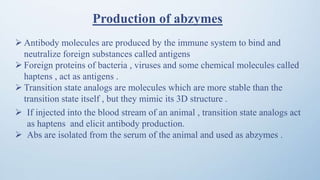
 Antibody molecules are produced by the immune system to bind and
neutralize foreign substances called antigens
 Foreign proteins of bacteria , viruses and some chemical molecules called
haptens , act as antigens .
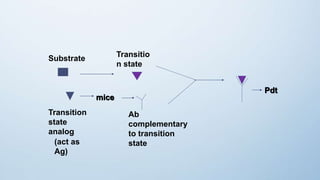
 Transition state analogs are molecules which are more stable than the
transition state itself , but they mimic its 3D structure .
 If injected into the blood stream of an animal , transition state analogs act
as haptens and elicit antibody production.
 Abs are isolated from the serum of the animal and used as abzymes .
Transitio
n state
Transition
state
analog
(act as
Ag)
Substrate
Ab
complementary
to transition
state
Pdt
mice
Examples for abzymes
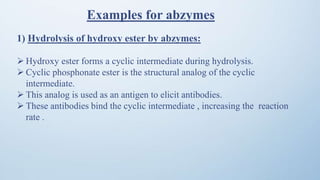
1) Hydrolysis of hydroxy ester by abzymes:
 Hydroxy ester forms a cyclic intermediate during hydrolysis.
 Cyclic phosphonate ester is the structural analog of the cyclic
intermediate.
 This analog is used as an antigen to elicit antibodies.
 These antibodies bind the cyclic intermediate , increasing the reaction
rate .
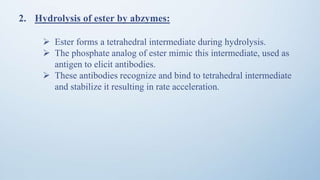
2. Hydrolysis of ester by abzymes:
 Ester forms a tetrahedral intermediate during hydrolysis.
 The phosphate analog of ester mimic this intermediate, used as
antigen to elicit antibodies.
 These antibodies recognize and bind to tetrahedral intermediate
and stabilize it resulting in rate acceleration.
3) Biosynthesis of Heme:
 It involves introduction of Fe2+ into protophorphyrine by
ferrochelatase.
 This process is called metallation.
 Metallation involves the distortation of pyrole ring by 36ºto create a
bent transition state.
 This state is apt for the entry Fe2+.
 Methyl mesoporphyrin , an analog of the bent transition state , is
used as antigen to elicit abzymes.
 These abzymes bind the bent transition state and distorts the
porphyrin facilitating metallation rate 2500fold higher.
Reactions catalyzed by Abzymes
1. Amide hydrolysis
2. Trans- Esterification
3. photo cleavage
4. Photodimerization
5. Decarboxylation
6. Oxidation
7. Cyclization
8. Reduction of diketone
9. Hydrolysis of enol ethers
Applications
1. Synthesis of simple organic molecules.
2. Drug development.
3. Treatment of Cancer.
4. Treating allergy.
5. To treat viral and bacterial infection.
Potential HIV treatment
 In June 2008 issue of the journal Autoimmunity Review, researchers of the
University Of Texas Medical School at Houston announced that they have
engineered an abzyme that degrades the super-antigenic region of
the gp120 CD4 binding site.
 This is the one part of the HIV-virus outer coating that does not change,
because it is the attachment point to T-lymphocytes, the key cell in cell-
mediated immunity.
 Once infected by HIV, patients produce antibodies to the more changeable
parts of the viral coat. The antibodies are ineffective because of the virus'
ability to change their coats rapidly.
 The abzyme does more than bind to the site, it catalytically destroys
the site, rendering the virus inert, and then can attack other HIV
viruses.
 A single abzyme molecule can destroy thousands of HIV viruses.
 Because this protein gp120 is necessary for HIV to attach, it does not
change across different strains and is a point of vulnerability across
the entire range of the HIV variant population.
Reference
 Enzymology –T. Devasena
 Planque, S; Nishiyama, Y; Taguchi, H; Salas, M; Hanson, C; Paul, S
(2008). "Catalytic antibodies to HIV: Physiological role and potential
clinical utility". Autoimmunity Reviews 7 (6): 473
doi:10.1016/j.autrev.2008.04.002. PMC 2527403. PMID 18558365.Jump
up^
 "UT pathologists believe they have pinpointed Achilles heel of
HIV". physorg.com. Retrieved 2008-07-16.
- JEEVA RAJ JOSEPH
1st M.Sc. Microbiology
MSRCASC
Thank you

Abzymes

  • 1.
    ABZYMES Submitted by, Jeeva RajJoseph 1st sem M.Sc. Microbiology MSRCASC
  • 2.
    Introduction  Antibodies andenzymes share the ability to bind with compounds with great specificity and high affinity.  This property has been exploited in the development of antibodies with catalytic activity.  One basic difference between antibodies and enzymes is that the former binds the complementary structure in its ground state , while enzymes bind in high energy state.  In 1986 , the 1st monoclonal catalytic antibodies termed abzymes against a chemically stable analog of the transition state of a reaction were obtained  Abzymes are catalytic antibodies having structural complementarity for the transition state of an enzyme catalyzed reaction.
  • 3.
    Abzyme  An abzyme(from antibody and enzyme), also called catmab (from catalytic monoclonal antibody), and most often called catalytic antibody, is a monoclonal antibody with catalytic activity.  They bind strongly to the transition state with high association constant, enhancing the reaction rate .  Abzymes reduce rotational entropy .
  • 4.
    Sources of Abzymes Abzymes are usually artificial constructs.  They also obtained from human and animal serum.  Found in normal humans and ii patients with autoimmune diseases.  These are capable of hydrolyzing proteins, DNA, RNA, polysaccharides, etc.
  • 5.
     Natural abzymeswith proteolytic activity are called Protabzymes .e.g.: hydrolysis of specific proteins in patients with autoimmune diseases such as bronchial Asthma ,multiple sclerosis.  DNA hydrolyzing activity are called DNA abzymes.  The pathogenic role of DNA abzymes is not quite clear. However they act as a powerful regulator of apoptosis. Protabzymes and DNAAbzymes
  • 6.
    Production of abzymes Antibody molecules are produced by the immune system to bind and neutralize foreign substances called antigens  Foreign proteins of bacteria , viruses and some chemical molecules called haptens , act as antigens .  Transition state analogs are molecules which are more stable than the transition state itself , but they mimic its 3D structure .  If injected into the blood stream of an animal , transition state analogs act as haptens and elicit antibody production.  Abs are isolated from the serum of the animal and used as abzymes .
  • 7.
  • 8.
    Examples for abzymes 1)Hydrolysis of hydroxy ester by abzymes:  Hydroxy ester forms a cyclic intermediate during hydrolysis.  Cyclic phosphonate ester is the structural analog of the cyclic intermediate.  This analog is used as an antigen to elicit antibodies.  These antibodies bind the cyclic intermediate , increasing the reaction rate .
  • 9.
    2. Hydrolysis ofester by abzymes:  Ester forms a tetrahedral intermediate during hydrolysis.  The phosphate analog of ester mimic this intermediate, used as antigen to elicit antibodies.  These antibodies recognize and bind to tetrahedral intermediate and stabilize it resulting in rate acceleration.
  • 10.
    3) Biosynthesis ofHeme:  It involves introduction of Fe2+ into protophorphyrine by ferrochelatase.  This process is called metallation.  Metallation involves the distortation of pyrole ring by 36ºto create a bent transition state.  This state is apt for the entry Fe2+.  Methyl mesoporphyrin , an analog of the bent transition state , is used as antigen to elicit abzymes.  These abzymes bind the bent transition state and distorts the porphyrin facilitating metallation rate 2500fold higher.
  • 11.
    Reactions catalyzed byAbzymes 1. Amide hydrolysis 2. Trans- Esterification 3. photo cleavage 4. Photodimerization 5. Decarboxylation 6. Oxidation 7. Cyclization 8. Reduction of diketone 9. Hydrolysis of enol ethers
  • 12.
    Applications 1. Synthesis ofsimple organic molecules. 2. Drug development. 3. Treatment of Cancer. 4. Treating allergy. 5. To treat viral and bacterial infection.
  • 13.
    Potential HIV treatment In June 2008 issue of the journal Autoimmunity Review, researchers of the University Of Texas Medical School at Houston announced that they have engineered an abzyme that degrades the super-antigenic region of the gp120 CD4 binding site.  This is the one part of the HIV-virus outer coating that does not change, because it is the attachment point to T-lymphocytes, the key cell in cell- mediated immunity.  Once infected by HIV, patients produce antibodies to the more changeable parts of the viral coat. The antibodies are ineffective because of the virus' ability to change their coats rapidly.
  • 14.
     The abzymedoes more than bind to the site, it catalytically destroys the site, rendering the virus inert, and then can attack other HIV viruses.  A single abzyme molecule can destroy thousands of HIV viruses.  Because this protein gp120 is necessary for HIV to attach, it does not change across different strains and is a point of vulnerability across the entire range of the HIV variant population.
  • 15.
    Reference  Enzymology –T.Devasena  Planque, S; Nishiyama, Y; Taguchi, H; Salas, M; Hanson, C; Paul, S (2008). "Catalytic antibodies to HIV: Physiological role and potential clinical utility". Autoimmunity Reviews 7 (6): 473 doi:10.1016/j.autrev.2008.04.002. PMC 2527403. PMID 18558365.Jump up^  "UT pathologists believe they have pinpointed Achilles heel of HIV". physorg.com. Retrieved 2008-07-16.
  • 16.
    - JEEVA RAJJOSEPH 1st M.Sc. Microbiology MSRCASC Thank you