Integrating Aboriginal
Resources into the Curriculum
   Grade 2 Social Studies: Communities In Canada
         Presented by Allison, Krista, Scott
 We assessed all of our resources to make sure that
  they were relevant and authentic utilizing
  Aboriginal Elders, community members, authors,
  and illustrators.
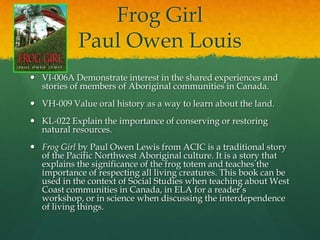
Frog Girl
            Paul Owen Louis
 VI-006A Demonstrate interest in the shared experiences and
  stories of members of Aboriginal communities in Canada.
 VH-009 Value oral history as a way to learn about the land.
 KL-022 Explain the importance of conserving or restoring
  natural resources.
 Frog Girl by Paul Owen Lewis from ACIC is a traditional story
  of the Pacific Northwest Aboriginal culture. It is a story that
  explains the significance of the frog totem and teaches the
  importance of respecting all living creatures. This book can be
  used in the context of Social Studies when teaching about West
  Coast communities in Canada, in ELA for a reader’s
  workshop, or in science when discussing the interdependence
  of living things.
What Am I Seeing?
            Karin Clark
 VI-006A Demonstrate interest in the shared experiences and
  stories of members of Aboriginal communities in Canada.
 VH-009 Value oral history as a way to learn about the land.
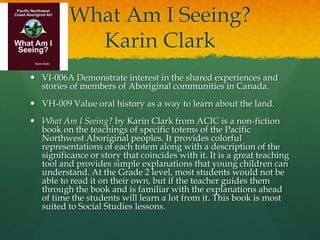
 What Am I Seeing? by Karin Clark from ACIC is a non-fiction
  book on the teachings of specific totems of the Pacific
  Northwest Aboriginal peoples. It provides colorful
  representations of each totem along with a description of the
  significance or story that coincides with it. It is a great teaching
  tool and provides simple explanations that young children can
  understand. At the Grade 2 level, most students would not be
  able to read it on their own, but if the teacher guides them
  through the book and is familiar with the explanations ahead
  of time the students will learn a lot from it. This book is most
  suited to Social Studies lessons.
Animal Tribe
      Websitehttp://www.animaltribe.com
   VI-006A Demonstrate interest in the shared experiences and stories of
    members of Aboriginal communities in Canada.

   VH-009 Value oral history as a way to learn about the land.

   http://www.animaltribe.com is a website that provides the resources
    necessary for creating your own totem pole with a paper towel roll. On it
    you can find the template for thunderbird which is typically featured at
    the top of a totem pole. Instead of using the pictures of the real animal as
    featured on the website, I chose to find images of Pacific Northwest
    artisanal representations of the different animal totems. I found that this
    further fostered appreciation for the artistic depictions that are an integral
    part of the Pacific Northwest Aboriginal culture and oral storytelling
    tradition.

   For a complete lesson plan that utilizes the above mentioned resources,
    please click HERE!
Traditional Inuit Games
   Social Studies
       2-VI-006A: Demonstrate interest in the shared experiences and stories of members of Aboriginal
        communities in Canada.

   Physical Education
       S.1.2.A.1.: Demonstrate competency in basic transport skills, moving in different directions.

   This webiste, any many others, show and explain how to do many of the traditional Inuit games
    that exist. This site is particularly good to use in the classroom because the ones who are
    demonstrating the games are Inuit children.

   Games include:
       The Kneel Jump
       The Back Push
       The Airplane
       The Sitting Knuckle Pull
       The Mouth Pull
       The Musk-ox Push

   A practical way to use this resource, is to show it to the class and then split them into research
    groups, having them research only one of the games. The students will look up its origin, and
    try to find a complete set of the rules for it. Each group will then present their research to the
    class, and then once everyone is done, we could have a class-wide Inuit games competition.

   http://www.athropolis.com/news-upload/master/11-frames.htm
Rainbow Crow
                                                          by: Nancy Van Laan


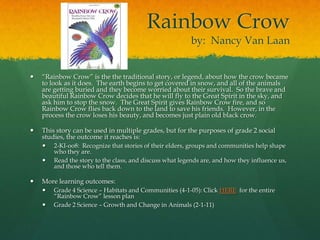
   “Rainbow Crow” is the the traditional story, or legend, about how the crow became
    to look as it does. The earth begins to get covered in snow, and all of the animals
    are getting buried and they become worried about their survival. So the brave and
    beautiful Rainbow Crow decides that he will fly to the Great Spirit in the sky, and
    ask him to stop the snow. The Great Spirit gives Rainbow Crow fire, and so
    Rainbow Crow flies back down to the land to save his friends. However, in the
    process the crow loses his beauty, and becomes just plain old black crow.

   This story can be used in multiple grades, but for the purposes of grade 2 social
    studies, the outcome it reaches is:
       2-KI-oo8: Recognize that stories of their elders, groups and communities help shape
        who they are.
       Read the story to the class, and discuss what legends are, and how they influence us,
        and those who tell them.

   More learning outcomes:
       Grade 4 Science – Habitats and Communities (4-1-05): Click HERE for the entire
        “Rainbow Crow” lesson plan
       Grade 2 Science – Growth and Change in Animals (2-1-11)
Frozen Land by
       Jan                                         Reynolds
   VI-006 Appreciate the diversity of ways of life in Canadian communities.

   KI-012 Identify common features of Canadian communities.

   KL-019 Describe natural and constructed features of communities studied.

   KL-023 Locate communities studied on a map of Canada.

   In this non-fiction book the author travels with an Inuit family to share a true story about their way of life. A real
    and educational look at everyday life in a Canadian community that is very different from our own. Kenalogak,
    the little girl, goes ice fishing, takes care of her father's sled dogs, and learns how to build an igloo and listens to
    hear grandmother throat sing. Shows real pictures about real people and focuses on Kenalogak, a young girl that
    would be about the same age as the students. This makes it very easy for young students to relate to. A map of the
    world is also included showing where the community is so students can locate where the community is in
    Canada.

   Help students value and understand a way of life different from their own.

   Have students compare their own lives to Kenalogak's. Talk about what is the same and different about their own
    community and her community.

   Throat Singing video http://www.youtube.com/watch?v=qtzBZGGy2l8

   For an entire lesson plan that utilizes this resource, please click HERE!
Email or Skype

 Email a classroom in an Inuit community in Northern
  Canada.
 Schools in Nunavut-
 http://www.aboriginalcanada.gc.ca/acp/site.nsf/eng/a
  o20507.html
 Or Skype a classroom to ask questions about their
  community.
 Skype in the Classroom –
 http://education.skype.com
The Moccasins
               Earl Einarson
 KE-036 Give examples of goods produced in Canadian
  communities.

 K-2 A-U3.1 Demonstrate understanding of ways in which
  artists and designers contribute to the quality of everyday life.

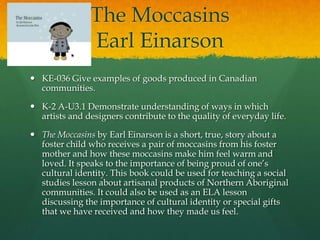
 The Moccasins by Earl Einarson is a short, true, story about a
  foster child who receives a pair of moccasins from his foster
  mother and how these moccasins make him feel warm and
  loved. It speaks to the importance of being proud of one’s
  cultural identity. This book could be used for teaching a social
  studies lesson about artisanal products of Northern Aboriginal
  communities. It could also be used as an ELA lesson
  discussing the importance of cultural identity or special gifts
  that we have received and how they made us feel.
My Arctic 1, 2, 3
           MichealKusugak
 KL-021 Give examples of ways in which the natural
  environment shapes daily life in communities studied.
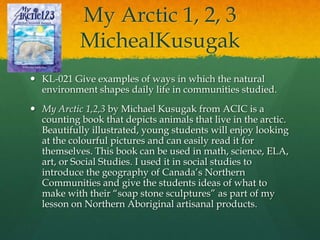
 My Arctic 1,2,3 by Michael Kusugak from ACIC is a
  counting book that depicts animals that live in the arctic.
  Beautifully illustrated, young students will enjoy looking
  at the colourful pictures and can easily read it for
  themselves. This book can be used in math, science, ELA,
  art, or Social Studies. I used it in social studies to
  introduce the geography of Canada’s Northern
  Communities and give the students ideas of what to
  make with their “soap stone sculptures” as part of my
  lesson on Northern Aboriginal artisanal products.
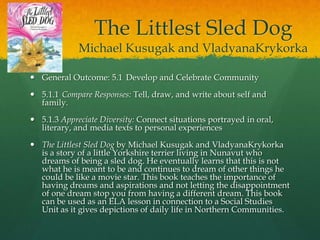
The Littlest Sled Dog
             Michael Kusugak and VladyanaKrykorka

 General Outcome: 5.1 Develop and Celebrate Community

 5.1.1 Compare Responses: Tell, draw, and write about self and
  family.

 5.1.3 Appreciate Diversity: Connect situations portrayed in oral,
  literary, and media texts to personal experiences

 The Littlest Sled Dog by Michael Kusugak and VladyanaKrykorka
  is a story of a little Yorkshire terrier living in Nunavut who
  dreams of being a sled dog. He eventually learns that this is not
  what he is meant to be and continues to dream of other things he
  could be like a movie star. This book teaches the importance of
  having dreams and aspirations and not letting the disappointment
  of one dream stop you from having a different dream. This book
  can be used as an ELA lesson in connection to a Social Studies
  Unit as it gives depictions of daily life in Northern Communities.
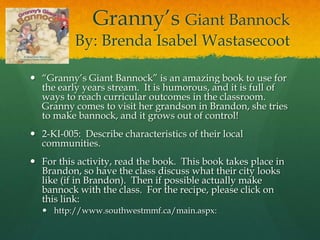
Granny’s Giant Bannock
          By: Brenda Isabel Wastasecoot

 “Granny’s Giant Bannock” is an amazing book to use for
  the early years stream. It is humorous, and it is full of
  ways to reach curricular outcomes in the classroom.
  Granny comes to visit her grandson in Brandon, she tries
  to make bannock, and it grows out of control!
 2-KI-005: Describe characteristics of their local
  communities.
 For this activity, read the book. This book takes place in
  Brandon, so have the class discuss what their city looks
  like (if in Brandon). Then if possible actually make
  bannock with the class. For the recipe, please click on
  this link:
   http://www.southwestmmf.ca/main.aspx:
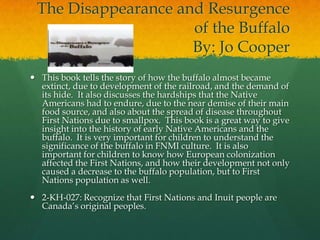
The Disappearance and Resurgence
                     of the Buffalo
                     By: Jo Cooper
 This book tells the story of how the buffalo almost became
  extinct, due to development of the railroad, and the demand of
  its hide. It also discusses the hardships that the Native
  Americans had to endure, due to the near demise of their main
  food source, and also about the spread of disease throughout
  First Nations due to smallpox. This book is a great way to give
  insight into the history of early Native Americans and the
  buffalo. It is very important for children to understand the
  significance of the buffalo in FNMI culture. It is also
  important for children to know how European colonization
  affected the First Nations, and how their development not only
  caused a decrease to the buffalo population, but to First
  Nations population as well.
 2-KH-027: Recognize that First Nations and Inuit people are
  Canada’s original peoples.
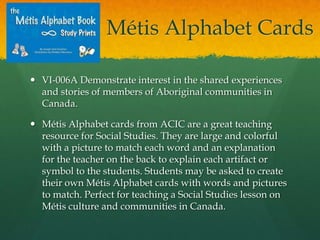
Métis Alphabet Cards

 VI-006A Demonstrate interest in the shared experiences
  and stories of members of Aboriginal communities in
  Canada.

 Métis Alphabet cards from ACIC are a great teaching
  resource for Social Studies. They are large and colorful
  with a picture to match each word and an explanation
  for the teacher on the back to explain each artifact or
  symbol to the students. Students may be asked to create
  their own Métis Alphabet cards with words and pictures
  to match. Perfect for teaching a Social Studies lesson on
  Métis culture and communities in Canada.
Manitoba Métis Federation
                  (204) 725-7520
      http://www.southwestmmf.ca/main.aspx:


 VI-006A Demonstrate interest in the shared experiences
  and stories of members of Aboriginal communities in
  Canada.

 Ask an Elder make a presentation to the class on Métis
  culture. Elders bring historical and cultural artifacts,
  knowledge and experience, and act as an ambassador for
  their culture. They are experts on the history and culture
  of their people and are able to share it with students at
  an age appropriate level. This is an important aspect of
  integrating Aboriginal perspectives/pedagogies/content
  into the curriculum.
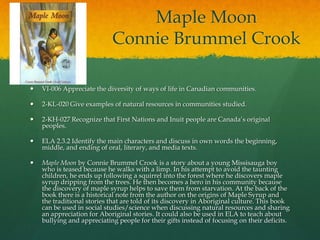
Maple Moon
                            Connie Brummel Crook

   VI-006 Appreciate the diversity of ways of life in Canadian communities.

   2-KL-020 Give examples of natural resources in communities studied.

   2-KH-027 Recognize that First Nations and Inuit people are Canada’s original
    peoples.

   ELA 2.3.2 Identify the main characters and discuss in own words the beginning,
    middle, and ending of oral, literary, and media texts.

   Maple Moon by Connie Brummel Crook is a story about a young Missisauga boy
    who is teased because he walks with a limp. In his attempt to avoid the taunting
    children, he ends up following a squirrel into the forest where he discovers maple
    syrup dripping from the trees. He then becomes a hero in his community because
    the discovery of maple syrup helps to save them from starvation. At the back of the
    book there is a historical note from the author on the origins of Maple Syrup and
    the traditional stories that are told of its discovery in Aboriginal culture. This book
    can be used in social studies/science when discussing natural resources and sharing
    an appreciation for Aboriginal stories. It could also be used in ELA to teach about
    bullying and appreciating people for their gifts instead of focusing on their deficits.
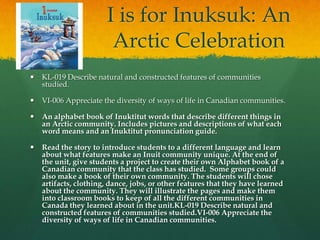
I is for Inuksuk: An
                        Arctic Celebration
   KL-019 Describe natural and constructed features of communities
    studied.

   VI-006 Appreciate the diversity of ways of life in Canadian communities.

   An alphabet book of Inuktitut words that describe different things in
    an Arctic community. Includes pictures and descriptions of what each
    word means and an Inuktitut pronunciation guide.

   Read the story to introduce students to a different language and learn
    about what features make an Inuit community unique. At the end of
    the unit, give students a project to create their own Alphabet book of a
    Canadian community that the class has studied. Some groups could
    also make a book of their own community. The students will chose
    artifacts, clothing, dance, jobs, or other features that they have learned
    about the community. They will illustrate the pages and make them
    into classroom books to keep of all the different communities in
    Canada they learned about in the unit.KL-019 Describe natural and
    constructed features of communities studied.VI-006 Appreciate the
    diversity of ways of life in Canadian communities.
Campsite 24

   VI-006 Appreciate the diversity of ways of life in Canadian communities.

   KL-020 Give examples of natural resources in communities studied.

   KE-036 Give examples of goods produced in Canadian communities

   An online, interactive game which takes players in a time machine. You may choose Geological
    Era, Aboriginal Era, Early Settlers Era or modern day. The Aboriginal Era takes players back 500
    years. Players click on different clues to make their way through the game, learning as they go.
    You must complete activities like sorting words onto the correct place on a medicine wheel. The
    game describes many Ojibwa artifacts and teaches the importance of environmental protection.

   Play this game as a whole class on a SMART-board. Have students take turns coming up to click
    on different artifacts and complete challenges together. They will have fun and learn a lot of
    Ojibwa culture and values at the same time. There is too much reading for Grade 2 children to
    play on their own but it would be great as a group.VI-006 Appreciate the diversity of ways of
    life in Canadian communities.KL-020 Give examples of natural resources in communities
    studied.KE-036 Give examples of goods produced in Canadian communities.

   http://www.campsite24.ca/aboriginal.html
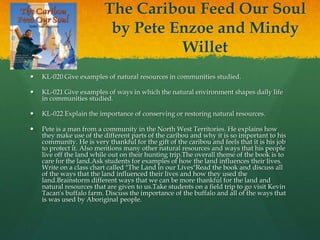
The Caribou Feed Our Soul
                           by Pete Enzoe and Mindy
                                    Willet
   KL-020 Give examples of natural resources in communities studied.

   KL-021 Give examples of ways in which the natural environment shapes daily life
    in communities studied.

   KL-022 Explain the importance of conserving or restoring natural resources.

   Pete is a man from a community in the North West Territories. He explains how
    they make use of the different parts of the caribou and why it is so important to his
    community. He is very thankful for the gift of the caribou and feels that it is his job
    to protect it. Also mentions many other natural resources and ways that his people
    live off the land while out on their hunting trip.The overall theme of the book is to
    care for the land.Ask students for examples of how the land influences their lives.
    Write on a class chart called "The Land in our Lives"Read the book and discuss all
    of the ways that the land influenced their lives and how they used the
    land.Brainstorm different ways that we can be more thankful for the land and
    natural resources that are given to us.Take students on a field trip to go visit Kevin
    Tacan's buffalo farm. Discuss the importance of the buffalo and all of the ways that
    is was used by Aboriginal people.
Oral Storytelling Bag

   VH-009 Value oral history as a way to learn about the land.

    Dr-C1.1 Experiment with and use a variety of idea sources (e.g., themes, personal
    experiences, pictures, learning in other subject areas) for dramatic play

   Make oral storytelling part of your class. Practice until you are able to tell at least
    one Aboriginal story from memory. Have a discussion with the students about why
    the characters behaved the way that they did and what they learned from the story.
    Retell the story having students role-play certain parts. (e.g What might the animals
    say to the main character at this point?)

   Create a class "storytelling bag". Ask students to help by bringing in one item each.
    Encourage them to try and find something natural that comes from the land. For
    example, a feather, stone, shell, grain. Pass the bag around the classroom. The
    storyteller grabs one item out of the bag, shows it to the class, and tells a story about
    the item to practice their oral storytelling skills.

   Link and story examples:

   http://www.aadnc-aandc.gc.ca/eng/1316530132377/1316530184659
Resources
   http://www.animaltribe.com

   http://www.aadnc-aandc.gc.ca/eng/1316530132377/1316530184659

   http://www.campsite24.ca/aboriginal.html

   http://www.youtube.com/watch?v=qtzBZGGy2l8

   http://www.southwestmmf.ca/main.aspx:

   http://www.southwestmmf.ca/main.aspx:

   http://www.athropolis.com/news-upload/master/11-frames.htm

   Laan, Nancy V. Rainbow Crow. New York: Dragonfly Books, 1989.

   Cooper, Jo. The Disappearance & Resurgence of the Buffalo. Pemmican
    Publications, 1996.

   Wastasecoot, Brenda Isabel. Granny’s Giant Bannock. Winnipeg: Pemmican
    Publications Ltd, 2008

   Lewis, Paul O. Frog Girl.
Resources

   Clark, Karin. What Am I Seeing?

   Crook, Connie B. Maple Moon.

   Métis Alphabet Cards

   Kusugak, Michael. Littlest Sled Dog.

   Einarson, Earl. The Moccasins.

   Kusugak, Michael. My Artic 1, 2, 3.

   Reynolds, Jan. Frozen Land

   Wallace, Mary. I is for Inuksuk: An Arctic Celebration

   Enzoe, Pete and Mindy Willet. The Caribou Feed our Soul

   All of these books can be found on www.amazon.ca or at the ACIC resource centre at Brandon University.

   h

Aboriginal curriculum portfolio

  • 1.
    Integrating Aboriginal Resources intothe Curriculum Grade 2 Social Studies: Communities In Canada Presented by Allison, Krista, Scott
  • 2.
     We assessedall of our resources to make sure that they were relevant and authentic utilizing Aboriginal Elders, community members, authors, and illustrators.
  • 3.
    Frog Girl Paul Owen Louis  VI-006A Demonstrate interest in the shared experiences and stories of members of Aboriginal communities in Canada.  VH-009 Value oral history as a way to learn about the land.  KL-022 Explain the importance of conserving or restoring natural resources.  Frog Girl by Paul Owen Lewis from ACIC is a traditional story of the Pacific Northwest Aboriginal culture. It is a story that explains the significance of the frog totem and teaches the importance of respecting all living creatures. This book can be used in the context of Social Studies when teaching about West Coast communities in Canada, in ELA for a reader’s workshop, or in science when discussing the interdependence of living things.
  • 4.
    What Am ISeeing? Karin Clark  VI-006A Demonstrate interest in the shared experiences and stories of members of Aboriginal communities in Canada.  VH-009 Value oral history as a way to learn about the land.  What Am I Seeing? by Karin Clark from ACIC is a non-fiction book on the teachings of specific totems of the Pacific Northwest Aboriginal peoples. It provides colorful representations of each totem along with a description of the significance or story that coincides with it. It is a great teaching tool and provides simple explanations that young children can understand. At the Grade 2 level, most students would not be able to read it on their own, but if the teacher guides them through the book and is familiar with the explanations ahead of time the students will learn a lot from it. This book is most suited to Social Studies lessons.
  • 5.
    Animal Tribe Websitehttp://www.animaltribe.com  VI-006A Demonstrate interest in the shared experiences and stories of members of Aboriginal communities in Canada.  VH-009 Value oral history as a way to learn about the land.  http://www.animaltribe.com is a website that provides the resources necessary for creating your own totem pole with a paper towel roll. On it you can find the template for thunderbird which is typically featured at the top of a totem pole. Instead of using the pictures of the real animal as featured on the website, I chose to find images of Pacific Northwest artisanal representations of the different animal totems. I found that this further fostered appreciation for the artistic depictions that are an integral part of the Pacific Northwest Aboriginal culture and oral storytelling tradition.  For a complete lesson plan that utilizes the above mentioned resources, please click HERE!
  • 6.
    Traditional Inuit Games  Social Studies  2-VI-006A: Demonstrate interest in the shared experiences and stories of members of Aboriginal communities in Canada.  Physical Education  S.1.2.A.1.: Demonstrate competency in basic transport skills, moving in different directions.  This webiste, any many others, show and explain how to do many of the traditional Inuit games that exist. This site is particularly good to use in the classroom because the ones who are demonstrating the games are Inuit children.  Games include:  The Kneel Jump  The Back Push  The Airplane  The Sitting Knuckle Pull  The Mouth Pull  The Musk-ox Push  A practical way to use this resource, is to show it to the class and then split them into research groups, having them research only one of the games. The students will look up its origin, and try to find a complete set of the rules for it. Each group will then present their research to the class, and then once everyone is done, we could have a class-wide Inuit games competition.  http://www.athropolis.com/news-upload/master/11-frames.htm
  • 7.
    Rainbow Crow by: Nancy Van Laan  “Rainbow Crow” is the the traditional story, or legend, about how the crow became to look as it does. The earth begins to get covered in snow, and all of the animals are getting buried and they become worried about their survival. So the brave and beautiful Rainbow Crow decides that he will fly to the Great Spirit in the sky, and ask him to stop the snow. The Great Spirit gives Rainbow Crow fire, and so Rainbow Crow flies back down to the land to save his friends. However, in the process the crow loses his beauty, and becomes just plain old black crow.  This story can be used in multiple grades, but for the purposes of grade 2 social studies, the outcome it reaches is:  2-KI-oo8: Recognize that stories of their elders, groups and communities help shape who they are.  Read the story to the class, and discuss what legends are, and how they influence us, and those who tell them.  More learning outcomes:  Grade 4 Science – Habitats and Communities (4-1-05): Click HERE for the entire “Rainbow Crow” lesson plan  Grade 2 Science – Growth and Change in Animals (2-1-11)
  • 8.
    Frozen Land by Jan Reynolds  VI-006 Appreciate the diversity of ways of life in Canadian communities.  KI-012 Identify common features of Canadian communities.  KL-019 Describe natural and constructed features of communities studied.  KL-023 Locate communities studied on a map of Canada.  In this non-fiction book the author travels with an Inuit family to share a true story about their way of life. A real and educational look at everyday life in a Canadian community that is very different from our own. Kenalogak, the little girl, goes ice fishing, takes care of her father's sled dogs, and learns how to build an igloo and listens to hear grandmother throat sing. Shows real pictures about real people and focuses on Kenalogak, a young girl that would be about the same age as the students. This makes it very easy for young students to relate to. A map of the world is also included showing where the community is so students can locate where the community is in Canada.  Help students value and understand a way of life different from their own.  Have students compare their own lives to Kenalogak's. Talk about what is the same and different about their own community and her community.  Throat Singing video http://www.youtube.com/watch?v=qtzBZGGy2l8  For an entire lesson plan that utilizes this resource, please click HERE!
  • 9.
    Email or Skype Email a classroom in an Inuit community in Northern Canada.  Schools in Nunavut-  http://www.aboriginalcanada.gc.ca/acp/site.nsf/eng/a o20507.html  Or Skype a classroom to ask questions about their community.  Skype in the Classroom –  http://education.skype.com
  • 10.
    The Moccasins Earl Einarson  KE-036 Give examples of goods produced in Canadian communities.  K-2 A-U3.1 Demonstrate understanding of ways in which artists and designers contribute to the quality of everyday life.  The Moccasins by Earl Einarson is a short, true, story about a foster child who receives a pair of moccasins from his foster mother and how these moccasins make him feel warm and loved. It speaks to the importance of being proud of one’s cultural identity. This book could be used for teaching a social studies lesson about artisanal products of Northern Aboriginal communities. It could also be used as an ELA lesson discussing the importance of cultural identity or special gifts that we have received and how they made us feel.
  • 11.
    My Arctic 1,2, 3 MichealKusugak  KL-021 Give examples of ways in which the natural environment shapes daily life in communities studied.  My Arctic 1,2,3 by Michael Kusugak from ACIC is a counting book that depicts animals that live in the arctic. Beautifully illustrated, young students will enjoy looking at the colourful pictures and can easily read it for themselves. This book can be used in math, science, ELA, art, or Social Studies. I used it in social studies to introduce the geography of Canada’s Northern Communities and give the students ideas of what to make with their “soap stone sculptures” as part of my lesson on Northern Aboriginal artisanal products.
  • 12.
    The Littlest SledDog Michael Kusugak and VladyanaKrykorka  General Outcome: 5.1 Develop and Celebrate Community  5.1.1 Compare Responses: Tell, draw, and write about self and family.  5.1.3 Appreciate Diversity: Connect situations portrayed in oral, literary, and media texts to personal experiences  The Littlest Sled Dog by Michael Kusugak and VladyanaKrykorka is a story of a little Yorkshire terrier living in Nunavut who dreams of being a sled dog. He eventually learns that this is not what he is meant to be and continues to dream of other things he could be like a movie star. This book teaches the importance of having dreams and aspirations and not letting the disappointment of one dream stop you from having a different dream. This book can be used as an ELA lesson in connection to a Social Studies Unit as it gives depictions of daily life in Northern Communities.
  • 13.
    Granny’s Giant Bannock By: Brenda Isabel Wastasecoot  “Granny’s Giant Bannock” is an amazing book to use for the early years stream. It is humorous, and it is full of ways to reach curricular outcomes in the classroom. Granny comes to visit her grandson in Brandon, she tries to make bannock, and it grows out of control!  2-KI-005: Describe characteristics of their local communities.  For this activity, read the book. This book takes place in Brandon, so have the class discuss what their city looks like (if in Brandon). Then if possible actually make bannock with the class. For the recipe, please click on this link:  http://www.southwestmmf.ca/main.aspx:
  • 14.
    The Disappearance andResurgence of the Buffalo By: Jo Cooper  This book tells the story of how the buffalo almost became extinct, due to development of the railroad, and the demand of its hide. It also discusses the hardships that the Native Americans had to endure, due to the near demise of their main food source, and also about the spread of disease throughout First Nations due to smallpox. This book is a great way to give insight into the history of early Native Americans and the buffalo. It is very important for children to understand the significance of the buffalo in FNMI culture. It is also important for children to know how European colonization affected the First Nations, and how their development not only caused a decrease to the buffalo population, but to First Nations population as well.  2-KH-027: Recognize that First Nations and Inuit people are Canada’s original peoples.
  • 15.
    Métis Alphabet Cards VI-006A Demonstrate interest in the shared experiences and stories of members of Aboriginal communities in Canada.  Métis Alphabet cards from ACIC are a great teaching resource for Social Studies. They are large and colorful with a picture to match each word and an explanation for the teacher on the back to explain each artifact or symbol to the students. Students may be asked to create their own Métis Alphabet cards with words and pictures to match. Perfect for teaching a Social Studies lesson on Métis culture and communities in Canada.
  • 16.
    Manitoba Métis Federation (204) 725-7520 http://www.southwestmmf.ca/main.aspx:  VI-006A Demonstrate interest in the shared experiences and stories of members of Aboriginal communities in Canada.  Ask an Elder make a presentation to the class on Métis culture. Elders bring historical and cultural artifacts, knowledge and experience, and act as an ambassador for their culture. They are experts on the history and culture of their people and are able to share it with students at an age appropriate level. This is an important aspect of integrating Aboriginal perspectives/pedagogies/content into the curriculum.
  • 17.
    Maple Moon Connie Brummel Crook  VI-006 Appreciate the diversity of ways of life in Canadian communities.  2-KL-020 Give examples of natural resources in communities studied.  2-KH-027 Recognize that First Nations and Inuit people are Canada’s original peoples.  ELA 2.3.2 Identify the main characters and discuss in own words the beginning, middle, and ending of oral, literary, and media texts.  Maple Moon by Connie Brummel Crook is a story about a young Missisauga boy who is teased because he walks with a limp. In his attempt to avoid the taunting children, he ends up following a squirrel into the forest where he discovers maple syrup dripping from the trees. He then becomes a hero in his community because the discovery of maple syrup helps to save them from starvation. At the back of the book there is a historical note from the author on the origins of Maple Syrup and the traditional stories that are told of its discovery in Aboriginal culture. This book can be used in social studies/science when discussing natural resources and sharing an appreciation for Aboriginal stories. It could also be used in ELA to teach about bullying and appreciating people for their gifts instead of focusing on their deficits.
  • 18.
    I is forInuksuk: An Arctic Celebration  KL-019 Describe natural and constructed features of communities studied.  VI-006 Appreciate the diversity of ways of life in Canadian communities.  An alphabet book of Inuktitut words that describe different things in an Arctic community. Includes pictures and descriptions of what each word means and an Inuktitut pronunciation guide.  Read the story to introduce students to a different language and learn about what features make an Inuit community unique. At the end of the unit, give students a project to create their own Alphabet book of a Canadian community that the class has studied. Some groups could also make a book of their own community. The students will chose artifacts, clothing, dance, jobs, or other features that they have learned about the community. They will illustrate the pages and make them into classroom books to keep of all the different communities in Canada they learned about in the unit.KL-019 Describe natural and constructed features of communities studied.VI-006 Appreciate the diversity of ways of life in Canadian communities.
  • 19.
    Campsite 24  VI-006 Appreciate the diversity of ways of life in Canadian communities.  KL-020 Give examples of natural resources in communities studied.  KE-036 Give examples of goods produced in Canadian communities  An online, interactive game which takes players in a time machine. You may choose Geological Era, Aboriginal Era, Early Settlers Era or modern day. The Aboriginal Era takes players back 500 years. Players click on different clues to make their way through the game, learning as they go. You must complete activities like sorting words onto the correct place on a medicine wheel. The game describes many Ojibwa artifacts and teaches the importance of environmental protection.  Play this game as a whole class on a SMART-board. Have students take turns coming up to click on different artifacts and complete challenges together. They will have fun and learn a lot of Ojibwa culture and values at the same time. There is too much reading for Grade 2 children to play on their own but it would be great as a group.VI-006 Appreciate the diversity of ways of life in Canadian communities.KL-020 Give examples of natural resources in communities studied.KE-036 Give examples of goods produced in Canadian communities.  http://www.campsite24.ca/aboriginal.html
  • 20.
    The Caribou FeedOur Soul by Pete Enzoe and Mindy Willet  KL-020 Give examples of natural resources in communities studied.  KL-021 Give examples of ways in which the natural environment shapes daily life in communities studied.  KL-022 Explain the importance of conserving or restoring natural resources.  Pete is a man from a community in the North West Territories. He explains how they make use of the different parts of the caribou and why it is so important to his community. He is very thankful for the gift of the caribou and feels that it is his job to protect it. Also mentions many other natural resources and ways that his people live off the land while out on their hunting trip.The overall theme of the book is to care for the land.Ask students for examples of how the land influences their lives. Write on a class chart called "The Land in our Lives"Read the book and discuss all of the ways that the land influenced their lives and how they used the land.Brainstorm different ways that we can be more thankful for the land and natural resources that are given to us.Take students on a field trip to go visit Kevin Tacan's buffalo farm. Discuss the importance of the buffalo and all of the ways that is was used by Aboriginal people.
  • 21.
    Oral Storytelling Bag  VH-009 Value oral history as a way to learn about the land.  Dr-C1.1 Experiment with and use a variety of idea sources (e.g., themes, personal experiences, pictures, learning in other subject areas) for dramatic play  Make oral storytelling part of your class. Practice until you are able to tell at least one Aboriginal story from memory. Have a discussion with the students about why the characters behaved the way that they did and what they learned from the story. Retell the story having students role-play certain parts. (e.g What might the animals say to the main character at this point?)  Create a class "storytelling bag". Ask students to help by bringing in one item each. Encourage them to try and find something natural that comes from the land. For example, a feather, stone, shell, grain. Pass the bag around the classroom. The storyteller grabs one item out of the bag, shows it to the class, and tells a story about the item to practice their oral storytelling skills.  Link and story examples:  http://www.aadnc-aandc.gc.ca/eng/1316530132377/1316530184659
  • 22.
    Resources  http://www.animaltribe.com  http://www.aadnc-aandc.gc.ca/eng/1316530132377/1316530184659  http://www.campsite24.ca/aboriginal.html  http://www.youtube.com/watch?v=qtzBZGGy2l8  http://www.southwestmmf.ca/main.aspx:  http://www.southwestmmf.ca/main.aspx:  http://www.athropolis.com/news-upload/master/11-frames.htm  Laan, Nancy V. Rainbow Crow. New York: Dragonfly Books, 1989.  Cooper, Jo. The Disappearance & Resurgence of the Buffalo. Pemmican Publications, 1996.  Wastasecoot, Brenda Isabel. Granny’s Giant Bannock. Winnipeg: Pemmican Publications Ltd, 2008  Lewis, Paul O. Frog Girl.
  • 23.
    Resources  Clark, Karin. What Am I Seeing?  Crook, Connie B. Maple Moon.  Métis Alphabet Cards  Kusugak, Michael. Littlest Sled Dog.  Einarson, Earl. The Moccasins.  Kusugak, Michael. My Artic 1, 2, 3.  Reynolds, Jan. Frozen Land  Wallace, Mary. I is for Inuksuk: An Arctic Celebration  Enzoe, Pete and Mindy Willet. The Caribou Feed our Soul  All of these books can be found on www.amazon.ca or at the ACIC resource centre at Brandon University.  h