ALTERNATIVE DV PROGRAMS Facilitator Training MAIN.pptx
Slides for facilitator training on alternative domestic violence programs presented at the Association of Batters Intervention Programs (ABIP) monthly meeting January 23, 2026.
ALTERNATIVE DV PROGRAMS Facilitator Training MAIN.pptx
1.
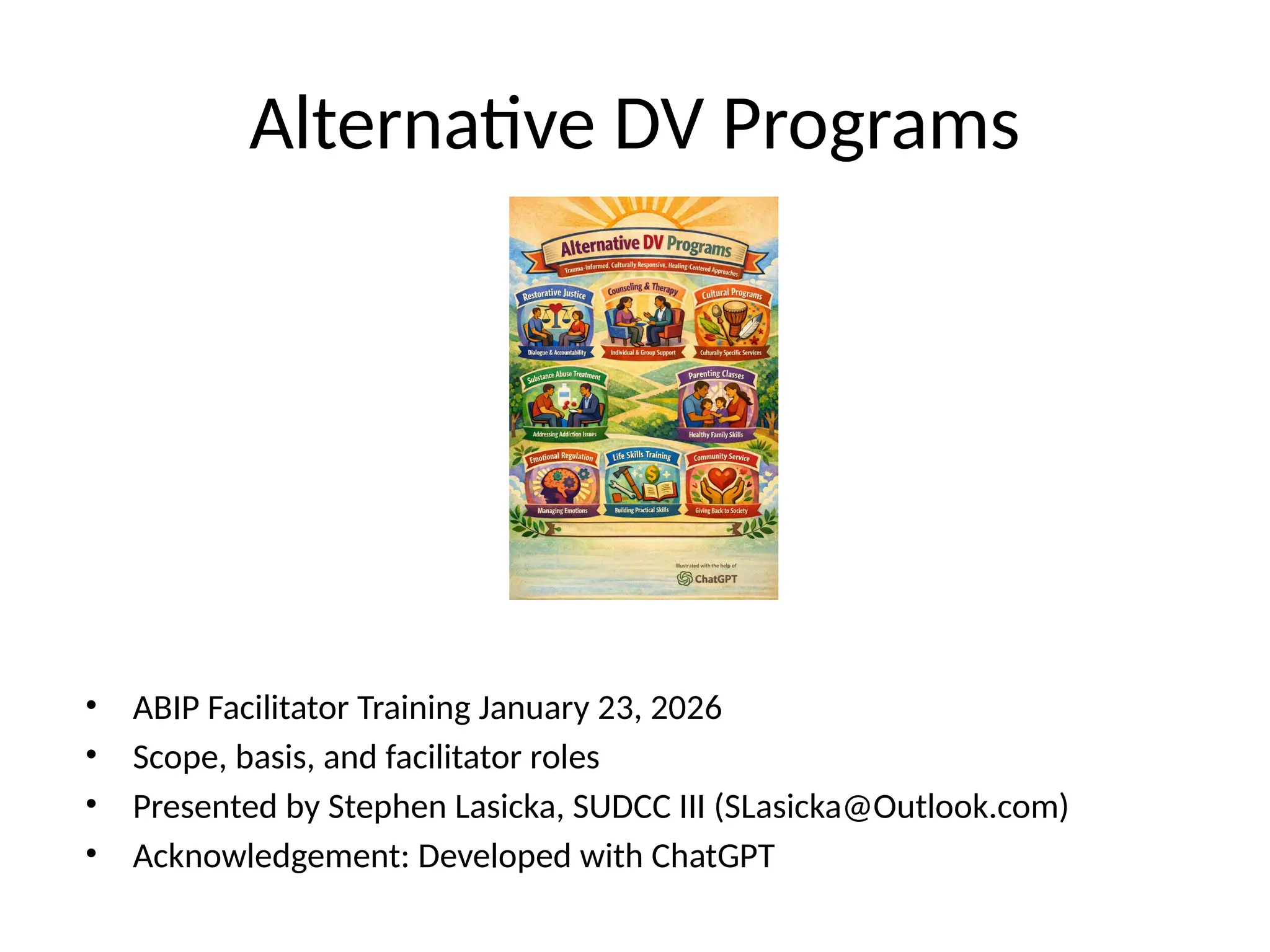
Alternative DV Programs
•ABIP Facilitator Training January 23, 2026
• Scope, basis, and facilitator roles
• Presented by Stephen Lasicka, SUDCC III (SLasicka@Outlook.com)
• Acknowledgement: Developed with ChatGPT
3.
Objectives
Consider:
• Why haveAlternative Domestic Violence (DV) programs?
• Facilitator roles
• Accountability and safety
• Reasons for change
4.
What AB 1549Authorizes
• Extends alternative DV programs in certain counties through 2030
• Includes Sacramento
• Does not replace BIPs.
Status: In legislative process; introduced January 7, 2026.
5.
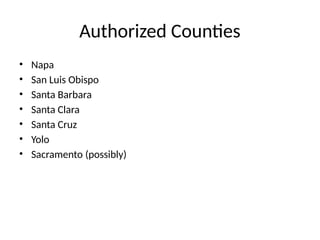
Authorized Counties
• Napa
•San Luis Obispo
• Santa Barbara
• Santa Clara
• Santa Cruz
• Yolo
• Sacramento (possibly)
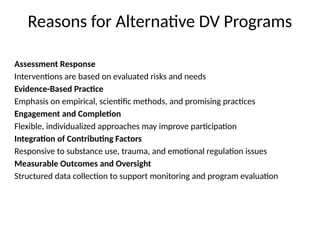
Reasons for AlternativeDV Programs
Assessment Response
Interventions are based on evaluated risks and needs
Evidence-Based Practice
Emphasis on empirical, scientific methods, and promising practices
Engagement and Completion
Flexible, individualized approaches may improve participation
Integration of Contributing Factors
Responsive to substance use, trauma, and emotional regulation issues
Measurable Outcomes and Oversight
Structured data collection to support monitoring and program evaluation
8.
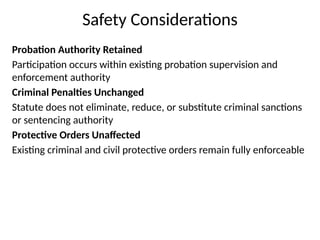
Safety Considerations
Probation AuthorityRetained
Participation occurs within existing probation supervision and
enforcement authority
Criminal Penalties Unchanged
Statute does not eliminate, reduce, or substitute criminal sanctions
or sentencing authority
Protective Orders Unaffected
Existing criminal and civil protective orders remain fully enforceable
Alternative Approaches
7. LifeSkills Training
• Improves communication & problem-solving
• Enhances stress management
• Encourages responsible decision-making
16.
Alternative Approaches
8. CommunityService
• Fosters empathy & social responsibility
• Strengthens prosocial identity
• Encourages reintegration into society
17.
Core Legal Requirements
•Validated risk assessment
• Written curriculum
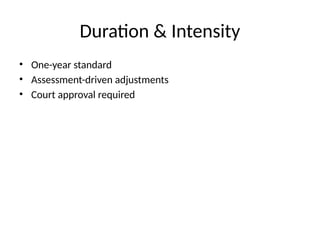
• One-year standard
• Outcome reporting
18.
Program Approval
⚖️Important distinction:
•For a standard batterer’s intervention program under
1203.097, the county probation department must approve
the program before a court can refer participants to it.
• For an alternative program under 1203.099, the statute sets
criteria counties must meet to offer the program. It doesn’t
specify a state-level approval step beyond those criteria.
19.
Risk & NeedsAssessment
• Required for all participants
• Drives focus and intensity
• Responds indirectly to California State Auditor’s 2022 report
• Assessment replaces one-size-fits-all
20.
Facilitator Role
• Aligncontent to risk
• Challenge minimization
• Document resistance
• Assessment evaluation
21.
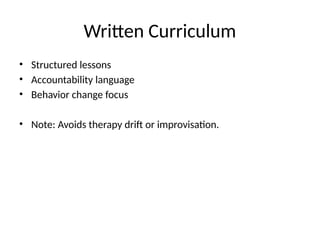
Written Curriculum
• Structuredlessons
• Accountability language
• Behavior change focus
• Note: Avoids therapy drift or improvisation.
22.
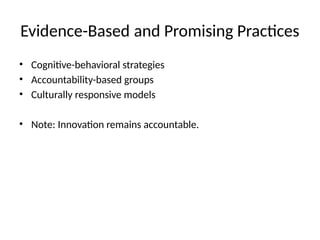
Evidence-Based and PromisingPractices
• Cognitive-behavioral strategies
• Accountability-based groups
• Culturally responsive models
• Note: Innovation remains accountable.
23.
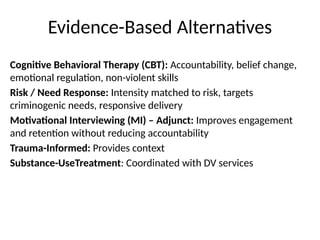
Evidence-Based Alternatives
Cognitive BehavioralTherapy (CBT): Accountability, belief change,
emotional regulation, non-violent skills
Risk / Need Response: Intensity matched to risk, targets
criminogenic needs, responsive delivery
Motivational Interviewing (MI) – Adjunct: Improves engagement
and retention without reducing accountability
Trauma-Informed: Provides context
Substance-UseTreatment: Coordinated with DV services
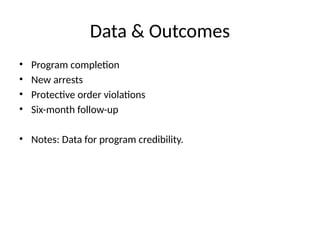
Data & Outcomes
•Program completion
• New arrests
• Protective order violations
• Six-month follow-up
• Notes: Data for program credibility.
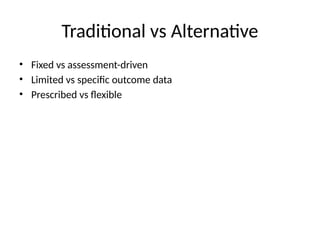
26.
Traditional vs Alternative
•Fixed vs assessment-driven
• Limited vs specific outcome data
• Prescribed vs flexible
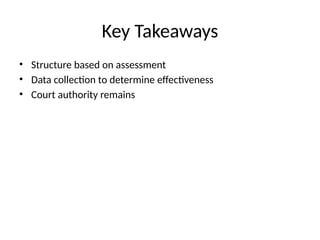
27.
Key Takeaways
• Structurebased on assessment
• Data collection to determine effectiveness
• Court authority remains
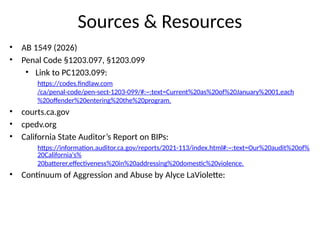
28.
Sources & Resources
•AB 1549 (2026)
• Penal Code §1203.097, §1203.099
• Link to PC1203.099:
https://codes.findlaw.com
/ca/penal-code/pen-sect-1203-099/#:~:text=Current%20as%20of%20January%2001,each
%20offender%20entering%20the%20program.
• courts.ca.gov
• cpedv.org
• California State Auditor’s Report on BIPs:
https://information.auditor.ca.gov/reports/2021-113/index.html#:~:text=Our%20audit%20of%
20California's%
20batterer,effectiveness%20in%20addressing%20domestic%20violence.
• Continuum of Aggression and Abuse by Alyce LaViolette:
29.
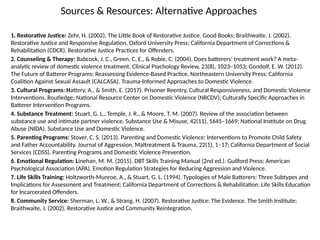
Sources & Resources:Alternative Approaches
1. Restorative Justice: Zehr, H. (2002). The Little Book of Restorative Justice. Good Books; Braithwaite, J. (2002).
Restorative Justice and Responsive Regulation. Oxford University Press; California Department of Corrections &
Rehabilitation (CDCR). Restorative Justice Practices for Offenders.
2. Counseling & Therapy: Babcock, J. C., Green, C. E., & Robie, C. (2004). Does batterers’ treatment work? A meta-
analytic review of domestic violence treatment. Clinical Psychology Review, 23(8), 1023–1053; Gondolf, E. W. (2012).
The Future of Batterer Programs: Reassessing Evidence-Based Practice. Northeastern University Press; California
Coalition Against Sexual Assault (CALCASA). Trauma-Informed Approaches to Domestic Violence.
3. Cultural Programs: Hattery, A., & Smith, E. (2017). Prisoner Reentry, Cultural Responsiveness, and Domestic Violence
Interventions. Routledge; National Resource Center on Domestic Violence (NRCDV); Culturally Specific Approaches in
Batterer Intervention Programs.
4. Substance Treatment: Stuart, G. L., Temple, J. R., & Moore, T. M. (2007). Review of the association between
substance use and intimate partner violence. Substance Use & Misuse, 42(11), 1645–1669; National Institute on Drug
Abuse (NIDA). Substance Use and Domestic Violence.
5. Parenting Programs: Stover, C. S. (2013). Parenting and Domestic Violence: Interventions to Promote Child Safety
and Father Accountability. Journal of Aggression, Maltreatment & Trauma, 22(1), 1–17; California Department of Social
Services (CDSS). Parenting Programs and Domestic Violence Prevention.
6. Emotional Regulation: Linehan, M. M. (2015). DBT Skills Training Manual (2nd ed.). Guilford Press; American
Psychological Association (APA). Emotion Regulation Strategies for Reducing Aggression and Violence.
7. Life Skills Training: Holtzworth-Munroe, A., & Stuart, G. L. (1994). Typologies of Male Batterers: Three Subtypes and
Implications for Assessment and Treatment; California Department of Corrections & Rehabilitation. Life Skills Education
for Incarcerated Offenders.
8. Community Service: Sherman, L. W., & Strang, H. (2007). Restorative Justice: The Evidence. The Smith Institute;
Braithwaite, J. (2002). Restorative Justice and Community Reintegration.
30.
Acknowledgment
• Developed withassistance from ChatGPT
• OpenAI language model
• Note: Prepared for facilitator training use.



![Pride%20 Program[1]](https://cdn.slidesharecdn.com/ss_thumbnails/pride20program1-1248336848-phpapp02-thumbnail.jpg?width=640&height=640&fit=bounds)


![[Albert r. roberts]_crisis_intervention_handbook_(book_zz.org)](https://cdn.slidesharecdn.com/ss_thumbnails/albertr-141226145217-conversion-gate01-thumbnail.jpg?width=640&height=640&fit=bounds)


