Presented by:
ABIN JOY
1st M-PHARM
Dept. of
Pharmacology
CPCSEA GUIDELINES
Committee for the Purpose of Control and Supervision
on Experiments on Animals
1
Why Are There Laws
About Animals?
2
The goal of these Guidelines is to promote the
humane care of animals used in biomedical and
behavioral research.
These guidelines provide the basic provisions for
animal care in using animals for teaching or
research purposes. 3
VETERINARY CARE
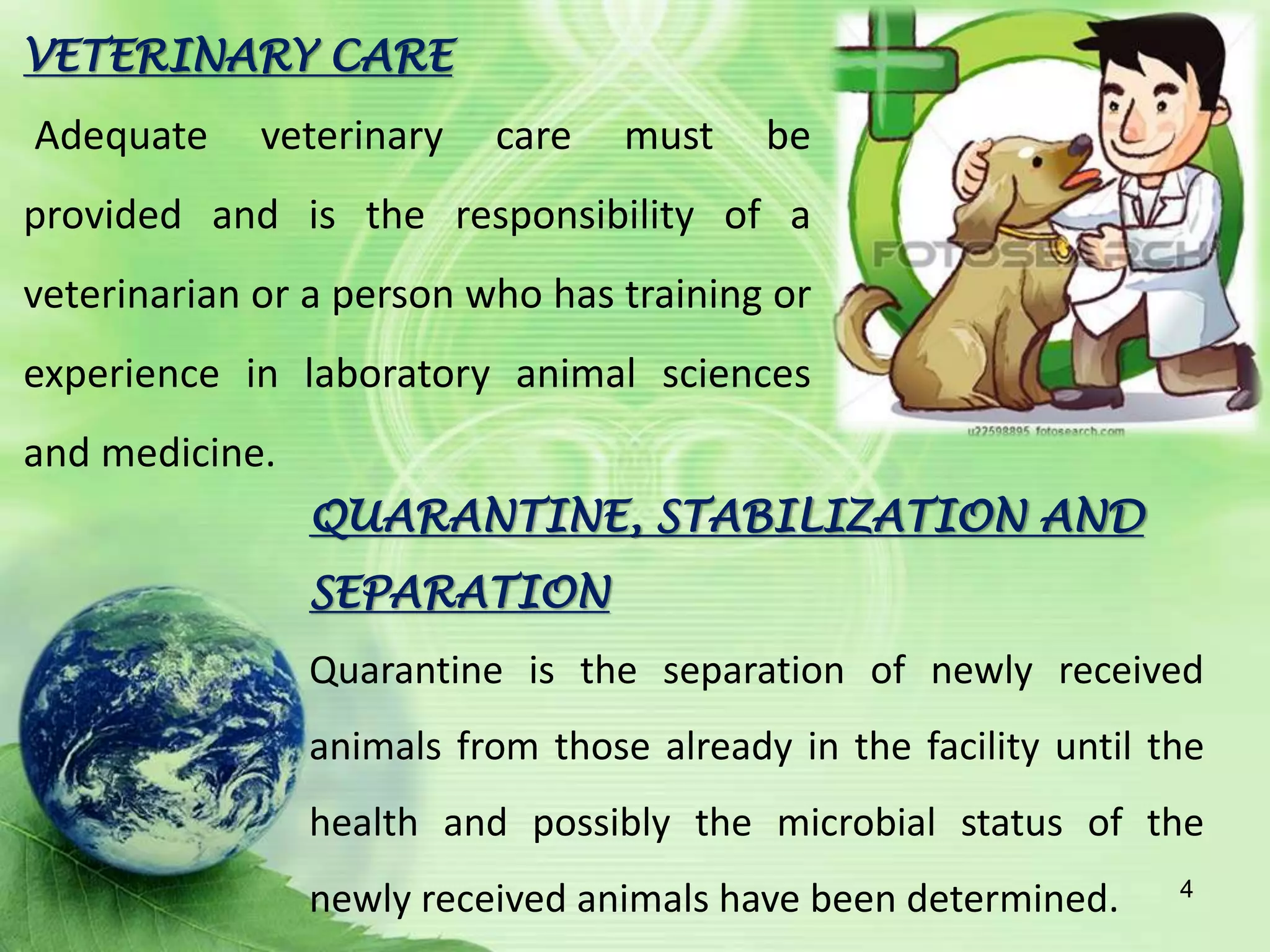
Adequate veterinary care must be
provided and is the responsibility of a
veterinarian or a person who has training or
experience in laboratory animal sciences
and medicine.
QUARANTINE, STABILIZATION AND
SEPARATION
Quarantine is the separation of newly received
animals from those already in the facility until the
health and possibly the microbial status of the
newly received animals have been determined. 4
FOOD AND WATER
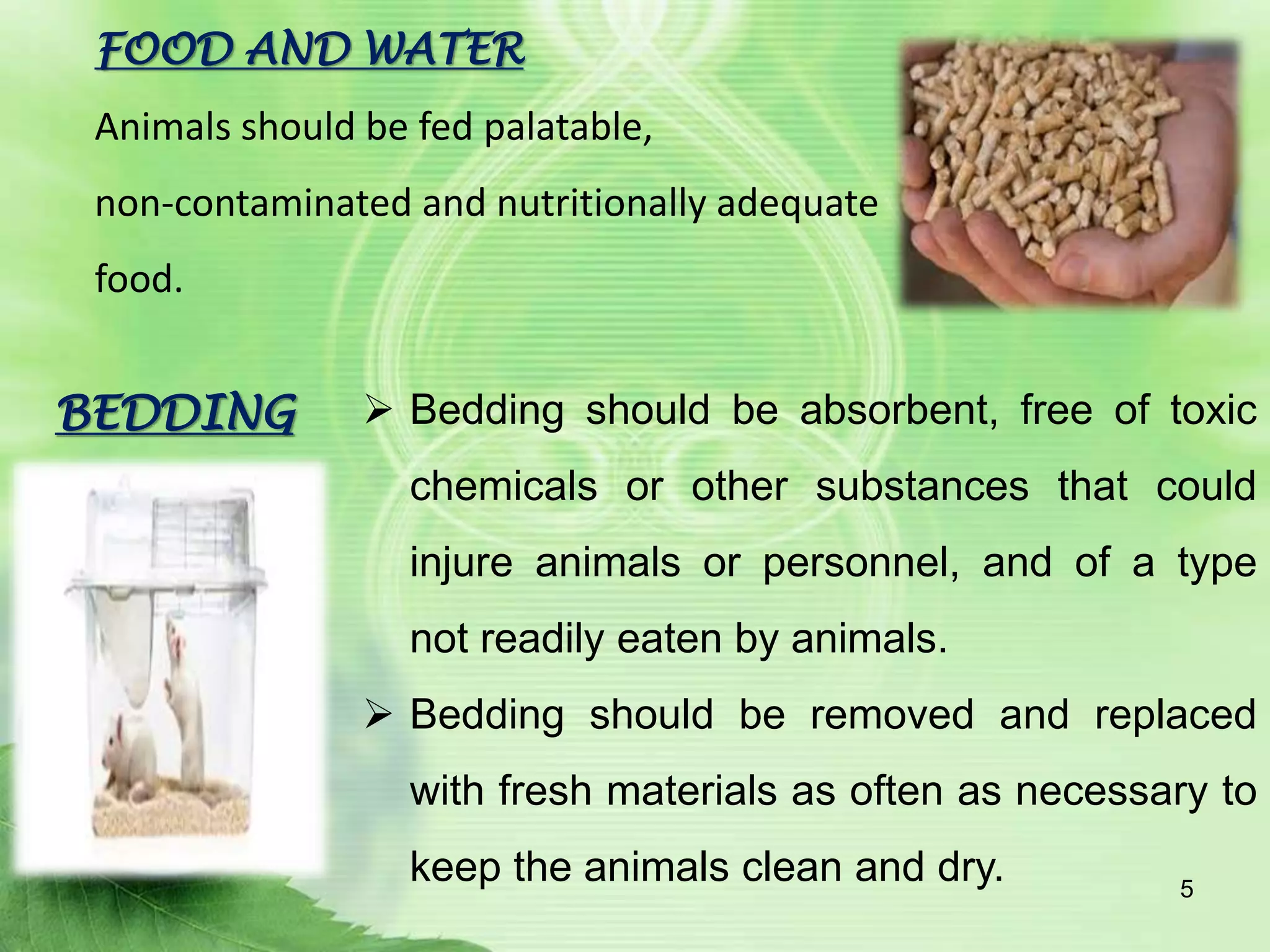
Animals should be fed palatable,
non-contaminated and nutritionally adequate
food.
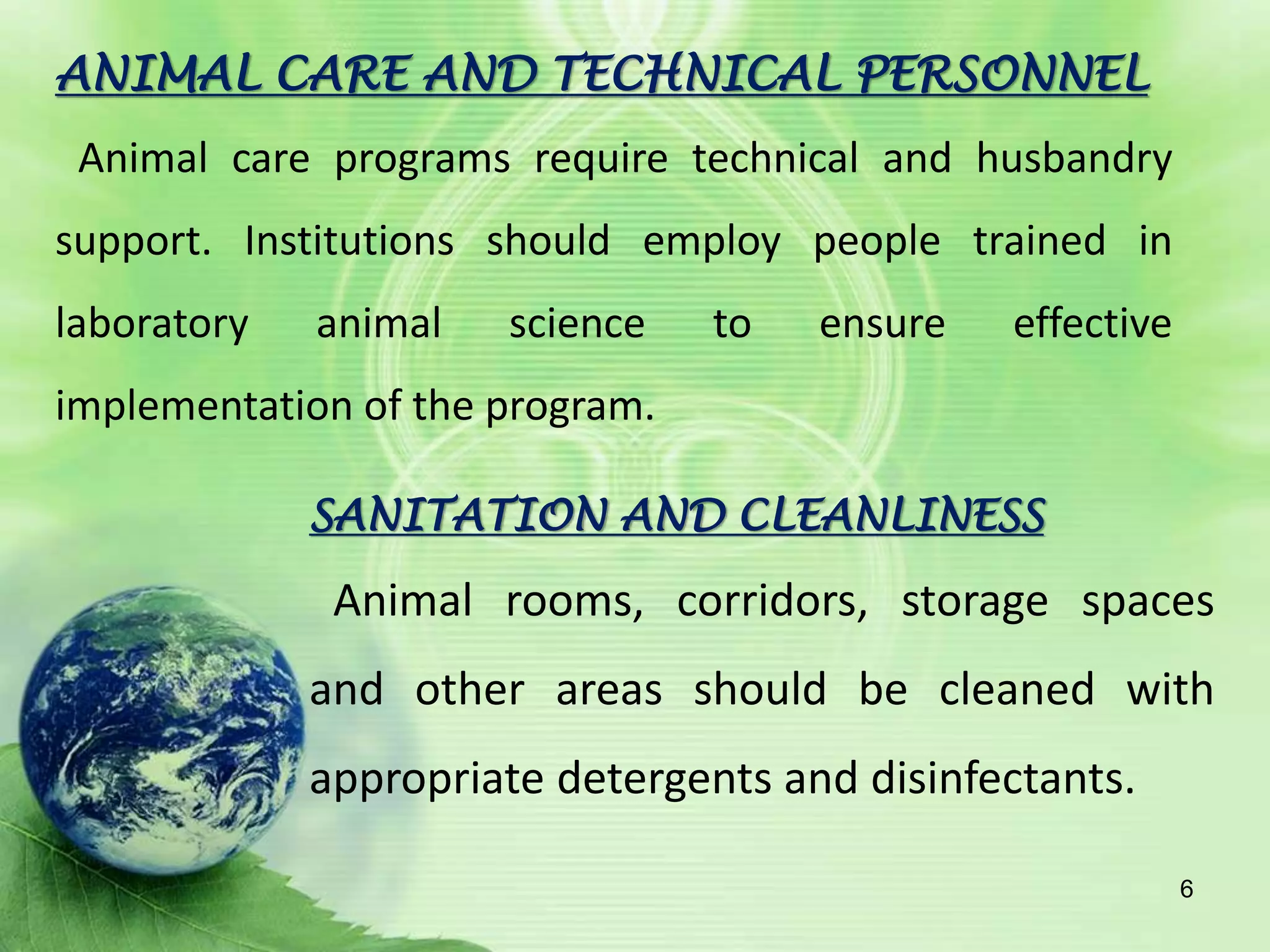
BEDDING  Bedding should be absorbent, free of toxic
chemicals or other substances that could
injure animals or personnel, and of a type
not readily eaten by animals.
 Bedding should be removed and replaced
with fresh materials as often as necessary to
keep the animals clean and dry. 5
SANITATION AND CLEANLINESS
Animal rooms, corridors, storage spaces
and other areas should be cleaned with
appropriate detergents and disinfectants.
ANIMAL CARE AND TECHNICAL PERSONNEL
Animal care programs require technical and husbandry
support. Institutions should employ people trained in
laboratory animal science to ensure effective
implementation of the program.
6
PERSONAL HYGIENE
It is essential for the animal care staff to
maintain high standard of personal cleanliness.
Facilities and supplies for meeting this
obligation should be provided e.g. showers,
change of uniforms, footwear etc.
DURATIONS OF EXPERIMENTS
No animal should be used for experimentation for
more than 3 years unless adequate justification is
provided.
7
RESTRAINT
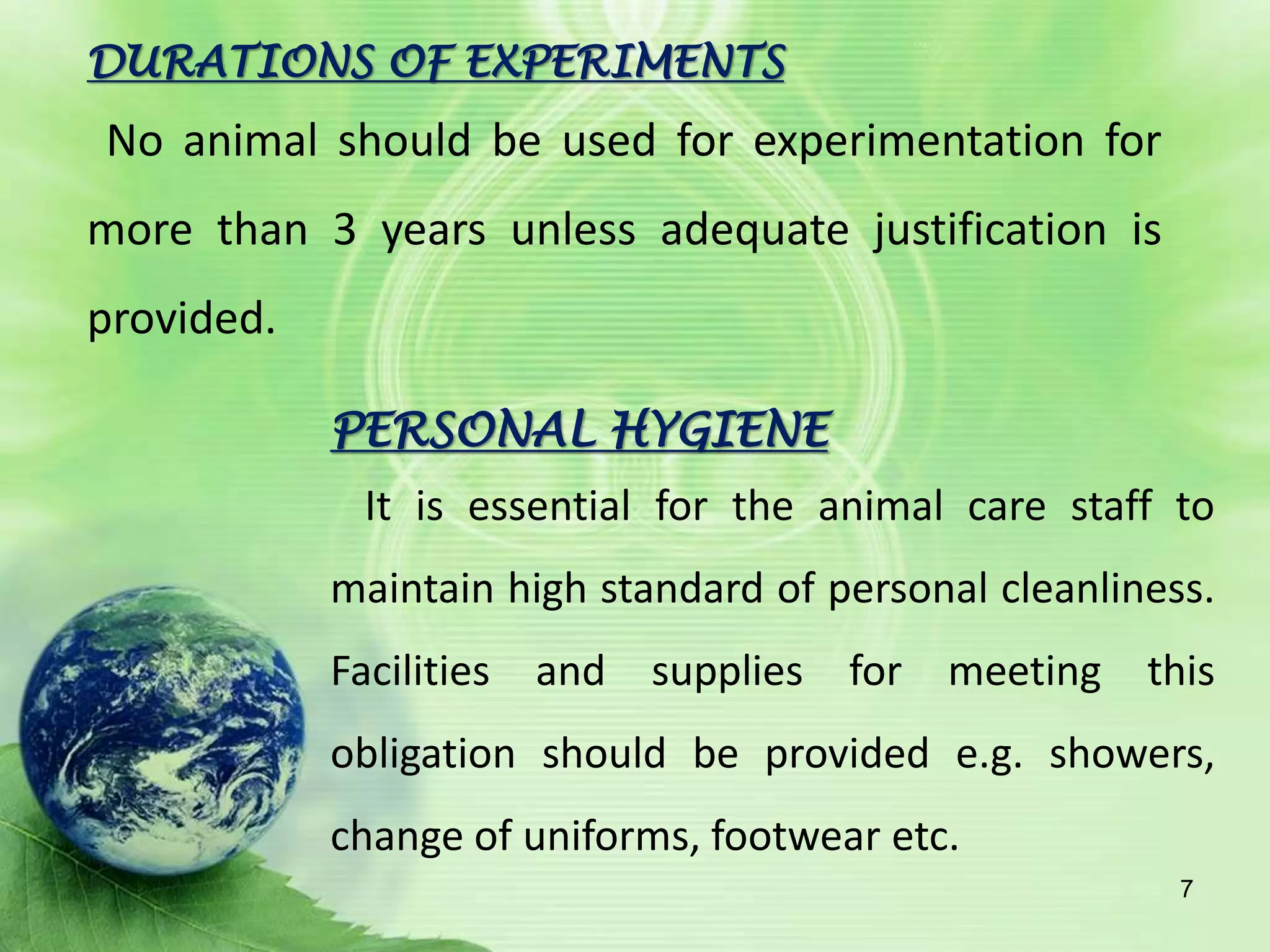
Devices required for holding animals for
examination and collection of samples
should be made available to minimize stress.
TRANSPORT OF LABORATORY ANIMALS
The main considerations for transport of
animals are, the mode of transport, the
containers, the animal density in cages, food
and water during transit, protection from
transit infections, injuries and stress. 8
PHYSICAL FACILITIES
Building materials should be selected to facilitate efficient
and hygienic operation of animal facilities. Durable,
moisture-proof, fire-resistant, seamless materials are most
desirable for interior surfaces including vermin and pest
resistance.
Corridors should be wide enough to facilitate
the movement of personnel as well as
equipment's and should be kept clean.
9
Utilities such as water lines, drain pipes, and electrical
connections should preferably be accessible through service
panels in corridors outside the animal rooms.
ANIMAL ROOM DOORS
Doors should be non-rust, vermin and dust
proof. They should fit properly within their
frames and provided with an observation
window. Door closures may also be provided.
Rodent barriers can be provided in the doors
of the small animal facilities. 10
EXTERIOR WINDOWS
Windows are not recommended for small animal facilities.
However, where power failures are frequent and backup power
is not available, they may be necessary to provide alternate
source of light and ventilation.
FLOORS
Floors should be smooth, moisture proof,
nonabsorbent, skid-proof, resistant to acid
solvents, adverse effects of detergents and
disinfectants.
11
WALLS & CEILINGS
Walls should be free of cracks, unsealed utility penetrations, or
imperfect junctions with doors, ceilings, floors and corners.
Surface materials should be capable of withstanding scrubbing
with detergents and disinfectants.
STORAGE AREAS
Separate storage areas should be designed for
feed, bedding, cages and materials not in use.
12
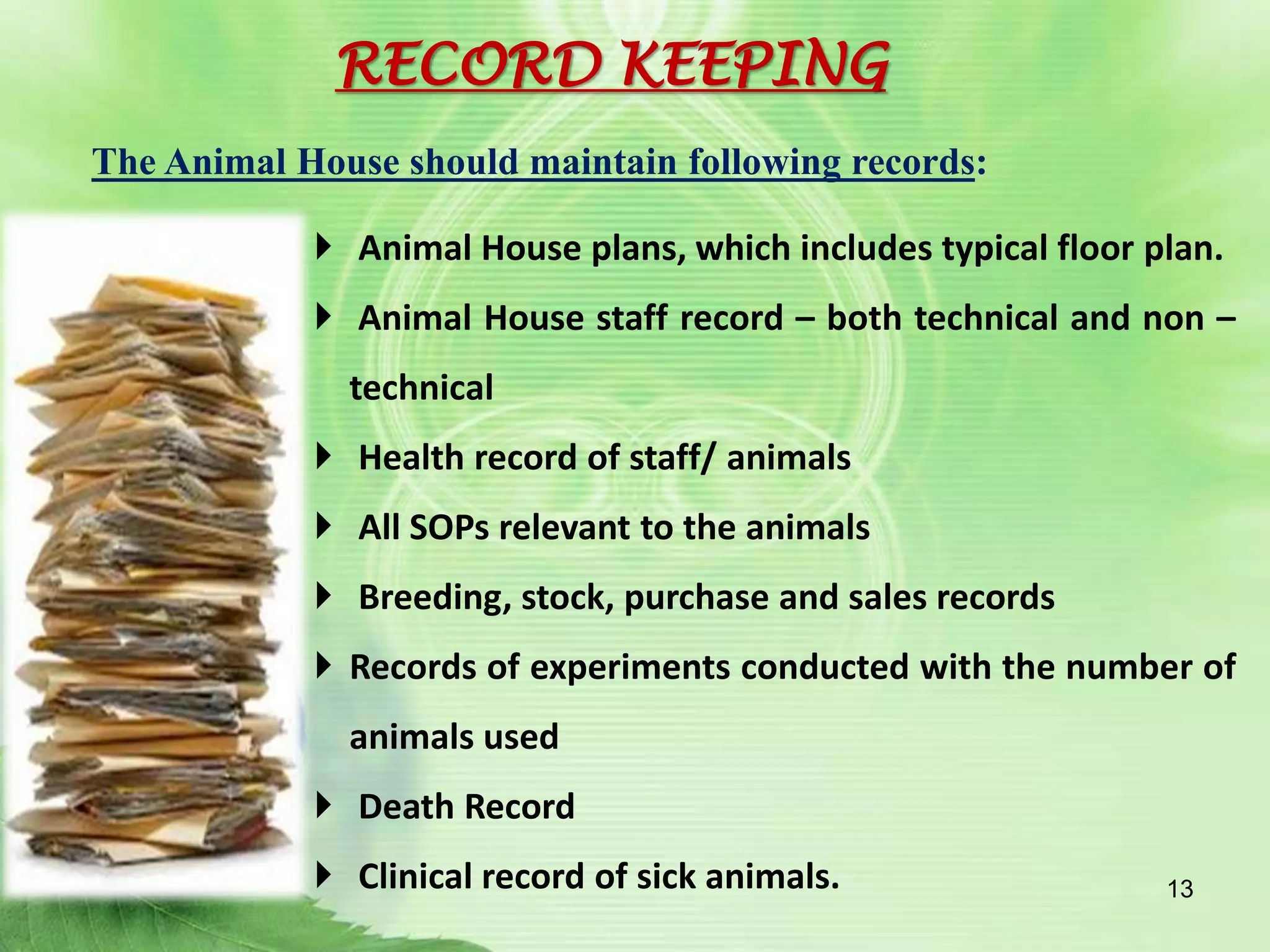
 Animal House plans, which includes typical floor plan.
 Animal House staff record – both technical and non –
technical
 Health record of staff/ animals
 All SOPs relevant to the animals
 Breeding, stock, purchase and sales records
 Records of experiments conducted with the number of
animals used
 Death Record
 Clinical record of sick animals.
The Animal House should maintain following records:
13
RECORD KEEPING
 Name of the Author
 Title of the SOP
 Date of preparation
 Reference of previous SOP on the same subject and
date (Issue no and Date)
 Objectives
 Detailed information of the instruments used in
relation with animals with methodology (Model no.,
Serial no., Date of commissioning, etc.)
STANDARD OPERATING PROCEDURES
(SOPs) / Guidelines
A SOP should contain the following items:
14
DISPOSAL
The transgenic and knockout animals should be first
euthanized and then disposed off as prescribed elsewhere
in the guidelines. A record of disposal and the manner of
disposal should be kept as a matter of routine.
15
ANAESTHESIA AND EUTHANASIA
 The scientists should ensure that the procedures, which
are considered painful, are conducted under appropriate
anaesthesia as recommended for each species of animals.
 It must also be ensured that the anaesthesia is given for
the full duration of experiment and at no stage the
animal is conscious to perceive pain during the
experiment.
 In the event of a decision to sacrifice an animal on
termination of an experiment or otherwise, an approved
method of euthanasia should be adopted. 16
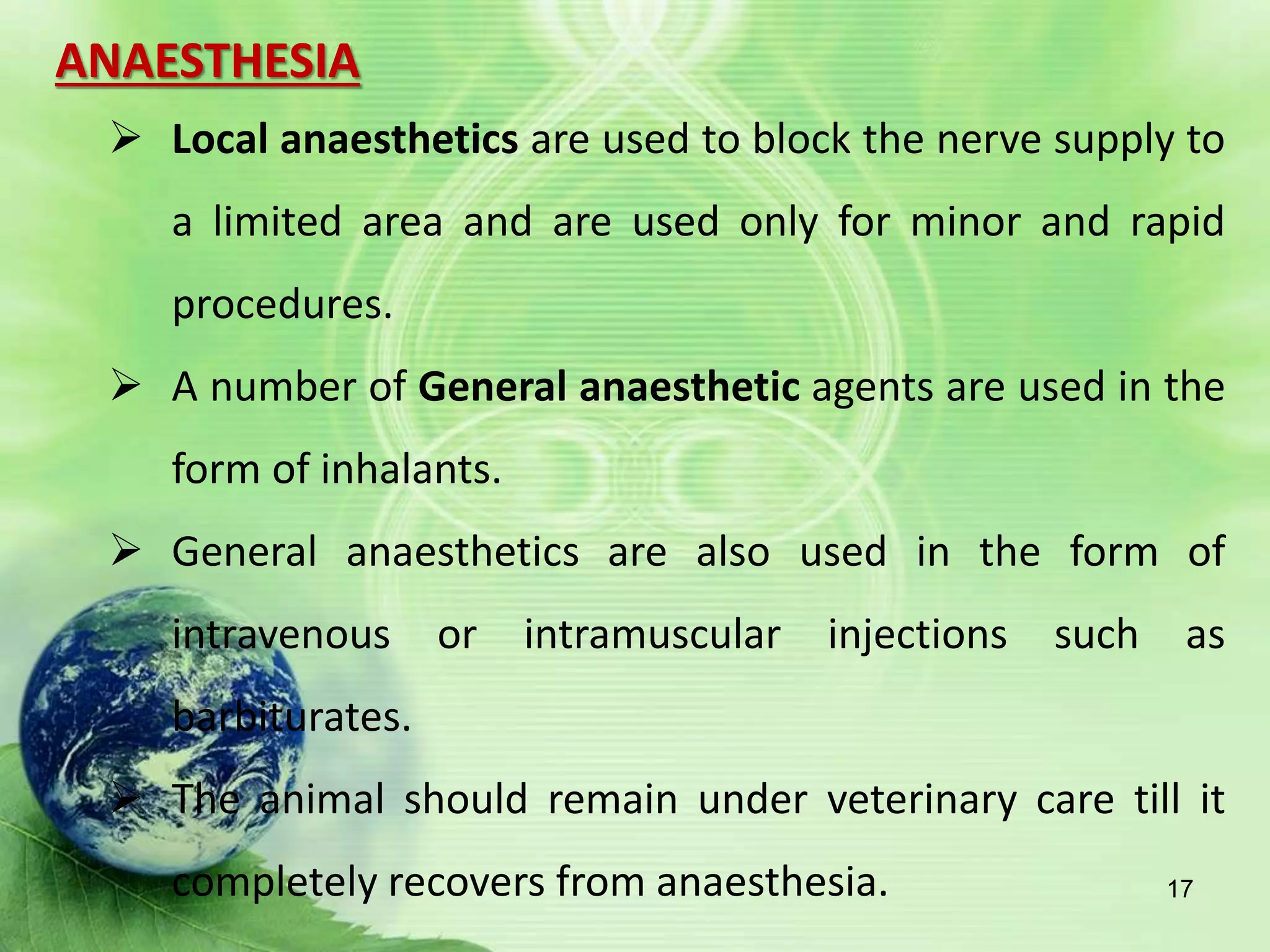
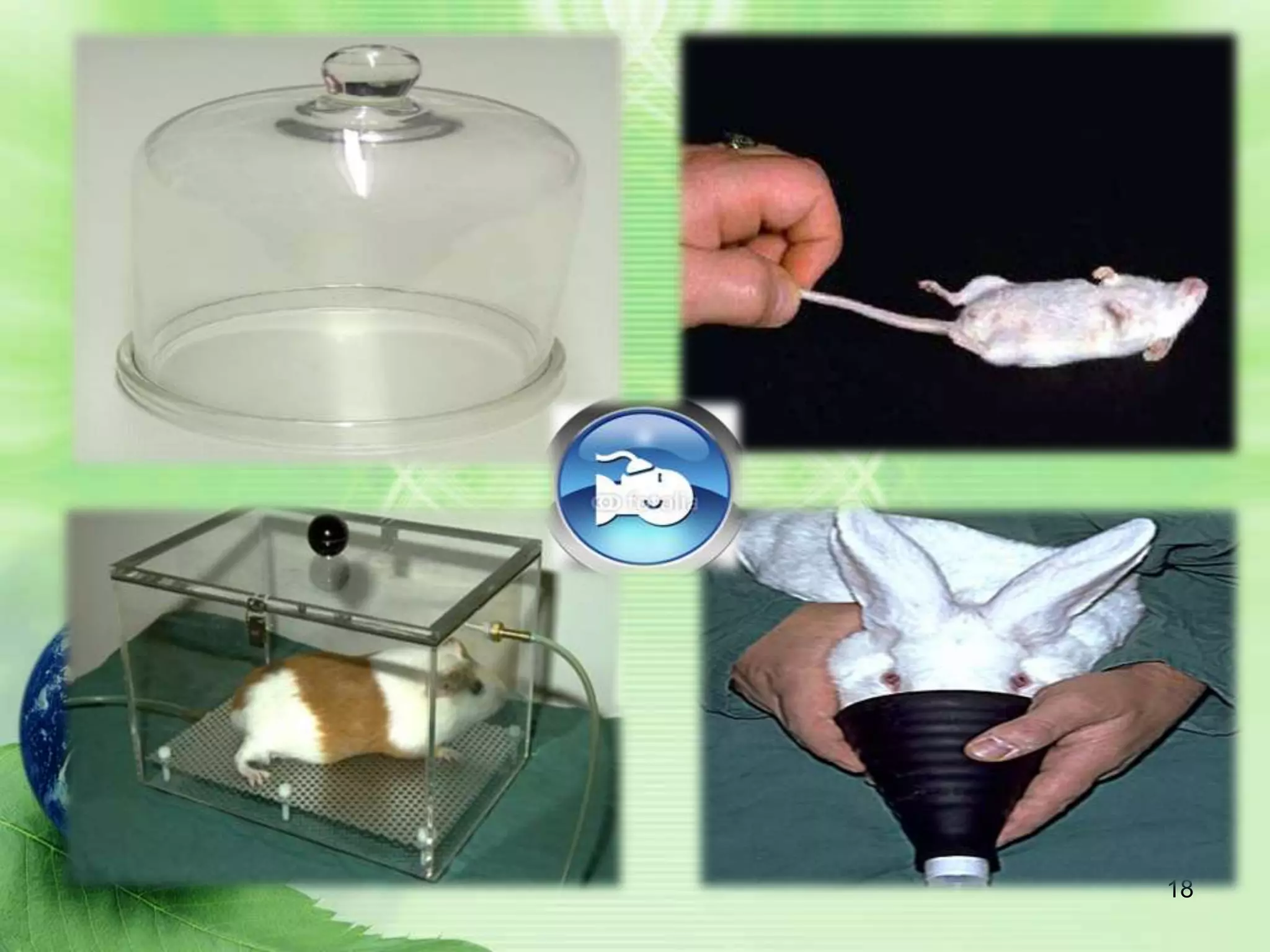
ANAESTHESIA
 Local anaesthetics are used to block the nerve supply to
a limited area and are used only for minor and rapid
procedures.
 A number of General anaesthetic agents are used in the
form of inhalants.
 General anaesthetics are also used in the form of
intravenous or intramuscular injections such as
barbiturates.
 The animal should remain under veterinary care till it
completely recovers from anaesthesia. 17
18
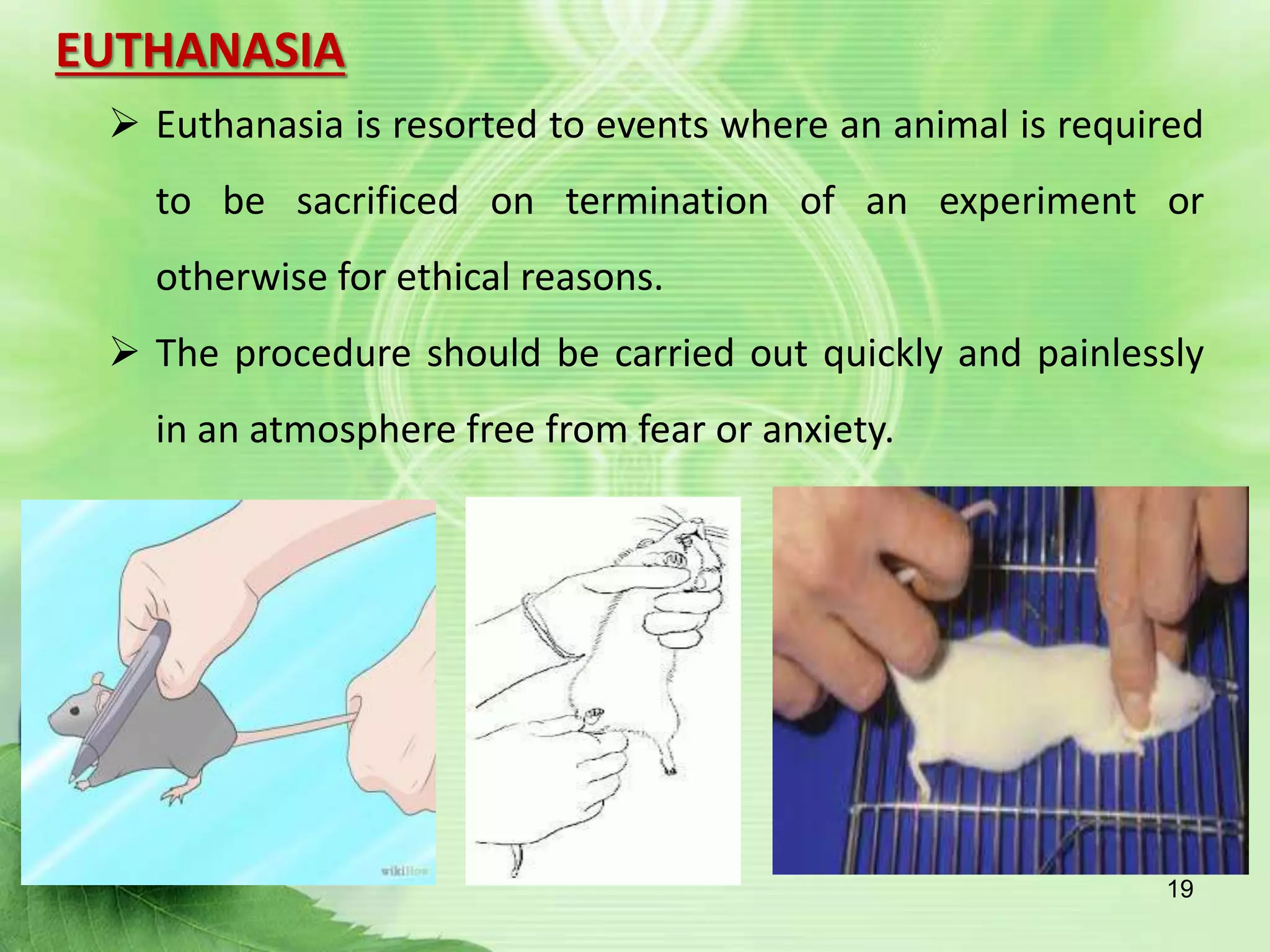
EUTHANASIA
 Euthanasia is resorted to events where an animal is required
to be sacrificed on termination of an experiment or
otherwise for ethical reasons.
 The procedure should be carried out quickly and painlessly
in an atmosphere free from fear or anxiety.
19
The method should in all cases meet the following
requirements:
(a) Death, without causing anxiety, pain or distress
with minimum time lag phase.
(b) Minimum physiological and psychological
disturbances.
(c) Compatibility with the purpose of study and
minimum emotional effect on the operator.
(d) Location should be separate from animal rooms
and free from environmental contaminants.
20
Thank you
“I’m so proud! All of my kids
are going into research” 21

CPCSEA Guidelines

  • 1.
    Presented by: ABIN JOY 1stM-PHARM Dept. of Pharmacology CPCSEA GUIDELINES Committee for the Purpose of Control and Supervision on Experiments on Animals 1
  • 2.
    Why Are ThereLaws About Animals? 2
  • 3.
    The goal ofthese Guidelines is to promote the humane care of animals used in biomedical and behavioral research. These guidelines provide the basic provisions for animal care in using animals for teaching or research purposes. 3
  • 4.
    VETERINARY CARE Adequate veterinarycare must be provided and is the responsibility of a veterinarian or a person who has training or experience in laboratory animal sciences and medicine. QUARANTINE, STABILIZATION AND SEPARATION Quarantine is the separation of newly received animals from those already in the facility until the health and possibly the microbial status of the newly received animals have been determined. 4
  • 5.
    FOOD AND WATER Animalsshould be fed palatable, non-contaminated and nutritionally adequate food. BEDDING  Bedding should be absorbent, free of toxic chemicals or other substances that could injure animals or personnel, and of a type not readily eaten by animals.  Bedding should be removed and replaced with fresh materials as often as necessary to keep the animals clean and dry. 5
  • 6.
    SANITATION AND CLEANLINESS Animalrooms, corridors, storage spaces and other areas should be cleaned with appropriate detergents and disinfectants. ANIMAL CARE AND TECHNICAL PERSONNEL Animal care programs require technical and husbandry support. Institutions should employ people trained in laboratory animal science to ensure effective implementation of the program. 6
  • 7.
    PERSONAL HYGIENE It isessential for the animal care staff to maintain high standard of personal cleanliness. Facilities and supplies for meeting this obligation should be provided e.g. showers, change of uniforms, footwear etc. DURATIONS OF EXPERIMENTS No animal should be used for experimentation for more than 3 years unless adequate justification is provided. 7
  • 8.
    RESTRAINT Devices required forholding animals for examination and collection of samples should be made available to minimize stress. TRANSPORT OF LABORATORY ANIMALS The main considerations for transport of animals are, the mode of transport, the containers, the animal density in cages, food and water during transit, protection from transit infections, injuries and stress. 8
  • 9.
    PHYSICAL FACILITIES Building materialsshould be selected to facilitate efficient and hygienic operation of animal facilities. Durable, moisture-proof, fire-resistant, seamless materials are most desirable for interior surfaces including vermin and pest resistance. Corridors should be wide enough to facilitate the movement of personnel as well as equipment's and should be kept clean. 9
  • 10.
    Utilities such aswater lines, drain pipes, and electrical connections should preferably be accessible through service panels in corridors outside the animal rooms. ANIMAL ROOM DOORS Doors should be non-rust, vermin and dust proof. They should fit properly within their frames and provided with an observation window. Door closures may also be provided. Rodent barriers can be provided in the doors of the small animal facilities. 10
  • 11.
    EXTERIOR WINDOWS Windows arenot recommended for small animal facilities. However, where power failures are frequent and backup power is not available, they may be necessary to provide alternate source of light and ventilation. FLOORS Floors should be smooth, moisture proof, nonabsorbent, skid-proof, resistant to acid solvents, adverse effects of detergents and disinfectants. 11
  • 12.
    WALLS & CEILINGS Wallsshould be free of cracks, unsealed utility penetrations, or imperfect junctions with doors, ceilings, floors and corners. Surface materials should be capable of withstanding scrubbing with detergents and disinfectants. STORAGE AREAS Separate storage areas should be designed for feed, bedding, cages and materials not in use. 12
  • 13.
     Animal Houseplans, which includes typical floor plan.  Animal House staff record – both technical and non – technical  Health record of staff/ animals  All SOPs relevant to the animals  Breeding, stock, purchase and sales records  Records of experiments conducted with the number of animals used  Death Record  Clinical record of sick animals. The Animal House should maintain following records: 13 RECORD KEEPING
  • 14.
     Name ofthe Author  Title of the SOP  Date of preparation  Reference of previous SOP on the same subject and date (Issue no and Date)  Objectives  Detailed information of the instruments used in relation with animals with methodology (Model no., Serial no., Date of commissioning, etc.) STANDARD OPERATING PROCEDURES (SOPs) / Guidelines A SOP should contain the following items: 14
  • 15.
    DISPOSAL The transgenic andknockout animals should be first euthanized and then disposed off as prescribed elsewhere in the guidelines. A record of disposal and the manner of disposal should be kept as a matter of routine. 15
  • 16.
    ANAESTHESIA AND EUTHANASIA The scientists should ensure that the procedures, which are considered painful, are conducted under appropriate anaesthesia as recommended for each species of animals.  It must also be ensured that the anaesthesia is given for the full duration of experiment and at no stage the animal is conscious to perceive pain during the experiment.  In the event of a decision to sacrifice an animal on termination of an experiment or otherwise, an approved method of euthanasia should be adopted. 16
  • 17.
    ANAESTHESIA  Local anaestheticsare used to block the nerve supply to a limited area and are used only for minor and rapid procedures.  A number of General anaesthetic agents are used in the form of inhalants.  General anaesthetics are also used in the form of intravenous or intramuscular injections such as barbiturates.  The animal should remain under veterinary care till it completely recovers from anaesthesia. 17
  • 18.
  • 19.
    EUTHANASIA  Euthanasia isresorted to events where an animal is required to be sacrificed on termination of an experiment or otherwise for ethical reasons.  The procedure should be carried out quickly and painlessly in an atmosphere free from fear or anxiety. 19
  • 20.
    The method shouldin all cases meet the following requirements: (a) Death, without causing anxiety, pain or distress with minimum time lag phase. (b) Minimum physiological and psychological disturbances. (c) Compatibility with the purpose of study and minimum emotional effect on the operator. (d) Location should be separate from animal rooms and free from environmental contaminants. 20
  • 21.
    Thank you “I’m soproud! All of my kids are going into research” 21