By
Shahla Arshad
&
Sehrish Naz
Lecturer INS-KMU
ABDOMIN, ANUS & RECTUM
ASSESSMENT
Abdominal Assessment
 Patient needs to be exposed from above the
xiphoid process to the symphasis pubis.
 Also, make sure your patient does not have a
full bladder.
 Place patient in a supine position in a good
lighted setting: pillow under the head and
knees. Helps to relax abdominal muscles.
 Have patient point out any areas of pain or
tenderness. Examine these last.
Abdominal Assessment
 During exam continue to monitor your
patient’s facial expression for pain and
discomfort.
 Use inspection, auscultation, percussion, and
palpation to perform the exam.
 Always auscultate before percussing or
palpating. These manipulations may alter your
patient’s bowel motility and resulting bowel
sounds.
TECHNIQUES
 Inspection
 Auscultation
 Percussion
 Palpation
Abdominal Assessment
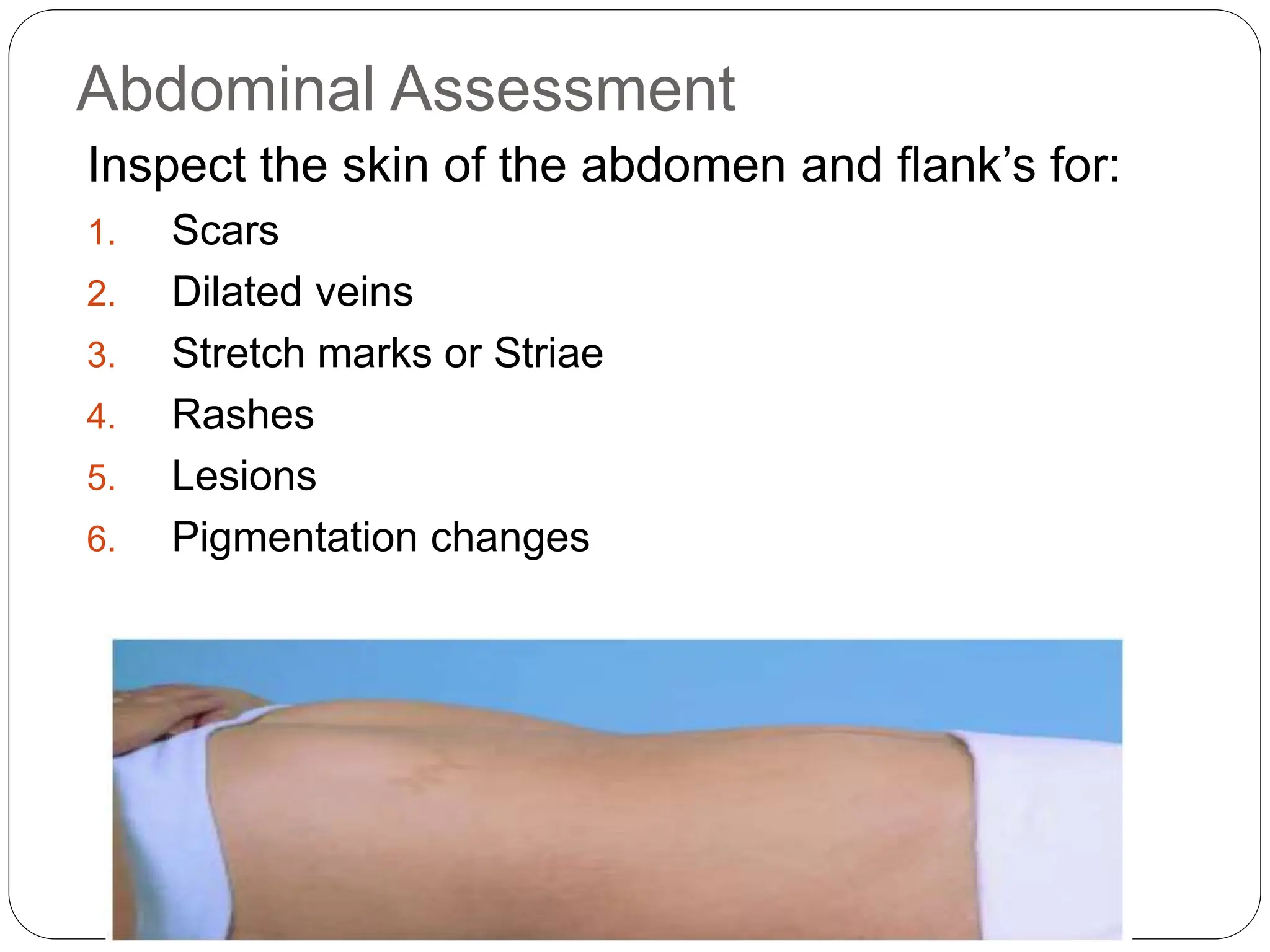
Inspect the skin of the abdomen and flank’s for:
1. Scars
2. Dilated veins
3. Stretch marks or Striae
4. Rashes
5. Lesions
6. Pigmentation changes
Abdominal Assessment
Symmetry of the abdomen
Look for enlarged liver and spleen
Peristalsis
pulsation
 Look for discoloration over the umbilicus:
1. Cullen’s Sign: discoloration over the umbilicus
2. Grey Turner’s Sign: discoloration over the flanks
 These are both late signs suggesting intra-
abdominal bleeding
Abdominal Assessment
Assess the size and shape of your patient’s abdomen
to determine:
1. Scaphoid (concave)
2. Flat
3. Round
4. Distended
 Ask the patient if it is its usual size and shape
Umbilicus
 Contour
 Location
 Inflammation
 Bulges(hernia)
ASCULTATION
Auscultation provides important information
about bowel motility. Listen to the abdomen
before performing percussion or palpation, since
these maneuvers may alter the frequency of
bowel sounds. You should practice auscultation
until you are thoroughly familiar with variations in
normal bowel sounds and can detect changes
suggestive of inflammation or obstruction
Auscultation may also reveal bruits, vascular
sounds resembling heart murmurs, over the
aorta or other arteries in the abdomen, which
suggest vascular occlusive disease.
 Place the diaphragm of your stethoscope gently on
the abdomen.
 Listen for bowel sounds and note their frequency and
character. Normal sounds consist of clicks and
gurgles, occurring at an estimated frequency of 5 to
34 per minute.
 Occasionally you may hear barborygmi—long
prolonged gurgles of hyper peristalsis—the familiar
“stomach growling.” Because bowel sounds are
widely transmitted through the abdomen, listening in
one spot, such as the right lower quadrant, is usually
sufficient
 If the patient has high blood pressure, listen in the
epigastrium and in each upper quadrant for bruits.
Later in the examination, when the patient sits up,
listen also in the costovertebral angles.
 Epigastric bruits confined to systole may be heard
normally.
 listen for bruits over the aorta, the iliac arteries,
and the femoral arteries.
PERCUSSION
 Percussion helps to assess the amount and
distribution of gas in the abdomen and identify possible
masses that are solid or fluid- filled .its use in
estimating the size of the liver and spleen.
 Percuss to assess Tampany and dullness. Tampany
usually predominant because of gas in the
gastrointestinal tract and dullness in fluid filled area.
PALPATION
LIGHT PALPATION.
 Feeling the abdomen gently is especially helpful in
identifying abdominal tenderness, muscular resistance,
and some superficial organs and masses.
 Keeping your hand and forearm on a horizontal plane,
with fingers together and flat on the abdominal surface,
palpate the abdomen with a light, gentle, dipping
motion.
 When moving your hand from place to place, raise it
just off the skin. Moving smoothly, feel in all quadrants.
 Identify any superficial organs or masses and any area
of tenderness or increased resistance to your hand. If
resistance is present, try to distinguish voluntary
guarding from involuntary muscular spasm.
 Feel for the relaxation of abdominal muscles that
normally accompanies exhalation. Ask the patient to
mouth-breathe with jaw dropped open.
DEEP PALPATION.
 This is usually required to delineate abdominal
masses.
 Again using the palmer surfaces of your fingers, feel in
all four quadrants.
 Identify any masses and note their location, size,
shape, consistency, tenderness, pulsations, and any
mobility with respiration or with the examining hand.
 Correlate your palpable findings with their percussion
notes.
TENDERNESS AND REBOUND
TENDERNESS
 Look for rebound tenderness. Press your fingers in
firmly and slowly, and then quickly withdraw them.
Watch and listen to the patient for signs of pain. Ask
the patient
(1) To compare which hurt more, the pressing or the
letting go, and
(2) To show you exactly where it hurt. Pain induced or
increased by quick withdrawal constitute rebound
tenderness. It results from the rapid movement of
an inflamed peritoneum.
LIVER
 Measure the vertical span of liver dullness in the
right midclavicular line
 Starting at a level below the umbilicus (in an area of
tympany, not dullness),lightly percuss upward toward
the liver.
 Determine the lower border of liver dullness in the
midclavicular line
 Next, identify the upper border of liver dullness in the
midclavicular line
 Lightly percuss from lung resonance down toward
liver dullness.
Now measure in centimeters the distance between your
two points
The vertical span of liver dullness greater in men than in
women, in tall people than in short .
PALPATION
Place your left hand behind the patient, parallel to and
supporting the right 11th and 12th ribs and nearby soft
tissues below
Remind the patient to relax on your hand if necessary.
By pressing your left hand forward, the patient’s liver
may be felt more easily by your other hand
Place your right hand on the patient’s right abdomen
lateral to the rectus muscle, with your fingertips well
below the lower border of liver dullness
Ask the patient to take a deep breath. Try to feel the
liver edge as it comes down to meet your fingertips
If you feel it, lighten the pressure of your palpating
hand slightly so that the liver can slip under your
finger pads and you can feel its anterior surface.
Note any tenderness. If palpable at all, the edge of a
normal liver is soft, sharp, and regular, its surface
smooth. The normal liver may be slightly tender
On inspiration, the liver is palpable about 3 cm below
the right costal margin in the midclavicular line.
Some people breathe more with their chests than with their
diaphragms. It may be helpful to train such a patient to
“breathe
with the abdomen,” thus bringing the liver, as well as the
spleen
and kidneys, into a palpable position during inspiration
HOOKING TECHNIQUE
The “hooking technique” may be helpful, especially when
the patient is obese.
Stand to the right of the patient’s chest. Place both
hands, side by side, on the right abdomen below the
border of liver dullness.
Press in with your fingers and up toward the costal
margin. Ask the patient to take a deep breath.
The liver edge shown below is palpable with the finger
pads of both hands.
ASSESSING TENDERNESS OF A
NONPALPABLE LIVER.
Place your left hand flat on the lower right rib cage
and then gently strike your hand with the ulnar
surface of your right fist. Ask the patient to compare
the sensation with that produced by a similar strike
on the left side.
Spleen
When a spleen enlarges, it expands anteriorly, downward,
and medially, often replacing the tympany of stomach and
colon with the dullness of a solid organ.
It then becomes palpable below the costal margin.
PERCUSSION
Two techniques may help you to detect splenomegaly, an
enlarged spleen:
Percuss the left anterior lower chest wall between lung
resonance above and the costal margin . As you percuss
along the routes suggested by the arrows in the following
figures, note the lateral extent of tympany.
 This is variable, but if tympany is prominent, especially
laterally, splenomegaly is not likely. The dullness of a
normal spleen is usually hidden within the dullness of
other posterior tissues.
Check for a splenic percussion sign.
 Percuss the lowest interspace in the left anterior axillary
line, as shown below. This area is usually tympanitic.
Then ask the patient to take a deep breath, and percuss
again. When spleen size is normal, the percussion note
usually remains tympanitic.
PALPATION
 With your left hand, reach over and around the patient to
support and press forward the lower left rib cage and
nearby soft tissue. With your right hand below the left
costal margin, press in toward the spleen. Begin
palpation low enough so that you are below a possibly
enlarged spleen. Ask the patient to take a deep breath ,
Try to feel the tip or edge of the spleen as it comes
down to meet your fingertips. Note any tenderness, and
assess the splenic contour. In a small percentage of
normal adults, the tip of the spleen is palpable.
Repeat with the patient lying on the right side
with legs somewhat flexed at hips and knees.
In this position, gravity may bring the spleen
forward and to the right into a palpable
location.
Palpation And Percussion Of Kidney
(Balloting Method)
Examination Of The Gallbladder
 Murphy's sign can be assessed by placing your examining
fingers over the gallbladder area and then asking the
patient to take a deep breath.
 If Murphy's sign is positive, there will be sudden inflection
of the pain on inspiration and inspiration will be inhibited.
Ascites
 Assessing possible ascites.
 Test for shifting dullness.
 Test for fluid wave.
Appendicitis
 On coughing.
 Local tenderness.
 Rebound tenderness.
 Check for Rovsing’s sign and for referred rebound
tenderness.
 Look for a psoas sign.
 Look for an obturator sign.
 Test for cutaneous hyperesthesia
Acute Cholecystitis
• Murphy’s sign.
Ascites/Test 2
 Test for fluid wave, ask
an assistant to press
the edge of his hand
firmly down the midline
of your patient’s
abdomen
 With your fingertips, tap
one flank and feel for
the impulse’s
transmission to the
other flank through
excess fluid
 If you detect the
impulse easily, suspect
ascites
ANUS & RECTUM
 Anal canal surrounded by 2 layers of muscle
called sphincters
 Internal sphincter is under involuntary control.
 External sphincter is under voluntary control.
 Rectum—15 cm, external layer continuous
 Anus 3-4 cm
EXAMINATION OF THE ANUS & RECTUM
 Inspect saccrococcygeal & perianal areas for:
 Lumps
 Ulcers
 Inflammation
 Rashes
 Excoriation
 Hemorrhoids
 Venereal warts
 Herpes
HEMORRHOID
EXAMINATION OF THE ANUS & RECTUM
 Examine sphincter tone of the anus; Note:
 Tenderness.
 Indurations.
 Irregularities.
 Insert finger clockwise & counterclockwise.
 Note; nodules, irregularities, induration.
 Stool for occult blood .
DOCUMENTATION
Abdomen is protuberant with active bowel sounds. it
is soft and non tender, no palpable mass or
hepatomegaly.liver span is 7cm in the right
midclaviculer line, edge is smooth and palpable 1cm
below the right costal margin, spleen and kidney not
felt, no costovertibral angle (CVA)tenderness.
References
 Bicklay, L. S. (1999). Bates’ guide to physical
examination and history taking (7th ed).
Philadelphia: J. B. Lippincott.
Abdominal assessment unit for nurses.ppt

Abdominal assessment unit for nurses.ppt

  • 1.
    By Shahla Arshad & Sehrish Naz LecturerINS-KMU ABDOMIN, ANUS & RECTUM ASSESSMENT
  • 6.
    Abdominal Assessment  Patientneeds to be exposed from above the xiphoid process to the symphasis pubis.  Also, make sure your patient does not have a full bladder.  Place patient in a supine position in a good lighted setting: pillow under the head and knees. Helps to relax abdominal muscles.  Have patient point out any areas of pain or tenderness. Examine these last.
  • 7.
    Abdominal Assessment  Duringexam continue to monitor your patient’s facial expression for pain and discomfort.  Use inspection, auscultation, percussion, and palpation to perform the exam.  Always auscultate before percussing or palpating. These manipulations may alter your patient’s bowel motility and resulting bowel sounds.
  • 8.
  • 9.
    Abdominal Assessment Inspect theskin of the abdomen and flank’s for: 1. Scars 2. Dilated veins 3. Stretch marks or Striae 4. Rashes 5. Lesions 6. Pigmentation changes
  • 10.
    Abdominal Assessment Symmetry ofthe abdomen Look for enlarged liver and spleen Peristalsis pulsation  Look for discoloration over the umbilicus: 1. Cullen’s Sign: discoloration over the umbilicus 2. Grey Turner’s Sign: discoloration over the flanks  These are both late signs suggesting intra- abdominal bleeding
  • 11.
    Abdominal Assessment Assess thesize and shape of your patient’s abdomen to determine: 1. Scaphoid (concave) 2. Flat 3. Round 4. Distended  Ask the patient if it is its usual size and shape Umbilicus  Contour  Location  Inflammation  Bulges(hernia)
  • 12.
    ASCULTATION Auscultation provides importantinformation about bowel motility. Listen to the abdomen before performing percussion or palpation, since these maneuvers may alter the frequency of bowel sounds. You should practice auscultation until you are thoroughly familiar with variations in normal bowel sounds and can detect changes suggestive of inflammation or obstruction Auscultation may also reveal bruits, vascular sounds resembling heart murmurs, over the aorta or other arteries in the abdomen, which suggest vascular occlusive disease.
  • 13.
     Place thediaphragm of your stethoscope gently on the abdomen.  Listen for bowel sounds and note their frequency and character. Normal sounds consist of clicks and gurgles, occurring at an estimated frequency of 5 to 34 per minute.  Occasionally you may hear barborygmi—long prolonged gurgles of hyper peristalsis—the familiar “stomach growling.” Because bowel sounds are widely transmitted through the abdomen, listening in one spot, such as the right lower quadrant, is usually sufficient
  • 14.
     If thepatient has high blood pressure, listen in the epigastrium and in each upper quadrant for bruits. Later in the examination, when the patient sits up, listen also in the costovertebral angles.  Epigastric bruits confined to systole may be heard normally.  listen for bruits over the aorta, the iliac arteries, and the femoral arteries.
  • 16.
    PERCUSSION  Percussion helpsto assess the amount and distribution of gas in the abdomen and identify possible masses that are solid or fluid- filled .its use in estimating the size of the liver and spleen.  Percuss to assess Tampany and dullness. Tampany usually predominant because of gas in the gastrointestinal tract and dullness in fluid filled area.
  • 17.
    PALPATION LIGHT PALPATION.  Feelingthe abdomen gently is especially helpful in identifying abdominal tenderness, muscular resistance, and some superficial organs and masses.  Keeping your hand and forearm on a horizontal plane, with fingers together and flat on the abdominal surface, palpate the abdomen with a light, gentle, dipping motion.  When moving your hand from place to place, raise it just off the skin. Moving smoothly, feel in all quadrants.  Identify any superficial organs or masses and any area of tenderness or increased resistance to your hand. If resistance is present, try to distinguish voluntary guarding from involuntary muscular spasm.
  • 19.
     Feel forthe relaxation of abdominal muscles that normally accompanies exhalation. Ask the patient to mouth-breathe with jaw dropped open. DEEP PALPATION.  This is usually required to delineate abdominal masses.  Again using the palmer surfaces of your fingers, feel in all four quadrants.  Identify any masses and note their location, size, shape, consistency, tenderness, pulsations, and any mobility with respiration or with the examining hand.  Correlate your palpable findings with their percussion notes.
  • 21.
    TENDERNESS AND REBOUND TENDERNESS Look for rebound tenderness. Press your fingers in firmly and slowly, and then quickly withdraw them. Watch and listen to the patient for signs of pain. Ask the patient (1) To compare which hurt more, the pressing or the letting go, and (2) To show you exactly where it hurt. Pain induced or increased by quick withdrawal constitute rebound tenderness. It results from the rapid movement of an inflamed peritoneum.
  • 22.
    LIVER  Measure thevertical span of liver dullness in the right midclavicular line  Starting at a level below the umbilicus (in an area of tympany, not dullness),lightly percuss upward toward the liver.  Determine the lower border of liver dullness in the midclavicular line  Next, identify the upper border of liver dullness in the midclavicular line  Lightly percuss from lung resonance down toward liver dullness.
  • 24.
    Now measure incentimeters the distance between your two points The vertical span of liver dullness greater in men than in women, in tall people than in short .
  • 26.
    PALPATION Place your lefthand behind the patient, parallel to and supporting the right 11th and 12th ribs and nearby soft tissues below Remind the patient to relax on your hand if necessary. By pressing your left hand forward, the patient’s liver may be felt more easily by your other hand Place your right hand on the patient’s right abdomen lateral to the rectus muscle, with your fingertips well below the lower border of liver dullness
  • 27.
    Ask the patientto take a deep breath. Try to feel the liver edge as it comes down to meet your fingertips If you feel it, lighten the pressure of your palpating hand slightly so that the liver can slip under your finger pads and you can feel its anterior surface. Note any tenderness. If palpable at all, the edge of a normal liver is soft, sharp, and regular, its surface smooth. The normal liver may be slightly tender On inspiration, the liver is palpable about 3 cm below the right costal margin in the midclavicular line.
  • 29.
    Some people breathemore with their chests than with their diaphragms. It may be helpful to train such a patient to “breathe with the abdomen,” thus bringing the liver, as well as the spleen and kidneys, into a palpable position during inspiration
  • 30.
    HOOKING TECHNIQUE The “hookingtechnique” may be helpful, especially when the patient is obese. Stand to the right of the patient’s chest. Place both hands, side by side, on the right abdomen below the border of liver dullness. Press in with your fingers and up toward the costal margin. Ask the patient to take a deep breath. The liver edge shown below is palpable with the finger pads of both hands.
  • 32.
    ASSESSING TENDERNESS OFA NONPALPABLE LIVER. Place your left hand flat on the lower right rib cage and then gently strike your hand with the ulnar surface of your right fist. Ask the patient to compare the sensation with that produced by a similar strike on the left side.
  • 33.
    Spleen When a spleenenlarges, it expands anteriorly, downward, and medially, often replacing the tympany of stomach and colon with the dullness of a solid organ. It then becomes palpable below the costal margin. PERCUSSION Two techniques may help you to detect splenomegaly, an enlarged spleen: Percuss the left anterior lower chest wall between lung resonance above and the costal margin . As you percuss along the routes suggested by the arrows in the following figures, note the lateral extent of tympany.
  • 35.
     This isvariable, but if tympany is prominent, especially laterally, splenomegaly is not likely. The dullness of a normal spleen is usually hidden within the dullness of other posterior tissues. Check for a splenic percussion sign.  Percuss the lowest interspace in the left anterior axillary line, as shown below. This area is usually tympanitic. Then ask the patient to take a deep breath, and percuss again. When spleen size is normal, the percussion note usually remains tympanitic.
  • 37.
    PALPATION  With yourleft hand, reach over and around the patient to support and press forward the lower left rib cage and nearby soft tissue. With your right hand below the left costal margin, press in toward the spleen. Begin palpation low enough so that you are below a possibly enlarged spleen. Ask the patient to take a deep breath , Try to feel the tip or edge of the spleen as it comes down to meet your fingertips. Note any tenderness, and assess the splenic contour. In a small percentage of normal adults, the tip of the spleen is palpable.
  • 39.
    Repeat with thepatient lying on the right side with legs somewhat flexed at hips and knees. In this position, gravity may bring the spleen forward and to the right into a palpable location.
  • 40.
    Palpation And PercussionOf Kidney (Balloting Method)
  • 42.
    Examination Of TheGallbladder  Murphy's sign can be assessed by placing your examining fingers over the gallbladder area and then asking the patient to take a deep breath.  If Murphy's sign is positive, there will be sudden inflection of the pain on inspiration and inspiration will be inhibited.
  • 43.
    Ascites  Assessing possibleascites.  Test for shifting dullness.  Test for fluid wave. Appendicitis  On coughing.  Local tenderness.  Rebound tenderness.  Check for Rovsing’s sign and for referred rebound tenderness.  Look for a psoas sign.  Look for an obturator sign.  Test for cutaneous hyperesthesia Acute Cholecystitis • Murphy’s sign.
  • 45.
    Ascites/Test 2  Testfor fluid wave, ask an assistant to press the edge of his hand firmly down the midline of your patient’s abdomen  With your fingertips, tap one flank and feel for the impulse’s transmission to the other flank through excess fluid  If you detect the impulse easily, suspect ascites
  • 47.
    ANUS & RECTUM Anal canal surrounded by 2 layers of muscle called sphincters  Internal sphincter is under involuntary control.  External sphincter is under voluntary control.  Rectum—15 cm, external layer continuous  Anus 3-4 cm
  • 48.
    EXAMINATION OF THEANUS & RECTUM  Inspect saccrococcygeal & perianal areas for:  Lumps  Ulcers  Inflammation  Rashes  Excoriation  Hemorrhoids  Venereal warts  Herpes
  • 49.
  • 50.
    EXAMINATION OF THEANUS & RECTUM  Examine sphincter tone of the anus; Note:  Tenderness.  Indurations.  Irregularities.  Insert finger clockwise & counterclockwise.  Note; nodules, irregularities, induration.  Stool for occult blood .
  • 51.
    DOCUMENTATION Abdomen is protuberantwith active bowel sounds. it is soft and non tender, no palpable mass or hepatomegaly.liver span is 7cm in the right midclaviculer line, edge is smooth and palpable 1cm below the right costal margin, spleen and kidney not felt, no costovertibral angle (CVA)tenderness.
  • 52.
    References  Bicklay, L.S. (1999). Bates’ guide to physical examination and history taking (7th ed). Philadelphia: J. B. Lippincott.