

The 
ABC 
of 
Copyright 
UNESCO 
Culture Sector 
United Nations 
Cultural Organization
The ABC 
of 
Copyright
Acknowledgements 
This handbook was written under the supervision of Ms Petya Totcharova and Emile Glélé, Section for the 
Diversity of Cultural Expressions, UNESCO. 
We particularly wish to thank Dr Thomas Ramsauer and Pr Victor Nabhan for their extensive contributions and 
Ms Racki Sy for her editorial assistance.
United Nations Educational, Scientific and Cultural Oranization 
(UNESCO) 
7, place de Fontenoy, F-75352 Paris 07 SP, Paris 
Internet : http://www.unesco.org/culture/copyright 
Illustrations : Christian Roux 
Graphic layout: © UNESCO 2010 
This information may be freely used and copied for educational and 
other non-commercial purposes, provided that any reproduction of 
data be accompanied by an acknowledgement of UNESCO as the 
source (© UNESCO).
Table of Contents 
Copyright - Past and Present 6 
What is copyright? 8 
How is copyright protection justified? 8 
What are the origins of copyright? 8 
When did the first copyright laws come into existence? 10 
How has the contemporary copyright system developed? 11 
The Scope of Copyright Protection 12 
What is the distinction between a protected work and a mere idea? 14 
When does a work qualify for copyright protection? 15 
The condition of originality 15 
Does copyright require any formalities? 16 
Must works be fixed in a tangible form to be protected? 17 
Are computer programs protected? 18 
How are databases protected? 18 
Can copyright protect traditional cultural expressions (‘folklore’)? 19 
Copyright Ownership 20 
Who owns the rights in a work made for hire? 22 
Who owns copyright in anonymous or pseudonymous works 23 
Who owns the rights in works created by several persons? 24 
Who owns the rights in cinematographic works? 25 
The Moral Rights of Authors 
How has recognition of moral rights evolved internationally? 29 
What are the basic features of moral rights? 29 
What does the right of attribution stand for? 30 
Against which acts does the right of integrity protect? 31 
When does the right of disclosure apply? 32 
What is the right of withdrawal? 33 
Economic Rights of Authors 34 
What is the reproduction right? 37 
How does the right of distribution work? 37 
What purpose do rental and lending rights serve? 38 
What are the rights concerning communication to the public? 39 
What is the Right of Making Available to the Public? 40
What does the Droit de suite or Resale Right stand for? 40 
What is the Adaptation Right? 41 
Limitations to Copyright Protection 42 
How long does copyright protection last? 44 
Are there general rules on exceptions to exclusive rights? 44 
Which are the exceptions in favour of freedom of expression? 45 
How can access to knowledge be secured? 46 
How are justice and government served? 47 
What exceptions are made for the benefit of private use? 47 
Limitations in the digital environment? 48 
Transfer of Rights: Assignment, Licensing and Succession 50 
What are the basic rules of a contractual transfer of rights? 52 
What does a transfer of rights by assignment mean? 53 
How does licensing operate? 53 
Are there limitations for the contractual transfer of rights? 54 
Are there requirements concerning the form and content of a contract for the transfer of rights? 55 
How are rights transferred after death? 55 
Protection of Related (Neighbouring) Rights 57 
How did the protection of related rights evolve? 59 
What are the characteristics of neighbouring or related rights? 59 
How are performers’ rights protected? 60 
What protection do the producers of phonograms enjoy? 61 
Enforcement of Copyright and Related Rights 64 
When does infringement of copyright and related rights take place? 66 
Civil remedies 66 
Penal sanctions 67 
What role do technological protection measures (TPM) play in rights enforcement? 68 
Challenges of enforcement in the digital environment 68 
Collective Management of Copyright and Related Rights 70 
What are the origins of collective management? 72 
What are the most important rights administered collectively? 72 
How are collective management bodies organized? 74 
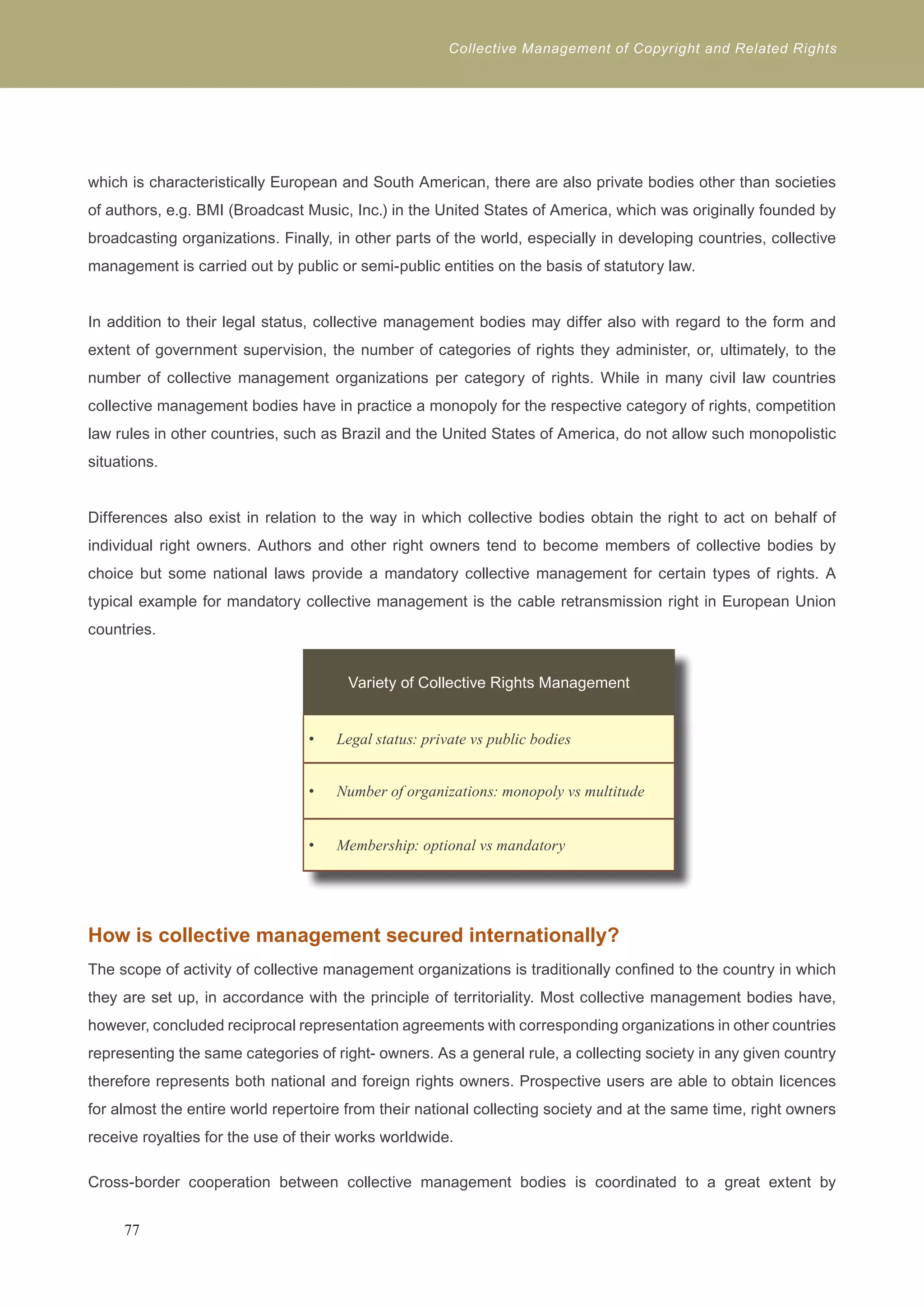
How is collective management secured internationally? 75 
What are the advantages of collective rights management? 76 
What challenges do recent technological developments pose to collective rights management? 77
International Copyright and Related Rights Protection 78 
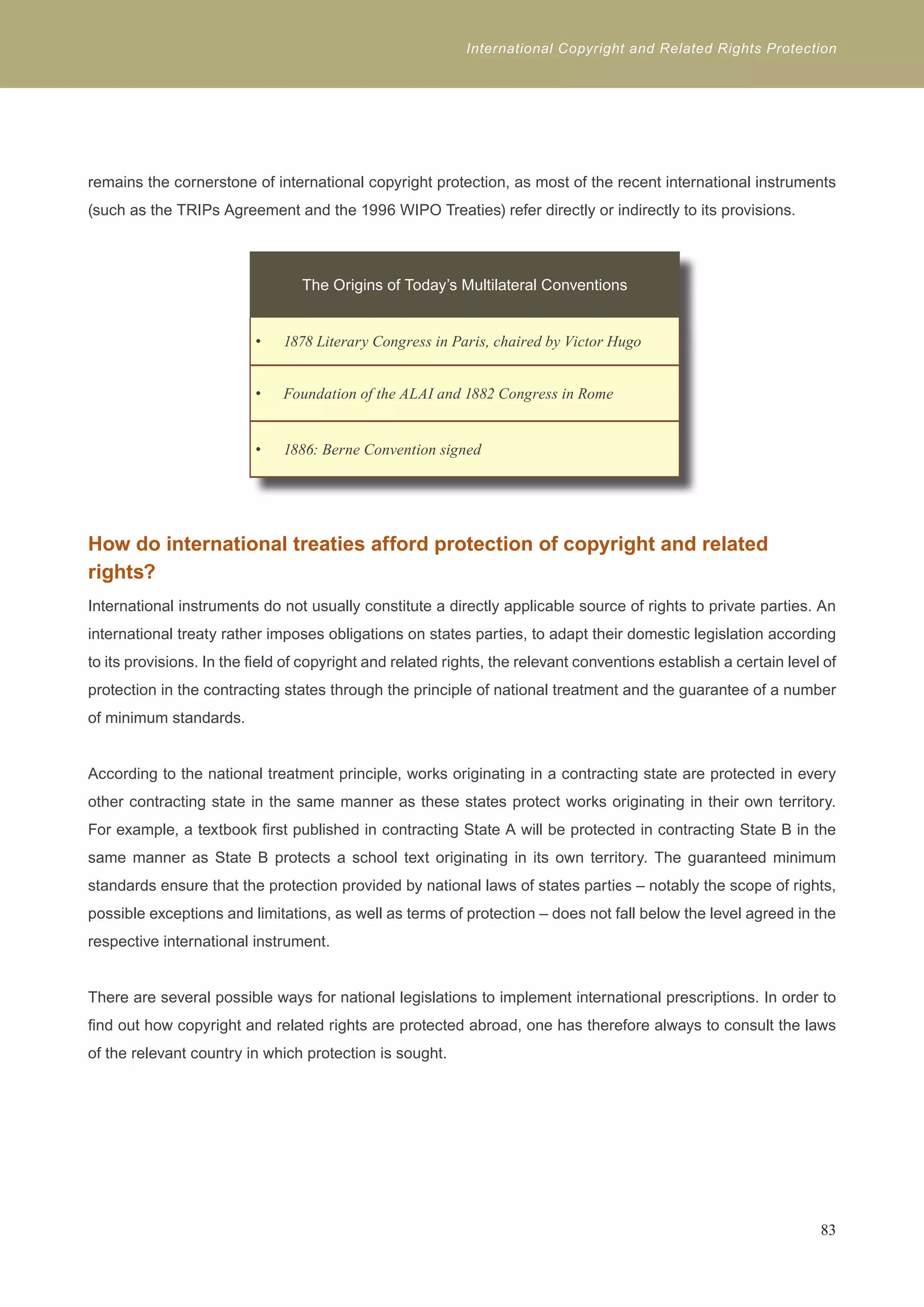
What are the origins of today’s international protection system? 80 
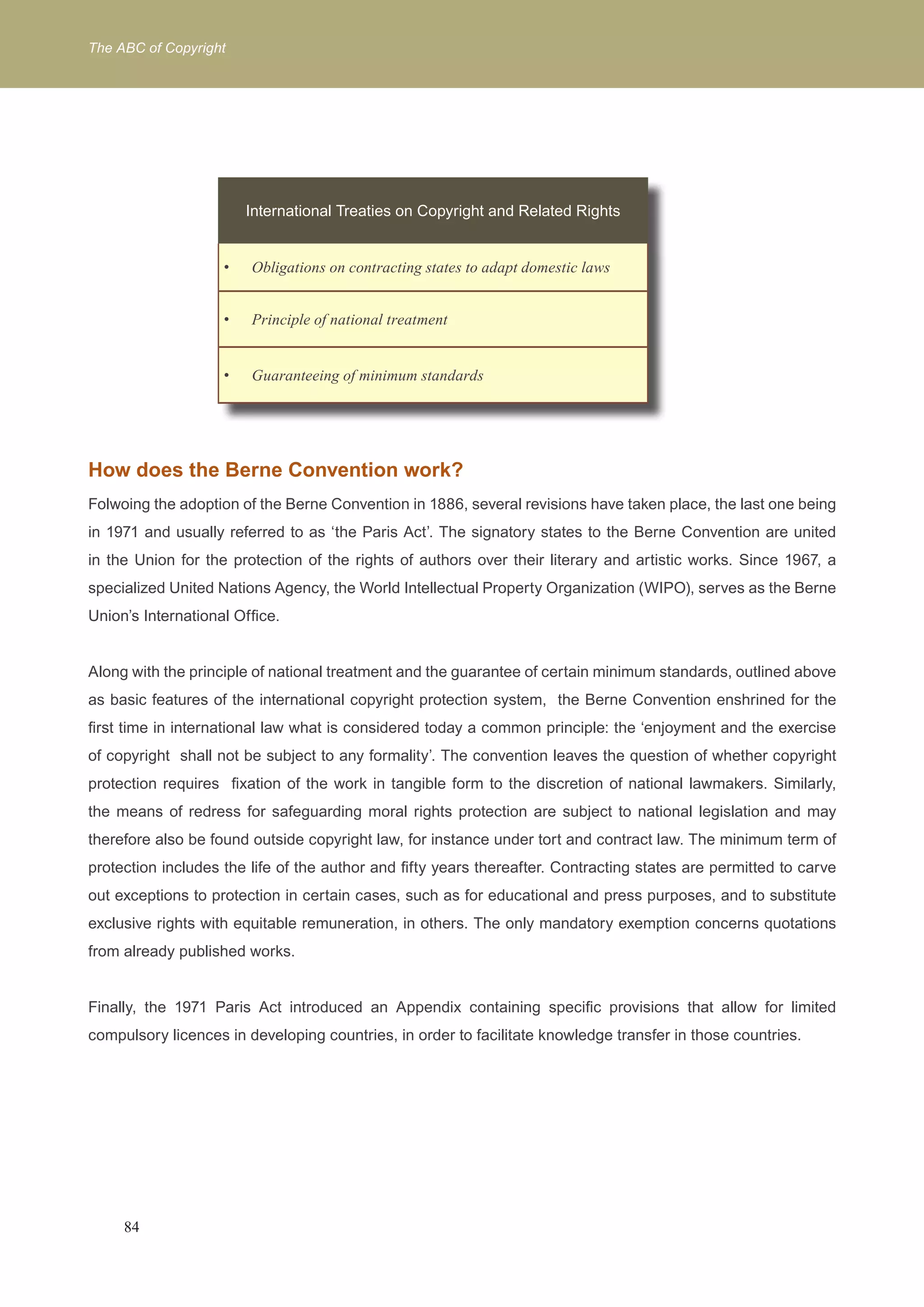
How do international treaties afford protection of copyright and related rights? 81 
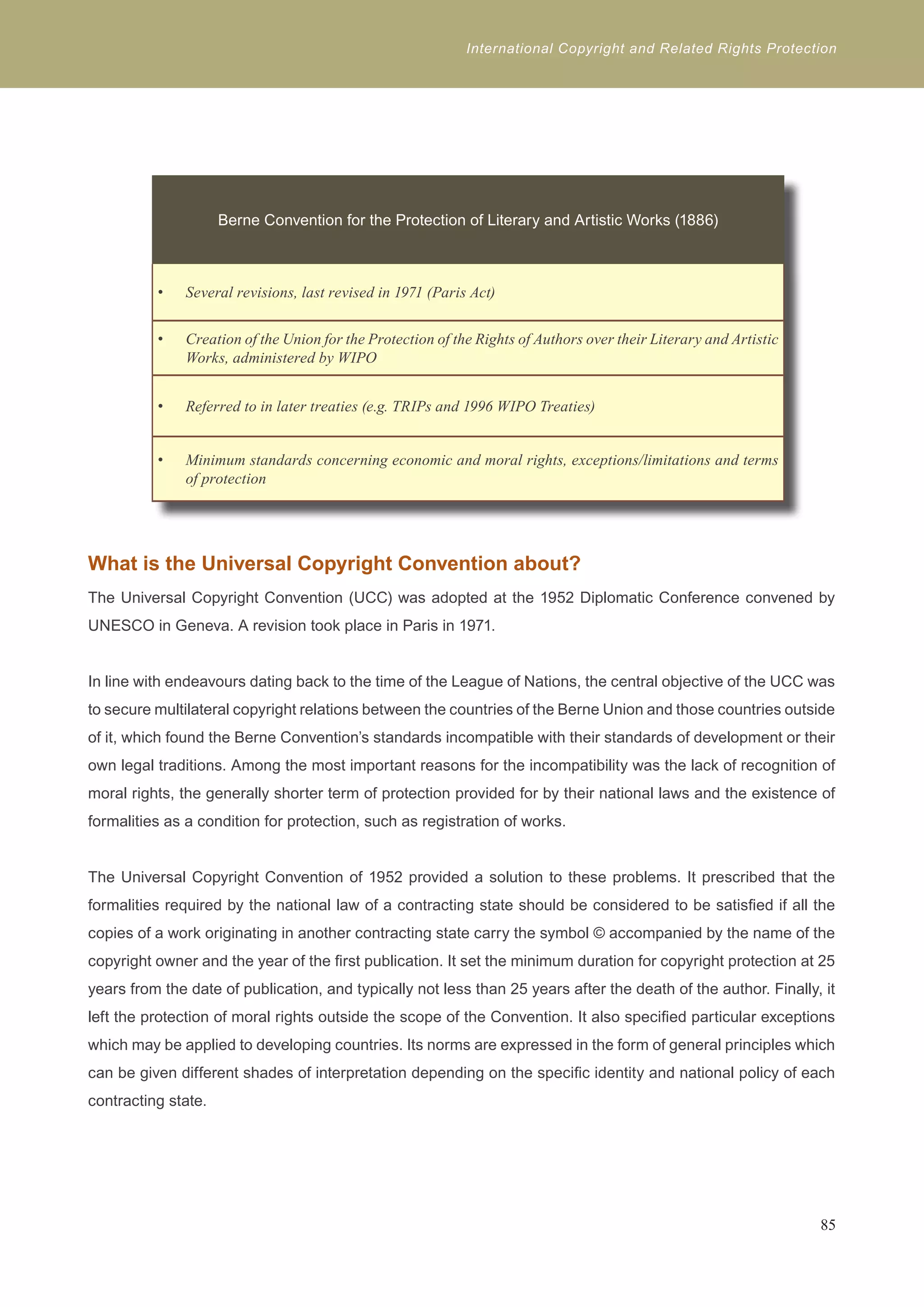
How does the Berne Convention work? 82 
What is the Universal Copyright Convention about? 83 
What provisions are included in the Rome Convention? 84 
What are the implications of the TRIPs Agreement? 85 
What is the role of the 1996 WIPO Treaties? 86
Copyright - 
Past and Present
The ABC of Copyright 
Introduction 
Today we live in a world of instant global communication. Everyone is familiar with the 
technological developments that have come with dazzling rapidity. New techniques 
for recording and transmitting texts, sound or visual images have proliferated. Digital 
technology has created prodigious capacities to store, disseminate and retrieve knowledge. 
This technology provides unprecedented possibilities for communication between people as well 
as for the development of cultural industries and the exploitation of works all over the world. At 
the same time, the possibility of piracy of protected works has increased dramatically. It is thus 
not surprising that in many countries, as well as on the international arena, copyright laws and 
international standards are being regularly revised to meet the challenges of new technologies. 
Copyright law plays now more than ever an important role in the modern world. This 
introductory chapter aims to provide an understanding of this complex legal domain by 
taking a look at its underlying principles and the way in which copyright laws have evolved 
over the centuries in response to technological developments and society’s needs. 
Copyright 
Central role in culture a • nd communication 
• Intrinsically linked to technological advances 
• Challenged by rampant piracy in many countries 
9
Copyright - Past and Present 
What is copyright? 
Copyright is a branch of law that grants authors (writers, musicians, artists and other creators) protection over 
their works. Such protection consists in providing authors with ownership or property rights (or exploitation 
rights), which take into account their material interests. Under copyright, authors are entitled to protection 
against unauthorized use of their works as well as to a possible share in any earnings from its use by the 
public. 
However, copyright laws may also provide protection for another set of interests, of a more personal nature, 
which are commonly called the ‘moral rights’ of authors. These rights allow the authors to claim authorship in 
their works as well as respect for their integrity. 
The protection of moral and material interests resulting from any scientific, literary or artistic production is also 
recognized as a human right under the Universal Declaration of Human Rights (1948) and the International 
Covenant on Economic, Social and Cultural Rights (1966). 
Copyright is part of intellectual property (IP) law, which protects other subject matter as well, such as trademarks, 
patents, designs, plant seed varieties, trade secrets, integrated circuits, topographies and geographical 
indications of source. All topics that come under the heading of intellectual property have in common the fact 
that a certain amount of intellect has been displayed in achieving the results for which protection is granted. 
Yet copyright laws do not only aim at establishing individual rights for the benefit of authors, they also take 
into account the needs of users and of society at large for access to knowledge and information. In order 
to maintain a fair balance between the conflicting interests, copyright protection is subject to a number of 
exceptions and limitations. The interplay between exclusive rights, on the one hand, and exceptions and 
limitations to these rights, on the other, forms the legal framework within which creativity and communication 
can develop. 
How is copyright protection justified? 
There are two main justifications for the legal protection provided by copyright. The first is linked to economic 
considerations, while the second stems from theories referring to natural law. Nearly all copyright laws have 
10 
The Essences of Copyright 
Right of o • wnership in creative works 
• Protection against unauthorized uses 
• Limitations for the benefit of society at large
The ABC of Copyright 
taken into account elements from these two lines of argument, although different countries may give varying 
emphasis to each of them. 
From an economic point of view, granting an exclusive right ensures that the author will receive an economic 
reward for the exploitation of the work for a certain period and hence constitutes an incentive for creativity. 
According to justifications based on natural law, on the other hand, each person has a natural right of property 
to the products of her labour. It is argued that this must also apply in the case of intellectual creations. 
The economic argument has been particularly prevalent in countries which are part of the Anglo-American 
world, while the doctrine of natural law has had greater influence on the European continent and in countries 
of Roman law tradition. Accordingly, we may distinguish two major traditions in copyright law: the Anglo- 
American, or common law copyright system, and the continental European, or civil law authors’ rights system. 
As this terminology might suggest, the former tends to emphasise the protection of the work, while the latter 
is rather centered on the personality of the work’s creator. The distinction becomes particularly relevant with 
respect to such questions as moral rights or a legal entity’s eligibility as author. 
The Rationale behind Copyright 
Exclusive rights as economic r • eward and stimulus for 
creativity 
• Natural/personal right in the results of intellectual work 
• Distinction between Anglo-American (common Law) and 
Continental (civil law) tradition 
What are the origins of copyright? 
The origins of copyright are linked to the European invention of printing (the Gutenberg press) in the fifteenth 
century. History shows, however, that some form of protection existed in relation to creative output even 
before the fifteenth century. For example, in ancient Greece and Rome, plagiarism was widely condemned 
as dishonourable. Moreover, ethnographers argue that, dating back to the earliest historical times, examples 
existed where some rights have been recognized in respect of works and trademarks among various peoples. 
It would, however, take several centuries before the pecuniary and moral interests of authors were formally 
recognized in the legal systems. 
The invention of printing in Europe marks a decisive date as it transformed the conditions for disseminating 
printed works in an unprecedented way. Secular rulers and the clergy, both in England and on the European 
11
Copyright - Past and Present 
continent, quickly recognized the printing press as a new powerful social influence and began to grant 
privileges to certain printers in order to control the distribution of printed works. From the late fifteenth to the 
early eighteenth century, the history of printing was marked by the issuance of various royal decrees and 
statutes, which may be considered as the precursors of today’s copyright laws. 
When did the first copyright laws come into existence? 
In seventeenth-century England, under the influence of the philosopher John Locke and others, the concept 
of individualism emerged and the parliamentary system replaced the absolute monarchy. In this period of 
changes, booksellers and printers started to push for some kind of copyright protection, referring to the theory 
of intellectual property. On 10 April 1710, a law hitherto known as The Statute of Queen Anne was passed. 
It was the first law on copyright in the modern sense of the term since it recognized for the first time the 
existence of an individual right to authors to be protected, albeit only with respect to their books. 
Further important steps in the evolution of copyright were taken in France at the end of the eighteenth century. 
Inspired by revolutionary ideals, the decrees of 1791 and 1793 instituted the concept of literary property. At 
the same time, the notion of public domain was introduced, and thus two fundamental principles in modern 
copyright were established. The French example was soon to be followed by other countries and by the mid-nineteenth 
century, many states, including some in Latin America, had already enacted national copyright 
laws. 
12 
The Origins of Copyright 
From the earliest days s • ome forms of protection 
• 15th-century Europe: Invention of the printing press 
• Printing privileges precursors of modern copyright laws 
The First Copyright Laws 
• 1710: Statute of Queen Anne (England) 
• 1791 and 1793: Revolutionary decrees (France) 
• By the mid-19th century: followed by many countries
The ABC of Copyright 
How has the contemporary copyright system developed? 
The modern system of copyright and related rights is substantially structured around international agreements. 
Already by the end of the nineteenth century, a considerable number of countries had recognized that the 
protection for works should not stop at a country’s borders. A number of bilateral agreements were thus 
signed, in particular among European countries. 
The first multilateral international treaty on the protection of copyright, the Berne Convention for the Protection 
of Literary and Artistic Works, was signed in 1886, on the initiative of the Association Littéraire et Artistique 
Internationale (ALAI). Since then, a number of revisions have taken place and other treaties have come into 
existence, for instance the 1952 Universal Copyright Convention administered by UNESCO, the 1994 Trade- 
Related Intellectual Property Aspects (TRIPs) Agreement, which constitutes an Annex to the Marrakech 
Agreement establishing the World Trade Organization (WTO) and, most recently, the WIPO Treaties of 1996, 
the WIPO Copyright Treaty (WCT) and the WIPO Performances and Phonograms Treaty (WPTT), which aim 
to provide adequate protection for works in the new digital environment. 
The increase in cross-border trade and technological developments triggered recent international developments. 
The current challenges to copyright presented by the information society require a evermore global approach. 
Care should be taken by legislators so as to ensure that copyright protection will be adequately provided for 
and enforced in the new digital environment, while at the same time not impeding lawful access to works.Thus 
the information society will be able to fulfil its cultural and economic potentials. 
The Modern Copyright System 
Marked by the conclusion of international ag • reements 
• Cross-border trade and technological advances as motor 
• Information society requires further global co-operation 
13
The Scope of Copyright 
Protection 
14
Introduction 
International conventions as well as most national laws mention that copyright law extends 
to ‘works of a literary, scientific or artistic nature’. But what constitutes a work? Generally 
speaking, a work has to be more than a mere idea and has to be original. These two basic 
notions of copyright law will be explored in greater detail below. In recent years, there has 
been a trend towards extending the scope of protected works, both on the international and 
national levels. Recent additions concern particularly computer programs and databases. 
A final rather controversial case is the protection of traditional cultural expressions of 
local communities (often referred to as ‘folklore’), which will also be dealt with below. 
15
The ABC of Copyright 
What is the distinction between a protected work and a mere idea? 
The distinction between protected works and ideas lies at the very heart of copyright law. The protection of a 
given work applies to the expressions of ideas that are contained therein. Mere ideas found in a work cannot 
be protected by copyright and may be used freely. Accordingly, in order for copyright in a work to be infringed 
or violated, one has to copy the form in which the ideas are expressed. The mere use of the ideas found in a 
work does not represent a copyright violation. 
For instance, any person is entitled to write a 
book explaining to the general public how to use 
a recent version of a computer program. Such an 
idea cannot be appropriated by the person who 
first wrote the book. Hence the author could not 
prevent anyone from publishing a book on the 
same topic. Nevertheless, subsequent authors 
writing on the same topic should refrain from 
copying from books published or written before 
or by others. 
The Scope of Copyright Protection 
Copyright protects 'works o • f a literary, scientific or 
artistic nature’ 
• Works must be original and more than mere ideas 
• Trend towards extension of scope in recent years 
The distinction between protected expressions and unprotected ideas has important practical consequences. 
It means that copyright does not preclude others from using information revealed in an author’s work. For 
example, the author of a chess guide will be protected against the making and selling by others of copies of 
the book. This protection will not, however, prevent anyone from applying the instructions given therein when 
playing chess. Likewise, copyright does not protect the underlying idea upon which certain works are created. 
The copyright in the famous Mickey Mouse character concerns, for instance, only the specific features of that 
particular cartoon character, but does not give any exclusivity over the general idea to create artistic works 
about talking mice or other animals. The same holds finally true for an artist’s characteristic style or method. 
Everyone may therefore make paintings in the Cubist style developed by Pablo Picasso or in the dotty manner 
of French Impressionists. Only if a concrete work of some of these painters is reproduced will copyright be 
infringed. Other examples of ideas that are not eligible for copyright protection include scientific theories, 
marketing concepts and algorithms. 
In order to illustrate what kind of works may be protected, most copyright laws contain an elaborate, but 
usually not exhaustive, list of examples. The enumerated categories comprise typically works of language 
(such as writings and speeches); musical works (with or without text, such as songs, sonatas, musical scores 
for films); dramatic works (such as plays, including pantomimes and choreographies); works of fine art (such 
as paintings, drawings, sculptures, including works of architecture and applied art); photographic works and 
16
The Scope of Copyright Protection 
cinematographic works; illustrations of a scientific or technical nature (such as plans, maps and sketches). 
It is important to note that such lists are given by way of example only, and that other sorts of creations not 
specifically mentioned in the list may be protected provided they qualify for copyright, i.e. are original. The 
question then arises as to when a work qualifies for protection. In other terms, what is originality? 
The Idea-Expression Dichotomy 
Copyright requires an expression i • n a particular form 
• No protection of underlying ideas, mere information or style 
• Usually non-exhaustive list of examples provided by copyright laws 
When does a work qualify for copyright protection? 
The condition of originality 
To qualify for copyright protection, a work must first and foremost be original. There is no unanimity as to what 
originality means, nor universally agreed upon standards. Broadly speaking, countries fall into two general 
categories. In common law countries courts require the display by the author of a certain degree of skill, labour 
and judgment for his or her work to qualify as original (this is called the ‘sweat of the brow theory’). In civil 
law countries courts require more: in order to be original, a work must reflect the individual personality of its 
creator. The mere display of skill, labour and judgement is not enough: the author must also show creativity. 
This difference of appreciation can lead to different results, as common law courts may be less severe in their 
assessment of originality. It might therefore be the case that some works which would not qualify as original in 
civil law countries due to a lack of creativity may nevertheless be considered original in common law countries 
if the author has shown a sufficient degree of skill, labour and judgement. 
Despite the differences that characterise the concept of originality, it should be acknowledged that a far 
greater unanimity prevails concerning the issue of what is not required for copyright protection: in other words, 
quality, novelty, artistic merit or value are not relevant criteria for judging whether or not a work is original. 
While a work may be strongly criticised for its contents and condemned for its style by specialists and the 
general public, it will not lose copyright protection. Finally, it does not matter what purpose a work has been 
created for, be it utilitarian or purely cultural: a piece of music composed for an advertisement would qualify 
for protection in the same way as a sonata or a symphony. 
17
The ABC of Copyright 
Finally, it should be noted that a work might be protected as original even though it is based on a pre-existing 
work. Copyright also protects “derivative works”: translations, adaptations, arrangements of music and other 
alterations of a literary or artistic work receive the same protection as original works. So do collections of 
literary and artistic works, such as encyclopaedias and anthologies provided they are original by reason of the 
selection or arrangements of their contents. 
For both derivative works and collections, the protection is granted “without prejudice to the copyright” in the 
pre-existing work or in the work forming part of the collection. This means that an author of a translation should 
obtain authorization to translate the work from the author of the work to be translated. Likewise, the author 
of an anthology of poems should obtain authorization to publish the selected poems from their respective 
authors. 
The Originality Criteria in Copyright Law 
Central requirement of originality t • o be interpreted by courts 
• Form, purpose, quality, novelty, artistic merit or commercial value 
not relevant 
• Derivative works protected like original works 
Does copyright require any formalities? 
Nowadays, it is an almost universally accepted principle that the protection of authors’ rights stems automatically 
from the act of creation and does not depend on any formalities, such as registration or deposit of the work. In 
that respect, copyright differs considerably from most forms of industrial property protection, such as patents 
or trademarks which generally require an act of registration. 
The absence of any formalities is enshrined in several international conventions. Today, only a small number 
of countries are not signatories to at least one of these. The widely known © symbol was introduced by the 
UNESCO-administered 1952 Universal Copyright Convention (UCC) in order to provide a simple prescribed 
form of copyright notice: this symbol, accompanied by the name of the copyright owner and the year of first 
publication, appearing on all copies of a copyrighted work, guarantees its protection in all UCC member 
countries, including those requiring compliance with formalities as a condition of protection. 
Although mandatory registration has meanwhile been abolished almost everywhere, many national laws allow 
for a voluntary registration of works by the national copyright administration or similar body. Such registration 
18
The Scope of Copyright Protection 
can serve as valuable prima facie evidence in legal disputes. 
Absence of Formalities in Copyright Law 
Absence of formalities enshrined i • n international 
conventions 
• © symbol introduced by the Universal Copyright 
Convention (1952) 
• Voluntary registration may serve as prima facie evidence 
Must works be fixed in a tangible form to be protected? 
The issue of whether a work must be fixed in a tangible form in order to be protected is not dealt with in a 
uniform way. Usually common law countries require that, in order to enjoy protection, the work must be fixed by 
any tangible, material means (for example it could be written on a piece of paper, or recorded on a cassette, a 
CD, a DVD, or stored on a floppy disk or on the computer hard disk), whereas countries with a civil law tradition 
do not have such a requirement. International law allows for both ways. 
Whether a work needs to be fixed in order to benefit from protection has important practical consequences, 
especially with regard to works of improvisation such as music, speeches or choreographies. If fixation is 
required, those works would not be protected until they are either recorded or transcribed. By contrast, in 
a country without fixation requirements, copyright protection takes effect from the very moment the work is 
created, i.e. when the improvised music or dance is performed or the speech is given. 
19 
Fixation Requirement in Copyright 
• Fixation ≠ registration; necessity depends on national 
legislation 
• Concerns ephemeral or improvised works (e.g. music, speeches, 
choreographies) 
• Decisive for the starting point of protection
The ABC of Copyright 
Are computer programs protected? 
Conforming to recent amendments in international law, most countries nowadays recognise computer programs 
as eligible subject matter for protection under copyright. Computer programs are usually protected regardless 
of the language in which they are written, be it source code or object code. The term generally refers to a 
series of instructions used directly or indirectly in an information processing system and may include both 
application programs and operating systems. To be protected, it is irrelevant in what form the program is 
embodied; it may be written on paper or stored on a CD or in the memory of a computer. 
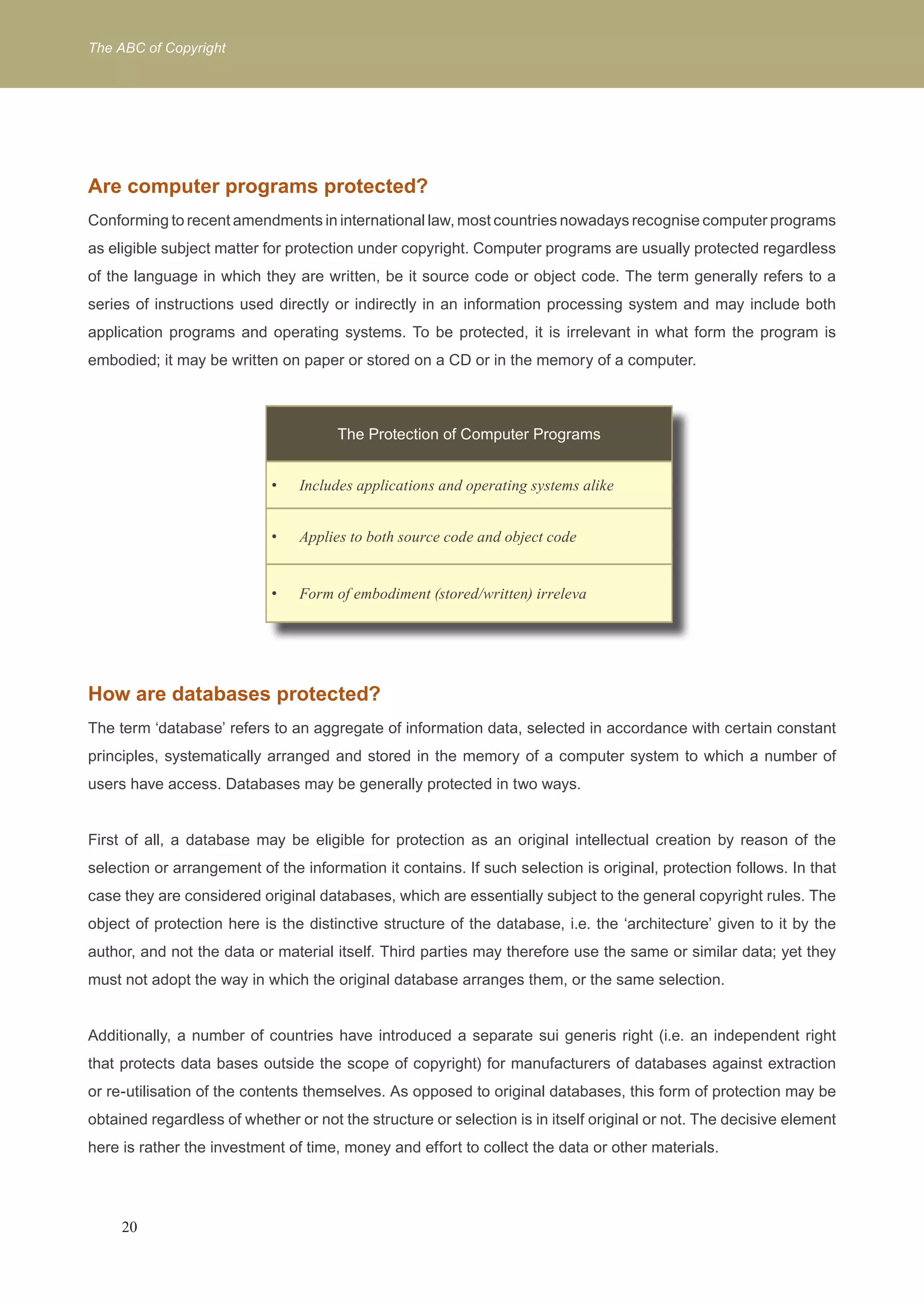
The Protection of Computer Programs 
Includes applications and o • perating systems alike 
• Applies to both source code and object code 
• Form of embodiment (stored/written) irreleva 
How are databases protected? 
The term ‘database’ refers to an aggregate of information data, selected in accordance with certain constant 
principles, systematically arranged and stored in the memory of a computer system to which a number of 
users have access. Databases may be generally protected in two ways. 
First of all, a database may be eligible for protection as an original intellectual creation by reason of the 
selection or arrangement of the information it contains. If such selection is original, protection follows. In that 
case they are considered original databases, which are essentially subject to the general copyright rules. The 
object of protection here is the distinctive structure of the database, i.e. the ‘architecture’ given to it by the 
author, and not the data or material itself. Third parties may therefore use the same or similar data; yet they 
must not adopt the way in which the original database arranges them, or the same selection. 
Additionally, a number of countries have introduced a separate sui generis right (i.e. an independent right 
that protects data bases outside the scope of copyright) for manufacturers of databases against extraction 
or re-utilisation of the contents themselves. As opposed to original databases, this form of protection may be 
obtained regardless of whether or not the structure or selection is in itself original or not. The decisive element 
here is rather the investment of time, money and effort to collect the data or other materials. 
20
The Scope of Copyright Protection 
Protection of Databases 
• ‘Original’ databases: protected as compilation by reason of 
structure 
• Sui generis protection of contents of non-original databases 
Can copyright protect traditional cultural expressions (‘folklore’)? 
Traditional cultural expressions (sometimes also referred to as ‘folklore’) such as the traditional music, stories 
and artistic designs of local communities have been developed under vernacular laws and customs for 
generations. They often constitute an important part of the culture from which they originate and are at the 
same time linked to the promotion of cultural diversity and human creativity. Today, many local and indigenous 
communities are concerned with the increasing commercial exploitation of their heritage without due respect 
to their own cultural and economic interests. 
The collective and anonymous nature of those expressions poses particular problems to the application of 
existing intellectual property rights, including copyright law. Though certain contemporary expressions may 
indeed meet the originality criteria, copyright as a genuinely individual right, rewarding personal creativity with 
a monopoly limited in time, may not in all cases prove to be the suitable framework for protection. 
UNESCO, as well as a number of other international bodies, has been striving for more than two decades 
to explore new forms of protection that are more specific, more operational and more practicable, and that 
will ultimately achieve a broad international consensus. UNESCO’s activities include the elaboration of the 
Model Provisions for National Laws on the Protection of Expressions of Folklore against Illicit Exploitation 
and other Prejudicial Actions in 1982 (together with WIPO), as well as the adoption of the Convention for 
the Safeguarding of the Intangible Cultural Heritage in 2003.The WIPO Intergovernmental Committee on 
Intellectual Property and Genetic Resources, Traditional Knowledge and Folklore (the IGC), which met for 
the the first time in 2001, is currently discussing approaches and possible frameworks for the protection of 
traditional knowledge and traditional cultural expressions. 
21 
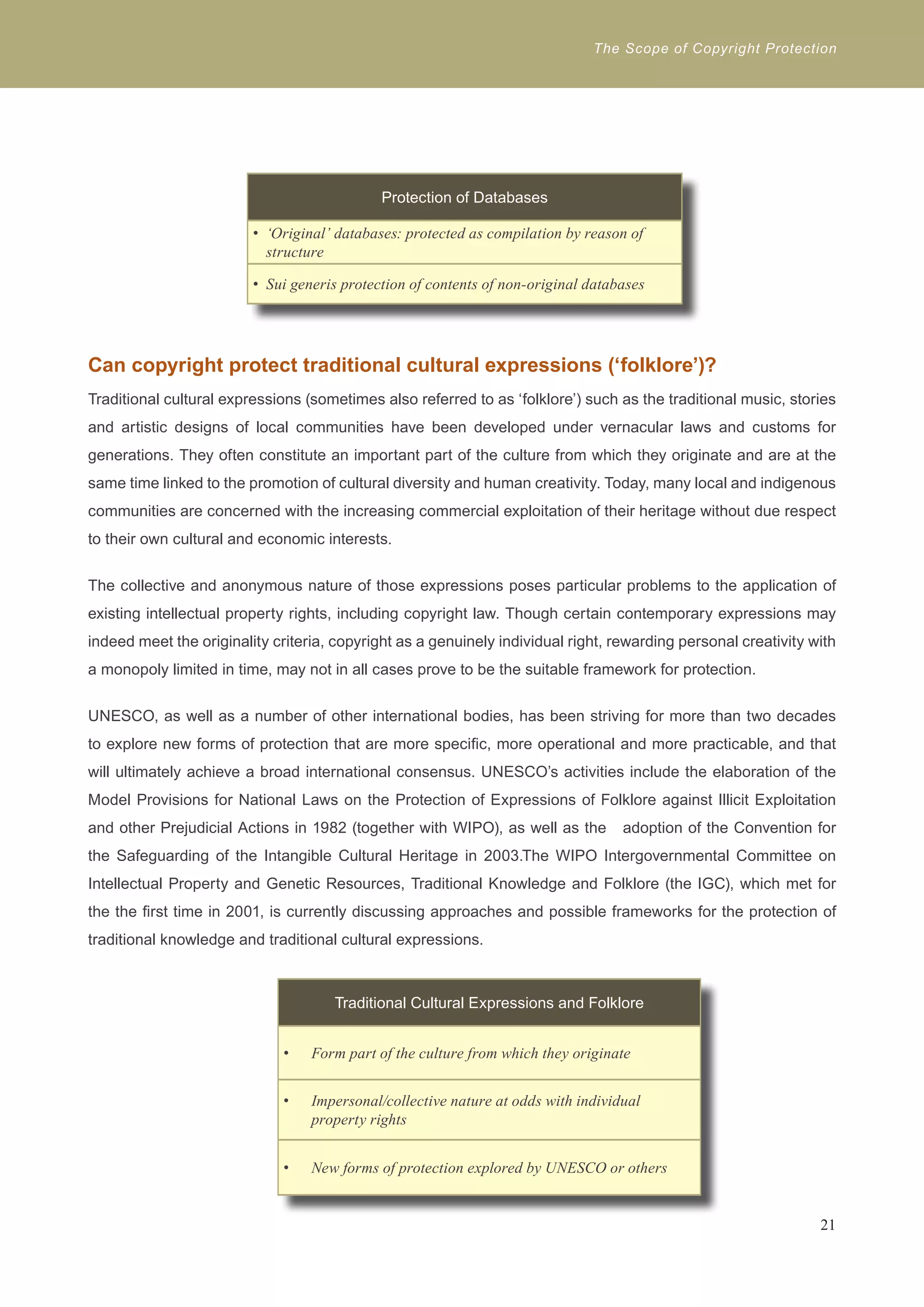
Traditional Cultural Expressions and Folklore 
Form part of the culture f • rom which they originate 
• Impersonal/collective nature at odds with individual 
property rights 
• New forms of protection explored by UNESCO or others
Copyright Ownership
Introduction 
It is not generally disputed that copyright in a work will initially belong to the person who has created 
it, i.e. the author. However, there are exceptions to this rule, which will be explained below. 
It should also be pointed out that ownership of copyright may be transferred, whether by way of 
inheritance after death or through contractual agreements. 
23
The ABC of Copyright 
Who is the ‘author’? 
In the simplest and most frequent case, the 
author is the natural person who has created 
the work. Approaches in national copyright 
laws nevertheless vary, with regard to the 
definition of authorship in cases when third 
parties are involved. 
Copyright Ownership 
Initial ownership g • enerally vested in authors 
• Certain exceptions in particular cases 
• Copyright transferable after death or by contracts 
Many laws, especially in common law countries, apply rather wide criteria which allow initial copyright 
ownership to be vested in persons other than the actual creator. For example, copyright may, since the first 
instance of the creation of the work, belong to a corporate body or legal entity, which are deemed to be the 
‘author’ by virtue of a legal fiction. This becomes especially important in the case of works made for hire (see 
next question). 
In contrast, the civil law tradition, as a rule, attaches authorship inseparably to the person who has created the 
work. This means, at least when the principle is strictly followed, that only human beings or natural persons 
can be the initial owners of copyright in literary or artistic works. Unlike in common-law countries, legal entities 
cannot be indicated as authors since they do not have the capacity to create works. Legal entities will therefore 
need to acquire rights in the work subsequently by contract. 
Who is the ‘Author’ ? 
• Primarily the natural person who created the work 
• Common law: third parties may be deemed authors (ex: 
corporate bodies, legal entities) 
• Civil law tradition: no author apart from the creator 
Who owns the rights in a work made for hire? 
According to the common law legal tradition, when an employee produces a work in the normal course of 
his or her employment, the employer is regarded as the initial owner of copyright in the work, and hence 
considered the author, unless there has been an express agreement to the contrary. The justification behind 
this lies in the fact that the employer is the one who makes the decisions and takes the initiatives, who pays 
for the work and its production. The employer should therefore reap all the economic benefits that are derived 
24
Copyright Ownership 
from the work. 
In countries where copyright laws attach authorship solely to natural persons, the approach is different: rights 
are vested initially in the employee and the employer (whether a natural person or a legal entity, such as a 
company) who hired the employee may subsequently acquire rights in a work by virtue of a contract. 
Works made for hire 
Works produced i • n the course of employment 
• Common law: copyright initially vested in employer instead of employee 
• Civil law: employer can acquire copyright via contract 
Who owns copyright in anonymous or pseudonymous works? 
Copyright laws generally acknowledge that there are cases in which a person may wish to publish a work 
without revealing his or her name (anonymous works) or under a borrowed or pen-name (pseudonymous 
works). In most countries, it is the publisher who exercises copyright in such works on behalf of the author, 
except in the case of transparent pseudonyms which leave no doubt as to the identity of the authors and are 
therefore equivalent to the latter’s real names (e.g. George Sand, Molière). 
Yet it should be clearly understood that in these cases, the publisher is not the real owner of copyright but is 
only entitled to protect and enforce the author’s rights by virtue of a legal fiction according to which the publisher 
is presumed to represent the author. Once the real authors reveal their true identities, this presumption will 
no longer be valid. From that moment on, the publisher steps aside and the rights are exercised solely by the 
authors, unless transferred by them to a third party. 
Copyright in Anonymous and Pseudonymous Works 
• Legal presumption in favour of publishers 
• Valid until the author reveals his or her identity 
25
The ABC of Copyright 
Who owns the rights in works created by several persons? 
Two or more persons can collaborate in the creation of a work in different ways. Copyright ownership in such 
works follows different rules according to the degree to which the individual contributions can be distinguished 
within the final result. 
When the contributions are made with the intention of being merged into an inseparable or interdependent 
unit, we speak of ‘joint works’ (or ‘works of collaboration’). Such is the case, for example, when two authors 
join their efforts to write a book together. However, if the book is written by one author and another one 
contributes a specific chapter and is given credit for this chapter, then this would not be a joint work because 
the contributions are not inseparable or interdependent. 
In the case of joint works, the contributors are considered co-authors who jointly own the rights in their 
creation. As joint owners they must generally exercise their rights together. Essentially, the co-authors may 
not unreasonably refuse to give their consent for the exploitation of the work. Unless otherwise contractually 
stipulated, profits are distributed in equal parts. 
Joint works are to be distinguished from ‘composite works’. The latter term is used if two or more pre-existing 
works are linked to a new creation without losing their individual character. For example, when music is written 
to pre-existing lyrics, and thus a song is created, both the music and the lyrics may be used separately from 
the song, without affecting the rights in the new ‘composite’ work. In that case, while the rights in this new 
work (the song) are held jointly, copyright in the individual contributions (the music and the lyrics) continues 
as a general rule to belong to the respective creators, subject to specific contractual arrangements which may 
have been made. 
Finally, a ‘collective work’ merely assembles several contributions without amounting to a joint work. Among 
the examples of collectives works are periodicals, anthologies and encyclopaedias as well as, to a certain 
extent, databases. Though the contributions in this case are separate and discernible, they are often undertaken 
at the initiative of someone who plans, arranges, coordinates, prepares and publishes the collection (often 
called the ‘editor’). It is therefore generally recognized that, without prejudice to the copyright in the individual 
works, there is a separate copyright in the whole, which is usually vested in this person or legal entity. 
26
Copyright Ownership 
Works Created by Several Persons 
Joint Works Composite Works Collective Works 
Contributions merged into 
an inseparable or interde-pendent 
unit 
• Droit d’auteur conjoint 
de tous les contributeurs 
sur la nouvelle oeuvre 
Pre-existing works linked to 
a new creation 
• Copyrights in pre-existing 
works remain separate 
• Joint copyright in new 
work for all contributorse 
Merely assemble several 
contributions 
• Copyrights in contribu-tions 
remain separate 
• Copyright in collection 
for the editor 
Who owns the rights in cinematographic works? 
The vast number of contributors to a film production poses particular challenges for copyright laws. Depending 
on which legal tradition a country follows, two basic solutions to the question of copyright ownership of 
cinematographic works may be found in domestic laws. 
In countries adhering to the civil law legal tradition, the copyright in a film generally belongs to several physical 
persons, who have contributed to the creation of the work. The models, however, may vary considerably from 
one country to another. In some cases, films are considered joint works of a number of co-authors (such as 
the director, the script writer, the composer) who jointly own the copyright in the overall work. Other countries 
consider only the director as the author of the film and grant, according to the rules for composite works, 
a separate copyright for each of the other creative contributions. In either case, the producer must enter 
into contractual arrangements with every right owner before the commercial exploitation of the film can take 
place. 
In contrast, copyright laws following the common law tradition usually consider the producer of a film as 
the sole copyright owner and the individual contributors are basically not granted any rights. Even when 
some rights are conferred to the principal collaborators (such as the rights that the United Kingdom copyright 
legislation grants to the film director), they are usually quite limited in scope and their application is subject to 
a number of conditions. The rationale behind this approach is to facilitate the film’s entry into the market by 
avoiding cumbersome negotiations with numerous right owners. 
27
The ABC of Copyright 
Rights Ownership in Cinematographic Works 
Civil laws approach: films as joint or composite • works, several 
right owners 
• Common law approach: producer typically sole copyright 
owner 
28
The Moral Rights of Authors 
29
Introduction 
As a creation of the mind, the work reflects 
the author’s personality. Apart from economic 
considerations, the author may therefore also have 
interests in the work which are not strictly financial 
or monetary, such as the right to claim authorship 
Concerns the author's non-financial inte-rests 
Recognized in most c • ountries in different ways 
• Recognition required by international law 
and to object to derogatory uses. Prerogatives like these are referred to as the author’s moral rights, 
as opposed to his or her economic rights. 
Partially by virtue of international treaties, most copyright laws in the world have today embraced the 
notion of moral rights, though the scope and implementation of these rights still vary considerably 
from one country to another. International law requires recognition of two kinds of moral rights: 
the right of attribution (or the right to claim authorship) and the right of integrity. Yet many national 
legislations also grant the author other moral rights, such as the right to choose whether the work 
should be published or not, usually referred to as the right of disclosure, and the right of withdrawal. 
The Most Important Moral Rights 
• Right of attribution (authorship) 
• Right of integrity 
• Right of disclosure 
• Right of withdrawal 
30
The Moral Rights of Authors 
How has recognition of moral rights evolved internationally? 
Originally moral rights are to be linked to theories that base copyright on natural law and personal rights. 
It is hence no surprise that these rights are highlighted in countries where civil law traditions prevail. From 
this perspective, it is worth noting that moral rights were first recognized in France during the first half of 
the nineteenth century under the expression “droit moral”, which explains the origin of the contemporary 
expression ‘moral rights’. In contrast, moral rights are viewed with less favour in common law countries, where 
emphasis has traditionally been put on the investment embodied in the work. 
The 1928 revision of the Berne Convention (the ‘Rome Act’) was a decisive step towards the international 
recognition of moral rights as it introduced an obligation for the contracting states to provide protection for 
the rights of attribution and integrity. Today, these rights are enshrined in the famous Article 6bis of the 
Berne Convention. Subsequent international instruments, such as the WIPO Treaties of 1996, also include 
provisions for moral rights. 
In practical terms, this Berne Convention requirement means that, at the moment of its accession to the 
Convention, every country, including those belonging to the common law family, should have provided for the 
protection of moral rights in their domestic laws. Yet, since the Convention leaves it to contracting states to 
determine the way in which they will fulfil their international obligations, some legislations have considered it 
sufficient to afford protection of these rights mainly on a basis different from copyright law, for instance under 
tort and contract law. 
Development of International Recognition 
Originally characteristic of c • ivil law systems 
• Art. 6bis Berne Convention / 1996 WIPO Treaties 
• Implementation outside copyright possible 
What are the basic features of moral rights? 
Moral rights are by their very nature connected to the person of the author, they are not property rights. 
Consequently, moral rights belong to authors, even though they may have transferred the economic rights to 
someone else. In addition, and contrary to economic rights, moral rights are not assignable. Authors cannot 
transfer their moral rights to someone else, whereas they would be allowed to sell their economic rights. For 
31
The ABC of Copyright 
example, an author may have transferred to a publisher the right to reproduce and distribute his or her novel. 
However, that has no bearing on the destiny of moral rights which continue to belong to the author who may 
hence claim authorship in the novel. In addition, the publisher may not remove his or her name as the author 
of the work, or substitute it with another one. However, some countries, especially those that adhere to the 
common law system, allow moral rights to be waived (or renounced) under certain conditions. 
For how long should moral rights be protected? This issue has traditionally given rise to controversy. While 
common law countries, as a rule, tend to provide that moral rights will not be protected after the author’s death, 
the civil law tradition generally regards moral rights as perpetual: in this case the rights in question may be 
exercised posthumously by the author’s heirs or, as provided under some national laws, by certain public or 
private bodies for the benefit of a country’s cultural heritage. The Berne Convention contains a compromise 
that the rights granted under its Article 6bis should last for at least as long as the author’s economic rights. 
Today, many Member States have adopted this model and grant the same term of protection for both moral 
and economic rights. Under international standards, the term of protection for economic rights is 50 years after 
the death of the author but some countries extend the term of protection to 70 years. 
What does the right of attribution stand for? 
The right of attribution is one of the moral rights provided under Article 6bis of the Berne Convention. It is 
often referred to as the ‘paternity’ right, which alludes to the spiritual kinship between the work and its creator, 
though this terminology may today seem outdated. 
Under the attribution right the authors are reserved the decision of whether or not to associate their names 
with the work and of when the work will be published or otherwise made available to the public. It is therefore 
the right to claim authorship, as well as the right to remain anonymous. The author may also use a borrowed 
name (a pseudonym), like the author of “Alice’s Adventures in Wonderland”, who was born as Charles Lutwidge 
32 
Basic Features of Moral Rights 
Exist independently f • rom economic rights 
• Generally not assignable 
• Last at least as long as economic rights
The Moral Rights of Authors 
Dodgson, but is known to the world as Lewis Carroll. Alternatively, the author may decide to use an acronym 
(like the famous ‘AD’ of the early sixteenth century German painter Albrecht Dürer). Along with this prerogative 
comes the obligation for users to acknowledge the source and the name of the author when they cite or 
otherwise refer to a work. 
The right of the author to be recognized as such has to be distinguished from the right to object to any wrongful 
attribution of authorship, e.g. when the signature of a famous artist is imitated on a painting which is not of 
his or her making. The possibility to defend one’s name against usurpation by third parties does not, strictly 
speaking, falls within the category of authors’ moral rights but rather forms a part of the general category of 
personality rights to which all individuals are entitled, regardless of whether they are authors or not. 
Against which acts does the right of integrity protect? 
The right of integrity allows the author to prevent any distortion, mutilation or derogatory action in relation to the 
work that would be prejudicial to his/her honour or reputation. This prerogative acknowledges the fact that the 
author’s personality is intimately reflected in the work. It is therefore also often called the ‘right to respect’. 
The integrity right grants protection against unauthorized modifications (a publisher may not, for instance, 
delete chapters from a narrative), as well as against use of the work in a demeaning context (such as the use 
of a song in a pornographic film ). With the advance of digital technology, authors face new types of threats to 
their works’ integrity as it becomes easier and easier to manipulate and modify their contents at will. 
Yet not every deviation from the author’s original design must be necessarily held to constitute an infringement 
of the integrity right. The problem becomes especially delicate in the case of adaptations. For example, when 
a novel is turned into a movie, the new medium or form of expression may make certain changes inevitable. 
Article 6bis of the Berne Convention is rather flexible in this regard as it allows some changes or modifications 
to be made to a work but only as long as they are not prejudicial to the author’s honour or reputation. Many 
national legislations have therefore made the integrity right subject to a balance of the legitimate interests of 
all parties concerned. 
33 
The Right of Attribution 
Right t • o claim authorship in a work 
• ≠ Right against wrongful attribution
The ABC of Copyright 
34 
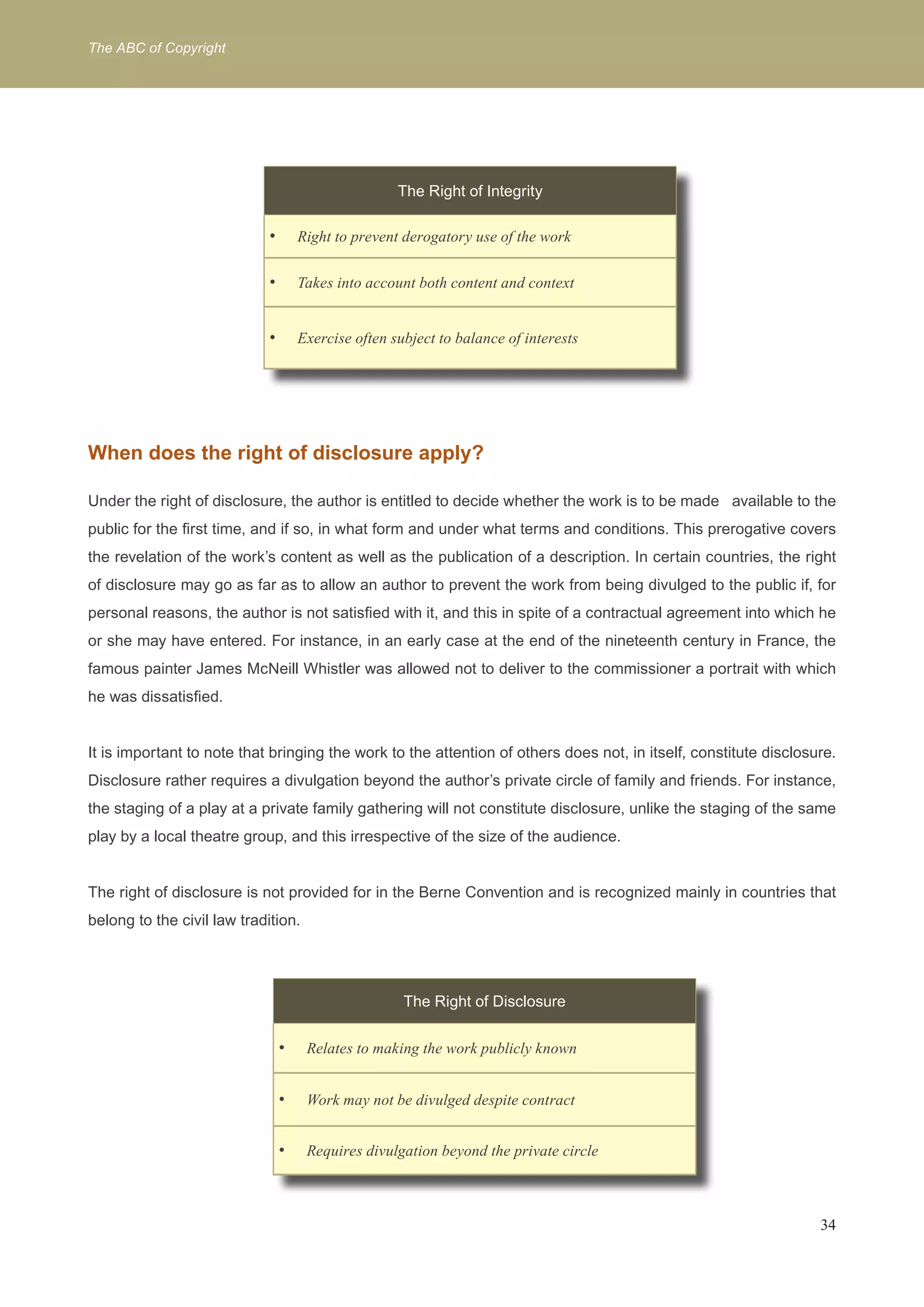
The Right of Integrity 
Right to prevent d • erogatory use of the work 
• Takes into account both content and context 
• Exercise often subject to balance of interests 
When does the right of disclosure apply? 
Under the right of disclosure, the author is entitled to decide whether the work is to be made available to the 
public for the first time, and if so, in what form and under what terms and conditions. This prerogative covers 
the revelation of the work’s content as well as the publication of a description. In certain countries, the right 
of disclosure may go as far as to allow an author to prevent the work from being divulged to the public if, for 
personal reasons, the author is not satisfied with it, and this in spite of a contractual agreement into which he 
or she may have entered. For instance, in an early case at the end of the nineteenth century in France, the 
famous painter James McNeill Whistler was allowed not to deliver to the commissioner a portrait with which 
he was dissatisfied. 
It is important to note that bringing the work to the attention of others does not, in itself, constitute disclosure. 
Disclosure rather requires a divulgation beyond the author’s private circle of family and friends. For instance, 
the staging of a play at a private family gathering will not constitute disclosure, unlike the staging of the same 
play by a local theatre group, and this irrespective of the size of the audience. 
The right of disclosure is not provided for in the Berne Convention and is recognized mainly in countries that 
belong to the civil law tradition. 
The Right of Disclosure 
• Relates to making the work publicly known 
• Work may not be divulged despite contract 
• Requires divulgation beyond the private circle
The Moral Rights of Authors 
What is the right of withdrawal? 
It may sometimes happen that, the author’s thoughts or opinions on issues exposed in the work change and 
that the work no longer reflects his/her intellectual or artistic views. In case where this occurs after the work 
has been lawfully brought to the public, the author cannot resort to the disclosure right to prevent it from 
being distributed. Nevertheless, some copyright laws grant the author the right to withdraw the work from the 
market. 
Since the withdrawal affects the interests of those who have already acquired the right to use the work (for 
example the publisher, who is entitled to make and distribute copies of the work), the right of withdrawal is 
normally subject to a range of conditions. Such conditions are designed to take into account the legitimate 
interests of the persons who have entered into contractual agreements with the author. Typically, they are 
entitled to indemnification for their resulting losses. Moreover, some laws provide that the original contractors 
will enjoy priority for the conclusion of a new contract should the author decide to resume the exploitation of 
the work. 
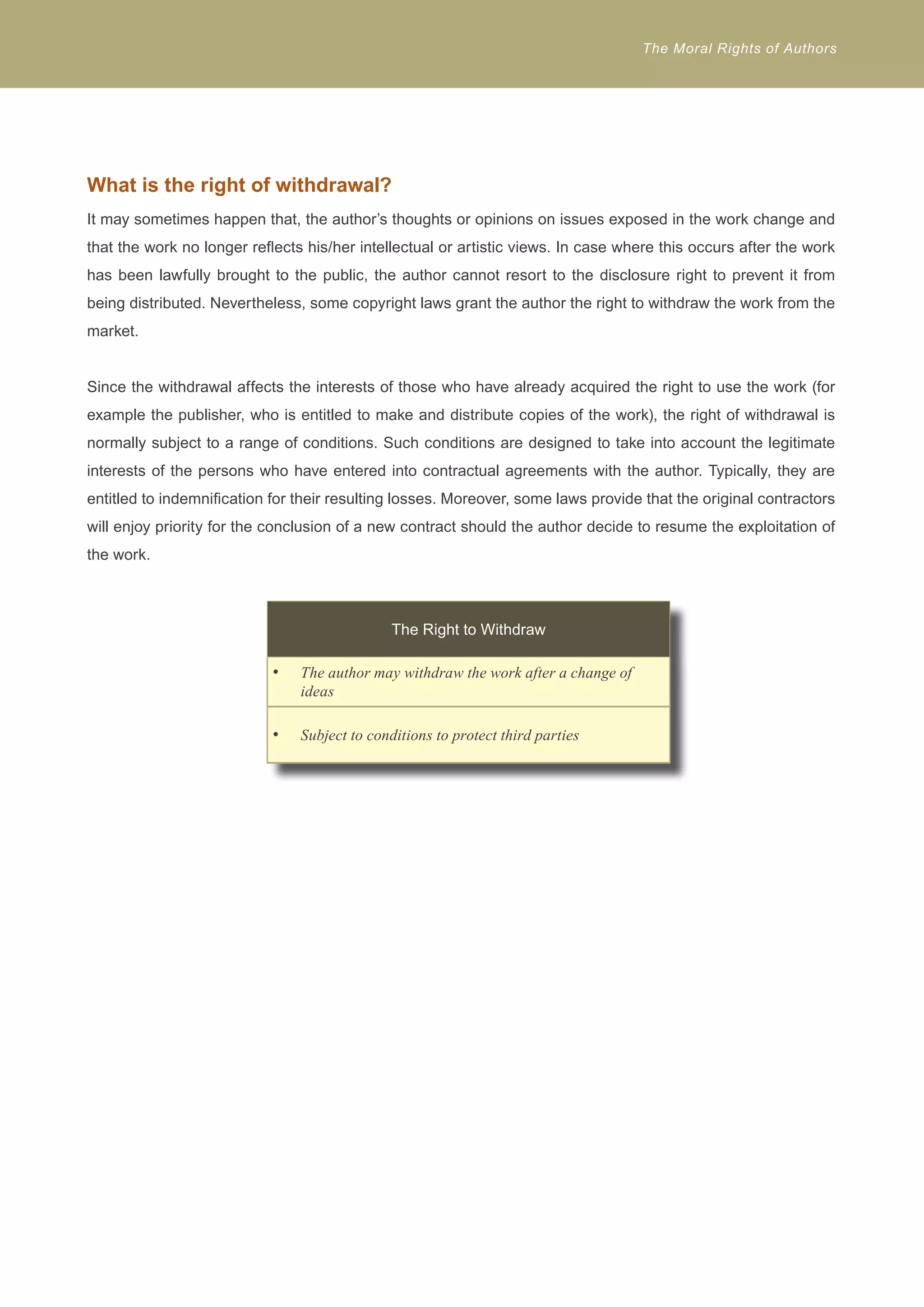
The Right to Withdraw 
The author may withdraw t • he work after a change of 
ideas 
• Subject to conditions to protect third parties
Economic Rights of Authors
Introduction 
In contrast to moral rights, economic rights 
enable authors to earn a living from their 
creative works. In most cases, musicians, 
artists and other creators do not 
exercise their economic rights personally, 
but entrust professional partners such as book publishers 
or record producers to bring their works to the market. 
Economic rights are generally exclusive rights. 
Practically speaking, this has two main implications. 
Firstly, it is up to the right owners to authorize others to 
carry out an act which falls within the scope of their rights. Consequently, anyone who wishes 
to use a protected work in a way covered under the author’s economic rights (for instance 
by publishing a novel, or recording a song), must seek the right owner’s authorization to that 
effect. The latter can thus determine the conditions of the use, including the remuneration. 
Secondly, the author also has the right not to grant permission to the would-be user (right of 
refusal). In this case, should the users proceed with their activity (for example, perform in public 
a play for which authorization has been refused), they may be sued for copyright violation. 
It may be worth mentioning that economic rights are not always of an exclusive nature. In 
37
The ABC of Copyright 
some instances national legislations as well as international treaties allow for uses of a work to 
be made in certain situations, without having to seek or obtain authorization from the right 
owner, provided, however, that the user pays a remuneration in order to compensate the 
author for the use of the work. If and when such situations occur, authors’ rights are limited to 
a right of remuneration and are no longer of an exclusive nature. The public lending right 
and the resale right (droit de suite) are two examples of the so-called remuneration rights. 
Economic rights are traditionally granted as a set of single prerogatives that correspond to the different 
ways in which a work may reach its audience. Each prerogative may be exercised separately. For 
instance, a dramatist who assigns to a publisher the right to publish his or her play in book format 
38 
does not thereby consent to the public performance of the play. 
In compliance with several international conventions, most countries recognize today a certain 
standard catalogue of economic rights, which has constantly expanded with the evolution of ever 
more efficient means of reproduction and communication. 
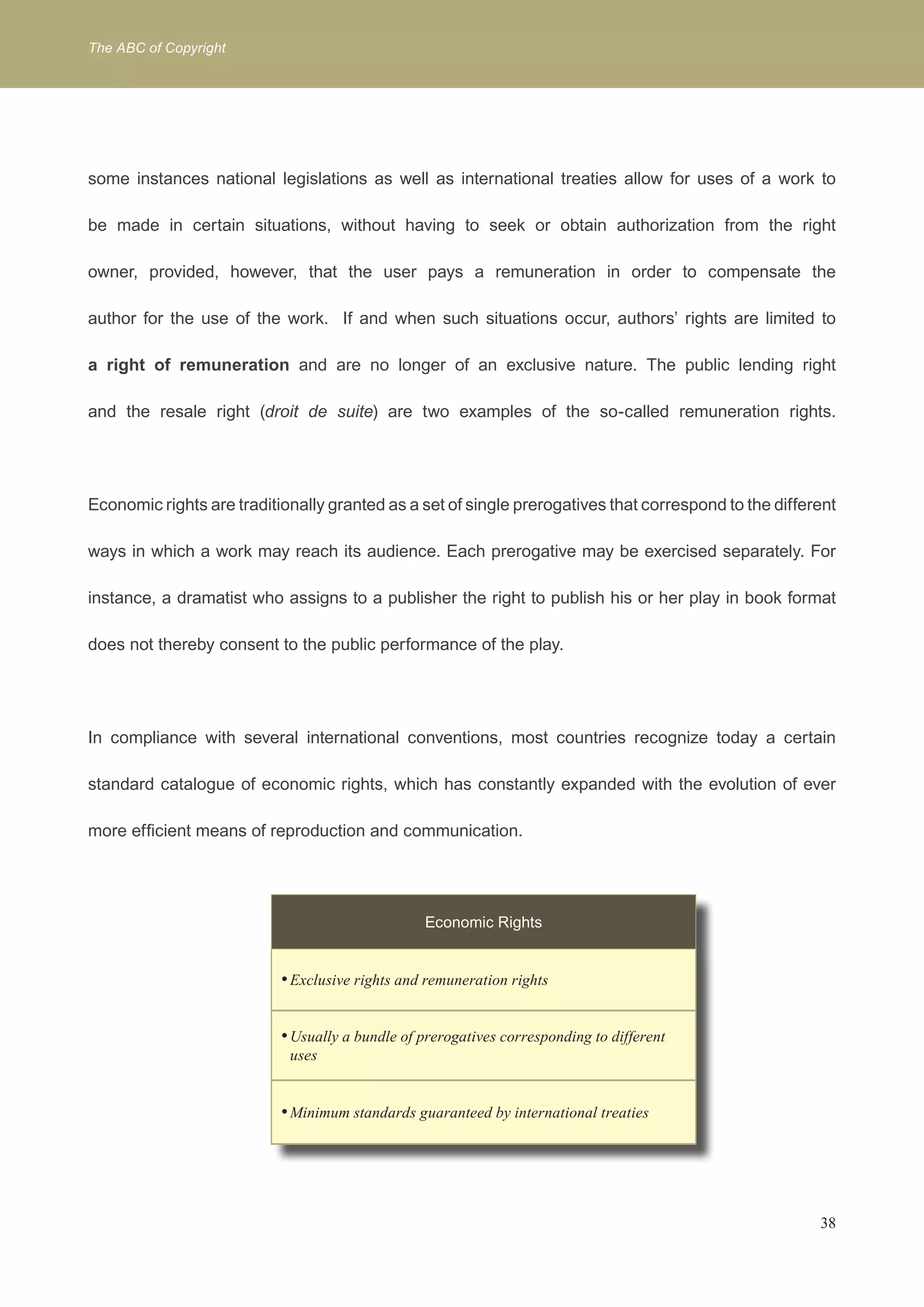
Economic Rights 
Exclusive rights a • nd remuneration rights 
• Usually a bundle of prerogatives corresponding to different 
uses 
• Minimum standards guaranteed by international treaties
Economic Rights of Authors 
What is the reproduction right? 
The author’s prerogative to authorize or prohibit the making of copies of the work (right of reproduction) may 
be considered the most fundamental economic right, as the control of copying is the legal basis for a wide 
range of subsequent commercial uses. 
In conformity with international law, reproduction is to be interpreted widely, covering all possible ways of copying 
a work, either known or yet to be discovered. Conventional examples include the printing or photocopying of 
books or articles as well as the recording of music and films. 
Recent progress in digital technology has brought a wide 
consensus, enshrined in international agreements, that 
the storage of a work in digital form using an electronic 
medium also constitutes reproduction in copyright terms, 
even though the result is not visible. A single exemption has 
been made with regard to those temporary or transient acts 
of reproduction (e.g. caching), the sole purpose of which is 
to enable a transmission in a network and which have no 
independent economic significance. 
How does the right of distribution work? 
Distribution means the putting into circulation tangible copies 
of a protected work. While some jurisdictions consider it a 
part of the reproduction right, recent international instruments, such as the 1996 WIPO Copyright Treaty 
(WCT) have explicitly recognized the distribution right as a separate prerogative, which can be exercised and 
transferred independently. The economic right of distribution must not be confused with the author’s moral 
right to decide on the disclosure or the first publication of her work. 
39 
The distribution right is subject to an 
important limitation in favour of the free 
circulation of goods which is usually 
referred to as the principle of exhaustion: 
when a particular copy of the work has 
been distributed for the first time with the 
copyright owner’s consent, the purchaser 
of that copy may dispose of it, for example 
The Right of Reproduction 
Right to a • uthorize the making of copies 
• Covers all methods known or yet to be discovered 
• Includes storage in digital form (except transient acts) 
Most Important Economic Rights 
• Right of Reproduction 
• Right of Distribution 
• Rental and Lending Rights 
• Rights of Communication to the Public (incl. 
Right of Making Available) 
• Droit de suite (Resale Right) 
• Adaptation Right (incl. Translation)
Economic Rights of Authors 
by giving it away or even by reselling it, without seeking further permission from the author. It is up to national 
legislation to determine whether the effect of exhaustion will be limited to the national territory where the copy 
in question has entered the market or to a larger area: trading blocks like the European Union or the North 
American Free Trade Agreement (NAFTA) apply for instance a regional exhaustion. Worldwide exhaustion is 
another possibility for which domestic laws may opt since international instruments contain no restrictions in 
this regard. 
What purpose do rental and lending rights serve? 
The rental and lending of copies of a work are, in a way, similar to selling such copies: in copyright terms, both 
acts function as forms of distribution. However, we have seen that the first sale of a copy generally leads to 
exhaustion of the distribution right. The copyright owner therefore has no say in further uses of the work and 
may thus not benefit from activities that occur subsequently to the sale, such as the rental or borrowing of the 
work. Moreover, when copies are borrowed or rented instead of being purchased, this may result in a reduced 
sales volume and hence less revenues for the copyright owner. Also, borrowing or renting a copy may be just 
the first step that precedes its copying at home. Instead of buying a computer program or a CD, one could rent 
it out for a small amount of money, make a copy of it at home - an easy and inexpensive procedure - and thus 
avoid having to buy the product. 
In order to reduce the harm caused to copyright owners by such practices, most countries have introduced 
rental rights,, in compliance with the 1996 WIPO Copyright Treaty, at least with respect to cinematographic 
works, sound recordings and computer programs, which are the areas where right owners have suffered the 
most from rental activities. Rental means making the original or a copy of the work available for borrowing 
on a commercial basis, e.g. in a video rental store. This right is of an exclusive nature and right owners have 
sometimes exercised it by refusing to authorize rental activities that were prejudicial to their economic interests 
(for example, this has been generally the case for computer program rental). 
In some countries, a lending right has also been introduced. Lending takes place on a non-commercial basis, 
for instance in public libraries. While rental rights are genuine exclusive rights, the lending right entitles the 
40 
The Right of Distribution 
Right to disseminate p • hysical copies 
• Subject to national, regional or world-wide exhaustion
Economic Rights of Authors 
author only to an equitable remuneration and is usually exercised through a system of collective management 
of rights or through state subsidies. 
What are the rights concerning communication to the public? 
The notion of ‘communication to the public’ comprises a wide range of activities aimed at rendering a work 
available to larger audiences (an indefinite number of people). In line with international law, a traditional 
distinction is made between the public performance of a work and different forms of remote transmission. 
The right of public performance refers to the presentation or performance of works outside the family circle 
and an author’s closest social acquaintances. The right does not only apply to live concerts, staging of theatre 
plays and projection of films in the cinema. The background music we hear in bars and shops (either live or 
recorded) is a form of public performance as well. In fact, the rights regarding the latter uses are often referred 
to as ‘small rights’ (in contrast to the ‘grand rights’ of staging dramatical or musico-dramatical works, such 
as theatre plays and operas). ‘Small’ rights represent today a considerable source of revenues in the music 
business. These rights are usually managed by collecting societies, which collect payments and pass them 
on to copyright owners. 
The rights concerning remote transmission of works have been constantly extended since the early days. 
Today, they cover the transmission by wireless means (radio, TV, satellite) and by wire (e.g. cable-cast), as 
well as the making available of works online (see below). 
It should be noted that each time a performance, broadcast or another transmission is being made available 
subsequently to an audience in a public space, i.e. outside the family circle, a new act of communication to the 
public takes place (usually referred to as ‘secondary use’). This act also requires the copyright owner’s consent. 
Several subsequent secondary uses may take place when, for instance, a concert (public performance) is 
broadcast on TV, which is turned on in a pub. 
41 
Rental and Lending Rights 
Address successive u • ses by multiple users 
• Rental: exclusive right 
• Lending: entitles authors to an equitable remuneration
The ABC of Copyright 
What is the Right of Making Available to the Public? 
Today, in line with international law, most countries have undertaken to grant authors the exclusive right to 
authorize or prohibit the making available of their works to the public in such a way that members of the public 
may access them from a place and at a time individually chosen by them. As outlined above, this prerogative 
is conceived as an element of the author’s broader right of communication to the public. 
The main example of ‘making available’ is works being offered on the Internet. Yet, the right of making available 
goes beyond the present state of technology and aims at covering all possible situations involving access to 
works at times and in places individually chosen by the public that may come into existence in the future. 
What does the Droit de suite or Resale Right stand for? 
The resale right, which is commonly referred to as droit de suite, as in French, has been adopted by an 
increasing number of countries in order to secure for the authors of graphic or plastic works (e.g. paintings and 
sculptures) a share in the resale of their works at public auctions and in galleries. The artist receives a certain 
percentage of the resale price from the auctioneer or art dealer, but has generally no possibility to prohibit the 
transaction as a whole. The resale right therefore constitutes a remuneration right rather than an exclusive 
right. 
42 
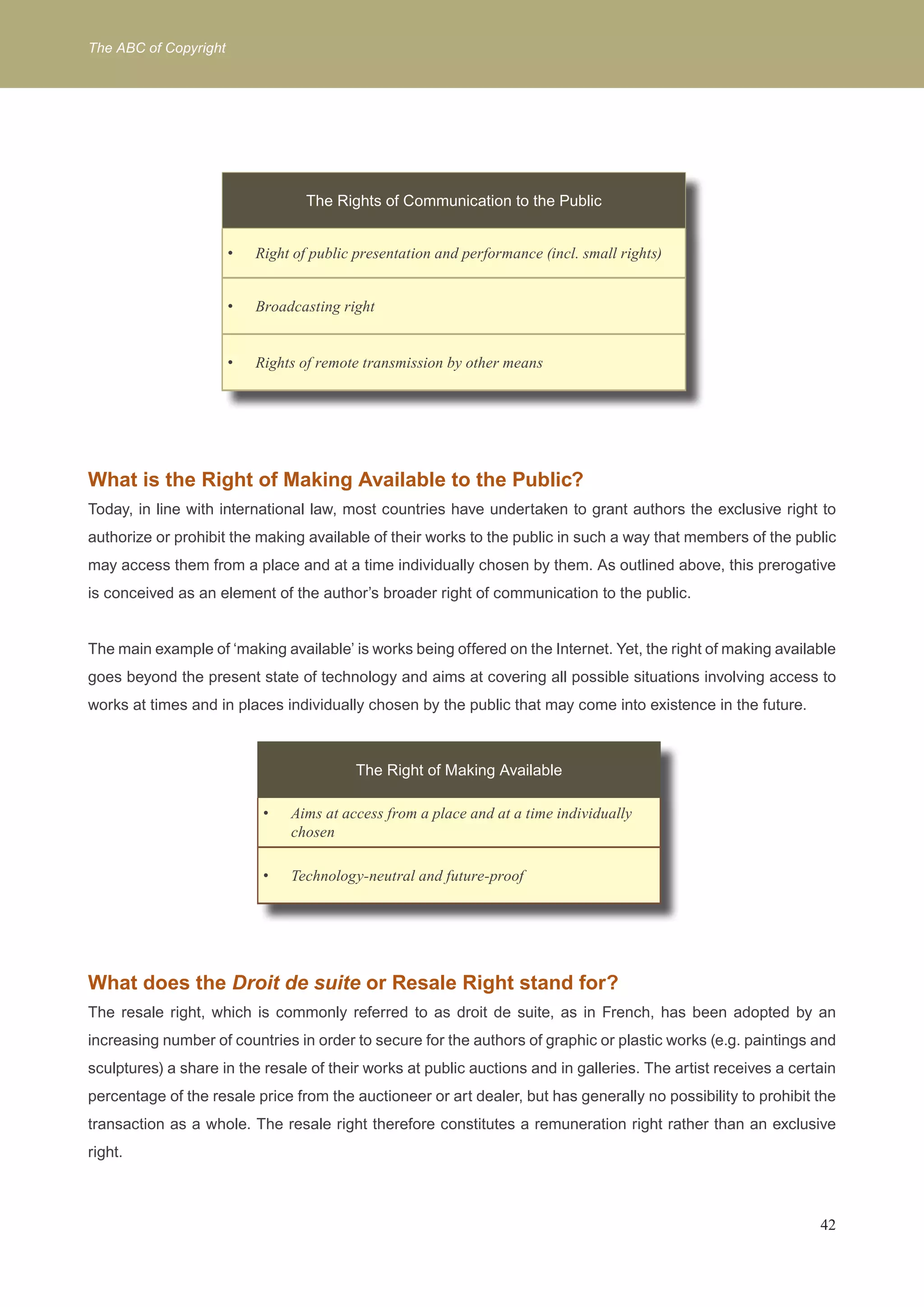
The Rights of Communication to the Public 
Right of public presentation and performance ( • incl. small rights) 
• Broadcasting right 
• Rights of remote transmission by other means 
The Right of Making Available 
• Aims at access from a place and at a time individually 
chosen 
• Technology-neutral and future-proof
Economic Rights of Authors 
Unlike authors of literary or musical works, visual artists can only capitalize on the traditional economic rights 
of reproduction and public communication in exceptional cases. Often, especially at the beginning of their 
career, they have to give their works away for a small amount of money in order to earn a living. The droit de 
suite therefore plays a compensatory role as it allows the artist to participate in a later increase of the sold 
works’ value. 
What is the Adaptation Right? 
Making an adaptation means modifying an existing work to produce a new work, usually referred to as a 
‘derivative work’. Examples include turning a novel into a screenplay or a theatre play, as well as altering the 
arrangement of a computer program or a database. A special case of adaptation is the translation, which, 
in some legislations, is addressed by a separate right. The adaptation right entitles the copyright owner to 
authorize or prohibit the creation and use of derivative works. 
The simple building, to one degree or another, on the ideas of others does not, however, automatically 
constitute an infringement of copyright. Everyone is free to draw their inspiration from existing works, and so 
most detective stories, romantic comedies or Westerns, for instance, are based on more or less the same 
patterns. In order to speak of an adaptation, the derivative work must incorporate a certain portion of the 
protected work in a certain form, which is not always easy to determine. 
It is worth mentioning that the author of 
the adaptation has her own copyright 
in the derivative work, if it meets the 
criteria for protection. In this case, 
the use of the derivative work by third 
parties will require the consent of both 
right owners. 
43 
The Resale Right (Droit de suite) 
Entitles visual artists to a share in the • resale price of their 
works 
• Remuneration right rather than exclusive 
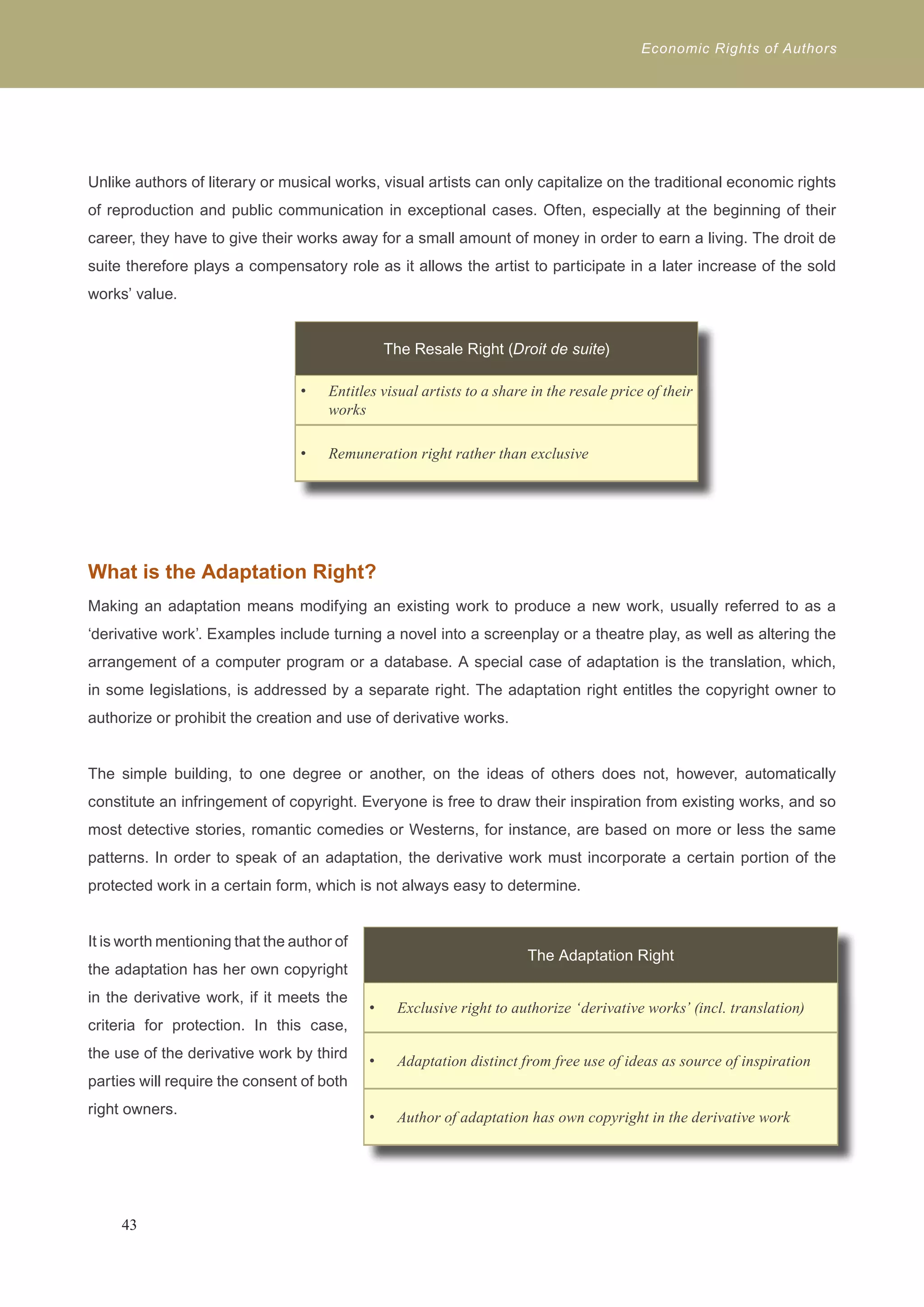
The Adaptation Right 
• Exclusive right to authorize ‘derivative works’ (incl. translation) 
• Adaptation distinct from free use of ideas as source of inspiration 
• Author of adaptation has own copyright in the derivative work
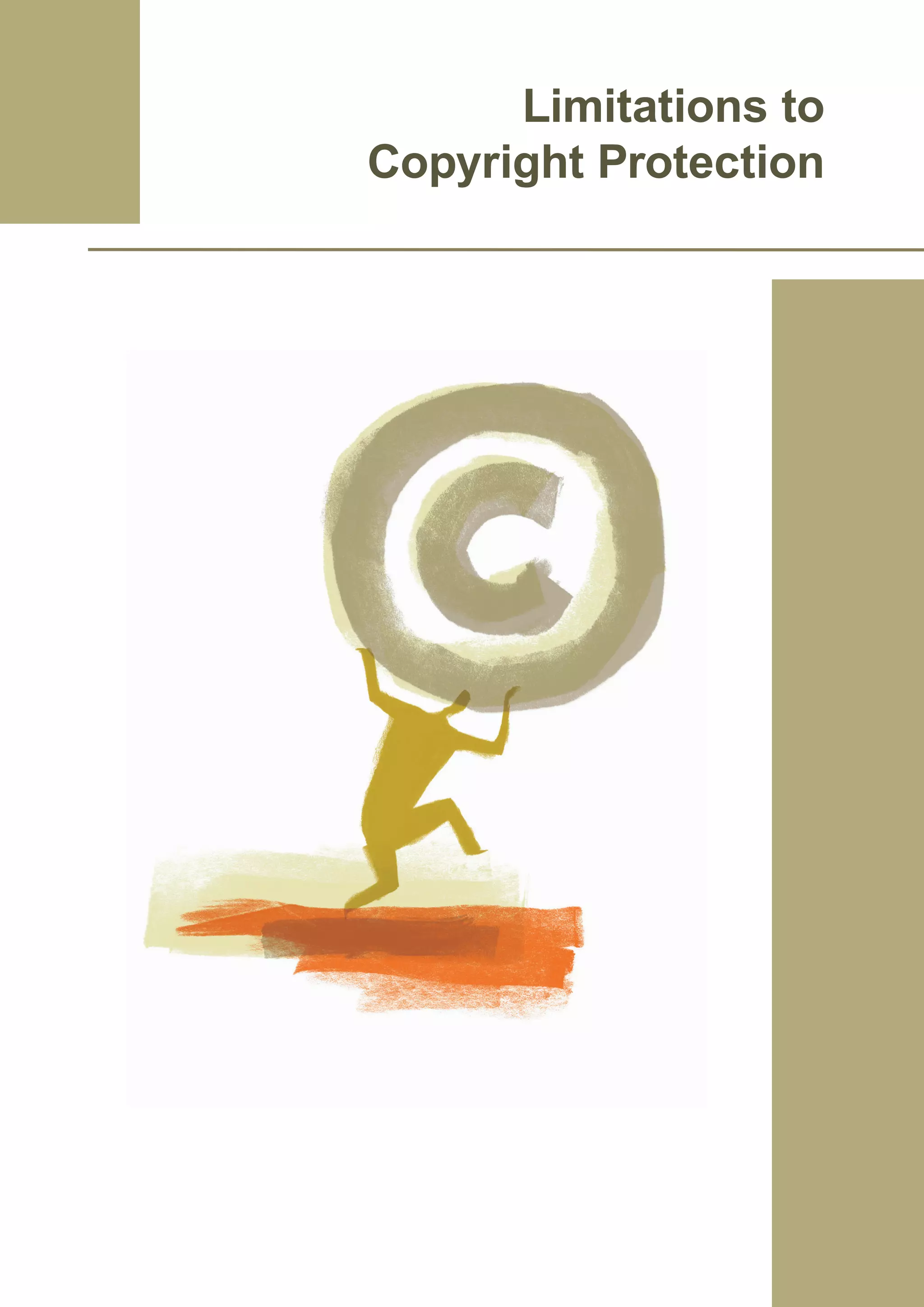
Limitations to 
Copyright Protection
Limitations to Copyright Protection 
Introduction 
Copyright laws must take into consideration the interests of authors and creators and the needs 
of society for access to knowledge and information. In order to strike a balance between the two, 
copyright is subjected to two sorts of limitations. 
On the one hand, there is a limitation to the 
duration of copyright protection: works are 
protected only for a certain period of time. When 
the term expires, they fall into the public domain 
and may thus be used freely by anyone. 
On the other hand, during the term of protection, the rights of authors to control the economic 
exploitation (use) of their works may be restricted by exceptions and limitations laid down by national 
laws: they allow for certain free uses, for purposes described by the legislators, which could be made, 
generally, without a financial compensation. Permitted free use of works is sometimes confused with 
the so-called system of ‘non-voluntary licences’. In some cases, national laws may, in accordance 
with the international standard, replace certain exclusive rights of the authors with such a system 
of non-voluntary licences: in practical terms, this means that right owners cannot refuse to grant 
authorization for the use of the work by third parties, but they retain the right to receive a remuneration 
and to negotiate its amount. Typical examples of non-voluntary licences can be found in the field of 
broadcasting. 
45 
Limitations to Copyright Protection 
Protection e • xpires after a limited time 
• Exceptions for certain legitimate uses 
• Non-voluntary licences
The ABC of Copyright 
How long does copyright protection last? 
Copyright is intended to secure to authors during their lifetime, and to some extent to their heirs and successors, 
the exclusive enjoyment of the fruit of their creative labour. After a certain time following the death of an author, 
however, the public’s interest in free access to intellectual works prevails, and therefore the rights of the 
authors, or at least their economic rights, expire. A work no longer protected by copyright is said to be in the 
public domain. 
With the increase in life expectancy, the duration of protection has been constantly extended. Recent 
international conventions provide for protection during the author’s lifetime and a minimum of 50 years after 
his or her death. Many countries, notably the United States of America and the European Union Member 
States, have introduced a term of protection that includes the author’s lifetime and 70 years thereafter. 
It is worth noting that in some countries the term of protection prescribed by the law applies equally to economic 
and moral rights, while in others the protection of moral rights lapses after the death of the author (as allowed 
by the Berne Convention). In a third group of countries, mostly those belonging to the civil law tradition, there 
is no time limit for the protection of moral rights: in this case we speak of perpetual moral rights (droit moral 
perpétuel). After an author’s death, the right to prevent derogatory uses of the work is exercised by either the 
heirs or by a public authority. 
Are there general rules on exceptions to exclusive rights? 
All copyright laws grant exceptions and limitations in favour of certain groups of users or the public at large. 
The legitimate interests recognized by domestic legislations and case law that would justify the existence of 
exceptions may be divided into four main categories: promotion of freedom of expression, access to knowledge, 
the purposes of justice and the public, and finally private or personal use. Yet it must not be overlooked that 
the notion of ‘legitimate interest’ may vary significantly from one jurisdiction to another. What may be allowed 
as an exception in one country is therefore not necessarily allowed in another. 
46 
Term of Protection 
According to international law: at least 50 • years after the death 
of the author 
• In some countries no time limit for moral rights
Limitations to Copyright Protection 
The limitations laid down in national legislation and the form of each particular limitation are usually determined 
by the assessment of the need and desirability for society to use a work, in conformity with the country’s 
national policy and traditions. The results of this assessment process vary considerably from one country to 
the next: while some countries (mainly those adhering to the civil law tradition) have adopted a very restrictive 
set of limitations on copyright protection, others include in their legislation comparatively extensive provisions 
allowing acts to take place without the prior authorization of the right owner. The open-ended ‘fair use’ concept 
in the United States and the more restrictive ‘fair dealing’ one in the United Kingdom, Canada or Australia, 
are examples of the latter approach. It is worth noting here that the exceptions and limitations have not been 
harmonized at the international level and that all but one of the exceptions provided for by the Berne Convention 
are optional: in other words, national legislators may decide whether to adopt them or leave them out. 
Nonetheless, the so called ‘three-step test’ has come to be regarded as the international yardstick for 
exceptions to exclusive rights. Initially introduced by the Berne Convention as a set of criteria against which 
any exception to the right of reproduction were to be assessed, nowadays it has been adopted by the most 
recent international instruments (the TRIPs Agreement and the WIPO 1996 Treaties) and serves as a basis 
for assessment of all exceptions to exclusive authors’ rights. According to the test, limitations or exceptions 
to exclusive rights should be confined to 1) certain special cases which 2) do not conflict with a normal 
exploitation of the work and 3) do not unreasonably prejudice the legitimate interests of the right owner. 
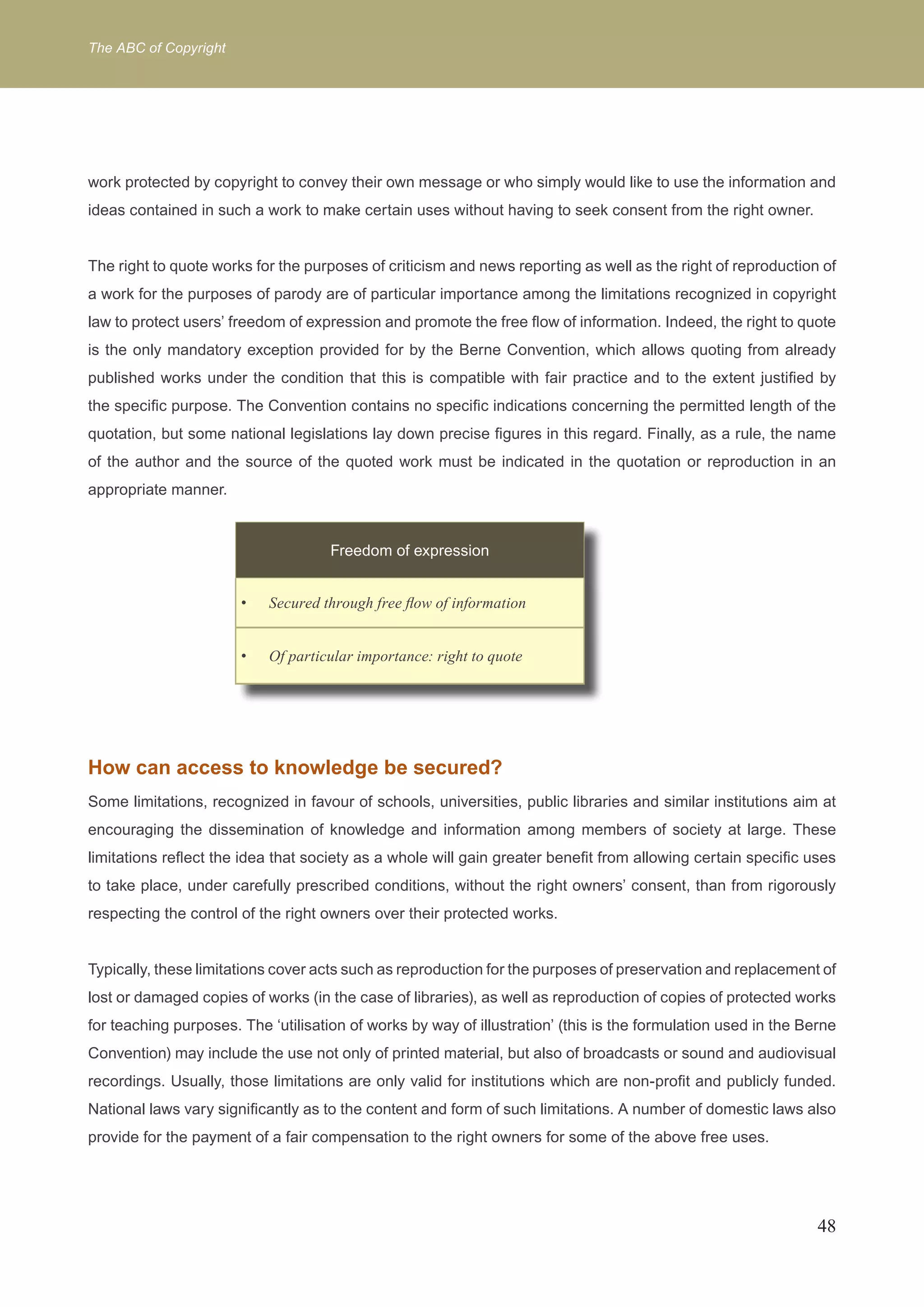
Which are the exceptions in favour of freedom of expression? 
Freedom of expression essentially concerns the possibility to seek, gather and disseminate information. These 
activities form an essential prerequisite to the shaping of people’s opinions and values in a democratic society. 
Recognized as a human right by the Universal Declaration of Human Rights, freedom of expression is the 
reason for a number of exceptions to copyright protection. These allow members of society who wish to use a 
47 
General Rules on Exceptions 
Basically four categories of l • egitimate interests 
• Concept and rules vary from one country to another 
• Strictly defined exceptions vs. wider concepts 
• Three-step test
The ABC of Copyright 
work protected by copyright to convey their own message or who simply would like to use the information and 
ideas contained in such a work to make certain uses without having to seek consent from the right owner. 
The right to quote works for the purposes of criticism and news reporting as well as the right of reproduction of 
a work for the purposes of parody are of particular importance among the limitations recognized in copyright 
law to protect users’ freedom of expression and promote the free flow of information. Indeed, the right to quote 
is the only mandatory exception provided for by the Berne Convention, which allows quoting from already 
published works under the condition that this is compatible with fair practice and to the extent justified by 
the specific purpose. The Convention contains no specific indications concerning the permitted length of the 
quotation, but some national legislations lay down precise figures in this regard. Finally, as a rule, the name 
of the author and the source of the quoted work must be indicated in the quotation or reproduction in an 
appropriate manner. 
How can access to knowledge be secured? 
Some limitations, recognized in favour of schools, universities, public libraries and similar institutions aim at 
encouraging the dissemination of knowledge and information among members of society at large. These 
limitations reflect the idea that society as a whole will gain greater benefit from allowing certain specific uses 
to take place, under carefully prescribed conditions, without the right owners’ consent, than from rigorously 
respecting the control of the right owners over their protected works. 
Typically, these limitations cover acts such as reproduction for the purposes of preservation and replacement of 
lost or damaged copies of works (in the case of libraries), as well as reproduction of copies of protected works 
for teaching purposes. The ‘utilisation of works by way of illustration’ (this is the formulation used in the Berne 
Convention) may include the use not only of printed material, but also of broadcasts or sound and audiovisual 
recordings. Usually, those limitations are only valid for institutions which are non-profit and publicly funded. 
National laws vary significantly as to the content and form of such limitations. A number of domestic laws also 
provide for the payment of a fair compensation to the right owners for some of the above free uses. 
48 
Freedom of expression 
Secured through f • ree flow of information 
• Of particular importance: right to quote
Limitations to Copyright Protection 
Among the limitations in national legislation which aim to encourage the dissemination of knowledge and 
information, many countries have in recent years started to adopt specific provisions in favour of handicapped 
persons. 
How are justice and government served? 
The requirements of justice, law enforcement and the functioning of government have been universally 
recognized by copyright laws. Genrally, official texts such as decisions of courts and administrative bodies are 
excluded from the scope of protection. Certain laws do not grant protection for speeches made during legal 
proceedings, parliamentary sessions or other public events. Finally, in most countries protected works may 
be presented in courts and other legal proceedings for purposes of evidence without the authorization of the 
right owner. 
What exceptions are made for the benefit of private use? 
A number of laws provide that a work may be reproduced by the user for personal use or for a limited circle 
of family members and friends. To qualify for this exception, the copied work must, as a rule, have already 
been made public and there should be no profit-making purpose. In order to compensate right owners, private 
copying provisions are usually (but not always) accompanied by levy-based remuneration schemes: they aim 
to compensate, at least partially, the right owners, whose rights may be prejudiced by private copying on a 
large scale through, for example, photocopying of printed works or home recording of films and music. Levies 
are usually imposed on the sale of reproduction equipment, such as photocopying machines or recording 
49 
Access to Knowledge 
Exceptions in favour of educational i • nstitutions 
• Usually valid only for non-profit uses 
• Specific clauses for the benefit of handicapped 
persons 
Justice and Government 
• Official texts often excluded from protection 
• Free use of protected material in courts
The ABC of Copyright 
devices, as well as on blank sound or video supports, and administered by collective management bodies, 
often on a mandatory basis. 
With the emergence of digital technologies the reproduction of protected content is becoming increasingly 
easy and inexpensive. This has provoked rather vigorous debates on the issue of private copying in recent 
years. 
Private Copying 
Permitted i • n a number of countries 
• Usually framed by levy-based remuneration 
Limitations in the digital environment? 
The digital environment, the ever more increasing use of works over digital networks and the use of technolo-gical 
protection measures (TPM) and digital rights management systems, which aim to prevent illegal copying 
of protected works, have provoked a heated discussion as to whether or not these measures limit the possi-bility 
of exercising legitimate free uses allowed by national copyright laws, as well as to the possible solutions 
that may reconcile these tensions. Case law varies from country to country and the debate is ongoing: there 
is no universally accepted solution and it is for the national lawmakers and courts to determine on a case-by-case 
50 
basis whether the general criteria of the three-step test are met. 
Limitations in the Digital Environment 
imitations in the Digital Environment 
• Right owners concern over enhanced quality of digital 
copies 
• TPM and application of limitations 
• Application subject to domestic law and courts
Limitations to Copyright Protection 
51
Transfer of Rights: 
Assignment, Licensing 
and Succession
Introduction 
In order to bring their works to the market, authors usually rely on professional partners such as 
publishing houses, record companies or film producers. To that end, they usually enter into contracts 
under which certain rights are transferred or licensed to the professional partner against payment of 
remuneration. In this case, we speak of contractual transfer of rights or transfer inter vivos (during the 
author’s lifetime). Copyright may also be transferred after the author’s death. This case is referred to 
as ‘transfer of rights mortis causa’. 
53 
Transfer of Rights 
Contractual transfer inter v • ivos (during the author’s 
lifetime) 
• Transfer mortis causa (after the author’s death)
The ABC of Copyright 
What are the basic rules of a contractual transfer of rights? 
The contractual transfer of rights only concerns the author’s economic rights. Moral rights are, in principle, 
inalienable since they are deemed to be linked directly to the author as such. 
Furthermore, it is important to bear in mind that the ownership of copyright in a work is distinct from the 
ownership of the physical object or material into which the work may be embodied (personal property). Thus, a 
person who has bought a painting has not, generally, acquired any of the prerogatives pertaining to copyright, 
such as the right to reproduce the painting on postcards or to include it in a catalogue. Should the owner of the 
painting wish to carry out any of these acts, he should seek the author’s permission and enter into a transfer 
of rights agreement. 
There are two main ways of transferring rights: by assignment or by licensing. Whichever way, the decision 
depends on a number of factors, including the nature of the work and the laws of the country in which the 
transfer is to take place. These options will be examined more closely below. 
Finally, it is important to point out that economic rights are traditionally granted as a bundle of single prerogatives 
that correspond to the different ways in which a work may reach its audience. Each prerogative may be 
exercised and hence transferred or licensed separately. For instance, the author of a play who assigns a 
publisher the right to publish the play in book format does not thereby consent to the public performance of 
the play. Similarly, the author of a novel written, say, in English, may assign or license to a publisher the right 
to publish and distribute a novel. However, the author may also enter into agreements with other publishers 
who wish to publish a translation of the novel in a foreign language (unless the translation right has already 
been assigned or licensed to the initial publisher). The author may, finally, sign a contract with a film producer 
for the adaptation right of the novel. 
54 
Contractual Transfer of Rights 
Concerns only economic rights; m • oral rights inalienable 
• Transfer of rights independent of ownership of the physical 
material 
• Two principal ways for rights transfer: assignment or licensing 
• Each right may be transferred or licensed separately
Transfer of Rights: Assignment, Licensing and Succession 
What does a transfer of rights by assignment mean? 
The legal consequence of the transfer of rights by way of assignment is that the assignee becomes the new 
owner of copyright and can take actions in his or her own name, including legal actions against third parties 
infringing the rights in the work. The assignment can concern copyright in its entirety or can be limited to one 
or more specific prerogatives. 
Transfer of rights by assignment is typical of common law jurisdictions, which allow copyright as such to be 
assigned wholly or partially to third parties. The civil law tradition, by contrast, considers copyright as exclusive 
incorporeal property since the work emanates from the personality of its creator. Accordingly, copyright laws 
based on that tradition generally do not allow rights to be assigned, be it totally or partially. In that case, 
licensing remains the only valid form of contractual transfer of rights. 
How does licensing operate? 
Unlike transfer by way of assignment, a licence is an agreement whereby the copyright owner preserves 
ownership of the rights but allows a third party to carry out certain acts covered by his/her economic rights, 
generally for a specific purpose and for a specific period of time. For example, the author of a novel may grant 
a licence to a publisher to make and distribute printed copies, and, at the same time, license someone else to 
write a film script based on that novel. 
A licence may be granted on an exclusive or non-exclusive basis. A non-exclusive licence entitles the licensee 
simply to use the work in a defined manner concurrently with the copyright owner and, possibly, simultaneously 
with other licensees as well. A typical example is the licensing of the public performance right in non-dramatic 
musical works to bars, discotheques and similar public places where music is played. 
An exclusive licence means, by contrast, that the licensee may use the work for the purpose in question to the 
exclusion of any other persons, including the copyright owner himself. For the period for which it is granted, 
the exclusive licence has an effect comparable to a transfer of rights by assignment. 
55 
Transfer of Rights by Assignment 
Assignee b • ecomes owner of the rights 
• Total or partial assignment possible 
• Typical of common law tradition
The ABC of Copyright 
Are there limitations for the contractual transfer of rights? 
Transfers of rights are made contractually and therefore the principle of contractual freedom applies to 
such transfers. Yet many copyright laws, especially in countries following the civil law tradition, lay down 
certain restrictions in order to protect authors, who typically have less bargaining power than their business 
partners. 
For instance, where partial transfers are concerned, many laws provide for a rather strict interpretation of 
contractual provisions, according to which the transferee acquires only such rights as specifically formulated 
in the contract. The rights that have not been transferred expressly will remain with the author. This means that 
when the author of a dramatic work transfers to a publisher the right to publish the work in book form, other 
prerogatives such as the right to authorize a stage performance of the play will not be affected. 
Other limitations may concern the transfer of rights for types of uses which do not exist, or that could not have 
been foreseen when the contract was signed. The underlying idea is to make sure that the author does not 
unconsciously give away assets which may later become a valuable source of income. An example would be 
the new digital uses of works such as the dissemination of texts and other content via the Internet. A book 
publisher who had, for instance, acquired all rights to communicate a work to the public, but at a time where 
the exploitation of works through the Internet did not exist, might have, in certain countries, to re-enter into 
negotiations with the author concerning the new uses. Limitations also exist with regard to the author’s ability 
to transfer rights in future works. 
Protective measures may finally aim at securing for the author a remuneration proportional to the revenue 
obtained by the exploitation of his/her work. Some laws strive to achieving this through reserving a certain 
minimum percentage of the revenues for the author, while others entitle the author to demand a revision of 
the agreed remuneration if it clearly proves to be disproportionate to the revenues derived during the course 
of the work’s exploitation. 
56 
The Licensing of Rights 
Right o • wner maintains ownership 
• Permission for a specific use 
• Simple licences vs. exclusive licences
Transfer of Rights: Assignment, Licensing and Succession 
57 
Limitations on Transfer of Rights 
Protection of the author a • s typically weaker party 
• Rules concerning scope of transfer 
• Rules concerning proportionate remuneration 
Limitations on Transfer of Rights 
Are there requirements concerning the form and content of a contract for the 
transfer of rights? 
Although there is no internationally binding rule concerning the form that contracts for transfer of rights must 
take, most national laws opt for the written form, both for assignment and licensing agreements, especially 
with regard to specific types of contracts (the publishing contract is the most typical example). 
The contract typically covers the period of time for which rights are granted, an enumeration of the rights 
transferred, the territory on which the work may be used, the royalties to be paid, the responsibility of the 
parties and the procedure for settlement of possible disputes between them. In some cases, national laws 
contain legal presumptions which apply when the parties fail to include some of the elements in the contract, 
which the respective national law may consider indispensable for its validity. Typically, continental European 
laws may contain provisions which determine the period for which the rights are granted. These provisions 
apply only if the parties have omitted to agree on this element. In other words, this type of legal presumption 
replaces, in some cases, the missing agreement between the parties. 
Formal Requirements 
• Usually written form of contract 
• Legal presumptions in some cases 
mal Requirements 
How are rights transferred after death? 
Authors’ economic rights may be transferred after death by will or may pass by operation of law to their 
successors in-title. The successors exercise these rights during the term of protection in the same way as the 
author himself/herself.
The ABC of Copyright 
As regards moral rights, rules vary from one country to another. In certain common law countries, moral rights, 
if granted, expire with the death of the author. In countries where moral rights may last beyond the death of the 
author, the transfer is secured by succession either by will or by operation of law. Yet, as a rule, successors 
are not entirely free in the exercise of the moral rights that they have inherited, since they are bound by the 
obligation to respect the particular wishes of the author or specific legal constraints. 
Some laws provide that, in the absence of designated successors or heirs to the author, the protection of 
moral rights is assured by designated governmental bodies.This is common in countries where moral rights 
are perpetual. 
58 
Transfer of Rights After Death 
Economic rights: f • reely transferable 
• Moral rights: several models in different countries
59 
Protection of Related 
(Neighbouring) Rights
Introduction 
Related rights, also called ‘neighbouring rights’, are commonly understood to designate the rights 
granted to protect persons, other than the authors of works, who are involved in the dissemination of 
copyrighted works. On the international level, the term is used particularly in relation to the rights of 
performers, producers of phonograms and broadcasting organizations. These people or organizations 
bring creative, technical or organizational skill that are fundamental to the process of bringing a work 
60 
to the public and are therefore considered to deserve protection. 
National laws may also include under this heading, for instance, the rights of publishers with regard 
to the typographical arrangement of their published editions, the protection of photographs and even 
database protection and design law. In line with a number of international treaties, most countries 
today have introduced related rights into their domestic legislation. In this chapter, the expression 
“related rights” or “neighbouring rights” will be used to designate only the rights that are devised for 
the protection of performers, phonogram producers and broadcasting organizations. 
Related Rights 
• Protect the results of certain activities mainly related to the dissemination of works 
The Most Important Related Rights 
• Performers' rights 
• Phonogram producers' rights 
• Broadcasters' rights
Protection of Related (Neighbouring) Rights 
How did the protection of related rights evolve? 
Unlike copyright protection, where international law resulted from developments in national legislations, 
standards of protection of neighbouring rights were first discussed and adopted at the international level, 
before being gradually integrated into domestic laws. The first multilateral instrument on neighbouring rights 
was the Rome Convention for the Protection of Performers, Producers of Phonograms, and Broadcasting 
Organizations of 1961. The next major step was the inclusion of all three categories of related rights in the 
1994 TRIPs Agreement within the framework of the then newly founded World Trade Organization (WTO). 
Finally, the 1996 WPTT aimed to adjust the international protection of the rights of performers and producers 
of phonograms to the challenges of the digital age. 
What are the characteristics of neighbouring or related rights? 
The term neighbouring or related rights, established through usage, applies to a variety of persons. Each 
category is protected for different reasons. While, for instance, the performance bears the mark of the 
performer’s personality in a way comparable to the way the work reflects the personality of its author, the 
activities of producers of phonograms and broadcasting organizations are of a much more technical and 
organizational nature. 
The expression ‘related’ or ‘neighbouring’ suggests a degree of closeness to copyright and, at the same time, 
distinguishes the rights in question from the latter. For example, in the case of a song, copyright belongs to the 
lyricist and the composer. The performers of the song (singers, musicians), the producer who records the song 
on a CD, and the broadcaster who transmits a program containing this song, will have a neighbouring right, 
each one with respect to his or her contribution (i.e. the performance, the sound recording or the broadcast). 
The terminology of related or neighbouring rights reflects the European civil law concept of copyright, where 
subject matter other than ‘works’ in the strict sense is classified under separate categories of rights. In 
61 
The Development of International Related Rights Protection 
• The Rome Convention of 1961 
• The TRIPs Agreement of 1994 
• The 1996 WIPO Performances and Phonograms Treaty
The ABC of Copyright 
common law countries, the producers of sound recordings and broadcasters traditionally have ‘copyright’ in 
their productions and broadcasts. 
Protection under related rights is similar to copyright, although the prerogatives granted to performers, 
producers of phonograms and broadcasting organizations are more limited in scope. Related rights, as a rule, 
are freely transferable and subject to comparable exceptions and limitations as authors’ rights, according to 
the relevant international conventions. 
How are performers’ rights protected? 
The 1961 Rome Convention defines performers as actors, singers, musicians, dancers, conductors and other 
persons that perform literary or artistic works. Under this definition, ‘works’ apply to creations that qualify for 
copyright protection, irrespective of the fact that such a work may have already fallen into the public domain at 
the time of the performance. For example, under this definition, a performer of a work composed by Beethoven 
or Chopin would qualify for protection under the Rome Convention. The WPPT of 1996 has additionally 
introduced protection for the performance of ‘expressions of folklore’, i.e. creations of local communities that 
have been developed through several generations and which are therefore normally not eligible for protection 
under copyright laws. Many national laws have adopted an even broader definition, also encompassing the 
activities of variety and circus artists. 
Along with the scope of application, the extent of performers’ rights has also expanded since the early days. 
While under earlier treaties, performers were only accorded ‘the possibility of preventing certain acts’, the 
WPPT has upgraded the economic rights of performers to fully-fledged exclusive rights. Performers have 
been accorded, more particularly, the rights of reproduction and distribution, the rental right and the right of 
making available. In the case of collective performances involving a group of artists (such as an orchestra), 
most countries concentrate the exercise of these rights in the hands of an elected representative. 
62 
The Characteristics of Related Rights 
Covering a variety of heterogeneous s • ubject matter 
• Terminology reflects personality-centred author’s rights approach 
• Protection similar to copyright albeit more limited
Protection of Related (Neighbouring) Rights 
Moreover, since a performer’s activity is to some degree of a personal nature, there is today a wide consensus 
that performers should also enjoy certain moral rights. The WPPT therefore provides them with the right to 
be identified as performers and the right to object to any distortion and other derogatory modifications of their 
performances. 
Finally, whereas under the Rome Convention, the term of protection is 20 years, the WPPT extends it to 50 
years from the date of the fixation of the performance or, if unfixed, from the date of the performance itself. 
Protection of Performers’ Rights 
‘Performer’: usually one who performs works o • r expressions of folklore 
• Rights of reproduction, distribution, rental and making available 
• Moral rights of identification and integrity 
• Minimum term of protection 50 years under the WPPT 
Protection of Performers’ Rights 
What protection do the producers of phonograms enjoy? 
In conventional law, the producer of phonograms is understood to be the natural person or legal entity on 
whose initiative and responsibility a fixation of a performance or other sounds is made for the first time. 
What is protected is the fixation of the sounds on a supporting medium, which is generally referred to as the 
‘phonogram’. The recorded sounds may, but need not be, works. As such, the recordings of bird songs or 
ocean waves, for instance, therefore also qualify for protection. 
Unlike performers, producers of phonograms have enjoyed, since the early days, an exclusive right of 
reproduction, to which the TRIPs Agreement has added the rental right. The WPPT, finally, has extended the 
protection, by introducing the new right of making available as well as the distribution right. As in the case of 
performers, the WPPT’s 50-year minimum term of protection applies. 
How are broadcasters protected? 
Under international law, the term ‘broadcast’ is usually understood to involve the transmission of sound or 
images or both by wireless means. National laws may, however, interpret the term to include also transmission 
by cable and other similar technical means. A broadcaster is the natural person or legal entity that makes the 
63
The ABC of Copyright 
decisions concerning the programming, including the day and time of the broadcast. The person or entity that 
merely provides for the technical equipment through which the signals are transmitted (e.g. network operators, 
etc.) is not considered to be a broadcaster. Broadcasts are protected as such, irrespective of whether they 
contain works in the strict copyright sense or other content. 
The Rome Convention provided broadcasters with the right to authorize or prohibit the re-broadcasting of their 
broadcasts, as well as their reproduction and communication to the public, the two latter rights being subject 
to certain conditions. These rights were reconfirmed by the TRIPs Agreement with slight modifications. The 
minimum term of protection under these two instruments is 20 years as of the end of the year in which the 
broadcast took place. 
While the rights of performers and producers were updated by the 1996 WPPT, a discussion on updating 
the international protection of broadcasters’ rights is still ongoing. While there is a general consensus among 
Member States that broadcasting organizations should be protected against illegal appropriation of their 
programme signals by third parties, some elements remain controversially debated, such as the inclusion of 
internet services (‘web-casting’), as well as the concrete scope and duration of rights. 
Protection of Broadcasters’ Rights 
‘Broadcast’: transmission of any sound o • r images by wireless means 
• Rights of re-broadcasting, reproduction and communication to the 
public. 
• Minimum term of protection 20 years 
• Ongoing discussion on updating protection within WIPO 
64 
Protection of Phonogram Producers 
• ‘Phonogram’: Fixation of sounds of any kind on any medium 
• Rights of reproduction, rental, distribution and making available 
• Minimum term of protection: 50 years
Protection of Related (Neighbouring) Rights 
65
Enforcement of Copyright 
and Related Rights 
66
Introduction 
As a general rule, any use of a protected work or other subject matter is lawful if proper authorization 
from the copyright owner has been obtained, except in certain cases prescribed by the law (see 
chapter on exceptions). Using a work or subject matter of related rights in a way that would have 
required authorization from its right owner would constitute an act of copyright (or related rights) 
infringement. 
Nearly all legislations provide for a variety of civil remedies, penal or administrative sanctions when 
such acts of infringement take place. Moreover, in order to prevent infringement of rights from the 
outset, many countries have nowadays adopted additional legal provisions, in compliance with 
international copyright instruments, allowing right owners to apply technical protection measures 
to their works. Among the important preventive measures laid down by many national laws are the 
provisional and border measures prescribed by the TRIPs Agreement ‘in order to permit effective 
action against any act of infringement’. 
67 
Enforcement of Rights 
• Civil Remedies 
• Penal and Administrative Sanctions 
• Technological Protection Measures 
• Provisional and Border Measures
The ABC of Copyright 
When does infringement of copyright and related rights take place? 
Infringement may take place in the form of a violation of both the economic and moral prerogatives of authors 
and other right owners. Economic rights are violated when a third party carries out one of the acts covered by 
them without the authorization of the right owner. Classic examples are the unauthorized copying of protected 
content such as CDs or DVDs, the illicit fixation of performances and the distribution of those products. 
Advances in digital reproduction technology as well as the emergence of so-called ‘peer-to-peer’ (P2P) 
networks have significantly contributed to a rampant increase in such activities. 
By contrast, infringement of moral rights generally occurs in cases where the third party has acquired the 
rights to use a work but, in the course of utilization, has acted in a way that is contrary to the moral rights of the 
author or the performer. For instance, if the publisher of a book makes changes to a novel that have not been 
agreed upon, the integrity right has been infringed. If, in addition, the publisher fails to indicate the author’s 
name on the cover, then the right of attribution is violated. 
Finally, there are also cases in which both sets of rights are affected at the same time, the typical example 
being plagiarism. Plagiarism is the appropriation of the work of another and its passing off as one’s own. 
This constitutes at least a violation of the author’s moral right to claim authorship and the economic rights of 
reproduction and distribution. 
Forms of Rights Infringement 
Infringement of E • conomic Rights 
• Infringement of Moral Rights 
Civil remedies 
Copyright laws usually provide for two major civil law remedies: injunctive relief and award of damages. An 
injunction is the most effective way stopping immediately or preventing the infringing acts and it is therefore 
often the primary remedy sought in copyright infringement cases. Where an infringement has occurred or 
is likely to take place, the right owner may typically demand for both preliminary and permanent orders. In 
order to secure discontinuation or prevention of the infringing acts, the court may additionally issue an order 
for seizure of the infringing objects, e.g. the unauthorized copies. Injunctive relief is available even when the 
defendant has acted in good faith, for instance, believing that the work or other protected subject matter in 
question had already fallen into the public domain. 
68
Enforcement of Copyright and Related Rights 
The awarding of damages aims at placing the right owners in the same position as they would have had in 
financial terms, should there have been no infringement. In principle, it is up to the plaintiff to prove the actual 
amount of damages suffered as a result of the copyright infringement. However, since this might often turn 
out to be quite difficult, many copyright laws allow for a calculation of damages on the basis of a hypothetical 
reasonable remuneration as a minimum amount. Moreover, in the case of moral rights infringement, many 
countries provide for additional monetary compensation of the plaintiff’s moral damages. Unlike an injunctive 
relief, damages are usually available only when the infringing party has acted intentionally or at least 
negligently. 
Civil Remedies 
Injunction and seizure of infringing objects • (no bad faith required) 
• Damages 
• Monetary compensation for moral suffering (in some countries) 
Penal sanctions 
In addition to civil remedies, the infringement of copyright and related rights may also entail penal sanctions 
under criminal law. Depending on the nature of the infringement and the circumstances under which it has 
taken place, the sanctions may range from insignificant fines to prison sentences of up to several years. Penal 
sanctions require intentional infringement and are generally applicable to cases where the unlawful use has 
been undertaken on a comparatively large scale and for commercial purposes (usually referred to as ‘piracy’). 
In compliance with their obligations under international agreements, in particular the 1994 TRIPs Agreement 
and the 1996 WIPO Treaties, many countries have significantly increased the possibilities of imposing penal 
sanctions. 
69 
Penal Sanctions 
• Fines and imprisonment depending on the severity of the act 
• Usually intentional infringement required 
• Significantly enhanced due to compliance with international law
The ABC of Copyright 
What role do technological protection measures (TPM) play in rights enforce-ment? 
While digital technology has largely facilitated both legal and illegal access to protected works and thus 
increased the risk of piracy, it has, at the same time, considerably improved the enforceability of rights by 
offering right owners a variety of technological tools to control the use of their works. ‘Protection measures’, 
such as encryption and copy control mechanisms, help prevent the unauthorized reproduction and distribution 
of protected content, whereas ‘rights management information’ allows to permanently identify the right owner 
or the terms and conditions of access to the work. 
In compliance with obligations arising from the 1996 WIPO Treaties, many countries have introduced a regime 
of legal protection that prohibits the circumvention of those protection measures. The relevant provisions 
state that effective technological protection measures, including rights management information, may not be 
removed or otherwise circumvented. Additionally, the sale and use of devices or services that are primarily 
designed to enable or facilitate the circumvention of such protection measures is declared illegal. Along with 
civil liability, the protection of TPM is usually backed up by penal and administrative sanctions. 
It is worth noting that TPM are often contested by users and civil society who argue that they prevent certain 
lawfully permitted uses of the works, to which protection measures are applied. Case law on this subject is not 
unanimous and the issue continues to be the focus of heated debates. 
Technological Protection Measures 
Encryption tools and ‘Digital R • ights Information’ 
• Legal protection against circumvention in compliance with international law 
Challenges of enforcement in the digital environment 
The digital revolution has increased the possibilities of access to works for Internet users and at the same 
time challenged the creative industries which face new forms of piracy, such as illegal up and downloading but 
dispose only with traditional measures the majority of which are inappropriate to fight against online piracy. 
In order to tackle unauthorized uses of works on the Internet, several countries, including France, South Korea 
and Taiwan, have passed legislation establishing a “graduated response” system (also called “three-strikes” 
rule). Under this system, the holder of an Internet account identified by right holders as an infringer is sent a 
70
Enforcement of Copyright and Related Rights 
notice by his Internet service provider advising him to stop infringing. In the case of repeated infringements, 
another warning is sent to the offender. Eventually, if the account holder continues to infringe, he faces a 
temporary suspension of his Internet access. It is important to mention that the “graduated response” system 
does not have unanimous support as the principle of a suspension of Internet connection is sometimes 
described as an infringement of the fundamental right of access to information. Opponents to the “graduated 
response” system propose an alternative solution called “global license”. According to this system, Internet 
account holders would pay a monthly charge to their Internet service provider in exchange of access to 
digitised works. Internet service providers would then be in charge of distributing the “royalties” to right owners. 
The question of the most appropriate measures to fight against online piracy remains open and is currently 
discussed at both national and international levels. 
Finally, the fight against online piracy also involves the development of the legal online offer of cultural products. 
In order to encourage Internet users to turn to legal offers, governments and creative industries are therefore 
taking measures to broaden legal online offer and facilitate access to creation on the Internet. 
71 
Challenges of enforcement in the digital environment 
• Online copyright piracy (illegal up and downloading) 
• Specific measures to tackle online infringements discussed 
(“Graduated response” v. “Global license”) 
• Development of legal online offer of cultural products
Collective Management of 
Copyright and Related Rights
Introduction 
Collective management of rights plays an important role in those cases where protected works are 
so widely used that it becomes difficult, if not impossible, to individually negotiate licences. The 
author may not be able to monitor all uses at all times and in an indefinite number of places around 
the world. On the other hand, users do not have the possibility to enter into worldwide negotiations 
with countless authors and other right owners on a one-by-one basis. The performance of music in 
various broadcasts, as well as in restaurants, bars or shopping malls, is only one of many examples. 
The primary role of a collective management organization is therefore to act as an intermediary 
between right owners, on the one hand, and users, on the other. It administers, usually as a 
trustee, the rights of its members and collects and distributes royalties on their behalf. However, 
according to the categories of rights, there are varying forms of collective management, which may 
sometimes include elements of individual licensing (this is the case, for example, of the collective 
management of rights in dramatic works). In addition to the administration of rights, collective 
management organizations may also carry out a variety of additional cultural and social activities. 
Collective Management of Rights 
Takes place where individual l • icences are impractical 
• Collective bodies act on behalf of individual right owners 
• Additional cultural and social activities 
73
The ABC of Copyright 
What are the origins of collective management? 
The starting point of collective management may be seen in the foundation of the Bureau de Législation 
Dramatique (Dramatic Legislation Office) on the initiative of the famous French writer Beaumarchais in 1777. 
This body later became the Society of Authors and Composers of Dramatic Works (Société des auteurs et 
compositeurs dramatiques), still in existence today. The first fully-fledged collective management organization 
to be established was, however, the Société des Auteurs, Compositeurs et Editeurs de Musique (SACEM) 
– the Society of Authors, Composers and Music Publishers, in 1851. It was set up shortly after the famous 
incident whereby the composers Parizot and Henrion together with the poet Bourget obtained an order against 
a Parisian café-concert for infringement of their rights by performing their works without permission and 
without payment of a remuneration. 
The French example was soon followed, first in other parts of Europe, then elsewhere. Today there exists an 
international network of collecting societies in more than 100 countries. 
The Origins of Collective Rights Management 
France of 18-19th Century: B • eaumarchais and others 
• 1777: Foundation of SACD 
• 1851: Foundation of SACEM 
What are the most important rights administered collectively? 
Collective management primarily takes place in those fields where individual licensing would be too costly to 
be efficient. 
The classic examples are the rights of composers and lyricists in the field of musical works, usually referred 
to as ‘performing/small rights’. When the first collecting societies were established, this category of rights 
included only performance of works in the presence of an audience, yet nowadays it includes nearly all 
forms of communication to the public, including transmission via the Internet. The criteria for distinguishing 
between ‘grand’ and ‘small’ rights is the type of works involved. Broadly speaking, grand rights concern the 
performance of all dramatico-musical creations, such as operas or ballets, while small rights refer to the non-dramatic 
forms of music. Only small rights are administered on a fully collective basis. Grand rights are, as 
74
Collective Management of Copyright and Related Rights 
a rule, licensed more or less individually, since the works in question are used far less frequently and their 
performance can be more easily monitored. 
Directly linked to the performing rights in musical works are the so-called ‘mechanical rights’, which concern 
the reproduction of works in the form of sound recordings (which need no longer be ‘mechanical’ nowadays). 
In many countries, mechanical and performing rights are administered by one collecting society. An 
important particularity of the management of mechanical rights is that standard contracts are negotiated 
on an international scale between associations representing respectively mechanical rights societies and 
phonogram producers. 
Other important fields of application for collective management include the administration of rights related 
to more recent forms of commercial exploitation such as cable re-transmission and satellite transmission of 
broadcast programmes, or the collection of levy-based remuneration in countries that have introduced such 
systems to secure a fair compensation to authors for certain permitted free use of their works. 
The most important rights administered collectively 
Performing rights in non-dramatic musical w • orks (‘small rights’) 
• Rights of reproduction on sound recordings (‘mechanical rights’) 
• Rights of satellite transmission and cable re-transmission 
• Remuneration rights (e.g. reprographic reproduction) 
Under which forms does collective management exist? 
The scope of functions performed by a collective administration body depends primarily on the category and 
nature of the rights it administers. 
Collective management in the traditional sense applies in particular to the so-called ‘small rights’. Under this 
system, right owners authorize one or more collecting societies to administer their rights on their behalf, on 
an exclusive basis, which means that the right owner, as a rule, may no longer individually negotiate terms 
and conditions. Instead, it is the societies that then offer licences to prospective users, usually in the form of 
blanket licences covering the use of all works in their repertoire. The royalties negotiated and collected by the 
75
The ABC of Copyright 
collective body are distributed to the individual members according to rather complex schemes that aim to 
reflect the relative importance of the works and performances in question. 
Yet in other fields, a collective management body may operate more like an agency for the individual right 
owner who remains, to a greater or lesser degree, directly involved in setting the terms of use of the works in 
question. An example of such agency-type of collective management is in the field of dramatic and dramatico-musical 
works where collecting societies negotiate a general agreement with organizations, representing 
theatres, for the exploitation of particular works. However, such agreements only specify minimum terms and 
the particular performance of each play still requires the permission of the author in question in the form of an 
individually negotiated contract. 
Finally, the so-called ‘one-stop shops’ are gaining increasing popularity. Under this concept, a coalition of 
independent collective management bodies offers licences that include several authorizations concerning 
different sets of rights. This centralized means of granting permission is particularly helpful with regard to 
audiovisual works, multimedia productions and all other works in which multiple right owners may claim rights, 
such as directors or script writers. 
Forms of Collective Management 
Traditional Agency-type One-stop shop 
Collective bodies 
negotiate licences on 
behalf of individual 
right owner 
No individual licences 
Collective bodies 
negotiate general 
framework 
Licences are granted 
individually 
Coalition of collective 
bodies issues licenses 
concerning a variety 
of rights of different 
right owners in one 
work 
How are collective management bodies organized? 
The legal status of collective management bodies may vary widely from one country to the next. The way in 
which collective management bodies are organized may also vary substantially, depending on the category of 
rights the organization manages. 
The first collective management organizations were non-profit-making private entities established by authors 
and sometimes publishers (often called ‘societies of authors’ or ‘collecting societies’). Besides this model, 
76
Collective Management of Copyright and Related Rights 
which is characteristically European and South American, there are also private bodies other than societies 
of authors, e.g. BMI (Broadcast Music, Inc.) in the United States of America, which was originally founded by 
broadcasting organizations. Finally, in other parts of the world, especially in developing countries, collective 
management is carried out by public or semi-public entities on the basis of statutory law. 
In addition to their legal status, collective management bodies may differ also with regard to the form and 
extent of government supervision, the number of categories of rights they administer, or, ultimately, to the 
number of collective management organizations per category of rights. While in many civil law countries 
collective management bodies have in practice a monopoly for the respective category of rights, competition 
law rules in other countries, such as Brazil and the United States of America, do not allow such monopolistic 
situations. 
Differences also exist in relation to the way in which collective bodies obtain the right to act on behalf of 
individual right owners. Authors and other right owners tend to become members of collective bodies by 
choice but some national laws provide a mandatory collective management for certain types of rights. A 
typical example for mandatory collective management is the cable retransmission right in European Union 
countries. 
Variety of Collective Rights Management 
Legal status: p • rivate vs public bodies 
• Number of organizations: monopoly vs multitude 
• Membership: optional vs mandatory 
How is collective management secured internationally? 
The scope of activity of collective management organizations is traditionally confined to the country in which 
they are set up, in accordance with the principle of territoriality. Most collective management bodies have, 
however, concluded reciprocal representation agreements with corresponding organizations in other countries 
representing the same categories of right- owners. As a general rule, a collecting society in any given country 
therefore represents both national and foreign rights owners. Prospective users are able to obtain licences 
for almost the entire world repertoire from their national collecting society and at the same time, right owners 
receive royalties for the use of their works worldwide. 
Cross-border cooperation between collective management bodies is coordinated to a great extent by 
77
The ABC of Copyright 
international umbrella organizations. Among them are the International Confederation of the Societies of 
Authors and Composers (CISAC), the Bureau international des sociétés gérant les droits d’enregistrement et 
de reproduction mécanique (BIEM) and the International Federation of Reproduction Rights Organizations 
(IFRRO). 
International Collective Rights Management 
Reciprocal representation ag • reements 
• International umbrella organizations (e.g. CISAC, BIEM) 
What are the advantages of collective rights management? 
Collective rights management constitutes an efficient way of organizing, on a worldwide scale, the lawful 
exploitation of works in those fields where individual licensing would prove impossible. Further, it is certainly 
cheaper to share the financial expenses of negotiation, supervision and collection of royalties among the 
greatest possible number of parties. As a result collective management significantly increases the choice of 
works available to the public. 
By reducing the number of persons with whom users have to negotiate licensing contracts, collective rights 
management is, more particularly, beneficial in those fields where easy access to protected works is generally 
seen as desirable, such as transmission of broadcasting programmes via satellite and cable retransmission. 
With regard to these uses, collective management may be considered a viable alternative to a system of 
non-voluntary licences as allowed for under certain international conventions. Finally, collective management 
increases the bargaining power of authors. While an individual person is typically in a weaker position facing 
powerful corporate users, such as record companies, publishing houses or broadcasting organizations, uniting 
authors through a joint organization allows them to stand on an equal footing with their counterparts, thus 
providing them with a greater say as to royalty tariffs and other licensing conditions. 
78 
The Advantages of Collective Rights Management 
• Facilitates licensing in case of individually uncontrollable uses 
• Viable alternative to non-voluntary licences 
• Increases individual author’s bargaining power
Collective Management of Copyright and Related Rights 
What challenges do recent technological developments pose to collective 
rights management? 
The conditions of creation and exploitation of protected works have gone through significant changes 
with the advance of digital technologies, and this will, no doubt, also affect the future of collective rights 
management. 
The advent of new digital technologies may, on the one hand, give rise to new forms of exercising rights. 
It is argued that technological protection measures and digital rights management information devices will 
soon allow for licensing practices on an almost entirely individual basis through the Internet and, as such, will 
eventually render collective management irrelevant. Even if it does not happen in the near future, it is not unlikely 
that the authors’ enhanced freedom of choice will affect the quasi-monopolistic position of today’s collective 
bodies. On the other hand, the ongoing globalization trends in economy and trade make the traditionally 
territorial basis for collective management seem increasingly inappropriate and discussion of supranational 
licensing schemes is taking places in different instances. 
Partly in response to those and other challenges, new forms of collective management, such as the 
aforementioned one-stop shops, have developed in recent years and there is a continuing tendency towards 
further integration among existing collective bodies. The survival and viability of collective management will 
greatly depend on its ability to prove efficient and attractive to authors and users alike. 
Challen 
79 
Challenges for Collective Rights Management 
Digital technology may e • ntail new forms of management 
• Globalization trends call into question traditional territorial 
basis
International Copyright and 
Related Rights Protection 
80
Introduction 
Creations of the mind can be enjoyed anywhere at any time and are clearly not confined to a country’s 
boundaries. Yet, no national copyright law is effective outside its respective territory (the ‘rule of 
territoriality’). 
In principle, every country is free to design its laws on copyright and related rights according to its 
own needs, policy objectives, and legal traditions. It is at the discretion of domestic lawmakers to 
decide whether and to what extent they wish to protect works of foreign nationals. In the early days, 
culture-importing countries tended to grant little protection to foreign works in order to secure cheap 
copies for their national markets. 
However, with the growing importance of international trade relations, from mid-nineteenth century 
onwards, states increasingly started to conclude bilateral treaties for reciprocal protection of authors’ 
rights. Today, a number of multilateral agreements provide a certain degree of harmonization of the 
protection of copyright and related rights in a wide range of countries. 
International Protection of Copyright and Related Rights 
• Rule of territoriality 
• Harmonization of national laws through international treaties 
• Today, system of widely accepted multilateral conventions 
81
The ABC of Copyright 
The Most Important International Conventions 
The Berne Convention for the Protection of Literary and Artistic Works of 
1886 (last revised in 1971) 
The Universal Copyright Convention of 1952 (last revised in 1971) 
The Rome Convention for the Protection of Performers, Producers of 
Phonograms, and Broadcasting Organizations of 1961 
The TRIPs Agreement of 1994 
The WIPO Copyright Treaty of 1996 
The WIPO Performances and Phonograms Treaty of 1996 
What are the origins of today’s international protection system? 
In the early days, international protection of copyright was ensured on the basis of bilateral copyright 
agreements, that is, agreements whereby only two countries were involved. However, these agreements failed 
to provide a reliable legal basis for cross-border trade with protected works as they were limited in scope and 
varied widely. Countries therefore gradually turned to multilateral conventions which commit all parties to a 
single set of obligations. 
The origins of today’s multilateral structure can be found in a movement that evolved out of France during 
the mid-nineteenth century, even before any bilateral copyright agreement had been concluded. Authors and 
publishers called for a universal recognition of their rights. A decisive step was the setting up of the International 
Literary and Artistic Association (Association Littéraire et Artistique Internationale -ALAI) at the 1878 Literary 
Congress in Paris, under the sponsorship of the prominent French writer Victor Hugo. In 1882, the ALAI held 
a congress in Rome which addressed copyright protection at the international level. 
Following a proposal by the German Publishers’ Association (Boersenverein der deutschen Buchhändler), 
four meetings were held in Berne between 1883 and 1886 with the aim of elaborating a draft text for an 
international treaty. The Convention for the Protection of Literary and Artistic Works (Berne Convention) was 
adopted on 9 September 1886 and signed by ten countries – Belgium, France, Germany, Haiti, Italy, Liberia, 
Spain, Switzerland, Tunisia and the United Kingdom. Regularly revised and updated, the Berne Convention 
82
International Copyright and Related Rights Protection 
remains the cornerstone of international copyright protection, as most of the recent international instruments 
(such as the TRIPs Agreement and the 1996 WIPO Treaties) refer directly or indirectly to its provisions. 
The Origins of Today’s Multilateral Conventions 
1878 Literary Congress in P • aris, chaired by Victor Hugo 
• Foundation of the ALAI and 1882 Congress in Rome 
• 1886: Berne Convention signed 
How do international treaties afford protection of copyright and related 
rights? 
International instruments do not usually constitute a directly applicable source of rights to private parties. An 
international treaty rather imposes obligations on states parties, to adapt their domestic legislation according 
to its provisions. In the field of copyright and related rights, the relevant conventions establish a certain level of 
protection in the contracting states through the principle of national treatment and the guarantee of a number 
of minimum standards. 
According to the national treatment principle, works originating in a contracting state are protected in every 
other contracting state in the same manner as these states protect works originating in their own territory. 
For example, a textbook first published in contracting State A will be protected in contracting State B in the 
same manner as State B protects a school text originating in its own territory. The guaranteed minimum 
standards ensure that the protection provided by national laws of states parties – notably the scope of rights, 
possible exceptions and limitations, as well as terms of protection – does not fall below the level agreed in the 
respective international instrument. 
There are several possible ways for national legislations to implement international prescriptions. In order to 
find out how copyright and related rights are protected abroad, one has therefore always to consult the laws 
of the relevant country in which protection is sought. 
83
The ABC of Copyright 
International Treaties on Copyright and Related Rights 
Obligations on contracting states t • o adapt domestic laws 
• Principle of national treatment 
• Guaranteeing of minimum standards 
International Treaties on Copyright and Related Rights 
How does the Berne Convention work? 
Folwoing the adoption of the Berne Convention in 1886, several revisions have taken place, the last one being 
in 1971 and usually referred to as ‘the Paris Act’. The signatory states to the Berne Convention are united 
in the Union for the protection of the rights of authors over their literary and artistic works. Since 1967, a 
specialized United Nations Agency, the World Intellectual Property Organization (WIPO), serves as the Berne 
Union’s International Office. 
Along with the principle of national treatment and the guarantee of certain minimum standards, outlined above 
as basic features of the international copyright protection system, the Berne Convention enshrined for the 
first time in international law what is considered today a common principle: the ‘enjoyment and the exercise 
of copyright shall not be subject to any formality’. The convention leaves the question of whether copyright 
protection requires fixation of the work in tangible form to the discretion of national lawmakers. Similarly, 
the means of redress for safeguarding moral rights protection are subject to national legislation and may 
therefore also be found outside copyright law, for instance under tort and contract law. The minimum term of 
protection includes the life of the author and fifty years thereafter. Contracting states are permitted to carve 
out exceptions to protection in certain cases, such as for educational and press purposes, and to substitute 
exclusive rights with equitable remuneration, in others. The only mandatory exemption concerns quotations 
from already published works. 
Finally, the 1971 Paris Act introduced an Appendix containing specific provisions that allow for limited 
compulsory licences in developing countries, in order to facilitate knowledge transfer in those countries. 
84
International Copyright and Related Rights Protection 
Berne Convention for the Protection of Literary and Artistic Works (1886) 
Several revisions, last r • evised in 1971 (Paris Act) 
• Creation of the Union for the Protection of the Rights of Authors over their Literary and Artistic 
Works, administered by WIPO 
• Referred to in later treaties (e.g. TRIPs and 1996 WIPO Treaties) 
• Minimum standards concerning economic and moral rights, exceptions/limitations and terms 
of protection 
What is the Universal Copyright Convention about? 
The Universal Copyright Convention (UCC) was adopted at the 1952 Diplomatic Conference convened by 
UNESCO in Geneva. A revision took place in Paris in 1971. 
In line with endeavours dating back to the time of the League of Nations, the central objective of the UCC was 
to secure multilateral copyright relations between the countries of the Berne Union and those countries outside 
of it, which found the Berne Convention’s standards incompatible with their standards of development or their 
own legal traditions. Among the most important reasons for the incompatibility was the lack of recognition of 
moral rights, the generally shorter term of protection provided for by their national laws and the existence of 
formalities as a condition for protection, such as registration of works. 
The Universal Copyright Convention of 1952 provided a solution to these problems. It prescribed that the 
formalities required by the national law of a contracting state should be considered to be satisfied if all the 
copies of a work originating in another contracting state carry the symbol © accompanied by the name of the 
copyright owner and the year of the first publication. It set the minimum duration for copyright protection at 25 
years from the date of publication, and typically not less than 25 years after the death of the author. Finally, it 
left the protection of moral rights outside the scope of the Convention. It also specified particular exceptions 
which may be applied to developing countries. Its norms are expressed in the form of general principles which 
can be given different shades of interpretation depending on the specific identity and national policy of each 
contracting state. 
85
The ABC of Copyright 
As the renowned French lawyer André Kerever has stated, the UCC ‘created a legal structure which could 
accommodate the United States, the USSR, the industrially developed countries and the developing countries’. 
It also influenced its predecessor, the Berne Convention. Fruitful cooperation led to the closer alignment of 
the two Conventions, which were revised in 1971. This revision gave concrete form to the twofold movement 
initiated in 1952 by the UCC: furtherance of the legal rights of creators and acknowledgement of the specific 
needs of developing countries. 
The Universal Copyright Convention 
(1952) 
• Revised in 1971 (Paris Act) 
• Intended to serve as a ’bridge’ toward the Berne Union 
What provisions are included in the Rome Convention? 
Questions over the international protection of neighbouring rights were first formally addressed at the 1928 
Rome Conference to revise the Berne Convention. In 1949, three international organizations – the United 
International Bureaux for the Protection of Intellectual Property (the predecessor of WIPO, best known by its 
French acronym BIRPI), UNESCO, and the International Labour Organization (ILO) took up this topic. Their 
joint efforts led to the adoption of the International Convention for the Protection of Performers, Producers of 
Phonograms and Broadcasting Organizations at the Diplomatic Conference in Rome in 1961 (usually referred 
to as the ‘Rome Convention’). The treaty was signed by 40 states and came into force in 1964. 
The Rome Convention relates to the protection of performing artists (‘performers’), record producers 
(‘producers of phonograms’) and broadcasting organizations. It provides for a constrained version of national 
treatment which only applies to the rights specifically granted in the treaty. While producers and broadcasters 
are granted exclusive rights concerning reproduction, distribution and communication to the public modelled 
on authors’ rights, performers have only ‘the possibility of preventing’ various specified acts. This distinction 
was intended to allow certain countries, mainly of the common law tradition, to continue to protect performers 
on a different legal basis. The Convention guarantees a general minimum term of protection of 20 years, as of 
the end of the year when respectively the performance, fixation or broadcast took place. Member states are 
allowed to establish certain exceptions for purposes such as private use or news reporting. 
86
International Copyright and Related Rights Protection 
The Rome Convention for the Protection of Performers, Producers of 
Phonograms, and Broadcasting Organizations 
(1961) 
Jointly administered b • y WIPO, UNESCO and ILO 
• First international instrument to address neighbouring rights 
What are the implications of the TRIPs Agreement? 
The Agreement on Trade-Related Aspects of Intellectual Property Rights (TRIPs) was signed in Marrakech, 
Morocco, on 15 April 1994. As a result of the Uruguay Round of Multilateral Trade Negotiations, it forms 
part of the legal obligations of the World Trade Organization (WTO), which is the successor of the General 
Agreement on Tariffs and Trade (GATT) of 1947. 
The TRIPs Agreement thus links intellectual property protection to trade issues, in particular by making 
available the WTO’s dispute settlement process, which can impose trade sanctions on members violating the 
agreement. 
With regard to copyright, the TRIPs Agreement requires WTO members to comply with the substantive 
provisions (with the exception of moral rights obligations) of the Berne Convention, which it complemented 
in several respects. More particularly, the TRIPs Agreement extended protection to computer programs 
and compilations of data and introduced an exclusive right to authorize or prohibit the commercial rental of 
computer programs and cinematographic works. 
In the sphere of neighbouring rights, the TRIPs Agreement set up its own provisions on the rights of performers, 
producers of phonograms (sound recordings) and broadcasters. Compared to the Rome Convention, it brought 
about an exclusive rental right for performing artists and phonogram producers under certain conditions, as 
well as a minimum term of protection of 50 years for these two groups of right owners. 
In addition, the TRIPs Agreement extended the application of the so-called ‘three-step test’ (i.e. the Berne 
Convention criteria for allowing exceptions to the right of reproduction) to all economic rights. It thus established 
an additional safeguard in order to calibrate the limitations that contracting countries may impose on exclusive 
rights. 
In order to ‘permit effective action against any act of infringement of intellectual property’, the TRIPs Agreement 
87
The ABC of Copyright 
requires that contracting states provide for specified enforcement procedures including ‘remedies which 
constitute a deterrent to future infringement’. Civil and penal remedies, as well as border measures should be 
provided for by Member States. 
The Agreement on Trade-Related Aspects of 
Intellectual Property Rights (1994) 
Links Intellectual Property with trade i • ssues within the World Trade 
Organization 
• “Berne / Rome plus” standard of protection (without moral rights) 
• Specific obligations on states to introduce effective enforcement 
procedures 
What is the role of the 1996 WIPO treaties? 
On 20 December 1996, representatives of approximately 120 countries adopted the WIPO Copyright Treaty 
(WCT) together with the WIPO Performances and Phonograms Treaty (WPPT) at a Diplomatic Conference on 
Certain Copyright and Neighbouring Rights. The treaties were designed to address questions related to the 
impact of new digital technologies on copyright and related rights. The WTC and the WPPT incorporate and 
update all achievements of Berne, Rome, and the TRIPs Agreement. 
The WCT obliges the contracting states to comply with the substantial provisions of the Paris Act of the Berne 
Convention. Like the TRIPs Agreement, protection is extended to computer programs and databases. Along 
with a qualified commercial rental right, the WCT introduces a new ‘right of making available to the public’ 
which encompasses interactive transmission of works on demand, for instance via the Internet. 
The WPPT draws on elements of the Rome Convention by spelling out minimum standards for the protection of 
performers and record producers (‘producers of phonograms’), but also introduces significant improvements, 
particularly for performers. Apart from acquiring exclusive economic rights instead of the mere possibility of 
preventing unauthorized uses, performers are also afforded rights of attribution and integrity. This was the 
first time that moral rights were attributed to performers in an international agreement. Moreover, a qualified 
rental right, as well as the new ‘right of making available to the public’ were introduced for both performers and 
record producers. In comparison to the Rome Convention, the minimum term of protection has been extended 
to 50 years. 
88
International Copyright and Related Rights Protection 
Both WIPO Treaties incorporate the three-step-test as established by the TRIPs Agreement and oblige parties 
to provide for effective remedies to enforce the rights under the Treaties. A key element in this context is the 
obligation to prevent the circumvention of encryption technologies and the interference with electronic rights 
management information, which is a new feature in the field of international protection of copyright and related 
rights. 
The WIPO Copyright Treaty 
The WIPO Performances and Phonograms Treaty 
(1996) 
Designed to address new technologies a • nd means of communication 
• Introduction of new ‘right of making available to the public’ 
• Obligation to prohibit circumvention of technical protection measures 
• Moral rights for performers 
89

Abc Copyright Unesco

  • 1.
    The ABC of Copyright UNESCO Culture Sector United Nations Cultural Organization
  • 2.
    The ABC of Copyright
  • 3.
    Acknowledgements This handbookwas written under the supervision of Ms Petya Totcharova and Emile Glélé, Section for the Diversity of Cultural Expressions, UNESCO. We particularly wish to thank Dr Thomas Ramsauer and Pr Victor Nabhan for their extensive contributions and Ms Racki Sy for her editorial assistance.
  • 4.
    United Nations Educational,Scientific and Cultural Oranization (UNESCO) 7, place de Fontenoy, F-75352 Paris 07 SP, Paris Internet : http://www.unesco.org/culture/copyright Illustrations : Christian Roux Graphic layout: © UNESCO 2010 This information may be freely used and copied for educational and other non-commercial purposes, provided that any reproduction of data be accompanied by an acknowledgement of UNESCO as the source (© UNESCO).
  • 5.
    Table of Contents Copyright - Past and Present 6 What is copyright? 8 How is copyright protection justified? 8 What are the origins of copyright? 8 When did the first copyright laws come into existence? 10 How has the contemporary copyright system developed? 11 The Scope of Copyright Protection 12 What is the distinction between a protected work and a mere idea? 14 When does a work qualify for copyright protection? 15 The condition of originality 15 Does copyright require any formalities? 16 Must works be fixed in a tangible form to be protected? 17 Are computer programs protected? 18 How are databases protected? 18 Can copyright protect traditional cultural expressions (‘folklore’)? 19 Copyright Ownership 20 Who owns the rights in a work made for hire? 22 Who owns copyright in anonymous or pseudonymous works 23 Who owns the rights in works created by several persons? 24 Who owns the rights in cinematographic works? 25 The Moral Rights of Authors How has recognition of moral rights evolved internationally? 29 What are the basic features of moral rights? 29 What does the right of attribution stand for? 30 Against which acts does the right of integrity protect? 31 When does the right of disclosure apply? 32 What is the right of withdrawal? 33 Economic Rights of Authors 34 What is the reproduction right? 37 How does the right of distribution work? 37 What purpose do rental and lending rights serve? 38 What are the rights concerning communication to the public? 39 What is the Right of Making Available to the Public? 40
  • 6.
    What does theDroit de suite or Resale Right stand for? 40 What is the Adaptation Right? 41 Limitations to Copyright Protection 42 How long does copyright protection last? 44 Are there general rules on exceptions to exclusive rights? 44 Which are the exceptions in favour of freedom of expression? 45 How can access to knowledge be secured? 46 How are justice and government served? 47 What exceptions are made for the benefit of private use? 47 Limitations in the digital environment? 48 Transfer of Rights: Assignment, Licensing and Succession 50 What are the basic rules of a contractual transfer of rights? 52 What does a transfer of rights by assignment mean? 53 How does licensing operate? 53 Are there limitations for the contractual transfer of rights? 54 Are there requirements concerning the form and content of a contract for the transfer of rights? 55 How are rights transferred after death? 55 Protection of Related (Neighbouring) Rights 57 How did the protection of related rights evolve? 59 What are the characteristics of neighbouring or related rights? 59 How are performers’ rights protected? 60 What protection do the producers of phonograms enjoy? 61 Enforcement of Copyright and Related Rights 64 When does infringement of copyright and related rights take place? 66 Civil remedies 66 Penal sanctions 67 What role do technological protection measures (TPM) play in rights enforcement? 68 Challenges of enforcement in the digital environment 68 Collective Management of Copyright and Related Rights 70 What are the origins of collective management? 72 What are the most important rights administered collectively? 72 How are collective management bodies organized? 74 How is collective management secured internationally? 75 What are the advantages of collective rights management? 76 What challenges do recent technological developments pose to collective rights management? 77
  • 7.
    International Copyright andRelated Rights Protection 78 What are the origins of today’s international protection system? 80 How do international treaties afford protection of copyright and related rights? 81 How does the Berne Convention work? 82 What is the Universal Copyright Convention about? 83 What provisions are included in the Rome Convention? 84 What are the implications of the TRIPs Agreement? 85 What is the role of the 1996 WIPO Treaties? 86
  • 8.
    Copyright - Pastand Present
  • 9.
    The ABC ofCopyright Introduction Today we live in a world of instant global communication. Everyone is familiar with the technological developments that have come with dazzling rapidity. New techniques for recording and transmitting texts, sound or visual images have proliferated. Digital technology has created prodigious capacities to store, disseminate and retrieve knowledge. This technology provides unprecedented possibilities for communication between people as well as for the development of cultural industries and the exploitation of works all over the world. At the same time, the possibility of piracy of protected works has increased dramatically. It is thus not surprising that in many countries, as well as on the international arena, copyright laws and international standards are being regularly revised to meet the challenges of new technologies. Copyright law plays now more than ever an important role in the modern world. This introductory chapter aims to provide an understanding of this complex legal domain by taking a look at its underlying principles and the way in which copyright laws have evolved over the centuries in response to technological developments and society’s needs. Copyright Central role in culture a • nd communication • Intrinsically linked to technological advances • Challenged by rampant piracy in many countries 9
  • 10.
    Copyright - Pastand Present What is copyright? Copyright is a branch of law that grants authors (writers, musicians, artists and other creators) protection over their works. Such protection consists in providing authors with ownership or property rights (or exploitation rights), which take into account their material interests. Under copyright, authors are entitled to protection against unauthorized use of their works as well as to a possible share in any earnings from its use by the public. However, copyright laws may also provide protection for another set of interests, of a more personal nature, which are commonly called the ‘moral rights’ of authors. These rights allow the authors to claim authorship in their works as well as respect for their integrity. The protection of moral and material interests resulting from any scientific, literary or artistic production is also recognized as a human right under the Universal Declaration of Human Rights (1948) and the International Covenant on Economic, Social and Cultural Rights (1966). Copyright is part of intellectual property (IP) law, which protects other subject matter as well, such as trademarks, patents, designs, plant seed varieties, trade secrets, integrated circuits, topographies and geographical indications of source. All topics that come under the heading of intellectual property have in common the fact that a certain amount of intellect has been displayed in achieving the results for which protection is granted. Yet copyright laws do not only aim at establishing individual rights for the benefit of authors, they also take into account the needs of users and of society at large for access to knowledge and information. In order to maintain a fair balance between the conflicting interests, copyright protection is subject to a number of exceptions and limitations. The interplay between exclusive rights, on the one hand, and exceptions and limitations to these rights, on the other, forms the legal framework within which creativity and communication can develop. How is copyright protection justified? There are two main justifications for the legal protection provided by copyright. The first is linked to economic considerations, while the second stems from theories referring to natural law. Nearly all copyright laws have 10 The Essences of Copyright Right of o • wnership in creative works • Protection against unauthorized uses • Limitations for the benefit of society at large
  • 11.
    The ABC ofCopyright taken into account elements from these two lines of argument, although different countries may give varying emphasis to each of them. From an economic point of view, granting an exclusive right ensures that the author will receive an economic reward for the exploitation of the work for a certain period and hence constitutes an incentive for creativity. According to justifications based on natural law, on the other hand, each person has a natural right of property to the products of her labour. It is argued that this must also apply in the case of intellectual creations. The economic argument has been particularly prevalent in countries which are part of the Anglo-American world, while the doctrine of natural law has had greater influence on the European continent and in countries of Roman law tradition. Accordingly, we may distinguish two major traditions in copyright law: the Anglo- American, or common law copyright system, and the continental European, or civil law authors’ rights system. As this terminology might suggest, the former tends to emphasise the protection of the work, while the latter is rather centered on the personality of the work’s creator. The distinction becomes particularly relevant with respect to such questions as moral rights or a legal entity’s eligibility as author. The Rationale behind Copyright Exclusive rights as economic r • eward and stimulus for creativity • Natural/personal right in the results of intellectual work • Distinction between Anglo-American (common Law) and Continental (civil law) tradition What are the origins of copyright? The origins of copyright are linked to the European invention of printing (the Gutenberg press) in the fifteenth century. History shows, however, that some form of protection existed in relation to creative output even before the fifteenth century. For example, in ancient Greece and Rome, plagiarism was widely condemned as dishonourable. Moreover, ethnographers argue that, dating back to the earliest historical times, examples existed where some rights have been recognized in respect of works and trademarks among various peoples. It would, however, take several centuries before the pecuniary and moral interests of authors were formally recognized in the legal systems. The invention of printing in Europe marks a decisive date as it transformed the conditions for disseminating printed works in an unprecedented way. Secular rulers and the clergy, both in England and on the European 11
  • 12.
    Copyright - Pastand Present continent, quickly recognized the printing press as a new powerful social influence and began to grant privileges to certain printers in order to control the distribution of printed works. From the late fifteenth to the early eighteenth century, the history of printing was marked by the issuance of various royal decrees and statutes, which may be considered as the precursors of today’s copyright laws. When did the first copyright laws come into existence? In seventeenth-century England, under the influence of the philosopher John Locke and others, the concept of individualism emerged and the parliamentary system replaced the absolute monarchy. In this period of changes, booksellers and printers started to push for some kind of copyright protection, referring to the theory of intellectual property. On 10 April 1710, a law hitherto known as The Statute of Queen Anne was passed. It was the first law on copyright in the modern sense of the term since it recognized for the first time the existence of an individual right to authors to be protected, albeit only with respect to their books. Further important steps in the evolution of copyright were taken in France at the end of the eighteenth century. Inspired by revolutionary ideals, the decrees of 1791 and 1793 instituted the concept of literary property. At the same time, the notion of public domain was introduced, and thus two fundamental principles in modern copyright were established. The French example was soon to be followed by other countries and by the mid-nineteenth century, many states, including some in Latin America, had already enacted national copyright laws. 12 The Origins of Copyright From the earliest days s • ome forms of protection • 15th-century Europe: Invention of the printing press • Printing privileges precursors of modern copyright laws The First Copyright Laws • 1710: Statute of Queen Anne (England) • 1791 and 1793: Revolutionary decrees (France) • By the mid-19th century: followed by many countries
  • 13.
    The ABC ofCopyright How has the contemporary copyright system developed? The modern system of copyright and related rights is substantially structured around international agreements. Already by the end of the nineteenth century, a considerable number of countries had recognized that the protection for works should not stop at a country’s borders. A number of bilateral agreements were thus signed, in particular among European countries. The first multilateral international treaty on the protection of copyright, the Berne Convention for the Protection of Literary and Artistic Works, was signed in 1886, on the initiative of the Association Littéraire et Artistique Internationale (ALAI). Since then, a number of revisions have taken place and other treaties have come into existence, for instance the 1952 Universal Copyright Convention administered by UNESCO, the 1994 Trade- Related Intellectual Property Aspects (TRIPs) Agreement, which constitutes an Annex to the Marrakech Agreement establishing the World Trade Organization (WTO) and, most recently, the WIPO Treaties of 1996, the WIPO Copyright Treaty (WCT) and the WIPO Performances and Phonograms Treaty (WPTT), which aim to provide adequate protection for works in the new digital environment. The increase in cross-border trade and technological developments triggered recent international developments. The current challenges to copyright presented by the information society require a evermore global approach. Care should be taken by legislators so as to ensure that copyright protection will be adequately provided for and enforced in the new digital environment, while at the same time not impeding lawful access to works.Thus the information society will be able to fulfil its cultural and economic potentials. The Modern Copyright System Marked by the conclusion of international ag • reements • Cross-border trade and technological advances as motor • Information society requires further global co-operation 13
  • 14.
    The Scope ofCopyright Protection 14
  • 15.
    Introduction International conventionsas well as most national laws mention that copyright law extends to ‘works of a literary, scientific or artistic nature’. But what constitutes a work? Generally speaking, a work has to be more than a mere idea and has to be original. These two basic notions of copyright law will be explored in greater detail below. In recent years, there has been a trend towards extending the scope of protected works, both on the international and national levels. Recent additions concern particularly computer programs and databases. A final rather controversial case is the protection of traditional cultural expressions of local communities (often referred to as ‘folklore’), which will also be dealt with below. 15
  • 16.
    The ABC ofCopyright What is the distinction between a protected work and a mere idea? The distinction between protected works and ideas lies at the very heart of copyright law. The protection of a given work applies to the expressions of ideas that are contained therein. Mere ideas found in a work cannot be protected by copyright and may be used freely. Accordingly, in order for copyright in a work to be infringed or violated, one has to copy the form in which the ideas are expressed. The mere use of the ideas found in a work does not represent a copyright violation. For instance, any person is entitled to write a book explaining to the general public how to use a recent version of a computer program. Such an idea cannot be appropriated by the person who first wrote the book. Hence the author could not prevent anyone from publishing a book on the same topic. Nevertheless, subsequent authors writing on the same topic should refrain from copying from books published or written before or by others. The Scope of Copyright Protection Copyright protects 'works o • f a literary, scientific or artistic nature’ • Works must be original and more than mere ideas • Trend towards extension of scope in recent years The distinction between protected expressions and unprotected ideas has important practical consequences. It means that copyright does not preclude others from using information revealed in an author’s work. For example, the author of a chess guide will be protected against the making and selling by others of copies of the book. This protection will not, however, prevent anyone from applying the instructions given therein when playing chess. Likewise, copyright does not protect the underlying idea upon which certain works are created. The copyright in the famous Mickey Mouse character concerns, for instance, only the specific features of that particular cartoon character, but does not give any exclusivity over the general idea to create artistic works about talking mice or other animals. The same holds finally true for an artist’s characteristic style or method. Everyone may therefore make paintings in the Cubist style developed by Pablo Picasso or in the dotty manner of French Impressionists. Only if a concrete work of some of these painters is reproduced will copyright be infringed. Other examples of ideas that are not eligible for copyright protection include scientific theories, marketing concepts and algorithms. In order to illustrate what kind of works may be protected, most copyright laws contain an elaborate, but usually not exhaustive, list of examples. The enumerated categories comprise typically works of language (such as writings and speeches); musical works (with or without text, such as songs, sonatas, musical scores for films); dramatic works (such as plays, including pantomimes and choreographies); works of fine art (such as paintings, drawings, sculptures, including works of architecture and applied art); photographic works and 16
  • 17.
    The Scope ofCopyright Protection cinematographic works; illustrations of a scientific or technical nature (such as plans, maps and sketches). It is important to note that such lists are given by way of example only, and that other sorts of creations not specifically mentioned in the list may be protected provided they qualify for copyright, i.e. are original. The question then arises as to when a work qualifies for protection. In other terms, what is originality? The Idea-Expression Dichotomy Copyright requires an expression i • n a particular form • No protection of underlying ideas, mere information or style • Usually non-exhaustive list of examples provided by copyright laws When does a work qualify for copyright protection? The condition of originality To qualify for copyright protection, a work must first and foremost be original. There is no unanimity as to what originality means, nor universally agreed upon standards. Broadly speaking, countries fall into two general categories. In common law countries courts require the display by the author of a certain degree of skill, labour and judgment for his or her work to qualify as original (this is called the ‘sweat of the brow theory’). In civil law countries courts require more: in order to be original, a work must reflect the individual personality of its creator. The mere display of skill, labour and judgement is not enough: the author must also show creativity. This difference of appreciation can lead to different results, as common law courts may be less severe in their assessment of originality. It might therefore be the case that some works which would not qualify as original in civil law countries due to a lack of creativity may nevertheless be considered original in common law countries if the author has shown a sufficient degree of skill, labour and judgement. Despite the differences that characterise the concept of originality, it should be acknowledged that a far greater unanimity prevails concerning the issue of what is not required for copyright protection: in other words, quality, novelty, artistic merit or value are not relevant criteria for judging whether or not a work is original. While a work may be strongly criticised for its contents and condemned for its style by specialists and the general public, it will not lose copyright protection. Finally, it does not matter what purpose a work has been created for, be it utilitarian or purely cultural: a piece of music composed for an advertisement would qualify for protection in the same way as a sonata or a symphony. 17
  • 18.
    The ABC ofCopyright Finally, it should be noted that a work might be protected as original even though it is based on a pre-existing work. Copyright also protects “derivative works”: translations, adaptations, arrangements of music and other alterations of a literary or artistic work receive the same protection as original works. So do collections of literary and artistic works, such as encyclopaedias and anthologies provided they are original by reason of the selection or arrangements of their contents. For both derivative works and collections, the protection is granted “without prejudice to the copyright” in the pre-existing work or in the work forming part of the collection. This means that an author of a translation should obtain authorization to translate the work from the author of the work to be translated. Likewise, the author of an anthology of poems should obtain authorization to publish the selected poems from their respective authors. The Originality Criteria in Copyright Law Central requirement of originality t • o be interpreted by courts • Form, purpose, quality, novelty, artistic merit or commercial value not relevant • Derivative works protected like original works Does copyright require any formalities? Nowadays, it is an almost universally accepted principle that the protection of authors’ rights stems automatically from the act of creation and does not depend on any formalities, such as registration or deposit of the work. In that respect, copyright differs considerably from most forms of industrial property protection, such as patents or trademarks which generally require an act of registration. The absence of any formalities is enshrined in several international conventions. Today, only a small number of countries are not signatories to at least one of these. The widely known © symbol was introduced by the UNESCO-administered 1952 Universal Copyright Convention (UCC) in order to provide a simple prescribed form of copyright notice: this symbol, accompanied by the name of the copyright owner and the year of first publication, appearing on all copies of a copyrighted work, guarantees its protection in all UCC member countries, including those requiring compliance with formalities as a condition of protection. Although mandatory registration has meanwhile been abolished almost everywhere, many national laws allow for a voluntary registration of works by the national copyright administration or similar body. Such registration 18
  • 19.
    The Scope ofCopyright Protection can serve as valuable prima facie evidence in legal disputes. Absence of Formalities in Copyright Law Absence of formalities enshrined i • n international conventions • © symbol introduced by the Universal Copyright Convention (1952) • Voluntary registration may serve as prima facie evidence Must works be fixed in a tangible form to be protected? The issue of whether a work must be fixed in a tangible form in order to be protected is not dealt with in a uniform way. Usually common law countries require that, in order to enjoy protection, the work must be fixed by any tangible, material means (for example it could be written on a piece of paper, or recorded on a cassette, a CD, a DVD, or stored on a floppy disk or on the computer hard disk), whereas countries with a civil law tradition do not have such a requirement. International law allows for both ways. Whether a work needs to be fixed in order to benefit from protection has important practical consequences, especially with regard to works of improvisation such as music, speeches or choreographies. If fixation is required, those works would not be protected until they are either recorded or transcribed. By contrast, in a country without fixation requirements, copyright protection takes effect from the very moment the work is created, i.e. when the improvised music or dance is performed or the speech is given. 19 Fixation Requirement in Copyright • Fixation ≠ registration; necessity depends on national legislation • Concerns ephemeral or improvised works (e.g. music, speeches, choreographies) • Decisive for the starting point of protection
  • 20.
    The ABC ofCopyright Are computer programs protected? Conforming to recent amendments in international law, most countries nowadays recognise computer programs as eligible subject matter for protection under copyright. Computer programs are usually protected regardless of the language in which they are written, be it source code or object code. The term generally refers to a series of instructions used directly or indirectly in an information processing system and may include both application programs and operating systems. To be protected, it is irrelevant in what form the program is embodied; it may be written on paper or stored on a CD or in the memory of a computer. The Protection of Computer Programs Includes applications and o • perating systems alike • Applies to both source code and object code • Form of embodiment (stored/written) irreleva How are databases protected? The term ‘database’ refers to an aggregate of information data, selected in accordance with certain constant principles, systematically arranged and stored in the memory of a computer system to which a number of users have access. Databases may be generally protected in two ways. First of all, a database may be eligible for protection as an original intellectual creation by reason of the selection or arrangement of the information it contains. If such selection is original, protection follows. In that case they are considered original databases, which are essentially subject to the general copyright rules. The object of protection here is the distinctive structure of the database, i.e. the ‘architecture’ given to it by the author, and not the data or material itself. Third parties may therefore use the same or similar data; yet they must not adopt the way in which the original database arranges them, or the same selection. Additionally, a number of countries have introduced a separate sui generis right (i.e. an independent right that protects data bases outside the scope of copyright) for manufacturers of databases against extraction or re-utilisation of the contents themselves. As opposed to original databases, this form of protection may be obtained regardless of whether or not the structure or selection is in itself original or not. The decisive element here is rather the investment of time, money and effort to collect the data or other materials. 20
  • 21.
    The Scope ofCopyright Protection Protection of Databases • ‘Original’ databases: protected as compilation by reason of structure • Sui generis protection of contents of non-original databases Can copyright protect traditional cultural expressions (‘folklore’)? Traditional cultural expressions (sometimes also referred to as ‘folklore’) such as the traditional music, stories and artistic designs of local communities have been developed under vernacular laws and customs for generations. They often constitute an important part of the culture from which they originate and are at the same time linked to the promotion of cultural diversity and human creativity. Today, many local and indigenous communities are concerned with the increasing commercial exploitation of their heritage without due respect to their own cultural and economic interests. The collective and anonymous nature of those expressions poses particular problems to the application of existing intellectual property rights, including copyright law. Though certain contemporary expressions may indeed meet the originality criteria, copyright as a genuinely individual right, rewarding personal creativity with a monopoly limited in time, may not in all cases prove to be the suitable framework for protection. UNESCO, as well as a number of other international bodies, has been striving for more than two decades to explore new forms of protection that are more specific, more operational and more practicable, and that will ultimately achieve a broad international consensus. UNESCO’s activities include the elaboration of the Model Provisions for National Laws on the Protection of Expressions of Folklore against Illicit Exploitation and other Prejudicial Actions in 1982 (together with WIPO), as well as the adoption of the Convention for the Safeguarding of the Intangible Cultural Heritage in 2003.The WIPO Intergovernmental Committee on Intellectual Property and Genetic Resources, Traditional Knowledge and Folklore (the IGC), which met for the the first time in 2001, is currently discussing approaches and possible frameworks for the protection of traditional knowledge and traditional cultural expressions. 21 Traditional Cultural Expressions and Folklore Form part of the culture f • rom which they originate • Impersonal/collective nature at odds with individual property rights • New forms of protection explored by UNESCO or others
  • 22.
  • 23.
    Introduction It isnot generally disputed that copyright in a work will initially belong to the person who has created it, i.e. the author. However, there are exceptions to this rule, which will be explained below. It should also be pointed out that ownership of copyright may be transferred, whether by way of inheritance after death or through contractual agreements. 23
  • 24.
    The ABC ofCopyright Who is the ‘author’? In the simplest and most frequent case, the author is the natural person who has created the work. Approaches in national copyright laws nevertheless vary, with regard to the definition of authorship in cases when third parties are involved. Copyright Ownership Initial ownership g • enerally vested in authors • Certain exceptions in particular cases • Copyright transferable after death or by contracts Many laws, especially in common law countries, apply rather wide criteria which allow initial copyright ownership to be vested in persons other than the actual creator. For example, copyright may, since the first instance of the creation of the work, belong to a corporate body or legal entity, which are deemed to be the ‘author’ by virtue of a legal fiction. This becomes especially important in the case of works made for hire (see next question). In contrast, the civil law tradition, as a rule, attaches authorship inseparably to the person who has created the work. This means, at least when the principle is strictly followed, that only human beings or natural persons can be the initial owners of copyright in literary or artistic works. Unlike in common-law countries, legal entities cannot be indicated as authors since they do not have the capacity to create works. Legal entities will therefore need to acquire rights in the work subsequently by contract. Who is the ‘Author’ ? • Primarily the natural person who created the work • Common law: third parties may be deemed authors (ex: corporate bodies, legal entities) • Civil law tradition: no author apart from the creator Who owns the rights in a work made for hire? According to the common law legal tradition, when an employee produces a work in the normal course of his or her employment, the employer is regarded as the initial owner of copyright in the work, and hence considered the author, unless there has been an express agreement to the contrary. The justification behind this lies in the fact that the employer is the one who makes the decisions and takes the initiatives, who pays for the work and its production. The employer should therefore reap all the economic benefits that are derived 24
  • 25.
    Copyright Ownership fromthe work. In countries where copyright laws attach authorship solely to natural persons, the approach is different: rights are vested initially in the employee and the employer (whether a natural person or a legal entity, such as a company) who hired the employee may subsequently acquire rights in a work by virtue of a contract. Works made for hire Works produced i • n the course of employment • Common law: copyright initially vested in employer instead of employee • Civil law: employer can acquire copyright via contract Who owns copyright in anonymous or pseudonymous works? Copyright laws generally acknowledge that there are cases in which a person may wish to publish a work without revealing his or her name (anonymous works) or under a borrowed or pen-name (pseudonymous works). In most countries, it is the publisher who exercises copyright in such works on behalf of the author, except in the case of transparent pseudonyms which leave no doubt as to the identity of the authors and are therefore equivalent to the latter’s real names (e.g. George Sand, Molière). Yet it should be clearly understood that in these cases, the publisher is not the real owner of copyright but is only entitled to protect and enforce the author’s rights by virtue of a legal fiction according to which the publisher is presumed to represent the author. Once the real authors reveal their true identities, this presumption will no longer be valid. From that moment on, the publisher steps aside and the rights are exercised solely by the authors, unless transferred by them to a third party. Copyright in Anonymous and Pseudonymous Works • Legal presumption in favour of publishers • Valid until the author reveals his or her identity 25
  • 26.
    The ABC ofCopyright Who owns the rights in works created by several persons? Two or more persons can collaborate in the creation of a work in different ways. Copyright ownership in such works follows different rules according to the degree to which the individual contributions can be distinguished within the final result. When the contributions are made with the intention of being merged into an inseparable or interdependent unit, we speak of ‘joint works’ (or ‘works of collaboration’). Such is the case, for example, when two authors join their efforts to write a book together. However, if the book is written by one author and another one contributes a specific chapter and is given credit for this chapter, then this would not be a joint work because the contributions are not inseparable or interdependent. In the case of joint works, the contributors are considered co-authors who jointly own the rights in their creation. As joint owners they must generally exercise their rights together. Essentially, the co-authors may not unreasonably refuse to give their consent for the exploitation of the work. Unless otherwise contractually stipulated, profits are distributed in equal parts. Joint works are to be distinguished from ‘composite works’. The latter term is used if two or more pre-existing works are linked to a new creation without losing their individual character. For example, when music is written to pre-existing lyrics, and thus a song is created, both the music and the lyrics may be used separately from the song, without affecting the rights in the new ‘composite’ work. In that case, while the rights in this new work (the song) are held jointly, copyright in the individual contributions (the music and the lyrics) continues as a general rule to belong to the respective creators, subject to specific contractual arrangements which may have been made. Finally, a ‘collective work’ merely assembles several contributions without amounting to a joint work. Among the examples of collectives works are periodicals, anthologies and encyclopaedias as well as, to a certain extent, databases. Though the contributions in this case are separate and discernible, they are often undertaken at the initiative of someone who plans, arranges, coordinates, prepares and publishes the collection (often called the ‘editor’). It is therefore generally recognized that, without prejudice to the copyright in the individual works, there is a separate copyright in the whole, which is usually vested in this person or legal entity. 26
  • 27.
    Copyright Ownership WorksCreated by Several Persons Joint Works Composite Works Collective Works Contributions merged into an inseparable or interde-pendent unit • Droit d’auteur conjoint de tous les contributeurs sur la nouvelle oeuvre Pre-existing works linked to a new creation • Copyrights in pre-existing works remain separate • Joint copyright in new work for all contributorse Merely assemble several contributions • Copyrights in contribu-tions remain separate • Copyright in collection for the editor Who owns the rights in cinematographic works? The vast number of contributors to a film production poses particular challenges for copyright laws. Depending on which legal tradition a country follows, two basic solutions to the question of copyright ownership of cinematographic works may be found in domestic laws. In countries adhering to the civil law legal tradition, the copyright in a film generally belongs to several physical persons, who have contributed to the creation of the work. The models, however, may vary considerably from one country to another. In some cases, films are considered joint works of a number of co-authors (such as the director, the script writer, the composer) who jointly own the copyright in the overall work. Other countries consider only the director as the author of the film and grant, according to the rules for composite works, a separate copyright for each of the other creative contributions. In either case, the producer must enter into contractual arrangements with every right owner before the commercial exploitation of the film can take place. In contrast, copyright laws following the common law tradition usually consider the producer of a film as the sole copyright owner and the individual contributors are basically not granted any rights. Even when some rights are conferred to the principal collaborators (such as the rights that the United Kingdom copyright legislation grants to the film director), they are usually quite limited in scope and their application is subject to a number of conditions. The rationale behind this approach is to facilitate the film’s entry into the market by avoiding cumbersome negotiations with numerous right owners. 27
  • 28.
    The ABC ofCopyright Rights Ownership in Cinematographic Works Civil laws approach: films as joint or composite • works, several right owners • Common law approach: producer typically sole copyright owner 28
  • 29.
    The Moral Rightsof Authors 29
  • 30.
    Introduction As acreation of the mind, the work reflects the author’s personality. Apart from economic considerations, the author may therefore also have interests in the work which are not strictly financial or monetary, such as the right to claim authorship Concerns the author's non-financial inte-rests Recognized in most c • ountries in different ways • Recognition required by international law • Recognition required by international law and to object to derogatory uses. Prerogatives like these are referred to as the author’s moral rights, as opposed to his or her economic rights. Partially by virtue of international treaties, most copyright laws in the world have today embraced the notion of moral rights, though the scope and implementation of these rights still vary considerably from one country to another. International law requires recognition of two kinds of moral rights: the right of attribution (or the right to claim authorship) and the right of integrity. Yet many national legislations also grant the author other moral rights, such as the right to choose whether the work should be published or not, usually referred to as the right of disclosure, and the right of withdrawal. The Most Important Moral Rights • Right of attribution (authorship) • Right of integrity • Right of disclosure • Right of withdrawal 30
  • 31.
    The Moral Rightsof Authors How has recognition of moral rights evolved internationally? Originally moral rights are to be linked to theories that base copyright on natural law and personal rights. It is hence no surprise that these rights are highlighted in countries where civil law traditions prevail. From this perspective, it is worth noting that moral rights were first recognized in France during the first half of the nineteenth century under the expression “droit moral”, which explains the origin of the contemporary expression ‘moral rights’. In contrast, moral rights are viewed with less favour in common law countries, where emphasis has traditionally been put on the investment embodied in the work. The 1928 revision of the Berne Convention (the ‘Rome Act’) was a decisive step towards the international recognition of moral rights as it introduced an obligation for the contracting states to provide protection for the rights of attribution and integrity. Today, these rights are enshrined in the famous Article 6bis of the Berne Convention. Subsequent international instruments, such as the WIPO Treaties of 1996, also include provisions for moral rights. In practical terms, this Berne Convention requirement means that, at the moment of its accession to the Convention, every country, including those belonging to the common law family, should have provided for the protection of moral rights in their domestic laws. Yet, since the Convention leaves it to contracting states to determine the way in which they will fulfil their international obligations, some legislations have considered it sufficient to afford protection of these rights mainly on a basis different from copyright law, for instance under tort and contract law. Development of International Recognition Originally characteristic of c • ivil law systems • Art. 6bis Berne Convention / 1996 WIPO Treaties • Implementation outside copyright possible What are the basic features of moral rights? Moral rights are by their very nature connected to the person of the author, they are not property rights. Consequently, moral rights belong to authors, even though they may have transferred the economic rights to someone else. In addition, and contrary to economic rights, moral rights are not assignable. Authors cannot transfer their moral rights to someone else, whereas they would be allowed to sell their economic rights. For 31
  • 32.
    The ABC ofCopyright example, an author may have transferred to a publisher the right to reproduce and distribute his or her novel. However, that has no bearing on the destiny of moral rights which continue to belong to the author who may hence claim authorship in the novel. In addition, the publisher may not remove his or her name as the author of the work, or substitute it with another one. However, some countries, especially those that adhere to the common law system, allow moral rights to be waived (or renounced) under certain conditions. For how long should moral rights be protected? This issue has traditionally given rise to controversy. While common law countries, as a rule, tend to provide that moral rights will not be protected after the author’s death, the civil law tradition generally regards moral rights as perpetual: in this case the rights in question may be exercised posthumously by the author’s heirs or, as provided under some national laws, by certain public or private bodies for the benefit of a country’s cultural heritage. The Berne Convention contains a compromise that the rights granted under its Article 6bis should last for at least as long as the author’s economic rights. Today, many Member States have adopted this model and grant the same term of protection for both moral and economic rights. Under international standards, the term of protection for economic rights is 50 years after the death of the author but some countries extend the term of protection to 70 years. What does the right of attribution stand for? The right of attribution is one of the moral rights provided under Article 6bis of the Berne Convention. It is often referred to as the ‘paternity’ right, which alludes to the spiritual kinship between the work and its creator, though this terminology may today seem outdated. Under the attribution right the authors are reserved the decision of whether or not to associate their names with the work and of when the work will be published or otherwise made available to the public. It is therefore the right to claim authorship, as well as the right to remain anonymous. The author may also use a borrowed name (a pseudonym), like the author of “Alice’s Adventures in Wonderland”, who was born as Charles Lutwidge 32 Basic Features of Moral Rights Exist independently f • rom economic rights • Generally not assignable • Last at least as long as economic rights
  • 33.
    The Moral Rightsof Authors Dodgson, but is known to the world as Lewis Carroll. Alternatively, the author may decide to use an acronym (like the famous ‘AD’ of the early sixteenth century German painter Albrecht Dürer). Along with this prerogative comes the obligation for users to acknowledge the source and the name of the author when they cite or otherwise refer to a work. The right of the author to be recognized as such has to be distinguished from the right to object to any wrongful attribution of authorship, e.g. when the signature of a famous artist is imitated on a painting which is not of his or her making. The possibility to defend one’s name against usurpation by third parties does not, strictly speaking, falls within the category of authors’ moral rights but rather forms a part of the general category of personality rights to which all individuals are entitled, regardless of whether they are authors or not. Against which acts does the right of integrity protect? The right of integrity allows the author to prevent any distortion, mutilation or derogatory action in relation to the work that would be prejudicial to his/her honour or reputation. This prerogative acknowledges the fact that the author’s personality is intimately reflected in the work. It is therefore also often called the ‘right to respect’. The integrity right grants protection against unauthorized modifications (a publisher may not, for instance, delete chapters from a narrative), as well as against use of the work in a demeaning context (such as the use of a song in a pornographic film ). With the advance of digital technology, authors face new types of threats to their works’ integrity as it becomes easier and easier to manipulate and modify their contents at will. Yet not every deviation from the author’s original design must be necessarily held to constitute an infringement of the integrity right. The problem becomes especially delicate in the case of adaptations. For example, when a novel is turned into a movie, the new medium or form of expression may make certain changes inevitable. Article 6bis of the Berne Convention is rather flexible in this regard as it allows some changes or modifications to be made to a work but only as long as they are not prejudicial to the author’s honour or reputation. Many national legislations have therefore made the integrity right subject to a balance of the legitimate interests of all parties concerned. 33 The Right of Attribution Right t • o claim authorship in a work • ≠ Right against wrongful attribution
  • 34.
    The ABC ofCopyright 34 The Right of Integrity Right to prevent d • erogatory use of the work • Takes into account both content and context • Exercise often subject to balance of interests When does the right of disclosure apply? Under the right of disclosure, the author is entitled to decide whether the work is to be made available to the public for the first time, and if so, in what form and under what terms and conditions. This prerogative covers the revelation of the work’s content as well as the publication of a description. In certain countries, the right of disclosure may go as far as to allow an author to prevent the work from being divulged to the public if, for personal reasons, the author is not satisfied with it, and this in spite of a contractual agreement into which he or she may have entered. For instance, in an early case at the end of the nineteenth century in France, the famous painter James McNeill Whistler was allowed not to deliver to the commissioner a portrait with which he was dissatisfied. It is important to note that bringing the work to the attention of others does not, in itself, constitute disclosure. Disclosure rather requires a divulgation beyond the author’s private circle of family and friends. For instance, the staging of a play at a private family gathering will not constitute disclosure, unlike the staging of the same play by a local theatre group, and this irrespective of the size of the audience. The right of disclosure is not provided for in the Berne Convention and is recognized mainly in countries that belong to the civil law tradition. The Right of Disclosure • Relates to making the work publicly known • Work may not be divulged despite contract • Requires divulgation beyond the private circle
  • 35.
    The Moral Rightsof Authors What is the right of withdrawal? It may sometimes happen that, the author’s thoughts or opinions on issues exposed in the work change and that the work no longer reflects his/her intellectual or artistic views. In case where this occurs after the work has been lawfully brought to the public, the author cannot resort to the disclosure right to prevent it from being distributed. Nevertheless, some copyright laws grant the author the right to withdraw the work from the market. Since the withdrawal affects the interests of those who have already acquired the right to use the work (for example the publisher, who is entitled to make and distribute copies of the work), the right of withdrawal is normally subject to a range of conditions. Such conditions are designed to take into account the legitimate interests of the persons who have entered into contractual agreements with the author. Typically, they are entitled to indemnification for their resulting losses. Moreover, some laws provide that the original contractors will enjoy priority for the conclusion of a new contract should the author decide to resume the exploitation of the work. The Right to Withdraw The author may withdraw t • he work after a change of ideas • Subject to conditions to protect third parties
  • 36.
  • 37.
    Introduction In contrastto moral rights, economic rights enable authors to earn a living from their creative works. In most cases, musicians, artists and other creators do not exercise their economic rights personally, but entrust professional partners such as book publishers or record producers to bring their works to the market. Economic rights are generally exclusive rights. Practically speaking, this has two main implications. Firstly, it is up to the right owners to authorize others to carry out an act which falls within the scope of their rights. Consequently, anyone who wishes to use a protected work in a way covered under the author’s economic rights (for instance by publishing a novel, or recording a song), must seek the right owner’s authorization to that effect. The latter can thus determine the conditions of the use, including the remuneration. Secondly, the author also has the right not to grant permission to the would-be user (right of refusal). In this case, should the users proceed with their activity (for example, perform in public a play for which authorization has been refused), they may be sued for copyright violation. It may be worth mentioning that economic rights are not always of an exclusive nature. In 37
  • 38.
    The ABC ofCopyright some instances national legislations as well as international treaties allow for uses of a work to be made in certain situations, without having to seek or obtain authorization from the right owner, provided, however, that the user pays a remuneration in order to compensate the author for the use of the work. If and when such situations occur, authors’ rights are limited to a right of remuneration and are no longer of an exclusive nature. The public lending right and the resale right (droit de suite) are two examples of the so-called remuneration rights. Economic rights are traditionally granted as a set of single prerogatives that correspond to the different ways in which a work may reach its audience. Each prerogative may be exercised separately. For instance, a dramatist who assigns to a publisher the right to publish his or her play in book format 38 does not thereby consent to the public performance of the play. In compliance with several international conventions, most countries recognize today a certain standard catalogue of economic rights, which has constantly expanded with the evolution of ever more efficient means of reproduction and communication. Economic Rights Exclusive rights a • nd remuneration rights • Usually a bundle of prerogatives corresponding to different uses • Minimum standards guaranteed by international treaties
  • 39.
    Economic Rights ofAuthors What is the reproduction right? The author’s prerogative to authorize or prohibit the making of copies of the work (right of reproduction) may be considered the most fundamental economic right, as the control of copying is the legal basis for a wide range of subsequent commercial uses. In conformity with international law, reproduction is to be interpreted widely, covering all possible ways of copying a work, either known or yet to be discovered. Conventional examples include the printing or photocopying of books or articles as well as the recording of music and films. Recent progress in digital technology has brought a wide consensus, enshrined in international agreements, that the storage of a work in digital form using an electronic medium also constitutes reproduction in copyright terms, even though the result is not visible. A single exemption has been made with regard to those temporary or transient acts of reproduction (e.g. caching), the sole purpose of which is to enable a transmission in a network and which have no independent economic significance. How does the right of distribution work? Distribution means the putting into circulation tangible copies of a protected work. While some jurisdictions consider it a part of the reproduction right, recent international instruments, such as the 1996 WIPO Copyright Treaty (WCT) have explicitly recognized the distribution right as a separate prerogative, which can be exercised and transferred independently. The economic right of distribution must not be confused with the author’s moral right to decide on the disclosure or the first publication of her work. 39 The distribution right is subject to an important limitation in favour of the free circulation of goods which is usually referred to as the principle of exhaustion: when a particular copy of the work has been distributed for the first time with the copyright owner’s consent, the purchaser of that copy may dispose of it, for example The Right of Reproduction Right to a • uthorize the making of copies • Covers all methods known or yet to be discovered • Includes storage in digital form (except transient acts) Most Important Economic Rights • Right of Reproduction • Right of Distribution • Rental and Lending Rights • Rights of Communication to the Public (incl. Right of Making Available) • Droit de suite (Resale Right) • Adaptation Right (incl. Translation)
  • 40.
    Economic Rights ofAuthors by giving it away or even by reselling it, without seeking further permission from the author. It is up to national legislation to determine whether the effect of exhaustion will be limited to the national territory where the copy in question has entered the market or to a larger area: trading blocks like the European Union or the North American Free Trade Agreement (NAFTA) apply for instance a regional exhaustion. Worldwide exhaustion is another possibility for which domestic laws may opt since international instruments contain no restrictions in this regard. What purpose do rental and lending rights serve? The rental and lending of copies of a work are, in a way, similar to selling such copies: in copyright terms, both acts function as forms of distribution. However, we have seen that the first sale of a copy generally leads to exhaustion of the distribution right. The copyright owner therefore has no say in further uses of the work and may thus not benefit from activities that occur subsequently to the sale, such as the rental or borrowing of the work. Moreover, when copies are borrowed or rented instead of being purchased, this may result in a reduced sales volume and hence less revenues for the copyright owner. Also, borrowing or renting a copy may be just the first step that precedes its copying at home. Instead of buying a computer program or a CD, one could rent it out for a small amount of money, make a copy of it at home - an easy and inexpensive procedure - and thus avoid having to buy the product. In order to reduce the harm caused to copyright owners by such practices, most countries have introduced rental rights,, in compliance with the 1996 WIPO Copyright Treaty, at least with respect to cinematographic works, sound recordings and computer programs, which are the areas where right owners have suffered the most from rental activities. Rental means making the original or a copy of the work available for borrowing on a commercial basis, e.g. in a video rental store. This right is of an exclusive nature and right owners have sometimes exercised it by refusing to authorize rental activities that were prejudicial to their economic interests (for example, this has been generally the case for computer program rental). In some countries, a lending right has also been introduced. Lending takes place on a non-commercial basis, for instance in public libraries. While rental rights are genuine exclusive rights, the lending right entitles the 40 The Right of Distribution Right to disseminate p • hysical copies • Subject to national, regional or world-wide exhaustion
  • 41.
    Economic Rights ofAuthors author only to an equitable remuneration and is usually exercised through a system of collective management of rights or through state subsidies. What are the rights concerning communication to the public? The notion of ‘communication to the public’ comprises a wide range of activities aimed at rendering a work available to larger audiences (an indefinite number of people). In line with international law, a traditional distinction is made between the public performance of a work and different forms of remote transmission. The right of public performance refers to the presentation or performance of works outside the family circle and an author’s closest social acquaintances. The right does not only apply to live concerts, staging of theatre plays and projection of films in the cinema. The background music we hear in bars and shops (either live or recorded) is a form of public performance as well. In fact, the rights regarding the latter uses are often referred to as ‘small rights’ (in contrast to the ‘grand rights’ of staging dramatical or musico-dramatical works, such as theatre plays and operas). ‘Small’ rights represent today a considerable source of revenues in the music business. These rights are usually managed by collecting societies, which collect payments and pass them on to copyright owners. The rights concerning remote transmission of works have been constantly extended since the early days. Today, they cover the transmission by wireless means (radio, TV, satellite) and by wire (e.g. cable-cast), as well as the making available of works online (see below). It should be noted that each time a performance, broadcast or another transmission is being made available subsequently to an audience in a public space, i.e. outside the family circle, a new act of communication to the public takes place (usually referred to as ‘secondary use’). This act also requires the copyright owner’s consent. Several subsequent secondary uses may take place when, for instance, a concert (public performance) is broadcast on TV, which is turned on in a pub. 41 Rental and Lending Rights Address successive u • ses by multiple users • Rental: exclusive right • Lending: entitles authors to an equitable remuneration
  • 42.
    The ABC ofCopyright What is the Right of Making Available to the Public? Today, in line with international law, most countries have undertaken to grant authors the exclusive right to authorize or prohibit the making available of their works to the public in such a way that members of the public may access them from a place and at a time individually chosen by them. As outlined above, this prerogative is conceived as an element of the author’s broader right of communication to the public. The main example of ‘making available’ is works being offered on the Internet. Yet, the right of making available goes beyond the present state of technology and aims at covering all possible situations involving access to works at times and in places individually chosen by the public that may come into existence in the future. What does the Droit de suite or Resale Right stand for? The resale right, which is commonly referred to as droit de suite, as in French, has been adopted by an increasing number of countries in order to secure for the authors of graphic or plastic works (e.g. paintings and sculptures) a share in the resale of their works at public auctions and in galleries. The artist receives a certain percentage of the resale price from the auctioneer or art dealer, but has generally no possibility to prohibit the transaction as a whole. The resale right therefore constitutes a remuneration right rather than an exclusive right. 42 The Rights of Communication to the Public Right of public presentation and performance ( • incl. small rights) • Broadcasting right • Rights of remote transmission by other means The Right of Making Available • Aims at access from a place and at a time individually chosen • Technology-neutral and future-proof
  • 43.
    Economic Rights ofAuthors Unlike authors of literary or musical works, visual artists can only capitalize on the traditional economic rights of reproduction and public communication in exceptional cases. Often, especially at the beginning of their career, they have to give their works away for a small amount of money in order to earn a living. The droit de suite therefore plays a compensatory role as it allows the artist to participate in a later increase of the sold works’ value. What is the Adaptation Right? Making an adaptation means modifying an existing work to produce a new work, usually referred to as a ‘derivative work’. Examples include turning a novel into a screenplay or a theatre play, as well as altering the arrangement of a computer program or a database. A special case of adaptation is the translation, which, in some legislations, is addressed by a separate right. The adaptation right entitles the copyright owner to authorize or prohibit the creation and use of derivative works. The simple building, to one degree or another, on the ideas of others does not, however, automatically constitute an infringement of copyright. Everyone is free to draw their inspiration from existing works, and so most detective stories, romantic comedies or Westerns, for instance, are based on more or less the same patterns. In order to speak of an adaptation, the derivative work must incorporate a certain portion of the protected work in a certain form, which is not always easy to determine. It is worth mentioning that the author of the adaptation has her own copyright in the derivative work, if it meets the criteria for protection. In this case, the use of the derivative work by third parties will require the consent of both right owners. 43 The Resale Right (Droit de suite) Entitles visual artists to a share in the • resale price of their works • Remuneration right rather than exclusive The Adaptation Right • Exclusive right to authorize ‘derivative works’ (incl. translation) • Adaptation distinct from free use of ideas as source of inspiration • Author of adaptation has own copyright in the derivative work
  • 44.
  • 45.
    Limitations to CopyrightProtection Introduction Copyright laws must take into consideration the interests of authors and creators and the needs of society for access to knowledge and information. In order to strike a balance between the two, copyright is subjected to two sorts of limitations. On the one hand, there is a limitation to the duration of copyright protection: works are protected only for a certain period of time. When the term expires, they fall into the public domain and may thus be used freely by anyone. On the other hand, during the term of protection, the rights of authors to control the economic exploitation (use) of their works may be restricted by exceptions and limitations laid down by national laws: they allow for certain free uses, for purposes described by the legislators, which could be made, generally, without a financial compensation. Permitted free use of works is sometimes confused with the so-called system of ‘non-voluntary licences’. In some cases, national laws may, in accordance with the international standard, replace certain exclusive rights of the authors with such a system of non-voluntary licences: in practical terms, this means that right owners cannot refuse to grant authorization for the use of the work by third parties, but they retain the right to receive a remuneration and to negotiate its amount. Typical examples of non-voluntary licences can be found in the field of broadcasting. 45 Limitations to Copyright Protection Protection e • xpires after a limited time • Exceptions for certain legitimate uses • Non-voluntary licences
  • 46.
    The ABC ofCopyright How long does copyright protection last? Copyright is intended to secure to authors during their lifetime, and to some extent to their heirs and successors, the exclusive enjoyment of the fruit of their creative labour. After a certain time following the death of an author, however, the public’s interest in free access to intellectual works prevails, and therefore the rights of the authors, or at least their economic rights, expire. A work no longer protected by copyright is said to be in the public domain. With the increase in life expectancy, the duration of protection has been constantly extended. Recent international conventions provide for protection during the author’s lifetime and a minimum of 50 years after his or her death. Many countries, notably the United States of America and the European Union Member States, have introduced a term of protection that includes the author’s lifetime and 70 years thereafter. It is worth noting that in some countries the term of protection prescribed by the law applies equally to economic and moral rights, while in others the protection of moral rights lapses after the death of the author (as allowed by the Berne Convention). In a third group of countries, mostly those belonging to the civil law tradition, there is no time limit for the protection of moral rights: in this case we speak of perpetual moral rights (droit moral perpétuel). After an author’s death, the right to prevent derogatory uses of the work is exercised by either the heirs or by a public authority. Are there general rules on exceptions to exclusive rights? All copyright laws grant exceptions and limitations in favour of certain groups of users or the public at large. The legitimate interests recognized by domestic legislations and case law that would justify the existence of exceptions may be divided into four main categories: promotion of freedom of expression, access to knowledge, the purposes of justice and the public, and finally private or personal use. Yet it must not be overlooked that the notion of ‘legitimate interest’ may vary significantly from one jurisdiction to another. What may be allowed as an exception in one country is therefore not necessarily allowed in another. 46 Term of Protection According to international law: at least 50 • years after the death of the author • In some countries no time limit for moral rights
  • 47.
    Limitations to CopyrightProtection The limitations laid down in national legislation and the form of each particular limitation are usually determined by the assessment of the need and desirability for society to use a work, in conformity with the country’s national policy and traditions. The results of this assessment process vary considerably from one country to the next: while some countries (mainly those adhering to the civil law tradition) have adopted a very restrictive set of limitations on copyright protection, others include in their legislation comparatively extensive provisions allowing acts to take place without the prior authorization of the right owner. The open-ended ‘fair use’ concept in the United States and the more restrictive ‘fair dealing’ one in the United Kingdom, Canada or Australia, are examples of the latter approach. It is worth noting here that the exceptions and limitations have not been harmonized at the international level and that all but one of the exceptions provided for by the Berne Convention are optional: in other words, national legislators may decide whether to adopt them or leave them out. Nonetheless, the so called ‘three-step test’ has come to be regarded as the international yardstick for exceptions to exclusive rights. Initially introduced by the Berne Convention as a set of criteria against which any exception to the right of reproduction were to be assessed, nowadays it has been adopted by the most recent international instruments (the TRIPs Agreement and the WIPO 1996 Treaties) and serves as a basis for assessment of all exceptions to exclusive authors’ rights. According to the test, limitations or exceptions to exclusive rights should be confined to 1) certain special cases which 2) do not conflict with a normal exploitation of the work and 3) do not unreasonably prejudice the legitimate interests of the right owner. Which are the exceptions in favour of freedom of expression? Freedom of expression essentially concerns the possibility to seek, gather and disseminate information. These activities form an essential prerequisite to the shaping of people’s opinions and values in a democratic society. Recognized as a human right by the Universal Declaration of Human Rights, freedom of expression is the reason for a number of exceptions to copyright protection. These allow members of society who wish to use a 47 General Rules on Exceptions Basically four categories of l • egitimate interests • Concept and rules vary from one country to another • Strictly defined exceptions vs. wider concepts • Three-step test
  • 48.
    The ABC ofCopyright work protected by copyright to convey their own message or who simply would like to use the information and ideas contained in such a work to make certain uses without having to seek consent from the right owner. The right to quote works for the purposes of criticism and news reporting as well as the right of reproduction of a work for the purposes of parody are of particular importance among the limitations recognized in copyright law to protect users’ freedom of expression and promote the free flow of information. Indeed, the right to quote is the only mandatory exception provided for by the Berne Convention, which allows quoting from already published works under the condition that this is compatible with fair practice and to the extent justified by the specific purpose. The Convention contains no specific indications concerning the permitted length of the quotation, but some national legislations lay down precise figures in this regard. Finally, as a rule, the name of the author and the source of the quoted work must be indicated in the quotation or reproduction in an appropriate manner. How can access to knowledge be secured? Some limitations, recognized in favour of schools, universities, public libraries and similar institutions aim at encouraging the dissemination of knowledge and information among members of society at large. These limitations reflect the idea that society as a whole will gain greater benefit from allowing certain specific uses to take place, under carefully prescribed conditions, without the right owners’ consent, than from rigorously respecting the control of the right owners over their protected works. Typically, these limitations cover acts such as reproduction for the purposes of preservation and replacement of lost or damaged copies of works (in the case of libraries), as well as reproduction of copies of protected works for teaching purposes. The ‘utilisation of works by way of illustration’ (this is the formulation used in the Berne Convention) may include the use not only of printed material, but also of broadcasts or sound and audiovisual recordings. Usually, those limitations are only valid for institutions which are non-profit and publicly funded. National laws vary significantly as to the content and form of such limitations. A number of domestic laws also provide for the payment of a fair compensation to the right owners for some of the above free uses. 48 Freedom of expression Secured through f • ree flow of information • Of particular importance: right to quote
  • 49.
    Limitations to CopyrightProtection Among the limitations in national legislation which aim to encourage the dissemination of knowledge and information, many countries have in recent years started to adopt specific provisions in favour of handicapped persons. How are justice and government served? The requirements of justice, law enforcement and the functioning of government have been universally recognized by copyright laws. Genrally, official texts such as decisions of courts and administrative bodies are excluded from the scope of protection. Certain laws do not grant protection for speeches made during legal proceedings, parliamentary sessions or other public events. Finally, in most countries protected works may be presented in courts and other legal proceedings for purposes of evidence without the authorization of the right owner. What exceptions are made for the benefit of private use? A number of laws provide that a work may be reproduced by the user for personal use or for a limited circle of family members and friends. To qualify for this exception, the copied work must, as a rule, have already been made public and there should be no profit-making purpose. In order to compensate right owners, private copying provisions are usually (but not always) accompanied by levy-based remuneration schemes: they aim to compensate, at least partially, the right owners, whose rights may be prejudiced by private copying on a large scale through, for example, photocopying of printed works or home recording of films and music. Levies are usually imposed on the sale of reproduction equipment, such as photocopying machines or recording 49 Access to Knowledge Exceptions in favour of educational i • nstitutions • Usually valid only for non-profit uses • Specific clauses for the benefit of handicapped persons Justice and Government • Official texts often excluded from protection • Free use of protected material in courts
  • 50.
    The ABC ofCopyright devices, as well as on blank sound or video supports, and administered by collective management bodies, often on a mandatory basis. With the emergence of digital technologies the reproduction of protected content is becoming increasingly easy and inexpensive. This has provoked rather vigorous debates on the issue of private copying in recent years. Private Copying Permitted i • n a number of countries • Usually framed by levy-based remuneration Limitations in the digital environment? The digital environment, the ever more increasing use of works over digital networks and the use of technolo-gical protection measures (TPM) and digital rights management systems, which aim to prevent illegal copying of protected works, have provoked a heated discussion as to whether or not these measures limit the possi-bility of exercising legitimate free uses allowed by national copyright laws, as well as to the possible solutions that may reconcile these tensions. Case law varies from country to country and the debate is ongoing: there is no universally accepted solution and it is for the national lawmakers and courts to determine on a case-by-case 50 basis whether the general criteria of the three-step test are met. Limitations in the Digital Environment imitations in the Digital Environment • Right owners concern over enhanced quality of digital copies • TPM and application of limitations • Application subject to domestic law and courts
  • 51.
  • 52.
    Transfer of Rights: Assignment, Licensing and Succession
  • 53.
    Introduction In orderto bring their works to the market, authors usually rely on professional partners such as publishing houses, record companies or film producers. To that end, they usually enter into contracts under which certain rights are transferred or licensed to the professional partner against payment of remuneration. In this case, we speak of contractual transfer of rights or transfer inter vivos (during the author’s lifetime). Copyright may also be transferred after the author’s death. This case is referred to as ‘transfer of rights mortis causa’. 53 Transfer of Rights Contractual transfer inter v • ivos (during the author’s lifetime) • Transfer mortis causa (after the author’s death)
  • 54.
    The ABC ofCopyright What are the basic rules of a contractual transfer of rights? The contractual transfer of rights only concerns the author’s economic rights. Moral rights are, in principle, inalienable since they are deemed to be linked directly to the author as such. Furthermore, it is important to bear in mind that the ownership of copyright in a work is distinct from the ownership of the physical object or material into which the work may be embodied (personal property). Thus, a person who has bought a painting has not, generally, acquired any of the prerogatives pertaining to copyright, such as the right to reproduce the painting on postcards or to include it in a catalogue. Should the owner of the painting wish to carry out any of these acts, he should seek the author’s permission and enter into a transfer of rights agreement. There are two main ways of transferring rights: by assignment or by licensing. Whichever way, the decision depends on a number of factors, including the nature of the work and the laws of the country in which the transfer is to take place. These options will be examined more closely below. Finally, it is important to point out that economic rights are traditionally granted as a bundle of single prerogatives that correspond to the different ways in which a work may reach its audience. Each prerogative may be exercised and hence transferred or licensed separately. For instance, the author of a play who assigns a publisher the right to publish the play in book format does not thereby consent to the public performance of the play. Similarly, the author of a novel written, say, in English, may assign or license to a publisher the right to publish and distribute a novel. However, the author may also enter into agreements with other publishers who wish to publish a translation of the novel in a foreign language (unless the translation right has already been assigned or licensed to the initial publisher). The author may, finally, sign a contract with a film producer for the adaptation right of the novel. 54 Contractual Transfer of Rights Concerns only economic rights; m • oral rights inalienable • Transfer of rights independent of ownership of the physical material • Two principal ways for rights transfer: assignment or licensing • Each right may be transferred or licensed separately
  • 55.
    Transfer of Rights:Assignment, Licensing and Succession What does a transfer of rights by assignment mean? The legal consequence of the transfer of rights by way of assignment is that the assignee becomes the new owner of copyright and can take actions in his or her own name, including legal actions against third parties infringing the rights in the work. The assignment can concern copyright in its entirety or can be limited to one or more specific prerogatives. Transfer of rights by assignment is typical of common law jurisdictions, which allow copyright as such to be assigned wholly or partially to third parties. The civil law tradition, by contrast, considers copyright as exclusive incorporeal property since the work emanates from the personality of its creator. Accordingly, copyright laws based on that tradition generally do not allow rights to be assigned, be it totally or partially. In that case, licensing remains the only valid form of contractual transfer of rights. How does licensing operate? Unlike transfer by way of assignment, a licence is an agreement whereby the copyright owner preserves ownership of the rights but allows a third party to carry out certain acts covered by his/her economic rights, generally for a specific purpose and for a specific period of time. For example, the author of a novel may grant a licence to a publisher to make and distribute printed copies, and, at the same time, license someone else to write a film script based on that novel. A licence may be granted on an exclusive or non-exclusive basis. A non-exclusive licence entitles the licensee simply to use the work in a defined manner concurrently with the copyright owner and, possibly, simultaneously with other licensees as well. A typical example is the licensing of the public performance right in non-dramatic musical works to bars, discotheques and similar public places where music is played. An exclusive licence means, by contrast, that the licensee may use the work for the purpose in question to the exclusion of any other persons, including the copyright owner himself. For the period for which it is granted, the exclusive licence has an effect comparable to a transfer of rights by assignment. 55 Transfer of Rights by Assignment Assignee b • ecomes owner of the rights • Total or partial assignment possible • Typical of common law tradition
  • 56.
    The ABC ofCopyright Are there limitations for the contractual transfer of rights? Transfers of rights are made contractually and therefore the principle of contractual freedom applies to such transfers. Yet many copyright laws, especially in countries following the civil law tradition, lay down certain restrictions in order to protect authors, who typically have less bargaining power than their business partners. For instance, where partial transfers are concerned, many laws provide for a rather strict interpretation of contractual provisions, according to which the transferee acquires only such rights as specifically formulated in the contract. The rights that have not been transferred expressly will remain with the author. This means that when the author of a dramatic work transfers to a publisher the right to publish the work in book form, other prerogatives such as the right to authorize a stage performance of the play will not be affected. Other limitations may concern the transfer of rights for types of uses which do not exist, or that could not have been foreseen when the contract was signed. The underlying idea is to make sure that the author does not unconsciously give away assets which may later become a valuable source of income. An example would be the new digital uses of works such as the dissemination of texts and other content via the Internet. A book publisher who had, for instance, acquired all rights to communicate a work to the public, but at a time where the exploitation of works through the Internet did not exist, might have, in certain countries, to re-enter into negotiations with the author concerning the new uses. Limitations also exist with regard to the author’s ability to transfer rights in future works. Protective measures may finally aim at securing for the author a remuneration proportional to the revenue obtained by the exploitation of his/her work. Some laws strive to achieving this through reserving a certain minimum percentage of the revenues for the author, while others entitle the author to demand a revision of the agreed remuneration if it clearly proves to be disproportionate to the revenues derived during the course of the work’s exploitation. 56 The Licensing of Rights Right o • wner maintains ownership • Permission for a specific use • Simple licences vs. exclusive licences
  • 57.
    Transfer of Rights:Assignment, Licensing and Succession 57 Limitations on Transfer of Rights Protection of the author a • s typically weaker party • Rules concerning scope of transfer • Rules concerning proportionate remuneration Limitations on Transfer of Rights Are there requirements concerning the form and content of a contract for the transfer of rights? Although there is no internationally binding rule concerning the form that contracts for transfer of rights must take, most national laws opt for the written form, both for assignment and licensing agreements, especially with regard to specific types of contracts (the publishing contract is the most typical example). The contract typically covers the period of time for which rights are granted, an enumeration of the rights transferred, the territory on which the work may be used, the royalties to be paid, the responsibility of the parties and the procedure for settlement of possible disputes between them. In some cases, national laws contain legal presumptions which apply when the parties fail to include some of the elements in the contract, which the respective national law may consider indispensable for its validity. Typically, continental European laws may contain provisions which determine the period for which the rights are granted. These provisions apply only if the parties have omitted to agree on this element. In other words, this type of legal presumption replaces, in some cases, the missing agreement between the parties. Formal Requirements • Usually written form of contract • Legal presumptions in some cases mal Requirements How are rights transferred after death? Authors’ economic rights may be transferred after death by will or may pass by operation of law to their successors in-title. The successors exercise these rights during the term of protection in the same way as the author himself/herself.
  • 58.
    The ABC ofCopyright As regards moral rights, rules vary from one country to another. In certain common law countries, moral rights, if granted, expire with the death of the author. In countries where moral rights may last beyond the death of the author, the transfer is secured by succession either by will or by operation of law. Yet, as a rule, successors are not entirely free in the exercise of the moral rights that they have inherited, since they are bound by the obligation to respect the particular wishes of the author or specific legal constraints. Some laws provide that, in the absence of designated successors or heirs to the author, the protection of moral rights is assured by designated governmental bodies.This is common in countries where moral rights are perpetual. 58 Transfer of Rights After Death Economic rights: f • reely transferable • Moral rights: several models in different countries
  • 59.
    59 Protection ofRelated (Neighbouring) Rights
  • 60.
    Introduction Related rights,also called ‘neighbouring rights’, are commonly understood to designate the rights granted to protect persons, other than the authors of works, who are involved in the dissemination of copyrighted works. On the international level, the term is used particularly in relation to the rights of performers, producers of phonograms and broadcasting organizations. These people or organizations bring creative, technical or organizational skill that are fundamental to the process of bringing a work 60 to the public and are therefore considered to deserve protection. National laws may also include under this heading, for instance, the rights of publishers with regard to the typographical arrangement of their published editions, the protection of photographs and even database protection and design law. In line with a number of international treaties, most countries today have introduced related rights into their domestic legislation. In this chapter, the expression “related rights” or “neighbouring rights” will be used to designate only the rights that are devised for the protection of performers, phonogram producers and broadcasting organizations. Related Rights • Protect the results of certain activities mainly related to the dissemination of works The Most Important Related Rights • Performers' rights • Phonogram producers' rights • Broadcasters' rights
  • 61.
    Protection of Related(Neighbouring) Rights How did the protection of related rights evolve? Unlike copyright protection, where international law resulted from developments in national legislations, standards of protection of neighbouring rights were first discussed and adopted at the international level, before being gradually integrated into domestic laws. The first multilateral instrument on neighbouring rights was the Rome Convention for the Protection of Performers, Producers of Phonograms, and Broadcasting Organizations of 1961. The next major step was the inclusion of all three categories of related rights in the 1994 TRIPs Agreement within the framework of the then newly founded World Trade Organization (WTO). Finally, the 1996 WPTT aimed to adjust the international protection of the rights of performers and producers of phonograms to the challenges of the digital age. What are the characteristics of neighbouring or related rights? The term neighbouring or related rights, established through usage, applies to a variety of persons. Each category is protected for different reasons. While, for instance, the performance bears the mark of the performer’s personality in a way comparable to the way the work reflects the personality of its author, the activities of producers of phonograms and broadcasting organizations are of a much more technical and organizational nature. The expression ‘related’ or ‘neighbouring’ suggests a degree of closeness to copyright and, at the same time, distinguishes the rights in question from the latter. For example, in the case of a song, copyright belongs to the lyricist and the composer. The performers of the song (singers, musicians), the producer who records the song on a CD, and the broadcaster who transmits a program containing this song, will have a neighbouring right, each one with respect to his or her contribution (i.e. the performance, the sound recording or the broadcast). The terminology of related or neighbouring rights reflects the European civil law concept of copyright, where subject matter other than ‘works’ in the strict sense is classified under separate categories of rights. In 61 The Development of International Related Rights Protection • The Rome Convention of 1961 • The TRIPs Agreement of 1994 • The 1996 WIPO Performances and Phonograms Treaty
  • 62.
    The ABC ofCopyright common law countries, the producers of sound recordings and broadcasters traditionally have ‘copyright’ in their productions and broadcasts. Protection under related rights is similar to copyright, although the prerogatives granted to performers, producers of phonograms and broadcasting organizations are more limited in scope. Related rights, as a rule, are freely transferable and subject to comparable exceptions and limitations as authors’ rights, according to the relevant international conventions. How are performers’ rights protected? The 1961 Rome Convention defines performers as actors, singers, musicians, dancers, conductors and other persons that perform literary or artistic works. Under this definition, ‘works’ apply to creations that qualify for copyright protection, irrespective of the fact that such a work may have already fallen into the public domain at the time of the performance. For example, under this definition, a performer of a work composed by Beethoven or Chopin would qualify for protection under the Rome Convention. The WPPT of 1996 has additionally introduced protection for the performance of ‘expressions of folklore’, i.e. creations of local communities that have been developed through several generations and which are therefore normally not eligible for protection under copyright laws. Many national laws have adopted an even broader definition, also encompassing the activities of variety and circus artists. Along with the scope of application, the extent of performers’ rights has also expanded since the early days. While under earlier treaties, performers were only accorded ‘the possibility of preventing certain acts’, the WPPT has upgraded the economic rights of performers to fully-fledged exclusive rights. Performers have been accorded, more particularly, the rights of reproduction and distribution, the rental right and the right of making available. In the case of collective performances involving a group of artists (such as an orchestra), most countries concentrate the exercise of these rights in the hands of an elected representative. 62 The Characteristics of Related Rights Covering a variety of heterogeneous s • ubject matter • Terminology reflects personality-centred author’s rights approach • Protection similar to copyright albeit more limited
  • 63.
    Protection of Related(Neighbouring) Rights Moreover, since a performer’s activity is to some degree of a personal nature, there is today a wide consensus that performers should also enjoy certain moral rights. The WPPT therefore provides them with the right to be identified as performers and the right to object to any distortion and other derogatory modifications of their performances. Finally, whereas under the Rome Convention, the term of protection is 20 years, the WPPT extends it to 50 years from the date of the fixation of the performance or, if unfixed, from the date of the performance itself. Protection of Performers’ Rights ‘Performer’: usually one who performs works o • r expressions of folklore • Rights of reproduction, distribution, rental and making available • Moral rights of identification and integrity • Minimum term of protection 50 years under the WPPT Protection of Performers’ Rights What protection do the producers of phonograms enjoy? In conventional law, the producer of phonograms is understood to be the natural person or legal entity on whose initiative and responsibility a fixation of a performance or other sounds is made for the first time. What is protected is the fixation of the sounds on a supporting medium, which is generally referred to as the ‘phonogram’. The recorded sounds may, but need not be, works. As such, the recordings of bird songs or ocean waves, for instance, therefore also qualify for protection. Unlike performers, producers of phonograms have enjoyed, since the early days, an exclusive right of reproduction, to which the TRIPs Agreement has added the rental right. The WPPT, finally, has extended the protection, by introducing the new right of making available as well as the distribution right. As in the case of performers, the WPPT’s 50-year minimum term of protection applies. How are broadcasters protected? Under international law, the term ‘broadcast’ is usually understood to involve the transmission of sound or images or both by wireless means. National laws may, however, interpret the term to include also transmission by cable and other similar technical means. A broadcaster is the natural person or legal entity that makes the 63
  • 64.
    The ABC ofCopyright decisions concerning the programming, including the day and time of the broadcast. The person or entity that merely provides for the technical equipment through which the signals are transmitted (e.g. network operators, etc.) is not considered to be a broadcaster. Broadcasts are protected as such, irrespective of whether they contain works in the strict copyright sense or other content. The Rome Convention provided broadcasters with the right to authorize or prohibit the re-broadcasting of their broadcasts, as well as their reproduction and communication to the public, the two latter rights being subject to certain conditions. These rights were reconfirmed by the TRIPs Agreement with slight modifications. The minimum term of protection under these two instruments is 20 years as of the end of the year in which the broadcast took place. While the rights of performers and producers were updated by the 1996 WPPT, a discussion on updating the international protection of broadcasters’ rights is still ongoing. While there is a general consensus among Member States that broadcasting organizations should be protected against illegal appropriation of their programme signals by third parties, some elements remain controversially debated, such as the inclusion of internet services (‘web-casting’), as well as the concrete scope and duration of rights. Protection of Broadcasters’ Rights ‘Broadcast’: transmission of any sound o • r images by wireless means • Rights of re-broadcasting, reproduction and communication to the public. • Minimum term of protection 20 years • Ongoing discussion on updating protection within WIPO 64 Protection of Phonogram Producers • ‘Phonogram’: Fixation of sounds of any kind on any medium • Rights of reproduction, rental, distribution and making available • Minimum term of protection: 50 years
  • 65.
    Protection of Related(Neighbouring) Rights 65
  • 66.
    Enforcement of Copyright and Related Rights 66
  • 67.
    Introduction As ageneral rule, any use of a protected work or other subject matter is lawful if proper authorization from the copyright owner has been obtained, except in certain cases prescribed by the law (see chapter on exceptions). Using a work or subject matter of related rights in a way that would have required authorization from its right owner would constitute an act of copyright (or related rights) infringement. Nearly all legislations provide for a variety of civil remedies, penal or administrative sanctions when such acts of infringement take place. Moreover, in order to prevent infringement of rights from the outset, many countries have nowadays adopted additional legal provisions, in compliance with international copyright instruments, allowing right owners to apply technical protection measures to their works. Among the important preventive measures laid down by many national laws are the provisional and border measures prescribed by the TRIPs Agreement ‘in order to permit effective action against any act of infringement’. 67 Enforcement of Rights • Civil Remedies • Penal and Administrative Sanctions • Technological Protection Measures • Provisional and Border Measures
  • 68.
    The ABC ofCopyright When does infringement of copyright and related rights take place? Infringement may take place in the form of a violation of both the economic and moral prerogatives of authors and other right owners. Economic rights are violated when a third party carries out one of the acts covered by them without the authorization of the right owner. Classic examples are the unauthorized copying of protected content such as CDs or DVDs, the illicit fixation of performances and the distribution of those products. Advances in digital reproduction technology as well as the emergence of so-called ‘peer-to-peer’ (P2P) networks have significantly contributed to a rampant increase in such activities. By contrast, infringement of moral rights generally occurs in cases where the third party has acquired the rights to use a work but, in the course of utilization, has acted in a way that is contrary to the moral rights of the author or the performer. For instance, if the publisher of a book makes changes to a novel that have not been agreed upon, the integrity right has been infringed. If, in addition, the publisher fails to indicate the author’s name on the cover, then the right of attribution is violated. Finally, there are also cases in which both sets of rights are affected at the same time, the typical example being plagiarism. Plagiarism is the appropriation of the work of another and its passing off as one’s own. This constitutes at least a violation of the author’s moral right to claim authorship and the economic rights of reproduction and distribution. Forms of Rights Infringement Infringement of E • conomic Rights • Infringement of Moral Rights Civil remedies Copyright laws usually provide for two major civil law remedies: injunctive relief and award of damages. An injunction is the most effective way stopping immediately or preventing the infringing acts and it is therefore often the primary remedy sought in copyright infringement cases. Where an infringement has occurred or is likely to take place, the right owner may typically demand for both preliminary and permanent orders. In order to secure discontinuation or prevention of the infringing acts, the court may additionally issue an order for seizure of the infringing objects, e.g. the unauthorized copies. Injunctive relief is available even when the defendant has acted in good faith, for instance, believing that the work or other protected subject matter in question had already fallen into the public domain. 68
  • 69.
    Enforcement of Copyrightand Related Rights The awarding of damages aims at placing the right owners in the same position as they would have had in financial terms, should there have been no infringement. In principle, it is up to the plaintiff to prove the actual amount of damages suffered as a result of the copyright infringement. However, since this might often turn out to be quite difficult, many copyright laws allow for a calculation of damages on the basis of a hypothetical reasonable remuneration as a minimum amount. Moreover, in the case of moral rights infringement, many countries provide for additional monetary compensation of the plaintiff’s moral damages. Unlike an injunctive relief, damages are usually available only when the infringing party has acted intentionally or at least negligently. Civil Remedies Injunction and seizure of infringing objects • (no bad faith required) • Damages • Monetary compensation for moral suffering (in some countries) Penal sanctions In addition to civil remedies, the infringement of copyright and related rights may also entail penal sanctions under criminal law. Depending on the nature of the infringement and the circumstances under which it has taken place, the sanctions may range from insignificant fines to prison sentences of up to several years. Penal sanctions require intentional infringement and are generally applicable to cases where the unlawful use has been undertaken on a comparatively large scale and for commercial purposes (usually referred to as ‘piracy’). In compliance with their obligations under international agreements, in particular the 1994 TRIPs Agreement and the 1996 WIPO Treaties, many countries have significantly increased the possibilities of imposing penal sanctions. 69 Penal Sanctions • Fines and imprisonment depending on the severity of the act • Usually intentional infringement required • Significantly enhanced due to compliance with international law
  • 70.
    The ABC ofCopyright What role do technological protection measures (TPM) play in rights enforce-ment? While digital technology has largely facilitated both legal and illegal access to protected works and thus increased the risk of piracy, it has, at the same time, considerably improved the enforceability of rights by offering right owners a variety of technological tools to control the use of their works. ‘Protection measures’, such as encryption and copy control mechanisms, help prevent the unauthorized reproduction and distribution of protected content, whereas ‘rights management information’ allows to permanently identify the right owner or the terms and conditions of access to the work. In compliance with obligations arising from the 1996 WIPO Treaties, many countries have introduced a regime of legal protection that prohibits the circumvention of those protection measures. The relevant provisions state that effective technological protection measures, including rights management information, may not be removed or otherwise circumvented. Additionally, the sale and use of devices or services that are primarily designed to enable or facilitate the circumvention of such protection measures is declared illegal. Along with civil liability, the protection of TPM is usually backed up by penal and administrative sanctions. It is worth noting that TPM are often contested by users and civil society who argue that they prevent certain lawfully permitted uses of the works, to which protection measures are applied. Case law on this subject is not unanimous and the issue continues to be the focus of heated debates. Technological Protection Measures Encryption tools and ‘Digital R • ights Information’ • Legal protection against circumvention in compliance with international law Challenges of enforcement in the digital environment The digital revolution has increased the possibilities of access to works for Internet users and at the same time challenged the creative industries which face new forms of piracy, such as illegal up and downloading but dispose only with traditional measures the majority of which are inappropriate to fight against online piracy. In order to tackle unauthorized uses of works on the Internet, several countries, including France, South Korea and Taiwan, have passed legislation establishing a “graduated response” system (also called “three-strikes” rule). Under this system, the holder of an Internet account identified by right holders as an infringer is sent a 70
  • 71.
    Enforcement of Copyrightand Related Rights notice by his Internet service provider advising him to stop infringing. In the case of repeated infringements, another warning is sent to the offender. Eventually, if the account holder continues to infringe, he faces a temporary suspension of his Internet access. It is important to mention that the “graduated response” system does not have unanimous support as the principle of a suspension of Internet connection is sometimes described as an infringement of the fundamental right of access to information. Opponents to the “graduated response” system propose an alternative solution called “global license”. According to this system, Internet account holders would pay a monthly charge to their Internet service provider in exchange of access to digitised works. Internet service providers would then be in charge of distributing the “royalties” to right owners. The question of the most appropriate measures to fight against online piracy remains open and is currently discussed at both national and international levels. Finally, the fight against online piracy also involves the development of the legal online offer of cultural products. In order to encourage Internet users to turn to legal offers, governments and creative industries are therefore taking measures to broaden legal online offer and facilitate access to creation on the Internet. 71 Challenges of enforcement in the digital environment • Online copyright piracy (illegal up and downloading) • Specific measures to tackle online infringements discussed (“Graduated response” v. “Global license”) • Development of legal online offer of cultural products
  • 72.
    Collective Management of Copyright and Related Rights
  • 73.
    Introduction Collective managementof rights plays an important role in those cases where protected works are so widely used that it becomes difficult, if not impossible, to individually negotiate licences. The author may not be able to monitor all uses at all times and in an indefinite number of places around the world. On the other hand, users do not have the possibility to enter into worldwide negotiations with countless authors and other right owners on a one-by-one basis. The performance of music in various broadcasts, as well as in restaurants, bars or shopping malls, is only one of many examples. The primary role of a collective management organization is therefore to act as an intermediary between right owners, on the one hand, and users, on the other. It administers, usually as a trustee, the rights of its members and collects and distributes royalties on their behalf. However, according to the categories of rights, there are varying forms of collective management, which may sometimes include elements of individual licensing (this is the case, for example, of the collective management of rights in dramatic works). In addition to the administration of rights, collective management organizations may also carry out a variety of additional cultural and social activities. Collective Management of Rights Takes place where individual l • icences are impractical • Collective bodies act on behalf of individual right owners • Additional cultural and social activities 73
  • 74.
    The ABC ofCopyright What are the origins of collective management? The starting point of collective management may be seen in the foundation of the Bureau de Législation Dramatique (Dramatic Legislation Office) on the initiative of the famous French writer Beaumarchais in 1777. This body later became the Society of Authors and Composers of Dramatic Works (Société des auteurs et compositeurs dramatiques), still in existence today. The first fully-fledged collective management organization to be established was, however, the Société des Auteurs, Compositeurs et Editeurs de Musique (SACEM) – the Society of Authors, Composers and Music Publishers, in 1851. It was set up shortly after the famous incident whereby the composers Parizot and Henrion together with the poet Bourget obtained an order against a Parisian café-concert for infringement of their rights by performing their works without permission and without payment of a remuneration. The French example was soon followed, first in other parts of Europe, then elsewhere. Today there exists an international network of collecting societies in more than 100 countries. The Origins of Collective Rights Management France of 18-19th Century: B • eaumarchais and others • 1777: Foundation of SACD • 1851: Foundation of SACEM What are the most important rights administered collectively? Collective management primarily takes place in those fields where individual licensing would be too costly to be efficient. The classic examples are the rights of composers and lyricists in the field of musical works, usually referred to as ‘performing/small rights’. When the first collecting societies were established, this category of rights included only performance of works in the presence of an audience, yet nowadays it includes nearly all forms of communication to the public, including transmission via the Internet. The criteria for distinguishing between ‘grand’ and ‘small’ rights is the type of works involved. Broadly speaking, grand rights concern the performance of all dramatico-musical creations, such as operas or ballets, while small rights refer to the non-dramatic forms of music. Only small rights are administered on a fully collective basis. Grand rights are, as 74
  • 75.
    Collective Management ofCopyright and Related Rights a rule, licensed more or less individually, since the works in question are used far less frequently and their performance can be more easily monitored. Directly linked to the performing rights in musical works are the so-called ‘mechanical rights’, which concern the reproduction of works in the form of sound recordings (which need no longer be ‘mechanical’ nowadays). In many countries, mechanical and performing rights are administered by one collecting society. An important particularity of the management of mechanical rights is that standard contracts are negotiated on an international scale between associations representing respectively mechanical rights societies and phonogram producers. Other important fields of application for collective management include the administration of rights related to more recent forms of commercial exploitation such as cable re-transmission and satellite transmission of broadcast programmes, or the collection of levy-based remuneration in countries that have introduced such systems to secure a fair compensation to authors for certain permitted free use of their works. The most important rights administered collectively Performing rights in non-dramatic musical w • orks (‘small rights’) • Rights of reproduction on sound recordings (‘mechanical rights’) • Rights of satellite transmission and cable re-transmission • Remuneration rights (e.g. reprographic reproduction) Under which forms does collective management exist? The scope of functions performed by a collective administration body depends primarily on the category and nature of the rights it administers. Collective management in the traditional sense applies in particular to the so-called ‘small rights’. Under this system, right owners authorize one or more collecting societies to administer their rights on their behalf, on an exclusive basis, which means that the right owner, as a rule, may no longer individually negotiate terms and conditions. Instead, it is the societies that then offer licences to prospective users, usually in the form of blanket licences covering the use of all works in their repertoire. The royalties negotiated and collected by the 75
  • 76.
    The ABC ofCopyright collective body are distributed to the individual members according to rather complex schemes that aim to reflect the relative importance of the works and performances in question. Yet in other fields, a collective management body may operate more like an agency for the individual right owner who remains, to a greater or lesser degree, directly involved in setting the terms of use of the works in question. An example of such agency-type of collective management is in the field of dramatic and dramatico-musical works where collecting societies negotiate a general agreement with organizations, representing theatres, for the exploitation of particular works. However, such agreements only specify minimum terms and the particular performance of each play still requires the permission of the author in question in the form of an individually negotiated contract. Finally, the so-called ‘one-stop shops’ are gaining increasing popularity. Under this concept, a coalition of independent collective management bodies offers licences that include several authorizations concerning different sets of rights. This centralized means of granting permission is particularly helpful with regard to audiovisual works, multimedia productions and all other works in which multiple right owners may claim rights, such as directors or script writers. Forms of Collective Management Traditional Agency-type One-stop shop Collective bodies negotiate licences on behalf of individual right owner No individual licences Collective bodies negotiate general framework Licences are granted individually Coalition of collective bodies issues licenses concerning a variety of rights of different right owners in one work How are collective management bodies organized? The legal status of collective management bodies may vary widely from one country to the next. The way in which collective management bodies are organized may also vary substantially, depending on the category of rights the organization manages. The first collective management organizations were non-profit-making private entities established by authors and sometimes publishers (often called ‘societies of authors’ or ‘collecting societies’). Besides this model, 76
  • 77.
    Collective Management ofCopyright and Related Rights which is characteristically European and South American, there are also private bodies other than societies of authors, e.g. BMI (Broadcast Music, Inc.) in the United States of America, which was originally founded by broadcasting organizations. Finally, in other parts of the world, especially in developing countries, collective management is carried out by public or semi-public entities on the basis of statutory law. In addition to their legal status, collective management bodies may differ also with regard to the form and extent of government supervision, the number of categories of rights they administer, or, ultimately, to the number of collective management organizations per category of rights. While in many civil law countries collective management bodies have in practice a monopoly for the respective category of rights, competition law rules in other countries, such as Brazil and the United States of America, do not allow such monopolistic situations. Differences also exist in relation to the way in which collective bodies obtain the right to act on behalf of individual right owners. Authors and other right owners tend to become members of collective bodies by choice but some national laws provide a mandatory collective management for certain types of rights. A typical example for mandatory collective management is the cable retransmission right in European Union countries. Variety of Collective Rights Management Legal status: p • rivate vs public bodies • Number of organizations: monopoly vs multitude • Membership: optional vs mandatory How is collective management secured internationally? The scope of activity of collective management organizations is traditionally confined to the country in which they are set up, in accordance with the principle of territoriality. Most collective management bodies have, however, concluded reciprocal representation agreements with corresponding organizations in other countries representing the same categories of right- owners. As a general rule, a collecting society in any given country therefore represents both national and foreign rights owners. Prospective users are able to obtain licences for almost the entire world repertoire from their national collecting society and at the same time, right owners receive royalties for the use of their works worldwide. Cross-border cooperation between collective management bodies is coordinated to a great extent by 77
  • 78.
    The ABC ofCopyright international umbrella organizations. Among them are the International Confederation of the Societies of Authors and Composers (CISAC), the Bureau international des sociétés gérant les droits d’enregistrement et de reproduction mécanique (BIEM) and the International Federation of Reproduction Rights Organizations (IFRRO). International Collective Rights Management Reciprocal representation ag • reements • International umbrella organizations (e.g. CISAC, BIEM) What are the advantages of collective rights management? Collective rights management constitutes an efficient way of organizing, on a worldwide scale, the lawful exploitation of works in those fields where individual licensing would prove impossible. Further, it is certainly cheaper to share the financial expenses of negotiation, supervision and collection of royalties among the greatest possible number of parties. As a result collective management significantly increases the choice of works available to the public. By reducing the number of persons with whom users have to negotiate licensing contracts, collective rights management is, more particularly, beneficial in those fields where easy access to protected works is generally seen as desirable, such as transmission of broadcasting programmes via satellite and cable retransmission. With regard to these uses, collective management may be considered a viable alternative to a system of non-voluntary licences as allowed for under certain international conventions. Finally, collective management increases the bargaining power of authors. While an individual person is typically in a weaker position facing powerful corporate users, such as record companies, publishing houses or broadcasting organizations, uniting authors through a joint organization allows them to stand on an equal footing with their counterparts, thus providing them with a greater say as to royalty tariffs and other licensing conditions. 78 The Advantages of Collective Rights Management • Facilitates licensing in case of individually uncontrollable uses • Viable alternative to non-voluntary licences • Increases individual author’s bargaining power
  • 79.
    Collective Management ofCopyright and Related Rights What challenges do recent technological developments pose to collective rights management? The conditions of creation and exploitation of protected works have gone through significant changes with the advance of digital technologies, and this will, no doubt, also affect the future of collective rights management. The advent of new digital technologies may, on the one hand, give rise to new forms of exercising rights. It is argued that technological protection measures and digital rights management information devices will soon allow for licensing practices on an almost entirely individual basis through the Internet and, as such, will eventually render collective management irrelevant. Even if it does not happen in the near future, it is not unlikely that the authors’ enhanced freedom of choice will affect the quasi-monopolistic position of today’s collective bodies. On the other hand, the ongoing globalization trends in economy and trade make the traditionally territorial basis for collective management seem increasingly inappropriate and discussion of supranational licensing schemes is taking places in different instances. Partly in response to those and other challenges, new forms of collective management, such as the aforementioned one-stop shops, have developed in recent years and there is a continuing tendency towards further integration among existing collective bodies. The survival and viability of collective management will greatly depend on its ability to prove efficient and attractive to authors and users alike. Challen 79 Challenges for Collective Rights Management Digital technology may e • ntail new forms of management • Globalization trends call into question traditional territorial basis
  • 80.
    International Copyright and Related Rights Protection 80
  • 81.
    Introduction Creations ofthe mind can be enjoyed anywhere at any time and are clearly not confined to a country’s boundaries. Yet, no national copyright law is effective outside its respective territory (the ‘rule of territoriality’). In principle, every country is free to design its laws on copyright and related rights according to its own needs, policy objectives, and legal traditions. It is at the discretion of domestic lawmakers to decide whether and to what extent they wish to protect works of foreign nationals. In the early days, culture-importing countries tended to grant little protection to foreign works in order to secure cheap copies for their national markets. However, with the growing importance of international trade relations, from mid-nineteenth century onwards, states increasingly started to conclude bilateral treaties for reciprocal protection of authors’ rights. Today, a number of multilateral agreements provide a certain degree of harmonization of the protection of copyright and related rights in a wide range of countries. International Protection of Copyright and Related Rights • Rule of territoriality • Harmonization of national laws through international treaties • Today, system of widely accepted multilateral conventions 81
  • 82.
    The ABC ofCopyright The Most Important International Conventions The Berne Convention for the Protection of Literary and Artistic Works of 1886 (last revised in 1971) The Universal Copyright Convention of 1952 (last revised in 1971) The Rome Convention for the Protection of Performers, Producers of Phonograms, and Broadcasting Organizations of 1961 The TRIPs Agreement of 1994 The WIPO Copyright Treaty of 1996 The WIPO Performances and Phonograms Treaty of 1996 What are the origins of today’s international protection system? In the early days, international protection of copyright was ensured on the basis of bilateral copyright agreements, that is, agreements whereby only two countries were involved. However, these agreements failed to provide a reliable legal basis for cross-border trade with protected works as they were limited in scope and varied widely. Countries therefore gradually turned to multilateral conventions which commit all parties to a single set of obligations. The origins of today’s multilateral structure can be found in a movement that evolved out of France during the mid-nineteenth century, even before any bilateral copyright agreement had been concluded. Authors and publishers called for a universal recognition of their rights. A decisive step was the setting up of the International Literary and Artistic Association (Association Littéraire et Artistique Internationale -ALAI) at the 1878 Literary Congress in Paris, under the sponsorship of the prominent French writer Victor Hugo. In 1882, the ALAI held a congress in Rome which addressed copyright protection at the international level. Following a proposal by the German Publishers’ Association (Boersenverein der deutschen Buchhändler), four meetings were held in Berne between 1883 and 1886 with the aim of elaborating a draft text for an international treaty. The Convention for the Protection of Literary and Artistic Works (Berne Convention) was adopted on 9 September 1886 and signed by ten countries – Belgium, France, Germany, Haiti, Italy, Liberia, Spain, Switzerland, Tunisia and the United Kingdom. Regularly revised and updated, the Berne Convention 82
  • 83.
    International Copyright andRelated Rights Protection remains the cornerstone of international copyright protection, as most of the recent international instruments (such as the TRIPs Agreement and the 1996 WIPO Treaties) refer directly or indirectly to its provisions. The Origins of Today’s Multilateral Conventions 1878 Literary Congress in P • aris, chaired by Victor Hugo • Foundation of the ALAI and 1882 Congress in Rome • 1886: Berne Convention signed How do international treaties afford protection of copyright and related rights? International instruments do not usually constitute a directly applicable source of rights to private parties. An international treaty rather imposes obligations on states parties, to adapt their domestic legislation according to its provisions. In the field of copyright and related rights, the relevant conventions establish a certain level of protection in the contracting states through the principle of national treatment and the guarantee of a number of minimum standards. According to the national treatment principle, works originating in a contracting state are protected in every other contracting state in the same manner as these states protect works originating in their own territory. For example, a textbook first published in contracting State A will be protected in contracting State B in the same manner as State B protects a school text originating in its own territory. The guaranteed minimum standards ensure that the protection provided by national laws of states parties – notably the scope of rights, possible exceptions and limitations, as well as terms of protection – does not fall below the level agreed in the respective international instrument. There are several possible ways for national legislations to implement international prescriptions. In order to find out how copyright and related rights are protected abroad, one has therefore always to consult the laws of the relevant country in which protection is sought. 83
  • 84.
    The ABC ofCopyright International Treaties on Copyright and Related Rights Obligations on contracting states t • o adapt domestic laws • Principle of national treatment • Guaranteeing of minimum standards International Treaties on Copyright and Related Rights How does the Berne Convention work? Folwoing the adoption of the Berne Convention in 1886, several revisions have taken place, the last one being in 1971 and usually referred to as ‘the Paris Act’. The signatory states to the Berne Convention are united in the Union for the protection of the rights of authors over their literary and artistic works. Since 1967, a specialized United Nations Agency, the World Intellectual Property Organization (WIPO), serves as the Berne Union’s International Office. Along with the principle of national treatment and the guarantee of certain minimum standards, outlined above as basic features of the international copyright protection system, the Berne Convention enshrined for the first time in international law what is considered today a common principle: the ‘enjoyment and the exercise of copyright shall not be subject to any formality’. The convention leaves the question of whether copyright protection requires fixation of the work in tangible form to the discretion of national lawmakers. Similarly, the means of redress for safeguarding moral rights protection are subject to national legislation and may therefore also be found outside copyright law, for instance under tort and contract law. The minimum term of protection includes the life of the author and fifty years thereafter. Contracting states are permitted to carve out exceptions to protection in certain cases, such as for educational and press purposes, and to substitute exclusive rights with equitable remuneration, in others. The only mandatory exemption concerns quotations from already published works. Finally, the 1971 Paris Act introduced an Appendix containing specific provisions that allow for limited compulsory licences in developing countries, in order to facilitate knowledge transfer in those countries. 84
  • 85.
    International Copyright andRelated Rights Protection Berne Convention for the Protection of Literary and Artistic Works (1886) Several revisions, last r • evised in 1971 (Paris Act) • Creation of the Union for the Protection of the Rights of Authors over their Literary and Artistic Works, administered by WIPO • Referred to in later treaties (e.g. TRIPs and 1996 WIPO Treaties) • Minimum standards concerning economic and moral rights, exceptions/limitations and terms of protection What is the Universal Copyright Convention about? The Universal Copyright Convention (UCC) was adopted at the 1952 Diplomatic Conference convened by UNESCO in Geneva. A revision took place in Paris in 1971. In line with endeavours dating back to the time of the League of Nations, the central objective of the UCC was to secure multilateral copyright relations between the countries of the Berne Union and those countries outside of it, which found the Berne Convention’s standards incompatible with their standards of development or their own legal traditions. Among the most important reasons for the incompatibility was the lack of recognition of moral rights, the generally shorter term of protection provided for by their national laws and the existence of formalities as a condition for protection, such as registration of works. The Universal Copyright Convention of 1952 provided a solution to these problems. It prescribed that the formalities required by the national law of a contracting state should be considered to be satisfied if all the copies of a work originating in another contracting state carry the symbol © accompanied by the name of the copyright owner and the year of the first publication. It set the minimum duration for copyright protection at 25 years from the date of publication, and typically not less than 25 years after the death of the author. Finally, it left the protection of moral rights outside the scope of the Convention. It also specified particular exceptions which may be applied to developing countries. Its norms are expressed in the form of general principles which can be given different shades of interpretation depending on the specific identity and national policy of each contracting state. 85
  • 86.
    The ABC ofCopyright As the renowned French lawyer André Kerever has stated, the UCC ‘created a legal structure which could accommodate the United States, the USSR, the industrially developed countries and the developing countries’. It also influenced its predecessor, the Berne Convention. Fruitful cooperation led to the closer alignment of the two Conventions, which were revised in 1971. This revision gave concrete form to the twofold movement initiated in 1952 by the UCC: furtherance of the legal rights of creators and acknowledgement of the specific needs of developing countries. The Universal Copyright Convention (1952) • Revised in 1971 (Paris Act) • Intended to serve as a ’bridge’ toward the Berne Union What provisions are included in the Rome Convention? Questions over the international protection of neighbouring rights were first formally addressed at the 1928 Rome Conference to revise the Berne Convention. In 1949, three international organizations – the United International Bureaux for the Protection of Intellectual Property (the predecessor of WIPO, best known by its French acronym BIRPI), UNESCO, and the International Labour Organization (ILO) took up this topic. Their joint efforts led to the adoption of the International Convention for the Protection of Performers, Producers of Phonograms and Broadcasting Organizations at the Diplomatic Conference in Rome in 1961 (usually referred to as the ‘Rome Convention’). The treaty was signed by 40 states and came into force in 1964. The Rome Convention relates to the protection of performing artists (‘performers’), record producers (‘producers of phonograms’) and broadcasting organizations. It provides for a constrained version of national treatment which only applies to the rights specifically granted in the treaty. While producers and broadcasters are granted exclusive rights concerning reproduction, distribution and communication to the public modelled on authors’ rights, performers have only ‘the possibility of preventing’ various specified acts. This distinction was intended to allow certain countries, mainly of the common law tradition, to continue to protect performers on a different legal basis. The Convention guarantees a general minimum term of protection of 20 years, as of the end of the year when respectively the performance, fixation or broadcast took place. Member states are allowed to establish certain exceptions for purposes such as private use or news reporting. 86
  • 87.
    International Copyright andRelated Rights Protection The Rome Convention for the Protection of Performers, Producers of Phonograms, and Broadcasting Organizations (1961) Jointly administered b • y WIPO, UNESCO and ILO • First international instrument to address neighbouring rights What are the implications of the TRIPs Agreement? The Agreement on Trade-Related Aspects of Intellectual Property Rights (TRIPs) was signed in Marrakech, Morocco, on 15 April 1994. As a result of the Uruguay Round of Multilateral Trade Negotiations, it forms part of the legal obligations of the World Trade Organization (WTO), which is the successor of the General Agreement on Tariffs and Trade (GATT) of 1947. The TRIPs Agreement thus links intellectual property protection to trade issues, in particular by making available the WTO’s dispute settlement process, which can impose trade sanctions on members violating the agreement. With regard to copyright, the TRIPs Agreement requires WTO members to comply with the substantive provisions (with the exception of moral rights obligations) of the Berne Convention, which it complemented in several respects. More particularly, the TRIPs Agreement extended protection to computer programs and compilations of data and introduced an exclusive right to authorize or prohibit the commercial rental of computer programs and cinematographic works. In the sphere of neighbouring rights, the TRIPs Agreement set up its own provisions on the rights of performers, producers of phonograms (sound recordings) and broadcasters. Compared to the Rome Convention, it brought about an exclusive rental right for performing artists and phonogram producers under certain conditions, as well as a minimum term of protection of 50 years for these two groups of right owners. In addition, the TRIPs Agreement extended the application of the so-called ‘three-step test’ (i.e. the Berne Convention criteria for allowing exceptions to the right of reproduction) to all economic rights. It thus established an additional safeguard in order to calibrate the limitations that contracting countries may impose on exclusive rights. In order to ‘permit effective action against any act of infringement of intellectual property’, the TRIPs Agreement 87
  • 88.
    The ABC ofCopyright requires that contracting states provide for specified enforcement procedures including ‘remedies which constitute a deterrent to future infringement’. Civil and penal remedies, as well as border measures should be provided for by Member States. The Agreement on Trade-Related Aspects of Intellectual Property Rights (1994) Links Intellectual Property with trade i • ssues within the World Trade Organization • “Berne / Rome plus” standard of protection (without moral rights) • Specific obligations on states to introduce effective enforcement procedures What is the role of the 1996 WIPO treaties? On 20 December 1996, representatives of approximately 120 countries adopted the WIPO Copyright Treaty (WCT) together with the WIPO Performances and Phonograms Treaty (WPPT) at a Diplomatic Conference on Certain Copyright and Neighbouring Rights. The treaties were designed to address questions related to the impact of new digital technologies on copyright and related rights. The WTC and the WPPT incorporate and update all achievements of Berne, Rome, and the TRIPs Agreement. The WCT obliges the contracting states to comply with the substantial provisions of the Paris Act of the Berne Convention. Like the TRIPs Agreement, protection is extended to computer programs and databases. Along with a qualified commercial rental right, the WCT introduces a new ‘right of making available to the public’ which encompasses interactive transmission of works on demand, for instance via the Internet. The WPPT draws on elements of the Rome Convention by spelling out minimum standards for the protection of performers and record producers (‘producers of phonograms’), but also introduces significant improvements, particularly for performers. Apart from acquiring exclusive economic rights instead of the mere possibility of preventing unauthorized uses, performers are also afforded rights of attribution and integrity. This was the first time that moral rights were attributed to performers in an international agreement. Moreover, a qualified rental right, as well as the new ‘right of making available to the public’ were introduced for both performers and record producers. In comparison to the Rome Convention, the minimum term of protection has been extended to 50 years. 88
  • 89.
    International Copyright andRelated Rights Protection Both WIPO Treaties incorporate the three-step-test as established by the TRIPs Agreement and oblige parties to provide for effective remedies to enforce the rights under the Treaties. A key element in this context is the obligation to prevent the circumvention of encryption technologies and the interference with electronic rights management information, which is a new feature in the field of international protection of copyright and related rights. The WIPO Copyright Treaty The WIPO Performances and Phonograms Treaty (1996) Designed to address new technologies a • nd means of communication • Introduction of new ‘right of making available to the public’ • Obligation to prohibit circumvention of technical protection measures • Moral rights for performers 89