The Promise of
  Self-Directed Neuroplasticity

         Australian Association of
Buddhist Counsellors and Psychotherapists
                      August 10, 2011


                    Rick Hanson, Ph.D.
The Wellspring Institute for Neuroscience and Contemplative Wisdom
           www.WiseBrain.org         www.RickHanson.net              1

                         drrh@comcast.net
Topics

! Perspectives


! Self-directed neuroplasticity


! Taking in the good


! Feeling cared about


                                  2
Perspectives


               3
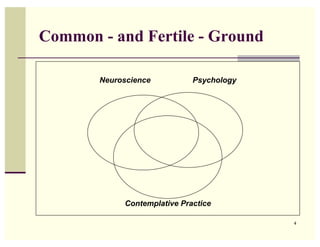
Common - and Fertile - Ground

       Neuroscience          Psychology


            Contemplative Practice

                                          4
The history of science is rich in the example
            of the fruitfulness of bringing
      two sets of techniques, two sets of ideas,
           developed in separate contexts
             for the pursuit of new truth,
            into touch with one another.

                 J. Robert Oppenheimer
                                                   5
When the facts change,
I change my mind, sir.

  What do you do?


John Maynard Keynes

                         6
Brain Basics


               7
8
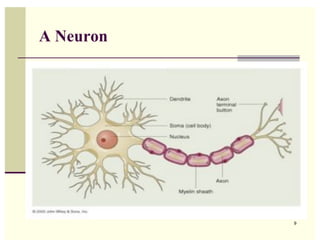
A Neuron


           9
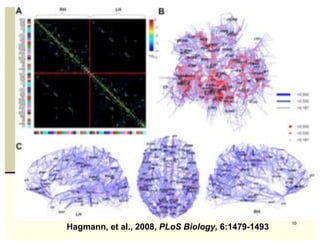
The Connectome - 2


                                                      10
   Hagmann, et al., 2008, PLoS Biology, 6:1479-1493
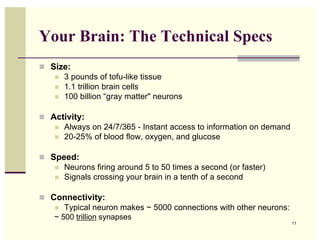
Your Brain: The Technical Specs
! Size:
   ! 3 pounds of tofu-like tissue
   ! 1.1 trillion brain cells
   ! 100 billion “gray matter" neurons


! Activity:
   ! Always on 24/7/365 - Instant access to information on demand
   ! 20-25% of blood flow, oxygen, and glucose


! Speed:
   ! Neurons firing around 5 to 50 times a second (or faster)
   ! Signals crossing your brain in a tenth of a second


! Connectivity:
   ! Typical neuron makes ~ 5000 connections with other neurons:
   ~ 500 trillion synapses
                                                                    11
Self-Directed Neuroplasticity


                                12
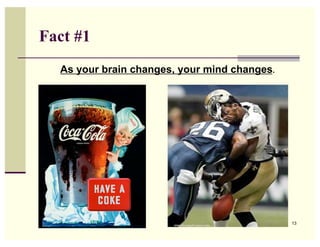
Fact #1
  As your brain changes, your mind changes.


                                              13
Ways That Brain Can Change Mind


! For better:
   ! A little caffeine: more alertness
   ! Thicker insula: more self-awareness, empathy
   ! More left prefrontal activation: more happiness


! For worse:
   ! Intoxication; imbalances in neurotransmitters
   ! Concussion, stroke, tumor, Alzheimer’s
   ! Cortisol-based shrinkage of hippocampus: less
     capacity for contextual memory                    14
Fact #2
       As your mind changes, your brain changes.

Immaterial mental activity maps to material neural
  activity.

This produces temporary changes in your brain and
  lasting ones.

Temporary changes include:
   !   Alterations in brainwaves (= changes in the firing patterns of
       synchronized neurons)
   !   Increased or decreased use of oxygen and glucose             15

   !   Ebbs and flows of neurochemicals
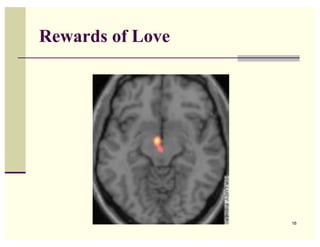
Rewards of Love


                  16
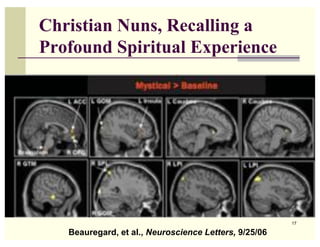
Christian Nuns, Recalling a
Profound Spiritual Experience


                                                       17

   Beauregard, et al., Neuroscience Letters, 9/25/06
Mind Changes Brain in Lasting Ways

! What flows through the mind sculpts your brain.
  Immaterial experience leaves material traces behind.

! Increased blood/nutrient flow to active regions


! Altered epigenetics (gene expression)


! “Neurons that fire together wire together.”
   !   Increasing excitability of active neurons
   !   Strengthening existing synapses
   !   Building new synapses; thickening cortex
   !   Neuronal “pruning” - “use it or lose it”      18
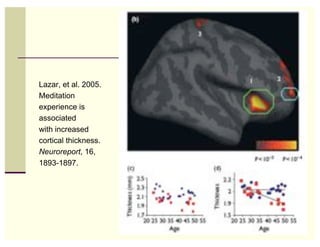
Lazar, et al. 2005.
Meditation
experience is
associated
with increased
cortical thickness.
Neuroreport, 16,
1893-1897.


                      19
Honoring Experience


One’s experience matters.

Both for how it feels in the moment and for the
  lasting residues it leaves behind, woven into
  the fabric of a person’s brain and being.


                                                  20
Fact #3

You can use your mind
to change your brain
to change your mind for the better.


This is self-directed neuroplasticity.


       How to do this, in skillful ways?   21
Neuroplasticity in Context

! Neuroplasticity is not breaking news. It’s been long
  presumed that mental activity changed neural
  structure: what else is learning?

! The news is in how the mind changes the brain.


! Most neuroplasticity is incremental, not dramatic.


! Neuroplasticity is ethically neutral.

                                                         22
Cultivating Inner Resources


                              23
The Importance of Inner Resources

! Examples:
   !   Freud’s “positive introjects”
   !   Internalization of “corrective emotional
       experiences” during psychotherapy
   !   “Learned optimism”

! Benefits
   !   Increase positive emotions: many physical and
       mental health benefits
   !   Improve self-soothing
   !   Improve outlook on world, self, and future
                                                       24
   !   Increase resilience, determination
Learning and Memory
! The sculpting of the brain by experience is memory:
   !   Explicit - Personal recollections; semantic memory
   !   Implicit - Bodily states; emotional residues; “views”
       (expectations, object relations, perspectives); behavioral
       repertoire and inclinations; what it feels like to be “me”


! Implicit memory is much larger than explicit memory.
  Resources are embedded mainly in implicit memory.

! Therefore, the key target is implicit memory. So what
  matters most is not the explicit recollection of positive
  events but the implicit emotional residue of positive
  experiences.                                            25
Self-Goodwill
! Moral teachings tell us to be compassionate and kind toward all
   beings. And that whatever we do to the world affects us, and
   whatever we do to ourselves affects the world.

! You are one of the “all beings!” And kindness to yourself
   benefits the world, while hurting yourself harms the world.

! It’s a general moral principle that the more power you have over
   someone, the greater your duty is to use that power wisely.
   Well, who is the one person in the world you have the greatest
   power over? It’s your future self. You hold that life in your hands,
   and what it will be depends on how you care for it.

! Consider yourself as an innocent child, as deserving of care and
   happiness as any other.                                           26
“Anthem”


     Ring the bells that still can ring
       Forget your perfect offering
      There is a crack in everything
       That’s how the light gets in
       That’s how the light gets in

              Leonard Cohen


                                          27
If one going down into a river,
   swollen and swiftly flowing,
is carried away by the current --
how can one help others across?

           The Buddha

                                    28
Just having positive experiences is not enough.

They pass through the brain like water through a sieve, while
  negative experiences are caught.

We need to engage positive experiences actively to weave them into
  the brain.


                                                                     29
How to Take in the Good

1. Look for positive facts, and let them become positive
   experiences.

2. Savor the positive experience:
    ! Sustain it for 10-20-30 seconds.
    ! Feel it in your body and emotions.
    ! Intensify it.


3. Sense and intend that the positive experience is
   soaking into your brain and body - registering deeply
   in emotional memory.                                  30
Why It’s Good to Take in the Good
! Rights an unfair imbalance, given the negativity bias


! Gives oneself today the caring and support one should have
   received as a child, but perhaps didn’t get in full measure; an
   inherent, implicit benefit

! Increases positive resources, such as:
    !   Postive emotions
    !   Capacity to manage stress and negative experiences

! Can help bring in missing “supplies” (e.g., love, strength, worth)


! Can help painful, even traumatic experiences
                                                                     31
Potential Synergies of TIG and MBSR

! Improved mindfulness from MBSR enhances TIG.


! TIG increases general resources for MBSR (e.g., heighten the
   PNS activation that promotes stable attention).

! TIG increases specific factors of MBSR (e.g., self-acceptance,
   self-compassion, tolerance of negative affect)

! TIG heightens internalization of key MBSR experiences:
   ! The sense of stable mindfulness itself
   ! Confidence that awareness itself is not in pain, upset, etc.
   ! Presence of supportive others (e.g., MBSR groups)
   ! Peacefulness of realizing that experiences come and go
                                                                    32
Feeling Stronger and Safer
! Be mindful of an experience of strength (e.g., physical
   challenge, standing up for someone).

! Staying grounded in strength, let things come to you without
   shaking your roots, like a mighty tree in a storm.

! Be mindful of:
   ! Protections (e.g., being in a safe place, imagining a shield)
   ! People who care about you
   ! Resources inside and outside you


! Let yourself feel as safe as you reasonably can:
   ! Noticing any anxiety about feeling safer
   ! Feeling more relaxed, tranquil, peaceful                        33

   ! Releasing bracing, guardedness, vigilance
Outstanding behavior,
    blameless action,
    open hands to all,
   and selfless giving:

This is a blessing supreme.

         The Buddha
                              34
Great Books
See www.RickHanson.net for other great books.

!   Austin, J. 2009. Selfless Insight. MIT Press.
!   Begley. S. 2007. Train Your Mind, Change Your Brain. Ballantine.
!   Carter, C. 2010. Raising Happiness. Ballantine.
!   Hanson, R. (with R. Mendius). 2009. Buddha’s Brain: The Practical
    Neuroscience of Happiness, Love, and Wisdom. New Harbinger.
!   Johnson, S. 2005. Mind Wide Open. Scribner.
!   Keltner, D. 2009. Born to Be Good. Norton.
!   Kornfield, J. 2009. The Wise Heart. Bantam.
!   LeDoux, J. 2003. Synaptic Self. Penguin.
!   Linden, D. 2008. The Accidental Mind. Belknap.
!   Sapolsky, R. 2004. Why Zebras Don’t Get Ulcers. Holt.
!   Siegel, D. 2007. The Mindful Brain. Norton.
!   Thompson, E. 2007. Mind in Life. Belknap.

                                                                        35
Key Papers - 1
See www.RickHanson.net for other scientific papers.

! Atmanspacher, H. & Graben, P. 2007. Contextual emergence of mental
   states from neurodynamics. Chaos & Complexity Letters, 2:151-168.

! Baumeister, R., Bratlavsky, E., Finkenauer, C. & Vohs, K. 2001. Bad is
   stronger than good. Review of General Psychology, 5:323-370.

! Braver, T. & Cohen, J. 2000. On the control of control: The role of
   dopamine in regulating prefrontal function and working memory; in
   Control of Cognitive Processes: Attention and Performance XVIII.
   Monsel, S. & Driver, J. (eds.). MIT Press.

! Carter, O.L., Callistemon, C., Ungerer, Y., Liu, G.B., & Pettigrew, J.D.
   2005. Meditation skills of Buddhist monks yield clues to brain's
   regulation of attention. Current Biology. 15:412-413.                     36
Key Papers - 2
!   Davidson, R.J. 2004. Well-being and affective style: neural substrates and
    biobehavioural correlates. Philosophical Transactions of the Royal Society.
    359:1395-1411.

!   Farb, N.A.S., Segal, Z.V., Mayberg, H., Bean, J., McKeon, D., Fatima, Z., and
    Anderson, A.K. 2007. Attending to the present: Mindfulness meditation reveals
    distinct neural modes of self-reflection. SCAN, 2, 313-322.

!   Gillihan, S.J. & Farah, M.J. 2005. Is self special? A critical review of evidence
    from experimental psychology and cognitive neuroscience. Psychological
    Bulletin, 131:76-97.

!   Hagmann, P., Cammoun, L., Gigandet, X., Meuli, R., Honey, C.J., Wedeen, V.J.,
    & Sporns, O. 2008. Mapping the structural core of human cerebral cortex. PLoS
    Biology. 6:1479-1493.

!   Hanson, R. 2008. Seven facts about the brain that incline the mind to joy. In
    Measuring the immeasurable: The scientific case for spirituality. Sounds True.      37
Key Papers - 3
!   Lazar, S., Kerr, C., Wasserman, R., Gray, J., Greve, D., Treadway, M.,
    McGarvey, M., Quinn, B., Dusek, J., Benson, H., Rauch, S., Moore, C., & Fischl,
    B. 2005. Meditation experience is associated with increased cortical thickness.
    Neuroreport. 16:1893-1897.

!   Lewis, M.D. & Todd, R.M. 2007. The self-regulating brain: Cortical-subcortical
    feedback and the development of intelligent action. Cognitive Development,
    22:406-430.

!   Lieberman, M.D. & Eisenberger, N.I. 2009. Pains and pleasures of social life.
    Science. 323:890-891.

!   Lutz, A., Greischar, L., Rawlings, N., Ricard, M. and Davidson, R. 2004. Long-
    term meditators self-induce high-amplitude gamma synchrony during mental
    practice. PNAS. 101:16369-16373.

!   Lutz, A., Slager, H.A., Dunne, J.D., & Davidson, R. J. 2008. Attention regulation
    and monitoring in meditation. Trends in Cognitive Sciences. 12:163-169.          38
Key Papers - 4
!   Rozin, P. & Royzman, E.B. 2001. Negativity bias, negativity dominance, and
    contagion. Personality and Social Psychology Review, 5:296-320.

!   Takahashi, H., Kato, M., Matsuura, M., Mobbs, D., Suhara, T., & Okubo, Y.
    2009. When your gain is my pain and your pain is my gain: Neural correlates of
    envy and schadenfreude. Science, 323:937-939.

!   Tang, Y.-Y., Ma, Y., Wang, J., Fan, Y., Feng, S., Lu, Q., Yu, Q., Sui, D.,
    Rothbart, M.K., Fan, M., & Posner, M. 2007. Short-term meditation training
    improves attention and self-regulation. PNAS, 104:17152-17156.

!   Thompson, E. & Varela F.J. 2001. Radical embodiment: Neural dynamics and
    consciousness. Trends in Cognitive Sciences, 5:418-425.

!   Walsh, R. & Shapiro, S. L. 2006. The meeting of meditative disciplines and
    Western psychology: A mutually enriching dialogue. American Psychologist,
    61:227-239.
                                                                                     39
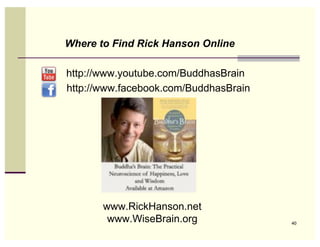
Where to Find Rick Hanson Online

http://www.youtube.com/BuddhasBrain
http://www.facebook.com/BuddhasBrain


               w


       www.RickHanson.net
        www.WiseBrain.org              40

The Promise of Self-Directed Neuroplasticity

  • 1.
    The Promise of Self-Directed Neuroplasticity Australian Association of Buddhist Counsellors and Psychotherapists August 10, 2011 Rick Hanson, Ph.D. The Wellspring Institute for Neuroscience and Contemplative Wisdom www.WiseBrain.org www.RickHanson.net 1 drrh@comcast.net
  • 2.
    Topics ! Perspectives ! Self-directedneuroplasticity ! Taking in the good ! Feeling cared about 2
  • 3.
  • 4.
    Common - andFertile - Ground Neuroscience Psychology Contemplative Practice 4
  • 5.
    The history ofscience is rich in the example of the fruitfulness of bringing two sets of techniques, two sets of ideas, developed in separate contexts for the pursuit of new truth, into touch with one another. J. Robert Oppenheimer 5
  • 6.
    When the factschange, I change my mind, sir. What do you do? John Maynard Keynes 6
  • 7.
  • 8.
  • 9.
  • 10.
    The Connectome -2 10 Hagmann, et al., 2008, PLoS Biology, 6:1479-1493
  • 11.
    Your Brain: TheTechnical Specs ! Size: ! 3 pounds of tofu-like tissue ! 1.1 trillion brain cells ! 100 billion “gray matter" neurons ! Activity: ! Always on 24/7/365 - Instant access to information on demand ! 20-25% of blood flow, oxygen, and glucose ! Speed: ! Neurons firing around 5 to 50 times a second (or faster) ! Signals crossing your brain in a tenth of a second ! Connectivity: ! Typical neuron makes ~ 5000 connections with other neurons: ~ 500 trillion synapses 11
  • 12.
  • 13.
    Fact #1 As your brain changes, your mind changes. 13
  • 14.
    Ways That BrainCan Change Mind ! For better: ! A little caffeine: more alertness ! Thicker insula: more self-awareness, empathy ! More left prefrontal activation: more happiness ! For worse: ! Intoxication; imbalances in neurotransmitters ! Concussion, stroke, tumor, Alzheimer’s ! Cortisol-based shrinkage of hippocampus: less capacity for contextual memory 14
  • 15.
    Fact #2 As your mind changes, your brain changes. Immaterial mental activity maps to material neural activity. This produces temporary changes in your brain and lasting ones. Temporary changes include: ! Alterations in brainwaves (= changes in the firing patterns of synchronized neurons) ! Increased or decreased use of oxygen and glucose 15 ! Ebbs and flows of neurochemicals
  • 16.
  • 17.
    Christian Nuns, Recallinga Profound Spiritual Experience 17 Beauregard, et al., Neuroscience Letters, 9/25/06
  • 18.
    Mind Changes Brainin Lasting Ways ! What flows through the mind sculpts your brain. Immaterial experience leaves material traces behind. ! Increased blood/nutrient flow to active regions ! Altered epigenetics (gene expression) ! “Neurons that fire together wire together.” ! Increasing excitability of active neurons ! Strengthening existing synapses ! Building new synapses; thickening cortex ! Neuronal “pruning” - “use it or lose it” 18
  • 19.
    Lazar, et al.2005. Meditation experience is associated with increased cortical thickness. Neuroreport, 16, 1893-1897. 19
  • 20.
    Honoring Experience One’s experiencematters. Both for how it feels in the moment and for the lasting residues it leaves behind, woven into the fabric of a person’s brain and being. 20
  • 21.
    Fact #3 You canuse your mind to change your brain to change your mind for the better. This is self-directed neuroplasticity. How to do this, in skillful ways? 21
  • 22.
    Neuroplasticity in Context !Neuroplasticity is not breaking news. It’s been long presumed that mental activity changed neural structure: what else is learning? ! The news is in how the mind changes the brain. ! Most neuroplasticity is incremental, not dramatic. ! Neuroplasticity is ethically neutral. 22
  • 23.
  • 24.
    The Importance ofInner Resources ! Examples: ! Freud’s “positive introjects” ! Internalization of “corrective emotional experiences” during psychotherapy ! “Learned optimism” ! Benefits ! Increase positive emotions: many physical and mental health benefits ! Improve self-soothing ! Improve outlook on world, self, and future 24 ! Increase resilience, determination
  • 25.
    Learning and Memory !The sculpting of the brain by experience is memory: ! Explicit - Personal recollections; semantic memory ! Implicit - Bodily states; emotional residues; “views” (expectations, object relations, perspectives); behavioral repertoire and inclinations; what it feels like to be “me” ! Implicit memory is much larger than explicit memory. Resources are embedded mainly in implicit memory. ! Therefore, the key target is implicit memory. So what matters most is not the explicit recollection of positive events but the implicit emotional residue of positive experiences. 25
  • 26.
    Self-Goodwill ! Moral teachingstell us to be compassionate and kind toward all beings. And that whatever we do to the world affects us, and whatever we do to ourselves affects the world. ! You are one of the “all beings!” And kindness to yourself benefits the world, while hurting yourself harms the world. ! It’s a general moral principle that the more power you have over someone, the greater your duty is to use that power wisely. Well, who is the one person in the world you have the greatest power over? It’s your future self. You hold that life in your hands, and what it will be depends on how you care for it. ! Consider yourself as an innocent child, as deserving of care and happiness as any other. 26
  • 27.
    “Anthem” Ring the bells that still can ring Forget your perfect offering There is a crack in everything That’s how the light gets in That’s how the light gets in Leonard Cohen 27
  • 28.
    If one goingdown into a river, swollen and swiftly flowing, is carried away by the current -- how can one help others across? The Buddha 28
  • 29.
    Just having positiveexperiences is not enough. They pass through the brain like water through a sieve, while negative experiences are caught. We need to engage positive experiences actively to weave them into the brain. 29
  • 30.
    How to Takein the Good 1. Look for positive facts, and let them become positive experiences. 2. Savor the positive experience: ! Sustain it for 10-20-30 seconds. ! Feel it in your body and emotions. ! Intensify it. 3. Sense and intend that the positive experience is soaking into your brain and body - registering deeply in emotional memory. 30
  • 31.
    Why It’s Goodto Take in the Good ! Rights an unfair imbalance, given the negativity bias ! Gives oneself today the caring and support one should have received as a child, but perhaps didn’t get in full measure; an inherent, implicit benefit ! Increases positive resources, such as: ! Postive emotions ! Capacity to manage stress and negative experiences ! Can help bring in missing “supplies” (e.g., love, strength, worth) ! Can help painful, even traumatic experiences 31
  • 32.
    Potential Synergies ofTIG and MBSR ! Improved mindfulness from MBSR enhances TIG. ! TIG increases general resources for MBSR (e.g., heighten the PNS activation that promotes stable attention). ! TIG increases specific factors of MBSR (e.g., self-acceptance, self-compassion, tolerance of negative affect) ! TIG heightens internalization of key MBSR experiences: ! The sense of stable mindfulness itself ! Confidence that awareness itself is not in pain, upset, etc. ! Presence of supportive others (e.g., MBSR groups) ! Peacefulness of realizing that experiences come and go 32
  • 33.
    Feeling Stronger andSafer ! Be mindful of an experience of strength (e.g., physical challenge, standing up for someone). ! Staying grounded in strength, let things come to you without shaking your roots, like a mighty tree in a storm. ! Be mindful of: ! Protections (e.g., being in a safe place, imagining a shield) ! People who care about you ! Resources inside and outside you ! Let yourself feel as safe as you reasonably can: ! Noticing any anxiety about feeling safer ! Feeling more relaxed, tranquil, peaceful 33 ! Releasing bracing, guardedness, vigilance
  • 34.
    Outstanding behavior, blameless action, open hands to all, and selfless giving: This is a blessing supreme. The Buddha 34
  • 35.
    Great Books See www.RickHanson.netfor other great books. ! Austin, J. 2009. Selfless Insight. MIT Press. ! Begley. S. 2007. Train Your Mind, Change Your Brain. Ballantine. ! Carter, C. 2010. Raising Happiness. Ballantine. ! Hanson, R. (with R. Mendius). 2009. Buddha’s Brain: The Practical Neuroscience of Happiness, Love, and Wisdom. New Harbinger. ! Johnson, S. 2005. Mind Wide Open. Scribner. ! Keltner, D. 2009. Born to Be Good. Norton. ! Kornfield, J. 2009. The Wise Heart. Bantam. ! LeDoux, J. 2003. Synaptic Self. Penguin. ! Linden, D. 2008. The Accidental Mind. Belknap. ! Sapolsky, R. 2004. Why Zebras Don’t Get Ulcers. Holt. ! Siegel, D. 2007. The Mindful Brain. Norton. ! Thompson, E. 2007. Mind in Life. Belknap. 35
  • 36.
    Key Papers -1 See www.RickHanson.net for other scientific papers. ! Atmanspacher, H. & Graben, P. 2007. Contextual emergence of mental states from neurodynamics. Chaos & Complexity Letters, 2:151-168. ! Baumeister, R., Bratlavsky, E., Finkenauer, C. & Vohs, K. 2001. Bad is stronger than good. Review of General Psychology, 5:323-370. ! Braver, T. & Cohen, J. 2000. On the control of control: The role of dopamine in regulating prefrontal function and working memory; in Control of Cognitive Processes: Attention and Performance XVIII. Monsel, S. & Driver, J. (eds.). MIT Press. ! Carter, O.L., Callistemon, C., Ungerer, Y., Liu, G.B., & Pettigrew, J.D. 2005. Meditation skills of Buddhist monks yield clues to brain's regulation of attention. Current Biology. 15:412-413. 36
  • 37.
    Key Papers -2 ! Davidson, R.J. 2004. Well-being and affective style: neural substrates and biobehavioural correlates. Philosophical Transactions of the Royal Society. 359:1395-1411. ! Farb, N.A.S., Segal, Z.V., Mayberg, H., Bean, J., McKeon, D., Fatima, Z., and Anderson, A.K. 2007. Attending to the present: Mindfulness meditation reveals distinct neural modes of self-reflection. SCAN, 2, 313-322. ! Gillihan, S.J. & Farah, M.J. 2005. Is self special? A critical review of evidence from experimental psychology and cognitive neuroscience. Psychological Bulletin, 131:76-97. ! Hagmann, P., Cammoun, L., Gigandet, X., Meuli, R., Honey, C.J., Wedeen, V.J., & Sporns, O. 2008. Mapping the structural core of human cerebral cortex. PLoS Biology. 6:1479-1493. ! Hanson, R. 2008. Seven facts about the brain that incline the mind to joy. In Measuring the immeasurable: The scientific case for spirituality. Sounds True. 37
  • 38.
    Key Papers -3 ! Lazar, S., Kerr, C., Wasserman, R., Gray, J., Greve, D., Treadway, M., McGarvey, M., Quinn, B., Dusek, J., Benson, H., Rauch, S., Moore, C., & Fischl, B. 2005. Meditation experience is associated with increased cortical thickness. Neuroreport. 16:1893-1897. ! Lewis, M.D. & Todd, R.M. 2007. The self-regulating brain: Cortical-subcortical feedback and the development of intelligent action. Cognitive Development, 22:406-430. ! Lieberman, M.D. & Eisenberger, N.I. 2009. Pains and pleasures of social life. Science. 323:890-891. ! Lutz, A., Greischar, L., Rawlings, N., Ricard, M. and Davidson, R. 2004. Long- term meditators self-induce high-amplitude gamma synchrony during mental practice. PNAS. 101:16369-16373. ! Lutz, A., Slager, H.A., Dunne, J.D., & Davidson, R. J. 2008. Attention regulation and monitoring in meditation. Trends in Cognitive Sciences. 12:163-169. 38
  • 39.
    Key Papers -4 ! Rozin, P. & Royzman, E.B. 2001. Negativity bias, negativity dominance, and contagion. Personality and Social Psychology Review, 5:296-320. ! Takahashi, H., Kato, M., Matsuura, M., Mobbs, D., Suhara, T., & Okubo, Y. 2009. When your gain is my pain and your pain is my gain: Neural correlates of envy and schadenfreude. Science, 323:937-939. ! Tang, Y.-Y., Ma, Y., Wang, J., Fan, Y., Feng, S., Lu, Q., Yu, Q., Sui, D., Rothbart, M.K., Fan, M., & Posner, M. 2007. Short-term meditation training improves attention and self-regulation. PNAS, 104:17152-17156. ! Thompson, E. & Varela F.J. 2001. Radical embodiment: Neural dynamics and consciousness. Trends in Cognitive Sciences, 5:418-425. ! Walsh, R. & Shapiro, S. L. 2006. The meeting of meditative disciplines and Western psychology: A mutually enriching dialogue. American Psychologist, 61:227-239. 39
  • 40.
    Where to FindRick Hanson Online http://www.youtube.com/BuddhasBrain http://www.facebook.com/BuddhasBrain w www.RickHanson.net www.WiseBrain.org 40