A&A 534, A41 (2011)                                                                                                  Astronomy
DOI: 10.1051/0004-6361/201117123                                                                                      &
c ESO 2011                                                                                                           Astrophysics


                               Multiwavelength campaign on Mrk 509
                                                                                                                            ,
                  VI. HST/COS observations of the far-ultraviolet spectrum
        G. A. Kriss1,2 , N. Arav3 , J. S. Kaastra4,5 , J. Ebrero4 , C. Pinto4 , B. Borguet3 , D. Edmonds3 , E. Costantini4 ,
        K. C. Steenbrugge6,7 , R. G. Detmers4,5 , E. Behar8 , S. Bianchi9 , A. J. Blustin10 , G. Branduardi-Raymont11 ,
                                 M. Cappi12 , M. Mehdipour11 , P. Petrucci13 , and G. Ponti14

       1
           Space Telescope Science Institute, 3700 San Martin Drive, Baltimore, MD 21218, USA
           e-mail: gak@stsci.edu
       2
           Department of Physics & Astronomy, The Johns Hopkins University, Baltimore, MD 21218, USA
       3
           Department of Physics, Virginia Tech, Blacksburg, VA 24061, USA
       4
           SRON Netherlands Institute for Space Research, Sorbonnelaan 2, 3584 CA Utrecht, The Netherlands
       5
           Astronomical Institute, University of Utrecht, Postbus 80000, 3508 TA Utrecht, The Netherlands
       6
           Instituto de Astronomía, Universidad Católica del Norte, Avenida Angamos 0610, Casilla 1280, Antofagasta, Chile
       7
           Department of Physics, University of Oxford, Keble Road, Oxford OX1 3RH, UK
       8
           Department of Physics, Technion, Haifa 32000, Israel
       9
           Dipartimento di Fisica, Universita degli Studi Roma Tre, via della Vasca Navale 84, 00146 Roma, Italy
      10
           Institute of Astronomy, University of Cambridge, Madingley Road, Cambridge CB3 0HA, UK
      11
           Mullard Space Science Laboratory, University College London, Holmbury St. Mary, Dorking, Surrey, RH5 6NT, UK
      12
           INAF-IASF Bologna, via Gobetti 101, 40129 Bologna, Italy
      13
           UJF-Grenoble 1/CNRS-INSU, Institut de Planétologie et d’Astrophysique de Grenoble (IPAG) UMR 5274, 38041 Grenoble,
           France
      14
           School of Physics and Astronomy, University of Southampton, Highfield, Southampton SO17 1BJ, UK
      Received 21 April 2011 / Accepted 26 May 2011

                                                                   ABSTRACT

      We present medium-resolution (λ/Δλ ∼ 20 000) ultraviolet spectra covering the 1155−1760 Å spectral range of the Seyfert 1 galaxy
      Mrk 509 obtained using the Cosmic Origins Spectrograph (COS) on the Hubble Space Telescope (HST). Our observations were
      obtained simultaneously with a Low Energy Transmission Grating Spectrometer observation using the Chandra X-ray Observatory,
      and they are part of a multiwavelength campaign in September through December 2009 which also included observations with
      XMM-Newton, Swift, and INTEGRAL. Our spectra are the highest signal-to-noise observations to date of the intrinsic absorption
      components seen in numerous prior ultraviolet observations. To take advantage of the high S/N, we describe special calibrations for
      wavelength, flat-field and line-spread function corrections that we applied to the COS data. We detect additional complexity in the
      absorption troughs compared to prior observations made with the Space Telescope Imaging Spectrograph (STIS) on HST. We attribute
      the UV absorption to a variety of sources in Mrk 509, including an outflow from the active nucleus, the interstellar medium and halo of
      the host galaxy, and possible infalling clouds or stripped gaseous material from a merger that are illuminated by the ionizing radiation
      of the active nucleus. Variability between the STIS and COS observation of the most blue-shifted component (#1) allows us to set
      an upper limit on its distance of <250 pc. Similarly, variability of component 6 between FUSE observations limits its distance to
      <1.5 kpc. The absorption lines in all components only partially cover the emission from the active nucleus with covering fractions
      that are lower than those seen in the prior STIS observations and are comparable to those seen in spectra from the Far Ultraviolet
      Spectroscopic Explorer (FUSE). Given the larger apertures of COS and FUSE compared to STIS, we favor scattered light from an
      extended region near the active nucleus as the explanation for the partial covering. As observed in prior X-ray and UV spectra, the
      UV absorption has velocities comparable to the X-ray absorption, but the bulk of the ultraviolet absorption is in a lower ionization
      state with lower total column density than the gas responsible for the X-ray absorption. We conclude that the outflow from the active
      nucleus is a multiphase wind.
      Key words. galaxies: active – galaxies: individual: Mrk 509 – quasars: absorption lines – galaxies: Seyfert – ultraviolet: galaxies –
      X-rays: galaxies


                                                                           1. Introduction
                                                                           Outflows from galaxies powered by an active galactic nucleus
     Based on observations made with the NASA/ESA Hubble Space
Telescope, obtained at the Space Telescope Science Institute, which is     (AGN) may play an important role in the chemical enrichment of
operated by the Association of Universities for Research in Astronomy,     the intergalactic medium (IGM). The most distant AGN known,
Inc., under NASA contract NAS 5-26555. These observations are asso-        quasars at redshifts of 6 or more, have abundances at solar or
ciated with program # 12022.                                               super-solar levels (Hamann & Ferland 1993, 1999; Pentericci
     Tables 3–7, 9–12, and Appendix are available in electronic form via   et al. 2002; Barth et al. 2003; Dietrich et al. 2003; Freudling et al.
http://www.aanda.org                                                       2003; Juarez et al. 2009). Although the chemical enrichment of
                                           Article published by EDP Sciences                                                    A41, page 1 of 26
A&A 534, A41 (2011)

the host likely predates the presence of the active nucleus (Simon   in the X-ray, although both the X-ray and UV absorption do
& Hamann 2010), winds powered by the AGN could return this           overlap in velocity.
metal-enriched material to the IGM (Furlanetto & Loeb 2001;               Our newer observations using the Cosmic Origins
Cavaliere et al. 2002; Germain et al. 2009; Hopkins & Elvis          Spectrograph (COS) on HST achieve higher S/Ns (S/N)
2010; Barai et al. 2011). Their presence and feedback may also       and provide insight into long-term changes in the absorbing gas.
have a significant impact on the evolution of their host galaxies     Our COS spectra provide a higher-resolution view of the veloc-
(Silk & Rees 1998; Scannapieco & Oh 2004; Granato et al. 2004;       ity structure in the outflowing gas, and sample lower ionization
Di Matteo et al. 2005; Hopkins et al. 2008; Somerville et al.        ionic species than are present in the X-ray spectra. At high
2008). While some fraction of these outflows in low-luminosity        spectral resolution and high S/N, we can use velocity-resolved
AGN may not escape their host galaxy, at least as measured           spectral coverage of the N v and C iv doublets to solve for the
in the local universe (Das et al. 2005, 2007; Ruiz et al. 2005),     covering fractions and column densities in the outflowing gas
the impact of the outflow on lower-density portions of the host       (Arav et al. 2007). Using our COS observations of Lyα together
interstellar medium (ISM) could provide a significant transport       with the archival FUSE observations of the higher-order Lyman
mechanism for the enrichment of the surrounding environment          lines, we can provide an absolute reference for abundances
(Hopkins & Elvis 2010). From constraints provided by the X-ray       relative to hydrogen, which cannot be measured directly in the
background, such lower luminosity AGN may dominate the pop-          X-ray spectra. These higher S/N spectra combined with the
ulation of active galaxies in the early universe (Treister et al.    higher S/N X-ray spectra permit a more detailed examination of
2009, 2010).                                                         the links between the UV and the X-ray absorbing gas in the
                                                                     outflow.
     Nearby AGN provide local analogs that can help us to un-
derstand the mechanics, energetics, and chemical enrichment               This paper describes the COS observations that are part of
patterns that may play a significant role in cosmic evolution at      our multiwavelength campaign on Mrk 509, and presents an
high redshift. More than half of low-redshift AGN exhibit blue-      initial interpretation of the results. In Sect. 2 we describe our
shifted UV or X-ray absorption features indicative of outflowing      COS observations and our data reduction methods, including en-
gas (Crenshaw et al. 2003; Dunn et al. 2007; Cappi et al. 2009;      hanced calibrations for the COS data and corrections for the line-
Tombesi et al. 2010). Understanding the geometry and the loca-       spread function (LSF). In Sect. 3 we describe our analysis of the
tion of the outflow relative to the active nucleus is a key to mak-   UV spectra and compare them to prior STIS and FUSE obser-
ing an accurate assessment of the total mass and the kinetic lu-     vations of Mrk 509. Finally, in Sect. 4 we discuss the physical
minosity of the outflow. Distance determinations are particularly     implications of our observations for the geometry and location
difficult. Using density-sensitive absorption lines to establish the   of the absorbing gas in Mrk 509 and its physical conditions. We
gas density, in combination with photoionization models that re-     end with a summary of our conclusions in Sect. 5.
produce the observed relative column densities can provide pre-
cise distance estimates. These measures have ranged from tens
of parsecs in NGC 3783 (Gabel et al. 2005b) and NGC 4151             2. Observations and data reduction
(Kraemer et al. 2006, if one uses the correct critical density for   As part of our extensive coordinated campaign on Mrk 509
C iii*), and up to kiloparsec scales in some quasars and AGN         (Kaastra et al. 2011b), we observed Mrk 509 using the Far-
(Hamann et al. 2001; Scott et al. 2004; Edmonds et al. 2011). UV     Ultraviolet Channel and the medium-resolution gratings of the
and X-ray observations of Mrk 279 (Scott et al. 2004; Arav et al.    COS on the HST. Descriptions of COS and its on-orbit perfor-
2007; Costantini et al. 2007) measured absolute abundances in        mance can be found in the COS Instrument Handbook (Dixon
the outflow of a local AGN for the first time, and they show evi-      et al. 2010). Our two visits on 2009 December 10 and 11 were si-
dence for enhanced CNO abundances that suggest contributions         multaneous with the Chandra observations described by Ebrero
from massive stars and AGB stellar winds.                            et al. (2011). Using gratings G130M and G160M and observ-
    To improve upon these prior studies, we have conducted a         ing through the Primary Science Aperture (PSA), we covered
multiwavelength campaign of coordinated X-ray, UV, and opti-         the far-ultraviolet spectral range from 1155 Å to 1760 Å. The
cal observations of the nearby luminous Seyfert 1 galaxy Mrk         instrument configurations, times of observation, and integration
509 (z = 0.034397; Huchra et al. 1993). A complete overview          times are summarized in Table 1. For each grating, we used only
of the campaign is given by Kaastra et al. (2011b). Mrk 509 is       two tilts to avoid placing gaps in spectral ranges of interest sur-
an ideal object for study due to its high flux, moderate lumi-        rounding the strong emission and absorption features in Mrk
nosity that rivals that of QSOs (Kopylov et al. 1974), and deep,     509. This resulted in almost complete spectral coverage except
well structured absorption troughs. The blue-shifted absorption      for a small gap from 1560−1590 Å. The two tilts and two ex-
indicative of a nuclear outflow has been known since the earli-       posures at each setting resulted in four independent placements
est UV spectral observations (Wu et al. 1980; York et al. 1984).     of the grid-wire shadows and other instrumental artifacts along
The outflow is also apparent in the blueshifted [O iii] emission      the spectrum. This enhanced our ability to flat field these high
detected across the face of Mrk 509 by Phillips et al. (1983).       S/N data. Exposure times were weighted more heavily in favor
More recently Kriss et al. (2000) and Kraemer et al. (2003) ob-      of grating G160M since Mrk 509 is fainter across this wave-
served Mrk 509 at high spectral resolution in the UV with the        length range, and the throughput of G160M is lower relative to
Far Ultraviolet Spectroscopic Explorer (FUSE) and the Space          G130M. This gives more uniform S/N across the full spectrum.
Telescope Imaging Spectrograph (STIS) on the Hubble Space            For G130M we obtained a total exposure time of 9470 s; for
Telescope (HST), respectively. The STIS observations were si-        G160M, the total exposure time was 16452 s.
multaneous with earlier Chandra X-ray grating observations               Our data were processed with the COS calibration pipeline
(Yaqoob et al. 2003) that also detect blue-shifted X-ray absorp-     v2.11b at STScI. This version of the pipeline does not correct for
tion lines. These prior UV observations show the presence of         flat-field features or the time-dependent sensitivity of COS, and
more than seven distinct kinematic components, none of which         there are still some residual anomalies in the wavelength cali-
could be unambiguously associated with the absorption detected       bration. To produce the best quality summed data set, we used
A41, page 2 of 26
G. A. Kriss et al.: Multiwavelength campaign on Mrk 509. VI.

Table 1. COS observations of Mrk 509.

                                Data set name     Grating/Tilt        Date      Start time   Exposure time
                                                                                 (GMT)            (s)
                                lbdh01010        G130M/1309      2009-12-10     02:48:40         1993
                                lbdh01020        G130M/1327      2009-12-10     04:07:03         2742
                                lbdh01030        G160M/1577      2009-12-10     05:42:57         5484
                                lbdh01040        G160M/1589      2009-12-10     08:54:42         2742
                                lbdh02010        G130M/1309      2009-12-11     02:46:46         1993
                                lbdh02020        G130M/1327      2009-12-11     04:05:12         2742
                                lbdh02030        G160M/1577      2009-12-11     05:41:05         2742
                                lbdh02040        G160M/1589      2009-12-11     07:16:57         5484


a customized series of procedures to make these corrections as          intrinsic to Mrk 509 and in intervening material) more accurately
described in the following sections.                                    for comparison in velocity space, and for comparison to prior ob-
                                                                        servations with FUSE and STIS. There can also be residual zero-
                                                                        point shifts in the wavelength scale due to offsets from the aper-
2.1. Flat-field corrections                                              ture center which may not have been fully removed in the target
                                                                        acquisition process. Therefore, we first adjusted the wavelength-
To flat field the data and correct for instrumental artifacts, we
                                                                        scale zero points for our G130M and G160M spectra by cross
used one-dimensional flat-field corrections developed from COS
                                                                        correlating them with the prior STIS observation of Mrk 509.
observations of white dwarf standards (Ake et al. 2010). These
flat fields correspond to each detector segment (A and B) for             For G130M, we used the wavelength region from 1245−1290 Å,
each grating (G130M and G160M) we used. The S/N in these                which is dominated by the intrinsic absorption features from Lyα
flat fields (in terms of purely Poisson-distributed noise) is com-        and N v. For G160M, we used the region from 1590−1615 Å,
parable to that in our data set. To reduce the impact of the added      centered on the intrinsic absorption from C iv. The intrinsic ab-
noise that would result from dividing by these data for our flat-        sorption features provide numerous sharp edges that result in a
field correction, we first smoothed the flat-fields. It may seem            strong, narrow cross-correlation peak that enhances the precision
counterintuitive to consider smoothing pixel-to-pixel flats when         of the alignment. The resulting corrections were <0.1 Å.
using them to correct for pattern noise and artifacts, but there            For the next level of correction, we used the numerous in-
are two fundamental reasons why this works. First, real artifacts       terstellar absorption lines in our spectra that spanned the full
and pattern noise are never sharper than the intrinsic resolution       wavelength range. As the sight line to Mrk 509 is very complex,
of the detector, which is approximately six pixels. Second, drifts      each interstellar line typically has multiple components. The H I
in the grating select mechanism, which are corrected during an          21-cm emission in this direction (Murphy et al. 1996) has a
observation using the TAG-FLASH observing mode, effectively              strong flux-weighted peak at +3.1 km s−1 in the local standard of
smear the pattern noise. Since our observations were longer than        rest (LSR), and a weaker, broader peak at ∼+65 km s−1 (LSR).
any of the individual ones used to develop the one-dimensional          The +3 km s−1 feature is present in all detected interstellar lines,
flats, the smearing of the pattern noise is greater. Smoothing the       and the +65 km s−1 one is present in the stronger lines. In addi-
flats partially corrects for this smearing. After trying a variety       tion, there are high-velocity features at −249 and −295 km s−1
of smoothing widths, we settled on smoothing the flats with a            visible in the strongest lines and in the higher ionization species
Gaussian profile having a 1-pixel dispersion. To align the flats          like C iv. We measured the wavelengths of all these interstellar
with the extracted 1D spectra from each exposure, we cross cor-         features. The wavelength differences of our measurements rel-
related the appropriate smoothed flat with the data, applied an          ative to vacuum wavelengths show a systematic, nearly linear
appropriate integer-pixel shift, and then divided it out.               trend with wavelength across each detector segment that amount
    Once the data were flat-field corrected, we aligned the indi-         to an offset of 0.06 Å from one end of each segment to the
vidual exposures by first cross-correlating them with each other         other. We take this as an indication that there is a slight error
and applying the closest integer-pixel shift. While this process        in the dispersion constant for the COS wavelength calibration.
produced a tremendous improvement in the data, some residual            To weight our correction by the strongest features, we used only
features remained. We then examined each individual exposure,           those corresponding to the +3 and +65 km s−1 components and
comparing them with each other and with the flat field used to            performed a linear fit to the wavelength offsets for each detec-
correct them. Strong features in the flats that did not divide out       tor segment. We then made a linear correction to the wavelength
well were then flagged in the individual exposures so that they          scale, with pivot points that have zero correction about 1260 Å
could be excluded when we did the final combination. Our final            and 1600 Å so that we keep our zero points aligned with the
spectrum for each grating is the exposure-weighted combination          STIS wavelength scale. After applying this correction, we then
of the unflagged pixels in each of the individual flat-fielded and         find a peak-to-peak variation among the velocity offsets of all
aligned exposures. Although our data would support a S/N of             the interstellar features of −10 to +8 km s−1 , with a dispersion of
over 100 per pixel in the Poisson limit, we do not do much better       4.3 km s−1 .
than 60:1 per pixel in our final spectrum.
                                                                        2.3. Flux calibration
2.2. Wavelength calibration
                                                                        The sensitivity of COS has been slowly declining since its instal-
While the nominal wavelength calibration of COS over most of            lation (Osten et al. 2010). We have applied the time-dependent
the spectral range has errors less than 15 km s−1 , this is not ad-     sensitivity corrections to our data as given by Osten et al. (2010).
equate for our analysis. We wish to align spectral features (both       These corrections amount to an adjustment of only 2.5% at the
                                                                                                                          A41, page 3 of 26
A&A 534, A41 (2011)


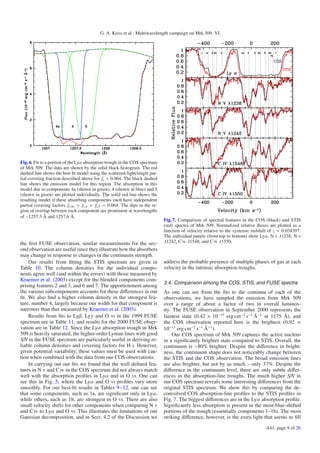
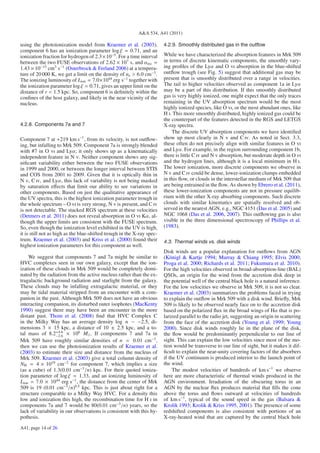
Fig. 1. Calibrated and merged COS spectrum of Mrk 509. Prominent emission features are labeled above the spectrum. Regions of intrinsic
absorption are indicated below the spectrum. Geocoronal emission in the center of the galactic Lyα absorption trough is indicated with an Earth
symbol.

short wavelength end of the G130M spectrum, and range up to              aperture (Kraemer et al. 2003; Yaqoob et al. 2003, Proposal ID
a correction of 5% at the long-wavelength end of G160M. We               8877, PI: Yaqoob). The spectrum we use is the one-dimensional
estimate an absolute flux accuracy of 5% at wavelengths above             extracted echelle spectrum direct from the MAST archive with
1220 Å, and 10% at shorter wavelengths (Massa et al. 2010).              all up-to-date calibrations applied, including corrections for scat-
We expect that relative fluxes are more precise. Our repeat ob-           tered light in the echelle mode (Valenti et al. 2002) and for the
servations in our two visits agree to better than 1%, and compar-        echelle blaze corrections (Aloisi et al. 2007). The STIS spec-
ison between the overlapping wavelength ranges of G130M and              trum of Mrk 509 has a resolution about twice that of the COS
G160M in our spectra show that they also agree to better than            spectra, R = 46 000. This spectrum is particularly useful for as-
1%.                                                                      sessing the true resolution of the COS spectrum, and the validity
    As an external comparison, and for cross-calibration pur-            of deconvolutions that repair the broad wings of the COS LSF.
poses with the other elements of our campaign, we compare                     To illustrate the dramatic improvement in the quality of our
our spectrum to the Swift UVM2 data point from 2010 Dec                  COS data compared to the prior STIS observation, Fig. 2 shows
10. These data are in a broad band centered at 2231 Å, with              a portion of both spectra in the region centered around the Lyα
some contamination from broad C iii] emission (Mehdipour et al.          absorption feature intrinsic to Mrk 509. One sees that Mrk 509
2011). To compare our COS spectrum to this point requires some           was ∼60% brighter during our COS observation. In addition, the
extrapolation. We take the 1140–8090 Å spectrum assembled by             higher throughput of COS also improves our resulting S/N by a
Shang et al. (2005) from FOS and KPNO 2.1-m spectra, and                 factor of ∼5. However, one can see that there are still instrumen-
normalize this spectrum to the corrected Swift UVM2 contin-              tal features that we must correct before doing a detailed analy-
                                                                         sis of the COS data. Deep, saturated absorption features in the
uum flux at 2231 Å of 5.12 × 10⁻¹⁴ erg cm−2 s−1 Å−1 (Mehdipour
                                                                         STIS spectrum, especially the interstellar Si ii line at 1260.5 Å,
et al. 2011). At wavelengths longer than 1220 Å, our COS spec-
                                                                         do not have square, black troughs in the COS spectrum. This
tra agree with the FOS spectrum normalized to the corrected
                                                                         is due to the broad wings on the LSF (Ghavamian et al. 2009)
Swift UVM2 flux to better than 4% at all wavelengths. Below
                                                                         that redistribute light from the bright continuum into cores of
1210 Å, our COS spectrum is brighter by up to 9% above the               the absorption lines. To extract the maximum information from
renormalized FOS spectrum. This could be a true difference in             our spectrum, we must correct for these broad wings on the LSF.
the spectrum, but it could also be an indication of our residual
uncertainties in the flux calibration. In the latter case, we conser-
vatively estimate that our absolute flux below 1220 Å is better           2.5. Deconvolving the COS spectrum
than 10%.
    Figure 1 shows our calibrated and merged COS spectra. We             The broad wings on the COS LSF are caused by mid-frequency
have labeled the prominent emission features in the spectrum             polishing errors on the HST primary & secondary mirrors
as well as the regions containing the intrinsic absorption fea-          (Ghavamian et al. 2009). Additional scattering by the HST mir-
tures. The many galactic interstellar absorption lines in our spec-      ror system and internal to COS makes these wings more exten-
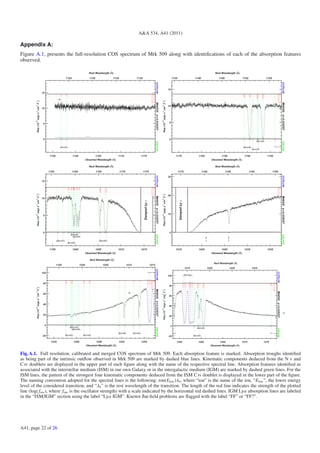
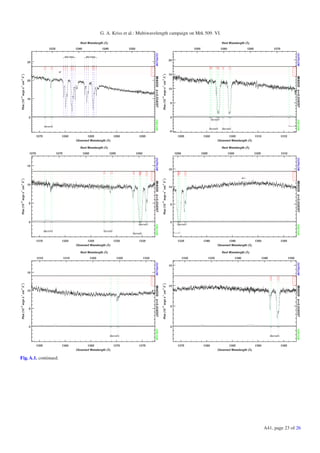
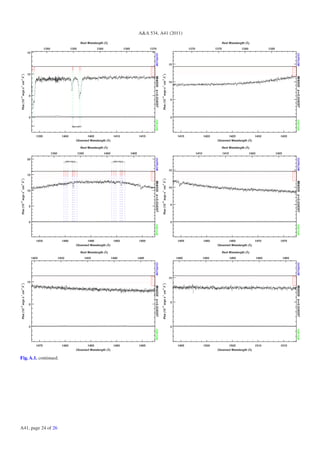
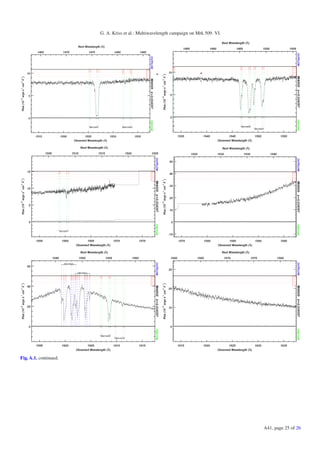
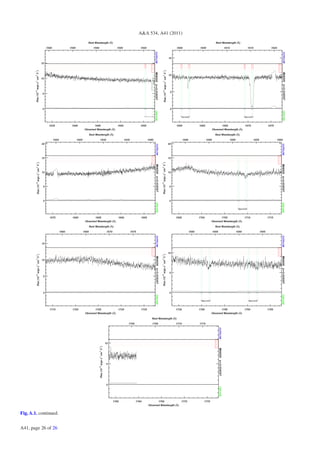
trum are not labeled here. In the appendix, Fig. A.1 shows full-         sive than originally thought (Kriss 2011). These errors must be
resolution plots of the COS spectrum of Mrk 509, and it can be           removed in order to obtain accurate measurements of the depths
found in the on-line version of the journal.                             of the absorption lines in the COS spectrum. On scales less than
                                                                         about 50 km s−1 , significant light can leak into the absorption
                                                                         line troughs from adjacent continuum regions. As a result, in-
2.4. STIS spectrum                                                       terstellar absorption lines expected to be saturated are not black.
                                                                         This is quite obvious when one compares the interstellar lines in
The STIS spectrum is a 7,600 s observation obtained on 2001-             the COS spectrum in Fig. 2 to the prior spectrum obtained with
04-13 using the echelle E140M grating and the 0.2 × 0.2 arcsec           STIS.
A41, page 4 of 26
G. A. Kriss et al.: Multiwavelength campaign on Mrk 509. VI.


Fig. 2. COS spectrum of Mrk 509 in the Lyα region (black) compared    Fig. 3. Comparison of the deconvolved COS spectrum in the spectral
to the STIS spectrum (red).                                           region surrounding the Lyα absorption trough (black) to the original
                                                                      COS spectrum (green) and the STIS spectrum (red).

    The high S/N of our data permits us to do a fairly good
job of deconvolving the LSF from our data. We use the Lucy-           renormalize all the fluxes to match channel LiF1A, which was
Richardson algorithm to deconvolve the data as implemented in         aligned with the fine guidance sensor for both observations. We
the STSDAS routine “lucy” in the analysis.restore package. We         correct for the “worm” in segment LiF2A by taking a ratio to the
deconvolve the spectrum in 50 Å intervals using the updated ver-      matching portion of the spectrum in LiF1B, fitting a spline, and
sions of the wavelength-dependent LSFs from the COS web site          applying that correction to LiF2A. We then combine all channels
at STScI (Kriss 2011). The deconvolution converges well after         in overlapping wavelength regions weighted by the S/N of the
∼20 iterations. A good illustration of the success of our deconvo-    individual pixels. Although Mrk 509 was fainter in 2000 com-
lution is provided by direct comparisons to the higher-resolution     pared to the first observation, channel alignment was better, and
STIS spectrum of Mrk 509. Figure 3 shows the normalized ver-          the overall S/N is higher. Mrk 509 was fainter in both FUSE ob-
sion of the original COS spectrum in the Lyα region, the decon-       servations than in our current COS observation by 34% to 55%.
volved spectrum, and the STIS spectrum, all plotted together.
The deconvolution deepens the narrow interstellar absorption
features so that they match the higher-resolution STIS spectra        3. Data analysis
well. Broader, saturated interstellar lines like Si ii λ1260.5 have   3.1. Continuum and emission lines
square, black bottoms. Overall, the deconvolved, high S/N COS
spectrum looks like an excellent fit to the STIS spectrum. One         Our first step in analyzing the absorption features in Mrk 509
disadvantage to the deconvolution, however, is that it amplifies       is to fit the line and continuum emission. We use the spec-
noise in the continuum. This can obscure weak absorption fea-         fit task in the contrib package of IRAF for our fits (Kriss
tures. Therefore, in our analysis we will adopt the approach of       1994). For the continuum, we use a reddened power law
using the original spectrum to identify significant features, but      (Fλ = F1000 (λ/1000 Å)−α ) with extinction of E(B − V) =
use the deconvolved spectrum to make accurate measurements            0.057 (as obtained from NED via the prescription of Schlegel
of the strength of known features so that the effects of the LSF       et al. 1998) and variation with wavelength as specified by
are fully corrected.                                                  Cardelli et al. (1989) with a ratio of selective to total extinc-
                                                                      tion of RV = 3.1. Our best-fit power law has Fλ = 2.48 ×
                                                                      10−13 (λ/1000 Å)−1.74 erg cm−2 s−1 Å−1 . A summary of the
2.6. FUSE spectra
                                                                      power law parameters and observed continuum fluxes at 1175 Å
FUSE (Moos et al. 2000) observed Mrk 509 on two different oc-          for the COS observation and the prior STIS and FUSE observa-
casions during the mission. The first FUSE spectrum, obtained          tions is given in Table 2.
in two closely spaced observations on 1999-11-02 (19 355 s) and           For the strongest emission lines, our model requires four
1999-11-06 (32 457 s), were analyzed and discussed by Kriss           Gaussian components to give a good fit. For O vi, Lyα, and C iv,
et al. (2000). The second FUSE visit (Observation ID P1080601)        we use a broad base, two moderately broad components that
was a 62 100 s observation obtained on 2000-09-05. We re-             comprise most of the line profile, and a narrow-line compo-
trieved these data from the MAST archive and reprocessed them         nent of full-width half-maximum (FWHM) of 300 km s−1 fixed
with a customized version of the FUSE pipeline, using only the        to match the width of the narrow [O iii] emission in the visible
night portions of the observation in order to minimize airglow        spectrum (Phillips et al. 1983). For the O vi and C iv doublets,
and background. Our version of the processing also lowers the         we include a component for each line of the doublet with the
background noise by screening out more of the lowest pulse            relative wavelengths fixed at the ratio of the laboratory values,
height channels. We cross correlate the overlapping wavelength        and an optically thin, 2:1 ratio for the blue to the red flux com-
sections of each channel to align the wavelength scales, and          ponent of the doublet. Weaker lines in the spectrum (e.g., C iii,
                                                                                                                        A41, page 5 of 26
A&A 534, A41 (2011)

Table 2. Continuum fits to observations of Mrk 509.

                          Observatory       Date                 F1000              α            F(1175 Å)
                                                       (10−13 erg cm−2 s−1 Å−1 )          (10−13 erg cm−2 s−1 Å−1 )
                          FUSE           1999-11-06              1.58              0.41            0.607
                          FUSE           2000-09-05              0.88              1.16            0.416
                          HST/STIS       2001-04-13              1.44              1.74            0.538
                          HST/COS        2009-12-10              2.48              1.74            0.918


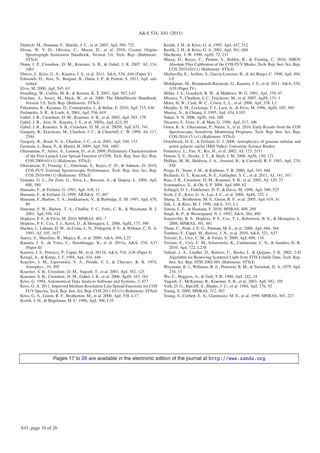
N v, Si iv) require only a moderately broad component. The only
other visible narrow line in the far-UV spectral range is a He ii
λ1640 line. The panels in Fig. 4 show the full emission model
overplotted on the COS spectrum of Mrk 509 and the individual
emission components for the regions surrounding the Lyα, N v,
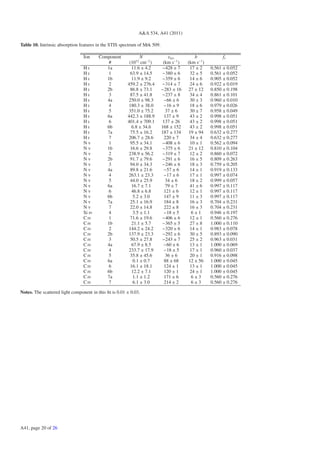
and C iv emission lines. Tables 3–6 give the best fitting param-
eters for the fitted emission lines in the COS, STIS, and FUSE
spectra. We note that the narrow-line components are weak, and
they are poorly constrained. They do improve the fit, but since
they have such a small contribution to the unabsorbed spectrum,
they ultimately have little impact on the properties derived for
the absorption lines.

3.2. Foreground absorption features
Given our description of the emission lines and continuum in
our spectrum of Mrk 509, we now identify and fit all signifi-
cant absorption features in the observed spectrum. Most of these
features are foreground absorption due to our own interstellar
medium, and they will be discussed in detail by Pinto (in prep.).
We fit the galactic and intergalactic absorption features using a
Gaussian profile in optical depth. Many of the strongest inter-
stellar lines are blends of features at several different velocities.
Up to seven individual components are detected in some ISM
lines. In cases where we cannot definitively separate these com-
ponents, we fix their relative velocities at the mean of the ve-
locities observed in cleanly resolved components of other inter-
stellar lines. Our measured velocities and equivalent widths for
the identified features are given in Table 7. The tabulated error
bars are purely statistical. For the velocities, at a resolution of
15 km s−1 and S/N > 50, the statistical errors are expected to be
<1 km s−1 . In such cases, we have rounded the values up to 1.
    We also find three foreground absorption features that we
identify as Lyα absorption in the intergalactic medium as shown
in Table 8. One of these features was previously identified by
Penton et al. (2000). The second feature at 1221.08 Å is simi-
lar to this, but much weaker. The third feature at 1239.03 Å is
badly blended with foreground galactic N v λ1238. Given the
observed equivalent width of the red component of N v λ1242,
this blend is too strong to be simply foreground N v absorption.       Fig. 4. Fit to the broad lines and continuum of Mrk 509 (red line) is
We attribute the excess (and the slight velocity offset) to an in-      plotted on the observed spectrum (black). Green lines show the individ-
tergalactic Lyα absorber. We observe no other absorption lines         ual emission-line components in the fit. The blue line is the continuum.
in our spectrum associated with these foreground intergalactic         The first panel shows the Lyα and N v region. The second panel shows
systems.                                                               the C iv region.


3.3. The intrinsic absorption features
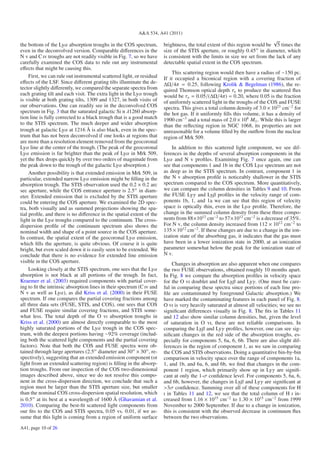
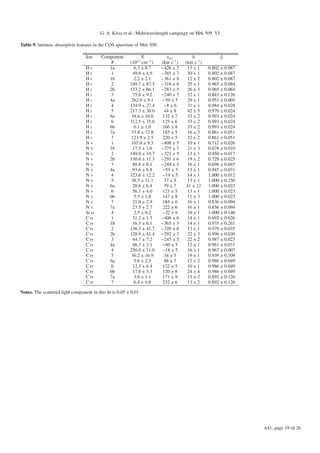
                                                                       resolve. Figure 5 shows the intrinsic absorption features detected
The COS spectrum of Mrk 509 shows a wealth of detail in the            in our COS spectrum as a function of velocity with the compo-
intrinsic absorption features. The seven major components orig-        nents labeled. For reference, we also include the O vi, Lyβ and
inally identified by Kriss et al. (2000) in the FUSE spectrum           Lyγ regions of the spectrum from the FUSE observation of Mrk
were expanded to eight by Kraemer et al. (2003) based on their         509 obtained in 2000. The numbering scheme follows that orig-
STIS spectrum. Our COS spectrum shows additional subtle in-            inated by Kriss et al. (2000), but includes the additional com-
flections indicating that the absorption troughs are a quite com-       ponent 4 added by Kraemer et al. (2003). However, instead of
plex blend of perhaps even more components than we can readily         continuing to designate additional components with a “prime”,
A41, page 6 of 26
G. A. Kriss et al.: Multiwavelength campaign on Mrk 509. VI.

Table 7. Interstellar absorption features                                  Table 7. continued.
in the COS spectrum of Mrk 509.
                                                                                        Feature      λ0       EW          VLSR
              Feature       λ0          EW          VLSR                                            (Å)      (mÅ)       (km s−1 )
                           (Å)         (mÅ)       (km s−1 )                             Ci        1328.83    27 ± 4      −1 ± 2
              Ci         1157.91       15 ± 3      −9 ± 1                               C ii      1334.53    76 ± 4    −293 ± 1
              S iii      1190.21     150 ± 18      +2 ± 1                               C ii      1334.53    23 ± 4    −223 ± 1
              Si ii      1190.42       75 ± 7     −48 ± 2                               C ii      1334.53    65 ± 4     −59 ± 1
              Si ii      1190.42     306 ± 13      +7 ± 1                               C ii      1334.53   496 ± 37    +11 ± 1
              Si ii      1190.42     360 ± 34     +65 ± 1                               C ii*     1335.50   444 ± 21   −144 ± 1
              Si ii      1190.42       11 ± 2     +143 ± 1                              C ii*     1335.50   150 ± 4     +49 ± 1
              Ci         1192.22       10 ± 2      −6 ± 1                               C ii*     1335.50   105 ± 4    +105 ± 1
              Si ii      1193.29       56 ± 4     −52 ± 1                               Ni ii     1317.22    33 ± 8      +3 ± 3
              Si ii      1193.29     329 ± 18     +11 ± 1                               Ni ii     1317.22    16 ± 3     +64 ± 1
              Si ii      1193.29     345 ± 28     +72 ± 1                               Ni ii     1370.13    41 ± 3      +4 ± 1
              Si ii      1193.29       12 ± 2     +132 ± 1                              Si iv     1393.76    95 ± 4    −298 ± 1
              Mn ii      1197.18       24 ± 3      +5 ± 1                               Si iv     1393.76    16 ± 3    −246 ± 1
              Mn ii      1199.39       45 ± 6      +3 ± 1                               Si iv     1393.76    19 ± 3     −63 ± 1
              Mn ii      1201.12       14 ± 2      +4 ± 1                               Si iv     1393.76   227 ± 14     +8 ± 2
              Ni         1199.55      193 ± 5      +9 ± 1                               Si iv     1393.76   165 ± 18    +64 ± 3
              Ni         1199.55      171 ± 4     +74 ± 1                               Si iv     1393.76     7±5      +131 ± 1
              Ni         1200.22      173 ± 5      +8 ± 1                               Si iv     1402.77    53 ± 3    −297 ± 1
              Ni         1200.22      149 ± 3     +70 ± 1                               Si iv     1402.77    11 ± 3    −275 ± 3
              Ni         1200.71      175 ± 5      +6 ± 1                               Si iv     1402.77     7±3       −64 ± 1
              Ni         1200.71      115 ± 3     +69 ± 1                               Si iv     1402.77   144 ± 7      +9 ± 1
              Si iii     1206.50      202 ± 4     −289 ± 1                              Si iv     1402.77   103 ± 8     +65 ± 2
              Si iii     1206.50       59 ± 3     −227 ± 1                              Si iv     1402.77     2±1      +131 ± 1
              Si iii     1206.50       11 ± 1     −63 ± 1                               Ni ii     1454.84    48 ± 5      −6 ± 1
              Si iii     1206.50     417 ± 37      +6 ± 1                               Si iva    1393.76    89 ± 4    −298 ± 1
              Si iii     1206.50     477 ± 84     +66 ± 1                               Si iv     1393.76    14 ± 3    −252 ± 3
              Si iii     1206.50       26 ± 2     +140 ± 1                              Si iv     1393.76    19 ± 3     −67 ± 1
              Nv         1238.82       11 ± 2     −292 ± 1                              Si iv     1393.76   223 ± 8      +4 ± 1
              Nv         1238.82       7±2        −236 ± 1                              Si iv     1393.76   160 ± 8     +60 ± 1
              Nv         1238.82       37 ± 2     +11 ± 1                               Si iv     1393.76    20 ± 4    +126 ± 1
              Nv         1238.82       10 ± 2     +69 ± 1                               Si iv     1402.77    65 ± 2    −297 ± 1
              Nv         1242.80       6±2        −294 ± 1                              Si iv     1402.77    14 ± 2    −250 ± 3
              Nv         1242.80       4±2        −238 ± 1                              Si iv     1402.77     7±2       −62 ± 1
              Nv         1242.80       19 ± 2     +10 ± 1                               Si iv     1402.77   157 ± 7      +9 ± 1
              Nv         1242.80       5±2        +68 ± 1                               Si iv     1402.77   116 ± 8     +69 ± 1
              Mg ii      1239.93       27 ± 2     +10 ± 1                               Si iv     1402.77     2±2      +131 ± 1
              Mg ii      1240.39       16 ± 2      +8 ± 1                               Ni ii     1454.84    24 ± 2      −2 ± 2
              S ii       1250.58      117 ± 3      +4 ± 1                               Ni ii     1454.84    11 ± 2     +56 ± 1
              S ii       1250.58       34 ± 2     +60 ± 1                               Si ii     1526.71    25 ± 2     −73 ± 1
              S ii       1253.81      138 ± 3      +8 ± 1                               Si ii     1526.71   408 ± 11     +0 ± 1
              S ii       1253.81       72 ± 1     +65 ± 1                               Si ii     1526.71   340 ± 11    +59 ± 1
              S ii       1259.52      151 ± 2      +4 ± 1                               C iv      1548.19   245 ± 5    −298 ± 1
              S ii       1259.52       85 ± 1     +64 ± 1                               C iv      1548.19    78 ± 5    −245 ± 1
              S ii       1259.52      153 ± 1      +4 ± 1                               C iv      1548.19    19 ± 3    −125 ± 3
              S ii       1259.52      86 ± 14     +64 ± 1                               C iv      1548.19    22 ± 4     −63 ± 1
              Si ii      1260.42       14 ± 2     −291 ± 1                              C iv      1548.19   336 ± 8      +8 ± 1
              Si ii      1260.42       6±3        −96 ± 1                               C iv      1548.19   293 ± 9     +66 ± 1
              Si ii      1260.42       51 ± 6     −61 ± 1                               C iv      1548.19    18 ± 4    +130 ± 1
              Si ii      1260.42     442 ± 15     +11 ± 1                               C iv      1550.77   170 ± 4    −298 ± 1
              Si ii      1260.42     341 ± 11     +75 ± 1                               C iv      1550.77    52 ± 4    −248 ± 1
              Si ii      1260.42       31 ± 4     +134 ± 1                              C iv      1550.77    1 ± 14    −269 ± 11
              Ci         1277.25      51 ± 32      +5 ± 1                               C iv      1550.77    10 ± 4     −64 ± 1
              P ii       1301.87       41 ± 3      +3 ± 1                               C iv      1550.77   251 ± 7      +5 ± 1
              Oi         1302.17       16 ± 6     −292 ± 1                              C iv      1550.77   178 ± 7     +65 ± 1
              Oi         1302.17       6±6        −97 ± 1                               C iv      1550.77    11 ± 4    +129 ± 1
              Oi         1302.17       2±6        −64 ± 1                               Ci        1560.31    45 ± 4      −2 ± 1
              Oi         1302.17      307 ± 9      +7 ± 1                               Fe ii     1608.45    22 ± 2     −73 ± 1
              Oi         1302.17     277 ± 21     +74 ± 1                               Fe ii     1608.45   217 ± 5      +2 ± 1
              Oi         1302.17       6±5        +131 ± 1                              Fe ii     1608.45   204 ± 5     +59 ± 1
              Si ii      1304.37       16 ± 6     −290 ± 1                              Fe ii     1608.45    19 ± 3     +91 ± 1
              Si ii      1304.37       6±6        −95 ± 1                               Fe ii     1611.20    36 ± 4      +2 ± 2
              Si ii      1304.37       8±6        −39 ± 13                              Ci        1656.93    72 ± 5      −3 ± 1
              Si ii      1304.37     284 ± 11      +9 ± 1                               Ci        1656.93    15 ± 3     +59 ± 1
              Si ii      1304.37     251 ± 10     +66 ± 1                               Al ii     1670.79    33 ± 3     −64 ± 8
              Si ii      1304.37       15 ± 6     +133 ± 1                              Al ii     1670.79   420 ± 30     +3 ± 1


                                                                                                                            A41, page 7 of 26
A&A 534, A41 (2011)

Table 7. continued.

             Feature       λ0          EW         VLSR
                          (Å)         (mÅ)      (km s−1 )
             Al ii      1670.79     379 ± 28    +56 ± 2
             Al ii      1670.79       23 ± 5    +121 ± 4
             Ni ii      1709.60      63 ± 12    +11 ± 4
             Ni ii      1709.60       28 ± 6    +69 ± 4
             Ni ii      1741.55      50 ± 10     +8 ± 6
             Ni ii      1741.55       20 ± 9    +66 ± 6
             Ni ii      1751.91      36 ± 13     +3 ± 5
             Ni ii      1751.91      17 ± 10    +61 ± 5

Notes. a The prior entries for Si iv λλ1393,1402 and Ni ii λ1454 were
for features in the G130M spectrum. These subsequent entries are for
features detected in the G160M spectrum.

Table 8. Intergalactic absorption features
in the COS spectrum of Mrk 509.

             Feature       λ0         EW           v
                          (Å)        (mÅ)       (km s−1 )
             Hi         1215.67      31 ± 3    +1345 ± 2
             Hi         1215.67     200 ± 4    +2561 ± 1
             Hi         1215.67      72 ± 4    +5772 ± 2


we use designations of “a” or “b” for the additional features, with
the convention that an “a” subcomponent is blueshifted from the
main feature, and a “b” subcomponent is redshifted. Component
4 in Kraemer et al. (2003) becomes 4a here.
                                                                        Fig. 5. Intrinsic absorption features in the COS and FUSE spectra of
    To fit these features with a simple Gaussian decomposition           Mrk 509. Normalized relative fluxes are plotted as a function of velocity
of the profiles as done by Kriss et al. (2000) clearly has limita-       relative to the systemic redshift of z = 0.034397. The top panel shows
tions built in by the choice of the number and placement of com-        the O vi doublet from the FUSE observation in 2000 September with
ponents. Given the complexity of the absorption troughs, a more         the red side of the doublet as a red line and the blue side of the doublet
model-independent approach is preferred. Several previous stud-         as a blue line. The middle four panels show the N v, C iv, Si iv and
ies of AGN outflows have used absorption-line doublets to mea-           Lyα absorption troughs from our COS observation. The bottom panel
sure the optical depth and covering fraction in discrete, velocity      shows the Lyγ (red) and Lyβ (black) absorption troughs from the FUSE
resolved bins (e.g., Hamann et al. 1997; Barlow & Sargent 1997;         observation. Dotted vertical lines indicate the velocities of identified
Arav et al. 1999; Ganguly et al. 1999; NGC 5548: Arav et al.            absorption components. The thin black vertical line shows v = 0.
2002; NGC 3783: Gabel et al. 2003; Mrk 279: Scott et al. 2004;
Gabel et al. 2005a). We will apply this method to our spectrum
of Mrk 509 in a subsequent publication (Arav et al., in prep.). In      residual light at the bottoms of our absorption troughs with a
this paper, however, we obtain a preliminary assessment of the          scattered component that is independent of wavelength provides
column densities and covering fractions of the intrinsic absorp-        a better match to the absorption profiles that we observe. For the
tion components by fitting the features with Gaussian profiles in         N v, Si iv, and C iv doublets, we link the relative wavelengths
optical depth. This enables a more straightforward comparison           at the ratio of their vacuum wavelengths, and we link the rela-
of our current results to the prior FUSE and STIS observations.         tive optical depths of the red and blue components at a value of
Our model also allows for partial covering by each component,           0.5. Since the Lyα absorption appears to be heavily saturated, as
as well as a scattered light component that is a wavelength-            noted previously by Kraemer et al. (2003), we fix the covering
independent fraction of the underlying emission components.             fraction for each of the Lyα components at the average of the
We note that in the case of a single absorbing region with a single     value determined for the corresponding components in the C iv
partial covering fraction (denoted fc ) that this is observationally    and N v profiles.
indistinguishable from having a scattered light component at a              Our best-fit results are given in Table 9. Note that for Si iv,
level of (1 − fc ). However, in the case where there is more than       as in Kraemer et al. (2003), we detect only component 4. Also,
one absorbing component that overlaps in velocity with another          as in Kraemer et al. (2003), no lower ionization lines (e.g., Si iii
absorbing component, there is a significant difference. Assuming          λ1206, Si ii λ1260, or C ii λ1335) are detected. As we noted
that the absorbers are statistically independent, in the region of      in Sect. 3.1, the narrow emission-line components in our emis-
velocity/wavelength space that they overlap, the transmission of        sion model have little impact on the measured properties of the
light from the source will be less than for either component indi-      absorption lines. Even if we eliminate the narrow-line emission
vidually, being the product (1 − fc1 )(1 − fc2 ). This produces extra   from our fits, the measured columns densities change by <1%.
dips in the modeled spectrum in the regions of overlap as illus-            Using the additional components that we have identified in
trated in Fig. 6. This is not a qualitatively accurate representation   our COS spectra, we have re-analyzed the archival FUSE and
of the profiles of the absorption troughs in our spectrum, which         STIS spectra of Mrk 509 in order to make a direct comparison
tend to show more smoothly varying profiles. Characterizing the          among the spectra. While Kriss et al. (2000) have done this for
A41, page 8 of 26
G. A. Kriss et al.: Multiwavelength campaign on Mrk 509. VI.


Fig. 6. Fit to a portion of the Lyα absorption trough in the COS spectrum
of Mrk 509. The data are shown by the solid black histogram. The red
dashed line shows the best fit model using the scattered-light/single par-
tial covering fraction described above for fc = 0.064. The black dashed
line shows the emission model for this region. The absorption in this
model due to components 4a (shown in green), 4 (shown in blue) and 5
(shown in green) are plotted individually. The solid red line shows the
resulting model if these absorbing components each have independent
partial covering factors fc,4a = fc,4 = fc,5 = 0.064. The dips in the re-
gion of overlap between each component are prominent at wavelengths
of ∼1257.3 Å and 1257.6 Å.
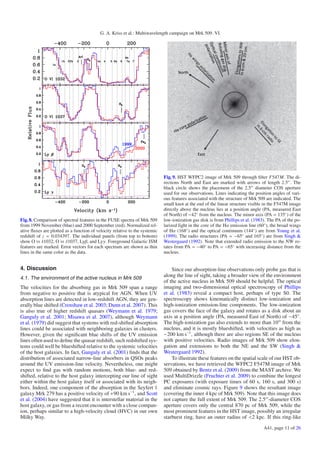
                                                                            Fig. 7. Comparison of spectral features in the COS (black) and STIS
                                                                            (red) spectra of Mrk 509. Normalized relative fluxes are plotted as a
                                                                            function of velocity relative to the systemic redshift of z = 0.034397.
                                                                            The individual panels (from top to bottom) show Lyα, N v λ1238, N v
the first FUSE observation, similar measurements for the sec-                λ1242, C iv λ1548, and C iv λ1550.
ond observation are useful since they illustrate how the absorbers
may change in response to changes in the continuum strength.
    Our results from fitting the STIS spectrum are given in                  address the probable presence of multiple phases of gas at each
Table 10. The column densities for the individual compo-                    velocity in the intrinsic absorption troughs.
nents agree well (and within the errors) with those measured by
Kraemer et al. (2003) except for the blended components com-
                                                                            3.4. Comparison among the COS, STIS, and FUSE spectra
prising features 2 and 3, and 6 and 7. The apportionment among
the various subcomponents accounts for these differences in our              As one can see from the fits to the continua of each of the
fit. We also find a higher column density in the strongest fea-               observations, we have sampled the emission from Mrk 509
ture, number 4, largely because our width for that component is             over a range of about a factor of two in overall luminos-
narrower than that measured by Kraemer et al. (2003).                       ity. The FUSE observation in September 2000 represents the
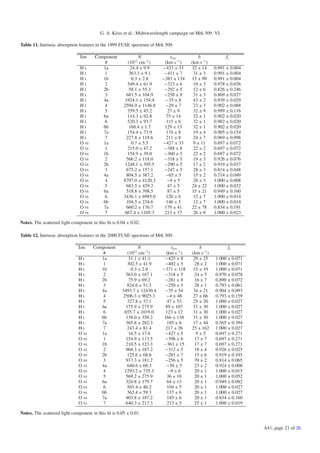
    Results from fits to Lyβ, Lyγ and O vi in the 1999 FUSE                  faintest state (0.42 × 10⁻¹³ erg cm−2 s−1 Å−1 at 1175 Å), and
spectrum are in Table 11, and results for the 2000 FUSE obser-              the COS observation reported here is the brightest (0.92 ×
vation are in Table 12. Since the Lyα absorption trough in Mrk              10−13 erg cm−2 s−1 Å−1 ).
509 is heavily saturated, the higher-order Lyman lines with good                 Our COS spectrum of Mrk 509 captures the active nucleus
S/N in the FUSE spectrum are particularly useful in deriving re-            in a significantly brighter state compared to STIS. Overall, the
liable column densities and covering factors for H i. However,              continuum is ∼80% brighter. Despite the difference in bright-
given potential variability, these values must be used with cau-            ness, the continuum shape does not noticeably change between
tion when combined with the data from our COS observations.                 the STIS and the COS observation. The broad emission lines
    In carrying out our fits we found that the well defined fea-              are also brighter, but not by as much – only 37%. Despite the
tures in N v and C iv in the COS spectrum did not always match              difference in the continuum level, there are only subtle differ-
well with the absorption profiles in Lyα and in O vi. One can                ences in the absorption-line troughs. The much higher S/N in
see this in Fig. 5, where the Lyα and O vi profiles vary more                our COS spectrum reveals some interesting differences from the
smoothly. For our best-fit results in Tables 9−12, one can see               original STIS spectrum. We show this by comparing the de-
that some components, such as 1a, are significant only in Lyα,               convolved COS absorption-line profiles to the STIS profiles in
while others, such as 1b, are strongest in O vi. There are also             Fig. 7. The biggest differences are in the Lyα absorption profile.
small velocity shifts for other components when comparing N v               Significantly less absorption is present in the most-blue-shifted
and C iv to Lyα and O vi. This illustrates the limitations of our           portions of the trough (essentially components 1–1b). The most
Gaussian decomposition, and in Sect. 4.2 of the Discussion we               striking difference, however, is the extra light that seems to fill
                                                                                                                                 A41, page 9 of 26
A&A 534, A41 (2011)
                                                                                                                            √
the bottom of the Lyα absorption troughs in the COS spectrum,           brightness, the total extent of this region would be 5 times the
even in the deconvolved version. Comparable differences in the           size of the STIS aperture, or roughly 0.45 in diameter, which
N v and C iv troughs are not readily visible in Fig. 7, so we have      is consistent with the limits in size we set from the lack of any
carefully examined the COS data to rule out any instrumental            detectable spatial extent in the COS spectrum.
effects that might be causing this.
                                                                            This scattering region would then have a radius of ∼150 pc.
     First, we can rule out instrumental scattered light, or residual   If it occupied a biconical region with a covering fraction of
effects of the LSF. Since different grating tilts illuminate the de-      ΔΩ/4π = 0.25, following Krolik & Begelman (1986), the re-
tector slightly differently, we compared the separate spectra from       quired Thomson optical depth τe to produce the scattered flux
each grating tilt and each visit. The extra light in the Lyα trough     would be τe = 0.05/(ΔΩ/4π) = 0.20, where 0.05 is the fraction
is visible at both grating tilts, 1309 and 1327, in both visits of      of uniformly scattered light in the troughs of the COS and FUSE
our observations. One can readily see in the deconvolved COS            spectra. This gives a total column density of 3.0 × 1023 cm−2 for
spectrum in Fig. 3 that the saturated galactic Si ii λ1260 absorp-      the hot gas. If it uniformly fills this volume, it has a density of
tion line is fully corrected to a black trough that is a good match     1900 cm−3 and a total mass of 2.0 × 10⁸ M . While this is larger
to the STIS spectrum. The much deeper and wider absorption              than the reflecting region in NGC 1068, its properties are not
trough at galactic Lyα at 1216 Å is also black, even in the spec-       unreasonable for a volume filled by the outflow from the nuclear
trum that has not been deconvolved if one looks at regions that         region of Mrk 509.
are more than a resolution element removed from the geocoronal
Lyα line at the center of the trough. (The peak of the geocoronal           In addition to this scattered light component, we see dif-
Lyα emission is far brighter than the peak of Lyα in Mrk 509,           ferences in the depths of several absorption components in the
yet the flux drops quickly by over two orders of magnitude from          Lyα and N v profiles. Examining Fig. 7 once again, one can
the peak down to the trough of the galactic Lyα absorption.)            see that components 1 and 1b in the COS Lyα spectrum are not
     Another possibility is that extended emission in Mrk 509, in       as deep as in the STIS spectrum. In contrast, component 1 in
particular, extended narrow Lyα emission might be filling in the         the N v absorption profile is noticeably shallower in the STIS
absorption trough. The STIS observation used the 0.2 × 0.2 arc          spectrum compared to the COS spectrum. More quantitatively,
sec aperture, while the COS entrance aperture is 2.5 in diam-           we can compare the column densities in Tables 9 and 10. From
eter. Extended emission that is excluded by the STIS aperture           the FUSE Lyγ and Lyβ profiles in the velocity range of com-
could be entering the COS aperture. We examined the 2D spec-            ponents 1b, 1, and 1a we can see that this region of velocity
tra, both visually and as summed projections showing the spa-           space is optically thin, even in the Lyα profile. Therefore, the
tial profile, and there is no difference in the spatial extent of the     change in the summed column density from these three compo-
light in the Lyα troughs compared to the continuum. The cross-          nents from 88×1012 cm−2 to 57×1012 cm−2 is a decrease of 35%.
dispersion profile of the continuum spectrum also shows the              For N v, the column density increased from 112 × 1012 cm−2 to
nominal width and shape of a point source in the COS aperture.          135 × 1012 cm−2 . If these changes are due to a change in the ion-
In contrast, the spatial extent of the geocoronal Lyα emission,         ization state of the absorbing gas, it indicates that the gas must
which fills the aperture, is quite obvious. Of course it is quite        have been in a lower ionization state in 2000, at an ionization
bright, but even scaled down it is easily seen to be extended. We       parameter somewhat below the peak for the ionization state of
conclude that there is no evidence for extended line emission           N v.
visible in the COS aperture.                                                Changes in absorption are also apparent when one compares
     Looking closely at the STIS spectrum, one sees that the Lyα        the two FUSE observations, obtained roughly 10 months apart.
absorption is not black at all portions of the trough. In fact,         In Fig. 8 we compare the absorption profiles in velocity space
Kraemer et al. (2003) required components with partial cover-           for the O vi doublet and for Lyβ and Lyγ. (One must be care-
ing to fit the intrinsic absorption lines in their spectrum (C iv and    ful in comparing these spectra since portions of each line pro-
N v as well as Lyα), as did Kriss et al. (2000) in their FUSE           file are contaminated by foreground Galactic absorption.) We
spectrum. If one compares the partial covering fractions among          have marked the contaminating features in each panel of Fig. 8.
all three data sets (FUSE, STIS, and COS), one sees that COS            O vi is very heavily saturated at almost all velocities; we see no
and FUSE require similar covering fractions, and STIS some-             significant differences visually in Fig. 8. The fits in Tables 11
what less. The total depth of the O vi absorption troughs in            and 12 also show similar column densities, but, given the level
Kriss et al. (2000) are almost directly comparable to the most          of saturation in O vi, these are not reliable comparisons. In
highly saturated portions of the Lyα trough in the COS spec-            comparing the Lyβ and Lyγ profiles, however, one can see sig-
trum, with the deepest portions having ∼92% coverage (includ-           nificant changes in the red side of the absorption troughs, es-
ing both the scattered light components and the partial covering        pecially for components 5, 6a, 6, 6b. There are also slight dif-
factors). Note that both the COS and FUSE spectra were ob-              ferences in the region of component 1, as we saw in comparing
tained through large apertures (2.5 diameter and 30 × 30 , re-          the COS and STIS observations. Doing a quantitative bin-by-bin
spectively), suggesting that an extended emission component (or         comparison in velocity space over the range of components 1a,
light from an extended scattering region) is filling in the absorp-      1, and 1b, and 6a, 6, and 6b, we find that changes in the com-
tion troughs. From our inspection of the COS two-dimensional            ponent 1 region, which primarily show up in Lyγ are signifi-
images described above, since we do not resolve this compo-             cant at only the 1-σ confidence level. For components 5, 6a, 6,
nent in the cross-dispersion direction, we conclude that such a         and 6b, however, the changes in Lyβ and Lyγ are significant at
region must be larger than the STIS aperture size, but smaller          >3σ confidence. Summing over all of these components for H
than the nominal COS cross-dispersion spatial resolution, which         i in Tables 11 and 12, we see that the total column of H i in-
is 0.5 at its best at a wavelength of 1600 Å (Ghavamian et al.          creased from 1.16 × 1015 cm−2 to 1.30 × 1015 cm−2 from 1999
2010). Comparing the best-fit scattered light components from            November to 2000 September. If due to a change in ionization,
our fits to the COS and STIS spectra, 0.05 vs. 0.01, if we as-           this is consistent with the observed decrease in continuum flux
sume that this light is coming from a region of uniform surface         between the two observations.
A41, page 10 of 26
G. A. Kriss et al.: Multiwavelength campaign on Mrk 509. VI.


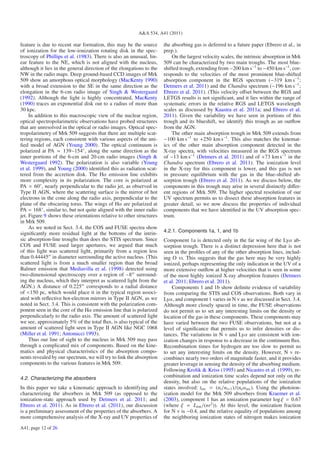
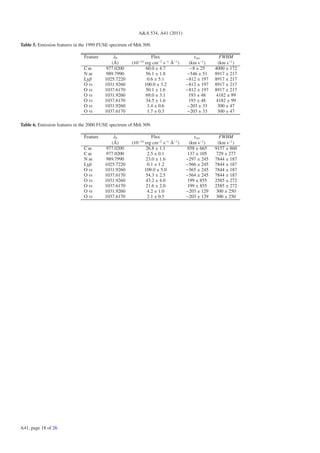
                                                                             Fig. 9. HST WFPC2 image of Mrk 509 through filter F547M. The di-
                                                                             rections North and East are marked with arrows of length 2.5 . The
                                                                             black circle shows the placement of the 2.5 diameter COS aperture
                                                                             used for our observations. Lines indicating the position angles of vari-
                                                                             ous features associated with the structure of Mrk 509 are indicated. The
                                                                             small knot at the end of the linear structure visible in the F547M image
                                                                             directly above the nucleus lies at a position angle (PA, measured East
                                                                             of North) of −42◦ from the nucleus. The minor axis (PA = 135◦ ) of the
Fig. 8. Comparison of spectral features in the FUSE spectra of Mrk 509       low-ionization gas disk is from Phillips et al. (1983). The PA of the po-
from 1999 November (blue) and 2000 September (red). Normalized rel-          larized light in the core of the Hα emission line (60◦ ), the broad wings
ative fluxes are plotted as a function of velocity relative to the systemic   of Hα (168◦ ) and the optical continuum (144◦ ) are from Young et al.
redshift of z = 0.034397. The individual panels (from top to bottom)         (1999). The radio structures (PA = −65◦ and 165◦ ) are from Singh &
show O vi λ1032, O vi λ1037, Lyβ, and Lyγ. Foreground Galactic ISM           Westergaard (1992). Note that extended radio emission to the NW ro-
features are marked. Error vectors for each spectrum are shown as thin       tates from PA = −40◦ to PA = −65◦ with increasing distance from the
lines in the same color as the data.                                         nucleus.


4. Discussion                                                                    Since our absorption-line observations only probe gas that is
4.1. The environment of the active nucleus in Mrk 509
                                                                             along the line of sight, taking a broader view of the environment
                                                                             of the active nucleus in Mrk 509 should be helpful. The optical
The velocities for the absorbing gas in Mrk 509 span a range                 imaging and two-dimensional optical spectroscopy of Phillips
from negative to positive that is atypical for AGN. When UV                  et al. (1983) reveal a compact host, perhaps of type S0. The
absorption lines are detected in low-redshift AGN, they are gen-             spectroscopy shows kinematically distinct low-ionization and
erally blue shifted (Crenshaw et al. 2003; Dunn et al. 2007). This           high-ionization emission-line components. The low-ionization
is also true of higher redshift quasars (Weymann et al. 1979;                gas covers the face of the galaxy and rotates as a disk about an
Ganguly et al. 2001; Misawa et al. 2007), although Weymann                   axis at a position angle (PA, measured East of North) of −45◦ .
et al. (1979) did suggest that systems with red-shifted absorption           The high-ionization gas also extends to more than 10 from the
lines could be associated with neighboring galaxies in clusters.             nucleus, and it is mostly blueshifted, with velocities as high as
However, given the significant blue shifts of the UV emission                 −200 km s−1 , although there are also regions SE of the nucleus
lines often used to define the quasar redshift, such redshifted sys-          with positive velocities. Radio images of Mrk 509 show elon-
tems could well be blueshifted relative to the systemic velocities           gation and extensions to both the NE and the SW (Singh &
of the host galaxies. In fact, Ganguly et al. (2001) finds that the           Westergaard 1992).
distribution of associated narrow-line absorbers in QSOs peaks                   To illustrate these features on the spatial scale of our HST ob-
around the UV emission-line velocity. Nevertheless, one might                servations, we have retrieved the WFPC2 F547M image of Mrk
expect to find gas with random motions, both blue- and red-                   509 obtained by Bentz et al. (2009) from the MAST archive. We
shifted, relative to the host galaxy intercepting our line of sight          used MultiDrizzle (Fruchter et al. 2009) to combine the longest
either within the host galaxy itself or associated with its neigh-           PC exposures (with exposure times of 60 s, 160 s, and 300 s)
bors. Indeed, one component of the absorption in the Seyfert 1               and eliminate cosmic rays. Figure 9 shows the resultant image
galaxy Mrk 279 has a positive velocity of +90 km s−1 , and Scott             (covering the inner 4 kpc of Mrk 509). Note that this image does
et al. (2004) have suggested that it is interstellar material in the         not capture the full extent of Mrk 509. The 2.5 -diameter COS
host galaxy, or gas from a recent encounter with a close compan-             aperture covers only the central 870 pc of Mrk 509, while the
ion, perhaps similar to a high-velocity cloud (HVC) in our own               most prominent features in the HST image, possibly an irregular
Milky Way.                                                                   starburst ring, have an outer radius of <2 kpc. If this ring-like
                                                                                                                                  A41, page 11 of 26
A&A 534, A41 (2011)

feature is due to recent star formation, this may be the source       the absorbing gas is deferred to a future paper (Ebrero et al., in
of ionization for the low-ionization rotating disk in the spec-       prep.).
troscopy of Phillips et al. (1983). There is also an unusual, lin-        On the largest velocity scales, the intrinsic absorption in Mrk
ear feature to the NE, which is not aligned with the nucleus,         509 can be characterized by two main troughs. The most blue-
although it lies in the general direction of the elongations to the   shifted trough, extending from −200 km s−1 to −450 km s−1 , cor-
NW in the radio maps. Deep ground-based CCD images of Mrk             responds to the velocities of the most prominent blue-shifted
509 show an amorphous optical morphology (MacKenty 1990)              absorption component in the RGS spectrum (−319 km s−1 ;
with a broad extension to the SE in the same direction as the         Detmers et al. 2011) and the Chandra spectrum (−196 km s−1 ;
elongation in the 6-cm radio image of Singh & Westergaard             Ebrero et al. 2011). (This velocity offset between the RGS and
(1992). Although the light is highly concentrated, MacKenty           LETGS results is not significant, and it lies within the range of
(1990) traces an exponential disk out to a radius of more than        systematic errors in the relative RGS and LETGS wavelength
30 kpc.                                                               scales as discussed by Kaastra et al. 2011a; and Ebrero et al.
     In addition to this macroscopic view of the nuclear region,      2011). Given the variability we have seen in portions of this
optical spectropolarimetric observations have probed structures       trough and its blueshift, we identify this trough as an outflow
that are unresolved in the optical or radio images. Optical spec-     from the AGN.
tropolarimetry of Mrk 509 suggests that there are multiple scat-          The other main absorption trough in Mrk 509 extends from
tering regions, each consistent with various aspects of the uni-      −100 km s−1 to +250 km s−1 . This also matches the kinemat-
fied model of AGN (Young 2000). The optical continuum is               ics of the other main absorption component detected in the
polarized at PA = 139−154◦ , along the same direction as the          X-ray spectra, with velocities measured in the RGS spectrum
inner portions of the 6-cm and 20-cm radio images (Singh &            of −13 km s−1 (Detmers et al. 2011) and of +73 km s−1 in the
Westergaard 1992). The polarization is also variable (Young           Chandra spectrum (Ebrero et al. 2011). The ionization level
et al. 1999), and Young (2000) identified this as radiation scat-      in the X-ray for this component is lower, and this gas is not
tered from the accretion disk. The Hα emission line exhibits          in pressure equilibrium with the gas in the blue-shifted ab-
more complexity in its polarization. The core is polarized at         sorption trough (Ebrero et al. 2011). As we discuss below, the
PA = 60◦ , nearly perpendicular to the radio jet, as observed in      components in this trough may arise in several distinctly differ-
Type II AGN, where the scattering surface is the mirror of hot        ent regions of Mrk 509. The higher spectral resolution of our
electrons in the cone along the radio axis, perpendicular to the      UV spectrum permits us to dissect these absorption features in
plane of the obscuring torus. The wings of Hα are polarized at        greater detail, so we now discuss the properties of individual
PA = 168◦, similar to, but not quite aligned with the inner radio     components that we have identified in the UV absorption spec-
jet. Figure 9 shows these orientations relative to other structures   trum.
in Mrk 509.
     As we noted in Sect. 3.4, the COS and FUSE spectra show
                                                                      4.2.1. Components 1a, 1, and 1b
significantly more residual light at the bottoms of the intrin-
sic absorption-line troughs than does the STIS spectrum. Since        Component 1a is detected only in the far wing of the Lyα ab-
COS and FUSE used larger apertures, we argued that much               sorption trough. There is a distinct depression here that is not
of this light was scattered light, primarily from a region less       seen in the profiles of any of the other absorption lines, includ-
than 0.44445 in diameter surrounding the active nucleus. (This        ing O vi. This suggests that the gas here may be very highly
scattered light is from a much smaller region than the broad          ionized, perhaps representing the only indication in the UV of a
Balmer emission that Mediavilla et al. (1998) detected using          more extensive outflow at higher velocities that is seen in some
two-dimensional spectroscopy over a region of ∼8 surround-            of the most highly ionized X-ray absorption features (Detmers
ing the nucleus, which they interpret as scattered light from the     et al. 2011; Ebrero et al. 2011).
AGN.) A distance of 0.225 corresponds to a radial distance                Components 1 and 1b show definite evidence of variability
of <150 pc, which would place it in the typical region associ-        from comparing the STIS and COS observations. Both vary in
ated with reflective hot-electron mirrors in Type II AGN, as we        Lyα, and component 1 varies in N v as we discussed in Sect. 3.4.
noted in Sect. 3.4. This is consistent with the polarization com-     Although more closely spaced in time, the FUSE observations
ponent seen in the core of the Hα emission line that is polarized     do not permit us to set any interesting limits on the density or
perpendicularly to the radio axis. The amount of scattered light      location of the gas in these components. These components may
we see, approximately 5% of the total flux, is also typical of the     have varied between the two FUSE observations, but not at a
amount of scattered light seen in Type II AGN like NGC 1068           level of significance that permits us to infer densities or dis-
(Miller et al. 1991; Antonucci 1993).                                 tances. The variations in N v and Lyα are consistent with ion-
     Thus our line of sight to the nucleus in Mrk 509 may pass        ization changes in response to a decrease in the continuum flux.
through a complicated mix of components. Based on the kine-           Recombination times for hydrogen are too slow to permit us
matics and physical characteristics of the absorption compo-          to set any interesting limits on the density. However, N v re-
nents revealed by our spectrum, we will try to link the absorption    combines nearly two orders of magnitude faster, and it provides
components to the various features in Mrk 509.                        greater leverage in sensing the density of the absorbing medium.
                                                                      Following Krolik & Kriss (1995) and Nicastro et al. (1999), re-
4.2. Characterizing the absorbers                                     combination and ionization time scales depend not only on the
                                                                      density, but also on the relative populations of the ionization
In this paper we take a kinematic approach to identifying and         states involved: trec = (ni /ni+1 )/(neαrec ). Using the photoion-
characterizing the absorbers in Mrk 509 (as opposed to the            ization model for the Mrk 509 absorbers from Kraemer et al.
ionization-state approach used by Detmers et al. 2011; and            (2003), component 1 has an ionization parameter log ξ = 0.67
Ebrero et al. 2011). As in Ebrero et al. (2011), our discussion       (where ξ = Lion /(nr2 )). At this level, the ionization fraction
is a preliminary assessment of the properties of the absorbers. A     for N v is ∼0.4, and the relative equality of populations among
more comprehensive analysis of the X-ray and UV properties of         the neighboring ionization states of nitrogen makes ionization
A41, page 12 of 26
G. A. Kriss et al.: Multiwavelength campaign on Mrk 509. VI.

and recombination timescales similar (Nicastro et al. 1999). For        4.2.5. Component 4
αrec = 8.96 × 10⁻¹² cm3 s−1 (Nahar 2006) at a temperature
of 20 000 K, and a time between the STIS and COS observa-               Perhaps the easiest component to characterize is #4. This ab-
tions of 2.733 × 10⁸ s, we get a lower limit on the density of          sorber has the lowest ionization state of any of the components. It
ne > 160 cm−3 . Since we are using the photoionization models           is the only one in which Si iv is detected, and it has the strongest
of Kraemer et al. (2003), we use an ionizing luminosity from            C iii absorption in the original FUSE spectrum of Kriss et al.
their SED in Yaqoob et al. (2003), Lion = 7.0 × 1044 erg s−1 .          (2000). Its velocity of ∼−22 km s−1 is the closest to our adopted
Together with the ionization parameter log ξ = 0.67, this gives         systemic redshift for Mrk 509. Given the high column densi-
an upper limit on the distance of r < 250 pc.                           ties, relatively low ionization state and velocity coincidence, it
                                                                        is likely that this component is the interstellar medium of the
    Component 1 is well defined in both N v and C iv, but in
                                                                        Mrk 509 host galaxy. Phillips et al. (1983) find a systemic veloc-
Lyα and O vi it is merely part of a smoothly varying trough that
                                                                        ity for the rotating low-ionization gas disk in their observations
runs from the deepest point in components 2 and 2b. As mod-
                                                                        that is in good agreement with the velocity of the [O iii] line-
eled by Kraemer et al. (2003) (who only used the STIS data),
                                                                        center velocity which they adopted as the systemic velocity of
this trough has only moderate ionization, probably even lower
                                                                        the host galaxy. To within their errors of ±30 km s−1 , all of these
than what they model since they grossly overpredict the amount
                                                                        velocities are consistent with the velocity we measure for com-
of O vi that should be present at this velocity. (Their trough at
                                                                        ponent 4. Kraemer et al. (2003) find that the broad range of UV
−420 km s−1 is three times deeper than the observed O vi λ1032
                                                                        ionization states present at this velocity requires more than one
absorption in the FUSE spectrum at this velocity.) In fact, as we
                                                                        component in a photoionization model solution. Component 4
discussed in Sect. 3.4, given the relative character of the variabil-
                                                                        has the closest match in velocity to component 1 identified in the
ity in Lyα and N v, the ionization state of this feature is below
                                                                        RGS spectrum by Detmers et al. (2011). Within the errors of the
the peak in ionization for N v. Component 1b appears to have
                                                                        Chandra spectrum, Component 4 may also be associated with
higher ionization since it is strong in O vi but very indistinct in
                                                                        component 1 from the LETGS spectrum (Ebrero et al. 2011).
N v. Although moderately strong in Lyα, it is also weaker than
                                                                        Given its low ionization parameter, Ebrero et al. (2011) suggest
component 1. If either of these components are associated with
                                                                        that this X-ray absorption may be associated with the ISM or
the X-ray portion of the outflow (which they do not match in
                                                                        halo of the host galaxy of Mrk 509.
detail kinematically), they are likely to be higher-density, lower-
ionization clumps embedded in a more tenuous, highly ionized
outflow.                                                                 4.2.6. Component 5
                                                                        Component 5 is similar in character to Component 4, but it has
4.2.2. Components 2 and 2b                                              lower overall column density and slightly higher ionization. Its
                                                                        slightly positive velocity is a good match to component 1 in the
Components 2 and 2b represent the deepest portions of the               LETGS spectrum. Highly ionized gas at this velocity is also seen
blue half of the absorption trough in the Mrk 509 spectrum.             in the three-dimensional spectroscopy of Phillips et al. (1983),
Kinematically, these components are the closest match to one            and it is within the velocity profile of the echelle spectrum of
of the major components detected in the X-ray spectrum of               [O iii] in the nuclear region of Mrk 509. It appears to have varied
Mrk 509. In the XMM-Newton/RGS spectrum, component 2 of                 in strength in H i between the two FUSE observations. As it is
Detmers et al. (2011) is almost an exact match in velocity to UV        difficult to disentangle this component’s variations from those of
component 2 (−319 km s−1 vs. −321 km s−1 , respectively). The           components 6a, 6, and 6b, we discuss the implications of this
ionization state of the gas detected in the UV absorption lines,        variation in the next subsection.
however, is not particularly high, and its total column density is
less than that seen in the X-ray. Again, this may be an example of
a higher-density, lower-ionization clump embedded in the more           4.2.7. Components 6a, 6, and 6b
highly ionized outflow seen in the X-ray.
                                                                        Although component 6 has a positive velocity, this does not pre-
                                                                        clude it from an association with the active nucleus in Mrk 509.
4.2.3. Component 3                                                      In fact, if one examines the [O iii] echelle spectrum of the nu-
                                                                        clear region in Mrk 509 in Fig. 3 of Phillips et al. (1983), one
Component 3 is the closest match in velocity to Component 2             can see that the actual peak of the line is at a positive velocity
of the Chandra LETGS spectrum (Ebrero et al. 2011), but in              of +120 km s−1 , matching our velocity for absorption in com-
the UV it too has rather low ionization, similar in character to        ponent 6. The kinematics of X-ray-heated winds modeled by
UV component 1. As with the previous components, this gas de-           Balsara & Krolik (1993) shows that portions of the flow that are
tected in the UV is likely to be a higher-density clump embedded        evaporated off the inner edge of the obscuring torus can be cap-
in more highly ionized outflowing gas.                                   tured by the central black hole. This results in streamlines with
                                                                        positive, inflow velocities.
4.2.4. Component 4a                                                         The variability in H i absorption we see over the 10 months
                                                                        between the two FUSE observations suggests a close relation-
Component 4a, first identified by Kraemer et al. (2003), shows            ship to the active nucleus for components 5 and 6, and, as for
up most clearly in N v and C iv. In velocity it is close to compo-      Component 1, it allows us to set an upper limit on the distance
nent 1 identified in the RGS spectrum by Detmers et al. (2011).          of this gas from the central engine. From 1999 November to
Its modest outflow velocity could suggest an association with            2000 September, over an interval of 303 days, the continuum
the base of the outflowing wind in Mrk 509. However, like all            flux from Mrk 509 dropped by 30%, and the hydrogen column
the components above, it is rather low in ionization, and its col-      density in components 5 and 6 increased by 14%, as we showed
umn density is lower than that seen in the X-ray absorber. It is        in Sect. 3.4. This gives us an upper limit on the recombination
probably not directly associated with the X-ray absorbing gas.          time for the gas, and hence a lower limit on the density. Again
                                                                                                                         A41, page 13 of 26
A&A 534, A41 (2011)

using the photoionization model from Kraemer et al. (2003),             4.2.9. Smoothly distributed gas in the outflow
component 6 has an ionization parameter log ξ = 0.71, and an
ionization fraction for hydrogen of 2.3×10⁻⁵. For a time interval       While we have characterized the absorption features in Mrk 509
between the two FUSE observations of 2.62 × 10⁷ s, and αrec =           in terms of discrete kinematic components, the smoothly vary-
1.43 × 10⁻¹³ cm3 s−1 (Osterbrock & Ferland 2006) at a tempera-          ing profiles of the Lyα and O vi absorption in the blue-shifted
ture of 20 000 K, we get a limit on the density of ne > 6.0 cm−3 .      outflow trough (see Fig. 5) suggest that additional gas may be
The ionizing luminosity of Lion = 7.0×1044 erg s−1 together with        present that is smoothly distributed over a range in velocities.
the ionization parameter log ξ = 0.71, gives an upper limit on the      The tail to higher velocities observed as component 1a in Lyα
distance of r < 1.5 kpc. So, component 6 is definitely within the        may be a part of this distribution. If this smoothly distributed
confines of the host galaxy, and likely in the near vicinity of the      gas is very highly ionized, one might expect that the only traces
nucleus.                                                                remaining in the UV absorption spectrum would be the most
                                                                        highly ionized species, like O vi, or the most abundant ones, like
                                                                        H i. This more smoothly distributed, highly ionized gas could be
                                                                        the counterpart of the features detected in the RGS and LETGS
4.2.8. Components 7a and 7                                              X-ray spectra.
                                                                            The discrete UV absorption components we have identified
Component 7 at +219 km s−1 , from its velocity, is not outflow-          show up most clearly in N v and C iv. As noted in Sect. 3.3,
ing, but infalling to Mrk 509. Component 7a is strongly blended         these often do not precisely align with similar features in O vi
with #7 in O vi and Lyα; it only shows up as a kinematically            and Lyα. For example, in the region surrounding component 1b,
independent feature in N v. Neither component shows any sig-            there is little C iv and N v absorption, but moderate depth in O vi
nificant variability either between the two FUSE observations            and the hydrogen lines, although it is a local minimum in H i.
in 1999 and 2000, or between the longer interval between STIS           The lower ionization, more discrete components we observe in
and COS from 2001 to 2009. Given that it is optically thin in           N v and C iv could be dense, lower-ionization clumps embedded
N v, C iv, and Lyα, this lack of variability is not being masked        in this flow, or clouds in the interstellar medium of Mrk 509 that
by saturation effects that limit our ability to see variations in        are being entrained in the flow. As shown by Ebrero et al. (2011),
other components. Based on just the qualitative appearance of           these lower-ionization components are not in pressure equilib-
the UV spectra, this is the highest ionization parameter trough in      rium with the other X-ray absorbing components. Such discrete
the whole spectrum – O vi is very strong, N v is present, and C iv      clouds with similar kinematics are spatially resolved and ob-
is not detectable. The stacked RGS spectrum at these velocities         served in the nearest AGN, e.g., NGC 4151 (Das et al. 2005) and
(Detmers et al. 2011) does not reveal absorption in O vi Kα, al-        NGC 1068 (Das et al. 2006, 2007). This outflowing gas is also
though the upper limits are consistent with the FUSE spectrum.          visible in the three dimensional spectroscopy of Phillips et al.
So, even though the ionization level exhibited in the UV is high,       (1983).
it is still not as high as the blue-shifted trough in the X-ray spec-
trum. Kraemer et al. (2003) and Kriss et al. (2000) found their         4.3. Thermal winds vs. disk winds
highest ionization parameters for this component as well.
                                                                        Disk winds are a popular explanation for outflows from AGN
    We suggest that components 7 and 7a might be similar to             (Königl & Kartje 1994; Murray & Chiang 1995; Elvis 2000;
HVC complexes seen in our own galaxy, except that the ion-              Proga et al. 2000; Richards et al. 2011; Fukumura et al. 2010).
ization of these clouds in Mrk 509 would be completely domi-            For the high velocities observed in broad-absorption-line (BAL)
nated by the radiation from the active nucleus rather than the ex-      QSOs, an origin for the wind from the accretion disk deep in
tragalactic background radiation and starlight from the galaxy.         the potential well of the central black hole is a natural inference.
These clouds may be infalling extragalactic material, or they           For the low velocities we observe in Mrk 509, it is not so clear.
may be tidal material stripped from an encounter with a com-            Kraemer et al. (2003) summarizes the problems faced in trying
panion in the past. Although Mrk 509 does not have an obvious           to explain the outflow in Mrk 509 with a disk wind. Briefly, Mrk
interacting companion, its disturbed outer isophotes (MacKenty          509 is likely to be observed nearly face on to the accretion disk
1990) suggest there may have been an encounter in the more              based on the polarized flux in the broad wings of Hα that is po-
distant past. Thom et al. (2008) find that HVC Complex C                 larized parallel to the radio jet, suggesting an origin in scattering
in the Milky Way has an average density log n ∼ −2.5, di-               from the face of the accretion disk (Young et al. 1999; Young
mensions 3 × 15 kpc, a distance of 10 ± 2.5 kpc, and a to-              2000). Since disk winds roughly lie in the plane of the disk,
tal mass of 8.2+4.6 × 10⁶ M . If components 7 and 7a in
                  −2.6                                                  the flow would be predominantly perpendicular to our line of
Mrk 509 have roughly similar densities of n = 0.01 cm−3 ,               sight. This can explain the low velocities since most of the mo-
then we can use the photoionization results of Kraemer et al.           tion would be transverse to our line of sight, but it makes it dif-
(2003) to estimate their size and distance from the nucleus of          ficult to explain the near-unity covering factors of the absorbers
Mrk 509. Kraemer et al. (2003) give a total column density of           if the UV continuum is produced interior to the launch point of
NH = 4 × 1019 cm−2 for component 7, which implies a size                the wind.
(as a cube) of 1.3(0.01 cm−3 /n) kpc. For their quoted ioniza-               The modest velocities of hundreds of km s−1 we observe
tion parameter of log ξ = 1.33, and an ionizing luminosity of           here are more characteristic of thermal winds produced in the
Lion = 7.0 × 1044 erg s−1 , the distance from the center of Mrk         AGN environment. Irradiation of the obscuring torus in an
509 is 19 (0.01 cm−3 /n)0.5 kpc. This is just about right for a         AGN by the nuclear flux produces material that fills the cone
structure comparable to a Milky Way HVC. For a density this             above the torus and flows outward at velocities of hundreds
low and ionization this high, the recombination time for H i in         of km s−1 , typical of the sound speed in the gas (Balsara &
components 7a and 7 would be 80(0.01 cm−3 /n) years, so the             Krolik 1993; Krolik & Kriss 1995, 2001). The presence of some
lack of variability in our observations is consistent with this hy-     redshifted components is also consistent with portions of an
pothesis.                                                               X-ray-heated wind that are captured by the central black hole
A41, page 14 of 26
G. A. Kriss et al.: Multiwavelength campaign on Mrk 509. VI.

(Balsara & Krolik 1993). These winds are also expected to have              The velocities of the two main absorption troughs roughly
multiple phases of gas as the surface of the torus is ablated by the   correspond to the kinematics of the detected X-ray absorption.
radiation from the central engine (Krolik & Kriss 1995, 2001).         The UV absorption in Mrk 509 arises from a variety of sources.
The most highly ionized portions of this flow can produce the X-        The lowest-velocity absorption trough covers a velocity range of
ray absorption. The dense part of the wind near the base of the        −100 km s−1 to +250 km s−1 . The deepest portion of this trough
ionization cone may be the slightly extended scattering region         in the UV is at the systemic velocity of Mrk 509, and it has the
producing the extra flux we see in the bottoms of the absorption        lowest ionization. This is also true for the X-ray absorption. We
troughs and also produce the polarization seen in the core of the      attribute this portion of the absorption to the interstellar medium
Hα emission line. As we noted in the prior section, the lower-         or galactic halo of Mrk 509. The most redshifted portion of the
ionization UV absorption components could be denser clumps             trough has characteristics comparable to the high-velocity cloud
embedded in this flow. The extended high-ionization [O iii] emis-       Complex C in our own Milky Way (Thom et al. 2008). At a
sion outflowing from the nuclear region and studied by Phillips         density of 0.01 cm−3 (which we can only assume, not measure),
et al. (1983) could be analogous to the discrete clouds imaged         it would have a size of roughly 1.3 kpc at a distance of 19 kpc
with HST in nearby AGN that show similar kinematics.                   from the center of Mrk 509.
                                                                            The most blue-shifted absorption trough in Mrk 509 is an
5. Conclusions                                                         outflow from the active nucleus. The velocities in this trough of
                                                                       −200 km s−1 to −450 km s−1 correspond to the most highly ion-
We have presented HST/COS observations of the Seyfert                  ized portion of the X-ray absorbing gas (Detmers et al. 2011;
1 galaxy Mrk 509 obtained as part of an extensive multi-               Ebrero et al. 2011), and they overlap with the extended emis-
wavelength campaign (Kaastra et al. 2011b) on this galaxy              sion from high-ionization gas that covers the face of Mrk 509 in
in late 2009. Our UV spectra were obtained simultaneously              the three-dimensional spectroscopy of Phillips et al. (1983). The
with Chandra LETGS spectra (Ebrero et al. 2011). The                   outflow velocities, embedded clumps of lower ionization gas, the
campaign also included immediately prior observations with             presence of an extended scattering region, and the extended out-
XMM-Newton, Swift, and INTEGRAL. Our spectra cover the                 flowing emission seen in [O iii] (Phillips et al. 1983) are all con-
1155−1760 Å wavelength range at a resolution of ∼15 km s−1 ,           sistent with an origin in a multiphase thermal wind produced by
and they are the highest signal-to-noise observations to date of       the irradiation of an obscuring torus by the active nucleus.
the intrinsic absorption components of Mrk 509. This enables
us to trace additional complexity in the absorption troughs com-
pared to prior STIS observations (Kraemer et al. 2003). As part        Acknowledgements. This work was supported by NASA through grants for
of our analysis, we have also examined archival FUSE observa-          HST program number 12022 from the Space Telescope Science Institute,
tions, which provide additional information on variability char-       which is operated by the Association of Universities for Research in
                                                                       Astronomy, Incorporated, under NASA contract NAS5-26555, XMM-Newton
acteristics of the absorbers.                                          grant NNX09AR01G from Goddard Space Flight Center. SRON is supported fi-
     In our COS spectra we identify a total of 14 kinematic com-       nancially by NWO, the Netherlands Organization for Scientific Research. K.C.S.
ponents. Six of these are blends that represent subcomponents          acknowledges the support of Comité Mixto ESO – Gobierno de Chile. S.B. ac-
of previously known features. The most blueshifted portions of         knowledges financial support from contract ASI-INAF No. I/088/06/0. E.B. was
                                                                       supported by a grant from the Israel Science Foundation. P.o.P. acknowledges
the Lyα absorption trough (components 1 and 1b) show a signif-         financial support from the GDR PCHE in France and from the CNES French
icant decrease in column density compared to prior STIS ob-            national space agency. G.P. acknowledges support via an EU Marie Curie Intra-
servations. At the same time, component 1 in N v increased             European Fellowship under contract No. FP7-PEOPLE-2009-IEF-254279.
in strength compared to the STIS observations. Using recom-
bination timescale arguments, the variation in the N v column
density allows us to set a lower limit on the gas density of           References
>160 cm−3 , and an upper limit on the distance of <250 pc for this
most blue-shifted component. We also detect variability between        Ake, T., Massa, D., Beland, S., et al. 2010, in HST Calibration Workshop, ed. S.
                                                                          Deustua, & C. Oliveira (Baltimore: STScI), in press
the two FUSE observations from 1999 November (Kriss et al.             Aloisi, A., Bohlin, R., & Quijano, J. K. 2007, New On-Orbit Sensitivity
2000) to 2000 September in component 6 at a positive veloc-               Calibration for All STIS Echelle Modes, Tech. Rep. Inst. Sci. Rep. STIS
ity of +120 km s−1 , which corresponds to the peak of the [O iii]         2007-01 (Baltimore: STScI)
emission-line profile from the echelle spectrum of Phillips et al.      Antonucci, R. 1993, ARA&A, 31, 473
(1983). Based on the recombination time, we set a limit on the         Arav, N., Korista, K. T., de Kool, M., Junkkarinen, V. T., & Begelman, M. C.
                                                                          1999, ApJ, 516, 27
density of this component of >6 cm−3 , and set an upper limit on       Arav, N., Korista, K. T., & de Kool, M. 2002, ApJ, 566, 699
its distance from the nucleus at <1.5 kpc.                             Arav, N., Gabel, J. R., Korista, K. T., et al. 2007, ApJ, 658, 829
     The COS spectra also show greater residual light at the bot-      Balsara, D. S., & Krolik, J. H. 1993, ApJ, 402, 109
toms of the absorption troughs relative to the STIS spectrum.          Barai, P., Martel, H., & Germain, J. 2011, ApJ, 727, 54
                                                                       Barlow, T. A., & Sargent, W. L. W. 1997, AJ, 113, 136
The fraction of residual light seen in COS is comparable to            Barth, A. J., Martini, P., Nelson, C. H., & Ho, L. C. 2003, ApJ, 594, L95
that seen in the FUSE spectra. We attribute this residual light        Bentz, M. C., Peterson, B. M., Pogge, R. W., & Vestergaard, M. 2009, ApJ, 694,
to scattering from an extended region near the nucleus, which is          L166
consistent with the larger apertures used for the COS and FUSE         Cappi, M., Tombesi, F., Bianchi, S., et al. 2009, A&A, 504, 401
observations relative to the STIS spectrum. Analysis of the            Cardelli, J. A., Clayton, G. C., & Mathis, J. S. 1989, ApJ, 345, 245
                                                                       Cavaliere, A., Lapi, A., & Menci, N. 2002, ApJ, 581, L1
cross-dispersion profile in the COS spectrum limits the spatial         Costantini, E., Kaastra, J. S., Arav, N., et al. 2007, A&A, 461, 121
extent of this scattering region to <0.5 , or <170 pc. Scattering      Crenshaw, D. M., Kraemer, S. B., & George, I. M. 2003, ARA&A, 41, 117
from such a region would be consistent with electron scattering        Das, V., Crenshaw, D. M., Hutchings, J. B., et al. 2005, AJ, 130, 945
from the base of an ionization cone in Mrk 509, and it would           Das, V., Crenshaw, D. M., Kraemer, S. B., & Deo, R. P. 2006, AJ, 132, 620
                                                                       Das, V., Crenshaw, D. M., & Kraemer, S. B. 2007, ApJ, 656, 699
explain the polarization in the core of Hα (Young et al. 1999)         Detmers, R. G., Kaastra, J. S., Steenbrugge, K. C., et al. 2011, A&A, 534, A38
which is observed to be perpendicular to the radio jet (Singh &           (Paper III)
Westergaard 1992).                                                     Di Matteo, T., Springel, V., & Hernquist, L. 2005, Nature, 433, 604

                                                                                                                                 A41, page 15 of 26
A&A 534, A41 (2011)

Dietrich, M., Hamann, F., Shields, J. C., et al. 2003, ApJ, 589, 722                 Krolik, J. H., & Kriss, G. A. 1995, ApJ, 447, 512
Dixon, W. V. D., Oliveira, C., Massa, D., et al. 2010, Cosmic Origins                Krolik, J. H., & Kriss, G. A. 2001, ApJ, 561, 684
   Spectrograph Instrument Handbook, Version 3.0, Tech. Rep. (Baltimore:             MacKenty, J. W. 1990, ApJS, 72, 231
   STScI)                                                                            Massa, D., Keyes, C., Penton, S., Bohlin, R., & Froning, C. 2010, SMOV
Dunn, J. P., Crenshaw, D. M., Kraemer, S. B., & Gabel, J. R. 2007, AJ, 134,             Absolute Flux Calibration of the COS FUV Modes, Tech. Rep. Inst. Sci. Rep.
   1061                                                                                 COS 2010-02(v1) (Baltimore: STScI)
Ebrero, J., Kriss, G. A., Kaastra, J. S., et al. 2011, A&A, 534, A40 (Paper V)       Mediavilla, E., Arribas, S., Garcia-Lorenzo, B., & del Burgo, C. 1998, ApJ, 494,
Edmonds, D., Arav, N., Borguet, B., Dunn, J. P., & Penton, S. 2011, ApJ, sub-           L9
   mitted                                                                            Mehdipour, M., Branduardi-Raymont, G., Kaastra, J. S., et al. 2011, A&A, 534,
Elvis, M. 2000, ApJ, 545, 63                                                            A39 (Paper IV)
Freudling, W., Corbin, M. R., & Korista, K. T. 2003, ApJ, 587, L67                   Miller, J. S., Goodrich, R. W., & Mathews, W. G. 1991, ApJ, 378, 47
Fruchter, A., Sosey, M., Hack, W., et al. 2009, The MultiDrizzle Handbook,           Misawa, T., Charlton, J. C., Eracleous, M., et al. 2007, ApJS, 171, 1
   Version 3.0, Tech. Rep. (Baltimore: STScI)                                        Moos, H. W., Cash, W. C., Cowie, L. L., et al. 2000, ApJ, 538, L1
Fukumura, K., Kazanas, D., Contopoulos, I., & Behar, E. 2010, ApJ, 715, 636          Murphy, E. M., Lockman, F. J., Laor, A., & Elvis, M. 1996, ApJS, 105, 369
Furlanetto, S. R., & Loeb, A. 2001, ApJ, 556, 619                                    Murray, N., & Chiang, J. 1995, ApJ, 454, L105
Gabel, J. R., Crenshaw, D. M., Kraemer, S. B., et al. 2003, ApJ, 583, 178            Nahar, S. N. 2006, ApJS, 164, 280
Gabel, J. R., Arav, N., Kaastra, J. S., et al. 2005a, ApJ, 623, 85                   Nicastro, F., Fiore, F., & Matt, G. 1999, ApJ, 517, 108
Gabel, J. R., Kraemer, S. B., Crenshaw, D. M., et al. 2005b, ApJ, 631, 741           Osten, R. A., Ghavamian, P., Niemi, S., et al. 2010, Early Results from the COS
Ganguly, R., Eracleous, M., Charlton, J. C., & Churchill, C. W. 1999, AJ, 117,          Spectroscopic Sensitivity Monitoring Programs, Tech. Rep. Inst. Sci. Rep.
   2594                                                                                 COS 2010-15 (v1) (Baltimore: STScI)
Ganguly, R., Bond, N. A., Charlton, J. C., et al. 2001, ApJ, 549, 133                Osterbrock, D. E., & Ferland, G. J. 2006, Astrophysics of gaseous nebulae and
Germain, J., Barai, P., & Martel, H. 2009, ApJ, 704, 1002                               active galactic nuclei (Mill Valley: University Science Books)
Ghavamian, P., Aloisi, A., Lennon, D., et al. 2009, Preliminary Characterization     Pentericci, L., Fan, X., Rix, H., et al. 2002, AJ, 123, 2151
   of the Post-Launch Line Spread Function of COS, Tech. Rep. Inst. Sci. Rep.        Penton, S. V., Stocke, J. T., & Shull, J. M. 2000, ApJS, 130, 121
   COS 2009-01(v1) (Baltimore: STScI)                                                Phillips, M. M., Baldwin, J. A., Atwood, B., & Carswell, R. F. 1983, ApJ, 274,
Ghavamian, P., Froning, C., Osterman, S., Keyes, C. D., & Sahnow, D. 2010,              558
   COS FUV External Spectroscopic Performance, Tech. Rep. Inst. Sci. Rep.            Proga, D., Stone, J. M., & Kallman, T. R. 2000, ApJ, 543, 686
   COS 2010-09(v1) (Baltimore: STScI)                                                Richards, G. T., Kruczek, N. E., Gallagher, S. C., et al. 2011, AJ, 141, 167
Granato, G. L., De Zotti, G., Silva, L., Bressan, A., & Danese, L. 2004, ApJ,        Ruiz, J. R., Crenshaw, D. M., Kraemer, S. B., et al. 2005, AJ, 129, 73
   600, 580                                                                          Scannapieco, E., & Oh, S. P. 2004, ApJ, 608, 62
Hamann, F., & Ferland, G. 1993, ApJ, 418, 11                                         Schlegel, D. J., Finkbeiner, D. P., & Davis, M. 1998, ApJ, 500, 525
Hamann, F., & Ferland, G. 1999, ARA&A, 37, 487                                       Scott, J. E., Kriss, G. A., Lee, J. C., et al. 2004, ApJS, 152, 1
Hamann, F., Barlow, T. A., Junkkarinen, V., & Burbidge, E. M. 1997, ApJ, 478,        Shang, Z., Brotherton, M. S., Green, R. F., et al. 2005, ApJ, 619, 41
   80                                                                                Silk, J., & Rees, M. J. 1998, A&A, 331, L1
Hamann, F. W., Barlow, T. A., Chaffee, F. C., Foltz, C. B., & Weymann, R. J.          Simon, L. E., & Hamann, F. 2010, MNRAS, 409, 269
   2001, ApJ, 550, 142                                                               Singh, K. P., & Westergaard, N. J. 1992, A&A, 264, 489
Hopkins, P. F., & Elvis, M. 2010, MNRAS, 401, 7                                      Somerville, R. S., Hopkins, P. F., Cox, T. J., Robertson, B. E., & Hernquist, L.
Hopkins, P. F., Cox, T. J., Kereš, D., & Hernquist, L. 2008, ApJS, 175, 390             2008, MNRAS, 391, 481
Huchra, J., Latham, D. W., da Costa, L. N., Pellegrini, P. S., & Willmer, C. N. A.   Thom, C., Peek, J. E. G., Putman, M. E., et al. 2008, ApJ, 684, 364
   1993, AJ, 105, 1637                                                               Tombesi, F., Cappi, M., Reeves, J. N., et al. 2010, A&A, 521, A57
Juarez, Y., Maiolino, R., Mujica, R., et al. 2009, A&A, 494, L25                     Treister, E., Urry, C. M., & Virani, S. 2009, ApJ, 696, 110
Kaastra, J. S., de Vries, C., Steenbrugge, K., et al. 2011a, A&A, 534, A37           Treister, E., Urry, C. M., Schawinski, K., Cardamone, C. N., & Sanders, D. B.
   (Paper II)                                                                           2010, ApJ, 722, L238
Kaastra, J. S., Petrucci, P., Cappi, M., et al. 2011b, A&A, 534, A36 (Paper I)       Valenti, J. A., Lindler, D., Bowers, C., Busko, I., & Quijano, J. K. 2002, 2-D
Königl, A., & Kartje, J. F. 1994, ApJ, 434, 446                                         Algorithm for Removing Scattered Light from STIS Echelle Data, Tech. Rep.
Kopylov, I. M., Lipovetskii, V. A., Pronik, V. I., & Chuvaev, K. K. 1974,               Inst. Sci. Rep. STIS 2002-001 (Baltimore: STScI)
   Astrophys., 10, 305                                                               Weymann, R. J., Williams, R. E., Peterson, B. M., & Turnshek, D. A. 1979, ApJ,
Kraemer, S. B., Crenshaw, D. M., Yaqoob, T., et al. 2003, ApJ, 582, 125                 234, 33
Kraemer, S. B., Crenshaw, D. M., Gabel, J. R., et al. 2006, ApJS, 167, 161           Wu, C., Boggess, A., & Gull, T. R. 1980, ApJ, 242, 14
Kriss, G. 1994, Astronomical Data Analysis Software and Systems, 3, 437              Yaqoob, T., McKernan, B., Kraemer, S. B., et al. 2003, ApJ, 582, 105
Kriss, G. A. 2011, Improved Medium Resolution Line Spread Functions for COS          York, D. G., Ratcliff, S., Blades, J. C., et al. 1984, ApJ, 276, 92
   FUV Spectra, Tech. Rep. Inst. Sci. Rep. COS 2011-01(v1) (Baltimore: STScI)        Young, S. 2000, MNRAS, 312, 567
Kriss, G. A., Green, R. F., Brotherton, M., et al. 2000, ApJ, 538, L17               Young, S., Corbett, E. A., Giannuzzo, M. E., et al. 1999, MNRAS, 303, 227
Krolik, J. H., & Begelman, M. C. 1986, ApJ, 308, L55


                   Pages 17 to 26 are available in the electronic edition of the journal at http://www.aanda.org


A41, page 16 of 26
G. A. Kriss et al.: Multiwavelength campaign on Mrk 509. VI.

Table 3. Emission features in the COS spectrum of Mrk 509.

                                Feature            λ0                 Flux                 vsys        FWHM
                                                  (Å)      (10−14 erg cm−2 s−1 Å−1 )    (km s−1 )     (km s−1 )
                                Lyα            1215.670             9.1 ± 2.5           166 ± 31      300 ± 23
                                Lyα            1215.670            73.9 ± 2.5          −151 ± 15     1339 ± 33
                                Lyα            1215.670           410.0 ± 1.8          −235 ± 8      3039 ± 14
                                Lyα            1215.670           838.0 ± 1.8          −156 ± 7      9677 ± 26
                                Nv             1238.821            22.1 ± 0.6           205 ± 22     2164 ± 45
                                Nv             1242.804            11.1 ± 0.2           205 ± 22     2164 ± 45
                                Si ii          1260.420            65.3 ± 1.0          −707 ± 36     5652 ± 66
                                O i+Si ii       1303.57            31.5 ± 0.6           36 ± 33      3307 ± 90
                                C ii           1335.205             8.0 ± 1.5            8 ± 67      2176 ± 424
                                Si iv          1393.755            85.0 ± 0.2           492 ± 9      5084 ± 36
                                Si iv          1402.770            42.5 ± 0.1           491 ± 9      5084 ± 36
                                C iv           1548.195             4.2 ± 1.4          −204 ± 39      300 ± 39
                                C iv           1550.770             2.1 ± 0.3          −204 ± 39      300 ± 39
                                C iv           1548.195            78.5 ± 0.5          −206 ± 7      1974 ± 15
                                C iv           1550.770            39.3 ± 0.5          −206 ± 7      1974 ± 15
                                C iv           1548.195           199.0 ± 1.9          −206 ± 7      4233 ± 15
                                C iv           1550.770            99.3 ± 1.9          −206 ± 7      4233 ± 15
                                C iv           1549.050           461.0 ± 1.1           158 ± 10     10299 ± 56
                                N iv]          1486.496             7.0 ± 0.1          −33 ± 61      2181 ± 108
                                Si ii          1526.710            15.7 ± 1.3            2 ± 27      2181 ± 108
                                He ii          1640.480             8.5 ± 0.3          −113 ± 39     1153 ± 83
                                He ii          1640.480            55.4 ± 0.5          −199 ± 25     4065 ± 61
                                O iii]         1663.445            66.0 ± 1.6           83 ± 19      3900 ± 69

Table 4. Emission features in the STIS spectrum of Mrk 509.

                               Feature           λ0                   Flux                 vsys          FWHM
                                                (Å)        (10−14 erg cm−2 s−1 Å−1 )     (km s−1 )      (km s−1 )
                               Lyα           1215.6700              6.8 ± 5.5          166 ± 575        300 ± 3
                               Lyα           1215.6700            102.0 ± 0.9            85 ± 15       1712 ± 66
                               Lyα           1215.6700            350.0 ± 2.9           −290 ± 4       3483 ± 25
                               Lyα           1215.6700            531.0 ± 4.4           −11 ± 19      10752 ± 56
                               Nv            1238.8210             17.4 ± 0.3           371 ± 44       2089 ± 39
                               Nv            1242.8040              8.7 ± 0.2           371 ± 44       2089 ± 39
                               Si ii         1260.4200             36.1 ± 1.0          −921 ± 130     5928 ± 151
                               O i+Si ii     1303.5700             21.8 ± 2.5           189 ± 62       3115 ± 94
                               C ii          1335.2050              4.7 ± 2.4          106 ± 284      1555 ± 459
                               Si iv         1393.7550             54.9 ± 3.0          381 ± 194       4374 ± 97
                               Si iv         1402.7700             27.4 ± 1.5           382 ± 194      4374 ± 97
                               C iv          1548.1950              6.7 ± 1.8          −204 ± 151      300 ± 95
                               C iv          1550.7700              3.4 ± 0.9          −204 ± 151      300 ± 95
                               C iv          1548.1950             65.9 ± 3.6           −103 ± 7       2108 ± 30
                               C iv          1550.7700             33.0 ± 1.8           −103 ± 7       2108 ± 30
                               C iv          1548.1950            148.0 ± 2.0           −103 ± 7       4102 ± 93
                               C iv          1550.7700             74.1 ± 1.0           −103 ± 7       4102 ± 93
                               C iv          1549.0530            389.0 ± 1.5          −605 ± 10      9392 ± 156
                               N iv]         1486.4960             12.3 ± 0.6           262 ± 71       3795 ± 20
                               Si ii         1526.7070             15.8 ± 1.4          −175 ± 86       3795 ± 20
                               He ii         1640.4800              5.4 ± 0.8            38 ± 48       888 ± 135
                               He ii         1640.4800             39.5 ± 3.1          −636 ± 67      4824 ± 104


                                                                                                                    A41, page 17 of 26
A&A 534, A41 (2011)

Table 5. Emission features in the 1999 FUSE spectrum of Mrk 509.

                               Feature       λ0                  Flux                vsys          FWHM
                                            (Å)       (10−14 erg cm−2 s−1 Å−1 )    (km s−1 )      (km s−1 )
                               C iii     977.0200             60.0 ± 4.7           −8 ± 25      4000 ± 172
                               N iii     989.7990             56.1 ± 1.8          −546 ± 51     8917 ± 217
                               Lyβ       1025.7220             0.6 ± 5.1          −812 ± 197    8917 ± 217
                               O vi      1031.9260           100.0 ± 3.2          −812 ± 197    8917 ± 217
                               O vi      1037.6170            50.1 ± 1.6          −812 ± 197    8917 ± 217
                               O vi      1031.9260            69.0 ± 3.1           193 ± 48      4182 ± 99
                               O vi      1037.6170            34.5 ± 1.6           193 ± 48      4182 ± 99
                               O vi      1031.9260             3.4 ± 0.6          −203 ± 33      300 ± 47
                               O vi      1037.6170             1.7 ± 0.3          −203 ± 33      300 ± 47

Table 6. Emission features in the 2000 FUSE spectrum of Mrk 509.

                               Feature       λ0                  Flux                 vsys         FWHM
                                            (Å)       (10−14 erg cm−2 s−1 Å−1 )     (km s−1 )     (km s−1 )
                               C iii     977.0200             26.8 ± 1.1           858 ± 665    9157 ± 860
                               C iii     977.0200              2.5 ± 0.1           137 ± 105     729 ± 277
                               N iii     989.7990             23.0 ± 1.6          −297 ± 245    7844 ± 187
                               Lyβ       1025.7220             0.1 ± 1.2          −566 ± 245    7844 ± 187
                               O vi      1031.9260           109.0 ± 5.0          −565 ± 245    7844 ± 187
                               O vi      1037.6170            54.3 ± 2.5          −564 ± 245    7844 ± 187
                               O vi      1031.9260            43.2 ± 4.0           199 ± 855    2585 ± 272
                               O vi      1037.6170            21.6 ± 2.0          199 ± 855     2585 ± 272
                               O vi      1031.9260             4.2 ± 1.0          −203 ± 129     300 ± 250
                               O vi      1037.6170             2.1 ± 0.5          −203 ± 129     300 ± 250


A41, page 18 of 26
G. A. Kriss et al.: Multiwavelength campaign on Mrk 509. VI.

Table 9. Intrinsic absorption features in the COS spectrum of Mrk 509.

                                  Ion     Component            N            vsys        b             fc
                                             #           (1012 cm−2 )    (km s−1 )   (km s−1 )
                                  Hi         1a            6.3 ± 0.7     −426 ± 5     13 ± 1     0.802 ± 0.087
                                  Hi         1            49.8 ± 4.9     −385 ± 7     30 ± 1     0.802 ± 0.087
                                  Hi         1b            2.2 ± 2.1     −361 ± 8     12 ± 2     0.802 ± 0.087
                                  Hi         2           349.7 ± 87.5    −316 ± 6     25 ± 1     0.965 ± 0.084
                                  Hi         2b          133.2 ± 66.1    −283 ± 5     26 ± 3     0.965 ± 0.084
                                  Hi         3            75.6 ± 9.2     −240 ± 7     32 ± 1     0.843 ± 0.126
                                  Hi         4a           262.0 ± 9.1    −59 ± 5      29 ± 1     0.953 ± 0.005
                                  Hi         4           134.9 ± 27.4     −8 ± 6      31 ± 1     0.984 ± 0.028
                                  Hi         5           217.3 ± 30.0      44 ± 8     42 ± 5     0.970 ± 0.024
                                  Hi         6a           34.6 ± 10.0     132 ± 7     33 ± 2     0.993 ± 0.024
                                  Hi         6           312.5 ± 35.6     125 ± 6     33 ± 2     0.993 ± 0.024
                                  Hi         6b            0.1 ± 1.0      166 ± 8     33 ± 2     0.993 ± 0.024
                                  Hi         7a           53.8 ± 12.8     185 ± 5     16 ± 3     0.861 ± 0.051
                                  Hi         7            123.9 ± 2.5     220 ± 5     32 ± 2     0.861 ± 0.051
                                  Nv         1            107.0 ± 9.5    −408 ± 5     10 ± 1     0.712 ± 0.026
                                  Nv         1b           17.5 ± 1.6     −375 ± 7     21 ± 3     0.678 ± 0.010
                                  Nv         2           149.0 ± 10.7    −321 ± 5     13 ± 1     0.950 ± 0.017
                                  Nv         2b          130.6 ± 11.3    −291 ± 6     19 ± 2     0.729 ± 0.025
                                  Nv         3            88.6 ± 8.1     −244 ± 5     16 ± 1     0.698 ± 0.045
                                  Nv         4a           93.6 ± 6.8     −59 ± 5      13 ± 1     0.945 ± 0.031
                                  Nv         4           323.6 ± 12.2    −19 ± 5      14 ± 1     1.000 ± 0.012
                                  Nv         5            38.3 ± 11.1      37 ± 5     13 ± 1     1.000 ± 0.250
                                  Nv         6a           20.6 ± 6.4       79 ± 7    41 ± 12     1.000 ± 0.023
                                  Nv         6            56.1 ± 4.0      121 ± 5     13 ± 1     1.000 ± 0.023
                                  Nv         6b            5.5 ± 1.8      147 ± 8     11 ± 3     1.000 ± 0.023
                                  Nv         7            21.0 ± 2.9      184 ± 6     16 ± 1     0.836 ± 0.094
                                  Nv         7a           23.5 ± 2.7      222 ± 6     16 ± 1     0.836 ± 0.094
                                  Si iv      4             2.5 ± 0.2     −22 ± 6      10 ± 1     1.000 ± 0.146
                                  C iv       1            31.2 ± 1.5     −406 ± 6     14 ± 1     0.892 ± 0.026
                                  C iv       1b           16.3 ± 6.1     −365 ± 5     14 ± 1     0.935 ± 0.261
                                  C iv       2           136.3 ± 41.7    −320 ± 6     13 ± 1     0.979 ± 0.035
                                  C iv       2b          128.9 ± 41.4    −292 ± 7     22 ± 3     0.896 ± 0.030
                                  C iv       3            44.7 ± 7.2     −245 ± 5     22 ± 2     0.987 ± 0.023
                                  C iv       4a           66.3 ± 2.1     −60 ± 5      12 ± 1     0.961 ± 0.031
                                  C iv       4           250.0 ± 11.0    −18 ± 5      16 ± 1     0.967 ± 0.007
                                  C iv       5            36.2 ± 16.9      34 ± 5     19 ± 1     0.939 ± 0.109
                                  C iv       6a            5.6 ± 2.3       88 ± 7     12 ± 2     0.986 ± 0.049
                                  C iv       6            12.3 ± 6.4      122 ± 5     10 ± 1     0.986 ± 0.049
                                  C iv       6b           17.6 ± 5.3      120 ± 8     24 ± 4     0.986 ± 0.049
                                  C iv       7a            3.6 ± 1.1      171 ± 9     13 ± 2     0.892 ± 0.126
                                  C iv       7             6.4 ± 0.8      232 ± 6     13 ± 2     0.892 ± 0.126

Notes. The scattered light component in this fit is 0.05 ± 0.01.


                                                                                                                 A41, page 19 of 26
A&A 534, A41 (2011)

Table 10. Intrinsic absorption features in the STIS spectrum of Mrk 509.

                                 Ion     Component             N               vsys        b             fc
                                             #           (1012 cm−2 )       (km s−1 )   (km s−1 )
                                 Hi         1a             11.6 ± 4.2      −428 ± 7      17 ± 2     0.561 ± 0.052
                                 Hi          1            63.9 ± 14.5      −380 ± 6      32 ± 5     0.561 ± 0.052
                                 Hi         1b             11.9 ± 9.2      −359 ± 6      14 ± 6     0.905 ± 0.052
                                 Hi          2          459.2 ± 276.4      −314 ± 7      24 ± 6     0.922 ± 0.019
                                 Hi         2b            86.8 ± 73.1      −283 ± 16    27 ± 12     0.850 ± 0.198
                                 Hi          3            87.5 ± 41.8      −237 ± 8      34 ± 4     0.861 ± 0.101
                                 Hi         4a          250.0 ± 98.3        −66 ± 6      30 ± 3     0.960 ± 0.010
                                 Hi          4          180.3 ± 38.0        −16 ± 9      18 ± 6     0.979 ± 0.026
                                 Hi          5          351.0 ± 75.2         37 ± 6      30 ± 7     0.958 ± 0.049
                                 Hi         6a          442.3 ± 188.9        137 ± 9     43 ± 2     0.998 ± 0.051
                                 Hi          6          401.4 ± 709.1       137 ± 26     43 ± 2     0.998 ± 0.051
                                 Hi         6b             6.8 ± 34.6      168 ± 152     43 ± 2     0.998 ± 0.051
                                 Hi         7a            75.5 ± 16.2      187 ± 134    19 ± 94     0.632 ± 0.277
                                 Hi          7          206.7 ± 28.6         220 ± 7     34 ± 4     0.632 ± 0.277
                                 Nv          1            95.5 ± 34.1      −408 ± 6      10 ± 1     0.562 ± 0.094
                                 Nv         1b            16.6 ± 29.8      −375 ± 6     21 ± 12     0.810 ± 0.104
                                 Nv          2          238.9 ± 56.2       −319 ± 7      12 ± 2     0.860 ± 0.072
                                 Nv         2b            91.7 ± 79.6      −291 ± 6      16 ± 5     0.809 ± 0.263
                                 Nv          3            94.0 ± 34.3      −246 ± 6      18 ± 3     0.759 ± 0.205
                                 Nv         4a            89.8 ± 21.6       −57 ± 6      14 ± 1     0.919 ± 0.133
                                 Nv          4          263.1 ± 23.3        −17 ± 6      17 ± 1     0.997 ± 0.074
                                 Nv          5            44.0 ± 25.9        34 ± 6      18 ± 2     0.999 ± 0.057
                                 Nv         6a             16.7 ± 7.1        79 ± 7      41 ± 6     0.997 ± 0.117
                                 Nv          6             46.8 ± 6.8        121 ± 6     12 ± 1     0.997 ± 0.117
                                 Nv         6b             5.2 ± 3.0         147 ± 9     11 ± 3     0.997 ± 0.117
                                 Nv         7a            25.1 ± 16.9        184 ± 8     16 ± 3     0.704 ± 0.231
                                 Nv          7            22.0 ± 14.8        222 ± 8     16 ± 3     0.704 ± 0.231
                                 Si iv       4             3.5 ± 1.1        −18 ± 5       6±1       0.946 ± 0.197
                                 C iv        1            71.6 ± 19.6      −406 ± 6      12 ± 1     0.560 ± 0.276
                                 C iv       1b             21.1 ± 5.7      −365 ± 5      27 ± 8     1.000 ± 0.110
                                 C iv        2          144.2 ± 24.2       −320 ± 6      14 ± 1     0.983 ± 0.078
                                 C iv       2b          137.9 ± 23.3       −292 ± 6      30 ± 5     0.893 ± 0.090
                                 C iv        3            50.5 ± 27.8      −243 ± 7      25 ± 2     0.963 ± 0.031
                                 C iv       4a             67.9 ± 8.5       −60 ± 6      13 ± 1     1.000 ± 0.069
                                 C iv        4          233.7 ± 17.9        −18 ± 5      17 ± 1     0.960 ± 0.037
                                 C iv        5            35.8 ± 45.6        36 ± 6      20 ± 1     0.916 ± 0.098
                                 C iv       6a             0.1 ± 0.7         88 ± 68    12 ± 56     1.000 ± 0.045
                                 C iv        6            16.1 ± 18.1        124 ± 1     13 ± 1     1.000 ± 0.045
                                 C iv       6b             12.2 ± 7.1        120 ± 1     24 ± 1     1.000 ± 0.045
                                 C iv       7a             1.1 ± 1.2         171 ± 6      6±3       0.560 ± 0.276
                                 C iv        7             6.1 ± 3.0         214 ± 2      6±3       0.560 ± 0.276

Notes. The scattered light component in this fit is 0.01 ± 0.03.


A41, page 20 of 26
G. A. Kriss et al.: Multiwavelength campaign on Mrk 509. VI.

Table 11. Intrinsic absorption features in the 1999 FUSE spectrum of Mrk 509.

                               Ion     Component               N            vsys           b             fc
                                           #             (1012 cm−2 )    (km s−1 )     (km s−1 )
                               Hi         1a               24.4 ± 9.9   −433 ± 33      32 ± 14     0.991 ± 0.004
                               Hi          1              363.3 ± 9.1    −411 ± 7       31 ± 3     0.991 ± 0.004
                               Hi         1b               0.3 ± 2.8    −383 ± 134     15 ± 99     0.991 ± 0.004
                               Hi          2            549.4 ± 61.9     −323 ± 6       19 ± 3     0.978 ± 0.036
                               Hi         2b              58.1 ± 55.3    −292 ± 5       12 ± 6     0.826 ± 0.246
                               Hi          3            681.5 ± 104.9    −258 ± 8       31 ± 3     0.869 ± 0.037
                               Hi         4a           1924.1 ± 154.4    −35 ± 8        43 ± 2     0.939 ± 0.029
                               Hi          4          2594.9 ± 1146.8    −29 ± 7        23 ± 3     0.902 ± 0.088
                               Hi          5            359.5 ± 45.2       27 ± 9       32 ± 9     0.999 ± 0.116
                               Hi         6a            114.3 ± 92.8      75 ± 14       32 ± 1     0.902 ± 0.020
                               Hi          6            520.3 ± 93.7      115 ± 6       32 ± 1     0.902 ± 0.020
                               Hi         6b              168.4 ± 1.7    129 ± 13       32 ± 1     0.902 ± 0.020
                               Hi         7a            154.4 ± 73.9      174 ± 8       19 ± 4     0.905 ± 0.154
                               Hi          7            227.8 ± 118.6     211 ± 8       24 ± 7     0.969 ± 0.098
                               O vi       1a               0.7 ± 5.5    −427 ± 33       9 ± 11     0.697 ± 0.072
                               O vi        1            215.0 ± 47.2     −388 ± 8       22 ± 2     0.697 ± 0.072
                               O vi       1b            154.9 ± 39.0     −360 ± 5       22 ± 2     0.697 ± 0.072
                               O vi        2            566.2 ± 118.0    −318 ± 5       19 ± 3     0.926 ± 0.076
                               O vi       2b           1248.1 ± 395.5    −290 ± 5       17 ± 2     0.919 ± 0.037
                               O vi        3            675.2 ± 157.1    −247 ± 5       28 ± 3     0.814 ± 0.048
                               O vi       4a            804.5 ± 387.2    −65 ± 5        15 ± 2     0.714 ± 0.049
                               O vi        4          8797.0 ± 4120.3     −9 ± 5        28 ± 3     1.000 ± 0.008
                               O vi        5            683.5 ± 429.3      47 ± 5      24 ± 22     1.000 ± 0.032
                               O vi       6a            518.8 ± 398.5      87 ± 5      15 ± 21     0.949 ± 0.160
                               O vi        6          3436.1 ± 6985.0     120 ± 6       12 ± 7     1.000 ± 0.014
                               O vi       6b            104.5 ± 234.6     146 ± 5       12 ± 7     1.000 ± 0.014
                               O vi       7a            660.2 ± 176.7    179 ± 41      22 ± 78     0.834 ± 0.191
                               O vi        7           667.4 ± 1105.3    213 ± 17       26 ± 8     1.000 ± 0.023

Notes. The scattered light component in this fit is 0.04 ± 0.02.

Table 12. Intrinsic absorption features in the 2000 FUSE spectrum of Mrk 509.

                              Ion     Component               N              vsys          b              fc
                                          #             (1012 cm−2 )      (km s−1 )    (km s−1 )
                              Hi         1a              31.1 ± 41.1      −425 ± 8     29 ± 25     1.000 ± 0.071
                              Hi          1             302.5 ± 41.9      −402 ± 5      28 ± 2     1.000 ± 0.071
                              Hi         1b               0.3 ± 2.8      −371 ± 118    15 ± 19     1.000 ± 0.071
                              Hi          2            563.0 ± 167.1      −318 ± 5      24 ± 5     0.970 ± 0.078
                              Hi         2b              75.9 ± 69.2      −281 ± 8      16 ± 7     0.890 ± 0.072
                              Hi          3             824.6 ± 51.5      −250 ± 5      28 ± 1     0.793 ± 0.061
                              Hi         4a          3493.7 ± 12430.4     −35 ± 54     34 ± 21     0.904 ± 0.093
                              Hi          4          2506.3 ± 9025.3      −4 ± 48      27 ± 66     0.793 ± 0.159
                              Hi          5             327.8 ± 37.1       47 ± 53     25 ± 20     1.000 ± 0.027
                              Hi         6a            175.9 ± 275.9      89 ± 107     31 ± 30     1.000 ± 0.027
                              Hi          6           655.7 ± 1019.0      123 ± 12     31 ± 30     1.000 ± 0.027
                              Hi         6b            138.0 ± 358.2     166 ± 138     31 ± 30     1.000 ± 0.027
                              Hi         7a            365.8 ± 282.3       185 ± 6     17 ± 44     0.565 ± 0.394
                              Hi          7             243.4 ± 81.4      217 ± 26     25 ± 162    1.000 ± 0.027
                              O vi       1a              16.5 ± 17.6      −427 ± 5       9±5       0.697 ± 0.271
                              O vi        1            154.9 ± 113.5      −396 ± 6      17 ± 7     0.697 ± 0.271
                              O vi       1b            210.5 ± 123.3     −363 ± 15      17 ± 7     0.697 ± 0.271
                              O vi        2            968.3 ± 187.2      −312 ± 5      18 ± 4     0.926 ± 0.025
                              O vi       2b             125.6 ± 68.6      −281 ± 7      15 ± 6     0.919 ± 0.103
                              O vi        3            917.3 ± 181.2      −256 ± 5      39 ± 2     0.814 ± 0.065
                              O vi       4a             640.6 ± 68.3      −56 ± 5       23 ± 2     0.924 ± 0.008
                              O vi        4           1293.2 ± 735.3       −9 ± 6       20 ± 1     1.000 ± 0.015
                              O vi        5            569.2 ± 275.9       36 ± 10      20 ± 1     1.000 ± 0.052
                              O vi       6a            324.8 ± 179.7       64 ± 13      20 ± 1     0.949 ± 0.082
                              O vi        6             565.4 ± 46.2       104 ± 5      20 ± 1     1.000 ± 0.027
                              O vi       6b             362.4 ± 59.3       137 ± 6      20 ± 1     1.000 ± 0.027
                              O vi       7a            403.8 ± 187.2       185 ± 6      20 ± 1     0.834 ± 0.160
                              O vi        7            640.3 ± 217.3       213 ± 5      25 ± 1     1.000 ± 0.019

Notes. The scattered light component in this fit is 0.05 ± 0.01.


                                                                                                                   A41, page 21 of 26
A&A 534, A41 (2011)

Appendix A:
Figure A.1, presents the full-resolution COS spectrum of Mrk 509 along with identifications of each of the absorption features
observed.


Fig. A.1. Full resolution, calibrated and merged COS spectrum of Mrk 509. Each absorption feature is marked. Absorption troughs identified
as being part of the intrinsic outflow observed in Mrk 509 are marked by dashed blue lines. Kinematic components deduced from the N v and
C iv doublets are displayed in the upper part of each figure along with the name of the respective spectral line. Absorption features identified as
associated with the interstellar medium (ISM) in our own Galaxy or in the intergalactic medium (IGM) are marked by dashed green lines. For the
ISM lines, the pattern of the strongest four kinematic components deduced from the ISM C iv doublet is displayed in the lower part of the figure.
The naming convention adopted for the spectral lines is the following: ion(Elow )λ0 , where “ion” is the name of the ion, “Elow ”, the lower energy
level of the considered transition, and “λ0 ” is the rest wavelength of the transition. The length of the red line indicates the strength of the plotted
line (log( fosc ), where fosc is the oscillator strength) with a scale indicated by the horizontal red dashed lines. IGM Lyα absorption lines are labeled
in the “ISM/IGM” section using the label “Lyα IGM”. Known flat-field problems are flagged with the label “FF" or “FF?”.


A41, page 22 of 26
G. A. Kriss et al.: Multiwavelength campaign on Mrk 509. VI.


Fig. A.1. continued.


                                                                                      A41, page 23 of 26
A&A 534, A41 (2011)


Fig. A.1. continued.


A41, page 24 of 26
G. A. Kriss et al.: Multiwavelength campaign on Mrk 509. VI.


Fig. A.1. continued.


                                                                                      A41, page 25 of 26
A&A 534, A41 (2011)


Fig. A.1. continued.


A41, page 26 of 26

Aa17123 11

  • 1.
    A&A 534, A41(2011) Astronomy DOI: 10.1051/0004-6361/201117123 & c ESO 2011 Astrophysics Multiwavelength campaign on Mrk 509 , VI. HST/COS observations of the far-ultraviolet spectrum G. A. Kriss1,2 , N. Arav3 , J. S. Kaastra4,5 , J. Ebrero4 , C. Pinto4 , B. Borguet3 , D. Edmonds3 , E. Costantini4 , K. C. Steenbrugge6,7 , R. G. Detmers4,5 , E. Behar8 , S. Bianchi9 , A. J. Blustin10 , G. Branduardi-Raymont11 , M. Cappi12 , M. Mehdipour11 , P. Petrucci13 , and G. Ponti14 1 Space Telescope Science Institute, 3700 San Martin Drive, Baltimore, MD 21218, USA e-mail: gak@stsci.edu 2 Department of Physics & Astronomy, The Johns Hopkins University, Baltimore, MD 21218, USA 3 Department of Physics, Virginia Tech, Blacksburg, VA 24061, USA 4 SRON Netherlands Institute for Space Research, Sorbonnelaan 2, 3584 CA Utrecht, The Netherlands 5 Astronomical Institute, University of Utrecht, Postbus 80000, 3508 TA Utrecht, The Netherlands 6 Instituto de Astronomía, Universidad Católica del Norte, Avenida Angamos 0610, Casilla 1280, Antofagasta, Chile 7 Department of Physics, University of Oxford, Keble Road, Oxford OX1 3RH, UK 8 Department of Physics, Technion, Haifa 32000, Israel 9 Dipartimento di Fisica, Universita degli Studi Roma Tre, via della Vasca Navale 84, 00146 Roma, Italy 10 Institute of Astronomy, University of Cambridge, Madingley Road, Cambridge CB3 0HA, UK 11 Mullard Space Science Laboratory, University College London, Holmbury St. Mary, Dorking, Surrey, RH5 6NT, UK 12 INAF-IASF Bologna, via Gobetti 101, 40129 Bologna, Italy 13 UJF-Grenoble 1/CNRS-INSU, Institut de Planétologie et d’Astrophysique de Grenoble (IPAG) UMR 5274, 38041 Grenoble, France 14 School of Physics and Astronomy, University of Southampton, Highfield, Southampton SO17 1BJ, UK Received 21 April 2011 / Accepted 26 May 2011 ABSTRACT We present medium-resolution (λ/Δλ ∼ 20 000) ultraviolet spectra covering the 1155−1760 Å spectral range of the Seyfert 1 galaxy Mrk 509 obtained using the Cosmic Origins Spectrograph (COS) on the Hubble Space Telescope (HST). Our observations were obtained simultaneously with a Low Energy Transmission Grating Spectrometer observation using the Chandra X-ray Observatory, and they are part of a multiwavelength campaign in September through December 2009 which also included observations with XMM-Newton, Swift, and INTEGRAL. Our spectra are the highest signal-to-noise observations to date of the intrinsic absorption components seen in numerous prior ultraviolet observations. To take advantage of the high S/N, we describe special calibrations for wavelength, flat-field and line-spread function corrections that we applied to the COS data. We detect additional complexity in the absorption troughs compared to prior observations made with the Space Telescope Imaging Spectrograph (STIS) on HST. We attribute the UV absorption to a variety of sources in Mrk 509, including an outflow from the active nucleus, the interstellar medium and halo of the host galaxy, and possible infalling clouds or stripped gaseous material from a merger that are illuminated by the ionizing radiation of the active nucleus. Variability between the STIS and COS observation of the most blue-shifted component (#1) allows us to set an upper limit on its distance of <250 pc. Similarly, variability of component 6 between FUSE observations limits its distance to <1.5 kpc. The absorption lines in all components only partially cover the emission from the active nucleus with covering fractions that are lower than those seen in the prior STIS observations and are comparable to those seen in spectra from the Far Ultraviolet Spectroscopic Explorer (FUSE). Given the larger apertures of COS and FUSE compared to STIS, we favor scattered light from an extended region near the active nucleus as the explanation for the partial covering. As observed in prior X-ray and UV spectra, the UV absorption has velocities comparable to the X-ray absorption, but the bulk of the ultraviolet absorption is in a lower ionization state with lower total column density than the gas responsible for the X-ray absorption. We conclude that the outflow from the active nucleus is a multiphase wind. Key words. galaxies: active – galaxies: individual: Mrk 509 – quasars: absorption lines – galaxies: Seyfert – ultraviolet: galaxies – X-rays: galaxies 1. Introduction Outflows from galaxies powered by an active galactic nucleus Based on observations made with the NASA/ESA Hubble Space Telescope, obtained at the Space Telescope Science Institute, which is (AGN) may play an important role in the chemical enrichment of operated by the Association of Universities for Research in Astronomy, the intergalactic medium (IGM). The most distant AGN known, Inc., under NASA contract NAS 5-26555. These observations are asso- quasars at redshifts of 6 or more, have abundances at solar or ciated with program # 12022. super-solar levels (Hamann & Ferland 1993, 1999; Pentericci Tables 3–7, 9–12, and Appendix are available in electronic form via et al. 2002; Barth et al. 2003; Dietrich et al. 2003; Freudling et al. http://www.aanda.org 2003; Juarez et al. 2009). Although the chemical enrichment of Article published by EDP Sciences A41, page 1 of 26
  • 2.
    A&A 534, A41(2011) the host likely predates the presence of the active nucleus (Simon in the X-ray, although both the X-ray and UV absorption do & Hamann 2010), winds powered by the AGN could return this overlap in velocity. metal-enriched material to the IGM (Furlanetto & Loeb 2001; Our newer observations using the Cosmic Origins Cavaliere et al. 2002; Germain et al. 2009; Hopkins & Elvis Spectrograph (COS) on HST achieve higher S/Ns (S/N) 2010; Barai et al. 2011). Their presence and feedback may also and provide insight into long-term changes in the absorbing gas. have a significant impact on the evolution of their host galaxies Our COS spectra provide a higher-resolution view of the veloc- (Silk & Rees 1998; Scannapieco & Oh 2004; Granato et al. 2004; ity structure in the outflowing gas, and sample lower ionization Di Matteo et al. 2005; Hopkins et al. 2008; Somerville et al. ionic species than are present in the X-ray spectra. At high 2008). While some fraction of these outflows in low-luminosity spectral resolution and high S/N, we can use velocity-resolved AGN may not escape their host galaxy, at least as measured spectral coverage of the N v and C iv doublets to solve for the in the local universe (Das et al. 2005, 2007; Ruiz et al. 2005), covering fractions and column densities in the outflowing gas the impact of the outflow on lower-density portions of the host (Arav et al. 2007). Using our COS observations of Lyα together interstellar medium (ISM) could provide a significant transport with the archival FUSE observations of the higher-order Lyman mechanism for the enrichment of the surrounding environment lines, we can provide an absolute reference for abundances (Hopkins & Elvis 2010). From constraints provided by the X-ray relative to hydrogen, which cannot be measured directly in the background, such lower luminosity AGN may dominate the pop- X-ray spectra. These higher S/N spectra combined with the ulation of active galaxies in the early universe (Treister et al. higher S/N X-ray spectra permit a more detailed examination of 2009, 2010). the links between the UV and the X-ray absorbing gas in the outflow. Nearby AGN provide local analogs that can help us to un- derstand the mechanics, energetics, and chemical enrichment This paper describes the COS observations that are part of patterns that may play a significant role in cosmic evolution at our multiwavelength campaign on Mrk 509, and presents an high redshift. More than half of low-redshift AGN exhibit blue- initial interpretation of the results. In Sect. 2 we describe our shifted UV or X-ray absorption features indicative of outflowing COS observations and our data reduction methods, including en- gas (Crenshaw et al. 2003; Dunn et al. 2007; Cappi et al. 2009; hanced calibrations for the COS data and corrections for the line- Tombesi et al. 2010). Understanding the geometry and the loca- spread function (LSF). In Sect. 3 we describe our analysis of the tion of the outflow relative to the active nucleus is a key to mak- UV spectra and compare them to prior STIS and FUSE obser- ing an accurate assessment of the total mass and the kinetic lu- vations of Mrk 509. Finally, in Sect. 4 we discuss the physical minosity of the outflow. Distance determinations are particularly implications of our observations for the geometry and location difficult. Using density-sensitive absorption lines to establish the of the absorbing gas in Mrk 509 and its physical conditions. We gas density, in combination with photoionization models that re- end with a summary of our conclusions in Sect. 5. produce the observed relative column densities can provide pre- cise distance estimates. These measures have ranged from tens of parsecs in NGC 3783 (Gabel et al. 2005b) and NGC 4151 2. Observations and data reduction (Kraemer et al. 2006, if one uses the correct critical density for As part of our extensive coordinated campaign on Mrk 509 C iii*), and up to kiloparsec scales in some quasars and AGN (Kaastra et al. 2011b), we observed Mrk 509 using the Far- (Hamann et al. 2001; Scott et al. 2004; Edmonds et al. 2011). UV Ultraviolet Channel and the medium-resolution gratings of the and X-ray observations of Mrk 279 (Scott et al. 2004; Arav et al. COS on the HST. Descriptions of COS and its on-orbit perfor- 2007; Costantini et al. 2007) measured absolute abundances in mance can be found in the COS Instrument Handbook (Dixon the outflow of a local AGN for the first time, and they show evi- et al. 2010). Our two visits on 2009 December 10 and 11 were si- dence for enhanced CNO abundances that suggest contributions multaneous with the Chandra observations described by Ebrero from massive stars and AGB stellar winds. et al. (2011). Using gratings G130M and G160M and observ- To improve upon these prior studies, we have conducted a ing through the Primary Science Aperture (PSA), we covered multiwavelength campaign of coordinated X-ray, UV, and opti- the far-ultraviolet spectral range from 1155 Å to 1760 Å. The cal observations of the nearby luminous Seyfert 1 galaxy Mrk instrument configurations, times of observation, and integration 509 (z = 0.034397; Huchra et al. 1993). A complete overview times are summarized in Table 1. For each grating, we used only of the campaign is given by Kaastra et al. (2011b). Mrk 509 is two tilts to avoid placing gaps in spectral ranges of interest sur- an ideal object for study due to its high flux, moderate lumi- rounding the strong emission and absorption features in Mrk nosity that rivals that of QSOs (Kopylov et al. 1974), and deep, 509. This resulted in almost complete spectral coverage except well structured absorption troughs. The blue-shifted absorption for a small gap from 1560−1590 Å. The two tilts and two ex- indicative of a nuclear outflow has been known since the earli- posures at each setting resulted in four independent placements est UV spectral observations (Wu et al. 1980; York et al. 1984). of the grid-wire shadows and other instrumental artifacts along The outflow is also apparent in the blueshifted [O iii] emission the spectrum. This enhanced our ability to flat field these high detected across the face of Mrk 509 by Phillips et al. (1983). S/N data. Exposure times were weighted more heavily in favor More recently Kriss et al. (2000) and Kraemer et al. (2003) ob- of grating G160M since Mrk 509 is fainter across this wave- served Mrk 509 at high spectral resolution in the UV with the length range, and the throughput of G160M is lower relative to Far Ultraviolet Spectroscopic Explorer (FUSE) and the Space G130M. This gives more uniform S/N across the full spectrum. Telescope Imaging Spectrograph (STIS) on the Hubble Space For G130M we obtained a total exposure time of 9470 s; for Telescope (HST), respectively. The STIS observations were si- G160M, the total exposure time was 16452 s. multaneous with earlier Chandra X-ray grating observations Our data were processed with the COS calibration pipeline (Yaqoob et al. 2003) that also detect blue-shifted X-ray absorp- v2.11b at STScI. This version of the pipeline does not correct for tion lines. These prior UV observations show the presence of flat-field features or the time-dependent sensitivity of COS, and more than seven distinct kinematic components, none of which there are still some residual anomalies in the wavelength cali- could be unambiguously associated with the absorption detected bration. To produce the best quality summed data set, we used A41, page 2 of 26
  • 3.
    G. A. Krisset al.: Multiwavelength campaign on Mrk 509. VI. Table 1. COS observations of Mrk 509. Data set name Grating/Tilt Date Start time Exposure time (GMT) (s) lbdh01010 G130M/1309 2009-12-10 02:48:40 1993 lbdh01020 G130M/1327 2009-12-10 04:07:03 2742 lbdh01030 G160M/1577 2009-12-10 05:42:57 5484 lbdh01040 G160M/1589 2009-12-10 08:54:42 2742 lbdh02010 G130M/1309 2009-12-11 02:46:46 1993 lbdh02020 G130M/1327 2009-12-11 04:05:12 2742 lbdh02030 G160M/1577 2009-12-11 05:41:05 2742 lbdh02040 G160M/1589 2009-12-11 07:16:57 5484 a customized series of procedures to make these corrections as intrinsic to Mrk 509 and in intervening material) more accurately described in the following sections. for comparison in velocity space, and for comparison to prior ob- servations with FUSE and STIS. There can also be residual zero- point shifts in the wavelength scale due to offsets from the aper- 2.1. Flat-field corrections ture center which may not have been fully removed in the target acquisition process. Therefore, we first adjusted the wavelength- To flat field the data and correct for instrumental artifacts, we scale zero points for our G130M and G160M spectra by cross used one-dimensional flat-field corrections developed from COS correlating them with the prior STIS observation of Mrk 509. observations of white dwarf standards (Ake et al. 2010). These flat fields correspond to each detector segment (A and B) for For G130M, we used the wavelength region from 1245−1290 Å, each grating (G130M and G160M) we used. The S/N in these which is dominated by the intrinsic absorption features from Lyα flat fields (in terms of purely Poisson-distributed noise) is com- and N v. For G160M, we used the region from 1590−1615 Å, parable to that in our data set. To reduce the impact of the added centered on the intrinsic absorption from C iv. The intrinsic ab- noise that would result from dividing by these data for our flat- sorption features provide numerous sharp edges that result in a field correction, we first smoothed the flat-fields. It may seem strong, narrow cross-correlation peak that enhances the precision counterintuitive to consider smoothing pixel-to-pixel flats when of the alignment. The resulting corrections were <0.1 Å. using them to correct for pattern noise and artifacts, but there For the next level of correction, we used the numerous in- are two fundamental reasons why this works. First, real artifacts terstellar absorption lines in our spectra that spanned the full and pattern noise are never sharper than the intrinsic resolution wavelength range. As the sight line to Mrk 509 is very complex, of the detector, which is approximately six pixels. Second, drifts each interstellar line typically has multiple components. The H I in the grating select mechanism, which are corrected during an 21-cm emission in this direction (Murphy et al. 1996) has a observation using the TAG-FLASH observing mode, effectively strong flux-weighted peak at +3.1 km s−1 in the local standard of smear the pattern noise. Since our observations were longer than rest (LSR), and a weaker, broader peak at ∼+65 km s−1 (LSR). any of the individual ones used to develop the one-dimensional The +3 km s−1 feature is present in all detected interstellar lines, flats, the smearing of the pattern noise is greater. Smoothing the and the +65 km s−1 one is present in the stronger lines. In addi- flats partially corrects for this smearing. After trying a variety tion, there are high-velocity features at −249 and −295 km s−1 of smoothing widths, we settled on smoothing the flats with a visible in the strongest lines and in the higher ionization species Gaussian profile having a 1-pixel dispersion. To align the flats like C iv. We measured the wavelengths of all these interstellar with the extracted 1D spectra from each exposure, we cross cor- features. The wavelength differences of our measurements rel- related the appropriate smoothed flat with the data, applied an ative to vacuum wavelengths show a systematic, nearly linear appropriate integer-pixel shift, and then divided it out. trend with wavelength across each detector segment that amount Once the data were flat-field corrected, we aligned the indi- to an offset of 0.06 Å from one end of each segment to the vidual exposures by first cross-correlating them with each other other. We take this as an indication that there is a slight error and applying the closest integer-pixel shift. While this process in the dispersion constant for the COS wavelength calibration. produced a tremendous improvement in the data, some residual To weight our correction by the strongest features, we used only features remained. We then examined each individual exposure, those corresponding to the +3 and +65 km s−1 components and comparing them with each other and with the flat field used to performed a linear fit to the wavelength offsets for each detec- correct them. Strong features in the flats that did not divide out tor segment. We then made a linear correction to the wavelength well were then flagged in the individual exposures so that they scale, with pivot points that have zero correction about 1260 Å could be excluded when we did the final combination. Our final and 1600 Å so that we keep our zero points aligned with the spectrum for each grating is the exposure-weighted combination STIS wavelength scale. After applying this correction, we then of the unflagged pixels in each of the individual flat-fielded and find a peak-to-peak variation among the velocity offsets of all aligned exposures. Although our data would support a S/N of the interstellar features of −10 to +8 km s−1 , with a dispersion of over 100 per pixel in the Poisson limit, we do not do much better 4.3 km s−1 . than 60:1 per pixel in our final spectrum. 2.3. Flux calibration 2.2. Wavelength calibration The sensitivity of COS has been slowly declining since its instal- While the nominal wavelength calibration of COS over most of lation (Osten et al. 2010). We have applied the time-dependent the spectral range has errors less than 15 km s−1 , this is not ad- sensitivity corrections to our data as given by Osten et al. (2010). equate for our analysis. We wish to align spectral features (both These corrections amount to an adjustment of only 2.5% at the A41, page 3 of 26
  • 4.
    A&A 534, A41(2011) Fig. 1. Calibrated and merged COS spectrum of Mrk 509. Prominent emission features are labeled above the spectrum. Regions of intrinsic absorption are indicated below the spectrum. Geocoronal emission in the center of the galactic Lyα absorption trough is indicated with an Earth symbol. short wavelength end of the G130M spectrum, and range up to aperture (Kraemer et al. 2003; Yaqoob et al. 2003, Proposal ID a correction of 5% at the long-wavelength end of G160M. We 8877, PI: Yaqoob). The spectrum we use is the one-dimensional estimate an absolute flux accuracy of 5% at wavelengths above extracted echelle spectrum direct from the MAST archive with 1220 Å, and 10% at shorter wavelengths (Massa et al. 2010). all up-to-date calibrations applied, including corrections for scat- We expect that relative fluxes are more precise. Our repeat ob- tered light in the echelle mode (Valenti et al. 2002) and for the servations in our two visits agree to better than 1%, and compar- echelle blaze corrections (Aloisi et al. 2007). The STIS spec- ison between the overlapping wavelength ranges of G130M and trum of Mrk 509 has a resolution about twice that of the COS G160M in our spectra show that they also agree to better than spectra, R = 46 000. This spectrum is particularly useful for as- 1%. sessing the true resolution of the COS spectrum, and the validity As an external comparison, and for cross-calibration pur- of deconvolutions that repair the broad wings of the COS LSF. poses with the other elements of our campaign, we compare To illustrate the dramatic improvement in the quality of our our spectrum to the Swift UVM2 data point from 2010 Dec COS data compared to the prior STIS observation, Fig. 2 shows 10. These data are in a broad band centered at 2231 Å, with a portion of both spectra in the region centered around the Lyα some contamination from broad C iii] emission (Mehdipour et al. absorption feature intrinsic to Mrk 509. One sees that Mrk 509 2011). To compare our COS spectrum to this point requires some was ∼60% brighter during our COS observation. In addition, the extrapolation. We take the 1140–8090 Å spectrum assembled by higher throughput of COS also improves our resulting S/N by a Shang et al. (2005) from FOS and KPNO 2.1-m spectra, and factor of ∼5. However, one can see that there are still instrumen- normalize this spectrum to the corrected Swift UVM2 contin- tal features that we must correct before doing a detailed analy- sis of the COS data. Deep, saturated absorption features in the uum flux at 2231 Å of 5.12 × 10⁻¹⁴ erg cm−2 s−1 Å−1 (Mehdipour STIS spectrum, especially the interstellar Si ii line at 1260.5 Å, et al. 2011). At wavelengths longer than 1220 Å, our COS spec- do not have square, black troughs in the COS spectrum. This tra agree with the FOS spectrum normalized to the corrected is due to the broad wings on the LSF (Ghavamian et al. 2009) Swift UVM2 flux to better than 4% at all wavelengths. Below that redistribute light from the bright continuum into cores of 1210 Å, our COS spectrum is brighter by up to 9% above the the absorption lines. To extract the maximum information from renormalized FOS spectrum. This could be a true difference in our spectrum, we must correct for these broad wings on the LSF. the spectrum, but it could also be an indication of our residual uncertainties in the flux calibration. In the latter case, we conser- vatively estimate that our absolute flux below 1220 Å is better 2.5. Deconvolving the COS spectrum than 10%. Figure 1 shows our calibrated and merged COS spectra. We The broad wings on the COS LSF are caused by mid-frequency have labeled the prominent emission features in the spectrum polishing errors on the HST primary & secondary mirrors as well as the regions containing the intrinsic absorption fea- (Ghavamian et al. 2009). Additional scattering by the HST mir- tures. The many galactic interstellar absorption lines in our spec- ror system and internal to COS makes these wings more exten- trum are not labeled here. In the appendix, Fig. A.1 shows full- sive than originally thought (Kriss 2011). These errors must be resolution plots of the COS spectrum of Mrk 509, and it can be removed in order to obtain accurate measurements of the depths found in the on-line version of the journal. of the absorption lines in the COS spectrum. On scales less than about 50 km s−1 , significant light can leak into the absorption line troughs from adjacent continuum regions. As a result, in- 2.4. STIS spectrum terstellar absorption lines expected to be saturated are not black. This is quite obvious when one compares the interstellar lines in The STIS spectrum is a 7,600 s observation obtained on 2001- the COS spectrum in Fig. 2 to the prior spectrum obtained with 04-13 using the echelle E140M grating and the 0.2 × 0.2 arcsec STIS. A41, page 4 of 26
  • 5.
    G. A. Krisset al.: Multiwavelength campaign on Mrk 509. VI. Fig. 2. COS spectrum of Mrk 509 in the Lyα region (black) compared Fig. 3. Comparison of the deconvolved COS spectrum in the spectral to the STIS spectrum (red). region surrounding the Lyα absorption trough (black) to the original COS spectrum (green) and the STIS spectrum (red). The high S/N of our data permits us to do a fairly good job of deconvolving the LSF from our data. We use the Lucy- renormalize all the fluxes to match channel LiF1A, which was Richardson algorithm to deconvolve the data as implemented in aligned with the fine guidance sensor for both observations. We the STSDAS routine “lucy” in the analysis.restore package. We correct for the “worm” in segment LiF2A by taking a ratio to the deconvolve the spectrum in 50 Å intervals using the updated ver- matching portion of the spectrum in LiF1B, fitting a spline, and sions of the wavelength-dependent LSFs from the COS web site applying that correction to LiF2A. We then combine all channels at STScI (Kriss 2011). The deconvolution converges well after in overlapping wavelength regions weighted by the S/N of the ∼20 iterations. A good illustration of the success of our deconvo- individual pixels. Although Mrk 509 was fainter in 2000 com- lution is provided by direct comparisons to the higher-resolution pared to the first observation, channel alignment was better, and STIS spectrum of Mrk 509. Figure 3 shows the normalized ver- the overall S/N is higher. Mrk 509 was fainter in both FUSE ob- sion of the original COS spectrum in the Lyα region, the decon- servations than in our current COS observation by 34% to 55%. volved spectrum, and the STIS spectrum, all plotted together. The deconvolution deepens the narrow interstellar absorption features so that they match the higher-resolution STIS spectra 3. Data analysis well. Broader, saturated interstellar lines like Si ii λ1260.5 have 3.1. Continuum and emission lines square, black bottoms. Overall, the deconvolved, high S/N COS spectrum looks like an excellent fit to the STIS spectrum. One Our first step in analyzing the absorption features in Mrk 509 disadvantage to the deconvolution, however, is that it amplifies is to fit the line and continuum emission. We use the spec- noise in the continuum. This can obscure weak absorption fea- fit task in the contrib package of IRAF for our fits (Kriss tures. Therefore, in our analysis we will adopt the approach of 1994). For the continuum, we use a reddened power law using the original spectrum to identify significant features, but (Fλ = F1000 (λ/1000 Å)−α ) with extinction of E(B − V) = use the deconvolved spectrum to make accurate measurements 0.057 (as obtained from NED via the prescription of Schlegel of the strength of known features so that the effects of the LSF et al. 1998) and variation with wavelength as specified by are fully corrected. Cardelli et al. (1989) with a ratio of selective to total extinc- tion of RV = 3.1. Our best-fit power law has Fλ = 2.48 × 10⁻¹³ (λ/1000 Å)−1.74 erg cm−2 s−1 Å−1 . A summary of the 2.6. FUSE spectra power law parameters and observed continuum fluxes at 1175 Å FUSE (Moos et al. 2000) observed Mrk 509 on two different oc- for the COS observation and the prior STIS and FUSE observa- casions during the mission. The first FUSE spectrum, obtained tions is given in Table 2. in two closely spaced observations on 1999-11-02 (19 355 s) and For the strongest emission lines, our model requires four 1999-11-06 (32 457 s), were analyzed and discussed by Kriss Gaussian components to give a good fit. For O vi, Lyα, and C iv, et al. (2000). The second FUSE visit (Observation ID P1080601) we use a broad base, two moderately broad components that was a 62 100 s observation obtained on 2000-09-05. We re- comprise most of the line profile, and a narrow-line compo- trieved these data from the MAST archive and reprocessed them nent of full-width half-maximum (FWHM) of 300 km s−1 fixed with a customized version of the FUSE pipeline, using only the to match the width of the narrow [O iii] emission in the visible night portions of the observation in order to minimize airglow spectrum (Phillips et al. 1983). For the O vi and C iv doublets, and background. Our version of the processing also lowers the we include a component for each line of the doublet with the background noise by screening out more of the lowest pulse relative wavelengths fixed at the ratio of the laboratory values, height channels. We cross correlate the overlapping wavelength and an optically thin, 2:1 ratio for the blue to the red flux com- sections of each channel to align the wavelength scales, and ponent of the doublet. Weaker lines in the spectrum (e.g., C iii, A41, page 5 of 26
  • 6.
    A&A 534, A41(2011) Table 2. Continuum fits to observations of Mrk 509. Observatory Date F1000 α F(1175 Å) (10−13 erg cm−2 s−1 Å−1 ) (10−13 erg cm−2 s−1 Å−1 ) FUSE 1999-11-06 1.58 0.41 0.607 FUSE 2000-09-05 0.88 1.16 0.416 HST/STIS 2001-04-13 1.44 1.74 0.538 HST/COS 2009-12-10 2.48 1.74 0.918 N v, Si iv) require only a moderately broad component. The only other visible narrow line in the far-UV spectral range is a He ii λ1640 line. The panels in Fig. 4 show the full emission model overplotted on the COS spectrum of Mrk 509 and the individual emission components for the regions surrounding the Lyα, N v, and C iv emission lines. Tables 3–6 give the best fitting param- eters for the fitted emission lines in the COS, STIS, and FUSE spectra. We note that the narrow-line components are weak, and they are poorly constrained. They do improve the fit, but since they have such a small contribution to the unabsorbed spectrum, they ultimately have little impact on the properties derived for the absorption lines. 3.2. Foreground absorption features Given our description of the emission lines and continuum in our spectrum of Mrk 509, we now identify and fit all signifi- cant absorption features in the observed spectrum. Most of these features are foreground absorption due to our own interstellar medium, and they will be discussed in detail by Pinto (in prep.). We fit the galactic and intergalactic absorption features using a Gaussian profile in optical depth. Many of the strongest inter- stellar lines are blends of features at several different velocities. Up to seven individual components are detected in some ISM lines. In cases where we cannot definitively separate these com- ponents, we fix their relative velocities at the mean of the ve- locities observed in cleanly resolved components of other inter- stellar lines. Our measured velocities and equivalent widths for the identified features are given in Table 7. The tabulated error bars are purely statistical. For the velocities, at a resolution of 15 km s−1 and S/N > 50, the statistical errors are expected to be <1 km s−1 . In such cases, we have rounded the values up to 1. We also find three foreground absorption features that we identify as Lyα absorption in the intergalactic medium as shown in Table 8. One of these features was previously identified by Penton et al. (2000). The second feature at 1221.08 Å is simi- lar to this, but much weaker. The third feature at 1239.03 Å is badly blended with foreground galactic N v λ1238. Given the observed equivalent width of the red component of N v λ1242, this blend is too strong to be simply foreground N v absorption. Fig. 4. Fit to the broad lines and continuum of Mrk 509 (red line) is We attribute the excess (and the slight velocity offset) to an in- plotted on the observed spectrum (black). Green lines show the individ- tergalactic Lyα absorber. We observe no other absorption lines ual emission-line components in the fit. The blue line is the continuum. in our spectrum associated with these foreground intergalactic The first panel shows the Lyα and N v region. The second panel shows systems. the C iv region. 3.3. The intrinsic absorption features resolve. Figure 5 shows the intrinsic absorption features detected The COS spectrum of Mrk 509 shows a wealth of detail in the in our COS spectrum as a function of velocity with the compo- intrinsic absorption features. The seven major components orig- nents labeled. For reference, we also include the O vi, Lyβ and inally identified by Kriss et al. (2000) in the FUSE spectrum Lyγ regions of the spectrum from the FUSE observation of Mrk were expanded to eight by Kraemer et al. (2003) based on their 509 obtained in 2000. The numbering scheme follows that orig- STIS spectrum. Our COS spectrum shows additional subtle in- inated by Kriss et al. (2000), but includes the additional com- flections indicating that the absorption troughs are a quite com- ponent 4 added by Kraemer et al. (2003). However, instead of plex blend of perhaps even more components than we can readily continuing to designate additional components with a “prime”, A41, page 6 of 26
  • 7.
    G. A. Krisset al.: Multiwavelength campaign on Mrk 509. VI. Table 7. Interstellar absorption features Table 7. continued. in the COS spectrum of Mrk 509. Feature λ0 EW VLSR Feature λ0 EW VLSR (Å) (mÅ) (km s−1 ) (Å) (mÅ) (km s−1 ) Ci 1328.83 27 ± 4 −1 ± 2 Ci 1157.91 15 ± 3 −9 ± 1 C ii 1334.53 76 ± 4 −293 ± 1 S iii 1190.21 150 ± 18 +2 ± 1 C ii 1334.53 23 ± 4 −223 ± 1 Si ii 1190.42 75 ± 7 −48 ± 2 C ii 1334.53 65 ± 4 −59 ± 1 Si ii 1190.42 306 ± 13 +7 ± 1 C ii 1334.53 496 ± 37 +11 ± 1 Si ii 1190.42 360 ± 34 +65 ± 1 C ii* 1335.50 444 ± 21 −144 ± 1 Si ii 1190.42 11 ± 2 +143 ± 1 C ii* 1335.50 150 ± 4 +49 ± 1 Ci 1192.22 10 ± 2 −6 ± 1 C ii* 1335.50 105 ± 4 +105 ± 1 Si ii 1193.29 56 ± 4 −52 ± 1 Ni ii 1317.22 33 ± 8 +3 ± 3 Si ii 1193.29 329 ± 18 +11 ± 1 Ni ii 1317.22 16 ± 3 +64 ± 1 Si ii 1193.29 345 ± 28 +72 ± 1 Ni ii 1370.13 41 ± 3 +4 ± 1 Si ii 1193.29 12 ± 2 +132 ± 1 Si iv 1393.76 95 ± 4 −298 ± 1 Mn ii 1197.18 24 ± 3 +5 ± 1 Si iv 1393.76 16 ± 3 −246 ± 1 Mn ii 1199.39 45 ± 6 +3 ± 1 Si iv 1393.76 19 ± 3 −63 ± 1 Mn ii 1201.12 14 ± 2 +4 ± 1 Si iv 1393.76 227 ± 14 +8 ± 2 Ni 1199.55 193 ± 5 +9 ± 1 Si iv 1393.76 165 ± 18 +64 ± 3 Ni 1199.55 171 ± 4 +74 ± 1 Si iv 1393.76 7±5 +131 ± 1 Ni 1200.22 173 ± 5 +8 ± 1 Si iv 1402.77 53 ± 3 −297 ± 1 Ni 1200.22 149 ± 3 +70 ± 1 Si iv 1402.77 11 ± 3 −275 ± 3 Ni 1200.71 175 ± 5 +6 ± 1 Si iv 1402.77 7±3 −64 ± 1 Ni 1200.71 115 ± 3 +69 ± 1 Si iv 1402.77 144 ± 7 +9 ± 1 Si iii 1206.50 202 ± 4 −289 ± 1 Si iv 1402.77 103 ± 8 +65 ± 2 Si iii 1206.50 59 ± 3 −227 ± 1 Si iv 1402.77 2±1 +131 ± 1 Si iii 1206.50 11 ± 1 −63 ± 1 Ni ii 1454.84 48 ± 5 −6 ± 1 Si iii 1206.50 417 ± 37 +6 ± 1 Si iva 1393.76 89 ± 4 −298 ± 1 Si iii 1206.50 477 ± 84 +66 ± 1 Si iv 1393.76 14 ± 3 −252 ± 3 Si iii 1206.50 26 ± 2 +140 ± 1 Si iv 1393.76 19 ± 3 −67 ± 1 Nv 1238.82 11 ± 2 −292 ± 1 Si iv 1393.76 223 ± 8 +4 ± 1 Nv 1238.82 7±2 −236 ± 1 Si iv 1393.76 160 ± 8 +60 ± 1 Nv 1238.82 37 ± 2 +11 ± 1 Si iv 1393.76 20 ± 4 +126 ± 1 Nv 1238.82 10 ± 2 +69 ± 1 Si iv 1402.77 65 ± 2 −297 ± 1 Nv 1242.80 6±2 −294 ± 1 Si iv 1402.77 14 ± 2 −250 ± 3 Nv 1242.80 4±2 −238 ± 1 Si iv 1402.77 7±2 −62 ± 1 Nv 1242.80 19 ± 2 +10 ± 1 Si iv 1402.77 157 ± 7 +9 ± 1 Nv 1242.80 5±2 +68 ± 1 Si iv 1402.77 116 ± 8 +69 ± 1 Mg ii 1239.93 27 ± 2 +10 ± 1 Si iv 1402.77 2±2 +131 ± 1 Mg ii 1240.39 16 ± 2 +8 ± 1 Ni ii 1454.84 24 ± 2 −2 ± 2 S ii 1250.58 117 ± 3 +4 ± 1 Ni ii 1454.84 11 ± 2 +56 ± 1 S ii 1250.58 34 ± 2 +60 ± 1 Si ii 1526.71 25 ± 2 −73 ± 1 S ii 1253.81 138 ± 3 +8 ± 1 Si ii 1526.71 408 ± 11 +0 ± 1 S ii 1253.81 72 ± 1 +65 ± 1 Si ii 1526.71 340 ± 11 +59 ± 1 S ii 1259.52 151 ± 2 +4 ± 1 C iv 1548.19 245 ± 5 −298 ± 1 S ii 1259.52 85 ± 1 +64 ± 1 C iv 1548.19 78 ± 5 −245 ± 1 S ii 1259.52 153 ± 1 +4 ± 1 C iv 1548.19 19 ± 3 −125 ± 3 S ii 1259.52 86 ± 14 +64 ± 1 C iv 1548.19 22 ± 4 −63 ± 1 Si ii 1260.42 14 ± 2 −291 ± 1 C iv 1548.19 336 ± 8 +8 ± 1 Si ii 1260.42 6±3 −96 ± 1 C iv 1548.19 293 ± 9 +66 ± 1 Si ii 1260.42 51 ± 6 −61 ± 1 C iv 1548.19 18 ± 4 +130 ± 1 Si ii 1260.42 442 ± 15 +11 ± 1 C iv 1550.77 170 ± 4 −298 ± 1 Si ii 1260.42 341 ± 11 +75 ± 1 C iv 1550.77 52 ± 4 −248 ± 1 Si ii 1260.42 31 ± 4 +134 ± 1 C iv 1550.77 1 ± 14 −269 ± 11 Ci 1277.25 51 ± 32 +5 ± 1 C iv 1550.77 10 ± 4 −64 ± 1 P ii 1301.87 41 ± 3 +3 ± 1 C iv 1550.77 251 ± 7 +5 ± 1 Oi 1302.17 16 ± 6 −292 ± 1 C iv 1550.77 178 ± 7 +65 ± 1 Oi 1302.17 6±6 −97 ± 1 C iv 1550.77 11 ± 4 +129 ± 1 Oi 1302.17 2±6 −64 ± 1 Ci 1560.31 45 ± 4 −2 ± 1 Oi 1302.17 307 ± 9 +7 ± 1 Fe ii 1608.45 22 ± 2 −73 ± 1 Oi 1302.17 277 ± 21 +74 ± 1 Fe ii 1608.45 217 ± 5 +2 ± 1 Oi 1302.17 6±5 +131 ± 1 Fe ii 1608.45 204 ± 5 +59 ± 1 Si ii 1304.37 16 ± 6 −290 ± 1 Fe ii 1608.45 19 ± 3 +91 ± 1 Si ii 1304.37 6±6 −95 ± 1 Fe ii 1611.20 36 ± 4 +2 ± 2 Si ii 1304.37 8±6 −39 ± 13 Ci 1656.93 72 ± 5 −3 ± 1 Si ii 1304.37 284 ± 11 +9 ± 1 Ci 1656.93 15 ± 3 +59 ± 1 Si ii 1304.37 251 ± 10 +66 ± 1 Al ii 1670.79 33 ± 3 −64 ± 8 Si ii 1304.37 15 ± 6 +133 ± 1 Al ii 1670.79 420 ± 30 +3 ± 1 A41, page 7 of 26
  • 8.
    A&A 534, A41(2011) Table 7. continued. Feature λ0 EW VLSR (Å) (mÅ) (km s−1 ) Al ii 1670.79 379 ± 28 +56 ± 2 Al ii 1670.79 23 ± 5 +121 ± 4 Ni ii 1709.60 63 ± 12 +11 ± 4 Ni ii 1709.60 28 ± 6 +69 ± 4 Ni ii 1741.55 50 ± 10 +8 ± 6 Ni ii 1741.55 20 ± 9 +66 ± 6 Ni ii 1751.91 36 ± 13 +3 ± 5 Ni ii 1751.91 17 ± 10 +61 ± 5 Notes. a The prior entries for Si iv λλ1393,1402 and Ni ii λ1454 were for features in the G130M spectrum. These subsequent entries are for features detected in the G160M spectrum. Table 8. Intergalactic absorption features in the COS spectrum of Mrk 509. Feature λ0 EW v (Å) (mÅ) (km s−1 ) Hi 1215.67 31 ± 3 +1345 ± 2 Hi 1215.67 200 ± 4 +2561 ± 1 Hi 1215.67 72 ± 4 +5772 ± 2 we use designations of “a” or “b” for the additional features, with the convention that an “a” subcomponent is blueshifted from the main feature, and a “b” subcomponent is redshifted. Component 4 in Kraemer et al. (2003) becomes 4a here. Fig. 5. Intrinsic absorption features in the COS and FUSE spectra of To fit these features with a simple Gaussian decomposition Mrk 509. Normalized relative fluxes are plotted as a function of velocity of the profiles as done by Kriss et al. (2000) clearly has limita- relative to the systemic redshift of z = 0.034397. The top panel shows tions built in by the choice of the number and placement of com- the O vi doublet from the FUSE observation in 2000 September with ponents. Given the complexity of the absorption troughs, a more the red side of the doublet as a red line and the blue side of the doublet model-independent approach is preferred. Several previous stud- as a blue line. The middle four panels show the N v, C iv, Si iv and ies of AGN outflows have used absorption-line doublets to mea- Lyα absorption troughs from our COS observation. The bottom panel sure the optical depth and covering fraction in discrete, velocity shows the Lyγ (red) and Lyβ (black) absorption troughs from the FUSE resolved bins (e.g., Hamann et al. 1997; Barlow & Sargent 1997; observation. Dotted vertical lines indicate the velocities of identified Arav et al. 1999; Ganguly et al. 1999; NGC 5548: Arav et al. absorption components. The thin black vertical line shows v = 0. 2002; NGC 3783: Gabel et al. 2003; Mrk 279: Scott et al. 2004; Gabel et al. 2005a). We will apply this method to our spectrum of Mrk 509 in a subsequent publication (Arav et al., in prep.). In residual light at the bottoms of our absorption troughs with a this paper, however, we obtain a preliminary assessment of the scattered component that is independent of wavelength provides column densities and covering fractions of the intrinsic absorp- a better match to the absorption profiles that we observe. For the tion components by fitting the features with Gaussian profiles in N v, Si iv, and C iv doublets, we link the relative wavelengths optical depth. This enables a more straightforward comparison at the ratio of their vacuum wavelengths, and we link the rela- of our current results to the prior FUSE and STIS observations. tive optical depths of the red and blue components at a value of Our model also allows for partial covering by each component, 0.5. Since the Lyα absorption appears to be heavily saturated, as as well as a scattered light component that is a wavelength- noted previously by Kraemer et al. (2003), we fix the covering independent fraction of the underlying emission components. fraction for each of the Lyα components at the average of the We note that in the case of a single absorbing region with a single value determined for the corresponding components in the C iv partial covering fraction (denoted fc ) that this is observationally and N v profiles. indistinguishable from having a scattered light component at a Our best-fit results are given in Table 9. Note that for Si iv, level of (1 − fc ). However, in the case where there is more than as in Kraemer et al. (2003), we detect only component 4. Also, one absorbing component that overlaps in velocity with another as in Kraemer et al. (2003), no lower ionization lines (e.g., Si iii absorbing component, there is a significant difference. Assuming λ1206, Si ii λ1260, or C ii λ1335) are detected. As we noted that the absorbers are statistically independent, in the region of in Sect. 3.1, the narrow emission-line components in our emis- velocity/wavelength space that they overlap, the transmission of sion model have little impact on the measured properties of the light from the source will be less than for either component indi- absorption lines. Even if we eliminate the narrow-line emission vidually, being the product (1 − fc1 )(1 − fc2 ). This produces extra from our fits, the measured columns densities change by <1%. dips in the modeled spectrum in the regions of overlap as illus- Using the additional components that we have identified in trated in Fig. 6. This is not a qualitatively accurate representation our COS spectra, we have re-analyzed the archival FUSE and of the profiles of the absorption troughs in our spectrum, which STIS spectra of Mrk 509 in order to make a direct comparison tend to show more smoothly varying profiles. Characterizing the among the spectra. While Kriss et al. (2000) have done this for A41, page 8 of 26
  • 9.
    G. A. Krisset al.: Multiwavelength campaign on Mrk 509. VI. Fig. 6. Fit to a portion of the Lyα absorption trough in the COS spectrum of Mrk 509. The data are shown by the solid black histogram. The red dashed line shows the best fit model using the scattered-light/single par- tial covering fraction described above for fc = 0.064. The black dashed line shows the emission model for this region. The absorption in this model due to components 4a (shown in green), 4 (shown in blue) and 5 (shown in green) are plotted individually. The solid red line shows the resulting model if these absorbing components each have independent partial covering factors fc,4a = fc,4 = fc,5 = 0.064. The dips in the re- gion of overlap between each component are prominent at wavelengths of ∼1257.3 Å and 1257.6 Å. Fig. 7. Comparison of spectral features in the COS (black) and STIS (red) spectra of Mrk 509. Normalized relative fluxes are plotted as a function of velocity relative to the systemic redshift of z = 0.034397. The individual panels (from top to bottom) show Lyα, N v λ1238, N v the first FUSE observation, similar measurements for the sec- λ1242, C iv λ1548, and C iv λ1550. ond observation are useful since they illustrate how the absorbers may change in response to changes in the continuum strength. Our results from fitting the STIS spectrum are given in address the probable presence of multiple phases of gas at each Table 10. The column densities for the individual compo- velocity in the intrinsic absorption troughs. nents agree well (and within the errors) with those measured by Kraemer et al. (2003) except for the blended components com- 3.4. Comparison among the COS, STIS, and FUSE spectra prising features 2 and 3, and 6 and 7. The apportionment among the various subcomponents accounts for these differences in our As one can see from the fits to the continua of each of the fit. We also find a higher column density in the strongest fea- observations, we have sampled the emission from Mrk 509 ture, number 4, largely because our width for that component is over a range of about a factor of two in overall luminos- narrower than that measured by Kraemer et al. (2003). ity. The FUSE observation in September 2000 represents the Results from fits to Lyβ, Lyγ and O vi in the 1999 FUSE faintest state (0.42 × 10⁻¹³ erg cm−2 s−1 Å−1 at 1175 Å), and spectrum are in Table 11, and results for the 2000 FUSE obser- the COS observation reported here is the brightest (0.92 × vation are in Table 12. Since the Lyα absorption trough in Mrk 10−13 erg cm−2 s−1 Å−1 ). 509 is heavily saturated, the higher-order Lyman lines with good Our COS spectrum of Mrk 509 captures the active nucleus S/N in the FUSE spectrum are particularly useful in deriving re- in a significantly brighter state compared to STIS. Overall, the liable column densities and covering factors for H i. However, continuum is ∼80% brighter. Despite the difference in bright- given potential variability, these values must be used with cau- ness, the continuum shape does not noticeably change between tion when combined with the data from our COS observations. the STIS and the COS observation. The broad emission lines In carrying out our fits we found that the well defined fea- are also brighter, but not by as much – only 37%. Despite the tures in N v and C iv in the COS spectrum did not always match difference in the continuum level, there are only subtle differ- well with the absorption profiles in Lyα and in O vi. One can ences in the absorption-line troughs. The much higher S/N in see this in Fig. 5, where the Lyα and O vi profiles vary more our COS spectrum reveals some interesting differences from the smoothly. For our best-fit results in Tables 9−12, one can see original STIS spectrum. We show this by comparing the de- that some components, such as 1a, are significant only in Lyα, convolved COS absorption-line profiles to the STIS profiles in while others, such as 1b, are strongest in O vi. There are also Fig. 7. The biggest differences are in the Lyα absorption profile. small velocity shifts for other components when comparing N v Significantly less absorption is present in the most-blue-shifted and C iv to Lyα and O vi. This illustrates the limitations of our portions of the trough (essentially components 1–1b). The most Gaussian decomposition, and in Sect. 4.2 of the Discussion we striking difference, however, is the extra light that seems to fill A41, page 9 of 26
  • 10.
    A&A 534, A41(2011) √ the bottom of the Lyα absorption troughs in the COS spectrum, brightness, the total extent of this region would be 5 times the even in the deconvolved version. Comparable differences in the size of the STIS aperture, or roughly 0.45 in diameter, which N v and C iv troughs are not readily visible in Fig. 7, so we have is consistent with the limits in size we set from the lack of any carefully examined the COS data to rule out any instrumental detectable spatial extent in the COS spectrum. effects that might be causing this. This scattering region would then have a radius of ∼150 pc. First, we can rule out instrumental scattered light, or residual If it occupied a biconical region with a covering fraction of effects of the LSF. Since different grating tilts illuminate the de- ΔΩ/4π = 0.25, following Krolik & Begelman (1986), the re- tector slightly differently, we compared the separate spectra from quired Thomson optical depth τe to produce the scattered flux each grating tilt and each visit. The extra light in the Lyα trough would be τe = 0.05/(ΔΩ/4π) = 0.20, where 0.05 is the fraction is visible at both grating tilts, 1309 and 1327, in both visits of of uniformly scattered light in the troughs of the COS and FUSE our observations. One can readily see in the deconvolved COS spectra. This gives a total column density of 3.0 × 1023 cm−2 for spectrum in Fig. 3 that the saturated galactic Si ii λ1260 absorp- the hot gas. If it uniformly fills this volume, it has a density of tion line is fully corrected to a black trough that is a good match 1900 cm−3 and a total mass of 2.0 × 10⁸ M . While this is larger to the STIS spectrum. The much deeper and wider absorption than the reflecting region in NGC 1068, its properties are not trough at galactic Lyα at 1216 Å is also black, even in the spec- unreasonable for a volume filled by the outflow from the nuclear trum that has not been deconvolved if one looks at regions that region of Mrk 509. are more than a resolution element removed from the geocoronal Lyα line at the center of the trough. (The peak of the geocoronal In addition to this scattered light component, we see dif- Lyα emission is far brighter than the peak of Lyα in Mrk 509, ferences in the depths of several absorption components in the yet the flux drops quickly by over two orders of magnitude from Lyα and N v profiles. Examining Fig. 7 once again, one can the peak down to the trough of the galactic Lyα absorption.) see that components 1 and 1b in the COS Lyα spectrum are not Another possibility is that extended emission in Mrk 509, in as deep as in the STIS spectrum. In contrast, component 1 in particular, extended narrow Lyα emission might be filling in the the N v absorption profile is noticeably shallower in the STIS absorption trough. The STIS observation used the 0.2 × 0.2 arc spectrum compared to the COS spectrum. More quantitatively, sec aperture, while the COS entrance aperture is 2.5 in diam- we can compare the column densities in Tables 9 and 10. From eter. Extended emission that is excluded by the STIS aperture the FUSE Lyγ and Lyβ profiles in the velocity range of com- could be entering the COS aperture. We examined the 2D spec- ponents 1b, 1, and 1a we can see that this region of velocity tra, both visually and as summed projections showing the spa- space is optically thin, even in the Lyα profile. Therefore, the tial profile, and there is no difference in the spatial extent of the change in the summed column density from these three compo- light in the Lyα troughs compared to the continuum. The cross- nents from 88×1012 cm−2 to 57×1012 cm−2 is a decrease of 35%. dispersion profile of the continuum spectrum also shows the For N v, the column density increased from 112 × 1012 cm−2 to nominal width and shape of a point source in the COS aperture. 135 × 1012 cm−2 . If these changes are due to a change in the ion- In contrast, the spatial extent of the geocoronal Lyα emission, ization state of the absorbing gas, it indicates that the gas must which fills the aperture, is quite obvious. Of course it is quite have been in a lower ionization state in 2000, at an ionization bright, but even scaled down it is easily seen to be extended. We parameter somewhat below the peak for the ionization state of conclude that there is no evidence for extended line emission N v. visible in the COS aperture. Changes in absorption are also apparent when one compares Looking closely at the STIS spectrum, one sees that the Lyα the two FUSE observations, obtained roughly 10 months apart. absorption is not black at all portions of the trough. In fact, In Fig. 8 we compare the absorption profiles in velocity space Kraemer et al. (2003) required components with partial cover- for the O vi doublet and for Lyβ and Lyγ. (One must be care- ing to fit the intrinsic absorption lines in their spectrum (C iv and ful in comparing these spectra since portions of each line pro- N v as well as Lyα), as did Kriss et al. (2000) in their FUSE file are contaminated by foreground Galactic absorption.) We spectrum. If one compares the partial covering fractions among have marked the contaminating features in each panel of Fig. 8. all three data sets (FUSE, STIS, and COS), one sees that COS O vi is very heavily saturated at almost all velocities; we see no and FUSE require similar covering fractions, and STIS some- significant differences visually in Fig. 8. The fits in Tables 11 what less. The total depth of the O vi absorption troughs in and 12 also show similar column densities, but, given the level Kriss et al. (2000) are almost directly comparable to the most of saturation in O vi, these are not reliable comparisons. In highly saturated portions of the Lyα trough in the COS spec- comparing the Lyβ and Lyγ profiles, however, one can see sig- trum, with the deepest portions having ∼92% coverage (includ- nificant changes in the red side of the absorption troughs, es- ing both the scattered light components and the partial covering pecially for components 5, 6a, 6, 6b. There are also slight dif- factors). Note that both the COS and FUSE spectra were ob- ferences in the region of component 1, as we saw in comparing tained through large apertures (2.5 diameter and 30 × 30 , re- the COS and STIS observations. Doing a quantitative bin-by-bin spectively), suggesting that an extended emission component (or comparison in velocity space over the range of components 1a, light from an extended scattering region) is filling in the absorp- 1, and 1b, and 6a, 6, and 6b, we find that changes in the com- tion troughs. From our inspection of the COS two-dimensional ponent 1 region, which primarily show up in Lyγ are signifi- images described above, since we do not resolve this compo- cant at only the 1-σ confidence level. For components 5, 6a, 6, nent in the cross-dispersion direction, we conclude that such a and 6b, however, the changes in Lyβ and Lyγ are significant at region must be larger than the STIS aperture size, but smaller >3σ confidence. Summing over all of these components for H than the nominal COS cross-dispersion spatial resolution, which i in Tables 11 and 12, we see that the total column of H i in- is 0.5 at its best at a wavelength of 1600 Å (Ghavamian et al. creased from 1.16 × 1015 cm−2 to 1.30 × 1015 cm−2 from 1999 2010). Comparing the best-fit scattered light components from November to 2000 September. If due to a change in ionization, our fits to the COS and STIS spectra, 0.05 vs. 0.01, if we as- this is consistent with the observed decrease in continuum flux sume that this light is coming from a region of uniform surface between the two observations. A41, page 10 of 26
  • 11.
    G. A. Krisset al.: Multiwavelength campaign on Mrk 509. VI. Fig. 9. HST WFPC2 image of Mrk 509 through filter F547M. The di- rections North and East are marked with arrows of length 2.5 . The black circle shows the placement of the 2.5 diameter COS aperture used for our observations. Lines indicating the position angles of vari- ous features associated with the structure of Mrk 509 are indicated. The small knot at the end of the linear structure visible in the F547M image directly above the nucleus lies at a position angle (PA, measured East of North) of −42◦ from the nucleus. The minor axis (PA = 135◦ ) of the Fig. 8. Comparison of spectral features in the FUSE spectra of Mrk 509 low-ionization gas disk is from Phillips et al. (1983). The PA of the po- from 1999 November (blue) and 2000 September (red). Normalized rel- larized light in the core of the Hα emission line (60◦ ), the broad wings ative fluxes are plotted as a function of velocity relative to the systemic of Hα (168◦ ) and the optical continuum (144◦ ) are from Young et al. redshift of z = 0.034397. The individual panels (from top to bottom) (1999). The radio structures (PA = −65◦ and 165◦ ) are from Singh & show O vi λ1032, O vi λ1037, Lyβ, and Lyγ. Foreground Galactic ISM Westergaard (1992). Note that extended radio emission to the NW ro- features are marked. Error vectors for each spectrum are shown as thin tates from PA = −40◦ to PA = −65◦ with increasing distance from the lines in the same color as the data. nucleus. 4. Discussion Since our absorption-line observations only probe gas that is 4.1. The environment of the active nucleus in Mrk 509 along the line of sight, taking a broader view of the environment of the active nucleus in Mrk 509 should be helpful. The optical The velocities for the absorbing gas in Mrk 509 span a range imaging and two-dimensional optical spectroscopy of Phillips from negative to positive that is atypical for AGN. When UV et al. (1983) reveal a compact host, perhaps of type S0. The absorption lines are detected in low-redshift AGN, they are gen- spectroscopy shows kinematically distinct low-ionization and erally blue shifted (Crenshaw et al. 2003; Dunn et al. 2007). This high-ionization emission-line components. The low-ionization is also true of higher redshift quasars (Weymann et al. 1979; gas covers the face of the galaxy and rotates as a disk about an Ganguly et al. 2001; Misawa et al. 2007), although Weymann axis at a position angle (PA, measured East of North) of −45◦ . et al. (1979) did suggest that systems with red-shifted absorption The high-ionization gas also extends to more than 10 from the lines could be associated with neighboring galaxies in clusters. nucleus, and it is mostly blueshifted, with velocities as high as However, given the significant blue shifts of the UV emission −200 km s−1 , although there are also regions SE of the nucleus lines often used to define the quasar redshift, such redshifted sys- with positive velocities. Radio images of Mrk 509 show elon- tems could well be blueshifted relative to the systemic velocities gation and extensions to both the NE and the SW (Singh & of the host galaxies. In fact, Ganguly et al. (2001) finds that the Westergaard 1992). distribution of associated narrow-line absorbers in QSOs peaks To illustrate these features on the spatial scale of our HST ob- around the UV emission-line velocity. Nevertheless, one might servations, we have retrieved the WFPC2 F547M image of Mrk expect to find gas with random motions, both blue- and red- 509 obtained by Bentz et al. (2009) from the MAST archive. We shifted, relative to the host galaxy intercepting our line of sight used MultiDrizzle (Fruchter et al. 2009) to combine the longest either within the host galaxy itself or associated with its neigh- PC exposures (with exposure times of 60 s, 160 s, and 300 s) bors. Indeed, one component of the absorption in the Seyfert 1 and eliminate cosmic rays. Figure 9 shows the resultant image galaxy Mrk 279 has a positive velocity of +90 km s−1 , and Scott (covering the inner 4 kpc of Mrk 509). Note that this image does et al. (2004) have suggested that it is interstellar material in the not capture the full extent of Mrk 509. The 2.5 -diameter COS host galaxy, or gas from a recent encounter with a close compan- aperture covers only the central 870 pc of Mrk 509, while the ion, perhaps similar to a high-velocity cloud (HVC) in our own most prominent features in the HST image, possibly an irregular Milky Way. starburst ring, have an outer radius of <2 kpc. If this ring-like A41, page 11 of 26
  • 12.
    A&A 534, A41(2011) feature is due to recent star formation, this may be the source the absorbing gas is deferred to a future paper (Ebrero et al., in of ionization for the low-ionization rotating disk in the spec- prep.). troscopy of Phillips et al. (1983). There is also an unusual, lin- On the largest velocity scales, the intrinsic absorption in Mrk ear feature to the NE, which is not aligned with the nucleus, 509 can be characterized by two main troughs. The most blue- although it lies in the general direction of the elongations to the shifted trough, extending from −200 km s−1 to −450 km s−1 , cor- NW in the radio maps. Deep ground-based CCD images of Mrk responds to the velocities of the most prominent blue-shifted 509 show an amorphous optical morphology (MacKenty 1990) absorption component in the RGS spectrum (−319 km s−1 ; with a broad extension to the SE in the same direction as the Detmers et al. 2011) and the Chandra spectrum (−196 km s−1 ; elongation in the 6-cm radio image of Singh & Westergaard Ebrero et al. 2011). (This velocity offset between the RGS and (1992). Although the light is highly concentrated, MacKenty LETGS results is not significant, and it lies within the range of (1990) traces an exponential disk out to a radius of more than systematic errors in the relative RGS and LETGS wavelength 30 kpc. scales as discussed by Kaastra et al. 2011a; and Ebrero et al. In addition to this macroscopic view of the nuclear region, 2011). Given the variability we have seen in portions of this optical spectropolarimetric observations have probed structures trough and its blueshift, we identify this trough as an outflow that are unresolved in the optical or radio images. Optical spec- from the AGN. tropolarimetry of Mrk 509 suggests that there are multiple scat- The other main absorption trough in Mrk 509 extends from tering regions, each consistent with various aspects of the uni- −100 km s−1 to +250 km s−1 . This also matches the kinemat- fied model of AGN (Young 2000). The optical continuum is ics of the other main absorption component detected in the polarized at PA = 139−154◦ , along the same direction as the X-ray spectra, with velocities measured in the RGS spectrum inner portions of the 6-cm and 20-cm radio images (Singh & of −13 km s−1 (Detmers et al. 2011) and of +73 km s−1 in the Westergaard 1992). The polarization is also variable (Young Chandra spectrum (Ebrero et al. 2011). The ionization level et al. 1999), and Young (2000) identified this as radiation scat- in the X-ray for this component is lower, and this gas is not tered from the accretion disk. The Hα emission line exhibits in pressure equilibrium with the gas in the blue-shifted ab- more complexity in its polarization. The core is polarized at sorption trough (Ebrero et al. 2011). As we discuss below, the PA = 60◦ , nearly perpendicular to the radio jet, as observed in components in this trough may arise in several distinctly differ- Type II AGN, where the scattering surface is the mirror of hot ent regions of Mrk 509. The higher spectral resolution of our electrons in the cone along the radio axis, perpendicular to the UV spectrum permits us to dissect these absorption features in plane of the obscuring torus. The wings of Hα are polarized at greater detail, so we now discuss the properties of individual PA = 168◦, similar to, but not quite aligned with the inner radio components that we have identified in the UV absorption spec- jet. Figure 9 shows these orientations relative to other structures trum. in Mrk 509. As we noted in Sect. 3.4, the COS and FUSE spectra show 4.2.1. Components 1a, 1, and 1b significantly more residual light at the bottoms of the intrin- sic absorption-line troughs than does the STIS spectrum. Since Component 1a is detected only in the far wing of the Lyα ab- COS and FUSE used larger apertures, we argued that much sorption trough. There is a distinct depression here that is not of this light was scattered light, primarily from a region less seen in the profiles of any of the other absorption lines, includ- than 0.44445 in diameter surrounding the active nucleus. (This ing O vi. This suggests that the gas here may be very highly scattered light is from a much smaller region than the broad ionized, perhaps representing the only indication in the UV of a Balmer emission that Mediavilla et al. (1998) detected using more extensive outflow at higher velocities that is seen in some two-dimensional spectroscopy over a region of ∼8 surround- of the most highly ionized X-ray absorption features (Detmers ing the nucleus, which they interpret as scattered light from the et al. 2011; Ebrero et al. 2011). AGN.) A distance of 0.225 corresponds to a radial distance Components 1 and 1b show definite evidence of variability of <150 pc, which would place it in the typical region associ- from comparing the STIS and COS observations. Both vary in ated with reflective hot-electron mirrors in Type II AGN, as we Lyα, and component 1 varies in N v as we discussed in Sect. 3.4. noted in Sect. 3.4. This is consistent with the polarization com- Although more closely spaced in time, the FUSE observations ponent seen in the core of the Hα emission line that is polarized do not permit us to set any interesting limits on the density or perpendicularly to the radio axis. The amount of scattered light location of the gas in these components. These components may we see, approximately 5% of the total flux, is also typical of the have varied between the two FUSE observations, but not at a amount of scattered light seen in Type II AGN like NGC 1068 level of significance that permits us to infer densities or dis- (Miller et al. 1991; Antonucci 1993). tances. The variations in N v and Lyα are consistent with ion- Thus our line of sight to the nucleus in Mrk 509 may pass ization changes in response to a decrease in the continuum flux. through a complicated mix of components. Based on the kine- Recombination times for hydrogen are too slow to permit us matics and physical characteristics of the absorption compo- to set any interesting limits on the density. However, N v re- nents revealed by our spectrum, we will try to link the absorption combines nearly two orders of magnitude faster, and it provides components to the various features in Mrk 509. greater leverage in sensing the density of the absorbing medium. Following Krolik & Kriss (1995) and Nicastro et al. (1999), re- 4.2. Characterizing the absorbers combination and ionization time scales depend not only on the density, but also on the relative populations of the ionization In this paper we take a kinematic approach to identifying and states involved: trec = (ni /ni+1 )/(neαrec ). Using the photoion- characterizing the absorbers in Mrk 509 (as opposed to the ization model for the Mrk 509 absorbers from Kraemer et al. ionization-state approach used by Detmers et al. 2011; and (2003), component 1 has an ionization parameter log ξ = 0.67 Ebrero et al. 2011). As in Ebrero et al. (2011), our discussion (where ξ = Lion /(nr2 )). At this level, the ionization fraction is a preliminary assessment of the properties of the absorbers. A for N v is ∼0.4, and the relative equality of populations among more comprehensive analysis of the X-ray and UV properties of the neighboring ionization states of nitrogen makes ionization A41, page 12 of 26
  • 13.
    G. A. Krisset al.: Multiwavelength campaign on Mrk 509. VI. and recombination timescales similar (Nicastro et al. 1999). For 4.2.5. Component 4 αrec = 8.96 × 10⁻¹² cm3 s−1 (Nahar 2006) at a temperature of 20 000 K, and a time between the STIS and COS observa- Perhaps the easiest component to characterize is #4. This ab- tions of 2.733 × 10⁸ s, we get a lower limit on the density of sorber has the lowest ionization state of any of the components. It ne > 160 cm−3 . Since we are using the photoionization models is the only one in which Si iv is detected, and it has the strongest of Kraemer et al. (2003), we use an ionizing luminosity from C iii absorption in the original FUSE spectrum of Kriss et al. their SED in Yaqoob et al. (2003), Lion = 7.0 × 1044 erg s−1 . (2000). Its velocity of ∼−22 km s−1 is the closest to our adopted Together with the ionization parameter log ξ = 0.67, this gives systemic redshift for Mrk 509. Given the high column densi- an upper limit on the distance of r < 250 pc. ties, relatively low ionization state and velocity coincidence, it is likely that this component is the interstellar medium of the Component 1 is well defined in both N v and C iv, but in Mrk 509 host galaxy. Phillips et al. (1983) find a systemic veloc- Lyα and O vi it is merely part of a smoothly varying trough that ity for the rotating low-ionization gas disk in their observations runs from the deepest point in components 2 and 2b. As mod- that is in good agreement with the velocity of the [O iii] line- eled by Kraemer et al. (2003) (who only used the STIS data), center velocity which they adopted as the systemic velocity of this trough has only moderate ionization, probably even lower the host galaxy. To within their errors of ±30 km s−1 , all of these than what they model since they grossly overpredict the amount velocities are consistent with the velocity we measure for com- of O vi that should be present at this velocity. (Their trough at ponent 4. Kraemer et al. (2003) find that the broad range of UV −420 km s−1 is three times deeper than the observed O vi λ1032 ionization states present at this velocity requires more than one absorption in the FUSE spectrum at this velocity.) In fact, as we component in a photoionization model solution. Component 4 discussed in Sect. 3.4, given the relative character of the variabil- has the closest match in velocity to component 1 identified in the ity in Lyα and N v, the ionization state of this feature is below RGS spectrum by Detmers et al. (2011). Within the errors of the the peak in ionization for N v. Component 1b appears to have Chandra spectrum, Component 4 may also be associated with higher ionization since it is strong in O vi but very indistinct in component 1 from the LETGS spectrum (Ebrero et al. 2011). N v. Although moderately strong in Lyα, it is also weaker than Given its low ionization parameter, Ebrero et al. (2011) suggest component 1. If either of these components are associated with that this X-ray absorption may be associated with the ISM or the X-ray portion of the outflow (which they do not match in halo of the host galaxy of Mrk 509. detail kinematically), they are likely to be higher-density, lower- ionization clumps embedded in a more tenuous, highly ionized outflow. 4.2.6. Component 5 Component 5 is similar in character to Component 4, but it has 4.2.2. Components 2 and 2b lower overall column density and slightly higher ionization. Its slightly positive velocity is a good match to component 1 in the Components 2 and 2b represent the deepest portions of the LETGS spectrum. Highly ionized gas at this velocity is also seen blue half of the absorption trough in the Mrk 509 spectrum. in the three-dimensional spectroscopy of Phillips et al. (1983), Kinematically, these components are the closest match to one and it is within the velocity profile of the echelle spectrum of of the major components detected in the X-ray spectrum of [O iii] in the nuclear region of Mrk 509. It appears to have varied Mrk 509. In the XMM-Newton/RGS spectrum, component 2 of in strength in H i between the two FUSE observations. As it is Detmers et al. (2011) is almost an exact match in velocity to UV difficult to disentangle this component’s variations from those of component 2 (−319 km s−1 vs. −321 km s−1 , respectively). The components 6a, 6, and 6b, we discuss the implications of this ionization state of the gas detected in the UV absorption lines, variation in the next subsection. however, is not particularly high, and its total column density is less than that seen in the X-ray. Again, this may be an example of a higher-density, lower-ionization clump embedded in the more 4.2.7. Components 6a, 6, and 6b highly ionized outflow seen in the X-ray. Although component 6 has a positive velocity, this does not pre- clude it from an association with the active nucleus in Mrk 509. 4.2.3. Component 3 In fact, if one examines the [O iii] echelle spectrum of the nu- clear region in Mrk 509 in Fig. 3 of Phillips et al. (1983), one Component 3 is the closest match in velocity to Component 2 can see that the actual peak of the line is at a positive velocity of the Chandra LETGS spectrum (Ebrero et al. 2011), but in of +120 km s−1 , matching our velocity for absorption in com- the UV it too has rather low ionization, similar in character to ponent 6. The kinematics of X-ray-heated winds modeled by UV component 1. As with the previous components, this gas de- Balsara & Krolik (1993) shows that portions of the flow that are tected in the UV is likely to be a higher-density clump embedded evaporated off the inner edge of the obscuring torus can be cap- in more highly ionized outflowing gas. tured by the central black hole. This results in streamlines with positive, inflow velocities. 4.2.4. Component 4a The variability in H i absorption we see over the 10 months between the two FUSE observations suggests a close relation- Component 4a, first identified by Kraemer et al. (2003), shows ship to the active nucleus for components 5 and 6, and, as for up most clearly in N v and C iv. In velocity it is close to compo- Component 1, it allows us to set an upper limit on the distance nent 1 identified in the RGS spectrum by Detmers et al. (2011). of this gas from the central engine. From 1999 November to Its modest outflow velocity could suggest an association with 2000 September, over an interval of 303 days, the continuum the base of the outflowing wind in Mrk 509. However, like all flux from Mrk 509 dropped by 30%, and the hydrogen column the components above, it is rather low in ionization, and its col- density in components 5 and 6 increased by 14%, as we showed umn density is lower than that seen in the X-ray absorber. It is in Sect. 3.4. This gives us an upper limit on the recombination probably not directly associated with the X-ray absorbing gas. time for the gas, and hence a lower limit on the density. Again A41, page 13 of 26
  • 14.
    A&A 534, A41(2011) using the photoionization model from Kraemer et al. (2003), 4.2.9. Smoothly distributed gas in the outflow component 6 has an ionization parameter log ξ = 0.71, and an ionization fraction for hydrogen of 2.3×10⁻⁵. For a time interval While we have characterized the absorption features in Mrk 509 between the two FUSE observations of 2.62 × 10⁷ s, and αrec = in terms of discrete kinematic components, the smoothly vary- 1.43 × 10⁻¹³ cm3 s−1 (Osterbrock & Ferland 2006) at a tempera- ing profiles of the Lyα and O vi absorption in the blue-shifted ture of 20 000 K, we get a limit on the density of ne > 6.0 cm−3 . outflow trough (see Fig. 5) suggest that additional gas may be The ionizing luminosity of Lion = 7.0×1044 erg s−1 together with present that is smoothly distributed over a range in velocities. the ionization parameter log ξ = 0.71, gives an upper limit on the The tail to higher velocities observed as component 1a in Lyα distance of r < 1.5 kpc. So, component 6 is definitely within the may be a part of this distribution. If this smoothly distributed confines of the host galaxy, and likely in the near vicinity of the gas is very highly ionized, one might expect that the only traces nucleus. remaining in the UV absorption spectrum would be the most highly ionized species, like O vi, or the most abundant ones, like H i. This more smoothly distributed, highly ionized gas could be the counterpart of the features detected in the RGS and LETGS 4.2.8. Components 7a and 7 X-ray spectra. The discrete UV absorption components we have identified Component 7 at +219 km s−1 , from its velocity, is not outflow- show up most clearly in N v and C iv. As noted in Sect. 3.3, ing, but infalling to Mrk 509. Component 7a is strongly blended these often do not precisely align with similar features in O vi with #7 in O vi and Lyα; it only shows up as a kinematically and Lyα. For example, in the region surrounding component 1b, independent feature in N v. Neither component shows any sig- there is little C iv and N v absorption, but moderate depth in O vi nificant variability either between the two FUSE observations and the hydrogen lines, although it is a local minimum in H i. in 1999 and 2000, or between the longer interval between STIS The lower ionization, more discrete components we observe in and COS from 2001 to 2009. Given that it is optically thin in N v and C iv could be dense, lower-ionization clumps embedded N v, C iv, and Lyα, this lack of variability is not being masked in this flow, or clouds in the interstellar medium of Mrk 509 that by saturation effects that limit our ability to see variations in are being entrained in the flow. As shown by Ebrero et al. (2011), other components. Based on just the qualitative appearance of these lower-ionization components are not in pressure equilib- the UV spectra, this is the highest ionization parameter trough in rium with the other X-ray absorbing components. Such discrete the whole spectrum – O vi is very strong, N v is present, and C iv clouds with similar kinematics are spatially resolved and ob- is not detectable. The stacked RGS spectrum at these velocities served in the nearest AGN, e.g., NGC 4151 (Das et al. 2005) and (Detmers et al. 2011) does not reveal absorption in O vi Kα, al- NGC 1068 (Das et al. 2006, 2007). This outflowing gas is also though the upper limits are consistent with the FUSE spectrum. visible in the three dimensional spectroscopy of Phillips et al. So, even though the ionization level exhibited in the UV is high, (1983). it is still not as high as the blue-shifted trough in the X-ray spec- trum. Kraemer et al. (2003) and Kriss et al. (2000) found their 4.3. Thermal winds vs. disk winds highest ionization parameters for this component as well. Disk winds are a popular explanation for outflows from AGN We suggest that components 7 and 7a might be similar to (Königl & Kartje 1994; Murray & Chiang 1995; Elvis 2000; HVC complexes seen in our own galaxy, except that the ion- Proga et al. 2000; Richards et al. 2011; Fukumura et al. 2010). ization of these clouds in Mrk 509 would be completely domi- For the high velocities observed in broad-absorption-line (BAL) nated by the radiation from the active nucleus rather than the ex- QSOs, an origin for the wind from the accretion disk deep in tragalactic background radiation and starlight from the galaxy. the potential well of the central black hole is a natural inference. These clouds may be infalling extragalactic material, or they For the low velocities we observe in Mrk 509, it is not so clear. may be tidal material stripped from an encounter with a com- Kraemer et al. (2003) summarizes the problems faced in trying panion in the past. Although Mrk 509 does not have an obvious to explain the outflow in Mrk 509 with a disk wind. Briefly, Mrk interacting companion, its disturbed outer isophotes (MacKenty 509 is likely to be observed nearly face on to the accretion disk 1990) suggest there may have been an encounter in the more based on the polarized flux in the broad wings of Hα that is po- distant past. Thom et al. (2008) find that HVC Complex C larized parallel to the radio jet, suggesting an origin in scattering in the Milky Way has an average density log n ∼ −2.5, di- from the face of the accretion disk (Young et al. 1999; Young mensions 3 × 15 kpc, a distance of 10 ± 2.5 kpc, and a to- 2000). Since disk winds roughly lie in the plane of the disk, tal mass of 8.2+4.6 × 10⁶ M . If components 7 and 7a in −2.6 the flow would be predominantly perpendicular to our line of Mrk 509 have roughly similar densities of n = 0.01 cm−3 , sight. This can explain the low velocities since most of the mo- then we can use the photoionization results of Kraemer et al. tion would be transverse to our line of sight, but it makes it dif- (2003) to estimate their size and distance from the nucleus of ficult to explain the near-unity covering factors of the absorbers Mrk 509. Kraemer et al. (2003) give a total column density of if the UV continuum is produced interior to the launch point of NH = 4 × 1019 cm−2 for component 7, which implies a size the wind. (as a cube) of 1.3(0.01 cm−3 /n) kpc. For their quoted ioniza- The modest velocities of hundreds of km s−1 we observe tion parameter of log ξ = 1.33, and an ionizing luminosity of here are more characteristic of thermal winds produced in the Lion = 7.0 × 1044 erg s−1 , the distance from the center of Mrk AGN environment. Irradiation of the obscuring torus in an 509 is 19 (0.01 cm−3 /n)0.5 kpc. This is just about right for a AGN by the nuclear flux produces material that fills the cone structure comparable to a Milky Way HVC. For a density this above the torus and flows outward at velocities of hundreds low and ionization this high, the recombination time for H i in of km s−1 , typical of the sound speed in the gas (Balsara & components 7a and 7 would be 80(0.01 cm−3 /n) years, so the Krolik 1993; Krolik & Kriss 1995, 2001). The presence of some lack of variability in our observations is consistent with this hy- redshifted components is also consistent with portions of an pothesis. X-ray-heated wind that are captured by the central black hole A41, page 14 of 26
  • 15.
    G. A. Krisset al.: Multiwavelength campaign on Mrk 509. VI. (Balsara & Krolik 1993). These winds are also expected to have The velocities of the two main absorption troughs roughly multiple phases of gas as the surface of the torus is ablated by the correspond to the kinematics of the detected X-ray absorption. radiation from the central engine (Krolik & Kriss 1995, 2001). The UV absorption in Mrk 509 arises from a variety of sources. The most highly ionized portions of this flow can produce the X- The lowest-velocity absorption trough covers a velocity range of ray absorption. The dense part of the wind near the base of the −100 km s−1 to +250 km s−1 . The deepest portion of this trough ionization cone may be the slightly extended scattering region in the UV is at the systemic velocity of Mrk 509, and it has the producing the extra flux we see in the bottoms of the absorption lowest ionization. This is also true for the X-ray absorption. We troughs and also produce the polarization seen in the core of the attribute this portion of the absorption to the interstellar medium Hα emission line. As we noted in the prior section, the lower- or galactic halo of Mrk 509. The most redshifted portion of the ionization UV absorption components could be denser clumps trough has characteristics comparable to the high-velocity cloud embedded in this flow. The extended high-ionization [O iii] emis- Complex C in our own Milky Way (Thom et al. 2008). At a sion outflowing from the nuclear region and studied by Phillips density of 0.01 cm−3 (which we can only assume, not measure), et al. (1983) could be analogous to the discrete clouds imaged it would have a size of roughly 1.3 kpc at a distance of 19 kpc with HST in nearby AGN that show similar kinematics. from the center of Mrk 509. The most blue-shifted absorption trough in Mrk 509 is an 5. Conclusions outflow from the active nucleus. The velocities in this trough of −200 km s−1 to −450 km s−1 correspond to the most highly ion- We have presented HST/COS observations of the Seyfert ized portion of the X-ray absorbing gas (Detmers et al. 2011; 1 galaxy Mrk 509 obtained as part of an extensive multi- Ebrero et al. 2011), and they overlap with the extended emis- wavelength campaign (Kaastra et al. 2011b) on this galaxy sion from high-ionization gas that covers the face of Mrk 509 in in late 2009. Our UV spectra were obtained simultaneously the three-dimensional spectroscopy of Phillips et al. (1983). The with Chandra LETGS spectra (Ebrero et al. 2011). The outflow velocities, embedded clumps of lower ionization gas, the campaign also included immediately prior observations with presence of an extended scattering region, and the extended out- XMM-Newton, Swift, and INTEGRAL. Our spectra cover the flowing emission seen in [O iii] (Phillips et al. 1983) are all con- 1155−1760 Å wavelength range at a resolution of ∼15 km s−1 , sistent with an origin in a multiphase thermal wind produced by and they are the highest signal-to-noise observations to date of the irradiation of an obscuring torus by the active nucleus. the intrinsic absorption components of Mrk 509. This enables us to trace additional complexity in the absorption troughs com- pared to prior STIS observations (Kraemer et al. 2003). As part Acknowledgements. This work was supported by NASA through grants for of our analysis, we have also examined archival FUSE observa- HST program number 12022 from the Space Telescope Science Institute, tions, which provide additional information on variability char- which is operated by the Association of Universities for Research in Astronomy, Incorporated, under NASA contract NAS5-26555, XMM-Newton acteristics of the absorbers. grant NNX09AR01G from Goddard Space Flight Center. SRON is supported fi- In our COS spectra we identify a total of 14 kinematic com- nancially by NWO, the Netherlands Organization for Scientific Research. K.C.S. ponents. Six of these are blends that represent subcomponents acknowledges the support of Comité Mixto ESO – Gobierno de Chile. S.B. ac- of previously known features. The most blueshifted portions of knowledges financial support from contract ASI-INAF No. I/088/06/0. E.B. was supported by a grant from the Israel Science Foundation. P.o.P. acknowledges the Lyα absorption trough (components 1 and 1b) show a signif- financial support from the GDR PCHE in France and from the CNES French icant decrease in column density compared to prior STIS ob- national space agency. G.P. acknowledges support via an EU Marie Curie Intra- servations. At the same time, component 1 in N v increased European Fellowship under contract No. FP7-PEOPLE-2009-IEF-254279. in strength compared to the STIS observations. Using recom- bination timescale arguments, the variation in the N v column density allows us to set a lower limit on the gas density of References >160 cm−3 , and an upper limit on the distance of <250 pc for this most blue-shifted component. We also detect variability between Ake, T., Massa, D., Beland, S., et al. 2010, in HST Calibration Workshop, ed. S. Deustua, & C. Oliveira (Baltimore: STScI), in press the two FUSE observations from 1999 November (Kriss et al. Aloisi, A., Bohlin, R., & Quijano, J. K. 2007, New On-Orbit Sensitivity 2000) to 2000 September in component 6 at a positive veloc- Calibration for All STIS Echelle Modes, Tech. Rep. Inst. Sci. Rep. STIS ity of +120 km s−1 , which corresponds to the peak of the [O iii] 2007-01 (Baltimore: STScI) emission-line profile from the echelle spectrum of Phillips et al. Antonucci, R. 1993, ARA&A, 31, 473 (1983). Based on the recombination time, we set a limit on the Arav, N., Korista, K. T., de Kool, M., Junkkarinen, V. T., & Begelman, M. C. 1999, ApJ, 516, 27 density of this component of >6 cm−3 , and set an upper limit on Arav, N., Korista, K. T., & de Kool, M. 2002, ApJ, 566, 699 its distance from the nucleus at <1.5 kpc. Arav, N., Gabel, J. R., Korista, K. T., et al. 2007, ApJ, 658, 829 The COS spectra also show greater residual light at the bot- Balsara, D. S., & Krolik, J. H. 1993, ApJ, 402, 109 toms of the absorption troughs relative to the STIS spectrum. Barai, P., Martel, H., & Germain, J. 2011, ApJ, 727, 54 Barlow, T. A., & Sargent, W. L. W. 1997, AJ, 113, 136 The fraction of residual light seen in COS is comparable to Barth, A. J., Martini, P., Nelson, C. H., & Ho, L. C. 2003, ApJ, 594, L95 that seen in the FUSE spectra. We attribute this residual light Bentz, M. C., Peterson, B. M., Pogge, R. W., & Vestergaard, M. 2009, ApJ, 694, to scattering from an extended region near the nucleus, which is L166 consistent with the larger apertures used for the COS and FUSE Cappi, M., Tombesi, F., Bianchi, S., et al. 2009, A&A, 504, 401 observations relative to the STIS spectrum. Analysis of the Cardelli, J. A., Clayton, G. C., & Mathis, J. S. 1989, ApJ, 345, 245 Cavaliere, A., Lapi, A., & Menci, N. 2002, ApJ, 581, L1 cross-dispersion profile in the COS spectrum limits the spatial Costantini, E., Kaastra, J. S., Arav, N., et al. 2007, A&A, 461, 121 extent of this scattering region to <0.5 , or <170 pc. Scattering Crenshaw, D. M., Kraemer, S. B., & George, I. M. 2003, ARA&A, 41, 117 from such a region would be consistent with electron scattering Das, V., Crenshaw, D. M., Hutchings, J. B., et al. 2005, AJ, 130, 945 from the base of an ionization cone in Mrk 509, and it would Das, V., Crenshaw, D. M., Kraemer, S. B., & Deo, R. P. 2006, AJ, 132, 620 Das, V., Crenshaw, D. M., & Kraemer, S. B. 2007, ApJ, 656, 699 explain the polarization in the core of Hα (Young et al. 1999) Detmers, R. G., Kaastra, J. S., Steenbrugge, K. C., et al. 2011, A&A, 534, A38 which is observed to be perpendicular to the radio jet (Singh & (Paper III) Westergaard 1992). Di Matteo, T., Springel, V., & Hernquist, L. 2005, Nature, 433, 604 A41, page 15 of 26
  • 16.
    A&A 534, A41(2011) Dietrich, M., Hamann, F., Shields, J. C., et al. 2003, ApJ, 589, 722 Krolik, J. H., & Kriss, G. A. 1995, ApJ, 447, 512 Dixon, W. V. D., Oliveira, C., Massa, D., et al. 2010, Cosmic Origins Krolik, J. H., & Kriss, G. A. 2001, ApJ, 561, 684 Spectrograph Instrument Handbook, Version 3.0, Tech. Rep. (Baltimore: MacKenty, J. W. 1990, ApJS, 72, 231 STScI) Massa, D., Keyes, C., Penton, S., Bohlin, R., & Froning, C. 2010, SMOV Dunn, J. P., Crenshaw, D. M., Kraemer, S. B., & Gabel, J. R. 2007, AJ, 134, Absolute Flux Calibration of the COS FUV Modes, Tech. Rep. Inst. Sci. Rep. 1061 COS 2010-02(v1) (Baltimore: STScI) Ebrero, J., Kriss, G. A., Kaastra, J. S., et al. 2011, A&A, 534, A40 (Paper V) Mediavilla, E., Arribas, S., Garcia-Lorenzo, B., & del Burgo, C. 1998, ApJ, 494, Edmonds, D., Arav, N., Borguet, B., Dunn, J. P., & Penton, S. 2011, ApJ, sub- L9 mitted Mehdipour, M., Branduardi-Raymont, G., Kaastra, J. S., et al. 2011, A&A, 534, Elvis, M. 2000, ApJ, 545, 63 A39 (Paper IV) Freudling, W., Corbin, M. R., & Korista, K. T. 2003, ApJ, 587, L67 Miller, J. S., Goodrich, R. W., & Mathews, W. G. 1991, ApJ, 378, 47 Fruchter, A., Sosey, M., Hack, W., et al. 2009, The MultiDrizzle Handbook, Misawa, T., Charlton, J. C., Eracleous, M., et al. 2007, ApJS, 171, 1 Version 3.0, Tech. Rep. (Baltimore: STScI) Moos, H. W., Cash, W. C., Cowie, L. L., et al. 2000, ApJ, 538, L1 Fukumura, K., Kazanas, D., Contopoulos, I., & Behar, E. 2010, ApJ, 715, 636 Murphy, E. M., Lockman, F. J., Laor, A., & Elvis, M. 1996, ApJS, 105, 369 Furlanetto, S. R., & Loeb, A. 2001, ApJ, 556, 619 Murray, N., & Chiang, J. 1995, ApJ, 454, L105 Gabel, J. R., Crenshaw, D. M., Kraemer, S. B., et al. 2003, ApJ, 583, 178 Nahar, S. N. 2006, ApJS, 164, 280 Gabel, J. R., Arav, N., Kaastra, J. S., et al. 2005a, ApJ, 623, 85 Nicastro, F., Fiore, F., & Matt, G. 1999, ApJ, 517, 108 Gabel, J. R., Kraemer, S. B., Crenshaw, D. M., et al. 2005b, ApJ, 631, 741 Osten, R. A., Ghavamian, P., Niemi, S., et al. 2010, Early Results from the COS Ganguly, R., Eracleous, M., Charlton, J. C., & Churchill, C. W. 1999, AJ, 117, Spectroscopic Sensitivity Monitoring Programs, Tech. Rep. Inst. Sci. Rep. 2594 COS 2010-15 (v1) (Baltimore: STScI) Ganguly, R., Bond, N. A., Charlton, J. C., et al. 2001, ApJ, 549, 133 Osterbrock, D. E., & Ferland, G. J. 2006, Astrophysics of gaseous nebulae and Germain, J., Barai, P., & Martel, H. 2009, ApJ, 704, 1002 active galactic nuclei (Mill Valley: University Science Books) Ghavamian, P., Aloisi, A., Lennon, D., et al. 2009, Preliminary Characterization Pentericci, L., Fan, X., Rix, H., et al. 2002, AJ, 123, 2151 of the Post-Launch Line Spread Function of COS, Tech. Rep. Inst. Sci. Rep. Penton, S. V., Stocke, J. T., & Shull, J. M. 2000, ApJS, 130, 121 COS 2009-01(v1) (Baltimore: STScI) Phillips, M. M., Baldwin, J. A., Atwood, B., & Carswell, R. F. 1983, ApJ, 274, Ghavamian, P., Froning, C., Osterman, S., Keyes, C. D., & Sahnow, D. 2010, 558 COS FUV External Spectroscopic Performance, Tech. Rep. Inst. Sci. Rep. Proga, D., Stone, J. M., & Kallman, T. R. 2000, ApJ, 543, 686 COS 2010-09(v1) (Baltimore: STScI) Richards, G. T., Kruczek, N. E., Gallagher, S. C., et al. 2011, AJ, 141, 167 Granato, G. L., De Zotti, G., Silva, L., Bressan, A., & Danese, L. 2004, ApJ, Ruiz, J. R., Crenshaw, D. M., Kraemer, S. B., et al. 2005, AJ, 129, 73 600, 580 Scannapieco, E., & Oh, S. P. 2004, ApJ, 608, 62 Hamann, F., & Ferland, G. 1993, ApJ, 418, 11 Schlegel, D. J., Finkbeiner, D. P., & Davis, M. 1998, ApJ, 500, 525 Hamann, F., & Ferland, G. 1999, ARA&A, 37, 487 Scott, J. E., Kriss, G. A., Lee, J. C., et al. 2004, ApJS, 152, 1 Hamann, F., Barlow, T. A., Junkkarinen, V., & Burbidge, E. M. 1997, ApJ, 478, Shang, Z., Brotherton, M. S., Green, R. F., et al. 2005, ApJ, 619, 41 80 Silk, J., & Rees, M. J. 1998, A&A, 331, L1 Hamann, F. W., Barlow, T. A., Chaffee, F. C., Foltz, C. B., & Weymann, R. J. Simon, L. E., & Hamann, F. 2010, MNRAS, 409, 269 2001, ApJ, 550, 142 Singh, K. P., & Westergaard, N. J. 1992, A&A, 264, 489 Hopkins, P. F., & Elvis, M. 2010, MNRAS, 401, 7 Somerville, R. S., Hopkins, P. F., Cox, T. J., Robertson, B. E., & Hernquist, L. Hopkins, P. F., Cox, T. J., Kereš, D., & Hernquist, L. 2008, ApJS, 175, 390 2008, MNRAS, 391, 481 Huchra, J., Latham, D. W., da Costa, L. N., Pellegrini, P. S., & Willmer, C. N. A. Thom, C., Peek, J. E. G., Putman, M. E., et al. 2008, ApJ, 684, 364 1993, AJ, 105, 1637 Tombesi, F., Cappi, M., Reeves, J. N., et al. 2010, A&A, 521, A57 Juarez, Y., Maiolino, R., Mujica, R., et al. 2009, A&A, 494, L25 Treister, E., Urry, C. M., & Virani, S. 2009, ApJ, 696, 110 Kaastra, J. S., de Vries, C., Steenbrugge, K., et al. 2011a, A&A, 534, A37 Treister, E., Urry, C. M., Schawinski, K., Cardamone, C. N., & Sanders, D. B. (Paper II) 2010, ApJ, 722, L238 Kaastra, J. S., Petrucci, P., Cappi, M., et al. 2011b, A&A, 534, A36 (Paper I) Valenti, J. A., Lindler, D., Bowers, C., Busko, I., & Quijano, J. K. 2002, 2-D Königl, A., & Kartje, J. F. 1994, ApJ, 434, 446 Algorithm for Removing Scattered Light from STIS Echelle Data, Tech. Rep. Kopylov, I. M., Lipovetskii, V. A., Pronik, V. I., & Chuvaev, K. K. 1974, Inst. Sci. Rep. STIS 2002-001 (Baltimore: STScI) Astrophys., 10, 305 Weymann, R. J., Williams, R. E., Peterson, B. M., & Turnshek, D. A. 1979, ApJ, Kraemer, S. B., Crenshaw, D. M., Yaqoob, T., et al. 2003, ApJ, 582, 125 234, 33 Kraemer, S. B., Crenshaw, D. M., Gabel, J. R., et al. 2006, ApJS, 167, 161 Wu, C., Boggess, A., & Gull, T. R. 1980, ApJ, 242, 14 Kriss, G. 1994, Astronomical Data Analysis Software and Systems, 3, 437 Yaqoob, T., McKernan, B., Kraemer, S. B., et al. 2003, ApJ, 582, 105 Kriss, G. A. 2011, Improved Medium Resolution Line Spread Functions for COS York, D. G., Ratcliff, S., Blades, J. C., et al. 1984, ApJ, 276, 92 FUV Spectra, Tech. Rep. Inst. Sci. Rep. COS 2011-01(v1) (Baltimore: STScI) Young, S. 2000, MNRAS, 312, 567 Kriss, G. A., Green, R. F., Brotherton, M., et al. 2000, ApJ, 538, L17 Young, S., Corbett, E. A., Giannuzzo, M. E., et al. 1999, MNRAS, 303, 227 Krolik, J. H., & Begelman, M. C. 1986, ApJ, 308, L55 Pages 17 to 26 are available in the electronic edition of the journal at http://www.aanda.org A41, page 16 of 26
  • 17.
    G. A. Krisset al.: Multiwavelength campaign on Mrk 509. VI. Table 3. Emission features in the COS spectrum of Mrk 509. Feature λ0 Flux vsys FWHM (Å) (10−14 erg cm−2 s−1 Å−1 ) (km s−1 ) (km s−1 ) Lyα 1215.670 9.1 ± 2.5 166 ± 31 300 ± 23 Lyα 1215.670 73.9 ± 2.5 −151 ± 15 1339 ± 33 Lyα 1215.670 410.0 ± 1.8 −235 ± 8 3039 ± 14 Lyα 1215.670 838.0 ± 1.8 −156 ± 7 9677 ± 26 Nv 1238.821 22.1 ± 0.6 205 ± 22 2164 ± 45 Nv 1242.804 11.1 ± 0.2 205 ± 22 2164 ± 45 Si ii 1260.420 65.3 ± 1.0 −707 ± 36 5652 ± 66 O i+Si ii 1303.57 31.5 ± 0.6 36 ± 33 3307 ± 90 C ii 1335.205 8.0 ± 1.5 8 ± 67 2176 ± 424 Si iv 1393.755 85.0 ± 0.2 492 ± 9 5084 ± 36 Si iv 1402.770 42.5 ± 0.1 491 ± 9 5084 ± 36 C iv 1548.195 4.2 ± 1.4 −204 ± 39 300 ± 39 C iv 1550.770 2.1 ± 0.3 −204 ± 39 300 ± 39 C iv 1548.195 78.5 ± 0.5 −206 ± 7 1974 ± 15 C iv 1550.770 39.3 ± 0.5 −206 ± 7 1974 ± 15 C iv 1548.195 199.0 ± 1.9 −206 ± 7 4233 ± 15 C iv 1550.770 99.3 ± 1.9 −206 ± 7 4233 ± 15 C iv 1549.050 461.0 ± 1.1 158 ± 10 10299 ± 56 N iv] 1486.496 7.0 ± 0.1 −33 ± 61 2181 ± 108 Si ii 1526.710 15.7 ± 1.3 2 ± 27 2181 ± 108 He ii 1640.480 8.5 ± 0.3 −113 ± 39 1153 ± 83 He ii 1640.480 55.4 ± 0.5 −199 ± 25 4065 ± 61 O iii] 1663.445 66.0 ± 1.6 83 ± 19 3900 ± 69 Table 4. Emission features in the STIS spectrum of Mrk 509. Feature λ0 Flux vsys FWHM (Å) (10−14 erg cm−2 s−1 Å−1 ) (km s−1 ) (km s−1 ) Lyα 1215.6700 6.8 ± 5.5 166 ± 575 300 ± 3 Lyα 1215.6700 102.0 ± 0.9 85 ± 15 1712 ± 66 Lyα 1215.6700 350.0 ± 2.9 −290 ± 4 3483 ± 25 Lyα 1215.6700 531.0 ± 4.4 −11 ± 19 10752 ± 56 Nv 1238.8210 17.4 ± 0.3 371 ± 44 2089 ± 39 Nv 1242.8040 8.7 ± 0.2 371 ± 44 2089 ± 39 Si ii 1260.4200 36.1 ± 1.0 −921 ± 130 5928 ± 151 O i+Si ii 1303.5700 21.8 ± 2.5 189 ± 62 3115 ± 94 C ii 1335.2050 4.7 ± 2.4 106 ± 284 1555 ± 459 Si iv 1393.7550 54.9 ± 3.0 381 ± 194 4374 ± 97 Si iv 1402.7700 27.4 ± 1.5 382 ± 194 4374 ± 97 C iv 1548.1950 6.7 ± 1.8 −204 ± 151 300 ± 95 C iv 1550.7700 3.4 ± 0.9 −204 ± 151 300 ± 95 C iv 1548.1950 65.9 ± 3.6 −103 ± 7 2108 ± 30 C iv 1550.7700 33.0 ± 1.8 −103 ± 7 2108 ± 30 C iv 1548.1950 148.0 ± 2.0 −103 ± 7 4102 ± 93 C iv 1550.7700 74.1 ± 1.0 −103 ± 7 4102 ± 93 C iv 1549.0530 389.0 ± 1.5 −605 ± 10 9392 ± 156 N iv] 1486.4960 12.3 ± 0.6 262 ± 71 3795 ± 20 Si ii 1526.7070 15.8 ± 1.4 −175 ± 86 3795 ± 20 He ii 1640.4800 5.4 ± 0.8 38 ± 48 888 ± 135 He ii 1640.4800 39.5 ± 3.1 −636 ± 67 4824 ± 104 A41, page 17 of 26
  • 18.
    A&A 534, A41(2011) Table 5. Emission features in the 1999 FUSE spectrum of Mrk 509. Feature λ0 Flux vsys FWHM (Å) (10−14 erg cm−2 s−1 Å−1 ) (km s−1 ) (km s−1 ) C iii 977.0200 60.0 ± 4.7 −8 ± 25 4000 ± 172 N iii 989.7990 56.1 ± 1.8 −546 ± 51 8917 ± 217 Lyβ 1025.7220 0.6 ± 5.1 −812 ± 197 8917 ± 217 O vi 1031.9260 100.0 ± 3.2 −812 ± 197 8917 ± 217 O vi 1037.6170 50.1 ± 1.6 −812 ± 197 8917 ± 217 O vi 1031.9260 69.0 ± 3.1 193 ± 48 4182 ± 99 O vi 1037.6170 34.5 ± 1.6 193 ± 48 4182 ± 99 O vi 1031.9260 3.4 ± 0.6 −203 ± 33 300 ± 47 O vi 1037.6170 1.7 ± 0.3 −203 ± 33 300 ± 47 Table 6. Emission features in the 2000 FUSE spectrum of Mrk 509. Feature λ0 Flux vsys FWHM (Å) (10−14 erg cm−2 s−1 Å−1 ) (km s−1 ) (km s−1 ) C iii 977.0200 26.8 ± 1.1 858 ± 665 9157 ± 860 C iii 977.0200 2.5 ± 0.1 137 ± 105 729 ± 277 N iii 989.7990 23.0 ± 1.6 −297 ± 245 7844 ± 187 Lyβ 1025.7220 0.1 ± 1.2 −566 ± 245 7844 ± 187 O vi 1031.9260 109.0 ± 5.0 −565 ± 245 7844 ± 187 O vi 1037.6170 54.3 ± 2.5 −564 ± 245 7844 ± 187 O vi 1031.9260 43.2 ± 4.0 199 ± 855 2585 ± 272 O vi 1037.6170 21.6 ± 2.0 199 ± 855 2585 ± 272 O vi 1031.9260 4.2 ± 1.0 −203 ± 129 300 ± 250 O vi 1037.6170 2.1 ± 0.5 −203 ± 129 300 ± 250 A41, page 18 of 26
  • 19.
    G. A. Krisset al.: Multiwavelength campaign on Mrk 509. VI. Table 9. Intrinsic absorption features in the COS spectrum of Mrk 509. Ion Component N vsys b fc # (1012 cm−2 ) (km s−1 ) (km s−1 ) Hi 1a 6.3 ± 0.7 −426 ± 5 13 ± 1 0.802 ± 0.087 Hi 1 49.8 ± 4.9 −385 ± 7 30 ± 1 0.802 ± 0.087 Hi 1b 2.2 ± 2.1 −361 ± 8 12 ± 2 0.802 ± 0.087 Hi 2 349.7 ± 87.5 −316 ± 6 25 ± 1 0.965 ± 0.084 Hi 2b 133.2 ± 66.1 −283 ± 5 26 ± 3 0.965 ± 0.084 Hi 3 75.6 ± 9.2 −240 ± 7 32 ± 1 0.843 ± 0.126 Hi 4a 262.0 ± 9.1 −59 ± 5 29 ± 1 0.953 ± 0.005 Hi 4 134.9 ± 27.4 −8 ± 6 31 ± 1 0.984 ± 0.028 Hi 5 217.3 ± 30.0 44 ± 8 42 ± 5 0.970 ± 0.024 Hi 6a 34.6 ± 10.0 132 ± 7 33 ± 2 0.993 ± 0.024 Hi 6 312.5 ± 35.6 125 ± 6 33 ± 2 0.993 ± 0.024 Hi 6b 0.1 ± 1.0 166 ± 8 33 ± 2 0.993 ± 0.024 Hi 7a 53.8 ± 12.8 185 ± 5 16 ± 3 0.861 ± 0.051 Hi 7 123.9 ± 2.5 220 ± 5 32 ± 2 0.861 ± 0.051 Nv 1 107.0 ± 9.5 −408 ± 5 10 ± 1 0.712 ± 0.026 Nv 1b 17.5 ± 1.6 −375 ± 7 21 ± 3 0.678 ± 0.010 Nv 2 149.0 ± 10.7 −321 ± 5 13 ± 1 0.950 ± 0.017 Nv 2b 130.6 ± 11.3 −291 ± 6 19 ± 2 0.729 ± 0.025 Nv 3 88.6 ± 8.1 −244 ± 5 16 ± 1 0.698 ± 0.045 Nv 4a 93.6 ± 6.8 −59 ± 5 13 ± 1 0.945 ± 0.031 Nv 4 323.6 ± 12.2 −19 ± 5 14 ± 1 1.000 ± 0.012 Nv 5 38.3 ± 11.1 37 ± 5 13 ± 1 1.000 ± 0.250 Nv 6a 20.6 ± 6.4 79 ± 7 41 ± 12 1.000 ± 0.023 Nv 6 56.1 ± 4.0 121 ± 5 13 ± 1 1.000 ± 0.023 Nv 6b 5.5 ± 1.8 147 ± 8 11 ± 3 1.000 ± 0.023 Nv 7 21.0 ± 2.9 184 ± 6 16 ± 1 0.836 ± 0.094 Nv 7a 23.5 ± 2.7 222 ± 6 16 ± 1 0.836 ± 0.094 Si iv 4 2.5 ± 0.2 −22 ± 6 10 ± 1 1.000 ± 0.146 C iv 1 31.2 ± 1.5 −406 ± 6 14 ± 1 0.892 ± 0.026 C iv 1b 16.3 ± 6.1 −365 ± 5 14 ± 1 0.935 ± 0.261 C iv 2 136.3 ± 41.7 −320 ± 6 13 ± 1 0.979 ± 0.035 C iv 2b 128.9 ± 41.4 −292 ± 7 22 ± 3 0.896 ± 0.030 C iv 3 44.7 ± 7.2 −245 ± 5 22 ± 2 0.987 ± 0.023 C iv 4a 66.3 ± 2.1 −60 ± 5 12 ± 1 0.961 ± 0.031 C iv 4 250.0 ± 11.0 −18 ± 5 16 ± 1 0.967 ± 0.007 C iv 5 36.2 ± 16.9 34 ± 5 19 ± 1 0.939 ± 0.109 C iv 6a 5.6 ± 2.3 88 ± 7 12 ± 2 0.986 ± 0.049 C iv 6 12.3 ± 6.4 122 ± 5 10 ± 1 0.986 ± 0.049 C iv 6b 17.6 ± 5.3 120 ± 8 24 ± 4 0.986 ± 0.049 C iv 7a 3.6 ± 1.1 171 ± 9 13 ± 2 0.892 ± 0.126 C iv 7 6.4 ± 0.8 232 ± 6 13 ± 2 0.892 ± 0.126 Notes. The scattered light component in this fit is 0.05 ± 0.01. A41, page 19 of 26
  • 20.
    A&A 534, A41(2011) Table 10. Intrinsic absorption features in the STIS spectrum of Mrk 509. Ion Component N vsys b fc # (1012 cm−2 ) (km s−1 ) (km s−1 ) Hi 1a 11.6 ± 4.2 −428 ± 7 17 ± 2 0.561 ± 0.052 Hi 1 63.9 ± 14.5 −380 ± 6 32 ± 5 0.561 ± 0.052 Hi 1b 11.9 ± 9.2 −359 ± 6 14 ± 6 0.905 ± 0.052 Hi 2 459.2 ± 276.4 −314 ± 7 24 ± 6 0.922 ± 0.019 Hi 2b 86.8 ± 73.1 −283 ± 16 27 ± 12 0.850 ± 0.198 Hi 3 87.5 ± 41.8 −237 ± 8 34 ± 4 0.861 ± 0.101 Hi 4a 250.0 ± 98.3 −66 ± 6 30 ± 3 0.960 ± 0.010 Hi 4 180.3 ± 38.0 −16 ± 9 18 ± 6 0.979 ± 0.026 Hi 5 351.0 ± 75.2 37 ± 6 30 ± 7 0.958 ± 0.049 Hi 6a 442.3 ± 188.9 137 ± 9 43 ± 2 0.998 ± 0.051 Hi 6 401.4 ± 709.1 137 ± 26 43 ± 2 0.998 ± 0.051 Hi 6b 6.8 ± 34.6 168 ± 152 43 ± 2 0.998 ± 0.051 Hi 7a 75.5 ± 16.2 187 ± 134 19 ± 94 0.632 ± 0.277 Hi 7 206.7 ± 28.6 220 ± 7 34 ± 4 0.632 ± 0.277 Nv 1 95.5 ± 34.1 −408 ± 6 10 ± 1 0.562 ± 0.094 Nv 1b 16.6 ± 29.8 −375 ± 6 21 ± 12 0.810 ± 0.104 Nv 2 238.9 ± 56.2 −319 ± 7 12 ± 2 0.860 ± 0.072 Nv 2b 91.7 ± 79.6 −291 ± 6 16 ± 5 0.809 ± 0.263 Nv 3 94.0 ± 34.3 −246 ± 6 18 ± 3 0.759 ± 0.205 Nv 4a 89.8 ± 21.6 −57 ± 6 14 ± 1 0.919 ± 0.133 Nv 4 263.1 ± 23.3 −17 ± 6 17 ± 1 0.997 ± 0.074 Nv 5 44.0 ± 25.9 34 ± 6 18 ± 2 0.999 ± 0.057 Nv 6a 16.7 ± 7.1 79 ± 7 41 ± 6 0.997 ± 0.117 Nv 6 46.8 ± 6.8 121 ± 6 12 ± 1 0.997 ± 0.117 Nv 6b 5.2 ± 3.0 147 ± 9 11 ± 3 0.997 ± 0.117 Nv 7a 25.1 ± 16.9 184 ± 8 16 ± 3 0.704 ± 0.231 Nv 7 22.0 ± 14.8 222 ± 8 16 ± 3 0.704 ± 0.231 Si iv 4 3.5 ± 1.1 −18 ± 5 6±1 0.946 ± 0.197 C iv 1 71.6 ± 19.6 −406 ± 6 12 ± 1 0.560 ± 0.276 C iv 1b 21.1 ± 5.7 −365 ± 5 27 ± 8 1.000 ± 0.110 C iv 2 144.2 ± 24.2 −320 ± 6 14 ± 1 0.983 ± 0.078 C iv 2b 137.9 ± 23.3 −292 ± 6 30 ± 5 0.893 ± 0.090 C iv 3 50.5 ± 27.8 −243 ± 7 25 ± 2 0.963 ± 0.031 C iv 4a 67.9 ± 8.5 −60 ± 6 13 ± 1 1.000 ± 0.069 C iv 4 233.7 ± 17.9 −18 ± 5 17 ± 1 0.960 ± 0.037 C iv 5 35.8 ± 45.6 36 ± 6 20 ± 1 0.916 ± 0.098 C iv 6a 0.1 ± 0.7 88 ± 68 12 ± 56 1.000 ± 0.045 C iv 6 16.1 ± 18.1 124 ± 1 13 ± 1 1.000 ± 0.045 C iv 6b 12.2 ± 7.1 120 ± 1 24 ± 1 1.000 ± 0.045 C iv 7a 1.1 ± 1.2 171 ± 6 6±3 0.560 ± 0.276 C iv 7 6.1 ± 3.0 214 ± 2 6±3 0.560 ± 0.276 Notes. The scattered light component in this fit is 0.01 ± 0.03. A41, page 20 of 26
  • 21.
    G. A. Krisset al.: Multiwavelength campaign on Mrk 509. VI. Table 11. Intrinsic absorption features in the 1999 FUSE spectrum of Mrk 509. Ion Component N vsys b fc # (1012 cm−2 ) (km s−1 ) (km s−1 ) Hi 1a 24.4 ± 9.9 −433 ± 33 32 ± 14 0.991 ± 0.004 Hi 1 363.3 ± 9.1 −411 ± 7 31 ± 3 0.991 ± 0.004 Hi 1b 0.3 ± 2.8 −383 ± 134 15 ± 99 0.991 ± 0.004 Hi 2 549.4 ± 61.9 −323 ± 6 19 ± 3 0.978 ± 0.036 Hi 2b 58.1 ± 55.3 −292 ± 5 12 ± 6 0.826 ± 0.246 Hi 3 681.5 ± 104.9 −258 ± 8 31 ± 3 0.869 ± 0.037 Hi 4a 1924.1 ± 154.4 −35 ± 8 43 ± 2 0.939 ± 0.029 Hi 4 2594.9 ± 1146.8 −29 ± 7 23 ± 3 0.902 ± 0.088 Hi 5 359.5 ± 45.2 27 ± 9 32 ± 9 0.999 ± 0.116 Hi 6a 114.3 ± 92.8 75 ± 14 32 ± 1 0.902 ± 0.020 Hi 6 520.3 ± 93.7 115 ± 6 32 ± 1 0.902 ± 0.020 Hi 6b 168.4 ± 1.7 129 ± 13 32 ± 1 0.902 ± 0.020 Hi 7a 154.4 ± 73.9 174 ± 8 19 ± 4 0.905 ± 0.154 Hi 7 227.8 ± 118.6 211 ± 8 24 ± 7 0.969 ± 0.098 O vi 1a 0.7 ± 5.5 −427 ± 33 9 ± 11 0.697 ± 0.072 O vi 1 215.0 ± 47.2 −388 ± 8 22 ± 2 0.697 ± 0.072 O vi 1b 154.9 ± 39.0 −360 ± 5 22 ± 2 0.697 ± 0.072 O vi 2 566.2 ± 118.0 −318 ± 5 19 ± 3 0.926 ± 0.076 O vi 2b 1248.1 ± 395.5 −290 ± 5 17 ± 2 0.919 ± 0.037 O vi 3 675.2 ± 157.1 −247 ± 5 28 ± 3 0.814 ± 0.048 O vi 4a 804.5 ± 387.2 −65 ± 5 15 ± 2 0.714 ± 0.049 O vi 4 8797.0 ± 4120.3 −9 ± 5 28 ± 3 1.000 ± 0.008 O vi 5 683.5 ± 429.3 47 ± 5 24 ± 22 1.000 ± 0.032 O vi 6a 518.8 ± 398.5 87 ± 5 15 ± 21 0.949 ± 0.160 O vi 6 3436.1 ± 6985.0 120 ± 6 12 ± 7 1.000 ± 0.014 O vi 6b 104.5 ± 234.6 146 ± 5 12 ± 7 1.000 ± 0.014 O vi 7a 660.2 ± 176.7 179 ± 41 22 ± 78 0.834 ± 0.191 O vi 7 667.4 ± 1105.3 213 ± 17 26 ± 8 1.000 ± 0.023 Notes. The scattered light component in this fit is 0.04 ± 0.02. Table 12. Intrinsic absorption features in the 2000 FUSE spectrum of Mrk 509. Ion Component N vsys b fc # (1012 cm−2 ) (km s−1 ) (km s−1 ) Hi 1a 31.1 ± 41.1 −425 ± 8 29 ± 25 1.000 ± 0.071 Hi 1 302.5 ± 41.9 −402 ± 5 28 ± 2 1.000 ± 0.071 Hi 1b 0.3 ± 2.8 −371 ± 118 15 ± 19 1.000 ± 0.071 Hi 2 563.0 ± 167.1 −318 ± 5 24 ± 5 0.970 ± 0.078 Hi 2b 75.9 ± 69.2 −281 ± 8 16 ± 7 0.890 ± 0.072 Hi 3 824.6 ± 51.5 −250 ± 5 28 ± 1 0.793 ± 0.061 Hi 4a 3493.7 ± 12430.4 −35 ± 54 34 ± 21 0.904 ± 0.093 Hi 4 2506.3 ± 9025.3 −4 ± 48 27 ± 66 0.793 ± 0.159 Hi 5 327.8 ± 37.1 47 ± 53 25 ± 20 1.000 ± 0.027 Hi 6a 175.9 ± 275.9 89 ± 107 31 ± 30 1.000 ± 0.027 Hi 6 655.7 ± 1019.0 123 ± 12 31 ± 30 1.000 ± 0.027 Hi 6b 138.0 ± 358.2 166 ± 138 31 ± 30 1.000 ± 0.027 Hi 7a 365.8 ± 282.3 185 ± 6 17 ± 44 0.565 ± 0.394 Hi 7 243.4 ± 81.4 217 ± 26 25 ± 162 1.000 ± 0.027 O vi 1a 16.5 ± 17.6 −427 ± 5 9±5 0.697 ± 0.271 O vi 1 154.9 ± 113.5 −396 ± 6 17 ± 7 0.697 ± 0.271 O vi 1b 210.5 ± 123.3 −363 ± 15 17 ± 7 0.697 ± 0.271 O vi 2 968.3 ± 187.2 −312 ± 5 18 ± 4 0.926 ± 0.025 O vi 2b 125.6 ± 68.6 −281 ± 7 15 ± 6 0.919 ± 0.103 O vi 3 917.3 ± 181.2 −256 ± 5 39 ± 2 0.814 ± 0.065 O vi 4a 640.6 ± 68.3 −56 ± 5 23 ± 2 0.924 ± 0.008 O vi 4 1293.2 ± 735.3 −9 ± 6 20 ± 1 1.000 ± 0.015 O vi 5 569.2 ± 275.9 36 ± 10 20 ± 1 1.000 ± 0.052 O vi 6a 324.8 ± 179.7 64 ± 13 20 ± 1 0.949 ± 0.082 O vi 6 565.4 ± 46.2 104 ± 5 20 ± 1 1.000 ± 0.027 O vi 6b 362.4 ± 59.3 137 ± 6 20 ± 1 1.000 ± 0.027 O vi 7a 403.8 ± 187.2 185 ± 6 20 ± 1 0.834 ± 0.160 O vi 7 640.3 ± 217.3 213 ± 5 25 ± 1 1.000 ± 0.019 Notes. The scattered light component in this fit is 0.05 ± 0.01. A41, page 21 of 26
  • 22.
    A&A 534, A41(2011) Appendix A: Figure A.1, presents the full-resolution COS spectrum of Mrk 509 along with identifications of each of the absorption features observed. Fig. A.1. Full resolution, calibrated and merged COS spectrum of Mrk 509. Each absorption feature is marked. Absorption troughs identified as being part of the intrinsic outflow observed in Mrk 509 are marked by dashed blue lines. Kinematic components deduced from the N v and C iv doublets are displayed in the upper part of each figure along with the name of the respective spectral line. Absorption features identified as associated with the interstellar medium (ISM) in our own Galaxy or in the intergalactic medium (IGM) are marked by dashed green lines. For the ISM lines, the pattern of the strongest four kinematic components deduced from the ISM C iv doublet is displayed in the lower part of the figure. The naming convention adopted for the spectral lines is the following: ion(Elow )λ0 , where “ion” is the name of the ion, “Elow ”, the lower energy level of the considered transition, and “λ0 ” is the rest wavelength of the transition. The length of the red line indicates the strength of the plotted line (log( fosc ), where fosc is the oscillator strength) with a scale indicated by the horizontal red dashed lines. IGM Lyα absorption lines are labeled in the “ISM/IGM” section using the label “Lyα IGM”. Known flat-field problems are flagged with the label “FF" or “FF?”. A41, page 22 of 26
  • 23.
    G. A. Krisset al.: Multiwavelength campaign on Mrk 509. VI. Fig. A.1. continued. A41, page 23 of 26
  • 24.
    A&A 534, A41(2011) Fig. A.1. continued. A41, page 24 of 26
  • 25.
    G. A. Krisset al.: Multiwavelength campaign on Mrk 509. VI. Fig. A.1. continued. A41, page 25 of 26
  • 26.
    A&A 534, A41(2011) Fig. A.1. continued. A41, page 26 of 26