International Journal of Engineering Inventions 
e-ISSN: 2278-7461, p-ISSN: 2319-6491 
Volume 4, Issue 3 (August 2014) PP:00-00 
www.ijeijournal.com Page | 1 
Dielectric behavior of acetonitrile + n-Butyl alcohol binary 
mixtures at microwave frequency 
A.P. Jogdand1, Dr. P.L. Kadam2 
1, 2, Physics research laboratory, YeshwantMahavidyalaya, Nanded-431605, Maharashtra, India 
Abstract: Values of dielectric constant (ɛ') and dielectric loss (ɛ") have been experimentally determined for 
binary liquid mixtures of acetonitrile + n-butyl alcohol at 10.75 GHz microwave frequencies at 300C and over 
the complete mole fraction range. The values of ɛ' and ɛ" have been used to evaluate the loss tangent ( tan ), 
molar polarization (P12), apparent polarization (P2) and a.c. conductivity ( p ).The results are discussed in 
terms of intermolecular interactions. The results are positive over the entire range of composition. 
Viscosity, density and refractive index measurement of pure liquid and binary liquid mixtures were 
carried out at 300C. The values of viscosity have been used to evaluate the activation energy (Ea). The surface 
tension has been experimentally determined for pure liquid and binary liquid mixtures at 300C.These 
parameters have been used to explain the formation of hydrogen bonding and formation of complex in the 
binary liquid mixtures. 
Keywords: Binary mixture, Dielectric constant, dielectric loss, Molar polarization, Activation energy, 
Molecular interaction. 
I. Introduction 
Alcohols are industrially and scientifically important organic compounds and their physical and 
chemical properties are largely determined by -OH group. Alcohols are strongly associated in solutions because 
of dipole-dipole interaction and hydrogen bonding1,2,3. 
N-butyl alcohol is used as a direct solvent and as an intermediate in the manufacture of other organic 
chemicals (e.g. Butyl acrylate, methacrylate, glycol ethers and butyl acetate).Therefore it seemed important to 
examine the dielectric behavior of n-butyl alcohol with acetonitrile. 
A dielectric investigation of solutions containing varying amounts of interacting molecules helps to 
detect the formation and composition of complexes in them4. A survey of the literature shows that a few 
workers have tried to investigate some binary systems taking nitriles as one of the constituent components in the 
binary mixtures. Though the information in this field is steadily being enlarged by a number of workers.5-9the 
nature of complex formation in binary mixtures is still far from clear. With this in view, we report new 
experimental data dielectric constant (ɛ'), dielectric loss (ɛ"),a.c. conductivity (σР), loss tangent ( tan ), molar 
polarization (P12), apparent polarization (P2), activation energy (Ea).In this paper we also report the new 
experimental data of physical properties includes viscosity, density, surface tension and refractive index. 
Knowledge of frequency dependent dielectric properties of binary liquid mixtures is important both in 
fundamental studies of solvent structure determination and its dynamics as well as in the practical applications. 
At fundamental level, the frequency dependent dielectric behavior of liquid mixtures provides information on 
molecular interactions and mechanisms of molecular process. In pharmaceutical and analytical sciences, the 
dielectric constant of mixed solvents is required to predict the solubility and chemical stability of the drug. 
The dielectric study of acetonitrile and n-butyl alcohol binary liquid mixtures using frequency domain 
reflectometry (FDR) have not been carried out in the past. 
Hence, we felt that the present investigation which may provide useful information about the formation 
of complexes in the acetonitrile + n-butyl alcohol binary liquid mixtures at 300C. 
II. Experimental Details 
The dissipation factor (D), dielectric constant ( ' ) and dielectric loss ( ") were measured using 
Surber’s technique10, 12 of measuring the reflection coefficient from the air-dielectric boundary of the liquid in 
the microwave X-band at 10.75 GHz frequency and at 300C temperature. 
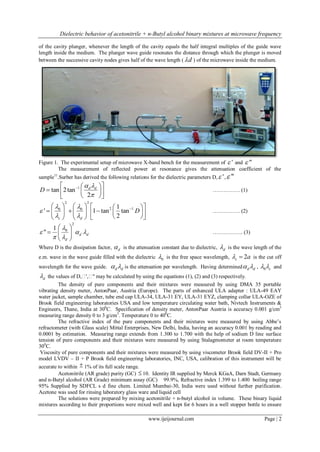
The experimental setup is shown in figure 1. The dielectric closed cell has a movable short. To hold the liquid 
in the cell, a thin mica window, whose VSWR and attenuation were neglected, was introduced between the cell 
and the rest of the microwave bench. Here source of reflex klystron 2 K 25 (USSR) was used. 
A plunger wave guide is converted into a cavity by introducing a coupling hole in the entrance and shorting the 
other end with the calibrated plunger. The sample occupies the entire volume of the cavity the frequency is kept 
constant and the length of the plunger cavity is changed. Hence, several nodes appear as one increase the length
Dielectric behavior of acetonitrile + n-Butyl alcohol binary mixtures at microwave frequency 
www.ijeijournal.com Page | 2 
of the cavity plunger, whenever the length of the cavity equals the half integral multiples of the guide wave 
length inside the medium. The plunger wave guide resonates the distance through which the plunger is moved 
between the successive cavity nodes gives half of the wave length (d ) of the microwave inside the medium. 
Figure 1. The experimental setup of microwave X-band bench for the measurement of  ' and  " 
The measurement of reflected power at resonance gives the attenuation coefficient of the 
sample11.Surber has derived the following relations for the dielectric parameters D, ' , " 
1 tan 2 tan 
2 
d d D 
  
 
    
    
   
…………… (1) 
2 2 
0 0 2 1 1 
' 1 tan tan 
2 c d 
D 
  
 
  
        
          
       
…………… (2) 
2 
0 1 
" d d 
d 
 
   
  
  
   
  
…………….. (3) 
Where D is the dissipation factor, d  is the attenuation constant due to dielectric, d  is the wave length of the 
e.m. wave in the wave guide filled with the dielectric 0  is the free space wavelength, 2 c   a is the cut off 
wavelength for the wave guide. d d   is the attenuation per wavelength. Having determined d d   , 0 c   and 
d  the values of D,ɛ',ɛ" may be calculated by using the equations (1), (2) and (3) respectively. 
The density of pure components and their mixtures were measured by using DMA 35 portable 
vibrating density meter, AntonPaar, Austria (Europe). The parts of enhanced ULA adapter : ULA-49 EAY 
water jacket, sample chamber, tube end cap ULA-34, ULA-31 EY, ULA-31 EYZ, clamping collar ULA-OZE of 
Brook field engineering laboratories USA and low temperature circulating water bath, Nivtech Instruments & 
Engineers, Thane, India at 300C. Specification of density meter, AntonPaar Austria is accuracy 0.001 g/cm3 
measuring range density 0 to 3 g/cm3. Temperature 0 to 400C. 
The refractive index of the pure components and their mixtures were measured by using Abbe’s 
refractometer (with Glass scale) Mittal Enterprises, New Delhi, India, having an accuracy 0.001 by reading and 
0.0001 by estimation. Measuring range extends from 1.300 to 1.700 with the help of sodium D line surface 
tension of pure components and their mixtures were measured by using Stalagmometer at room temperature 
300C. 
Viscosity of pure components and their mixtures were measured by using viscometer Brook field DV-II + Pro 
model LVDV – II + P Brook field engineering laboratories, INC, USA, calibration of this instrument will be 
accurate to within  1% of its full scale range. 
Acetonitrile (AR grade) purity (GC)  10. Identity IR supplied by Merck KGaA, Darn Stadt, Germany 
and n-Butyl alcohol (AR Grade) minimum assay (GC) 99.9%, Refractive index 1.399 to 1.400 boiling range 
95% Supplied by SDFCL s d fine chem. Limited Mumbai-30, India were used without further purification. 
Acetone was used for rinsing laboratory glass ware and liquid cell 
The solutions were prepared by mixing acetonitrile + n-butyl alcohol in volume. These binary liquid 
mixtures according to their proportions were mixed well and kept for 6 hours in a well stopper bottle to ensure
Dielectric behavior of acetonitrile + n-Butyl alcohol binary mixtures at microwave frequency 
www.ijeijournal.com Page | 3 
good thermal equilibrium. Microwave input and output power measured by Pm-437 (Attest) power meter, 
Chennai, India. Rectangular wave guide working E10  mode 10dB, VidyutyantraUdyog, India. 
Low temperature water circulating bath was used for maintaining temperature of pure components and 
their binary liquid mixtures for measurement of refractive index, density, viscosity and plunger reading using X-band 
microwave bench. 
III. Results And Discussion 
In recent years there has been considerable advancement in the theoretical and experimental 
investigation of the dielectric properties of binary liquid mixtures. Liquid mixtures exhibit various 
phenomenon’s, which cannot be found in pure substances. The most interesting of these are perhaps the new 
types of phase equilibrium. Which arise from the extra degrees of freedom introduced by the possibility of 
varying the properties of the components. A limited number of studies have been reported for mixtures. 
Dissipation factor, dielectric constant, dielectric loss, a.c.conductivity, loss tangent ( tan ), molar 
polarization ( 12 p ), apparent polarization (P2) and activation energy ( a E ) for the viscous flow with increasing 
mole fraction (XA) of Acetonitrile for the binary mixture. Acetonitrile + n-butyl alcohol are listed in Table 
1.The values of viscosity ( ), refractive index ( D n ), density (  ), surface tension (T), square of refractive 
index , mole fraction of solute and solvent are listed in Table 2. 
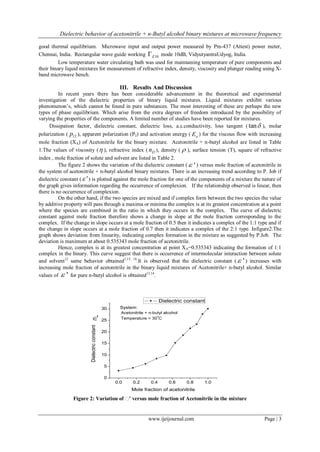
The figure 2 shows the variation of the dielectric constant ( ' ) versus mole fraction of acetonitrile in 
the system of acetonitrile + n-butyl alcohol binary mixtures. There is an increasing trend according to P. Job if 
dielectric constant ( ' ) is plotted against the mole fraction for one of the components of a mixture the nature of 
the graph gives information regarding the occurrence of complexion. If the relationship observed is linear, then 
there is no occurrence of complexion. 
On the other hand, if the two species are mixed and if complex form between the two species the value 
by additive property will pass through a maxima or minima the complex is at its greatest concentration at a point 
where the species are combined in the ratio in which they occurs in the complex. The curve of dielectric 
constant against mole fraction therefore shows a change in slope at the mole fraction corresponding to the 
complex. If the change in slope occurs at a mole fraction of 0.5 then it indicates a complex of the 1:1 type and if 
the change in slope occurs at a mole fraction of 0.7 then it indicates a complex of the 2:1 type. Infigure2.The 
graph shows deviation from linearity, indicating complex formation in the mixture as suggested by P.Job. The 
deviation is maximum at about 0.535343 mole fraction of acetonitrile. 
Hence, complex is at its greatest concentration at point XA=0.535343 indicating the formation of 1:1 
complex in the binary. This curve suggest that there is occurrence of intermolecular interaction between solute 
and solvent12 same behavior obtained1,15, 16.It is observed that the dielectric constant ( ' ) increases with 
increasing mole fraction of acetonitrile in the binary liquid mixtures of Acetonitrile+ n-butyl alcohol. Similar 
values of  ' for pure n-butyl alcohol is obtained13,14. 
0.0 0.2 0.4 0.6 0.8 1.0 
0 
5 
10 
15 
20 
25 
30 
' 
Dielectric constant 
Mole fraction of acetonitrile 
Dielectric constant 
Acetonitrile + n-butyl alcohol 
Temperature = 300C 
System: 
Figure 2: Variation of ɛ' versus mole fraction of Acetonitrile in the mixture
Dielectric behavior of acetonitrile + n-Butyl alcohol binary mixtures at microwave frequency 
www.ijeijournal.com Page | 4 
Loss tangent ( tan ): 
Figure3. Variation of Loss Tangent ( tan ) versus Mole fraction of acetonitrile in the mixture 
It is seen from figure 3, that the microwave energy absorption in the mixture is greater than that in pure 
liquids, a maxima in tan δ cure occurring at XA=0.301699 mole fraction of Acetonitrile in the Acetonitrile + n-butyl 
alcohol mixtures An interaction causing association between two types of molecules may be responsible 
for nonlinear behavior. Similar result was obtained.14 
Molar polarization: 
The values of molar polarization P12 of the mixtures were obtained by the formula. 
  
  
  1 2 
12 
' 1 
' 2 
A B X M X M 
P 
 
  
  
 
 
…………… (4) 
Where 1 M and 2 M are the molecular weights. A X and B X are the mole fraction of solute 
(Acetonitrile) and solvent (n-butyl alcohol) respectively and  is the density of the mixture.( ' ) dielectric 
constant of the binary liquid mixtures. 
0.0 0.2 0.4 0.6 0.8 1.0 
36 
38 
40 
42 
44 
46 
48 
50 
52 
54 
56 
58 
Molar polarization (P12) 
Mole fraction of acetonitrile 
Molar polarization 
system: 
Acetonitrile + n- butyl alcohol 
Temperature = 300C 
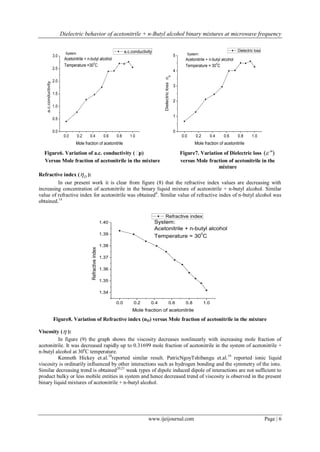
Figure 4. Variation of Molar Polarization (P12) versus Mole fraction of acetonitrile in the mixture 
Solvent – Solvent interaction between types of polar protic – polar aprotic solvent is due to hydrogen 
bonding formation as a result of amphiprotic hydrogen bond acceptor-donor (HBA-D). These solvent-solvent 
interaction property is depends mainly on different physical properties of solvent such as dielectric constant, 
dipole moment, molar polarization (P12), donor number, chemical structure solvatochromic quantitative values 
of Kamlet Taft hydrogen bond acidity, basicity anddipolarity – Polarizability8. 
0.0 0.2 0.4 0.6 0.8 1.0 
0.15 
0.20 
0.25 
0.30 
0.35 
Loss Tangent 
Mole fraction of acetonitrile 
Loss Tangent 
System: 
Acetonitrle + n-butyl alcohol 
Temperature = 300C
Dielectric behavior of acetonitrile + n-Butyl alcohol binary mixtures at microwave frequency 
www.ijeijournal.com Page | 5 
In present investigation the concentration of acetonitrile in the system increases the dielectric constant 
of the system(acetonitrile + n-butyl alcohol) increases with molar polarization. It is due to the formation of 
KamletTalfhydrogen bonding between Acetonitrile and n-butyl alcohol binary system. 
We may interpret figure 4 as, the intersection of the dotted straight line ideally representing the point of 
maximum concentration of complex. The point of intersection for the system occurs at about XA =0.55 mole 
fraction of Acetonitrile which corresponds to 1:1 complex for the system. 
Thus this result regarding the formation of complex is supported by our earlier conclusion made from 
the ɛ' versus mole fraction of acetonitrile curve for the samesystem. Similar result have been obtained.14 
This is due to formation of hydrogen bonding and this occurred due to increasing the concentration of 
more polar solvent. The probable structural arrangement is as follows: 
퐶퐻3 − 퐶 ≡ 푁훿− ⋯ ⋯ ⋯ 퐻훿+ − 푂 − 퐶퐻2 − 퐶퐻2 − 퐶퐻2 − 퐶퐻3 
Apparent polarization (P2): 
Apparent polarization (P2) of the mixtures were obtained by the formula 
12 1 
2 
A 
B 
P X P 
P 
X 
 
 
…………… (5) 
Where P12 is the molar polarization of the mixtures, P1 is molar polarization of pure solvent, XA and XB are mole 
fraction of solute and solvent respectively. 
The graph of apparent polarization (P2) versus mole fraction (XA) of acetonitrile is depicted in figure 5. The 
graph indicates that apparent polarization decreases with increasing mole fraction (XA) of acetonitrile in the 
mixture. 
0.0 0.2 0.4 0.6 0.8 1.0 
45 
50 
55 
60 
65 
70 
75 
80 
85 
Apparent Polarization 
Mole fraction of acetonitrile 
Apparent Polarization 
System: 
Acetonitrile + n-butyl alcohol 
Temperature = 300C 
Figure5. Variation of apparent polarization (P2) versus Mole fraction of acetonitrile in the mixture 
a.c. Conductivity ( p  ): 
a.c. conductivity of the mixtures were obtained by using the formula 
 p  0 " 
…………… (6) 
0 2 " p    f   
…………… (7) 
Where  2 f , f = 10.75 GHz , 
12 2 
0  8.854187816 10 C / Jm    
 "  Dielectric loss of binary liquid mixture 
In our present work, it is found that a.c. conductivity depends on dielectric loss (ɛ"). Dielectric loss increases 
a.c. conductivity increases and dielectric loss decreases a.c. conductivity decreases. 
Dielectric loss is proportional to the a.c. conductivity. Thus a.c. conductivity depends upon the dielectric 
loss17.a.c conductivity and dielectric loss is presented in figure (6) and (7) respectively.
Dielectric behavior of acetonitrile + n-Butyl alcohol binary mixtures at microwave frequency 
www.ijeijournal.com Page | 6 
0.0 0.2 0.4 0.6 0.8 1.0 
0.0 
0.5 
1.0 
1.5 
2.0 
2.5 
3.0 
a.c.conductivity 
Mole fraction of acetonitrile 
a.c.conductivity 
Acetonitrile + n-butyl alcohol 
Temperature =300C 
System: 
0.0 0.2 0.4 0.6 0.8 1.0 
0 
1 
2 
3 
4 
5 
" 
Dielectric loss 
Mole fraction of acetonitrile 
Dielectric loss 
Acetonitrile + n-butyl alcohol 
Temperature = 300C 
System: 
Figure6. Variation of a.c. conductivity (σp) Figure7. Variation of Dielectric loss ( ") 
Versus Mole fraction of acetonitrile in the mixture versus Mole fraction of acetonitrile in the 
mixture 
Refractive index ( D  ): 
In our present work it is clear from figure (8) that the refractive index values are decreasing with 
increasing concentration of acetonitrile in the binary liquid mixture of acetonitrile + n-butyl alcohol. Similar 
value of refractive index for acetonitrile was obtained6. Similar value of refractive index of n-butyl alcohol was 
obtained.14 
0.0 0.2 0.4 0.6 0.8 1.0 
1.34 
1.35 
1.36 
1.37 
1.38 
1.39 
1.40 
Refractive index 
Mole fraction of acetonitrile 
Refractive index 
System: 
Acetonitrile + n-butyl alcohol 
Temperature = 300C 
Figure8. Variation of Refractive index (nD) versus Mole fraction of acetonitrile in the mixture 
Viscosity ( ): 
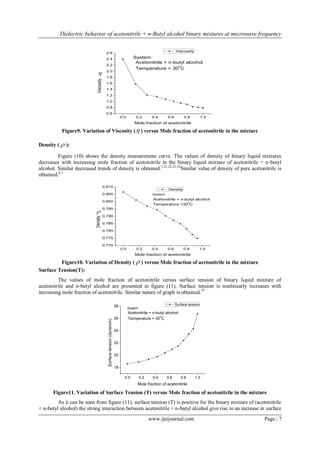
In figure (9) the graph shows the viscosity decreases nonlinearly with increasing mole fraction of 
acetonitrile. It was decreased rapidly up to 0.31699 mole fraction of acetonitrile in the system of acetonitrile + 
n-butyl alcohol at 300C temperature. 
Kenneth Hickey et.al.18reported similar result. PatricNgoyTshibangu et.al.19 reported ionic liquid 
viscosity is ordinarily influenced by other interactions such as hydrogen bonding and the symmetry of the ions. 
Similar decreasing trend is obtained20,21 weak types of dipole induced dipole of interactions are not sufficient to 
product bulky or less mobile entities in system and hence decreased trend of viscosity is observed in the present 
binary liquid mixtures of acetonitrile + n-butyl alcohol.
Dielectric behavior of acetonitrile + n-Butyl alcohol binary mixtures at microwave frequency 
www.ijeijournal.com Page | 7 
0.0 0.2 0.4 0.6 0.8 1.0 
0.6 
0.8 
1.0 
1.2 
1.4 
1.6 
1.8 
2.0 
2.2 
2.4 
2.6 
 
Viscosity 
Mole fraction of acetonitrile 
Viscosity 
Acetonitrile + n-butyl alcohol 
Temperature = 300C 
System: 
Figure9. Variation of Viscosity ( ) versus Mole fraction of acetonitrile in the mixture 
Density (  ): 
Figure (10) shows the density measurement curve. The values of density of binary liquid mixtures 
decreases with increasing mole fraction of acetonitrile in the binary liquid mixture of acetonitrile + n-butyl 
alcohol. Similar decreased trends of density is obtained.1,21,22,23,24Similar value of density of pure acetonitrile is 
obtained.6,7 
0.0 0.2 0.4 0.6 0.8 1.0 
0.770 
0.775 
0.780 
0.785 
0.790 
0.795 
0.800 
0.805 
0.810 
 
Density 
Mole fraction of acetonitrile 
Density 
Acetonitrile + n-butyl alcohol 
Temperature =300C 
System: 
Figure10. Variation of Density (  ) versus Mole fraction of acetonitrile in the mixture 
Surface Tension(T): 
The values of mole fraction of acetonitrile versus surface tension of binary liquid mixture of 
acetonitrile and n-butyl alcohol are presented in figure (11). Surface tension is nonlinearly increases with 
increasing mole fraction of acetonitrile. Similar nature of graph is obtained.27 
0.0 0.2 0.4 0.6 0.8 1.0 
18 
20 
22 
24 
26 
28 
Surface tension (dyne/cm) 
Mole fraction of acetonitrile 
Surface tension 
Acetonitrile + n-butyl alcohol 
Temperature = 300C 
System: 
Figure11. Variation of Surface Tension (T) versus Mole fraction of acetonitrile in the mixture 
As it can be seen from figure (11), surface tension (T) is positive for the binary mixture of (acetonitrile 
+ n-butyl alcohol) the strong interaction between acetonitrile + n-butyl alcohol give rise to an increase in surface
Dielectric behavior of acetonitrile + n-Butyl alcohol binary mixtures at microwave frequency 
www.ijeijournal.com Page | 8 
tension. This is in turn responsible for the positive surface tension (T) for the (Acetonitrile + n-butyl alcohol) 
system.23. 
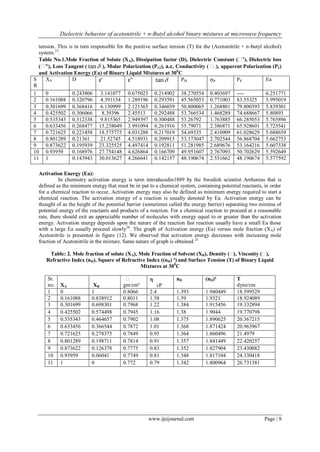
Table No.1.Mole Fraction of Solute (XA), Dissipation factor (D), Dielectric Constant (ɛ'), Dielectric loss 
(ɛ"), Loss Tangent ( tan ), Molar Polarization (P12), a.c. Conductivity (σσ), apparent Polarization (P2) 
and Activation Energy (Ea) of Binary Liquid Mixtures at 300C 
S 
R 
XA D ɛ' ɛ" tan 
P₁₂ σP P₂ Ea 
1 0 0.243806 3.141077 0.675023 0.214902 38.270554 0.403697 ---- 6.251771 
2 0.161088 0.320796 4.391134 1.289196 0.293591 45.565053 0.771003 83.55325 5.995019 
3 0.301699 0.368416 6.130999 2.121565 0.346039 50.800065 1.268801 79.800393 5.839301 
4 0.425502 0.306066 8.39396 2.45513 0.292488 53.766534 1.468289 74.688667 5.80893 
5 0.535343 0.312338 9.815365 2.949397 0.300488 53.26792 1.763885 66.285053 5.765896 
6 0.633456 0.268477 15.238049 3.991094 0.261916 55.79071 2.386871 65.928601 5.725541 
7 0.721625 0.221458 18.575775 4.031288 0.217019 54.69335 2.410909 61.028629 5.688659 
8 0.801289 0.21361 21.52745 4.518931 0.209915 53.173047 2.702544 56.868704 5.662753 
9 0.873622 0.195939 23.325525 4.497414 0.192811 51.281985 2.689676 53.164216 5.607338 
10 0.93959 0.168976 27.754148 4.626864 0.166709 49.951607 2.767093 50.702629 5.592649 
11 1 0.143943 30.013627 4.266641 0.142157 48.190674 2.551662 48.190674 5.577592 
Activation Energy (Ea): 
In chemistry activation energy is term introducedin1889 by the Swedish scientist Arrhenius that is 
defined as the minimum energy that must be in put to a chemical system, containing potential reactants, in order 
for a chemical reaction to occur, Activation energy may also be defined as minimum energy required to start a 
chemical reaction. The activation energy of a reaction is usually denoted by Ea. Activation energy can be 
thought of as the height of the potential barrier (sometimes called the energy barrier) separating two minima of 
potential energy of the reactants and products of a reaction. For a chemical reaction to proceed at a reasonable 
rate, there should exit an appreciable number of molecules with energy equal to or greater than the activation 
energy. Activation energy depends upon the nature of the reaction fast reaction usually have a small Ea those 
with a large Ea usually proceed slowly26. The graph of Activation energy (Ea) versus mole fraction (XA) of 
Acetonitrile is presented in figure (12). We observed that activation energy decreases with increasing mole 
fraction of Acetonitrile in the mixture. Same nature of graph is obtained.25 
Table: 2. Mole fraction of solute (XA), Mole Fraction of Solvent (XB), Density (σ), Viscosity (ɛ), 
Refractive Index (nD), Square of Refractive Index ((nD) ²) and Surface Tension (T) of Binary Liquid 
Mixtures at 300C 
Sr. 
no. 
XA 
XB 
σ 
gm/cm³ 
 
cP 
nD (nD)² T 
dyne/cm 
1 0 1 0.8066 2.4 1.393 1.940449 18.599529 
2 0.161088 0.838912 0.8011 1.58 1.39 1.9321 18.924089 
3 0.301699 0.698301 0.7968 1.22 1.384 1.915456 19.332894 
4 0.425502 0.574498 0.7945 1.16 1.38 1.9044 19.770798 
5 0.535343 0.464657 0.7902 1.08 1.375 1.890625 20.367215 
6 0.633456 0.366544 0.7872 1.01 1.368 1.871424 20.963967 
7 0.721625 0.278375 0.7849 0.95 1.364 1.860496 21.4979 
8 0.801289 0.198711 0.7814 0.91 1.357 1.841449 22.420257 
9 0.873622 0.126378 0.7775 0.83 1.352 1.827904 23.430082 
10 0.93959 0.06041 0.7749 0.81 1.348 1.817104 24.330418 
11 1 0 0.772 0.79 1.342 1.800964 26.731381
Dielectric behavior of acetonitrile + n-Butyl alcohol binary mixtures at microwave frequency 
www.ijeijournal.com Page | 9 
0.0 0.2 0.4 0.6 0.8 1.0 
5.5 
5.6 
5.7 
5.8 
5.9 
6.0 
6.1 
6.2 
6.3 
Activation energy 
Mole fraction of acetonitrile 
Activation energy 
Acetonitrile + n-butyl alcohol 
Temperature = 300C 
System: 
Figure12. Variation of Activation Energy (Ea) versus Mole fraction of acetonitrile in the mixture 
IV. Conclusions 
The values of dielectric constant ( ' ), Dielectric loss ( "), loss tangent ( tan ), molar polarization 
(P12), Apparent polarization (P2), activation energy (Ea) and viscosity, refractive index, square of refractive 
index, surface tension and density are all positive values indicating strong interactions between acetonitrile + n-butyl 
alcohol molecules. Loss tangent curve indicates large microwave energy absorption occurred at 
XA=0.301699 mole fraction of acetonitrile. We also investigated dielectric loss is proportional to a.c. 
conductivity of binary liquid mixtures. 
There is intermolecular interaction among the components of the binary mixtures leading to hydrogen 
bond formation. Dielectric constant curve indicates 1:1 complex and molar polarization curve indicates 1:1 
complex in the binary liquid mixtures (Acetonitrile + n-butyl alcohol). 
REFERENCES 
[1]. A.P.Jogdand and Dr. P.L.Kadam , Dielectric behavior of acetonitrile + methanol binary mixtures at microwave frequency. IOSR 
journal of Applied physics (IOSR-JAP), e-ISSN: 2278-4861, vol. 6, Issue Iver. IT(Feb 2014), pp. 14-22 
[2]. A.P.Jogdand and Dr. P.L.Kadam , Excess properties of acetonitrile + methanol binary mixtures at microwave frequency. IOSR 
journal of Engineering (IOSR-JEN)www.iosrjen.orgISSN (e):2250-302. ISSN(P):2278-8719, vol. 4, Issue 03, (March 2014), 
║v4║pp 47-55 International 
[3]. S.V. Kumara Sastry, S. SreehariSastry and VRK Murthy, Excess dielectric and thermo dynamical studies on hydrogen bonded 
binary mixtures of propan-1-ol with methyl and ethyl benzoates, Chem. Sci. Trans. 2012, 1 (3), 638-652. 
[4]. RekhaPande& G.M. Kalamse, Asian J. Chemistry Vol. 17, No. 1 (2005), 283-288. 
[5]. Ch. V.V. Ramana, A.B.V. Kirankumar, M. Ashok kumar and M.K. Moodley Dielectric and excess dielectric constant of 
acetonitrile + Butyl amine + Ethylamine and methylamine at 303, 313, and 323 K,Journal of chemistry volume 2013 (2013), 
Article ID 687106 
[6]. Abeer K. Shams Densities, refractive indices and excess properties of binary mixtures of acetonitrile with Benzene, Toluene n-xylene 
and mesitylene at temperatures from (298.15 to 313.15 K), Journal of Al. Nahrain University Vol. 14 (2), June, 2011, Pp. 
75-85. 
[7]. R.K. Sukla, G.K. Gupta, S.K. Puranik, A.K. Sharma and Balwant Singh, surface tension of Binary liquid mixtures from various 
liquid state models at 293.15, 298.15 and 313.15 K, Int. J. of Latest Research in Science and Technology vol. I. Issue 3 Page NO. 
276-281 Sept-Oct (2012) 
[8]. Farid I. EI. Dossoki refractive index and density measurements for selected binary protic – protic, aprotic – aprotic, and aprotic-protic 
systems at temperatures from 298.15 K to 308.15 K. J. of the Chinese chemical society 2007, 54, 1129-1137. 
[9]. Ch. V.V. Ramana G. Ramachandra Reddy and M. Mohan Reddy, Dielectric and excess dielectric constant of acetonitrile + 
hexane + heptanes and + cyclohexane at 303-313 and 323 K, Physical chemistry, Vol. 4, No. 2, 2009. 
[10]. P.J. Singh and K.S. Sharma Dielectric behavior of ketone-amine binary mixtures at microwave frequencies pramana Journal of 
Physics Vol. 46, No.4, April 1996, Pp. 259-270. 
[11]. W.H. Surber, 1, Appl. Phys. 19, 514 (1948) 
[12]. P. Job Ann. Chem. 9, 113, (1928) 
[13]. Mohammed N. Afsar, Nattakarn, Suwanvisan, and Yong wang permittivity measurement of low and high loss liquids in the freq. 
range of 8 to 40 GHz using wave guide transmission line technique microwave and optical technology letters. Vol. 48, NO. 2, 
275-281, Feb. 2006. 
[14]. NarwadeBhanudasSheshrao,Thermodynamic properties and related studies of polar liquids at microwave frequencies, thesis 
SRTMU Nanded, Maharashtra India, 2006, P.No. 77-88. 
[15]. R.S. Kawale, U.B. Tumbarphale, V.G. Kalamse and G.M. Kalamse, Dielectric behaviour of thiophenol in benzene, carbon 
tetrachloride, cyclohexane, N-hexane, International J. of Physics & Mathematical Sciences ISSN: 2277-2111, 2013, Vol. 3 (2), 
April-June, pp. 99-103/ Kawle et.al. 
[16]. B.S. Narwade, P.G. Gawali, RekhaPande and G.M. Kalamse, Dielectric studies of binary mixtures of n-propyl alcohol and 
ethylenediamine J. Chem. Soci. Vol. 117, No. 6, Nov. 2005, Pp. 673-676.
Dielectric behavior of acetonitrile + n-Butyl alcohol binary mixtures at microwave frequency 
www.ijeijournal.com Page | 10 
[17]. H.C. Chaudhari and V.J. Shinde, Dielectric properties of soils at X-band microwave frequencies, Indian Journal of Pure and applied physics vol.50 January 2012, pp. 64-66. 
[18]. Kenneth Hickey and W. Earle Waghore, Viscosities and Volumes of dilute solutions of formamide in water + acetonitrile and for formamide and N,N-dimehtylformamide in methanol + acetonitrile mixed solvents : Viscosity B-coefficients, activation free energies for viscous flow and partial molar volumes, J. Chem. Eng. Data 2001, 46, 851-857. 
[19]. Patrick NgoyTshibangu, Silindile, Nomatheruba Ezekiel Dixon Dikio. Density, Viscosity and conductivity, study of 1-Butyle-3- methylimidazolium Bronide Int. J. Electro Chem. Sci. 6 (2011) 2201-2213. 
[20]. Sujata S. Patil and Sunil R. Mirgane, Thermodynamics of binary liquid mixtures of acrylates with dodecane-1-ol Pelagia Research Library. Advances in applied science research 2013, (4), 242-250, ISSN : 0976-8610, Coden (USA) AASRC 
[21]. Chandra mohanSaxena, ArchanaSaxena, Ashok Kumar Srivastava and Noveen Kumar Shukla, Densities, voscosites and ultrasonic studies of binary liquid mixture of thylamine and Benzyl alcohl at different temperatures, American chemical science journal 3 (4), 468-478, 2013, Science Dome in international. 
[22]. George Rizoulis, Excess properties of the binary liquid systems dimethyl sulfoxide + isopropanol and propylene carbonate + isopropanol, Can J. Chem. 67 (1989), 1105. 
[23]. SeyedHesammirfakhar, DavoodRezaei- Teimourbagloo, Density and surface tension of binary mixture of acetonitrile, 2-Alkanol at 298.15K, Journal of science and Today’s world, 2013 volume 2, issue 4, pages 344-357. 
[24]. Jeevanandham P, Kumar S. Periyasamy, P. and Sedhumatharen K. Dielectric properties of binary liquid mixtures of aniline, o- chloroaniline and o-anisidine with carbon tetrachloride at 303.15K, Int. J. of Recent Scientific research Vo. 3 Issue 10 pp. 878- 883, October 2012. 
[25]. Kh. Abdul Maleque Effects of Binary chemical reaction and Activation energy on MHD Boundary layer Heat and mass Transfer flow with viscous Dissipation and Heat Generation /Absorption., Hindawi publishing corporation ISRN Thermodynamics Volume 2013, Article ID 284637, 9 pages http://dx.doi.org/10.1155/2013/284637. 
[26]. http://www.files.chem.vt.edu/RVGS/ACT/notes. 
[27]. Oscar cabeza, Sandra Garcia-Garabad, Luisa segade, montservat, Domingue-Perez Esther pilo and Luis M. Varela, 2011. Universidada da coruna, universidadesatiago de comnaspain Physical properties of Binary mixtures of ILS with water and ethanol A review (Roger and Seddon) ionic liquids. Theory properties, Newapproatues prof. Alexander Kokorin (Ed.) ISBN 978-303-349 In. Tech.

Dielectric behavior of acetonitrile + n-Butyl alcohol binary mixtures at microwave frequency

  • 1.
    International Journal ofEngineering Inventions e-ISSN: 2278-7461, p-ISSN: 2319-6491 Volume 4, Issue 3 (August 2014) PP:00-00 www.ijeijournal.com Page | 1 Dielectric behavior of acetonitrile + n-Butyl alcohol binary mixtures at microwave frequency A.P. Jogdand1, Dr. P.L. Kadam2 1, 2, Physics research laboratory, YeshwantMahavidyalaya, Nanded-431605, Maharashtra, India Abstract: Values of dielectric constant (ɛ') and dielectric loss (ɛ") have been experimentally determined for binary liquid mixtures of acetonitrile + n-butyl alcohol at 10.75 GHz microwave frequencies at 300C and over the complete mole fraction range. The values of ɛ' and ɛ" have been used to evaluate the loss tangent ( tan ), molar polarization (P12), apparent polarization (P2) and a.c. conductivity ( p ).The results are discussed in terms of intermolecular interactions. The results are positive over the entire range of composition. Viscosity, density and refractive index measurement of pure liquid and binary liquid mixtures were carried out at 300C. The values of viscosity have been used to evaluate the activation energy (Ea). The surface tension has been experimentally determined for pure liquid and binary liquid mixtures at 300C.These parameters have been used to explain the formation of hydrogen bonding and formation of complex in the binary liquid mixtures. Keywords: Binary mixture, Dielectric constant, dielectric loss, Molar polarization, Activation energy, Molecular interaction. I. Introduction Alcohols are industrially and scientifically important organic compounds and their physical and chemical properties are largely determined by -OH group. Alcohols are strongly associated in solutions because of dipole-dipole interaction and hydrogen bonding1,2,3. N-butyl alcohol is used as a direct solvent and as an intermediate in the manufacture of other organic chemicals (e.g. Butyl acrylate, methacrylate, glycol ethers and butyl acetate).Therefore it seemed important to examine the dielectric behavior of n-butyl alcohol with acetonitrile. A dielectric investigation of solutions containing varying amounts of interacting molecules helps to detect the formation and composition of complexes in them4. A survey of the literature shows that a few workers have tried to investigate some binary systems taking nitriles as one of the constituent components in the binary mixtures. Though the information in this field is steadily being enlarged by a number of workers.5-9the nature of complex formation in binary mixtures is still far from clear. With this in view, we report new experimental data dielectric constant (ɛ'), dielectric loss (ɛ"),a.c. conductivity (σР), loss tangent ( tan ), molar polarization (P12), apparent polarization (P2), activation energy (Ea).In this paper we also report the new experimental data of physical properties includes viscosity, density, surface tension and refractive index. Knowledge of frequency dependent dielectric properties of binary liquid mixtures is important both in fundamental studies of solvent structure determination and its dynamics as well as in the practical applications. At fundamental level, the frequency dependent dielectric behavior of liquid mixtures provides information on molecular interactions and mechanisms of molecular process. In pharmaceutical and analytical sciences, the dielectric constant of mixed solvents is required to predict the solubility and chemical stability of the drug. The dielectric study of acetonitrile and n-butyl alcohol binary liquid mixtures using frequency domain reflectometry (FDR) have not been carried out in the past. Hence, we felt that the present investigation which may provide useful information about the formation of complexes in the acetonitrile + n-butyl alcohol binary liquid mixtures at 300C. II. Experimental Details The dissipation factor (D), dielectric constant ( ' ) and dielectric loss ( ") were measured using Surber’s technique10, 12 of measuring the reflection coefficient from the air-dielectric boundary of the liquid in the microwave X-band at 10.75 GHz frequency and at 300C temperature. The experimental setup is shown in figure 1. The dielectric closed cell has a movable short. To hold the liquid in the cell, a thin mica window, whose VSWR and attenuation were neglected, was introduced between the cell and the rest of the microwave bench. Here source of reflex klystron 2 K 25 (USSR) was used. A plunger wave guide is converted into a cavity by introducing a coupling hole in the entrance and shorting the other end with the calibrated plunger. The sample occupies the entire volume of the cavity the frequency is kept constant and the length of the plunger cavity is changed. Hence, several nodes appear as one increase the length
  • 2.
    Dielectric behavior ofacetonitrile + n-Butyl alcohol binary mixtures at microwave frequency www.ijeijournal.com Page | 2 of the cavity plunger, whenever the length of the cavity equals the half integral multiples of the guide wave length inside the medium. The plunger wave guide resonates the distance through which the plunger is moved between the successive cavity nodes gives half of the wave length (d ) of the microwave inside the medium. Figure 1. The experimental setup of microwave X-band bench for the measurement of  ' and  " The measurement of reflected power at resonance gives the attenuation coefficient of the sample11.Surber has derived the following relations for the dielectric parameters D, ' , " 1 tan 2 tan 2 d d D               …………… (1) 2 2 0 0 2 1 1 ' 1 tan tan 2 c d D                               …………… (2) 2 0 1 " d d d              …………….. (3) Where D is the dissipation factor, d  is the attenuation constant due to dielectric, d  is the wave length of the e.m. wave in the wave guide filled with the dielectric 0  is the free space wavelength, 2 c   a is the cut off wavelength for the wave guide. d d   is the attenuation per wavelength. Having determined d d   , 0 c   and d  the values of D,ɛ',ɛ" may be calculated by using the equations (1), (2) and (3) respectively. The density of pure components and their mixtures were measured by using DMA 35 portable vibrating density meter, AntonPaar, Austria (Europe). The parts of enhanced ULA adapter : ULA-49 EAY water jacket, sample chamber, tube end cap ULA-34, ULA-31 EY, ULA-31 EYZ, clamping collar ULA-OZE of Brook field engineering laboratories USA and low temperature circulating water bath, Nivtech Instruments & Engineers, Thane, India at 300C. Specification of density meter, AntonPaar Austria is accuracy 0.001 g/cm3 measuring range density 0 to 3 g/cm3. Temperature 0 to 400C. The refractive index of the pure components and their mixtures were measured by using Abbe’s refractometer (with Glass scale) Mittal Enterprises, New Delhi, India, having an accuracy 0.001 by reading and 0.0001 by estimation. Measuring range extends from 1.300 to 1.700 with the help of sodium D line surface tension of pure components and their mixtures were measured by using Stalagmometer at room temperature 300C. Viscosity of pure components and their mixtures were measured by using viscometer Brook field DV-II + Pro model LVDV – II + P Brook field engineering laboratories, INC, USA, calibration of this instrument will be accurate to within  1% of its full scale range. Acetonitrile (AR grade) purity (GC)  10. Identity IR supplied by Merck KGaA, Darn Stadt, Germany and n-Butyl alcohol (AR Grade) minimum assay (GC) 99.9%, Refractive index 1.399 to 1.400 boiling range 95% Supplied by SDFCL s d fine chem. Limited Mumbai-30, India were used without further purification. Acetone was used for rinsing laboratory glass ware and liquid cell The solutions were prepared by mixing acetonitrile + n-butyl alcohol in volume. These binary liquid mixtures according to their proportions were mixed well and kept for 6 hours in a well stopper bottle to ensure
  • 3.
    Dielectric behavior ofacetonitrile + n-Butyl alcohol binary mixtures at microwave frequency www.ijeijournal.com Page | 3 good thermal equilibrium. Microwave input and output power measured by Pm-437 (Attest) power meter, Chennai, India. Rectangular wave guide working E10  mode 10dB, VidyutyantraUdyog, India. Low temperature water circulating bath was used for maintaining temperature of pure components and their binary liquid mixtures for measurement of refractive index, density, viscosity and plunger reading using X-band microwave bench. III. Results And Discussion In recent years there has been considerable advancement in the theoretical and experimental investigation of the dielectric properties of binary liquid mixtures. Liquid mixtures exhibit various phenomenon’s, which cannot be found in pure substances. The most interesting of these are perhaps the new types of phase equilibrium. Which arise from the extra degrees of freedom introduced by the possibility of varying the properties of the components. A limited number of studies have been reported for mixtures. Dissipation factor, dielectric constant, dielectric loss, a.c.conductivity, loss tangent ( tan ), molar polarization ( 12 p ), apparent polarization (P2) and activation energy ( a E ) for the viscous flow with increasing mole fraction (XA) of Acetonitrile for the binary mixture. Acetonitrile + n-butyl alcohol are listed in Table 1.The values of viscosity ( ), refractive index ( D n ), density (  ), surface tension (T), square of refractive index , mole fraction of solute and solvent are listed in Table 2. The figure 2 shows the variation of the dielectric constant ( ' ) versus mole fraction of acetonitrile in the system of acetonitrile + n-butyl alcohol binary mixtures. There is an increasing trend according to P. Job if dielectric constant ( ' ) is plotted against the mole fraction for one of the components of a mixture the nature of the graph gives information regarding the occurrence of complexion. If the relationship observed is linear, then there is no occurrence of complexion. On the other hand, if the two species are mixed and if complex form between the two species the value by additive property will pass through a maxima or minima the complex is at its greatest concentration at a point where the species are combined in the ratio in which they occurs in the complex. The curve of dielectric constant against mole fraction therefore shows a change in slope at the mole fraction corresponding to the complex. If the change in slope occurs at a mole fraction of 0.5 then it indicates a complex of the 1:1 type and if the change in slope occurs at a mole fraction of 0.7 then it indicates a complex of the 2:1 type. Infigure2.The graph shows deviation from linearity, indicating complex formation in the mixture as suggested by P.Job. The deviation is maximum at about 0.535343 mole fraction of acetonitrile. Hence, complex is at its greatest concentration at point XA=0.535343 indicating the formation of 1:1 complex in the binary. This curve suggest that there is occurrence of intermolecular interaction between solute and solvent12 same behavior obtained1,15, 16.It is observed that the dielectric constant ( ' ) increases with increasing mole fraction of acetonitrile in the binary liquid mixtures of Acetonitrile+ n-butyl alcohol. Similar values of  ' for pure n-butyl alcohol is obtained13,14. 0.0 0.2 0.4 0.6 0.8 1.0 0 5 10 15 20 25 30 ' Dielectric constant Mole fraction of acetonitrile Dielectric constant Acetonitrile + n-butyl alcohol Temperature = 300C System: Figure 2: Variation of ɛ' versus mole fraction of Acetonitrile in the mixture
  • 4.
    Dielectric behavior ofacetonitrile + n-Butyl alcohol binary mixtures at microwave frequency www.ijeijournal.com Page | 4 Loss tangent ( tan ): Figure3. Variation of Loss Tangent ( tan ) versus Mole fraction of acetonitrile in the mixture It is seen from figure 3, that the microwave energy absorption in the mixture is greater than that in pure liquids, a maxima in tan δ cure occurring at XA=0.301699 mole fraction of Acetonitrile in the Acetonitrile + n-butyl alcohol mixtures An interaction causing association between two types of molecules may be responsible for nonlinear behavior. Similar result was obtained.14 Molar polarization: The values of molar polarization P12 of the mixtures were obtained by the formula.       1 2 12 ' 1 ' 2 A B X M X M P        …………… (4) Where 1 M and 2 M are the molecular weights. A X and B X are the mole fraction of solute (Acetonitrile) and solvent (n-butyl alcohol) respectively and  is the density of the mixture.( ' ) dielectric constant of the binary liquid mixtures. 0.0 0.2 0.4 0.6 0.8 1.0 36 38 40 42 44 46 48 50 52 54 56 58 Molar polarization (P12) Mole fraction of acetonitrile Molar polarization system: Acetonitrile + n- butyl alcohol Temperature = 300C Figure 4. Variation of Molar Polarization (P12) versus Mole fraction of acetonitrile in the mixture Solvent – Solvent interaction between types of polar protic – polar aprotic solvent is due to hydrogen bonding formation as a result of amphiprotic hydrogen bond acceptor-donor (HBA-D). These solvent-solvent interaction property is depends mainly on different physical properties of solvent such as dielectric constant, dipole moment, molar polarization (P12), donor number, chemical structure solvatochromic quantitative values of Kamlet Taft hydrogen bond acidity, basicity anddipolarity – Polarizability8. 0.0 0.2 0.4 0.6 0.8 1.0 0.15 0.20 0.25 0.30 0.35 Loss Tangent Mole fraction of acetonitrile Loss Tangent System: Acetonitrle + n-butyl alcohol Temperature = 300C
  • 5.
    Dielectric behavior ofacetonitrile + n-Butyl alcohol binary mixtures at microwave frequency www.ijeijournal.com Page | 5 In present investigation the concentration of acetonitrile in the system increases the dielectric constant of the system(acetonitrile + n-butyl alcohol) increases with molar polarization. It is due to the formation of KamletTalfhydrogen bonding between Acetonitrile and n-butyl alcohol binary system. We may interpret figure 4 as, the intersection of the dotted straight line ideally representing the point of maximum concentration of complex. The point of intersection for the system occurs at about XA =0.55 mole fraction of Acetonitrile which corresponds to 1:1 complex for the system. Thus this result regarding the formation of complex is supported by our earlier conclusion made from the ɛ' versus mole fraction of acetonitrile curve for the samesystem. Similar result have been obtained.14 This is due to formation of hydrogen bonding and this occurred due to increasing the concentration of more polar solvent. The probable structural arrangement is as follows: 퐶퐻3 − 퐶 ≡ 푁훿− ⋯ ⋯ ⋯ 퐻훿+ − 푂 − 퐶퐻2 − 퐶퐻2 − 퐶퐻2 − 퐶퐻3 Apparent polarization (P2): Apparent polarization (P2) of the mixtures were obtained by the formula 12 1 2 A B P X P P X   …………… (5) Where P12 is the molar polarization of the mixtures, P1 is molar polarization of pure solvent, XA and XB are mole fraction of solute and solvent respectively. The graph of apparent polarization (P2) versus mole fraction (XA) of acetonitrile is depicted in figure 5. The graph indicates that apparent polarization decreases with increasing mole fraction (XA) of acetonitrile in the mixture. 0.0 0.2 0.4 0.6 0.8 1.0 45 50 55 60 65 70 75 80 85 Apparent Polarization Mole fraction of acetonitrile Apparent Polarization System: Acetonitrile + n-butyl alcohol Temperature = 300C Figure5. Variation of apparent polarization (P2) versus Mole fraction of acetonitrile in the mixture a.c. Conductivity ( p  ): a.c. conductivity of the mixtures were obtained by using the formula  p  0 " …………… (6) 0 2 " p    f   …………… (7) Where  2 f , f = 10.75 GHz , 12 2 0  8.854187816 10 C / Jm     "  Dielectric loss of binary liquid mixture In our present work, it is found that a.c. conductivity depends on dielectric loss (ɛ"). Dielectric loss increases a.c. conductivity increases and dielectric loss decreases a.c. conductivity decreases. Dielectric loss is proportional to the a.c. conductivity. Thus a.c. conductivity depends upon the dielectric loss17.a.c conductivity and dielectric loss is presented in figure (6) and (7) respectively.
  • 6.
    Dielectric behavior ofacetonitrile + n-Butyl alcohol binary mixtures at microwave frequency www.ijeijournal.com Page | 6 0.0 0.2 0.4 0.6 0.8 1.0 0.0 0.5 1.0 1.5 2.0 2.5 3.0 a.c.conductivity Mole fraction of acetonitrile a.c.conductivity Acetonitrile + n-butyl alcohol Temperature =300C System: 0.0 0.2 0.4 0.6 0.8 1.0 0 1 2 3 4 5 " Dielectric loss Mole fraction of acetonitrile Dielectric loss Acetonitrile + n-butyl alcohol Temperature = 300C System: Figure6. Variation of a.c. conductivity (σp) Figure7. Variation of Dielectric loss ( ") Versus Mole fraction of acetonitrile in the mixture versus Mole fraction of acetonitrile in the mixture Refractive index ( D  ): In our present work it is clear from figure (8) that the refractive index values are decreasing with increasing concentration of acetonitrile in the binary liquid mixture of acetonitrile + n-butyl alcohol. Similar value of refractive index for acetonitrile was obtained6. Similar value of refractive index of n-butyl alcohol was obtained.14 0.0 0.2 0.4 0.6 0.8 1.0 1.34 1.35 1.36 1.37 1.38 1.39 1.40 Refractive index Mole fraction of acetonitrile Refractive index System: Acetonitrile + n-butyl alcohol Temperature = 300C Figure8. Variation of Refractive index (nD) versus Mole fraction of acetonitrile in the mixture Viscosity ( ): In figure (9) the graph shows the viscosity decreases nonlinearly with increasing mole fraction of acetonitrile. It was decreased rapidly up to 0.31699 mole fraction of acetonitrile in the system of acetonitrile + n-butyl alcohol at 300C temperature. Kenneth Hickey et.al.18reported similar result. PatricNgoyTshibangu et.al.19 reported ionic liquid viscosity is ordinarily influenced by other interactions such as hydrogen bonding and the symmetry of the ions. Similar decreasing trend is obtained20,21 weak types of dipole induced dipole of interactions are not sufficient to product bulky or less mobile entities in system and hence decreased trend of viscosity is observed in the present binary liquid mixtures of acetonitrile + n-butyl alcohol.
  • 7.
    Dielectric behavior ofacetonitrile + n-Butyl alcohol binary mixtures at microwave frequency www.ijeijournal.com Page | 7 0.0 0.2 0.4 0.6 0.8 1.0 0.6 0.8 1.0 1.2 1.4 1.6 1.8 2.0 2.2 2.4 2.6  Viscosity Mole fraction of acetonitrile Viscosity Acetonitrile + n-butyl alcohol Temperature = 300C System: Figure9. Variation of Viscosity ( ) versus Mole fraction of acetonitrile in the mixture Density (  ): Figure (10) shows the density measurement curve. The values of density of binary liquid mixtures decreases with increasing mole fraction of acetonitrile in the binary liquid mixture of acetonitrile + n-butyl alcohol. Similar decreased trends of density is obtained.1,21,22,23,24Similar value of density of pure acetonitrile is obtained.6,7 0.0 0.2 0.4 0.6 0.8 1.0 0.770 0.775 0.780 0.785 0.790 0.795 0.800 0.805 0.810  Density Mole fraction of acetonitrile Density Acetonitrile + n-butyl alcohol Temperature =300C System: Figure10. Variation of Density (  ) versus Mole fraction of acetonitrile in the mixture Surface Tension(T): The values of mole fraction of acetonitrile versus surface tension of binary liquid mixture of acetonitrile and n-butyl alcohol are presented in figure (11). Surface tension is nonlinearly increases with increasing mole fraction of acetonitrile. Similar nature of graph is obtained.27 0.0 0.2 0.4 0.6 0.8 1.0 18 20 22 24 26 28 Surface tension (dyne/cm) Mole fraction of acetonitrile Surface tension Acetonitrile + n-butyl alcohol Temperature = 300C System: Figure11. Variation of Surface Tension (T) versus Mole fraction of acetonitrile in the mixture As it can be seen from figure (11), surface tension (T) is positive for the binary mixture of (acetonitrile + n-butyl alcohol) the strong interaction between acetonitrile + n-butyl alcohol give rise to an increase in surface
  • 8.
    Dielectric behavior ofacetonitrile + n-Butyl alcohol binary mixtures at microwave frequency www.ijeijournal.com Page | 8 tension. This is in turn responsible for the positive surface tension (T) for the (Acetonitrile + n-butyl alcohol) system.23. Table No.1.Mole Fraction of Solute (XA), Dissipation factor (D), Dielectric Constant (ɛ'), Dielectric loss (ɛ"), Loss Tangent ( tan ), Molar Polarization (P12), a.c. Conductivity (σσ), apparent Polarization (P2) and Activation Energy (Ea) of Binary Liquid Mixtures at 300C S R XA D ɛ' ɛ" tan P₁₂ σP P₂ Ea 1 0 0.243806 3.141077 0.675023 0.214902 38.270554 0.403697 ---- 6.251771 2 0.161088 0.320796 4.391134 1.289196 0.293591 45.565053 0.771003 83.55325 5.995019 3 0.301699 0.368416 6.130999 2.121565 0.346039 50.800065 1.268801 79.800393 5.839301 4 0.425502 0.306066 8.39396 2.45513 0.292488 53.766534 1.468289 74.688667 5.80893 5 0.535343 0.312338 9.815365 2.949397 0.300488 53.26792 1.763885 66.285053 5.765896 6 0.633456 0.268477 15.238049 3.991094 0.261916 55.79071 2.386871 65.928601 5.725541 7 0.721625 0.221458 18.575775 4.031288 0.217019 54.69335 2.410909 61.028629 5.688659 8 0.801289 0.21361 21.52745 4.518931 0.209915 53.173047 2.702544 56.868704 5.662753 9 0.873622 0.195939 23.325525 4.497414 0.192811 51.281985 2.689676 53.164216 5.607338 10 0.93959 0.168976 27.754148 4.626864 0.166709 49.951607 2.767093 50.702629 5.592649 11 1 0.143943 30.013627 4.266641 0.142157 48.190674 2.551662 48.190674 5.577592 Activation Energy (Ea): In chemistry activation energy is term introducedin1889 by the Swedish scientist Arrhenius that is defined as the minimum energy that must be in put to a chemical system, containing potential reactants, in order for a chemical reaction to occur, Activation energy may also be defined as minimum energy required to start a chemical reaction. The activation energy of a reaction is usually denoted by Ea. Activation energy can be thought of as the height of the potential barrier (sometimes called the energy barrier) separating two minima of potential energy of the reactants and products of a reaction. For a chemical reaction to proceed at a reasonable rate, there should exit an appreciable number of molecules with energy equal to or greater than the activation energy. Activation energy depends upon the nature of the reaction fast reaction usually have a small Ea those with a large Ea usually proceed slowly26. The graph of Activation energy (Ea) versus mole fraction (XA) of Acetonitrile is presented in figure (12). We observed that activation energy decreases with increasing mole fraction of Acetonitrile in the mixture. Same nature of graph is obtained.25 Table: 2. Mole fraction of solute (XA), Mole Fraction of Solvent (XB), Density (σ), Viscosity (ɛ), Refractive Index (nD), Square of Refractive Index ((nD) ²) and Surface Tension (T) of Binary Liquid Mixtures at 300C Sr. no. XA XB σ gm/cm³  cP nD (nD)² T dyne/cm 1 0 1 0.8066 2.4 1.393 1.940449 18.599529 2 0.161088 0.838912 0.8011 1.58 1.39 1.9321 18.924089 3 0.301699 0.698301 0.7968 1.22 1.384 1.915456 19.332894 4 0.425502 0.574498 0.7945 1.16 1.38 1.9044 19.770798 5 0.535343 0.464657 0.7902 1.08 1.375 1.890625 20.367215 6 0.633456 0.366544 0.7872 1.01 1.368 1.871424 20.963967 7 0.721625 0.278375 0.7849 0.95 1.364 1.860496 21.4979 8 0.801289 0.198711 0.7814 0.91 1.357 1.841449 22.420257 9 0.873622 0.126378 0.7775 0.83 1.352 1.827904 23.430082 10 0.93959 0.06041 0.7749 0.81 1.348 1.817104 24.330418 11 1 0 0.772 0.79 1.342 1.800964 26.731381
  • 9.
    Dielectric behavior ofacetonitrile + n-Butyl alcohol binary mixtures at microwave frequency www.ijeijournal.com Page | 9 0.0 0.2 0.4 0.6 0.8 1.0 5.5 5.6 5.7 5.8 5.9 6.0 6.1 6.2 6.3 Activation energy Mole fraction of acetonitrile Activation energy Acetonitrile + n-butyl alcohol Temperature = 300C System: Figure12. Variation of Activation Energy (Ea) versus Mole fraction of acetonitrile in the mixture IV. Conclusions The values of dielectric constant ( ' ), Dielectric loss ( "), loss tangent ( tan ), molar polarization (P12), Apparent polarization (P2), activation energy (Ea) and viscosity, refractive index, square of refractive index, surface tension and density are all positive values indicating strong interactions between acetonitrile + n-butyl alcohol molecules. Loss tangent curve indicates large microwave energy absorption occurred at XA=0.301699 mole fraction of acetonitrile. We also investigated dielectric loss is proportional to a.c. conductivity of binary liquid mixtures. There is intermolecular interaction among the components of the binary mixtures leading to hydrogen bond formation. Dielectric constant curve indicates 1:1 complex and molar polarization curve indicates 1:1 complex in the binary liquid mixtures (Acetonitrile + n-butyl alcohol). REFERENCES [1]. A.P.Jogdand and Dr. P.L.Kadam , Dielectric behavior of acetonitrile + methanol binary mixtures at microwave frequency. IOSR journal of Applied physics (IOSR-JAP), e-ISSN: 2278-4861, vol. 6, Issue Iver. IT(Feb 2014), pp. 14-22 [2]. A.P.Jogdand and Dr. P.L.Kadam , Excess properties of acetonitrile + methanol binary mixtures at microwave frequency. IOSR journal of Engineering (IOSR-JEN)www.iosrjen.orgISSN (e):2250-302. ISSN(P):2278-8719, vol. 4, Issue 03, (March 2014), ║v4║pp 47-55 International [3]. S.V. Kumara Sastry, S. SreehariSastry and VRK Murthy, Excess dielectric and thermo dynamical studies on hydrogen bonded binary mixtures of propan-1-ol with methyl and ethyl benzoates, Chem. Sci. Trans. 2012, 1 (3), 638-652. [4]. RekhaPande& G.M. Kalamse, Asian J. Chemistry Vol. 17, No. 1 (2005), 283-288. [5]. Ch. V.V. Ramana, A.B.V. Kirankumar, M. Ashok kumar and M.K. Moodley Dielectric and excess dielectric constant of acetonitrile + Butyl amine + Ethylamine and methylamine at 303, 313, and 323 K,Journal of chemistry volume 2013 (2013), Article ID 687106 [6]. Abeer K. Shams Densities, refractive indices and excess properties of binary mixtures of acetonitrile with Benzene, Toluene n-xylene and mesitylene at temperatures from (298.15 to 313.15 K), Journal of Al. Nahrain University Vol. 14 (2), June, 2011, Pp. 75-85. [7]. R.K. Sukla, G.K. Gupta, S.K. Puranik, A.K. Sharma and Balwant Singh, surface tension of Binary liquid mixtures from various liquid state models at 293.15, 298.15 and 313.15 K, Int. J. of Latest Research in Science and Technology vol. I. Issue 3 Page NO. 276-281 Sept-Oct (2012) [8]. Farid I. EI. Dossoki refractive index and density measurements for selected binary protic – protic, aprotic – aprotic, and aprotic-protic systems at temperatures from 298.15 K to 308.15 K. J. of the Chinese chemical society 2007, 54, 1129-1137. [9]. Ch. V.V. Ramana G. Ramachandra Reddy and M. Mohan Reddy, Dielectric and excess dielectric constant of acetonitrile + hexane + heptanes and + cyclohexane at 303-313 and 323 K, Physical chemistry, Vol. 4, No. 2, 2009. [10]. P.J. Singh and K.S. Sharma Dielectric behavior of ketone-amine binary mixtures at microwave frequencies pramana Journal of Physics Vol. 46, No.4, April 1996, Pp. 259-270. [11]. W.H. Surber, 1, Appl. Phys. 19, 514 (1948) [12]. P. Job Ann. Chem. 9, 113, (1928) [13]. Mohammed N. Afsar, Nattakarn, Suwanvisan, and Yong wang permittivity measurement of low and high loss liquids in the freq. range of 8 to 40 GHz using wave guide transmission line technique microwave and optical technology letters. Vol. 48, NO. 2, 275-281, Feb. 2006. [14]. NarwadeBhanudasSheshrao,Thermodynamic properties and related studies of polar liquids at microwave frequencies, thesis SRTMU Nanded, Maharashtra India, 2006, P.No. 77-88. [15]. R.S. Kawale, U.B. Tumbarphale, V.G. Kalamse and G.M. Kalamse, Dielectric behaviour of thiophenol in benzene, carbon tetrachloride, cyclohexane, N-hexane, International J. of Physics & Mathematical Sciences ISSN: 2277-2111, 2013, Vol. 3 (2), April-June, pp. 99-103/ Kawle et.al. [16]. B.S. Narwade, P.G. Gawali, RekhaPande and G.M. Kalamse, Dielectric studies of binary mixtures of n-propyl alcohol and ethylenediamine J. Chem. Soci. Vol. 117, No. 6, Nov. 2005, Pp. 673-676.
  • 10.
    Dielectric behavior ofacetonitrile + n-Butyl alcohol binary mixtures at microwave frequency www.ijeijournal.com Page | 10 [17]. H.C. Chaudhari and V.J. Shinde, Dielectric properties of soils at X-band microwave frequencies, Indian Journal of Pure and applied physics vol.50 January 2012, pp. 64-66. [18]. Kenneth Hickey and W. Earle Waghore, Viscosities and Volumes of dilute solutions of formamide in water + acetonitrile and for formamide and N,N-dimehtylformamide in methanol + acetonitrile mixed solvents : Viscosity B-coefficients, activation free energies for viscous flow and partial molar volumes, J. Chem. Eng. Data 2001, 46, 851-857. [19]. Patrick NgoyTshibangu, Silindile, Nomatheruba Ezekiel Dixon Dikio. Density, Viscosity and conductivity, study of 1-Butyle-3- methylimidazolium Bronide Int. J. Electro Chem. Sci. 6 (2011) 2201-2213. [20]. Sujata S. Patil and Sunil R. Mirgane, Thermodynamics of binary liquid mixtures of acrylates with dodecane-1-ol Pelagia Research Library. Advances in applied science research 2013, (4), 242-250, ISSN : 0976-8610, Coden (USA) AASRC [21]. Chandra mohanSaxena, ArchanaSaxena, Ashok Kumar Srivastava and Noveen Kumar Shukla, Densities, voscosites and ultrasonic studies of binary liquid mixture of thylamine and Benzyl alcohl at different temperatures, American chemical science journal 3 (4), 468-478, 2013, Science Dome in international. [22]. George Rizoulis, Excess properties of the binary liquid systems dimethyl sulfoxide + isopropanol and propylene carbonate + isopropanol, Can J. Chem. 67 (1989), 1105. [23]. SeyedHesammirfakhar, DavoodRezaei- Teimourbagloo, Density and surface tension of binary mixture of acetonitrile, 2-Alkanol at 298.15K, Journal of science and Today’s world, 2013 volume 2, issue 4, pages 344-357. [24]. Jeevanandham P, Kumar S. Periyasamy, P. and Sedhumatharen K. Dielectric properties of binary liquid mixtures of aniline, o- chloroaniline and o-anisidine with carbon tetrachloride at 303.15K, Int. J. of Recent Scientific research Vo. 3 Issue 10 pp. 878- 883, October 2012. [25]. Kh. Abdul Maleque Effects of Binary chemical reaction and Activation energy on MHD Boundary layer Heat and mass Transfer flow with viscous Dissipation and Heat Generation /Absorption., Hindawi publishing corporation ISRN Thermodynamics Volume 2013, Article ID 284637, 9 pages http://dx.doi.org/10.1155/2013/284637. [26]. http://www.files.chem.vt.edu/RVGS/ACT/notes. [27]. Oscar cabeza, Sandra Garcia-Garabad, Luisa segade, montservat, Domingue-Perez Esther pilo and Luis M. Varela, 2011. Universidada da coruna, universidadesatiago de comnaspain Physical properties of Binary mixtures of ILS with water and ethanol A review (Roger and Seddon) ionic liquids. Theory properties, Newapproatues prof. Alexander Kokorin (Ed.) ISBN 978-303-349 In. Tech.