A Type-level Ruby Interpreter
for Testing and Understanding
Yusuke Endoh
RubyKaigi 2019 (2019/04/18)
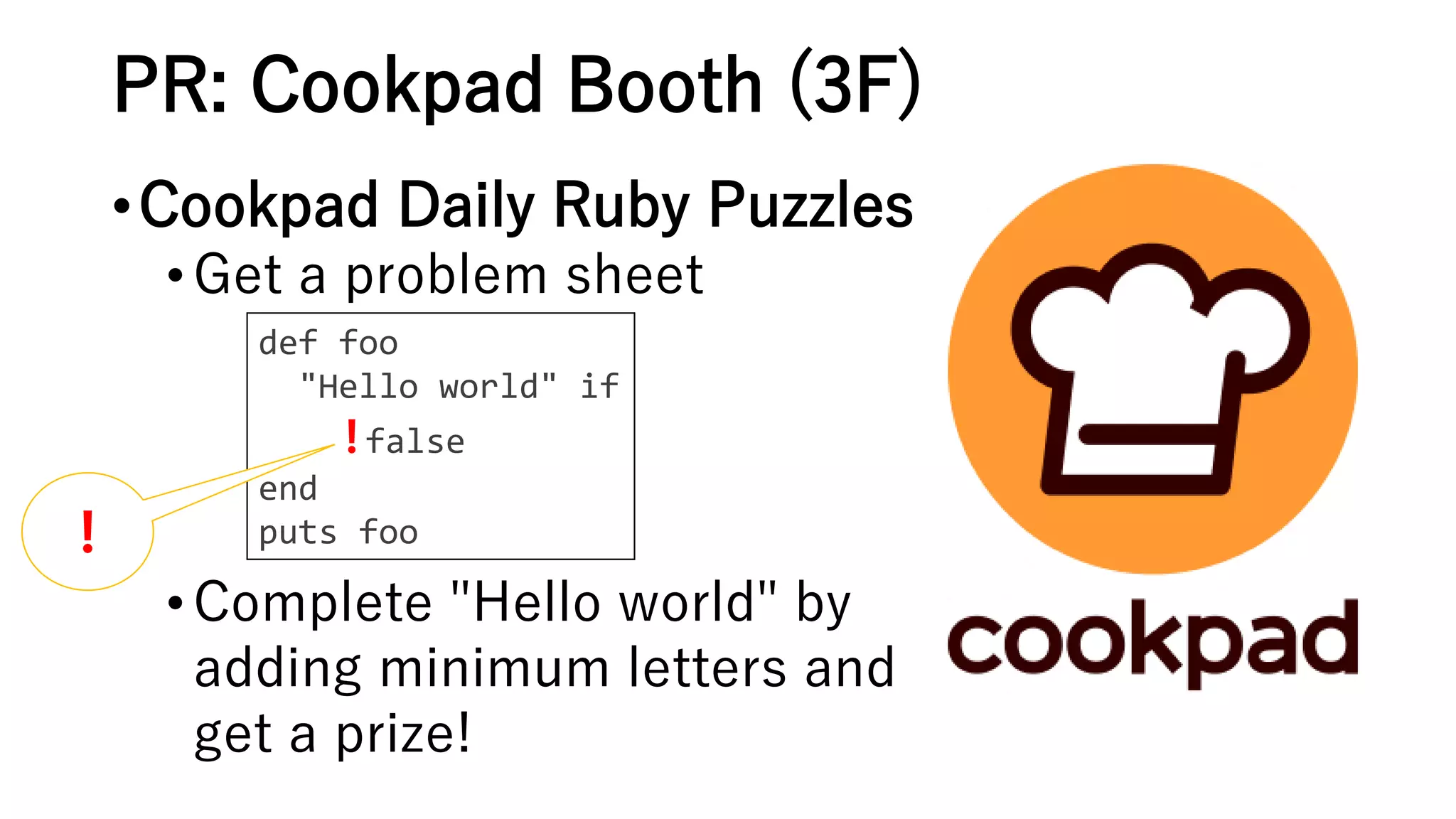
PR: Cookpad Booth (3F)
•Cookpad Daily Ruby Puzzles
•Get a problem sheet
•Complete "Hello world" by
adding minimum letters and
get a prize!
def foo
"Hello world" if
false
end
puts foo
def foo
"Hello world" if
!false
end
puts foo!
This talk is about "Type Profiler"
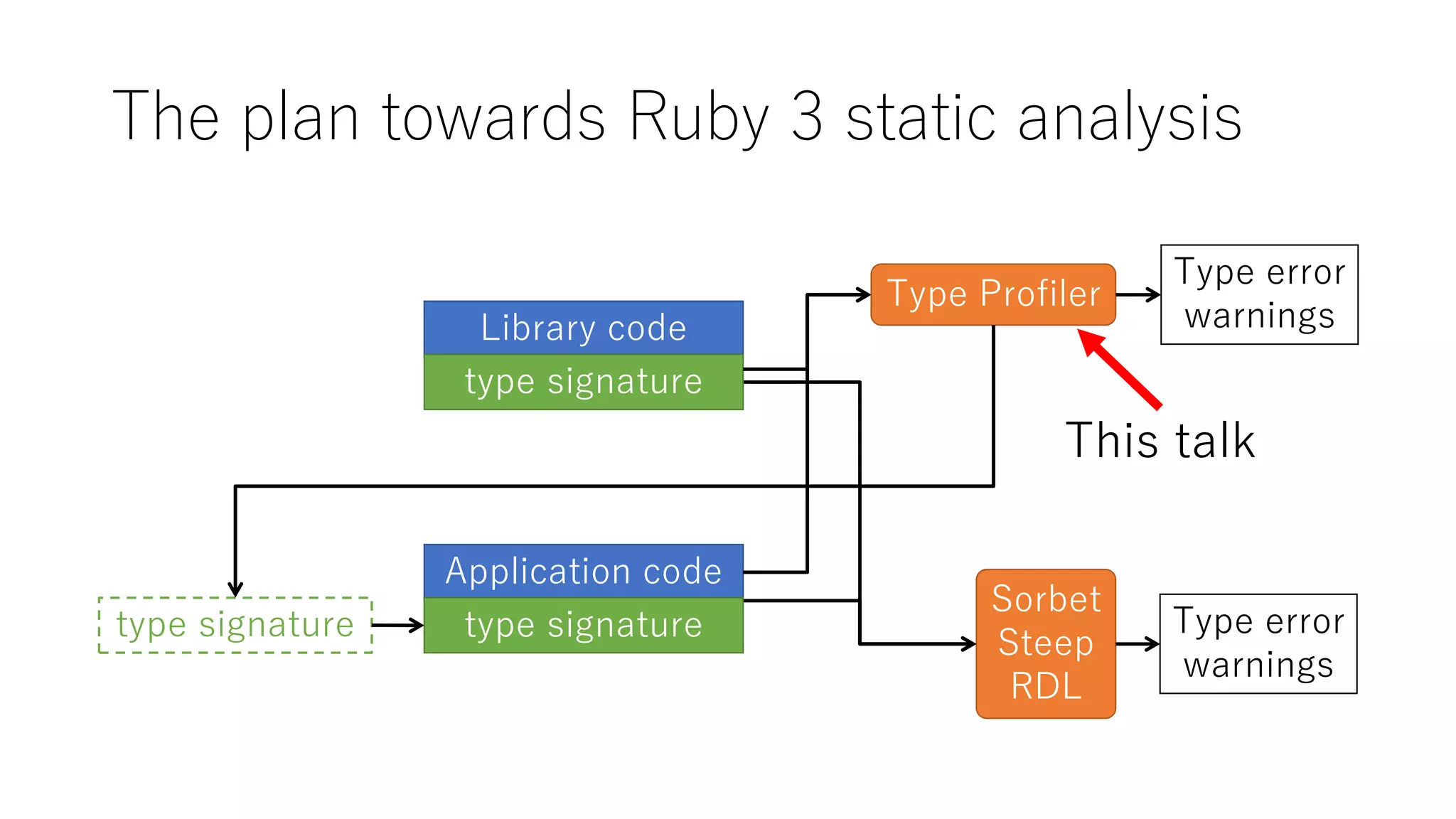
The plan towards Ruby 3 static analysis
Sorbet
Steep
RDL
Library code
type signature
Type error
warnings
Application code
type signaturetype signature
Type Profiler
Type error
warnings
This talk
This talk is about "Type Profiler"
•A type analyzer for Ruby 3
applicable to a non-annotated Ruby code
•Level-1 type checking
•Type signature prototyping
•Note: The analysis is not "sound"
•It may miss bugs and print wrong signature
Agenda
➔What "Type Profiler" is
•Demos
•Implementation
•Evaluation
•Conclusion
What Type Profiler is
•Target: A normal Ruby code
•No type signature/annotation required
•Objectives: Testing and understanding
•Testing: Warns possible errors of Ruby code
•Understanding: Prototypes type signature
Type Profiler for Testing
•Finds NoMethodError, TypeError, etc.
def foo(n)
if n < 10
n.timees {|x|
}
end
end
foo(42)
Type
Profiler
t.rb:3: [error] undefined method:
Integer#timees
Typo
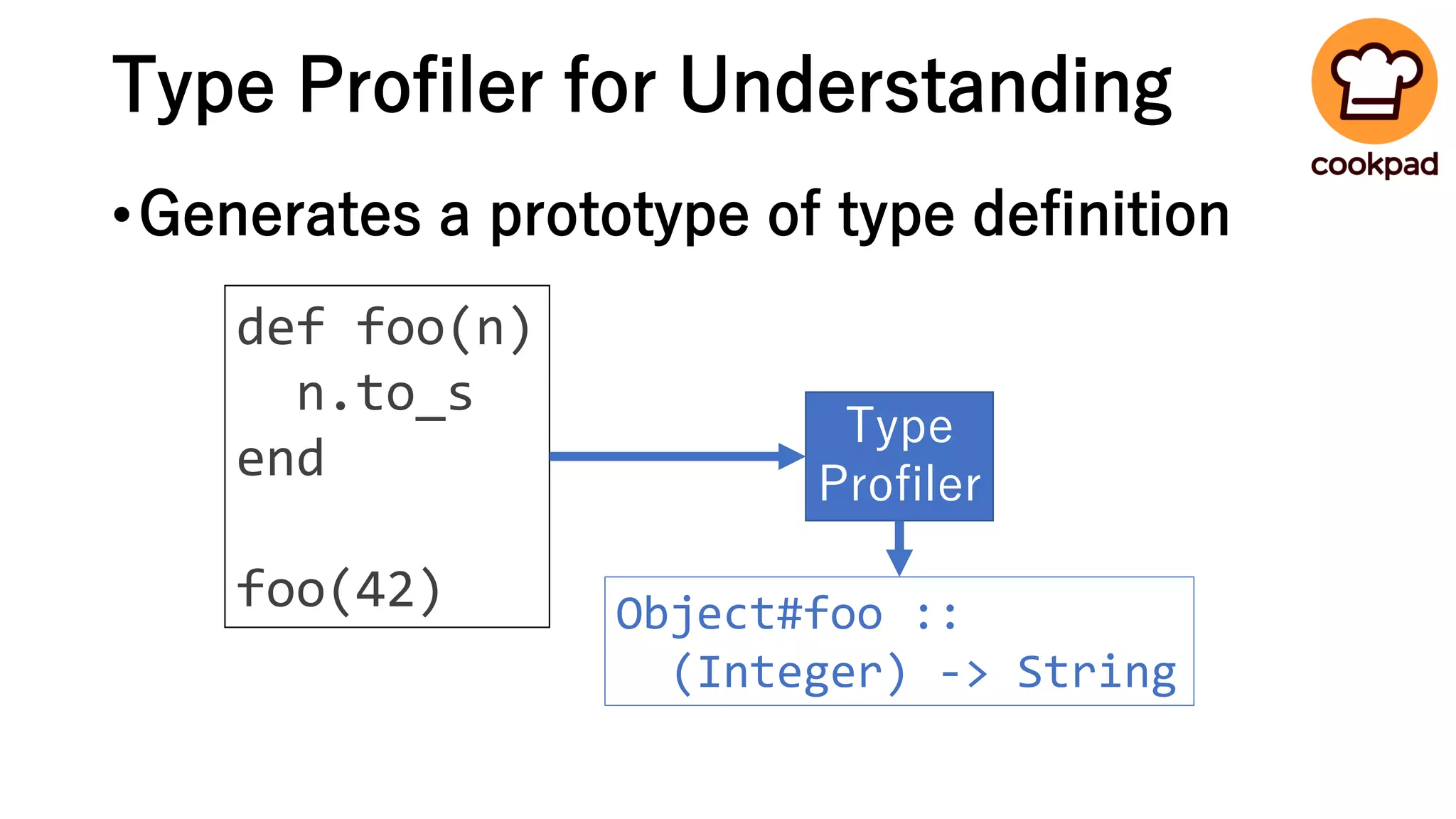
Type Profiler for Understanding
•Generates a prototype of type definition
def foo(n)
n.to_s
end
foo(42)
Type
Profiler
Object#foo ::
(Integer) -> String
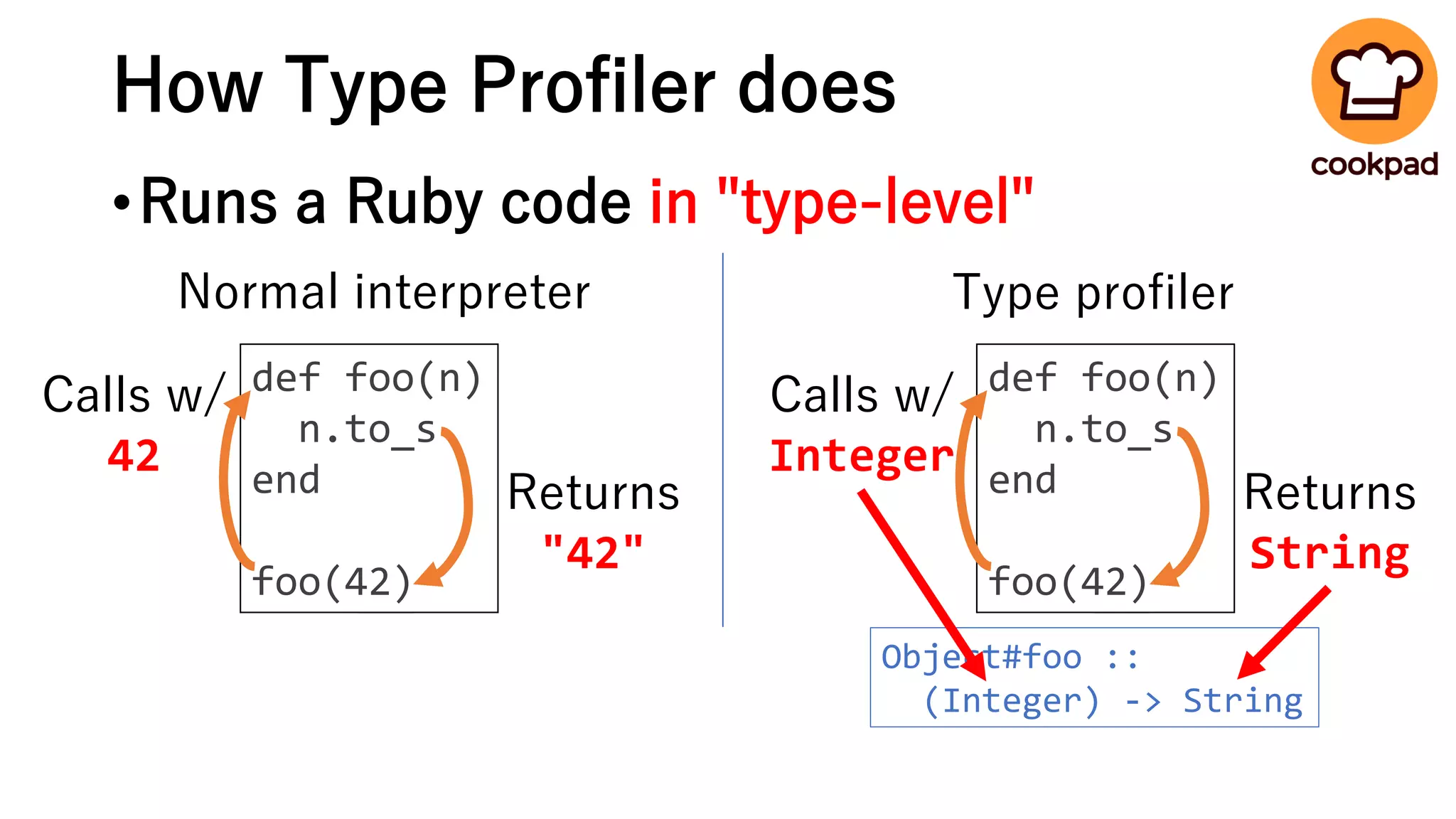
How Type Profiler does
•Runs a Ruby code in "type-level"
Normal interpreter
def foo(n)
n.to_s
end
foo(42)
Calls w/
42
Returns
"42"
Type profiler
def foo(n)
n.to_s
end
foo(42)
Calls w/
Integer
Returns
String
Object#foo ::
(Integer) -> String
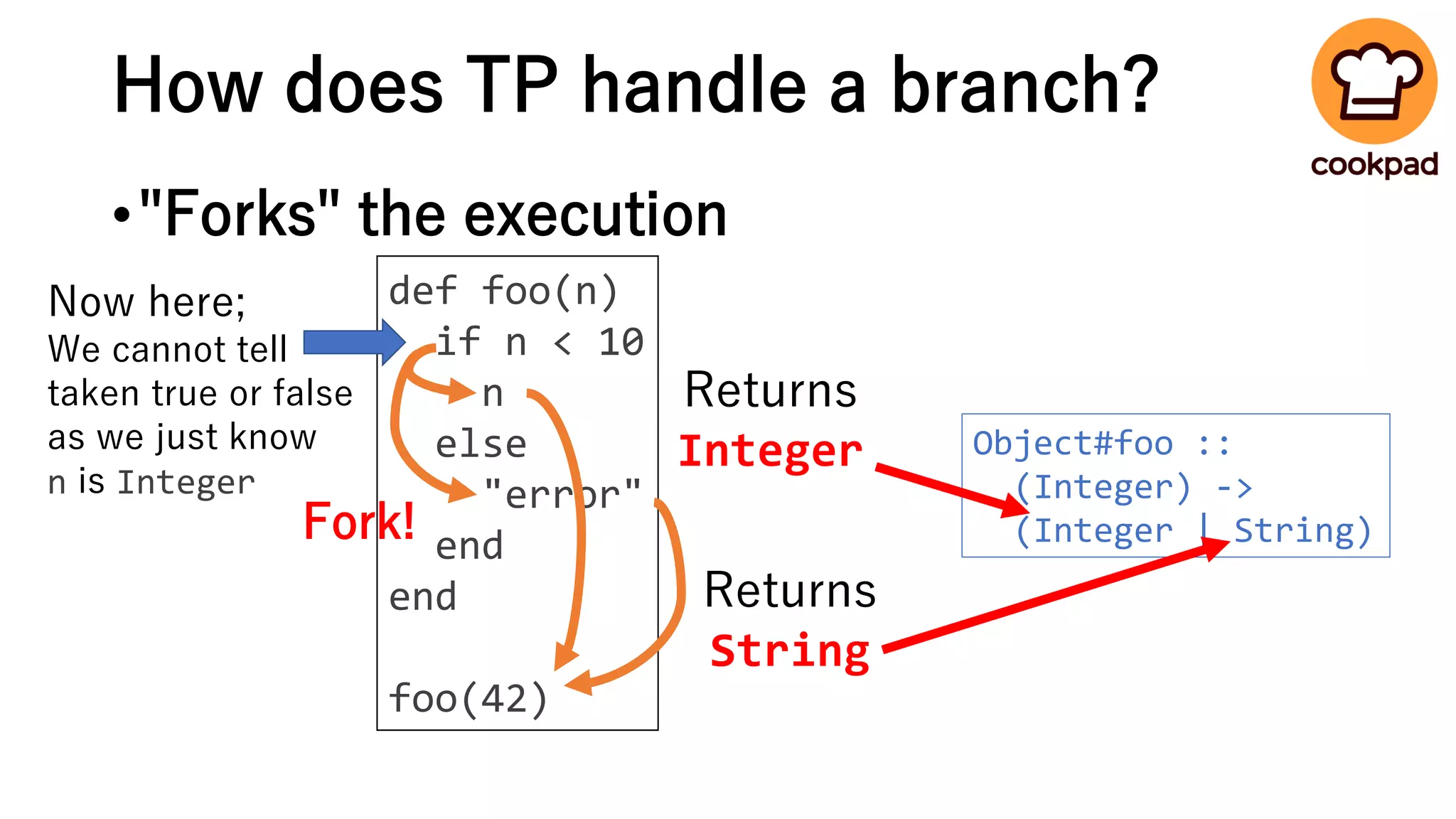
How does TP handle a branch?
•"Forks" the execution
def foo(n)
if n < 10
n
else
"error"
end
end
foo(42)
Fork!
Now here;
We cannot tell
taken true or false
as we just know
n is Integer
Returns
Integer
Returns
String
Object#foo ::
(Integer) ->
(Integer | String)
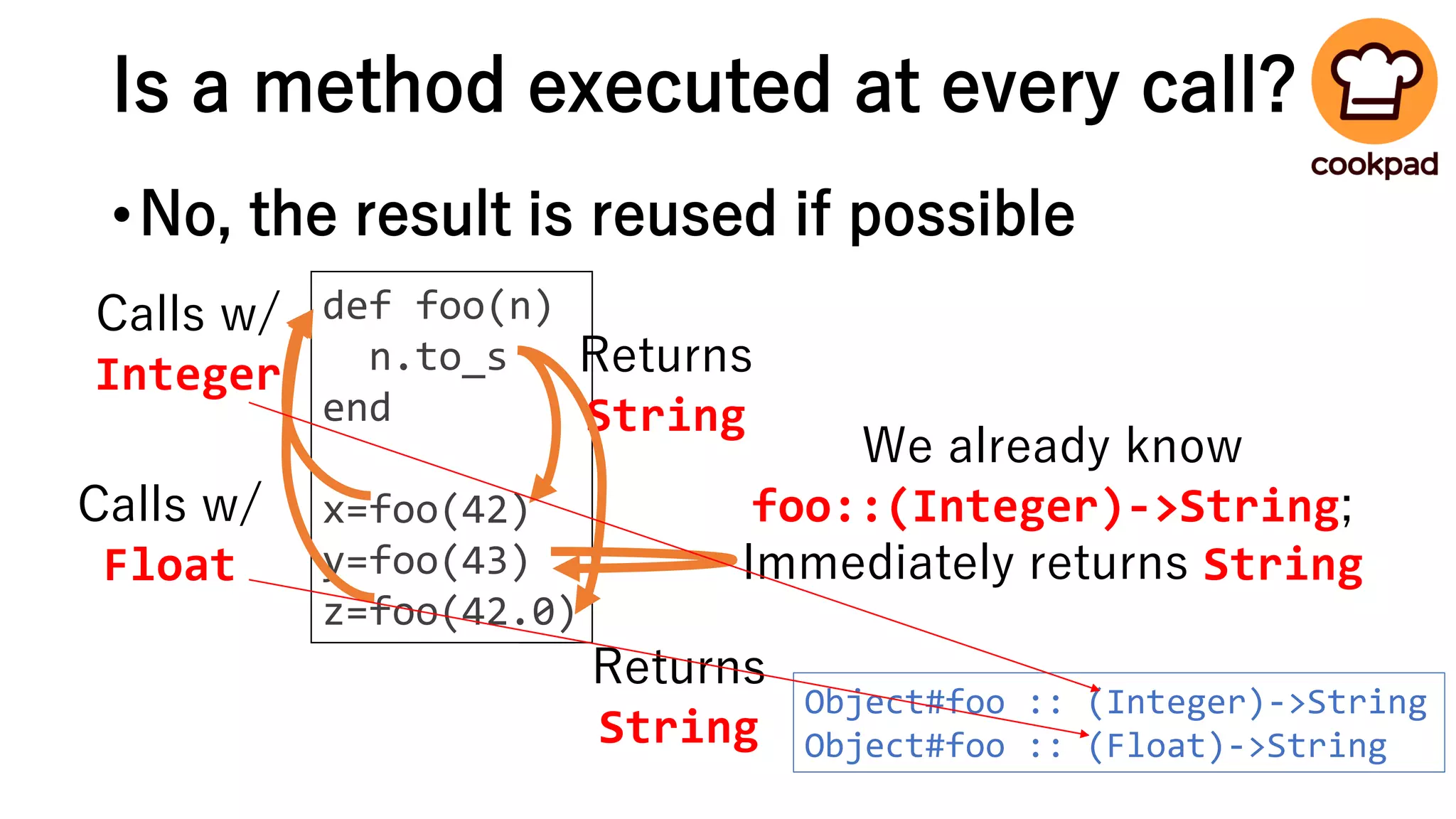
Is a method executed at every call?
•No, the result is reused if possible
def foo(n)
n.to_s
end
x=foo(42)
y=foo(43)
z=foo(42.0)
Calls w/
Integer Returns
String
We already know
foo::(Integer)->String;
Immediately returns String
Calls w/
Float
Returns
String
Object#foo :: (Integer)->String
Object#foo :: (Float)->String
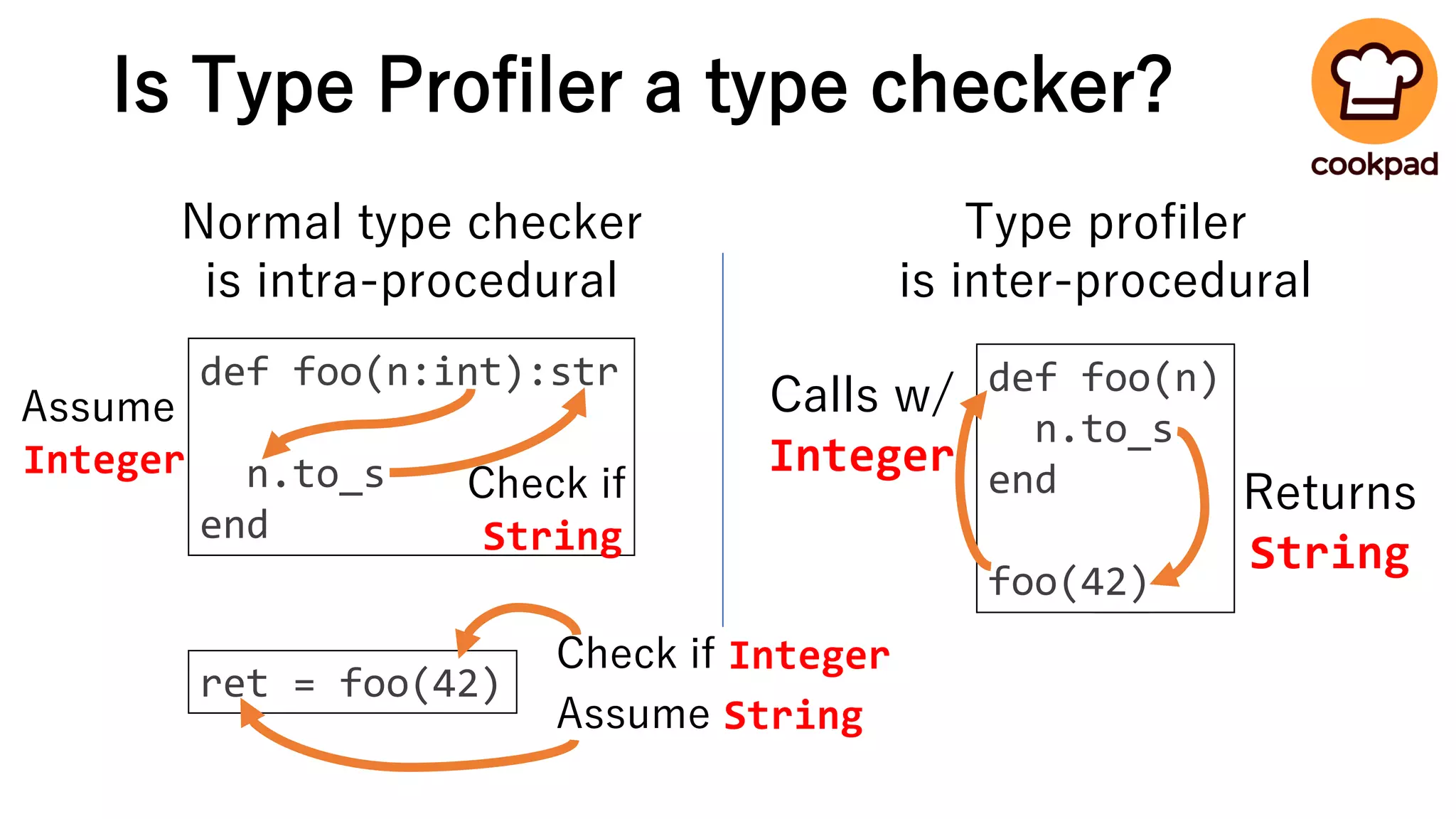
Is Type Profiler a type checker?
Normal type checker
is intra-procedural
def foo(n:int):str
n.to_s
end
ret = foo(42)
Assume
Integer
Check if
String
Check if Integer
Assume String
Type profiler
is inter-procedural
def foo(n)
n.to_s
end
foo(42)
Calls w/
Integer
Returns
String
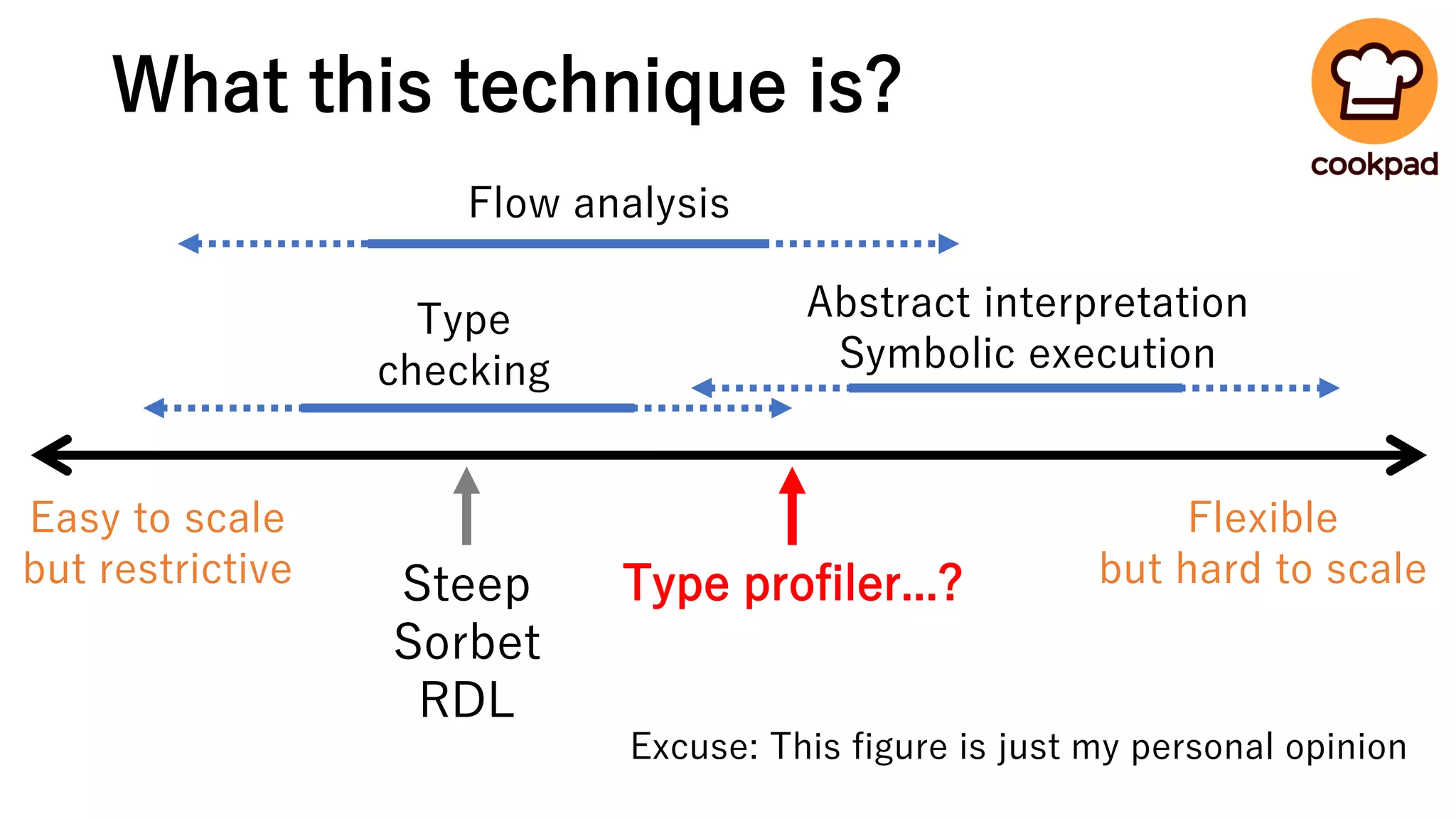
What this technique is?
Easy to scale
but restrictive
Flexible
but hard to scale
Type
checking
Abstract interpretation
Symbolic execution
Type profiler...?
Flow analysis
Steep
Sorbet
RDL
Excuse: This figure is just my personal opinion
Agenda
•What "Type Profiler" is
➔Demos (and Problems)
•Implementation
•Evaluation
•Conclusion
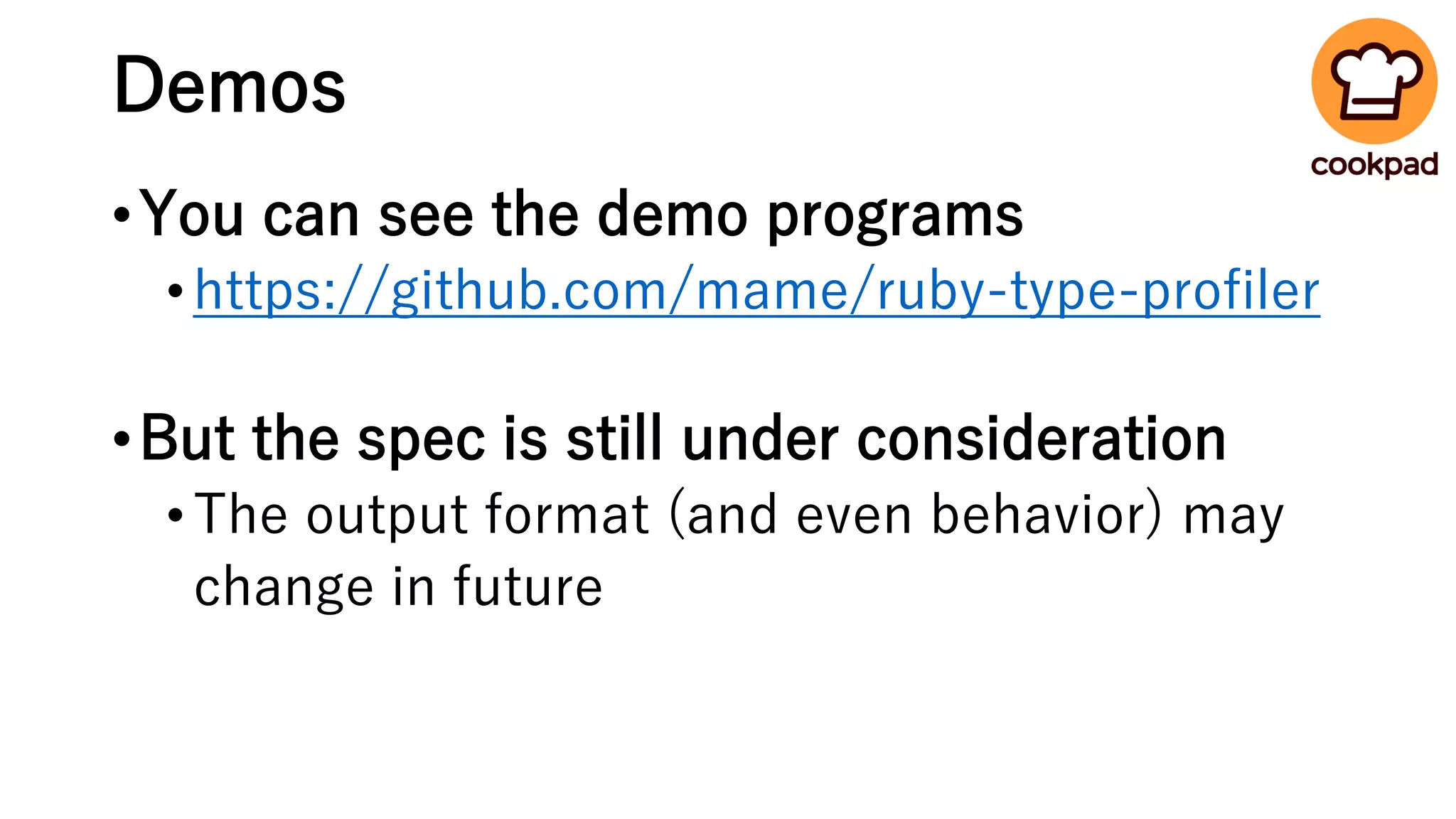
Demos
•You can see the demo programs
•https://github.com/mame/ruby-type-profiler
•But the spec is still under consideration
•The output format (and even behavior) may
change in future
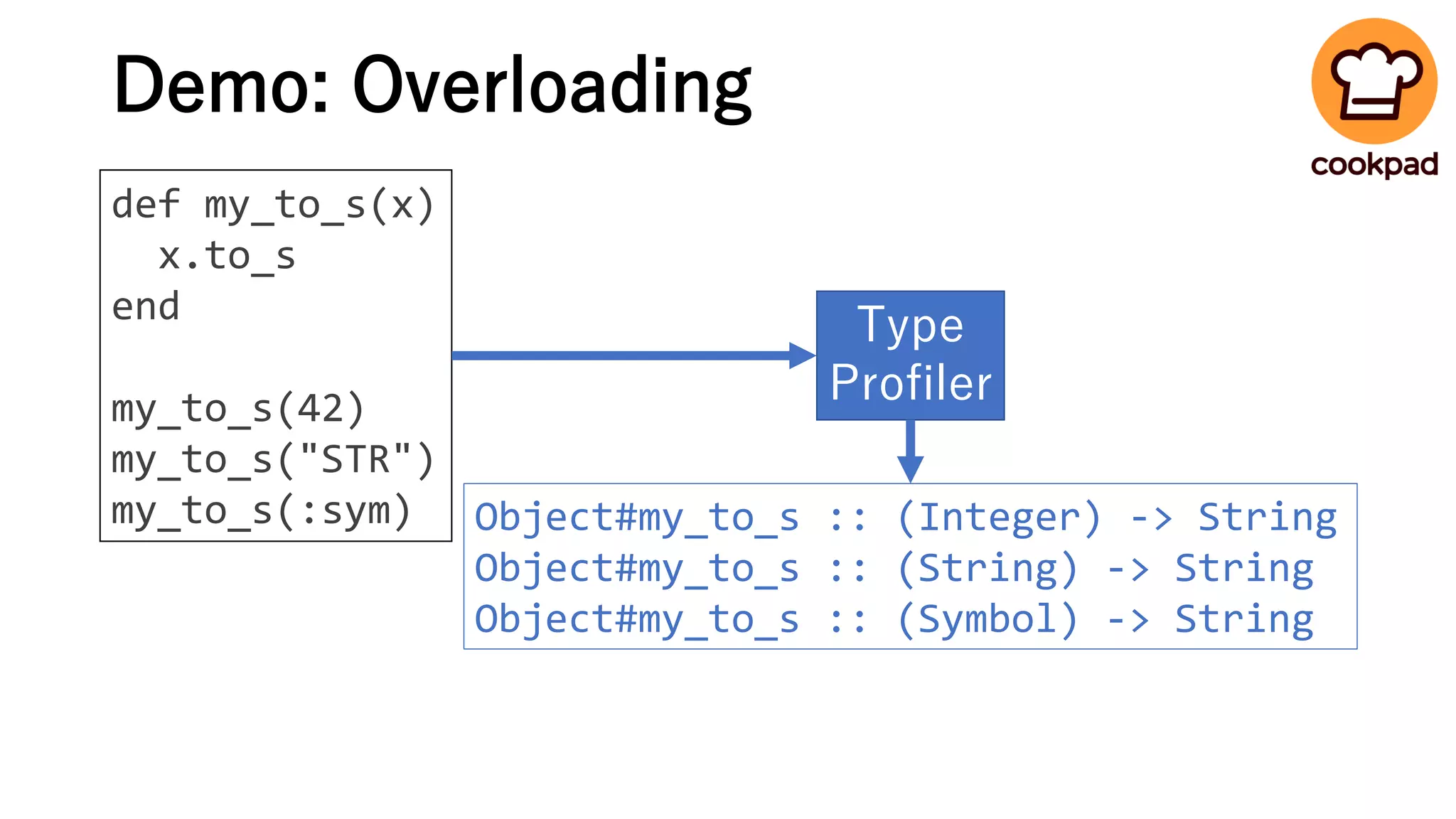
Demo: Overloading
def my_to_s(x)
x.to_s
end
my_to_s(42)
my_to_s("STR")
my_to_s(:sym)
Type
Profiler
Object#my_to_s :: (Integer) -> String
Object#my_to_s :: (String) -> String
Object#my_to_s :: (Symbol) -> String
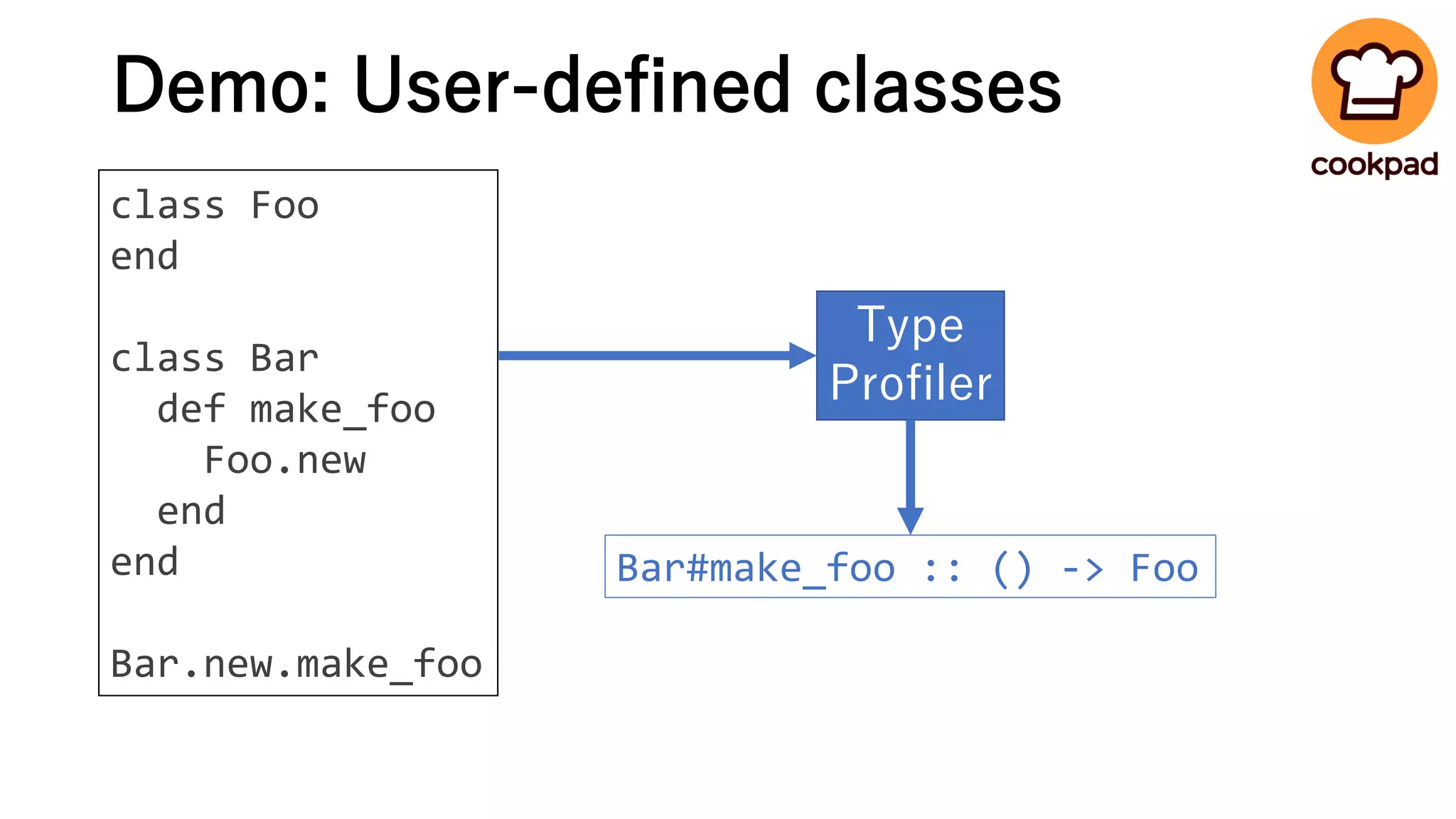
Demo: User-defined classes
class Foo
end
class Bar
def make_foo
Foo.new
end
end
Bar.new.make_foo
Type
Profiler
Bar#make_foo :: () -> Foo
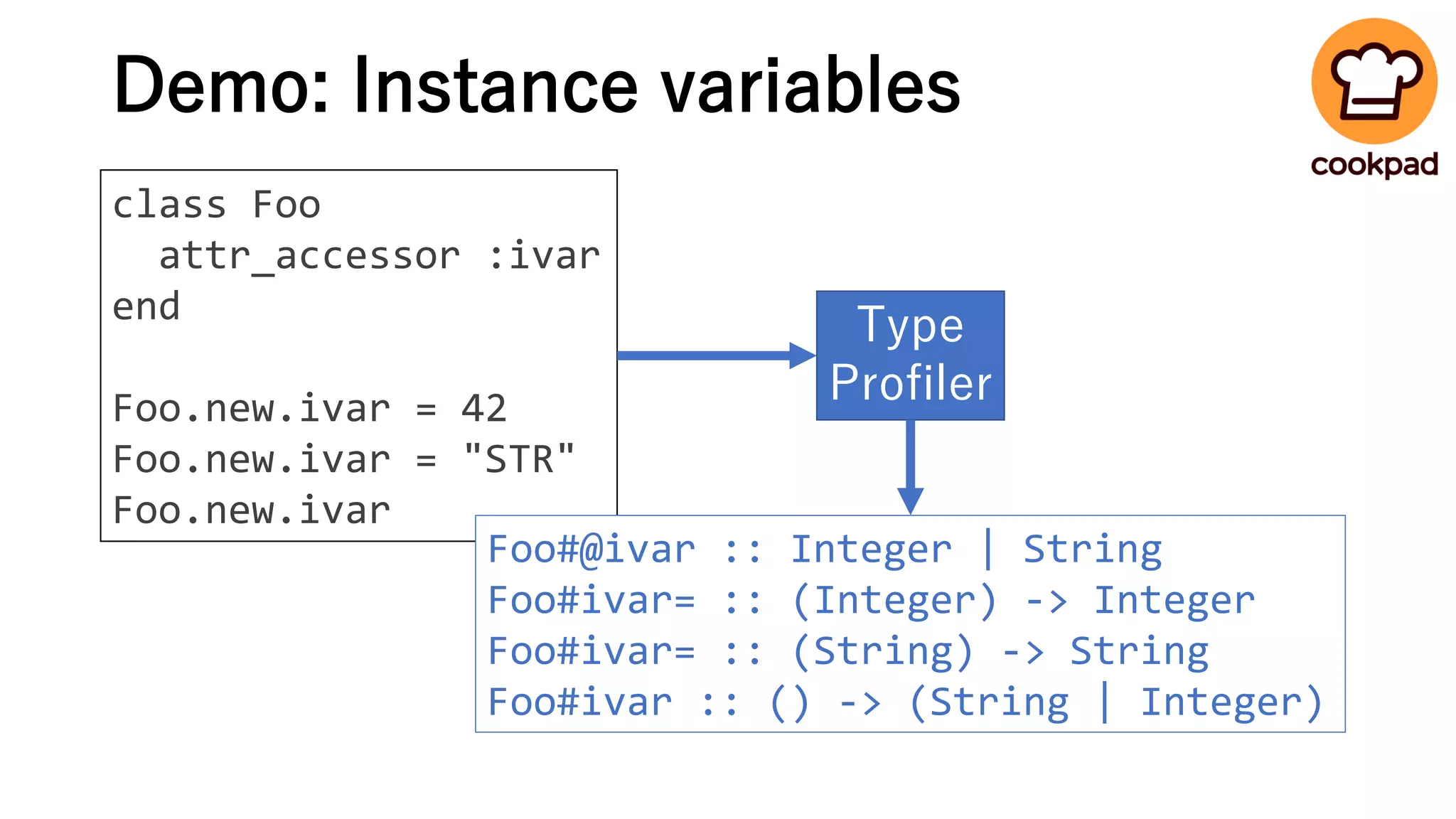
Demo: Instance variables
class Foo
attr_accessor :ivar
end
Foo.new.ivar = 42
Foo.new.ivar = "STR"
Foo.new.ivar
Type
Profiler
Foo#@ivar :: Integer | String
Foo#ivar= :: (Integer) -> Integer
Foo#ivar= :: (String) -> String
Foo#ivar :: () -> (String | Integer)
Demo: Block
def foo(x)
yield 42
end
s = "str"
foo(1) do |x|
s
end
Type
Profiler
Object#foo ::
(Integer, &Proc[(Integer) -> String])
-> String
Demo: Tuple-like array
def swap(a)
[a[1], a[0]]
end
a = [42, "str"]
swap(a)
Type
Profiler
Object#swap ::
([Integer, String])
-> [String, Integer]
Demo: Sequence-like array
def foo
[1] + ["str"]
end
foo
Type
Profiler
Object#foo ::
Array[Integer | String]
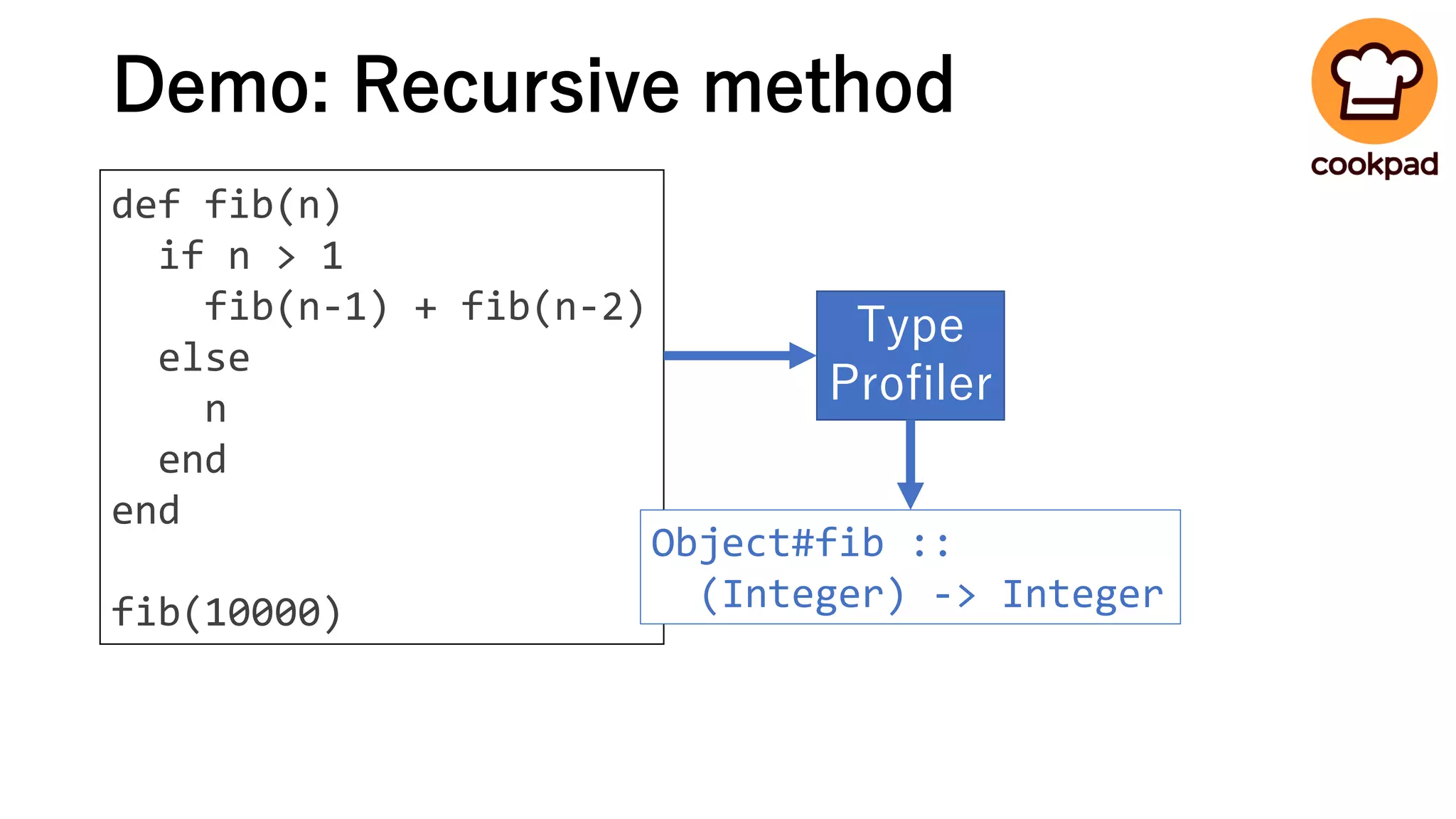
Demo: Recursive method
def fib(n)
if n > 1
fib(n-1) + fib(n-2)
else
n
end
end
fib(10000)
Type
Profiler
Object#fib ::
(Integer) -> Integer
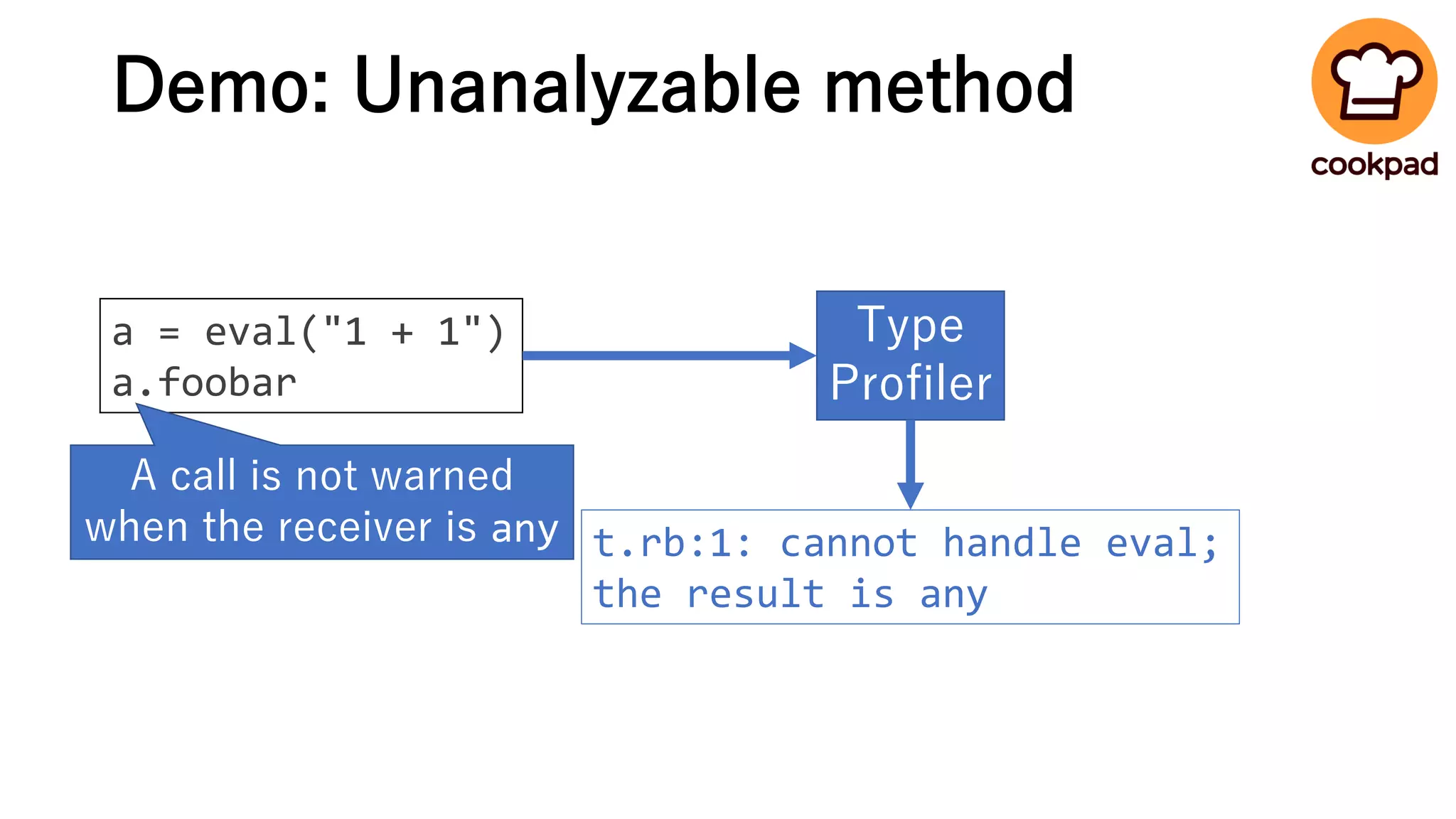
Demo: Unanalyzable method
a = eval("1 + 1")
a.foobar
Type
Profiler
t.rb:1: cannot handle eval;
the result is any
A call is not warned
when the receiver is any
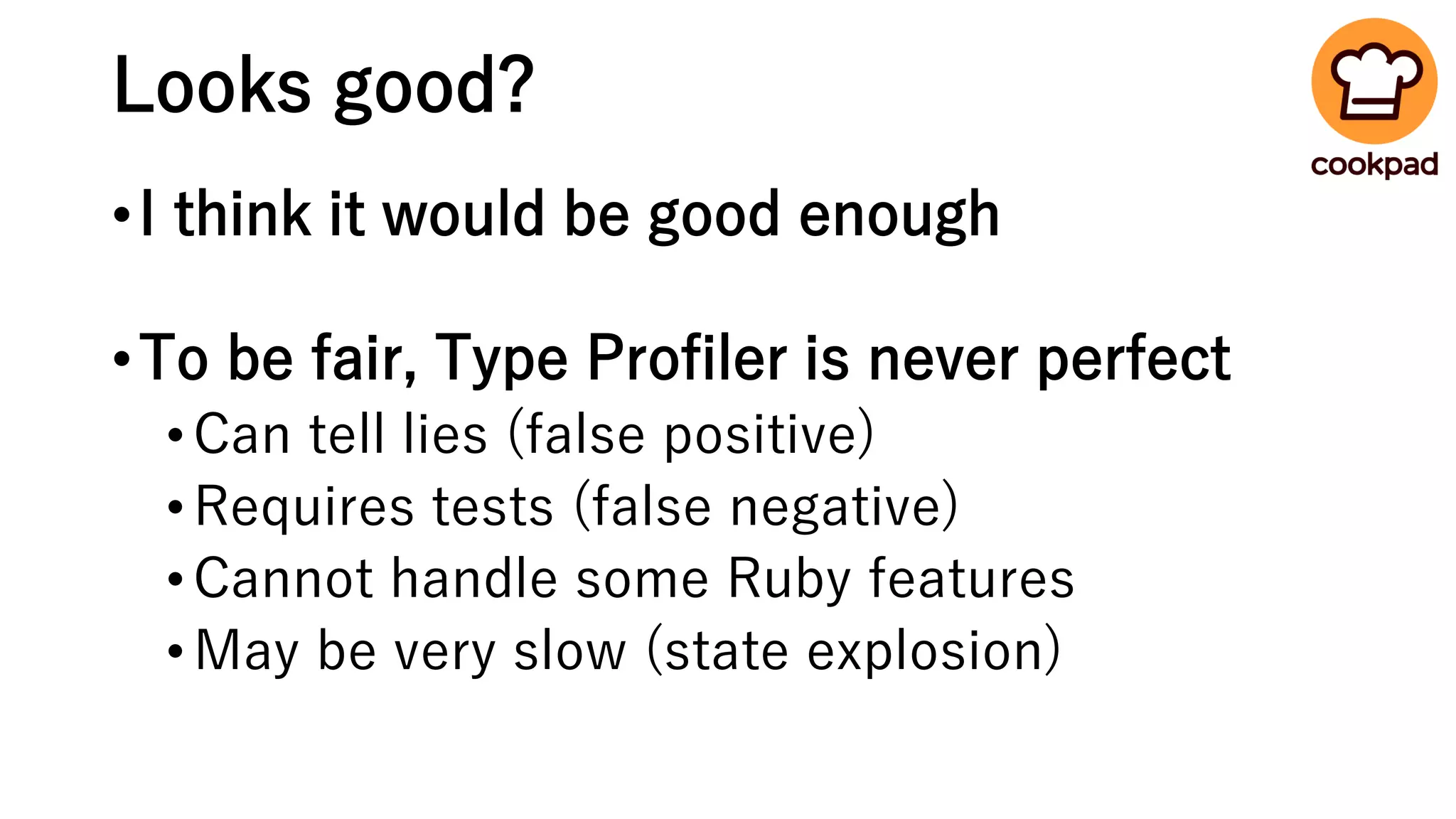
Looks good?
•I think it would be good enough
•To be fair, Type Profiler is never perfect
•Can tell lies (false positive)
•Requires tests (false negative)
•Cannot handle some Ruby features
•May be very slow (state explosion)
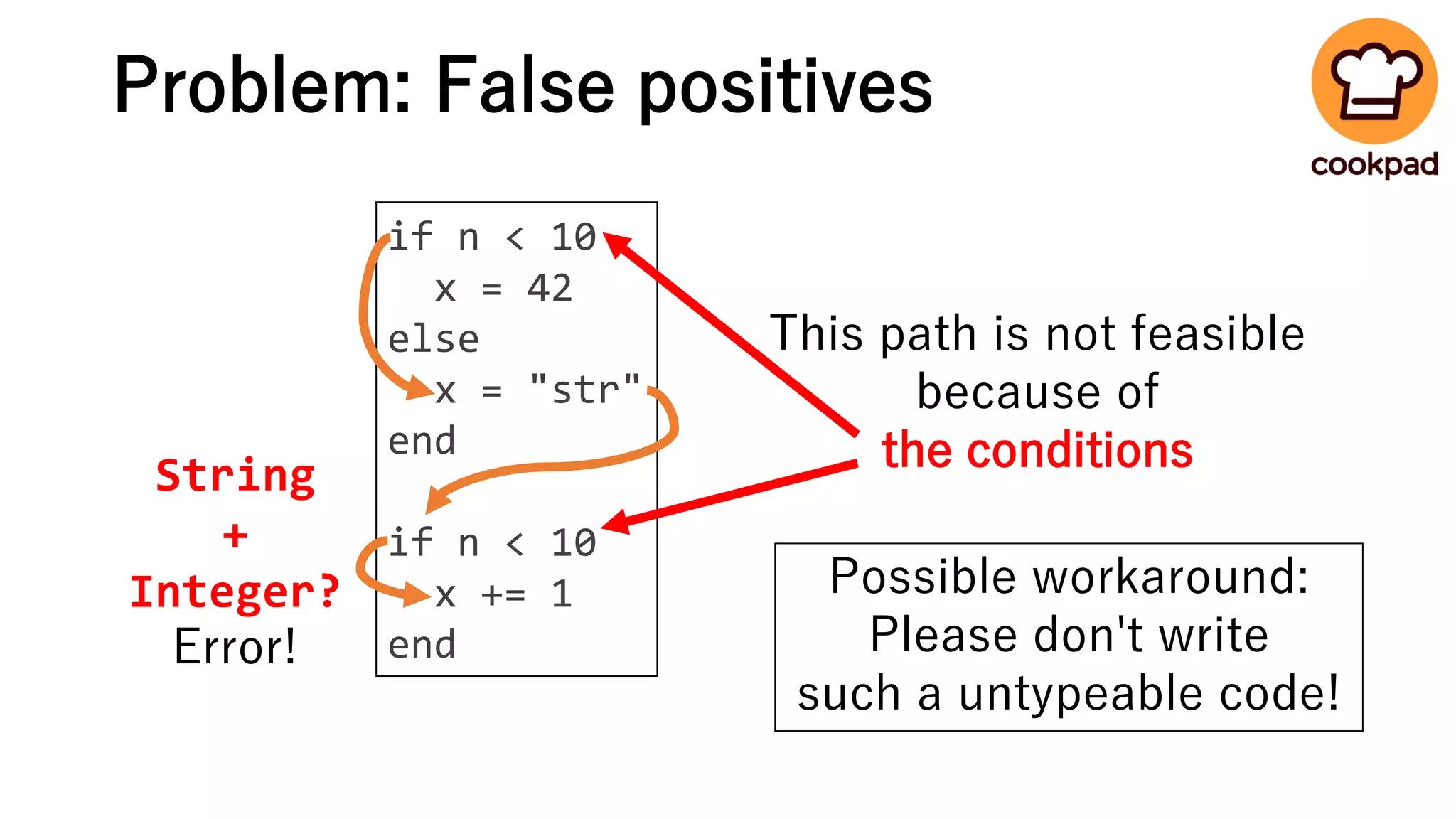
Problem: False positives
if n < 10
x = 42
else
x = "str"
end
if n < 10
x += 1
end
String
+
Integer?
Error!
This path is not feasible
because of
the conditions
Possible workaround:
Please don't write
such a untypeable code!
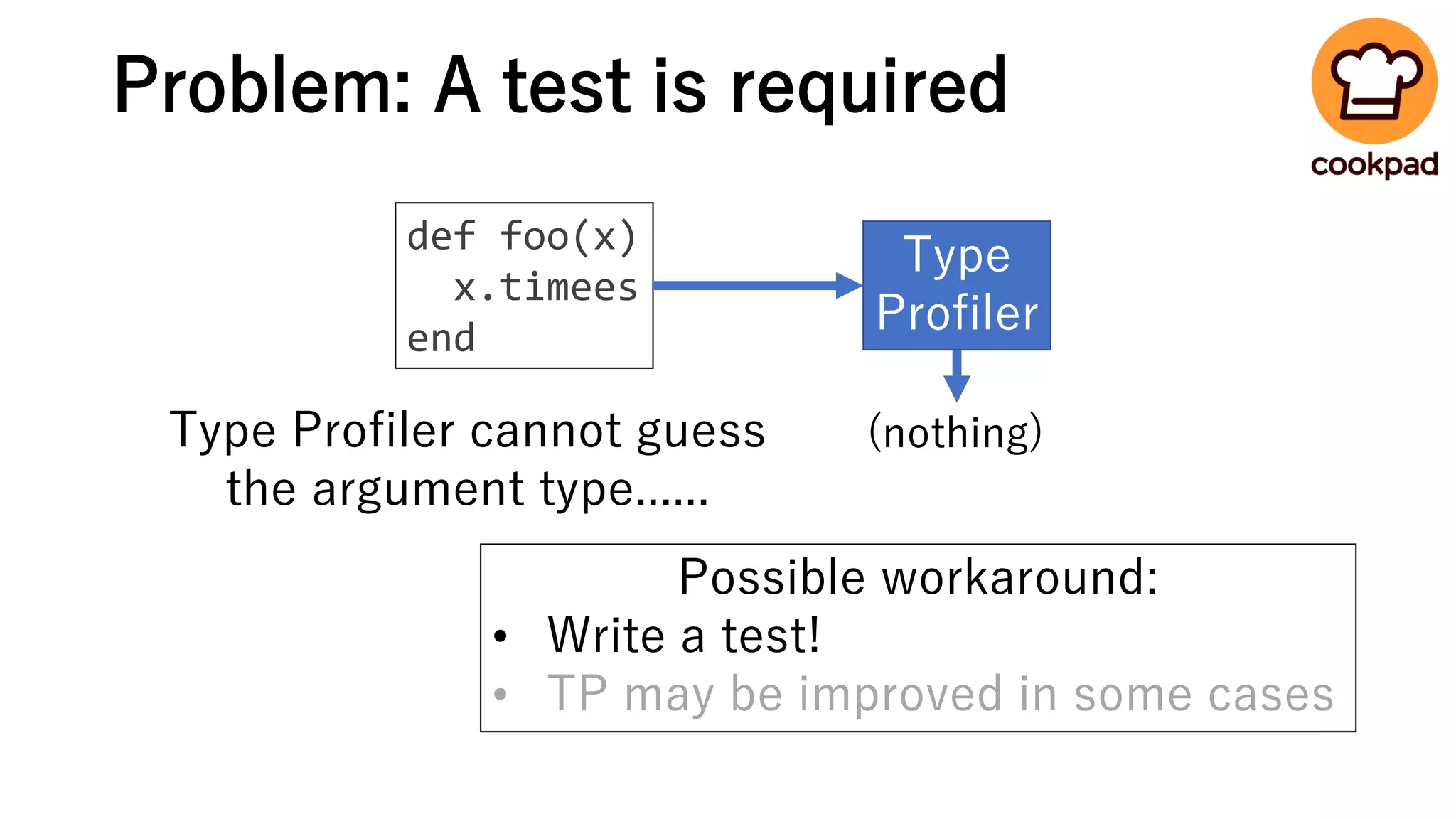
Problem: A test is required
Possible workaround:
• Write a test!
• TP may be improved in some cases
def foo(x)
x.timees
end
Type
Profiler
(nothing)Type Profiler cannot guess
the argument type......
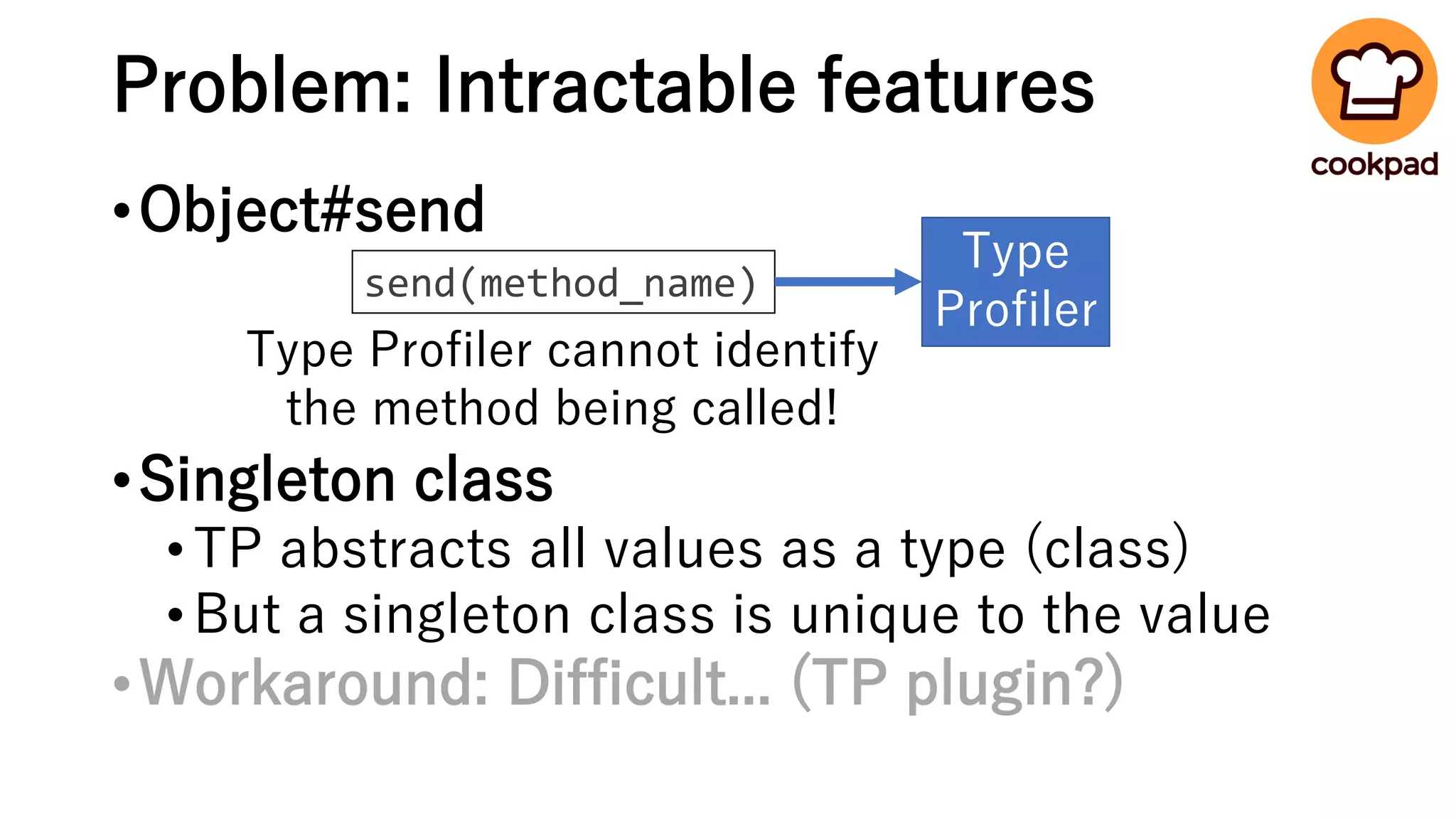
Problem: Intractable features
•Object#send
•Singleton class
•TP abstracts all values as a type (class)
•But a singleton class is unique to the value
•Workaround: Difficult... (TP plugin?)
send(method_name)
Type
Profiler
Type Profiler cannot identify
the method being called!
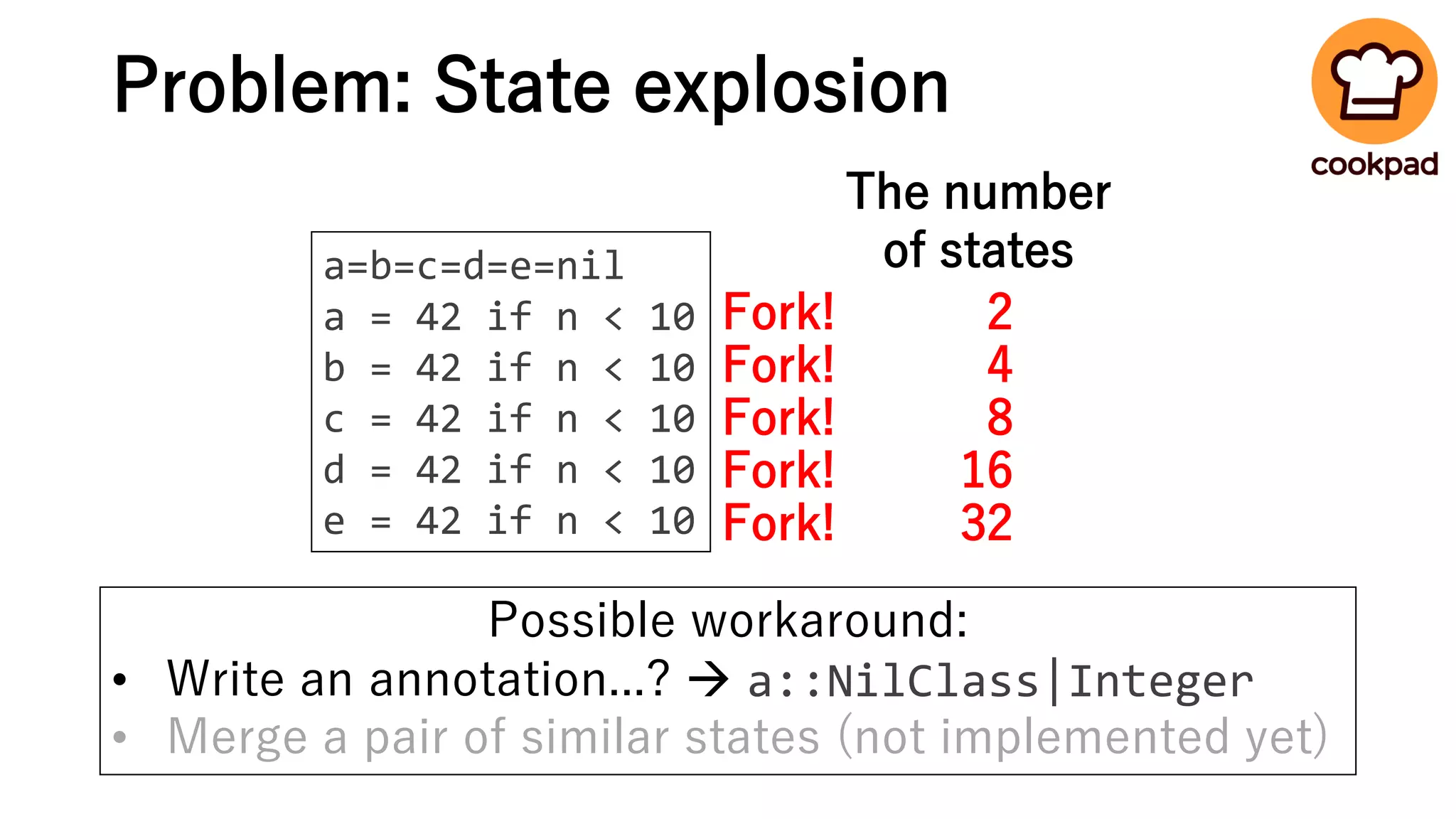
Problem: State explosion
a=b=c=d=e=nil
a = 42 if n < 10
b = 42 if n < 10
c = 42 if n < 10
d = 42 if n < 10
e = 42 if n < 10
Fork!
Fork!
Fork!
Fork!
Fork!
2
4
8
16
32
The number
of states
Possible workaround:
• Write an annotation...? → a::NilClass|Integer
• Merge a pair of similar states (not implemented yet)
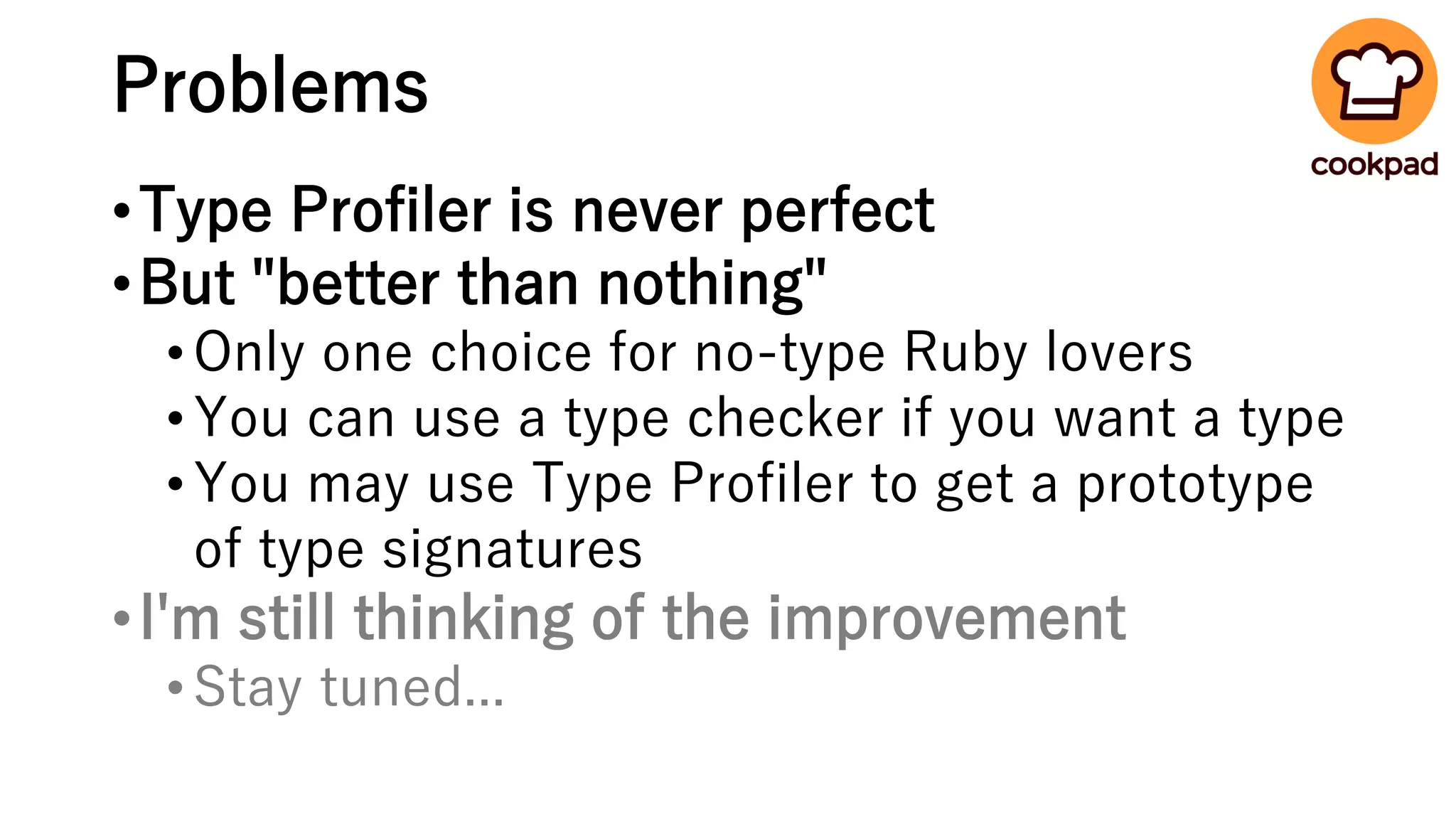
Problems
•Type Profiler is never perfect
•But "better than nothing"
•Only one choice for no-type Ruby lovers
•You can use a type checker if you want a type
•You may use Type Profiler to get a prototype
of type signatures
•I'm still thinking of the improvement
•Stay tuned...
Agenda
•What "Type Profiler" is
•Demos and Problems
➔Implementation
•Evaluation
•Conclusion
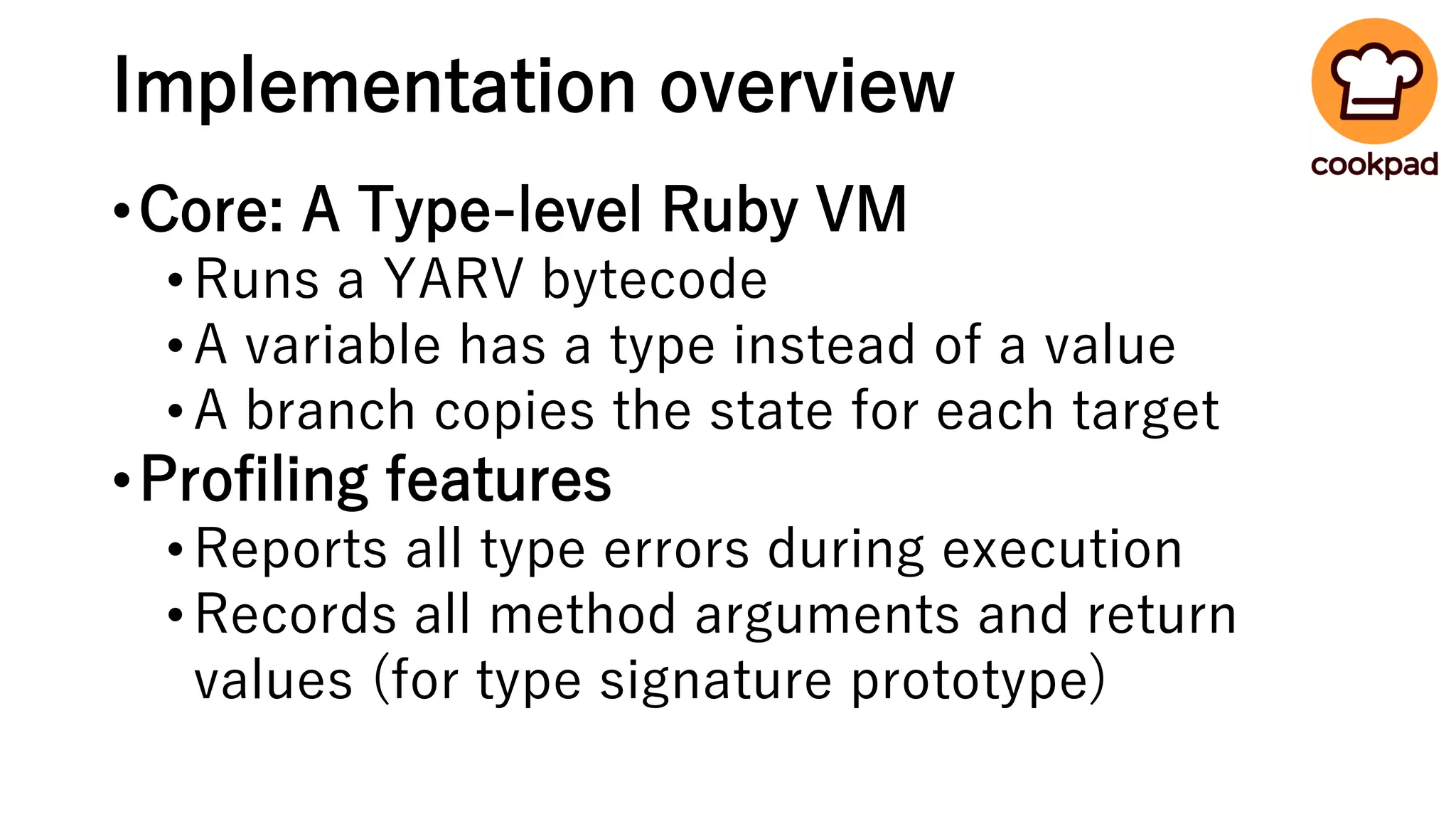
Implementation overview
•Core: A Type-level Ruby VM
•Runs a YARV bytecode
•A variable has a type instead of a value
•A branch copies the state for each target
•Profiling features
•Reports all type errors during execution
•Records all method arguments and return
values (for type signature prototype)
Some implementation details
•State enumeration
•Method return
•Three method types
State enumeration
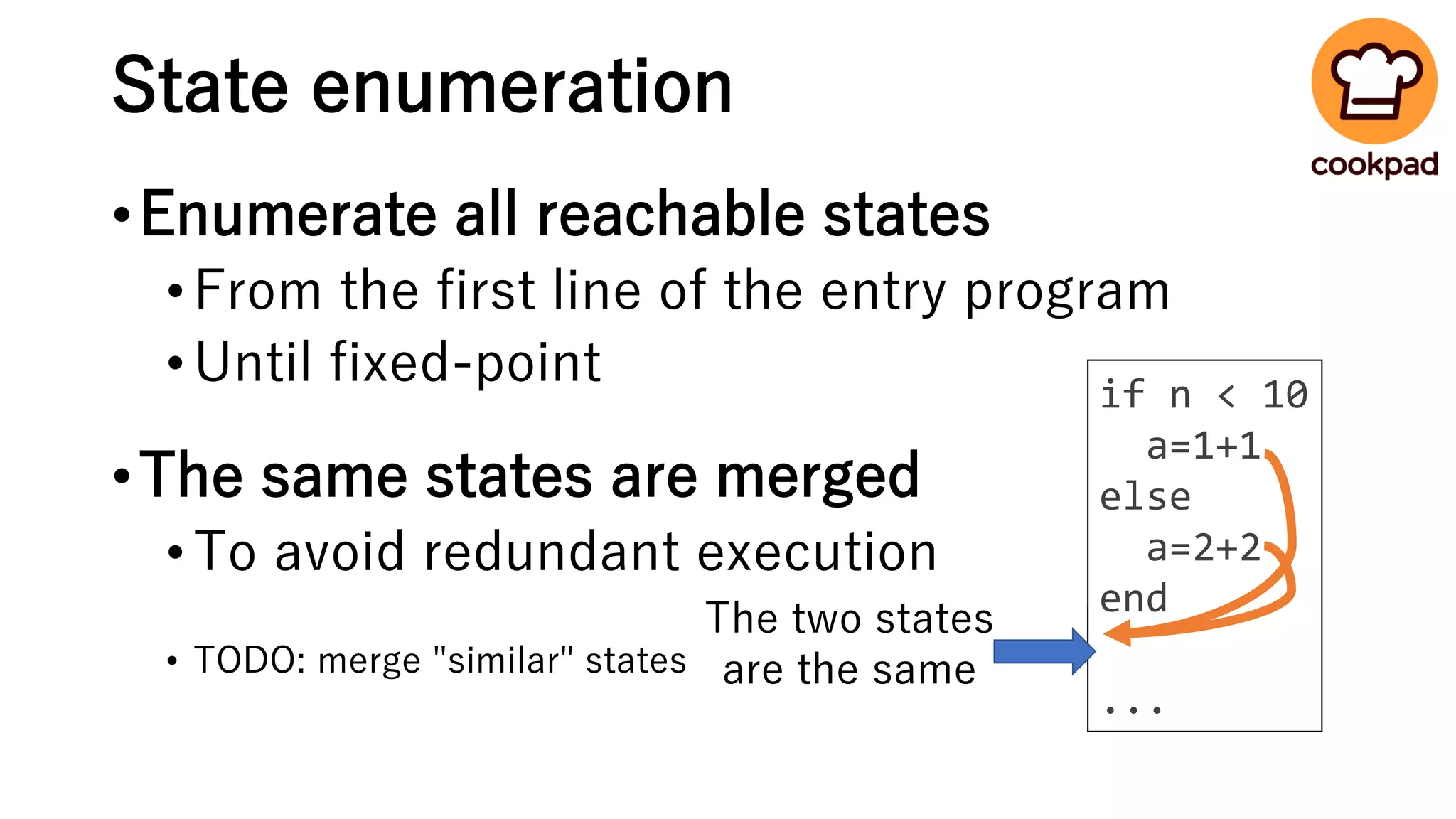
•Enumerate all reachable states
•From the first line of the entry program
•Until fixed-point
•The same states are merged
•To avoid redundant execution
• TODO: merge "similar" states
if n < 10
a=1+1
else
a=2+2
end
...
The two states
are the same
Method return
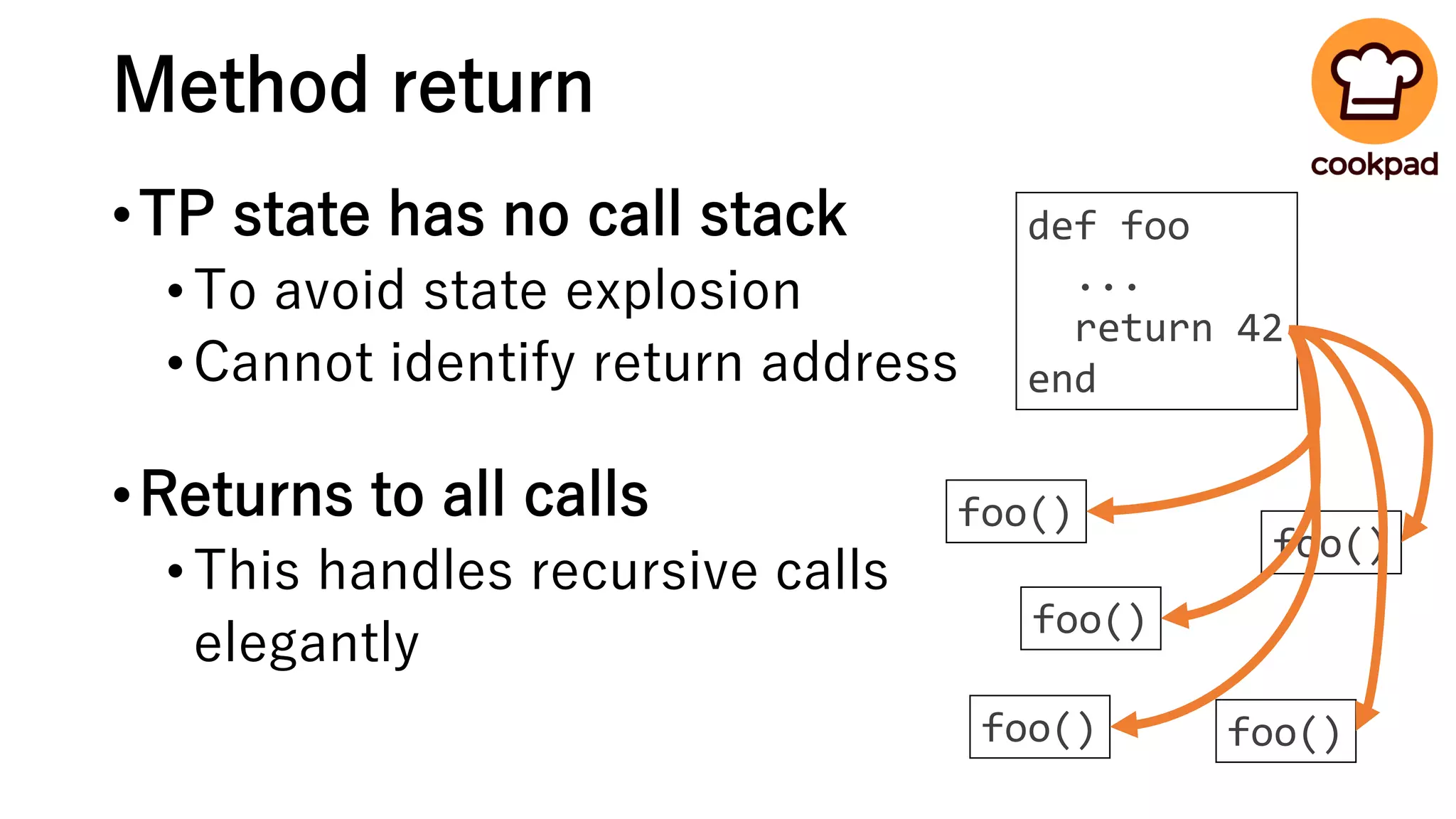
•TP state has no call stack
•To avoid state explosion
•Cannot identify return address
•Returns to all calls
•This handles recursive calls
elegantly
def foo
...
return 42
end
foo()
foo()
foo()
foo()foo()
Three method types
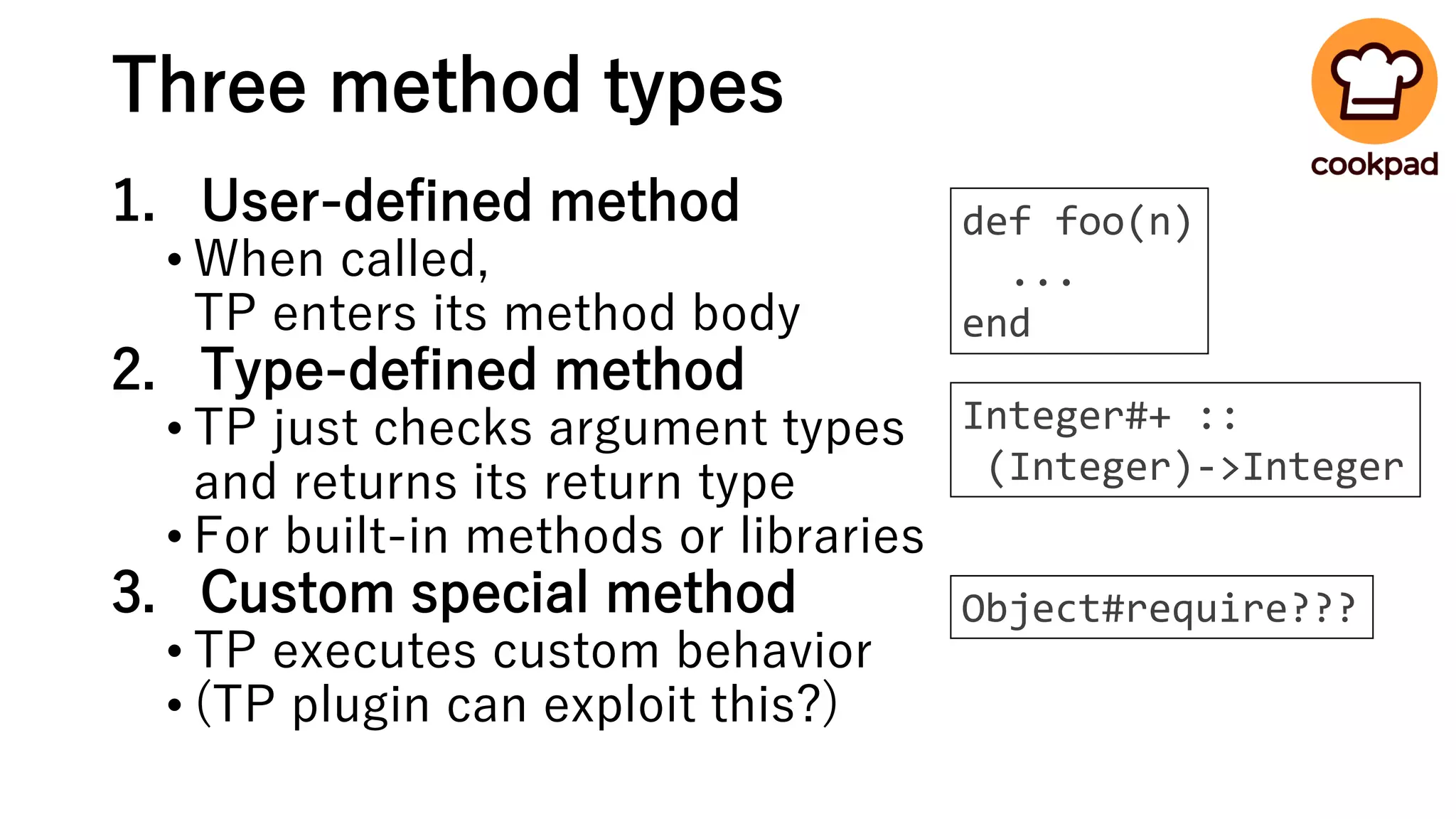
1. User-defined method
• When called,
TP enters its method body
2. Type-defined method
• TP just checks argument types
and returns its return type
• For built-in methods or libraries
3. Custom special method
• TP executes custom behavior
• (TP plugin can exploit this?)
def foo(n)
...
end
Integer#+ ::
(Integer)->Integer
Object#require???
Agenda
•What "Type Profiler" is
•Demos and Problems
•Implementation
➔(Very preliminary) Evaluation
•Conclusion
Excuse: TP is very preliminary...
•Currently supports
• Basic language features
• Limited built-in classes (shown in Demos)
•No-support-yet
• Almost all built-in classes including Hash
• Complex arguments (optional, rest, keywords)
• Exceptions
• Modules (Mix-in)
• etc etc.
Experiments
•Experiment 1: Self Type-profiling
•Experiment 2: Type-profiling optcarrot
Experiment 1: Self-profiling
•Apply Type Profiler to itself
•TP statistics: 2167 LOC, 221 methods
•Quantitative result:
•Reached 91 methods in 10 minutes (!)
•Qualitative result: Found an actual bug
•TP said "a method receives NilClass"
•It is not intended, and turned out a bug
Why many methods not reached?
•Because of not-implemented-yet features
•For example, Array#<< is not implemented
•Some methods are defined but unused
•Idea: virtually call all methods with "any"
arguments?
a = []
a << Foo.new
a[0].bar
Foo#bar
cannot be reached
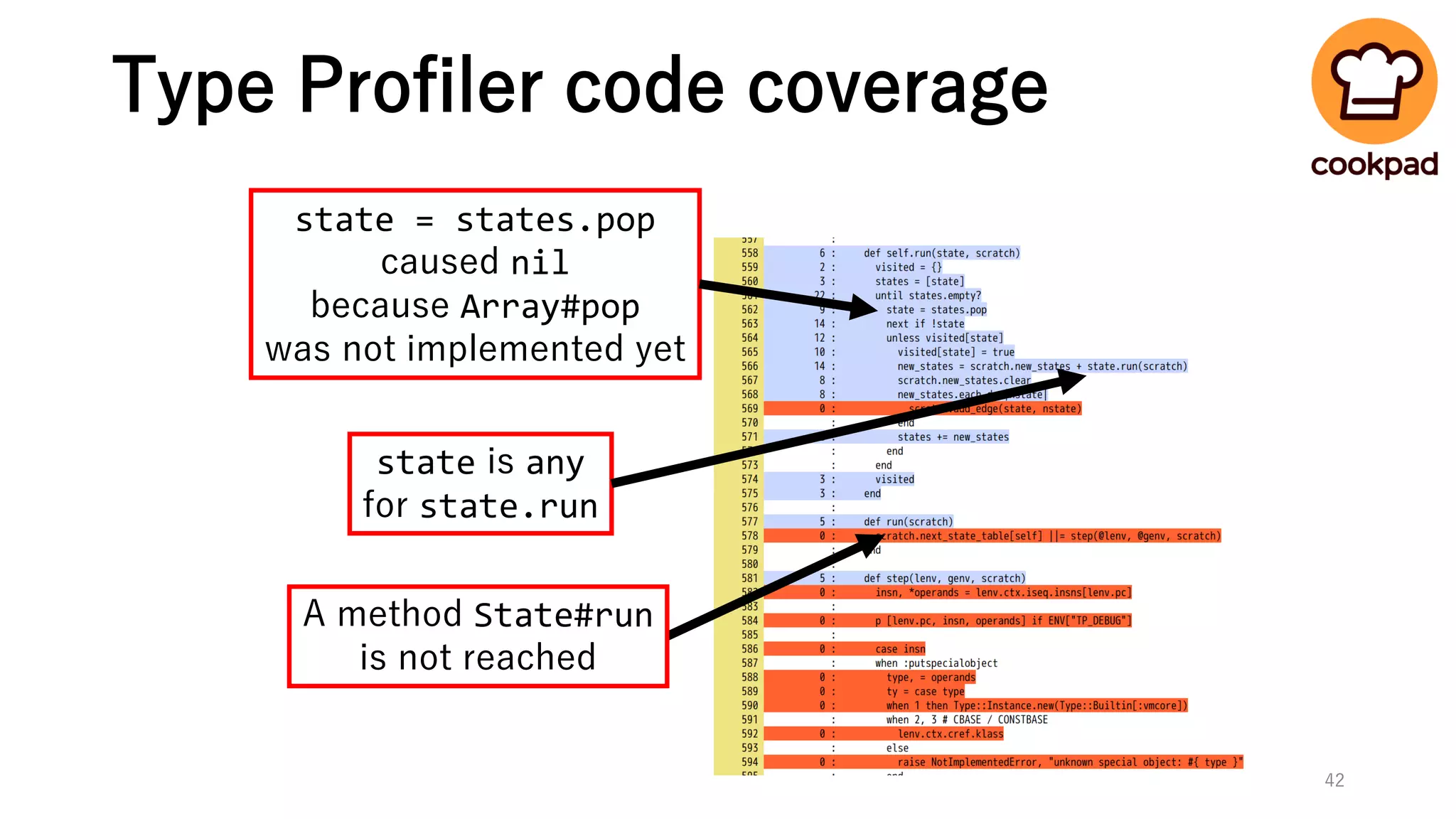
Type Profiler code coverage
42
A method State#run
is not reached
state is any
for state.run
state = states.pop
caused nil
because Array#pop
was not implemented yet
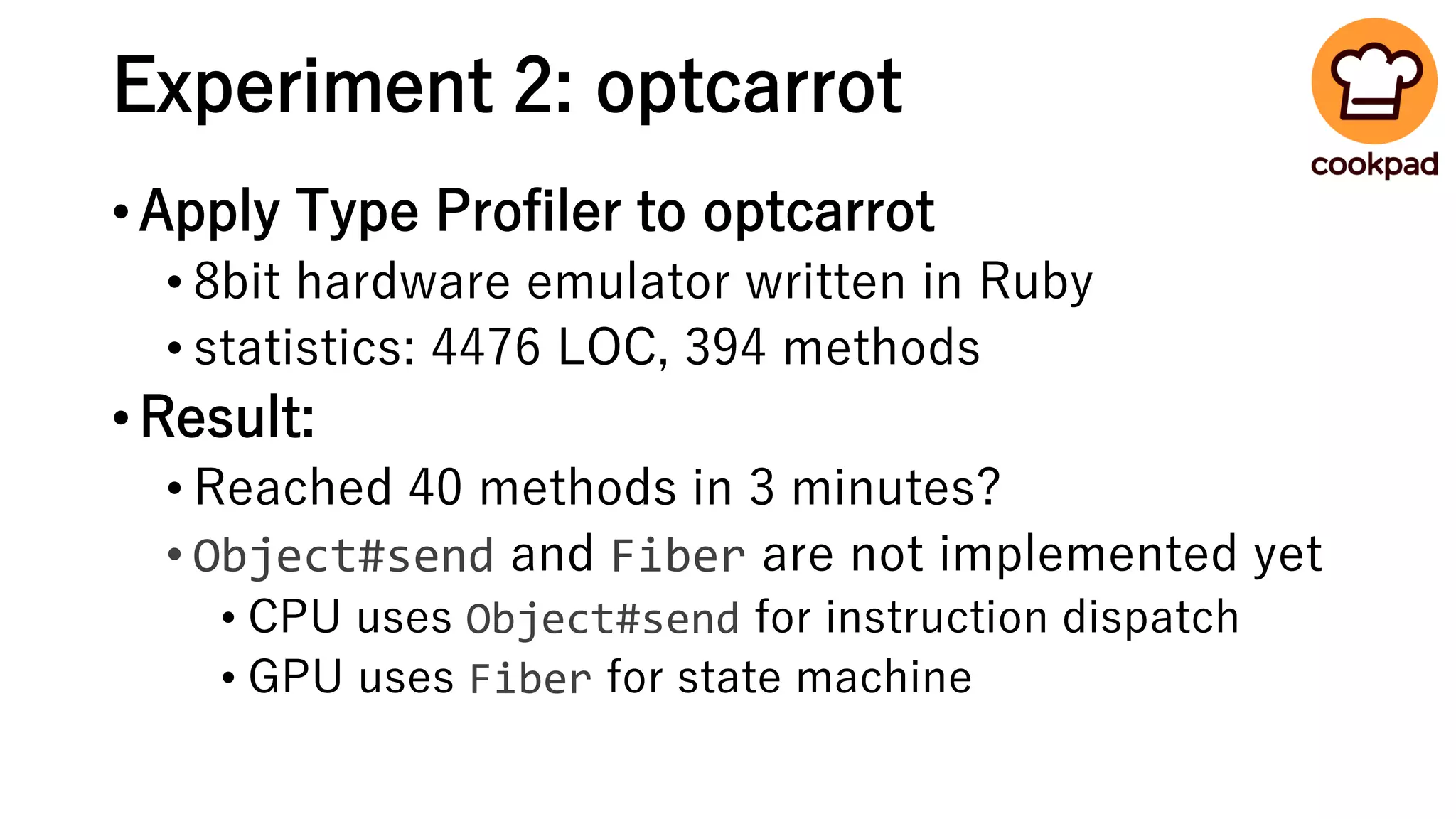
Experiment 2: optcarrot
•Apply Type Profiler to optcarrot
• 8bit hardware emulator written in Ruby
• statistics: 4476 LOC, 394 methods
•Result:
• Reached 40 methods in 3 minutes?
• Object#send and Fiber are not implemented yet
• CPU uses Object#send for instruction dispatch
• GPU uses Fiber for state machine
Why did it took so long?
•State explosion
•A method returns
Array or Integer
•Calling it forks
the state
•Idea: Merge similar states more intelligently
foo()
foo()
foo()
foo()
foo()
Fork!
Fork!
Fork!
Fork!
Fork!
foo :: () ->
(Array[Integer] | Integer)
Agenda
•What "Type Profiler" is
•Demos and Problems
•Implementation
•Very preliminary evaluation
➔(Related work and) Conclusion
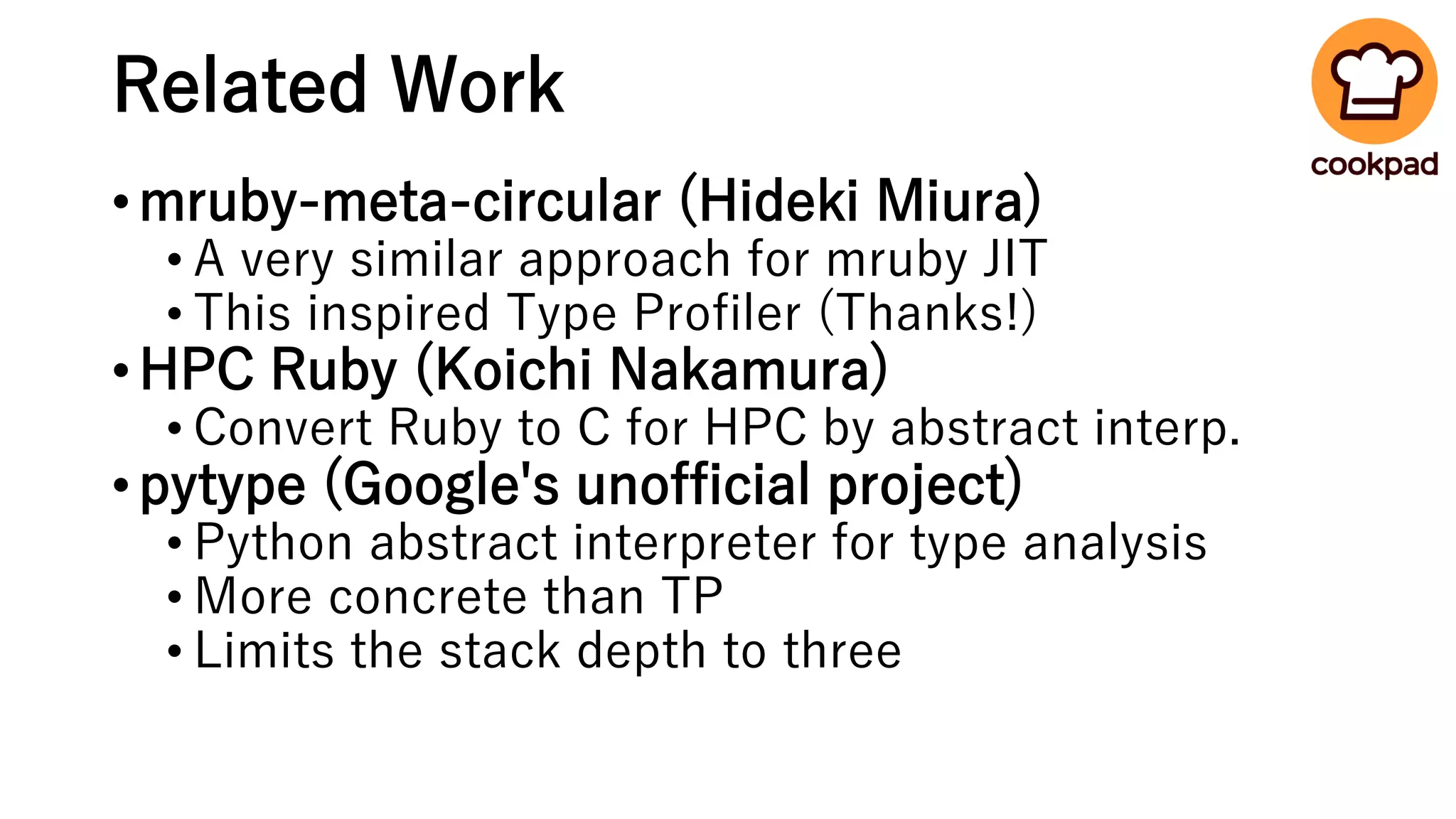
Related Work
•mruby-meta-circular (Hideki Miura)
• A very similar approach for mruby JIT
• This inspired Type Profiler (Thanks!)
•HPC Ruby (Koichi Nakamura)
• Convert Ruby to C for HPC by abstract interp.
•pytype (Google's unofficial project)
• Python abstract interpreter for type analysis
• More concrete than TP
• Limits the stack depth to three
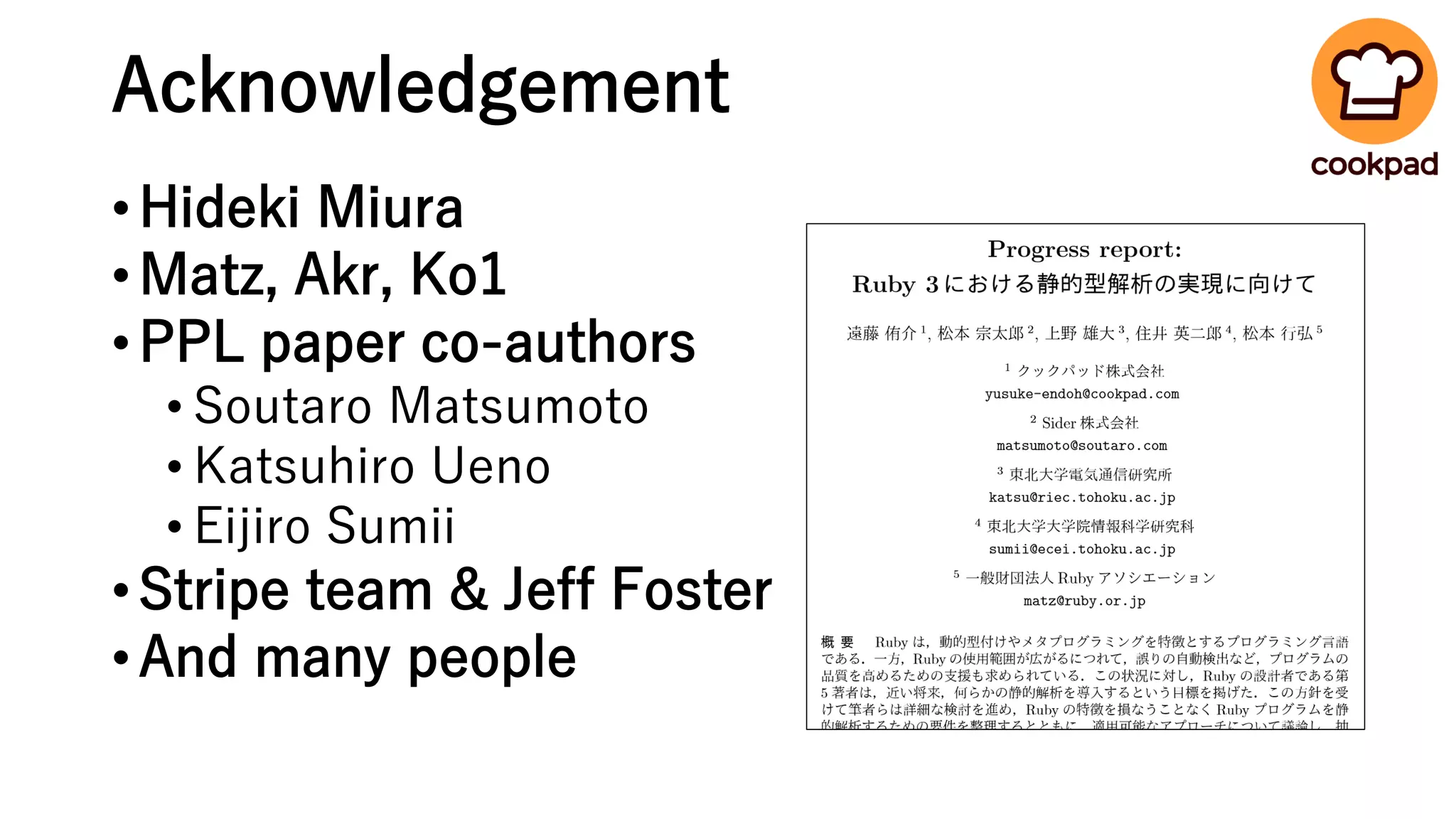
Acknowledgement
•Hideki Miura
•Matz, Akr, Ko1
•PPL paper co-authors
• Soutaro Matsumoto
• Katsuhiro Ueno
• Eijiro Sumii
•Stripe team & Jeff Foster
•And many people
Conclusion
•A yet another type analyzer for Ruby 3
applicable to a non-annotated Ruby code
•Based on abstract interpretation technique
•Little change for Ruby programming experience
•Contribution is really welcome!
•The development is very preliminary
•https://github.com/mame/ruby-type-profiler
(A lot of) Future work
• Support language features
• Almost all built-in classes
including Hash
• Complex arguments
(optional, rest, keywords)
• Exceptions
• Modules (Mix-in)
• etc etc.
• Write a type definition for
built-in classes/methods
• Read type definition file
• Improve performance
• Make it useful
• Code coverage
• Flow-sensitive analysis
• Heuristic type aggregation
• Diagnosis feature
• Incremental type profiling
• etc etc.

A Type-level Ruby Interpreter for Testing and Understanding

  • 1.
    A Type-level RubyInterpreter for Testing and Understanding Yusuke Endoh RubyKaigi 2019 (2019/04/18)
  • 2.
    PR: Cookpad Booth(3F) •Cookpad Daily Ruby Puzzles •Get a problem sheet •Complete "Hello world" by adding minimum letters and get a prize! def foo "Hello world" if false end puts foo def foo "Hello world" if !false end puts foo!
  • 3.
    This talk isabout "Type Profiler"
  • 4.
    The plan towardsRuby 3 static analysis Sorbet Steep RDL Library code type signature Type error warnings Application code type signaturetype signature Type Profiler Type error warnings This talk
  • 5.
    This talk isabout "Type Profiler" •A type analyzer for Ruby 3 applicable to a non-annotated Ruby code •Level-1 type checking •Type signature prototyping •Note: The analysis is not "sound" •It may miss bugs and print wrong signature
  • 6.
    Agenda ➔What "Type Profiler"is •Demos •Implementation •Evaluation •Conclusion
  • 7.
    What Type Profileris •Target: A normal Ruby code •No type signature/annotation required •Objectives: Testing and understanding •Testing: Warns possible errors of Ruby code •Understanding: Prototypes type signature
  • 8.
    Type Profiler forTesting •Finds NoMethodError, TypeError, etc. def foo(n) if n < 10 n.timees {|x| } end end foo(42) Type Profiler t.rb:3: [error] undefined method: Integer#timees Typo
  • 9.
    Type Profiler forUnderstanding •Generates a prototype of type definition def foo(n) n.to_s end foo(42) Type Profiler Object#foo :: (Integer) -> String
  • 10.
    How Type Profilerdoes •Runs a Ruby code in "type-level" Normal interpreter def foo(n) n.to_s end foo(42) Calls w/ 42 Returns "42" Type profiler def foo(n) n.to_s end foo(42) Calls w/ Integer Returns String Object#foo :: (Integer) -> String
  • 11.
    How does TPhandle a branch? •"Forks" the execution def foo(n) if n < 10 n else "error" end end foo(42) Fork! Now here; We cannot tell taken true or false as we just know n is Integer Returns Integer Returns String Object#foo :: (Integer) -> (Integer | String)
  • 12.
    Is a methodexecuted at every call? •No, the result is reused if possible def foo(n) n.to_s end x=foo(42) y=foo(43) z=foo(42.0) Calls w/ Integer Returns String We already know foo::(Integer)->String; Immediately returns String Calls w/ Float Returns String Object#foo :: (Integer)->String Object#foo :: (Float)->String
  • 13.
    Is Type Profilera type checker? Normal type checker is intra-procedural def foo(n:int):str n.to_s end ret = foo(42) Assume Integer Check if String Check if Integer Assume String Type profiler is inter-procedural def foo(n) n.to_s end foo(42) Calls w/ Integer Returns String
  • 14.
    What this techniqueis? Easy to scale but restrictive Flexible but hard to scale Type checking Abstract interpretation Symbolic execution Type profiler...? Flow analysis Steep Sorbet RDL Excuse: This figure is just my personal opinion
  • 15.
    Agenda •What "Type Profiler"is ➔Demos (and Problems) •Implementation •Evaluation •Conclusion
  • 16.
    Demos •You can seethe demo programs •https://github.com/mame/ruby-type-profiler •But the spec is still under consideration •The output format (and even behavior) may change in future
  • 17.
    Demo: Overloading def my_to_s(x) x.to_s end my_to_s(42) my_to_s("STR") my_to_s(:sym) Type Profiler Object#my_to_s:: (Integer) -> String Object#my_to_s :: (String) -> String Object#my_to_s :: (Symbol) -> String
  • 18.
    Demo: User-defined classes classFoo end class Bar def make_foo Foo.new end end Bar.new.make_foo Type Profiler Bar#make_foo :: () -> Foo
  • 19.
    Demo: Instance variables classFoo attr_accessor :ivar end Foo.new.ivar = 42 Foo.new.ivar = "STR" Foo.new.ivar Type Profiler Foo#@ivar :: Integer | String Foo#ivar= :: (Integer) -> Integer Foo#ivar= :: (String) -> String Foo#ivar :: () -> (String | Integer)
  • 20.
    Demo: Block def foo(x) yield42 end s = "str" foo(1) do |x| s end Type Profiler Object#foo :: (Integer, &Proc[(Integer) -> String]) -> String
  • 21.
    Demo: Tuple-like array defswap(a) [a[1], a[0]] end a = [42, "str"] swap(a) Type Profiler Object#swap :: ([Integer, String]) -> [String, Integer]
  • 22.
    Demo: Sequence-like array deffoo [1] + ["str"] end foo Type Profiler Object#foo :: Array[Integer | String]
  • 23.
    Demo: Recursive method deffib(n) if n > 1 fib(n-1) + fib(n-2) else n end end fib(10000) Type Profiler Object#fib :: (Integer) -> Integer
  • 24.
    Demo: Unanalyzable method a= eval("1 + 1") a.foobar Type Profiler t.rb:1: cannot handle eval; the result is any A call is not warned when the receiver is any
  • 25.
    Looks good? •I thinkit would be good enough •To be fair, Type Profiler is never perfect •Can tell lies (false positive) •Requires tests (false negative) •Cannot handle some Ruby features •May be very slow (state explosion)
  • 26.
    Problem: False positives ifn < 10 x = 42 else x = "str" end if n < 10 x += 1 end String + Integer? Error! This path is not feasible because of the conditions Possible workaround: Please don't write such a untypeable code!
  • 27.
    Problem: A testis required Possible workaround: • Write a test! • TP may be improved in some cases def foo(x) x.timees end Type Profiler (nothing)Type Profiler cannot guess the argument type......
  • 28.
    Problem: Intractable features •Object#send •Singletonclass •TP abstracts all values as a type (class) •But a singleton class is unique to the value •Workaround: Difficult... (TP plugin?) send(method_name) Type Profiler Type Profiler cannot identify the method being called!
  • 29.
    Problem: State explosion a=b=c=d=e=nil a= 42 if n < 10 b = 42 if n < 10 c = 42 if n < 10 d = 42 if n < 10 e = 42 if n < 10 Fork! Fork! Fork! Fork! Fork! 2 4 8 16 32 The number of states Possible workaround: • Write an annotation...? → a::NilClass|Integer • Merge a pair of similar states (not implemented yet)
  • 30.
    Problems •Type Profiler isnever perfect •But "better than nothing" •Only one choice for no-type Ruby lovers •You can use a type checker if you want a type •You may use Type Profiler to get a prototype of type signatures •I'm still thinking of the improvement •Stay tuned...
  • 31.
    Agenda •What "Type Profiler"is •Demos and Problems ➔Implementation •Evaluation •Conclusion
  • 32.
    Implementation overview •Core: AType-level Ruby VM •Runs a YARV bytecode •A variable has a type instead of a value •A branch copies the state for each target •Profiling features •Reports all type errors during execution •Records all method arguments and return values (for type signature prototype)
  • 33.
    Some implementation details •Stateenumeration •Method return •Three method types
  • 34.
    State enumeration •Enumerate allreachable states •From the first line of the entry program •Until fixed-point •The same states are merged •To avoid redundant execution • TODO: merge "similar" states if n < 10 a=1+1 else a=2+2 end ... The two states are the same
  • 35.
    Method return •TP statehas no call stack •To avoid state explosion •Cannot identify return address •Returns to all calls •This handles recursive calls elegantly def foo ... return 42 end foo() foo() foo() foo()foo()
  • 36.
    Three method types 1.User-defined method • When called, TP enters its method body 2. Type-defined method • TP just checks argument types and returns its return type • For built-in methods or libraries 3. Custom special method • TP executes custom behavior • (TP plugin can exploit this?) def foo(n) ... end Integer#+ :: (Integer)->Integer Object#require???
  • 37.
    Agenda •What "Type Profiler"is •Demos and Problems •Implementation ➔(Very preliminary) Evaluation •Conclusion
  • 38.
    Excuse: TP isvery preliminary... •Currently supports • Basic language features • Limited built-in classes (shown in Demos) •No-support-yet • Almost all built-in classes including Hash • Complex arguments (optional, rest, keywords) • Exceptions • Modules (Mix-in) • etc etc.
  • 39.
    Experiments •Experiment 1: SelfType-profiling •Experiment 2: Type-profiling optcarrot
  • 40.
    Experiment 1: Self-profiling •ApplyType Profiler to itself •TP statistics: 2167 LOC, 221 methods •Quantitative result: •Reached 91 methods in 10 minutes (!) •Qualitative result: Found an actual bug •TP said "a method receives NilClass" •It is not intended, and turned out a bug
  • 41.
    Why many methodsnot reached? •Because of not-implemented-yet features •For example, Array#<< is not implemented •Some methods are defined but unused •Idea: virtually call all methods with "any" arguments? a = [] a << Foo.new a[0].bar Foo#bar cannot be reached
  • 42.
    Type Profiler codecoverage 42 A method State#run is not reached state is any for state.run state = states.pop caused nil because Array#pop was not implemented yet
  • 43.
    Experiment 2: optcarrot •ApplyType Profiler to optcarrot • 8bit hardware emulator written in Ruby • statistics: 4476 LOC, 394 methods •Result: • Reached 40 methods in 3 minutes? • Object#send and Fiber are not implemented yet • CPU uses Object#send for instruction dispatch • GPU uses Fiber for state machine
  • 44.
    Why did ittook so long? •State explosion •A method returns Array or Integer •Calling it forks the state •Idea: Merge similar states more intelligently foo() foo() foo() foo() foo() Fork! Fork! Fork! Fork! Fork! foo :: () -> (Array[Integer] | Integer)
  • 45.
    Agenda •What "Type Profiler"is •Demos and Problems •Implementation •Very preliminary evaluation ➔(Related work and) Conclusion
  • 46.
    Related Work •mruby-meta-circular (HidekiMiura) • A very similar approach for mruby JIT • This inspired Type Profiler (Thanks!) •HPC Ruby (Koichi Nakamura) • Convert Ruby to C for HPC by abstract interp. •pytype (Google's unofficial project) • Python abstract interpreter for type analysis • More concrete than TP • Limits the stack depth to three
  • 47.
    Acknowledgement •Hideki Miura •Matz, Akr,Ko1 •PPL paper co-authors • Soutaro Matsumoto • Katsuhiro Ueno • Eijiro Sumii •Stripe team & Jeff Foster •And many people
  • 48.
    Conclusion •A yet anothertype analyzer for Ruby 3 applicable to a non-annotated Ruby code •Based on abstract interpretation technique •Little change for Ruby programming experience •Contribution is really welcome! •The development is very preliminary •https://github.com/mame/ruby-type-profiler
  • 49.
    (A lot of)Future work • Support language features • Almost all built-in classes including Hash • Complex arguments (optional, rest, keywords) • Exceptions • Modules (Mix-in) • etc etc. • Write a type definition for built-in classes/methods • Read type definition file • Improve performance • Make it useful • Code coverage • Flow-sensitive analysis • Heuristic type aggregation • Diagnosis feature • Incremental type profiling • etc etc.