












Artificial Intelligence
Damian Gordon
Contents
•Artificial Intelligence
• Overview and Definitions
• History and Key Milestones
• Main Application Areas
Artificial Intelligence
•Artificial Intelligence is “behaviour of a
machine which, if a human behaves in
the same way, is considered intelligent”.
•Simmons and Chappell (1988).
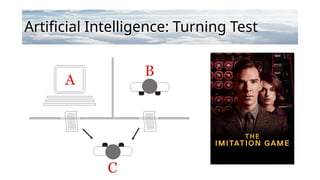
Artificial Intelligence: Turning Test
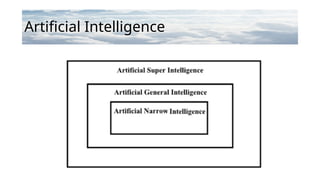
Artificial Intelligence
Two common approaches are:
1. Rule-Based Systems
2. Biologically-inspired Systems
Artificial Intelligence
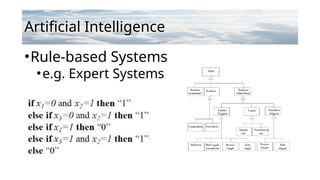
•Rule-based Systems
•e.g. Expert Systems
Artificial Intelligence
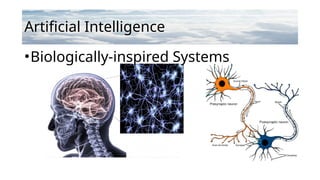
•Biologically-inspired Systems
Artificial Intelligence
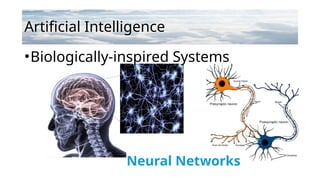
•Biologically-inspired Systems
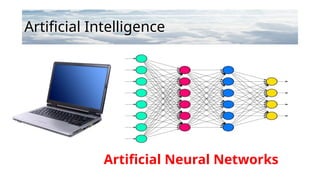
Neural Networks
Artificial Intelligence
Artificial Neural Networks
Artificial Intelligence
Activity
Artificial Intelligence
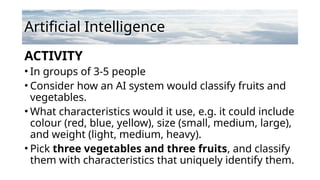
ACTIVITY
• In groups of 3-5 people
• Consider how an AI system would classify fruits and
vegetables.
• What characteristics would it use, e.g. it could include
colour (red, blue, yellow), size (small, medium, large),
and weight (light, medium, heavy).
• Pick three vegetables and three fruits, and classify
them with characteristics that uniquely identify them.
Colour
Size
Weight
Artificial Intelligence
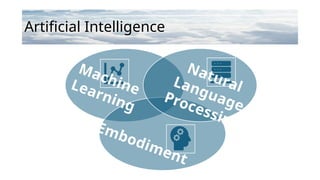
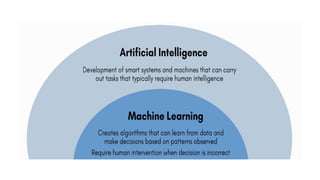
Machine
Learning
Natural
Language
Processing
Embodiment
Machine Learning
Artificial Intelligence: Machine
Learning
•Machine Learning is often defined as a
“field of study that gives computers the ability
to learn without being explicitly programmed”
•Arthur Samuel (1959)
•What this means is that it is AI techniques
that focus on the use of data in learning.
Artificial Intelligence: Machine
Learning
•So what this means is that instead of
defining all of the rules of a system, the
machine learning approach just outlines
the key rules to complete the overall
goals of the system, and then the
machine learning system uses suitable
data to figure out its own set of rules.
Labels
Artificial Intelligence: Machine
Learning
•The Datasets we use to train the
machine learning system will be
information about a specific topic.
•We can add labels to each row in the
data to make it easier for the machine
learning system to understand what
the system needs to learn.
Artificial Intelligence: Machine
Learning
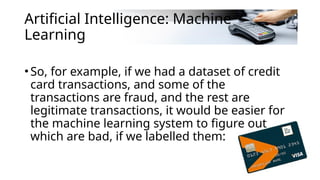
•So, for example, if we had a dataset of credit
card transactions, and some of the
transactions are fraud, and the rest are
legitimate transactions, it would be easier for
the machine learning system to figure out
which are bad, if we labelled them:
Artificial Intelligence: Machine
Learning
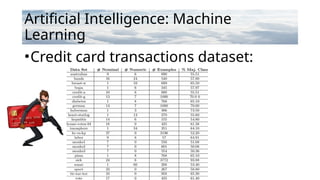
•Credit card transactions dataset:
Artificial Intelligence: Machine
Learning
Fraud
NotFrau
d
NotFrau
d
Fraud
NotFrau
d
NotFrau
d
Fraud
NotFrau
d
NotFrau
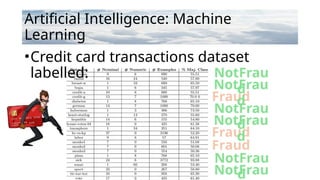
•Credit card transactions dataset
labelled:
Artificial Intelligence: Machine
Learning
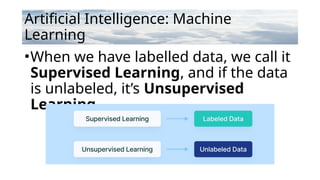
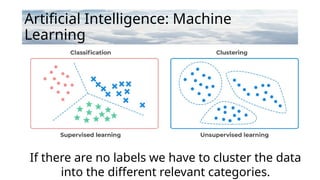
•When we have labelled data, we call it
Supervised Learning, and if the data
is unlabeled, it’s Unsupervised
Learning.
Artificial Intelligence: Machine
Learning
If there are no labels we have to cluster the data
into the different relevant categories.
Artificial Intelligence: Machine
Learning
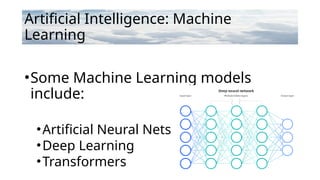
•Some Machine Learning models
include:
•Artificial Neural Nets
•Deep Learning
•Transformers
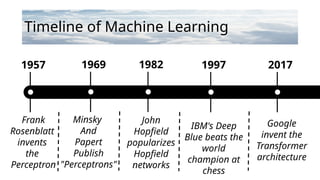
Timeline of Machine Learning
1957
Frank
Rosenblatt
invents
the
Perceptron
1969
Minsky
And
Papert
Publish
"Perceptrons"
1982
John
Hopfield
popularizes
Hopfield
networks
1997
IBM's Deep
Blue beats the
world
champion at
chess
2017
Google
invent the
Transformer
architecture
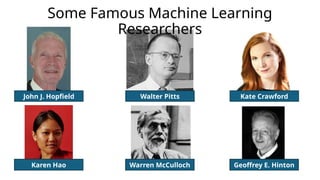
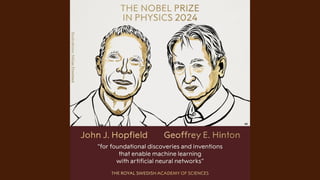
John J. Hopfield
Karen Hao
Walter Pitts
Warren McCulloch
Kate Crawford
Geoffrey E. Hinton
Some Famous Machine Learning
Researchers
Natural
Language
Processing
(NLP)
Artificial Intelligence: NLP
•Natural Language Processing (NLP) is
analyzing texts “for the purpose of
achieving human-like language
processing for a range of tasks or
applications” - Liddy (2001)
Artificial Intelligence: NLP
•Natural Language Processing (NLP) is
used in things like:
•Chat tools (like ChatGPT, Baird, etc.)
•Computer-based Language Translation
•Sentiment Analysis
Artificial Intelligence: NLP
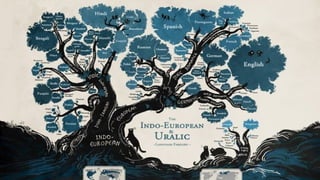
•Natural languages are the spoken and
written languages that people use to
communicate (e.g. English, French,
Chinese, and Fijian), that have
evolved, grown and changed over
centuries.
Artificial Intelligence: NLP
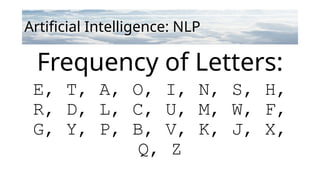
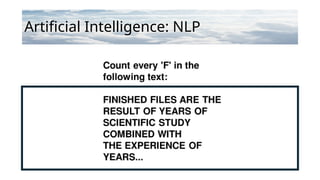
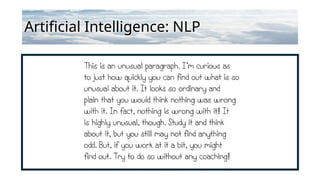
Frequency of Letters:
E, T, A, O, I, N, S, H,
R, D, L, C, U, M, W, F,
G, Y, P, B, V, K, J, X,
Q, Z
Artificial Intelligence: NLP
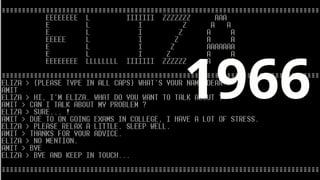
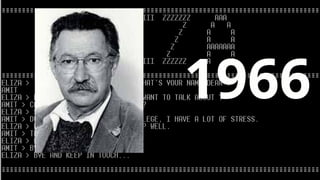
1966
1966
Artificial Intelligence: NLP
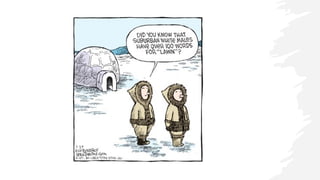
•Linguistic Relativity: Sapir–Whorf
hypothesis and Whorf-Sapir hypothesis.
•Linguistic relativity asserts that language
influences worldview or cognition, and
language determines thought and that
linguistic categories limit and restrict
cognitive categories.
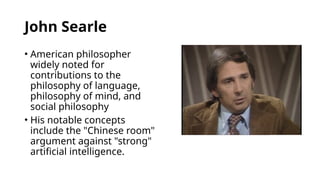
John Searle
• American philosopher
widely noted for
contributions to the
philosophy of language,
philosophy of mind, and
social philosophy
• His notable concepts
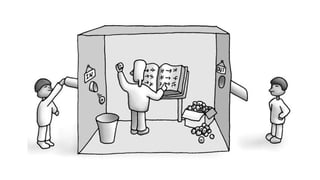
include the "Chinese room"
argument against "strong"
artificial intelligence.
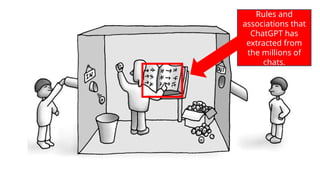
Rules and
associations that
ChatGPT has
extracted from
the millions of
chats.
Rules and
associations that
ChatGPT has
extracted from
the millions of
chats.
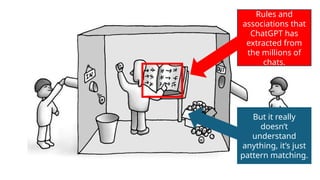
But it really
doesn’t
understand
anything, it’s just
pattern matching.
Artificial Intelligence
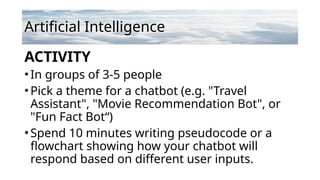
ACTIVITY
•In groups of 3-5 people
•Pick a theme for a chatbot (e.g. "Travel
Assistant", "Movie Recommendation Bot", or
"Fun Fact Bot“)
•Spend 10 minutes writing pseudocode or a
flowchart showing how your chatbot will
respond based on different user inputs.
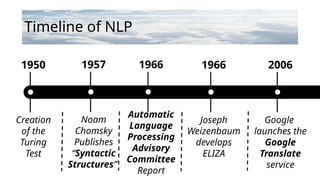
Timeline of NLP
1950
Creation
of the
Turing
Test
1957
Noam
Chomsky
Publishes
“Syntactic
Structures”
1966
Automatic
Language
Processing
Advisory
Committee
Report
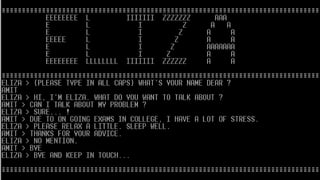
1966
Joseph
Weizenbaum
develops
ELIZA
2006
Google
launches the
Google
Translate
service
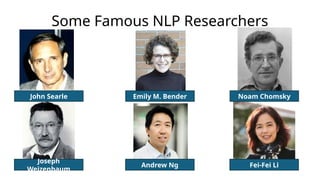
John Searle
Joseph
Weizenbaum
Emily M. Bender
Andrew Ng
Noam Chomsky
Fei-Fei Li
Some Famous NLP Researchers
Embodiment
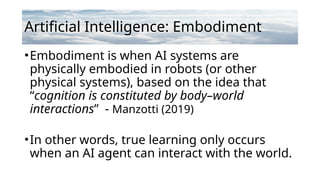
Artificial Intelligence: Embodiment
•Embodiment is when AI systems are
physically embodied in robots (or other
physical systems), based on the idea that
“cognition is constituted by body–world
interactions” - Manzotti (2019)
•In other words, true learning only occurs
when an AI agent can interact with the world.
Artificial Intelligence: Embodiment
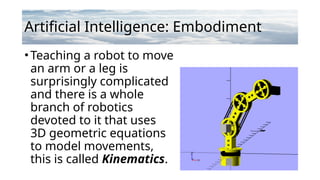
•Teaching a robot to move
an arm or a leg is
surprisingly complicated
and there is a whole
branch of robotics
devoted to it that uses
3D geometric equations
to model movements,
this is called Kinematics.
Artificial Intelligence: Embodiment
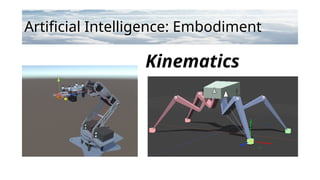
Kinematics
Artificial Intelligence: Embodiment
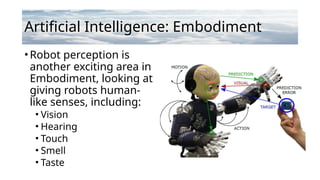
•Robot perception is
another exciting area in
Embodiment, looking at
giving robots human-
like senses, including:
• Vision
• Hearing
• Touch
• Smell
• Taste
Artificial Intelligence: Embodiment
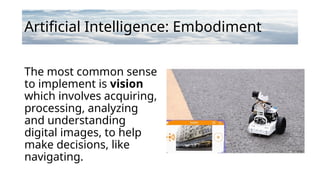
The most common sense
to implement is vision
which involves acquiring,
processing, analyzing
and understanding
digital images, to help
make decisions, like
navigating.
Artificial Intelligence: Embodiment
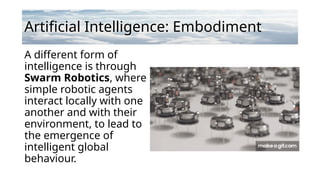
A different form of
intelligence is through
Swarm Robotics, where
simple robotic agents
interact locally with one
another and with their
environment, to lead to
the emergence of
intelligent global
behaviour.
Artificial Intelligence: Embodiment
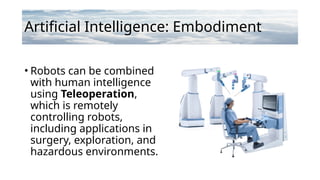
• Robots can be combined
with human intelligence
using Teleoperation,
which is remotely
controlling robots,
including applications in
surgery, exploration, and
hazardous environments.
Timeline of Embodiment
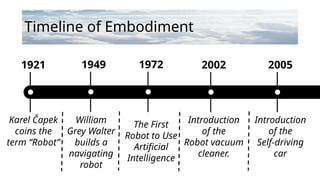
1921
Karel Čapek
coins the
term “Robot”
1949
William
Grey Walter
builds a
navigating
robot
1972
The First
Robot to Use
Artificial
Intelligence
2002
Introduction
of the
Robot vacuum
cleaner.
2005
Introduction
of the
Self-driving
car
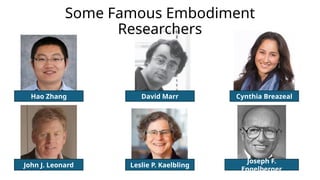
Hao Zhang
John J. Leonard
David Marr
Leslie P. Kaelbling
Cynthia Breazeal
Joseph F.
Engelberger
Some Famous Embodiment
Researchers
Artificial Intelligence
•Knowledge Representation
•Descriptive logic
•Semantic networks
•Probalistic reason
•Fuzzy logic
•Ontology engineering
Search Algorithms
Artificial Intelligence: Search
Algorithms
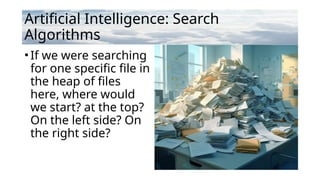
•If we were searching
for one specific file in
the heap of files
here, where would
we start? at the top?
On the left side? On
the right side?
Artificial Intelligence: Search
Algorithms
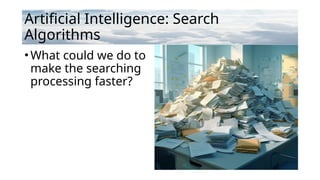
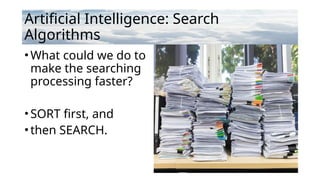
•What could we do to
make the searching
processing faster?
Artificial Intelligence: Search
Algorithms
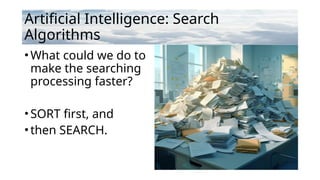
•What could we do to
make the searching
processing faster?
•SORT first, and
•then SEARCH.
Artificial Intelligence: Search
Algorithms
•What could we do to
make the searching
processing faster?
•SORT first, and
•then SEARCH.
Artificial Intelligence: Search
Algorithms
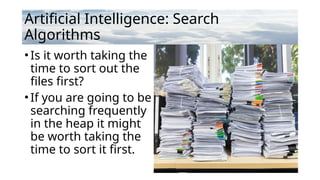
•Is it worth taking the
time to sort out the
files first?
•If you are going to be
searching frequently
in the heap it might
be worth taking the
time to sort it first.
Artificial Intelligence: Search
Algorithms
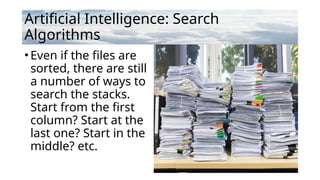
•Even if the files are
sorted, there are still
a number of ways to
search the stacks.
Start from the first
column? Start at the
last one? Start in the
middle? etc.
Artificial Intelligence: Search
Algorithms
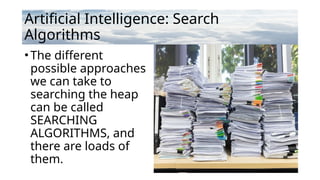
•The different
possible approaches
we can take to
searching the heap
can be called
SEARCHING
ALGORITHMS, and
there are loads of
them.
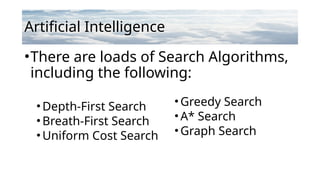
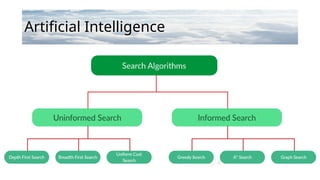
Artificial Intelligence
•There are loads of Search Algorithms,
including the following:
•Depth-First Search
•Breath-First Search
•Uniform Cost Search
•Greedy Search
•A* Search
•Graph Search
Artificial Intelligence
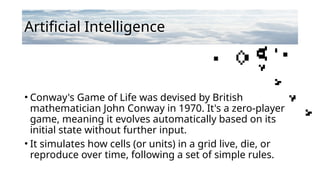
John Conway’s
Game of Life
Artificial Intelligence
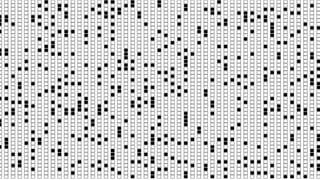
• Conway's Game of Life was devised by British
mathematician John Conway in 1970. It's a zero-player
game, meaning it evolves automatically based on its
initial state without further input.
• It simulates how cells (or units) in a grid live, die, or
reproduce over time, following a set of simple rules.
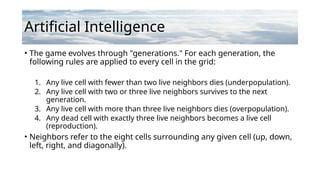
Artificial Intelligence
• The game evolves through "generations." For each generation, the
following rules are applied to every cell in the grid:
1. Any live cell with fewer than two live neighbors dies (underpopulation).
2. Any live cell with two or three live neighbors survives to the next
generation.
3. Any live cell with more than three live neighbors dies (overpopulation).
4. Any dead cell with exactly three live neighbors becomes a live cell
(reproduction).
• Neighbors refer to the eight cells surrounding any given cell (up, down,
left, right, and diagonally).
Artificial Intelligence
• Conway's Game of Life demonstrates how simple
rules can lead to complex and emergent behavior.
• The Game of Life explores concepts such as self-
replication, emergence, and chaos vs. order, and has
fascinated scientists, mathematicians, and computer
enthusiasts for decades because even though it
operates on simple rules, the patterns it generates
can become very complex and unpredictable.
Artificial Intelligence
The AI Winters
Artificial Intelligence: The AI Winters
• “AI Winters” refer to periods of time when there is a
reduced interest and funding in AI research.
• Part of the problem is that when new AI discoveries
are made, they are sometimes over-hyped by the
media and by investors, which can lead to unrealist
expectations as to what these AI systems will
actually be able to do.
• This will ultimately lead to disappointment and
criticism, followed by funding cuts.
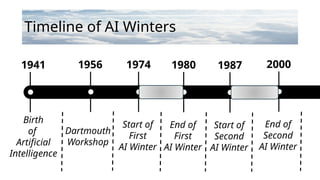
Timeline of AI Winters
1941
Birth
of
Artificial
Intelligence
1956
Dartmouth
Workshop
1974
Start of
First
AI Winter
1980
End of
First
AI Winter
1987
Start of
Second
AI Winter
2000
End of
Second
AI Winter
Artificial Intelligence: Setbacks
• 1966: USA - The ALPAC (Automatic Language Processing
Advisory Committee) was established in 1964 by the United
States government in order to evaluate the progress in
computational linguistics, and in 1966 they issued a report that
was very skeptical of research done in machine translation.
• 1969: USA - ALPAC chair, John Pierce from Dell, publishes an
open letter called “Whither Speech Recognition?” that was critical
of speech recognition research.
• 1969: USA - A famous book “Perceptrons” by Marvin Minsky and
Seymour Papert showed that it was impossible for single-layer
perceptrons to learn a simple logic function, an XOR function.
1960s
Artificial Intelligence: Setbacks
• 1973: UK - The Lighthill report is published. Written by James
Lighthill for the British Science Research Council, it stated
that “in no part of [AI] have the discoveries made so far
produced the major impact that was then promised“.
• 1973-1974: USA - DARPA cut funding to academic AI
research partially based on their frustration with the lack of
progression from Carnegie Mellon University’s Speech
Understanding Research program.
1970s
First AI Winter
(1974 - 1980)
Artificial Intelligence: Setbacks
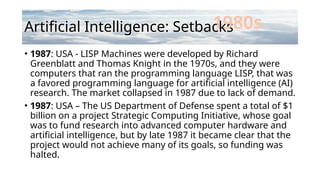
• 1987: USA - LISP Machines were developed by Richard
Greenblatt and Thomas Knight in the 1970s, and they were
computers that ran the programming language LISP, that was
a favored programming language for artificial intelligence (AI)
research. The market collapsed in 1987 due to lack of demand.
• 1987: USA – The US Department of Defense spent a total of $1
billion on a project Strategic Computing Initiative, whose goal
was to fund research into advanced computer hardware and
artificial intelligence, but by late 1987 it became clear that the
project would not achieve many of its goals, so funding was
halted.
1980s
Second AI Winter
(1987 - 2000)
Artificial Intelligence: Setbacks
• Rebranding “Artificial Intelligence”:
• 2005: John Markoff in the New York Times says: "At its low point,
some computer scientists and software engineers avoided the term
artificial intelligence for fear of being viewed as wild-eyed dreamers.“
• 2006: Patty Tascarella in the Pittsburgh Business Times: "Some
believe the word 'robotics' actually carries a stigma that hurts a
company's chances at funding."
• 2007: Alex Castro in The Economist: "[Investors] were put off by the
term 'voice recognition' which, like 'artificial intelligence', is
associated with systems that have all too often failed to live up to
their promises."
2000s
Artificial Intelligence: Setbacks
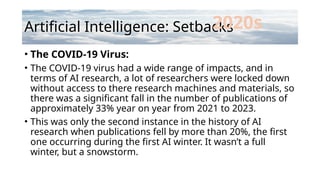
• The COVID-19 Virus:
• The COVID-19 virus had a wide range of impacts, and in
terms of AI research, a lot of researchers were locked down
without access to there research machines and materials, so
there was a significant fall in the number of publications of
approximately 33% year on year from 2021 to 2023.
• This was only the second instance in the history of AI
research when publications fell by more than 20%, the first
one occurring during the first AI winter. It wasn’t a full
winter, but a snowstorm.
2020s
COVID-19 Snowstorm
(2021 - 2023)
Artificial Intelligence: Setbacks
• November 30th
, 2022
• The release of ChatGPT caused a
reinvigoration in the interest of AI, not only in
terms of research but also in terms of general
interest by the public, as well as in terms of
lots of investment.
• ChatGPT and other generative AI systems easy
to use by everyone, and therefore have ignited
people’s interest and imagination in the use of
AI.
2020s
… but remember …
* ALWAYS *
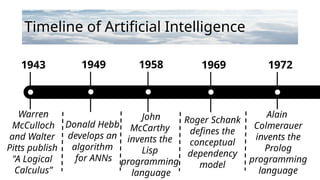
Timeline of Artificial Intelligence
1943
Warren
McCulloch
and Walter
Pitts publish
"A Logical
Calculus”
1949
Donald Hebb
develops an
algorithm
for ANNs
1958
John
McCarthy
invents the
Lisp
programming
language
1969
Roger Schank
defines the
conceptual
dependency
model
1972
Alain
Colmerauer
invents the
Prolog
programming
language
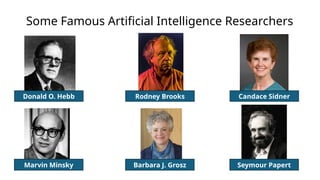
Donald O. Hebb
Marvin Minsky
Rodney Brooks
Barbara J. Grosz
Candace Sidner
Seymour Papert
Some Famous Artificial Intelligence Researchers
A Non-technical Introduction to Artificial Intelligence

A Non-technical Introduction to Artificial Intelligence

Editor's Notes

  • #3 Simmons, A.B. and Chappell, S.G., 1988. Artificial intelligence-definition and practice. IEEE journal of oceanic engineering, 13(2), pp.14-42.
  • #33 Liddy, E.D. 2001. Natural Language Processing. In Encyclopedia of Library and Information Science, 2nd Ed. NY. Marcel Decker, Inc.
  • #36 https://www.youtube.com/watch?v=
  • #38 https://www.youtube.com/watch?v=a5mZ0R3h8m0
  • #56 Manzotti, R., 2019. Embodied AI beyond embodied cognition and enactivism. Philosophies, 4(3), p.39.
  • #77 https://www.geeksforgeeks.org/search-algorithms-in-ai/
  • #85 Crevier, Daniel (1993). AI: The Tumultuous Search for Artificial Intelligence. New York, NY: BasicBooks. ISBN 0-465-02997-3.