A Big Data Journey
Growing a Hadoop-based Capability
Paul Boal – VP Delivery - Amitech Solutions
January 7, 2016
1
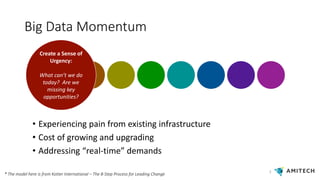
Big Data Momentum
2
Create a Sense of
Urgency:
What can’t we do
today? Are we
missing key
opportunities?
* The model here is from Kotter International – The 8-Step Process for Leading Change
• Experiencing pain from existing infrastructure
• Cost of growing and upgrading
• Addressing “real-time” demands
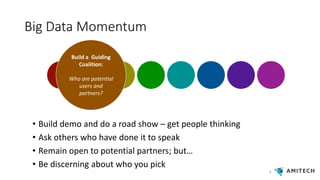
Big Data Momentum
3
Build a Guiding
Coalition:
Who are potential
users and
partners?
• Build demo and do a road show – get people thinking
• Ask others who have done it to speak
• Remain open to potential partners; but…
• Be discerning about who you pick
Big Data Momentum
4
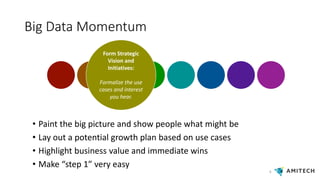
Form Strategic
Vision and
Initiatives:
Formalize the use
cases and interest
you hear.
• Paint the big picture and show people what might be
• Lay out a potential growth plan based on use cases
• Highlight business value and immediate wins
• Make “step 1” very easy
Big Data Momentum
5
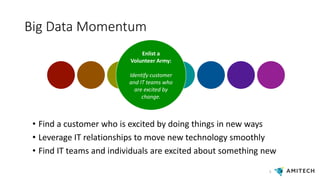
Enlist a
Volunteer Army:
Identify customer
and IT teams who
are excited by
change.
• Find a customer who is excited by doing things in new ways
• Leverage IT relationships to move new technology smoothly
• Find IT teams and individuals are excited about something new
Big Data Momentum
6
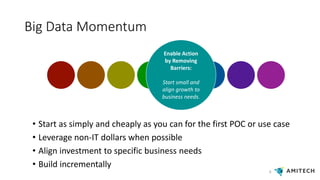
Enable Action
by Removing
Barriers:
Start small and
align growth to
business needs.
• Start as simply and cheaply as you can for the first POC or use case
• Leverage non-IT dollars when possible
• Align investment to specific business needs
• Build incrementally
Big Data Momentum
7
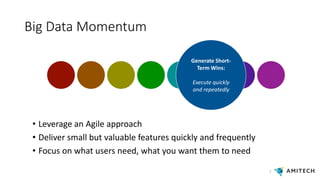
Generate Short-
Term Wins:
Execute quickly
and repeatedly
• Leverage an Agile approach
• Deliver small but valuable features quickly and frequently
• Focus on what users need, what you want them to need
Big Data Momentum
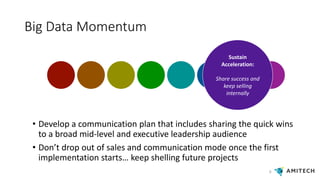
8
Sustain
Acceleration:
Share success and
keep selling
internally
• Develop a communication plan that includes sharing the quick wins
to a broad mid-level and executive leadership audience
• Don’t drop out of sales and communication mode once the first
implementation starts… keep shelling future projects
Big Data Momentum
9
Institute Change:
Let Hadoop be
your default
platform.
• Switch from “we’ll use Hadoop if we have to” to “we’ll use Hadoop
unless we can’t do it there.”
• Take on some small and simple projects. They can be quick wins,
and they’re good opportunities for new developers to learn, too.
Example Solutions
• Chart Search (POC) – search has “wow factor”
• System Archival – Simple process to archive Omnicell data and expose for
reporting with SAP Business Objects
• Real-Time Clinical Analytics – Documentation Improvement and the big
vision of what Hadoop could do based on Epic data
• Lab Text Search – Easier way to dig through Epic lab notes using Hive, Solr,
some custom code and various integration pieces, and reporting via SAP
Business Objects
• Epic Access Log – Got those billions of rows of Epic access log data out of
our reporting database, compressed, and easier to report on
10
Challenges and Lessons
• Leverage other departments and
projects, including their funding
• Keep sharing what Hadoop can do, and
write down everything you do
• Build solutions and tools that are
reusable and scalable
• Leverage the entire Hadoop stack of
related tools
• Try to fail as quickly as possible, and
then try something else
• Build an approach / methodology that
scales (e.g. Data Lake)
• Don’t underestimate the learning
curve
• Leverage polyglot developers
• Spend extra time with traditional data
warehouse and ETL developers
• Pay attention to versions and learn
how to upgrade quickly
11

A Big Data Journey

  • 1.
    A Big DataJourney Growing a Hadoop-based Capability Paul Boal – VP Delivery - Amitech Solutions January 7, 2016 1
  • 2.
    Big Data Momentum 2 Createa Sense of Urgency: What can’t we do today? Are we missing key opportunities? * The model here is from Kotter International – The 8-Step Process for Leading Change • Experiencing pain from existing infrastructure • Cost of growing and upgrading • Addressing “real-time” demands
  • 3.
    Big Data Momentum 3 Builda Guiding Coalition: Who are potential users and partners? • Build demo and do a road show – get people thinking • Ask others who have done it to speak • Remain open to potential partners; but… • Be discerning about who you pick
  • 4.
    Big Data Momentum 4 FormStrategic Vision and Initiatives: Formalize the use cases and interest you hear. • Paint the big picture and show people what might be • Lay out a potential growth plan based on use cases • Highlight business value and immediate wins • Make “step 1” very easy
  • 5.
    Big Data Momentum 5 Enlista Volunteer Army: Identify customer and IT teams who are excited by change. • Find a customer who is excited by doing things in new ways • Leverage IT relationships to move new technology smoothly • Find IT teams and individuals are excited about something new
  • 6.
    Big Data Momentum 6 EnableAction by Removing Barriers: Start small and align growth to business needs. • Start as simply and cheaply as you can for the first POC or use case • Leverage non-IT dollars when possible • Align investment to specific business needs • Build incrementally
  • 7.
    Big Data Momentum 7 GenerateShort- Term Wins: Execute quickly and repeatedly • Leverage an Agile approach • Deliver small but valuable features quickly and frequently • Focus on what users need, what you want them to need
  • 8.
    Big Data Momentum 8 Sustain Acceleration: Sharesuccess and keep selling internally • Develop a communication plan that includes sharing the quick wins to a broad mid-level and executive leadership audience • Don’t drop out of sales and communication mode once the first implementation starts… keep shelling future projects
  • 9.
    Big Data Momentum 9 InstituteChange: Let Hadoop be your default platform. • Switch from “we’ll use Hadoop if we have to” to “we’ll use Hadoop unless we can’t do it there.” • Take on some small and simple projects. They can be quick wins, and they’re good opportunities for new developers to learn, too.
  • 10.
    Example Solutions • ChartSearch (POC) – search has “wow factor” • System Archival – Simple process to archive Omnicell data and expose for reporting with SAP Business Objects • Real-Time Clinical Analytics – Documentation Improvement and the big vision of what Hadoop could do based on Epic data • Lab Text Search – Easier way to dig through Epic lab notes using Hive, Solr, some custom code and various integration pieces, and reporting via SAP Business Objects • Epic Access Log – Got those billions of rows of Epic access log data out of our reporting database, compressed, and easier to report on 10
  • 11.
    Challenges and Lessons •Leverage other departments and projects, including their funding • Keep sharing what Hadoop can do, and write down everything you do • Build solutions and tools that are reusable and scalable • Leverage the entire Hadoop stack of related tools • Try to fail as quickly as possible, and then try something else • Build an approach / methodology that scales (e.g. Data Lake) • Don’t underestimate the learning curve • Leverage polyglot developers • Spend extra time with traditional data warehouse and ETL developers • Pay attention to versions and learn how to upgrade quickly 11