Task 1:
A Beginners Guide to Video Technology
By LMA Film & Media Year 2
PAL was Invented by a man named Walter Bruch at
'Telefunken' in Germany who developed PAL, and it
was in 1963 that the format was first unveiled. The
first broadcasts to use PAL was in 1967, in United
Kingdom and Germany.
MORE ABOUT
ADVANTAGES OF
The advantages of using the PAL format is that It
provides a better image than the Canadian/US
standard NTSC but is often seen as inferior in
comparison to France's 'SECAM'
This is because PAL DVDs have "576 pixels of
vertical resolution" versus "480 pixels of vertical
resolution" Meaning that there is a 20% increase in
resolution for a PAL DVD as compared to an NTSC
DVD
NTSC
NTSC, which is short for 'National Television
System Committee', is an analog video color
format which is used to broadcast television
signals.
bRIEF HISTORY
The NTSC system was first developed in
1941 and had no provision for color TV.
NTSC was the very
first broadcast color
system to be widely
adopted.
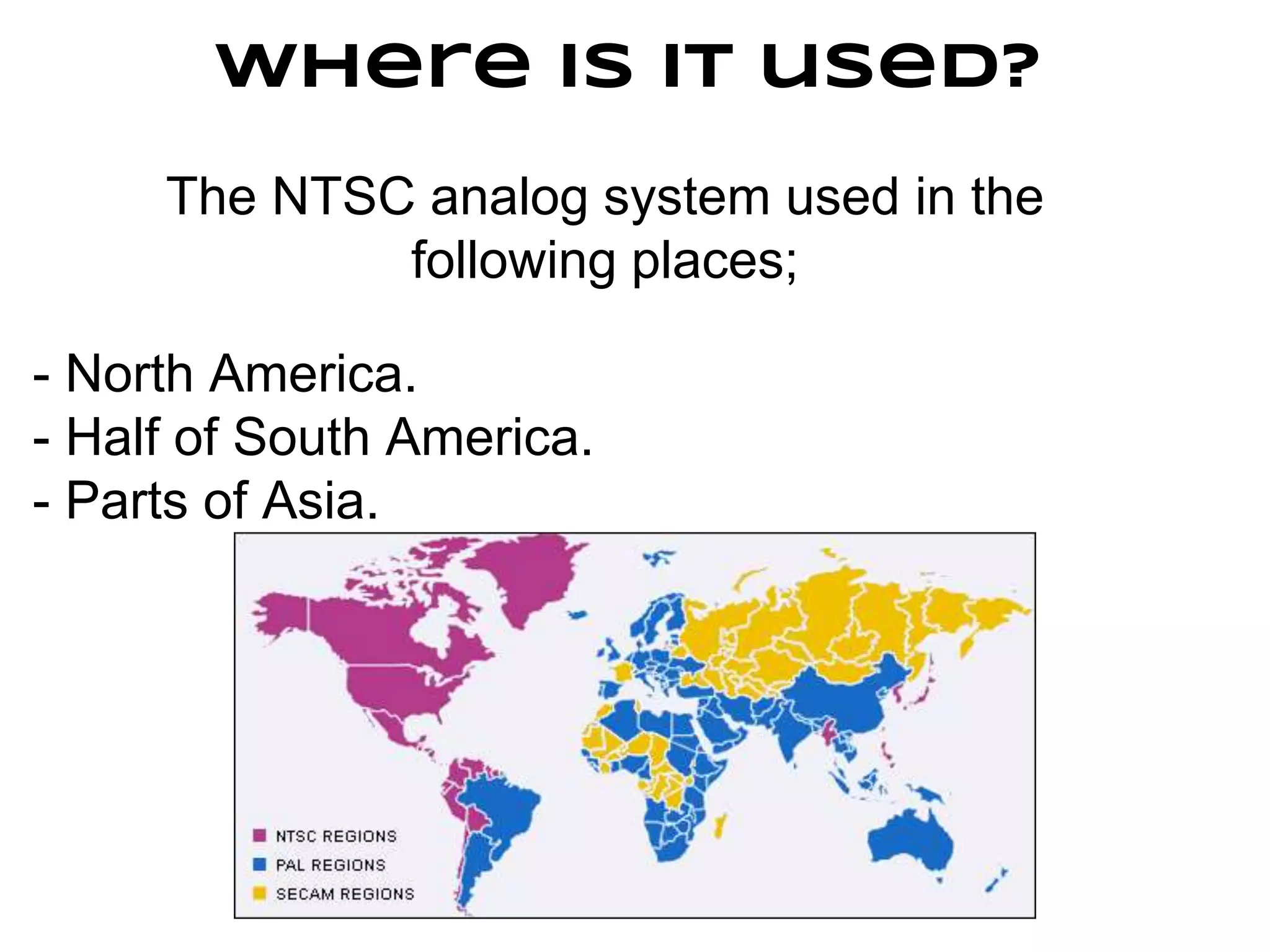
Where is it used?
The NTSC analog system used in the
following places;
- North America.
- Half of South America.
- Parts of Asia.
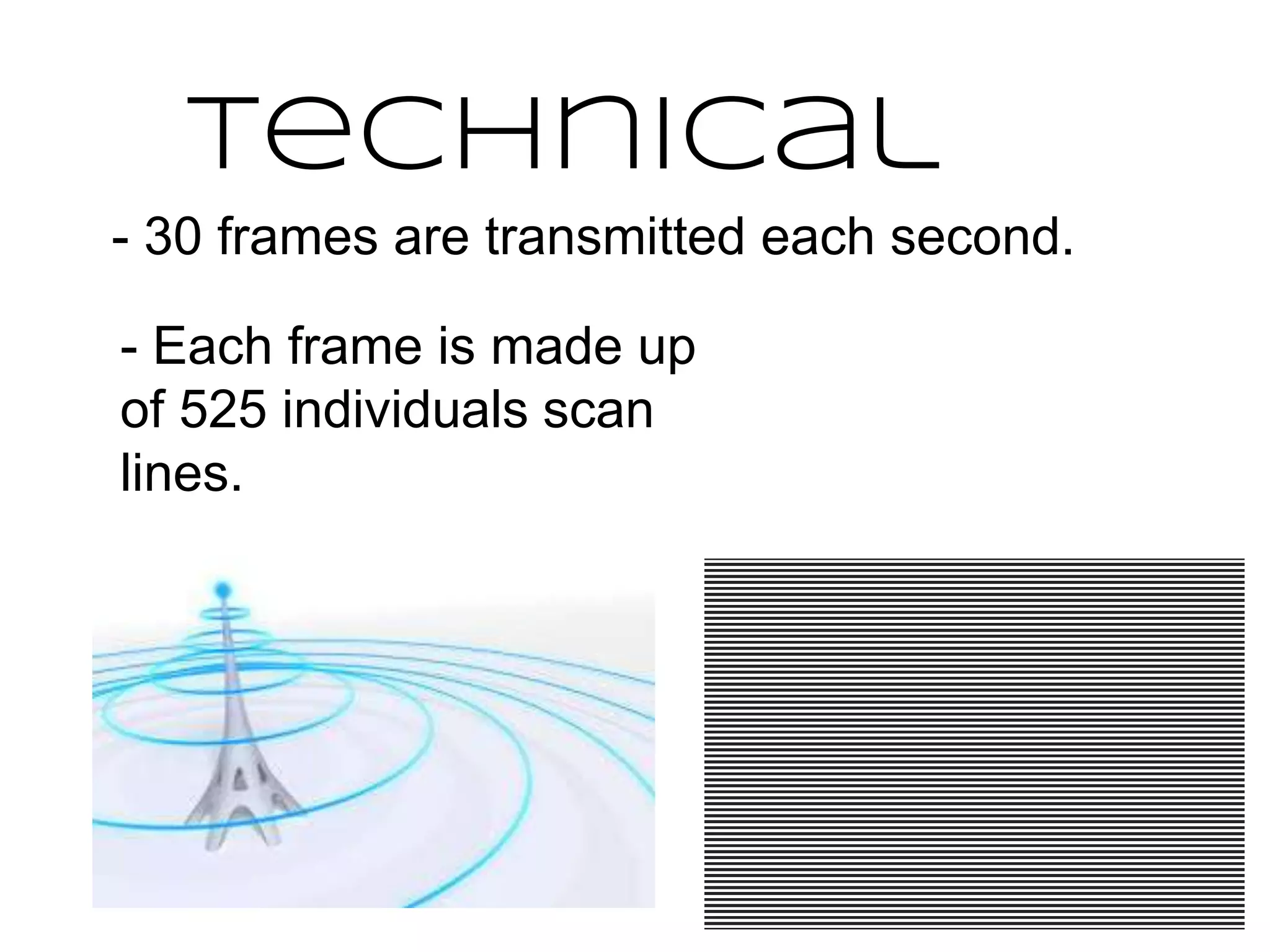
- 30 frames are transmitted each second.
- Each frame is made up
of 525 individuals scan
lines.
technical
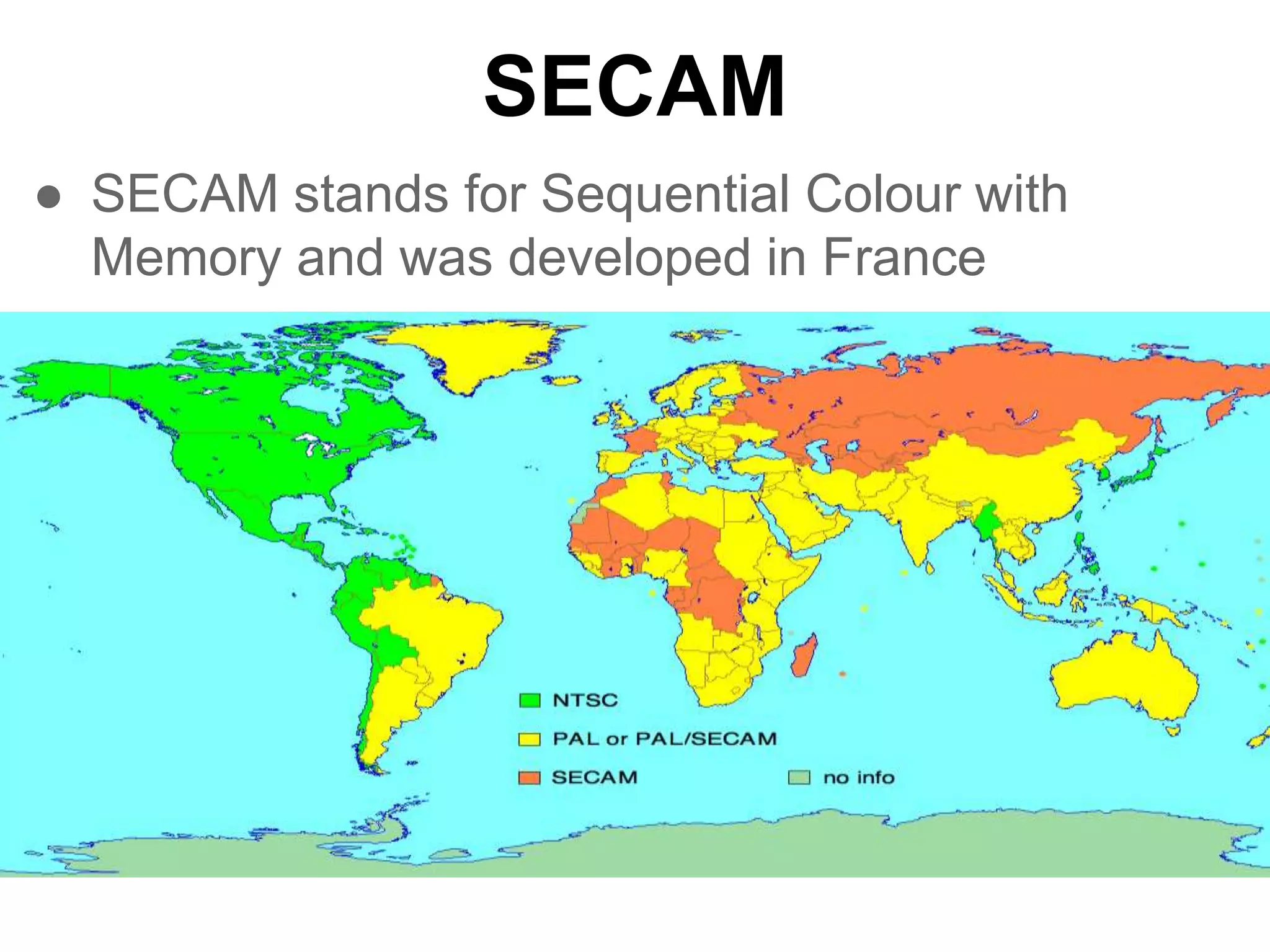
SECAM
● SECAM stands for Sequential Colour with
Memory and was developed in France
SECAM Development
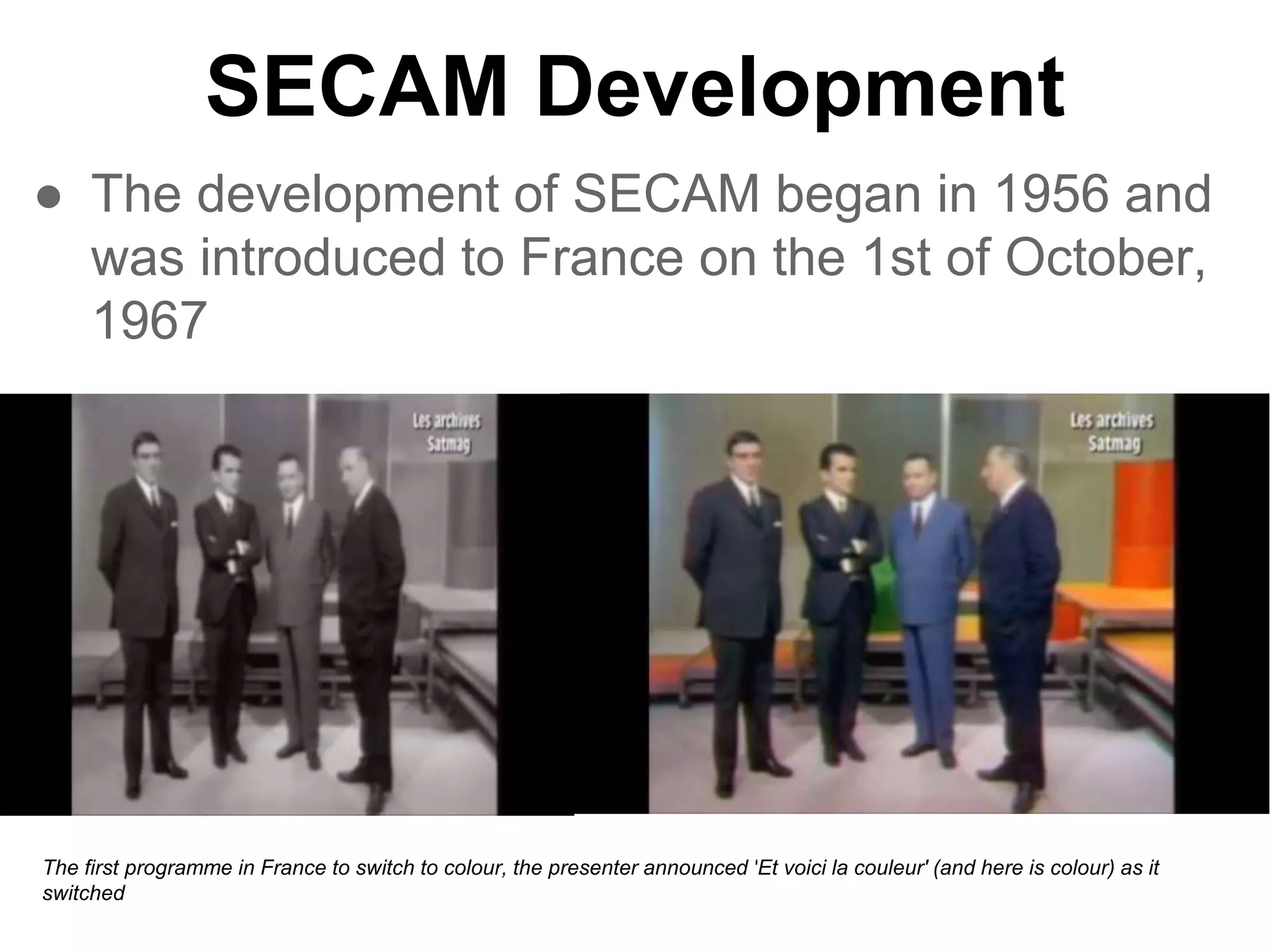
● The development of SECAM began in 1956 and
was introduced to France on the 1st of October,
1967
The first programme in France to switch to colour, the presenter announced 'Et voici la couleur' (and here is colour) as it
switched
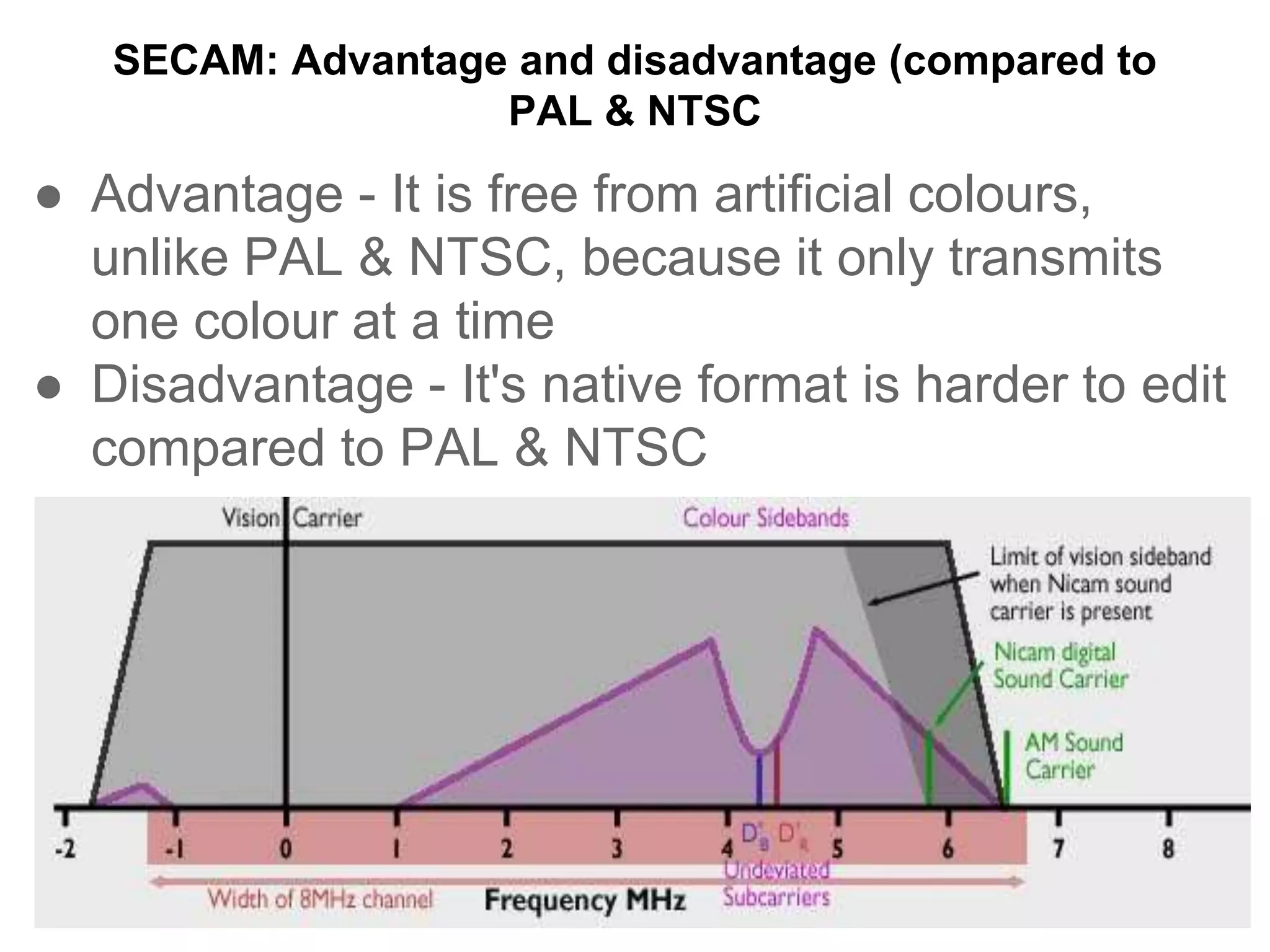
SECAM: Advantage and disadvantage (compared to
PAL & NTSC
● Advantage - It is free from artificial colours,
unlike PAL & NTSC, because it only transmits
one colour at a time
● Disadvantage - It's native format is harder to edit
compared to PAL & NTSC
2: Methods of
Recording, Camera
techniques &
procedures.
Harry, Fraz & Joe
Methods of Recording
Back in the days of yore we used to record
using film, however as technology advanced
digital became the norm for filming.
Film Stock
Film stock is used in the majority
of feature films and was the first
method of recording film.
Film comes in different forms such
as 16mm and 35mm, made popular
by the Lumiere Brothers.
Film
The way in which film works is basically a
combination of photos combined to make a
moving image.
The first (ever) example being Eadweard
Muybridge's "The Horse"
Anything that is filmed is captured in some
form as mentioned, tape was the standard.
Remember this? VHS (Video Home System)
made it possible for people to watch movies
at home rather than a cinema!
Tape
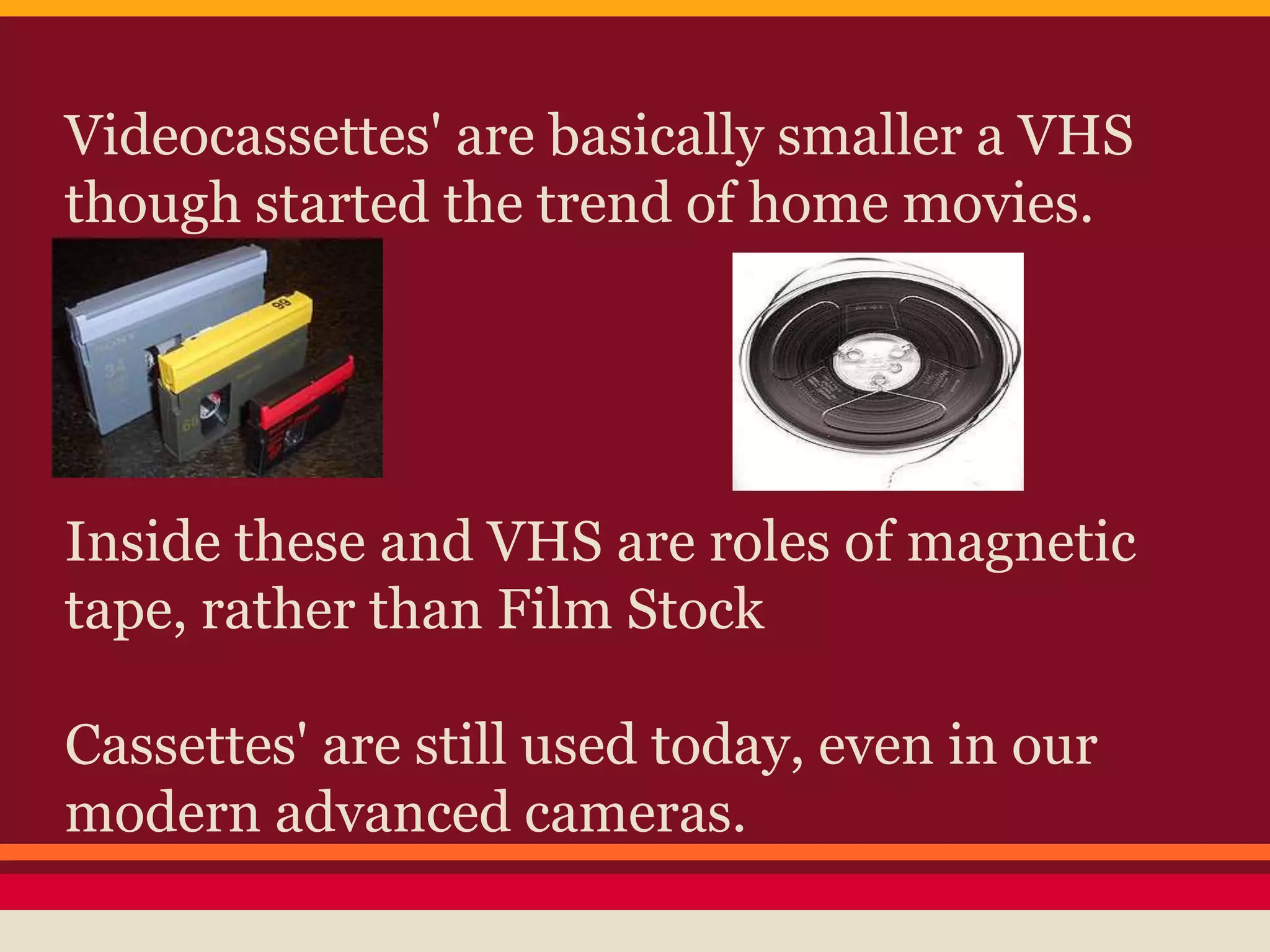
Videocassettes' are basically smaller a VHS
though started the trend of home movies.
Inside these and VHS are roles of magnetic
tape, rather than Film Stock
Cassettes' are still used today, even in our
modern advanced cameras.
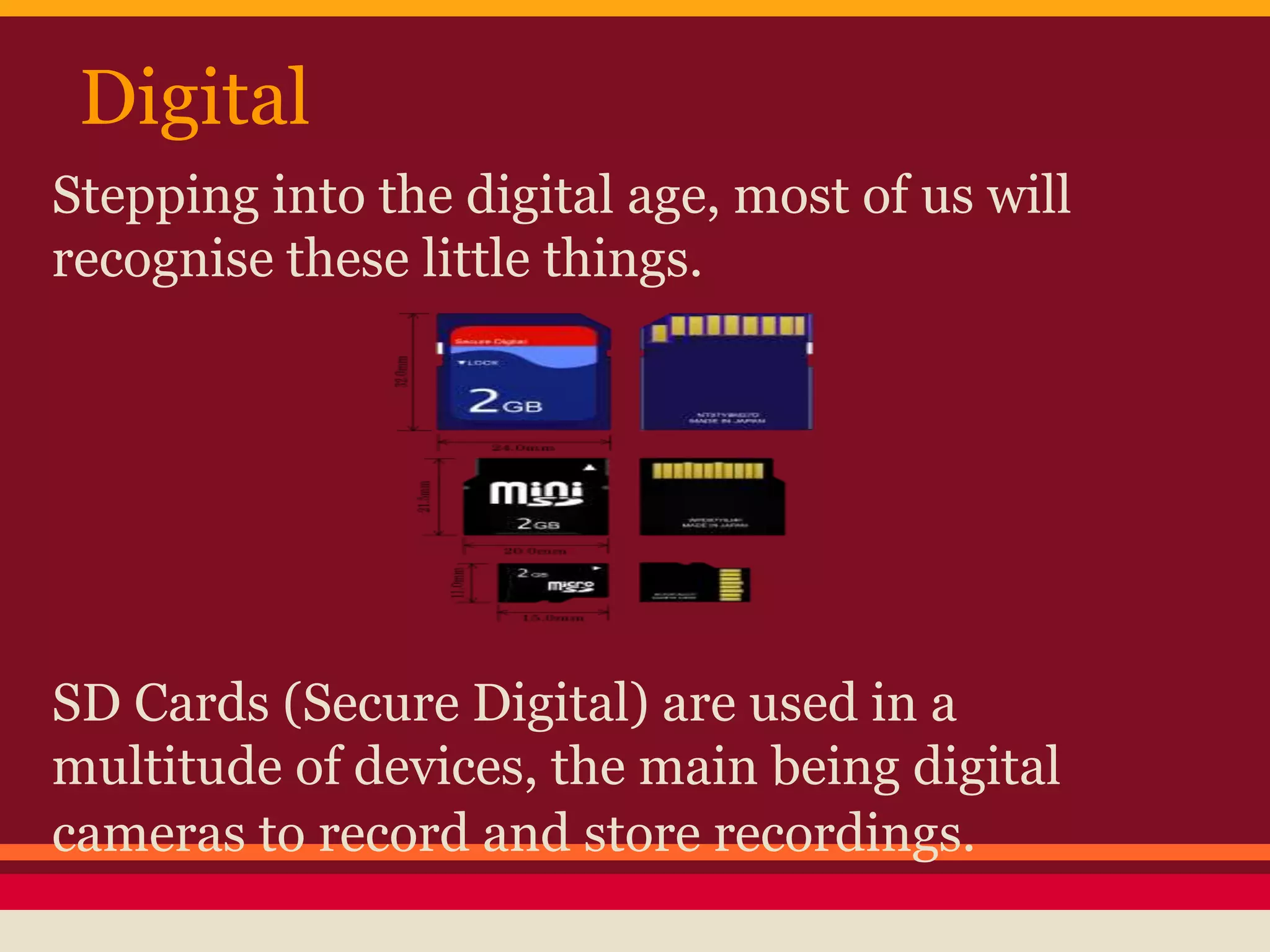
Stepping into the digital age, most of us will
recognise these little things.
SD Cards (Secure Digital) are used in a
multitude of devices, the main being digital
cameras to record and store recordings.
Digital
Colour Temperature!
In film, Colour is measured in Kelvin, or K.
Kelvin is a standard measurement of heat,
hence... Temperature!
The 'Hotter' the colour, the
more BLUE it will be
The cooler the colour, the
more RED it will be.
You took something perfect,
and painted it redddd
This is where it gets a little tricky...
So just how hot is White??
If your camera is
'Indoor Balanced',
white will be 3200k.
If your camera is
Outdoor or Daylight
Balanced, then
white will be 5500k.
This process is called White Balancing.
Focus
When filming, focusing can be done both
'automatically' and 'manually'. This is to
obtain different styles of shots.
Focus 2
The prefered method of focus for most
filmmakers is 'manual' focus, because there
is no sudden shift of focus from one
item/person to another.
Autofocus Manual Focus
Focus 3
Focus is measured by the distance of the
object to the camera, so therefore manual
focus is used more in busy situation with one
point of reference in the distance.
Exposure
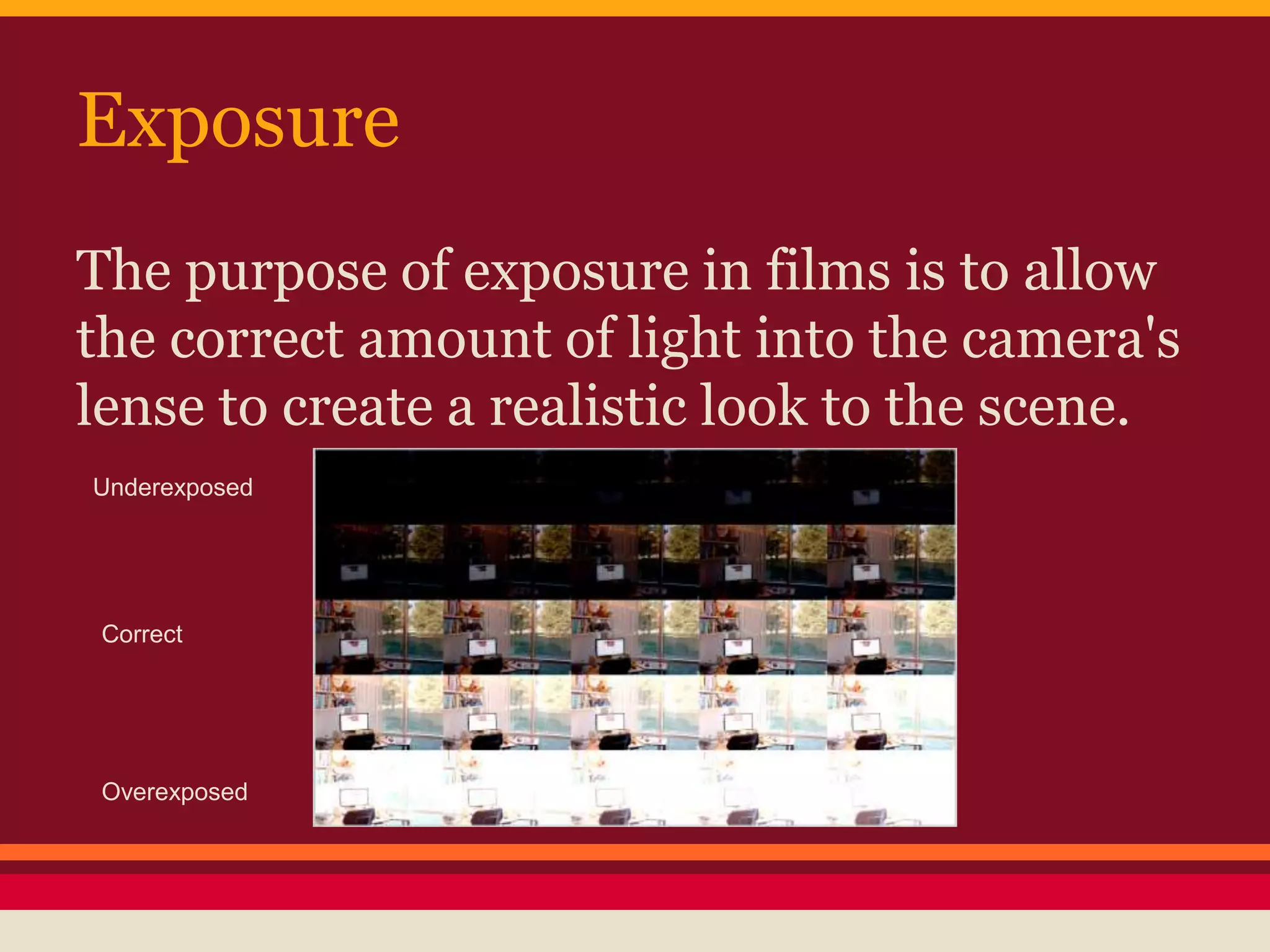
The purpose of exposure in films is to allow
the correct amount of light into the camera's
lense to create a realistic look to the scene.
Underexposed
Correct
Overexposed
Audio Line-Up
Often on film productions,
the visuals and the sound are
often not recorded together.
but how do the get them to
match up in the edit??
The solution is simple!
The Clapperboard!
To sync up the sound, we
use a clapperboard. this
is because the harsh
'clap' and the arm hitting
the board is very easy to
match up.
This means everything
else afterwards will be
perfectly in line.
Aspect Ratio
By Paddy, Dave & Anthony M
4:3
● Aspect ratio (4:3) for standard TV has been
used since video cameras were invented,
many computer monitors used to use this
aspect ratio.
● It was the aspect ratio used throughout the
era of silent movies.
● Because TV used to match aspect ratio
(4:3), movies that were originally filmed on
35mm film could be watched on TV in its
early days (1940's and 50's).
4:3 (continued)
● When the amount of people attending cinema fell,
Hollywood started to change the aspect ratio that
they filmed on and started filming in widescreen
aspect ratios (for example 1.85:1) so that the film
industries and TV industries looked different.
● Since the start of the 21st Century, broadcasters
have tried to stop using aspect ratio (4:3)
completely because modern day technology has
started favouring the (16:9) and (16:10) aspect
ratios of all modern day television sets, computer
monitors and broadcast cameras.
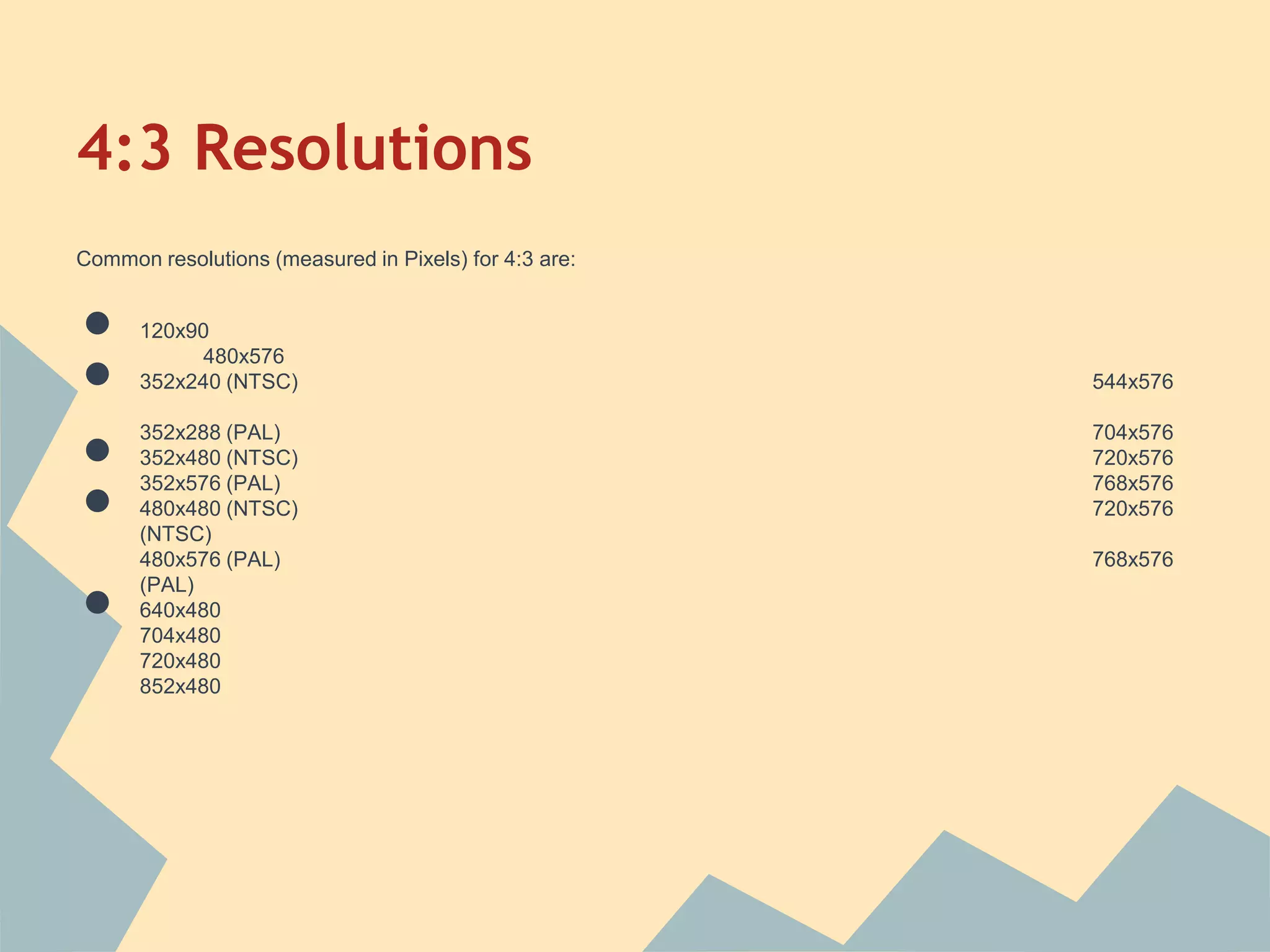
4:3 Resolutions
Common resolutions (measured in Pixels) for 4:3 are:
● 120x90
480x576
● 352x240 (NTSC) 544x576
352x288 (PAL) 704x576
● 352x480 (NTSC) 720x576
352x576 (PAL) 768x576
● 480x480 (NTSC) 720x576
(NTSC)
480x576 (PAL) 768x576
(PAL)
● 640x480
704x480
720x480
852x480
16:9
● Proposed by Kerns H. Powers (SMPTE).
● 16:9 is an aspect ratio with a width of 16 units and
height of 9.
● The most common aspect ratio since 2009.
● the international standard format of HDTV, Full HD,
non-HD digital television.
● The computer industry started switching to 16:9 in 2008.
● 16:9 is the only widescreen aspect ratio supported by
the DVD format.
16:9 Resolutions
● Common resolutions (measured in Pixels) for 16:9 are:
○ 640×360,
○ 854×480,
○ 960×540,
○ 1024×576,
○ 1280×720 (720p),
○ 1366×768,
○ 1600×900,
○ 1920×1080 (1080p),
○ 2048×1152,
○ 2560×1440,
○ 3840×2160, and;
○ 4096×2304.
16:9 Use
Some countries in Europe that use 16:9:
● Albania
● Belgium
● Cyprus
● France
● Germany
● Greece
● Ireland
● Italy
● Poland
● Sweden
● Turkey
● U.K.
Conversion from 4:3 to 16:9
First ever use of
widescreen
The Corbett-Fitzsimmons Fight 1897
First ever
feature film
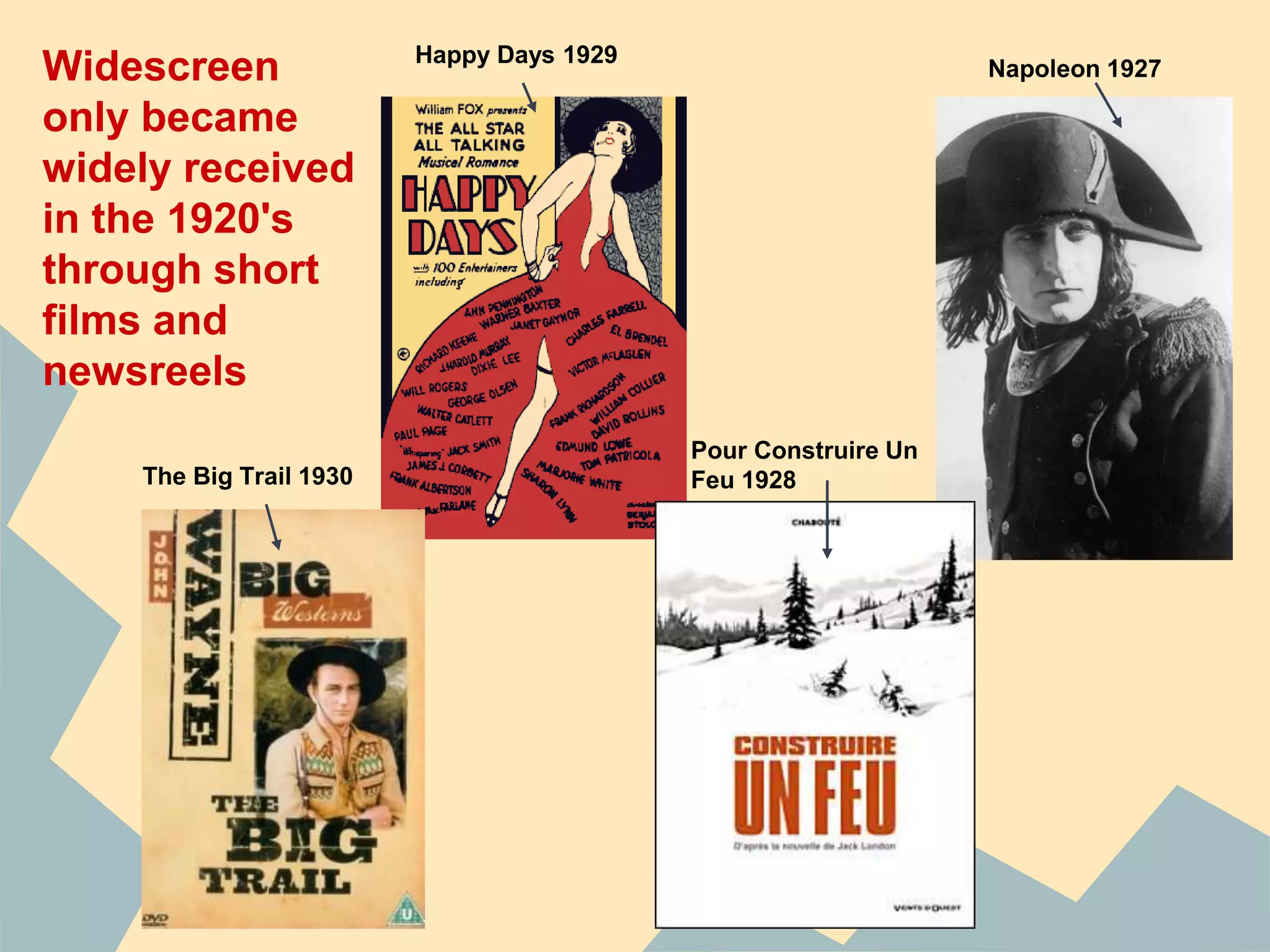
Napoleon 1927Widescreen
only became
widely received
in the 1920's
through short
films and
newsreels
Pour Construire Un
Feu 1928
Happy Days 1929
The Big Trail 1930
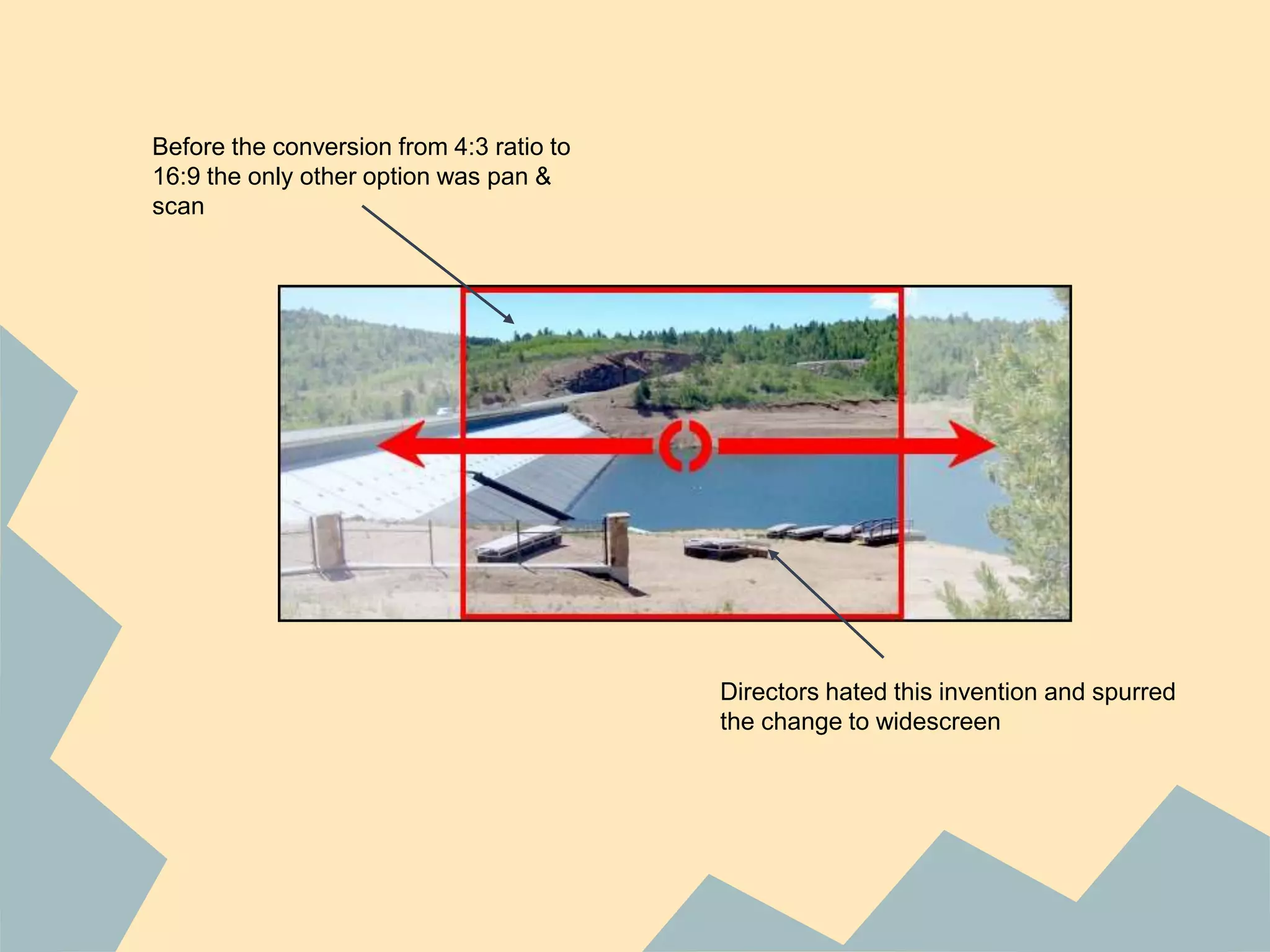
Before the conversion from 4:3 ratio to
16:9 the only other option was pan &
scan
Directors hated this invention and spurred
the change to widescreen
HD and SD
By Steven Bayley, Holly Keenan and Joe L
4
History of high definition
- The first 'high definition' television system was
the 405 lines system.
- In 1939 the US and Europe experimented with
higher definition systems like the 441 or 605
lines.
- By the 80s the highest definition was the 625
line colour.
History continued...
-Europe developed HD-MAC in the 1980s.
(1250 lines)
- In the 1990s came the DVB standard of
resolutions. (1080, 720, 480)
-During the 2000s DVB seemed to be the
standard definition for the future.
Adoption of HD in Television
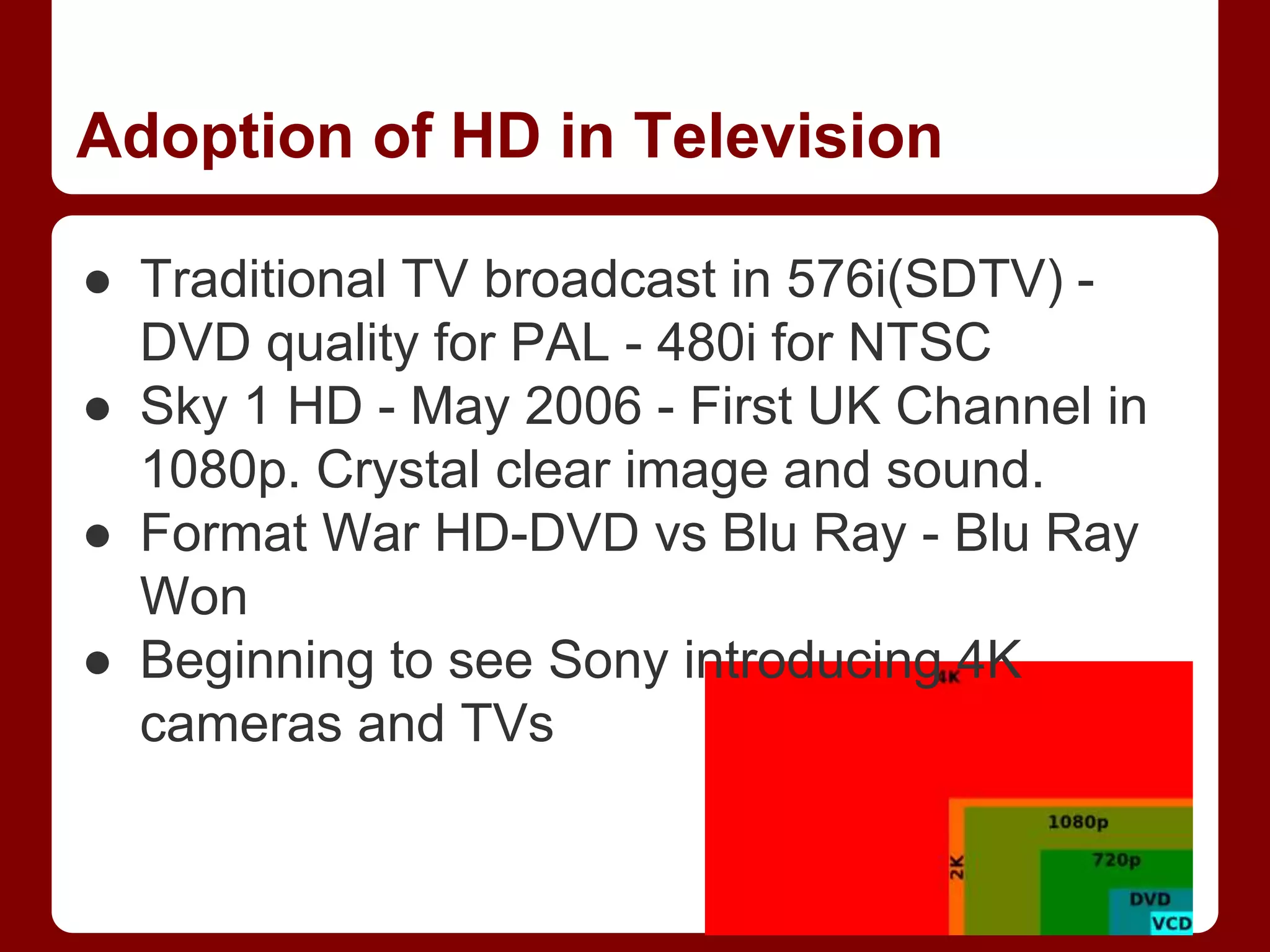
● Traditional TV broadcast in 576i(SDTV) -
DVD quality for PAL - 480i for NTSC
● Sky 1 HD - May 2006 - First UK Channel in
1080p. Crystal clear image and sound.
● Format War HD-DVD vs Blu Ray - Blu Ray
Won
● Beginning to see Sony introducing 4K
cameras and TVs
SD on the internet
SD is common online, due to slow internet
speeds.
● With the introduction of fibre optic cables,
viewing content in HD 1080p is vastly
improved.
High Definition within film
Skyfall, Les Miserables, The Dark Knight Rises
what do each of these films have in common?
But would these films have the same effect on
the audience if they weren't in HD?
The audience doesn't see HD as a bonus, but
as a given.
Can you tell which is HD?
Video Signals
5
● Video signals are separated into different
channels for transmission and recording
Composite & Component
● Both carry analogue signals
● Video that is carried by composite cables is a compressed version of the
video carried by component cables
● Hello i seem to missing a hat have you seen it? really need your help :/
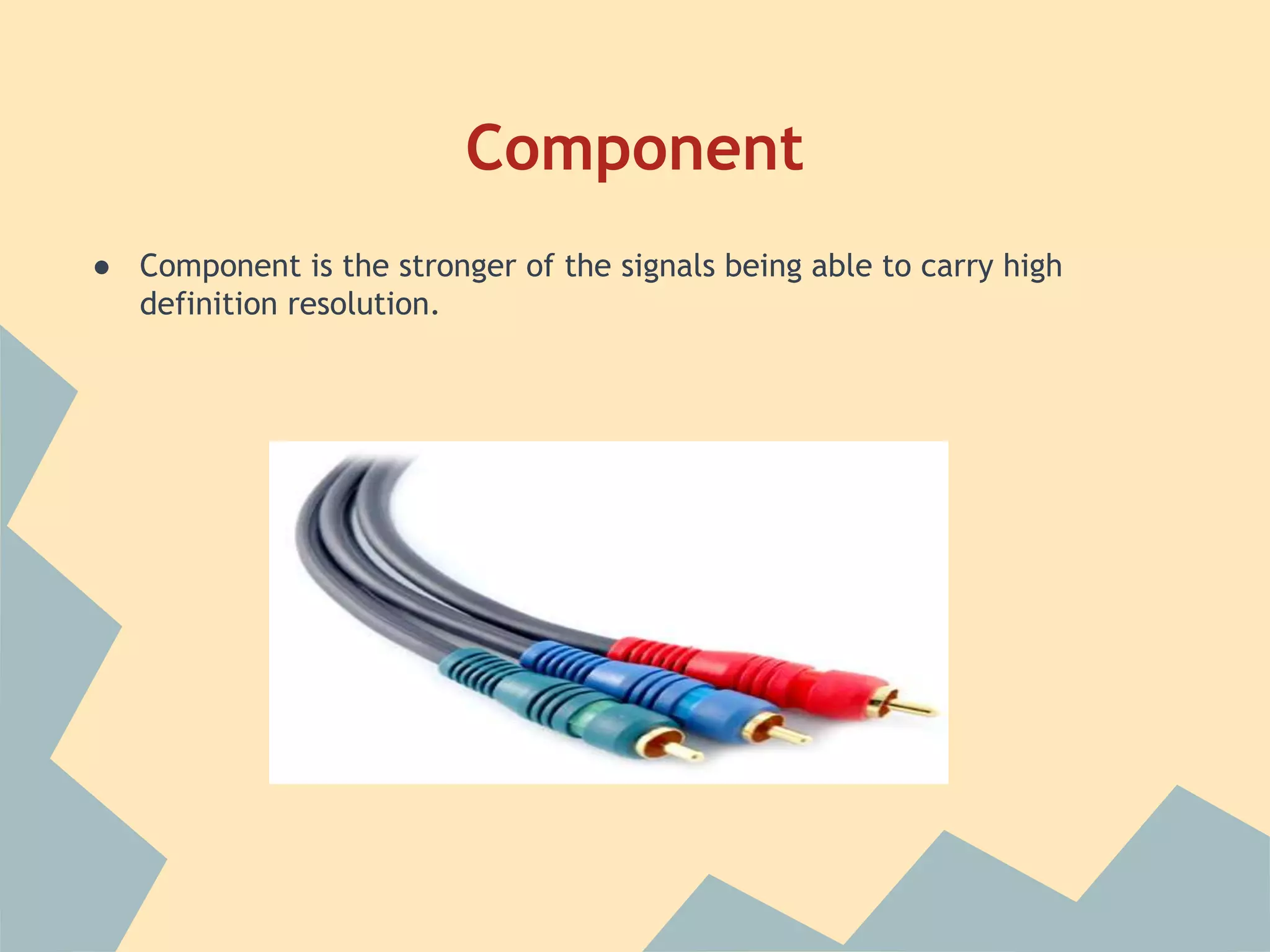
Component
● Component is the stronger of the signals being able to carry high
definition resolution.
Composite
● Composite signal is all of the components of the video signal, limited to
standard definition resolution
● A video signal contains basically five elements. A synchronization signal
to tell the TV when to start scanning, a brightness control to set the
intensity at any given instant and three signals that control each of the
levels for the primary video colors.
● A composite video signal mixes all elements together, which makes a
more convenient connection with a single video cable. But this limits the
information sent to the screen, making composite video the lowest
quality format.
S-Video
S-Video is considered a slightly lower quality than composite but slightly
higher quality than component video.
4 Pin Connector
How can you tell them apart?
Describe and Explain Digital Editing...
Corey and Cailey
Editing Software
Editing Software is used to edit together film and
video footage into a final production.
Popular Software:
● Avid (Windows/Mac)
● Sony Vegas
● Adobe Premiere / After Effects (Windows/Mac)
● Final Cut (Mac Only)
● Windows Movie Maker
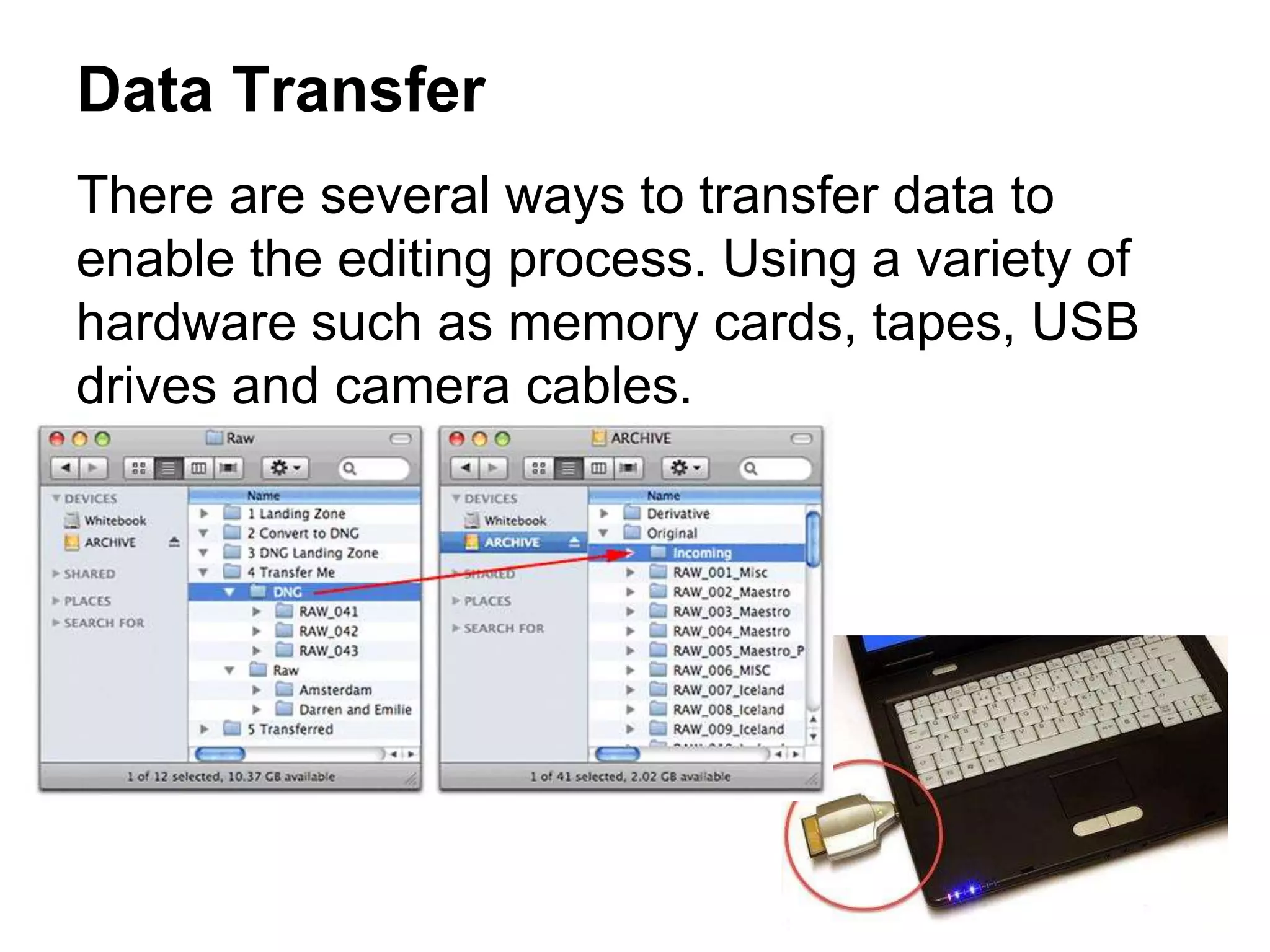
Data Transfer
There are several ways to transfer data to
enable the editing process. Using a variety of
hardware such as memory cards, tapes, USB
drives and camera cables.
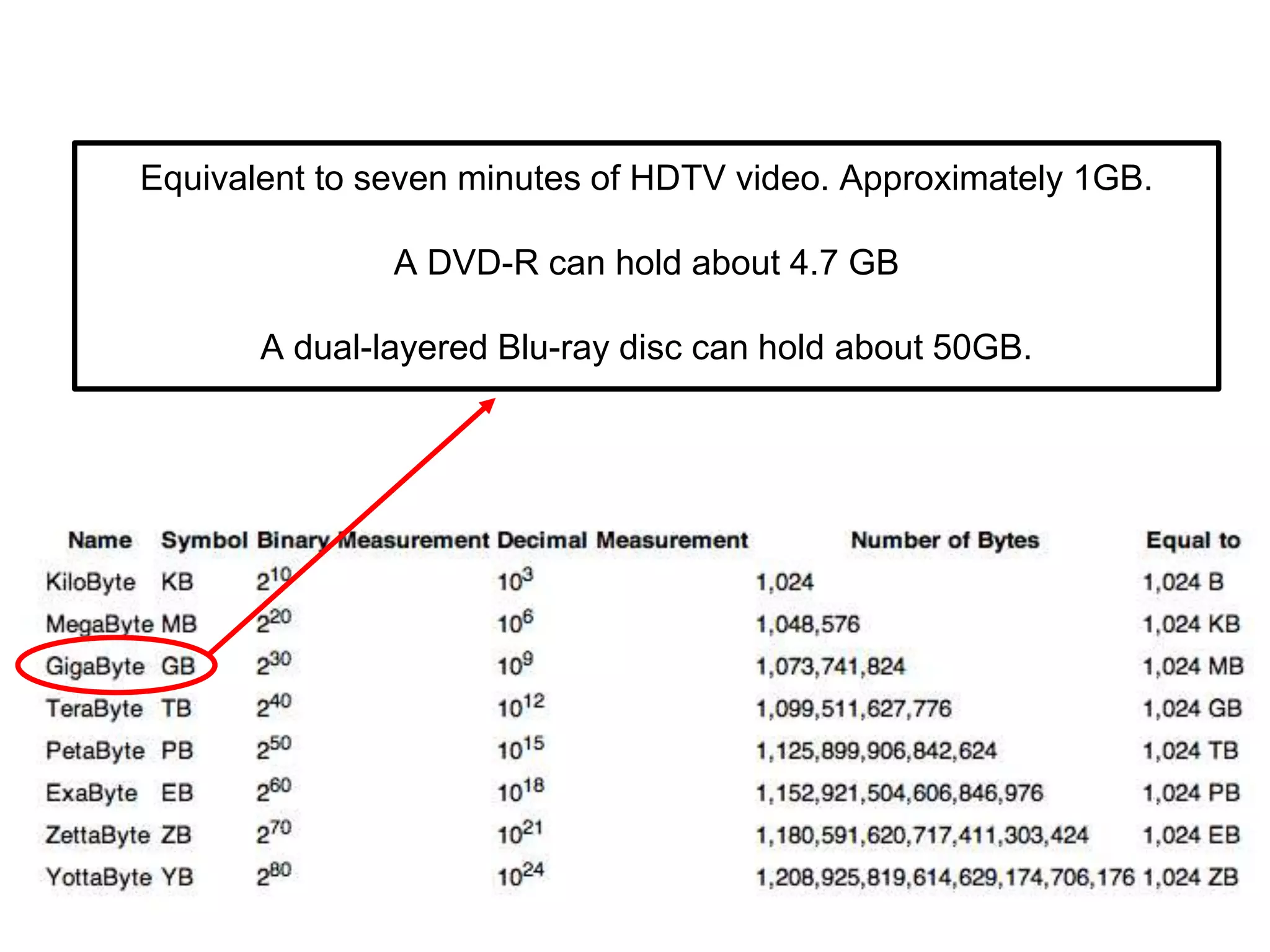
File Size
File size measures the size of a computer file.
Typically it is measured in bytes.
GB is the measurement of file size most frequently
used in digital film production.
Equivalent to seven minutes of HDTV video. Approximately 1GB.
A DVD-R can hold about 4.7 GB
A dual-layered Blu-ray disc can hold about 50GB.
File Management
The term computer file management refers to
the manipulation of documents and data in files
on a computer.
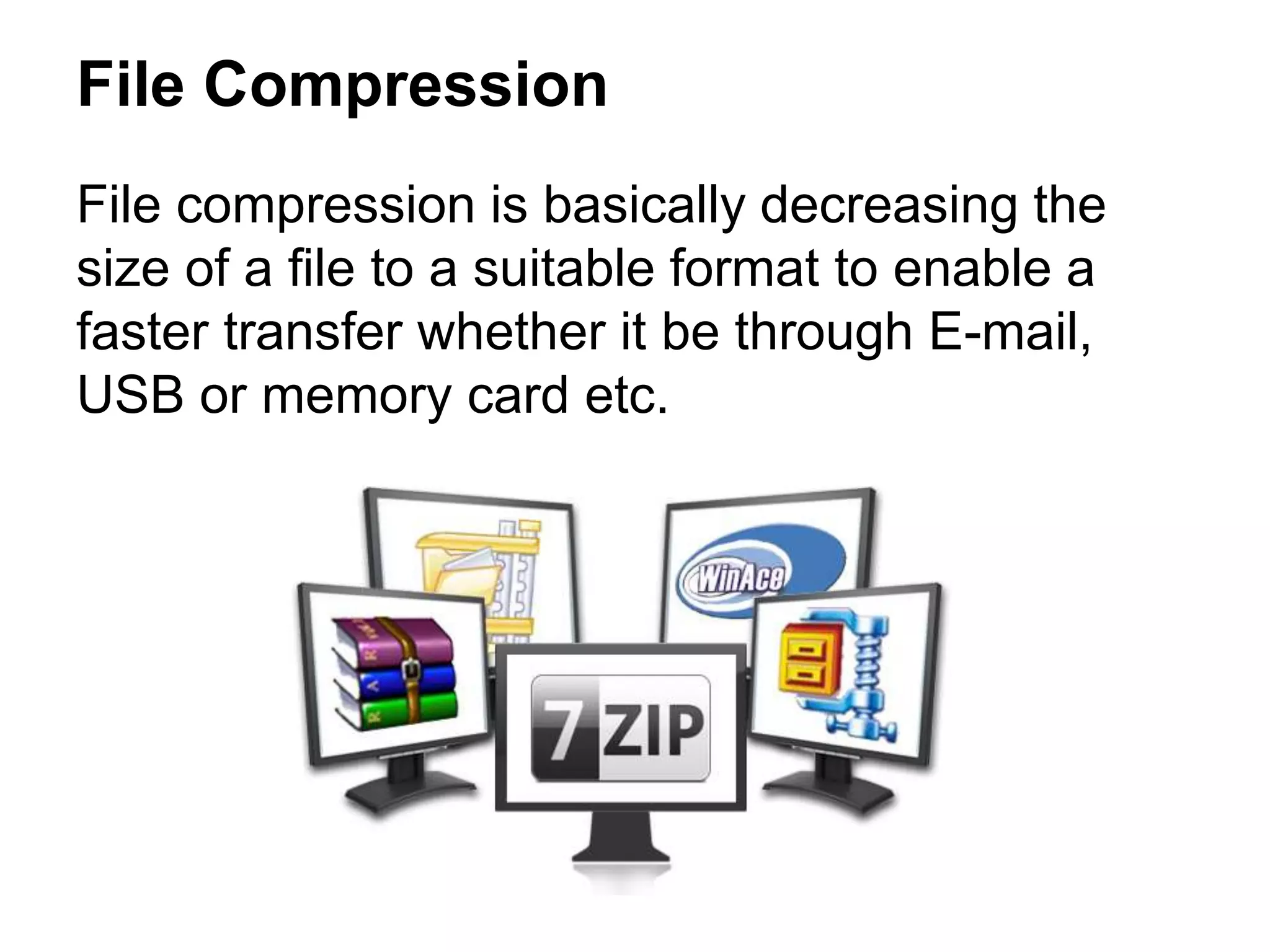
File Compression
File compression is basically decreasing the
size of a file to a suitable format to enable a
faster transfer whether it be through E-mail,
USB or memory card etc.
File Formats
● WAV (Widely used on Windows platform)
● MPEG - is the standard compression of video and
audio. It is designed to compress VHS quality raw
digital video and CD into a smaller file size.
● mp4 -video format uses separate compression for audio
and video tracks.
● WMV - Windows Media Video is a video compression
format for several proprietary codecs developed by
Microsoft.
Downloading and
Streaming
Connor Bostock and Elliott Condron
Content
● Downloading
● Streaming
Downloading
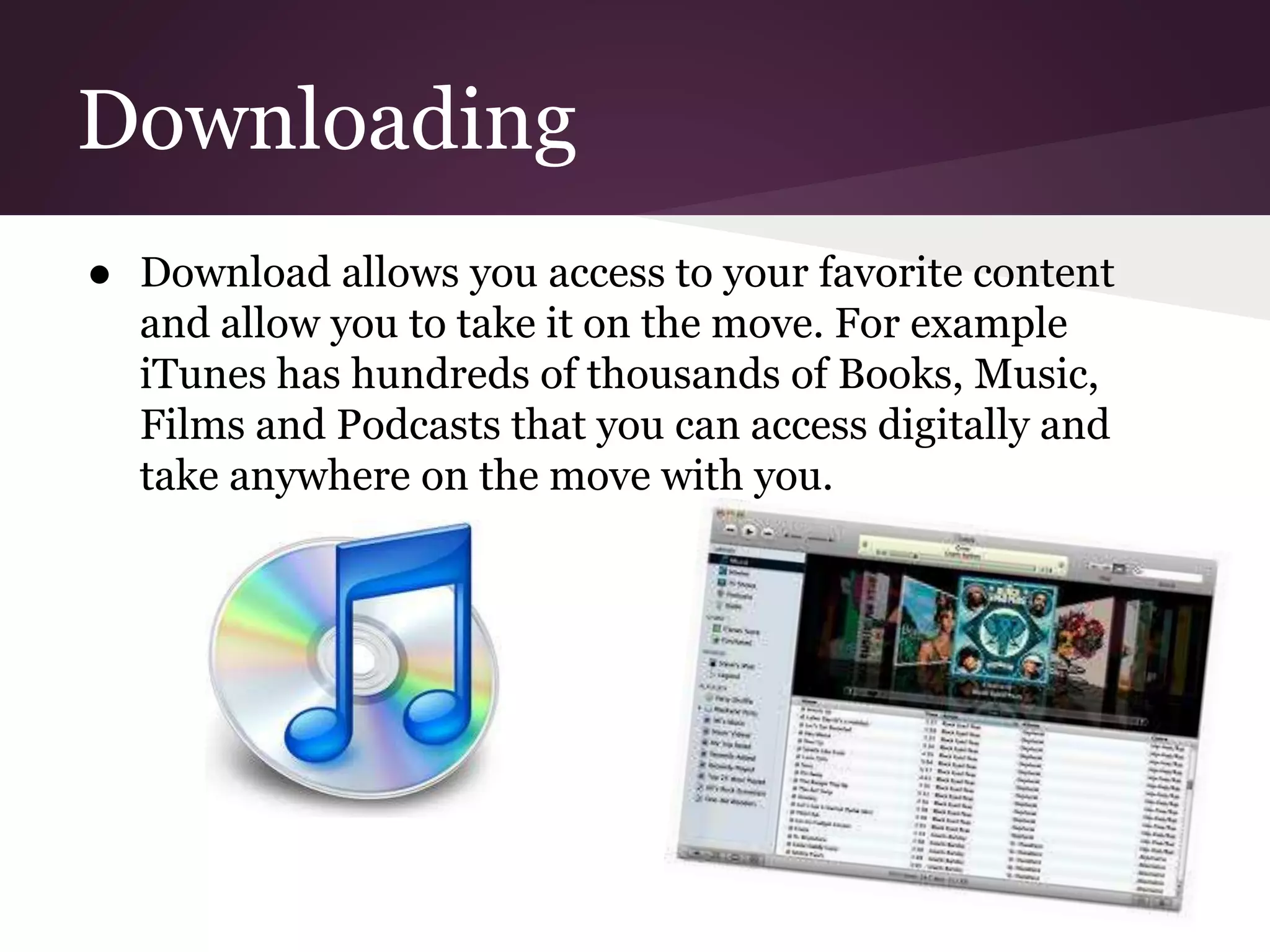
● Download allows you access to your favorite content
and allow you to take it on the move. For example
iTunes has hundreds of thousands of Books, Music,
Films and Podcasts that you can access digitally and
take anywhere on the move with you.
Streaming
● Streaming allows you to watch your favorite tv shows
that you have missed on the move for example, BBC
iPlayer and 4oD.
● Also you can watch live events as they happen for
example a gig or a historic moment such as felix
Baumgartner's jump from the edge of space on Youtube
Benefits of both
● It allows you the freedom of watch programmes on the
move through lots of ways like wi-fi, 3G or EE which run
it clearly.
● and as technology gets streaming and download will
keep up with people being able to download and stream
at higher ratios such as 720p and 1080p
#8
Quotes taken from
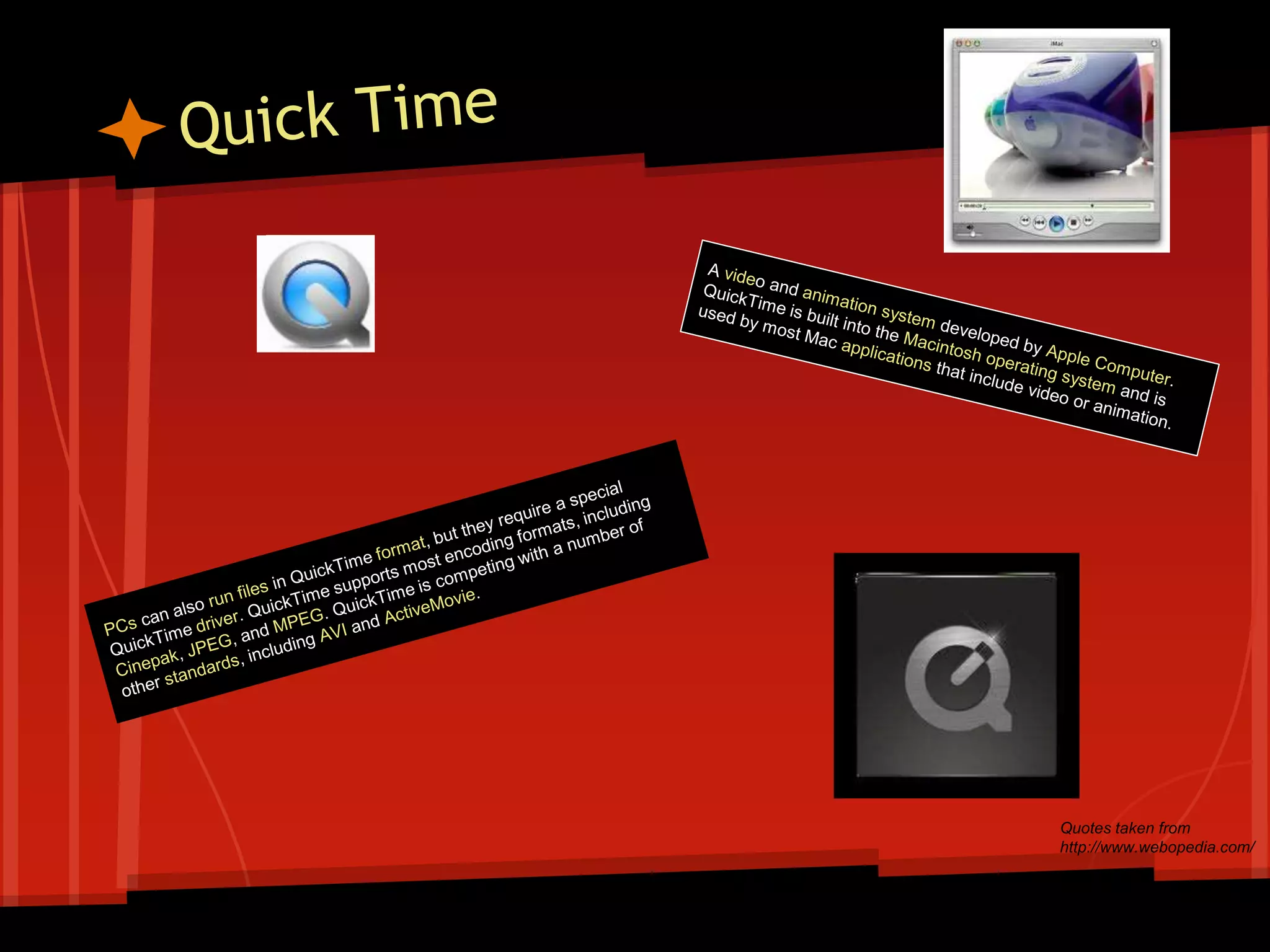
http://www.webopedia.com/
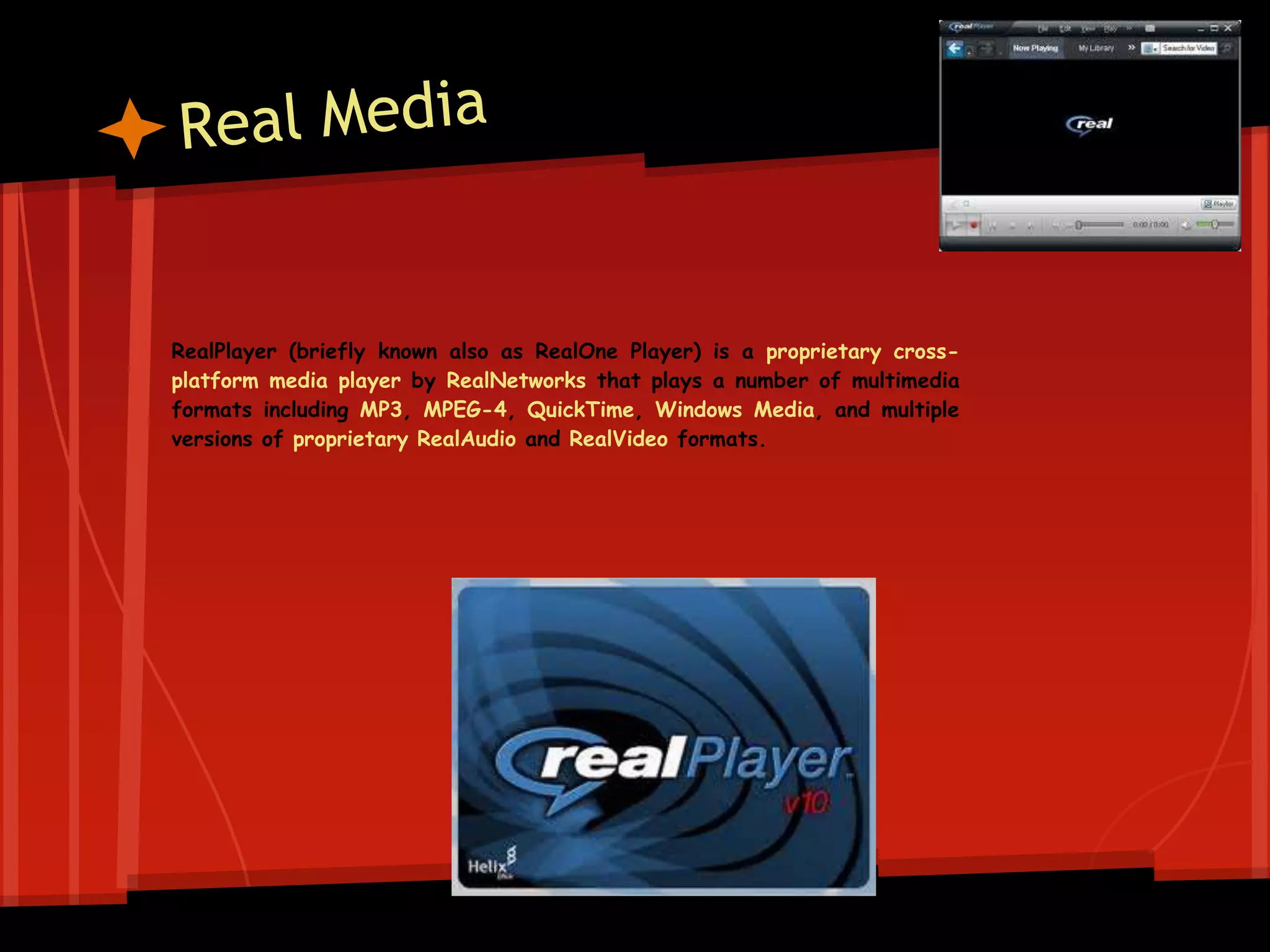
RealPlayer (briefly known also as RealOne Player) is a proprietary cross-
platform media player by RealNetworks that plays a number of multimedia
formats including MP3, MPEG-4, QuickTime, Windows Media, and multiple
versions of proprietary RealAudio and RealVideo formats.
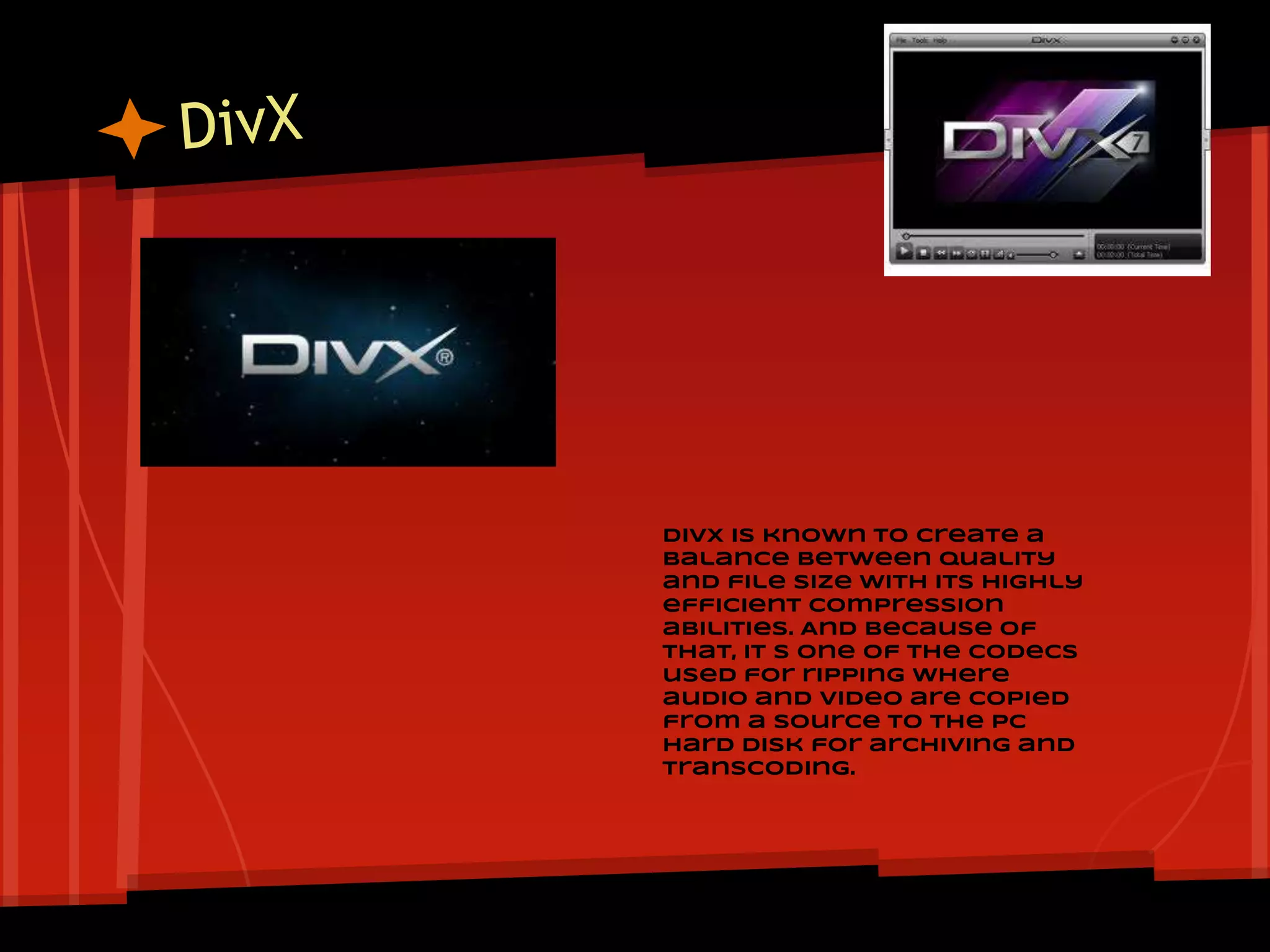
DivX is known to create a
balance between quality
and file size with its highly
efficient compression
abilities. And because of
that, it s one of the codecs
used for ripping where
audio and video are copied
from a source to the PC
hard disk for archiving and
transcoding.

A beginners guide to video technology

  • 1.
    Task 1: A BeginnersGuide to Video Technology By LMA Film & Media Year 2
  • 3.
    PAL was Inventedby a man named Walter Bruch at 'Telefunken' in Germany who developed PAL, and it was in 1963 that the format was first unveiled. The first broadcasts to use PAL was in 1967, in United Kingdom and Germany. MORE ABOUT
  • 4.
    ADVANTAGES OF The advantagesof using the PAL format is that It provides a better image than the Canadian/US standard NTSC but is often seen as inferior in comparison to France's 'SECAM' This is because PAL DVDs have "576 pixels of vertical resolution" versus "480 pixels of vertical resolution" Meaning that there is a 20% increase in resolution for a PAL DVD as compared to an NTSC DVD
  • 5.
    NTSC NTSC, which isshort for 'National Television System Committee', is an analog video color format which is used to broadcast television signals.
  • 6.
    bRIEF HISTORY The NTSCsystem was first developed in 1941 and had no provision for color TV. NTSC was the very first broadcast color system to be widely adopted.
  • 7.
    Where is itused? The NTSC analog system used in the following places; - North America. - Half of South America. - Parts of Asia.
  • 8.
    - 30 framesare transmitted each second. - Each frame is made up of 525 individuals scan lines. technical
  • 9.
    SECAM ● SECAM standsfor Sequential Colour with Memory and was developed in France
  • 10.
    SECAM Development ● Thedevelopment of SECAM began in 1956 and was introduced to France on the 1st of October, 1967 The first programme in France to switch to colour, the presenter announced 'Et voici la couleur' (and here is colour) as it switched
  • 11.
    SECAM: Advantage anddisadvantage (compared to PAL & NTSC ● Advantage - It is free from artificial colours, unlike PAL & NTSC, because it only transmits one colour at a time ● Disadvantage - It's native format is harder to edit compared to PAL & NTSC
  • 12.
    2: Methods of Recording,Camera techniques & procedures. Harry, Fraz & Joe
  • 13.
    Methods of Recording Backin the days of yore we used to record using film, however as technology advanced digital became the norm for filming.
  • 14.
    Film Stock Film stockis used in the majority of feature films and was the first method of recording film. Film comes in different forms such as 16mm and 35mm, made popular by the Lumiere Brothers.
  • 15.
    Film The way inwhich film works is basically a combination of photos combined to make a moving image. The first (ever) example being Eadweard Muybridge's "The Horse"
  • 16.
    Anything that isfilmed is captured in some form as mentioned, tape was the standard. Remember this? VHS (Video Home System) made it possible for people to watch movies at home rather than a cinema! Tape
  • 17.
    Videocassettes' are basicallysmaller a VHS though started the trend of home movies. Inside these and VHS are roles of magnetic tape, rather than Film Stock Cassettes' are still used today, even in our modern advanced cameras.
  • 18.
    Stepping into thedigital age, most of us will recognise these little things. SD Cards (Secure Digital) are used in a multitude of devices, the main being digital cameras to record and store recordings. Digital
  • 19.
    Colour Temperature! In film,Colour is measured in Kelvin, or K. Kelvin is a standard measurement of heat, hence... Temperature! The 'Hotter' the colour, the more BLUE it will be The cooler the colour, the more RED it will be. You took something perfect, and painted it redddd
  • 20.
    This is whereit gets a little tricky... So just how hot is White?? If your camera is 'Indoor Balanced', white will be 3200k. If your camera is Outdoor or Daylight Balanced, then white will be 5500k. This process is called White Balancing.
  • 21.
    Focus When filming, focusingcan be done both 'automatically' and 'manually'. This is to obtain different styles of shots.
  • 22.
    Focus 2 The preferedmethod of focus for most filmmakers is 'manual' focus, because there is no sudden shift of focus from one item/person to another. Autofocus Manual Focus
  • 23.
    Focus 3 Focus ismeasured by the distance of the object to the camera, so therefore manual focus is used more in busy situation with one point of reference in the distance.
  • 24.
    Exposure The purpose ofexposure in films is to allow the correct amount of light into the camera's lense to create a realistic look to the scene. Underexposed Correct Overexposed
  • 25.
    Audio Line-Up Often onfilm productions, the visuals and the sound are often not recorded together. but how do the get them to match up in the edit??
  • 26.
    The solution issimple! The Clapperboard! To sync up the sound, we use a clapperboard. this is because the harsh 'clap' and the arm hitting the board is very easy to match up. This means everything else afterwards will be perfectly in line.
  • 28.
    Aspect Ratio By Paddy,Dave & Anthony M
  • 29.
    4:3 ● Aspect ratio(4:3) for standard TV has been used since video cameras were invented, many computer monitors used to use this aspect ratio. ● It was the aspect ratio used throughout the era of silent movies. ● Because TV used to match aspect ratio (4:3), movies that were originally filmed on 35mm film could be watched on TV in its early days (1940's and 50's).
  • 30.
    4:3 (continued) ● Whenthe amount of people attending cinema fell, Hollywood started to change the aspect ratio that they filmed on and started filming in widescreen aspect ratios (for example 1.85:1) so that the film industries and TV industries looked different. ● Since the start of the 21st Century, broadcasters have tried to stop using aspect ratio (4:3) completely because modern day technology has started favouring the (16:9) and (16:10) aspect ratios of all modern day television sets, computer monitors and broadcast cameras.
  • 31.
    4:3 Resolutions Common resolutions(measured in Pixels) for 4:3 are: ● 120x90 480x576 ● 352x240 (NTSC) 544x576 352x288 (PAL) 704x576 ● 352x480 (NTSC) 720x576 352x576 (PAL) 768x576 ● 480x480 (NTSC) 720x576 (NTSC) 480x576 (PAL) 768x576 (PAL) ● 640x480 704x480 720x480 852x480
  • 32.
    16:9 ● Proposed byKerns H. Powers (SMPTE). ● 16:9 is an aspect ratio with a width of 16 units and height of 9. ● The most common aspect ratio since 2009. ● the international standard format of HDTV, Full HD, non-HD digital television. ● The computer industry started switching to 16:9 in 2008. ● 16:9 is the only widescreen aspect ratio supported by the DVD format.
  • 33.
    16:9 Resolutions ● Commonresolutions (measured in Pixels) for 16:9 are: ○ 640×360, ○ 854×480, ○ 960×540, ○ 1024×576, ○ 1280×720 (720p), ○ 1366×768, ○ 1600×900, ○ 1920×1080 (1080p), ○ 2048×1152, ○ 2560×1440, ○ 3840×2160, and; ○ 4096×2304.
  • 34.
    16:9 Use Some countriesin Europe that use 16:9: ● Albania ● Belgium ● Cyprus ● France ● Germany ● Greece ● Ireland ● Italy ● Poland ● Sweden ● Turkey ● U.K.
  • 35.
    Conversion from 4:3to 16:9 First ever use of widescreen The Corbett-Fitzsimmons Fight 1897 First ever feature film
  • 36.
    Napoleon 1927Widescreen only became widelyreceived in the 1920's through short films and newsreels Pour Construire Un Feu 1928 Happy Days 1929 The Big Trail 1930
  • 37.
    Before the conversionfrom 4:3 ratio to 16:9 the only other option was pan & scan Directors hated this invention and spurred the change to widescreen
  • 38.
    HD and SD BySteven Bayley, Holly Keenan and Joe L 4
  • 39.
    History of highdefinition - The first 'high definition' television system was the 405 lines system. - In 1939 the US and Europe experimented with higher definition systems like the 441 or 605 lines. - By the 80s the highest definition was the 625 line colour.
  • 40.
    History continued... -Europe developedHD-MAC in the 1980s. (1250 lines) - In the 1990s came the DVB standard of resolutions. (1080, 720, 480) -During the 2000s DVB seemed to be the standard definition for the future.
  • 41.
    Adoption of HDin Television ● Traditional TV broadcast in 576i(SDTV) - DVD quality for PAL - 480i for NTSC ● Sky 1 HD - May 2006 - First UK Channel in 1080p. Crystal clear image and sound. ● Format War HD-DVD vs Blu Ray - Blu Ray Won ● Beginning to see Sony introducing 4K cameras and TVs
  • 42.
    SD on theinternet SD is common online, due to slow internet speeds. ● With the introduction of fibre optic cables, viewing content in HD 1080p is vastly improved.
  • 43.
    High Definition withinfilm Skyfall, Les Miserables, The Dark Knight Rises what do each of these films have in common? But would these films have the same effect on the audience if they weren't in HD? The audience doesn't see HD as a bonus, but as a given.
  • 44.
    Can you tellwhich is HD?
  • 45.
  • 47.
    ● Video signalsare separated into different channels for transmission and recording
  • 48.
    Composite & Component ●Both carry analogue signals ● Video that is carried by composite cables is a compressed version of the video carried by component cables ● Hello i seem to missing a hat have you seen it? really need your help :/
  • 49.
    Component ● Component isthe stronger of the signals being able to carry high definition resolution.
  • 50.
    Composite ● Composite signalis all of the components of the video signal, limited to standard definition resolution ● A video signal contains basically five elements. A synchronization signal to tell the TV when to start scanning, a brightness control to set the intensity at any given instant and three signals that control each of the levels for the primary video colors. ● A composite video signal mixes all elements together, which makes a more convenient connection with a single video cable. But this limits the information sent to the screen, making composite video the lowest quality format.
  • 51.
    S-Video S-Video is considereda slightly lower quality than composite but slightly higher quality than component video. 4 Pin Connector
  • 52.
    How can youtell them apart?
  • 53.
    Describe and ExplainDigital Editing... Corey and Cailey
  • 54.
    Editing Software Editing Softwareis used to edit together film and video footage into a final production. Popular Software: ● Avid (Windows/Mac) ● Sony Vegas ● Adobe Premiere / After Effects (Windows/Mac) ● Final Cut (Mac Only) ● Windows Movie Maker
  • 55.
    Data Transfer There areseveral ways to transfer data to enable the editing process. Using a variety of hardware such as memory cards, tapes, USB drives and camera cables.
  • 56.
    File Size File sizemeasures the size of a computer file. Typically it is measured in bytes. GB is the measurement of file size most frequently used in digital film production.
  • 57.
    Equivalent to sevenminutes of HDTV video. Approximately 1GB. A DVD-R can hold about 4.7 GB A dual-layered Blu-ray disc can hold about 50GB.
  • 58.
    File Management The termcomputer file management refers to the manipulation of documents and data in files on a computer.
  • 59.
    File Compression File compressionis basically decreasing the size of a file to a suitable format to enable a faster transfer whether it be through E-mail, USB or memory card etc.
  • 60.
    File Formats ● WAV(Widely used on Windows platform) ● MPEG - is the standard compression of video and audio. It is designed to compress VHS quality raw digital video and CD into a smaller file size. ● mp4 -video format uses separate compression for audio and video tracks. ● WMV - Windows Media Video is a video compression format for several proprietary codecs developed by Microsoft.
  • 61.
  • 62.
  • 63.
    Downloading ● Download allowsyou access to your favorite content and allow you to take it on the move. For example iTunes has hundreds of thousands of Books, Music, Films and Podcasts that you can access digitally and take anywhere on the move with you.
  • 64.
    Streaming ● Streaming allowsyou to watch your favorite tv shows that you have missed on the move for example, BBC iPlayer and 4oD. ● Also you can watch live events as they happen for example a gig or a historic moment such as felix Baumgartner's jump from the edge of space on Youtube
  • 65.
    Benefits of both ●It allows you the freedom of watch programmes on the move through lots of ways like wi-fi, 3G or EE which run it clearly. ● and as technology gets streaming and download will keep up with people being able to download and stream at higher ratios such as 720p and 1080p
  • 66.
  • 68.
  • 69.
    RealPlayer (briefly knownalso as RealOne Player) is a proprietary cross- platform media player by RealNetworks that plays a number of multimedia formats including MP3, MPEG-4, QuickTime, Windows Media, and multiple versions of proprietary RealAudio and RealVideo formats.
  • 70.
    DivX is knownto create a balance between quality and file size with its highly efficient compression abilities. And because of that, it s one of the codecs used for ripping where audio and video are copied from a source to the PC hard disk for archiving and transcoding.