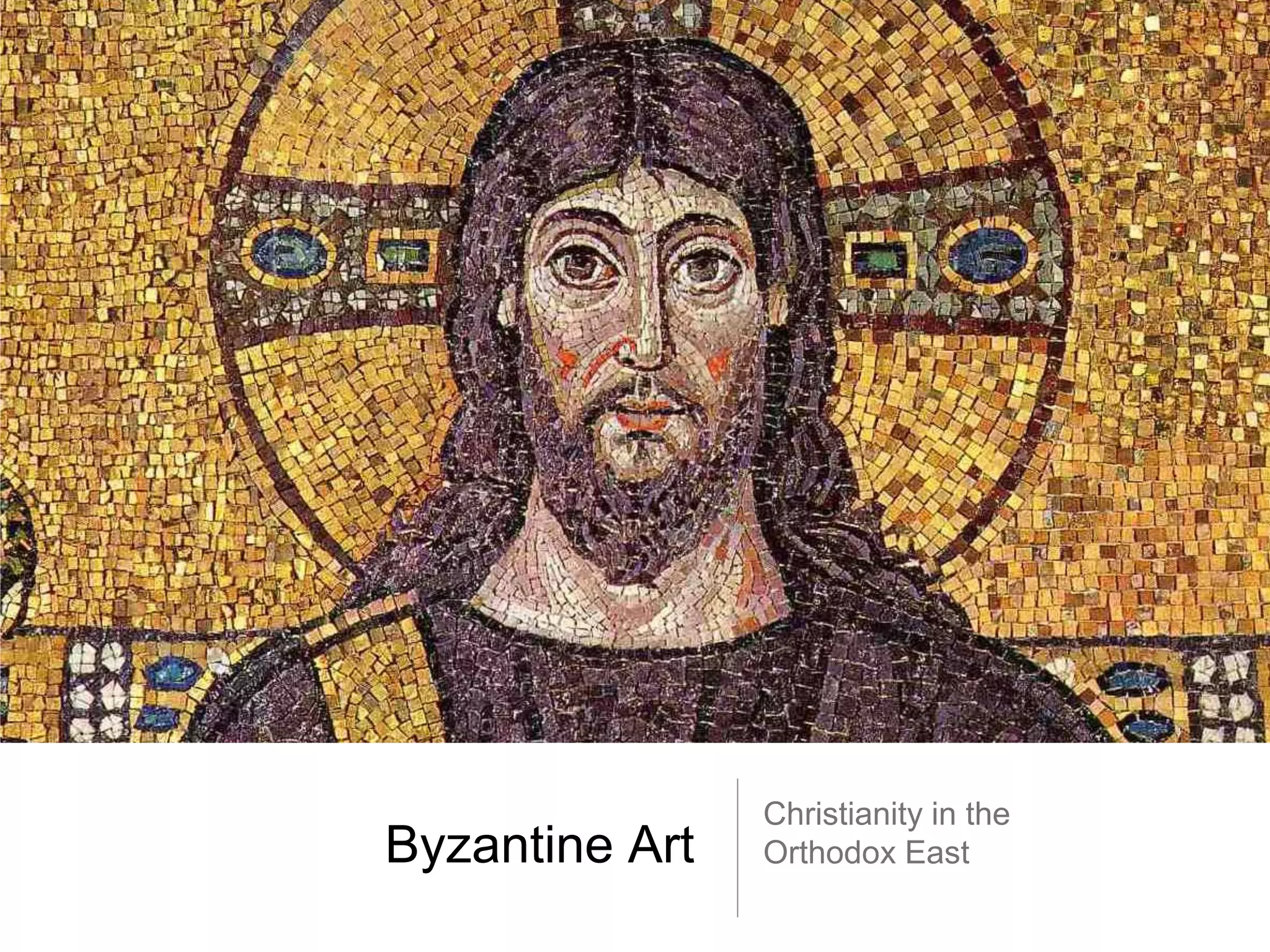
Christianity in the
Byzantine Art   Orthodox East
DISCLAIMER
This presentation is an overview of the material in your text. It is not
comprehensive, nor is it meant to be. This presentation allows you to introduce
yourself to concepts and images in the respective chapter. Best practice says to
view this presentation with your book open, as many of the images in this
presentation are small or incomplete.
Guiding Questions
• How does Christian art reflect a
  dominant political power over a
  sustained, 1,000 year period?


  Hagia Sophia with interior pendatives, Istanbul,
   Turkey. The Hagia Sophia is such a powerful
   Orthodox symbol of power that it will later be
converted to an Islamic mosque when Arabic power
             comes to rule the region.
Guiding Historical Periods
• Early Byzantine Period 527—726 CE
 Byzantium is the New Rome—prospering from trade with Asia and Europe and connecting The Black Sea with the Mediterranean.
 At the time, the Empire holds northern Africa, Sicily, much of Italy, and part of Spain. Ravenna is the Emperor’s capital in the
 West—an important port. It ends when iconoclasm becomes popular.


• Middle Byzantine Period 843—1204 CE
Begins when Empress Theodora reinstates the veneration of icons and ends in 1204, when Christian crusaders, on a mission to
stamp out Islam, from the west occupy Constantinople and its wealth. The Empire is reduced to Turkey, Greece, and Southern
Italy, and Venice but extends into Russia and Ukraine.


• Late Byzantine Period 1261—1453 CE
Begins in 1261, when Byzantine (eastern) rule is reestablished after the Christian Crusaders are ousted and ends in 1453,
when the Ottoman Turks take over the Empire and Russia succeeds Constantinople as the Third Rome and the center of
Eastern Orthodoxy. Despite the dwindling Empire in terms of size, there is a period of resurgence in the arts—the Paleologue
Renaissance.
Where in the world are we? While the Byzantine world is growing, the Medieval
region is developing. We will explore that region in a later chapter.


                                                    Byzantine
                                                     Regions

            Medieval
            Regions


                                       5
San Vitale: A Distinct Architecture


                                                              Theodora and Attendants


                  Justinian and Attendants

Self Study:
The octagonal shape of San Vitale is meant to distinguish
Orthodox architecture from Roman West (Catholic)
architecture. The mosaics there are meant to give Justinian
and Theodora a presence in a location they likely never                  View of Apse
visited.
Orthodoxy


                       Orthodoxy does not recognize
                       the power of the Roman
                       Catholic Pope, and allows
                       bishops to marry. But most
                       importantly, it disagrees with
                       the Catholic Church about the
                       nature of Christ as so splits
                       from Catholic doctrines in the
                       Late Antiquity period.

                       Orthodox churches will be
                       ornamented according to a
                       liturgical standard—the
                       Theotokos will be in the apse,
                       the Pantokrator will be in the
                       Dome surrounded by the
                       Apostles.


 Cathedral of Santa
Sophia, Kiev, Russia
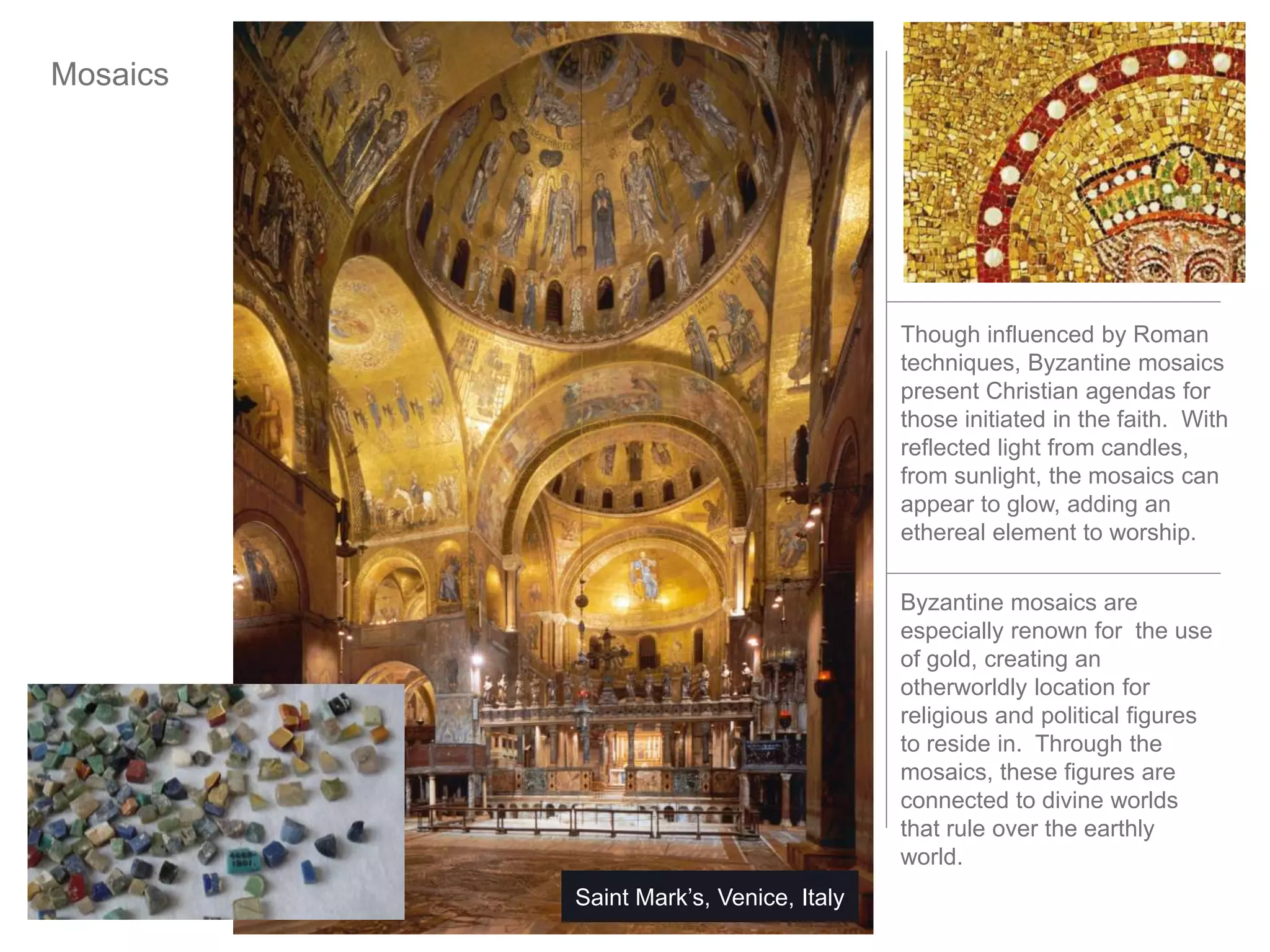
Mosaics


                                        Though influenced by Roman
                                        techniques, Byzantine mosaics
                                        present Christian agendas for
                                        those initiated in the faith. With
                                        reflected light from candles,
                                        from sunlight, the mosaics can
                                        appear to glow, adding an
                                        ethereal element to worship.

                                        Byzantine mosaics are
                                        especially renown for the use
                                        of gold, creating an
                                        otherworldly location for
                                        religious and political figures
                                        to reside in. Through the
                                        mosaics, these figures are
                                        connected to divine worlds
                                        that rule over the earthly
                                        world.
          Saint Mark’s, Venice, Italy
Introducing the Major Figures of Byzantine Worship


                                                             Theotokos (God Bearer)

                                                             The Pantokrator is known for
                                                             his halo, hand gesture and
                                                             book; he is the Divine Judge.
                                                             The Theotokos is known for
                                                             her mantle and the man-baby
                                                             Christ she holds. Remember:
                                                             Mary is not worshipped but
                                 Pantokrator, Monastery at   rather revered as a mediator
                                     Daphni, Greece          on behalf of Christian
                                                             believers.
The Monastic Life
                                                                   Monasteries are isolated and
                                                                   run on ascetic ritual.
                                                                   Monasteries the primary
                Monastery of Saint Catherine, Mount Sinai, Egypt
                                                                   producers of illuminated
                                                                   manuscripts and devotional
                                                                   objects. Art is a religious
                                                                   practice; it is not expressive
                                                                    Folio from Vienna Genesis,
                                                                       first known illuminated
                                                                    scripture, Syria or Palestine


Self Study:                                                        Monasteries are responsible
The role of monasteries will change and will be different          for the manufacturing of
in various regions of the Christian world. Compare the             illuminated manuscripts—
                                                                   bound books of pages (vellum
role of monasteries in the Byzantine world with those of           or parchment) decorated with
the Medieval world.                                                miniatures of religious
                                                                   iconography.
Icons are devotional aids
 Icons and
                                 created in spiritual practice;
 Iconoclam
                                 they could and can be
                                 personal, portable objects or
                                 large screens that were used
                                 in processions to separate
                                 laity from clergy


                                 Iconoclasm is a movement of
                                 erasing or destroying religious
                                 icons. It is present
                                 throughout Christian history
                                 as a preemptive move to
                                 eliminate “idolatrous” worship,
                                 in keeping with the 2nd
                                 Commandment, though
                                 iconoclasm has not always
  Painter removing religious     been accurate in its view of
icon, from the Chludov Psalter   what it considered idolatrous.
Review

• As Christianity is legitimized by political power, Byzantine
  emperors seek to connect themselves to divine power. This is
  what political leadership has done since the time of the
  Sumerians.

• Christian symbols become instruments of political messaging—
  architectural plans, Emperor portraits, etc…

• We can see that Christianity experiences periods of iconoclasm

• Throughout 1,000 years of Christian history, we move more
  and more toward naturalism (this will be true in Medieval art as
  well).

9.byzantine art

  • 1.
  • 2.
    DISCLAIMER This presentation isan overview of the material in your text. It is not comprehensive, nor is it meant to be. This presentation allows you to introduce yourself to concepts and images in the respective chapter. Best practice says to view this presentation with your book open, as many of the images in this presentation are small or incomplete.
  • 3.
    Guiding Questions • Howdoes Christian art reflect a dominant political power over a sustained, 1,000 year period? Hagia Sophia with interior pendatives, Istanbul, Turkey. The Hagia Sophia is such a powerful Orthodox symbol of power that it will later be converted to an Islamic mosque when Arabic power comes to rule the region.
  • 4.
    Guiding Historical Periods •Early Byzantine Period 527—726 CE Byzantium is the New Rome—prospering from trade with Asia and Europe and connecting The Black Sea with the Mediterranean. At the time, the Empire holds northern Africa, Sicily, much of Italy, and part of Spain. Ravenna is the Emperor’s capital in the West—an important port. It ends when iconoclasm becomes popular. • Middle Byzantine Period 843—1204 CE Begins when Empress Theodora reinstates the veneration of icons and ends in 1204, when Christian crusaders, on a mission to stamp out Islam, from the west occupy Constantinople and its wealth. The Empire is reduced to Turkey, Greece, and Southern Italy, and Venice but extends into Russia and Ukraine. • Late Byzantine Period 1261—1453 CE Begins in 1261, when Byzantine (eastern) rule is reestablished after the Christian Crusaders are ousted and ends in 1453, when the Ottoman Turks take over the Empire and Russia succeeds Constantinople as the Third Rome and the center of Eastern Orthodoxy. Despite the dwindling Empire in terms of size, there is a period of resurgence in the arts—the Paleologue Renaissance.
  • 5.
    Where in theworld are we? While the Byzantine world is growing, the Medieval region is developing. We will explore that region in a later chapter. Byzantine Regions Medieval Regions 5
  • 6.
    San Vitale: ADistinct Architecture Theodora and Attendants Justinian and Attendants Self Study: The octagonal shape of San Vitale is meant to distinguish Orthodox architecture from Roman West (Catholic) architecture. The mosaics there are meant to give Justinian and Theodora a presence in a location they likely never View of Apse visited.
  • 7.
    Orthodoxy Orthodoxy does not recognize the power of the Roman Catholic Pope, and allows bishops to marry. But most importantly, it disagrees with the Catholic Church about the nature of Christ as so splits from Catholic doctrines in the Late Antiquity period. Orthodox churches will be ornamented according to a liturgical standard—the Theotokos will be in the apse, the Pantokrator will be in the Dome surrounded by the Apostles. Cathedral of Santa Sophia, Kiev, Russia
  • 8.
    Mosaics Though influenced by Roman techniques, Byzantine mosaics present Christian agendas for those initiated in the faith. With reflected light from candles, from sunlight, the mosaics can appear to glow, adding an ethereal element to worship. Byzantine mosaics are especially renown for the use of gold, creating an otherworldly location for religious and political figures to reside in. Through the mosaics, these figures are connected to divine worlds that rule over the earthly world. Saint Mark’s, Venice, Italy
  • 9.
    Introducing the MajorFigures of Byzantine Worship Theotokos (God Bearer) The Pantokrator is known for his halo, hand gesture and book; he is the Divine Judge. The Theotokos is known for her mantle and the man-baby Christ she holds. Remember: Mary is not worshipped but Pantokrator, Monastery at rather revered as a mediator Daphni, Greece on behalf of Christian believers.
  • 10.
    The Monastic Life Monasteries are isolated and run on ascetic ritual. Monasteries the primary Monastery of Saint Catherine, Mount Sinai, Egypt producers of illuminated manuscripts and devotional objects. Art is a religious practice; it is not expressive Folio from Vienna Genesis, first known illuminated scripture, Syria or Palestine Self Study: Monasteries are responsible The role of monasteries will change and will be different for the manufacturing of in various regions of the Christian world. Compare the illuminated manuscripts— bound books of pages (vellum role of monasteries in the Byzantine world with those of or parchment) decorated with the Medieval world. miniatures of religious iconography.
  • 11.
    Icons are devotionalaids Icons and created in spiritual practice; Iconoclam they could and can be personal, portable objects or large screens that were used in processions to separate laity from clergy Iconoclasm is a movement of erasing or destroying religious icons. It is present throughout Christian history as a preemptive move to eliminate “idolatrous” worship, in keeping with the 2nd Commandment, though iconoclasm has not always Painter removing religious been accurate in its view of icon, from the Chludov Psalter what it considered idolatrous.
  • 12.
    Review • As Christianityis legitimized by political power, Byzantine emperors seek to connect themselves to divine power. This is what political leadership has done since the time of the Sumerians. • Christian symbols become instruments of political messaging— architectural plans, Emperor portraits, etc… • We can see that Christianity experiences periods of iconoclasm • Throughout 1,000 years of Christian history, we move more and more toward naturalism (this will be true in Medieval art as well).