MALNUTRITION -I
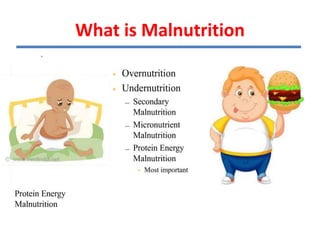
What is Malnutrition
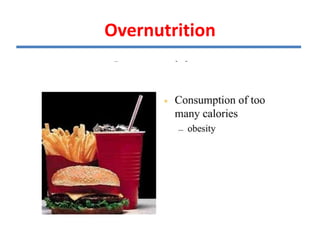
Overnutrition
Undernutrition
• Secondary Malnutrition
– Parasitic infestation
– Helminthic infections
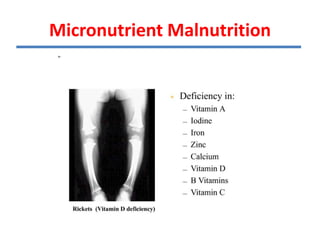
Micronutrient Malnutrition
Protein Energy Malnutrition
• Chronic pathological condition
• Absolute or relative lack of protein and energy
in the diet over an extended period of time
• Commonly associated with infection albeit
infestation in young children
Etiology
• Immediate Determinants
– inadequate dietary intake
– illness
• Underlying Determinants
– Food
– Health
– Care
• Basic Determinants
Assessment of Nutritional Status
• Direct
– Clinical
– Anthropometry
– Dietary
– Laboratory
•Indirect
–Health statistics
–Ecological variables
Clinical
• Useful in severe forms of PEM
• Based on thorough physical examination
• Focuses on skin, eye, hair, mouth, bones
• Chronic illnesses to be evaluated
• Advantages
– fast and easy to perform
– Inexpensive
– non invasive
• Limitations
– can not detect early cases
– trained staff needed
Clinical
Anthropometry
• Objective
• Measuring weight, height, MUAC, HC, skin fold
thickness, BMI, waist to hip ratio
• Readings are numerical and gradable on
standard growth charts
• Non expensive, need minimal training
• Limitations
– Interobserver errors in measurements
– Problems in reference standards
Anthropometry
• Hematological
– CBC
– Iron
– Vitamin levels
• Microbiological
– Parasites
– Infections
Laboratory Assessment
Dietary Assessment
• Breast and complementary feeding details
• 24 hr dietary recall
• Calculation of protein and calories
• Feeding technique and food habits
Epidemiology
• The majority of world’s children live in
developing countries
• Lack of food & clean water, poor sanitation,
infection & social unrest lead to LBW & PEM
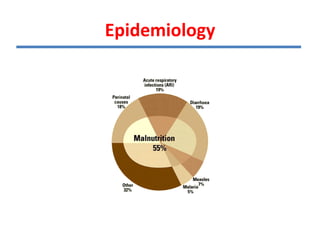
• Malnutrition is implicated in >50% of deaths
of <5 children (5 million/yr)
The major contributing factors are:
Diarrhea 20%
ARI 20%
Perinatal causes 18%
Measles 07%
Malaria 05%
55% of the total have malnutrition
Epidemiology
Epidemiology
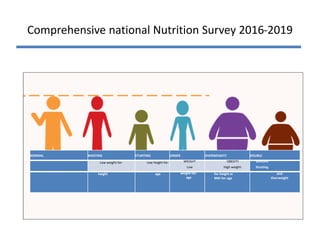
Comprehensive national Nutrition Survey 2016-2019
NORMAL WASTING STUNTING UNDER OVERWEIGHT/ DOUBLE
Low weight-for- Low height-for- WEIGHT
Low
OBESITY
High weight-
BURDEN
Stunting
height age weight-for-
age
for-height or
BMI-for-age
and
Overweight
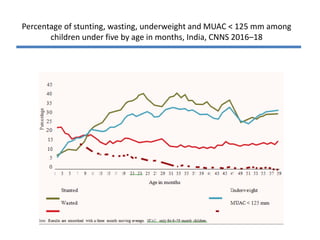
Percentage of stunting, wasting, underweight and MUAC < 125 mm among
children under five by age in months, India, CNNS 2016–18
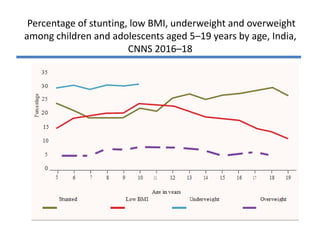
Percentage of stunting, low BMI, underweight and overweight
among children and adolescents aged 5–19 years by age, India,
CNNS 2016–18
• The term protein energy malnutrition has
been adopted by WHO in 1976
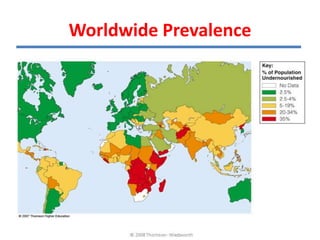
• Highly prevalent in developing countries
among <5 children; severe forms 1-10% &
underweight 20-40%
• All children with PEM have micronutrient
deficiency.
Malnutrition
Worldwide Prevalence
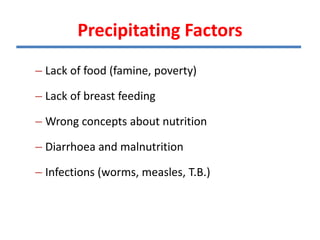
Precipitating Factors
– Lack of food (famine, poverty)
– Lack of breast feeding
– Wrong concepts about nutrition
– Diarrhoea and malnutrition
– Infections (worms, measles, T.B.)
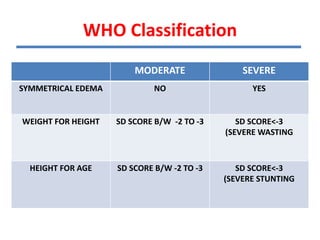
WHO Classification
MODERATE SEVERE
SYMMETRICAL EDEMA NO YES
WEIGHT FOR HEIGHT SD SCORE B/W -2 TO -3 SD SCORE<-3
(SEVERE WASTING
HEIGHT FOR AGE SD SCORE B/W -2 TO -3 SD SCORE<-3
(SEVERE STUNTING
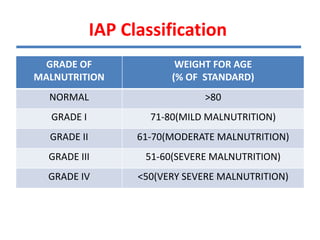
IAP Classification
GRADE OF
MALNUTRITION
WEIGHT FOR AGE
(% OF STANDARD)
NORMAL >80
GRADE I 71-80(MILD MALNUTRITION)
GRADE II 61-70(MODERATE MALNUTRITION)
GRADE III 51-60(SEVERE MALNUTRITION)
GRADE IV <50(VERY SEVERE MALNUTRITION)
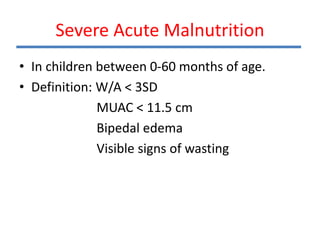
Severe Acute Malnutrition
• In children between 0-60 months of age.
• Definition: W/A < 3SD
MUAC < 11.5 cm
Bipedal edema
Visible signs of wasting
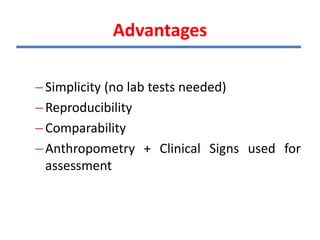
Advantages
–Simplicity (no lab tests needed)
–Reproducibility
–Comparability
–Anthropometry + Clinical Signs used for
assessment
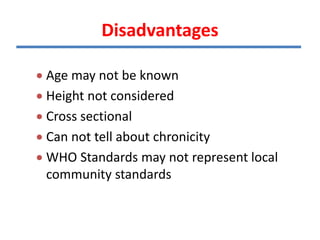
Disadvantages
 Age may not be known
 Height not considered
 Cross sectional
 Can not tell about chronicity
 WHO Standards may not represent local
community standards
Age Independent Indices
• MUAC : <11.5 indicates severe malnutrition
• SKINFOLD THICKNESS :
– <6mm-severe malnutrition
• RATIOS :
– Kanawati and mcLarens index
– Rao and singhs index
– Dugdales index
– Quaker arm circumference
Kwashiorkar
• Cecilly Williams, a British nurse, had
introduced the word Kwashiorkor to the
medical literature in 1933
• The word is taken from the Ga language in
Ghana & used to describe the sickness of
weaning.
Etiology
• Kwashiorkor can occur in infancy but its maximal
incidence is in the 2nd yr of life following abrupt
weaning
• Kwashiorkor is not only dietary in origin. Infective,
psycho-socical, and cultural factors are also operative
Kwashiorkor is an example of lack of
physiological adaptation to
unbalanced deficiency where the body
utilized proteins and conserve S/C fat.
One theory says Kwash is a result of
liver insult with hypoproteinemia and
oedema. Food toxins like aflatoxins
have been suggested as precipitating
factors.
• Kwashiorkor is an example of lack of
physiological adaptation to unbalanced
deficiency where the body utilized proteins and
conserve S/C fat.
• One theory says Kwashiorkar is a result of liver
insult with hypoproteinemia and oedema. Food
toxins like aflatoxins have been suggested as
precipitating factors.
Etiology
Kwashiorkar is characterized by certain constant
features in addition to a variable spectrum of
symptoms and signs
Clinical presentation is affected by:
•The degree of deficiency
•The duration of deficiency
 The speed of onset
 The age at onset
 Presence of conditioning factors
 Genetic factors
Etiology
Constant Features of Kwashiorkar
Oedema
Psychomotor changes
Growth retardation
Muscle wasting
Signs that are usually present
Hair changes
Skin pigmentation
Anemia
Moon face
Less Common Clinical Findings
• Hepatomegaly
• Flaky paint dermatitis
• Cardiomyopathy and Congestive Heart Failure
• Dehydration (Diarrhoea & Vomiting)
• Signs of micronutrient deficiency
• Signs of infection
TIONS
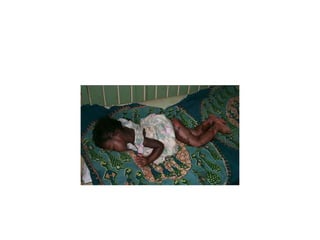
Marasmus
 The term marasmus is derived from the Greek
marasmos, which means wasting
 Marasmus involves inadequate intake of
protein and calories and is characterized by
emaciation
 Marasmus represents the end result of
starvation where both proteins and calories
are deficient.
 Marasmus represents an adaptive response to
starvation, whereas kwashiorkor represents a
maladaptive response to starvation
 In Marasmus the body utilizes all fat stores
before using muscles
Marasmus
Epidemiology
 Seen most commonly in the first year of life
due to lack of breast feeding and the use of
dilute animal milk
 Poverty or famine and diarrhoea are the usual
precipitating factors
 Ignorance & poor maternal nutrition are also
contributory
Clinical Features
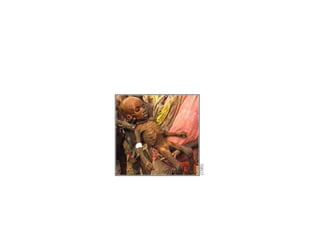
 Severe wasting of muscle & s/c fats
 Severe growth retardation
 Child looks older than his age
 No edema or hair changes
 Alert but miserable
 Hungry
 Diarrhoea & Dehydration
 Interrogation & physical exam including
detailed dietary history.
 Anthropometric measurements
 Team approach with involvement of dieticians,
social workers & community support groups.
Clinical Assessment
Investigations
 Full blood counts
 Blood glucose profile
 Septic screening
 Stool & urine for parasites & germs
 Electrolytes, Ca, Ph & ALP, serum proteins
 CXR & Mantoux test
 Exclude HIV & malabsorption

99998615.ppt

  • 1.
  • 2.
  • 3.
  • 4.
    Undernutrition • Secondary Malnutrition –Parasitic infestation – Helminthic infections
  • 5.
  • 6.
    Protein Energy Malnutrition •Chronic pathological condition • Absolute or relative lack of protein and energy in the diet over an extended period of time • Commonly associated with infection albeit infestation in young children
  • 7.
    Etiology • Immediate Determinants –inadequate dietary intake – illness • Underlying Determinants – Food – Health – Care • Basic Determinants
  • 8.
    Assessment of NutritionalStatus • Direct – Clinical – Anthropometry – Dietary – Laboratory •Indirect –Health statistics –Ecological variables
  • 9.
    Clinical • Useful insevere forms of PEM • Based on thorough physical examination • Focuses on skin, eye, hair, mouth, bones • Chronic illnesses to be evaluated
  • 10.
    • Advantages – fastand easy to perform – Inexpensive – non invasive • Limitations – can not detect early cases – trained staff needed Clinical
  • 11.
    Anthropometry • Objective • Measuringweight, height, MUAC, HC, skin fold thickness, BMI, waist to hip ratio • Readings are numerical and gradable on standard growth charts • Non expensive, need minimal training
  • 12.
    • Limitations – Interobservererrors in measurements – Problems in reference standards Anthropometry
  • 13.
    • Hematological – CBC –Iron – Vitamin levels • Microbiological – Parasites – Infections Laboratory Assessment
  • 14.
    Dietary Assessment • Breastand complementary feeding details • 24 hr dietary recall • Calculation of protein and calories • Feeding technique and food habits
  • 15.
    Epidemiology • The majorityof world’s children live in developing countries • Lack of food & clean water, poor sanitation, infection & social unrest lead to LBW & PEM • Malnutrition is implicated in >50% of deaths of <5 children (5 million/yr)
  • 16.
    The major contributingfactors are: Diarrhea 20% ARI 20% Perinatal causes 18% Measles 07% Malaria 05% 55% of the total have malnutrition Epidemiology
  • 17.
  • 18.
    Comprehensive national NutritionSurvey 2016-2019 NORMAL WASTING STUNTING UNDER OVERWEIGHT/ DOUBLE Low weight-for- Low height-for- WEIGHT Low OBESITY High weight- BURDEN Stunting height age weight-for- age for-height or BMI-for-age and Overweight
  • 19.
    Percentage of stunting,wasting, underweight and MUAC < 125 mm among children under five by age in months, India, CNNS 2016–18
  • 20.
    Percentage of stunting,low BMI, underweight and overweight among children and adolescents aged 5–19 years by age, India, CNNS 2016–18
  • 21.
    • The termprotein energy malnutrition has been adopted by WHO in 1976 • Highly prevalent in developing countries among <5 children; severe forms 1-10% & underweight 20-40% • All children with PEM have micronutrient deficiency. Malnutrition
  • 22.
  • 23.
    Precipitating Factors – Lackof food (famine, poverty) – Lack of breast feeding – Wrong concepts about nutrition – Diarrhoea and malnutrition – Infections (worms, measles, T.B.)
  • 24.
    WHO Classification MODERATE SEVERE SYMMETRICALEDEMA NO YES WEIGHT FOR HEIGHT SD SCORE B/W -2 TO -3 SD SCORE<-3 (SEVERE WASTING HEIGHT FOR AGE SD SCORE B/W -2 TO -3 SD SCORE<-3 (SEVERE STUNTING
  • 25.
    IAP Classification GRADE OF MALNUTRITION WEIGHTFOR AGE (% OF STANDARD) NORMAL >80 GRADE I 71-80(MILD MALNUTRITION) GRADE II 61-70(MODERATE MALNUTRITION) GRADE III 51-60(SEVERE MALNUTRITION) GRADE IV <50(VERY SEVERE MALNUTRITION)
  • 26.
    Severe Acute Malnutrition •In children between 0-60 months of age. • Definition: W/A < 3SD MUAC < 11.5 cm Bipedal edema Visible signs of wasting
  • 27.
    Advantages –Simplicity (no labtests needed) –Reproducibility –Comparability –Anthropometry + Clinical Signs used for assessment
  • 28.
    Disadvantages  Age maynot be known  Height not considered  Cross sectional  Can not tell about chronicity  WHO Standards may not represent local community standards
  • 29.
    Age Independent Indices •MUAC : <11.5 indicates severe malnutrition • SKINFOLD THICKNESS : – <6mm-severe malnutrition • RATIOS : – Kanawati and mcLarens index – Rao and singhs index – Dugdales index – Quaker arm circumference
  • 30.
    Kwashiorkar • Cecilly Williams,a British nurse, had introduced the word Kwashiorkor to the medical literature in 1933 • The word is taken from the Ga language in Ghana & used to describe the sickness of weaning.
  • 31.
    Etiology • Kwashiorkor canoccur in infancy but its maximal incidence is in the 2nd yr of life following abrupt weaning • Kwashiorkor is not only dietary in origin. Infective, psycho-socical, and cultural factors are also operative
  • 32.
    Kwashiorkor is anexample of lack of physiological adaptation to unbalanced deficiency where the body utilized proteins and conserve S/C fat. One theory says Kwash is a result of liver insult with hypoproteinemia and oedema. Food toxins like aflatoxins have been suggested as precipitating factors. • Kwashiorkor is an example of lack of physiological adaptation to unbalanced deficiency where the body utilized proteins and conserve S/C fat. • One theory says Kwashiorkar is a result of liver insult with hypoproteinemia and oedema. Food toxins like aflatoxins have been suggested as precipitating factors. Etiology
  • 33.
    Kwashiorkar is characterizedby certain constant features in addition to a variable spectrum of symptoms and signs Clinical presentation is affected by: •The degree of deficiency •The duration of deficiency  The speed of onset  The age at onset  Presence of conditioning factors  Genetic factors Etiology
  • 34.
    Constant Features ofKwashiorkar Oedema Psychomotor changes Growth retardation Muscle wasting
  • 35.
    Signs that areusually present Hair changes Skin pigmentation Anemia Moon face
  • 36.
    Less Common ClinicalFindings • Hepatomegaly • Flaky paint dermatitis • Cardiomyopathy and Congestive Heart Failure • Dehydration (Diarrhoea & Vomiting) • Signs of micronutrient deficiency • Signs of infection TIONS
  • 38.
    Marasmus  The termmarasmus is derived from the Greek marasmos, which means wasting  Marasmus involves inadequate intake of protein and calories and is characterized by emaciation  Marasmus represents the end result of starvation where both proteins and calories are deficient.
  • 39.
     Marasmus representsan adaptive response to starvation, whereas kwashiorkor represents a maladaptive response to starvation  In Marasmus the body utilizes all fat stores before using muscles Marasmus
  • 40.
    Epidemiology  Seen mostcommonly in the first year of life due to lack of breast feeding and the use of dilute animal milk  Poverty or famine and diarrhoea are the usual precipitating factors  Ignorance & poor maternal nutrition are also contributory
  • 41.
    Clinical Features  Severewasting of muscle & s/c fats  Severe growth retardation  Child looks older than his age  No edema or hair changes  Alert but miserable  Hungry  Diarrhoea & Dehydration
  • 43.
     Interrogation &physical exam including detailed dietary history.  Anthropometric measurements  Team approach with involvement of dieticians, social workers & community support groups. Clinical Assessment
  • 44.
    Investigations  Full bloodcounts  Blood glucose profile  Septic screening  Stool & urine for parasites & germs  Electrolytes, Ca, Ph & ALP, serum proteins  CXR & Mantoux test  Exclude HIV & malabsorption