Chapter 12:
Pointers, Classes, Virtual
Functions, and Abstract Classes
Objectives
• In this chapter, you will:
– Learn about the pointer data type and pointer
variables
– Explore how to declare and manipulate pointer
variables
– Learn about the address of the operator and the
dereferencing operator
– Learn how pointers work with classes and
structs
– Discover dynamic variables
2C++ Programming: From Problem Analysis to Program Design, Seventh Edition
Objectives (cont’d.)
– Explore how to use the new and delete
operators to manipulate dynamic variables
– Learn about pointer arithmetic
– Learn how to work with dynamic arrays
– Become familiar with the limitations of range-
based for loops with dynamic arrays
– Explore how pointers work with functions as
parameters and functions as return values
3C++ Programming: From Problem Analysis to Program Design, Seventh Edition
Objectives (cont’d.)
– Become familiar with the shallow and deep copies
of data
– Discover the peculiarities of classes with pointer
member variables
– Learn about virtual functions
– Examine the relationship between the address of
operator and classes
– Become aware of abstract classes
4C++ Programming: From Problem Analysis to Program Design, Seventh Edition
Pointer Data Type and Pointer
Variables
• Pointer variable: content is a memory address
• No name associated with the pointer data
type in C++
5C++ Programming: From Problem Analysis to Program Design, Seventh Edition
Declaring Pointer Variables
• Syntax:
• Examples:
int *p;
char *ch;
• These statements are equivalent:
int *p;
int* p;
int * p;
6C++ Programming: From Problem Analysis to Program Design, Seventh Edition
Declaring Pointer Variables (cont’d.)
• In the statement:
int* p, q;
– Only p is a pointer variable
– q is an int variable
• To avoid confusion, attach the character * to
the variable name:
int *p, q;
int *p, *q;
7C++ Programming: From Problem Analysis to Program Design, Seventh Edition
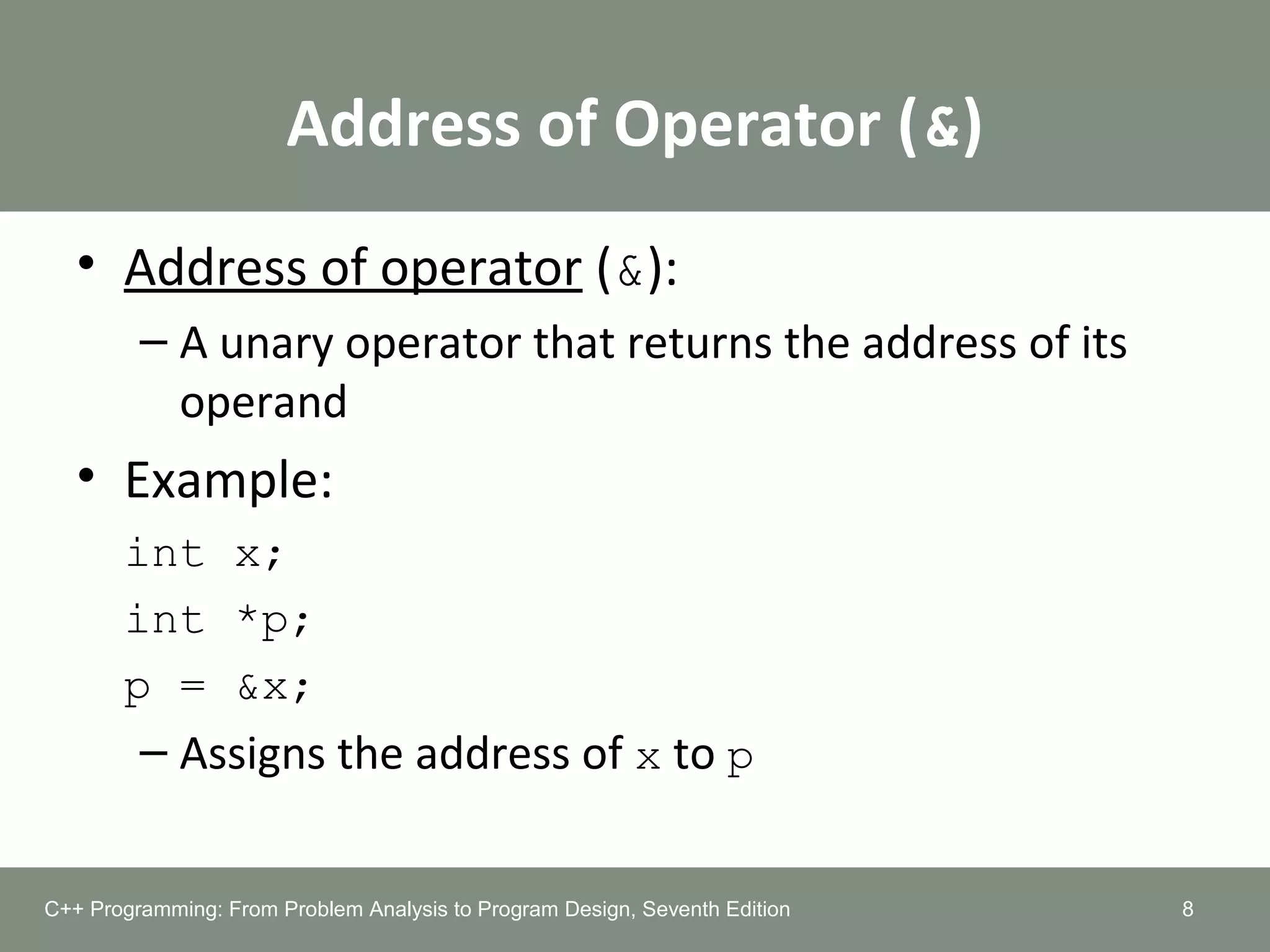
Address of Operator (&)
• Address of operator (&):
– A unary operator that returns the address of its
operand
• Example:
int x;
int *p;
p = &x;
– Assigns the address of x to p
8C++ Programming: From Problem Analysis to Program Design, Seventh Edition
Dereferencing Operator (*)
• Dereferencing operator (or indirection
operator):
– When used as a unary operator, * refers to object
to which its operand points
• Example:
cout << *p << endl;
– Prints the value stored in the memory location
pointed to by p
9C++ Programming: From Problem Analysis to Program Design, Seventh Edition
Classes, structs, and Pointer
Variables
• You can declare pointers to other data types:
– student is an object of type studentType
– studentPtr is a pointer variable of type
studentType
10C++ Programming: From Problem Analysis to Program Design, Seventh Edition
Classes, structs, and Pointer
Variables (cont’d.)
• To store address of student in
studentPtr:
studentPtr = &student;
• To store 3.9 in component gpa of
student:
(*studentPtr).gpa = 3.9;
– ( ) used because dot operator has higher
precedence than dereferencing operator
– Alternative: use member access operator arrow
(->)
11C++ Programming: From Problem Analysis to Program Design, Seventh Edition
Classes, structs, and Pointer
Variables (cont’d.)
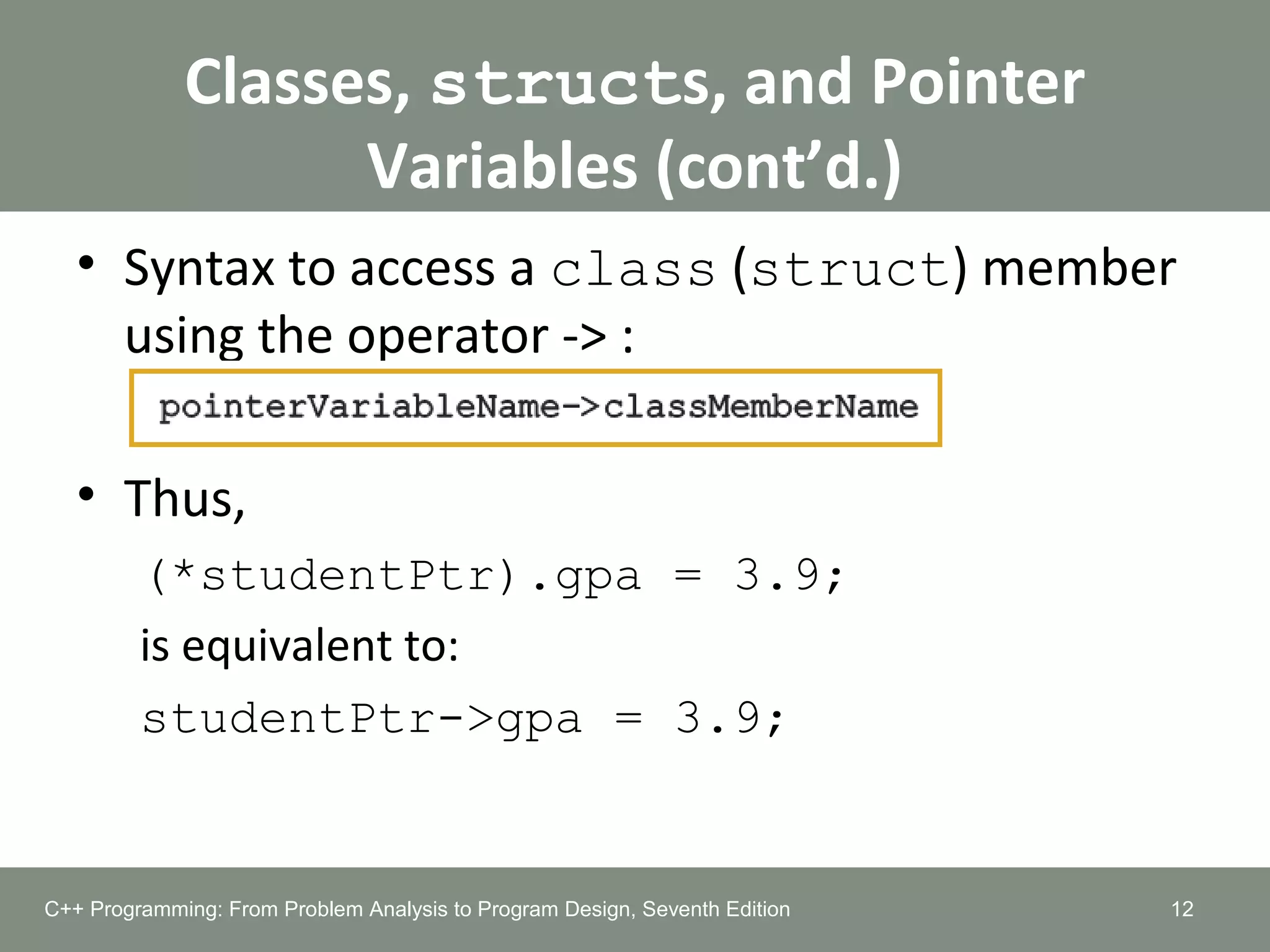
• Syntax to access a class (struct) member
using the operator -> :
• Thus,
(*studentPtr).gpa = 3.9;
is equivalent to:
studentPtr->gpa = 3.9;
12C++ Programming: From Problem Analysis to Program Design, Seventh Edition
Initializing Pointer Variables
• C++ does not automatically initialize variables
• Pointer variables must be initialized if you do
not want them to point to anything
– Initialized using the null pointer: the value 0
– Or, use the NULL named constant
– The number 0 is the only number that can be
directly assigned to a pointer variable
• C++11 includes a nullptr
13C++ Programming: From Problem Analysis to Program Design, Seventh Edition
Dynamic Variables
• Dynamic variables: created during execution
• C++ creates dynamic variables using pointers
• new and delete operators: used to create
and destroy dynamic variables
– new and delete are reserved words in C++
14C++ Programming: From Problem Analysis to Program Design, Seventh Edition
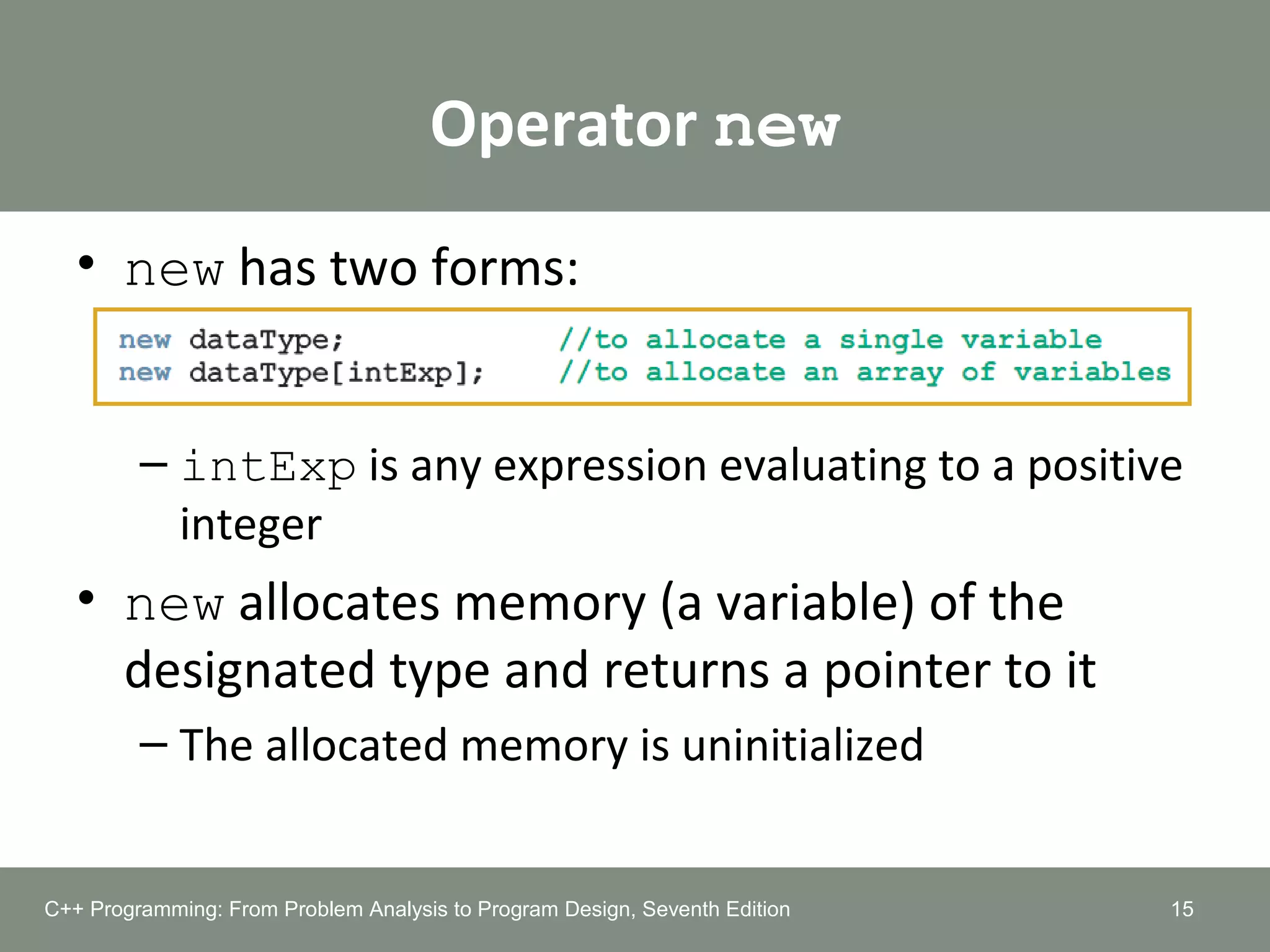
Operator new
• new has two forms:
– intExp is any expression evaluating to a positive
integer
• new allocates memory (a variable) of the
designated type and returns a pointer to it
– The allocated memory is uninitialized
15C++ Programming: From Problem Analysis to Program Design, Seventh Edition
Operator new (cont’d.)
• Example: p = new int;
– Creates a variable during program execution
somewhere in memory
– Stores the address of the allocated memory in p
• To access allocated memory, use *p
• A dynamic variable cannot be accessed
directly
• Because it is unnamed
16C++ Programming: From Problem Analysis to Program Design, Seventh Edition
Operator delete
• Memory leak: previously allocated memory that
cannot be reallocated
– To avoid a memory leak, when a dynamic variable is no
longer needed, destroy it to deallocate its memory
• delete operator: used to destroy dynamic
variables
• Syntax:
17C++ Programming: From Problem Analysis to Program Design, Seventh Edition
Operations on Pointer Variables
• Assignment: value of one pointer variable can
be assigned to another pointer of same type
• Relational operations: two pointer variables of
same type can be compared for equality, etc.
• Some limited arithmetic operations:
– Integer values can be added and subtracted from
a pointer variable
– Value of one pointer variable can be subtracted
from another pointer variable
18C++ Programming: From Problem Analysis to Program Design, Seventh Edition
Operations on Pointer Variables
(cont’d.)
• Pointer arithmetic can be very dangerous:
– Program can accidentally access memory
locations of other variables and change their
content without warning
• Some systems might terminate the program with an
appropriate error message
• Always exercise extra care when doing pointer
arithmetic
19C++ Programming: From Problem Analysis to Program Design, Seventh Edition
Dynamic Arrays
• Dynamic array: array created during program
execution
• Example:
int *p;
p = new int[10];
*p = 25;
p++; //to point to next array component
*p = 35;
20
stores 25 into the first memory location
stores 35 into the second memory location
C++ Programming: From Problem Analysis to Program Design, Seventh Edition
Dynamic Arrays (cont’d.)
• Can use array notation to access these
memory locations
• Example:
p[0] = 25;
p[1] = 35;
– Stores 25 and 35 into the first and second array
components, respectively
• An array name is a constant pointer
21C++ Programming: From Problem Analysis to Program Design, Seventh Edition
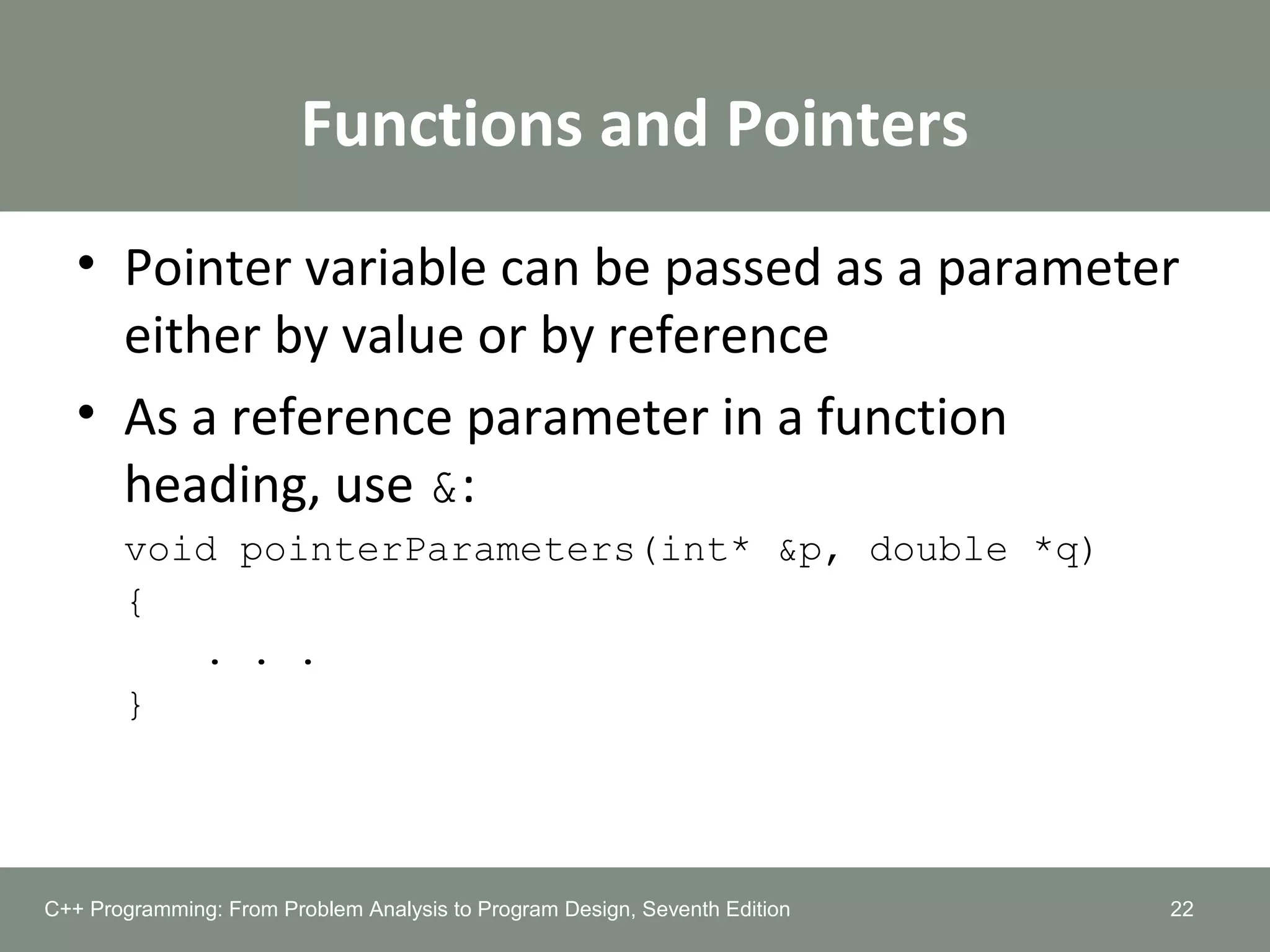
Functions and Pointers
• Pointer variable can be passed as a parameter
either by value or by reference
• As a reference parameter in a function
heading, use &:
void pointerParameters(int* &p, double *q)
{
. . .
}
22C++ Programming: From Problem Analysis to Program Design, Seventh Edition
Pointers and Function Return Values
• A function can return a value of type pointer:
int* testExp(...)
{
. . .
}
23C++ Programming: From Problem Analysis to Program Design, Seventh Edition
Dynamic Two-Dimensional Arrays
• You can create dynamic multidimensional
arrays
• Examples:
24
declares board to be an array of four
pointers wherein each pointer is of type int
declares board to be a pointer to a pointer
creates the rows of board
C++ Programming: From Problem Analysis to Program Design, Seventh Edition
Shallow Versus Deep Copy and
Pointers
• Shallow copy: when two or more pointers of
the same types point to the same memory
– They point to the same data
– Danger: deleting one deletes the data pointed to
by all of them
• Deep copy: when the contents of the memory
pointed to by a pointer are copied to the
memory location of another pointer
– Two copies of the data
25C++ Programming: From Problem Analysis to Program Design, Seventh Edition
Classes and Pointers: Some
Peculiarities
• Example class:
• Example program statements:
26C++ Programming: From Problem Analysis to Program Design, Seventh Edition
Destructor
• If objectOne goes out of scope, its member
variables are destroyed
– Memory space of dynamic array stays marked as
allocated, even though it cannot be accessed
• Solution: in destructor, ensure that when
objectOne goes out of scope, its array
memory is deallocated:
27C++ Programming: From Problem Analysis to Program Design, Seventh Edition
Assignment Operator
• After a shallow copy: if objectTwo.p
deallocates memory space to which it points,
objectOne.p becomes invalid
• Solution: extend definition of the assignment
operator to avoid shallow copying of data
28C++ Programming: From Problem Analysis to Program Design, Seventh Edition
Copy Constructor
• Default member-wise initialization:
• Initializing a class object by using the value of an
existing object of the same type
• Example:
ptrMemberVarType objectThree(objectOne);
• Copy constructor: provided by the compiler
– Performs this initialization
– Leads to a shallow copying of the data if class has
pointer member variables
29C++ Programming: From Problem Analysis to Program Design, Seventh Edition
Copy Constructor (cont’d.)
• Similar problem occurs when passing objects
by value
• Copy constructor automatically executes in
three situations:
– When an object is declared and initialized by using
the value of another object
– When an object is passed by value as a parameter
– When the return value of a function is an object
30C++ Programming: From Problem Analysis to Program Design, Seventh Edition
Copy Constructor (cont’d.)
• Solution: override the copy constructor
• For classes with pointer member variables,
three things are normally done:
– Include the destructor in the class
– Overload the assignment operator for the class
– Include the copy constructor
31C++ Programming: From Problem Analysis to Program Design, Seventh Edition
Inheritance, Pointers, and Virtual
Functions
• Can pass an object of a derived class to a
formal parameter of the base class type
• Compile-time binding: the necessary code to
call specific function is generated by compiler
– Also known as static binding or early binding
• Virtual function: binding occurs at program
execution time, not at compile time
– Declared with reserved word virtual
32C++ Programming: From Problem Analysis to Program Design, Seventh Edition
Inheritance, Pointers, and Virtual
Functions (cont’d.)
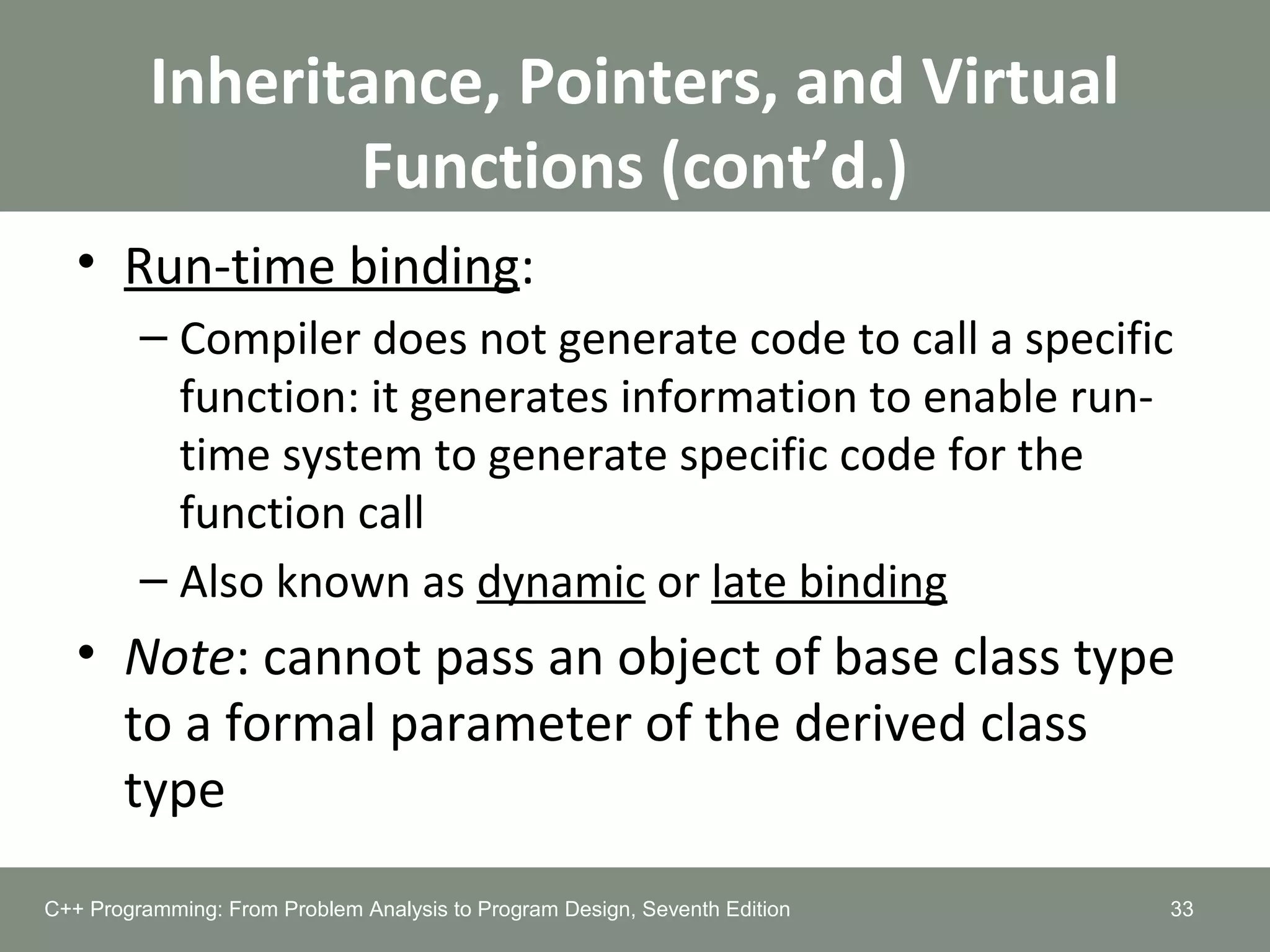
• Run-time binding:
– Compiler does not generate code to call a specific
function: it generates information to enable run-
time system to generate specific code for the
function call
– Also known as dynamic or late binding
• Note: cannot pass an object of base class type
to a formal parameter of the derived class
type
33C++ Programming: From Problem Analysis to Program Design, Seventh Edition
Inheritance, Pointers, and Virtual
Functions (cont’d.)
• Values of a derived class object can be copied
into a base class object
• Slicing problem: if derived class has more data
members than base class, some data could be
lost
• Solution: use pointers for both base and
derived class objects
34C++ Programming: From Problem Analysis to Program Design, Seventh Edition
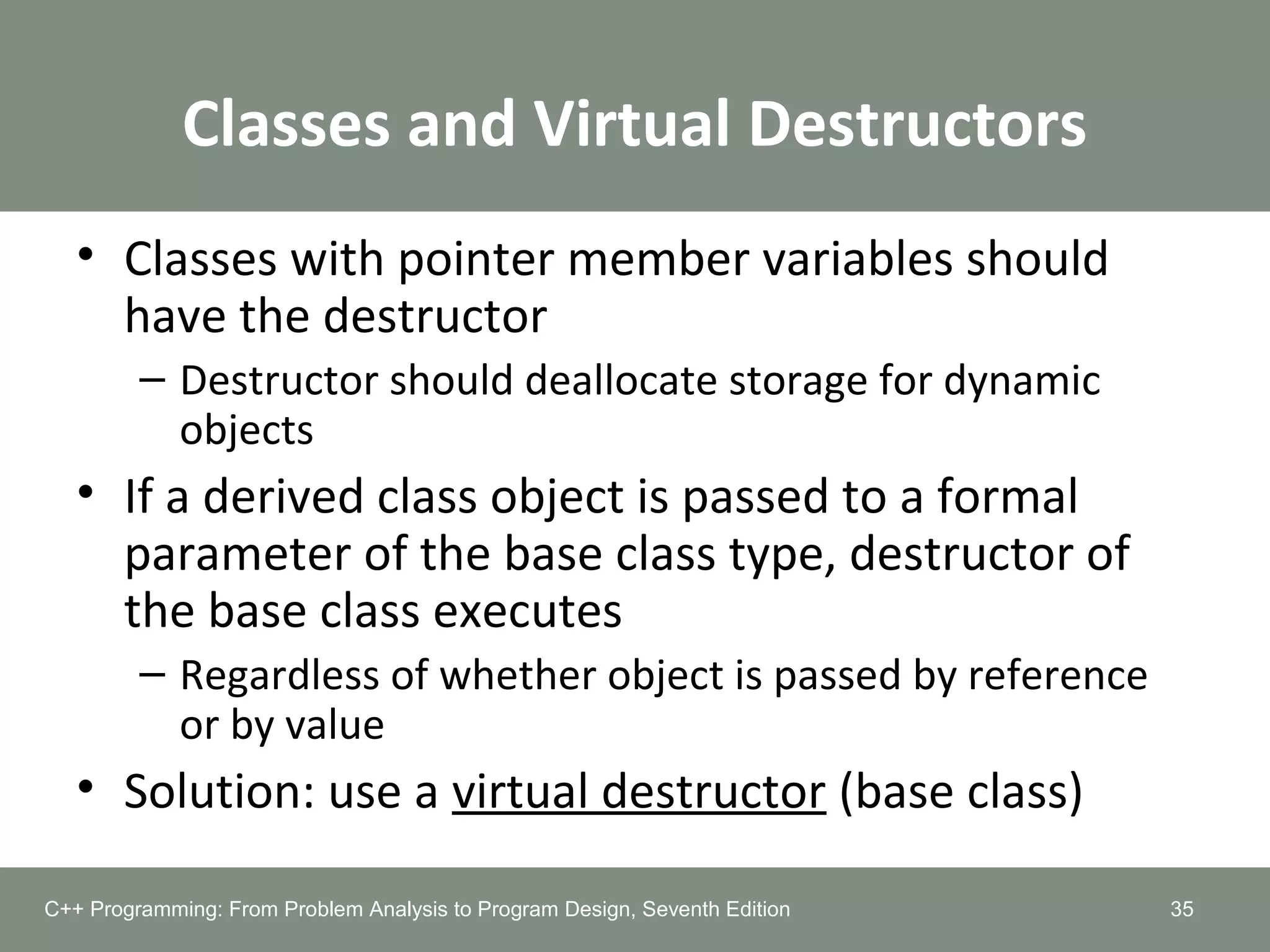
Classes and Virtual Destructors
• Classes with pointer member variables should
have the destructor
– Destructor should deallocate storage for dynamic
objects
• If a derived class object is passed to a formal
parameter of the base class type, destructor of
the base class executes
– Regardless of whether object is passed by reference
or by value
• Solution: use a virtual destructor (base class)
35C++ Programming: From Problem Analysis to Program Design, Seventh Edition
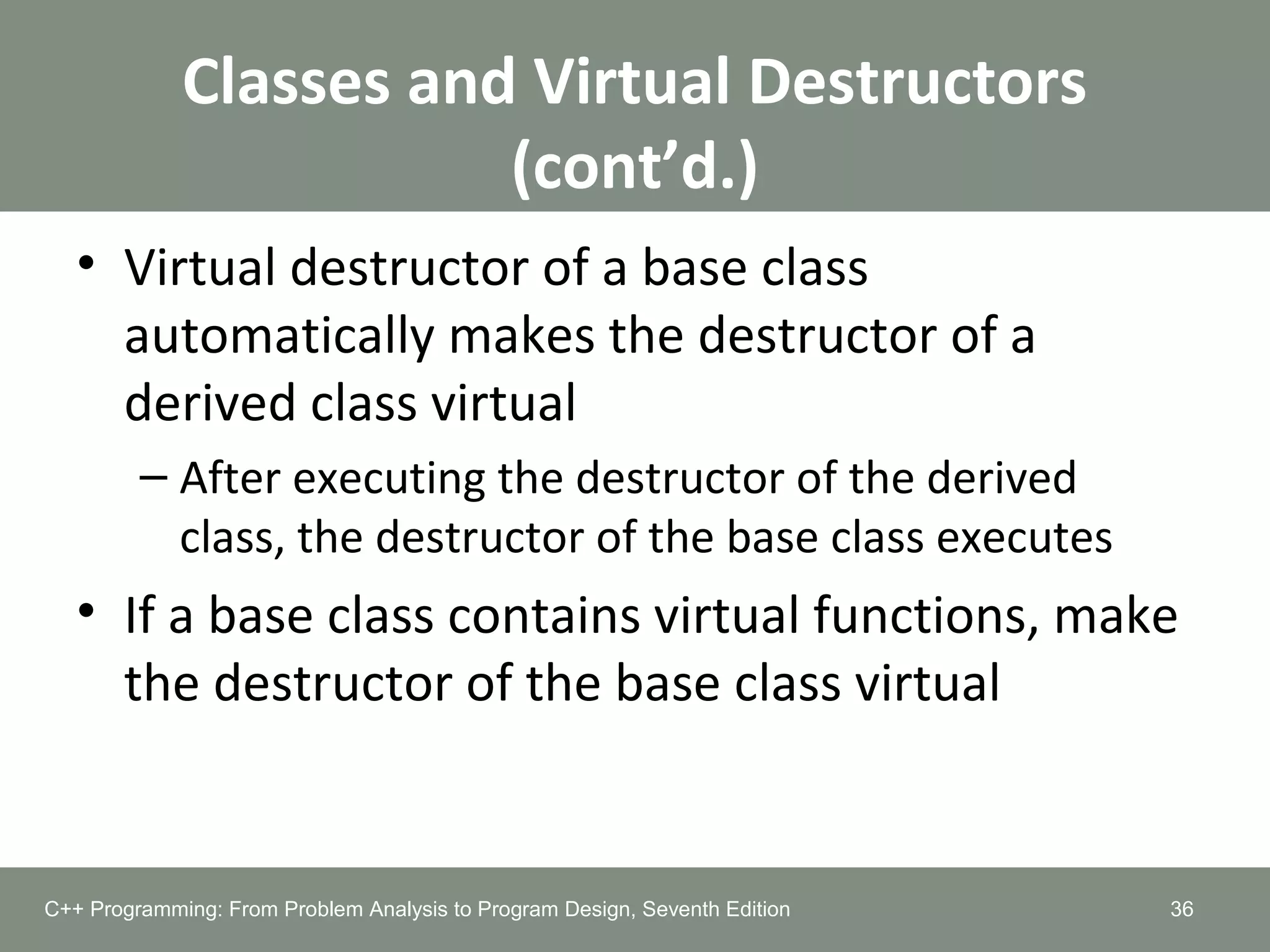
Classes and Virtual Destructors
(cont’d.)
• Virtual destructor of a base class
automatically makes the destructor of a
derived class virtual
– After executing the destructor of the derived
class, the destructor of the base class executes
• If a base class contains virtual functions, make
the destructor of the base class virtual
36C++ Programming: From Problem Analysis to Program Design, Seventh Edition
Abstract Classes
and Pure Virtual Functions
• New classes can be derived through inheritance
without designing them from scratch
– Derived classes inherit existing members of base class
– Can add their own members
– Can redefine or override public and protected
member functions
• Base class can contain functions that you would
want each derived class to implement
• However, base class may contain functions that may
not have meaningful definitions in the base class
37C++ Programming: From Problem Analysis to Program Design, Seventh Edition
Abstract Classes and Pure Virtual
Functions (cont’d.)
• Pure virtual functions:
– Do not have definitions (bodies have no code)
• Example: virtual void draw() = 0;
• Abstract class: a class with one or more virtual
functions
– Can contain instance variables, constructors, and
functions that are not pure virtual
– Class must provide the definitions of
constructor/functions that are not pure virtual
38C++ Programming: From Problem Analysis to Program Design, Seventh Edition
Address of Operator and Classes
• & operator can create aliases to an object
• Example:
int x;
int &y = x;
x and y refer to the same memory location
y is like a constant pointer variable
y = 25; sets the value of y (and of x) to 25
x = 2 * x + 30; updates value of x and y
39C++ Programming: From Problem Analysis to Program Design, Seventh Edition
Address of Operator and Classes
(cont’d.)
• Address of operator can also be used to return
the address of a private member variable of a
class
– However, if you are not careful, this operation can
result in serious errors in the program
40C++ Programming: From Problem Analysis to Program Design, Seventh Edition
Summary
• Pointer variables contain the addresses of
other variables as their values
• Declare a pointer variable with an asterisk, *,
between the data type and the variable
• Address of operator (&)returns the address of its
operand
• Unary operator * is the dereferencing operator
• Member access operator (->) accesses the object
component pointed to by a pointer
41C++ Programming: From Problem Analysis to Program Design, Seventh Edition
Summary (cont’d.)
• Dynamic variable: created during execution
– Created using new, deallocated using delete
• Shallow copy: two or more pointers of the
same type point to the same memory
• Deep copy: two or more pointers of the same
type have their own copies of the data
• Binding of virtual functions occurs at
execution time (dynamic or run-time binding)
42C++ Programming: From Problem Analysis to Program Design, Seventh Edition

9781285852744 ppt ch12

  • 1.
    Chapter 12: Pointers, Classes,Virtual Functions, and Abstract Classes
  • 2.
    Objectives • In thischapter, you will: – Learn about the pointer data type and pointer variables – Explore how to declare and manipulate pointer variables – Learn about the address of the operator and the dereferencing operator – Learn how pointers work with classes and structs – Discover dynamic variables 2C++ Programming: From Problem Analysis to Program Design, Seventh Edition
  • 3.
    Objectives (cont’d.) – Explorehow to use the new and delete operators to manipulate dynamic variables – Learn about pointer arithmetic – Learn how to work with dynamic arrays – Become familiar with the limitations of range- based for loops with dynamic arrays – Explore how pointers work with functions as parameters and functions as return values 3C++ Programming: From Problem Analysis to Program Design, Seventh Edition
  • 4.
    Objectives (cont’d.) – Becomefamiliar with the shallow and deep copies of data – Discover the peculiarities of classes with pointer member variables – Learn about virtual functions – Examine the relationship between the address of operator and classes – Become aware of abstract classes 4C++ Programming: From Problem Analysis to Program Design, Seventh Edition
  • 5.
    Pointer Data Typeand Pointer Variables • Pointer variable: content is a memory address • No name associated with the pointer data type in C++ 5C++ Programming: From Problem Analysis to Program Design, Seventh Edition
  • 6.
    Declaring Pointer Variables •Syntax: • Examples: int *p; char *ch; • These statements are equivalent: int *p; int* p; int * p; 6C++ Programming: From Problem Analysis to Program Design, Seventh Edition
  • 7.
    Declaring Pointer Variables(cont’d.) • In the statement: int* p, q; – Only p is a pointer variable – q is an int variable • To avoid confusion, attach the character * to the variable name: int *p, q; int *p, *q; 7C++ Programming: From Problem Analysis to Program Design, Seventh Edition
  • 8.
    Address of Operator(&) • Address of operator (&): – A unary operator that returns the address of its operand • Example: int x; int *p; p = &x; – Assigns the address of x to p 8C++ Programming: From Problem Analysis to Program Design, Seventh Edition
  • 9.
    Dereferencing Operator (*) •Dereferencing operator (or indirection operator): – When used as a unary operator, * refers to object to which its operand points • Example: cout << *p << endl; – Prints the value stored in the memory location pointed to by p 9C++ Programming: From Problem Analysis to Program Design, Seventh Edition
  • 10.
    Classes, structs, andPointer Variables • You can declare pointers to other data types: – student is an object of type studentType – studentPtr is a pointer variable of type studentType 10C++ Programming: From Problem Analysis to Program Design, Seventh Edition
  • 11.
    Classes, structs, andPointer Variables (cont’d.) • To store address of student in studentPtr: studentPtr = &student; • To store 3.9 in component gpa of student: (*studentPtr).gpa = 3.9; – ( ) used because dot operator has higher precedence than dereferencing operator – Alternative: use member access operator arrow (->) 11C++ Programming: From Problem Analysis to Program Design, Seventh Edition
  • 12.
    Classes, structs, andPointer Variables (cont’d.) • Syntax to access a class (struct) member using the operator -> : • Thus, (*studentPtr).gpa = 3.9; is equivalent to: studentPtr->gpa = 3.9; 12C++ Programming: From Problem Analysis to Program Design, Seventh Edition
  • 13.
    Initializing Pointer Variables •C++ does not automatically initialize variables • Pointer variables must be initialized if you do not want them to point to anything – Initialized using the null pointer: the value 0 – Or, use the NULL named constant – The number 0 is the only number that can be directly assigned to a pointer variable • C++11 includes a nullptr 13C++ Programming: From Problem Analysis to Program Design, Seventh Edition
  • 14.
    Dynamic Variables • Dynamicvariables: created during execution • C++ creates dynamic variables using pointers • new and delete operators: used to create and destroy dynamic variables – new and delete are reserved words in C++ 14C++ Programming: From Problem Analysis to Program Design, Seventh Edition
  • 15.
    Operator new • newhas two forms: – intExp is any expression evaluating to a positive integer • new allocates memory (a variable) of the designated type and returns a pointer to it – The allocated memory is uninitialized 15C++ Programming: From Problem Analysis to Program Design, Seventh Edition
  • 16.
    Operator new (cont’d.) •Example: p = new int; – Creates a variable during program execution somewhere in memory – Stores the address of the allocated memory in p • To access allocated memory, use *p • A dynamic variable cannot be accessed directly • Because it is unnamed 16C++ Programming: From Problem Analysis to Program Design, Seventh Edition
  • 17.
    Operator delete • Memoryleak: previously allocated memory that cannot be reallocated – To avoid a memory leak, when a dynamic variable is no longer needed, destroy it to deallocate its memory • delete operator: used to destroy dynamic variables • Syntax: 17C++ Programming: From Problem Analysis to Program Design, Seventh Edition
  • 18.
    Operations on PointerVariables • Assignment: value of one pointer variable can be assigned to another pointer of same type • Relational operations: two pointer variables of same type can be compared for equality, etc. • Some limited arithmetic operations: – Integer values can be added and subtracted from a pointer variable – Value of one pointer variable can be subtracted from another pointer variable 18C++ Programming: From Problem Analysis to Program Design, Seventh Edition
  • 19.
    Operations on PointerVariables (cont’d.) • Pointer arithmetic can be very dangerous: – Program can accidentally access memory locations of other variables and change their content without warning • Some systems might terminate the program with an appropriate error message • Always exercise extra care when doing pointer arithmetic 19C++ Programming: From Problem Analysis to Program Design, Seventh Edition
  • 20.
    Dynamic Arrays • Dynamicarray: array created during program execution • Example: int *p; p = new int[10]; *p = 25; p++; //to point to next array component *p = 35; 20 stores 25 into the first memory location stores 35 into the second memory location C++ Programming: From Problem Analysis to Program Design, Seventh Edition
  • 21.
    Dynamic Arrays (cont’d.) •Can use array notation to access these memory locations • Example: p[0] = 25; p[1] = 35; – Stores 25 and 35 into the first and second array components, respectively • An array name is a constant pointer 21C++ Programming: From Problem Analysis to Program Design, Seventh Edition
  • 22.
    Functions and Pointers •Pointer variable can be passed as a parameter either by value or by reference • As a reference parameter in a function heading, use &: void pointerParameters(int* &p, double *q) { . . . } 22C++ Programming: From Problem Analysis to Program Design, Seventh Edition
  • 23.
    Pointers and FunctionReturn Values • A function can return a value of type pointer: int* testExp(...) { . . . } 23C++ Programming: From Problem Analysis to Program Design, Seventh Edition
  • 24.
    Dynamic Two-Dimensional Arrays •You can create dynamic multidimensional arrays • Examples: 24 declares board to be an array of four pointers wherein each pointer is of type int declares board to be a pointer to a pointer creates the rows of board C++ Programming: From Problem Analysis to Program Design, Seventh Edition
  • 25.
    Shallow Versus DeepCopy and Pointers • Shallow copy: when two or more pointers of the same types point to the same memory – They point to the same data – Danger: deleting one deletes the data pointed to by all of them • Deep copy: when the contents of the memory pointed to by a pointer are copied to the memory location of another pointer – Two copies of the data 25C++ Programming: From Problem Analysis to Program Design, Seventh Edition
  • 26.
    Classes and Pointers:Some Peculiarities • Example class: • Example program statements: 26C++ Programming: From Problem Analysis to Program Design, Seventh Edition
  • 27.
    Destructor • If objectOnegoes out of scope, its member variables are destroyed – Memory space of dynamic array stays marked as allocated, even though it cannot be accessed • Solution: in destructor, ensure that when objectOne goes out of scope, its array memory is deallocated: 27C++ Programming: From Problem Analysis to Program Design, Seventh Edition
  • 28.
    Assignment Operator • Aftera shallow copy: if objectTwo.p deallocates memory space to which it points, objectOne.p becomes invalid • Solution: extend definition of the assignment operator to avoid shallow copying of data 28C++ Programming: From Problem Analysis to Program Design, Seventh Edition
  • 29.
    Copy Constructor • Defaultmember-wise initialization: • Initializing a class object by using the value of an existing object of the same type • Example: ptrMemberVarType objectThree(objectOne); • Copy constructor: provided by the compiler – Performs this initialization – Leads to a shallow copying of the data if class has pointer member variables 29C++ Programming: From Problem Analysis to Program Design, Seventh Edition
  • 30.
    Copy Constructor (cont’d.) •Similar problem occurs when passing objects by value • Copy constructor automatically executes in three situations: – When an object is declared and initialized by using the value of another object – When an object is passed by value as a parameter – When the return value of a function is an object 30C++ Programming: From Problem Analysis to Program Design, Seventh Edition
  • 31.
    Copy Constructor (cont’d.) •Solution: override the copy constructor • For classes with pointer member variables, three things are normally done: – Include the destructor in the class – Overload the assignment operator for the class – Include the copy constructor 31C++ Programming: From Problem Analysis to Program Design, Seventh Edition
  • 32.
    Inheritance, Pointers, andVirtual Functions • Can pass an object of a derived class to a formal parameter of the base class type • Compile-time binding: the necessary code to call specific function is generated by compiler – Also known as static binding or early binding • Virtual function: binding occurs at program execution time, not at compile time – Declared with reserved word virtual 32C++ Programming: From Problem Analysis to Program Design, Seventh Edition
  • 33.
    Inheritance, Pointers, andVirtual Functions (cont’d.) • Run-time binding: – Compiler does not generate code to call a specific function: it generates information to enable run- time system to generate specific code for the function call – Also known as dynamic or late binding • Note: cannot pass an object of base class type to a formal parameter of the derived class type 33C++ Programming: From Problem Analysis to Program Design, Seventh Edition
  • 34.
    Inheritance, Pointers, andVirtual Functions (cont’d.) • Values of a derived class object can be copied into a base class object • Slicing problem: if derived class has more data members than base class, some data could be lost • Solution: use pointers for both base and derived class objects 34C++ Programming: From Problem Analysis to Program Design, Seventh Edition
  • 35.
    Classes and VirtualDestructors • Classes with pointer member variables should have the destructor – Destructor should deallocate storage for dynamic objects • If a derived class object is passed to a formal parameter of the base class type, destructor of the base class executes – Regardless of whether object is passed by reference or by value • Solution: use a virtual destructor (base class) 35C++ Programming: From Problem Analysis to Program Design, Seventh Edition
  • 36.
    Classes and VirtualDestructors (cont’d.) • Virtual destructor of a base class automatically makes the destructor of a derived class virtual – After executing the destructor of the derived class, the destructor of the base class executes • If a base class contains virtual functions, make the destructor of the base class virtual 36C++ Programming: From Problem Analysis to Program Design, Seventh Edition
  • 37.
    Abstract Classes and PureVirtual Functions • New classes can be derived through inheritance without designing them from scratch – Derived classes inherit existing members of base class – Can add their own members – Can redefine or override public and protected member functions • Base class can contain functions that you would want each derived class to implement • However, base class may contain functions that may not have meaningful definitions in the base class 37C++ Programming: From Problem Analysis to Program Design, Seventh Edition
  • 38.
    Abstract Classes andPure Virtual Functions (cont’d.) • Pure virtual functions: – Do not have definitions (bodies have no code) • Example: virtual void draw() = 0; • Abstract class: a class with one or more virtual functions – Can contain instance variables, constructors, and functions that are not pure virtual – Class must provide the definitions of constructor/functions that are not pure virtual 38C++ Programming: From Problem Analysis to Program Design, Seventh Edition
  • 39.
    Address of Operatorand Classes • & operator can create aliases to an object • Example: int x; int &y = x; x and y refer to the same memory location y is like a constant pointer variable y = 25; sets the value of y (and of x) to 25 x = 2 * x + 30; updates value of x and y 39C++ Programming: From Problem Analysis to Program Design, Seventh Edition
  • 40.
    Address of Operatorand Classes (cont’d.) • Address of operator can also be used to return the address of a private member variable of a class – However, if you are not careful, this operation can result in serious errors in the program 40C++ Programming: From Problem Analysis to Program Design, Seventh Edition
  • 41.
    Summary • Pointer variablescontain the addresses of other variables as their values • Declare a pointer variable with an asterisk, *, between the data type and the variable • Address of operator (&)returns the address of its operand • Unary operator * is the dereferencing operator • Member access operator (->) accesses the object component pointed to by a pointer 41C++ Programming: From Problem Analysis to Program Design, Seventh Edition
  • 42.
    Summary (cont’d.) • Dynamicvariable: created during execution – Created using new, deallocated using delete • Shallow copy: two or more pointers of the same type point to the same memory • Deep copy: two or more pointers of the same type have their own copies of the data • Binding of virtual functions occurs at execution time (dynamic or run-time binding) 42C++ Programming: From Problem Analysis to Program Design, Seventh Edition