By Aniruddh Kommajosyula 
. 
III C 
Delhi Public School, Nerul
FOOD HABITS OF BIRDS. 
 Birds like other living things need food. But they do 
not have teeth to eat their food. 
 They have beaks. 
 A bird uses its beak to catch and eat food. 
 Different kinds of birds have different types of 
beaks. 
 The shape of the beaks tells us about the kind of 
food they eat. 
 Some birds also use their beaks to protect 
themselves from their enemies.
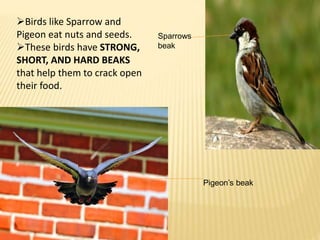
Sparrows 
beak 
Pigeon’s beak 
Birds like Sparrow and 
Pigeon eat nuts and seeds. 
These birds have STRONG, 
SHORT, AND HARD BEAKS 
that help them to crack open 
their food.
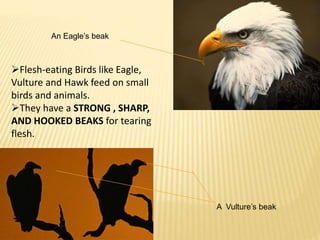
An Eagle’s beak 
A Vulture’s beak 
Flesh-eating Birds like Eagle, 
Vulture and Hawk feed on small 
birds and animals. 
They have a STRONG , SHARP, 
AND HOOKED BEAKS for tearing 
flesh.
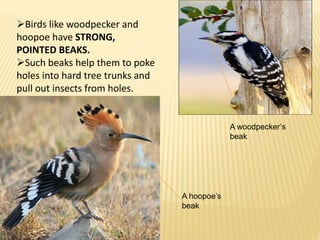
A woodpecker’s 
beak 
A hoopoe’s 
beak 
Birds like woodpecker and 
hoopoe have STRONG, 
POINTED BEAKS. 
Such beaks help them to poke 
holes into hard tree trunks and 
pull out insects from holes.
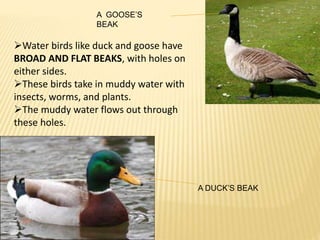
A DUCK’S BEAK 
A GOOSE’S 
BEAK 
Water birds like duck and goose have 
BROAD AND FLAT BEAKS, with holes on 
either sides. 
These birds take in muddy water with 
insects, worms, and plants. 
The muddy water flows out through 
these holes.
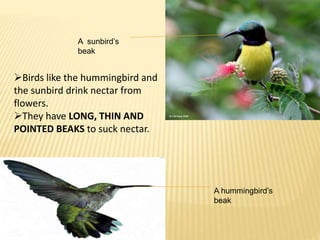
A hummingbird’s 
beak 
A sunbird’s 
beak 
Birds like the hummingbird and 
the sunbird drink nectar from 
flowers. 
They have LONG, THIN AND 
POINTED BEAKS to suck nectar.
FEET AND CLAWS 
 Birds have two feet with four toes on each. They use 
their feet to walk and hop around, as well as to catch 
and hold food. 
 Flesh-eating birds eagle and vulture 
 Perching birds like crows, sparrows, pigeons, and 
parrots 
 Scratching birds like hens, peacock etc. 
 Climbing birds like woodpecker. 
 Water birds like duck and goose have webbed feet. 
 Wading birds like crane and heron can walk through 
water.
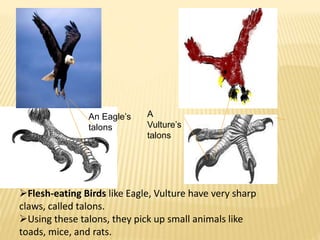
An Eagle’s 
talons 
A 
Vulture’s 
talons 
Flesh-eating Birds like Eagle, Vulture have very sharp 
claws, called talons. 
Using these talons, they pick up small animals like 
toads, mice, and rats.
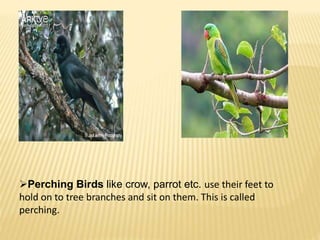
Perching Birds like crow, parrot etc. use their feet to 
hold on to tree branches and sit on them. This is called 
perching.
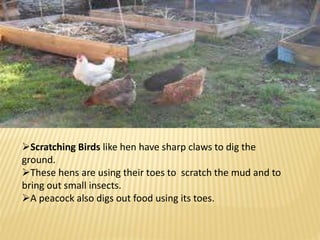
Scratching Birds like hen have sharp claws to dig the 
ground. 
These hens are using their toes to scratch the mud and to 
bring out small insects. 
A peacock also digs out food using its toes.
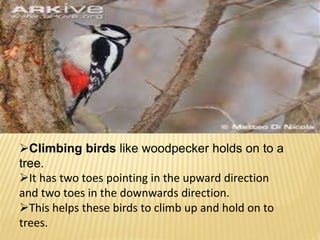
Climbing birds like woodpecker holds on to a 
tree. 
It has two toes pointing in the upward direction 
and two toes in the downwards direction. 
This helps these birds to climb up and hold on to 
trees.
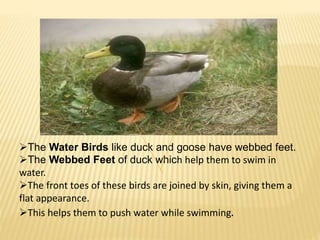
The Water Birds like duck and goose have webbed feet. 
The Webbed Feet of duck which help them to swim in 
water. 
The front toes of these birds are joined by skin, giving them a 
flat appearance. 
This helps them to push water while swimming.
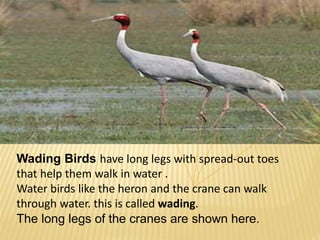
Wading Birds have long legs with spread-out toes 
that help them walk in water . 
Water birds like the heron and the crane can walk 
through water. this is called wading. 
The long legs of the cranes are shown here.
WHAT MAKES A BIRD FLY? 
 A bird has a very light body. 
 A bird’s body consists of head, trunk, wings, legs and tail. All 
these parts are very light. 
 The body of a bird is made of a strong framework of bones. 
These bones are hollow and filled with air. This makes them light 
but strong. 
 A bird has a boat shaped body. This shape helps it to float in the 
air easily. 
 A bird has wings in place of arms. These wings have feathers 
which help it to fly. 
 A bird also has strong muscles which move the wings up and 
down. These muscles attach the wings to the breast bone. These 
are called flight muscles. 
 The tail of a bird acts like the rudder of a boat. It helps the bird to 
change its direction during flight.
HOW BIRDS FLY? 
 Birds fly with the help of their wings. 
 The wings are joined to the body with strong muscles. 
 Some birds do not fly at all. They move on the earth with the 
help of their legs. These birds are also called Flightless birds. 
Examples: Ostritch, Kiwi and Penguin 
 These muscles help the birds to move their wings. 
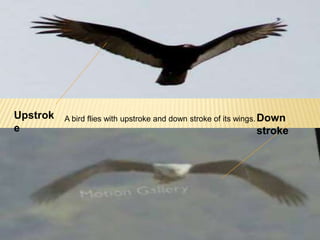
 To fly, a bird flaps its wings both in the upward and 
downward directions. 
 These strokes are called upstroke and down stroke, 
respectively. 
 A hummingbird can flap its wings 90 times in a second!
A bird flies with Upstrok upstroke and down stroke of its wings. 
e 
Down 
stroke
FEATHERS 
 A bird’s body and wings are covered with many feathers. 
 There are three kinds of feathers. 
 Body feathers 
 Down feathers 
 Flight feathers.
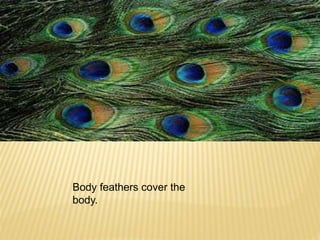
Body feathers cover the 
body.
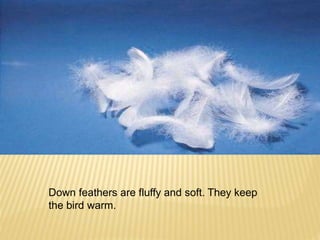
Down feathers are fluffy and soft. They keep 
the bird warm.
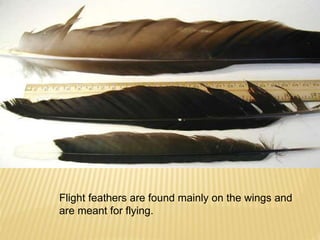
Flight feathers are found mainly on the wings and 
are meant for flying.
BIRDS AND THEIR NESTS 
 Birds build their nests to live. 
 They build their nests to lay eggs, to hatch 
their eggs and reproduce their young ones. 
 Birds build their nests to protect and feed 
their young ones until they are ready to fly on 
their own. 
 They build nests to protect themselves and 
their young ones from heat, cold, rain and 
wind.
BIRDS AND THEIR NESTS 
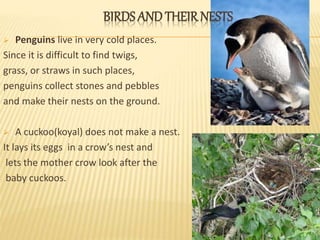
 Penguins live in very cold places. 
Since it is difficult to find twigs, 
grass, or straws in such places, 
penguins collect stones and pebbles 
and make their nests on the ground. 
 A cuckoo(koyal) does not make a nest. 
It lays its eggs in a crow’s nest and 
lets the mother crow look after the 
baby cuckoos.
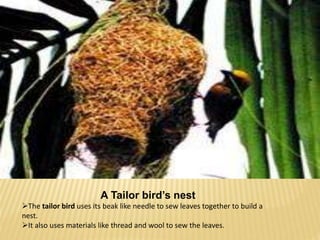
A Tailor bird’s nest 
The tailor bird uses its beak like needle to sew leaves together to build a 
nest. 
It also uses materials like thread and wool to sew the leaves.
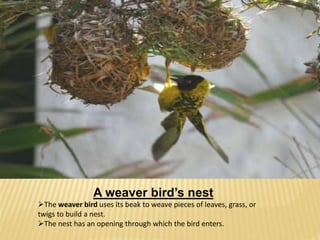
A weaver bird’s nest 
The weaver bird uses its beak to weave pieces of leaves, grass, or 
twigs to build a nest. 
The nest has an opening through which the bird enters.
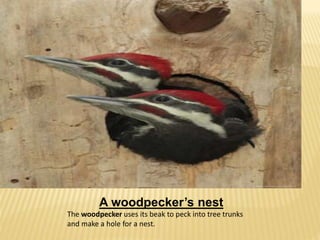
A woodpecker’s nest 
The woodpecker uses its beak to peck into tree trunks 
and make a hole for a nest.
THE 
END!!!!!!

8.birds

  • 1.
    By Aniruddh Kommajosyula . III C Delhi Public School, Nerul
  • 2.
    FOOD HABITS OFBIRDS.  Birds like other living things need food. But they do not have teeth to eat their food.  They have beaks.  A bird uses its beak to catch and eat food.  Different kinds of birds have different types of beaks.  The shape of the beaks tells us about the kind of food they eat.  Some birds also use their beaks to protect themselves from their enemies.
  • 3.
    Sparrows beak Pigeon’sbeak Birds like Sparrow and Pigeon eat nuts and seeds. These birds have STRONG, SHORT, AND HARD BEAKS that help them to crack open their food.
  • 4.
    An Eagle’s beak A Vulture’s beak Flesh-eating Birds like Eagle, Vulture and Hawk feed on small birds and animals. They have a STRONG , SHARP, AND HOOKED BEAKS for tearing flesh.
  • 5.
    A woodpecker’s beak A hoopoe’s beak Birds like woodpecker and hoopoe have STRONG, POINTED BEAKS. Such beaks help them to poke holes into hard tree trunks and pull out insects from holes.
  • 6.
    A DUCK’S BEAK A GOOSE’S BEAK Water birds like duck and goose have BROAD AND FLAT BEAKS, with holes on either sides. These birds take in muddy water with insects, worms, and plants. The muddy water flows out through these holes.
  • 7.
    A hummingbird’s beak A sunbird’s beak Birds like the hummingbird and the sunbird drink nectar from flowers. They have LONG, THIN AND POINTED BEAKS to suck nectar.
  • 8.
    FEET AND CLAWS  Birds have two feet with four toes on each. They use their feet to walk and hop around, as well as to catch and hold food.  Flesh-eating birds eagle and vulture  Perching birds like crows, sparrows, pigeons, and parrots  Scratching birds like hens, peacock etc.  Climbing birds like woodpecker.  Water birds like duck and goose have webbed feet.  Wading birds like crane and heron can walk through water.
  • 9.
    An Eagle’s talons A Vulture’s talons Flesh-eating Birds like Eagle, Vulture have very sharp claws, called talons. Using these talons, they pick up small animals like toads, mice, and rats.
  • 10.
    Perching Birds likecrow, parrot etc. use their feet to hold on to tree branches and sit on them. This is called perching.
  • 11.
    Scratching Birds likehen have sharp claws to dig the ground. These hens are using their toes to scratch the mud and to bring out small insects. A peacock also digs out food using its toes.
  • 12.
    Climbing birds likewoodpecker holds on to a tree. It has two toes pointing in the upward direction and two toes in the downwards direction. This helps these birds to climb up and hold on to trees.
  • 13.
    The Water Birdslike duck and goose have webbed feet. The Webbed Feet of duck which help them to swim in water. The front toes of these birds are joined by skin, giving them a flat appearance. This helps them to push water while swimming.
  • 14.
    Wading Birds havelong legs with spread-out toes that help them walk in water . Water birds like the heron and the crane can walk through water. this is called wading. The long legs of the cranes are shown here.
  • 15.
    WHAT MAKES ABIRD FLY?  A bird has a very light body.  A bird’s body consists of head, trunk, wings, legs and tail. All these parts are very light.  The body of a bird is made of a strong framework of bones. These bones are hollow and filled with air. This makes them light but strong.  A bird has a boat shaped body. This shape helps it to float in the air easily.  A bird has wings in place of arms. These wings have feathers which help it to fly.  A bird also has strong muscles which move the wings up and down. These muscles attach the wings to the breast bone. These are called flight muscles.  The tail of a bird acts like the rudder of a boat. It helps the bird to change its direction during flight.
  • 16.
    HOW BIRDS FLY?  Birds fly with the help of their wings.  The wings are joined to the body with strong muscles.  Some birds do not fly at all. They move on the earth with the help of their legs. These birds are also called Flightless birds. Examples: Ostritch, Kiwi and Penguin  These muscles help the birds to move their wings.  To fly, a bird flaps its wings both in the upward and downward directions.  These strokes are called upstroke and down stroke, respectively.  A hummingbird can flap its wings 90 times in a second!
  • 17.
    A bird flieswith Upstrok upstroke and down stroke of its wings. e Down stroke
  • 18.
    FEATHERS  Abird’s body and wings are covered with many feathers.  There are three kinds of feathers.  Body feathers  Down feathers  Flight feathers.
  • 19.
  • 20.
    Down feathers arefluffy and soft. They keep the bird warm.
  • 21.
    Flight feathers arefound mainly on the wings and are meant for flying.
  • 22.
    BIRDS AND THEIRNESTS  Birds build their nests to live.  They build their nests to lay eggs, to hatch their eggs and reproduce their young ones.  Birds build their nests to protect and feed their young ones until they are ready to fly on their own.  They build nests to protect themselves and their young ones from heat, cold, rain and wind.
  • 23.
    BIRDS AND THEIRNESTS  Penguins live in very cold places. Since it is difficult to find twigs, grass, or straws in such places, penguins collect stones and pebbles and make their nests on the ground.  A cuckoo(koyal) does not make a nest. It lays its eggs in a crow’s nest and lets the mother crow look after the baby cuckoos.
  • 24.
    A Tailor bird’snest The tailor bird uses its beak like needle to sew leaves together to build a nest. It also uses materials like thread and wool to sew the leaves.
  • 25.
    A weaver bird’snest The weaver bird uses its beak to weave pieces of leaves, grass, or twigs to build a nest. The nest has an opening through which the bird enters.
  • 26.
    A woodpecker’s nest The woodpecker uses its beak to peck into tree trunks and make a hole for a nest.
  • 27.