Day 83: January 13
Problem Solving
Some Basics
Cognition—the mental activities
associated with thinking, knowing,
remembering, and communicating
SOME BASICS
Concepts—a mental grouping of similar
objects, events, ideas, or people
Prototypes—a mental image or best example
of a category. Matching new items to a
prototype provides a quick and easy method
for sorting items into categories
ACTIVITY 1: What is prototypical? Give the best
example (or first example that comes to mind) when
given the following categories. After you write down
your answers, proceed to the next slide.
1. A bird
2. A color
3. A triangle
4. A motor vehicle
5. A sentence
6. A hero
7. A heroic action
8. A game
9. A philosopher
10. A writer
There are no “right” answers, but these are the most
common responses, or the most prototypical
responses.
1. A bird
2. A color
3. A triangle
4. A motor vehicle
5. A sentence
6. A hero
7. A heroic action
8. A game
9. A philosopher
10. A writer
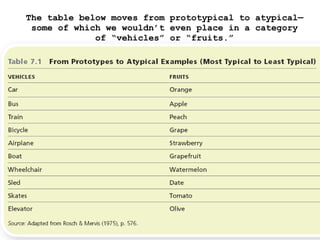
The table below moves from prototypical to atypical—
some of which we wouldn’t even place in a category
of “vehicles” or “fruits.”
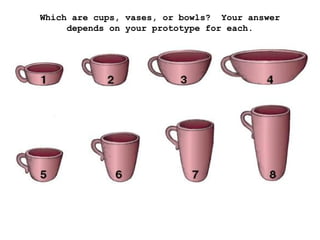
Which are cups, vases, or bowls? Your answer
depends on your prototype for each.
Problem-Solving—process of cognition that
occurs when a goal must be reached by
thinking and behaving in certain ways.
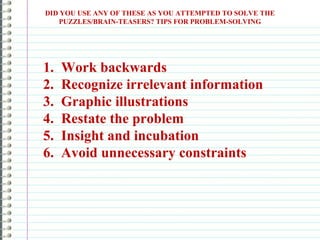
DID YOU USE ANY OF THESE AS YOU ATTEMPTED TO SOLVE THE
PUZZLES/BRAIN-TEASERS? TIPS FOR PROBLEM-SOLVING
1. Work backwards
2. Recognize irrelevant information
3. Graphic illustrations
4. Restate the problem
5. Insight and incubation
6. Avoid unnecessary constraints
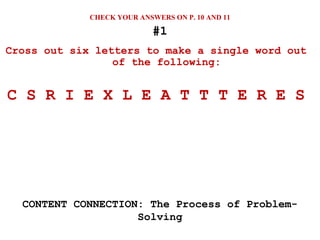
#1
Cross out six letters to make a single word out
of the following:
C S R I E X L E A T T T E R E S
CONTENT CONNECTION: The Process of Problem-
Solving
CHECK YOUR ANSWERS ON P. 10 AND 11
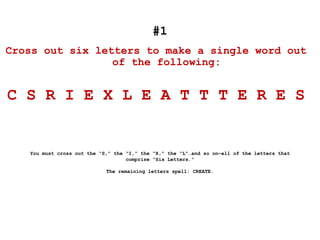
#1
Cross out six letters to make a single word out
of the following:
C S R I E X L E A T T T E R E S
You must cross out the “S,” the “I,” the “X,” the “L”…and so on—all of the letters that
comprise “Six Letters.”
The remaining letters spell: CREATE.
#2: Husbands and Wives
Three men—Fred, Ed, and Ted—are married to
Joan, Sally, and Vickie, but not
necessarily in that order. Joan, who is
Ed’s sister, lives in Detroit. Fred
dislikes animals. Ed weighs more than
the man who is married to Vickie. The
man married to Sally breeds Siamese cats
as a hobby. Fred commutes over 200
hours a year from his home in Ann Arbor,
Michigan to his job in Detroit. Match
up the men with the women they married.
Next slide will reveal answer.
#2: Husbands and Wives
Fred is married to Vickie.
Ed is married to Sally.
Ted is married to Joan.
PROBLEM-SOLVING STRATEGIES
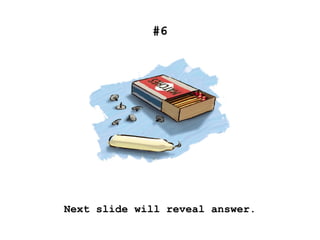
Trial and error—problem-solving method in
which one possible solution after another is
tried until a successful one is found
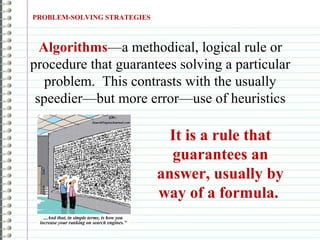
PROBLEM-SOLVING STRATEGIES
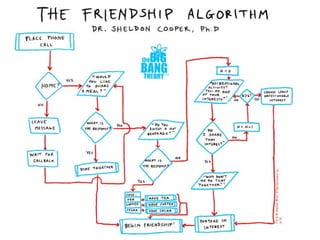
Algorithms—a methodical, logical rule or
procedure that guarantees solving a particular
problem. This contrasts with the usually
speedier—but more error—use of heuristics
It is a rule that
guarantees an
answer, usually by
way of a formula.
Take a minute to watch VIDEO 1: BIG
BANG.
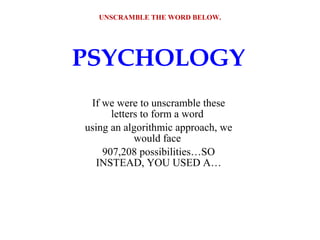
S P L O Y O C H Y G
UNSCRAMBLE THE WORD BELOW.
PSYCHOLOGY
If we were to unscramble these
letters to form a word
using an algorithmic approach, we
would face
907,208 possibilities…SO
INSTEAD, YOU USED A…
UNSCRAMBLE THE WORD BELOW.
PROBLEM-SOLVING STRATEGIES
Heuristic—a simple thinking strategy that
often allows us to make judgments and solve
problems efficiently; usually speedier but
more error-prone that algorithms…more on
this later.
PROBLEM-SOLVING STRATEGIES
Rule of thumb—a general rule that fits
most situations
Check out this site that documents general
RULES OF THUMB.
http://rulesofthumb.org/
PROBLEM-SOLVING STRATEGIES
Insight—a sudden and often novel realization
of the solution to a problem; it contrasts with
strategy-based solutions
This is like Skinner’s pigeon who suddenly got the
idea to use the box as a stool to get the hanging fruit.
#3
The maker doesn’t want it,
the buyer doesn’t use it,
and the user doesn’t see
it. What is it?
Next slide will reveal answer.
#3
A COFFIN
#4
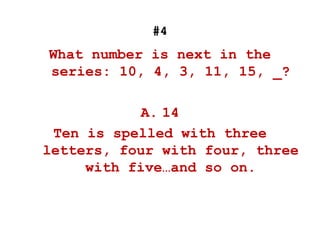
What number is next in the
series: 10, 4, 3, 11, 15, _?
A. 14
B. 1
C. 17
D. 12
Next slide will reveal answer.
#4
What number is next in the
series: 10, 4, 3, 11, 15, _?
A. 14
Ten is spelled with three
letters, four with four, three
with five…and so on.
#5
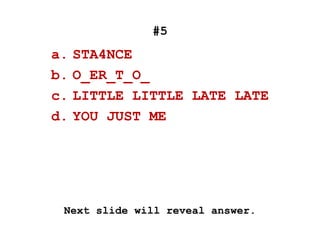
a. STA4NCE
b. O_ER_T_O_
c. LITTLE LITTLE LATE LATE
d. YOU JUST ME
Next slide will reveal answer.
#5
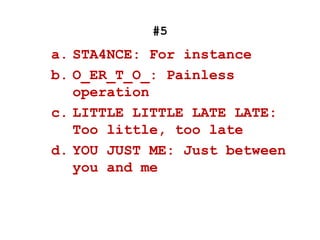
a. STA4NCE: For instance
b. O_ER_T_O_: Painless
operation
c. LITTLE LITTLE LATE LATE:
Too little, too late
d. YOU JUST ME: Just between
you and me
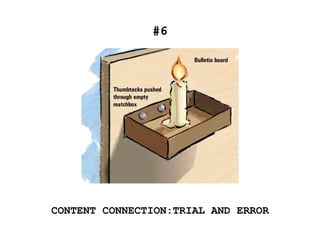
#6
Next slide will reveal answer.
#6
CONTENT CONNECTION:TRIAL AND ERROR
#10: REMOTE ASSOCIATION TEST
a. Law, Birthday, Swim
b. Brother, Sister, Knight
c. Paint, Doll, Dog
d. Cottage, Cake, Blue
e. Toast, Poodle, Kiss
f. Heart, Tooth, Talk
Next slide will reveal answer.
#10: REMOTE ASSOCIATION TEST
CONTENT CONNECTION:TRIAL AND ERROR
a. Law, Birthday, Swim: SUIT
b. Brother, Sister, Knight: HOOD
c. Paint, Doll, Dog: HOUSE
d. Cottage, Cake, Blue: CHEESE
e. Toast, Poodle, Kiss: FRENCH
f. Heart, Tooth, Talk: SWEET
Creativity—the ability to produce
novel and valuable ideas
ROBERT STERNBERG’S COMPONENTS OF CREATIVITY
1.Expertise
2.Imaginative thinking skills
3.A venturesome personality
4.Intrinsic motivation
5.A creative environment
Convergent thinking—type of thinking in
which a problem is seen as having only one
answer, and all lines of thinking will
eventually lead to that single answer, using
previous knowledge and logic.
Divergent thinking—type of thinking in
which a person starts from one point and
comes up with many different ideas or
possibilities based on that point.
OBSTACLES TO PROBLEM SOLVING
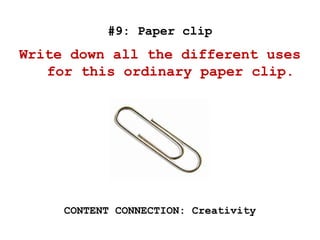
#9: Paper clip
Write down all the different uses
for this ordinary paper clip.
CONTENT CONNECTION: Creativity
#9: Paper clip
Write down all the different uses
for this ordinary paper clip.
Speaker Ken Robinson suggests that children
are much better at this than adults.
Robinson asserts that schools kill
creativity. (I strongly disagree with this,
by the way.)
#9: Paper clip
Some great examples of
creativity.
Hull strawberries easily using a straw.
Stop cut apples browning in your childs lunch box
by securing with a rubber band.
Pump up the volume by placing your iPhone & iPod
in a bowl. The concave shape amplifies the music.
Overhaul your linen cupboard, store bed linen sets
inside one of their own pillowcases and there will
be no more hunting through piles for a match.
Bake cupcakes directly in ice-cream cones, so
much more fun and easier for kids to eat.
A muffin pan becomes a craft caddy. Magnets
hold the plastic cups down to make them
tip-resistant.
Toast your bread to perfection.
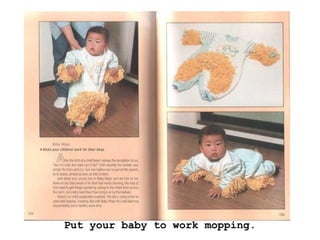
Put your baby to work mopping.
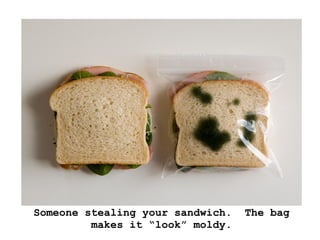
Someone stealing your sandwich. The bag
makes it “look” moldy.
Obstacles to problem solving
Confirmation Bias—a tendency to search for
information that supports our preconceptions
and to ignore or distort contradictory evidence
OBSTACLES TO PROBLEM SOLVING
Mental set—a tendency to approach a
problem in one particular way, often a way
that has been successful in the past
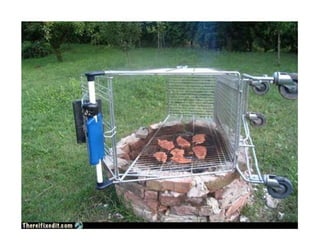
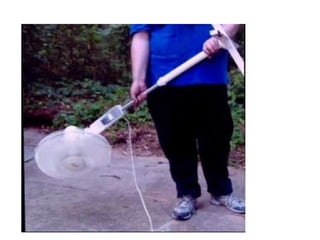
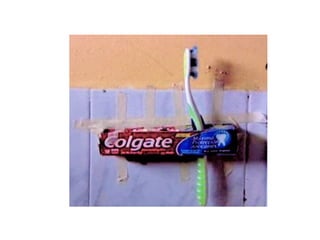
Functional fixedness—the tendency to think
of things only in terms of their usual
functions; an impediment to problem
solving
OBSTACLES TO PROBLEM SOLVING
Fixation—the inability to see a problem from
a new perspective by employing a different
mental set
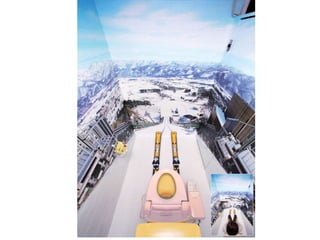
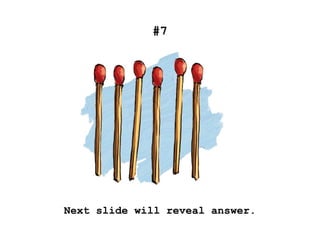
#7
Next slide will reveal answer.
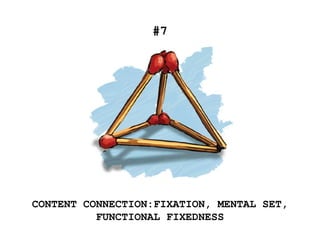
#7
CONTENT CONNECTION:FIXATION, MENTAL SET,
FUNCTIONAL FIXEDNESS
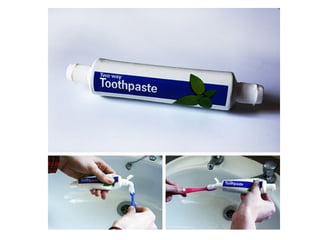
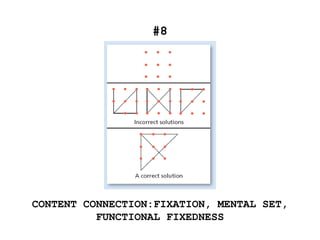
#8
CONTENT CONNECTION:FIXATION, MENTAL SET,
FUNCTIONAL FIXEDNESS
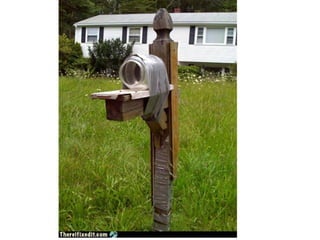
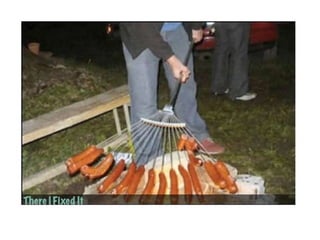
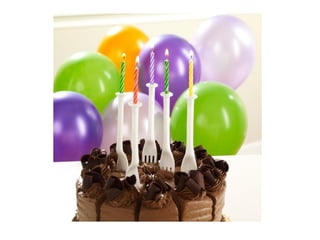
These innovators have
successfully overcome
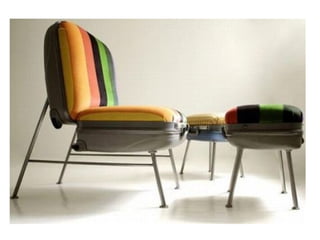
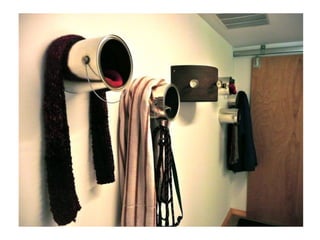
FUNCTIONAL FIXEDNESS.
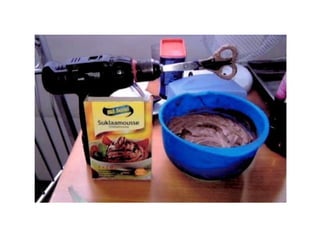
Turn your muffin pan upside down, bake cookie-dough
over the top and voila, you have cookie bowls for fruit
or ice-cream.
Create a window-box veggie patch using guttering.
Use egg cartons to separate and store your
Christmas decorations.
Making Decisions and
Forming Judgments
Intuition—an effortless, immediate,
automatic feeling or thought, as contrasted
with explicit conscious reasoning
MAKING DECISIONS AND FORMING JUDGMENTS
A bat and a ball
A bat and a ball cost $1.10 in
total. The bat costs $1 more
than the ball. How much does
the ball cost?
Next slide will reveal answer.
A bat and a ball
The bat costs $1.05; the ball
costs 5 cents. Did you get it
wrong? Lots of people do.
Intuition can steer us wrong.
Next slide will reveal answer.
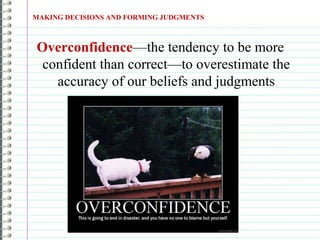
Overconfidence—the tendency to be more
confident than correct—to overestimate the
accuracy of our beliefs and judgments
MAKING DECISIONS AND FORMING JUDGMENTS
Fact: only 50% of people in any particular
field can be above average.
Fact: 80% of the people in the US describe
themselves as above average.
(Therefore, 30% of Americans have an
unrealistic view of their abilities.)
Representative heuristic—judging the
likelihood of things in terms of how well
they seem to represent, or match, particular
prototypes; this may lead us to ignore other
relevant information
MAKING DECISIONS AND FORMING JUDGMENTS
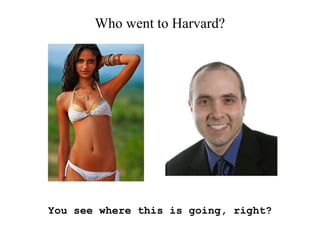
Who went to Harvard?
You see where this is going, right?
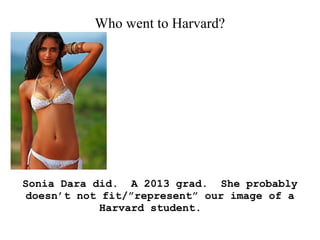
Who went to Harvard?
Sonia Dara did. A 2013 grad. She probably
doesn’t not fit/”represent” our image of a
Harvard student.
Availability heuristics—estimating the
likelihood of events based on their
availability in memory; if instances come
readily to mind (perhaps because of their
vividness), we presume such events are
common
MAKING DECISIONS AND FORMING JUDGMENTS
Earlier this year, Ebola seemed to be sweeping the world.
You might be surprised to know that you have a 1:13.3
million chance of contracting Ebola.
To put this in perspective, you have a 1:3.7 million chance
of being killed by a shark in your lifetime.
AVAILABILITY HEURISTIC affects our
thinking. See more on link at the bottom of the lesson
to see Ebola statistics.
MAKING DECISIONS AND FORMING JUDGMENTS
Which city in the US has
the highest crime rate?
What came to mind?
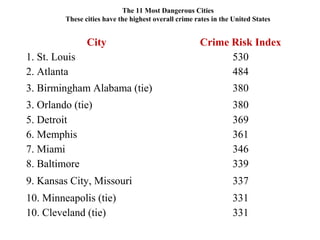
City Crime Risk Index
1. St. Louis 530
2. Atlanta 484
3. Birmingham Alabama (tie) 380
3. Orlando (tie) 380
5. Detroit 369
6. Memphis 361
7. Miami 346
8. Baltimore 339
9. Kansas City, Missouri 337
10. Minneapolis (tie) 331
10. Cleveland (tie) 331
The 11 Most Dangerous Cities
These cities have the highest overall crime rates in the United States
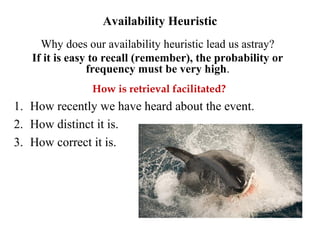
Availability Heuristic
Why does our availability heuristic lead us astray?
If it is easy to recall (remember), the probability or
frequency must be very high.
How is retrieval facilitated?
1. How recently we have heard about the event.
2. How distinct it is.
3. How correct it is.
Belief perseverance—clinging to one’s initial
conceptions after the basis on which they
were formed has been discredited
Please read p. 15 in notes packet.
MAKING DECISIONS AND FORMING JUDGMENTS
Framing—the way an issue is posed; how an
issue is framed can significantly affect
decisions and judgments
MAKING DECISIONS AND FORMING JUDGMENTS

Problem Solving

  • 1.
    Day 83: January13 Problem Solving
  • 2.
  • 3.
    Cognition—the mental activities associatedwith thinking, knowing, remembering, and communicating
  • 4.
    SOME BASICS Concepts—a mentalgrouping of similar objects, events, ideas, or people Prototypes—a mental image or best example of a category. Matching new items to a prototype provides a quick and easy method for sorting items into categories
  • 5.
    ACTIVITY 1: Whatis prototypical? Give the best example (or first example that comes to mind) when given the following categories. After you write down your answers, proceed to the next slide. 1. A bird 2. A color 3. A triangle 4. A motor vehicle 5. A sentence 6. A hero 7. A heroic action 8. A game 9. A philosopher 10. A writer
  • 6.
    There are no“right” answers, but these are the most common responses, or the most prototypical responses. 1. A bird 2. A color 3. A triangle 4. A motor vehicle 5. A sentence 6. A hero 7. A heroic action 8. A game 9. A philosopher 10. A writer
  • 7.
    The table belowmoves from prototypical to atypical— some of which we wouldn’t even place in a category of “vehicles” or “fruits.”
  • 8.
    Which are cups,vases, or bowls? Your answer depends on your prototype for each.
  • 9.
    Problem-Solving—process of cognitionthat occurs when a goal must be reached by thinking and behaving in certain ways.
  • 10.
    DID YOU USEANY OF THESE AS YOU ATTEMPTED TO SOLVE THE PUZZLES/BRAIN-TEASERS? TIPS FOR PROBLEM-SOLVING 1. Work backwards 2. Recognize irrelevant information 3. Graphic illustrations 4. Restate the problem 5. Insight and incubation 6. Avoid unnecessary constraints
  • 11.
    #1 Cross out sixletters to make a single word out of the following: C S R I E X L E A T T T E R E S CONTENT CONNECTION: The Process of Problem- Solving CHECK YOUR ANSWERS ON P. 10 AND 11
  • 12.
    #1 Cross out sixletters to make a single word out of the following: C S R I E X L E A T T T E R E S You must cross out the “S,” the “I,” the “X,” the “L”…and so on—all of the letters that comprise “Six Letters.” The remaining letters spell: CREATE.
  • 13.
    #2: Husbands andWives Three men—Fred, Ed, and Ted—are married to Joan, Sally, and Vickie, but not necessarily in that order. Joan, who is Ed’s sister, lives in Detroit. Fred dislikes animals. Ed weighs more than the man who is married to Vickie. The man married to Sally breeds Siamese cats as a hobby. Fred commutes over 200 hours a year from his home in Ann Arbor, Michigan to his job in Detroit. Match up the men with the women they married. Next slide will reveal answer.
  • 14.
    #2: Husbands andWives Fred is married to Vickie. Ed is married to Sally. Ted is married to Joan.
  • 15.
    PROBLEM-SOLVING STRATEGIES Trial anderror—problem-solving method in which one possible solution after another is tried until a successful one is found
  • 16.
    PROBLEM-SOLVING STRATEGIES Algorithms—a methodical,logical rule or procedure that guarantees solving a particular problem. This contrasts with the usually speedier—but more error—use of heuristics It is a rule that guarantees an answer, usually by way of a formula.
  • 18.
    Take a minuteto watch VIDEO 1: BIG BANG.
  • 19.
    S P LO Y O C H Y G UNSCRAMBLE THE WORD BELOW.
  • 20.
    PSYCHOLOGY If we wereto unscramble these letters to form a word using an algorithmic approach, we would face 907,208 possibilities…SO INSTEAD, YOU USED A… UNSCRAMBLE THE WORD BELOW.
  • 21.
    PROBLEM-SOLVING STRATEGIES Heuristic—a simplethinking strategy that often allows us to make judgments and solve problems efficiently; usually speedier but more error-prone that algorithms…more on this later.
  • 22.
    PROBLEM-SOLVING STRATEGIES Rule ofthumb—a general rule that fits most situations
  • 23.
    Check out thissite that documents general RULES OF THUMB. http://rulesofthumb.org/
  • 24.
    PROBLEM-SOLVING STRATEGIES Insight—a suddenand often novel realization of the solution to a problem; it contrasts with strategy-based solutions This is like Skinner’s pigeon who suddenly got the idea to use the box as a stool to get the hanging fruit.
  • 25.
    #3 The maker doesn’twant it, the buyer doesn’t use it, and the user doesn’t see it. What is it? Next slide will reveal answer.
  • 26.
  • 27.
    #4 What number isnext in the series: 10, 4, 3, 11, 15, _? A. 14 B. 1 C. 17 D. 12 Next slide will reveal answer.
  • 28.
    #4 What number isnext in the series: 10, 4, 3, 11, 15, _? A. 14 Ten is spelled with three letters, four with four, three with five…and so on.
  • 29.
    #5 a. STA4NCE b. O_ER_T_O_ c.LITTLE LITTLE LATE LATE d. YOU JUST ME Next slide will reveal answer.
  • 30.
    #5 a. STA4NCE: Forinstance b. O_ER_T_O_: Painless operation c. LITTLE LITTLE LATE LATE: Too little, too late d. YOU JUST ME: Just between you and me
  • 31.
    #6 Next slide willreveal answer.
  • 32.
  • 33.
    #10: REMOTE ASSOCIATIONTEST a. Law, Birthday, Swim b. Brother, Sister, Knight c. Paint, Doll, Dog d. Cottage, Cake, Blue e. Toast, Poodle, Kiss f. Heart, Tooth, Talk Next slide will reveal answer.
  • 34.
    #10: REMOTE ASSOCIATIONTEST CONTENT CONNECTION:TRIAL AND ERROR a. Law, Birthday, Swim: SUIT b. Brother, Sister, Knight: HOOD c. Paint, Doll, Dog: HOUSE d. Cottage, Cake, Blue: CHEESE e. Toast, Poodle, Kiss: FRENCH f. Heart, Tooth, Talk: SWEET
  • 35.
    Creativity—the ability toproduce novel and valuable ideas
  • 36.
    ROBERT STERNBERG’S COMPONENTSOF CREATIVITY 1.Expertise 2.Imaginative thinking skills 3.A venturesome personality 4.Intrinsic motivation 5.A creative environment
  • 37.
    Convergent thinking—type ofthinking in which a problem is seen as having only one answer, and all lines of thinking will eventually lead to that single answer, using previous knowledge and logic. Divergent thinking—type of thinking in which a person starts from one point and comes up with many different ideas or possibilities based on that point. OBSTACLES TO PROBLEM SOLVING
  • 38.
    #9: Paper clip Writedown all the different uses for this ordinary paper clip. CONTENT CONNECTION: Creativity
  • 39.
    #9: Paper clip Writedown all the different uses for this ordinary paper clip. Speaker Ken Robinson suggests that children are much better at this than adults. Robinson asserts that schools kill creativity. (I strongly disagree with this, by the way.)
  • 40.
    #9: Paper clip Somegreat examples of creativity.
  • 41.
  • 42.
    Stop cut applesbrowning in your childs lunch box by securing with a rubber band.
  • 43.
    Pump up thevolume by placing your iPhone & iPod in a bowl. The concave shape amplifies the music.
  • 44.
    Overhaul your linencupboard, store bed linen sets inside one of their own pillowcases and there will be no more hunting through piles for a match.
  • 45.
    Bake cupcakes directlyin ice-cream cones, so much more fun and easier for kids to eat.
  • 46.
    A muffin panbecomes a craft caddy. Magnets hold the plastic cups down to make them tip-resistant.
  • 47.
    Toast your breadto perfection.
  • 48.
    Put your babyto work mopping.
  • 49.
    Someone stealing yoursandwich. The bag makes it “look” moldy.
  • 52.
  • 53.
    Confirmation Bias—a tendencyto search for information that supports our preconceptions and to ignore or distort contradictory evidence OBSTACLES TO PROBLEM SOLVING
  • 54.
    Mental set—a tendencyto approach a problem in one particular way, often a way that has been successful in the past Functional fixedness—the tendency to think of things only in terms of their usual functions; an impediment to problem solving OBSTACLES TO PROBLEM SOLVING Fixation—the inability to see a problem from a new perspective by employing a different mental set
  • 55.
    #7 Next slide willreveal answer.
  • 56.
    #7 CONTENT CONNECTION:FIXATION, MENTALSET, FUNCTIONAL FIXEDNESS
  • 57.
    #8 CONTENT CONNECTION:FIXATION, MENTALSET, FUNCTIONAL FIXEDNESS
  • 58.
    These innovators have successfullyovercome FUNCTIONAL FIXEDNESS.
  • 66.
    Turn your muffinpan upside down, bake cookie-dough over the top and voila, you have cookie bowls for fruit or ice-cream.
  • 67.
    Create a window-boxveggie patch using guttering.
  • 68.
    Use egg cartonsto separate and store your Christmas decorations.
  • 75.
  • 76.
    Intuition—an effortless, immediate, automaticfeeling or thought, as contrasted with explicit conscious reasoning MAKING DECISIONS AND FORMING JUDGMENTS
  • 77.
    A bat anda ball A bat and a ball cost $1.10 in total. The bat costs $1 more than the ball. How much does the ball cost? Next slide will reveal answer.
  • 78.
    A bat anda ball The bat costs $1.05; the ball costs 5 cents. Did you get it wrong? Lots of people do. Intuition can steer us wrong. Next slide will reveal answer.
  • 79.
    Overconfidence—the tendency tobe more confident than correct—to overestimate the accuracy of our beliefs and judgments MAKING DECISIONS AND FORMING JUDGMENTS
  • 80.
    MAKING DECISIONS ANDFORMING JUDGMENTS Fact: only 50% of people in any particular field can be above average. Fact: 80% of the people in the US describe themselves as above average. (Therefore, 30% of Americans have an unrealistic view of their abilities.)
  • 81.
    Representative heuristic—judging the likelihoodof things in terms of how well they seem to represent, or match, particular prototypes; this may lead us to ignore other relevant information MAKING DECISIONS AND FORMING JUDGMENTS
  • 82.
    Who went toHarvard? You see where this is going, right?
  • 83.
    Who went toHarvard? Sonia Dara did. A 2013 grad. She probably doesn’t not fit/”represent” our image of a Harvard student.
  • 84.
    Availability heuristics—estimating the likelihoodof events based on their availability in memory; if instances come readily to mind (perhaps because of their vividness), we presume such events are common MAKING DECISIONS AND FORMING JUDGMENTS
  • 85.
    Earlier this year,Ebola seemed to be sweeping the world. You might be surprised to know that you have a 1:13.3 million chance of contracting Ebola. To put this in perspective, you have a 1:3.7 million chance of being killed by a shark in your lifetime. AVAILABILITY HEURISTIC affects our thinking. See more on link at the bottom of the lesson to see Ebola statistics. MAKING DECISIONS AND FORMING JUDGMENTS
  • 86.
    Which city inthe US has the highest crime rate? What came to mind?
  • 87.
    City Crime RiskIndex 1. St. Louis 530 2. Atlanta 484 3. Birmingham Alabama (tie) 380 3. Orlando (tie) 380 5. Detroit 369 6. Memphis 361 7. Miami 346 8. Baltimore 339 9. Kansas City, Missouri 337 10. Minneapolis (tie) 331 10. Cleveland (tie) 331 The 11 Most Dangerous Cities These cities have the highest overall crime rates in the United States
  • 88.
    Availability Heuristic Why doesour availability heuristic lead us astray? If it is easy to recall (remember), the probability or frequency must be very high. How is retrieval facilitated? 1. How recently we have heard about the event. 2. How distinct it is. 3. How correct it is.
  • 89.
    Belief perseverance—clinging toone’s initial conceptions after the basis on which they were formed has been discredited Please read p. 15 in notes packet. MAKING DECISIONS AND FORMING JUDGMENTS
  • 90.
    Framing—the way anissue is posed; how an issue is framed can significantly affect decisions and judgments MAKING DECISIONS AND FORMING JUDGMENTS

Editor's Notes

  • #50 The bag itself is colored to make it look like mold.
  • #51 A toilet