IEEE 802.15.4
and Zigbee Overview
Topics
• 802.15.4
• ZigBee
• Competing Technologies
• Products
• Some Motorola Projects
Slide 2
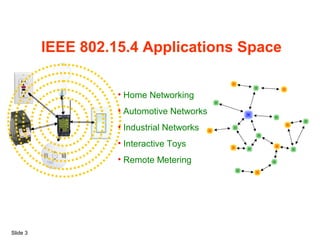
• Home Networking
• Automotive Networks
• Industrial Networks
• Interactive Toys
• Remote Metering
IEEE 802.15.4 Applications Space
Slide 3
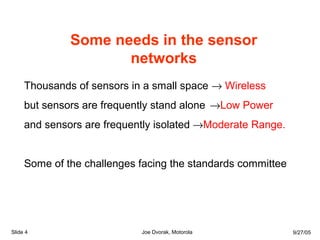
Some needs in the sensor
networks
Thousands of sensors in a small space → Wireless
but sensors are frequently stand alone →Low Power
and sensors are frequently isolated →Moderate Range.
Some of the challenges facing the standards committee
Slide 4 Joe Dvorak, Motorola 9/27/05
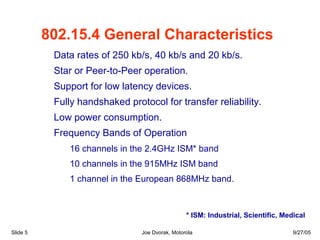
802.15.4 General Characteristics
Data rates of 250 kb/s, 40 kb/s and 20 kb/s.
Star or Peer-to-Peer operation.
Support for low latency devices.
Fully handshaked protocol for transfer reliability.
Low power consumption.
Frequency Bands of Operation
16 channels in the 2.4GHz ISM* band
10 channels in the 915MHz ISM band
1 channel in the European 868MHz band.
* ISM: Industrial, Scientific, Medical
Slide 5 Joe Dvorak, Motorola 9/27/05
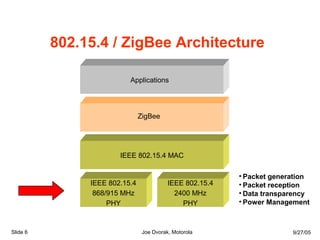
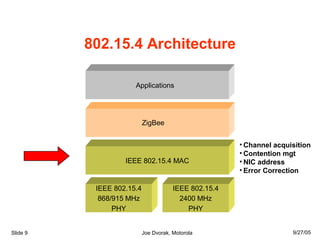
IEEE 802.15.4 MAC
Applications
IEEE 802.15.4
2400 MHz
PHY
IEEE 802.15.4
868/915 MHz
PHY
802.15.4 / ZigBee Architecture
ZigBee
• Packet generation
• Packet reception
• Data transparency
• Power Management
Slide 6 Joe Dvorak, Motorola 9/27/05
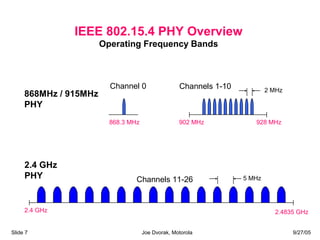
IEEE 802.15.4 PHY Overview
Operating Frequency Bands
868MHz / 915MHz
PHY
2.4 GHz
868.3 MHz
Channel 0 Channels 1-10
Channels 11-26
2.4835 GHz
928 MHz902 MHz
5 MHz
2 MHz
2.4 GHz
PHY
Slide 7 Joe Dvorak, Motorola 9/27/05
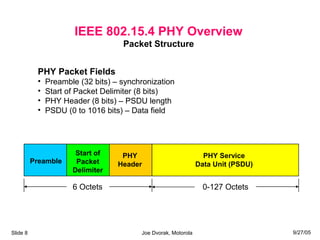
IEEE 802.15.4 PHY Overview
Packet Structure
Preamble
Start of
Packet
Delimiter
PHY
Header
PHY Service
Data Unit (PSDU)
PHY Packet Fields
• Preamble (32 bits) – synchronization
• Start of Packet Delimiter (8 bits)
• PHY Header (8 bits) – PSDU length
• PSDU (0 to 1016 bits) – Data field
6 Octets 0-127 Octets
Slide 8 Joe Dvorak, Motorola 9/27/05
802.15.4 Architecture
IEEE 802.15.4 MAC
Applications
IEEE 802.15.4
2400 MHz
PHY
IEEE 802.15.4
868/915 MHz
PHY
• Channel acquisition
• Contention mgt
• NIC address
• Error Correction
ZigBee
Slide 9 Joe Dvorak, Motorola 9/27/05
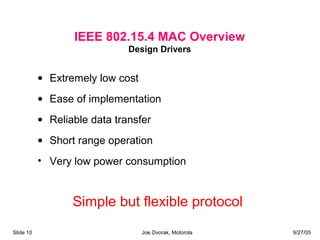
• Extremely low cost
• Ease of implementation
• Reliable data transfer
• Short range operation
• Very low power consumption
Simple but flexible protocol
IEEE 802.15.4 MAC Overview
Design Drivers
Slide 10 Joe Dvorak, Motorola 9/27/05
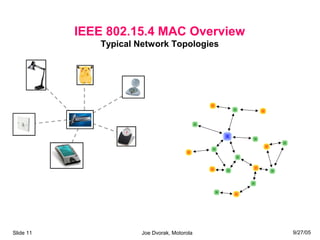
IEEE 802.15.4 MAC Overview
Typical Network Topologies
Slide 11 Joe Dvorak, Motorola 9/27/05
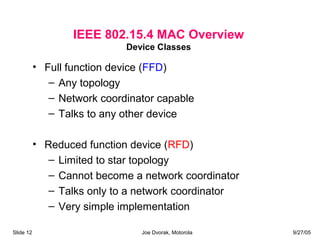
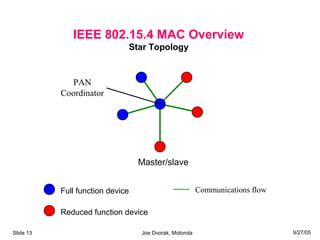
• Full function device (FFD)
– Any topology
– Network coordinator capable
– Talks to any other device
• Reduced function device (RFD)
– Limited to star topology
– Cannot become a network coordinator
– Talks only to a network coordinator
– Very simple implementation
IEEE 802.15.4 MAC Overview
Device Classes
Slide 12 Joe Dvorak, Motorola 9/27/05
Full function device
Reduced function device
Communications flow
Master/slave
PAN
Coordinator
IEEE 802.15.4 MAC Overview
Star Topology
Slide 13 Joe Dvorak, Motorola 9/27/05
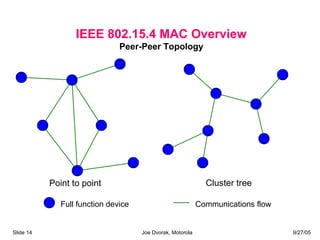
Full function device Communications flow
Point to point Cluster tree
IEEE 802.15.4 MAC Overview
Peer-Peer Topology
Slide 14 Joe Dvorak, Motorola 9/27/05
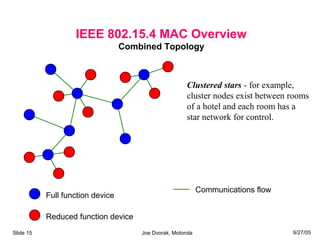
Full function device
Reduced function device
Communications flow
Clustered stars - for example,
cluster nodes exist between rooms
of a hotel and each room has a
star network for control.
IEEE 802.15.4 MAC Overview
Combined Topology
Slide 15 Joe Dvorak, Motorola 9/27/05
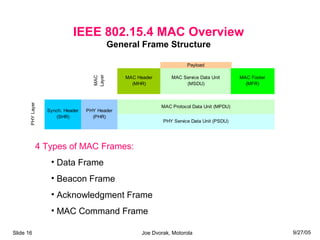
IEEE 802.15.4 MAC Overview
General Frame Structure
Payload
PHYLayer
MAC
Layer
MAC Header
(MHR)
MAC Footer
(MFR)
MAC Protocol Data Unit (MPDU)
MAC Service Data Unit
(MSDU)
PHY Header
(PHR)
Synch. Header
(SHR)
PHY Service Data Unit (PSDU)
4 Types of MAC Frames:
• Data Frame
• Beacon Frame
• Acknowledgment Frame
• MAC Command Frame
Slide 16 Joe Dvorak, Motorola 9/27/05
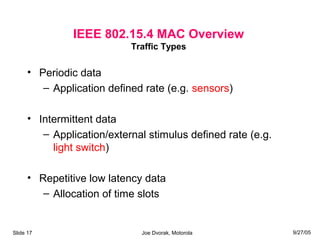
• Periodic data
– Application defined rate (e.g. sensors)
• Intermittent data
– Application/external stimulus defined rate (e.g.
light switch)
• Repetitive low latency data
– Allocation of time slots
IEEE 802.15.4 MAC Overview
Traffic Types
Slide 17 Joe Dvorak, Motorola 9/27/05
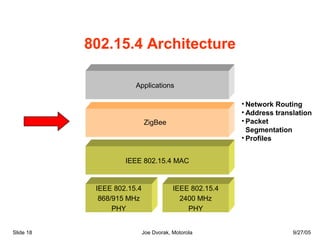
802.15.4 Architecture
IEEE 802.15.4 MAC
Applications
IEEE 802.15.4
2400 MHz
PHY
IEEE 802.15.4
868/915 MHz
PHY
• Network Routing
• Address translation
• Packet
Segmentation
• Profiles
ZigBee
Slide 18 Joe Dvorak, Motorola 9/27/05
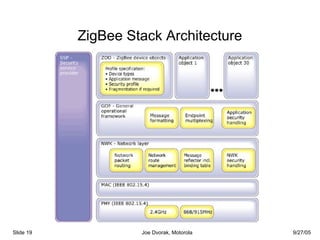
ZigBee Stack Architecture
Slide 19 Joe Dvorak, Motorola 9/27/05
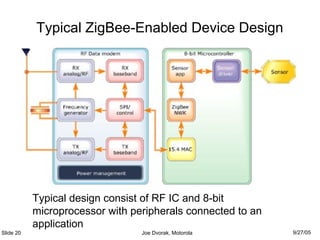
Typical ZigBee-Enabled Device Design
Typical design consist of RF IC and 8-bit
microprocessor with peripherals connected to an
application
Slide 20 Joe Dvorak, Motorola 9/27/05
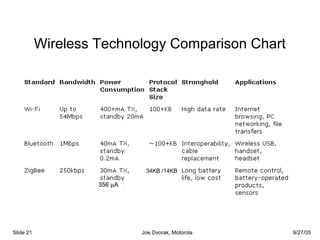
Wireless Technology Comparison Chart
356 µA
34KB /14KB
Slide 21 Joe Dvorak, Motorola 9/27/05

802 15-4 tutorial

  • 1.
  • 2.
    Topics • 802.15.4 • ZigBee •Competing Technologies • Products • Some Motorola Projects Slide 2
  • 3.
    • Home Networking •Automotive Networks • Industrial Networks • Interactive Toys • Remote Metering IEEE 802.15.4 Applications Space Slide 3
  • 4.
    Some needs inthe sensor networks Thousands of sensors in a small space → Wireless but sensors are frequently stand alone →Low Power and sensors are frequently isolated →Moderate Range. Some of the challenges facing the standards committee Slide 4 Joe Dvorak, Motorola 9/27/05
  • 5.
    802.15.4 General Characteristics Datarates of 250 kb/s, 40 kb/s and 20 kb/s. Star or Peer-to-Peer operation. Support for low latency devices. Fully handshaked protocol for transfer reliability. Low power consumption. Frequency Bands of Operation 16 channels in the 2.4GHz ISM* band 10 channels in the 915MHz ISM band 1 channel in the European 868MHz band. * ISM: Industrial, Scientific, Medical Slide 5 Joe Dvorak, Motorola 9/27/05
  • 6.
    IEEE 802.15.4 MAC Applications IEEE802.15.4 2400 MHz PHY IEEE 802.15.4 868/915 MHz PHY 802.15.4 / ZigBee Architecture ZigBee • Packet generation • Packet reception • Data transparency • Power Management Slide 6 Joe Dvorak, Motorola 9/27/05
  • 7.
    IEEE 802.15.4 PHYOverview Operating Frequency Bands 868MHz / 915MHz PHY 2.4 GHz 868.3 MHz Channel 0 Channels 1-10 Channels 11-26 2.4835 GHz 928 MHz902 MHz 5 MHz 2 MHz 2.4 GHz PHY Slide 7 Joe Dvorak, Motorola 9/27/05
  • 8.
    IEEE 802.15.4 PHYOverview Packet Structure Preamble Start of Packet Delimiter PHY Header PHY Service Data Unit (PSDU) PHY Packet Fields • Preamble (32 bits) – synchronization • Start of Packet Delimiter (8 bits) • PHY Header (8 bits) – PSDU length • PSDU (0 to 1016 bits) – Data field 6 Octets 0-127 Octets Slide 8 Joe Dvorak, Motorola 9/27/05
  • 9.
    802.15.4 Architecture IEEE 802.15.4MAC Applications IEEE 802.15.4 2400 MHz PHY IEEE 802.15.4 868/915 MHz PHY • Channel acquisition • Contention mgt • NIC address • Error Correction ZigBee Slide 9 Joe Dvorak, Motorola 9/27/05
  • 10.
    • Extremely lowcost • Ease of implementation • Reliable data transfer • Short range operation • Very low power consumption Simple but flexible protocol IEEE 802.15.4 MAC Overview Design Drivers Slide 10 Joe Dvorak, Motorola 9/27/05
  • 11.
    IEEE 802.15.4 MACOverview Typical Network Topologies Slide 11 Joe Dvorak, Motorola 9/27/05
  • 12.
    • Full functiondevice (FFD) – Any topology – Network coordinator capable – Talks to any other device • Reduced function device (RFD) – Limited to star topology – Cannot become a network coordinator – Talks only to a network coordinator – Very simple implementation IEEE 802.15.4 MAC Overview Device Classes Slide 12 Joe Dvorak, Motorola 9/27/05
  • 13.
    Full function device Reducedfunction device Communications flow Master/slave PAN Coordinator IEEE 802.15.4 MAC Overview Star Topology Slide 13 Joe Dvorak, Motorola 9/27/05
  • 14.
    Full function deviceCommunications flow Point to point Cluster tree IEEE 802.15.4 MAC Overview Peer-Peer Topology Slide 14 Joe Dvorak, Motorola 9/27/05
  • 15.
    Full function device Reducedfunction device Communications flow Clustered stars - for example, cluster nodes exist between rooms of a hotel and each room has a star network for control. IEEE 802.15.4 MAC Overview Combined Topology Slide 15 Joe Dvorak, Motorola 9/27/05
  • 16.
    IEEE 802.15.4 MACOverview General Frame Structure Payload PHYLayer MAC Layer MAC Header (MHR) MAC Footer (MFR) MAC Protocol Data Unit (MPDU) MAC Service Data Unit (MSDU) PHY Header (PHR) Synch. Header (SHR) PHY Service Data Unit (PSDU) 4 Types of MAC Frames: • Data Frame • Beacon Frame • Acknowledgment Frame • MAC Command Frame Slide 16 Joe Dvorak, Motorola 9/27/05
  • 17.
    • Periodic data –Application defined rate (e.g. sensors) • Intermittent data – Application/external stimulus defined rate (e.g. light switch) • Repetitive low latency data – Allocation of time slots IEEE 802.15.4 MAC Overview Traffic Types Slide 17 Joe Dvorak, Motorola 9/27/05
  • 18.
    802.15.4 Architecture IEEE 802.15.4MAC Applications IEEE 802.15.4 2400 MHz PHY IEEE 802.15.4 868/915 MHz PHY • Network Routing • Address translation • Packet Segmentation • Profiles ZigBee Slide 18 Joe Dvorak, Motorola 9/27/05
  • 19.
    ZigBee Stack Architecture Slide19 Joe Dvorak, Motorola 9/27/05
  • 20.
    Typical ZigBee-Enabled DeviceDesign Typical design consist of RF IC and 8-bit microprocessor with peripherals connected to an application Slide 20 Joe Dvorak, Motorola 9/27/05
  • 21.
    Wireless Technology ComparisonChart 356 µA 34KB /14KB Slide 21 Joe Dvorak, Motorola 9/27/05

Editor's Notes

  • #12 An example network topology in the area of home (living room) control. A set-top-box is acting as the master with a remote, TV, DVD, lamp and curtains enumerated on the network. This has no functionality since the slaves can only talk to the master. What the consumer actually wants is to be able to control the TV, DVD, lamp and curtains using the remote. In this case there needs to be some virtual peer-to-peer links between the remote and the other devices on the network. The mechanism of creating these links is known as pairing.