7
Logical Form
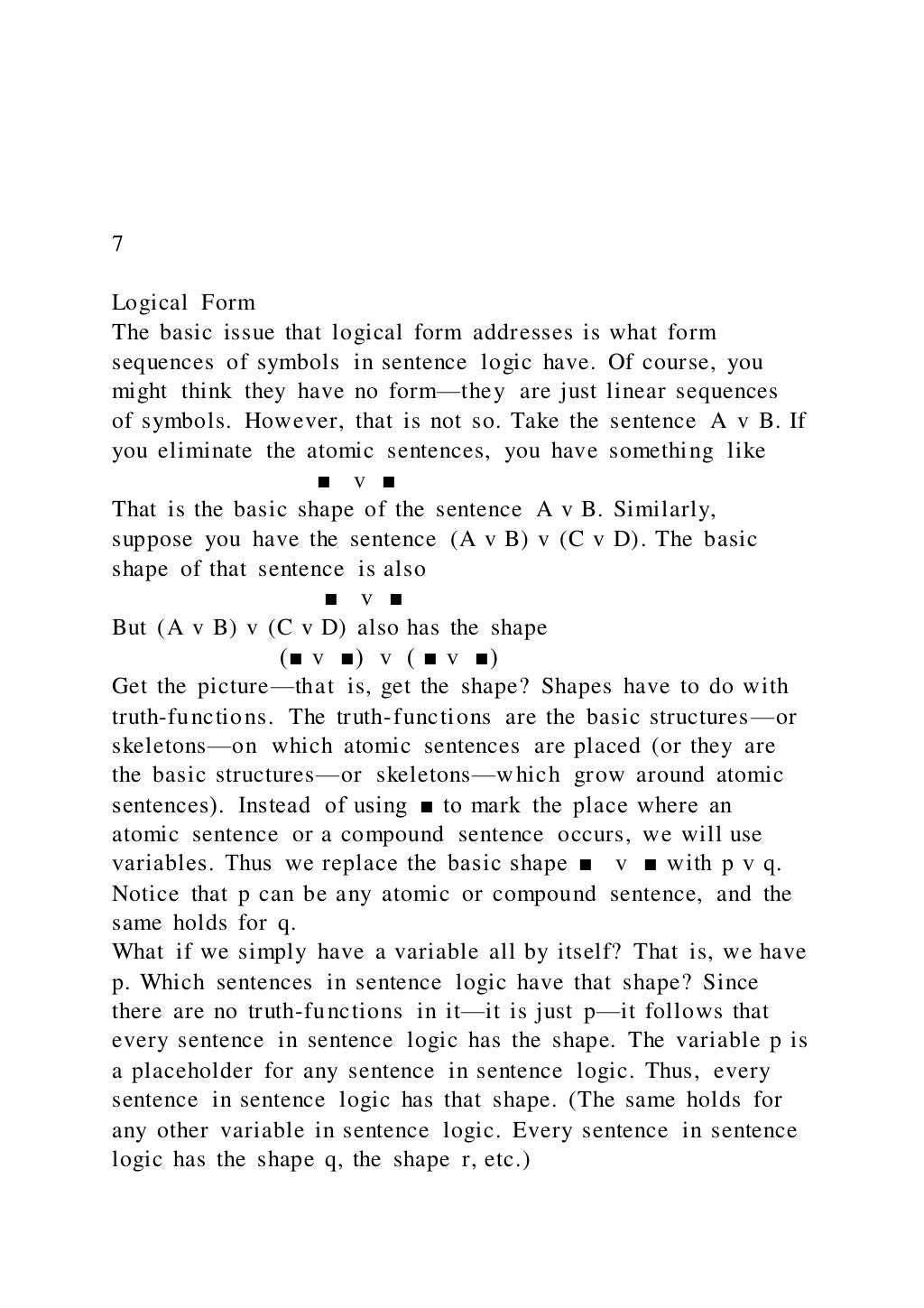
The basic issue that logical form addresses is what form
sequences of symbols in sentence logic have. Of course, you
might think they have no form—they are just linear sequences
of symbols. However, that is not so. Take the sentence A v B. If
you eliminate the atomic sentences, you have something like
■ v ■
That is the basic shape of the sentence A v B. Similarly,
suppose you have the sentence (A v B) v (C v D). The basic
shape of that sentence is also
■ v ■
But (A v B) v (C v D) also has the shape
(■ v ■) v ( ■ v ■)
Get the picture—that is, get the shape? Shapes have to do with
truth-functions. The truth-functions are the basic structures—or
skeletons—on which atomic sentences are placed (or they are
the basic structures—or skeletons—which grow around atomic
sentences). Instead of using ■ to mark the place where an
atomic sentence or a compound sentence occurs, we will use
variables. Thus we replace the basic shape ■ v ■ with p v q.
Notice that p can be any atomic or compound sentence, and the
same holds for q.
What if we simply have a variable all by itself? That is, we have
p. Which sentences in sentence logic have that shape? Since
there are no truth-functions in it—it is just p—it follows that
every sentence in sentence logic has the shape. The variable p is
a placeholder for any sentence in sentence logic. Thus, every
sentence in sentence logic has that shape. (The same holds for
any other variable in sentence logic. Every sentence in sentence
logic has the shape q, the shape r, etc.)
Shapes are described by a combination of sentential variables
and truth-functions. Actual sentences in sentence logic contain
only atomic sentences and/or truth-functions, and are not used
to describe shapes. The basic question we can raise about any
sentence in sentence logic is: what shape does it have?
However, there is a precise vocabulary in which we can raise
that question. Call a combination of sentential variables and
truth-functions a sentence form. For example, p v q is a
sentence form. p v q is not a sentence in sentence logic, but a
form that a sentence in sentence logic can have. If a sentence in
sentence logic has that form, then it is called a substitution
instance of that sentence form.
Thus, A v B is a substitution instance of the sentence form p v
q.
Another way of saying the same thing: the sentence in sentence
logic A v B has the logical form p v q. We can ask, of every
sentence in sentence logic, which sentence forms it is a
substitution instance of. If a sentence in sentence logic is a
substitution instance of some sentence form, then it has that
logical form. Sentences in sentence logic can have different
logical forms. Here is an example: A v B. This sentence in
sentence logic is a substitution instance of p and it is also a
substitution instance of p v q. So it has 2 logical forms. (It is
clearly a substitution instance of p, since any sentence in
sentence logic is a substitution instance of p.)
Shape and restrictions
Not every sentence in sentence logic has the shape p v q. Only
sentences whose truth-function of largest scope is the wedge
have that shape. Thus, p v q imposes a restriction on what
sentences have that shape. The sentence A • B does not have the
shape p v q, since the connective of largest scope is a dot, not a
wedge. You can think of sentence forms as analogous to the
dress code of a club you go to on the weekend. Some clubs
require that you wear certain items of clothing. If you are not
wearing those items, you cannot get into the club. p v q is a
club that imposes the restriction that you cannot get in unless
you are wearing a wedge. Moreover, you must be wearing it in
the right place. A v B is wearing it in the right place, and so can
enter the club. But (A v B) • (C v D) cannot get in, since,
although it has 2 wedges, neither are in the right place. In p v q,
the wedge is the truth-function of largest scope. But that is not
so in (A v B) • (C v D). The dot is the truth-function of largest
scope. Thus (A v B) • (C v D) does not have the shape (the
logical form) p v q. It is not a substitution instance of p v q.
Consider the following sentence forms: (i) p, (ii) ~p, (iii)
~~p. As you already know, every sentence in sentence logic is
a substitution instance of the first form. For the second form—
~p—only those sentences whose truth-function of largest scope
is the squiggle are substitution instances. For the third form—
~~p—only those sentences whose truth-function of largest scope
is the squiggle and whose truth-function of next largest scope is
the squiggle are substitution instances.
P has the following substitution instances (and others as well):
A, ~A, ~~A
~p has the following substitution instances (and others as well):
~A, ~~A. A is NOT a substitution instance, since it has no
squiggle.
~~p has the following substitution instances (and others as
well): ~~A. A is NOT a substitution instance (for the same
reason above), and ~A is NOT a substitution instance, since it
has only 1 squiggle.
Extra symbols in the sentences in sentence logic
~((A v B) (C • D)) is a substitution instance of ~p. Why?
Because the truth-function of largest scope in ~p is the
squiggle, and that is what the sentence form ~p has. ~p has only
one truth-function in it. Thus, any extra symbols in the sentence
in sentence logic that has the shape are irrelevant in deciding
whether it is a substitution instance of ~p.
A sentence in sentence logic can have more truth-functions and
atomic sentences than the sentence form that it is a substitution
instance of. However, if a sentence in sentence logic has fewer
truth-functions that a sentence form, then it CANNOT be a
substitution instance of that sentence form. To be a substitution
instance of a sentence form, a sentence in sentence logic must
have all of the truth-functions that the sentence form has, and
they must have the same scope sizes as the truth-functions in
the sentence form.
Deciding whether a sentence is a substitution instance of a
sentence form
This is very easy to do.
Step 1: Find the truth-function of largest scope in the sentence
form.
Step 2: Find the truth-function of largest scope in the sentence.
Step 3: Are they the same? If yes, continue. If NO, stop. The
sentence is NOT a substitution instance.
By ‘continue,’ I mean: do steps 1-3 again, this time for the
truth-function of next-largest scope. If you keep getting ‘yes,’
continue until you have found ALL of the truth-functions in the
sentence form. At that point, you have shown that the sentence
has all of the truth-functions, and of the same scope sizes, as
the sentence form. You probably think you are finished.
WRONG! There is one last thing you have to do, and it requires
knowing about repeated variables.
Repeated variables in sentence forms
The sentence form p v q is different from the sentence form p v
p. The latter has only one kind of variable in it, namely p. The
former has two kinds of variables in it, namely, p and q.
However, in p v p the variable p occurs 2 times. The second
occurrence is a repeat of the first occurrence. If your sentence
has repeated variables, then after you have shown that the
sentence has all of the truth-functions and of the right scope
sizes as the sentence form, you have to make sure that whatever
matches up with the first occurrence of the variable in the
sentence form, the same symbols match up with the second (or
any other) occurrence as well. Here is an example of what I’m
talking about.
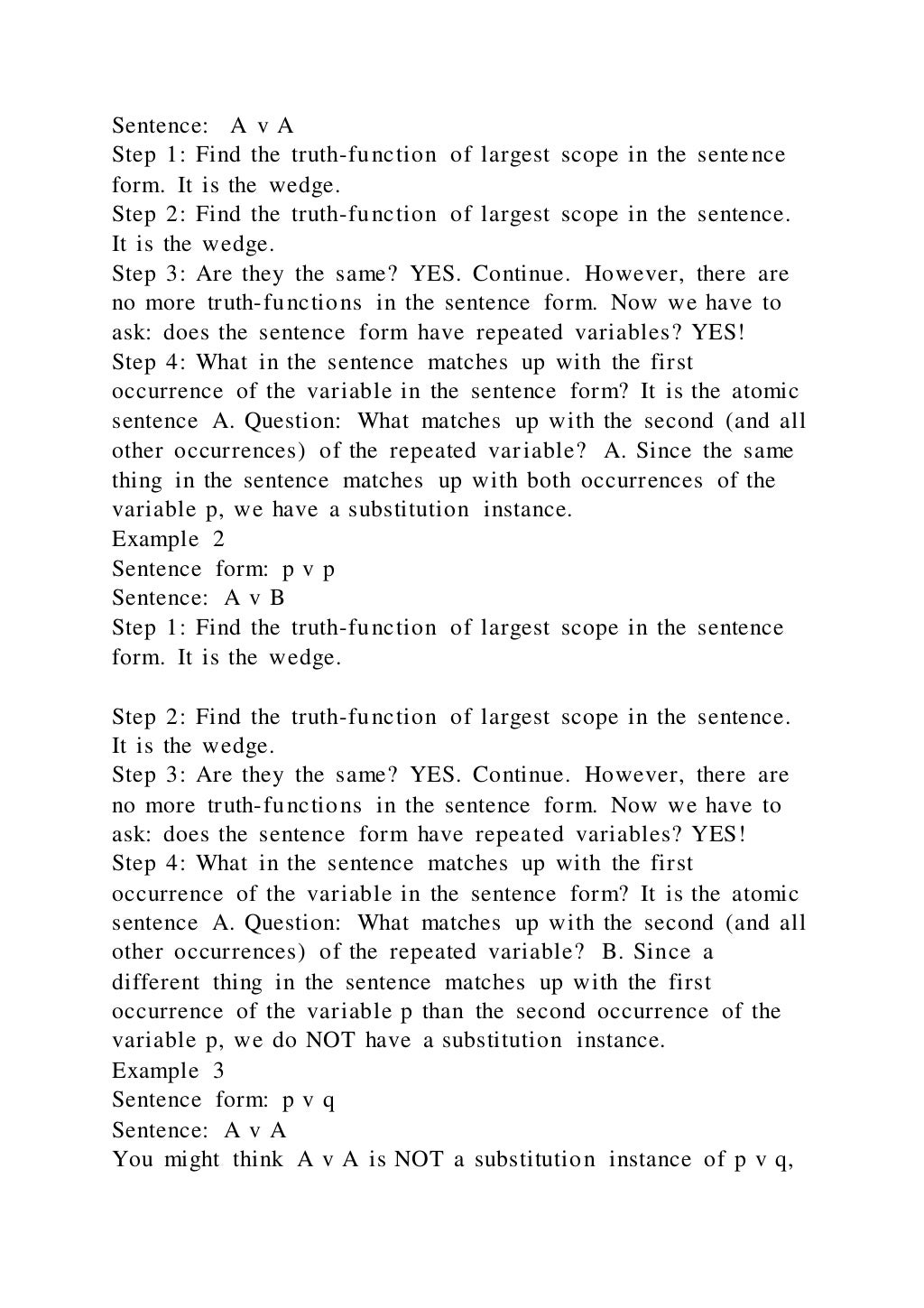
Example 1
Sentence form: p v p
Sentence: A v A
Step 1: Find the truth-function of largest scope in the sentence
form. It is the wedge.
Step 2: Find the truth-function of largest scope in the sentence.
It is the wedge.
Step 3: Are they the same? YES. Continue. However, there are
no more truth-functions in the sentence form. Now we have to
ask: does the sentence form have repeated variables? YES!
Step 4: What in the sentence matches up with the first
occurrence of the variable in the sentence form? It is the atomic
sentence A. Question: What matches up with the second (and all
other occurrences) of the repeated variable? A. Since the same
thing in the sentence matches up with both occurrences of the
variable p, we have a substitution instance.
Example 2
Sentence form: p v p
Sentence: A v B
Step 1: Find the truth-function of largest scope in the sentence
form. It is the wedge.
Step 2: Find the truth-function of largest scope in the sentence.
It is the wedge.
Step 3: Are they the same? YES. Continue. However, there are
no more truth-functions in the sentence form. Now we have to
ask: does the sentence form have repeated variables? YES!
Step 4: What in the sentence matches up with the first
occurrence of the variable in the sentence form? It is the atomic
sentence A. Question: What matches up with the second (and all
other occurrences) of the repeated variable? B. Since a
different thing in the sentence matches up with the first
occurrence of the variable p than the second occurrence of the
variable p, we do NOT have a substitution instance.
Example 3
Sentence form: p v q
Sentence: A v A
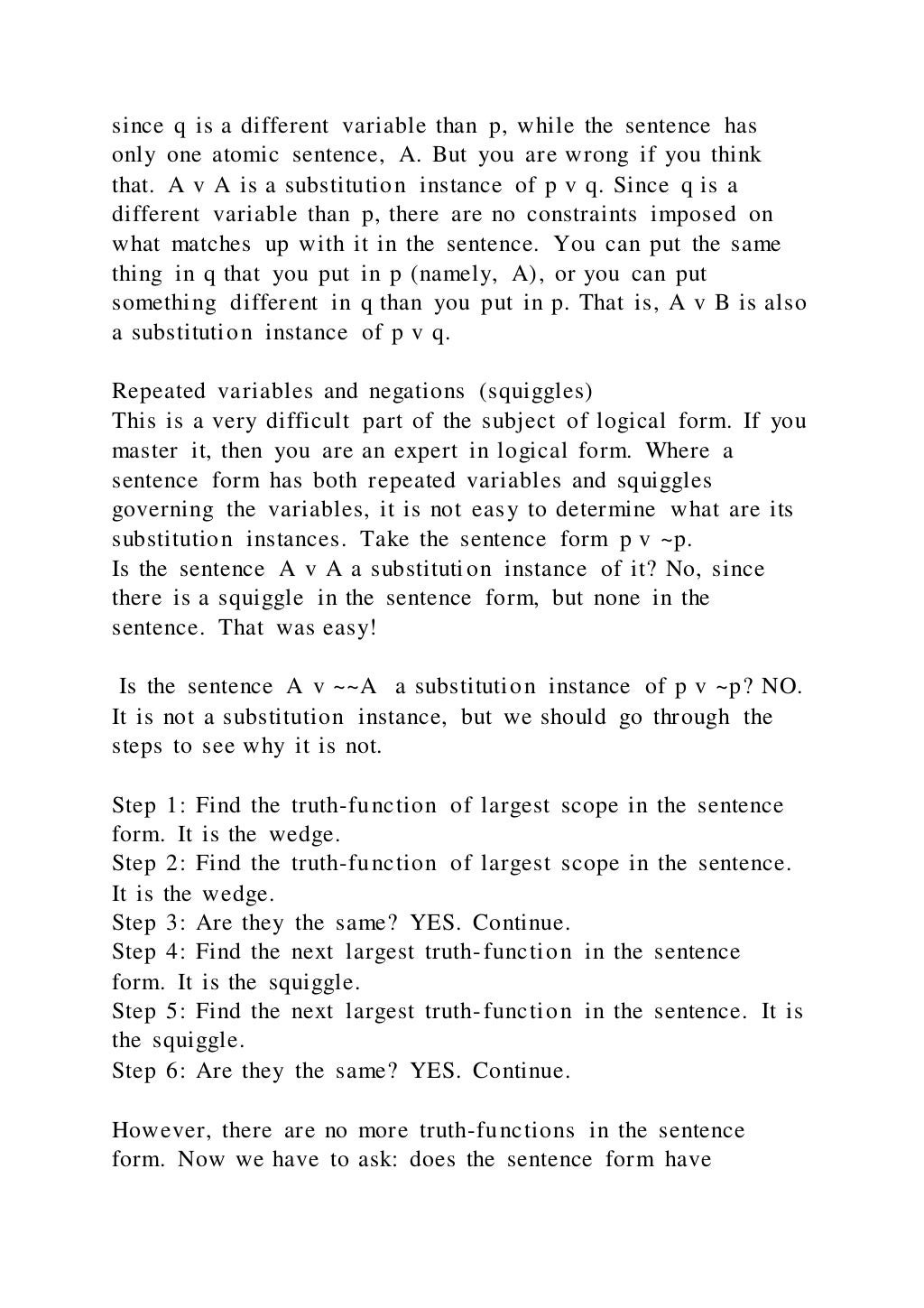
You might think A v A is NOT a substitution instance of p v q,
since q is a different variable than p, while the sentence has
only one atomic sentence, A. But you are wrong if you think
that. A v A is a substitution instance of p v q. Since q is a
different variable than p, there are no constraints imposed on
what matches up with it in the sentence. You can put the same
thing in q that you put in p (namely, A), or you can put
something different in q than you put in p. That is, A v B is also
a substitution instance of p v q.
Repeated variables and negations (squiggles)
This is a very difficult part of the subject of logical form. If you
master it, then you are an expert in logical form. Where a
sentence form has both repeated variables and squiggles
governing the variables, it is not easy to determine what are its
substitution instances. Take the sentence form p v ~p.
Is the sentence A v A a substitution instance of it? No, since
there is a squiggle in the sentence form, but none in the
sentence. That was easy!
Is the sentence A v ~~A a substitution instance of p v ~p? NO.
It is not a substitution instance, but we should go through the
steps to see why it is not.
Step 1: Find the truth-function of largest scope in the sentence
form. It is the wedge.
Step 2: Find the truth-function of largest scope in the sentence.
It is the wedge.
Step 3: Are they the same? YES. Continue.
Step 4: Find the next largest truth-function in the sentence
form. It is the squiggle.
Step 5: Find the next largest truth-function in the sentence. It is
the squiggle.
Step 6: Are they the same? YES. Continue.
However, there are no more truth-functions in the sentence
form. Now we have to ask: does the sentence form have
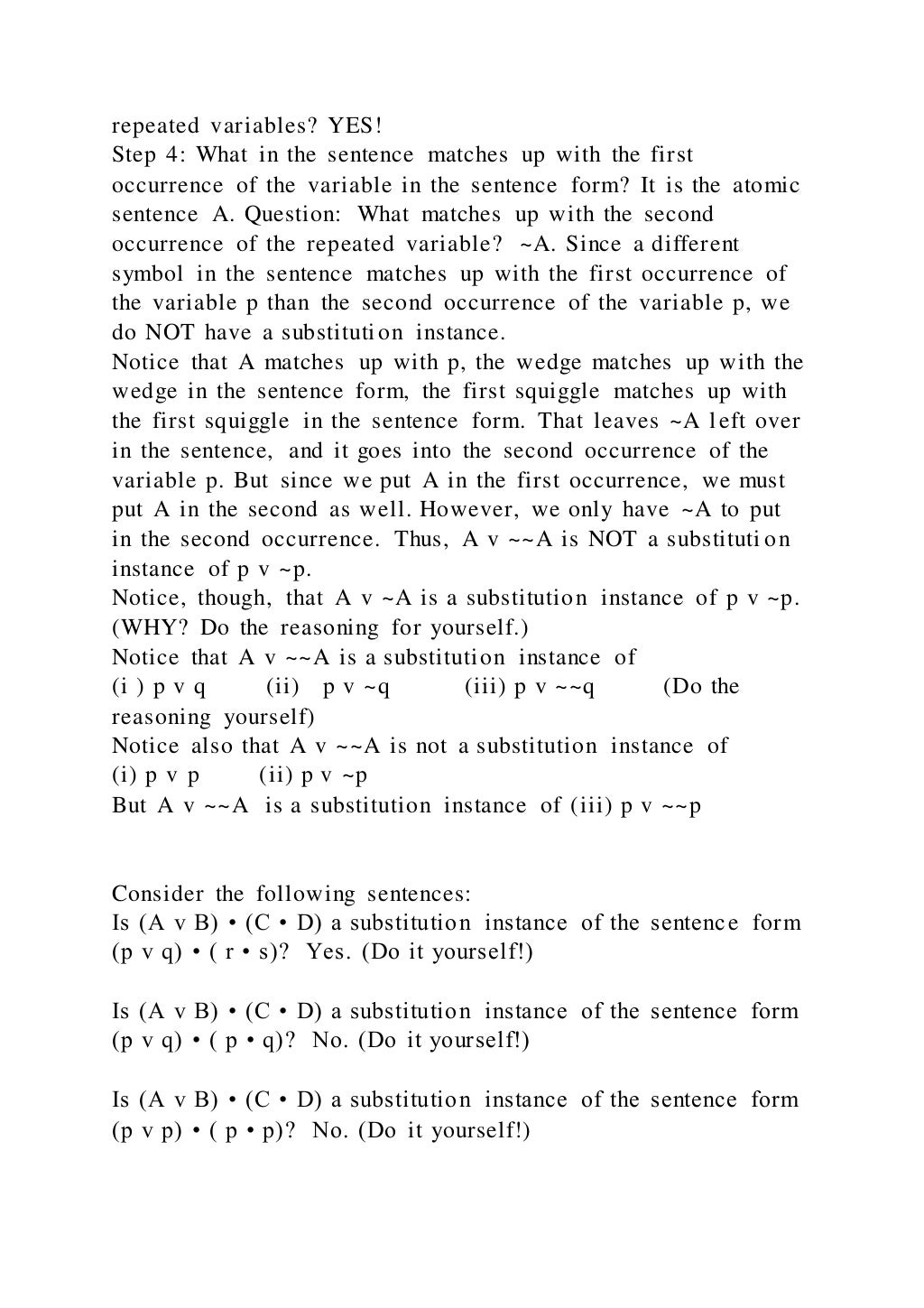
repeated variables? YES!
Step 4: What in the sentence matches up with the first
occurrence of the variable in the sentence form? It is the atomic
sentence A. Question: What matches up with the second
occurrence of the repeated variable? ~A. Since a different
symbol in the sentence matches up with the first occurrence of
the variable p than the second occurrence of the variable p, we
do NOT have a substitution instance.
Notice that A matches up with p, the wedge matches up with the
wedge in the sentence form, the first squiggle matches up with
the first squiggle in the sentence form. That leaves ~A l eft over
in the sentence, and it goes into the second occurrence of the
variable p. But since we put A in the first occurrence, we must
put A in the second as well. However, we only have ~A to put
in the second occurrence. Thus, A v ~~A is NOT a substituti on
instance of p v ~p.
Notice, though, that A v ~A is a substitution instance of p v ~p.
(WHY? Do the reasoning for yourself.)
Notice that A v ~~A is a substitution instance of
(i ) p v q (ii) p v ~q (iii) p v ~~q (Do the
reasoning yourself)
Notice also that A v ~~A is not a substitution instance of
(i) p v p (ii) p v ~p
But A v ~~A is a substitution instance of (iii) p v ~~p
Consider the following sentences:
Is (A v B) • (C • D) a substitution instance of the sentence form
(p v q) • ( r • s)? Yes. (Do it yourself!)
Is (A v B) • (C • D) a substitution instance of the sentence form
(p v q) • ( p • q)? No. (Do it yourself!)
Is (A v B) • (C • D) a substitution instance of the sentence form
(p v p) • ( p • p)? No. (Do it yourself!)
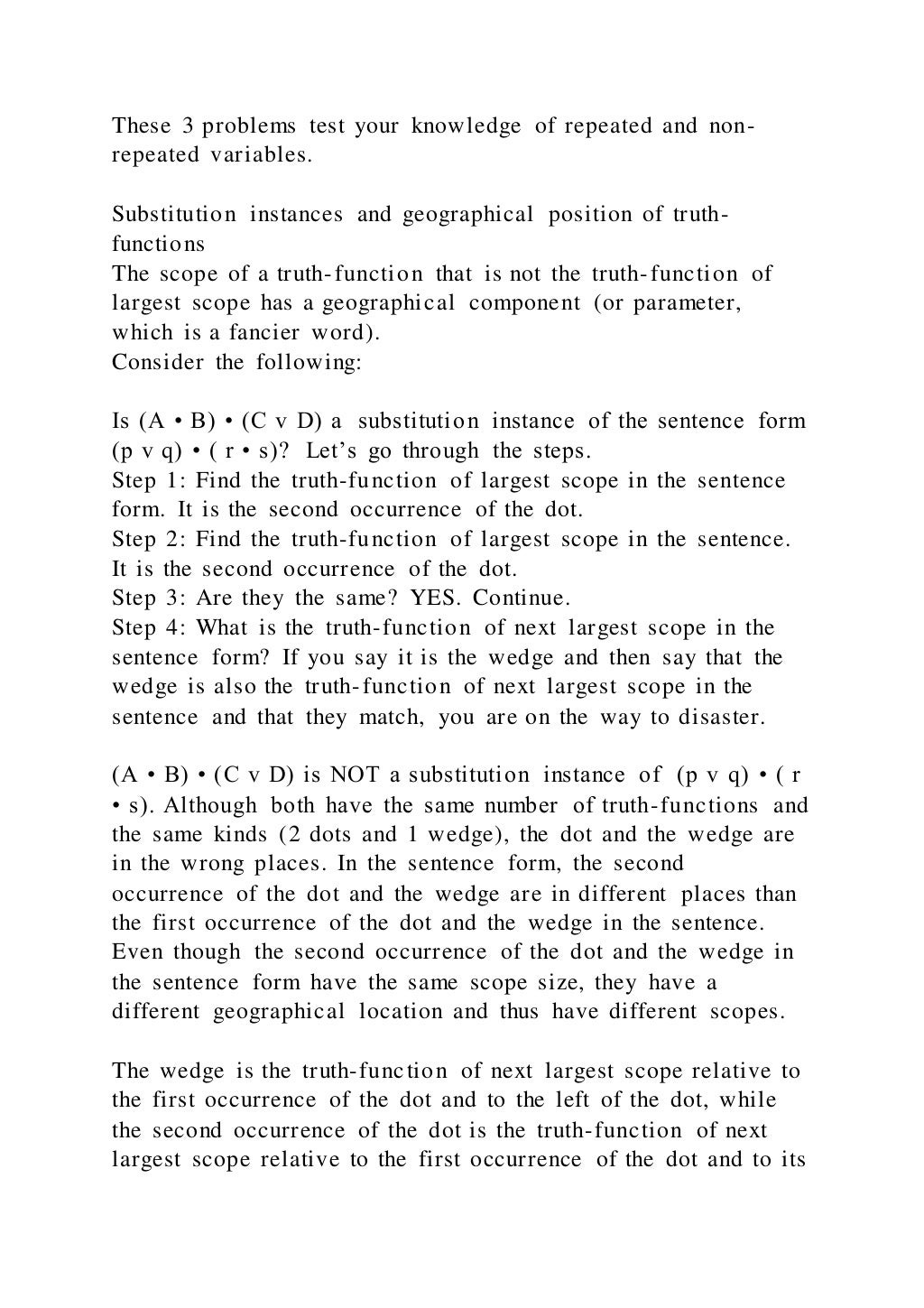
These 3 problems test your knowledge of repeated and non-
repeated variables.
Substitution instances and geographical position of truth-
functions
The scope of a truth-function that is not the truth-function of
largest scope has a geographical component (or parameter,
which is a fancier word).
Consider the following:
Is (A • B) • (C v D) a substitution instance of the sentence form
(p v q) • ( r • s)? Let’s go through the steps.
Step 1: Find the truth-function of largest scope in the sentence
form. It is the second occurrence of the dot.
Step 2: Find the truth-function of largest scope in the sentence.
It is the second occurrence of the dot.
Step 3: Are they the same? YES. Continue.
Step 4: What is the truth-function of next largest scope in the
sentence form? If you say it is the wedge and then say that the
wedge is also the truth-function of next largest scope in the
sentence and that they match, you are on the way to disaster.
(A • B) • (C v D) is NOT a substitution instance of (p v q) • ( r
• s). Although both have the same number of truth-functions and
the same kinds (2 dots and 1 wedge), the dot and the wedge are
in the wrong places. In the sentence form, the second
occurrence of the dot and the wedge are in different places than
the first occurrence of the dot and the wedge in the sentence.
Even though the second occurrence of the dot and the wedge in
the sentence form have the same scope size, they have a
different geographical location and thus have different scopes.
The wedge is the truth-function of next largest scope relative to
the first occurrence of the dot and to the left of the dot, while
the second occurrence of the dot is the truth-function of next
largest scope relative to the first occurrence of the dot and to its
right. However, in the sentence, the first occurrence of the dot
is to the LEFT of the truth-function of largest scope and the
wedge is to the RIGHT of the truth-function of largest scope.
That is why
(A • B) • (C v D)
is NOT a substitution instance of
(p v q) • ( r • s).
FOR THE QUIZ, JUST WRITE THE SENTENCE FORMS FOR
WHICH THE TWO SENTENCES BELOW ARE A
SUBSTITUTION INSTANCE. You don't have to write out the
sentence form--just the letter which precedes it.
USE THE FOLLOWING SENTENCES. (DO NOT USE ANY OF
THE NUMBERED SENTENCES IN EXERCISE 3-4.) RUN
EACH OF THE TWO SENTENCES BELOW THROUGH ALL
OF THE SENTENCE FORMS ON THE RHS OF EXERCISE 3-
4. LIST THE LETTERS FOR WHICH EACH OF THE TWO
SENTENCES BELOW IS A SUBSTITUTION-INSTANCE. (--->
means 'if ... then ...' It is the horseshoe. * means 'and.'
It is the dot.
1. ~ ~ [ ( A v ~A) v ~ ~ B]
2. ~ ~A --> ~ (~ B --> C)
Answer Choices
a. p
b. �p
c. p∨ q
d. p�q e. �p∨ q
f. �p�q
g. �p��q h. �(p∨ q)
i. �(p�q)
j. �(�p�q) k. (p∨ q)�r l. p∨ (q�r)
m. (�p∨ q)�r n. �(p∨ q)�r o. (p∨ q)��r p. �[p∨ (q�r)] q.
�[(p∨ q)�r]

7Logical FormThe basic issue that logical form addresses

  • 1.
    7 Logical Form The basicissue that logical form addresses is what form sequences of symbols in sentence logic have. Of course, you might think they have no form—they are just linear sequences of symbols. However, that is not so. Take the sentence A v B. If you eliminate the atomic sentences, you have something like ■ v ■ That is the basic shape of the sentence A v B. Similarly, suppose you have the sentence (A v B) v (C v D). The basic shape of that sentence is also ■ v ■ But (A v B) v (C v D) also has the shape (■ v ■) v ( ■ v ■) Get the picture—that is, get the shape? Shapes have to do with truth-functions. The truth-functions are the basic structures—or skeletons—on which atomic sentences are placed (or they are the basic structures—or skeletons—which grow around atomic sentences). Instead of using ■ to mark the place where an atomic sentence or a compound sentence occurs, we will use variables. Thus we replace the basic shape ■ v ■ with p v q. Notice that p can be any atomic or compound sentence, and the same holds for q. What if we simply have a variable all by itself? That is, we have p. Which sentences in sentence logic have that shape? Since there are no truth-functions in it—it is just p—it follows that every sentence in sentence logic has the shape. The variable p is a placeholder for any sentence in sentence logic. Thus, every sentence in sentence logic has that shape. (The same holds for any other variable in sentence logic. Every sentence in sentence logic has the shape q, the shape r, etc.)
  • 2.
    Shapes are describedby a combination of sentential variables and truth-functions. Actual sentences in sentence logic contain only atomic sentences and/or truth-functions, and are not used to describe shapes. The basic question we can raise about any sentence in sentence logic is: what shape does it have? However, there is a precise vocabulary in which we can raise that question. Call a combination of sentential variables and truth-functions a sentence form. For example, p v q is a sentence form. p v q is not a sentence in sentence logic, but a form that a sentence in sentence logic can have. If a sentence in sentence logic has that form, then it is called a substitution instance of that sentence form. Thus, A v B is a substitution instance of the sentence form p v q. Another way of saying the same thing: the sentence in sentence logic A v B has the logical form p v q. We can ask, of every sentence in sentence logic, which sentence forms it is a substitution instance of. If a sentence in sentence logic is a substitution instance of some sentence form, then it has that logical form. Sentences in sentence logic can have different logical forms. Here is an example: A v B. This sentence in sentence logic is a substitution instance of p and it is also a substitution instance of p v q. So it has 2 logical forms. (It is clearly a substitution instance of p, since any sentence in sentence logic is a substitution instance of p.) Shape and restrictions Not every sentence in sentence logic has the shape p v q. Only sentences whose truth-function of largest scope is the wedge have that shape. Thus, p v q imposes a restriction on what sentences have that shape. The sentence A • B does not have the shape p v q, since the connective of largest scope is a dot, not a wedge. You can think of sentence forms as analogous to the dress code of a club you go to on the weekend. Some clubs require that you wear certain items of clothing. If you are not wearing those items, you cannot get into the club. p v q is a club that imposes the restriction that you cannot get in unless
  • 3.
    you are wearinga wedge. Moreover, you must be wearing it in the right place. A v B is wearing it in the right place, and so can enter the club. But (A v B) • (C v D) cannot get in, since, although it has 2 wedges, neither are in the right place. In p v q, the wedge is the truth-function of largest scope. But that is not so in (A v B) • (C v D). The dot is the truth-function of largest scope. Thus (A v B) • (C v D) does not have the shape (the logical form) p v q. It is not a substitution instance of p v q. Consider the following sentence forms: (i) p, (ii) ~p, (iii) ~~p. As you already know, every sentence in sentence logic is a substitution instance of the first form. For the second form— ~p—only those sentences whose truth-function of largest scope is the squiggle are substitution instances. For the third form— ~~p—only those sentences whose truth-function of largest scope is the squiggle and whose truth-function of next largest scope is the squiggle are substitution instances. P has the following substitution instances (and others as well): A, ~A, ~~A ~p has the following substitution instances (and others as well): ~A, ~~A. A is NOT a substitution instance, since it has no squiggle. ~~p has the following substitution instances (and others as well): ~~A. A is NOT a substitution instance (for the same reason above), and ~A is NOT a substitution instance, since it has only 1 squiggle. Extra symbols in the sentences in sentence logic ~((A v B) (C • D)) is a substitution instance of ~p. Why? Because the truth-function of largest scope in ~p is the squiggle, and that is what the sentence form ~p has. ~p has only one truth-function in it. Thus, any extra symbols in the sentence in sentence logic that has the shape are irrelevant in deciding whether it is a substitution instance of ~p. A sentence in sentence logic can have more truth-functions and atomic sentences than the sentence form that it is a substitution instance of. However, if a sentence in sentence logic has fewer truth-functions that a sentence form, then it CANNOT be a
  • 4.
    substitution instance ofthat sentence form. To be a substitution instance of a sentence form, a sentence in sentence logic must have all of the truth-functions that the sentence form has, and they must have the same scope sizes as the truth-functions in the sentence form. Deciding whether a sentence is a substitution instance of a sentence form This is very easy to do. Step 1: Find the truth-function of largest scope in the sentence form. Step 2: Find the truth-function of largest scope in the sentence. Step 3: Are they the same? If yes, continue. If NO, stop. The sentence is NOT a substitution instance. By ‘continue,’ I mean: do steps 1-3 again, this time for the truth-function of next-largest scope. If you keep getting ‘yes,’ continue until you have found ALL of the truth-functions in the sentence form. At that point, you have shown that the sentence has all of the truth-functions, and of the same scope sizes, as the sentence form. You probably think you are finished. WRONG! There is one last thing you have to do, and it requires knowing about repeated variables. Repeated variables in sentence forms The sentence form p v q is different from the sentence form p v p. The latter has only one kind of variable in it, namely p. The former has two kinds of variables in it, namely, p and q. However, in p v p the variable p occurs 2 times. The second occurrence is a repeat of the first occurrence. If your sentence has repeated variables, then after you have shown that the sentence has all of the truth-functions and of the right scope sizes as the sentence form, you have to make sure that whatever matches up with the first occurrence of the variable in the sentence form, the same symbols match up with the second (or any other) occurrence as well. Here is an example of what I’m talking about. Example 1 Sentence form: p v p
  • 5.
    Sentence: A vA Step 1: Find the truth-function of largest scope in the sentence form. It is the wedge. Step 2: Find the truth-function of largest scope in the sentence. It is the wedge. Step 3: Are they the same? YES. Continue. However, there are no more truth-functions in the sentence form. Now we have to ask: does the sentence form have repeated variables? YES! Step 4: What in the sentence matches up with the first occurrence of the variable in the sentence form? It is the atomic sentence A. Question: What matches up with the second (and all other occurrences) of the repeated variable? A. Since the same thing in the sentence matches up with both occurrences of the variable p, we have a substitution instance. Example 2 Sentence form: p v p Sentence: A v B Step 1: Find the truth-function of largest scope in the sentence form. It is the wedge. Step 2: Find the truth-function of largest scope in the sentence. It is the wedge. Step 3: Are they the same? YES. Continue. However, there are no more truth-functions in the sentence form. Now we have to ask: does the sentence form have repeated variables? YES! Step 4: What in the sentence matches up with the first occurrence of the variable in the sentence form? It is the atomic sentence A. Question: What matches up with the second (and all other occurrences) of the repeated variable? B. Since a different thing in the sentence matches up with the first occurrence of the variable p than the second occurrence of the variable p, we do NOT have a substitution instance. Example 3 Sentence form: p v q Sentence: A v A You might think A v A is NOT a substitution instance of p v q,
  • 6.
    since q isa different variable than p, while the sentence has only one atomic sentence, A. But you are wrong if you think that. A v A is a substitution instance of p v q. Since q is a different variable than p, there are no constraints imposed on what matches up with it in the sentence. You can put the same thing in q that you put in p (namely, A), or you can put something different in q than you put in p. That is, A v B is also a substitution instance of p v q. Repeated variables and negations (squiggles) This is a very difficult part of the subject of logical form. If you master it, then you are an expert in logical form. Where a sentence form has both repeated variables and squiggles governing the variables, it is not easy to determine what are its substitution instances. Take the sentence form p v ~p. Is the sentence A v A a substitution instance of it? No, since there is a squiggle in the sentence form, but none in the sentence. That was easy! Is the sentence A v ~~A a substitution instance of p v ~p? NO. It is not a substitution instance, but we should go through the steps to see why it is not. Step 1: Find the truth-function of largest scope in the sentence form. It is the wedge. Step 2: Find the truth-function of largest scope in the sentence. It is the wedge. Step 3: Are they the same? YES. Continue. Step 4: Find the next largest truth-function in the sentence form. It is the squiggle. Step 5: Find the next largest truth-function in the sentence. It is the squiggle. Step 6: Are they the same? YES. Continue. However, there are no more truth-functions in the sentence form. Now we have to ask: does the sentence form have
  • 7.
    repeated variables? YES! Step4: What in the sentence matches up with the first occurrence of the variable in the sentence form? It is the atomic sentence A. Question: What matches up with the second occurrence of the repeated variable? ~A. Since a different symbol in the sentence matches up with the first occurrence of the variable p than the second occurrence of the variable p, we do NOT have a substitution instance. Notice that A matches up with p, the wedge matches up with the wedge in the sentence form, the first squiggle matches up with the first squiggle in the sentence form. That leaves ~A l eft over in the sentence, and it goes into the second occurrence of the variable p. But since we put A in the first occurrence, we must put A in the second as well. However, we only have ~A to put in the second occurrence. Thus, A v ~~A is NOT a substituti on instance of p v ~p. Notice, though, that A v ~A is a substitution instance of p v ~p. (WHY? Do the reasoning for yourself.) Notice that A v ~~A is a substitution instance of (i ) p v q (ii) p v ~q (iii) p v ~~q (Do the reasoning yourself) Notice also that A v ~~A is not a substitution instance of (i) p v p (ii) p v ~p But A v ~~A is a substitution instance of (iii) p v ~~p Consider the following sentences: Is (A v B) • (C • D) a substitution instance of the sentence form (p v q) • ( r • s)? Yes. (Do it yourself!) Is (A v B) • (C • D) a substitution instance of the sentence form (p v q) • ( p • q)? No. (Do it yourself!) Is (A v B) • (C • D) a substitution instance of the sentence form (p v p) • ( p • p)? No. (Do it yourself!)
  • 8.
    These 3 problemstest your knowledge of repeated and non- repeated variables. Substitution instances and geographical position of truth- functions The scope of a truth-function that is not the truth-function of largest scope has a geographical component (or parameter, which is a fancier word). Consider the following: Is (A • B) • (C v D) a substitution instance of the sentence form (p v q) • ( r • s)? Let’s go through the steps. Step 1: Find the truth-function of largest scope in the sentence form. It is the second occurrence of the dot. Step 2: Find the truth-function of largest scope in the sentence. It is the second occurrence of the dot. Step 3: Are they the same? YES. Continue. Step 4: What is the truth-function of next largest scope in the sentence form? If you say it is the wedge and then say that the wedge is also the truth-function of next largest scope in the sentence and that they match, you are on the way to disaster. (A • B) • (C v D) is NOT a substitution instance of (p v q) • ( r • s). Although both have the same number of truth-functions and the same kinds (2 dots and 1 wedge), the dot and the wedge are in the wrong places. In the sentence form, the second occurrence of the dot and the wedge are in different places than the first occurrence of the dot and the wedge in the sentence. Even though the second occurrence of the dot and the wedge in the sentence form have the same scope size, they have a different geographical location and thus have different scopes. The wedge is the truth-function of next largest scope relative to the first occurrence of the dot and to the left of the dot, while the second occurrence of the dot is the truth-function of next largest scope relative to the first occurrence of the dot and to its
  • 9.
    right. However, inthe sentence, the first occurrence of the dot is to the LEFT of the truth-function of largest scope and the wedge is to the RIGHT of the truth-function of largest scope. That is why (A • B) • (C v D) is NOT a substitution instance of (p v q) • ( r • s). FOR THE QUIZ, JUST WRITE THE SENTENCE FORMS FOR WHICH THE TWO SENTENCES BELOW ARE A SUBSTITUTION INSTANCE. You don't have to write out the sentence form--just the letter which precedes it. USE THE FOLLOWING SENTENCES. (DO NOT USE ANY OF THE NUMBERED SENTENCES IN EXERCISE 3-4.) RUN EACH OF THE TWO SENTENCES BELOW THROUGH ALL OF THE SENTENCE FORMS ON THE RHS OF EXERCISE 3- 4. LIST THE LETTERS FOR WHICH EACH OF THE TWO SENTENCES BELOW IS A SUBSTITUTION-INSTANCE. (---> means 'if ... then ...' It is the horseshoe. * means 'and.' It is the dot. 1. ~ ~ [ ( A v ~A) v ~ ~ B] 2. ~ ~A --> ~ (~ B --> C) Answer Choices a. p b. �p
  • 10.
    c. p∨ q d.p�q e. �p∨ q f. �p�q g. �p��q h. �(p∨ q) i. �(p�q) j. �(�p�q) k. (p∨ q)�r l. p∨ (q�r) m. (�p∨ q)�r n. �(p∨ q)�r o. (p∨ q)��r p. �[p∨ (q�r)] q. �[(p∨ q)�r]