7 Common Challenges While
Using Assessment Tools
1
2
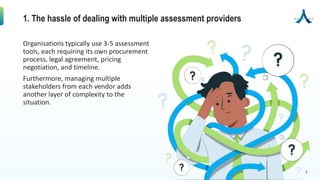
1. The hassle of dealing with multiple assessment providers
Organisations typically use 3-5 assessment
tools, each requiring its own procurement
process, legal agreement, pricing
negotiation, and timeline.
Furthermore, managing multiple
stakeholders from each vendor adds
another layer of complexity to the
situation.
3
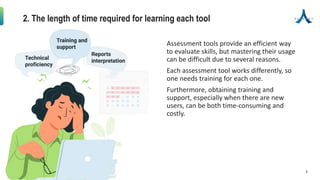
2. The length of time required for learning each tool
Assessment tools provide an efficient way
to evaluate skills, but mastering their usage
can be difficult due to several reasons.
Each assessment tool works differently, so
one needs training for each one.
Furthermore, obtaining training and
support, especially when there are new
users, can be both time-consuming and
costly.
4
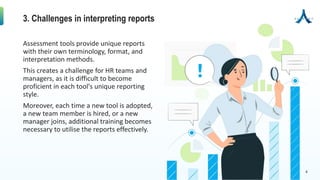
3. Challenges in interpreting reports
Assessment tools provide unique reports
with their own terminology, format, and
interpretation methods.
This creates a challenge for HR teams and
managers, as it is difficult to become
proficient in each tool's unique reporting
style.
Moreover, each time a new tool is adopted,
a new team member is hired, or a new
manager joins, additional training becomes
necessary to utilise the reports effectively.
5
4. Consolidating assessment data
Consolidating assessment scores from
multiple tools (as psychometric + cognitive
+ face to face interview) is essential for
hiring managers to make informed
decisions.
However, the process can be complex,
because HR needs to manually combine
data from each source, where everything is
different - document formats, scales,
headers, details, etc.
6
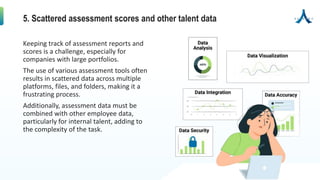
5. Scattered assessment scores and other talent data
Keeping track of assessment reports and
scores is a challenge, especially for
companies with large portfolios.
The use of various assessment tools often
results in scattered data across multiple
platforms, files, and folders, making it a
frustrating process.
Additionally, assessment data must be
combined with other employee data,
particularly for internal talent, adding to
the complexity of the task.
7
6. Building a positive candidate experience
Ensuring a smooth candidate experience is
essential when utilising assessment tools.
However, in many situations, the process
can have a negative impact on the
candidate. Assessments can sometimes be
an intimidating process.
Moreover, lengthy, or repetitive
procedures, unclear instructions, or
ambiguous evaluation criteria can lead to
candidate frustration.
8
7. Speed of rolling out assessment tools
Proper training is necessary for rolling out
each assessment tool. Without proper
training, the assessment process can lead
to inaccurate results, user frustration and
delays.
HR teams often must devote considerable
time to the assessment process, thereby
slowing down the overall hiring timeline.
# amazeever yone
# amazeever yone
# amazeever yone
To overcome these common challenges, visit our
Assessment Marketplace today!
9

7 Common Challenges While Using Assessment Tools

  • 1.
    7 Common ChallengesWhile Using Assessment Tools 1
  • 2.
    2 1. The hassleof dealing with multiple assessment providers Organisations typically use 3-5 assessment tools, each requiring its own procurement process, legal agreement, pricing negotiation, and timeline. Furthermore, managing multiple stakeholders from each vendor adds another layer of complexity to the situation.
  • 3.
    3 2. The lengthof time required for learning each tool Assessment tools provide an efficient way to evaluate skills, but mastering their usage can be difficult due to several reasons. Each assessment tool works differently, so one needs training for each one. Furthermore, obtaining training and support, especially when there are new users, can be both time-consuming and costly.
  • 4.
    4 3. Challenges ininterpreting reports Assessment tools provide unique reports with their own terminology, format, and interpretation methods. This creates a challenge for HR teams and managers, as it is difficult to become proficient in each tool's unique reporting style. Moreover, each time a new tool is adopted, a new team member is hired, or a new manager joins, additional training becomes necessary to utilise the reports effectively.
  • 5.
    5 4. Consolidating assessmentdata Consolidating assessment scores from multiple tools (as psychometric + cognitive + face to face interview) is essential for hiring managers to make informed decisions. However, the process can be complex, because HR needs to manually combine data from each source, where everything is different - document formats, scales, headers, details, etc.
  • 6.
    6 5. Scattered assessmentscores and other talent data Keeping track of assessment reports and scores is a challenge, especially for companies with large portfolios. The use of various assessment tools often results in scattered data across multiple platforms, files, and folders, making it a frustrating process. Additionally, assessment data must be combined with other employee data, particularly for internal talent, adding to the complexity of the task.
  • 7.
    7 6. Building apositive candidate experience Ensuring a smooth candidate experience is essential when utilising assessment tools. However, in many situations, the process can have a negative impact on the candidate. Assessments can sometimes be an intimidating process. Moreover, lengthy, or repetitive procedures, unclear instructions, or ambiguous evaluation criteria can lead to candidate frustration.
  • 8.
    8 7. Speed ofrolling out assessment tools Proper training is necessary for rolling out each assessment tool. Without proper training, the assessment process can lead to inaccurate results, user frustration and delays. HR teams often must devote considerable time to the assessment process, thereby slowing down the overall hiring timeline.
  • 9.
    # amazeever yone #amazeever yone # amazeever yone To overcome these common challenges, visit our Assessment Marketplace today! 9