
Architectures/Los Angeles MPPA-DL 452 Session 7
Course Themes Dynamics:  Globalization, Urbanization Circuits:  Transnationals, Diasporas Centers:  Agglomeration, Sprawl Margins:  New Inequalities Ecologies:  Sustainability Architectures:  A Sense of Place Crises:  Globalization in Reverse Frontiers:  Looking Ahead
A Sense of Place Two trends: Increasing privatization of space Building as spectacle Contested space / Exclusion Increasing mediation of experience City of shopping Global media city / Invasion
Building as spectacle Contested space City of shopping Global media city Urbanism
In societies dominated by modern conditions of production, life is presented as an immense accumulation of  spectacles.  Everything that was directly lived has receded into a representation.  The spectacle…is not a mere decoration added to the real world. It is the very heart of this real society’s unreality. In all of its particular manifestations — news, propaganda, advertising, entertainment — the spectacle represents the dominant  model  of life. (…) In both form and content the spectacle serves as a total justification of the conditions and goals of the existing system. The spectacle also represents the  constant presence  of this justification since it monopolizes the majority of the time spent outside the production process.” Guy Debord,  The Society of the Spectacle  (1967)
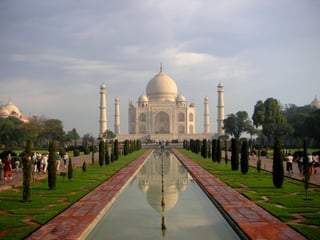
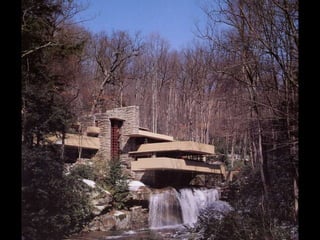
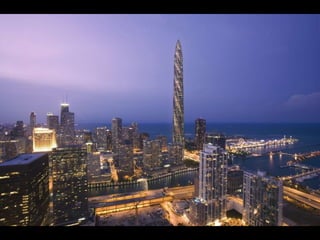
Individual buildings and whole building complexes are being used increasingly as a means of establishing a city on the map of world locations and destinations… The  trophy building  usually results from hiring a world-renowned architect as a certain guarantee to get recognition on a world scale… ( Mega-events ) serve as impetuses and legitimizing forces in the structural and physical redevelopment schemes of major parts of cities and their regions… Large-scale projects …play a dominant role in image production of cities not only because of their sheer size but also because of the impact they have on the urban, and therefore social, fabric. Ute Lehrer, “Willing the Global City: Berlin,” in  The Global Cities Reader , p. 334
 
 
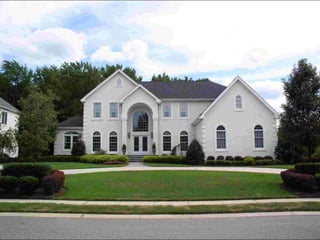
“ Conspicuous consumption claims a relatively larger portion of the income of the urban than of the rural population, and the claim is also more imperative.  “… in the struggle to outdo one another the city population push their normal standard of conspicuous consumption to a higher point, with the result that a relatively greater expenditure in this direction is required to indicate a given degree of pecuniary decency in the city. The requirement of conformity to this higher conventional standard becomes mandatory. The standard of decency is higher, class for class, and this requirement of decent appearance must be lived up to on pain of losing caste.” Thorstein Veblen,  The Theory of the Leisure Class: An Economic Study of Institutions  (New York: Macmillan, 1902)
 
Building as spectacle Contested space City of shopping Global media city Urbanism
 
In its internal spatial structure, the world city may be divided into the “citadel” and the “ghetto”.  Its geography is typically one of inequality and class domination.  The citadel serves the specific needs of the transnational elites and their immediate retinues who rule the city’s economic life, the ghetto is adapted to the circumstances of the permanent underclass. With its towers of steel and glass and its fanciful shopping malls, the Citadel is the city’s most vulnerable symbol.  Its smooth surfaces suggest the sleek impersonality of money power.  Its interior spaces are ample, elegant, and plush.  In appropriately secluded spaces, the transnational elites have built their residences and playgrounds:  country clubs and bridle paths and private beaches. John Friedmann and Goetz Wolff, “World City Formation,” in  The Global Cities Reader , p. 64
“ Creative people…don’t just cluster where the jobs are.  They cluster in places that are centers of creativity and also where they like to live.” Richard Florida, The Rise of the Creative Class (2002)
 
Building as spectacle Contested space City of shopping Global media city Urbanism
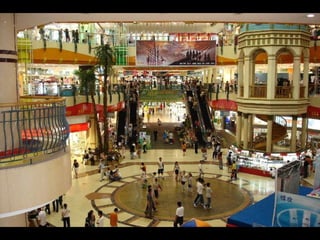
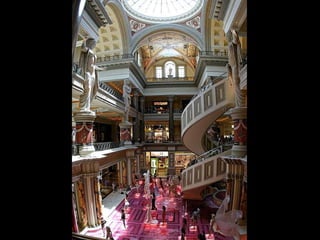
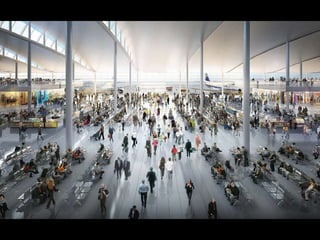
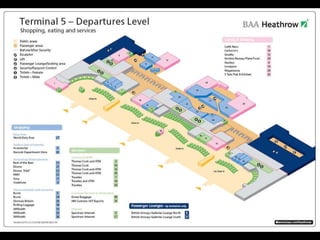
The city has twice been humiliated by the suburbs:  once upon the loss of its constituency to the suburbs and again upon that constituency’s return.  These prodigal citizens brought back with them their suburban values of predictability and control. The relationship between shopping and the city has, over the last half century, inverted from shopping as a component of the city to shopping as the prerequisite to urbanity.  Rather than shopping (as an activity) taking place in the city (as a place), the city (as an idea) is taking place within shopping (as a place)… The significance of the mall lies in its ability to create the effects of urbanity without need of the city, and it is this very realization that allows for the idea of an instrumental urbanity.  The city itself is the medium for post-mall shopping. John McMorrough, “City of Shopping,” in  Project on the City 2: The Harvard Design School Guide to Shopping  (2001)
 
 
Diversification of the production process and markets leads to a  spatial division of labor , which is expressed at a regional level.  This implies functionally different urban regions and towns, each with functionally different building forms developing:  mills, factories, foundries, and extensive working-class housing in  production-oriented industrial towns ;  market halls, banks, offices, and more socially differentiated housing in more  commercially oriented settlements ; and  theatres, assembly rooms, promenades, piers, and a variety of dwellings in the more spacious,  consumption-oriented spas and resorts . (…)  Social divisions of labor are architecturally expressed. Anthony King,  Urbanism, Colonialism and the World-economy  (1991), from  The Global Cities Reader , p. 197
 
 
Building as spectacle Contested space City of shopping Global media city Urbanism
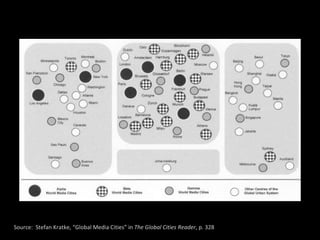
Source:  Stefan Kratke, “Global Media Cities” in  The Global Cities Reader , p. 328
“ Global media cities are functioning as ‘lifestyle producers’ which includes the  production of lifestyle images .  The current lifestyle producers in the culture and media industry are concentrated in leading media cities, from which they spread lifestyle images in the global urban network… “ What is remarkable is the polarity in the group of U.S. global media cities:  integration into global location networks of the media industry is concentrated on just  two outstanding clusters  – New York and Los Angeles.” Stefan Kratke, “Global Media Cities,” in The Global Cities Reader, p. 328
 
 
Building as spectacle Contested space City of shopping Global media city Urbanism
Olmstead Le Corbusier Wright Krier New Urbanism
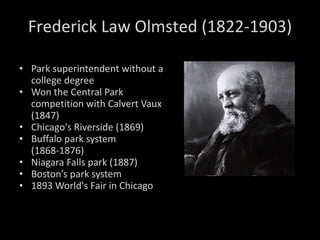
Park superintendent without a college degree Won the Central Park competition with Calvert Vaux (1847)  Chicago's Riverside (1869) Buffalo park system (1868-1876) Niagara Falls park (1887) Boston’s park system 1893 World's Fair in Chicago Frederick Law Olmsted (1822-1903)
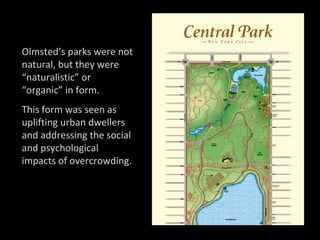
Olmsted’s parks were not natural, but they were “naturalistic” or “organic” in form. This form was seen as uplifting urban dwellers and addressing the social and psychological impacts of overcrowding.
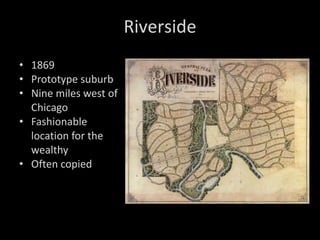
1869 Prototype suburb Nine miles west of Chicago Fashionable location for the wealthy Often copied Riverside
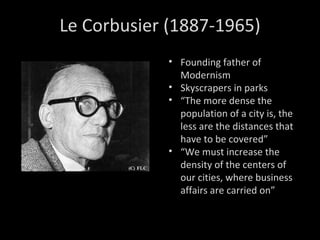
Le Corbusier (1887-1965) Founding father of Modernism Skyscrapers in parks “ The more dense the population of a city is, the less are the distances that have to be covered” “ We must increase the density of the centers of our cities, where business affairs are carried on”
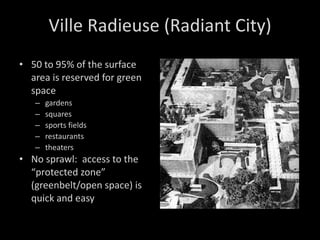
50 to 95% of the surface area is reserved for green space gardens squares sports fields restaurants theaters No sprawl:  access to the “protected zone” (greenbelt/open space) is quick and easy Ville Radieuse (Radiant City)
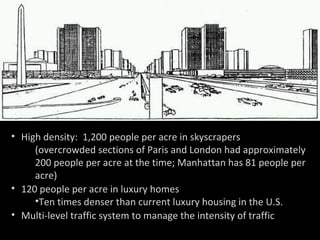
High density:  1,200 people per acre in skyscrapers (overcrowded sections of Paris and London had approximately 200 people per acre at the time; Manhattan has 81 people per acre) 120 people per acre in luxury homes Ten times denser than current luxury housing in the U.S. Multi-level traffic system to manage the intensity of traffic
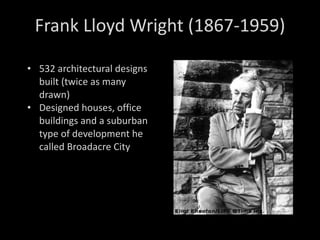
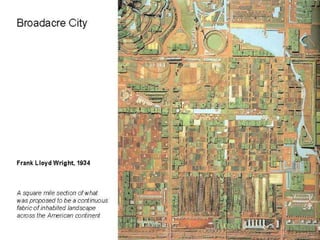
532 architectural designs built (twice as many drawn) Designed houses, office buildings and a suburban type of development he called Broadacre City Frank Lloyd Wright (1867-1959)
 
Wright’s Broadacre City Low-density Car-oriented Freeways and feeder roads Multinucleated FLW’s small house with carport became the American standard in the 1950s His dream of a decentralized, automobile-dependent society materialized
Urban planning today Zoning is the main tool More than 19,000 different zoning systems in the U.S.  Zoning reinforces the status quo encourages separation by property class encourages retail strip development discourages mixed use, pedestrian areas promotes bedroom communities and suburbs
“ Planning” but not urbanism Water  quality and sanitation controlled Most people have adequate light and air Fire danger controlled Disease controlled Zoning practice is mostly about protecting property values Sprawl continues to create unhealthy and dehumanizing environments (pollution, stress, isolation, lack of community)
Potential improvements TOD (transit-oriented development) PUD (planned unit development) Participatory Planning New Urbanism & neo-traditional planning Peter Calthorpe Leon Krier Congress for the New Urbanism (www.cnu.org)
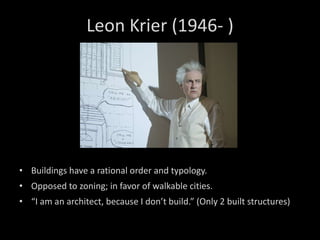
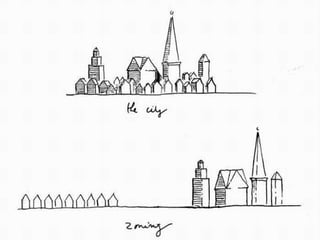
Leon Krier (1946- ) Buildings have a rational order and typology. Opposed to zoning; in favor of walkable cities. “ I am an architect, because I don’t build.” (Only 2 built structures)
 
“ Every traditional architecture makes a fundamental difference between public and/or sacred buildings on one hand, and utilitarian and/or private on the other. “ The first ones express the quality of collective institutions (dignity, solemnity, grandeur) in the  res publica  and the  res sacra ; the second ones express the more modest rank of private activities (residential and economic) in the  res privata  and the  res economica .   “ When industries have facades of cathedrals and dwellings look like royal palaces, if museums look like factories and churches like industrial halls, it means that a fundamental value of the republic is in crisis." Leon Krier,  Choice or Fate  (1998)
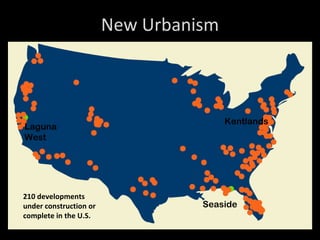
210 developments under construction or complete in the U.S. New Urbanism Seaside Kentlands Laguna West
Charter of the New Urbanism (excerpts)  - www.cnu.org We stand for the restoration of existing urban centers and towns within coherent metropolitan regions, the reconfiguration of sprawling suburbs into communities of real neighborhoods and diverse districts, the conservation of natural environments, and the preservation of our built legacy. The metropolitan region is a fundamental economic unit of the contemporary world. Governmental cooperation, public policy, physical planning, and economic strategies must reflect this new reality. The metropolis has a necessary and fragile relationship to its agrarian hinterland and natural landscapes. The relationship is environmental, economic, and cultural. Farmland and nature are as important to the metropolis as the garden is to the house. Cities and towns should bring into proximity a broad spectrum of public and private uses to support a regional economy that benefits people of all incomes. Affordable housing should be distributed throughout the region to match job opportunities and to avoid concentrations of poverty.
Revenues and resources can be shared more cooperatively among the municipalities and centers within regions to avoid destructive competition for tax base and to promote rational coordination of transportation, recreation, public services, housing, and community institutions.  Within neighborhoods, a broad range of housing types and price levels can bring people of diverse ages, races, and incomes into daily interaction, strengthening the personal and civic bonds essential to an authentic community. Transit corridors, when properly planned and coordinated, can help organize metropolitan structure and revitalize urban centers. In contrast, highway corridors should not displace investment from existing centers.  The economic health and harmonious evolution of neighborhoods, districts, and corridors can be improved through graphic urban design codes that serve as predictable guides for change. Copyright 1996, Congress for the New Urbanism. Permission is hereby granted to reproduce the Charter in full or in excerpt, provided that this copyright notice remains intact.


7 architectures-la

  • 1.
  • 2.
    Course Themes Dynamics: Globalization, Urbanization Circuits: Transnationals, Diasporas Centers: Agglomeration, Sprawl Margins: New Inequalities Ecologies: Sustainability Architectures: A Sense of Place Crises: Globalization in Reverse Frontiers: Looking Ahead
  • 3.
    A Sense ofPlace Two trends: Increasing privatization of space Building as spectacle Contested space / Exclusion Increasing mediation of experience City of shopping Global media city / Invasion
  • 4.
    Building as spectacleContested space City of shopping Global media city Urbanism
  • 5.
    In societies dominatedby modern conditions of production, life is presented as an immense accumulation of spectacles. Everything that was directly lived has receded into a representation. The spectacle…is not a mere decoration added to the real world. It is the very heart of this real society’s unreality. In all of its particular manifestations — news, propaganda, advertising, entertainment — the spectacle represents the dominant model of life. (…) In both form and content the spectacle serves as a total justification of the conditions and goals of the existing system. The spectacle also represents the constant presence of this justification since it monopolizes the majority of the time spent outside the production process.” Guy Debord, The Society of the Spectacle (1967)
  • 6.
    Individual buildings andwhole building complexes are being used increasingly as a means of establishing a city on the map of world locations and destinations… The trophy building usually results from hiring a world-renowned architect as a certain guarantee to get recognition on a world scale… ( Mega-events ) serve as impetuses and legitimizing forces in the structural and physical redevelopment schemes of major parts of cities and their regions… Large-scale projects …play a dominant role in image production of cities not only because of their sheer size but also because of the impact they have on the urban, and therefore social, fabric. Ute Lehrer, “Willing the Global City: Berlin,” in The Global Cities Reader , p. 334
  • 7.
  • 8.
  • 9.
    “ Conspicuous consumptionclaims a relatively larger portion of the income of the urban than of the rural population, and the claim is also more imperative. “… in the struggle to outdo one another the city population push their normal standard of conspicuous consumption to a higher point, with the result that a relatively greater expenditure in this direction is required to indicate a given degree of pecuniary decency in the city. The requirement of conformity to this higher conventional standard becomes mandatory. The standard of decency is higher, class for class, and this requirement of decent appearance must be lived up to on pain of losing caste.” Thorstein Veblen, The Theory of the Leisure Class: An Economic Study of Institutions (New York: Macmillan, 1902)
  • 10.
  • 11.
    Building as spectacleContested space City of shopping Global media city Urbanism
  • 12.
  • 13.
    In its internalspatial structure, the world city may be divided into the “citadel” and the “ghetto”. Its geography is typically one of inequality and class domination. The citadel serves the specific needs of the transnational elites and their immediate retinues who rule the city’s economic life, the ghetto is adapted to the circumstances of the permanent underclass. With its towers of steel and glass and its fanciful shopping malls, the Citadel is the city’s most vulnerable symbol. Its smooth surfaces suggest the sleek impersonality of money power. Its interior spaces are ample, elegant, and plush. In appropriately secluded spaces, the transnational elites have built their residences and playgrounds: country clubs and bridle paths and private beaches. John Friedmann and Goetz Wolff, “World City Formation,” in The Global Cities Reader , p. 64
  • 14.
    “ Creative people…don’tjust cluster where the jobs are. They cluster in places that are centers of creativity and also where they like to live.” Richard Florida, The Rise of the Creative Class (2002)
  • 15.
  • 16.
    Building as spectacleContested space City of shopping Global media city Urbanism
  • 17.
    The city hastwice been humiliated by the suburbs: once upon the loss of its constituency to the suburbs and again upon that constituency’s return. These prodigal citizens brought back with them their suburban values of predictability and control. The relationship between shopping and the city has, over the last half century, inverted from shopping as a component of the city to shopping as the prerequisite to urbanity. Rather than shopping (as an activity) taking place in the city (as a place), the city (as an idea) is taking place within shopping (as a place)… The significance of the mall lies in its ability to create the effects of urbanity without need of the city, and it is this very realization that allows for the idea of an instrumental urbanity. The city itself is the medium for post-mall shopping. John McMorrough, “City of Shopping,” in Project on the City 2: The Harvard Design School Guide to Shopping (2001)
  • 18.
  • 19.
  • 20.
    Diversification of theproduction process and markets leads to a spatial division of labor , which is expressed at a regional level. This implies functionally different urban regions and towns, each with functionally different building forms developing: mills, factories, foundries, and extensive working-class housing in production-oriented industrial towns ; market halls, banks, offices, and more socially differentiated housing in more commercially oriented settlements ; and theatres, assembly rooms, promenades, piers, and a variety of dwellings in the more spacious, consumption-oriented spas and resorts . (…) Social divisions of labor are architecturally expressed. Anthony King, Urbanism, Colonialism and the World-economy (1991), from The Global Cities Reader , p. 197
  • 21.
  • 22.
  • 23.
    Building as spectacleContested space City of shopping Global media city Urbanism
  • 24.
    Source: StefanKratke, “Global Media Cities” in The Global Cities Reader , p. 328
  • 25.
    “ Global mediacities are functioning as ‘lifestyle producers’ which includes the production of lifestyle images . The current lifestyle producers in the culture and media industry are concentrated in leading media cities, from which they spread lifestyle images in the global urban network… “ What is remarkable is the polarity in the group of U.S. global media cities: integration into global location networks of the media industry is concentrated on just two outstanding clusters – New York and Los Angeles.” Stefan Kratke, “Global Media Cities,” in The Global Cities Reader, p. 328
  • 26.
  • 27.
  • 28.
    Building as spectacleContested space City of shopping Global media city Urbanism
  • 29.
    Olmstead Le CorbusierWright Krier New Urbanism
  • 30.
    Park superintendent withouta college degree Won the Central Park competition with Calvert Vaux (1847) Chicago's Riverside (1869) Buffalo park system (1868-1876) Niagara Falls park (1887) Boston’s park system 1893 World's Fair in Chicago Frederick Law Olmsted (1822-1903)
  • 31.
    Olmsted’s parks werenot natural, but they were “naturalistic” or “organic” in form. This form was seen as uplifting urban dwellers and addressing the social and psychological impacts of overcrowding.
  • 32.
    1869 Prototype suburbNine miles west of Chicago Fashionable location for the wealthy Often copied Riverside
  • 33.
    Le Corbusier (1887-1965)Founding father of Modernism Skyscrapers in parks “ The more dense the population of a city is, the less are the distances that have to be covered” “ We must increase the density of the centers of our cities, where business affairs are carried on”
  • 34.
    50 to 95%of the surface area is reserved for green space gardens squares sports fields restaurants theaters No sprawl: access to the “protected zone” (greenbelt/open space) is quick and easy Ville Radieuse (Radiant City)
  • 35.
    High density: 1,200 people per acre in skyscrapers (overcrowded sections of Paris and London had approximately 200 people per acre at the time; Manhattan has 81 people per acre) 120 people per acre in luxury homes Ten times denser than current luxury housing in the U.S. Multi-level traffic system to manage the intensity of traffic
  • 36.
    532 architectural designsbuilt (twice as many drawn) Designed houses, office buildings and a suburban type of development he called Broadacre City Frank Lloyd Wright (1867-1959)
  • 37.
  • 38.
    Wright’s Broadacre CityLow-density Car-oriented Freeways and feeder roads Multinucleated FLW’s small house with carport became the American standard in the 1950s His dream of a decentralized, automobile-dependent society materialized
  • 39.
    Urban planning todayZoning is the main tool More than 19,000 different zoning systems in the U.S. Zoning reinforces the status quo encourages separation by property class encourages retail strip development discourages mixed use, pedestrian areas promotes bedroom communities and suburbs
  • 40.
    “ Planning” butnot urbanism Water quality and sanitation controlled Most people have adequate light and air Fire danger controlled Disease controlled Zoning practice is mostly about protecting property values Sprawl continues to create unhealthy and dehumanizing environments (pollution, stress, isolation, lack of community)
  • 41.
    Potential improvements TOD(transit-oriented development) PUD (planned unit development) Participatory Planning New Urbanism & neo-traditional planning Peter Calthorpe Leon Krier Congress for the New Urbanism (www.cnu.org)
  • 42.
    Leon Krier (1946-) Buildings have a rational order and typology. Opposed to zoning; in favor of walkable cities. “ I am an architect, because I don’t build.” (Only 2 built structures)
  • 43.
  • 44.
    “ Every traditionalarchitecture makes a fundamental difference between public and/or sacred buildings on one hand, and utilitarian and/or private on the other. “ The first ones express the quality of collective institutions (dignity, solemnity, grandeur) in the  res publica and the res sacra ; the second ones express the more modest rank of private activities (residential and economic) in the res privata and the res economica .   “ When industries have facades of cathedrals and dwellings look like royal palaces, if museums look like factories and churches like industrial halls, it means that a fundamental value of the republic is in crisis." Leon Krier, Choice or Fate (1998)
  • 45.
    210 developments underconstruction or complete in the U.S. New Urbanism Seaside Kentlands Laguna West
  • 46.
    Charter of theNew Urbanism (excerpts) - www.cnu.org We stand for the restoration of existing urban centers and towns within coherent metropolitan regions, the reconfiguration of sprawling suburbs into communities of real neighborhoods and diverse districts, the conservation of natural environments, and the preservation of our built legacy. The metropolitan region is a fundamental economic unit of the contemporary world. Governmental cooperation, public policy, physical planning, and economic strategies must reflect this new reality. The metropolis has a necessary and fragile relationship to its agrarian hinterland and natural landscapes. The relationship is environmental, economic, and cultural. Farmland and nature are as important to the metropolis as the garden is to the house. Cities and towns should bring into proximity a broad spectrum of public and private uses to support a regional economy that benefits people of all incomes. Affordable housing should be distributed throughout the region to match job opportunities and to avoid concentrations of poverty.
  • 47.
    Revenues and resourcescan be shared more cooperatively among the municipalities and centers within regions to avoid destructive competition for tax base and to promote rational coordination of transportation, recreation, public services, housing, and community institutions. Within neighborhoods, a broad range of housing types and price levels can bring people of diverse ages, races, and incomes into daily interaction, strengthening the personal and civic bonds essential to an authentic community. Transit corridors, when properly planned and coordinated, can help organize metropolitan structure and revitalize urban centers. In contrast, highway corridors should not displace investment from existing centers. The economic health and harmonious evolution of neighborhoods, districts, and corridors can be improved through graphic urban design codes that serve as predictable guides for change. Copyright 1996, Congress for the New Urbanism. Permission is hereby granted to reproduce the Charter in full or in excerpt, provided that this copyright notice remains intact.
  • 48.
  • 49.