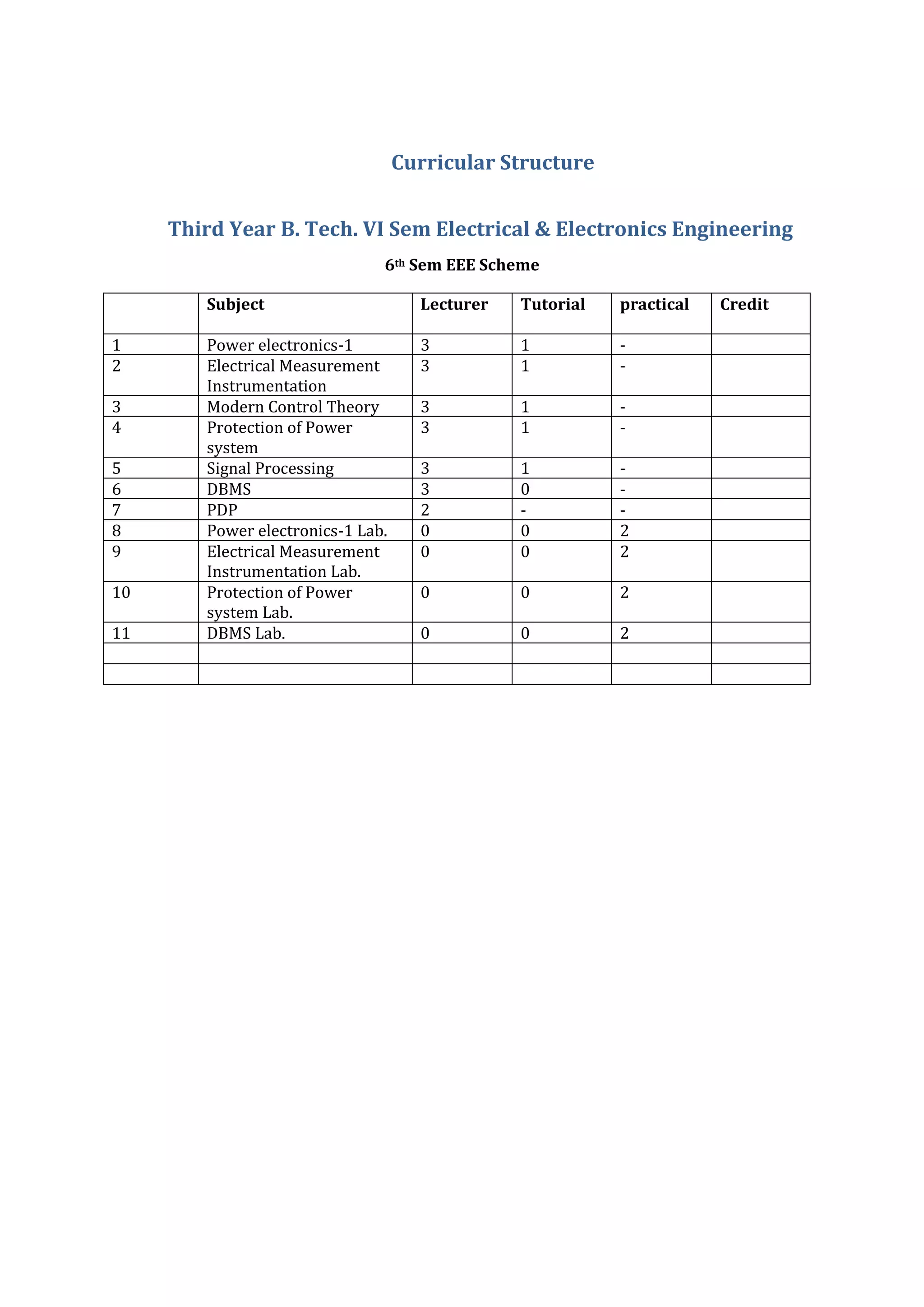
Curricular Structure


     Third Year B. Tech. VI Sem Electrical & Electronics Engineering
                               6th Sem EEE Scheme

        Subject                      Lecturer   Tutorial   practical   Credit

1       Power electronics-1          3          1          -
2       Electrical Measurement       3          1          -
        Instrumentation
3       Modern Control Theory        3          1          -
4       Protection of Power          3          1          -
        system
5       Signal Processing            3          1          -
6       DBMS                         3          0          -
7       PDP                          2          -          -
8       Power electronics-1 Lab.     0          0          2
9       Electrical Measurement       0          0          2
        Instrumentation Lab.
10      Protection of Power          0          0          2
        system Lab.
11      DBMS Lab.                    0          0          2
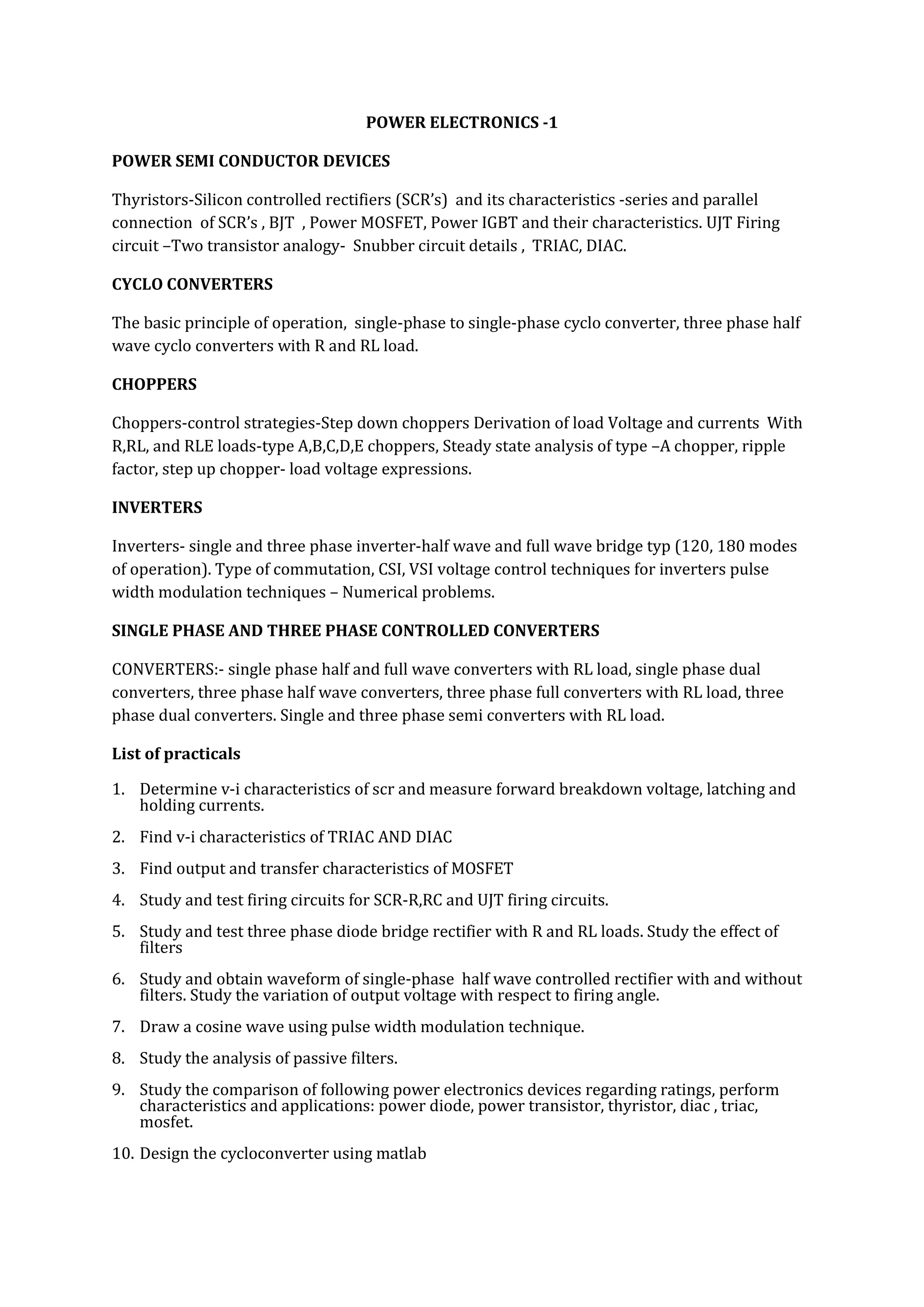
POWER ELECTRONICS -1

POWER SEMI CONDUCTOR DEVICES

Thyristors-Silicon controlled rectifiers (SCR’s) and its characteristics -series and parallel
connection of SCR’s , BJT , Power MOSFET, Power IGBT and their characteristics. UJT Firing
circuit –Two transistor analogy- Snubber circuit details , TRIAC, DIAC.

CYCLO CONVERTERS

The basic principle of operation, single-phase to single-phase cyclo converter, three phase half
wave cyclo converters with R and RL load.

CHOPPERS

Choppers-control strategies-Step down choppers Derivation of load Voltage and currents With
R,RL, and RLE loads-type A,B,C,D,E choppers, Steady state analysis of type –A chopper, ripple
factor, step up chopper- load voltage expressions.

INVERTERS

Inverters- single and three phase inverter-half wave and full wave bridge typ (120, 180 modes
of operation). Type of commutation, CSI, VSI voltage control techniques for inverters pulse
width modulation techniques – Numerical problems.

SINGLE PHASE AND THREE PHASE CONTROLLED CONVERTERS

CONVERTERS:- single phase half and full wave converters with RL load, single phase dual
converters, three phase half wave converters, three phase full converters with RL load, three
phase dual converters. Single and three phase semi converters with RL load.

List of practicals

1. Determine v-i characteristics of scr and measure forward breakdown voltage, latching and
   holding currents.
2. Find v-i characteristics of TRIAC AND DIAC
3. Find output and transfer characteristics of MOSFET
4. Study and test firing circuits for SCR-R,RC and UJT firing circuits.
5. Study and test three phase diode bridge rectifier with R and RL loads. Study the effect of
   filters
6. Study and obtain waveform of single-phase half wave controlled rectifier with and without
   filters. Study the variation of output voltage with respect to firing angle.
7. Draw a cosine wave using pulse width modulation technique.
8. Study the analysis of passive filters.
9. Study the comparison of following power electronics devices regarding ratings, perform
   characteristics and applications: power diode, power transistor, thyristor, diac , triac,
   mosfet.
10. Design the cycloconverter using matlab
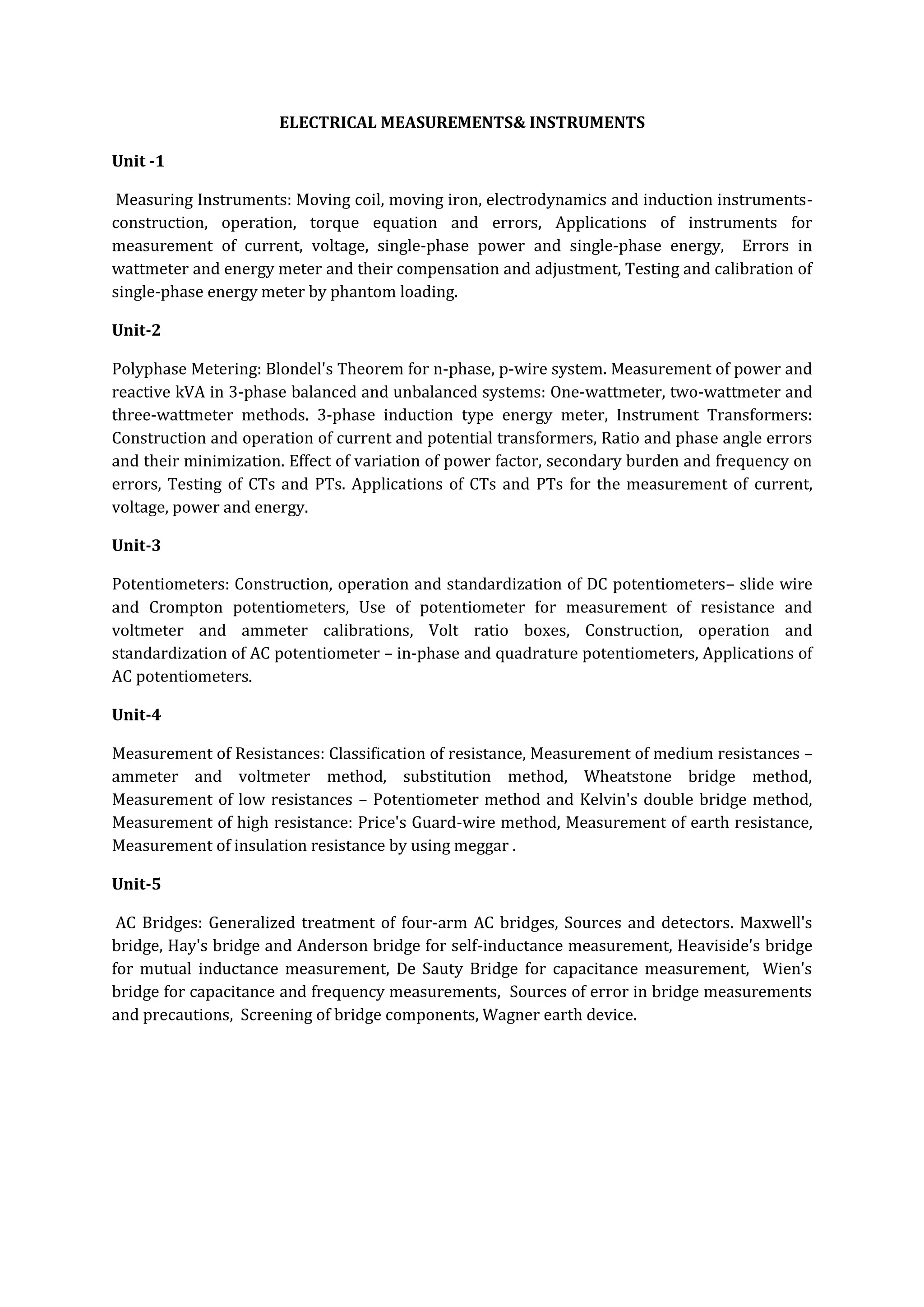
ELECTRICAL MEASUREMENTS& INSTRUMENTS

Unit -1

 Measuring Instruments: Moving coil, moving iron, electrodynamics and induction instruments-
construction, operation, torque equation and errors, Applications of instruments for
measurement of current, voltage, single-phase power and single-phase energy, Errors in
wattmeter and energy meter and their compensation and adjustment, Testing and calibration of
single-phase energy meter by phantom loading.

Unit-2

Polyphase Metering: Blondel's Theorem for n-phase, p-wire system. Measurement of power and
reactive kVA in 3-phase balanced and unbalanced systems: One-wattmeter, two-wattmeter and
three-wattmeter methods. 3-phase induction type energy meter, Instrument Transformers:
Construction and operation of current and potential transformers, Ratio and phase angle errors
and their minimization. Effect of variation of power factor, secondary burden and frequency on
errors, Testing of CTs and PTs. Applications of CTs and PTs for the measurement of current,
voltage, power and energy.

Unit-3

Potentiometers: Construction, operation and standardization of DC potentiometers– slide wire
and Crompton potentiometers, Use of potentiometer for measurement of resistance and
voltmeter and ammeter calibrations, Volt ratio boxes, Construction, operation and
standardization of AC potentiometer – in-phase and quadrature potentiometers, Applications of
AC potentiometers.

Unit-4

Measurement of Resistances: Classification of resistance, Measurement of medium resistances –
ammeter and voltmeter method, substitution method, Wheatstone bridge method,
Measurement of low resistances – Potentiometer method and Kelvin's double bridge method,
Measurement of high resistance: Price's Guard-wire method, Measurement of earth resistance,
Measurement of insulation resistance by using meggar .

Unit-5

 AC Bridges: Generalized treatment of four-arm AC bridges, Sources and detectors. Maxwell's
bridge, Hay's bridge and Anderson bridge for self-inductance measurement, Heaviside's bridge
for mutual inductance measurement, De Sauty Bridge for capacitance measurement, Wien's
bridge for capacitance and frequency measurements, Sources of error in bridge measurements
and precautions, Screening of bridge components, Wagner earth device.
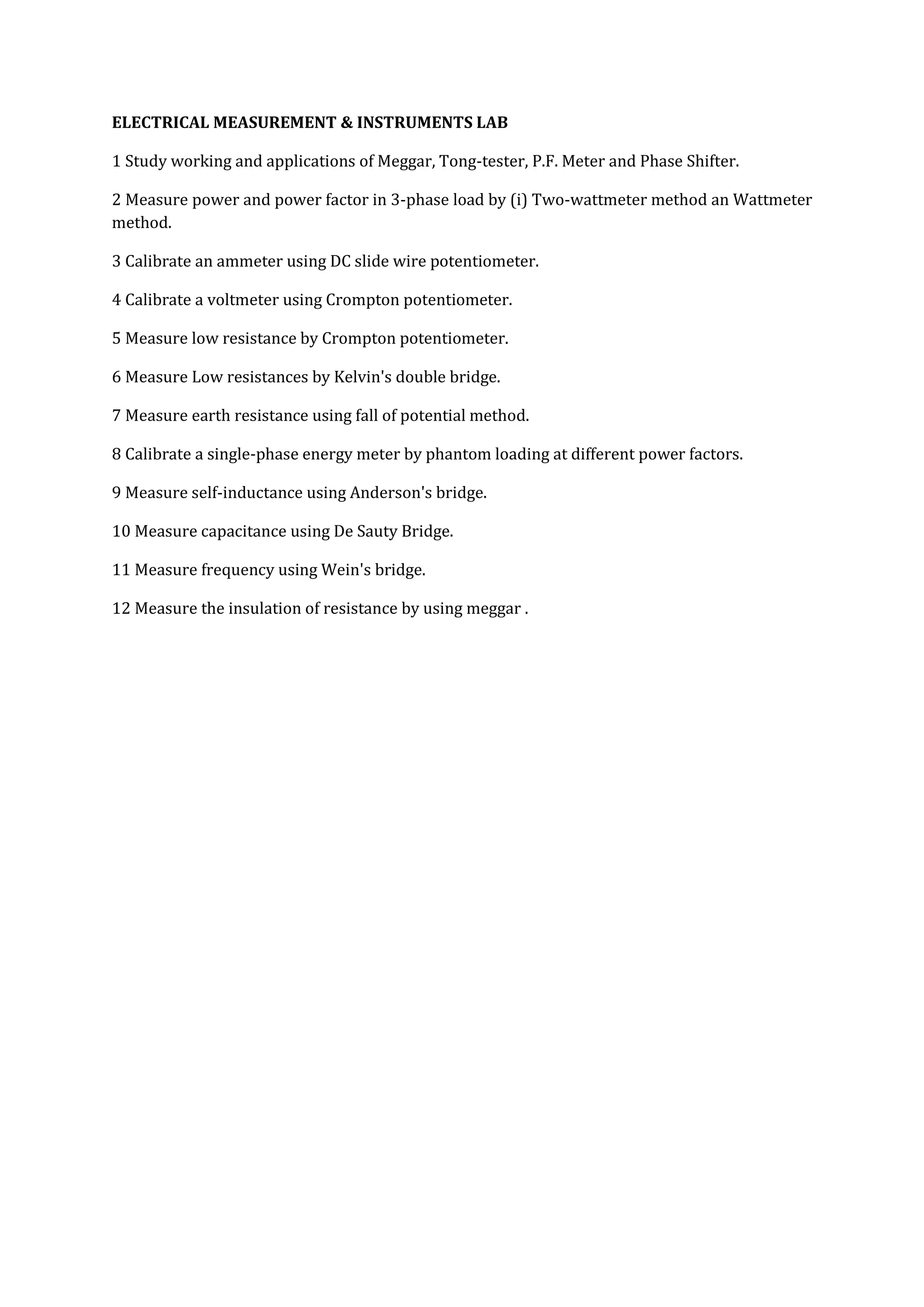
ELECTRICAL MEASUREMENT & INSTRUMENTS LAB

1 Study working and applications of Meggar, Tong-tester, P.F. Meter and Phase Shifter.

2 Measure power and power factor in 3-phase load by (i) Two-wattmeter method an Wattmeter
method.

3 Calibrate an ammeter using DC slide wire potentiometer.

4 Calibrate a voltmeter using Crompton potentiometer.

5 Measure low resistance by Crompton potentiometer.

6 Measure Low resistances by Kelvin's double bridge.

7 Measure earth resistance using fall of potential method.

8 Calibrate a single-phase energy meter by phantom loading at different power factors.

9 Measure self-inductance using Anderson's bridge.

10 Measure capacitance using De Sauty Bridge.

11 Measure frequency using Wein's bridge.

12 Measure the insulation of resistance by using meggar .
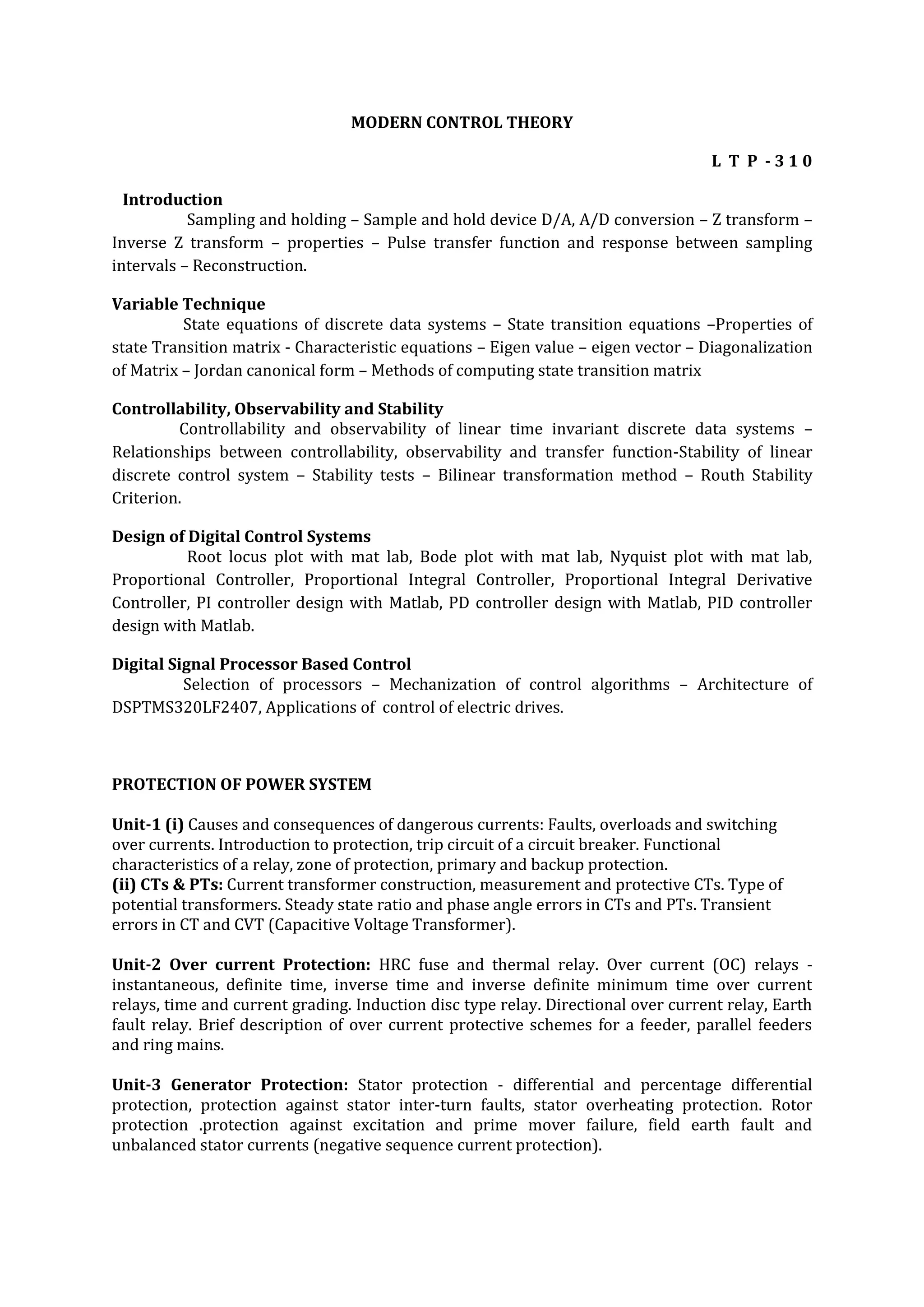
MODERN CONTROL THEORY

                                                                                   L T P -310

  Introduction
           Sampling and holding – Sample and hold device D/A, A/D conversion – Z transform –
Inverse Z transform – properties – Pulse transfer function and response between sampling
intervals – Reconstruction.

Variable Technique
          State equations of discrete data systems – State transition equations –Properties of
state Transition matrix - Characteristic equations – Eigen value – eigen vector – Diagonalization
of Matrix – Jordan canonical form – Methods of computing state transition matrix

Controllability, Observability and Stability
         Controllability and observability of linear time invariant discrete data systems –
Relationships between controllability, observability and transfer function-Stability of linear
discrete control system – Stability tests – Bilinear transformation method – Routh Stability
Criterion.

Design of Digital Control Systems
          Root locus plot with mat lab, Bode plot with mat lab, Nyquist plot with mat lab,
Proportional Controller, Proportional Integral Controller, Proportional Integral Derivative
Controller, PI controller design with Matlab, PD controller design with Matlab, PID controller
design with Matlab.

Digital Signal Processor Based Control
          Selection of processors – Mechanization of control algorithms – Architecture of
DSPTMS320LF2407, Applications of control of electric drives.


PROTECTION OF POWER SYSTEM

Unit-1 (i) Causes and consequences of dangerous currents: Faults, overloads and switching
over currents. Introduction to protection, trip circuit of a circuit breaker. Functional
characteristics of a relay, zone of protection, primary and backup protection.
(ii) CTs & PTs: Current transformer construction, measurement and protective CTs. Type of
potential transformers. Steady state ratio and phase angle errors in CTs and PTs. Transient
errors in CT and CVT (Capacitive Voltage Transformer).

Unit-2 Over current Protection: HRC fuse and thermal relay. Over current (OC) relays -
instantaneous, definite time, inverse time and inverse definite minimum time over current
relays, time and current grading. Induction disc type relay. Directional over current relay, Earth
fault relay. Brief description of over current protective schemes for a feeder, parallel feeders
and ring mains.

Unit-3 Generator Protection: Stator protection - differential and percentage differential
protection, protection against stator inter-turn faults, stator overheating protection. Rotor
protection .protection against excitation and prime mover failure, field earth fault and
unbalanced stator currents (negative sequence current protection).
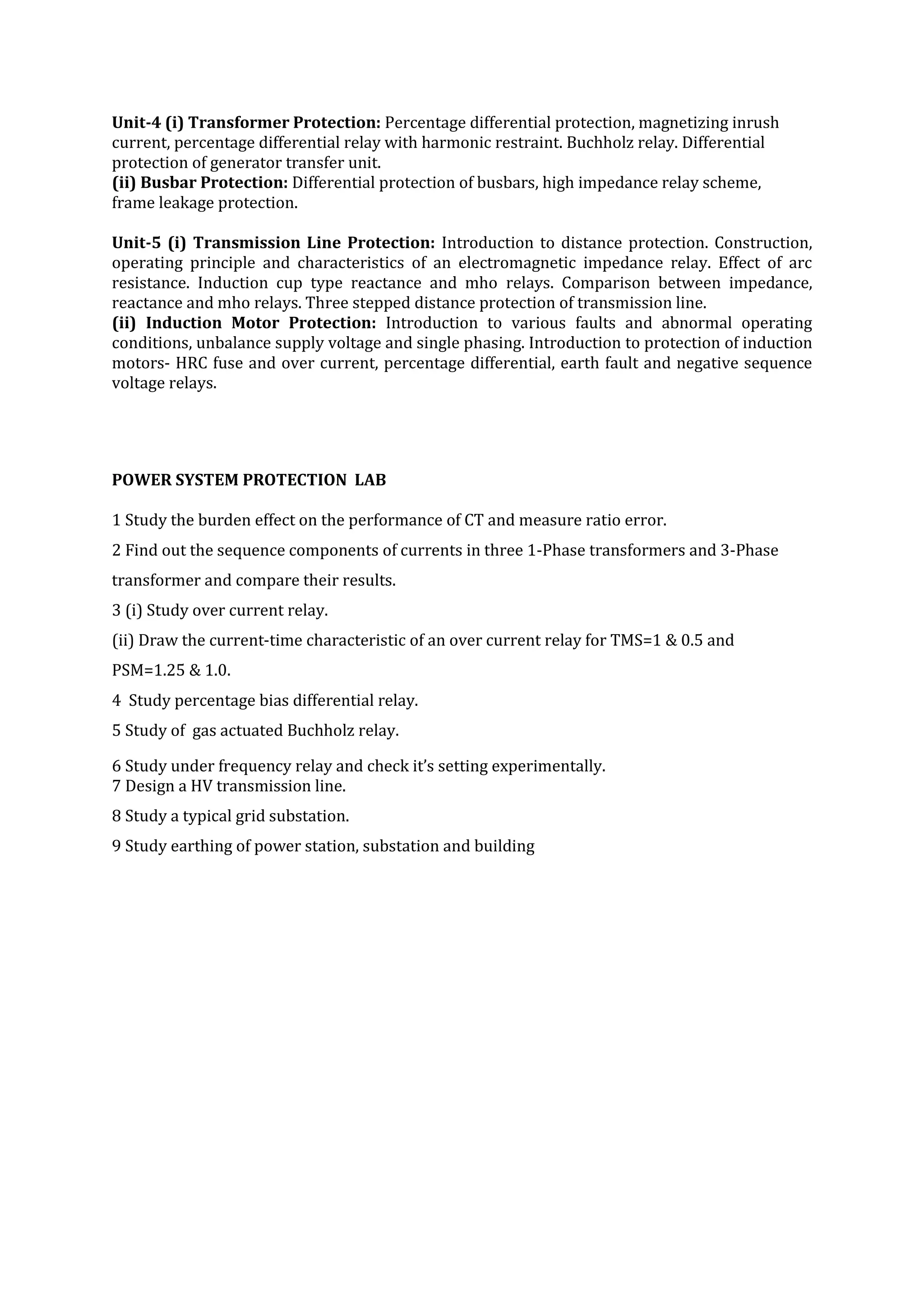
Unit-4 (i) Transformer Protection: Percentage differential protection, magnetizing inrush
current, percentage differential relay with harmonic restraint. Buchholz relay. Differential
protection of generator transfer unit.
(ii) Busbar Protection: Differential protection of busbars, high impedance relay scheme,
frame leakage protection.

Unit-5 (i) Transmission Line Protection: Introduction to distance protection. Construction,
operating principle and characteristics of an electromagnetic impedance relay. Effect of arc
resistance. Induction cup type reactance and mho relays. Comparison between impedance,
reactance and mho relays. Three stepped distance protection of transmission line.
(ii) Induction Motor Protection: Introduction to various faults and abnormal operating
conditions, unbalance supply voltage and single phasing. Introduction to protection of induction
motors- HRC fuse and over current, percentage differential, earth fault and negative sequence
voltage relays.


POWER SYSTEM PROTECTION LAB

1 Study the burden effect on the performance of CT and measure ratio error.
2 Find out the sequence components of currents in three 1-Phase transformers and 3-Phase
transformer and compare their results.
3 (i) Study over current relay.
(ii) Draw the current-time characteristic of an over current relay for TMS=1 & 0.5 and
PSM=1.25 & 1.0.
4 Study percentage bias differential relay.
5 Study of gas actuated Buchholz relay.

6 Study under frequency relay and check it’s setting experimentally.
7 Design a HV transmission line.
8 Study a typical grid substation.
9 Study earthing of power station, substation and building
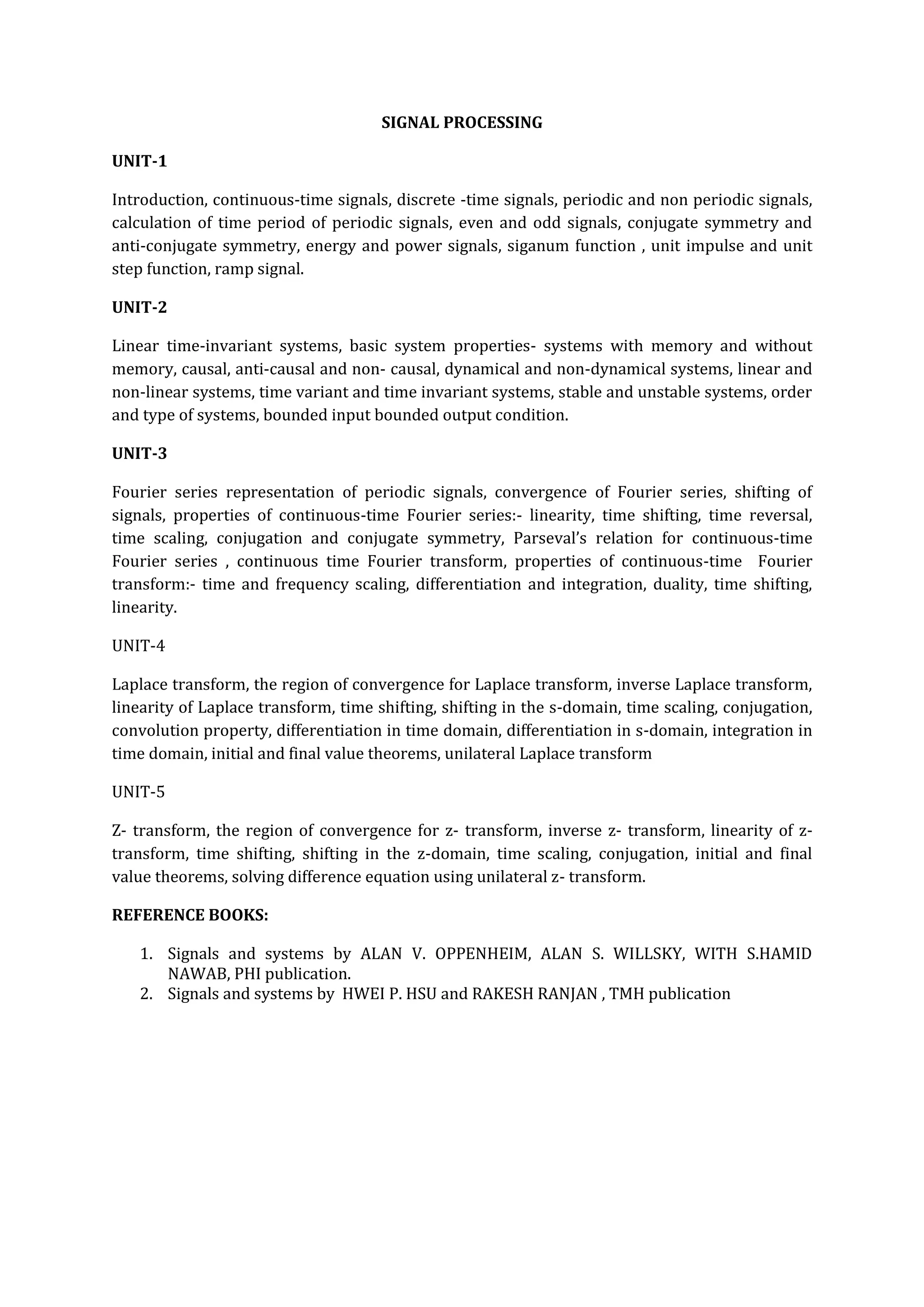
SIGNAL PROCESSING

UNIT-1

Introduction, continuous-time signals, discrete -time signals, periodic and non periodic signals,
calculation of time period of periodic signals, even and odd signals, conjugate symmetry and
anti-conjugate symmetry, energy and power signals, siganum function , unit impulse and unit
step function, ramp signal.

UNIT-2

Linear time-invariant systems, basic system properties- systems with memory and without
memory, causal, anti-causal and non- causal, dynamical and non-dynamical systems, linear and
non-linear systems, time variant and time invariant systems, stable and unstable systems, order
and type of systems, bounded input bounded output condition.

UNIT-3

Fourier series representation of periodic signals, convergence of Fourier series, shifting of
signals, properties of continuous-time Fourier series:- linearity, time shifting, time reversal,
time scaling, conjugation and conjugate symmetry, Parseval’s relation for continuous-time
Fourier series , continuous time Fourier transform, properties of continuous-time Fourier
transform:- time and frequency scaling, differentiation and integration, duality, time shifting,
linearity.

UNIT-4

Laplace transform, the region of convergence for Laplace transform, inverse Laplace transform,
linearity of Laplace transform, time shifting, shifting in the s-domain, time scaling, conjugation,
convolution property, differentiation in time domain, differentiation in s-domain, integration in
time domain, initial and final value theorems, unilateral Laplace transform

UNIT-5

Z- transform, the region of convergence for z- transform, inverse z- transform, linearity of z-
transform, time shifting, shifting in the z-domain, time scaling, conjugation, initial and final
value theorems, solving difference equation using unilateral z- transform.

REFERENCE BOOKS:

   1. Signals and systems by ALAN V. OPPENHEIM, ALAN S. WILLSKY, WITH S.HAMID
      NAWAB, PHI publication.
   2. Signals and systems by HWEI P. HSU and RAKESH RANJAN , TMH publication
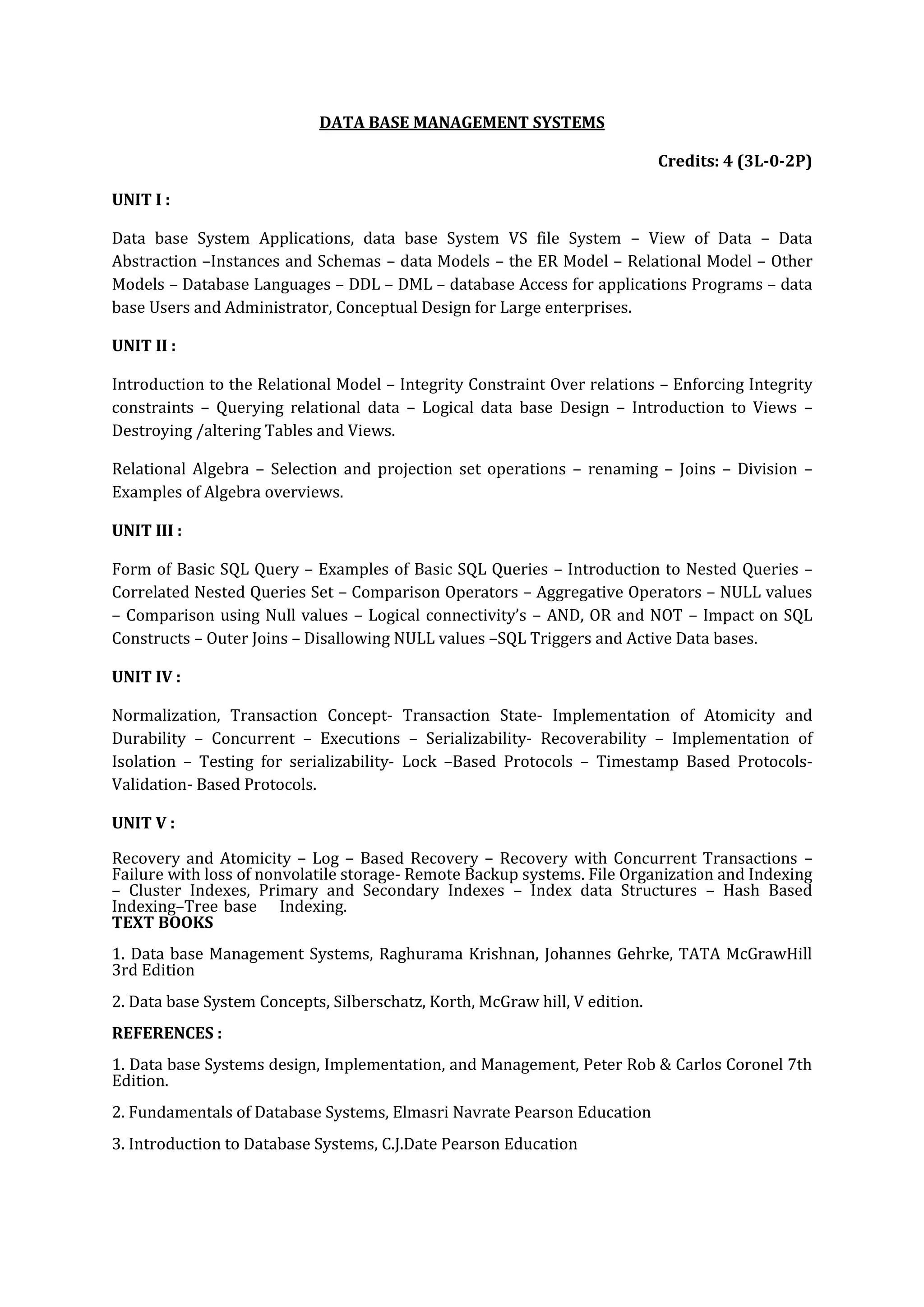
DATA BASE MANAGEMENT SYSTEMS

                                                                             Credits: 4 (3L-0-2P)

UNIT I :

Data base System Applications, data base System VS file System – View of Data – Data
Abstraction –Instances and Schemas – data Models – the ER Model – Relational Model – Other
Models – Database Languages – DDL – DML – database Access for applications Programs – data
base Users and Administrator, Conceptual Design for Large enterprises.

UNIT II :

Introduction to the Relational Model – Integrity Constraint Over relations – Enforcing Integrity
constraints – Querying relational data – Logical data base Design – Introduction to Views –
Destroying /altering Tables and Views.

Relational Algebra – Selection and projection set operations – renaming – Joins – Division –
Examples of Algebra overviews.

UNIT III :

Form of Basic SQL Query – Examples of Basic SQL Queries – Introduction to Nested Queries –
Correlated Nested Queries Set – Comparison Operators – Aggregative Operators – NULL values
– Comparison using Null values – Logical connectivity’s – AND, OR and NOT – Impact on SQL
Constructs – Outer Joins – Disallowing NULL values –SQL Triggers and Active Data bases.

UNIT IV :

Normalization, Transaction Concept- Transaction State- Implementation of Atomicity and
Durability – Concurrent – Executions – Serializability- Recoverability – Implementation of
Isolation – Testing for serializability- Lock –Based Protocols – Timestamp Based Protocols-
Validation- Based Protocols.

UNIT V :

Recovery and Atomicity – Log – Based Recovery – Recovery with Concurrent Transactions –
Failure with loss of nonvolatile storage- Remote Backup systems. File Organization and Indexing
– Cluster Indexes, Primary and Secondary Indexes – Index data Structures – Hash Based
Indexing–Tree base Indexing.
TEXT BOOKS
1. Data base Management Systems, Raghurama Krishnan, Johannes Gehrke, TATA McGrawHill
3rd Edition
2. Data base System Concepts, Silberschatz, Korth, McGraw hill, V edition.
REFERENCES :
1. Data base Systems design, Implementation, and Management, Peter Rob & Carlos Coronel 7th
Edition.
2. Fundamentals of Database Systems, Elmasri Navrate Pearson Education
3. Introduction to Database Systems, C.J.Date Pearson Education

6th sem eee scheme

  • 1.
    Curricular Structure Third Year B. Tech. VI Sem Electrical & Electronics Engineering 6th Sem EEE Scheme Subject Lecturer Tutorial practical Credit 1 Power electronics-1 3 1 - 2 Electrical Measurement 3 1 - Instrumentation 3 Modern Control Theory 3 1 - 4 Protection of Power 3 1 - system 5 Signal Processing 3 1 - 6 DBMS 3 0 - 7 PDP 2 - - 8 Power electronics-1 Lab. 0 0 2 9 Electrical Measurement 0 0 2 Instrumentation Lab. 10 Protection of Power 0 0 2 system Lab. 11 DBMS Lab. 0 0 2
  • 2.
    POWER ELECTRONICS -1 POWERSEMI CONDUCTOR DEVICES Thyristors-Silicon controlled rectifiers (SCR’s) and its characteristics -series and parallel connection of SCR’s , BJT , Power MOSFET, Power IGBT and their characteristics. UJT Firing circuit –Two transistor analogy- Snubber circuit details , TRIAC, DIAC. CYCLO CONVERTERS The basic principle of operation, single-phase to single-phase cyclo converter, three phase half wave cyclo converters with R and RL load. CHOPPERS Choppers-control strategies-Step down choppers Derivation of load Voltage and currents With R,RL, and RLE loads-type A,B,C,D,E choppers, Steady state analysis of type –A chopper, ripple factor, step up chopper- load voltage expressions. INVERTERS Inverters- single and three phase inverter-half wave and full wave bridge typ (120, 180 modes of operation). Type of commutation, CSI, VSI voltage control techniques for inverters pulse width modulation techniques – Numerical problems. SINGLE PHASE AND THREE PHASE CONTROLLED CONVERTERS CONVERTERS:- single phase half and full wave converters with RL load, single phase dual converters, three phase half wave converters, three phase full converters with RL load, three phase dual converters. Single and three phase semi converters with RL load. List of practicals 1. Determine v-i characteristics of scr and measure forward breakdown voltage, latching and holding currents. 2. Find v-i characteristics of TRIAC AND DIAC 3. Find output and transfer characteristics of MOSFET 4. Study and test firing circuits for SCR-R,RC and UJT firing circuits. 5. Study and test three phase diode bridge rectifier with R and RL loads. Study the effect of filters 6. Study and obtain waveform of single-phase half wave controlled rectifier with and without filters. Study the variation of output voltage with respect to firing angle. 7. Draw a cosine wave using pulse width modulation technique. 8. Study the analysis of passive filters. 9. Study the comparison of following power electronics devices regarding ratings, perform characteristics and applications: power diode, power transistor, thyristor, diac , triac, mosfet. 10. Design the cycloconverter using matlab
  • 3.
    ELECTRICAL MEASUREMENTS& INSTRUMENTS Unit-1 Measuring Instruments: Moving coil, moving iron, electrodynamics and induction instruments- construction, operation, torque equation and errors, Applications of instruments for measurement of current, voltage, single-phase power and single-phase energy, Errors in wattmeter and energy meter and their compensation and adjustment, Testing and calibration of single-phase energy meter by phantom loading. Unit-2 Polyphase Metering: Blondel's Theorem for n-phase, p-wire system. Measurement of power and reactive kVA in 3-phase balanced and unbalanced systems: One-wattmeter, two-wattmeter and three-wattmeter methods. 3-phase induction type energy meter, Instrument Transformers: Construction and operation of current and potential transformers, Ratio and phase angle errors and their minimization. Effect of variation of power factor, secondary burden and frequency on errors, Testing of CTs and PTs. Applications of CTs and PTs for the measurement of current, voltage, power and energy. Unit-3 Potentiometers: Construction, operation and standardization of DC potentiometers– slide wire and Crompton potentiometers, Use of potentiometer for measurement of resistance and voltmeter and ammeter calibrations, Volt ratio boxes, Construction, operation and standardization of AC potentiometer – in-phase and quadrature potentiometers, Applications of AC potentiometers. Unit-4 Measurement of Resistances: Classification of resistance, Measurement of medium resistances – ammeter and voltmeter method, substitution method, Wheatstone bridge method, Measurement of low resistances – Potentiometer method and Kelvin's double bridge method, Measurement of high resistance: Price's Guard-wire method, Measurement of earth resistance, Measurement of insulation resistance by using meggar . Unit-5 AC Bridges: Generalized treatment of four-arm AC bridges, Sources and detectors. Maxwell's bridge, Hay's bridge and Anderson bridge for self-inductance measurement, Heaviside's bridge for mutual inductance measurement, De Sauty Bridge for capacitance measurement, Wien's bridge for capacitance and frequency measurements, Sources of error in bridge measurements and precautions, Screening of bridge components, Wagner earth device.
  • 4.
    ELECTRICAL MEASUREMENT &INSTRUMENTS LAB 1 Study working and applications of Meggar, Tong-tester, P.F. Meter and Phase Shifter. 2 Measure power and power factor in 3-phase load by (i) Two-wattmeter method an Wattmeter method. 3 Calibrate an ammeter using DC slide wire potentiometer. 4 Calibrate a voltmeter using Crompton potentiometer. 5 Measure low resistance by Crompton potentiometer. 6 Measure Low resistances by Kelvin's double bridge. 7 Measure earth resistance using fall of potential method. 8 Calibrate a single-phase energy meter by phantom loading at different power factors. 9 Measure self-inductance using Anderson's bridge. 10 Measure capacitance using De Sauty Bridge. 11 Measure frequency using Wein's bridge. 12 Measure the insulation of resistance by using meggar .
  • 5.
    MODERN CONTROL THEORY L T P -310 Introduction Sampling and holding – Sample and hold device D/A, A/D conversion – Z transform – Inverse Z transform – properties – Pulse transfer function and response between sampling intervals – Reconstruction. Variable Technique State equations of discrete data systems – State transition equations –Properties of state Transition matrix - Characteristic equations – Eigen value – eigen vector – Diagonalization of Matrix – Jordan canonical form – Methods of computing state transition matrix Controllability, Observability and Stability Controllability and observability of linear time invariant discrete data systems – Relationships between controllability, observability and transfer function-Stability of linear discrete control system – Stability tests – Bilinear transformation method – Routh Stability Criterion. Design of Digital Control Systems Root locus plot with mat lab, Bode plot with mat lab, Nyquist plot with mat lab, Proportional Controller, Proportional Integral Controller, Proportional Integral Derivative Controller, PI controller design with Matlab, PD controller design with Matlab, PID controller design with Matlab. Digital Signal Processor Based Control Selection of processors – Mechanization of control algorithms – Architecture of DSPTMS320LF2407, Applications of control of electric drives. PROTECTION OF POWER SYSTEM Unit-1 (i) Causes and consequences of dangerous currents: Faults, overloads and switching over currents. Introduction to protection, trip circuit of a circuit breaker. Functional characteristics of a relay, zone of protection, primary and backup protection. (ii) CTs & PTs: Current transformer construction, measurement and protective CTs. Type of potential transformers. Steady state ratio and phase angle errors in CTs and PTs. Transient errors in CT and CVT (Capacitive Voltage Transformer). Unit-2 Over current Protection: HRC fuse and thermal relay. Over current (OC) relays - instantaneous, definite time, inverse time and inverse definite minimum time over current relays, time and current grading. Induction disc type relay. Directional over current relay, Earth fault relay. Brief description of over current protective schemes for a feeder, parallel feeders and ring mains. Unit-3 Generator Protection: Stator protection - differential and percentage differential protection, protection against stator inter-turn faults, stator overheating protection. Rotor protection .protection against excitation and prime mover failure, field earth fault and unbalanced stator currents (negative sequence current protection).
  • 6.
    Unit-4 (i) TransformerProtection: Percentage differential protection, magnetizing inrush current, percentage differential relay with harmonic restraint. Buchholz relay. Differential protection of generator transfer unit. (ii) Busbar Protection: Differential protection of busbars, high impedance relay scheme, frame leakage protection. Unit-5 (i) Transmission Line Protection: Introduction to distance protection. Construction, operating principle and characteristics of an electromagnetic impedance relay. Effect of arc resistance. Induction cup type reactance and mho relays. Comparison between impedance, reactance and mho relays. Three stepped distance protection of transmission line. (ii) Induction Motor Protection: Introduction to various faults and abnormal operating conditions, unbalance supply voltage and single phasing. Introduction to protection of induction motors- HRC fuse and over current, percentage differential, earth fault and negative sequence voltage relays. POWER SYSTEM PROTECTION LAB 1 Study the burden effect on the performance of CT and measure ratio error. 2 Find out the sequence components of currents in three 1-Phase transformers and 3-Phase transformer and compare their results. 3 (i) Study over current relay. (ii) Draw the current-time characteristic of an over current relay for TMS=1 & 0.5 and PSM=1.25 & 1.0. 4 Study percentage bias differential relay. 5 Study of gas actuated Buchholz relay. 6 Study under frequency relay and check it’s setting experimentally. 7 Design a HV transmission line. 8 Study a typical grid substation. 9 Study earthing of power station, substation and building
  • 7.
    SIGNAL PROCESSING UNIT-1 Introduction, continuous-timesignals, discrete -time signals, periodic and non periodic signals, calculation of time period of periodic signals, even and odd signals, conjugate symmetry and anti-conjugate symmetry, energy and power signals, siganum function , unit impulse and unit step function, ramp signal. UNIT-2 Linear time-invariant systems, basic system properties- systems with memory and without memory, causal, anti-causal and non- causal, dynamical and non-dynamical systems, linear and non-linear systems, time variant and time invariant systems, stable and unstable systems, order and type of systems, bounded input bounded output condition. UNIT-3 Fourier series representation of periodic signals, convergence of Fourier series, shifting of signals, properties of continuous-time Fourier series:- linearity, time shifting, time reversal, time scaling, conjugation and conjugate symmetry, Parseval’s relation for continuous-time Fourier series , continuous time Fourier transform, properties of continuous-time Fourier transform:- time and frequency scaling, differentiation and integration, duality, time shifting, linearity. UNIT-4 Laplace transform, the region of convergence for Laplace transform, inverse Laplace transform, linearity of Laplace transform, time shifting, shifting in the s-domain, time scaling, conjugation, convolution property, differentiation in time domain, differentiation in s-domain, integration in time domain, initial and final value theorems, unilateral Laplace transform UNIT-5 Z- transform, the region of convergence for z- transform, inverse z- transform, linearity of z- transform, time shifting, shifting in the z-domain, time scaling, conjugation, initial and final value theorems, solving difference equation using unilateral z- transform. REFERENCE BOOKS: 1. Signals and systems by ALAN V. OPPENHEIM, ALAN S. WILLSKY, WITH S.HAMID NAWAB, PHI publication. 2. Signals and systems by HWEI P. HSU and RAKESH RANJAN , TMH publication
  • 8.
    DATA BASE MANAGEMENTSYSTEMS Credits: 4 (3L-0-2P) UNIT I : Data base System Applications, data base System VS file System – View of Data – Data Abstraction –Instances and Schemas – data Models – the ER Model – Relational Model – Other Models – Database Languages – DDL – DML – database Access for applications Programs – data base Users and Administrator, Conceptual Design for Large enterprises. UNIT II : Introduction to the Relational Model – Integrity Constraint Over relations – Enforcing Integrity constraints – Querying relational data – Logical data base Design – Introduction to Views – Destroying /altering Tables and Views. Relational Algebra – Selection and projection set operations – renaming – Joins – Division – Examples of Algebra overviews. UNIT III : Form of Basic SQL Query – Examples of Basic SQL Queries – Introduction to Nested Queries – Correlated Nested Queries Set – Comparison Operators – Aggregative Operators – NULL values – Comparison using Null values – Logical connectivity’s – AND, OR and NOT – Impact on SQL Constructs – Outer Joins – Disallowing NULL values –SQL Triggers and Active Data bases. UNIT IV : Normalization, Transaction Concept- Transaction State- Implementation of Atomicity and Durability – Concurrent – Executions – Serializability- Recoverability – Implementation of Isolation – Testing for serializability- Lock –Based Protocols – Timestamp Based Protocols- Validation- Based Protocols. UNIT V : Recovery and Atomicity – Log – Based Recovery – Recovery with Concurrent Transactions – Failure with loss of nonvolatile storage- Remote Backup systems. File Organization and Indexing – Cluster Indexes, Primary and Secondary Indexes – Index data Structures – Hash Based Indexing–Tree base Indexing. TEXT BOOKS 1. Data base Management Systems, Raghurama Krishnan, Johannes Gehrke, TATA McGrawHill 3rd Edition 2. Data base System Concepts, Silberschatz, Korth, McGraw hill, V edition. REFERENCES : 1. Data base Systems design, Implementation, and Management, Peter Rob & Carlos Coronel 7th Edition. 2. Fundamentals of Database Systems, Elmasri Navrate Pearson Education 3. Introduction to Database Systems, C.J.Date Pearson Education