Big Ideas
1. Capacity Building (Renforcement des capacities)
(WA)
2. Communication (WA)
3. Timely provision of location-specific forecasts,
early warnings, & advisories (S&EA)
4. Enhancing capacities of met services, extension
agents, farmers, agricultural researchers (S&EA)
5. Use of crop & climate information services to
transform climate risk agriculture to climate smart
agriculture (SA)
6. Enhance infrastructure and human capacities to
improve delivery of agro-climatic service (SA)
Big Ideas (cont’d)
7. Coordination between funding agencies in developing shared
mechanisms, extending beyond just climate services.
8. Co-production of climate services: Engaging farmers in
determining information packages via participatory
platforms
9. Open spaces for dialogue at the outset (eg: national
workshop for Early Warning>Early Action): two-way
communication between farmers, extension agents, met
services.
– Use an understanding of cultural styles of participation and
knowledge sharing as a basis for interaction.
– Apply on both local and regional levels.
Big Ideas (end)
10. Bridging the Gap between Met and Agr research communities to
integrate climate information into larger agricultural and rural
development packages: bundling climate services with inputs and
interventions to fully put them to use
11. Integrate Climate Services into National Plans: Create an institutional
framework for the production of farmer focused climate services
– Bridging the Gap between Met, Agriculture, farmer and boundary
organizations
– Building the institutional linkages needed to enable cross
disciplinary partnerships Eg: National framework for
– Advocate with Policy Makers – engage them - Be creative (take
farmers to parliament?)
12. Multidisciplinary approach in producing climate services– we need to
involve farmers and other disciplines (as appropriate) from the
beginning.
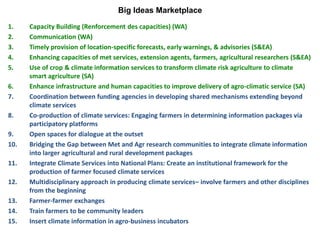
1. Capacity Building (Renforcement des capacities) (WA)
2. Communication (WA)
3. Timely provision of location-specific forecasts, early warnings, & advisories (S&EA)
4. Enhancing capacities of met services, extension agents, farmers, agricultural researchers (S&EA)
5. Use of crop & climate information services to transform climate risk agriculture to climate
smart agriculture (SA)
6. Enhance infrastructure and human capacities to improve delivery of agro-climatic service (SA)
7. Coordination between funding agencies in developing shared mechanisms extending beyond
climate services
8. Co-production of climate services: Engaging farmers in determining information packages via
participatory platforms
9. Open spaces for dialogue at the outset
10. Bridging the Gap between Met and Agr research communities to integrate climate information
into larger agricultural and rural development packages
11. Integrate Climate Services into National Plans: Create an institutional framework for the
production of farmer focused climate services
12. Multidisciplinary approach in producing climate services– involve farmers and other disciplines
from the beginning
13. Farmer-farmer exchanges
14. Train farmers to be community leaders
15. Insert climate information in agro-business incubators
Big Ideas Marketplace
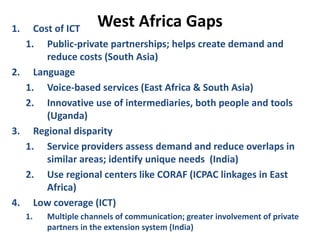
West Africa Gaps
1. Cost of ICT
1. Public-private partnerships; helps create demand and
reduce costs (South Asia)
2. Language
1. Voice-based services (East Africa & South Asia)
2. Innovative use of intermediaries, both people and tools
(Uganda)
3. Regional disparity
1. Service providers assess demand and reduce overlaps in
similar areas; identify unique needs (India)
2. Use regional centers like CORAF (ICPAC linkages in East
Africa)
4. Low coverage (ICT)
1. Multiple channels of communication; greater involvement of private
partners in the extension system (India)
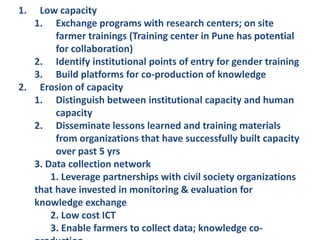
1. Low capacity
1. Exchange programs with research centers; on site
farmer trainings (Training center in Pune has potential
for collaboration)
2. Identify institutional points of entry for gender training
3. Build platforms for co-production of knowledge
2. Erosion of capacity
1. Distinguish between institutional capacity and human
capacity
2. Disseminate lessons learned and training materials
from organizations that have successfully built capacity
over past 5 yrs
3. Data collection network
1. Leverage partnerships with civil society organizations
that have invested in monitoring & evaluation for
knowledge exchange
2. Low cost ICT
3. Enable farmers to collect data; knowledge co-
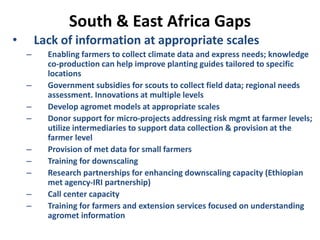
South & East Africa Gaps
• Lack of information at appropriate scales
– Enabling farmers to collect climate data and express needs; knowledge
co-production can help improve planting guides tailored to specific
locations
– Government subsidies for scouts to collect field data; regional needs
assessment. Innovations at multiple levels
– Develop agromet models at appropriate scales
– Donor support for micro-projects addressing risk mgmt at farmer levels;
utilize intermediaries to support data collection & provision at the
farmer level
– Provision of met data for small farmers
– Training for downscaling
– Research partnerships for enhancing downscaling capacity (Ethiopian
met agency-IRI partnership)
– Call center capacity
– Training for farmers and extension services focused on understanding
agromet information
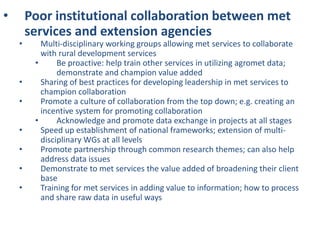
• Poor institutional collaboration between met
services and extension agencies
• Multi-disciplinary working groups allowing met services to collaborate
with rural development services
• Be proactive: help train other services in utilizing agromet data;
demonstrate and champion value added
• Sharing of best practices for developing leadership in met services to
champion collaboration
• Promote a culture of collaboration from the top down; e.g. creating an
incentive system for promoting collaboration
• Acknowledge and promote data exchange in projects at all stages
• Speed up establishment of national frameworks; extension of multi-
disciplinary WGs at all levels
• Promote partnership through common research themes; can also help
address data issues
• Demonstrate to met services the value added of broadening their client
base
• Training for met services in adding value to information; how to process
and share raw data in useful ways
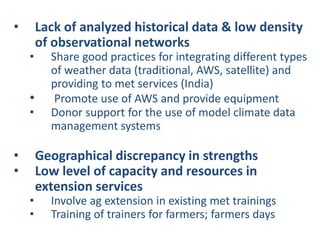
• Lack of analyzed historical data & low density
of observational networks
• Share good practices for integrating different types
of weather data (traditional, AWS, satellite) and
providing to met services (India)
• Promote use of AWS and provide equipment
• Donor support for the use of model climate data
management systems
• Geographical discrepancy in strengths
• Low level of capacity and resources in
extension services
• Involve ag extension in existing met trainings
• Training of trainers for farmers; farmers days
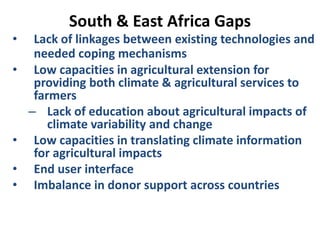
South & East Africa Gaps
• Lack of linkages between existing technologies and
needed coping mechanisms
• Low capacities in agricultural extension for
providing both climate & agricultural services to
farmers
– Lack of education about agricultural impacts of
climate variability and change
• Low capacities in translating climate information
for agricultural impacts
• End user interface
• Imbalance in donor support across countries
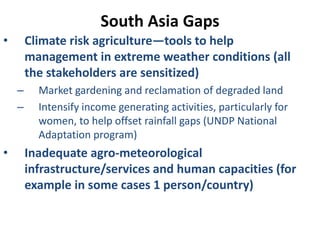
South Asia Gaps
• Climate risk agriculture—tools to help
management in extreme weather conditions (all
the stakeholders are sensitized)
– Market gardening and reclamation of degraded land
– Intensify income generating activities, particularly for
women, to help offset rainfall gaps (UNDP National
Adaptation program)
• Inadequate agro-meteorological
infrastructure/services and human capacities (for
example in some cases 1 person/country)
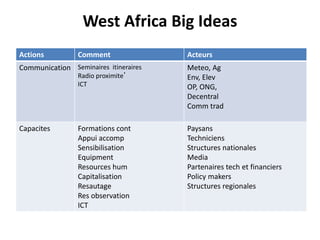
West Africa Big Ideas
Actions Comment Acteurs
Communication Seminaires itineraires
Radio proximite’
ICT
Meteo, Ag
Env, Elev
OP, ONG,
Decentral
Comm trad
Capacites Formations cont
Appui accomp
Sensibilisation
Equipment
Resources hum
Capitalisation
Resautage
Res observation
ICT
Paysans
Techniciens
Structures nationales
Media
Partenaires tech et financiers
Policy makers
Structures regionales
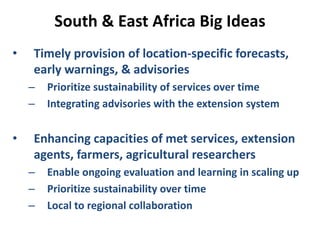
South & East Africa Big Ideas
• Timely provision of location-specific forecasts,
early warnings, & advisories
– Prioritize sustainability of services over time
– Integrating advisories with the extension system
• Enhancing capacities of met services, extension
agents, farmers, agricultural researchers
– Enable ongoing evaluation and learning in scaling up
– Prioritize sustainability over time
– Local to regional collaboration
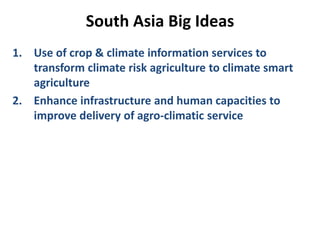
South Asia Big Ideas
1. Use of crop & climate information services to
transform climate risk agriculture to climate smart
agriculture
2. Enhance infrastructure and human capacities to
improve delivery of agro-climatic service

6 Big Ideas.ppt

  • 1.
    Big Ideas 1. CapacityBuilding (Renforcement des capacities) (WA) 2. Communication (WA) 3. Timely provision of location-specific forecasts, early warnings, & advisories (S&EA) 4. Enhancing capacities of met services, extension agents, farmers, agricultural researchers (S&EA) 5. Use of crop & climate information services to transform climate risk agriculture to climate smart agriculture (SA) 6. Enhance infrastructure and human capacities to improve delivery of agro-climatic service (SA)
  • 2.
    Big Ideas (cont’d) 7.Coordination between funding agencies in developing shared mechanisms, extending beyond just climate services. 8. Co-production of climate services: Engaging farmers in determining information packages via participatory platforms 9. Open spaces for dialogue at the outset (eg: national workshop for Early Warning>Early Action): two-way communication between farmers, extension agents, met services. – Use an understanding of cultural styles of participation and knowledge sharing as a basis for interaction. – Apply on both local and regional levels.
  • 3.
    Big Ideas (end) 10.Bridging the Gap between Met and Agr research communities to integrate climate information into larger agricultural and rural development packages: bundling climate services with inputs and interventions to fully put them to use 11. Integrate Climate Services into National Plans: Create an institutional framework for the production of farmer focused climate services – Bridging the Gap between Met, Agriculture, farmer and boundary organizations – Building the institutional linkages needed to enable cross disciplinary partnerships Eg: National framework for – Advocate with Policy Makers – engage them - Be creative (take farmers to parliament?) 12. Multidisciplinary approach in producing climate services– we need to involve farmers and other disciplines (as appropriate) from the beginning.
  • 4.
    1. Capacity Building(Renforcement des capacities) (WA) 2. Communication (WA) 3. Timely provision of location-specific forecasts, early warnings, & advisories (S&EA) 4. Enhancing capacities of met services, extension agents, farmers, agricultural researchers (S&EA) 5. Use of crop & climate information services to transform climate risk agriculture to climate smart agriculture (SA) 6. Enhance infrastructure and human capacities to improve delivery of agro-climatic service (SA) 7. Coordination between funding agencies in developing shared mechanisms extending beyond climate services 8. Co-production of climate services: Engaging farmers in determining information packages via participatory platforms 9. Open spaces for dialogue at the outset 10. Bridging the Gap between Met and Agr research communities to integrate climate information into larger agricultural and rural development packages 11. Integrate Climate Services into National Plans: Create an institutional framework for the production of farmer focused climate services 12. Multidisciplinary approach in producing climate services– involve farmers and other disciplines from the beginning 13. Farmer-farmer exchanges 14. Train farmers to be community leaders 15. Insert climate information in agro-business incubators Big Ideas Marketplace
  • 5.
    West Africa Gaps 1.Cost of ICT 1. Public-private partnerships; helps create demand and reduce costs (South Asia) 2. Language 1. Voice-based services (East Africa & South Asia) 2. Innovative use of intermediaries, both people and tools (Uganda) 3. Regional disparity 1. Service providers assess demand and reduce overlaps in similar areas; identify unique needs (India) 2. Use regional centers like CORAF (ICPAC linkages in East Africa) 4. Low coverage (ICT) 1. Multiple channels of communication; greater involvement of private partners in the extension system (India)
  • 6.
    1. Low capacity 1.Exchange programs with research centers; on site farmer trainings (Training center in Pune has potential for collaboration) 2. Identify institutional points of entry for gender training 3. Build platforms for co-production of knowledge 2. Erosion of capacity 1. Distinguish between institutional capacity and human capacity 2. Disseminate lessons learned and training materials from organizations that have successfully built capacity over past 5 yrs 3. Data collection network 1. Leverage partnerships with civil society organizations that have invested in monitoring & evaluation for knowledge exchange 2. Low cost ICT 3. Enable farmers to collect data; knowledge co-
  • 7.
    South & EastAfrica Gaps • Lack of information at appropriate scales – Enabling farmers to collect climate data and express needs; knowledge co-production can help improve planting guides tailored to specific locations – Government subsidies for scouts to collect field data; regional needs assessment. Innovations at multiple levels – Develop agromet models at appropriate scales – Donor support for micro-projects addressing risk mgmt at farmer levels; utilize intermediaries to support data collection & provision at the farmer level – Provision of met data for small farmers – Training for downscaling – Research partnerships for enhancing downscaling capacity (Ethiopian met agency-IRI partnership) – Call center capacity – Training for farmers and extension services focused on understanding agromet information
  • 8.
    • Poor institutionalcollaboration between met services and extension agencies • Multi-disciplinary working groups allowing met services to collaborate with rural development services • Be proactive: help train other services in utilizing agromet data; demonstrate and champion value added • Sharing of best practices for developing leadership in met services to champion collaboration • Promote a culture of collaboration from the top down; e.g. creating an incentive system for promoting collaboration • Acknowledge and promote data exchange in projects at all stages • Speed up establishment of national frameworks; extension of multi- disciplinary WGs at all levels • Promote partnership through common research themes; can also help address data issues • Demonstrate to met services the value added of broadening their client base • Training for met services in adding value to information; how to process and share raw data in useful ways
  • 9.
    • Lack ofanalyzed historical data & low density of observational networks • Share good practices for integrating different types of weather data (traditional, AWS, satellite) and providing to met services (India) • Promote use of AWS and provide equipment • Donor support for the use of model climate data management systems • Geographical discrepancy in strengths • Low level of capacity and resources in extension services • Involve ag extension in existing met trainings • Training of trainers for farmers; farmers days
  • 10.
    South & EastAfrica Gaps • Lack of linkages between existing technologies and needed coping mechanisms • Low capacities in agricultural extension for providing both climate & agricultural services to farmers – Lack of education about agricultural impacts of climate variability and change • Low capacities in translating climate information for agricultural impacts • End user interface • Imbalance in donor support across countries
  • 11.
    South Asia Gaps •Climate risk agriculture—tools to help management in extreme weather conditions (all the stakeholders are sensitized) – Market gardening and reclamation of degraded land – Intensify income generating activities, particularly for women, to help offset rainfall gaps (UNDP National Adaptation program) • Inadequate agro-meteorological infrastructure/services and human capacities (for example in some cases 1 person/country)
  • 12.
    West Africa BigIdeas Actions Comment Acteurs Communication Seminaires itineraires Radio proximite’ ICT Meteo, Ag Env, Elev OP, ONG, Decentral Comm trad Capacites Formations cont Appui accomp Sensibilisation Equipment Resources hum Capitalisation Resautage Res observation ICT Paysans Techniciens Structures nationales Media Partenaires tech et financiers Policy makers Structures regionales
  • 13.
    South & EastAfrica Big Ideas • Timely provision of location-specific forecasts, early warnings, & advisories – Prioritize sustainability of services over time – Integrating advisories with the extension system • Enhancing capacities of met services, extension agents, farmers, agricultural researchers – Enable ongoing evaluation and learning in scaling up – Prioritize sustainability over time – Local to regional collaboration
  • 14.
    South Asia BigIdeas 1. Use of crop & climate information services to transform climate risk agriculture to climate smart agriculture 2. Enhance infrastructure and human capacities to improve delivery of agro-climatic service