5G INSTALLATION
By: Akshi Bangotra
Rollno._141/19
Under the guidance of
Prof. Anil Gupta
Contents
 Introduction to telecommunication
 Basic elements of telecommunication
 Transmission modes
 Evolution of mobile communication
- First Generation mobile system(1G)
- Second Generation mobile system (2G)
- Third Generation mobile system (3G)
- Fourth Generation mobile system (4G)
- Fifth Generation mobile system (5G)
 Difference between 1G, 2G, 3G, 4G, 5G
Contd.
 Literature Survey
 Inference drawn
What is telecommunication?
 Telecommunication is the transmission of information
over a distance via electronic signals
 Revolutionized the way we communicate
 Allowing us to stay in touch with friends and family
 Access information
 Conduct business from anywhere in the world
 Most common types of telecommunications:-
- Telephone
- Radio
- Internet
- Satellite communication
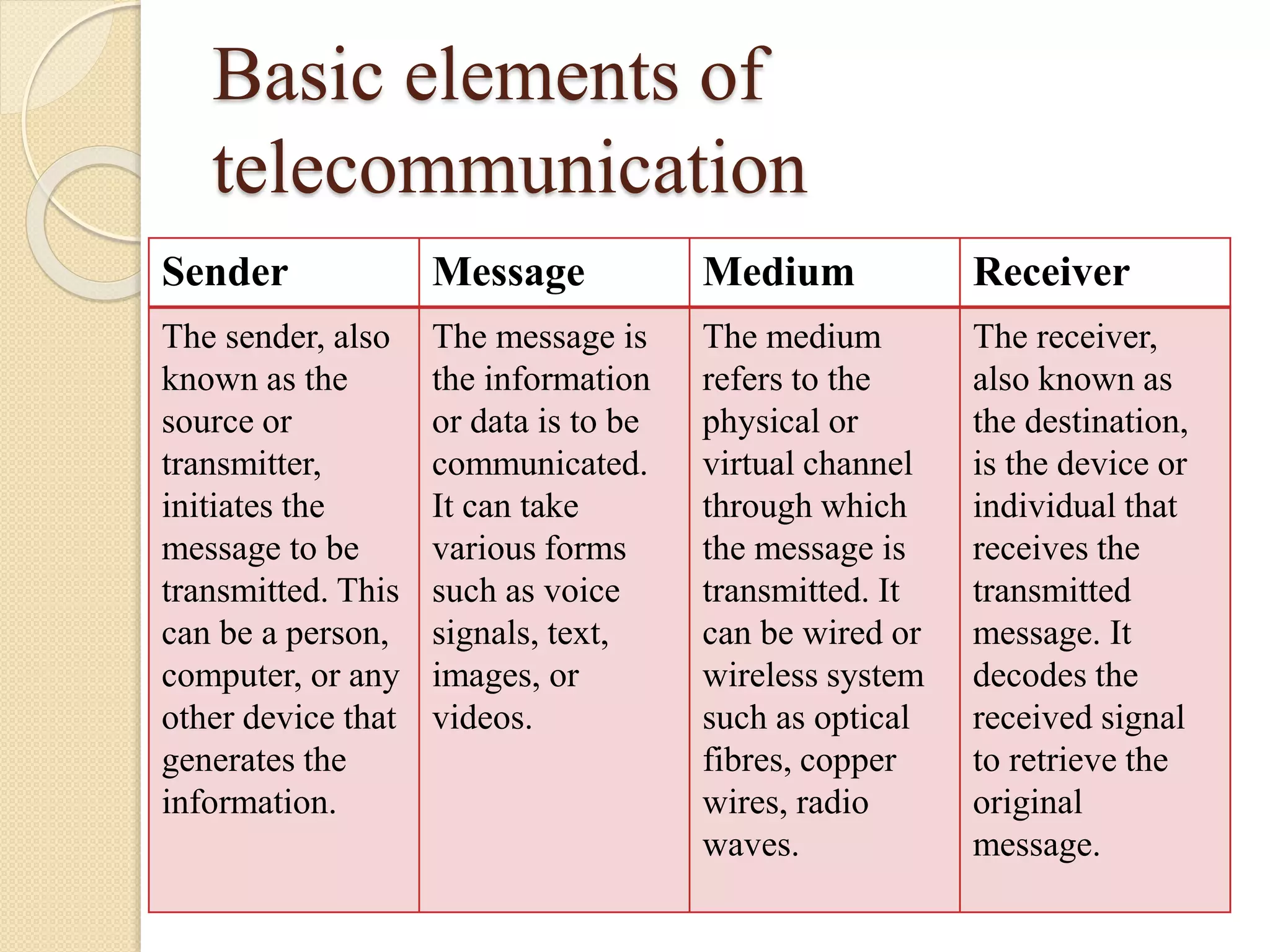
Basic elements of
telecommunication
Sender Message Medium Receiver
The sender, also
known as the
source or
transmitter,
initiates the
message to be
transmitted. This
can be a person,
computer, or any
other device that
generates the
information.
The message is
the information
or data is to be
communicated.
It can take
various forms
such as voice
signals, text,
images, or
videos.
The medium
refers to the
physical or
virtual channel
through which
the message is
transmitted. It
can be wired or
wireless system
such as optical
fibres, copper
wires, radio
waves.
The receiver,
also known as
the destination,
is the device or
individual that
receives the
transmitted
message. It
decodes the
received signal
to retrieve the
original
message.
Transmission Modes
 When a data is transmitted from one device to another
device is known as transmission mode
 Also known as communication mode
 Three types of transmission modes are:
Transmission modes
Half-duplex mode Full-duplex mode
Simplex mode
Contd.
 Simplex mode:
- Unidirectional communication
- Only one device can send information and another
receives
- Example: keyboard and traditional monitors
 Half-duplex mode:
- Bidirectional communication
- Each station can both transmit and receive but not at
the same time
- Example: Walkie-talkie
Contd.
 Full-duplex mode:
- Bidirectional communication
- Used when communication in both directions is
required all the time
- Example: Telephone Network
Evolution of mobile
communication
 Mobile wireless communication system has gone
through several evolution stages in the past few decades
 Due to huge demand for more connections worldwide,
mobile communication standards advanced rapidly to
support more users
First Generation mobile system(1G)
 The first generation of mobile network was
deployed in Japan by Nippon Telephone and
Telegraph company (NTT) in Tokyo during 1979
 In the beginning of 1980s, it gained popularity in
the US, Finland, UK and Europe
 System used analogue signals
 It uses Push to Talk (PTT), Improved mobile telephone
service (IMTS)
Contd.
 Features:
- Bandwidth: 10 MHz (666 duplex channels with
bandwidth of 30 KHz)
- Technology: Analogue switching
- Modulation: Frequency Modulation (FM)
- Mode of service: voice only
- Access technique: Frequency Division Multiple
Access (FDMA)
Contd.
 Disadvantages of 1G system :
- Poor voice quality due to interference
- Poor battery life
- Large sized mobile phones (not convenient to carry)
- Less security (calls could be decoded using an FM
demodulator)
- Limited number of users and cell coverage
- Roaming was not possible between similar systems
Second Generation mobile system(2G)
 2G refers as the second generation which is based on
GSM.
 In 1991, 2G was first launched in Finland.
 Digital modulation signal was used in 2G.
 Speed is 14 kbps to 64 kbps.
 Technologies in 2G were Code Division Multiple
Access(CDMA),GSM,TDMA,GPRS.
Contd.
 Features :
- It includes Digital text messages , Picture messages.
- Better quality and capacity and consumes less battery
power.
- Voice clarity, reduces noise in the line.
- Gives security and safety to the data and voice calls.
Contd.
 GSM Architecture
Contd.
GSM Architecture Consists of Four major interconnected
subsystems:
 Base station Subsystem(BSS), two types:
- Base Transceiver station &
- Base station Controller
 Network and Switching Subsystem(NSS), three different
Data Bases these are:-
- Home Location Register(HLR)
- Visitor Location Register (VLR)
- Authentication centre (AUC)
 Mobile Station
 Operation support subsystem
Third Generation mobile system(3G)
 Also known as UMTS – Universal Mobile
Telecommunication Systems.
 UMTS has the data rate of 384kbps
 It support Video calling for the first time on mobile
devices
 After the introduction of 3G mobile communication
system, smart phones became popular across the globe
 Specific applications were developed for smart phones
which handles multimedia chat, email, video calling,
games, social media and healthcare
Contd.
 Key features of 3G system
- Higher data rate
- Video calling
- Mobile app support
- Multimedia message support
- Location Tracking and Maps
- Better web browsing
Contd.
 Disadvantages of 3G systems
- Expensive spectrum licenses
- Costly infrastructure, equipment and implementation.
- Higher bandwidth requirements to support higher
data rate
Fourth Generation mobile system(4G)
Difference between 1G, 2G, 3G,
4G, 5G
Generation` Year Speed Technology
1G 1970-1980s 2 Kbps AMPS, TACS
2G 1990-2004 14.4-64 Kbps TDMA,
CDMA, GPRS
3G 2004-2010 2 Mbps CDMA
4G 2010-
onwards
200 Mbps to
1 Gbps for
low mobility
WiMAX, LTE
and Wi-Fi
5G 2018-
onwards
1 Gbps and
higher
LTE advanced
Contd.
Generation Frequency Bandwidth Use case
1G 30 KHz 2 kbps Analog system, Dropped
calls, Giant cell phones
2G 1.8 GHz 364 kbps Texting (SMS), MMS,
Conference calls, Long
distance call tracking
3G 1.6-2 GHz 3 Mbps Cheap data transmission,
GPS Web browsing, SD
Video streaming
4G 2-8 GHz 100 Mbps HD video streaming, High
speed applications
5G 3-30 GHz 10 Gbps Internet of things, Cloud
storage, Remote surgical
robots
Literature Survey
 Jyotsna Agrawal, “Evolution of mobile communication”,
International Journal of multidisciplinary and current
Research, 02 Nov 2015
 In this paper, author discussed about the demand of
mobile and internet which is increasing day by day, they
are becoming the preferred means of personal and
professional communication
 The communication has shown a great transformation
over generations, communication has moved from a
simple voice communication system to an IP based
system
Contd.
 Dr. Kiran B Malagi, “A Study on Mobile Networks and
Their Generations’’, International Journal of Advanced
Research in Science, Communication and Technology
(IJARSCT) Volume 11, Issue 1, November 2021
 The main purpose of this paper is to provide detailed
research on the cell phone manufacturing technologies
in wireless communication, this paper focuses on mobile
generations from 1G to 5G and future mobile phones
 Advanced wireless technology has provided to be very
useful in the field of communication in developing it
Contd.

5G  INSTALLATION  .pptx

5G INSTALLATION .pptx

  • 1.
    5G INSTALLATION By: AkshiBangotra Rollno._141/19 Under the guidance of Prof. Anil Gupta
  • 2.
    Contents  Introduction totelecommunication  Basic elements of telecommunication  Transmission modes  Evolution of mobile communication - First Generation mobile system(1G) - Second Generation mobile system (2G) - Third Generation mobile system (3G) - Fourth Generation mobile system (4G) - Fifth Generation mobile system (5G)  Difference between 1G, 2G, 3G, 4G, 5G
  • 3.
  • 4.
    What is telecommunication? Telecommunication is the transmission of information over a distance via electronic signals  Revolutionized the way we communicate  Allowing us to stay in touch with friends and family  Access information  Conduct business from anywhere in the world  Most common types of telecommunications:- - Telephone - Radio - Internet - Satellite communication
  • 5.
    Basic elements of telecommunication SenderMessage Medium Receiver The sender, also known as the source or transmitter, initiates the message to be transmitted. This can be a person, computer, or any other device that generates the information. The message is the information or data is to be communicated. It can take various forms such as voice signals, text, images, or videos. The medium refers to the physical or virtual channel through which the message is transmitted. It can be wired or wireless system such as optical fibres, copper wires, radio waves. The receiver, also known as the destination, is the device or individual that receives the transmitted message. It decodes the received signal to retrieve the original message.
  • 6.
    Transmission Modes  Whena data is transmitted from one device to another device is known as transmission mode  Also known as communication mode  Three types of transmission modes are: Transmission modes Half-duplex mode Full-duplex mode Simplex mode
  • 7.
    Contd.  Simplex mode: -Unidirectional communication - Only one device can send information and another receives - Example: keyboard and traditional monitors  Half-duplex mode: - Bidirectional communication - Each station can both transmit and receive but not at the same time - Example: Walkie-talkie
  • 8.
    Contd.  Full-duplex mode: -Bidirectional communication - Used when communication in both directions is required all the time - Example: Telephone Network
  • 9.
    Evolution of mobile communication Mobile wireless communication system has gone through several evolution stages in the past few decades  Due to huge demand for more connections worldwide, mobile communication standards advanced rapidly to support more users
  • 10.
    First Generation mobilesystem(1G)  The first generation of mobile network was deployed in Japan by Nippon Telephone and Telegraph company (NTT) in Tokyo during 1979  In the beginning of 1980s, it gained popularity in the US, Finland, UK and Europe  System used analogue signals  It uses Push to Talk (PTT), Improved mobile telephone service (IMTS)
  • 11.
    Contd.  Features: - Bandwidth:10 MHz (666 duplex channels with bandwidth of 30 KHz) - Technology: Analogue switching - Modulation: Frequency Modulation (FM) - Mode of service: voice only - Access technique: Frequency Division Multiple Access (FDMA)
  • 12.
    Contd.  Disadvantages of1G system : - Poor voice quality due to interference - Poor battery life - Large sized mobile phones (not convenient to carry) - Less security (calls could be decoded using an FM demodulator) - Limited number of users and cell coverage - Roaming was not possible between similar systems
  • 13.
    Second Generation mobilesystem(2G)  2G refers as the second generation which is based on GSM.  In 1991, 2G was first launched in Finland.  Digital modulation signal was used in 2G.  Speed is 14 kbps to 64 kbps.  Technologies in 2G were Code Division Multiple Access(CDMA),GSM,TDMA,GPRS.
  • 14.
    Contd.  Features : -It includes Digital text messages , Picture messages. - Better quality and capacity and consumes less battery power. - Voice clarity, reduces noise in the line. - Gives security and safety to the data and voice calls.
  • 15.
  • 16.
    Contd. GSM Architecture Consistsof Four major interconnected subsystems:  Base station Subsystem(BSS), two types: - Base Transceiver station & - Base station Controller  Network and Switching Subsystem(NSS), three different Data Bases these are:- - Home Location Register(HLR) - Visitor Location Register (VLR) - Authentication centre (AUC)  Mobile Station  Operation support subsystem
  • 17.
    Third Generation mobilesystem(3G)  Also known as UMTS – Universal Mobile Telecommunication Systems.  UMTS has the data rate of 384kbps  It support Video calling for the first time on mobile devices  After the introduction of 3G mobile communication system, smart phones became popular across the globe  Specific applications were developed for smart phones which handles multimedia chat, email, video calling, games, social media and healthcare
  • 18.
    Contd.  Key featuresof 3G system - Higher data rate - Video calling - Mobile app support - Multimedia message support - Location Tracking and Maps - Better web browsing
  • 19.
    Contd.  Disadvantages of3G systems - Expensive spectrum licenses - Costly infrastructure, equipment and implementation. - Higher bandwidth requirements to support higher data rate
  • 20.
  • 21.
    Difference between 1G,2G, 3G, 4G, 5G Generation` Year Speed Technology 1G 1970-1980s 2 Kbps AMPS, TACS 2G 1990-2004 14.4-64 Kbps TDMA, CDMA, GPRS 3G 2004-2010 2 Mbps CDMA 4G 2010- onwards 200 Mbps to 1 Gbps for low mobility WiMAX, LTE and Wi-Fi 5G 2018- onwards 1 Gbps and higher LTE advanced
  • 22.
    Contd. Generation Frequency BandwidthUse case 1G 30 KHz 2 kbps Analog system, Dropped calls, Giant cell phones 2G 1.8 GHz 364 kbps Texting (SMS), MMS, Conference calls, Long distance call tracking 3G 1.6-2 GHz 3 Mbps Cheap data transmission, GPS Web browsing, SD Video streaming 4G 2-8 GHz 100 Mbps HD video streaming, High speed applications 5G 3-30 GHz 10 Gbps Internet of things, Cloud storage, Remote surgical robots
  • 23.
    Literature Survey  JyotsnaAgrawal, “Evolution of mobile communication”, International Journal of multidisciplinary and current Research, 02 Nov 2015  In this paper, author discussed about the demand of mobile and internet which is increasing day by day, they are becoming the preferred means of personal and professional communication  The communication has shown a great transformation over generations, communication has moved from a simple voice communication system to an IP based system
  • 24.
    Contd.  Dr. KiranB Malagi, “A Study on Mobile Networks and Their Generations’’, International Journal of Advanced Research in Science, Communication and Technology (IJARSCT) Volume 11, Issue 1, November 2021  The main purpose of this paper is to provide detailed research on the cell phone manufacturing technologies in wireless communication, this paper focuses on mobile generations from 1G to 5G and future mobile phones  Advanced wireless technology has provided to be very useful in the field of communication in developing it
  • 25.