Physical and Chemical ChangesPhysical and Chemical Changes
5.6
Physical ChangesPhysical Changes
Physical change: when matter
changes size, shape, or form
◦ Physical changes can be reversed
◦ You know it is a physical change
when you can get it back somehow
Freezing and MeltingFreezing and Melting
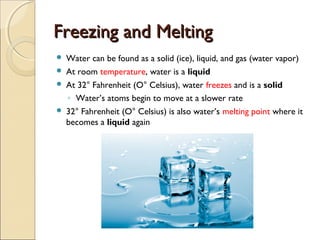
 Water can be found as a solid (ice), liquid, and gas (water vapor)
 At room temperature, water is a liquid
 At 32° Fahrenheit (O° Celsius), water freezes and is a solid
◦ Water’s atoms begin to move at a slower rate
 32° Fahrenheit (O° Celsius) is also water’s melting point where it
becomes a liquid again
EvaporationEvaporation
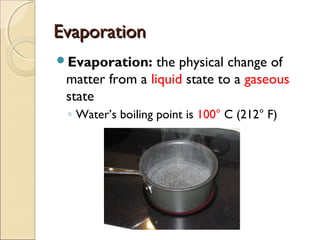
Evaporation: the physical change of
matter from a liquid state to a gaseous
state
◦ Water’s boiling point is 100° C (212° F)
CondensationCondensation
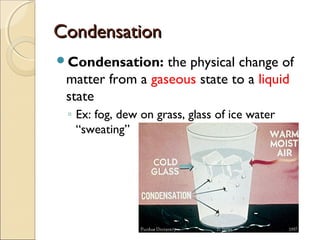
Condensation: the physical change of
matter from a gaseous state to a liquid
state
◦ Ex: fog, dew on grass, glass of ice water
“sweating”
Chemical ChangesChemical Changes
Chemical change: a change in matter that
forms a new substance with different
properties
◦ Chemical changes can’t be reversed
◦ You know it’s a chemical change when it can’t go
back
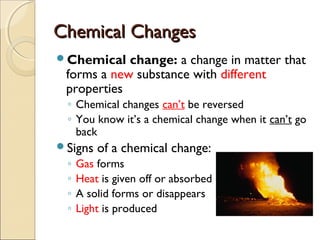
Signs of a chemical change:
◦ Gas forms
◦ Heat is given off or absorbed
◦ A solid forms or disappears
◦ Light is produced
BurningBurning
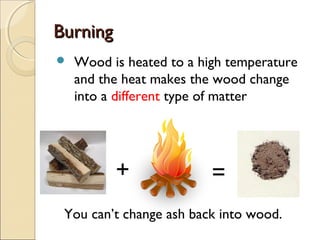
 Wood is heated to a high temperature
and the heat makes the wood change
into a different type of matter
+ =
You can’t change ash back into wood.
““Property Changes” BrainPop VideoProperty Changes” BrainPop Video
and Physical and Chemical Changesand Physical and Chemical Changes
FoldableFoldable

5.6 Physical & Chemical Changes

  • 1.
    Physical and ChemicalChangesPhysical and Chemical Changes 5.6
  • 2.
    Physical ChangesPhysical Changes Physicalchange: when matter changes size, shape, or form ◦ Physical changes can be reversed ◦ You know it is a physical change when you can get it back somehow
  • 3.
    Freezing and MeltingFreezingand Melting  Water can be found as a solid (ice), liquid, and gas (water vapor)  At room temperature, water is a liquid  At 32° Fahrenheit (O° Celsius), water freezes and is a solid ◦ Water’s atoms begin to move at a slower rate  32° Fahrenheit (O° Celsius) is also water’s melting point where it becomes a liquid again
  • 4.
    EvaporationEvaporation Evaporation: the physicalchange of matter from a liquid state to a gaseous state ◦ Water’s boiling point is 100° C (212° F)
  • 5.
    CondensationCondensation Condensation: the physicalchange of matter from a gaseous state to a liquid state ◦ Ex: fog, dew on grass, glass of ice water “sweating”
  • 6.
    Chemical ChangesChemical Changes Chemicalchange: a change in matter that forms a new substance with different properties ◦ Chemical changes can’t be reversed ◦ You know it’s a chemical change when it can’t go back Signs of a chemical change: ◦ Gas forms ◦ Heat is given off or absorbed ◦ A solid forms or disappears ◦ Light is produced
  • 7.
    BurningBurning  Wood isheated to a high temperature and the heat makes the wood change into a different type of matter + = You can’t change ash back into wood.
  • 8.
    ““Property Changes” BrainPopVideoProperty Changes” BrainPop Video and Physical and Chemical Changesand Physical and Chemical Changes FoldableFoldable