An Exploration of Using Mobile Dating Apps
to Go On Real Dates

HCDE 519 Qualitative Research

Spring 2019

Abhinav Yadav, Amy Zhong, Carol Yuan, James Choi
ABSTRACT

Relationship-seekers are taking advantage of dating apps’ accessibility, convenience, and novel features to
explore initial compatibilities with potential matches without face-to-face interaction. But how do these
people transition from online conversations to meeting in real life and building long-term relationships? 

In this study, we aimed to uncover how a first and second date happen when using dating apps. Using a
combination of a diary study and group interview, we uncovered a series of tactics participants adopted to
take them to first dates: utilize heuristics to filter out undesirable matches, monitor the flow of the
conversation, and vet social profiles. We also learned that to get to second dates, chemistry is the key and
hinting at a second date while on the first date is recommended. An awareness of these experiences and
concerns can help dating app companies improve their apps’ user experience and individuals have a
higher chance of meeting matches in person — a step towards building a lasting relationship. 

INTRODUCTION

Couples used to first meet each other in real life, now they “match” online. What was once considered a
“taboo,” the number of couples meeting online has more than doubled in the last decade to about 1-in-5 in
the United States – with much of it credited to dating apps [1]. Apps like Tinder contributed to much of this
phenomenon when it was launched in 2012 as it gamified online dating with its “swipe-right-to-like”
approach [1]. Now there are hundreds of dating apps on app stores worldwide.

While mobile dating apps simplified the process of connecting strangers, the transition from online to
meeting in real life, however, seemed less straightforward as people took different approaches to get to first
dates and second dates – the path towards a longer-term relationship. The goal of our research was to
explore the following two research questions:

● How does a first date happen when using dating apps?

● Subsequently, how does a second date happen for those who met through dating apps?

For our research, a date was defined as matches physically meeting up to learn more about each other. Our
study used phenomenology to understand the “lived experience” of the participants who have used dating
apps. We used a diary study and group interview as our qualitative research methods.

BACKGROUND

Dating apps have become a powerful tool for people seeking new relationships [2] with 40 million
Americans having experienced online dating [4]. People’s attitudes towards online dating has also become
more positive over time. 42% of Americans know an online dater [4] and 23% of them said they have met a
spouse or stayed in a long-term relationship through meeting someone online [3].

Dating apps widens relationship-seekers’ social circle thus enabling them to connect with potential
matches they otherwise would have never crossed paths [5]. The number of people that went on a date
through dating apps in the United States have increased over time from 43% in 2005 to 66% in 2013 [3].
These apps also allow people to put their best foot forward in terms of profiles. Participants in a study
stressed the importance of creating an appealing profile because profile helps them to create a holistic
persona that combines superficial aspects like pictures with aspects of their personality into an easily
consumable form [8][9]. 

Dating apps also come with their own set of issues [4]. For example, people tend to create an exaggerated
persona to appear more attractive online [6]. In a 2012 study on dating deceptions, researchers have found
that males tend to use deception to look more dominant while females project a more favorable physical
appearance than reality [6]. In a 2006 Gibbs et al.study, 86% of participants said they felt physical
appearances were most misrepresented in online dating profiles [4]. Safety is another issue negatively
affecting how people, especially women, using mobile dating apps. 42% of women reported to have
experienced uncomfortable contact by someone via online dating [3]. To mitigate such issues, users often
end up using social networking platforms to get more information about their potential dates [8].

Although there are a significant number of studies focusing on people’s behaviors and perceptions towards
dating apps and tips-and-tricks articles about the best practices to get to that first date, few have looked
into factors that lead to a second date. One of the few studies we found, attributed attitude similarity as the
strongest criteria when it comes to a second date [9]. The goal of our research was to uncover the journey
from dating apps to first dates and then to gain insight on how to successfully reaching the second date. 

METHODS

We chose phenomenology as the grounding methodology for this research. Social Phenomenology as
explored by Alfred Schutz seeks to understand the impact of humanity’s subjective thoughts, inclinations
and judgements towards a given system in society [7]. By understanding our participants’ past experiences
and their current interactions with dating apps, we hoped to explore how they navigate and make sense of
the current dating scene. To unravel the phenomenon, we chose diary study and group interview as our
research methods. 

Our team leveraged our social networks to recruit participants who met the following criteria: 

● At least 18 years old

● Have used or currently use at least one dating app on their mobile phone (required to be currently
using for diary study/not required for group interview)

● Have been on at least one date with a person met through a mobile dating app 

We originally recruited 8 users for the diary study and 5 participants for the group interview. However,
because the topic is quite sensitive and personal, some of our participants ended up backing out of the
group interview and opted for the diary study. In the end, we had 7 total unique participants, 2 for the diary
study and 5 for the group interview, one of which is a researcher on the team. 

Diary study
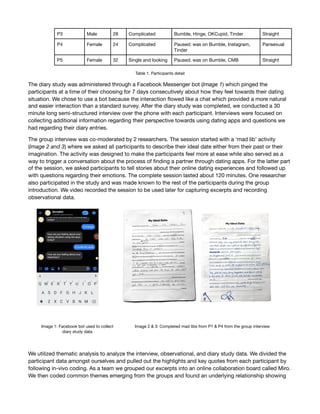
Participant Gender Age Relationship
Status
Dating App Orientation
D1 Female 23 Single and looking Hinge Straight
D2 Female 29 Single and looking Coffee Meets Bagel (CMB) Straight
Group interview
Participant Gender Age Relationship
Status
Dating App Orientation
P1 Female 30 Seeing someone
met on Tinder
Bumble, CMB, Hinge, OKCupid, The
League, Tinder
Straight
P2 Male 27 Single & passively
looking
Paused; was on Bumble, CMB, Tinder Straight
Table 1. Participants detail

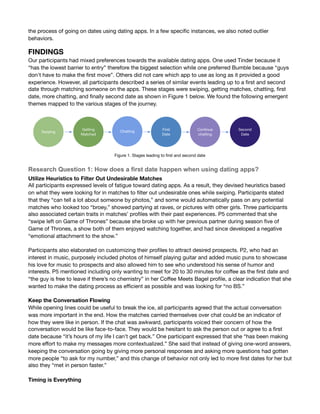
The diary study was administered through a Facebook Messenger bot (Image 1) which pinged the
participants at a time of their choosing for 7 days consecutively about how they feel towards their dating
situation. We chose to use a bot because the interaction flowed like a chat which provided a more natural
and easier interaction than a standard survey. After the diary study was completed, we conducted a 30
minute long semi-structured interview over the phone with each participant. Interviews were focused on
collecting additional information regarding their perspective towards using dating apps and questions we
had regarding their diary entries. 

The group interview was co-moderated by 2 researchers. The session started with a ‘mad lib’ activity
(Image 2 and 3) where we asked all participants to describe their ideal date either from their past or their
imagination. The activity was designed to make the participants feel more at ease while also served as a
way to trigger a conversation about the process of finding a partner through dating apps. For the latter part
of the session, we asked participants to tell stories about their online dating experiences and followed up
with questions regarding their emotions. The complete session lasted about 120 minutes. One researcher
also participated in the study and was made known to the rest of the participants during the group
introduction. We video recorded the session to be used later for capturing excerpts and recording
observational data. 

We utilized thematic analysis to analyze the interview, observational, and diary study data. We divided the
participant data amongst ourselves and pulled out the highlights and key quotes from each participant by
following in-vivo coding. As a team we grouped our excerpts into an online collaboration board called Miro.
We then coded common themes emerging from the groups and found an underlying relationship showing
P3 Male 28 Complicated Bumble, Hinge, OKCupid, Tinder Straight
P4 Female 24 Complicated Paused; was on Bumble, Instagram,
Tinder
Pansexual
P5 Female 32 Single and looking Paused; was on Bumble, CMB Straight
Image 1: Facebook bot used to collect
diary study data
Image 2 & 3: Completed mad libs from P1 & P4 from the group interview
the process of going on dates using dating apps. In a few specific instances, we also noted outlier
behaviors. 

FINDINGS

Our participants had mixed preferences towards the available dating apps. One used Tinder because it
“has the lowest barrier to entry” therefore the biggest selection while one preferred Bumble because “guys
don't have to make the first move”. Others did not care which app to use as long as it provided a good
experience. However, all participants described a series of similar events leading up to a first and second
date through matching someone on the apps. These stages were swiping, getting matches, chatting, first
date, more chatting, and finally second date as shown in Figure 1 below. We found the following emergent
themes mapped to the various stages of the journey.


Figure 1. Stages leading to first and second date

Research Question 1: How does a first date happen when using dating apps?
Utilize Heuristics to Filter Out Undesirable Matches
All participants expressed levels of fatigue toward dating apps. As a result, they devised heuristics based
on what they were looking for in matches to filter out undesirable ones while swiping. Participants stated
that they “can tell a lot about someone by photos,” and some would automatically pass on any potential
matches who looked too “broey,” showed partying at raves, or pictures with other girls. Three participants
also associated certain traits in matches’ profiles with their past experiences. P5 commented that she
“swipe left on Game of Thrones” because she broke up with her previous partner during season five of
Game of Thrones, a show both of them enjoyed watching together, and had since developed a negative
“emotional attachment to the show.”

Participants also elaborated on customizing their profiles to attract desired prospects. P2, who had an
interest in music, purposely included photos of himself playing guitar and added music puns to showcase
his love for music to prospects and also allowed him to see who understood his sense of humor and
interests. P5 mentioned including only wanting to meet for 20 to 30 minutes for coffee as the first date and
“the guy is free to leave if there’s no chemistry” in her Coffee Meets Bagel profile, a clear indication that she
wanted to make the dating process as efficient as possible and was looking for “no BS.” 

Keep the Conversation Flowing
While opening lines could be useful to break the ice, all participants agreed that the actual conversation
was more important in the end. How the matches carried themselves over chat could be an indicator of
how they were like in person. If the chat was awkward, participants voiced their concern of how the
conversation would be like face-to-face. They would be hesitant to ask the person out or agree to a first
date because “it’s hours of my life I can’t get back.” One participant expressed that she “has been making
more effort to make my messages more contextualized.” She said that instead of giving one-word answers,
keeping the conversation going by giving more personal responses and asking more questions had gotten
more people “to ask for my number,” and this change of behavior not only led to more first dates for her but
also they “met in person faster.”


Timing is Everything
One female participant who had used dating apps on and off over the years noticed that recent matches
would ask her out on earlier in the conversation than compare to the past. She, however, was hesitant to
meet them so fast as “seven days of messaging back and forth…usually that’s around the time I feel like
we’ve talked about enough things.” It was interesting to note that this contrasted with the male participants
(P2 & P3) who said they would ask out their matches in two to four days if they feel the conversation was
going well.

Concerns Over Safety & Being Catfished
Participants discussed the need to vet their matches on services such as Facebook, LinkedIn, and Google
before going on a first date. We observed that P1 was particularly firm in voicing her need to feel safe with
a date because she didn’t “want to get kidnapped and end up in a ditch.” P3, on the other hand, was more
concerned about getting catfished and needing the “comfort [of knowing] that someone is who they say
they are.” He found it a “little weird” if someone did not have an online social presence to which most of the
participants nodded their heads in agreement. 

Research Question 2: Subsequently, how does a second date happen for those who met
through dating apps?
Chemistry is Key
To transition from a first date to a second date, participants felt the need of “having chemistry” during the
first date with their match. Chemistry can be defined as a feeling of “having a good time,” wanting to spend
more time with each other, and “get[ting] to know each other more.” Furthermore, all participants
unanimously agreed that “getting each other’s joke” was an important factor of chemistry. That said,
immediate chemistry was not always necessary. P1 was willing to give her date another try, a second date,
stating: “first dates are very awkward.” P5, on the other hand, didn’t even consider chemistry as a
requirement. She based her decisions on her “animalistic instincts” — if she wasn’t physically attracted to
her match’s look or scent first, then it didn’t matter if there was chemistry or not because “attraction cannot
grow over time.” 


Hint at a Second Date During the First Date
When the chemistry did exist, participants mentioned they will casually hint at a future plan to show their
intent and gauge the match’s interest in moving towards a second date. P3 said “If we’re passionate about
something in common like a concert, I’ll say to her like ‘Hey so and so is coming to town. Are you
interested?’ I’m not actually saying it’s a second date. Just putting it out there.” These participants wanted
to be proactive, but not seemed too eager, so they put out feelers to see if the match will show interests
then proceed to ask them out again.


Participants noted that they also drop hints to show there won’t be a second date. If the match insisted on
paying for the bill and the first date was good, participants would eventually let the match pay. If the date
was lacking chemistry, the participant felt strongly about “definitely paying” for her share of the meal (P1).
Another participant nodded in agreement saying she did not want to feel like she owed the date anything.


LIMITATIONS 

Given we had less than 8 weeks to conduct the research, we designed our study based on how we could
most effectively recruit participants, collect and analyze the data. As a result, this could reduce the
transferability of our findings to a larger population. For the diary study, we had to limit it to a 7 day study.
Even then, some of the participants weren’t able to participate everyday or fill out additional information
beyond the prompts. A longer time frame would have allowed us to uncover additional insights and
motivations. We also were only able to recruit friends who lived in urban environments—Seattle and LA. We
believe having a more diverse sample could have provided richer data. And lastly, us being friends with the
participants may or may not have affected how much information the participants were willing to share. 

DISCUSSION

Our study explored how a first and second date happen using dating apps through a qualitative approach.
In Table 2 below, we outlined what is already known and what our study adds. While online dating has
become a favorable way to seek a relationship, people still have concerns of meeting strangers in person
as noted in our research. We believe dating app companies can take advantage of our research to improve
their apps’ user experience. While we can’t guarantee long term relationships, individuals using dating apps
can benefit from our findings to improve their chance of meeting matches in person, a step towards the
right direction. 

Table 2: What is known and what this study adds

While our participants spent a lot of time on dating apps, they all voiced a level of fatigue and frustration
towards using them, saying “it feels like homework.” Bustle, an online lifestyle magazine, surveyed over
500 app users and found similar responses. 65% of the respondents said [swiping] felt like a job [11]. To
overcome fatigue, our participants applied their own heuristics to shortcut the process. Profile photos
played an important heuristic role in influencing participants’ decisions on accepting or rejecting the
potential match, so did their past dating experiences. Dating app companies could benefit from adding or
improving features that take account of these heuristics to help users reach their desired matches faster. 

Dating profiles lack a sense of validity and in order to verify the accuracy of these accounts, all of the
participants conducted social media vetting of their potential matches and this behavior was considered
normal to the extent that Mashable published an article saying “stop acting like you don’t know your Tinder
date’s last name. [13]” The need for social vetting for female participants was predominantly a safety
concerns and for the male participants, they wanted to avoid being catfished. We believe our research
indicated that there are opportunities for dating companies to explore and improve dating transparency. 

Previous studies have established that attitude similarities is a strong indicator of the possibility of a second
date, along with showing genuine interest in the other person by asking them personal questions [12]. Our
participants stated that chemistry was the crucial factor they were looking for, which they primarily defined
as a shared sense of humor, physical attraction, maintaining a conversation etc.

While not directly related to our research question, our participants discussed interesting perspectives on
salient topics like compatibility, attraction, and vulnerability when looking for a partner. Given more time or
as a next step, we would explore these topics more in-depth in follow up studies.

What is known What this study adds
● People use social media to check information about
someone they are interested in dating.

● People use their profiles to communicate their
personality, interests, occupation, relationship goals,
etc.

● Attitude similarities as a strong indicator for a
second date along with showing genuine interest in
the other person.
● Men and women both use social
media as a safety net but for different
purposes. 

● People customize profiles to attract
specific type of people they want to
date.

● Revealed factors through which
participants define “chemistry”
REFERENCES

1. Cardona, F. (2019 March 23). The Rise of Online Dating, and the Company That Dominates the
Market. https://www.visualcapitalist.com/online-dating-big-business/.

2. Whitty, M. T., & Carr, A. N. (2006). Cyberspace romance: The psychology of online relationships.
New York, NY, : Palgrave Macmillan.

3. Smith, A., & Duggan, M. (2013, October 21). Online Dating & Relationships, http://
www.pewinternet.org/2013/10/21/online-dating-relationships/.

4. James, J. (2015, April 10). Mobile Dating in the Digital Age: Computer-Mediated Communication
and Relationship Building on Tinder.

5. Ferdman, R. (2016, March 23). How well online dating works, according to someone who has been
studying it for years. https://www.washingtonpost.com/news/wonk/wp/2016/03/23/the-truth-about-
online-dating-according-to-someone-who-has-been-studying-it-for-years/?
noredirect=on&utm_term=.aefc5cebeb3d.

6. Guadagno, R. E., Okdie, B. M., & Kruse, S. A. (2012). Dating deception: Gender, online dating, and
exaggerated self-presentation. Computers in Human Behavior, Volume 28, Issue 2, Pages 642-647.
http://dx.doi.org/10.1016/j.chb.2011.11.010.

7. Schutz, Alfred. The phenomenology of the social world. Northwestern University Press (1967). 

8. Aaron Smith & Maeve Duggan (2013). Online Dating & Relationships

https://www.pewinternet.org/2013/10/21/online-dating-relationships/

9. Whitty, M.T. (2008). Revealing the ‘real’ me, searching for the ‘actual’ you: Presentations of self on
an internet dating site. http://citeseerx.ist.psu.edu/viewdoc/download?
doi=10.1.1.862.3940&rep=rep1&type=pdf

10. Liesel L. Sharabi & John P. Caughlin (2017). What predicts first date success? A longitudinal study
of modality switching in online dating

https://onlinelibrary.wiley.com/doi/epdf/10.1111/pere.12188

11. Lea Rose Emery (2017, April 02). 7 Signs You Have Dating App Burnout & The Best Way To Deal
With it. https://www.bustle.com/p/7-signs-you-have-dating-app-burnout-the-best-way-to-deal-
with-it-47442 

12. Rachel Hosie (2017, May 20). Asking Questions Is The Key To Getting A Second Date, Study Finds
Showing Genuine interest could help you find love. https://www.independent.co.uk/life-style/love-
sex/asking-questions-nosy-first-date-second-dating-study-harvard-university-love-a7746106.html

13. Peter Allen Clark (2018, Jan 26). Stop acting like you don’t know your Tinder date’s last name.

https://mashable.com/2018/01/26/online-dating-find-someones-last-name/
AUTHOR CONTRIBUTIONS

Abhinav Yadav
I conceptualised the idea of the group interview along with diary study. I wrote the draft paper and
contributed to the methods and discussion section in the final version. I created the Messenger bot to
administer the diary study and was responsible for monitoring the frequency of responses. I coded D1 and
P2’s interview. I recruited D1 and P4. Conducted follow up interview with D1. I wrote the outline for the
research paper, and for the final research paper co-wrote the methods, background and discussion section.

Amy Zhong
I facilitated our team meetings and made sure the team is on track to make our deadlines. I drafted the
consent forms and part of the research and observation plan, including authoring the mad lib exercise and
part of the diary study questionnaires. I recruited half of the participants, handled the interview logistics and
co-moderated the group interview. I also conducted one of the two diary study follow up interviews. I
coded D2 and P5’s interview and observation sessions and collaborated with the team to organize and
group codes into themes. I designed the final presentation, authored and presented the background and
discussion section. For the research paper. I covered part of the findings and limitations. Lastly, I
contributed to editing, proofreading, formatting of the final paper and for past assignments as well.

Carol Yuan
I helped with and took notes on the group interview and took down key notes on all participants. I then
coded group interview data on P4 and participated in the organization and grouping of the codes into
themes and collective thematic analysis. I presented the first half the findings section of the presentation. I
then wrote the background and discussion section of the research paper.

James Choi
I contributed in all in-class and outside class meetings. I coordinated meetings and booked rooms. I edited
the consent form based on changes to our research methods. I wrote and edited sections of the research
plan, interview/data collection guide, and group presentation slides. I co-prepared and co-ran the group
interview. I took detailed notes with time stamps of all participants of the group interview. I coded P1 and
P3’s group interviews. I co-wrote the abstract, introduction, and findings of the final paper. I helped format
and proofread the final paper.

519 final research paper

  • 1.
    An Exploration ofUsing Mobile Dating Apps to Go On Real Dates HCDE 519 Qualitative Research Spring 2019 Abhinav Yadav, Amy Zhong, Carol Yuan, James Choi
  • 2.
    ABSTRACT
 Relationship-seekers are takingadvantage of dating apps’ accessibility, convenience, and novel features to explore initial compatibilities with potential matches without face-to-face interaction. But how do these people transition from online conversations to meeting in real life and building long-term relationships? In this study, we aimed to uncover how a first and second date happen when using dating apps. Using a combination of a diary study and group interview, we uncovered a series of tactics participants adopted to take them to first dates: utilize heuristics to filter out undesirable matches, monitor the flow of the conversation, and vet social profiles. We also learned that to get to second dates, chemistry is the key and hinting at a second date while on the first date is recommended. An awareness of these experiences and concerns can help dating app companies improve their apps’ user experience and individuals have a higher chance of meeting matches in person — a step towards building a lasting relationship. INTRODUCTION
 Couples used to first meet each other in real life, now they “match” online. What was once considered a “taboo,” the number of couples meeting online has more than doubled in the last decade to about 1-in-5 in the United States – with much of it credited to dating apps [1]. Apps like Tinder contributed to much of this phenomenon when it was launched in 2012 as it gamified online dating with its “swipe-right-to-like” approach [1]. Now there are hundreds of dating apps on app stores worldwide. While mobile dating apps simplified the process of connecting strangers, the transition from online to meeting in real life, however, seemed less straightforward as people took different approaches to get to first dates and second dates – the path towards a longer-term relationship. The goal of our research was to explore the following two research questions: ● How does a first date happen when using dating apps? ● Subsequently, how does a second date happen for those who met through dating apps? For our research, a date was defined as matches physically meeting up to learn more about each other. Our study used phenomenology to understand the “lived experience” of the participants who have used dating apps. We used a diary study and group interview as our qualitative research methods. BACKGROUND
 Dating apps have become a powerful tool for people seeking new relationships [2] with 40 million Americans having experienced online dating [4]. People’s attitudes towards online dating has also become more positive over time. 42% of Americans know an online dater [4] and 23% of them said they have met a spouse or stayed in a long-term relationship through meeting someone online [3]. Dating apps widens relationship-seekers’ social circle thus enabling them to connect with potential matches they otherwise would have never crossed paths [5]. The number of people that went on a date through dating apps in the United States have increased over time from 43% in 2005 to 66% in 2013 [3]. These apps also allow people to put their best foot forward in terms of profiles. Participants in a study stressed the importance of creating an appealing profile because profile helps them to create a holistic persona that combines superficial aspects like pictures with aspects of their personality into an easily consumable form [8][9]. Dating apps also come with their own set of issues [4]. For example, people tend to create an exaggerated persona to appear more attractive online [6]. In a 2012 study on dating deceptions, researchers have found
  • 3.
    that males tendto use deception to look more dominant while females project a more favorable physical appearance than reality [6]. In a 2006 Gibbs et al.study, 86% of participants said they felt physical appearances were most misrepresented in online dating profiles [4]. Safety is another issue negatively affecting how people, especially women, using mobile dating apps. 42% of women reported to have experienced uncomfortable contact by someone via online dating [3]. To mitigate such issues, users often end up using social networking platforms to get more information about their potential dates [8]. Although there are a significant number of studies focusing on people’s behaviors and perceptions towards dating apps and tips-and-tricks articles about the best practices to get to that first date, few have looked into factors that lead to a second date. One of the few studies we found, attributed attitude similarity as the strongest criteria when it comes to a second date [9]. The goal of our research was to uncover the journey from dating apps to first dates and then to gain insight on how to successfully reaching the second date. 
 METHODS
 We chose phenomenology as the grounding methodology for this research. Social Phenomenology as explored by Alfred Schutz seeks to understand the impact of humanity’s subjective thoughts, inclinations and judgements towards a given system in society [7]. By understanding our participants’ past experiences and their current interactions with dating apps, we hoped to explore how they navigate and make sense of the current dating scene. To unravel the phenomenon, we chose diary study and group interview as our research methods. Our team leveraged our social networks to recruit participants who met the following criteria: ● At least 18 years old ● Have used or currently use at least one dating app on their mobile phone (required to be currently using for diary study/not required for group interview) ● Have been on at least one date with a person met through a mobile dating app We originally recruited 8 users for the diary study and 5 participants for the group interview. However, because the topic is quite sensitive and personal, some of our participants ended up backing out of the group interview and opted for the diary study. In the end, we had 7 total unique participants, 2 for the diary study and 5 for the group interview, one of which is a researcher on the team. Diary study Participant Gender Age Relationship Status Dating App Orientation D1 Female 23 Single and looking Hinge Straight D2 Female 29 Single and looking Coffee Meets Bagel (CMB) Straight Group interview Participant Gender Age Relationship Status Dating App Orientation P1 Female 30 Seeing someone met on Tinder Bumble, CMB, Hinge, OKCupid, The League, Tinder Straight P2 Male 27 Single & passively looking Paused; was on Bumble, CMB, Tinder Straight
  • 4.
    Table 1. Participantsdetail The diary study was administered through a Facebook Messenger bot (Image 1) which pinged the participants at a time of their choosing for 7 days consecutively about how they feel towards their dating situation. We chose to use a bot because the interaction flowed like a chat which provided a more natural and easier interaction than a standard survey. After the diary study was completed, we conducted a 30 minute long semi-structured interview over the phone with each participant. Interviews were focused on collecting additional information regarding their perspective towards using dating apps and questions we had regarding their diary entries. The group interview was co-moderated by 2 researchers. The session started with a ‘mad lib’ activity (Image 2 and 3) where we asked all participants to describe their ideal date either from their past or their imagination. The activity was designed to make the participants feel more at ease while also served as a way to trigger a conversation about the process of finding a partner through dating apps. For the latter part of the session, we asked participants to tell stories about their online dating experiences and followed up with questions regarding their emotions. The complete session lasted about 120 minutes. One researcher also participated in the study and was made known to the rest of the participants during the group introduction. We video recorded the session to be used later for capturing excerpts and recording observational data. We utilized thematic analysis to analyze the interview, observational, and diary study data. We divided the participant data amongst ourselves and pulled out the highlights and key quotes from each participant by following in-vivo coding. As a team we grouped our excerpts into an online collaboration board called Miro. We then coded common themes emerging from the groups and found an underlying relationship showing P3 Male 28 Complicated Bumble, Hinge, OKCupid, Tinder Straight P4 Female 24 Complicated Paused; was on Bumble, Instagram, Tinder Pansexual P5 Female 32 Single and looking Paused; was on Bumble, CMB Straight Image 1: Facebook bot used to collect diary study data Image 2 & 3: Completed mad libs from P1 & P4 from the group interview
  • 5.
    the process ofgoing on dates using dating apps. In a few specific instances, we also noted outlier behaviors. FINDINGS
 Our participants had mixed preferences towards the available dating apps. One used Tinder because it “has the lowest barrier to entry” therefore the biggest selection while one preferred Bumble because “guys don't have to make the first move”. Others did not care which app to use as long as it provided a good experience. However, all participants described a series of similar events leading up to a first and second date through matching someone on the apps. These stages were swiping, getting matches, chatting, first date, more chatting, and finally second date as shown in Figure 1 below. We found the following emergent themes mapped to the various stages of the journey. Figure 1. Stages leading to first and second date Research Question 1: How does a first date happen when using dating apps? Utilize Heuristics to Filter Out Undesirable Matches All participants expressed levels of fatigue toward dating apps. As a result, they devised heuristics based on what they were looking for in matches to filter out undesirable ones while swiping. Participants stated that they “can tell a lot about someone by photos,” and some would automatically pass on any potential matches who looked too “broey,” showed partying at raves, or pictures with other girls. Three participants also associated certain traits in matches’ profiles with their past experiences. P5 commented that she “swipe left on Game of Thrones” because she broke up with her previous partner during season five of Game of Thrones, a show both of them enjoyed watching together, and had since developed a negative “emotional attachment to the show.” Participants also elaborated on customizing their profiles to attract desired prospects. P2, who had an interest in music, purposely included photos of himself playing guitar and added music puns to showcase his love for music to prospects and also allowed him to see who understood his sense of humor and interests. P5 mentioned including only wanting to meet for 20 to 30 minutes for coffee as the first date and “the guy is free to leave if there’s no chemistry” in her Coffee Meets Bagel profile, a clear indication that she wanted to make the dating process as efficient as possible and was looking for “no BS.” Keep the Conversation Flowing While opening lines could be useful to break the ice, all participants agreed that the actual conversation was more important in the end. How the matches carried themselves over chat could be an indicator of how they were like in person. If the chat was awkward, participants voiced their concern of how the conversation would be like face-to-face. They would be hesitant to ask the person out or agree to a first date because “it’s hours of my life I can’t get back.” One participant expressed that she “has been making more effort to make my messages more contextualized.” She said that instead of giving one-word answers, keeping the conversation going by giving more personal responses and asking more questions had gotten more people “to ask for my number,” and this change of behavior not only led to more first dates for her but also they “met in person faster.” Timing is Everything
  • 6.
    One female participantwho had used dating apps on and off over the years noticed that recent matches would ask her out on earlier in the conversation than compare to the past. She, however, was hesitant to meet them so fast as “seven days of messaging back and forth…usually that’s around the time I feel like we’ve talked about enough things.” It was interesting to note that this contrasted with the male participants (P2 & P3) who said they would ask out their matches in two to four days if they feel the conversation was going well. Concerns Over Safety & Being Catfished Participants discussed the need to vet their matches on services such as Facebook, LinkedIn, and Google before going on a first date. We observed that P1 was particularly firm in voicing her need to feel safe with a date because she didn’t “want to get kidnapped and end up in a ditch.” P3, on the other hand, was more concerned about getting catfished and needing the “comfort [of knowing] that someone is who they say they are.” He found it a “little weird” if someone did not have an online social presence to which most of the participants nodded their heads in agreement. Research Question 2: Subsequently, how does a second date happen for those who met through dating apps? Chemistry is Key To transition from a first date to a second date, participants felt the need of “having chemistry” during the first date with their match. Chemistry can be defined as a feeling of “having a good time,” wanting to spend more time with each other, and “get[ting] to know each other more.” Furthermore, all participants unanimously agreed that “getting each other’s joke” was an important factor of chemistry. That said, immediate chemistry was not always necessary. P1 was willing to give her date another try, a second date, stating: “first dates are very awkward.” P5, on the other hand, didn’t even consider chemistry as a requirement. She based her decisions on her “animalistic instincts” — if she wasn’t physically attracted to her match’s look or scent first, then it didn’t matter if there was chemistry or not because “attraction cannot grow over time.” Hint at a Second Date During the First Date When the chemistry did exist, participants mentioned they will casually hint at a future plan to show their intent and gauge the match’s interest in moving towards a second date. P3 said “If we’re passionate about something in common like a concert, I’ll say to her like ‘Hey so and so is coming to town. Are you interested?’ I’m not actually saying it’s a second date. Just putting it out there.” These participants wanted to be proactive, but not seemed too eager, so they put out feelers to see if the match will show interests then proceed to ask them out again. Participants noted that they also drop hints to show there won’t be a second date. If the match insisted on paying for the bill and the first date was good, participants would eventually let the match pay. If the date was lacking chemistry, the participant felt strongly about “definitely paying” for her share of the meal (P1). Another participant nodded in agreement saying she did not want to feel like she owed the date anything. LIMITATIONS 
 Given we had less than 8 weeks to conduct the research, we designed our study based on how we could most effectively recruit participants, collect and analyze the data. As a result, this could reduce the transferability of our findings to a larger population. For the diary study, we had to limit it to a 7 day study. Even then, some of the participants weren’t able to participate everyday or fill out additional information beyond the prompts. A longer time frame would have allowed us to uncover additional insights and motivations. We also were only able to recruit friends who lived in urban environments—Seattle and LA. We
  • 7.
    believe having amore diverse sample could have provided richer data. And lastly, us being friends with the participants may or may not have affected how much information the participants were willing to share. DISCUSSION
 Our study explored how a first and second date happen using dating apps through a qualitative approach. In Table 2 below, we outlined what is already known and what our study adds. While online dating has become a favorable way to seek a relationship, people still have concerns of meeting strangers in person as noted in our research. We believe dating app companies can take advantage of our research to improve their apps’ user experience. While we can’t guarantee long term relationships, individuals using dating apps can benefit from our findings to improve their chance of meeting matches in person, a step towards the right direction. Table 2: What is known and what this study adds While our participants spent a lot of time on dating apps, they all voiced a level of fatigue and frustration towards using them, saying “it feels like homework.” Bustle, an online lifestyle magazine, surveyed over 500 app users and found similar responses. 65% of the respondents said [swiping] felt like a job [11]. To overcome fatigue, our participants applied their own heuristics to shortcut the process. Profile photos played an important heuristic role in influencing participants’ decisions on accepting or rejecting the potential match, so did their past dating experiences. Dating app companies could benefit from adding or improving features that take account of these heuristics to help users reach their desired matches faster. Dating profiles lack a sense of validity and in order to verify the accuracy of these accounts, all of the participants conducted social media vetting of their potential matches and this behavior was considered normal to the extent that Mashable published an article saying “stop acting like you don’t know your Tinder date’s last name. [13]” The need for social vetting for female participants was predominantly a safety concerns and for the male participants, they wanted to avoid being catfished. We believe our research indicated that there are opportunities for dating companies to explore and improve dating transparency. Previous studies have established that attitude similarities is a strong indicator of the possibility of a second date, along with showing genuine interest in the other person by asking them personal questions [12]. Our participants stated that chemistry was the crucial factor they were looking for, which they primarily defined as a shared sense of humor, physical attraction, maintaining a conversation etc. While not directly related to our research question, our participants discussed interesting perspectives on salient topics like compatibility, attraction, and vulnerability when looking for a partner. Given more time or as a next step, we would explore these topics more in-depth in follow up studies. What is known What this study adds ● People use social media to check information about someone they are interested in dating. ● People use their profiles to communicate their personality, interests, occupation, relationship goals, etc. ● Attitude similarities as a strong indicator for a second date along with showing genuine interest in the other person. ● Men and women both use social media as a safety net but for different purposes. ● People customize profiles to attract specific type of people they want to date. ● Revealed factors through which participants define “chemistry”
  • 8.
    REFERENCES 1. Cardona, F.(2019 March 23). The Rise of Online Dating, and the Company That Dominates the Market. https://www.visualcapitalist.com/online-dating-big-business/. 2. Whitty, M. T., & Carr, A. N. (2006). Cyberspace romance: The psychology of online relationships. New York, NY, : Palgrave Macmillan. 3. Smith, A., & Duggan, M. (2013, October 21). Online Dating & Relationships, http:// www.pewinternet.org/2013/10/21/online-dating-relationships/. 4. James, J. (2015, April 10). Mobile Dating in the Digital Age: Computer-Mediated Communication and Relationship Building on Tinder. 5. Ferdman, R. (2016, March 23). How well online dating works, according to someone who has been studying it for years. https://www.washingtonpost.com/news/wonk/wp/2016/03/23/the-truth-about- online-dating-according-to-someone-who-has-been-studying-it-for-years/? noredirect=on&utm_term=.aefc5cebeb3d. 6. Guadagno, R. E., Okdie, B. M., & Kruse, S. A. (2012). Dating deception: Gender, online dating, and exaggerated self-presentation. Computers in Human Behavior, Volume 28, Issue 2, Pages 642-647. http://dx.doi.org/10.1016/j.chb.2011.11.010. 7. Schutz, Alfred. The phenomenology of the social world. Northwestern University Press (1967). 8. Aaron Smith & Maeve Duggan (2013). Online Dating & Relationships
 https://www.pewinternet.org/2013/10/21/online-dating-relationships/ 9. Whitty, M.T. (2008). Revealing the ‘real’ me, searching for the ‘actual’ you: Presentations of self on an internet dating site. http://citeseerx.ist.psu.edu/viewdoc/download? doi=10.1.1.862.3940&rep=rep1&type=pdf 10. Liesel L. Sharabi & John P. Caughlin (2017). What predicts first date success? A longitudinal study of modality switching in online dating
 https://onlinelibrary.wiley.com/doi/epdf/10.1111/pere.12188 11. Lea Rose Emery (2017, April 02). 7 Signs You Have Dating App Burnout & The Best Way To Deal With it. https://www.bustle.com/p/7-signs-you-have-dating-app-burnout-the-best-way-to-deal- with-it-47442 12. Rachel Hosie (2017, May 20). Asking Questions Is The Key To Getting A Second Date, Study Finds Showing Genuine interest could help you find love. https://www.independent.co.uk/life-style/love- sex/asking-questions-nosy-first-date-second-dating-study-harvard-university-love-a7746106.html 13. Peter Allen Clark (2018, Jan 26). Stop acting like you don’t know your Tinder date’s last name.
 https://mashable.com/2018/01/26/online-dating-find-someones-last-name/
  • 9.
    AUTHOR CONTRIBUTIONS Abhinav Yadav Iconceptualised the idea of the group interview along with diary study. I wrote the draft paper and contributed to the methods and discussion section in the final version. I created the Messenger bot to administer the diary study and was responsible for monitoring the frequency of responses. I coded D1 and P2’s interview. I recruited D1 and P4. Conducted follow up interview with D1. I wrote the outline for the research paper, and for the final research paper co-wrote the methods, background and discussion section. Amy Zhong I facilitated our team meetings and made sure the team is on track to make our deadlines. I drafted the consent forms and part of the research and observation plan, including authoring the mad lib exercise and part of the diary study questionnaires. I recruited half of the participants, handled the interview logistics and co-moderated the group interview. I also conducted one of the two diary study follow up interviews. I coded D2 and P5’s interview and observation sessions and collaborated with the team to organize and group codes into themes. I designed the final presentation, authored and presented the background and discussion section. For the research paper. I covered part of the findings and limitations. Lastly, I contributed to editing, proofreading, formatting of the final paper and for past assignments as well. Carol Yuan I helped with and took notes on the group interview and took down key notes on all participants. I then coded group interview data on P4 and participated in the organization and grouping of the codes into themes and collective thematic analysis. I presented the first half the findings section of the presentation. I then wrote the background and discussion section of the research paper. James Choi I contributed in all in-class and outside class meetings. I coordinated meetings and booked rooms. I edited the consent form based on changes to our research methods. I wrote and edited sections of the research plan, interview/data collection guide, and group presentation slides. I co-prepared and co-ran the group interview. I took detailed notes with time stamps of all participants of the group interview. I coded P1 and P3’s group interviews. I co-wrote the abstract, introduction, and findings of the final paper. I helped format and proofread the final paper.