| | 1
by Julian Kalac, P.Eng
Lean Six Sigma Master Black Belt
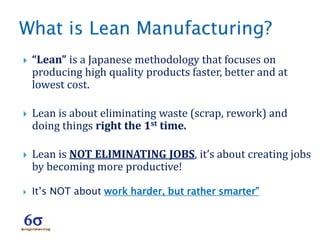
 “Lean” is a Japanese methodology that focuses on
producing high quality products faster, better and at
lowest cost.
 Lean is about eliminating waste (scrap, rework) and
doing things right the 1st time.
 Lean is NOT ELIMINATING JOBS, it’s about creating jobs
by becoming more productive!
 It’s NOT about work harder, but rather smarter”
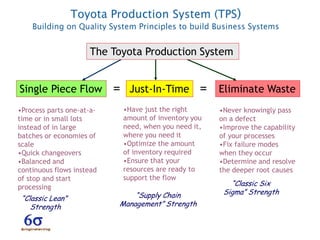
Single Piece Flow Just-In-Time Eliminate Waste
•Process parts one-at-a-
time or in small lots
instead of in large
batches or economies of
scale
•Quick changeovers
•Balanced and
continuous flows instead
of stop and start
processing
•Have just the right
amount of inventory you
need, when you need it,
where you need it
•Optimize the amount
of inventory required
•Ensure that your
resources are ready to
support the flow
•Never knowingly pass
on a defect
•Improve the capability
of your processes
•Fix failure modes
when they occur
•Determine and resolve
the deeper root causes
= =
The Toyota Production System
“Classic Lean”
Strength
“Supply Chain
Management” Strength
“Classic Six
Sigma” Strength
| | 4
 Customers demand shorter lead times,
improved quality & reduced prices
 Increase through-put and quality and reduce
time wasted and frustration by working on non-
value add activities.
 Gain new business
| | 5
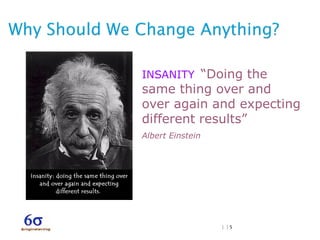
INSANITY “Doing the
same thing over and
over again and expecting
different results”
Albert Einstein
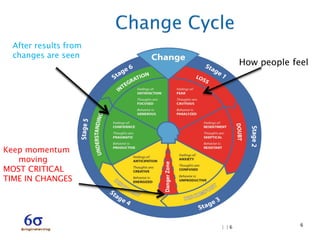
| | 6 6
How people feel
Keep momentum
moving
MOST CRITICAL
TIME IN CHANGES
After results from
changes are seen
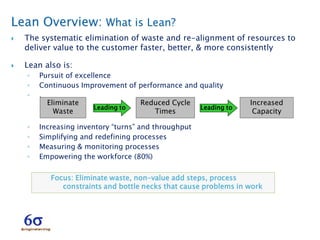
 The systematic elimination of waste and re-alignment of resources to
deliver value to the customer faster, better, & more consistently
 Lean also is:
◦ Pursuit of excellence
◦ Continuous Improvement of performance and quality
◦ .
◦ Increasing inventory “turns” and throughput
◦ Simplifying and redefining processes
◦ Measuring & monitoring processes
◦ Empowering the workforce (80%)
Leading to Leading to
Eliminate
Waste
Reduced Cycle
Times
Increased
Capacity
Focus: Eliminate waste, non-value add steps, process
constraints and bottle necks that cause problems in work
| | 8
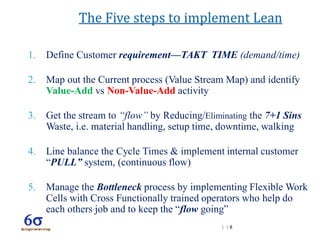
1. Define Customer requirement—TAKT TIME (demand/time)
2. Map out the Current process (Value Stream Map) and identify
Value-Add vs Non-Value-Add activity
3. Get the stream to “flow” by Reducing/Eliminating the 7+1 Sins
Waste, i.e. material handling, setup time, downtime, walking
4. Line balance the Cycle Times & implement internal customer
“PULL” system, (continuous flow)
5. Manage the Bottleneck process by implementing Flexible Work
Cells with Cross Functionally trained operators who help do
each others job and to keep the “flow going”
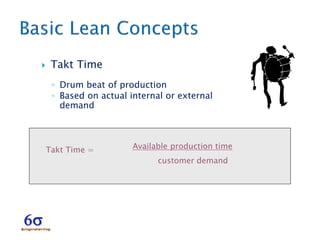
 Takt Time
◦ Drum beat of production
◦ Based on actual internal or external
demand
Available production time
customer demand
Takt Time =
| | 10
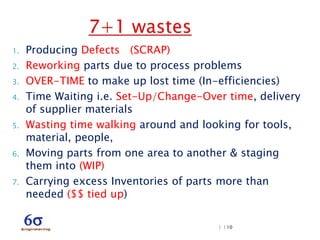
1. Producing Defects (SCRAP)
2. Reworking parts due to process problems
3. OVER-TIME to make up lost time (In-efficiencies)
4. Time Waiting i.e. Set-Up/Change-Over time, delivery
of supplier materials
5. Wasting time walking around and looking for tools,
material, people,
6. Moving parts from one area to another & staging
them into (WIP)
7. Carrying excess Inventories of parts more than
needed ($$ tied up)
| | 11
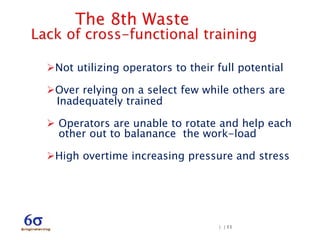
Not utilizing operators to their full potential
Over relying on a select few while others are
Inadequately trained
 Operators are unable to rotate and help each
other out to balanance the work-load
High overtime increasing pressure and stress
 Elements of Lead Time
◦ Lead Time = total process time from
initiation to design to build to ship to
payment
◦ Batch & Queue – Accumulate orders, then
wait to be processed
◦ Setup time – prepare to process next job
◦ Run time – processing time per unit
 Often less than 1% of cycle time
 Only value added step of Lead time
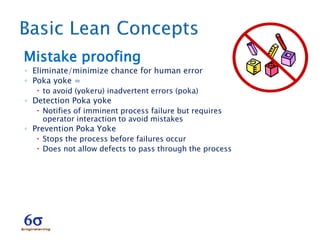
Mistake proofing
◦ Eliminate/minimize chance for human error
◦ Poka yoke =
 to avoid (yokeru) inadvertent errors (poka)
◦ Detection Poka yoke
 Notifies of imminent process failure but requires
operator interaction to avoid mistakes
◦ Prevention Poka Yoke
 Stops the process before failures occur
 Does not allow defects to pass through the process
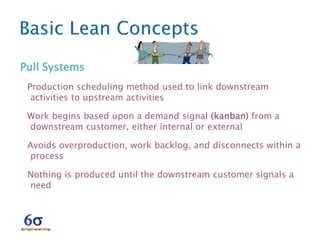
Pull Systems
Production scheduling method used to link downstream
activities to upstream activities
Work begins based upon a demand signal (kanban) from a
downstream customer, either internal or external
Avoids overproduction, work backlog, and disconnects within a
process
Nothing is produced until the downstream customer signals a
need
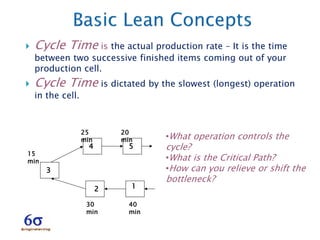
 Cycle Time is the actual production rate – It is the time
between two successive finished items coming out of your
production cell.
 Cycle Time is dictated by the slowest (longest) operation
in the cell.
40
min
20
min
25
min
15
min
30
min
1
54
3
2
•What operation controls the
cycle?
•What is the Critical Path?
•How can you relieve or shift the
bottleneck?
| | 16
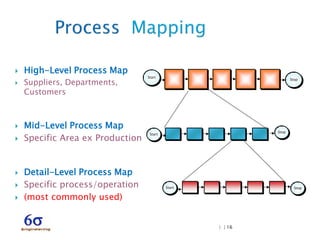
 High-Level Process Map
 Suppliers, Departments,
Customers
 Mid-Level Process Map
 Specific Area ex Production
 Detail-Level Process Map
 Specific process/operation
 (most commonly used)
Stop
Start
Stop
Start
Start
Stop
Stop
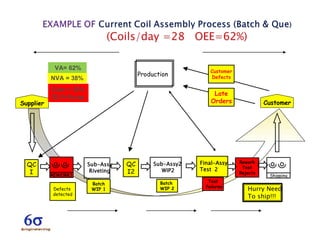
Customer
Batch
WIP 1
Test
failures
Batch
WIP 2
Production
Defects
detected
Customer
Defects
Late
Orders
QC
I
Rework
Test
Rejects
QC
I2REWORK1
Sub-Assy
Riveting
Shipping
Supplier
Sub-Assy2
WIP2
Final-Assy
Test 2
Hurry Need
To ship!!!
NVA = 38%
Cost = 32%
DLV+Scrap
VA= 62%
| | 18
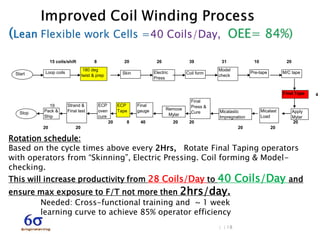
15 coils/shift 8 20 26 39 31 10 20
4
13
19
20 8 40 20 20 20
20 20 20 20
Start Loop coils
180 deg
twist & prep
Skin Electric
Press
Coil form
Model
check
M/C tapePre-tape
Final Tape
Apply
Mylar
Micalast
Load
Micalastic
Impregnation
Final
Press &
Cure
Remove
Mylar
Final
gauge
ECP
Tape
ECP
oven
cure
Strand &
Final testPack &
Ship
Stop
Rotation schedule:
Based on the cycle times above every 2Hrs, Rotate Final Taping operators
with operators from “Skinning”, Electric Pressing. Coil forming & Model-
checking.
This will increase productivity from 28 Coils/Day to 40 Coils/Day and
ensure max exposure to F/T not more then 2hrs/day.
Needed: Cross-functional training and ~ 1 week
learning curve to achieve 85% operator efficiency
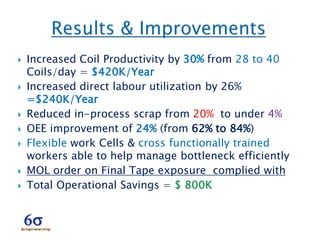
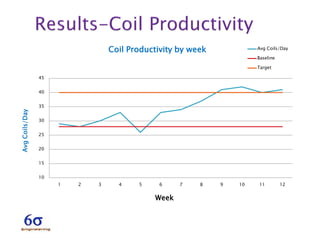
 Increased Coil Productivity by 30% from 28 to 40
Coils/day = $420K/Year
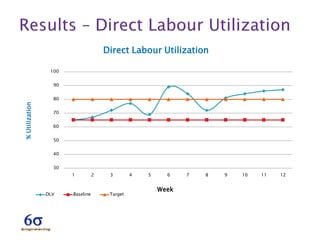
 Increased direct labour utilization by 26%
=$240K/Year
 Reduced in-process scrap from 20% to under 4%
 OEE improvement of 24% (from 62% to 84%)
 Flexible work Cells & cross functionally trained
workers able to help manage bottleneck efficiently
 MOL order on Final Tape exposure complied with
 Total Operational Savings = $ 800K
 Workers can do each others work, help out when
someone is sick, on holidays, quit
 Workers help improve bottleneck operations by
helping out each other
 Variety in work making it more full-filling
 Training new workers
| | 20
10
15
20
25
30
35
40
45
1 2 3 4 5 6 7 8 9 10 11 12
AvgCoils/Day
Week
Coil Productivity by week Avg Coils/Day
Baseline
Target
30
40
50
60
70
80
90
100
1 2 3 4 5 6 7 8 9 10 11 12
Direct Labour Utilization
DLV Baseline Target
Week
%Utilization
| | 23
 Setup Time
◦ Starts when last piece of previous job is complete; ends when
first good piece of next job is complete
 Internal set-up: While machine is shut-down
◦ Strive to minimize this as process is not producing parts
 External set-up: While machine is working
◦ Prepare for set-up, get all tools/parts needed ready and
beside the press before starting set-up
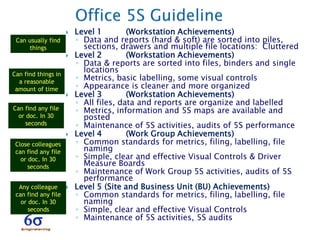
 Level 1 (Workstation Achievements)
◦ Data and reports (hard & soft) are sorted into piles,
sections, drawers and multiple file locations: Cluttered
 Level 2 (Workstation Achievements)
◦ Data & reports are sorted into files, binders and single
locations
◦ Metrics, basic labelling, some visual controls
◦ Appearance is cleaner and more organized
 Level 3 (Workstation Achievements)
◦ All files, data and reports are organize and labelled
◦ Metrics, information and 5S maps are available and
posted
◦ Maintenance of 5S activities, audits of 5S performance
 Level 4 (Work Group Achievements)
◦ Common standards for metrics, filing, labelling, file
naming
◦ Simple, clear and effective Visual Controls & Driver
Measure Boards
◦ Maintenance of Work Group 5S activities, audits of 5S
performance
 Level 5 (Site and Business Unit (BU) Achievements)
◦ Common standards for metrics, filing, labelling, file
naming
◦ Simple, clear and effective Visual Controls
◦ Maintenance of 5S activities, 5S audits
Can usually find
things
Can find things in
a reasonable
amount of time
Can find any file
or doc. In 30
seconds
Close colleagues
can find any file
or doc. In 30
seconds
Any colleague
can find any file
or doc. In 30
seconds
| | 25

5 Steps to implementing Lean

  • 1.
    | | 1 byJulian Kalac, P.Eng Lean Six Sigma Master Black Belt
  • 2.
     “Lean” isa Japanese methodology that focuses on producing high quality products faster, better and at lowest cost.  Lean is about eliminating waste (scrap, rework) and doing things right the 1st time.  Lean is NOT ELIMINATING JOBS, it’s about creating jobs by becoming more productive!  It’s NOT about work harder, but rather smarter”
  • 3.
    Single Piece FlowJust-In-Time Eliminate Waste •Process parts one-at-a- time or in small lots instead of in large batches or economies of scale •Quick changeovers •Balanced and continuous flows instead of stop and start processing •Have just the right amount of inventory you need, when you need it, where you need it •Optimize the amount of inventory required •Ensure that your resources are ready to support the flow •Never knowingly pass on a defect •Improve the capability of your processes •Fix failure modes when they occur •Determine and resolve the deeper root causes = = The Toyota Production System “Classic Lean” Strength “Supply Chain Management” Strength “Classic Six Sigma” Strength
  • 4.
    | | 4 Customers demand shorter lead times, improved quality & reduced prices  Increase through-put and quality and reduce time wasted and frustration by working on non- value add activities.  Gain new business
  • 5.
    | | 5 INSANITY“Doing the same thing over and over again and expecting different results” Albert Einstein
  • 6.
    | | 66 How people feel Keep momentum moving MOST CRITICAL TIME IN CHANGES After results from changes are seen
  • 7.
     The systematicelimination of waste and re-alignment of resources to deliver value to the customer faster, better, & more consistently  Lean also is: ◦ Pursuit of excellence ◦ Continuous Improvement of performance and quality ◦ . ◦ Increasing inventory “turns” and throughput ◦ Simplifying and redefining processes ◦ Measuring & monitoring processes ◦ Empowering the workforce (80%) Leading to Leading to Eliminate Waste Reduced Cycle Times Increased Capacity Focus: Eliminate waste, non-value add steps, process constraints and bottle necks that cause problems in work
  • 8.
    | | 8 1.Define Customer requirement—TAKT TIME (demand/time) 2. Map out the Current process (Value Stream Map) and identify Value-Add vs Non-Value-Add activity 3. Get the stream to “flow” by Reducing/Eliminating the 7+1 Sins Waste, i.e. material handling, setup time, downtime, walking 4. Line balance the Cycle Times & implement internal customer “PULL” system, (continuous flow) 5. Manage the Bottleneck process by implementing Flexible Work Cells with Cross Functionally trained operators who help do each others job and to keep the “flow going”
  • 9.
     Takt Time ◦Drum beat of production ◦ Based on actual internal or external demand Available production time customer demand Takt Time =
  • 10.
    | | 10 1.Producing Defects (SCRAP) 2. Reworking parts due to process problems 3. OVER-TIME to make up lost time (In-efficiencies) 4. Time Waiting i.e. Set-Up/Change-Over time, delivery of supplier materials 5. Wasting time walking around and looking for tools, material, people, 6. Moving parts from one area to another & staging them into (WIP) 7. Carrying excess Inventories of parts more than needed ($$ tied up)
  • 11.
    | | 11 Notutilizing operators to their full potential Over relying on a select few while others are Inadequately trained  Operators are unable to rotate and help each other out to balanance the work-load High overtime increasing pressure and stress
  • 12.
     Elements ofLead Time ◦ Lead Time = total process time from initiation to design to build to ship to payment ◦ Batch & Queue – Accumulate orders, then wait to be processed ◦ Setup time – prepare to process next job ◦ Run time – processing time per unit  Often less than 1% of cycle time  Only value added step of Lead time
  • 13.
    Mistake proofing ◦ Eliminate/minimizechance for human error ◦ Poka yoke =  to avoid (yokeru) inadvertent errors (poka) ◦ Detection Poka yoke  Notifies of imminent process failure but requires operator interaction to avoid mistakes ◦ Prevention Poka Yoke  Stops the process before failures occur  Does not allow defects to pass through the process
  • 14.
    Pull Systems Production schedulingmethod used to link downstream activities to upstream activities Work begins based upon a demand signal (kanban) from a downstream customer, either internal or external Avoids overproduction, work backlog, and disconnects within a process Nothing is produced until the downstream customer signals a need
  • 15.
     Cycle Timeis the actual production rate – It is the time between two successive finished items coming out of your production cell.  Cycle Time is dictated by the slowest (longest) operation in the cell. 40 min 20 min 25 min 15 min 30 min 1 54 3 2 •What operation controls the cycle? •What is the Critical Path? •How can you relieve or shift the bottleneck?
  • 16.
    | | 16 High-Level Process Map  Suppliers, Departments, Customers  Mid-Level Process Map  Specific Area ex Production  Detail-Level Process Map  Specific process/operation  (most commonly used) Stop Start Stop Start Start Stop Stop
  • 17.
  • 18.
    | | 18 15coils/shift 8 20 26 39 31 10 20 4 13 19 20 8 40 20 20 20 20 20 20 20 Start Loop coils 180 deg twist & prep Skin Electric Press Coil form Model check M/C tapePre-tape Final Tape Apply Mylar Micalast Load Micalastic Impregnation Final Press & Cure Remove Mylar Final gauge ECP Tape ECP oven cure Strand & Final testPack & Ship Stop Rotation schedule: Based on the cycle times above every 2Hrs, Rotate Final Taping operators with operators from “Skinning”, Electric Pressing. Coil forming & Model- checking. This will increase productivity from 28 Coils/Day to 40 Coils/Day and ensure max exposure to F/T not more then 2hrs/day. Needed: Cross-functional training and ~ 1 week learning curve to achieve 85% operator efficiency
  • 19.
     Increased CoilProductivity by 30% from 28 to 40 Coils/day = $420K/Year  Increased direct labour utilization by 26% =$240K/Year  Reduced in-process scrap from 20% to under 4%  OEE improvement of 24% (from 62% to 84%)  Flexible work Cells & cross functionally trained workers able to help manage bottleneck efficiently  MOL order on Final Tape exposure complied with  Total Operational Savings = $ 800K
  • 20.
     Workers cando each others work, help out when someone is sick, on holidays, quit  Workers help improve bottleneck operations by helping out each other  Variety in work making it more full-filling  Training new workers | | 20
  • 21.
    10 15 20 25 30 35 40 45 1 2 34 5 6 7 8 9 10 11 12 AvgCoils/Day Week Coil Productivity by week Avg Coils/Day Baseline Target
  • 22.
    30 40 50 60 70 80 90 100 1 2 34 5 6 7 8 9 10 11 12 Direct Labour Utilization DLV Baseline Target Week %Utilization
  • 23.
    | | 23 Setup Time ◦ Starts when last piece of previous job is complete; ends when first good piece of next job is complete  Internal set-up: While machine is shut-down ◦ Strive to minimize this as process is not producing parts  External set-up: While machine is working ◦ Prepare for set-up, get all tools/parts needed ready and beside the press before starting set-up
  • 24.
     Level 1(Workstation Achievements) ◦ Data and reports (hard & soft) are sorted into piles, sections, drawers and multiple file locations: Cluttered  Level 2 (Workstation Achievements) ◦ Data & reports are sorted into files, binders and single locations ◦ Metrics, basic labelling, some visual controls ◦ Appearance is cleaner and more organized  Level 3 (Workstation Achievements) ◦ All files, data and reports are organize and labelled ◦ Metrics, information and 5S maps are available and posted ◦ Maintenance of 5S activities, audits of 5S performance  Level 4 (Work Group Achievements) ◦ Common standards for metrics, filing, labelling, file naming ◦ Simple, clear and effective Visual Controls & Driver Measure Boards ◦ Maintenance of Work Group 5S activities, audits of 5S performance  Level 5 (Site and Business Unit (BU) Achievements) ◦ Common standards for metrics, filing, labelling, file naming ◦ Simple, clear and effective Visual Controls ◦ Maintenance of 5S activities, 5S audits Can usually find things Can find things in a reasonable amount of time Can find any file or doc. In 30 seconds Close colleagues can find any file or doc. In 30 seconds Any colleague can find any file or doc. In 30 seconds
  • 25.