SUBMITTEDTO:
Mr.DHIRAJ KUMAR SINGH
SUBMITTED BY:
NIKHIL NAMA
A
SEMINAR PRESENTATION
ON
5 Pen Pc Technology
 History
 Introduction
 5 functions
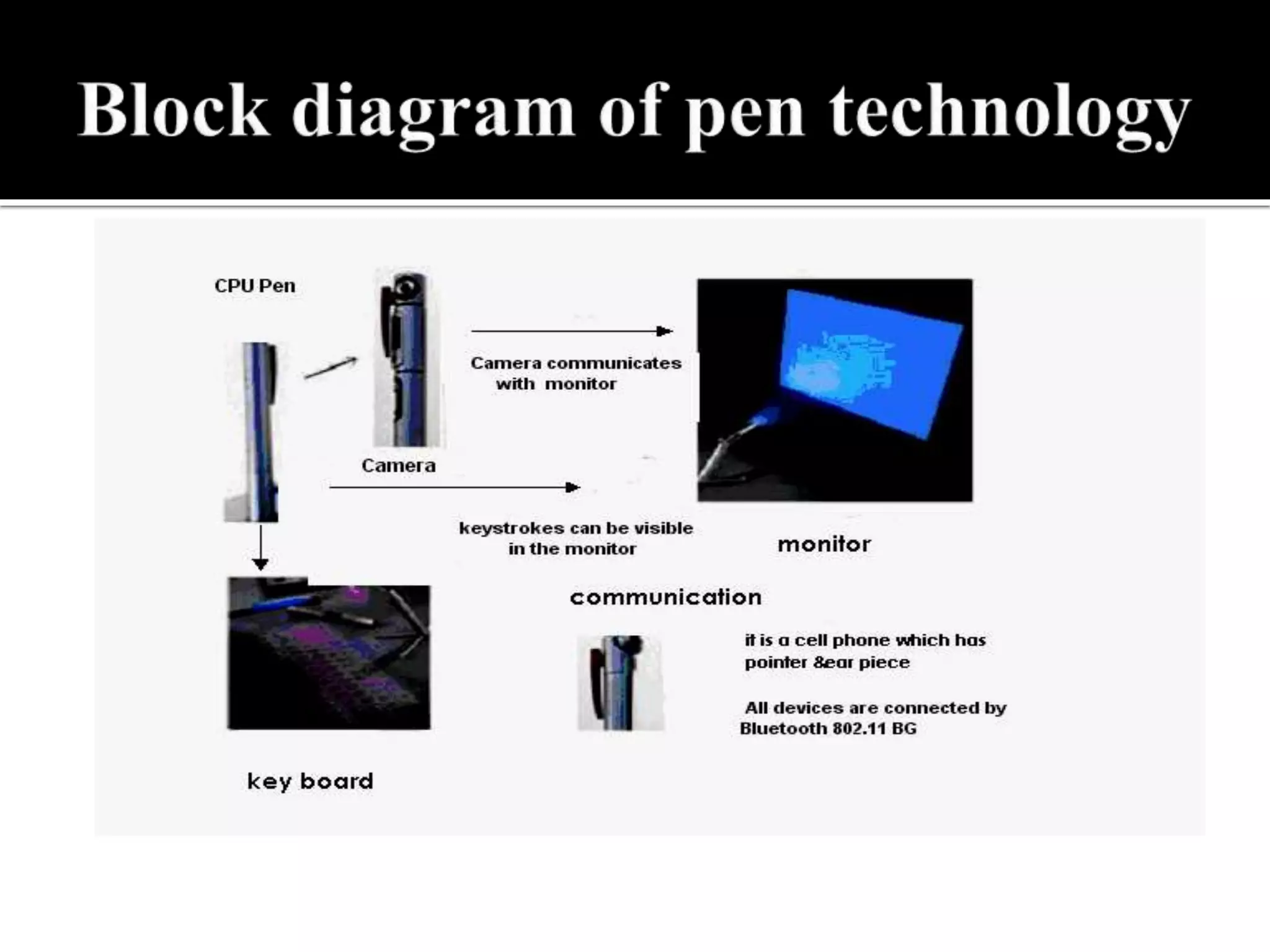
 Block Diagram
 Merits
 Demerits
 Conclusion
 Pen style personal networking gadget
created in 2003, by Tokyo-based Japanese
technology company NEC.
 P-ISM was first featured at the 2003 ITU
Telecom world held in Geneva, Switzerland
 The P-ISM system was based on "low-
cost electronic perception technology"
produced by the San Jose, California, firm of
Canesta
said that
” In developing this concept he
asked himself – “What is the
future of IT when it is small?”
The pen was a logical choice.
He also wanted a product that
you could touch and feel.
Further, the intent is to allow
for an office anywhere.
 P-ISM (“Pen-style Personal Networking
Gadget Package”), which is under developing,
stage by NEC Corporation ( Nippon Electric
Company, Limited).
 This 'pen sort of instruments' produces both the
soft-output as well as the Virtual keyboard on any
flat surfaces from where you can carry out
functions you would normally do on your
desktop computer.
 It is based on Electronic perception technology.
 Electronic Perception Technology (EPT) is a low-cost,
single-chip imagining technology that enables
electronic components to form a 3-D map of their
surroundings and see what their users are doing.
One of the first applications is a “virtual keyboard”, a
system that projects a laser keyboard onto a table
and detects which keys the user is pressing by
watching their hands and sensing which spots on the
table their fingers are touching. Current EPT
keyboards can sense up to 400 characters per
minute.
 C.P.U Pen
 Camera Pen
 Virtual Keyboard .
 Projector Pen
 Communication Pen.
 The functionality of the CPU is done by one of
the pen. It is also known as computing engine.
 Dual Core processor is used.
 Works with windows operating system.
 Wireless Bluetooth Technology.
Exchange information with
wireless connection
 Connected to internet through
cellular phone function.
 Uses Wi-Fi technology.
 Virtual Keyboard is a new gadget.
 It emits laser on desk which gives an
alternative input mechanism
 Based of Electronic PerceptionTechnology
 The role of monitor is
taken by LED Projector
which projects on the
screen. The size of the
projector is of A4 size.
It has the approximate
resolution capacity of
1024 X 768. Thus it is
gives more clarity and
good picture
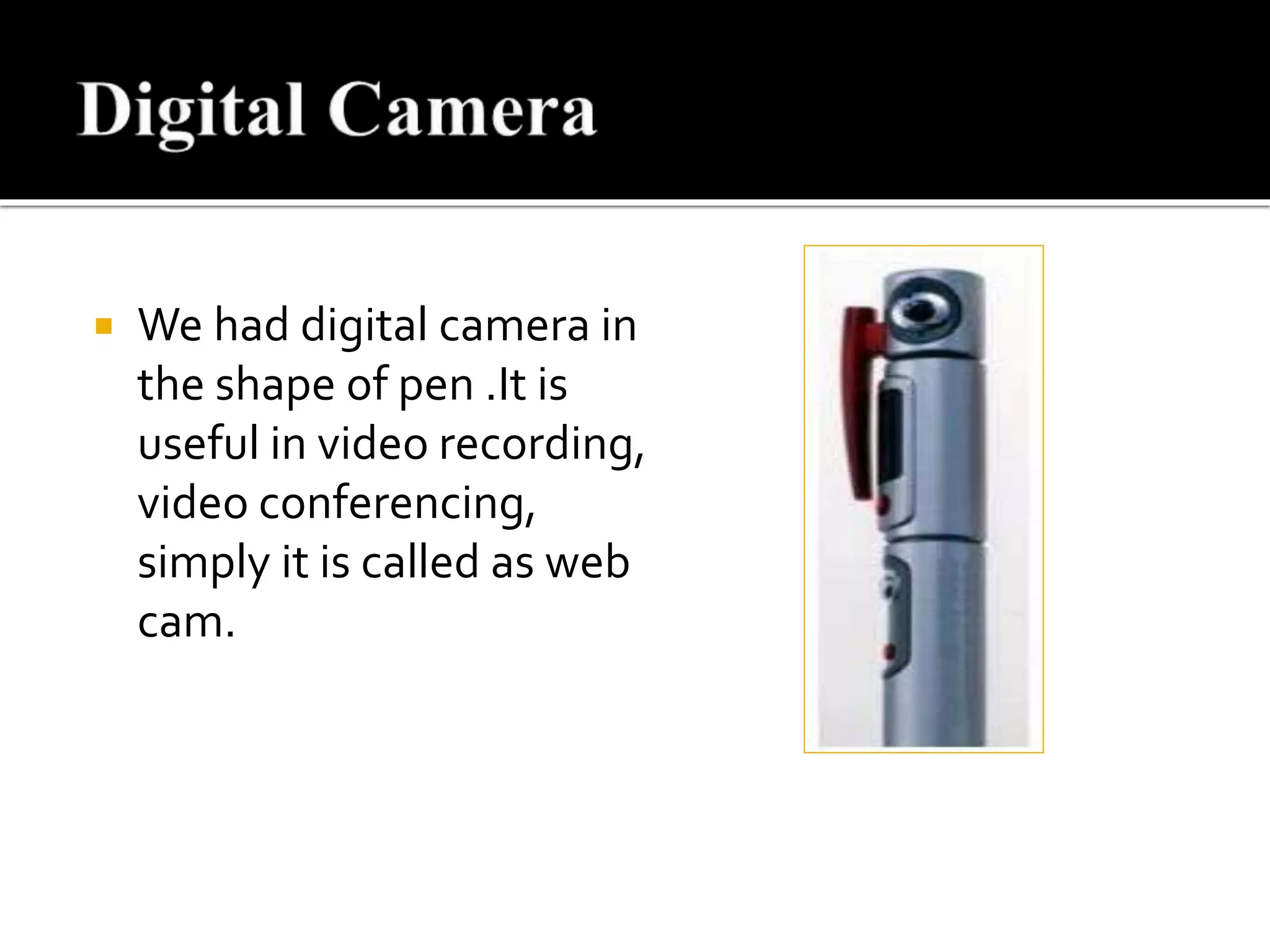
 We had digital camera in
the shape of pen .It is
useful in video recording,
video conferencing,
simply it is called as web
cam.
 It is the most important part
in portable type of
computers.
 Usually batteries are small in
size and work for a long time.
 It comes with a battery life of
6+ (i.e. 6days).
 For normal use it can be used
for 2 weeks.
MERITS
 Portable
 Feasible
 Wi-Fi technology
 Based on Electronic
PerceptionTechnology
DEMERITS
 Currently Unclear
 Cost
 Positioning is main
 The communication devices are becoming
smaller and compact. This is only an example
for the start of this new technology. We can
expect more such developments in the
future. From this I have come up with an idea
on how an existing product can improve by
using the same technology as the P-ISM.
5 pen
5 pen

5 pen

  • 1.
    SUBMITTEDTO: Mr.DHIRAJ KUMAR SINGH SUBMITTEDBY: NIKHIL NAMA A SEMINAR PRESENTATION ON 5 Pen Pc Technology
  • 2.
     History  Introduction 5 functions  Block Diagram  Merits  Demerits  Conclusion
  • 3.
     Pen stylepersonal networking gadget created in 2003, by Tokyo-based Japanese technology company NEC.  P-ISM was first featured at the 2003 ITU Telecom world held in Geneva, Switzerland  The P-ISM system was based on "low- cost electronic perception technology" produced by the San Jose, California, firm of Canesta
  • 4.
    said that ” Indeveloping this concept he asked himself – “What is the future of IT when it is small?” The pen was a logical choice. He also wanted a product that you could touch and feel. Further, the intent is to allow for an office anywhere.
  • 5.
     P-ISM (“Pen-stylePersonal Networking Gadget Package”), which is under developing, stage by NEC Corporation ( Nippon Electric Company, Limited).  This 'pen sort of instruments' produces both the soft-output as well as the Virtual keyboard on any flat surfaces from where you can carry out functions you would normally do on your desktop computer.  It is based on Electronic perception technology.
  • 6.
     Electronic PerceptionTechnology (EPT) is a low-cost, single-chip imagining technology that enables electronic components to form a 3-D map of their surroundings and see what their users are doing. One of the first applications is a “virtual keyboard”, a system that projects a laser keyboard onto a table and detects which keys the user is pressing by watching their hands and sensing which spots on the table their fingers are touching. Current EPT keyboards can sense up to 400 characters per minute.
  • 7.
     C.P.U Pen Camera Pen  Virtual Keyboard .  Projector Pen  Communication Pen.
  • 9.
     The functionalityof the CPU is done by one of the pen. It is also known as computing engine.  Dual Core processor is used.  Works with windows operating system.
  • 10.
     Wireless BluetoothTechnology. Exchange information with wireless connection  Connected to internet through cellular phone function.  Uses Wi-Fi technology.
  • 11.
     Virtual Keyboardis a new gadget.  It emits laser on desk which gives an alternative input mechanism  Based of Electronic PerceptionTechnology
  • 12.
     The roleof monitor is taken by LED Projector which projects on the screen. The size of the projector is of A4 size. It has the approximate resolution capacity of 1024 X 768. Thus it is gives more clarity and good picture
  • 13.
     We haddigital camera in the shape of pen .It is useful in video recording, video conferencing, simply it is called as web cam.
  • 14.
     It isthe most important part in portable type of computers.  Usually batteries are small in size and work for a long time.  It comes with a battery life of 6+ (i.e. 6days).  For normal use it can be used for 2 weeks.
  • 15.
    MERITS  Portable  Feasible Wi-Fi technology  Based on Electronic PerceptionTechnology DEMERITS  Currently Unclear  Cost  Positioning is main
  • 16.
     The communicationdevices are becoming smaller and compact. This is only an example for the start of this new technology. We can expect more such developments in the future. From this I have come up with an idea on how an existing product can improve by using the same technology as the P-ISM.