EECE488 Set 4 - Differential Amplifiers 1
SM
EECE488: Analog CMOS Integrated Circuit Design
Set 4
Differential Amplifiers
Shahriar Mirabbasi
Department of Electrical and Computer Engineering
University of British Columbia
shahriar@ece.ubc.ca
EECE488 Set 4 - Differential Amplifiers 2
SM
Overview
• The “differential amplifier” is one of the most important circuit
inventions.
• Their invention dates back to vacuum tube era (1930s).
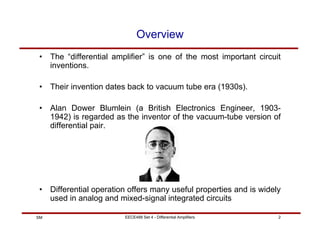
• Alan Dower Blumlein (a British Electronics Engineer, 1903-
1942) is regarded as the inventor of the vacuum-tube version of
differential pair.
• Differential operation offers many useful properties and is widely
used in analog and mixed-signal integrated circuits
EECE488 Set 4 - Differential Amplifiers 3
SM
Single-ended and Differential Signals
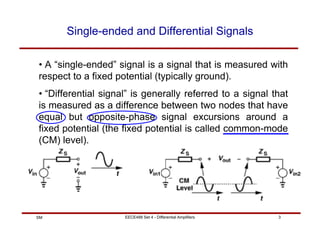
• A “single-ended” signal is a signal that is measured with
respect to a fixed potential (typically ground).
• “Differential signal” is generally referred to a signal that
is measured as a difference between two nodes that have
equal but opposite-phase signal excursions around a
fixed potential (the fixed potential is called common-mode
(CM) level).
EECE488 Set 4 - Differential Amplifiers 4
SM
Board Notes (Differential Amplifiers)
EECE488 Set 4 - Differential Amplifiers 5
SM
Why Differential?
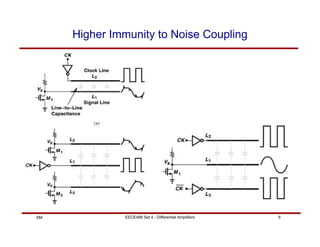
• Better immunity to environmental noise
• Improved linearity
• Higher signal swing compared to single-ended
EECE488 Set 4 - Differential Amplifiers 6
SM
Higher Immunity to Noise Coupling
EECE488 Set 4 - Differential Amplifiers 7
SM
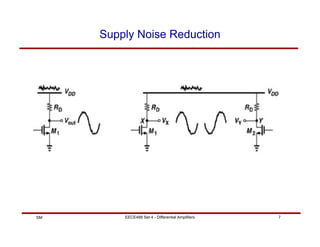
Supply Noise Reduction
EECE488 Set 4 - Differential Amplifiers 8
SM
Board Notes (Improved Linearity)
EECE488 Set 4 - Differential Amplifiers 9
SM
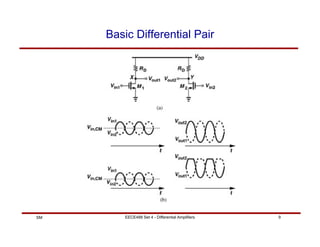
Basic Differential Pair
EECE488 Set 4 - Differential Amplifiers 10
SM
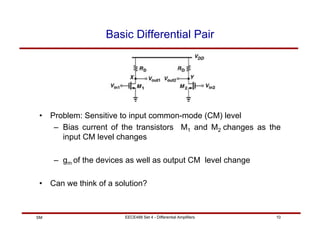
Basic Differential Pair
• Problem: Sensitive to input common-mode (CM) level
– Bias current of the transistors M1 and M2 changes as the
input CM level changes
– gm of the devices as well as output CM level change
• Can we think of a solution?
EECE488 Set 4 - Differential Amplifiers 11
SM
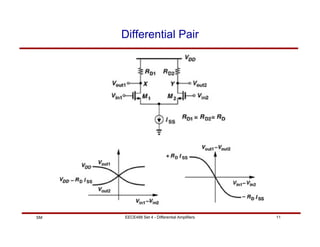
Differential Pair
EECE488 Set 4 - Differential Amplifiers 12
SM
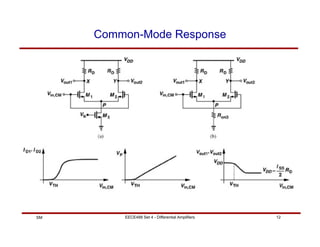
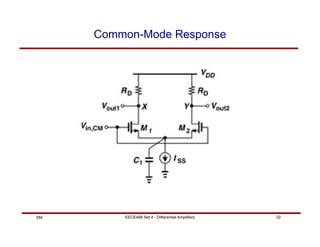
Common-Mode Response
EECE488 Set 4 - Differential Amplifiers 13
SM
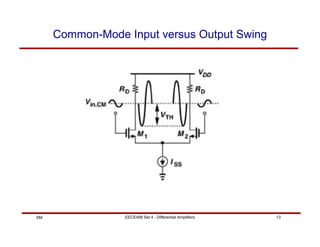
Common-Mode Input versus Output Swing
EECE488 Set 4 - Differential Amplifiers 14
SM
Board Notes (“Half-Circuit” Concept)
EECE488 Set 4 - Differential Amplifiers 15
SM
Board Notes (“Half-Circuit” Concept)
EECE488 Set 4 - Differential Amplifiers 16
SM
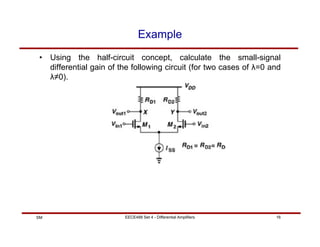
Example
• Using the half-circuit concept, calculate the small-signal
differential gain of the following circuit (for two cases of λ=0 and
λ≠0).
EECE488 Set 4 - Differential Amplifiers 17
SM
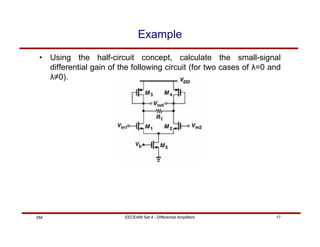
Example
• Using the half-circuit concept, calculate the small-signal
differential gain of the following circuit (for two cases of λ=0 and
λ≠0).
EECE488 Set 4 - Differential Amplifiers 18
SM
Example
• Sketch the small-signal gain of a differential pair as a function of
its input common-mode level.
EECE488 Set 4 - Differential Amplifiers 19
SM
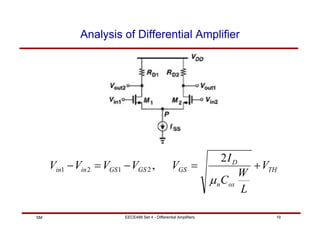
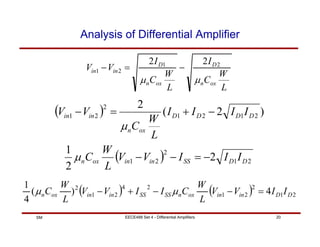
Analysis of Differential Amplifier
TH
ox
n
D
GS
GS
GS
in
in V
L
W
C
I
V
V
V
V
V +
=
−
=
−
µ
2
,
2
1
2
1
EECE488 Set 4 - Differential Amplifiers 20
SM
Analysis of Differential Amplifier
L
W
C
I
L
W
C
I
V
V
ox
n
D
ox
n
D
in
in
µ
µ
2
1
2
1
2
2
−
=
−
( ) )
2
(
2
2
1
2
1
2
2
1 D
D
D
D
ox
n
in
in I
I
I
I
L
W
C
V
V −
+
=
−
µ
( ) 2
1
2
2
1 2
2
1
D
D
SS
in
in
ox
n I
I
I
V
V
L
W
C −
=
−
−
µ
( ) ( ) 2
1
2
2
1
2
4
2
1
2
4
)
(
4
1
D
D
in
in
ox
n
SS
SS
in
in
ox
n I
I
V
V
L
W
C
I
I
V
V
L
W
C =
−
−
+
− µ
µ
EECE488 Set 4 - Differential Amplifiers 21
SM
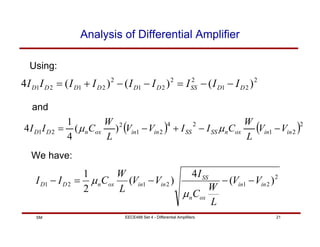
Analysis of Differential Amplifier
2
2
1
2
1
2
1 )
(
4
)
(
2
1
in
in
ox
n
SS
in
in
ox
n
D
D V
V
L
W
C
I
V
V
L
W
C
I
I −
−
−
=
−
µ
µ
Using:
2
2
1
2
2
2
1
2
2
1
2
1 )
(
)
(
)
(
4 D
D
SS
D
D
D
D
D
D I
I
I
I
I
I
I
I
I −
−
=
−
−
+
=
We have:
( ) ( )2
2
1
2
4
2
1
2
2
1 )
(
4
1
4 in
in
ox
n
SS
SS
in
in
ox
n
D
D V
V
L
W
C
I
I
V
V
L
W
C
I
I −
−
+
−
= µ
µ
and
EECE488 Set 4 - Differential Amplifiers 22
SM
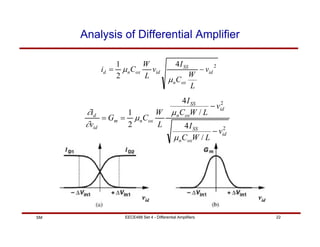
Analysis of Differential Amplifier
/
4
/
4
2
1
2
2
id
ox
n
SS
id
ox
n
SS
ox
n
m
id
d
v
L
W
C
I
v
L
W
C
I
L
W
C
G
v
i
−
−
=
=
µ
µ
µ
∂
∂
vid vid
2
4
2
1
id
ox
n
SS
id
ox
n
d v
L
W
C
I
v
L
W
C
i −
=
µ
µ
EECE488 Set 4 - Differential Amplifiers 23
SM
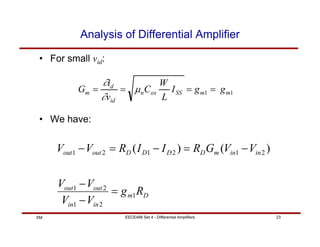
Analysis of Differential Amplifier
• For small vid:
• We have:
1
1 m
m
SS
ox
n
id
d
m g
g
I
L
W
C
v
i
G =
=
=
= µ
∂
∂
D
m
in
in
out
out
in
in
m
D
D
D
D
out
out
R
g
V
V
V
V
V
V
G
R
I
I
R
V
V
1
2
1
2
1
2
1
2
1
2
1 )
(
)
(
=
−
−
−
=
−
=
−
EECE488 Set 4 - Differential Amplifiers 24
SM
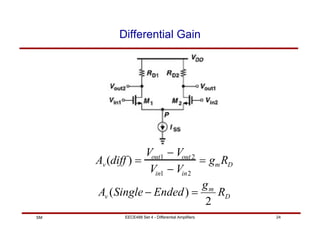
Differential Gain
Av(diff ) =
Vout1 − Vout 2
Vin1 − Vin2
= gmRD
D
m
v R
g
Ended
Single
A
2
)
( =
−
EECE488 Set 4 - Differential Amplifiers 25
SM
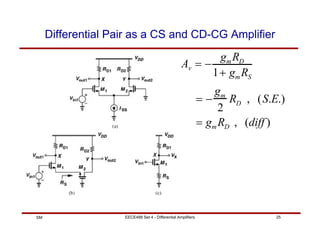
Differential Pair as a CS and CD-CG Amplifier
Av = −
gmRD
1+ gmRS
= −
gm
2
RD , (S.E.)
= gmRD , (diff )
EECE488 Set 4 - Differential Amplifiers 26
SM
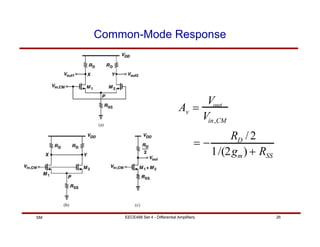
Common-Mode Response
Av =
Vout
Vin,CM
= −
RD /2
1/(2gm) + RSS
EECE488 Set 4 - Differential Amplifiers 27
SM
Board Notes
EECE488 Set 4 - Differential Amplifiers 28
SM
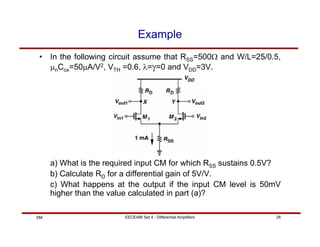
Example
• In the following circuit assume that RSS=500Ω and W/L=25/0.5,
µnCox=50µA/V2, VTH =0.6, λ=γ=0 and VDD=3V.
a) What is the required input CM for which RSS sustains 0.5V?
b) Calculate RD for a differential gain of 5V/V.
c) What happens at the output if the input CM level is 50mV
higher than the value calculated in part (a)?
EECE488 Set 4 - Differential Amplifiers 29
SM
Board Notes
EECE488 Set 4 - Differential Amplifiers 30
SM
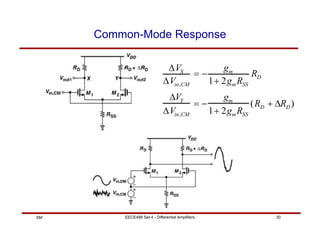
Common-Mode Response
∆VX
∆Vin,CM
= −
gm
1+ 2gmRSS
RD
∆VY
∆Vin,CM
= −
gm
1+ 2gmRSS
(RD + ∆RD)
EECE488 Set 4 - Differential Amplifiers 31
SM
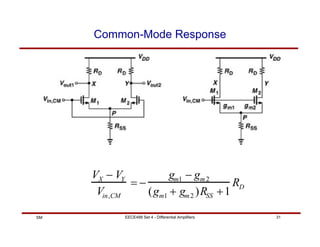
Common-Mode Response
VX − VY
Vin,CM
= −
gm1 − gm2
(gm1 + gm2 )RSS +1
RD
EECE488 Set 4 - Differential Amplifiers 32
SM
Common-Mode Response
EECE488 Set 4 - Differential Amplifiers 33
SM
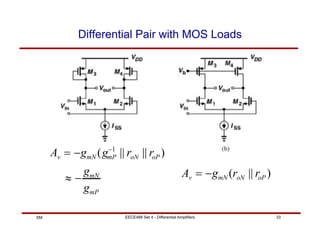
Differential Pair with MOS Loads
Av = −gmN (gmP
−1
|| roN || roP )
≈ −
gmN
gmP
Av = −gmN (roN || roP )
EECE488 Set 4 - Differential Amplifiers 34
SM
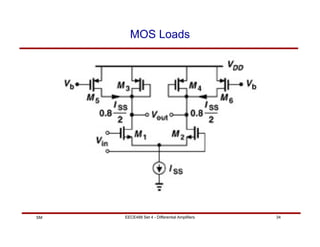
MOS Loads
EECE488 Set 4 - Differential Amplifiers 35
SM
MOS Loads
Av ≈ gm1[(gm3ro3ro1 ) || (gm5ro5ro7 )]
EECE488 Set 4 - Differential Amplifiers 36
SM
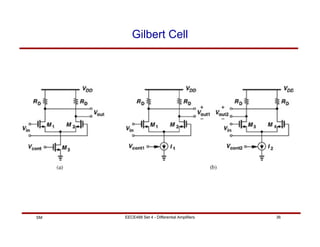
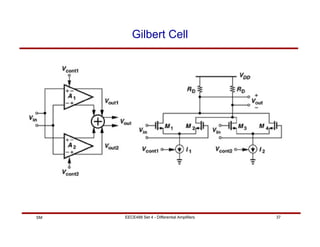
Gilbert Cell
EECE488 Set 4 - Differential Amplifiers 37
SM
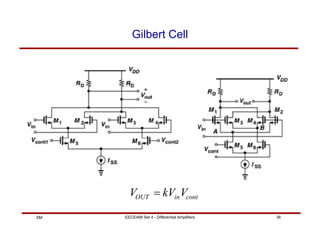
Gilbert Cell
EECE488 Set 4 - Differential Amplifiers 38
SM
Gilbert Cell
VOUT = kVinVcont

5. differential amplifier

  • 1.
    EECE488 Set 4- Differential Amplifiers 1 SM EECE488: Analog CMOS Integrated Circuit Design Set 4 Differential Amplifiers Shahriar Mirabbasi Department of Electrical and Computer Engineering University of British Columbia shahriar@ece.ubc.ca
  • 2.
    EECE488 Set 4- Differential Amplifiers 2 SM Overview • The “differential amplifier” is one of the most important circuit inventions. • Their invention dates back to vacuum tube era (1930s). • Alan Dower Blumlein (a British Electronics Engineer, 1903- 1942) is regarded as the inventor of the vacuum-tube version of differential pair. • Differential operation offers many useful properties and is widely used in analog and mixed-signal integrated circuits
  • 3.
    EECE488 Set 4- Differential Amplifiers 3 SM Single-ended and Differential Signals • A “single-ended” signal is a signal that is measured with respect to a fixed potential (typically ground). • “Differential signal” is generally referred to a signal that is measured as a difference between two nodes that have equal but opposite-phase signal excursions around a fixed potential (the fixed potential is called common-mode (CM) level).
  • 4.
    EECE488 Set 4- Differential Amplifiers 4 SM Board Notes (Differential Amplifiers)
  • 5.
    EECE488 Set 4- Differential Amplifiers 5 SM Why Differential? • Better immunity to environmental noise • Improved linearity • Higher signal swing compared to single-ended
  • 6.
    EECE488 Set 4- Differential Amplifiers 6 SM Higher Immunity to Noise Coupling
  • 7.
    EECE488 Set 4- Differential Amplifiers 7 SM Supply Noise Reduction
  • 8.
    EECE488 Set 4- Differential Amplifiers 8 SM Board Notes (Improved Linearity)
  • 9.
    EECE488 Set 4- Differential Amplifiers 9 SM Basic Differential Pair
  • 10.
    EECE488 Set 4- Differential Amplifiers 10 SM Basic Differential Pair • Problem: Sensitive to input common-mode (CM) level – Bias current of the transistors M1 and M2 changes as the input CM level changes – gm of the devices as well as output CM level change • Can we think of a solution?
  • 11.
    EECE488 Set 4- Differential Amplifiers 11 SM Differential Pair
  • 12.
    EECE488 Set 4- Differential Amplifiers 12 SM Common-Mode Response
  • 13.
    EECE488 Set 4- Differential Amplifiers 13 SM Common-Mode Input versus Output Swing
  • 14.
    EECE488 Set 4- Differential Amplifiers 14 SM Board Notes (“Half-Circuit” Concept)
  • 15.
    EECE488 Set 4- Differential Amplifiers 15 SM Board Notes (“Half-Circuit” Concept)
  • 16.
    EECE488 Set 4- Differential Amplifiers 16 SM Example • Using the half-circuit concept, calculate the small-signal differential gain of the following circuit (for two cases of λ=0 and λ≠0).
  • 17.
    EECE488 Set 4- Differential Amplifiers 17 SM Example • Using the half-circuit concept, calculate the small-signal differential gain of the following circuit (for two cases of λ=0 and λ≠0).
  • 18.
    EECE488 Set 4- Differential Amplifiers 18 SM Example • Sketch the small-signal gain of a differential pair as a function of its input common-mode level.
  • 19.
    EECE488 Set 4- Differential Amplifiers 19 SM Analysis of Differential Amplifier TH ox n D GS GS GS in in V L W C I V V V V V + = − = − µ 2 , 2 1 2 1
  • 20.
    EECE488 Set 4- Differential Amplifiers 20 SM Analysis of Differential Amplifier L W C I L W C I V V ox n D ox n D in in µ µ 2 1 2 1 2 2 − = − ( ) ) 2 ( 2 2 1 2 1 2 2 1 D D D D ox n in in I I I I L W C V V − + = − µ ( ) 2 1 2 2 1 2 2 1 D D SS in in ox n I I I V V L W C − = − − µ ( ) ( ) 2 1 2 2 1 2 4 2 1 2 4 ) ( 4 1 D D in in ox n SS SS in in ox n I I V V L W C I I V V L W C = − − + − µ µ
  • 21.
    EECE488 Set 4- Differential Amplifiers 21 SM Analysis of Differential Amplifier 2 2 1 2 1 2 1 ) ( 4 ) ( 2 1 in in ox n SS in in ox n D D V V L W C I V V L W C I I − − − = − µ µ Using: 2 2 1 2 2 2 1 2 2 1 2 1 ) ( ) ( ) ( 4 D D SS D D D D D D I I I I I I I I I − − = − − + = We have: ( ) ( )2 2 1 2 4 2 1 2 2 1 ) ( 4 1 4 in in ox n SS SS in in ox n D D V V L W C I I V V L W C I I − − + − = µ µ and
  • 22.
    EECE488 Set 4- Differential Amplifiers 22 SM Analysis of Differential Amplifier / 4 / 4 2 1 2 2 id ox n SS id ox n SS ox n m id d v L W C I v L W C I L W C G v i − − = = µ µ µ ∂ ∂ vid vid 2 4 2 1 id ox n SS id ox n d v L W C I v L W C i − = µ µ
  • 23.
    EECE488 Set 4- Differential Amplifiers 23 SM Analysis of Differential Amplifier • For small vid: • We have: 1 1 m m SS ox n id d m g g I L W C v i G = = = = µ ∂ ∂ D m in in out out in in m D D D D out out R g V V V V V V G R I I R V V 1 2 1 2 1 2 1 2 1 2 1 ) ( ) ( = − − − = − = −
  • 24.
    EECE488 Set 4- Differential Amplifiers 24 SM Differential Gain Av(diff ) = Vout1 − Vout 2 Vin1 − Vin2 = gmRD D m v R g Ended Single A 2 ) ( = −
  • 25.
    EECE488 Set 4- Differential Amplifiers 25 SM Differential Pair as a CS and CD-CG Amplifier Av = − gmRD 1+ gmRS = − gm 2 RD , (S.E.) = gmRD , (diff )
  • 26.
    EECE488 Set 4- Differential Amplifiers 26 SM Common-Mode Response Av = Vout Vin,CM = − RD /2 1/(2gm) + RSS
  • 27.
    EECE488 Set 4- Differential Amplifiers 27 SM Board Notes
  • 28.
    EECE488 Set 4- Differential Amplifiers 28 SM Example • In the following circuit assume that RSS=500Ω and W/L=25/0.5, µnCox=50µA/V2, VTH =0.6, λ=γ=0 and VDD=3V. a) What is the required input CM for which RSS sustains 0.5V? b) Calculate RD for a differential gain of 5V/V. c) What happens at the output if the input CM level is 50mV higher than the value calculated in part (a)?
  • 29.
    EECE488 Set 4- Differential Amplifiers 29 SM Board Notes
  • 30.
    EECE488 Set 4- Differential Amplifiers 30 SM Common-Mode Response ∆VX ∆Vin,CM = − gm 1+ 2gmRSS RD ∆VY ∆Vin,CM = − gm 1+ 2gmRSS (RD + ∆RD)
  • 31.
    EECE488 Set 4- Differential Amplifiers 31 SM Common-Mode Response VX − VY Vin,CM = − gm1 − gm2 (gm1 + gm2 )RSS +1 RD
  • 32.
    EECE488 Set 4- Differential Amplifiers 32 SM Common-Mode Response
  • 33.
    EECE488 Set 4- Differential Amplifiers 33 SM Differential Pair with MOS Loads Av = −gmN (gmP −1 || roN || roP ) ≈ − gmN gmP Av = −gmN (roN || roP )
  • 34.
    EECE488 Set 4- Differential Amplifiers 34 SM MOS Loads
  • 35.
    EECE488 Set 4- Differential Amplifiers 35 SM MOS Loads Av ≈ gm1[(gm3ro3ro1 ) || (gm5ro5ro7 )]
  • 36.
    EECE488 Set 4- Differential Amplifiers 36 SM Gilbert Cell
  • 37.
    EECE488 Set 4- Differential Amplifiers 37 SM Gilbert Cell
  • 38.
    EECE488 Set 4- Differential Amplifiers 38 SM Gilbert Cell VOUT = kVinVcont