Course:

Introduction to sociology
3.00 Credit Hours, Fall 2013,
Undergraduate Program
Instructor: Ghulam Fouzia
Date:17-01-2014
SESSION 6

© www.uogsialkot.edu
Mores and Folkways
Mores:
Norms that are widely observed and have great moral significance.
They distinguish between right and wrong
E.g:

Folkways:
Norms for routine or casual interaction
Folkways draws a distinction between right and rude

E.g:
Social Control:
These are the attempts by society to regulate people’s thought and behavior.
Shame: the painful sense that others disapprove of our actions
Guilt: The negative judgment we make of ourselves .
Ideal and Real Culture:
Ideal culture includes the patterns ,norms and values which
we desire to have in a culture
E.g: the equal rights fro all, equal distribution of resources
equal opportunities despite any gender discrimination
etc…
The cultural patterns which actually exist in any society
either positive or negative
E.g: the judicial system of Pakistan.
Artifacts:
These are the wide range of tangible human creation
Artifacts reflect underlying cultural values.
Technology:
“Knowledge that people use to make a way of life in their
surroundings” .
E.g: Automobiles, electronics etc…
Societies with high technologies are supposed to be more
advanced as compared to the societies who didn’t posess
latest technology.
High and Popular Culture:
The cultural patterns that distinguish a society’s elites.
E.g: Playing Golf, Horse race, using cigar etc…
Popular Culture includes the patterns that are widespread
among a society’s population.
E.g: playing cards, playing cricket, smoking etc…
Sociologists disagree with both concepts because
1: Neither elites not ordinary people share all the same
interests or taste
2: We may praise elites on the basis of money, power
Sub cultures
• Cultural patterns that set apart some segment of a
society’s population , jazz, musician..etc
• Almost everyone participates in many subcultures
without having much commitment in any of them.
• Sometimes these separation in subcultures cause tragic
consequences.
• These subcultures also cause tensions.
• Subcultures involves not just differences but hierarchy
too…
Multiculturalism
•Educational program recognizing the
cultural diversity of the united states and
promoting the equality of all cultural
traditions.
•Migration plays an important role in
forming new way of life.
Eurocentirism:
The dominance of European cultural
patterns.
Continu……
Afrocentrism:
• The dominance of African cultural patterns
Criticism:
• It encourages divisiveness rather than unity,
urging people to identify with their own
category rather than with the nation as a
whole.
• Our common humanity dissolves in the cultures.
• It harms minorities because it seems to endorse
the racial segregation that may deprive the
individuals from their basic rights.
Counter Culture:
The cultural patterns that strongly oppose those
widely accepted within a society.
Cultural Change
Culture changes with the passage of time.
Change in any segment or dimension of culture usually
sparks changes in others.
Cultural Integration:
The close relationship among the various segments of
the culture.
Cultural Lag:
The fact that some cultural elements change more
quickly than others, disrupting a cultural system.
Causes of Cultural Change
Invention:
• The process of creating new cultural elements
• Invention has changed the cultures
Discovery:
• Recognizing the better understanding something
already in existence
Diffusion:
• Spread of cultural traits from one society to another
Conti……..
Ethnocentrism:
• The process of judging other cultures by the
standards of one’s own culture.
• Ethnocentrism also generate misunderstanding and
some times conflict.
Cultural Relativism:
The practice of evaluating a culture by its own
standards.
Conti…………
•It can be difficult to adopt because it not only
requires openness and readiness to unfamiliar norms
and values but also the suspension of cultural
standards we have known all our lives.
• Cultural relativism has its problems too.
Xenocentrism:
• Culturally based tendency to value other cultures
more highly than one’s own cultures. Like different
brands we use or give more preference to foreign
products…..etc.
Wall Street Journal
Socialization and
the Life Course
Socialization: Lifelong process in which
people learn appropriate attitudes, values,
and behaviors
█ Personality: Person’s
typical patterns of
attitudes, needs,
characteristics,
and behavior
█
The Role of Socialization
• Sociobiology
– Sociobiology is the systematic study of the
biological bases of social behavior.
– In its extreme form, sociobiology suggests that all
behavior is the result of genetic or biological
factors and places little emphasis on social
interaction.
How We Learn Culture: Socialization
Three stages of socialization
Primary socialization—of infants and young
children by the family and early care-givers
Secondary socialization—in childhood and
adolescence, by the school, the religious
affiliation, the peer group, the neighborhood,
and the media
Adult socialization—the workplace, travel,
assuming new roles in life
Some Results of Socialization
Because the process of socialization is

intended to cause individuals to
internalize knowledge, attitudes, values,
and beliefs, it has several results which
should not be surprising:
 Ethnocentrism
 Perception
 Categorization
 Stereotypes
Some Results of Socialization
Because the process of socialization is

intended to cause individuals to
internalize knowledge, attitudes, values,
and beliefs, it has several results which
should not be surprising:
 Ethnocentrism
 Perception
 Categorization
 Stereotypes
Ethnocentrism
Ethnocentrism is the tendency people have to
evaluate others according to their own
standards and experience
While this tendency can help bind people
together, it can also present serious obstacles
to cross-cultural interactions
Perception
 Perception is the process of attaining awareness or
understanding of sensory information. It comes
from the Latin word “perceptio” which means
receiving, collecting and action of taking.
 Human perception is using ones senses to become
aware of things in the environment. Perception
usually leads to a new understanding about
something.
 What we perceive—what we see, hear, feel, taste, and
smell—is shaped in part by our culture.
Categorization
 Categorization is the cognitive process by which
all human beings simplify their world by
grouping similar stimuli or
 an orderly grouping (of things or persons)
considered as a unit; the result of arranging; "a
flower arrangement
 Example: for the category “bird,” we usually
think of robins, not "chickens”
 Our categories give meaning to our perceptions.
Stereotypes
 a widely held but fixed and oversimplified image
or idea of a particular type of person or thing
 E.g: the stereotype of the woman as caretaker

 Stereotypes are socially-constructed categories of
people.
 They usually obscure differences within groups.
 They are frequently negative, and play to
ethnocentric ideas of “the other.”
Some Limits on Socialization
While socialization is a powerful process, it
does have limits.
It is limited by a child’s physical limits.
It is limited because it is never finished, and thus
never absolute; it can be changed.
It is limited because human beings are not passive
recipients, but also actors in their environments.
Understanding Cultural Differences
In a complex, pluralistic society like the United
States, all people are in some way
multicultural.
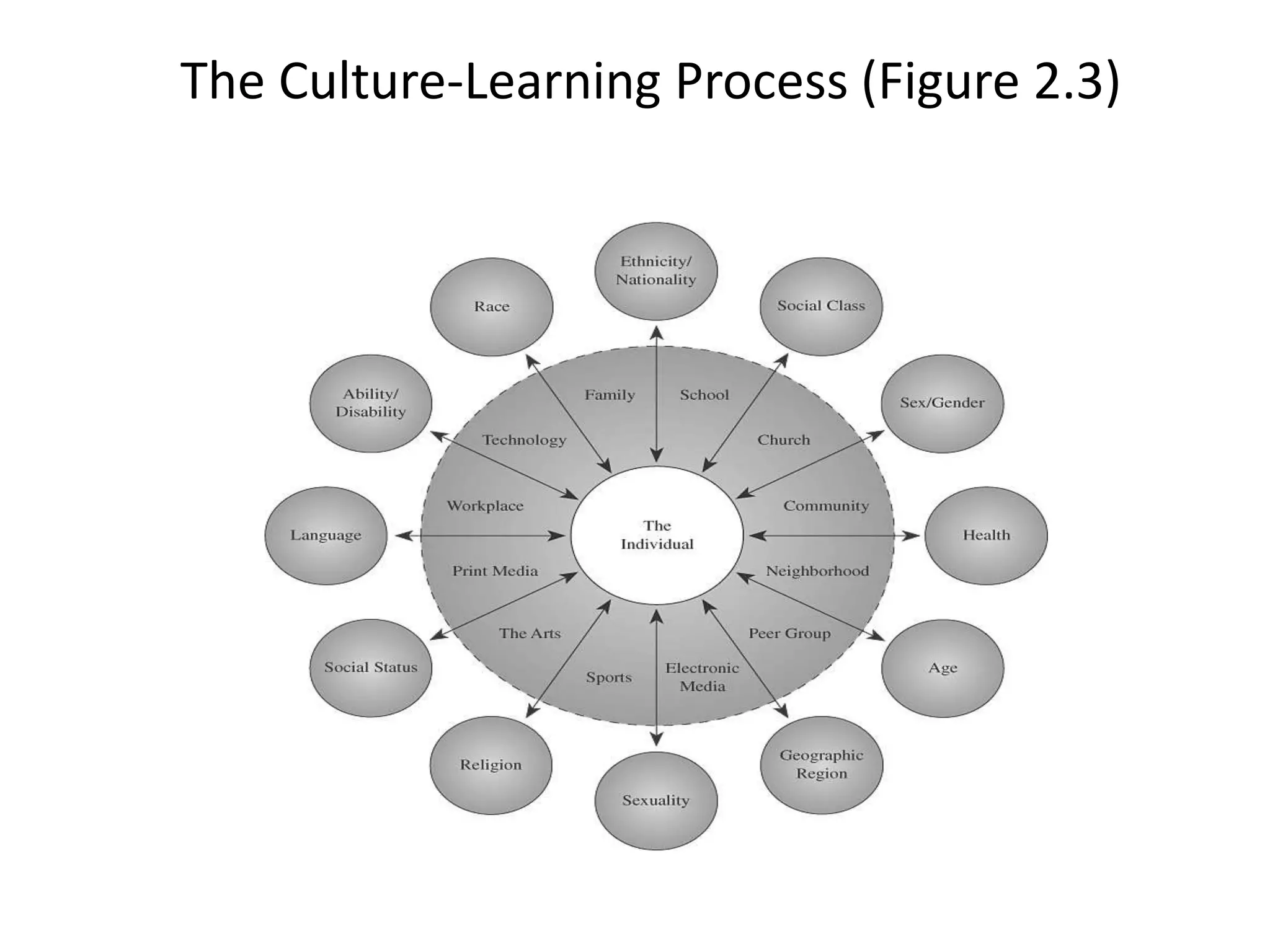
While we all draw on common sources of
knowledge, we are socialized by different
agents, with different perspectives on that
knowledge.
The Culture-Learning Process (Figure 2.3)
Variations in Cultural Environments
Although the sources of cultural identity are
the same in all society, the content in those
sources may be different.
Moreover, each community varies
considerably in the number and character of
its socializing agents.

Continued…
 Given this complexity, it is wise to
consider the immense variation of
possible cultural elements in our own
lives and in the lives of others.
 Despite this enormous potential for
variation among individuals and within
groups, there are similarities or
generalizations that can be made about
individuals who identify with particular
groups.

 What is needed is a more sophisticated
way of looking at diversity.

4th bs lecture new slides given by sociology's teacher

  • 1.
    Course: Introduction to sociology 3.00Credit Hours, Fall 2013, Undergraduate Program Instructor: Ghulam Fouzia Date:17-01-2014 SESSION 6 © www.uogsialkot.edu
  • 2.
    Mores and Folkways Mores: Normsthat are widely observed and have great moral significance. They distinguish between right and wrong E.g: Folkways: Norms for routine or casual interaction Folkways draws a distinction between right and rude E.g: Social Control: These are the attempts by society to regulate people’s thought and behavior. Shame: the painful sense that others disapprove of our actions Guilt: The negative judgment we make of ourselves .
  • 3.
    Ideal and RealCulture: Ideal culture includes the patterns ,norms and values which we desire to have in a culture E.g: the equal rights fro all, equal distribution of resources equal opportunities despite any gender discrimination etc… The cultural patterns which actually exist in any society either positive or negative E.g: the judicial system of Pakistan.
  • 4.
    Artifacts: These are thewide range of tangible human creation Artifacts reflect underlying cultural values. Technology: “Knowledge that people use to make a way of life in their surroundings” . E.g: Automobiles, electronics etc… Societies with high technologies are supposed to be more advanced as compared to the societies who didn’t posess latest technology.
  • 5.
    High and PopularCulture: The cultural patterns that distinguish a society’s elites. E.g: Playing Golf, Horse race, using cigar etc… Popular Culture includes the patterns that are widespread among a society’s population. E.g: playing cards, playing cricket, smoking etc… Sociologists disagree with both concepts because 1: Neither elites not ordinary people share all the same interests or taste 2: We may praise elites on the basis of money, power
  • 6.
    Sub cultures • Culturalpatterns that set apart some segment of a society’s population , jazz, musician..etc • Almost everyone participates in many subcultures without having much commitment in any of them. • Sometimes these separation in subcultures cause tragic consequences. • These subcultures also cause tensions. • Subcultures involves not just differences but hierarchy too…
  • 7.
    Multiculturalism •Educational program recognizingthe cultural diversity of the united states and promoting the equality of all cultural traditions. •Migration plays an important role in forming new way of life. Eurocentirism: The dominance of European cultural patterns.
  • 8.
    Continu…… Afrocentrism: • The dominanceof African cultural patterns Criticism: • It encourages divisiveness rather than unity, urging people to identify with their own category rather than with the nation as a whole.
  • 9.
    • Our commonhumanity dissolves in the cultures. • It harms minorities because it seems to endorse the racial segregation that may deprive the individuals from their basic rights. Counter Culture: The cultural patterns that strongly oppose those widely accepted within a society.
  • 10.
    Cultural Change Culture changeswith the passage of time. Change in any segment or dimension of culture usually sparks changes in others. Cultural Integration: The close relationship among the various segments of the culture. Cultural Lag: The fact that some cultural elements change more quickly than others, disrupting a cultural system.
  • 11.
    Causes of CulturalChange Invention: • The process of creating new cultural elements • Invention has changed the cultures Discovery: • Recognizing the better understanding something already in existence Diffusion: • Spread of cultural traits from one society to another
  • 12.
    Conti…….. Ethnocentrism: • The processof judging other cultures by the standards of one’s own culture. • Ethnocentrism also generate misunderstanding and some times conflict. Cultural Relativism: The practice of evaluating a culture by its own standards.
  • 13.
    Conti………… •It can bedifficult to adopt because it not only requires openness and readiness to unfamiliar norms and values but also the suspension of cultural standards we have known all our lives. • Cultural relativism has its problems too. Xenocentrism: • Culturally based tendency to value other cultures more highly than one’s own cultures. Like different brands we use or give more preference to foreign products…..etc. Wall Street Journal
  • 14.
    Socialization and the LifeCourse Socialization: Lifelong process in which people learn appropriate attitudes, values, and behaviors █ Personality: Person’s typical patterns of attitudes, needs, characteristics, and behavior █
  • 15.
    The Role ofSocialization • Sociobiology – Sociobiology is the systematic study of the biological bases of social behavior. – In its extreme form, sociobiology suggests that all behavior is the result of genetic or biological factors and places little emphasis on social interaction.
  • 16.
    How We LearnCulture: Socialization Three stages of socialization Primary socialization—of infants and young children by the family and early care-givers Secondary socialization—in childhood and adolescence, by the school, the religious affiliation, the peer group, the neighborhood, and the media Adult socialization—the workplace, travel, assuming new roles in life
  • 17.
    Some Results ofSocialization Because the process of socialization is intended to cause individuals to internalize knowledge, attitudes, values, and beliefs, it has several results which should not be surprising:  Ethnocentrism  Perception  Categorization  Stereotypes
  • 18.
    Some Results ofSocialization Because the process of socialization is intended to cause individuals to internalize knowledge, attitudes, values, and beliefs, it has several results which should not be surprising:  Ethnocentrism  Perception  Categorization  Stereotypes
  • 19.
    Ethnocentrism Ethnocentrism is thetendency people have to evaluate others according to their own standards and experience While this tendency can help bind people together, it can also present serious obstacles to cross-cultural interactions
  • 20.
    Perception  Perception isthe process of attaining awareness or understanding of sensory information. It comes from the Latin word “perceptio” which means receiving, collecting and action of taking.  Human perception is using ones senses to become aware of things in the environment. Perception usually leads to a new understanding about something.  What we perceive—what we see, hear, feel, taste, and smell—is shaped in part by our culture.
  • 21.
    Categorization  Categorization isthe cognitive process by which all human beings simplify their world by grouping similar stimuli or  an orderly grouping (of things or persons) considered as a unit; the result of arranging; "a flower arrangement  Example: for the category “bird,” we usually think of robins, not "chickens”  Our categories give meaning to our perceptions.
  • 22.
    Stereotypes  a widelyheld but fixed and oversimplified image or idea of a particular type of person or thing  E.g: the stereotype of the woman as caretaker  Stereotypes are socially-constructed categories of people.  They usually obscure differences within groups.  They are frequently negative, and play to ethnocentric ideas of “the other.”
  • 23.
    Some Limits onSocialization While socialization is a powerful process, it does have limits. It is limited by a child’s physical limits. It is limited because it is never finished, and thus never absolute; it can be changed. It is limited because human beings are not passive recipients, but also actors in their environments.
  • 24.
    Understanding Cultural Differences Ina complex, pluralistic society like the United States, all people are in some way multicultural. While we all draw on common sources of knowledge, we are socialized by different agents, with different perspectives on that knowledge.
  • 25.
  • 26.
    Variations in CulturalEnvironments Although the sources of cultural identity are the same in all society, the content in those sources may be different. Moreover, each community varies considerably in the number and character of its socializing agents. Continued…
  • 27.
     Given thiscomplexity, it is wise to consider the immense variation of possible cultural elements in our own lives and in the lives of others.  Despite this enormous potential for variation among individuals and within groups, there are similarities or generalizations that can be made about individuals who identify with particular groups.  What is needed is a more sophisticated way of looking at diversity.