DIVERSITY
COMBINING
TECHNIQUES
Lecture Videos are available for this slides
at
www.youtube.com/gurukula
Support by Subscribing to my
Channel
Diversity Achieved. How to Resolve?
Selection
Diversity
Combining
Diversity
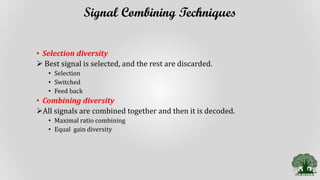
Signal Combining Techniques
• Selection diversity
 Best signal is selected, and the rest are discarded.
• Selection
• Switched
• Feed back
• Combining diversity
All signals are combined together and then it is decoded.
• Maximal ratio combining
• Equal gain diversity
Selection Diversity
• There are 2 selection criteria:
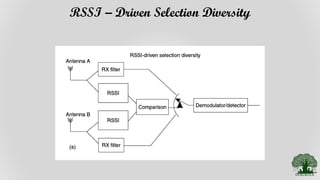
• RSSI – Received Signal Strength Indication
• BER – Bit Error Rate
• The receiver selects the signal with the
largest instantaneous power
RSSI – Driven Selection Diversity
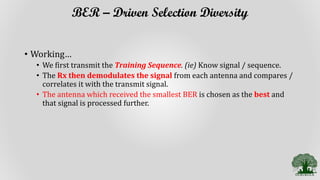
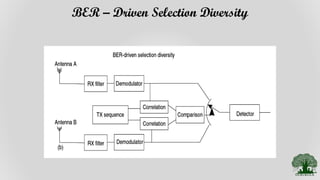
BER – Driven Selection Diversity
• Working…
• We first transmit the Training Sequence. (ie) Know signal / sequence.
• The Rx then demodulates the signal from each antenna and compares /
correlates it with the transmit signal.
• The antenna which received the smallest BER is chosen as the best and
that signal is processed further.
BER – Driven Selection Diversity
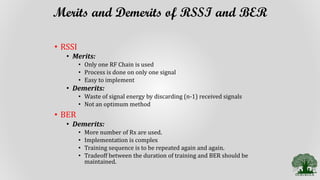
Merits and Demerits of RSSI and BER
• RSSI
• Merits:
• Only one RF Chain is used
• Process is done on only one signal
• Easy to implement
• Demerits:
• Waste of signal energy by discarding (n-1) received signals
• Not an optimum method
• BER
• Demerits:
• More number of Rx are used.
• Implementation is complex
• Training sequence is to be repeated again and again.
• Tradeoff between the duration of training and BER should be
maintained.
Switched Selection Diversity
• The main drawback of the selection diversity is its criteria.
• RSSSI and BER has to be monitored continuously on all
branches.
• Leads to complex designs and heavy hardware requirements.
These drawbacks are eliminated by switched selection diversity.
• In this method the selection criteria is monitored
only in the active branches.
• If it falls below a certain threshold value, then the
receiver switches to a different antenna.
• Case 1: All branches have equal power then the
selection of active branch is RANDOM.
• Case 2: All branches are below threshold level,
then the receiver just switches back and forth
until an active line is detected.
The performance of the switched diversity is
worse than the selection diversity. Hence it is not
considered widely.
Feed Back Diversity
• Also called scanning diversity.
• This is a combination of selection and switched diversity.
• All the available channels are scanned first in a fixed sequence
until one is found above the threshold level.
• The signal is received from that antenna until it falls off the
threshold value and scanning process is initiated again.
2. Combining Diversity
• It exploits all available copies of signals. Each signal
copy is multiplied by a (complex) weight and then
added up.
• Weight = phase correction + weight of amplitude
• Phase correction is done to make the signals
coherent.
• Amplitude weighting has 2 methods:
• Maximal ratio combining (MRC).
• Equal gain combining (EGC).
Maximum Ratio Combining
• This method weighs all signal copies by their amplitude.
• They also does the phase correction for different antennas.
Merits:
• Output are acceptable even when all the received signals are faded
highly.
Equal Gain Combining
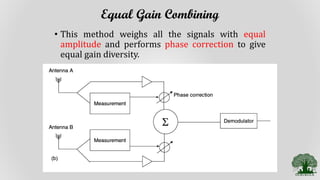
• This method weighs all the signals with equal
amplitude and performs phase correction to give
equal gain diversity.
MRC Vs EGC

4.4 diversity combining techniques

  • 1.
  • 2.
    Lecture Videos areavailable for this slides at www.youtube.com/gurukula Support by Subscribing to my Channel
  • 3.
    Diversity Achieved. Howto Resolve? Selection Diversity Combining Diversity
  • 4.
    Signal Combining Techniques •Selection diversity  Best signal is selected, and the rest are discarded. • Selection • Switched • Feed back • Combining diversity All signals are combined together and then it is decoded. • Maximal ratio combining • Equal gain diversity
  • 5.
    Selection Diversity • Thereare 2 selection criteria: • RSSI – Received Signal Strength Indication • BER – Bit Error Rate • The receiver selects the signal with the largest instantaneous power
  • 6.
    RSSI – DrivenSelection Diversity
  • 7.
    BER – DrivenSelection Diversity • Working… • We first transmit the Training Sequence. (ie) Know signal / sequence. • The Rx then demodulates the signal from each antenna and compares / correlates it with the transmit signal. • The antenna which received the smallest BER is chosen as the best and that signal is processed further.
  • 8.
    BER – DrivenSelection Diversity
  • 9.
    Merits and Demeritsof RSSI and BER • RSSI • Merits: • Only one RF Chain is used • Process is done on only one signal • Easy to implement • Demerits: • Waste of signal energy by discarding (n-1) received signals • Not an optimum method • BER • Demerits: • More number of Rx are used. • Implementation is complex • Training sequence is to be repeated again and again. • Tradeoff between the duration of training and BER should be maintained.
  • 10.
    Switched Selection Diversity •The main drawback of the selection diversity is its criteria. • RSSSI and BER has to be monitored continuously on all branches. • Leads to complex designs and heavy hardware requirements. These drawbacks are eliminated by switched selection diversity.
  • 11.
    • In thismethod the selection criteria is monitored only in the active branches. • If it falls below a certain threshold value, then the receiver switches to a different antenna. • Case 1: All branches have equal power then the selection of active branch is RANDOM. • Case 2: All branches are below threshold level, then the receiver just switches back and forth until an active line is detected. The performance of the switched diversity is worse than the selection diversity. Hence it is not considered widely.
  • 12.
    Feed Back Diversity •Also called scanning diversity. • This is a combination of selection and switched diversity. • All the available channels are scanned first in a fixed sequence until one is found above the threshold level. • The signal is received from that antenna until it falls off the threshold value and scanning process is initiated again.
  • 13.
    2. Combining Diversity •It exploits all available copies of signals. Each signal copy is multiplied by a (complex) weight and then added up. • Weight = phase correction + weight of amplitude • Phase correction is done to make the signals coherent. • Amplitude weighting has 2 methods: • Maximal ratio combining (MRC). • Equal gain combining (EGC).
  • 14.
    Maximum Ratio Combining •This method weighs all signal copies by their amplitude. • They also does the phase correction for different antennas. Merits: • Output are acceptable even when all the received signals are faded highly.
  • 15.
    Equal Gain Combining •This method weighs all the signals with equal amplitude and performs phase correction to give equal gain diversity.
  • 16.