ZX75US-5
Sample Parts & Service Manual — Technical Preview
This is a sample preview — full manual available at reliable-store.com
117W-1-1
SECTION 1
GENERAL IMFORMATION
—CONTENTS—
Group 1 Precautions for Disassembly
and Assembly
Precautions for Disassembly and
Assembly.............................................. W1-1-1
Group 2 Tightening
Tightening Torque Specification.............. W1-2-1
Torque Chart .......................................... W1-2-2
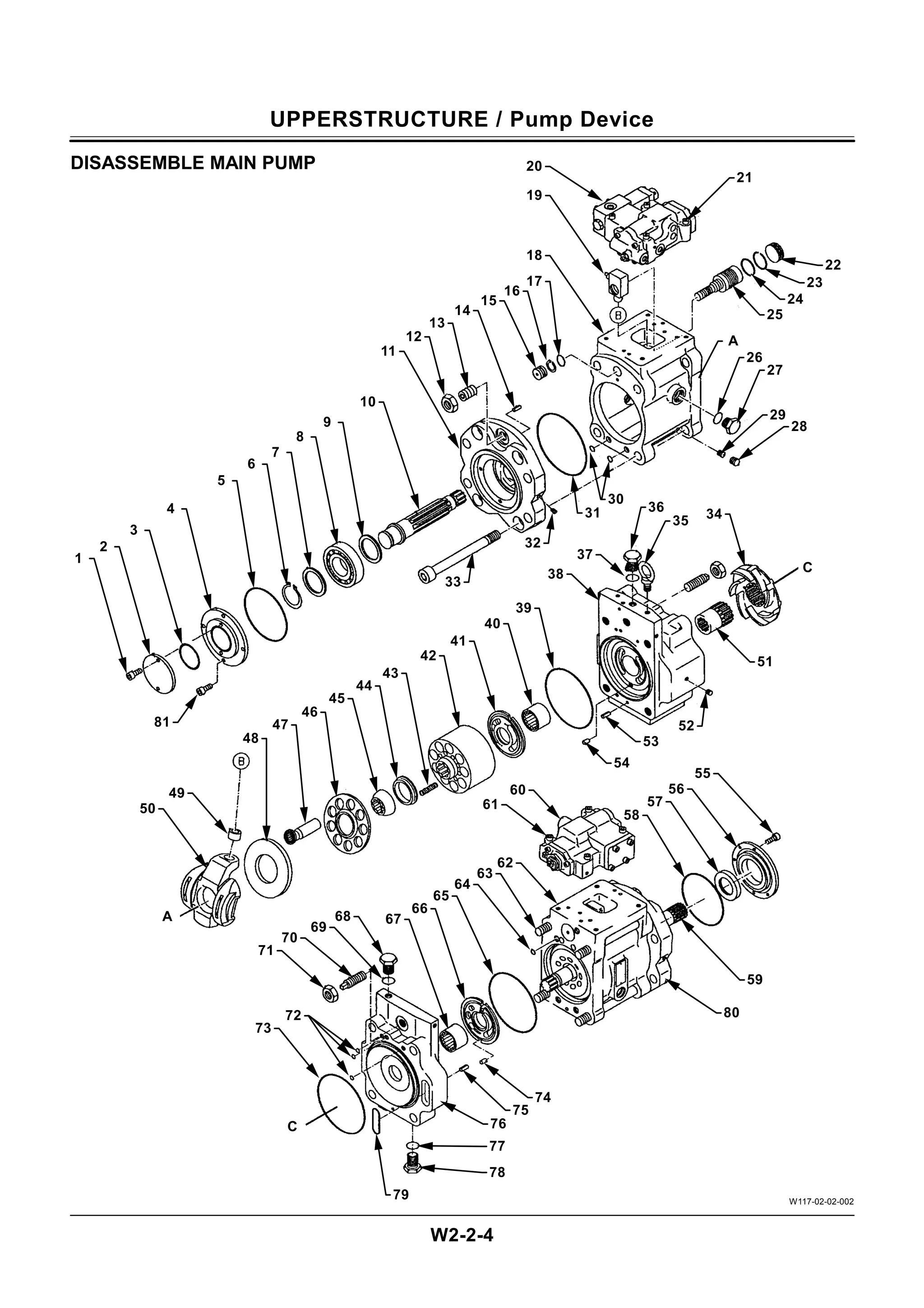
Piping Joint ............................................ W1-2-5
GENERAL INFORMATION / Precautions for Disassembly and Assembly
W1-1-1
PRECAUTIONS FOR DISASSEMBLY AND
ASSEMBLY
Preparations for Disassembly
• Clean the Machine
Thoroughly wash the machine before bringing it into
the shop. Bringing a dirty machine into the shop may
cause machine components to be contaminated
during disassembling/assembling, resulting in
damage to machine components, as well as
decreased efficiency in service work.
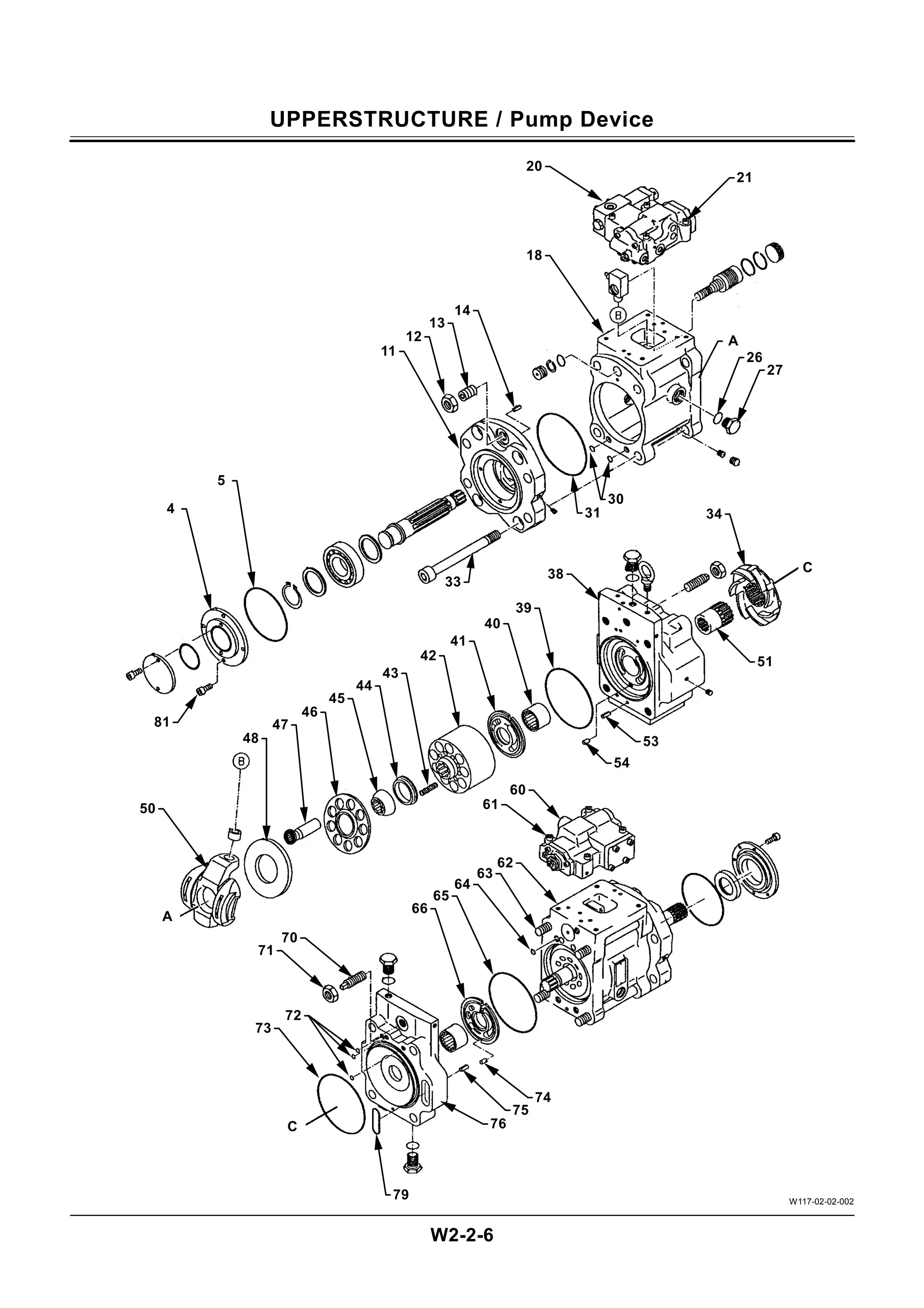
• Inspect the Machine
Be sure to thoroughly understand all disassem-
bling/assembling procedures beforehand, to help
avoid incorrect disassembling of components as well
as personal injury.
Check and record the items listed below to prevent
problems from occurring in the future.
• The machine model, machine serial number, and
hour meter reading.
• Reason for disassembly (symptoms, failed parts,
and causes).
• Clogging of filters and oil, water or air leaks, if any.
• Capacities and condition of lubricants.
• Loose or damaged parts.
• Prepare and Clean Tools and Disassembly Area
Prepare the necessary tools to be used and the area
for disassembling work.
Precautions for Disassembly and Assembly
• Precautions for Disassembly
• To prevent dirt from entering the hydraulic system,
cap or plug the removed pipes.
• Before disassembling, clean the exterior of the
components and place them on a clean work
bench.
• Before disassembling, drain gear oil from the
reduction gear.
• Be sure to provide appropriate containers for
fluids.
• Use matching marks for easier reassembling.
• Be sure to use the specified tools, when
instructed.
• If a part or component cannot be removed after
removing its securing nuts and bolts, do not
attempt to remove forcibly. Find the cause(s), then
take the appropriate measures.
• Orderly arrange disassembled parts. Mark and
tag them as necessary.
• Store common parts, such as bolts and nuts with
reference to where they are to be used and in a
manner that will prevent loss.
• Inspect the contact or sliding surfaces of
disassembled parts for abnormal wear, sticking,
or other damage.
• Measure and record the degree of wear and
clearances.
• Precautions for Assembly
• Be sure to clean all parts and inspect them for any
damage. If any damage is found, repair or replace
it.
• Dirt or debris on the contact or sliding surfaces
may shorten the service life of the machine. Take
care not to contaminate any contact or sliding
surfaces.
• Be sure to replace O-rings, backup rings, and oil
seals with new ones once they are disassembled.
Apply a film of grease before installing.
• Be sure that liquid-gasket-applied surfaces are
clean and dry.
• If an anti-corrosive agent has been used on a new
part, be sure to thoroughly clean the part.
• Utilize matching marks when assembling.
• Be sure to use the designated tools to assemble
bearings, bushings and oil seals.
• Keep a record of the number of tools used for
disassembly/assembly. After assembling is
complete, count the tools, so as to make sure that
no tools are missing.
GENERAL INFORMATION / Precautions for Disassembly and Assembly
W1-1-2
Bleeding Air from Hydraulic System
When hydraulic oil is drained, the suction filter or the
suction lines are replaced, or the removal and install
ation of the pump, swing motor, travel motor or
cylinder is done, bleed air from the hydraulic system
in the following procedures:
• Bleeding Air from Hydraulic Pump
IMPORTANT: If the engine is started with air
trapped in the hydraulic pump
housing, damage to the pump may
result. Be sure to bleed air before
starting the engine.
• Remove the air bleeding plug from the top of the
pump and fill the pump housing with hydraulic oil.
• After the pump housing is filled with hydraulic oil,
temporarily tighten the plug. Then, start the
engine and run at slow idle speed.
• Slightly loosen the plug to bleed air from the pump
housing until hydraulic oil oozes out.
• After bleeding all the air, securely tighten the plug.
• Bleeding Air from Travel Motor / Swing Motor
• With the drain plug / hose on travel motor / swing
motor removed, fill the motor case with hydraulic
oil.
• Bleeding Air from Hydraulic Circuit
• After refilling hydraulic oil, start the engine. While
operating each cylinder, swing motor and travel
motor evenly, operate the machine under light
loads for 10 to 15 minutes. Slowly start each
operation (never fully stroke the cylinders during
initial operation stage). As the pilot oil circuit has
an air bleed device, air trapped in the pilot oil
circuit will be bled while performing the above
operation for approx. 5 minutes.
• Reposition the front attachment to check hydraulic
oil level.
• Stop the engine. Recheck hydraulic oil level.
Replenish oil as necessary.
M104-07-021
GENERAL INFORMATION / Precautions for Disassembly and Assembly
W1-1-3
Floating Seal Precautions
1. In general, always replace the floating seal with a
new one.
If the floating seal is to be reused, follow these
procedures:
(1) Keep seal rings together as a matched set with
seal ring faces together. Insert a piece of
cardboard to protect surfaces.
(2) Check seal ring face (A) for scuffing, scoring,
corrosion, deformation or uneven wear.
(3) Check O-ring (B) for tears, breaks, deformation
or hardening.
2. If incorrectly assembled, oil leakage or damage
will occur. Be sure to do the following, to prevent
trouble.
(1) Clean the floating seal and seal mounting
bores with cleaning solvent.
Use a wire brush to remove mud, rust or dirt.
After cleaning, thoroughly dry parts with
compressed air.
(2) Clean the floating seal and seal mounting
bores, as dust on them tends to enter the
floating seal when installing it.
(3) Check that the O-ring is not twisted, and that it
is installed correctly on the seal ring.
(4) After installing the floating seal, check that seal
ring surface (A) is parallel with mating face (C)
by measuring the distances (A) and (C) at point
(a) and (b), as illustrated. If these distances
differ, correct the O-ring seating.
W105-03-05-019
W105-03-05-020
W110-03-05-004
A
B
Incorrect
Correct
aҐb
b b
a
a
a=b
A
B
Correct Incorrect
C
GENERAL INFORMATION / Precautions for Disassembly and Assembly
W1-1-4
(Blank)
GENERAL INFORMATION / Tightening Torque
W1-2-1
TIGHTENING TORQUE SPECIFICATIONS
Torque
No. Descriptions
Bolt Dia
mm
Q'ty
Wrench
Size
mm N⋅m (kgf⋅m) (lbf⋅ft)
1 Engine cushion rubber mounting bolt: 36 6 55 3140 (320) (2310)
2 Engine bracket mounting bolt: 30
22
12
4
46
32
1420
740
(145)
(75)
(1050)
(540)
3 Hydraulic oil tank mounting bolt: 30 10 46 1420 (145) (1050)
4 Fuel tank mounting bolt: 30 12 46 1420 (145) (1050)
5 Pump transmission mounting bolt: 12 16 19 108 (11) (80)
6 Pump device mounting bolt: 24 12 36 690 (70) (510)
7 Fan drive mounting bolt: 20 4 30 390 (40) (290)
8 Gear pump moounting bolt: 12 4 19 88 (9) (65)
9 Control valve mounting nut: 20 12 30 390 (40) (290)
10 Swing device mounting bolt: 33 50 50 2550 (260) (1880)
11 Swing motor mounting bolt: 20 16 30 390 (40) (290)
12 Battery mounting bolt: 10 16 17 49 (5) (36)
13 Cab mounting bolt: 18 8 27 295 (30) (215)
14 Cab bed mounting bolt: 16 36 24 205 (21) (152)
15 Swing vearing mounting bolt: 48 60 75 4900 (500) (3620)
16 Counterweight mounting nut: 48 6 75 5150 (525) (3800)
17 Engine bed mounting bolt: 30 26 46 1420 (145) (1050)
18 Oil cooler mounting nut: 24 8 36 690 (70) (510)
19 Radiator mounting nut: 27 16 41 1370 (140) (1010)
20 Fan motor mounting bolt: 12 10 10 108 (11) (80)
21 Fan motor bracket mounting bolt: 12 12 19 88 (9) (65)
22 Travel device mounting bolt: 27
36
20
16
24
56
30
32
41
55
30
24
1370
3140
390
205
(140)
(320)
(40)
(21)
(1010)
(2310)
(290)
(152)
23 Travel motor mounting bolt: 22 8 32 740 (75) (540)
24 Upper roller mounting bolt: 22 24 32 540 (55) (400)
25 Lower roller mounting bolt: 36 64 55 3140 (320) (2310)
26 Track pin-retaining bolt: 30 156 46 1910 (195) (1410)
27 Side frame mounting bolt: 48 68 85 4900 (500) (3620)
28 Front pin-retaining bolt: 24
20
16
28
16
6
36
30
24
690
390
265
(70)
(40)
(27)
(510)
(290)
(195)
NOTE: (1) Apply lubricant (e.g. white zinc B dissolved into spindle oil) to bolts and nuts to stabilize friction
coefficient of them.
(2) Make sure bolt and nut threads are clean before installing.
(3) Apply LOCTITE to threads before installing and tightening swing bearing mounting bolts.
GENERAL INFORMATION / Tightening Torque
W1-2-2
TORQUE CHART
CAUTION: Use tools appropriate for the
work to be done. Makeshift tools and
procedures can create safety hazards. For
loosening and tightening nuts and bolts, use
the correct tools. Avoid bodily injury caused
by slipping wrenches.
Bolt Types
Tighten nuts or bolts correctly to torque specifications.
Four kinds of bolts, hexagon bolts T, H, M and socket
bolts, each made of different material, are used.
Make sure to employ the correct bolts and tighten
them to specification when assembling the machine
or components.
SA-040
W162-01-01-001
Specified Tightening Torque Chart
T Bolt, Socket Bolt H Bolt M Bolt
Bolt
Dia.
Wrench
Size
Hexagon
Wrench
Size N⋅m (kgf⋅m) (lbf⋅ft) N⋅m (kgf⋅m) (lbf⋅ft) N⋅m (kgf⋅m) (lbf⋅ft)
M 8 13 6 29.5 (3) (22) 19.5 (2) (14.5) 9.8 (1) (7.2)
M 10 17 8 64 (6.5) (47) 49 (5) (36) 19.5 (2)) (14.5)
M 12 19 10 108 (11) (80) 88 (9) (65) 34 (3.5) (25.5)
M 14 22 12 175 (18) (130) 137 (14) (101) 54 (5.5) (40)
M 16 24 14 265 (27) (195) 205 (21) (152) 78 (8) (58)
M 18 27 14 390 (40) (290) 295 (30) (220) 118 (12) (87)
M 20 30 17 540 (55) (400) 390 (40) (290) 167 (17) (123)
M 22 32 17 740 (75) (540) 540 (55) (400) 215 (22) (159)
M 24 36 19 930 (95) (690) 690 (70) (505) 275 (28) (205)
M 27 41 19 1370 (140) (1010) 1030 (105) (760) 390 (40) (290)
M 30 46 22 1910 (195) (1410) 1420 (145) (1050) 540 (55) (400)
M 33 50 24 2550 (260) (1880) 1910 (195) (1410) 740 (75) (540)
M 36 55 27 3140 (320) (2310) 2400 (245) (1770) 930 (95) (690)
Socket Bolt
Hexagon M Bolt
Hexagon H Bolt
Hexagon T Bolt
GENERAL INFORMATION / Tightening Torque
W1-2-5
PIPING JOINT
Pipe Thread Connection/Union Joint Tightening
Torque Specifications
Union Joint
Metal sealing faces (4) and (5) of adaptor (1) and
hose (2) fit together to seal pressure oil. Union joints
are used to join small-diameter lines.
IMPORTANT: (1) Do not over-tighten union nut (3).
Excessive force will be applied to
metal sealing surfaces (4) and (5),
possibly cracking adaptor (1). Be
sure to tighten union nut (3) to
specifications.
(2) Scratches or other damage to
sealing surfaces (4) or (5) will
cause oil leakage at the joint.
Take care not to damage them
when connecting /disconnecting.
O-Ring Seal Joint
O-ring (6) seats against the end face of adaptor (7) to
seal pressure oil.
IMPORTANT: (1) Be sure to replace O-ring (6) with
a new one when reconnecting.
(2) Before tightening union nut (9),
confirm that O-ring (6) is seated
correctly in O-ring groove (8).
Tightening union nut (9) with O-
ring (6) displaced will damage O-
ring (6), resulting in oil leakage.
(3) Take care not to damage O-ring
groove (8) or sealing face (10).
Damage to O-ring (6) will cause
oil leakage.
(4) If union nut (9) is found to be
loose, causing oil leakage, do not
tighten it to stop the leak. Instead,
replace O-ring (6) with a new one,
then tighten union nut (9) after
confirming that O-ring (6) is
securely seated in place.
M202-07-051
W105-01-01-017
Tightening Torque
Wrench Size
mm N⋅m (kgf⋅m) (Ibf⋅ft)
19
22
27
32
36
41
50
29
39
93
137
175
205
255
(3.0)
(4.0)
(9.5)
(14)
(18)
(21)
(26)
(22)
(29)
(69)
(101)
(130)
(152)
(188)
M104-07-033
Tightening Torque
Wrench Size
mm N⋅m (kgf⋅m) (Ibf⋅ft)
27
32
36
41, 46
93
137
175
205
(9.5)
(14)
(18)
(21)
(69)
(101)
(130)
(152)
Female Union Joint
Male Union Joint
30° or 37°
30° or 37°
7
Joint Body
6 9
1
8
4
10
3 5 2
GENERAL INFORMATION / Tightening Torque
W1-2-7
Connecting Hose
CAUTION:
(1) When replacing hoses, be sure to use
only genuine Hitachi service parts. Using
hoses other than genuine Hitachi hoses
may cause oil leakage, hose rupture or
separation of fitting, possibly resulting in
a fire on the machine.
(2) Do not install hoses kinked. Application
of high oil pressure, vibration, or an
impact to a kinked hose may result in oil
leakage, hose rupture or separation of
fitting. Utilize print marks on hoses when
installing hoses to prevent hose from
being installed kinked.
(3) If hoses rub against each other, wear to
the hoses will result, leading to hose
rupture. Take necessary measures to
protect hoses from rubbing against each
other.
Take care that hoses do not come into
contact with moving parts or sharp
objects.
W105-01-01-011
W105-01-01-012
W105-01-01-013
W105-01-01-014
RIGHT
WRONG
Rubbing Against
Each Other
RIGHT
WRONG
RIGHT
WRONG
Rubbing
Clamp Clamp
WRONG
Rubbing
Clamp
RIGHT
117W-2-1
SECTION 2
UPPERSTRUCTURE
—CONTENTS—
Group 1 Cab
Windowpane Dimensions ......................... W2-1-1
Group 2 Pump Device
Remove and Install
Pump Device .......................................... W2-2-1
Pump Device Line Connection.................. W2-2-3
Disassemble Main Pump.......................... W2-2-4
Assemble Main Pump............................. W2-2-10
Maintenance Standards.......................... W2-2-13
Disassemble Regulator .......................... W2-2-14
Assemble Regulator ............................... W2-2-20
Disassemble and Assemble
4-Unit Pump ......................................... W2-2-27
Disassemble Fan Drive Pump ................ W2-2-28
Assemble Fan Drive Pump ..................... W2-2-32
Maintenance Standards.......................... W2-2-34
Disassemble Regulator .......................... W2-2-36
Assemble Regulator ............................... W2-2-40
Disassemble and Assemble Compressor
Drive Pump ⋅ Pilot Pump....................... W2-2-42
Disassemble and Assemble Transmission
Oil Cooling Pump.................................. W2-2-44
Group 3 Control Valve
Remove and Install
Control Valve .......................................... W2-3-1
Pilot Line Port Location ............................ W2-3-3
Main Hydraulic Line Port Location ............ W2-3-4
Disassemble and Assemble
Control Valve .......................................... W2-3-5
Group 4 Swing Device
Remove and Install Swing Device............. W2-4-1
Disassemble Swing Device....................... W2-4-2
Assemble Swing Device ........................... W2-4-6
Disassemble Swing Motor ...................... W2-4-12
Assemble Swing Motor ........................... W2-4-14
Maintenance Standard............................ W2-4-16
Disassemble and Assemble
Relief Block .......................................... W2-4-17
Group 5 Pilot Valve
Remove and Install Front/Swing
Pilot Valve............................................... W2-5-1
Remove and Install Travel and Bucket
Open/Close Pilot Valves ......................... W2-5-3
Pilot Valve Ports ....................................... W2-5-5
Disassemble and Assemble
Pilot Valve............................................... W2-5-6
Group 6 Pilot Shut-Off Valve
Remove and Install
Shut-Off Valve .......................................... W2-6-1
Disassemble Pilot Shut-Off Valve ............. W2-6-2
Assemble Pilot Shut-Off Valve .................. W2-6-4
UPPERSTRUCTURE / Pump Device
W2-2-1
REMOVE AND INSTALL PUMP DEVICE
CAUTION: Escaping fluid under pressure
can penetrate the skin and eyes, causing
serious injury. Avoid this hazard by relieving
pressure before disconnecting hydraulic or
other lines.
Hydraulic oil may be hot just after operation.
Hot hydraulic oil may spout, possibly causing
severe burns. Be sure to wait for oil to cool
before starting work.
Do not quickly loosen the cap on the hydrau-
lic oil tank. The cap may fly off due to internal
pressure. Always turn the cap slowly to re-
lease any remaining pressure before remov-
ing it.
Preparation:
1. Stop the engine. Move all control levers to release
the pressure remaining in the system. Slowly turn
the cap on the hydraulic oil tank approximately 30
degrees counter-clockwise to release any
remaining pressure.
2. Close all hydraulic line stop valves.
UPPERSTRUCTURE / Pump Device
W2-2-2
Removal
1. Disconnect all wire harness ends and hydraulic
line ends from the pump.
CAUTION: Pump Device Weight:
298 kg (657 Ib)
Approximate Quadruple Pump Weight: 100 kg
(220 Ib)
2. Remove the pump mounting bolts to remove the
pumps.
: 36 mm
: 690 N⋅m (70 kgf⋅m, 507 lbf⋅ft)
: 30 mm
: 390 N⋅m (40 kgf⋅m, 290 lbf⋅ft)
Installation
NOTE: Refar to the Removal section for wrench
size and tightening torque.
1. Install the pumps using the mounting bolts.
2. Connect all wire harness ends and hydraulic line
ends to the pump.
3. Bleed the air from the pump. (Refer to W1-1-2)
IMPORTANT: Prevent pump seizure from
occurring. Be sure to perform
running-in operation after installing
the pumps.
Pump Running-In Operation Procedure:
1. Run the engine at slow idle for 20 minutes.
Check for oil leaks during the engine idling
operation.
2. Increase the engine speed to the maximum
speed. Slowly operate the boom from stroke
end to stroke end repeatedly for 20 minutes.
T117-02-01-001
M117-07-118
Mounting Bolt
Air Bleed Position Air Bleed Position
UPPERSTRUCTURE / Pump Device
W2-2-5
1 - Socket Bolt (2 Used) 22 - Stopper (2 Used) 42 - Cylinder Block
(2 Used)
62 - Housing
2 - Cover 23 - Back-Up Ring (2 Used) 43 - Spring (18 Used) 63 - Socket Bolt (4 Used)
3 - O-Ring 24 - O-Ring (2 Used) 44 - Spacer (2 Used) 64 - O-Ring (12 Used)
4 - Cover 25 - Servo Piston (2 Used) 45 - Spherical Bushing
(2 Used)
65 - O-Ring
5 - O-Ring 26 - O-Ring (2 Used) 46 - Retainer (2 Used) 66 - Valve Plate
6 - Retaining Ring
(2 Used)
27 - Plug (2 Used) 47 - Plunger (18 Used) 67 - Needle Bearing
7 - Spacer (2 Used) 28 - Taper Screw 48 - Shoe Plate (2 Used) 68 - Plug
8 - Bearing (2 Used) 29 - Plug 49 - Bushing (2 Used) 69 - O-Ring
9 - Spacer (2 Used) 30 - O-Ring (4 Used) 50 - Swash Plate (2 Used) 70 - Adjusting Screw
(2 Used)
10 - Shaft 31 - O-Ring 51 - Coupling 71 - Nut (2 Used)
11 - Cover 32 - Plug 52 - Plug 72 - O-Ring (3 Used)
12 - Nut (2 Used) 33 - Socket Bolt (4 Used) 53 - Spring Pin 73 - O-Ring
13 - Adjusting Screw
(2 Used)
34 - Booster 54 - Pin 74 - Pin
14 - Spring Pin 35 - Eye Bolt 55 - Socket Bolt (8 Used) 75 - Spring Cover
15 - Stopper (2 Used) 36 - Plug 56 - Cover 76 - Cover
16 - Back-Up Ring (2 Used) 37 - O-Ring 57 - Oil Seal 77 - O-Ring
17 - O-Ring (2 Used) 38 - Valve Cover 58 - O-Ring 78 - Plug
18 - Housing 39 - O-Ring 59 - Shaft 79 - O-Ring
19 - Displacement Angle Shift
Pin (2 Used)
40 - Needle Bearing 60 - Regulator 80 - Cover
20 - Regulator 41 - Valve Plate 61 - Socket Bolt (4 Used) 81 - Socket Bolt (4 Used)
21 - Socket Bolt (4 Used)
NOTE: The components of housing (62): parts (6) to (9), (15) to (17), (19), (22) to (25), and (42) to (50), are
exactly the same as those of housing (18).
UPPERSTRUCTURE / Pump Device
W2-2-7
Disassemble Main Pump
IMPORTANT: Do not attempt to remove nut (12),
adjusting screw (13), nut (71), and
adjusting screw (70). Leave them as
installed. The set flow rate may be
altered.
1. Remove plugs (27) (2 used) and O-rings (26) (2
used) to drain hydraulic oil from the pump.
: 36 mm
2. Remove socket bolts (21) (4 used) and (61) (4
used) to remove regulators (20) and (60),
respectively.
: 6 mm
3. Turn the pump over (on the regulator mounting
side). Remove socket bolts (33) (4 used) and (63)
(4 used).
: 17 mm
4. Separate housing (18), valve cover (38), cover
(76), and housing (62) assemblies. Be sure to
remove O-rings (39), (65), (64), (72), (73), and
(79) and spring pins (53) and (75) when
separating these assemblies.
NOTE: Take care not to drop valve plates (41) and
(66) while separating these assemblies.
5. Remove booster (34), coupling (51), valve plate
(41) and pin (54) from valve cover (38).
NOTE: Do not remove needle bearing (40) unless
required.
6. Remove cylinder block (42), springs (43) (9 used),
spacer (44), spherical bushing (45), retainer (46),
and plungers (47) (9 used) from housing (18).
7. Remove socket bolts (81) (4 used) to remove
cover (4) and O-ring (5).
: 6 mm
8. Tap on cover (11) using a plastic hammer to
remove it. Remove O-rings (30) (2 used) and (31),
and spring pin (14) as well.
9. Remove swash plate (50) and shoe plate (48)
from housing (18).
UPPERSTRUCTURE / Pump Device
W2-2-10
ASSEMBLE MAIN PUMP
W117-02-02-003
1 - Socket Bolt (2 Used) 22 - Stopper (2 Used) 42 - Cylinder Block
(2 Used)
62 - Housing
2 - Cover 23 - Back-Up Ring (2 Used) 43 - Spring (18 Used) 63 - Socket Bolt (4 Used)
3 - O-Ring 24 - O-Ring (2 Used) 44 - Spacer (2 Used) 64 - O-Ring (12 Used)
4 - Cover 25 - Servo Piston (2 Used) 45 - Spherical Bushing
(2 Used)
65 - O-Ring
5 - O-Ring 26 - O-Ring (2 Used) 46 - Retainer (2 Used) 66 - Valve Plate
6 - Retaining Ring
(2 Used)
27 - Plug (2 Used) 47 - Plunger (18 Used) 67 - Needle Bearing
7 - Spacer (2 Used) 28 - Taper Screw 48 - Shoe Plate (2 Used) 68 - Plug
8 - Bearing (2 Used) 29 - Plug 49 - Bushing (2 Used) 69 - O-Ring
9 - Spacer (2 Used) 30 - O-Ring (4 Used) 50 - Swash Plate (2 Used) 70 - Adjusting Screw
(2 Used)
10 - Shaft 31 - O-Ring 51 - Coupling 71 - Nut (2 Used)
11 - Cover 32 - Plug 52 - Plug 72 - O-Ring (3 Used)
12 - Nut (2 Used) 33 - Socket Bolt (4 Used) 53 - Spring Pin 73 - O-Ring
13 - Adjusting Screw
(2 Used)
34 - Booster 54 - Pin 74 - Pin
14 - Spring Pin 35 - Eye Bolt 55 - Socket Bolt (8 Used) 75 - Spring Cover
15 - Stopper (2 Used) 36 - Plug 56 - Cover 76 - Cover
16 - Back-Up Ring (2 Used) 37 - O-Ring 57 - Oil Seal 77 - O-Ring
17 - O-Ring (2 Used) 38 - Valve Cover 58 - O-Ring 78 - Plug
18 - Housing 39 - O-Ring 59 - Shaft 79 - O-Ring
19 - Displacement Angle Shift
Pin (2 Used)
40 - Needle Bearing 60 - Regulator 80 - Cover
20 - Regulator 41 - Valve Plate 61 - Socket Bolt (4 Used) 81 - Socket Bolt (4 Used)
21 - Socket Bolt (4 Used)
NOTE: The components of housing (62): parts (6) to (9), (15) to (17), (19), (22) to (25), and (42) to (50), are
exactly the same as those of housing (18).
14
8
5
3
2
10
6
1
81
4
33
7
13
12
15 16, 17
25
19
22
23, 24
64
39
38
73
76
64
65
62
49
48
50
45
80
71
70
55
56
59
57
58
63
46 47 44 43 42 66 74 67 75 34 51 40 54 53 41 18 9
31 11
117W-1-2
(Blank)
GENERAL INFORMATION / Tightening Torque
W1-2-3
IMPORTANT: (1) Apply lubricant (i. e. white zinc B
dissolved into spindle oil) to nuts
and bolts to stabilize their friction
coefficients.
(2) Torque tolerance is ±
±
±
±10 %.
(3) Be sure to use bolts of correct
length. Bolts that are too long
cannot be tightened, as the bolt
tip comes into contact with the
bottom of the bolt hole. Bolts that
are too short cannot develop
sufficient tightening force.
(4) The torques given in the chart
are for general use only.
Do not use these torques if a
different torque is given for a
specific application.
(5) Make sure that the nut and bolt
threads are clean before
installing. Remove dirt or
corrosion, if any.
Bolt Tightening Order
When tightening two or more bolts, tighten them
alternately, as shown, to ensure even tightening.
W105-01-01-003
Tighten from center
and diagonally
Tighten diagonally
Equally tighten upper
and lower alternately
14
7
6
1
4
9
12
6
4
2
5
3
1
2,3
1,4
11
10
3
2
5
8
13
GENERAL INFORMATION / Tightening Torque
W1-2-4
Service Recommendations for Split Flange
IMPORTANT: (1) Be sure to clean and inspect
sealing surfaces. Scratches /
roughness cause leaks and seal
wear. Unevenness causes seal
extrusion. If defects cannot be
removed, replace the component.
(2) Be sure to use only specified O-
rings. Inspect O-rings for any
damage. Take care not to file O-
ring surfaces. When installing an
O-ring into a groove, use grease
to hold it in place.
(3) Loosely assemble split flange
halves. Make sure that the split is
centrally located and
perpendicular to the port. Hand-
tighten the bolts to hold the parts
in place. Take care not to pinch
the O-ring.
(4) Tighten bolts alternately and
diagonally, as shown, to ensure
even tightening.
(5) Do not use air wrenches. Using
an air wrench often causes
tightening of one bolt fully before
tighten the others, resulting in
damage to O-rings or uneven
tightening of bolts.
Nut and Bolt Lockings
• Lock Plate
IMPORTANT: Do not reuse lock plates. Do not try
to bend the same point twice.
• Cotter Pin
IMPORTANT: Do not reuse cotter pins. Match the
holes in the bolt and nut while
tightening, not while loosening.
• Lock Wire
IMPORTANT: Apply wire to bolts in the bolt-
tightening direction, not in the bolt-
loosening direction.
W105-01-01-015
W105-01-01-016
W105-01-01-008
W105-01-01-009
W105-01-01-010
WRONG
WRONG
WRONG
RIGHT
RIGHT
Bend along edge sharply
Do not bend it round
Bend along edge sharply
RIGHT
Tighten
Loosen WRONG
WRONG
RIGHT
RIGHT
RIGHT
GENERAL INFORMATION / Tightening Torque
W1-2-6
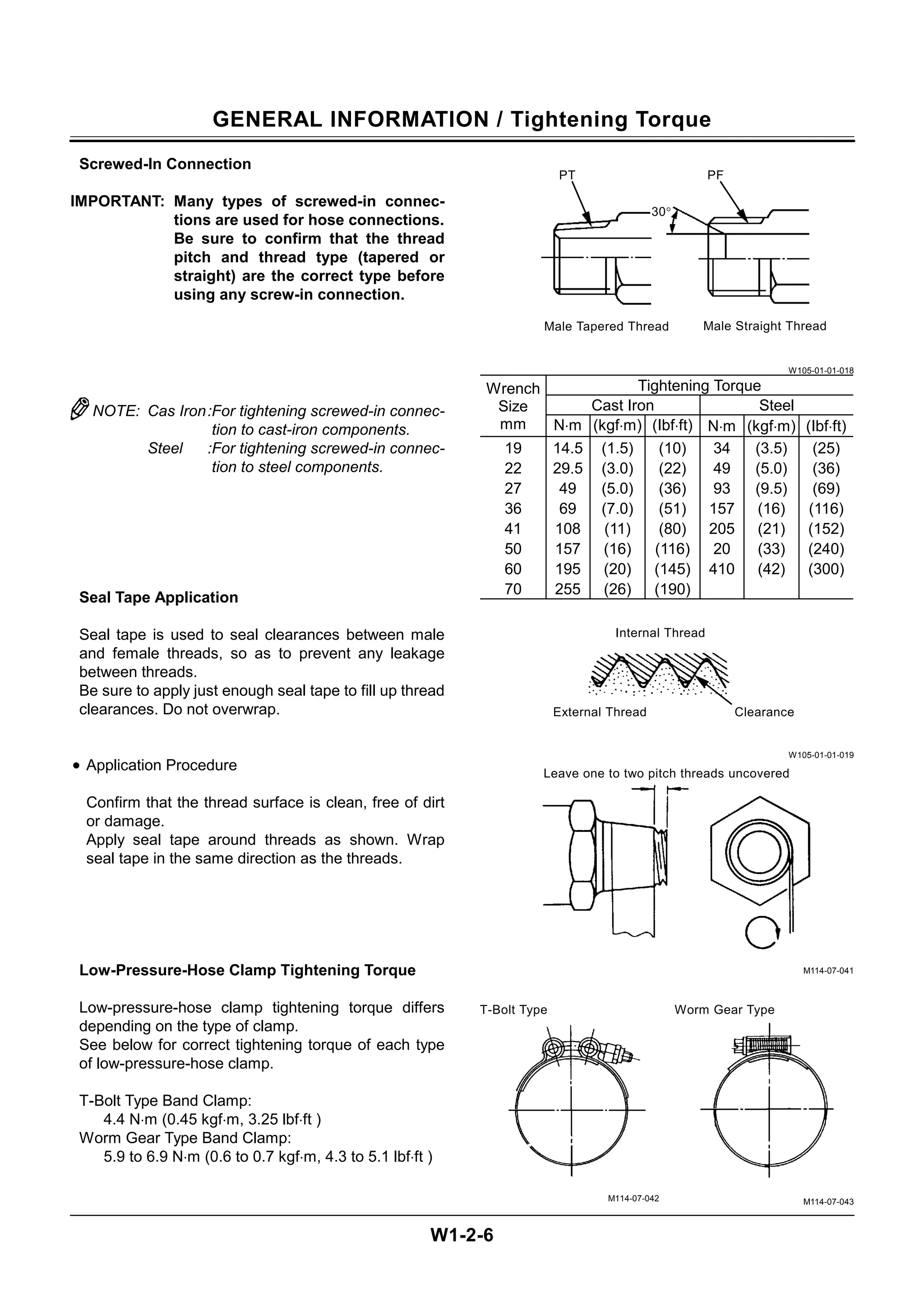
Screwed-In Connection
IMPORTANT: Many types of screwed-in connec-
tions are used for hose connections.
Be sure to confirm that the thread
pitch and thread type (tapered or
straight) are the correct type before
using any screw-in connection.
NOTE: Cas Iron:For tightening screwed-in connec-
tion to cast-iron components.
Steel :For tightening screwed-in connec-
tion to steel components.
Seal Tape Application
Seal tape is used to seal clearances between male
and female threads, so as to prevent any leakage
between threads.
Be sure to apply just enough seal tape to fill up thread
clearances. Do not overwrap.
• Application Procedure
Confirm that the thread surface is clean, free of dirt
or damage.
Apply seal tape around threads as shown. Wrap
seal tape in the same direction as the threads.
Low-Pressure-Hose Clamp Tightening Torque
Low-pressure-hose clamp tightening torque differs
depending on the type of clamp.
See below for correct tightening torque of each type
of low-pressure-hose clamp.
T-Bolt Type Band Clamp:
4.4 N⋅m (0.45 kgf⋅m, 3.25 lbf⋅ft )
Worm Gear Type Band Clamp:
5.9 to 6.9 N⋅m (0.6 to 0.7 kgf⋅m, 4.3 to 5.1 lbf⋅ft )
W105-01-01-018
Tightening Torque
Cast Iron Steel
Wrench
Size
mm N⋅m (kgf⋅m) (Ibf⋅ft) N⋅m (kgf⋅m) (Ibf⋅ft)
19
22
27
36
41
50
60
70
14.5
29.5
49
69
108
157
195
255
(1.5)
(3.0)
(5.0)
(7.0)
(11)
(16)
(20)
(26)
(10)
(22)
(36)
(51)
(80)
(116)
(145)
(190)
34
49
93
157
205
20
410
(3.5)
(5.0)
(9.5)
(16)
(21)
(33)
(42)
(25)
(36)
(69)
(116)
(152)
(240)
(300)
W105-01-01-019
M114-07-041
T-Bolt Type
M114-07-042
Worm Gear Type
M114-07-043
Male Straight Thread
Male Tapered Thread
Clearance
External Thread
Internal Thread
Leave one to two pitch threads uncovered
PT
30°
PF
GENERAL INFORMATION / Tightening Torque
W1-2-8
(Blank)
117W-2-2
Group 7 Solenoid Valve
Remove and Install
Solenoid Valve........................................ W2-7-1
Disassemble and Assemble
Fan Motor Solenoid Valve....................... W2-7-2
Disassemble and Assemble Horsepower
Reducing Solenoid Valve ........................ W2-7-3
Disassemble and Assemble
EHC Valve .............................................. W2-7-4
Disassemble and Assemble
Swing Stop Solenoid Valve ..................... W2-7-5
Disassemble and Assemble Travel Mode Shift
Solenoid Valve........................................ W2-7-6
Group 8 Fan Drive Motor
Remove and Install
Fan Drive Motor...................................... W2-8-1
Disassemble Fan Drive Motor .................. W2-8-4
Assemble Fan Drive Motor ....................... W2-8-6
Maintenance Standards............................ W2-8-8
Group 9 Compressor Drive Motor
Remove and Install
Compressor Drive Motor......................... W2-9-1
Disassemble and Assemble
Compressor Drive Motor......................... W2-9-4
Group 10 Air Conditioner
Work After Component
Replacement ........................................ W2-10-1
Add Compressor Oil ............................... W2-10-1
Charge Air Conditioner with
Refrigerant ........................................... W2-10-2
UPPERSTRUCTURE / Cab
W2-1-1
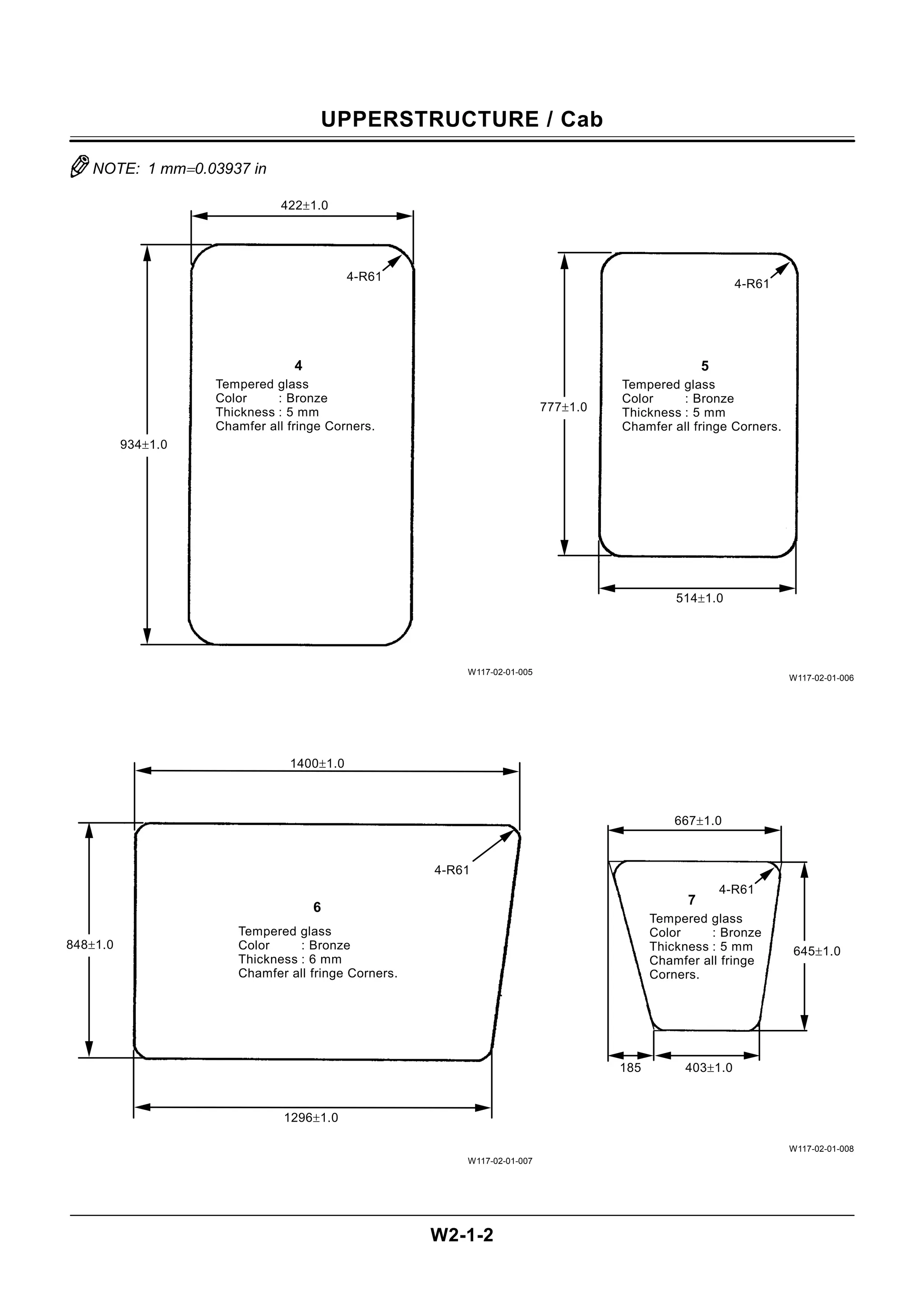
WINDOWPANE DIMENSIONS
Material : JIS R 3211 or equivalent
NOTE: 1 mm=0.03937 in Unit:mm
W117-02-01-001
W117-02-01-003
W117-02-01-002
W117-02-01-004
2
3
4
5
7
6
1
1679+2.0
−0
1378±1.5
Laminated glass
Color : Transparent
Thickness : 10 mm
Chamfer all fringe Corners.
1
4-R91
Tempered glass
Color : Bronze
Thickness : 6 mm
Chamfer all fringe Corners.
2
4-R61
1369±1.5
917±1.0
1256±1.5
Tempered glass
Color : Bronze
Thickness : 5 mm
Chamfer all fringe
Corners.
3
4-R61
433±1.0
769±1.0
UPPERSTRUCTURE / Cab
W2-1-2
NOTE: 1 mm=0.03937 in
W117-02-01-005
W117-02-01-007
W117-02-01-006
W117-02-01-008
Tempered glass
Color : Bronze
Thickness : 6 mm
Chamfer all fringe Corners.
6
4-R61
848±1.0
1296±1.0
1400±1.0
Tempered glass
Color : Bronze
Thickness : 5 mm
Chamfer all fringe
Corners.
7
4-R61
645±1.0
185 403±1.0
667±1.0
Tempered glass
Color : Bronze
Thickness : 5 mm
Chamfer all fringe Corners.
5
4-R61
514±1.0
777±1.0
Tempered glass
Color : Bronze
Thickness : 5 mm
Chamfer all fringe Corners.
4
4-R61
934±1.0
422±1.0
UPPERSTRUCTURE / Pump Device
W2-2-3
PUMP DEVICE LINE CONNECTION
T117-02-01-001
1 - Main Pump 3 (Transmission Side)
Main Pump 4 (Tip Side)
3 - Main Pump 1 (Transmission Side)
Main Pump 2 (Tip Side)
5 - Suction Line 6 - Delivery Line
2 - Main Pump 5 (Transmission Side)
Main Pump 6 (Tip Side)
4 - Quadruple Pump
T117-02-01-004
Psv - Pump Servo Assist Pressure (From the pilot pump) Pf - Horsepower Reducing Control Pressure
(Horsepower Reducing Solenoid Valve)
Pi - Flow Rate Control Pressure
(Switch Valves 1 and 2, Pressure Reducing Valve)
Pz -Horsepower Increasing Control Pressure
(EHC Valve)
6
6
5
1
6
2
3
5
4
5
Pi Pf
Psv Pz
Pi
Psv
Pz
UPPERSTRUCTURE / Pump Device
W2-2-4
DISASSEMBLE MAIN PUMP
W117-02-02-002
21
20
19
18
17
16
15
14
13
12
11
10
9
8
7
6
5
4
3
2
1
22
23
24
25
A
26
27
29
28
30
31
32
33
81
C
34
35
36
37
38
39
40
41
42
43
44
45
46
47
48
49
50
A
51
52
53
54
60
61
55
56
57
58
62
63
64
65
66
67
68
69
70
71
72
73
C
59
80
74
75
76
77
78
79
UPPERSTRUCTURE / Pump Device
W2-2-6
W117-02-02-002
21
20
18
14
13
12
11
5
4
A
26
27
30
31
33
81
C
34
38
39
40
41
42
43
44
45
46
47
48
50
A
51
53
54
60
61
62
63
64
65
66
70
71
72
73
C
74
75
76
79
Get the complete manual
Get the complete manual including full parts diagrams, torque specs &
troubleshooting. Download now from reliable-store.com
Download full official manual — reliable-store.com

41413 ZX75US-5 Operational and Repair Manual

  • 1.
    ZX75US-5 Sample Parts &Service Manual — Technical Preview This is a sample preview — full manual available at reliable-store.com
  • 2.
    117W-1-1 SECTION 1 GENERAL IMFORMATION —CONTENTS— Group1 Precautions for Disassembly and Assembly Precautions for Disassembly and Assembly.............................................. W1-1-1 Group 2 Tightening Tightening Torque Specification.............. W1-2-1 Torque Chart .......................................... W1-2-2 Piping Joint ............................................ W1-2-5
  • 3.
    GENERAL INFORMATION /Precautions for Disassembly and Assembly W1-1-1 PRECAUTIONS FOR DISASSEMBLY AND ASSEMBLY Preparations for Disassembly • Clean the Machine Thoroughly wash the machine before bringing it into the shop. Bringing a dirty machine into the shop may cause machine components to be contaminated during disassembling/assembling, resulting in damage to machine components, as well as decreased efficiency in service work. • Inspect the Machine Be sure to thoroughly understand all disassem- bling/assembling procedures beforehand, to help avoid incorrect disassembling of components as well as personal injury. Check and record the items listed below to prevent problems from occurring in the future. • The machine model, machine serial number, and hour meter reading. • Reason for disassembly (symptoms, failed parts, and causes). • Clogging of filters and oil, water or air leaks, if any. • Capacities and condition of lubricants. • Loose or damaged parts. • Prepare and Clean Tools and Disassembly Area Prepare the necessary tools to be used and the area for disassembling work. Precautions for Disassembly and Assembly • Precautions for Disassembly • To prevent dirt from entering the hydraulic system, cap or plug the removed pipes. • Before disassembling, clean the exterior of the components and place them on a clean work bench. • Before disassembling, drain gear oil from the reduction gear. • Be sure to provide appropriate containers for fluids. • Use matching marks for easier reassembling. • Be sure to use the specified tools, when instructed. • If a part or component cannot be removed after removing its securing nuts and bolts, do not attempt to remove forcibly. Find the cause(s), then take the appropriate measures. • Orderly arrange disassembled parts. Mark and tag them as necessary. • Store common parts, such as bolts and nuts with reference to where they are to be used and in a manner that will prevent loss. • Inspect the contact or sliding surfaces of disassembled parts for abnormal wear, sticking, or other damage. • Measure and record the degree of wear and clearances. • Precautions for Assembly • Be sure to clean all parts and inspect them for any damage. If any damage is found, repair or replace it. • Dirt or debris on the contact or sliding surfaces may shorten the service life of the machine. Take care not to contaminate any contact or sliding surfaces. • Be sure to replace O-rings, backup rings, and oil seals with new ones once they are disassembled. Apply a film of grease before installing. • Be sure that liquid-gasket-applied surfaces are clean and dry. • If an anti-corrosive agent has been used on a new part, be sure to thoroughly clean the part. • Utilize matching marks when assembling. • Be sure to use the designated tools to assemble bearings, bushings and oil seals. • Keep a record of the number of tools used for disassembly/assembly. After assembling is complete, count the tools, so as to make sure that no tools are missing.
  • 4.
    GENERAL INFORMATION /Precautions for Disassembly and Assembly W1-1-2 Bleeding Air from Hydraulic System When hydraulic oil is drained, the suction filter or the suction lines are replaced, or the removal and install ation of the pump, swing motor, travel motor or cylinder is done, bleed air from the hydraulic system in the following procedures: • Bleeding Air from Hydraulic Pump IMPORTANT: If the engine is started with air trapped in the hydraulic pump housing, damage to the pump may result. Be sure to bleed air before starting the engine. • Remove the air bleeding plug from the top of the pump and fill the pump housing with hydraulic oil. • After the pump housing is filled with hydraulic oil, temporarily tighten the plug. Then, start the engine and run at slow idle speed. • Slightly loosen the plug to bleed air from the pump housing until hydraulic oil oozes out. • After bleeding all the air, securely tighten the plug. • Bleeding Air from Travel Motor / Swing Motor • With the drain plug / hose on travel motor / swing motor removed, fill the motor case with hydraulic oil. • Bleeding Air from Hydraulic Circuit • After refilling hydraulic oil, start the engine. While operating each cylinder, swing motor and travel motor evenly, operate the machine under light loads for 10 to 15 minutes. Slowly start each operation (never fully stroke the cylinders during initial operation stage). As the pilot oil circuit has an air bleed device, air trapped in the pilot oil circuit will be bled while performing the above operation for approx. 5 minutes. • Reposition the front attachment to check hydraulic oil level. • Stop the engine. Recheck hydraulic oil level. Replenish oil as necessary. M104-07-021
  • 5.
    GENERAL INFORMATION /Precautions for Disassembly and Assembly W1-1-3 Floating Seal Precautions 1. In general, always replace the floating seal with a new one. If the floating seal is to be reused, follow these procedures: (1) Keep seal rings together as a matched set with seal ring faces together. Insert a piece of cardboard to protect surfaces. (2) Check seal ring face (A) for scuffing, scoring, corrosion, deformation or uneven wear. (3) Check O-ring (B) for tears, breaks, deformation or hardening. 2. If incorrectly assembled, oil leakage or damage will occur. Be sure to do the following, to prevent trouble. (1) Clean the floating seal and seal mounting bores with cleaning solvent. Use a wire brush to remove mud, rust or dirt. After cleaning, thoroughly dry parts with compressed air. (2) Clean the floating seal and seal mounting bores, as dust on them tends to enter the floating seal when installing it. (3) Check that the O-ring is not twisted, and that it is installed correctly on the seal ring. (4) After installing the floating seal, check that seal ring surface (A) is parallel with mating face (C) by measuring the distances (A) and (C) at point (a) and (b), as illustrated. If these distances differ, correct the O-ring seating. W105-03-05-019 W105-03-05-020 W110-03-05-004 A B Incorrect Correct aҐb b b a a a=b A B Correct Incorrect C
  • 6.
    GENERAL INFORMATION /Precautions for Disassembly and Assembly W1-1-4 (Blank)
  • 7.
    GENERAL INFORMATION /Tightening Torque W1-2-1 TIGHTENING TORQUE SPECIFICATIONS Torque No. Descriptions Bolt Dia mm Q'ty Wrench Size mm N⋅m (kgf⋅m) (lbf⋅ft) 1 Engine cushion rubber mounting bolt: 36 6 55 3140 (320) (2310) 2 Engine bracket mounting bolt: 30 22 12 4 46 32 1420 740 (145) (75) (1050) (540) 3 Hydraulic oil tank mounting bolt: 30 10 46 1420 (145) (1050) 4 Fuel tank mounting bolt: 30 12 46 1420 (145) (1050) 5 Pump transmission mounting bolt: 12 16 19 108 (11) (80) 6 Pump device mounting bolt: 24 12 36 690 (70) (510) 7 Fan drive mounting bolt: 20 4 30 390 (40) (290) 8 Gear pump moounting bolt: 12 4 19 88 (9) (65) 9 Control valve mounting nut: 20 12 30 390 (40) (290) 10 Swing device mounting bolt: 33 50 50 2550 (260) (1880) 11 Swing motor mounting bolt: 20 16 30 390 (40) (290) 12 Battery mounting bolt: 10 16 17 49 (5) (36) 13 Cab mounting bolt: 18 8 27 295 (30) (215) 14 Cab bed mounting bolt: 16 36 24 205 (21) (152) 15 Swing vearing mounting bolt: 48 60 75 4900 (500) (3620) 16 Counterweight mounting nut: 48 6 75 5150 (525) (3800) 17 Engine bed mounting bolt: 30 26 46 1420 (145) (1050) 18 Oil cooler mounting nut: 24 8 36 690 (70) (510) 19 Radiator mounting nut: 27 16 41 1370 (140) (1010) 20 Fan motor mounting bolt: 12 10 10 108 (11) (80) 21 Fan motor bracket mounting bolt: 12 12 19 88 (9) (65) 22 Travel device mounting bolt: 27 36 20 16 24 56 30 32 41 55 30 24 1370 3140 390 205 (140) (320) (40) (21) (1010) (2310) (290) (152) 23 Travel motor mounting bolt: 22 8 32 740 (75) (540) 24 Upper roller mounting bolt: 22 24 32 540 (55) (400) 25 Lower roller mounting bolt: 36 64 55 3140 (320) (2310) 26 Track pin-retaining bolt: 30 156 46 1910 (195) (1410) 27 Side frame mounting bolt: 48 68 85 4900 (500) (3620) 28 Front pin-retaining bolt: 24 20 16 28 16 6 36 30 24 690 390 265 (70) (40) (27) (510) (290) (195) NOTE: (1) Apply lubricant (e.g. white zinc B dissolved into spindle oil) to bolts and nuts to stabilize friction coefficient of them. (2) Make sure bolt and nut threads are clean before installing. (3) Apply LOCTITE to threads before installing and tightening swing bearing mounting bolts.
  • 8.
    GENERAL INFORMATION /Tightening Torque W1-2-2 TORQUE CHART CAUTION: Use tools appropriate for the work to be done. Makeshift tools and procedures can create safety hazards. For loosening and tightening nuts and bolts, use the correct tools. Avoid bodily injury caused by slipping wrenches. Bolt Types Tighten nuts or bolts correctly to torque specifications. Four kinds of bolts, hexagon bolts T, H, M and socket bolts, each made of different material, are used. Make sure to employ the correct bolts and tighten them to specification when assembling the machine or components. SA-040 W162-01-01-001 Specified Tightening Torque Chart T Bolt, Socket Bolt H Bolt M Bolt Bolt Dia. Wrench Size Hexagon Wrench Size N⋅m (kgf⋅m) (lbf⋅ft) N⋅m (kgf⋅m) (lbf⋅ft) N⋅m (kgf⋅m) (lbf⋅ft) M 8 13 6 29.5 (3) (22) 19.5 (2) (14.5) 9.8 (1) (7.2) M 10 17 8 64 (6.5) (47) 49 (5) (36) 19.5 (2)) (14.5) M 12 19 10 108 (11) (80) 88 (9) (65) 34 (3.5) (25.5) M 14 22 12 175 (18) (130) 137 (14) (101) 54 (5.5) (40) M 16 24 14 265 (27) (195) 205 (21) (152) 78 (8) (58) M 18 27 14 390 (40) (290) 295 (30) (220) 118 (12) (87) M 20 30 17 540 (55) (400) 390 (40) (290) 167 (17) (123) M 22 32 17 740 (75) (540) 540 (55) (400) 215 (22) (159) M 24 36 19 930 (95) (690) 690 (70) (505) 275 (28) (205) M 27 41 19 1370 (140) (1010) 1030 (105) (760) 390 (40) (290) M 30 46 22 1910 (195) (1410) 1420 (145) (1050) 540 (55) (400) M 33 50 24 2550 (260) (1880) 1910 (195) (1410) 740 (75) (540) M 36 55 27 3140 (320) (2310) 2400 (245) (1770) 930 (95) (690) Socket Bolt Hexagon M Bolt Hexagon H Bolt Hexagon T Bolt
  • 9.
    GENERAL INFORMATION /Tightening Torque W1-2-5 PIPING JOINT Pipe Thread Connection/Union Joint Tightening Torque Specifications Union Joint Metal sealing faces (4) and (5) of adaptor (1) and hose (2) fit together to seal pressure oil. Union joints are used to join small-diameter lines. IMPORTANT: (1) Do not over-tighten union nut (3). Excessive force will be applied to metal sealing surfaces (4) and (5), possibly cracking adaptor (1). Be sure to tighten union nut (3) to specifications. (2) Scratches or other damage to sealing surfaces (4) or (5) will cause oil leakage at the joint. Take care not to damage them when connecting /disconnecting. O-Ring Seal Joint O-ring (6) seats against the end face of adaptor (7) to seal pressure oil. IMPORTANT: (1) Be sure to replace O-ring (6) with a new one when reconnecting. (2) Before tightening union nut (9), confirm that O-ring (6) is seated correctly in O-ring groove (8). Tightening union nut (9) with O- ring (6) displaced will damage O- ring (6), resulting in oil leakage. (3) Take care not to damage O-ring groove (8) or sealing face (10). Damage to O-ring (6) will cause oil leakage. (4) If union nut (9) is found to be loose, causing oil leakage, do not tighten it to stop the leak. Instead, replace O-ring (6) with a new one, then tighten union nut (9) after confirming that O-ring (6) is securely seated in place. M202-07-051 W105-01-01-017 Tightening Torque Wrench Size mm N⋅m (kgf⋅m) (Ibf⋅ft) 19 22 27 32 36 41 50 29 39 93 137 175 205 255 (3.0) (4.0) (9.5) (14) (18) (21) (26) (22) (29) (69) (101) (130) (152) (188) M104-07-033 Tightening Torque Wrench Size mm N⋅m (kgf⋅m) (Ibf⋅ft) 27 32 36 41, 46 93 137 175 205 (9.5) (14) (18) (21) (69) (101) (130) (152) Female Union Joint Male Union Joint 30° or 37° 30° or 37° 7 Joint Body 6 9 1 8 4 10 3 5 2
  • 10.
    GENERAL INFORMATION /Tightening Torque W1-2-7 Connecting Hose CAUTION: (1) When replacing hoses, be sure to use only genuine Hitachi service parts. Using hoses other than genuine Hitachi hoses may cause oil leakage, hose rupture or separation of fitting, possibly resulting in a fire on the machine. (2) Do not install hoses kinked. Application of high oil pressure, vibration, or an impact to a kinked hose may result in oil leakage, hose rupture or separation of fitting. Utilize print marks on hoses when installing hoses to prevent hose from being installed kinked. (3) If hoses rub against each other, wear to the hoses will result, leading to hose rupture. Take necessary measures to protect hoses from rubbing against each other. Take care that hoses do not come into contact with moving parts or sharp objects. W105-01-01-011 W105-01-01-012 W105-01-01-013 W105-01-01-014 RIGHT WRONG Rubbing Against Each Other RIGHT WRONG RIGHT WRONG Rubbing Clamp Clamp WRONG Rubbing Clamp RIGHT
  • 11.
    117W-2-1 SECTION 2 UPPERSTRUCTURE —CONTENTS— Group 1Cab Windowpane Dimensions ......................... W2-1-1 Group 2 Pump Device Remove and Install Pump Device .......................................... W2-2-1 Pump Device Line Connection.................. W2-2-3 Disassemble Main Pump.......................... W2-2-4 Assemble Main Pump............................. W2-2-10 Maintenance Standards.......................... W2-2-13 Disassemble Regulator .......................... W2-2-14 Assemble Regulator ............................... W2-2-20 Disassemble and Assemble 4-Unit Pump ......................................... W2-2-27 Disassemble Fan Drive Pump ................ W2-2-28 Assemble Fan Drive Pump ..................... W2-2-32 Maintenance Standards.......................... W2-2-34 Disassemble Regulator .......................... W2-2-36 Assemble Regulator ............................... W2-2-40 Disassemble and Assemble Compressor Drive Pump ⋅ Pilot Pump....................... W2-2-42 Disassemble and Assemble Transmission Oil Cooling Pump.................................. W2-2-44 Group 3 Control Valve Remove and Install Control Valve .......................................... W2-3-1 Pilot Line Port Location ............................ W2-3-3 Main Hydraulic Line Port Location ............ W2-3-4 Disassemble and Assemble Control Valve .......................................... W2-3-5 Group 4 Swing Device Remove and Install Swing Device............. W2-4-1 Disassemble Swing Device....................... W2-4-2 Assemble Swing Device ........................... W2-4-6 Disassemble Swing Motor ...................... W2-4-12 Assemble Swing Motor ........................... W2-4-14 Maintenance Standard............................ W2-4-16 Disassemble and Assemble Relief Block .......................................... W2-4-17 Group 5 Pilot Valve Remove and Install Front/Swing Pilot Valve............................................... W2-5-1 Remove and Install Travel and Bucket Open/Close Pilot Valves ......................... W2-5-3 Pilot Valve Ports ....................................... W2-5-5 Disassemble and Assemble Pilot Valve............................................... W2-5-6 Group 6 Pilot Shut-Off Valve Remove and Install Shut-Off Valve .......................................... W2-6-1 Disassemble Pilot Shut-Off Valve ............. W2-6-2 Assemble Pilot Shut-Off Valve .................. W2-6-4
  • 12.
    UPPERSTRUCTURE / PumpDevice W2-2-1 REMOVE AND INSTALL PUMP DEVICE CAUTION: Escaping fluid under pressure can penetrate the skin and eyes, causing serious injury. Avoid this hazard by relieving pressure before disconnecting hydraulic or other lines. Hydraulic oil may be hot just after operation. Hot hydraulic oil may spout, possibly causing severe burns. Be sure to wait for oil to cool before starting work. Do not quickly loosen the cap on the hydrau- lic oil tank. The cap may fly off due to internal pressure. Always turn the cap slowly to re- lease any remaining pressure before remov- ing it. Preparation: 1. Stop the engine. Move all control levers to release the pressure remaining in the system. Slowly turn the cap on the hydraulic oil tank approximately 30 degrees counter-clockwise to release any remaining pressure. 2. Close all hydraulic line stop valves.
  • 13.
    UPPERSTRUCTURE / PumpDevice W2-2-2 Removal 1. Disconnect all wire harness ends and hydraulic line ends from the pump. CAUTION: Pump Device Weight: 298 kg (657 Ib) Approximate Quadruple Pump Weight: 100 kg (220 Ib) 2. Remove the pump mounting bolts to remove the pumps. : 36 mm : 690 N⋅m (70 kgf⋅m, 507 lbf⋅ft) : 30 mm : 390 N⋅m (40 kgf⋅m, 290 lbf⋅ft) Installation NOTE: Refar to the Removal section for wrench size and tightening torque. 1. Install the pumps using the mounting bolts. 2. Connect all wire harness ends and hydraulic line ends to the pump. 3. Bleed the air from the pump. (Refer to W1-1-2) IMPORTANT: Prevent pump seizure from occurring. Be sure to perform running-in operation after installing the pumps. Pump Running-In Operation Procedure: 1. Run the engine at slow idle for 20 minutes. Check for oil leaks during the engine idling operation. 2. Increase the engine speed to the maximum speed. Slowly operate the boom from stroke end to stroke end repeatedly for 20 minutes. T117-02-01-001 M117-07-118 Mounting Bolt Air Bleed Position Air Bleed Position
  • 14.
    UPPERSTRUCTURE / PumpDevice W2-2-5 1 - Socket Bolt (2 Used) 22 - Stopper (2 Used) 42 - Cylinder Block (2 Used) 62 - Housing 2 - Cover 23 - Back-Up Ring (2 Used) 43 - Spring (18 Used) 63 - Socket Bolt (4 Used) 3 - O-Ring 24 - O-Ring (2 Used) 44 - Spacer (2 Used) 64 - O-Ring (12 Used) 4 - Cover 25 - Servo Piston (2 Used) 45 - Spherical Bushing (2 Used) 65 - O-Ring 5 - O-Ring 26 - O-Ring (2 Used) 46 - Retainer (2 Used) 66 - Valve Plate 6 - Retaining Ring (2 Used) 27 - Plug (2 Used) 47 - Plunger (18 Used) 67 - Needle Bearing 7 - Spacer (2 Used) 28 - Taper Screw 48 - Shoe Plate (2 Used) 68 - Plug 8 - Bearing (2 Used) 29 - Plug 49 - Bushing (2 Used) 69 - O-Ring 9 - Spacer (2 Used) 30 - O-Ring (4 Used) 50 - Swash Plate (2 Used) 70 - Adjusting Screw (2 Used) 10 - Shaft 31 - O-Ring 51 - Coupling 71 - Nut (2 Used) 11 - Cover 32 - Plug 52 - Plug 72 - O-Ring (3 Used) 12 - Nut (2 Used) 33 - Socket Bolt (4 Used) 53 - Spring Pin 73 - O-Ring 13 - Adjusting Screw (2 Used) 34 - Booster 54 - Pin 74 - Pin 14 - Spring Pin 35 - Eye Bolt 55 - Socket Bolt (8 Used) 75 - Spring Cover 15 - Stopper (2 Used) 36 - Plug 56 - Cover 76 - Cover 16 - Back-Up Ring (2 Used) 37 - O-Ring 57 - Oil Seal 77 - O-Ring 17 - O-Ring (2 Used) 38 - Valve Cover 58 - O-Ring 78 - Plug 18 - Housing 39 - O-Ring 59 - Shaft 79 - O-Ring 19 - Displacement Angle Shift Pin (2 Used) 40 - Needle Bearing 60 - Regulator 80 - Cover 20 - Regulator 41 - Valve Plate 61 - Socket Bolt (4 Used) 81 - Socket Bolt (4 Used) 21 - Socket Bolt (4 Used) NOTE: The components of housing (62): parts (6) to (9), (15) to (17), (19), (22) to (25), and (42) to (50), are exactly the same as those of housing (18).
  • 15.
    UPPERSTRUCTURE / PumpDevice W2-2-7 Disassemble Main Pump IMPORTANT: Do not attempt to remove nut (12), adjusting screw (13), nut (71), and adjusting screw (70). Leave them as installed. The set flow rate may be altered. 1. Remove plugs (27) (2 used) and O-rings (26) (2 used) to drain hydraulic oil from the pump. : 36 mm 2. Remove socket bolts (21) (4 used) and (61) (4 used) to remove regulators (20) and (60), respectively. : 6 mm 3. Turn the pump over (on the regulator mounting side). Remove socket bolts (33) (4 used) and (63) (4 used). : 17 mm 4. Separate housing (18), valve cover (38), cover (76), and housing (62) assemblies. Be sure to remove O-rings (39), (65), (64), (72), (73), and (79) and spring pins (53) and (75) when separating these assemblies. NOTE: Take care not to drop valve plates (41) and (66) while separating these assemblies. 5. Remove booster (34), coupling (51), valve plate (41) and pin (54) from valve cover (38). NOTE: Do not remove needle bearing (40) unless required. 6. Remove cylinder block (42), springs (43) (9 used), spacer (44), spherical bushing (45), retainer (46), and plungers (47) (9 used) from housing (18). 7. Remove socket bolts (81) (4 used) to remove cover (4) and O-ring (5). : 6 mm 8. Tap on cover (11) using a plastic hammer to remove it. Remove O-rings (30) (2 used) and (31), and spring pin (14) as well. 9. Remove swash plate (50) and shoe plate (48) from housing (18).
  • 16.
    UPPERSTRUCTURE / PumpDevice W2-2-10 ASSEMBLE MAIN PUMP W117-02-02-003 1 - Socket Bolt (2 Used) 22 - Stopper (2 Used) 42 - Cylinder Block (2 Used) 62 - Housing 2 - Cover 23 - Back-Up Ring (2 Used) 43 - Spring (18 Used) 63 - Socket Bolt (4 Used) 3 - O-Ring 24 - O-Ring (2 Used) 44 - Spacer (2 Used) 64 - O-Ring (12 Used) 4 - Cover 25 - Servo Piston (2 Used) 45 - Spherical Bushing (2 Used) 65 - O-Ring 5 - O-Ring 26 - O-Ring (2 Used) 46 - Retainer (2 Used) 66 - Valve Plate 6 - Retaining Ring (2 Used) 27 - Plug (2 Used) 47 - Plunger (18 Used) 67 - Needle Bearing 7 - Spacer (2 Used) 28 - Taper Screw 48 - Shoe Plate (2 Used) 68 - Plug 8 - Bearing (2 Used) 29 - Plug 49 - Bushing (2 Used) 69 - O-Ring 9 - Spacer (2 Used) 30 - O-Ring (4 Used) 50 - Swash Plate (2 Used) 70 - Adjusting Screw (2 Used) 10 - Shaft 31 - O-Ring 51 - Coupling 71 - Nut (2 Used) 11 - Cover 32 - Plug 52 - Plug 72 - O-Ring (3 Used) 12 - Nut (2 Used) 33 - Socket Bolt (4 Used) 53 - Spring Pin 73 - O-Ring 13 - Adjusting Screw (2 Used) 34 - Booster 54 - Pin 74 - Pin 14 - Spring Pin 35 - Eye Bolt 55 - Socket Bolt (8 Used) 75 - Spring Cover 15 - Stopper (2 Used) 36 - Plug 56 - Cover 76 - Cover 16 - Back-Up Ring (2 Used) 37 - O-Ring 57 - Oil Seal 77 - O-Ring 17 - O-Ring (2 Used) 38 - Valve Cover 58 - O-Ring 78 - Plug 18 - Housing 39 - O-Ring 59 - Shaft 79 - O-Ring 19 - Displacement Angle Shift Pin (2 Used) 40 - Needle Bearing 60 - Regulator 80 - Cover 20 - Regulator 41 - Valve Plate 61 - Socket Bolt (4 Used) 81 - Socket Bolt (4 Used) 21 - Socket Bolt (4 Used) NOTE: The components of housing (62): parts (6) to (9), (15) to (17), (19), (22) to (25), and (42) to (50), are exactly the same as those of housing (18). 14 8 5 3 2 10 6 1 81 4 33 7 13 12 15 16, 17 25 19 22 23, 24 64 39 38 73 76 64 65 62 49 48 50 45 80 71 70 55 56 59 57 58 63 46 47 44 43 42 66 74 67 75 34 51 40 54 53 41 18 9 31 11
  • 17.
  • 18.
    GENERAL INFORMATION /Tightening Torque W1-2-3 IMPORTANT: (1) Apply lubricant (i. e. white zinc B dissolved into spindle oil) to nuts and bolts to stabilize their friction coefficients. (2) Torque tolerance is ± ± ± ±10 %. (3) Be sure to use bolts of correct length. Bolts that are too long cannot be tightened, as the bolt tip comes into contact with the bottom of the bolt hole. Bolts that are too short cannot develop sufficient tightening force. (4) The torques given in the chart are for general use only. Do not use these torques if a different torque is given for a specific application. (5) Make sure that the nut and bolt threads are clean before installing. Remove dirt or corrosion, if any. Bolt Tightening Order When tightening two or more bolts, tighten them alternately, as shown, to ensure even tightening. W105-01-01-003 Tighten from center and diagonally Tighten diagonally Equally tighten upper and lower alternately 14 7 6 1 4 9 12 6 4 2 5 3 1 2,3 1,4 11 10 3 2 5 8 13
  • 19.
    GENERAL INFORMATION /Tightening Torque W1-2-4 Service Recommendations for Split Flange IMPORTANT: (1) Be sure to clean and inspect sealing surfaces. Scratches / roughness cause leaks and seal wear. Unevenness causes seal extrusion. If defects cannot be removed, replace the component. (2) Be sure to use only specified O- rings. Inspect O-rings for any damage. Take care not to file O- ring surfaces. When installing an O-ring into a groove, use grease to hold it in place. (3) Loosely assemble split flange halves. Make sure that the split is centrally located and perpendicular to the port. Hand- tighten the bolts to hold the parts in place. Take care not to pinch the O-ring. (4) Tighten bolts alternately and diagonally, as shown, to ensure even tightening. (5) Do not use air wrenches. Using an air wrench often causes tightening of one bolt fully before tighten the others, resulting in damage to O-rings or uneven tightening of bolts. Nut and Bolt Lockings • Lock Plate IMPORTANT: Do not reuse lock plates. Do not try to bend the same point twice. • Cotter Pin IMPORTANT: Do not reuse cotter pins. Match the holes in the bolt and nut while tightening, not while loosening. • Lock Wire IMPORTANT: Apply wire to bolts in the bolt- tightening direction, not in the bolt- loosening direction. W105-01-01-015 W105-01-01-016 W105-01-01-008 W105-01-01-009 W105-01-01-010 WRONG WRONG WRONG RIGHT RIGHT Bend along edge sharply Do not bend it round Bend along edge sharply RIGHT Tighten Loosen WRONG WRONG RIGHT RIGHT RIGHT
  • 20.
    GENERAL INFORMATION /Tightening Torque W1-2-6 Screwed-In Connection IMPORTANT: Many types of screwed-in connec- tions are used for hose connections. Be sure to confirm that the thread pitch and thread type (tapered or straight) are the correct type before using any screw-in connection. NOTE: Cas Iron:For tightening screwed-in connec- tion to cast-iron components. Steel :For tightening screwed-in connec- tion to steel components. Seal Tape Application Seal tape is used to seal clearances between male and female threads, so as to prevent any leakage between threads. Be sure to apply just enough seal tape to fill up thread clearances. Do not overwrap. • Application Procedure Confirm that the thread surface is clean, free of dirt or damage. Apply seal tape around threads as shown. Wrap seal tape in the same direction as the threads. Low-Pressure-Hose Clamp Tightening Torque Low-pressure-hose clamp tightening torque differs depending on the type of clamp. See below for correct tightening torque of each type of low-pressure-hose clamp. T-Bolt Type Band Clamp: 4.4 N⋅m (0.45 kgf⋅m, 3.25 lbf⋅ft ) Worm Gear Type Band Clamp: 5.9 to 6.9 N⋅m (0.6 to 0.7 kgf⋅m, 4.3 to 5.1 lbf⋅ft ) W105-01-01-018 Tightening Torque Cast Iron Steel Wrench Size mm N⋅m (kgf⋅m) (Ibf⋅ft) N⋅m (kgf⋅m) (Ibf⋅ft) 19 22 27 36 41 50 60 70 14.5 29.5 49 69 108 157 195 255 (1.5) (3.0) (5.0) (7.0) (11) (16) (20) (26) (10) (22) (36) (51) (80) (116) (145) (190) 34 49 93 157 205 20 410 (3.5) (5.0) (9.5) (16) (21) (33) (42) (25) (36) (69) (116) (152) (240) (300) W105-01-01-019 M114-07-041 T-Bolt Type M114-07-042 Worm Gear Type M114-07-043 Male Straight Thread Male Tapered Thread Clearance External Thread Internal Thread Leave one to two pitch threads uncovered PT 30° PF
  • 21.
    GENERAL INFORMATION /Tightening Torque W1-2-8 (Blank)
  • 22.
    117W-2-2 Group 7 SolenoidValve Remove and Install Solenoid Valve........................................ W2-7-1 Disassemble and Assemble Fan Motor Solenoid Valve....................... W2-7-2 Disassemble and Assemble Horsepower Reducing Solenoid Valve ........................ W2-7-3 Disassemble and Assemble EHC Valve .............................................. W2-7-4 Disassemble and Assemble Swing Stop Solenoid Valve ..................... W2-7-5 Disassemble and Assemble Travel Mode Shift Solenoid Valve........................................ W2-7-6 Group 8 Fan Drive Motor Remove and Install Fan Drive Motor...................................... W2-8-1 Disassemble Fan Drive Motor .................. W2-8-4 Assemble Fan Drive Motor ....................... W2-8-6 Maintenance Standards............................ W2-8-8 Group 9 Compressor Drive Motor Remove and Install Compressor Drive Motor......................... W2-9-1 Disassemble and Assemble Compressor Drive Motor......................... W2-9-4 Group 10 Air Conditioner Work After Component Replacement ........................................ W2-10-1 Add Compressor Oil ............................... W2-10-1 Charge Air Conditioner with Refrigerant ........................................... W2-10-2
  • 23.
    UPPERSTRUCTURE / Cab W2-1-1 WINDOWPANEDIMENSIONS Material : JIS R 3211 or equivalent NOTE: 1 mm=0.03937 in Unit:mm W117-02-01-001 W117-02-01-003 W117-02-01-002 W117-02-01-004 2 3 4 5 7 6 1 1679+2.0 −0 1378±1.5 Laminated glass Color : Transparent Thickness : 10 mm Chamfer all fringe Corners. 1 4-R91 Tempered glass Color : Bronze Thickness : 6 mm Chamfer all fringe Corners. 2 4-R61 1369±1.5 917±1.0 1256±1.5 Tempered glass Color : Bronze Thickness : 5 mm Chamfer all fringe Corners. 3 4-R61 433±1.0 769±1.0
  • 24.
    UPPERSTRUCTURE / Cab W2-1-2 NOTE:1 mm=0.03937 in W117-02-01-005 W117-02-01-007 W117-02-01-006 W117-02-01-008 Tempered glass Color : Bronze Thickness : 6 mm Chamfer all fringe Corners. 6 4-R61 848±1.0 1296±1.0 1400±1.0 Tempered glass Color : Bronze Thickness : 5 mm Chamfer all fringe Corners. 7 4-R61 645±1.0 185 403±1.0 667±1.0 Tempered glass Color : Bronze Thickness : 5 mm Chamfer all fringe Corners. 5 4-R61 514±1.0 777±1.0 Tempered glass Color : Bronze Thickness : 5 mm Chamfer all fringe Corners. 4 4-R61 934±1.0 422±1.0
  • 25.
    UPPERSTRUCTURE / PumpDevice W2-2-3 PUMP DEVICE LINE CONNECTION T117-02-01-001 1 - Main Pump 3 (Transmission Side) Main Pump 4 (Tip Side) 3 - Main Pump 1 (Transmission Side) Main Pump 2 (Tip Side) 5 - Suction Line 6 - Delivery Line 2 - Main Pump 5 (Transmission Side) Main Pump 6 (Tip Side) 4 - Quadruple Pump T117-02-01-004 Psv - Pump Servo Assist Pressure (From the pilot pump) Pf - Horsepower Reducing Control Pressure (Horsepower Reducing Solenoid Valve) Pi - Flow Rate Control Pressure (Switch Valves 1 and 2, Pressure Reducing Valve) Pz -Horsepower Increasing Control Pressure (EHC Valve) 6 6 5 1 6 2 3 5 4 5 Pi Pf Psv Pz Pi Psv Pz
  • 26.
    UPPERSTRUCTURE / PumpDevice W2-2-4 DISASSEMBLE MAIN PUMP W117-02-02-002 21 20 19 18 17 16 15 14 13 12 11 10 9 8 7 6 5 4 3 2 1 22 23 24 25 A 26 27 29 28 30 31 32 33 81 C 34 35 36 37 38 39 40 41 42 43 44 45 46 47 48 49 50 A 51 52 53 54 60 61 55 56 57 58 62 63 64 65 66 67 68 69 70 71 72 73 C 59 80 74 75 76 77 78 79
  • 27.
    UPPERSTRUCTURE / PumpDevice W2-2-6 W117-02-02-002 21 20 18 14 13 12 11 5 4 A 26 27 30 31 33 81 C 34 38 39 40 41 42 43 44 45 46 47 48 50 A 51 53 54 60 61 62 63 64 65 66 70 71 72 73 C 74 75 76 79
  • 28.
    Get the completemanual Get the complete manual including full parts diagrams, torque specs & troubleshooting. Download now from reliable-store.com Download full official manual — reliable-store.com