4.1
Chapter 4
Digital Transmission
►Digital data-to-Digital signal
►Analog data-to-Digital signal
4.2
DIGITAL-TO-DIGITAL CONVERSION
Line Coding
Block Coding
4.3
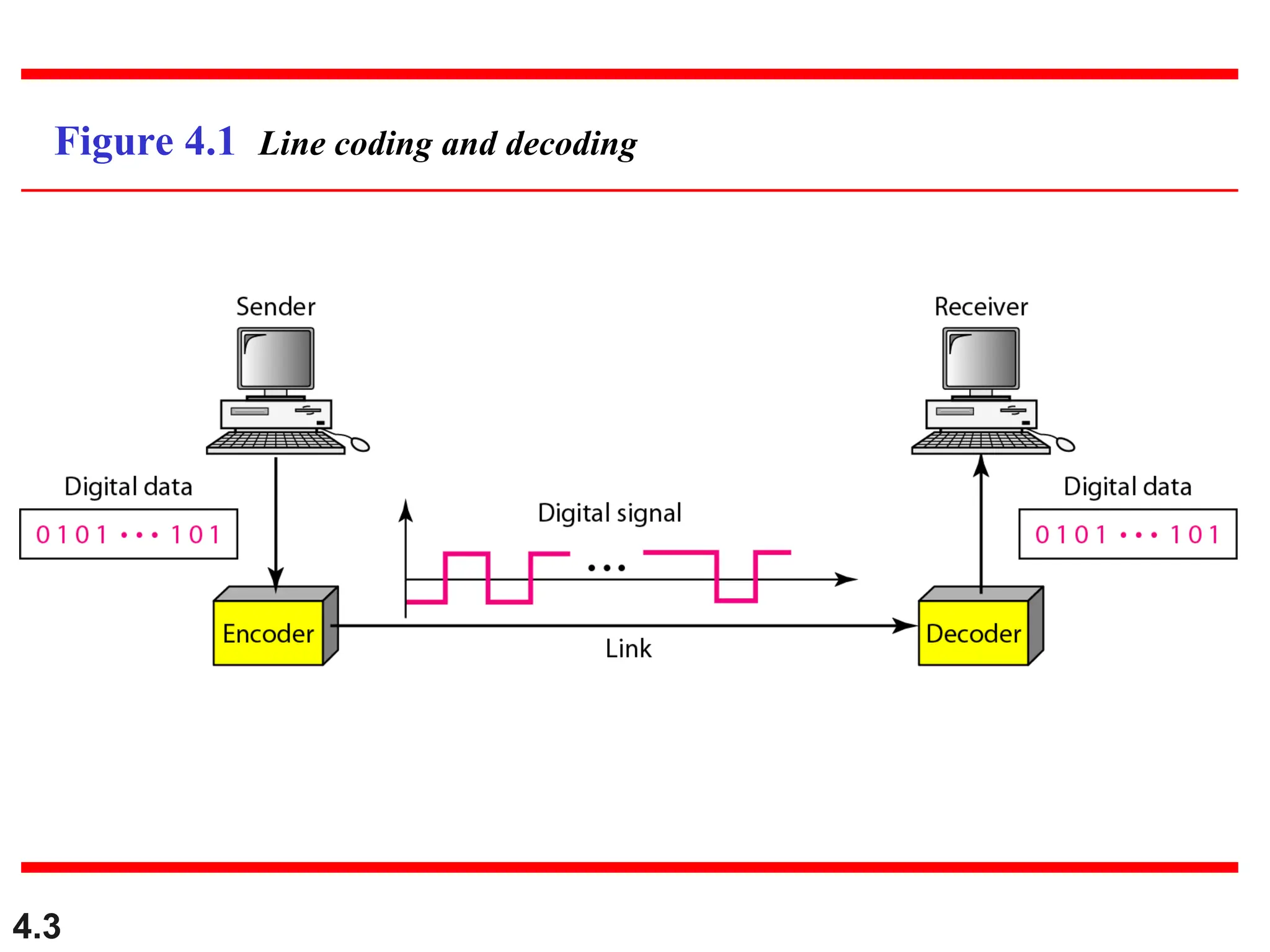
Figure 4.1 Line coding and decoding
4.4
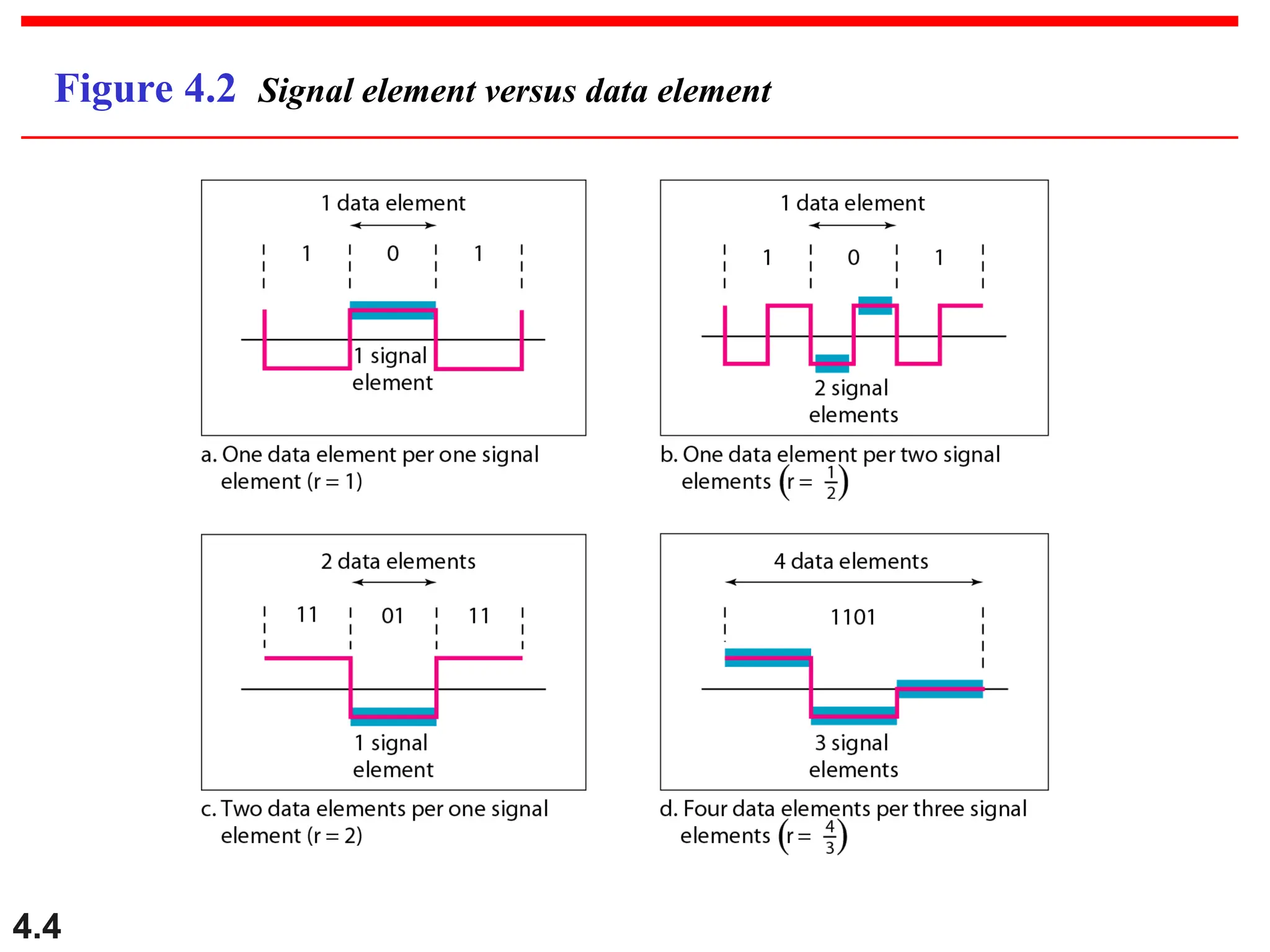
Figure 4.2 Signal element versus data element
4.5
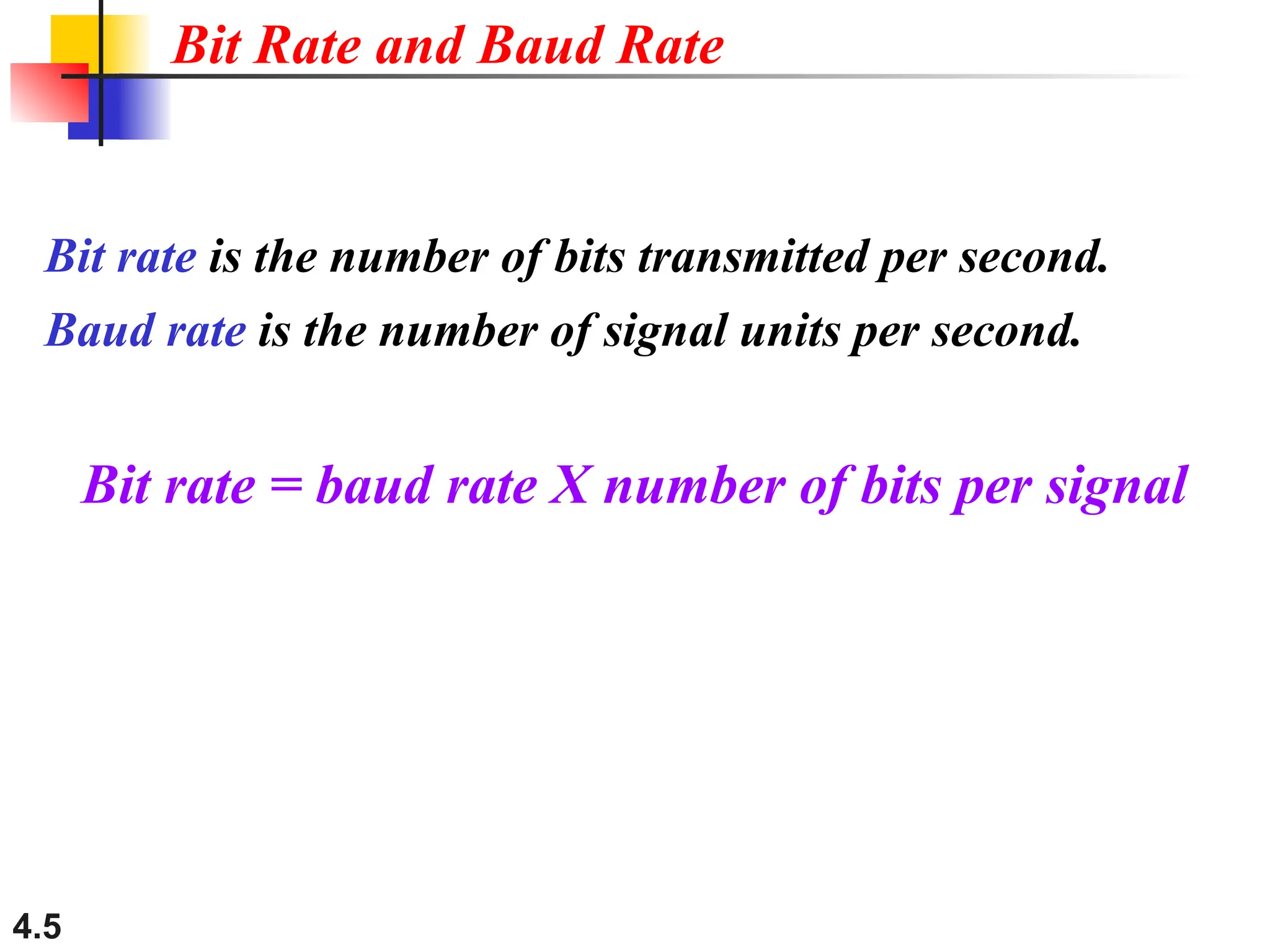
Bit rate is the number of bits transmitted per second.
Baud rate is the number of signal units per second.
Bit rate = baud rate X number of bits per signal
Bit Rate and Baud Rate
4.6
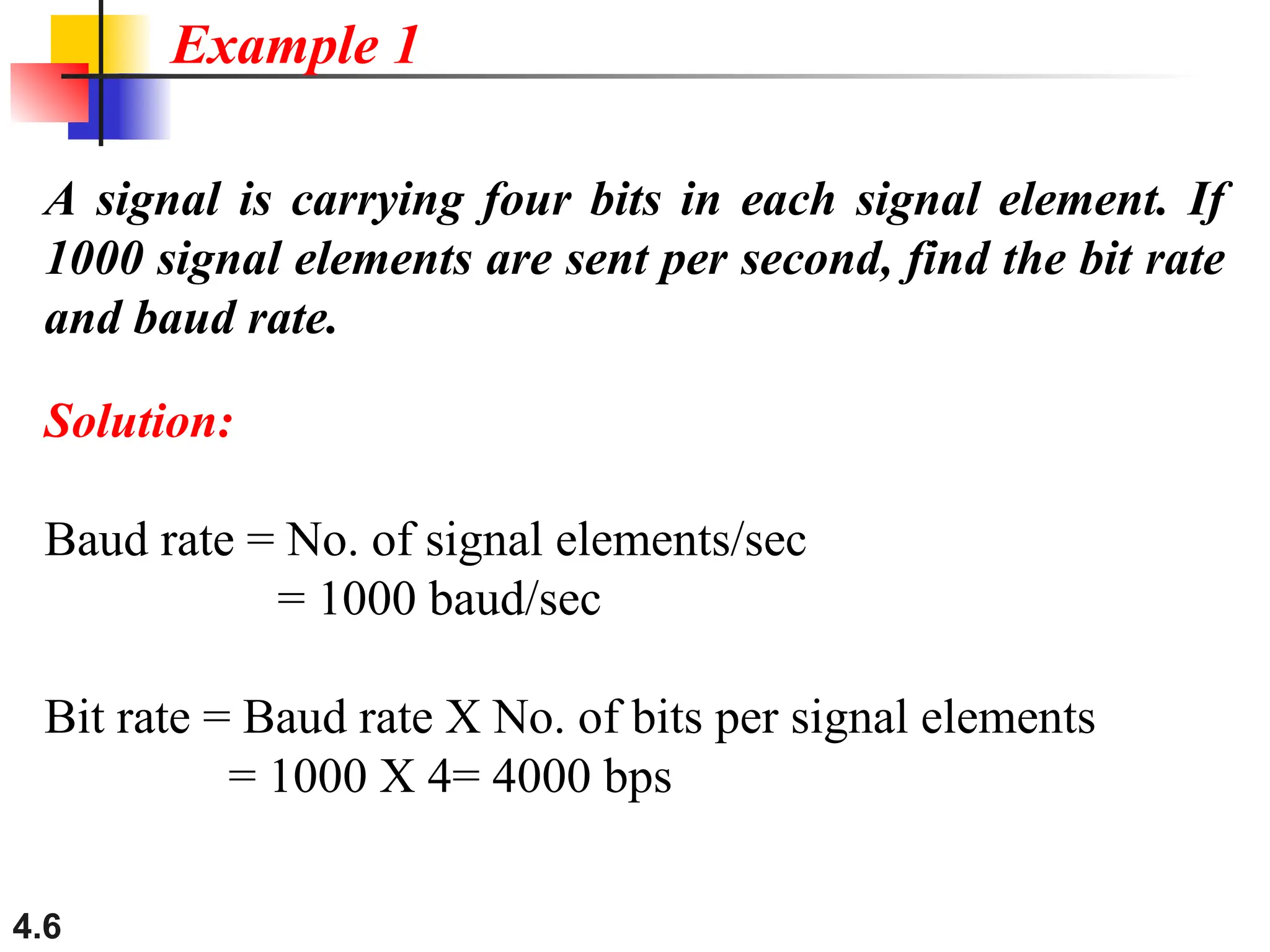
A signal is carrying four bits in each signal element. If
1000 signal elements are sent per second, find the bit rate
and baud rate.
Solution:
Baud rate = No. of signal elements/sec
= 1000 baud/sec
Bit rate = Baud rate X No. of bits per signal elements
= 1000 X 4= 4000 bps
Example 1
4.7
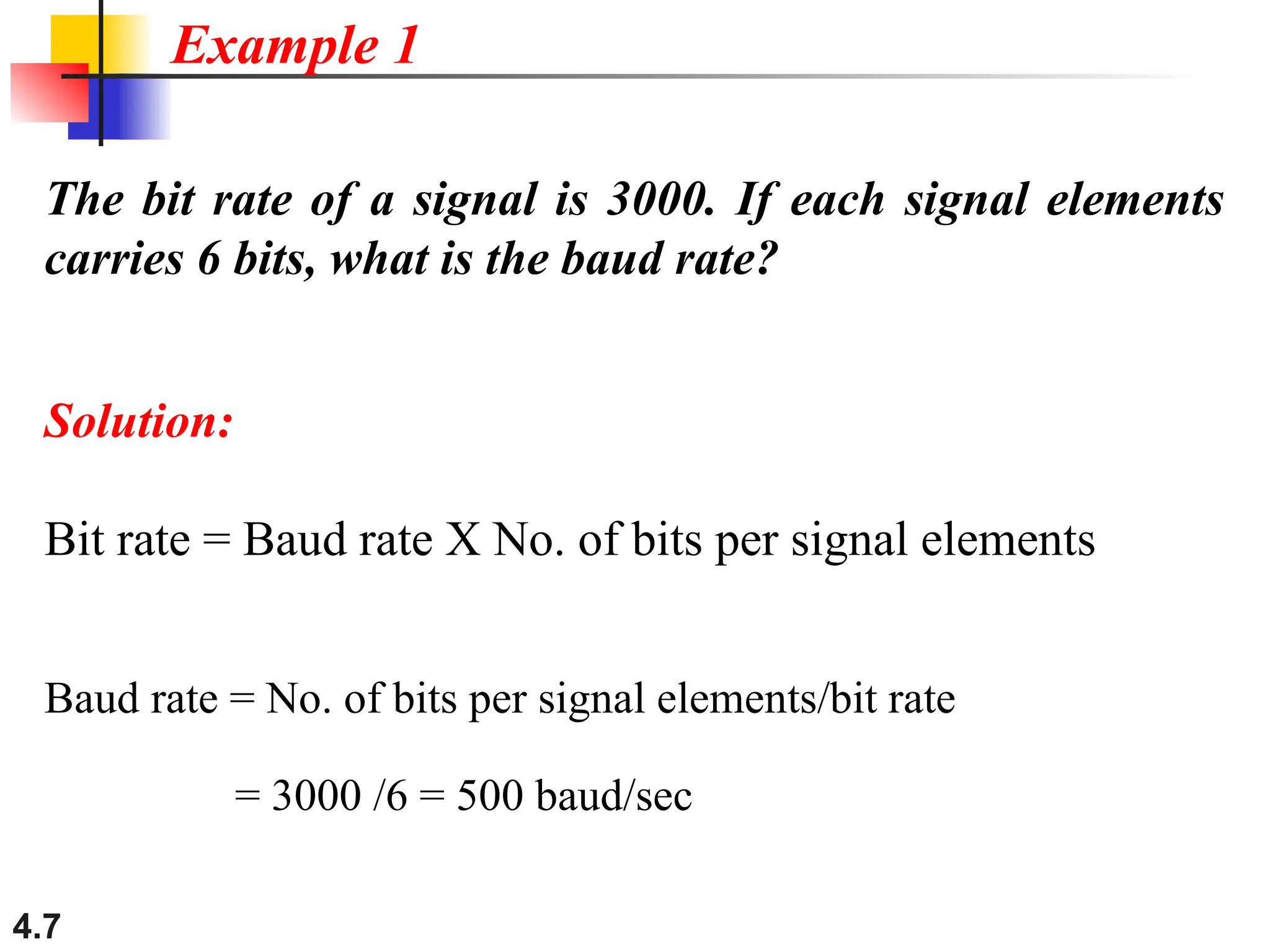
The bit rate of a signal is 3000. If each signal elements
carries 6 bits, what is the baud rate?
Solution:
Bit rate = Baud rate X No. of bits per signal elements
Baud rate = No. of bits per signal elements/bit rate
= 3000 /6 = 500 baud/sec
Example 1
4.8
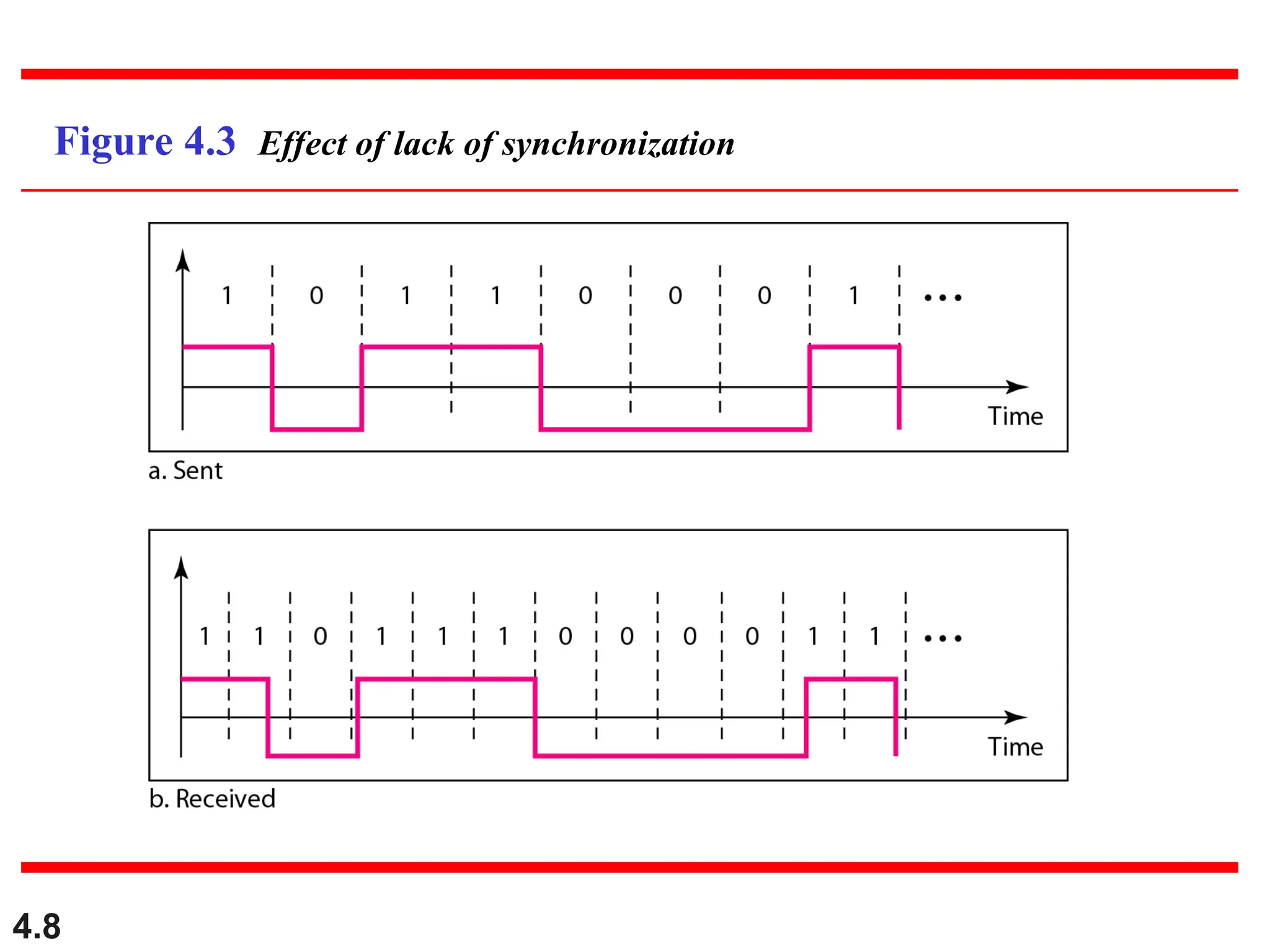
Figure 4.3 Effect of lack of synchronization
4.9
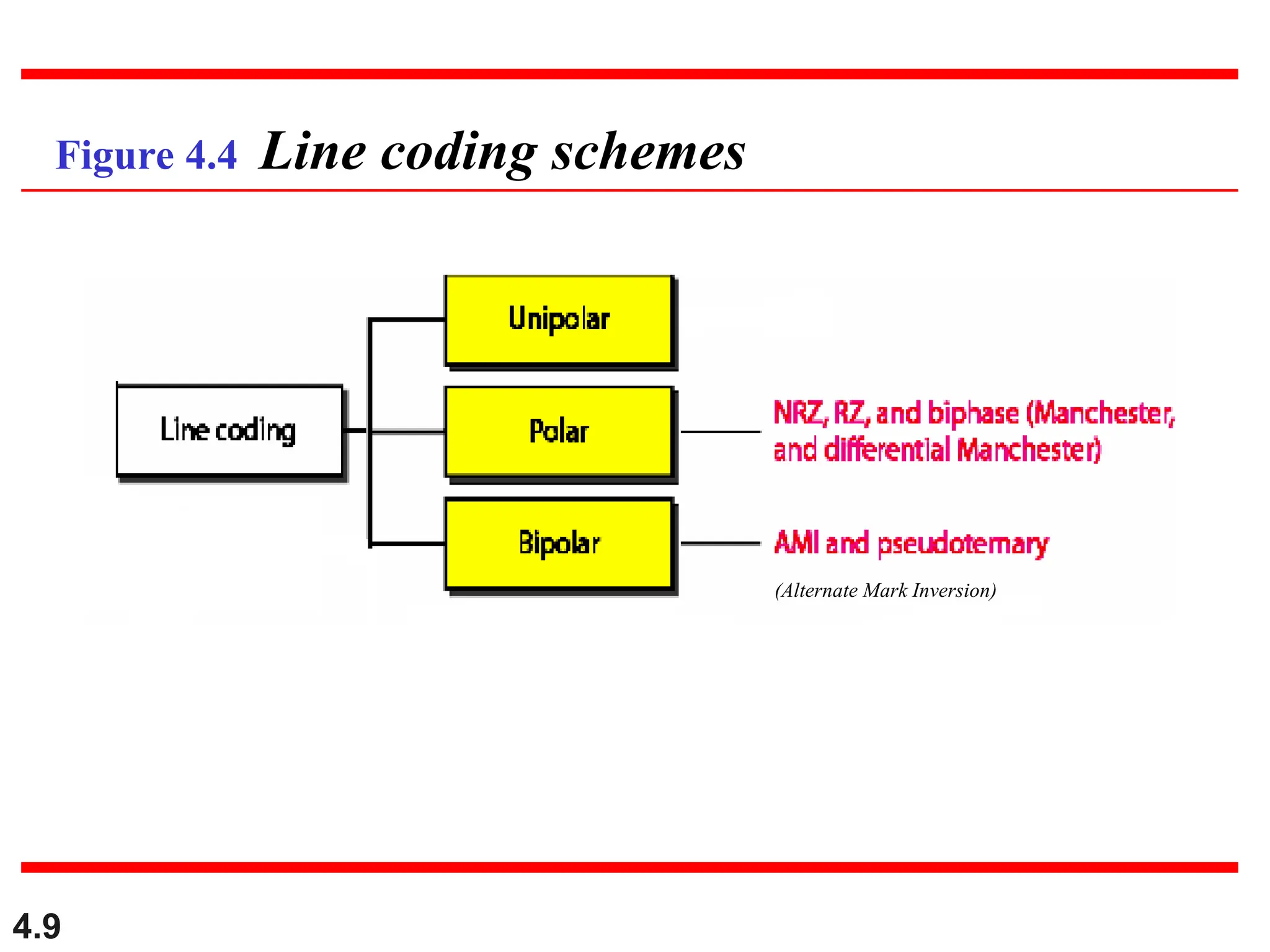
Figure 4.4 Line coding schemes
(alternate mark inversion)
(Alternate Mark Inversion)
4.10
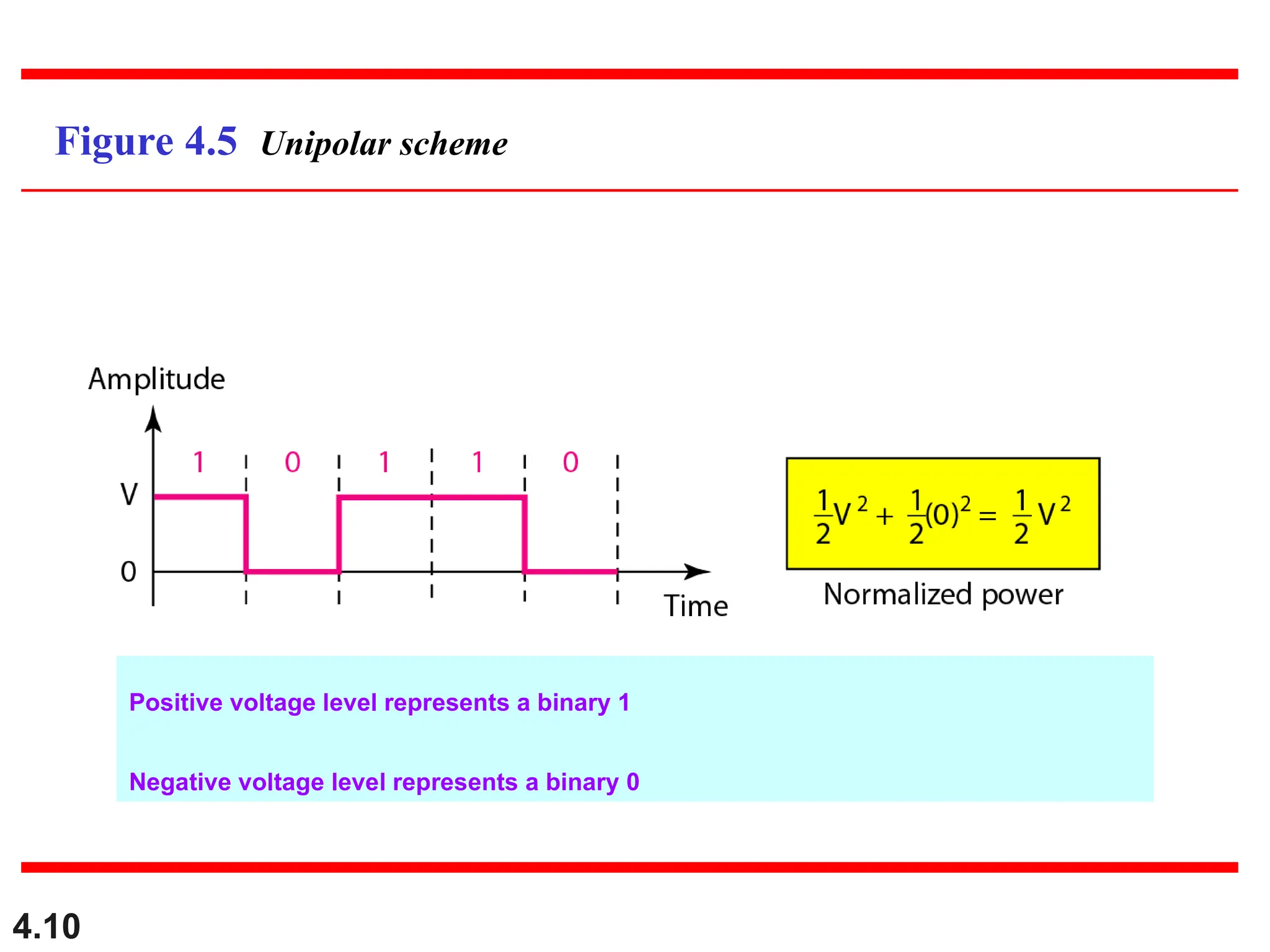
Figure 4.5 Unipolar scheme
Positive voltage level represents a binary 1
Negative voltage level represents a binary 0
4.11
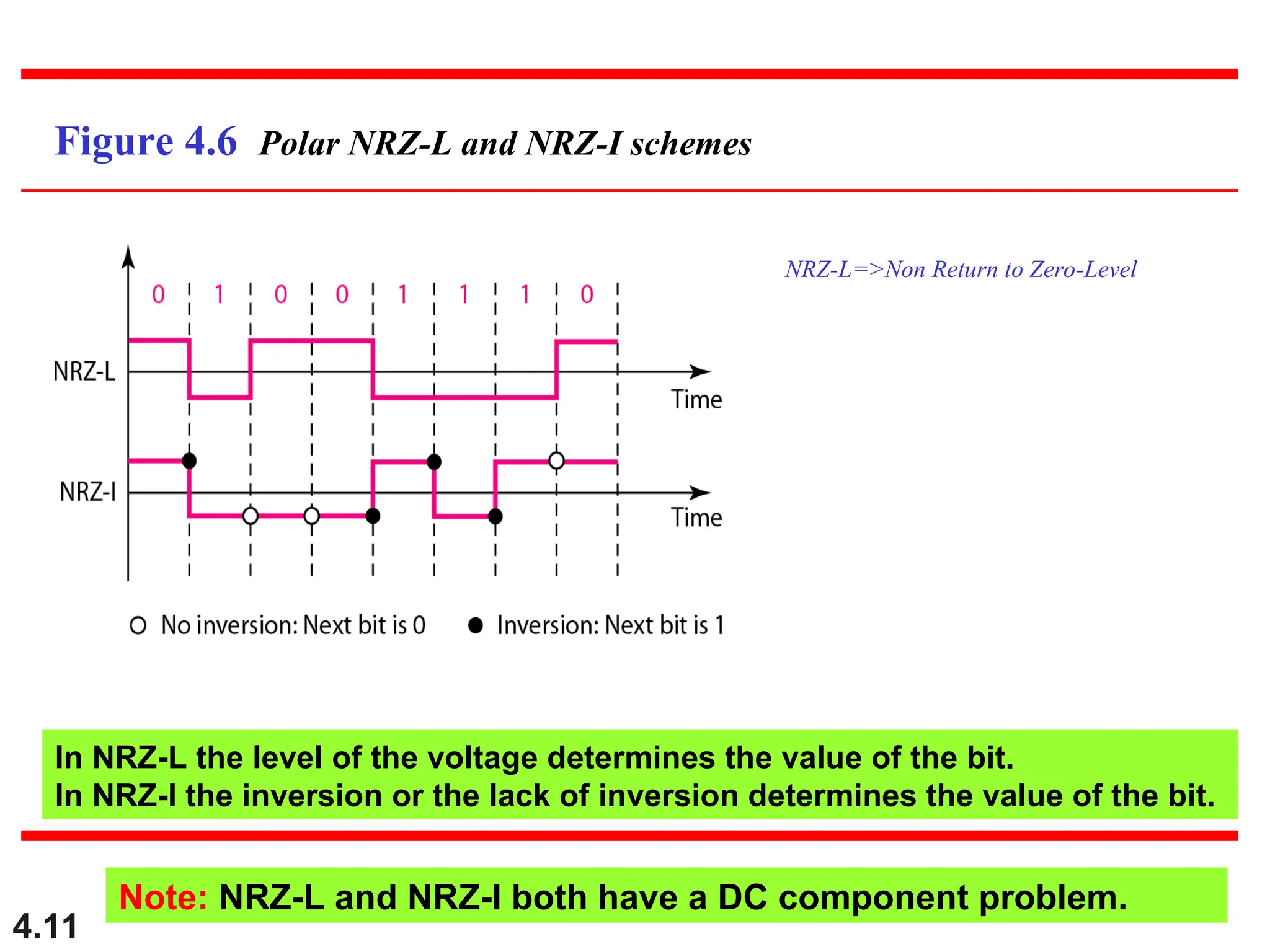
Figure 4.6 Polar NRZ-L and NRZ-I schemes
In NRZ-L the level of the voltage determines the value of the bit.
In NRZ-I the inversion or the lack of inversion determines the value of the bit.
Note: NRZ-L and NRZ-I both have a DC component problem.
NRZ-L=>Non Return to Zero-Level
4.12
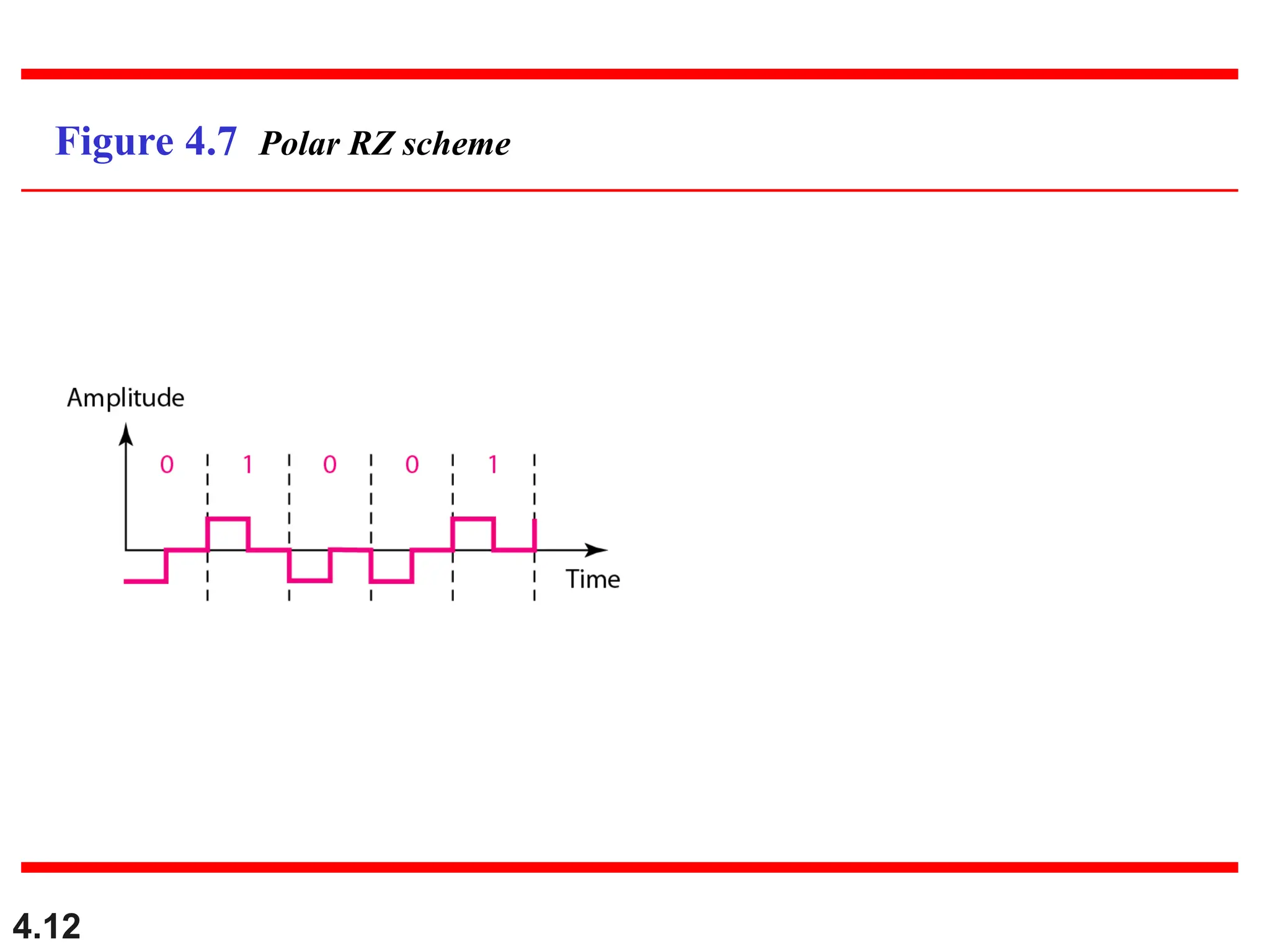
Figure 4.7 Polar RZ scheme
4.13
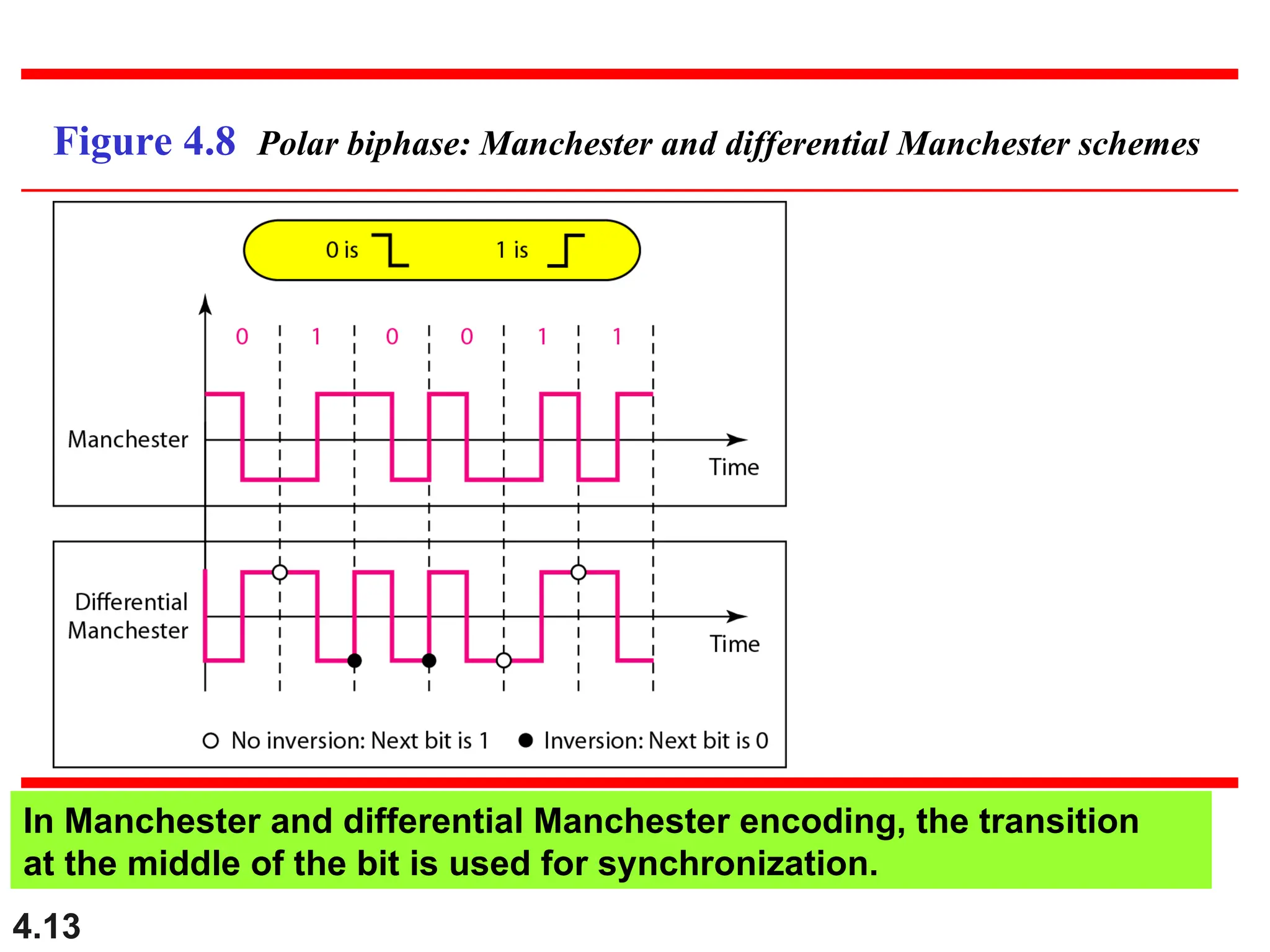
Figure 4.8 Polar biphase: Manchester and differential Manchester schemes
In Manchester and differential Manchester encoding, the transition
at the middle of the bit is used for synchronization.
4.14
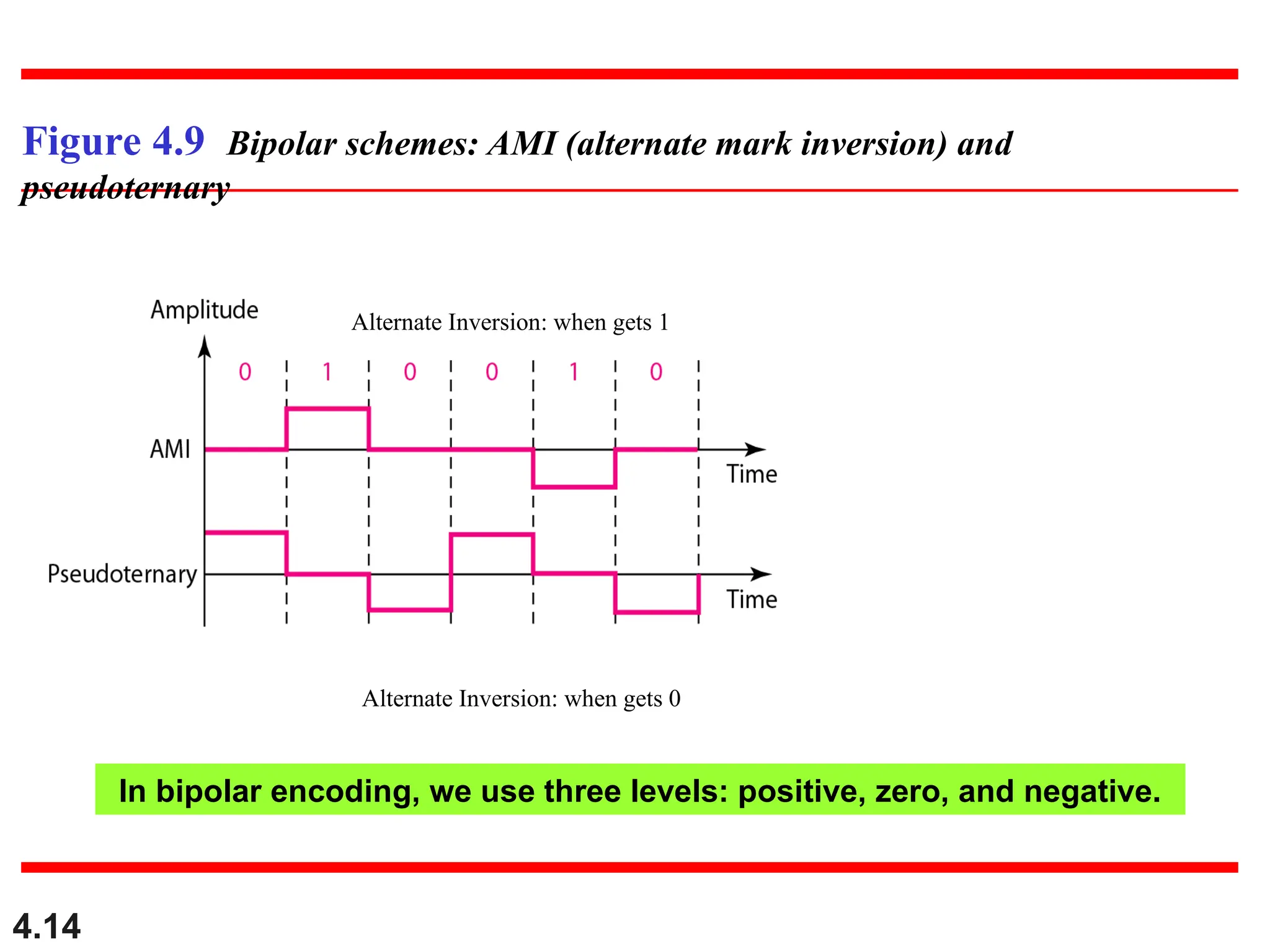
Figure 4.9 Bipolar schemes: AMI (alternate mark inversion) and
pseudoternary
Alternate Inversion: when gets 1
Alternate Inversion: when gets 0
In bipolar encoding, we use three levels: positive, zero, and negative.
4.15
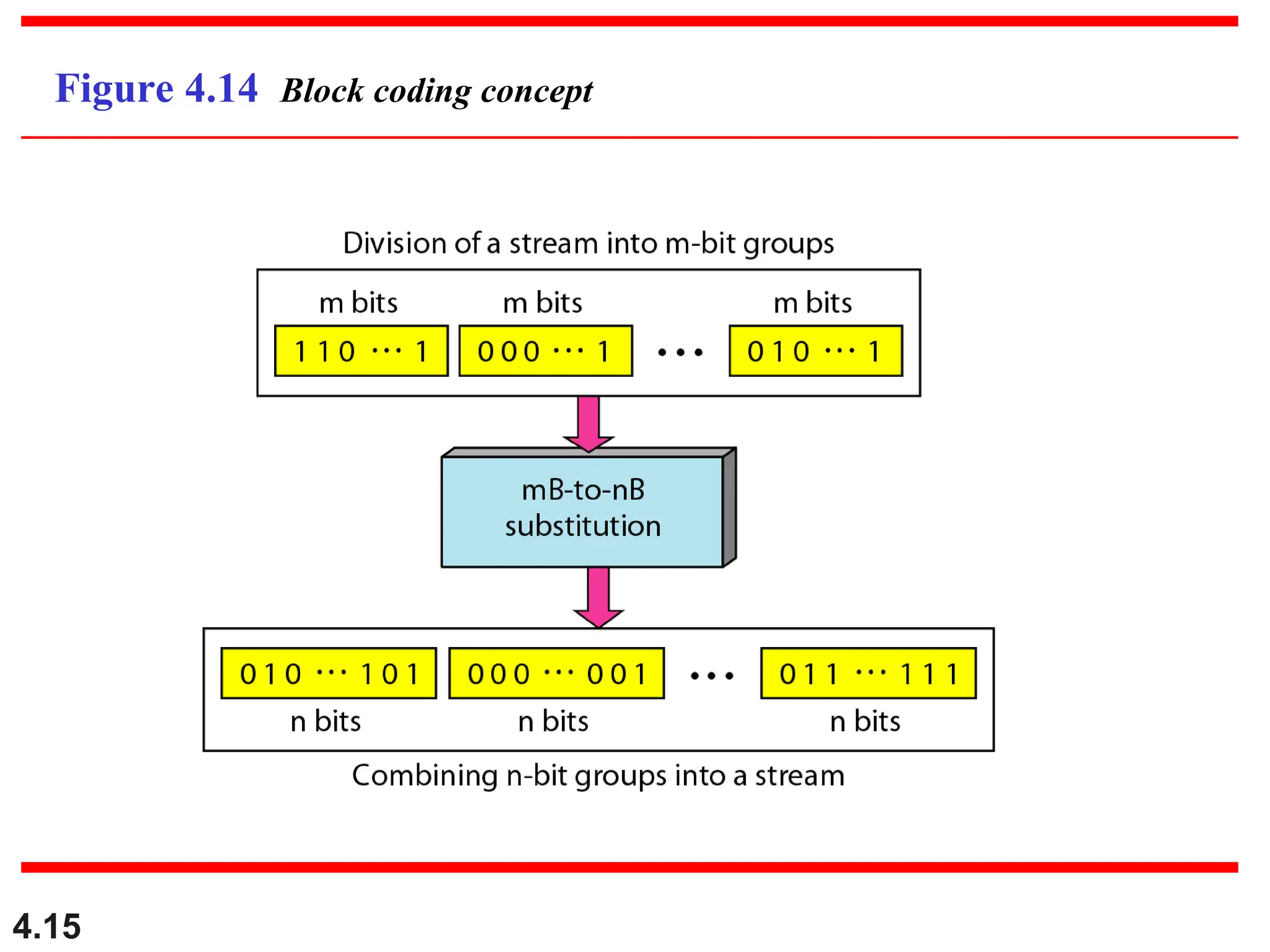
Figure 4.14 Block coding concept
4.16
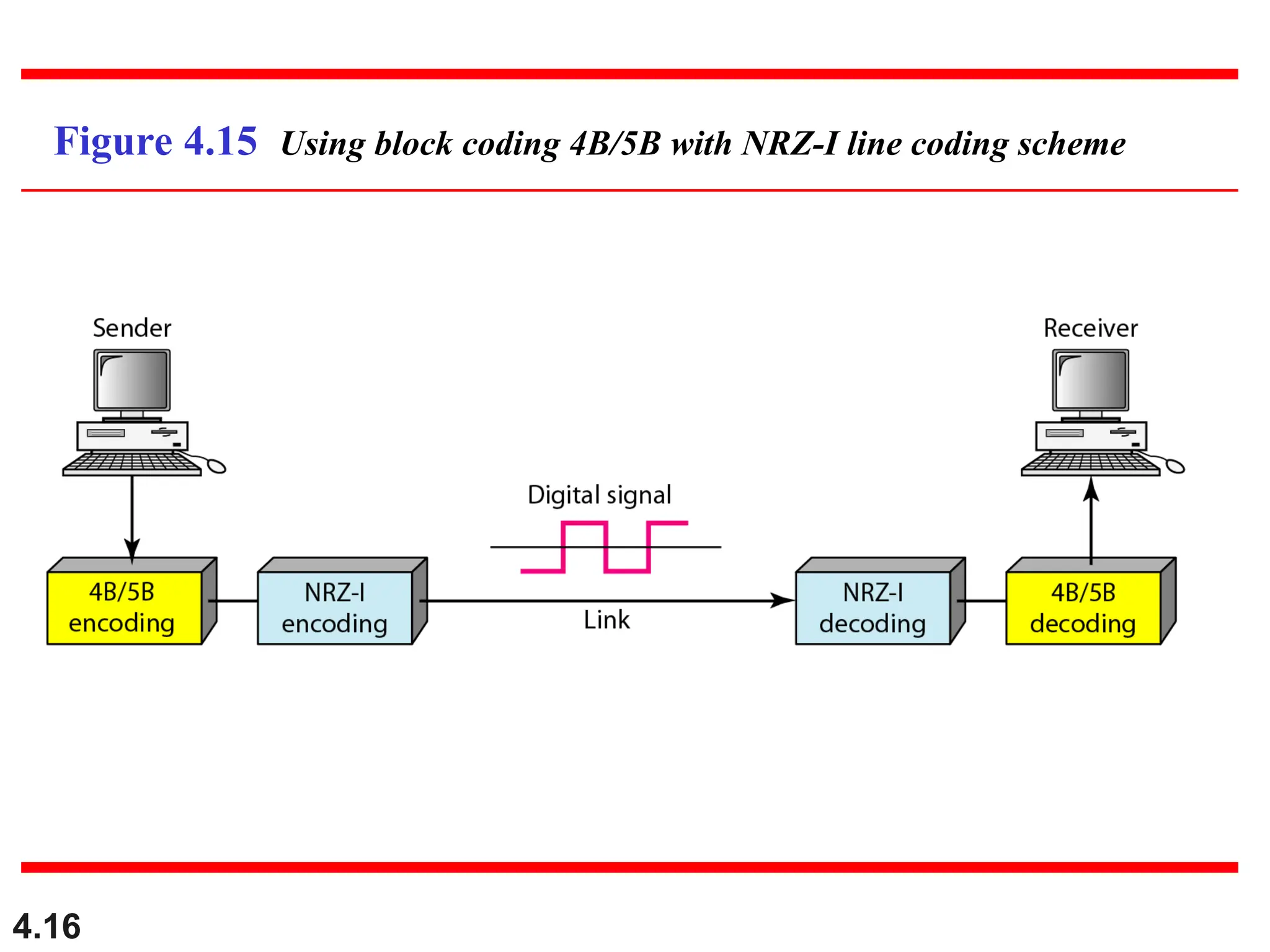
Figure 4.15 Using block coding 4B/5B with NRZ-I line coding scheme
4.17
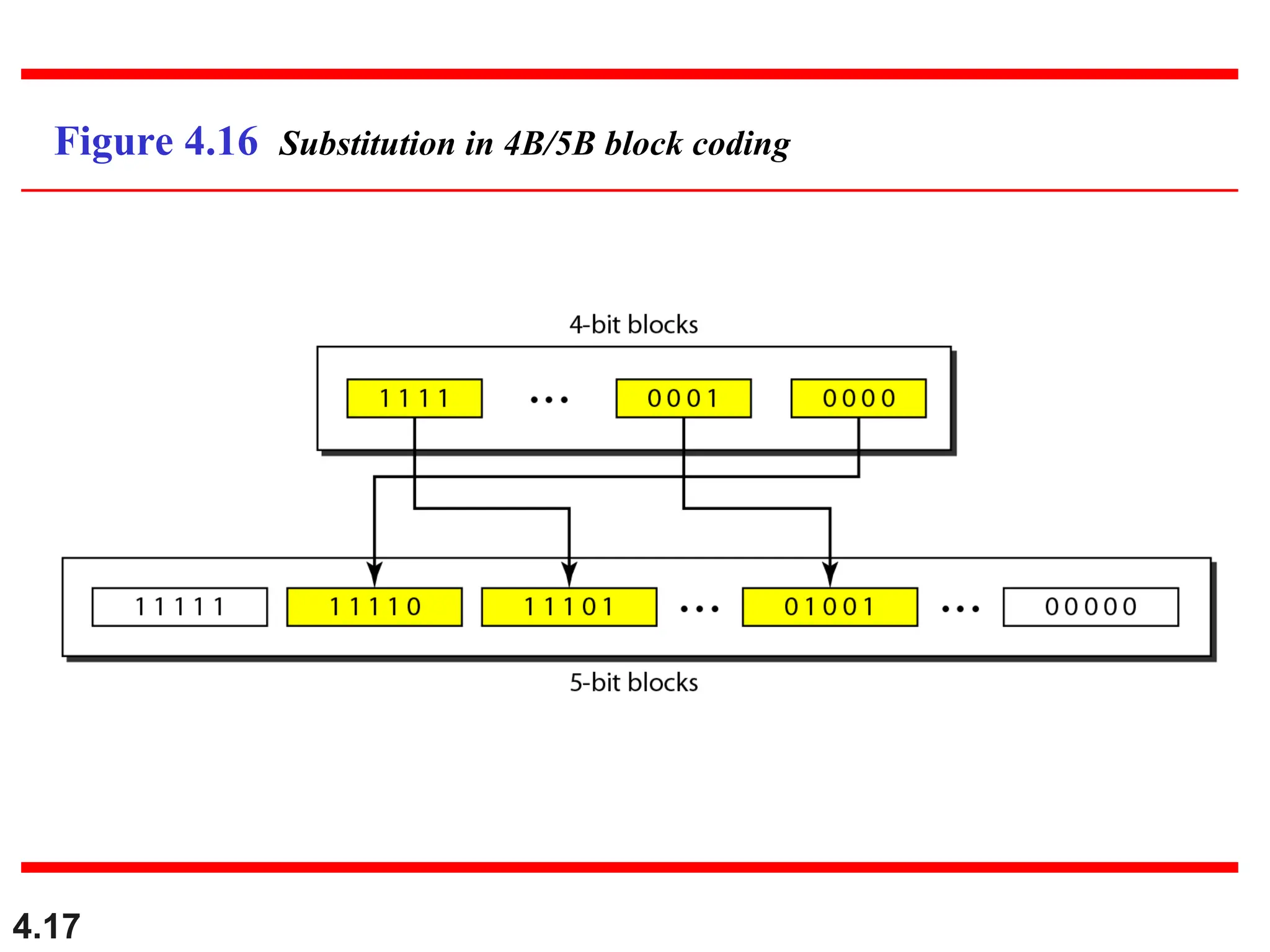
Figure 4.16 Substitution in 4B/5B block coding
4.18
ANALOG-TO-DIGITAL CONVERSION
Pulse Code Modulation (PCM)
Delta Modulation (DM)
Topics discussed in this section:
4.19
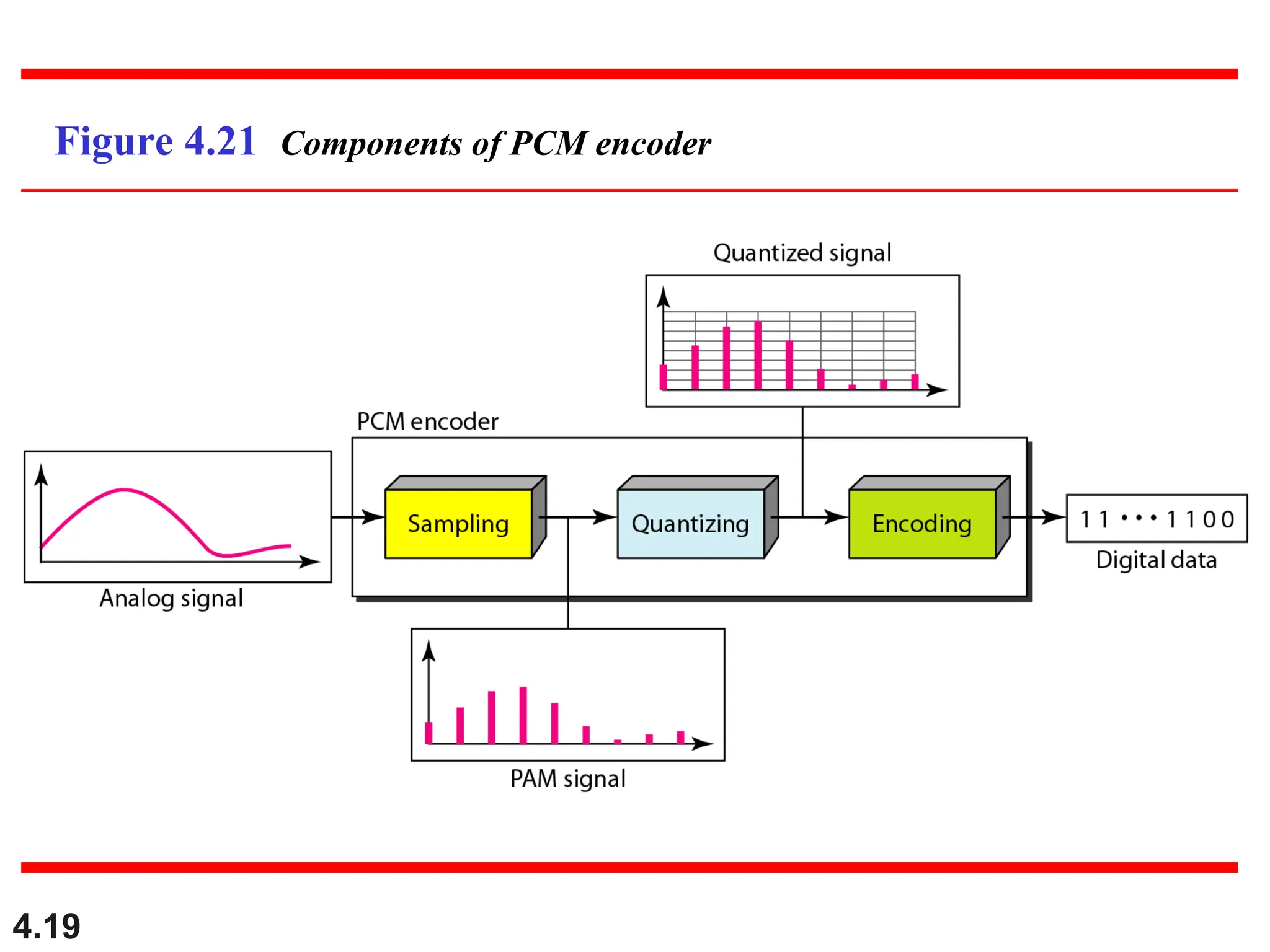
Figure 4.21 Components of PCM encoder
4.20
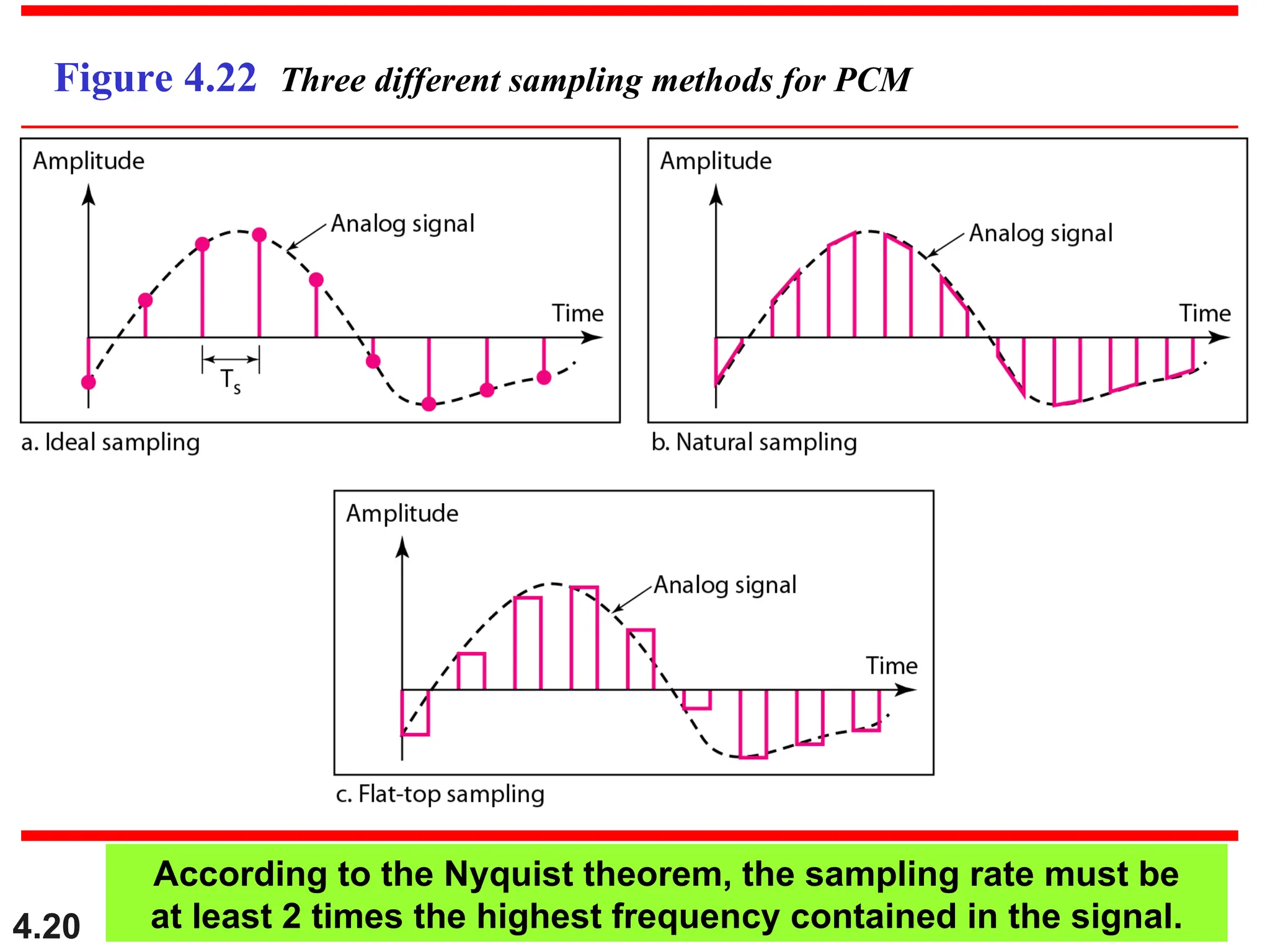
Figure 4.22 Three different sampling methods for PCM
According to the Nyquist theorem, the sampling rate must be
at least 2 times the highest frequency contained in the signal.
4.21
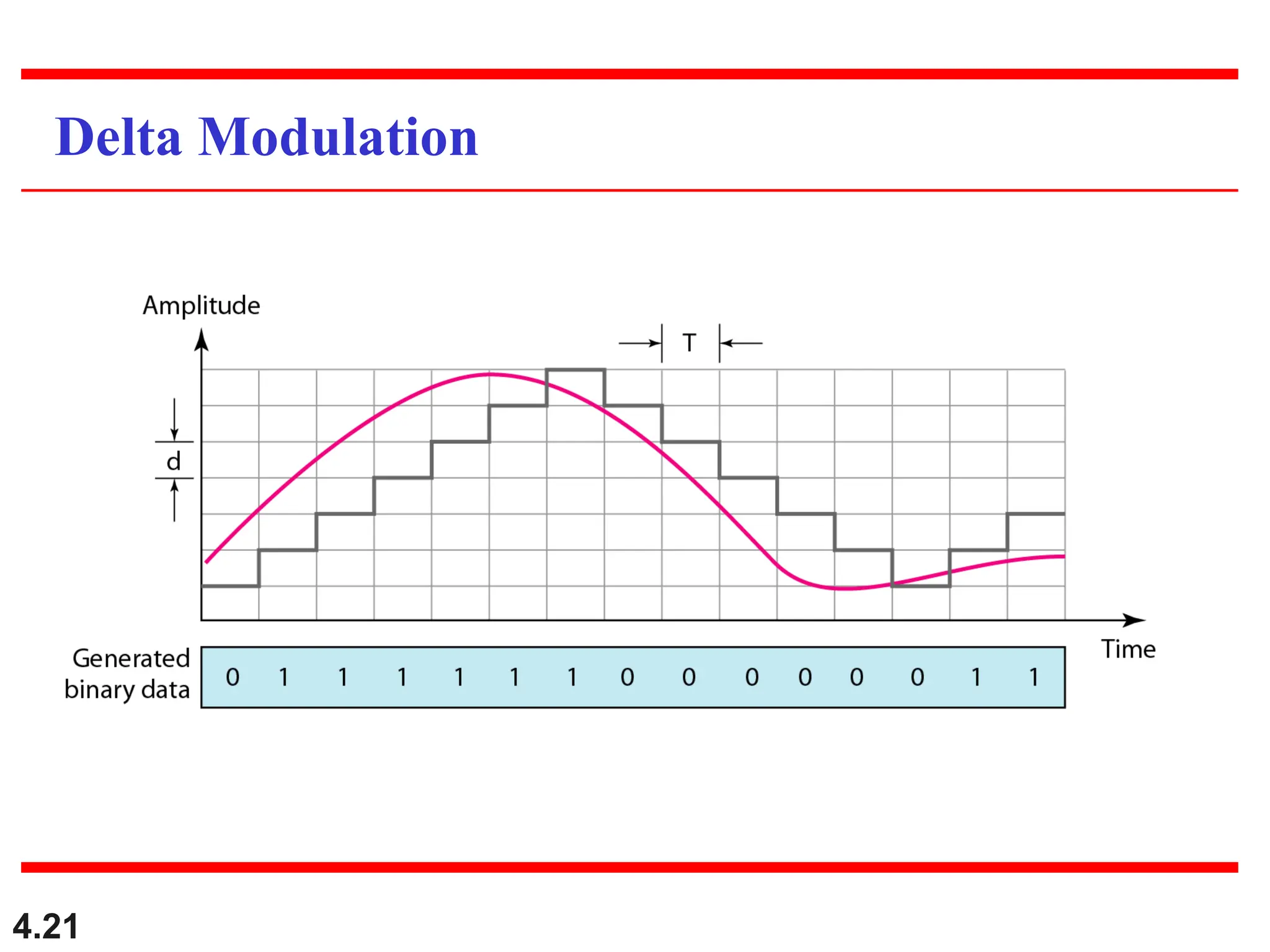
Delta Modulation
4.22
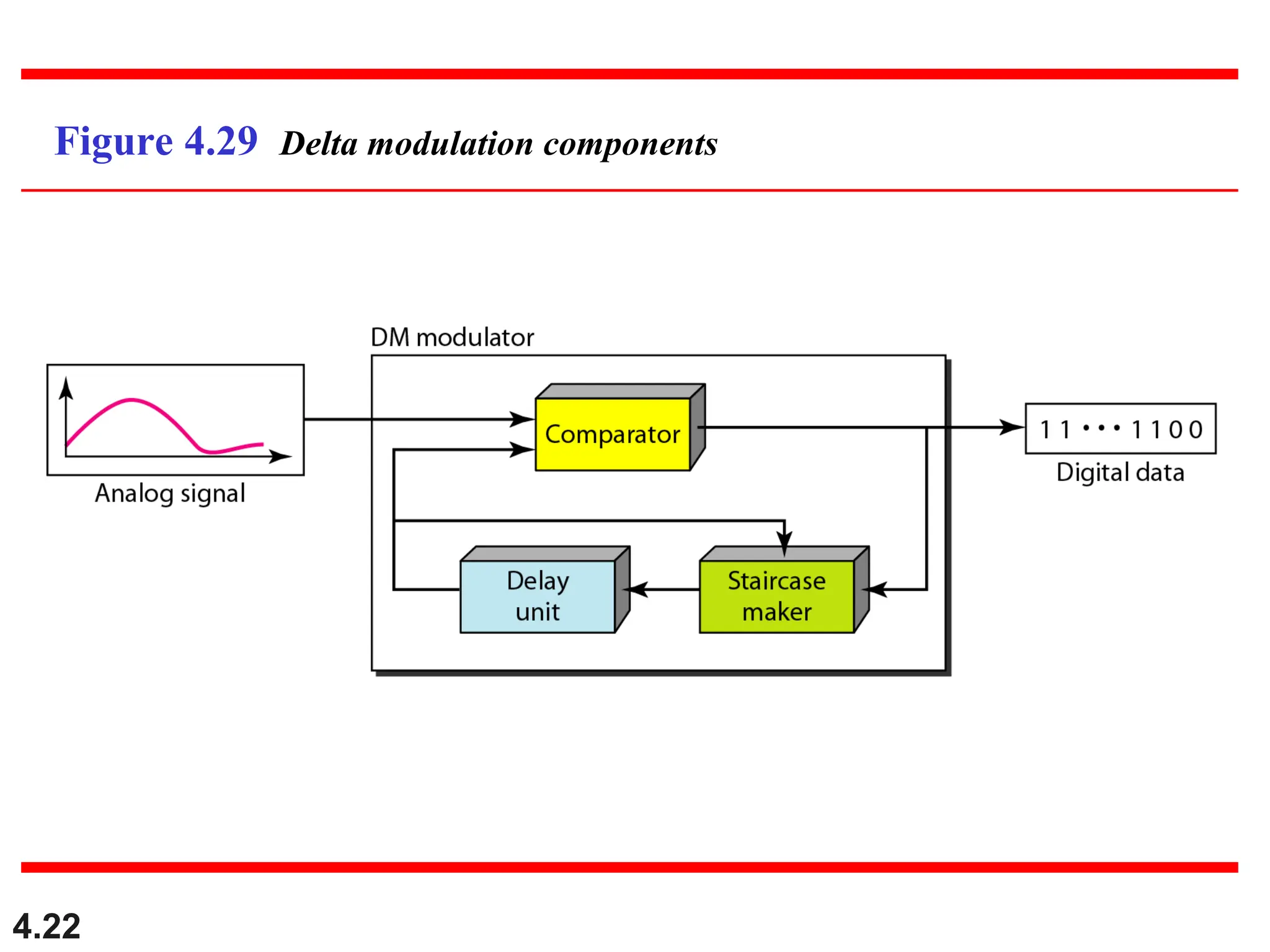
Figure 4.29 Delta modulation components
4.23
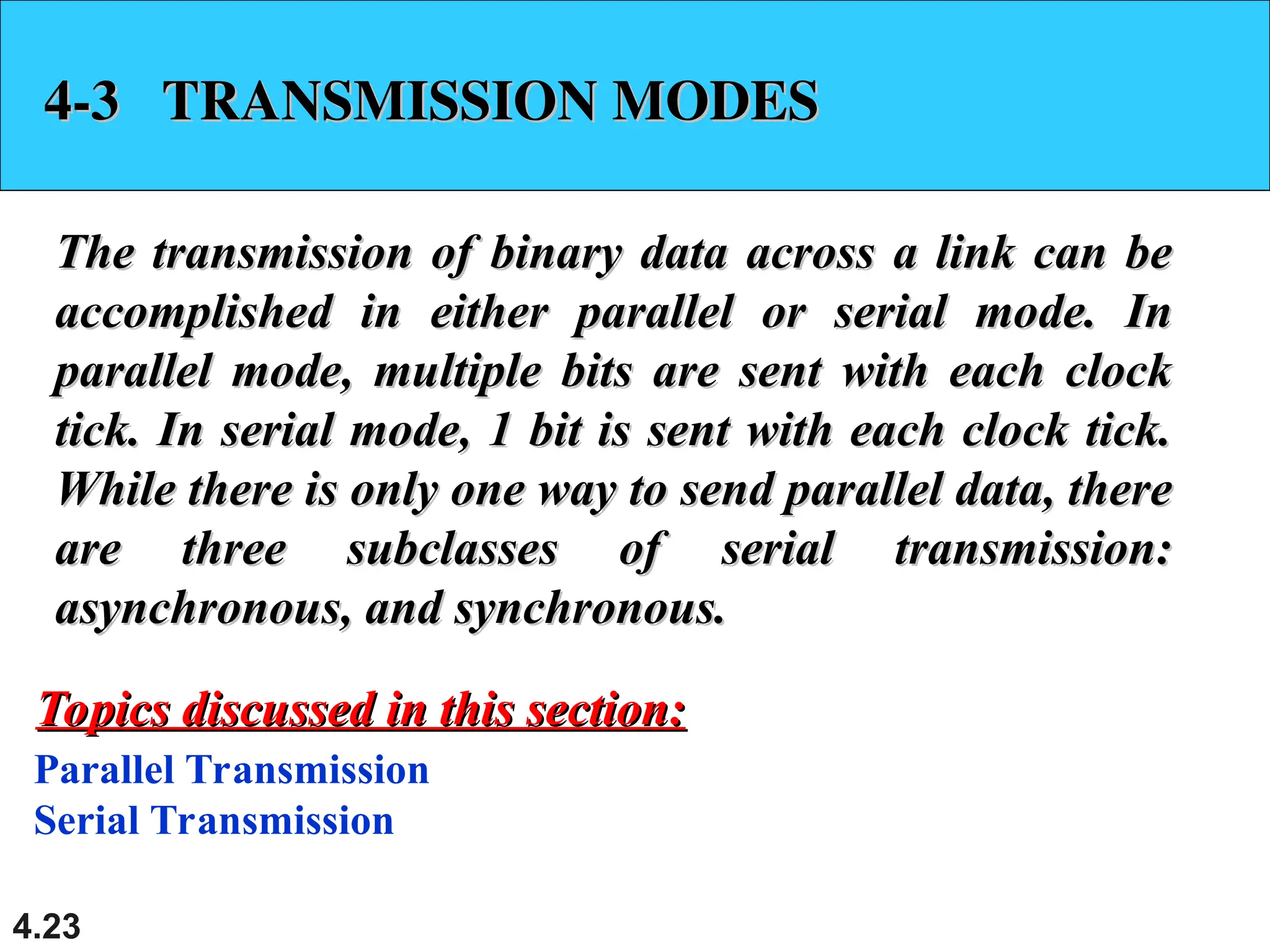
4-3 TRANSMISSION MODES
The transmission of binary data across a link can be
accomplished in either parallel or serial mode. In
parallel mode, multiple bits are sent with each clock
tick. In serial mode, 1 bit is sent with each clock tick.
While there is only one way to send parallel data, there
are three subclasses of serial transmission:
asynchronous, and synchronous.
Parallel Transmission
Serial Transmission
Topics discussed in this section:
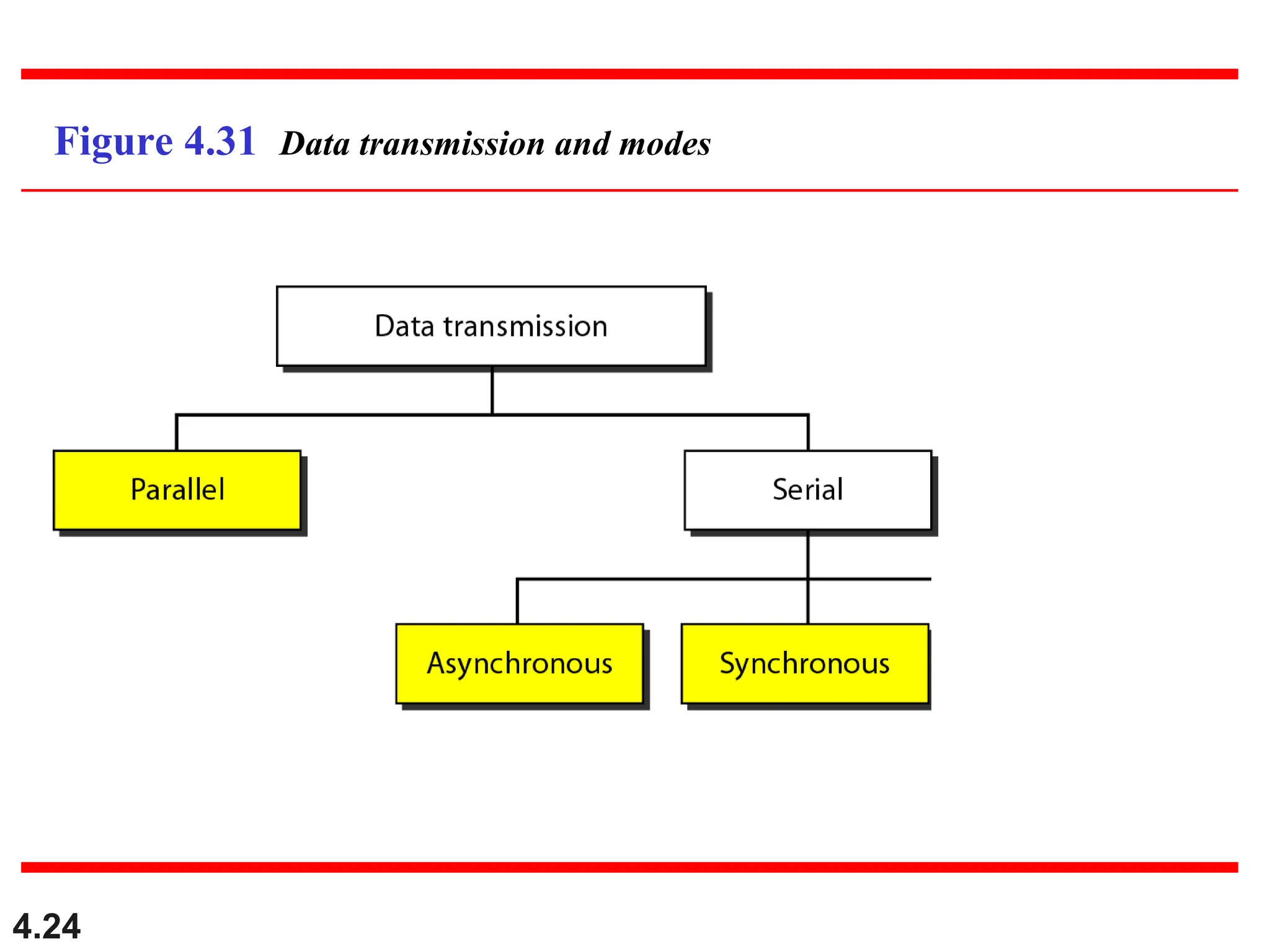
4.24
Figure 4.31 Data transmission and modes
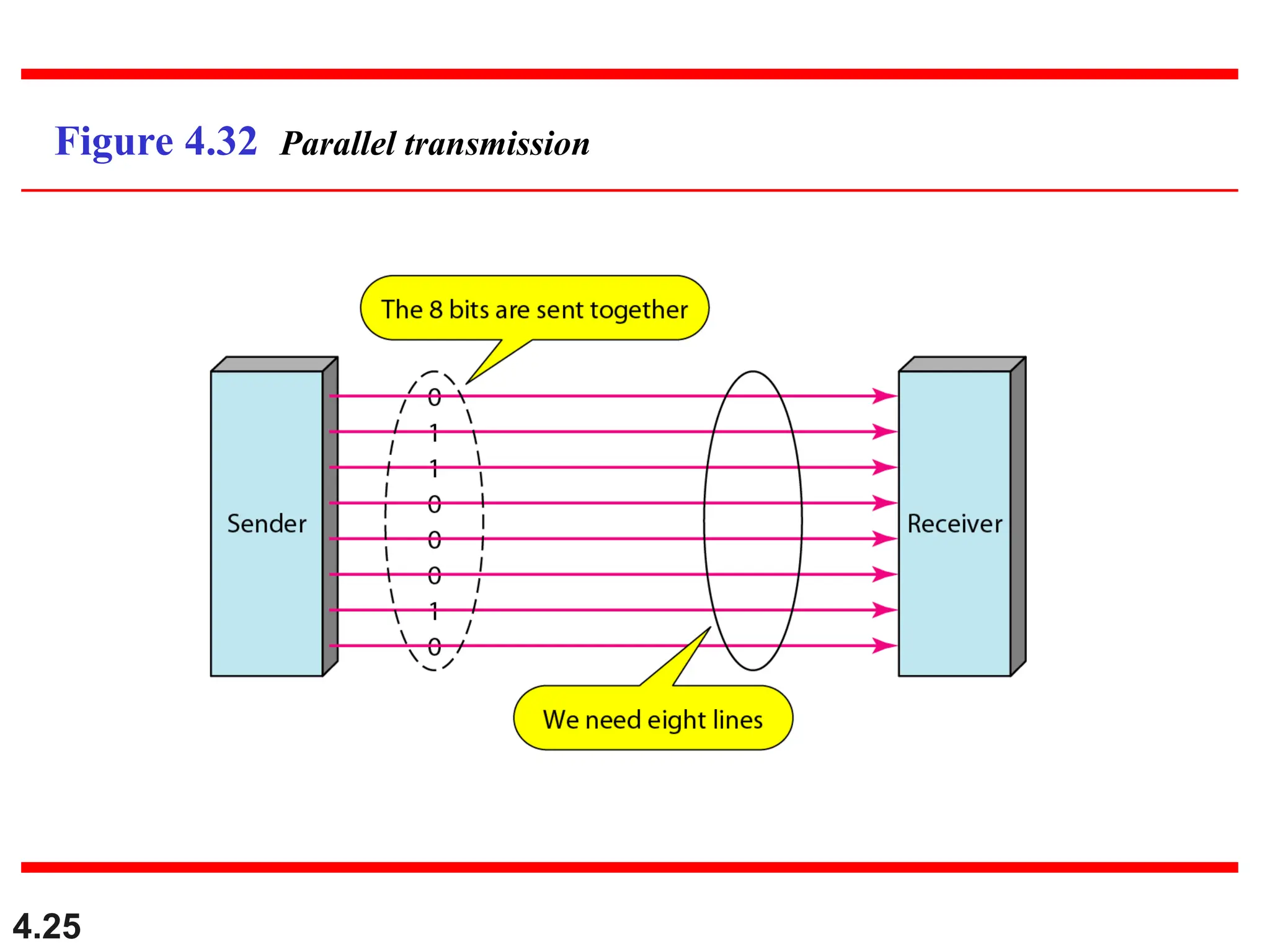
4.25
Figure 4.32 Parallel transmission
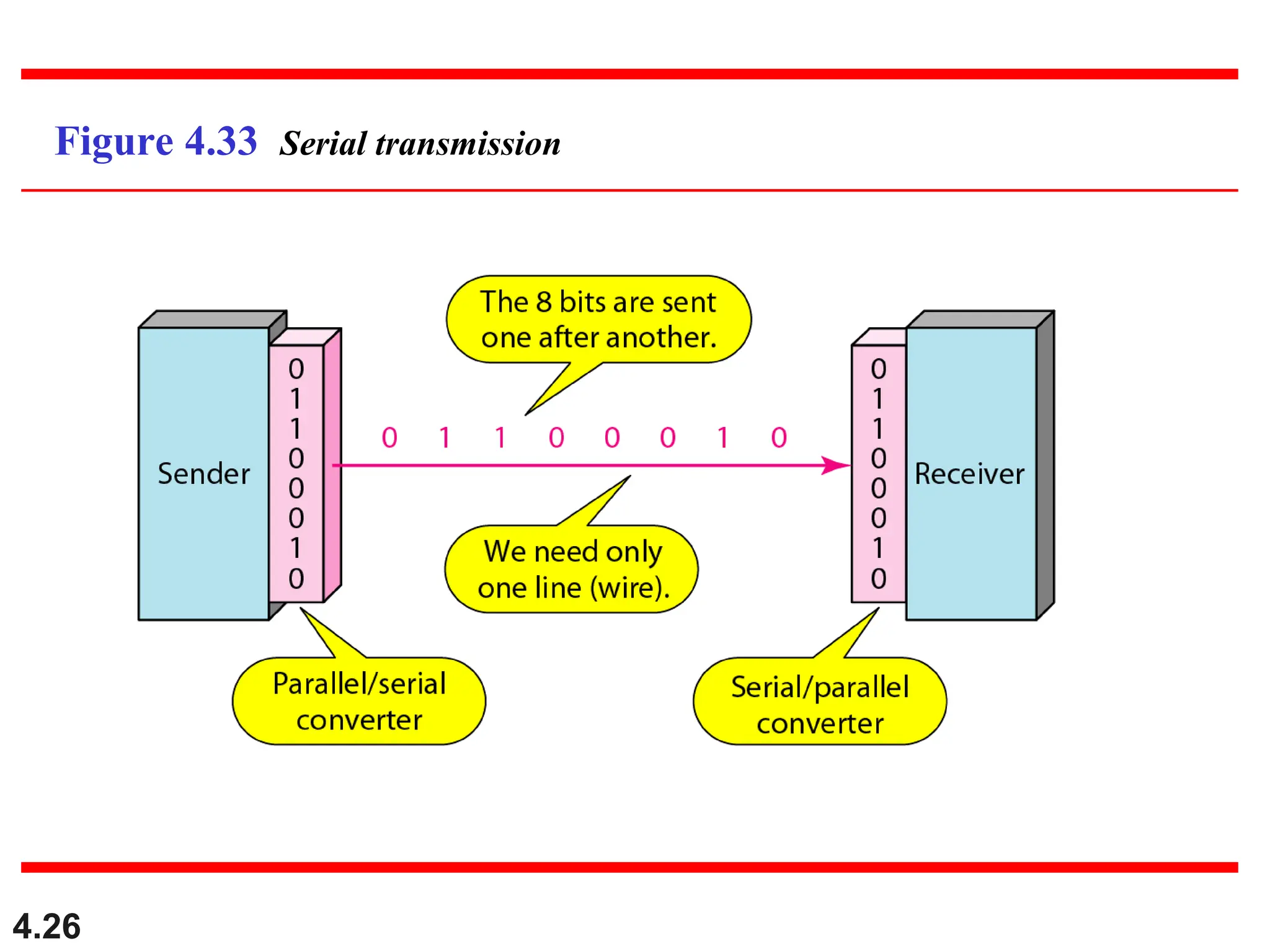
4.26
Figure 4.33 Serial transmission
4.27
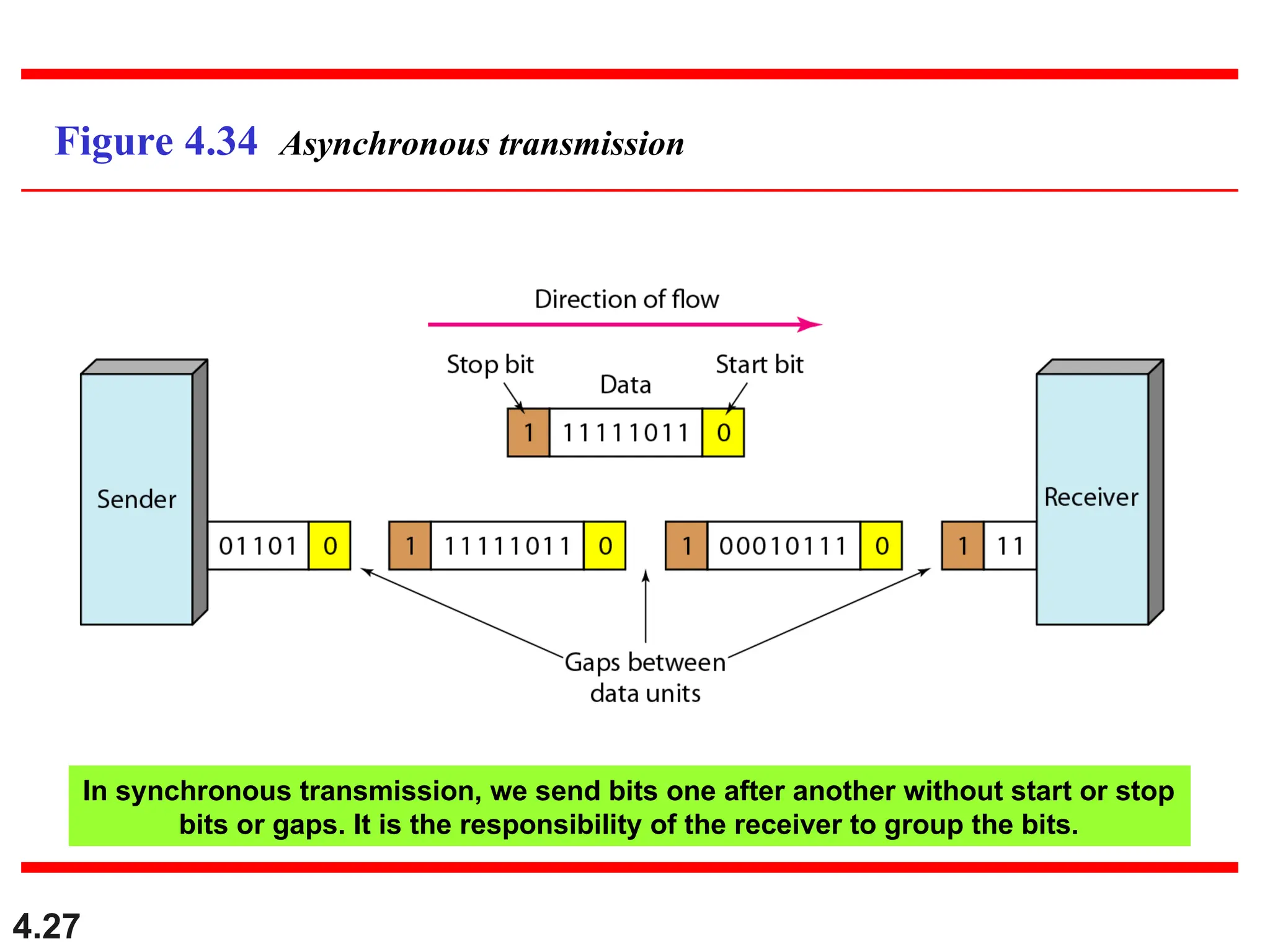
Figure 4.34 Asynchronous transmission
In synchronous transmission, we send bits one after another without start or stop
bits or gaps. It is the responsibility of the receiver to group the bits.
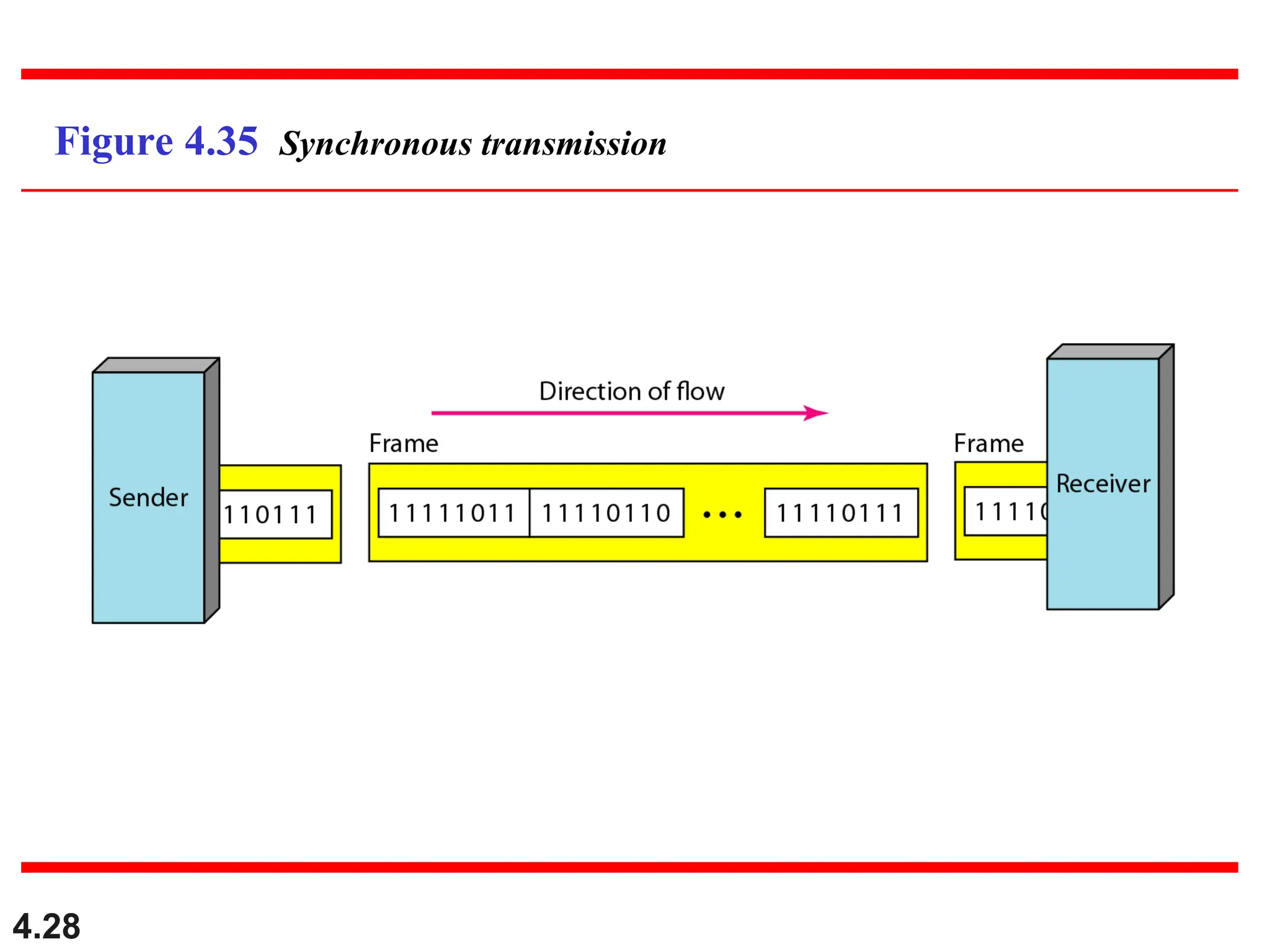
4.28
Figure 4.35 Synchronous transmission

4. Digital Transmission.ppt Data Communication slide

  • 1.
    4.1 Chapter 4 Digital Transmission ►Digitaldata-to-Digital signal ►Analog data-to-Digital signal
  • 2.
  • 3.
    4.3 Figure 4.1 Linecoding and decoding
  • 4.
    4.4 Figure 4.2 Signalelement versus data element
  • 5.
    4.5 Bit rate isthe number of bits transmitted per second. Baud rate is the number of signal units per second. Bit rate = baud rate X number of bits per signal Bit Rate and Baud Rate
  • 6.
    4.6 A signal iscarrying four bits in each signal element. If 1000 signal elements are sent per second, find the bit rate and baud rate. Solution: Baud rate = No. of signal elements/sec = 1000 baud/sec Bit rate = Baud rate X No. of bits per signal elements = 1000 X 4= 4000 bps Example 1
  • 7.
    4.7 The bit rateof a signal is 3000. If each signal elements carries 6 bits, what is the baud rate? Solution: Bit rate = Baud rate X No. of bits per signal elements Baud rate = No. of bits per signal elements/bit rate = 3000 /6 = 500 baud/sec Example 1
  • 8.
    4.8 Figure 4.3 Effectof lack of synchronization
  • 9.
    4.9 Figure 4.4 Linecoding schemes (alternate mark inversion) (Alternate Mark Inversion)
  • 10.
    4.10 Figure 4.5 Unipolarscheme Positive voltage level represents a binary 1 Negative voltage level represents a binary 0
  • 11.
    4.11 Figure 4.6 PolarNRZ-L and NRZ-I schemes In NRZ-L the level of the voltage determines the value of the bit. In NRZ-I the inversion or the lack of inversion determines the value of the bit. Note: NRZ-L and NRZ-I both have a DC component problem. NRZ-L=>Non Return to Zero-Level
  • 12.
  • 13.
    4.13 Figure 4.8 Polarbiphase: Manchester and differential Manchester schemes In Manchester and differential Manchester encoding, the transition at the middle of the bit is used for synchronization.
  • 14.
    4.14 Figure 4.9 Bipolarschemes: AMI (alternate mark inversion) and pseudoternary Alternate Inversion: when gets 1 Alternate Inversion: when gets 0 In bipolar encoding, we use three levels: positive, zero, and negative.
  • 15.
    4.15 Figure 4.14 Blockcoding concept
  • 16.
    4.16 Figure 4.15 Usingblock coding 4B/5B with NRZ-I line coding scheme
  • 17.
    4.17 Figure 4.16 Substitutionin 4B/5B block coding
  • 18.
    4.18 ANALOG-TO-DIGITAL CONVERSION ANALOG-TO-DIGITAL CONVERSION PulseCode Modulation (PCM) Delta Modulation (DM) Topics discussed in this section: Topics discussed in this section:
  • 19.
  • 20.
    4.20 Figure 4.22 Threedifferent sampling methods for PCM According to the Nyquist theorem, the sampling rate must be at least 2 times the highest frequency contained in the signal.
  • 21.
  • 22.
    4.22 Figure 4.29 Deltamodulation components
  • 23.
    4.23 4-3 TRANSMISSION MODES 4-3TRANSMISSION MODES The transmission of binary data across a link can be The transmission of binary data across a link can be accomplished in either parallel or serial mode. In accomplished in either parallel or serial mode. In parallel mode, multiple bits are sent with each clock parallel mode, multiple bits are sent with each clock tick. In serial mode, 1 bit is sent with each clock tick. tick. In serial mode, 1 bit is sent with each clock tick. While there is only one way to send parallel data, there While there is only one way to send parallel data, there are three subclasses of serial transmission: are three subclasses of serial transmission: asynchronous, and synchronous. asynchronous, and synchronous. Parallel Transmission Serial Transmission Topics discussed in this section: Topics discussed in this section:
  • 24.
    4.24 Figure 4.31 Datatransmission and modes
  • 25.
  • 26.
  • 27.
    4.27 Figure 4.34 Asynchronoustransmission In synchronous transmission, we send bits one after another without start or stop bits or gaps. It is the responsibility of the receiver to group the bits.
  • 28.