CRISP final conference 6th CoU Meeting, Brussels, 16 March 2017
THEMATIC WORKSHOP STEFI
Ronald Boon/Dick Hortensius
Netherlands Standardisation Institute (NEN)
CRISP final conference 6th CoU Meeting, 16 March 2017
Programme for this session
Introduction to the STEFi evaluation
Nathalie Hirschman, TUB CTS
CCTV standards in support of certification
Frank Rottman, Bosch, IEC CLCTC 79/WG 12
CCTV systems and privacy protection
Erik Krempel, Fraunhofer Institute
CWA on the STEFi evaluation
Dick Hortensius, NEN
Panel discussion
Presenters plus expets of the CRISP consortium
Wrap-up and conclusions
CEN Workshop Agreement
on STEFi evaluation
30 September 2016
Dick Hortensius
Netherlands Standardisation Institute
Agenda for the presentation
Why a CWA?
Development process
Scope and content
Next steps
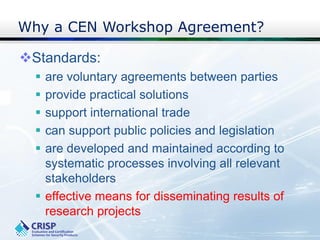
Why a CEN Workshop Agreement?
Standards:
 are voluntary agreements between parties
 provide practical solutions
 support international trade
 can support public policies and legislation
 are developed and maintained according to
systematic processes involving all relevant
stakeholders
 effective means for disseminating results of
research projects
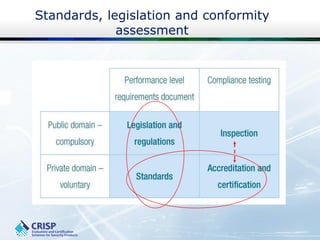
Standards, legislation and conformity
assessment
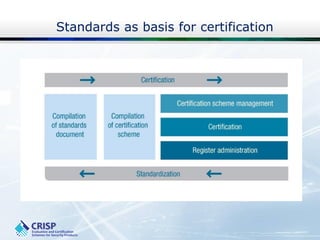
Standards as basis for certification
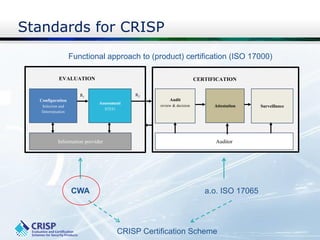
Standards for CRISP
Information provider
Audit
review & decision
Auditor
EVALUATION CERTIFICATION
SurveillanceAttestation
Assessment
STEFi
Configuration
Selection and
Determination
R2R1
a.o. ISO 17065
Functional approach to (product) certification (ISO 17000)
CRISP Certification Scheme
CWA
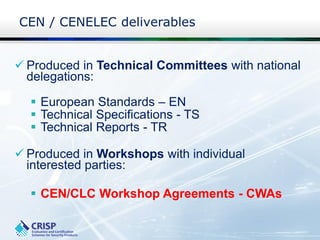
CEN / CENELEC deliverables
 Produced in Technical Committees with national
delegations:
 European Standards – EN
 Technical Specifications - TS
 Technical Reports - TR
 Produced in Workshops with individual
interested parties:
 CEN/CLC Workshop Agreements - CWAs
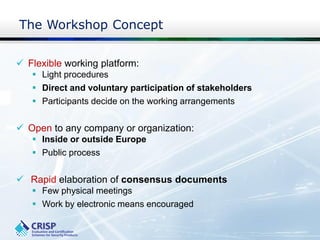
The Workshop Concept
 Flexible working platform:
 Light procedures
 Direct and voluntary participation of stakeholders
 Participants decide on the working arrangements
 Open to any company or organization:
 Inside or outside Europe
 Public process
 Rapid elaboration of consensus documents
 Few physical meetings
 Work by electronic means encouraged
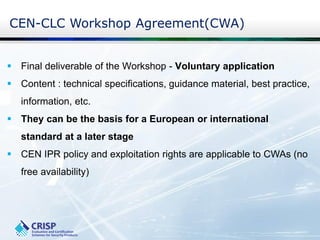
CEN-CLC Workshop Agreement(CWA)
 Final deliverable of the Workshop - Voluntary application
 Content : technical specifications, guidance material, best practice,
information, etc.
 They can be the basis for a European or international
standard at a later stage
 CEN IPR policy and exploitation rights are applicable to CWAs (no
free availability)
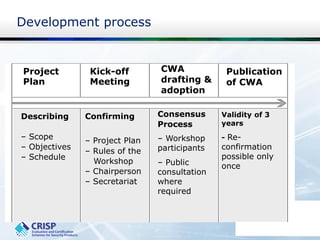
Development process
Project
Plan
Publication
of CWA
CWA
drafting &
adoption
Kick-off
Meeting
Describing
– Scope
– Objectives
– Schedule
Confirming
– Project Plan
– Rules of the
Workshop
– Chairperson
– Secretariat
Consensus
Process
– Workshop
participants
– Public
consultation
where
required
Validity of 3
years
- Re-
confirmation
possible only
once
Development process
Project
Plan
Publication
of CWA
CWA
drafting &
adoption
Kick-off
Meeting
Describing
– Scope
– Objectives
– Schedule
Confirming
– Project Plan
– Rules of the
Workshop
– Chairperson
– Secretariat
Consensus
Process
– Workshop
participants
– Public
consultation
where
required
Validity of 3
years
- Re-
confirmation
possible only
once
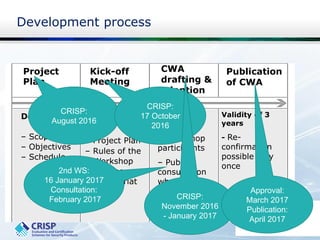
CRISP:
August 2016
CRISP:
17 October
2016
CRISP:
November 2016
- January 2017
2nd WS:
16 January 2017
Consultation:
February 2017
Approval:
March 2017
Publication:
April 2017
CRISP final conference 6th CoU Meeting, 16 March 2017
CEN Workshop Agreement
Characteristics
 Guidelines for STEFi
evaluation
 Planned and installed
security systems (specific
context)
 Example: video surveillance
systems (CCTV)
CRISP final conference 6th CoU Meeting, 16 March 2017
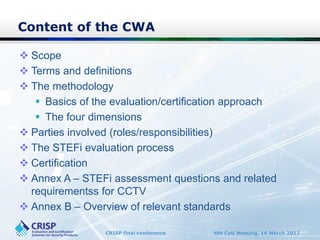
Content of the CWA
 Scope
 Terms and definitions
 The methodology
 Basics of the evaluation/certification approach
 The four dimensions
 Parties involved (roles/responsibilities)
 The STEFi evaluation process
 Certification
 Annex A – STEFi assessment questions and related
requirementss for CCTV
 Annex B – Overview of relevant standards
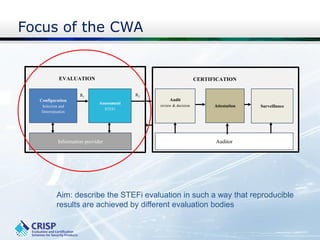
Focus of the CWA
Information provider
Audit
review & decision
Auditor
EVALUATION CERTIFICATION
SurveillanceAttestation
Assessment
STEFi
Configuration
Selection and
Determination
R2R1
Aim: describe the STEFi evaluation in such a way that reproducible
results are achieved by different evaluation bodies
CRISP final conference 6th CoU Meeting, 16 March 2017
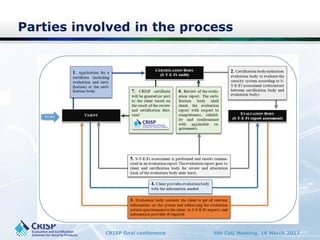
Parties involved in the process
CRISP final conference 6th CoU Meeting, 16 March 2017
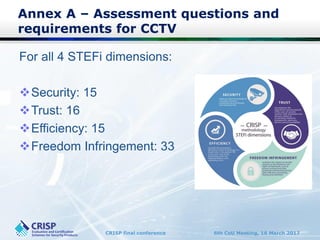
Annex A – Assessment questions and
requirements for CCTV
For all 4 STEFi dimensions:
Security: 15
Trust: 16
Efficiency: 15
Freedom Infringement: 33
CRISP final conference 6th CoU Meeting, 16 March 2017
Example Annex A - Security
Ref.
CRITERION, Attribute Assessment question Assessment requirement
Relation with standards or
regulation
SECURITY DIMENSION
S.1 Are there measures in place for assessing possible threats (prior as well as after the installation of the system) and in further consequence
to adequately address situations involving possible threats?
S.1.1 RISK, Threats 1. Has a risk assessment been
performed prior to the design and
installation of the video surveillance
system, assessing the probability and
the impact of threats and hazards on
the operational site? [yes/no]
2. Which issues have been addressed in
the risk assessment and have the
results of the assessment been
included in the design and installation
of the system? [qualitative]
Prior to video surveillance system design, a
risk assessment shall be performed, which
will identify threats and hazards to the
premises and assess their likelihood.
The required security functions for the
mitigation of the threats shall be identified
and the video surveillance system will be
designed in a way to mitigate the assessed
risks at the specified location and in regard to
the identified threats.
EN-IEC 62676-4 2015
(Clause 4.2ff.)
(ISO 31000:2009 describes
the principles for the
carrying out of a risk
assessment.)
CRISP final conference 6th CoU Meeting, 16 March 2017
Example Annex A – Freedom infringement
Fi.3.1
2
PERSONAL DATA,
Storage limitation
1. Is the retention limit of video footage
and/or the personal data potentially
extracted form it clearly defined? Does
the retention time reflect the minimum
time that is necessary for the purposes
for which the personal data are
processed? [yes/no]
2. How are retention limits enforced in
practice? [qualitative]
Personal data processed by the video
surveillance system shall be kept in a form
which permits identification of data subjects
for no longer than is necessary for the
purposes for which the personal data are
processed.
Art 5.1e GDPR
Provisions in national
legislation (if existing).
Fi.3.1
3
PERSONAL DATA,
Processing which does
not require identification
1. If the purposes for which the operator
processes personal data do not or do
no longer require the identification of a
data subject by the controller, does the
controller maintain, acquire or process
additional information in order to
identify the data subject? [yes/no]
2. What are the internal policy provisions
to assure non identification?
[qualitative]
Processing personal data by video
surveillance system which does not require
identification shall be in line with conditions
from GDPR Article 11.
Art. 11 GDPR
CRISP final conference 6th CoU Meeting, 16 March 2017
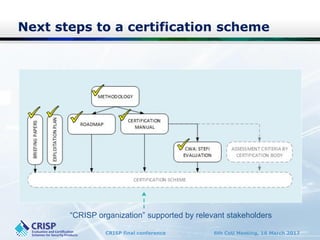
Next steps to a certification scheme
“CRISP organization” supported by relevant stakeholders
CRISP final conference 6th CoU Meeting, 16 March 2017
Panel discussion
Nathalie Hirschmann, TUB CST
Frank Rottmann, Bosch, IEC/CLC TC 79
Erik Krempel, Fraunhofer Institute
Dick Hortensius, NEN
Jelena Burnik, IPRS
Simone Wurster, TUB
Jorje Viguri, UJI
Roger von Laufenberg, VICESSE
Moderator: Ronald Boon, NEN

Introduction to the CWA process - CRISP Final Conference

  • 1.
    CRISP final conference6th CoU Meeting, Brussels, 16 March 2017 THEMATIC WORKSHOP STEFI Ronald Boon/Dick Hortensius Netherlands Standardisation Institute (NEN)
  • 2.
    CRISP final conference6th CoU Meeting, 16 March 2017 Programme for this session Introduction to the STEFi evaluation Nathalie Hirschman, TUB CTS CCTV standards in support of certification Frank Rottman, Bosch, IEC CLCTC 79/WG 12 CCTV systems and privacy protection Erik Krempel, Fraunhofer Institute CWA on the STEFi evaluation Dick Hortensius, NEN Panel discussion Presenters plus expets of the CRISP consortium Wrap-up and conclusions
  • 3.
    CEN Workshop Agreement onSTEFi evaluation 30 September 2016 Dick Hortensius Netherlands Standardisation Institute
  • 4.
    Agenda for thepresentation Why a CWA? Development process Scope and content Next steps
  • 5.
    Why a CENWorkshop Agreement? Standards:  are voluntary agreements between parties  provide practical solutions  support international trade  can support public policies and legislation  are developed and maintained according to systematic processes involving all relevant stakeholders  effective means for disseminating results of research projects
  • 6.
    Standards, legislation andconformity assessment
  • 7.
    Standards as basisfor certification
  • 8.
    Standards for CRISP Informationprovider Audit review & decision Auditor EVALUATION CERTIFICATION SurveillanceAttestation Assessment STEFi Configuration Selection and Determination R2R1 a.o. ISO 17065 Functional approach to (product) certification (ISO 17000) CRISP Certification Scheme CWA
  • 9.
    CEN / CENELECdeliverables  Produced in Technical Committees with national delegations:  European Standards – EN  Technical Specifications - TS  Technical Reports - TR  Produced in Workshops with individual interested parties:  CEN/CLC Workshop Agreements - CWAs
  • 10.
    The Workshop Concept Flexible working platform:  Light procedures  Direct and voluntary participation of stakeholders  Participants decide on the working arrangements  Open to any company or organization:  Inside or outside Europe  Public process  Rapid elaboration of consensus documents  Few physical meetings  Work by electronic means encouraged
  • 11.
    CEN-CLC Workshop Agreement(CWA) Final deliverable of the Workshop - Voluntary application  Content : technical specifications, guidance material, best practice, information, etc.  They can be the basis for a European or international standard at a later stage  CEN IPR policy and exploitation rights are applicable to CWAs (no free availability)
  • 12.
    Development process Project Plan Publication of CWA CWA drafting& adoption Kick-off Meeting Describing – Scope – Objectives – Schedule Confirming – Project Plan – Rules of the Workshop – Chairperson – Secretariat Consensus Process – Workshop participants – Public consultation where required Validity of 3 years - Re- confirmation possible only once
  • 13.
    Development process Project Plan Publication of CWA CWA drafting& adoption Kick-off Meeting Describing – Scope – Objectives – Schedule Confirming – Project Plan – Rules of the Workshop – Chairperson – Secretariat Consensus Process – Workshop participants – Public consultation where required Validity of 3 years - Re- confirmation possible only once CRISP: August 2016 CRISP: 17 October 2016 CRISP: November 2016 - January 2017 2nd WS: 16 January 2017 Consultation: February 2017 Approval: March 2017 Publication: April 2017
  • 14.
    CRISP final conference6th CoU Meeting, 16 March 2017 CEN Workshop Agreement Characteristics  Guidelines for STEFi evaluation  Planned and installed security systems (specific context)  Example: video surveillance systems (CCTV)
  • 15.
    CRISP final conference6th CoU Meeting, 16 March 2017 Content of the CWA  Scope  Terms and definitions  The methodology  Basics of the evaluation/certification approach  The four dimensions  Parties involved (roles/responsibilities)  The STEFi evaluation process  Certification  Annex A – STEFi assessment questions and related requirementss for CCTV  Annex B – Overview of relevant standards
  • 16.
    Focus of theCWA Information provider Audit review & decision Auditor EVALUATION CERTIFICATION SurveillanceAttestation Assessment STEFi Configuration Selection and Determination R2R1 Aim: describe the STEFi evaluation in such a way that reproducible results are achieved by different evaluation bodies
  • 17.
    CRISP final conference6th CoU Meeting, 16 March 2017 Parties involved in the process
  • 18.
    CRISP final conference6th CoU Meeting, 16 March 2017 Annex A – Assessment questions and requirements for CCTV For all 4 STEFi dimensions: Security: 15 Trust: 16 Efficiency: 15 Freedom Infringement: 33
  • 19.
    CRISP final conference6th CoU Meeting, 16 March 2017 Example Annex A - Security Ref. CRITERION, Attribute Assessment question Assessment requirement Relation with standards or regulation SECURITY DIMENSION S.1 Are there measures in place for assessing possible threats (prior as well as after the installation of the system) and in further consequence to adequately address situations involving possible threats? S.1.1 RISK, Threats 1. Has a risk assessment been performed prior to the design and installation of the video surveillance system, assessing the probability and the impact of threats and hazards on the operational site? [yes/no] 2. Which issues have been addressed in the risk assessment and have the results of the assessment been included in the design and installation of the system? [qualitative] Prior to video surveillance system design, a risk assessment shall be performed, which will identify threats and hazards to the premises and assess their likelihood. The required security functions for the mitigation of the threats shall be identified and the video surveillance system will be designed in a way to mitigate the assessed risks at the specified location and in regard to the identified threats. EN-IEC 62676-4 2015 (Clause 4.2ff.) (ISO 31000:2009 describes the principles for the carrying out of a risk assessment.)
  • 20.
    CRISP final conference6th CoU Meeting, 16 March 2017 Example Annex A – Freedom infringement Fi.3.1 2 PERSONAL DATA, Storage limitation 1. Is the retention limit of video footage and/or the personal data potentially extracted form it clearly defined? Does the retention time reflect the minimum time that is necessary for the purposes for which the personal data are processed? [yes/no] 2. How are retention limits enforced in practice? [qualitative] Personal data processed by the video surveillance system shall be kept in a form which permits identification of data subjects for no longer than is necessary for the purposes for which the personal data are processed. Art 5.1e GDPR Provisions in national legislation (if existing). Fi.3.1 3 PERSONAL DATA, Processing which does not require identification 1. If the purposes for which the operator processes personal data do not or do no longer require the identification of a data subject by the controller, does the controller maintain, acquire or process additional information in order to identify the data subject? [yes/no] 2. What are the internal policy provisions to assure non identification? [qualitative] Processing personal data by video surveillance system which does not require identification shall be in line with conditions from GDPR Article 11. Art. 11 GDPR
  • 21.
    CRISP final conference6th CoU Meeting, 16 March 2017 Next steps to a certification scheme “CRISP organization” supported by relevant stakeholders
  • 22.
    CRISP final conference6th CoU Meeting, 16 March 2017 Panel discussion Nathalie Hirschmann, TUB CST Frank Rottmann, Bosch, IEC/CLC TC 79 Erik Krempel, Fraunhofer Institute Dick Hortensius, NEN Jelena Burnik, IPRS Simone Wurster, TUB Jorje Viguri, UJI Roger von Laufenberg, VICESSE Moderator: Ronald Boon, NEN