B
Progressive Education Series 2016
Volume 3 – Issue 4, pp. 1-13
Renuka RajasekaranProgressive Education Series presents
free customized content, in a one topic
per presentation format. It is ideal for
use in Professional Learning
Communities and in Teacher Education
Programs and Workshops.
GRIFFIN RESA: STEM Instructional Technology Drive-In Conference, Sep 28, 2016
Part 1: Introduction
What is 3D Learning?
A. New Generation Science Standards, NGSS
B. Three Dimensions: Builds understanding of
multiple grade-appropriate elements of the
science and engineering practices (SEPs),
disciplinary core ideas (DCIs), and crosscutting
concepts (CCCs) that are deliberately selected to
aid student sense-making of phenomena and/or
designing of solutions.
i. Provides opportunities to develop and use
specific elements of the SEP(s).
ii. Provides opportunities to develop and use
specific elements of the DCI(s).
iii. Provides opportunities to develop and use
specific elements of the CCC(s).
Integrating the Three Dimensions: Student sense-
making of phenomena and/or designing of solutions
requires student performances that integrate elements
of the SEPs, CCCs, and DCIs.
Science and Engineering
Practices
Disciplinary Core Ideas
Cross Cutting Concepts
SEPs
CCIs
DCIs
Affective
Where do we begin ?
Knowledge Explosion x Technology Explosion = Today’s Unprecedented Confusion
There are two explosions constantly taking place in our
society – Knowledge explosion and Technology
Explosion – These two explosions multiply with each
other and are creating a great confusion in our
classrooms.
But at the same time, we have certain educational
objectives:
One. Use of Technology
Two: Self-Directed Learning
Three: Project Based Learning
Technology is spewed at a rapid rate. You make the
best effort to choose the best technology that works
best for you and when you get used to it – it vanishes
and your search begins – over and over.
Self-directed learning is highly recommended and it is
also used synonymously with metacognition . But none
tells how of the metacognition.
Project Based Learning or PBL is a big focus – there
are at least 8 components of PBL and self-directed
learning is also a part of PBL. Technology integration
in PBL is highly recommended but a reliable robust
way to accomplish PBL is what is needed.
“The ability of a student to become a self-directed learner
relies on the development of their metacognitive skills.”*
There are 8 components in PBL
1 2 3
https://youtu.be/LMCZvGesRz8
Can you guess how many of these 8 components
are interrelated?
Curriculum
Content
21st Century
Skills
Need to
Know
Driving
Question
Student
Vice and
Choice
In-Depth
and Inquiry
Reflection
& Revision
Audience
Presented
Product
A Quick Recap
Think of what you did so far - can you call that a self-
directed learning? Yes/No
Do you now believe that PBL is easier than you thought
earlier? Yes/No
Do you feel that you could use Power Point as a very easy,
inexpensive, and robust tool for PBL.? Yes/No
If you believe that it is self-directed learning, do you think
that questions helped you to perform the self-directed
learning? Yes/No
The Problem of Excess What can we do ? Aren’t there keys?
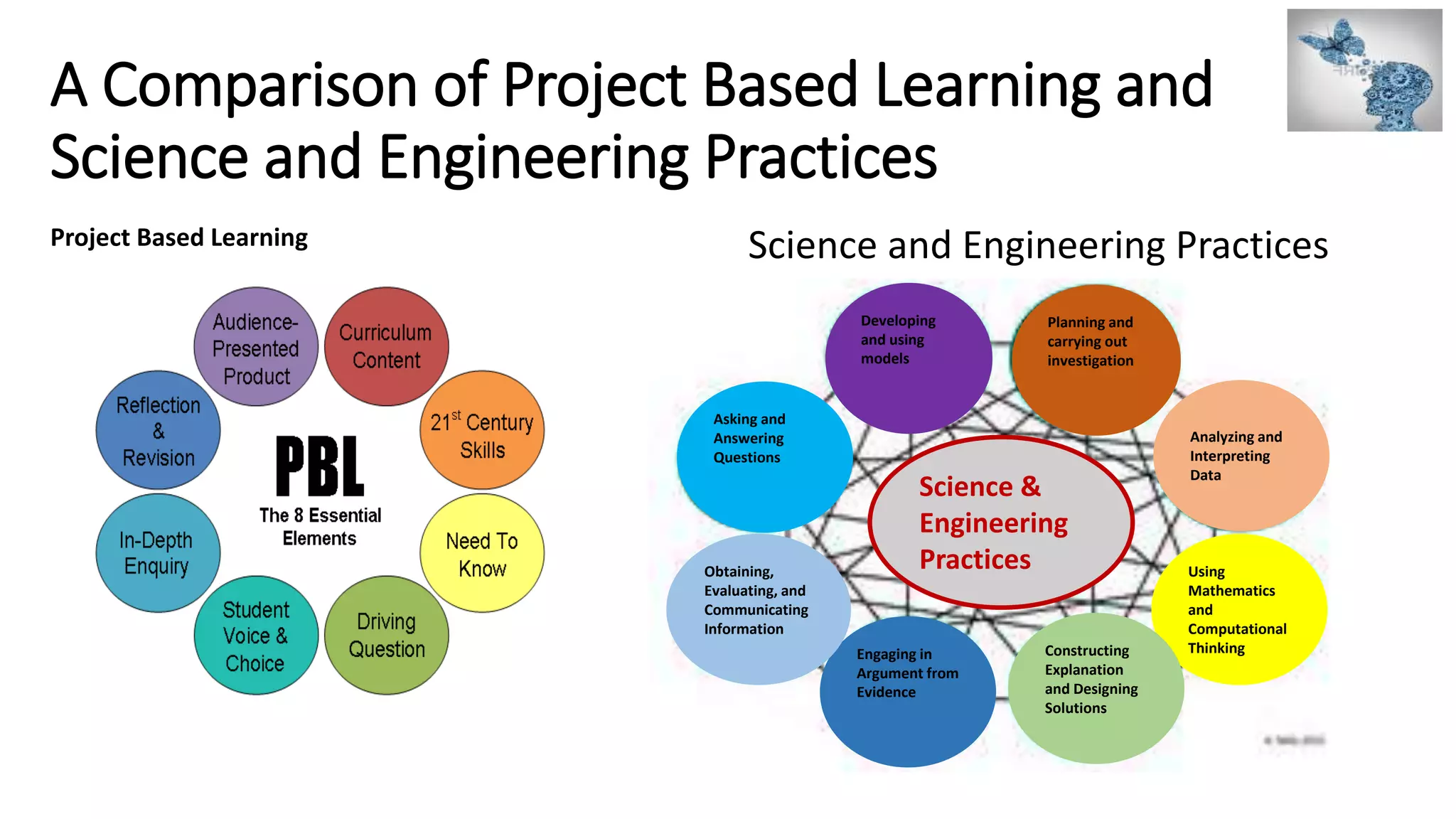
A Comparison of Project Based Learning and
Science and Engineering Practices
Project Based Learning Science and Engineering Practices
Developing
and using
models
Planning and
carrying out
investigation
Using
Mathematics
and
Computational
Thinking
Analyzing and
Interpreting
Data
Constructing
Explanation
and Designing
Solutions
Engaging in
Argument from
Evidence
Obtaining,
Evaluating, and
Communicating
Information
Asking and
Answering
Questions
Science &
Engineering
Practices
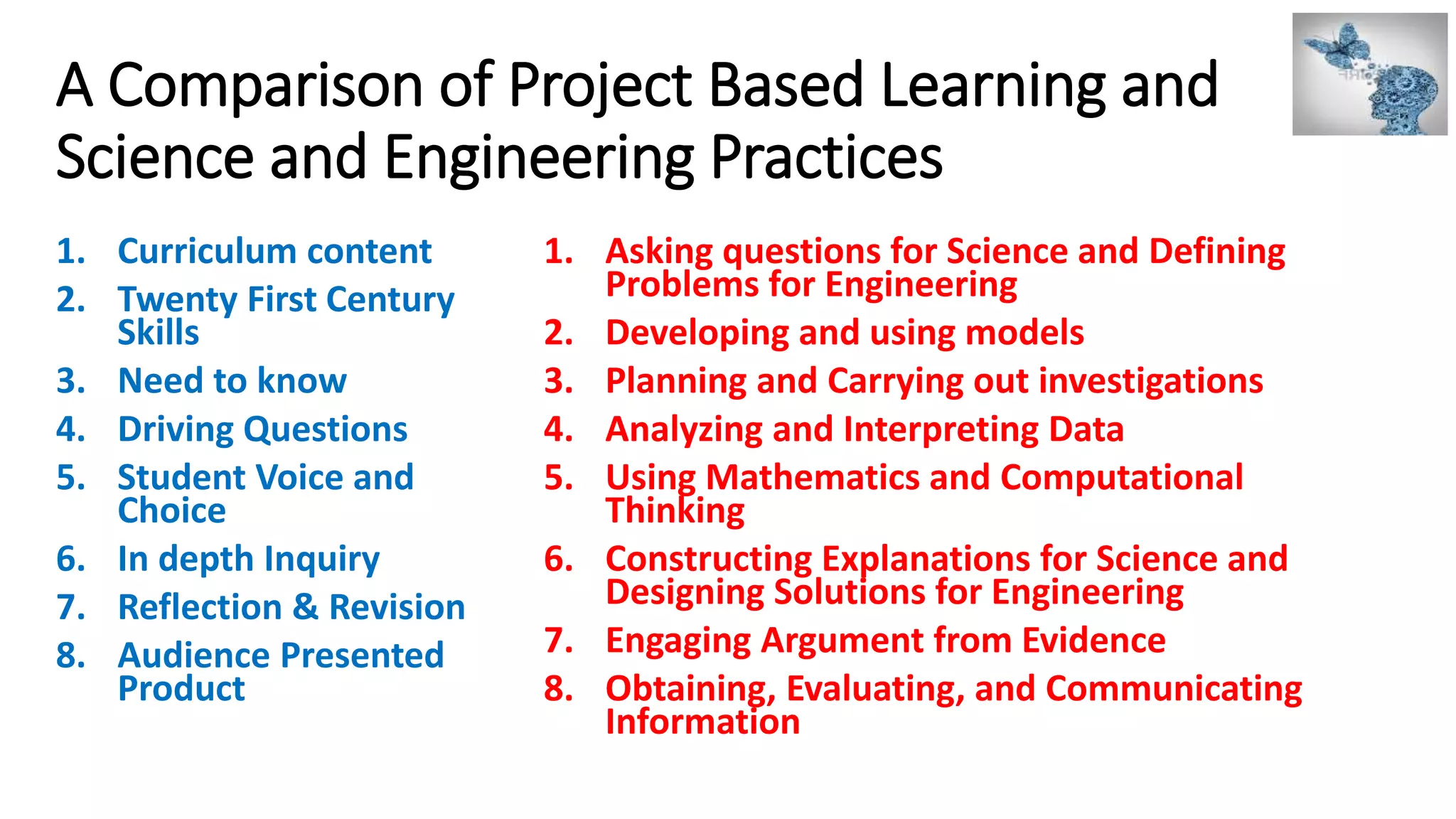
A Comparison of Project Based Learning and
Science and Engineering Practices
1. Curriculum content
2. Twenty First Century
Skills
3. Need to know
4. Driving Questions
5. Student Voice and
Choice
6. In depth Inquiry
7. Reflection & Revision
8. Audience Presented
Product
1. Asking questions for Science and Defining
Problems for Engineering
2. Developing and using models
3. Planning and Carrying out investigations
4. Analyzing and Interpreting Data
5. Using Mathematics and Computational
Thinking
6. Constructing Explanations for Science and
Designing Solutions for Engineering
7. Engaging Argument from Evidence
8. Obtaining, Evaluating, and Communicating
Information
STEM & STEAM and the NGSS
Image Courtesy: https://www.pinterest.com/pandalhu/steam-
a-framework-for-teaching-across-the-discipli/
Where do you get the ideas for 3 D Learning?
There are mines and minds under your feet –
within your grab
Look into Your Every Day Concepts.
Abundant every day themes are waiting for you!
Every concept lends itself for 3D learning – the
remotest idea you can think of has its roots for 3D
Learning.
Your Task for
Session 1
Work in Pairs or Groups and Generate the following Questions:
1. What Science Ideas go with these sample(s) Specify: Biology, Chemistry,
Physical Science, Physics, Forensic Science, Physics, Human Anatomy &
Physiology, Earth Systems?
2. What Math Ideas go with these sample(s) Specify: Coordinate Algebra,
Advanced Algebra, Geometry, Calculus, Statistics – Reason abstractly and
quantitatively?
3. What Engineering Ideas go with these sample(s)Specify: Analyzing a major
global challenge/ Designing a Solution to a Complex Real World
Problem/Evaluating a Solution to a Complex Real World Problem/Simulating
and or making physical models to project the impact of a proposed solution?
4. What Literacy Ideas go with these sample(s)?
5. What Art Ideas go with these sample(s)? Specify: (Music, Theatre?/Drawing-
Visual arts and Abstract/Painting- Scientific and Artistic/Creating Models
Note: Use Slide 14 for your work. Use Commenting facility and Voice Over facility. You can work
collaboratively online. Slides 10- 13 have some resources for your quick reference.
HS Engineering Standards as an Example
HS-ETS1-1. Analyze a major global challenge to specify qualitative and quantitative criteria and
constraints for solutions that account for societal needs and wants.
HS-ETS1-2. Design a solution to a complex real-world problem by breaking it down into smaller,
more manageable problems that can be solved through engineering.
HS-ETS1-3. Evaluate a solution to a complex real-world problem based on prioritized criteria and
trade-offs that account for a range of constraints, including cost, safety, reliability, and
aesthetics as well as possible social, cultural, and environmental impacts.
HS-ETS1-4. Use a computer simulation to model the impact of proposed solutions to a complex real-
world problem with numerous criteria and constraints on interactions within and
between systems relevant to the problem.
http://www.nextgenscience.org/topic-
arrangement/hsengineering-design - ELA Standards
ELA/Literacy -
RST.11-12.7 Integrate and evaluate multiple sources of information presented in diverse formats and
media (e.g., quantitative data, video, multimedia) in order to address a question or solve a
problem. (HS-ETS1-1),(HS-ETS1-3)
RST.11-12.8 Evaluate the hypotheses, data, analysis, and conclusions in a science or technical text,
verifying the data when possible and corroborating or challenging conclusions with other
sources of information. (HS-ETS1-1),(HS-ETS1-3)
RST.11-12.9 Synthesize information from a range of sources (e.g., texts, experiments, simulations) into
a coherent understanding of a process, phenomenon, or concept, resolving conflicting
information when possible. (HS-ETS1-1),(HS-ETS1-3)
Mathematics -
MP.2 Reason abstractly and quantitatively. (HS-ETS1-1),(HS-ETS1-3),(HS-ETS1-4)
MP.4 Model with mathematics. (HS-ETS1-1),(HS-ETS1-2),(HS-ETS1-3),(HS-ETS1-4)
Remember
• Connections to HS-ETS1.A: Defining and Delimiting Engineering
Problems include:
• Physical Science: HS-PS2-3, HS-PS3-3Connections to HS-ETS1.B:
Developing Possible Solutions Problems include:
• Earth and Space Science: HS-ESS3-2, HS-ESS3-4 Life Science: HS-LS2-
7, HS-LS4-6Connections to MS-ETS1.C: Optimizing the Design Solution
include:
• Physical Science: HS-PS1-6, HS-PS2-3
Educational Standards
Next Generation Science Standards: Science
•Develop a model based on evidence to illustrate the relationships between systems or between components of a system.
(Grades 9 - 12)
• Common Core State Standards: Math
•Define appropriate quantities for the purpose of descriptive modeling. (Grades 9 - 12)
• International Technology and Engineering Educators Association: Technology
•Models are used to communicate and test design ideas and processes. (Grades 3 - 5)
•Modeling, testing, evaluating, and modifying are used to transform ideas into practical solutions. (Grades 6 - 8)
•Technological progress promotes the advancement of science and mathematics. (Grades 9 - 12)
• Georgia: Math
•Add, subtract, and multiply algebraic expressions. (Grades 9 - 12)
•Students will generate and interpret equivalent numeric and algebraic expressions. (Grades 9 - 12)
•Georgia: Science
•Students will analyze anatomical structures in relationship to their physiological functions. (Grades 9 - 12)
•Students will analyze the physical, chemical, and biological properties of process systems as these relate to transportation,
absorption and excretion, including the cardiovascular, respiratory, digestive, excretory and immune systems. (Grades 9 - 12)
•Students will analyze the nature of matter and its classifications. (Grades 9 - 12)
•Explain that further understanding of scientific problems relies on the design and execution of new experiments which may
reinforce or weaken opposing explanations. (Grades 9 - 12)
• Students will investigate the properties of solutions. (Grades 9 - 12) Students will analyze the relationships between force, mass,
gravity, and the motion of objects. (Grades 9 - 12) Students will use standard safety practices for all classroom laboratory and field
investigations. (Grades 9 - 12)
•Students will demonstrate the computation and estimation skills necessary for analyzing data and developing reasonable scientific
explanations. (Grades 9 - 12)
•Look for Literacy Standards
•Look for Arts Standards
Your Theme:
Science Ideas
Biology
Engineering Ideas
Chemistry Physics
Human Anatomy &
Physiology
Forensics
Environmental Science
Agriculture &
Biotechnology
Math Ideas
StatisticsGeometryCalculusAdvanced AlgebraTrigonometryNumber Systems
Matrices &
Linear Algebra
Major Global Challenge Real World Problem: Solution Real World Problem: Constraints Computer Simulation Model
Members
1.
2.
3.
4.
Note: Use Commenting facility and
Voice Over facility. You can work
collaboratively online.

3 D Project Based Learning Basics for the New Generation Science Standards

  • 1.
    B Progressive Education Series2016 Volume 3 – Issue 4, pp. 1-13 Renuka RajasekaranProgressive Education Series presents free customized content, in a one topic per presentation format. It is ideal for use in Professional Learning Communities and in Teacher Education Programs and Workshops.
  • 2.
    GRIFFIN RESA: STEMInstructional Technology Drive-In Conference, Sep 28, 2016 Part 1: Introduction
  • 3.
    What is 3DLearning? A. New Generation Science Standards, NGSS B. Three Dimensions: Builds understanding of multiple grade-appropriate elements of the science and engineering practices (SEPs), disciplinary core ideas (DCIs), and crosscutting concepts (CCCs) that are deliberately selected to aid student sense-making of phenomena and/or designing of solutions. i. Provides opportunities to develop and use specific elements of the SEP(s). ii. Provides opportunities to develop and use specific elements of the DCI(s). iii. Provides opportunities to develop and use specific elements of the CCC(s). Integrating the Three Dimensions: Student sense- making of phenomena and/or designing of solutions requires student performances that integrate elements of the SEPs, CCCs, and DCIs. Science and Engineering Practices Disciplinary Core Ideas Cross Cutting Concepts SEPs CCIs DCIs Affective
  • 4.
    Where do webegin ? Knowledge Explosion x Technology Explosion = Today’s Unprecedented Confusion There are two explosions constantly taking place in our society – Knowledge explosion and Technology Explosion – These two explosions multiply with each other and are creating a great confusion in our classrooms. But at the same time, we have certain educational objectives: One. Use of Technology Two: Self-Directed Learning Three: Project Based Learning Technology is spewed at a rapid rate. You make the best effort to choose the best technology that works best for you and when you get used to it – it vanishes and your search begins – over and over. Self-directed learning is highly recommended and it is also used synonymously with metacognition . But none tells how of the metacognition. Project Based Learning or PBL is a big focus – there are at least 8 components of PBL and self-directed learning is also a part of PBL. Technology integration in PBL is highly recommended but a reliable robust way to accomplish PBL is what is needed. “The ability of a student to become a self-directed learner relies on the development of their metacognitive skills.”* There are 8 components in PBL 1 2 3 https://youtu.be/LMCZvGesRz8 Can you guess how many of these 8 components are interrelated? Curriculum Content 21st Century Skills Need to Know Driving Question Student Vice and Choice In-Depth and Inquiry Reflection & Revision Audience Presented Product A Quick Recap Think of what you did so far - can you call that a self- directed learning? Yes/No Do you now believe that PBL is easier than you thought earlier? Yes/No Do you feel that you could use Power Point as a very easy, inexpensive, and robust tool for PBL.? Yes/No If you believe that it is self-directed learning, do you think that questions helped you to perform the self-directed learning? Yes/No The Problem of Excess What can we do ? Aren’t there keys?
  • 5.
    A Comparison ofProject Based Learning and Science and Engineering Practices Project Based Learning Science and Engineering Practices Developing and using models Planning and carrying out investigation Using Mathematics and Computational Thinking Analyzing and Interpreting Data Constructing Explanation and Designing Solutions Engaging in Argument from Evidence Obtaining, Evaluating, and Communicating Information Asking and Answering Questions Science & Engineering Practices
  • 6.
    A Comparison ofProject Based Learning and Science and Engineering Practices 1. Curriculum content 2. Twenty First Century Skills 3. Need to know 4. Driving Questions 5. Student Voice and Choice 6. In depth Inquiry 7. Reflection & Revision 8. Audience Presented Product 1. Asking questions for Science and Defining Problems for Engineering 2. Developing and using models 3. Planning and Carrying out investigations 4. Analyzing and Interpreting Data 5. Using Mathematics and Computational Thinking 6. Constructing Explanations for Science and Designing Solutions for Engineering 7. Engaging Argument from Evidence 8. Obtaining, Evaluating, and Communicating Information
  • 7.
    STEM & STEAMand the NGSS Image Courtesy: https://www.pinterest.com/pandalhu/steam- a-framework-for-teaching-across-the-discipli/
  • 8.
    Where do youget the ideas for 3 D Learning? There are mines and minds under your feet – within your grab Look into Your Every Day Concepts. Abundant every day themes are waiting for you! Every concept lends itself for 3D learning – the remotest idea you can think of has its roots for 3D Learning.
  • 9.
    Your Task for Session1 Work in Pairs or Groups and Generate the following Questions: 1. What Science Ideas go with these sample(s) Specify: Biology, Chemistry, Physical Science, Physics, Forensic Science, Physics, Human Anatomy & Physiology, Earth Systems? 2. What Math Ideas go with these sample(s) Specify: Coordinate Algebra, Advanced Algebra, Geometry, Calculus, Statistics – Reason abstractly and quantitatively? 3. What Engineering Ideas go with these sample(s)Specify: Analyzing a major global challenge/ Designing a Solution to a Complex Real World Problem/Evaluating a Solution to a Complex Real World Problem/Simulating and or making physical models to project the impact of a proposed solution? 4. What Literacy Ideas go with these sample(s)? 5. What Art Ideas go with these sample(s)? Specify: (Music, Theatre?/Drawing- Visual arts and Abstract/Painting- Scientific and Artistic/Creating Models Note: Use Slide 14 for your work. Use Commenting facility and Voice Over facility. You can work collaboratively online. Slides 10- 13 have some resources for your quick reference.
  • 10.
    HS Engineering Standardsas an Example HS-ETS1-1. Analyze a major global challenge to specify qualitative and quantitative criteria and constraints for solutions that account for societal needs and wants. HS-ETS1-2. Design a solution to a complex real-world problem by breaking it down into smaller, more manageable problems that can be solved through engineering. HS-ETS1-3. Evaluate a solution to a complex real-world problem based on prioritized criteria and trade-offs that account for a range of constraints, including cost, safety, reliability, and aesthetics as well as possible social, cultural, and environmental impacts. HS-ETS1-4. Use a computer simulation to model the impact of proposed solutions to a complex real- world problem with numerous criteria and constraints on interactions within and between systems relevant to the problem.
  • 11.
    http://www.nextgenscience.org/topic- arrangement/hsengineering-design - ELAStandards ELA/Literacy - RST.11-12.7 Integrate and evaluate multiple sources of information presented in diverse formats and media (e.g., quantitative data, video, multimedia) in order to address a question or solve a problem. (HS-ETS1-1),(HS-ETS1-3) RST.11-12.8 Evaluate the hypotheses, data, analysis, and conclusions in a science or technical text, verifying the data when possible and corroborating or challenging conclusions with other sources of information. (HS-ETS1-1),(HS-ETS1-3) RST.11-12.9 Synthesize information from a range of sources (e.g., texts, experiments, simulations) into a coherent understanding of a process, phenomenon, or concept, resolving conflicting information when possible. (HS-ETS1-1),(HS-ETS1-3) Mathematics - MP.2 Reason abstractly and quantitatively. (HS-ETS1-1),(HS-ETS1-3),(HS-ETS1-4) MP.4 Model with mathematics. (HS-ETS1-1),(HS-ETS1-2),(HS-ETS1-3),(HS-ETS1-4)
  • 12.
    Remember • Connections toHS-ETS1.A: Defining and Delimiting Engineering Problems include: • Physical Science: HS-PS2-3, HS-PS3-3Connections to HS-ETS1.B: Developing Possible Solutions Problems include: • Earth and Space Science: HS-ESS3-2, HS-ESS3-4 Life Science: HS-LS2- 7, HS-LS4-6Connections to MS-ETS1.C: Optimizing the Design Solution include: • Physical Science: HS-PS1-6, HS-PS2-3
  • 13.
    Educational Standards Next GenerationScience Standards: Science •Develop a model based on evidence to illustrate the relationships between systems or between components of a system. (Grades 9 - 12) • Common Core State Standards: Math •Define appropriate quantities for the purpose of descriptive modeling. (Grades 9 - 12) • International Technology and Engineering Educators Association: Technology •Models are used to communicate and test design ideas and processes. (Grades 3 - 5) •Modeling, testing, evaluating, and modifying are used to transform ideas into practical solutions. (Grades 6 - 8) •Technological progress promotes the advancement of science and mathematics. (Grades 9 - 12) • Georgia: Math •Add, subtract, and multiply algebraic expressions. (Grades 9 - 12) •Students will generate and interpret equivalent numeric and algebraic expressions. (Grades 9 - 12) •Georgia: Science •Students will analyze anatomical structures in relationship to their physiological functions. (Grades 9 - 12) •Students will analyze the physical, chemical, and biological properties of process systems as these relate to transportation, absorption and excretion, including the cardiovascular, respiratory, digestive, excretory and immune systems. (Grades 9 - 12) •Students will analyze the nature of matter and its classifications. (Grades 9 - 12) •Explain that further understanding of scientific problems relies on the design and execution of new experiments which may reinforce or weaken opposing explanations. (Grades 9 - 12) • Students will investigate the properties of solutions. (Grades 9 - 12) Students will analyze the relationships between force, mass, gravity, and the motion of objects. (Grades 9 - 12) Students will use standard safety practices for all classroom laboratory and field investigations. (Grades 9 - 12) •Students will demonstrate the computation and estimation skills necessary for analyzing data and developing reasonable scientific explanations. (Grades 9 - 12) •Look for Literacy Standards •Look for Arts Standards
  • 14.
    Your Theme: Science Ideas Biology EngineeringIdeas Chemistry Physics Human Anatomy & Physiology Forensics Environmental Science Agriculture & Biotechnology Math Ideas StatisticsGeometryCalculusAdvanced AlgebraTrigonometryNumber Systems Matrices & Linear Algebra Major Global Challenge Real World Problem: Solution Real World Problem: Constraints Computer Simulation Model Members 1. 2. 3. 4. Note: Use Commenting facility and Voice Over facility. You can work collaboratively online.